


Abstract
Cognitive reserve reflects the brain’s capacity to maintain function despite ageing or pathology, potentially delaying cognitive decline. Its timing and dynamic effects on memory remain unclear. We analyzed longitudinal data from 10,203 participants in the English Longitudinal Study of Ageing, assessed across nine waves over a follow-up period up to 18 years. Verbal episodic memory was assessed using immediate and delayed recall from a ten-word task (Total Recall, range 0–20). Cognitive reserve was indexed by educational attainment, physical activity, and social engagement. A Bayesian nonlinear mixed-effects change-point model estimated effects on pre-decline memory performance, onset of decline, and deterioration rate. Compared with less than upper secondary education, tertiary education was associated with higher pre-decline memory performance (posterior median [PM] = 2.85 words; 95% credible interval [CrI]: 2.70–3.01) and a later estimated onset of decline (PM = 3.11 years; 95% CrI: 1.12–5.19), but a steeper subsequent rate of deterioration. Higher physical activity at wave 4, compared with sedentary activity, and social engagement were associated with a later estimated onset of memory decline (2.64 and 2.04 years, respectively). Women showed higher pre-decline memory performance and a later estimated onset of accelerated decline (PM = 3.82 years; 95% CrI: 2.43–5.25), but a steeper subsequent rate of deterioration. These findings are consistent with the cognitive reserve hypothesis, although the observational design and the timing of exposure assessments limit causal interpretation.
1. Introduction
The global ageing of the population presents unprecedented challenges for health and social care while also presenting opportunities for cognitive health research. As individuals live longer, the prevalence of age-related cognitive disorders continues to rise. Trajectories of cognitive function often exhibit heterogeneous patterns across individuals, as some older adults maintain cognitive abilities well into advanced age, while others experience significant decline, which suggests the existence of protective mechanisms that operate on some but not all individuals moderating the effects of ageing and neuropathology on cognition. Recent evidence has highlighted the importance of potentially modifiable factors, including education, physical inactivity, and social isolation, in relation to dementia risk [1]. The concept of cognitive reserve (CR) represents one of the most promising theoretical frameworks for understanding these individual differences in cognitive trajectories.
Cognitive reserve refers to the brain’s capacity to optimize performance through differential recruitment of neural networks or alternative cognitive processing strategies, potentially compensating for brain pathology and age-related neurodegeneration. This concept was initially proposed by Stern [2] to explain the observed disconnection between the degree of brain pathology and its clinical manifestation in cognitive performance. Individuals with higher estimated CR often demonstrate better cognitive function than would be predicted by their level of brain pathology, suggesting protective effects against the clinical expression of neuropathological changes [3].
Unlike the concept of brain reserve, which refers to physical and structural aspects of the brain, CR emphasizes the brain’s ability to compensate functionally through more efficient utilization of brain networks or recruitment of alternative neural circuits when primary networks are compromised [4]. This active compensation may be particularly relevant for complex cognitive processes that rely on distributed neural systems, such as memory encoding and retrieval.
Lifetime experiences, including educational attainment, occupational complexity, and engagement in cognitively stimulating activities, are thought to contribute to the development and maintenance of CR [5]. Evidence from observational research suggests that engagement in enriching activities during early life is associated with better cognitive performance in later adulthood, with educational attainment potentially contributing to these relationships [6]. The effects of these experiences appear to accumulate throughout the lifespan, with evidence suggesting that both early-life factors and ongoing cognitive engagement in later life contribute to cognitive resilience [7].
Longitudinal studies have provided evidence of associations between CR proxies and cognitive performance and decline in older adults, although these associations may differ across components of cognitive trajectories. The Religious Orders Study [8] and Rush Memory and Aging Project [9], which have followed older adults for decades with annual cognitive assessments and eventual neuropathological examination, have demonstrated that higher educational attainment and more frequent participation in cognitively stimulating activities are associated with slower rates of cognitive decline, even among individuals with significant Alzheimer’s disease pathology [10]. These studies found that some participants maintained relatively normal cognitive function despite extensive neuropathology, providing strong support for the CR hypothesis. More recently, Montemurro et al. [11] showed that individuals with higher CR maintain a more stable cognitive state despite age-related changes. Additionally, Gamble et al. [12] demonstrated in a study of 1537 people with mild-to-moderate dementia that higher CR is associated with better cognition, even though it may lead to accelerated decline once dementia becomes evident.
Longitudinal designs allow researchers to distinguish between effects on cognitive performance levels and effects on rates of change over time. Using data from the Seattle Longitudinal Study, Yu et al. [13] examined longitudinal trajectories of verbal memory over 14 years and found that higher educational attainment was associated with better memory performance, while greater work control was also positively associated with verbal memory scores. However, their analyses did not establish that education was associated with a slower rate of memory decline. Complementary findings from the Seattle Longitudinal Study suggest that trajectories of cognitive ageing vary across individuals and that environmental and intellectual engagement factors are associated with differences in cognitive maintenance and decline [14]. Finally, using data from the Einstein Aging Study, Hyun et al. [15] found that greater engagement in cognitively stimulating leisure activities in later life was associated with slower longitudinal memory decline. In contrast, higher educational attainment was associated with faster rates of decline across the cognitive domains examined.
In the case of memory, using data from the Victoria Longitudinal Study, Zahodne et al. [16] found that higher educational attainment was associated with better cognitive performance, including verbal episodic memory, but not with slower rates of longitudinal cognitive decline. These findings suggest that educational attainment may be associated with differences in cognitive performance without necessarily altering the subsequent rate of deterioration. Research from the Baltimore Longitudinal Study of Aging has also examined individual differences in longitudinal verbal memory performance. Lamar et al. [17] investigated age-related changes in verbal learning and recall, accounting for education, sex, and repeated testing. More recently, McCarrey et al. [18] found that women showed higher verbal memory performance than men, although longitudinal rates of change were similar between sexes. These findings highlight the importance of distinguishing differences in cognitive performance levels from differences in subsequent rates of decline.
However, measuring CR presents methodological challenges, as reserve represents an unobserved construct rather than a directly observable variable. Longitudinal studies have typically employed proxy measures of reserve, including educational attainment, occupational complexity, literacy, and participation in cognitively stimulating activities. These socio-behavioral indicators are commonly used to represent life experiences that may contribute to the development of CR, although they should not be interpreted as direct measures of the underlying construct [19]. While education has been the most consistently used proxy due to its availability in most datasets, it represents early-life experiences and may not capture ongoing cognitive enrichment throughout adulthood. Social engagement may represent opportunities for cognitive stimulation and interpersonal interaction, whereas physical activity has also been considered a potential contributor to CR. However, physical activity may influence cognitive functioning through additional mechanisms, including cardiovascular health and brain maintenance, which are conceptually distinct from CR. Consequently, these variables should be regarded as socio-behavioral indicators potentially related to CR rather than interchangeable measures of a single underlying mechanism. More comprehensive approaches combining multiple reserve indicators across the lifespan may better capture the multidimensional nature of CR.
Taken together, previous research indicates that educational attainment is consistently associated with higher cognitive performance, whereas its association with the rate of age-related cognitive decline appears to be small or inconsistent across studies [20,21]. However, the complexity of these processes calls for analytical models capable of capturing nonlinear trajectories over time. A linear trajectory model may present several disadvantages. First, it may fail to capture the nonlinear nature of cognitive deterioration, which often does not follow a constant progression but can accelerate or stabilize at different life stages. Furthermore, analyses based exclusively on cognitive performance levels or average rates of change may overlook important differences in the timing of cognitive decline. This distinction is particularly relevant to the CR hypothesis, since higher cognitive performance does not necessarily imply a later onset of decline or a slower subsequent deterioration. A nonlinear model incorporating a change point (CP) allows these components to be examined separately, providing estimates of memory performance prior to decline, the timing of its onset, and the subsequent rate of deterioration.
An important aspect of evaluating the CR hypothesis involves examining whether commonly used CR proxies are associated with the timing of accelerated cognitive decline and its subsequent progression. In particular, the CR framework is compatible with trajectories characterized by a later onset of decline followed by a steeper subsequent deterioration. Previous studies have investigated the relationship between education and other factors and the onset of terminal decline [22,23]. More specifically, Hall et al. [24] used a change-point model to demonstrate that higher educational attainment was associated with a later onset of accelerated memory decline and a steeper subsequent deterioration among individuals who developed dementia. Building on these findings, the present study examines whether different CR proxies exhibit similar or distinct associations with the components of age-related memory trajectories in a large population-based cohort of older adults. By including the CR indicators jointly as distinct covariates and estimating their associations with each component of the memory-ageing trajectory, the analysis may provide a more differentiated understanding of how CR proxies relate to memory ageing.
The current study aims to examine the association between various CR proxies and trajectories of memory performance in older adults, with particular attention to pre-decline memory performance, the estimated onset of accelerated decline, and the subsequent rate of deterioration using data from the English Longitudinal Study of Ageing (ELSA). Specifically, we investigate the associations of educational attainment, physical activity, and social engagement with three components of memory trajectories: the level of memory performance preceding decline, the estimated timing of decline onset, and the subsequent rate of deterioration. By distinguishing these components, the study seeks to determine whether different CR proxies exhibit similar patterns of association with memory ageing or are more strongly related to specific features of cognitive trajectories. This approach provides a more detailed assessment of patterns consistent with the CR hypothesis, while recognizing that the observed associations do not establish underlying causal mechanisms. Based on the CR framework, we hypothesized that higher educational attainment, physical activity, and social engagement would be associated with higher pre-decline memory performance and a later estimated onset of accelerated memory decline. Regarding the subsequent rate of deterioration, previous evidence suggests a more complex relationship, including the possibility of steeper decline following a later onset. Therefore, associations with the rate parameter were examined without specifying a common directional hypothesis across the different CR proxies.
2. Materials and Methods
2.1. Data
Data from the ELSA project were used [25]. The first nine waves of this study, conducted at biennial intervals, include 17,916 participants (with a total of 84,742 observations) aged 50 years or older living in private households in England. Information from Wave 0, corresponding to the Health Survey for England, was not included. ELSA received ethical approval from the relevant National Health Service Research Ethics Committees for its data collection waves, and informed consent was obtained from all participants. The present study involved a secondary analysis of de-identified ELSA data. The reporting of this observational study was guided by the Strengthening the Reporting of Observational Studies in Epidemiology recommendations.
Verbal episodic memory was assessed using immediate and delayed recall of a ten-word list, following the cognitive assessment protocol of ELSA [26]. Participants were asked to recall as many words as possible immediately after presentation and again after approximately five minutes. Total Recall (TR) was defined as the sum of correctly recalled words across both assessments, ranging from 0 to 20. Educational attainment was considered an early-life proxy of CR. This variable was recoded into three categories: less than upper secondary education, upper secondary education, and tertiary education.
Physical activity was self-reported in wave 4. The physical activity measure was constructed by combining responses regarding occupational activity level and the “type and amount of physical activity in daily life”, including the frequency of participation in mild, moderate, or vigorous activities or sports. Based on their responses, individuals were classified into four categories: sedentary, low, moderate, and high, as described by [27] and previously used by [28,29]. This measure was treated as a time-invariant covariate in the longitudinal models. Thus, the analyses examine the association between physical activity status reported at wave 4 and the memory trajectories over the study period, rather than the association with changes in physical activity over the follow-up period.
Social engagement was coded as a binary variable based on participation in social, cultural, and recreational activities reported at each participant’s first available assessment. Social engagement was treated as a time-invariant covariate in the longitudinal models. Finally, an occupational variable was constructed from each individual’s initial response to the main occupation question, categorized into three levels: low (lower supervisory, lower technical, semi-routine, and routine occupations), medium (lower managerial, higher supervisory, intermediate occupations, employers in small organizations, and self-employed workers), and high (employers in large organizations, higher managerial occupations, higher professional, and lower professional occupations with higher technical functions).
After excluding 24,894 observations with missing values in TR scores, 11,651 participants remained, contributing 59,848 observations. An additional 1448 participants were excluded due to incomplete information on the explanatory variables. Consequently, the final analytical sample comprised 10,203 participants, contributing 56,374 observations, with an average follow-up of approximately 8 years (range: 0 to 18 years).
2.2. Statistical Analysis
Categorical data were summarized using frequency measures. For numerical data, measures of central tendency were used to characterize central values, while the standard deviation (SD) was used to assess dispersion. Since all explanatory variables were categorical, Cramér’s V statistic was used as a pre-selection criterion to mitigate multicollinearity. Variables showing a high degree of association were carefully examined. Because Cramér’s V only measures pairwise associations between categorical variables, it was not considered a sufficient diagnostic of collinearity in the nonlinear mixed-effects model. To further assess the implications of overlapping covariates, we conducted a sensitivity analysis including occupational status in an alternative model.
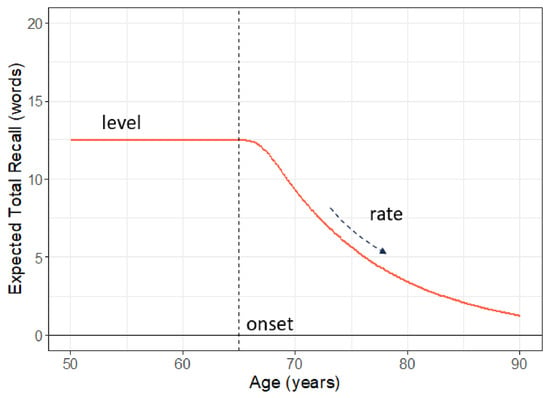
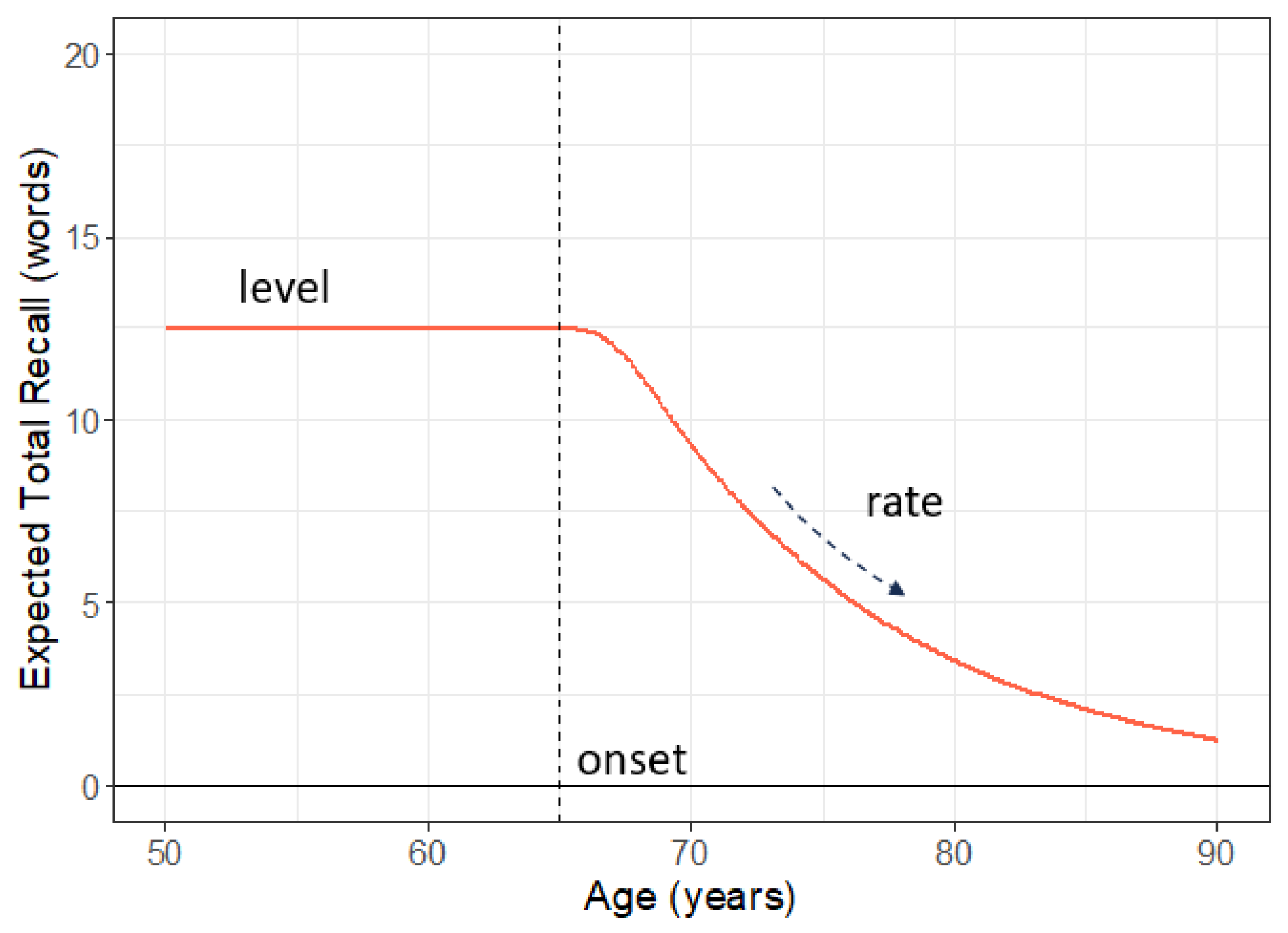
To investigate the association between CR proxies and longitudinal memory performance, we fitted a Bayesian nonlinear mixed-effects model based on the framework proposed by [30]. Although this framework allows for a non-zero slope before the CP, in the present application, this slope was fixed at zero to obtain a more parsimonious specification representing a period of relatively stable memory performance preceding accelerated decline. The model provides a flexible framework for quantifying the effects of CR proxies on three key features of the longitudinal TR trajectory: the cognitive level prior to decline, the timing of the CP, and the subsequent rate of decline (Figure 1).
Figure 1.
Schematic representation of the modeled memory trajectory. Level represents the expected TR score during the pre-decline phase (words recalled, range 0–20), onset denotes the age at which the transition toward accelerated decline begins (years), and rate represents the instantaneous relative rate of deterioration after the transition (year−1).
The three parameters that characterize this curve (, , and ) are included in the vector and are part of the equations defining the model. In particular, these parameters are embedded within a hierarchical structure that allows simultaneous modeling of individual variability and the effects of explanatory variables on each component of the trajectory.
Equation (1a) defines the functional form of the longitudinal trajectory. The rate function governs the relative change in the mean memory performance after the CP. In the present application, the pre-change-point slope is fixed at zero, and the rate function is defined as:
where and denotes the duration of the transition period. The cubic function ensures a smooth transition from a zero relative rate of change at the CP to the constant relative rate at the end of the transition. When , the trajectory follows exponential deterioration after this period. Thus, represents the asymptotic instantaneous relative rate of memory decline per year. Equation (1b) specifies the decomposition of observations into a systematic component, determined by the model structure, and an additive error term that captures residual variability. Finally, Equation (1c) links the model coefficients to their structural components, distinguishing between fixed effects (associated with CR proxies) and random effects representing inter-individual heterogeneity.
To account for the potential influence of repeated testing on observed memory performance, a sensitivity analysis was conducted incorporating the number of previous cognitive assessments as a time-varying covariate. Specifically, the expected TR score was modified as:
where denotes the number of previous assessments completed by participant i before observation j, and represents the corresponding regression coefficient. This specification preserves the functional form of the underlying memory trajectory while allowing previous test exposure to influence the expected observed score.
To complete the model specification, weakly informative prior distributions were assigned following the general approach described by [30]. Specifically, diffuse Gaussian priors were used for the regression coefficients associated with fixed effects. Uniform prior distributions were considered for the change-point and transition parameters, with bounds defined according to the temporal scale of the study. Half-Cauchy prior distributions were adopted for the scale parameters associated with the observation errors and individual random effects. These choices were intended to provide a flexible prior specification while accounting for the constraints and scales of the different model parameters. Parameter estimates were obtained from their posterior medians (PM), and uncertainty regarding the regression coefficients was assessed using credible intervals (CrI). Model fitting was computationally demanding, requiring approximately ten hours per run on a standard desktop computer. Each run consisted of four chains with 1000 iterations each, preceded by an additional 10,000 iterations used as a burn-in period, without applying thinning. These values were chosen to achieve satisfactory convergence diagnostics, particularly the statistic [31], providing a direct assessment of convergence for the regression coefficients associated with the three components of memory trajectories. Model fit was evaluated through posterior predictive checks, comparing the distributions of observed and replicated TR scores. These comparisons were performed both for the overall sample and separately by assessment wave. All statistical procedures were performed using the R version 4.4.1 [32]. Bayesian model estimation was implemented through the package rjags version 4-17 [33], with the package snow 0.4-4 [34] employed to run the four MCMC chains in parallel. The R and JAGS code used for model estimation, along with an illustrative example using simulated data, is publicly available at: https://github.com/nando11235813/ELSA-cognitive-reserve-memory-trajectories (accessed on 7 November 2026).
3. Results
A total of 10,203 participants (52.4% women) were included in the study, with a follow-up period ranging from 0 to 18 years with a mean follow-up duration of 8.23 (SD = 5.54) years. Almost a third of participants (27.2%) were assessed fewer than three times, while 38.1% were assessed between seven and nine times. Of the 10,203 participants included in the analysis, 549 (5.4%) contributed only one TR observation. About 51% of participants attained upper secondary education and 19.1% attained tertiary education. Engagement in physical activities varied among the four predefined levels (sedentary, low, moderate, high) with the majority (55.2%) reporting moderate engagement. Regarding participation in social activities, 34.2% of individuals reported involvement in social events. Lastly, 37.9% of participants were classified into the lower tier of occupation, 34.1% into medium and the remaining 28.0% in the “high” category. Table 1 provides a description of the descriptive statistics of the baseline characteristics of the sample. Descriptive statistics of TR, age, and participant characteristics across the nine ELSA assessment waves are presented in Supplementary Table S1. Additionally, Supplementary Table S2 presents the distribution of observations and participants across five-year age intervals. The number of observations decreases at older ages, although 1635 observations from 729 distinct participants were available in the 85 to 90 year age interval.
Table 1.
Sample statistics of participants at their baseline of the English Longitudinal Study of Ageing.
Bivariate analyses revealed mild to moderate associations between educational attainment and the other explanatory variables, with a relatively stronger association observed between education and occupational status (Cramér’s V = 0.396). Given this association, we also fitted an alternative model incorporating occupational status (medium and high categories) as a predictor of all three components of memory trajectories, to examine the implications of simultaneously including education and occupation. The results of this alternative specification are presented in Supplementary Table S3.
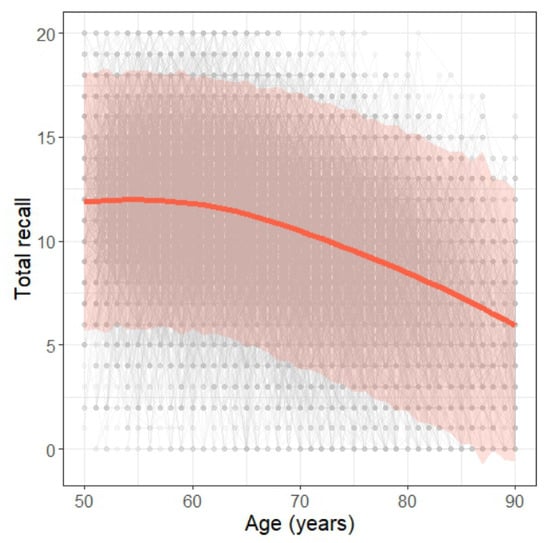
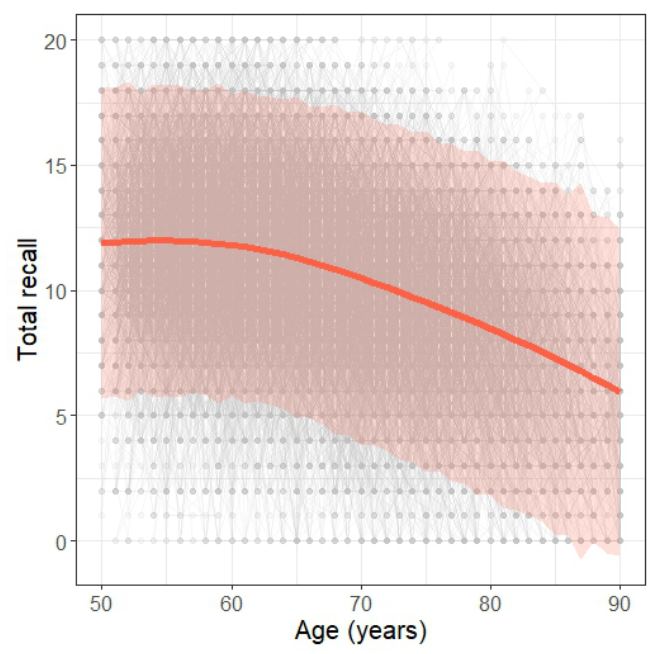
The 56,374 values of memory scores in the sample ranged from 0 to 20 with an average of 10.7 (SD = 3.6). Figure 2 presents a descriptive trajectory of TR as a function of age, obtained using locally estimated scatterplot smoothing (LOESS), independently of the proposed change-point model. The smoothed trajectory shows relatively limited variation between approximately 50 and 60 years of age, followed by a progressively more pronounced decline. This descriptive pattern provides empirical motivation for considering a relatively stable phase before accelerated memory deterioration. Importantly, this descriptive pattern represents the average relationship between age and TR in the observed sample and should not be interpreted as evidence that all participants experience a CP at a common age. The proposed hierarchical model allows individual-specific onset ages, reflecting heterogeneity in the timing of accelerated memory decline.
Figure 2.
Descriptive trajectory of Total Recall according to age, estimated using locally estimated scatterplot smoothing (LOESS). The shaded region represents the pointwise 95% bootstrap confidence interval for the smoothed curve. Individual observations are displayed with transparency to reduce overplotting.
The results of the longitudinal assessment of CR on TR are presented in Table 2. For the reference group (men with less than upper secondary education, sedentary physical activity, and no social engagement), the estimated pre-decline TR level was 8.49 words (95% CrI: 8.30 to 8.67). For the reference group, the estimated onset of accelerated memory decline occurred at approximately 68.3 years of age, followed by a gradual transition toward an annual instantaneous relative rate of deterioration of approximately 4.1% (PM = ). Regarding pre-decline memory performance, participants with tertiary education recalled an estimated 2.85 additional words (95% CrI: 2.70 to 3.01) compared with those with less than upper secondary education. Women demonstrated higher pre-decline memory performance, with a posterior median difference of 1.04 words. Physical activity was also positively associated with pre-decline memory performance across all activity categories. Finally, social engagement showed a smaller positive association (PM = 0.17 words), whose magnitude was modest relative to the 20-point TR scale.
Table 2.
Posterior summaries of regression coefficients associated with the level, onset, and rate components of longitudinal TR trajectories.
Regarding the estimated onset of accelerated memory decline, tertiary education was associated with a later onset (PM = 3.11 years; 95% CrI: 1.12 to 5.19), compared with less than upper secondary education. Female sex was also associated with a later estimated onset (PM = 3.82 years; 95% CrI: 2.43 to 5.25). Social engagement showed a positive association with onset (PM = 2.04 years; 95% CrI: 0.64 to 3.46). Regarding physical activity, only the high-activity category showed a positive association whose 95% credible interval excluded zero (PM = 2.64 years; 95% CrI: 0.27 to 4.99), compared with the sedentary reference group. The credible intervals for low and moderate physical activity included zero, indicating greater uncertainty regarding these associations. Finally, the subsequent rate of deterioration was more negative among women and participants with tertiary education.
Regarding the variability components of the model, PM estimates of the standard deviations of the individual random effects associated with Level and Onset were 1.93 words and 8.36 years, respectively. Although the proposed modeling framework allows for individual random effects in the Rate parameter, this component ( in the third expression of Equation (1c)) was not included in the final specification to favor model parsimony and avoid introducing additional variability parameters that may be difficult to identify from relatively sparse individual longitudinal trajectories. The PM of the residual standard deviation was 2.22 words. Finally, the PM of the transition duration parameter was 4.41 years.
As a sensitivity analysis, we refitted the model after excluding the 48 participants with a recorded dementia diagnosis during follow-up (Supplementary Table S4). The estimated associations with pre-decline memory performance remained largely unchanged. Regarding the onset of accelerated decline, the associations with tertiary education, female sex, and social engagement were similar to those obtained from the full sample. However, the association with high physical activity decreased from 2.64 to 1.70 years, and its 95% credible interval included zero in the sensitivity analysis. The associations of tertiary education and female sex with the subsequent rate of deterioration were slightly attenuated but remained negative, with 95% credible intervals excluding zero. Overall, the main patterns of association were largely preserved after excluding participants with a recorded dementia diagnosis.
To assess the potential influence of practice effects, we conducted a sensitivity analysis incorporating the number of previous cognitive assessments as a time-varying covariate through a multiplicative adjustment to the expected TR score (Supplementary Table S5). The estimated coefficient was small, with a credible interval including zero (PM = 0.00072; 95% CrI: −0.00009 to 0.00150). The associations of education, sex, and social engagement with the estimated onset of accelerated memory decline remained largely similar to those obtained from the main model.
The alternative model including occupational status yielded noticeable changes in the estimated associations of several explanatory variables, particularly those related to the onset of memory decline (Supplementary Table S3). For instance, the posterior median of the association between tertiary education and onset decreased from 3.11 to 1.98 years, while its 95% credible interval changed from (1.12, 5.19) to (−0.13, 3.96), thereby including zero. Similarly, the association between high physical activity and onset was no longer clearly distinguishable from zero after including occupation. In contrast, the associations of female sex and social engagement with onset remained relatively stable. Occupational status showed positive associations with pre-decline memory performance, but no clear associations with the estimated onset of decline. Considering these results, the overlap between education and occupation, and the aim of maintaining a parsimonious and interpretable specification, occupational status was not retained in the main model.
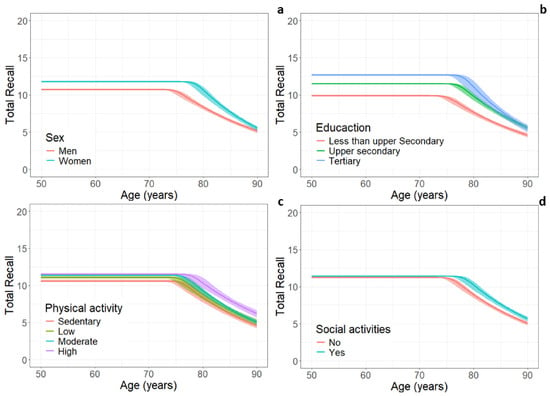
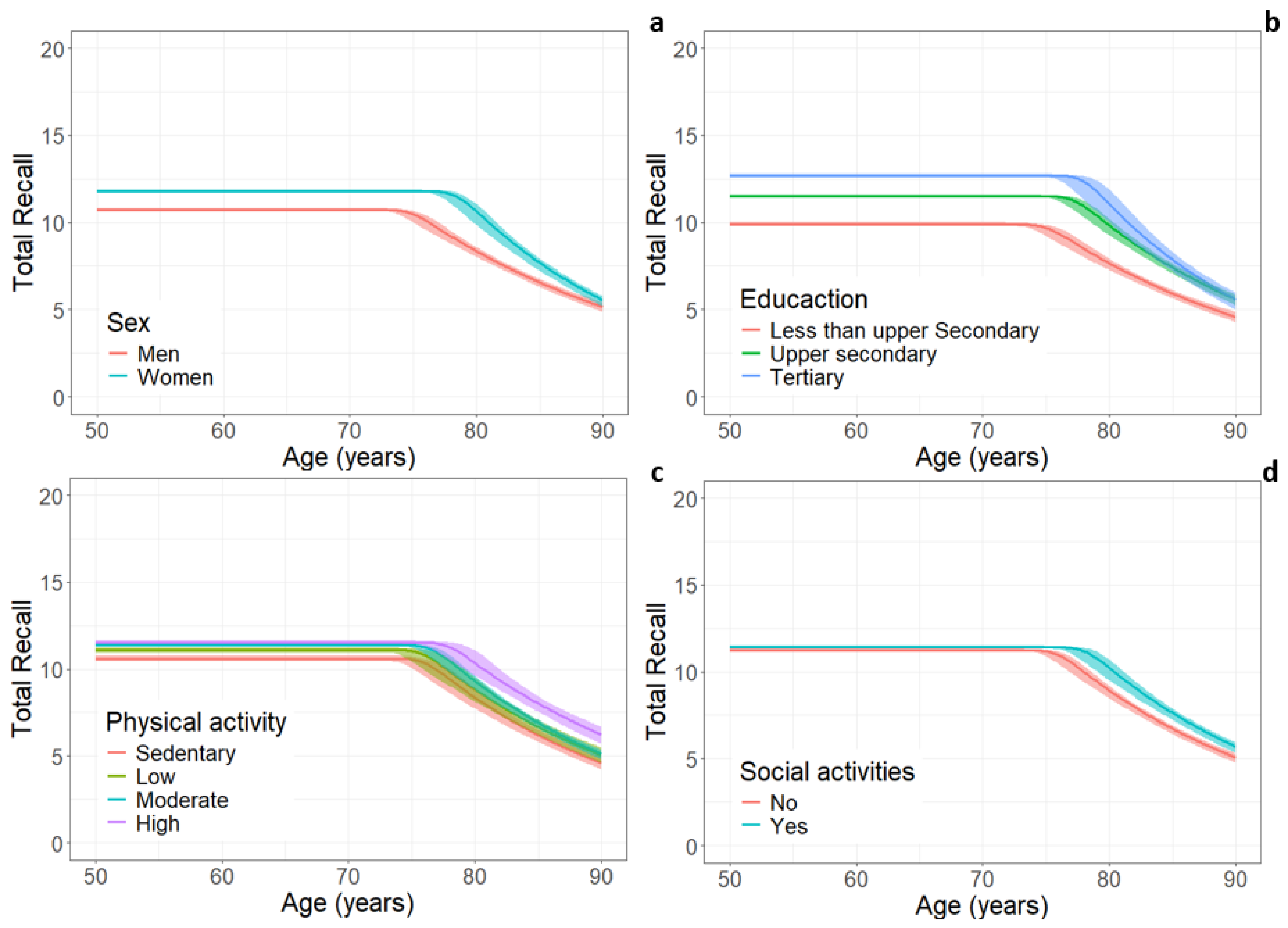
To facilitate interpretation, Figure 3 displays panels illustrating the average trajectory of TR according to the levels of each explanatory variable, while controlling for the others. Figure 3a illustrates a higher cognitive performance among women, a delayed onset of memory decline, and a steeper rate of deterioration. Figure 3b demonstrates a positive association between educational attainment and both the initial cognitive level and the onset of memory decline. Similarly, Figure 3c reveals that individuals with greater physical activity exhibit higher cognitive levels and a postponed onset of decline. Finally, Figure 3d highlights a delay in the onset of cognitive decline among socially active participants.
Figure 3.
Predicted memory trajectories according to (a) Sex; (b) Education; (c) Physical Activity and (d) Social Activities. For each comparison, the remaining covariates were standardized to their observed distribution in the analytical sample by averaging the corresponding population-level trajectory parameters across participants. Solid lines represent posterior median trajectories, and shaded areas indicate pointwise 95% Bayesian CrI.
4. Discussion
This study examined how proxies of CR relate to the onset of accelerated memory decline in older adults, using a Bayesian nonlinear modeling approach. Our findings are consistent with predictions derived from the CR hypothesis, as higher levels of several reserve-related proxies were associated with better pre-decline memory performance and a later estimated onset of memory decline.
The data showed that individuals with higher levels of education presented higher pre-decline memory performance, recalling on average nearly three more words than those with less than upper secondary education. Higher educational attainment was associated with an estimated onset of memory decline more than three years later. Notably, including occupational status alongside education, attenuated and destabilized the estimated effects on decline onset, suggesting substantial overlap in the socioeconomic pathways captured by both variables rather than independent reserve mechanisms. Hence, our results illustrate the relevance of educational attainment as a commonly used and interpretable proxy potentially related to CR, while highlighting the sensitivity of some estimated associations to the inclusion of occupational status. Educational attainment may also be associated with memory trajectories through pathways involving occupational opportunities, working conditions, and subsequent lifestyle experiences, highlighting the potentially interconnected nature of these factors throughout the life course. Previous longitudinal studies have reported that educational attainment is associated with higher cognitive performance, while its relationship with rates of cognitive decline is less consistent [16,20,21]. Our findings extend this distinction by separately examining the estimated onset of accelerated memory decline and the subsequent rate of deterioration, rather than relying on a single average rate of change across the observed age range.
Similarly, high levels of physical activity and social engagement were associated with delayed onset of cognitive deterioration, underscoring the cumulative and multifaceted nature of CR. Women exhibited both a higher pre-decline memory performance and a notably delayed onset of memory decline, although their rate of deterioration was steeper compared to men. These findings suggest that a later onset of accelerated memory decline does not necessarily imply a slower subsequent deterioration. In particular, tertiary education and female sex were associated with both a later estimated onset and a steeper subsequent rate of decline. Importantly, our findings highlight the nonlinear nature of cognitive decline, supporting the use of CP models to more accurately identify when deterioration begins. This has significant implications for the timing of interventions aimed at preserving cognitive health.
An important finding of this study is that the examined CR proxies were associated with different components of longitudinal memory trajectories. Higher physical activity and social engagement were associated with a later estimated onset of memory decline, whereas no clear associations were observed with the subsequent rate of deterioration. This pattern suggests that these factors may be more closely related to the timing of memory decline than to its progression after onset. However, the absence of clear associations with the rate parameter should not be interpreted as evidence that these factors have no relationship with the subsequent progression of memory decline. In contrast, higher educational attainment was associated with both a later estimated onset and a steeper subsequent decline. This pattern is consistent with the CR hypothesis, according to which individuals with greater reserve may maintain cognitive performance for longer before showing a more pronounced decline. Female sex exhibited a similar combination of a later estimated onset and a steeper subsequent decline, although this finding may reflect multiple biological, social, and methodological factors that cannot be distinguished in the present analysis. Importantly, sex was included as an adjustment variable rather than a proxy for CR. The later estimated onset and steeper subsequent decline observed among women may reflect several factors, including differences in verbal memory performance, cohort-related experiences, and selective survival. These potential explanations cannot be distinguished using the present analysis, and the observed pattern should not be interpreted as direct evidence of a CR mechanism.
As illustrated in Figure 3, some of the predicted trajectories tend to converge at advanced ages, suggesting that differences in memory performance associated with certain covariates may diminish over time. This pattern is consistent with the combination of a later estimated onset of decline and a steeper subsequent deterioration observed for some groups. Consequently, the associations with higher pre-decline memory performance or later onset should not be interpreted as evidence of sustained advantages throughout the entire age range.
These patterns can be understood within the framework of CR theory. According to this perspective, individuals with higher reserve can recruit alternative neural networks or employ more efficient cognitive strategies to compensate for accumulating neuropathology. Within this theoretical framework, greater cognitive reserve may allow individuals to maintain cognitive performance despite accumulating neuropathology, potentially delaying the observable onset of decline. Once compensatory capacity is exceeded, cognitive deterioration may become more pronounced. Although this interpretation is consistent with some of our findings, the present analysis does not directly assess the underlying neurobiological mechanisms. Related findings from the Religious Orders Study and Rush Memory and Aging Project have contributed to understanding the relationships between CR, cognitive performance, and neuropathology [10]. Previous findings from the Victoria Longitudinal Study and the Baltimore Longitudinal Study of Aging have demonstrated that individual characteristics may be associated differently with cognitive performance levels and longitudinal rates of change [16,18]. Building on this literature, our Bayesian change-point approach allows us to examine an additional component of memory trajectories: the estimated timing of accelerated decline. Furthermore, our use of a Bayesian CP model builds on recent methodological advances [30], allowing us to distinguish effects on cognitive levels from those on the onset and slope of decline.
An important modeling decision in the present study concerns the assumption of relatively stable memory performance before the CP. Although the general differential-equation framework allows for a non-zero pre-change-point slope, we adopted a more parsimonious specification in which this parameter was fixed at zero. This choice was motivated by both the observed data and previous longitudinal research. In particular, the LOESS-smoothed trajectory presented in Figure 2, obtained independently of the change-point model, shows relatively stable TR performance between approximately 50 and 60 years of age, followed by a progressively more pronounced decline. This pattern is consistent with findings by [35], who reported no longitudinal decline in episodic memory before age 60, and [36], who identified predominantly stable verbal episodic memory trajectories among middle-aged participants in ELSA. Together, these findings provide empirical and theoretical support for using a relatively stable pre-decline phase as a simplifying approximation. Nevertheless, this specification does not imply that memory performance remains strictly constant for all individuals or that gradual changes cannot occur before accelerated deterioration.
These findings may have implications for research on age-related memory decline and the identification of factors associated with memory trajectories. Educational attainment, physical activity, and social engagement were associated with differences in the estimated timing of memory decline, suggesting that these factors warrant further investigation in studies designed to evaluate potential causal relationships. However, the observational nature of the present study does not establish whether interventions targeting these factors would delay cognitive deterioration. Future longitudinal and intervention studies are needed to determine whether modifying these exposures can influence the onset or progression of memory decline.
4.1. Limitations
Several limitations must be acknowledged. First, the CR proxies used—education, physical activity, and social engagement—are indirect socio-behavioral indicators potentially related to CR, rather than direct measures of the construct itself. Although education is widely used, it reflects early-life cognitive enrichment and may not account for ongoing cognitive stimulation. Additionally, residual confounding by unmeasured variables, such as diet, mental health, or genetic factors, cannot be ruled out. In particular, socioeconomic circumstances, including income and wealth, as well as vascular health conditions, were not included as covariates in the present models and may contribute to the observed associations. Moreover, the observed associations may reflect alternative explanations, including differences in premorbid cognitive ability, socioeconomic conditions, cohort effects, or characteristics of the memory assessment, which cannot be fully distinguished from CR-related mechanisms in the present study. An additional limitation concerns the timing of the physical activity assessment. Physical activity was measured only at wave 4 and was treated as a time-invariant covariate in the longitudinal models. However, physical activity may change over time, particularly in older adults, and a single assessment cannot capture these changes throughout the follow-up period. Consequently, the observed associations may not reflect the relationship between sustained physical activity and memory trajectories. Furthermore, physical activity may be associated with cognitive functioning through mechanisms other than CR, including cardiovascular, metabolic, and brain maintenance processes. Since the present study did not include measures of brain pathology or neurobiological integrity, it was not possible to determine whether the associations observed for physical activity reflect CR mechanisms or alternative pathways. Therefore, these findings should be interpreted as associations between physical activity status at the time of assessment and memory trajectories, without attributing them to a specific underlying mechanism. Social engagement was also treated as a time-invariant covariate, based on the first available assessment for each participant. Consequently, changes in social participation throughout follow-up were not captured. Furthermore, reverse causation cannot be excluded, as lower cognitive functioning or preclinical cognitive changes may influence participation in physical and social activities. The observed associations should therefore not be interpreted as evidence that these activities causally influence the timing or progression of memory decline.
Additionally, the sensitivity analysis including occupational status revealed changes in the magnitude and uncertainty of some estimated associations, particularly those involving the onset of memory decline. These findings indicate that the estimated associations should be interpreted in the context of the selected covariate specification, as adjustment for occupational status may influence the resulting inferences.
Our reliance on self-reported data for physical and social activities introduces the potential for reporting bias. Another important limitation relates to the nature of the outcome variable. The memory recall score is a count variable with a predefined upper limit (maximum score of 20), which inherently introduces the possibility of ceiling and floor effects. Participants with very high or very low cognitive abilities may cluster at the extremes of the scale, potentially distorting the estimation of both the level and the rate of decline. Despite the appeal and interpretability of assuming a normal distribution for modeling purposes, this choice may not fully capture the bounded and discrete characteristics of the data, potentially affecting the robustness of parameter estimates. Nevertheless, posterior predictive checks revealed that the model generates out-of-range values only 0.53% of the time, and visual comparisons of observed versus predicted distributions (see Figures S1 and S2 of the Supplementary Material) show excellent model calibration across all waves.
An additional limitation concerns the assessment of cognitive functioning. The present study focused exclusively on verbal episodic memory, assessed through immediate and delayed word recall. Although this measure is widely used in longitudinal studies of cognitive ageing, it captures only one dimension of cognitive functioning and does not directly assess other cognitive abilities or the strategies potentially involved in CR. Consequently, our findings should be interpreted specifically in relation to verbal memory trajectories rather than generalized to cognitive functioning as a whole.
The assumption of a zero slope before the CP should also be considered when interpreting the results. Although this specification is supported by the descriptive pattern observed in Figure 2 and previous longitudinal evidence, it represents a simplified characterization of memory trajectories, as some individuals may experience gradual changes before the onset of accelerated decline. Accordingly, the estimated CP should be interpreted as the transition toward a more pronounced phase of memory deterioration within the adopted modeling framework, rather than the precise age at which cognitive changes first emerge.
The estimation of individual CPs may be uncertain for participants with relatively few observations or whose measurements do not adequately cover the transition toward memory decline. The hierarchical structure of the model allows individual estimates to borrow information from the population-level distribution through partial pooling. Nevertheless, this mechanism does not ensure precise identification of individual CPs when longitudinal information is limited. Importantly, our main interest lies in estimating population-level associations with the timing of accelerated memory decline rather than obtaining precise individual-level predictions.
Although the sensitivity analysis accounted for the number of previous cognitive assessments, this variable is only an indirect indicator of potential practice effects. Moreover, the multiplicative adjustment assumes a constant relative association per additional assessment and cannot fully distinguish practice effects from age-related changes or differences in participant retention. Therefore, the possibility of residual practice effects cannot be excluded.
The estimated associations with the onset of accelerated memory decline were accompanied by relatively wide credible intervals, particularly for tertiary education and high physical activity. Consequently, the posterior medians should not be interpreted as precisely determined differences in the timing of decline. Moreover, although social engagement was positively associated with pre-decline memory performance, the magnitude of this association was small, and its clinical relevance remains uncertain.
Another limitation concerns potential selection bias arising from missing observations, loss to follow-up, and mortality. Although the longitudinal mixed-effects model accommodates participants with different numbers of observations and follow-up durations, this does not eliminate the possibility of informative attrition. In particular, individuals experiencing poorer cognitive functioning or faster deterioration may be more likely to discontinue participation or die during follow-up, potentially affecting the estimated memory trajectories, especially at older ages. The present analysis did not explicitly model dropout or mortality processes, and therefore the potential influence of informative attrition on the estimated change points and rates of decline cannot be ruled out.
4.2. Strengths
This study presents several notable strengths. First, it utilizes data from a large and well-characterized cohort with extensive follow-up, enhancing both the statistical power and the generalizability of the findings to older adult populations in similar contexts. The richness of the dataset allowed for the incorporation of multiple CR proxies, enabling a more nuanced understanding of how diverse life experiences contribute to cognitive resilience.
Second, the Bayesian nonlinear mixed-effects change-point model provides a flexible framework for characterizing memory trajectories, allowing pre-decline performance, the estimated onset of accelerated decline, and the subsequent rate of deterioration to be examined jointly. By doing so, it avoids the oversimplification of assuming a uniform trajectory across individuals and highlights the heterogeneity in cognitive ageing processes. Furthermore, estimating the timing of accelerated memory decline provides additional information for understanding age-related changes in memory performance.
An additional strength lies in the decision to model separate proxies of CR (education, physical activity, and social engagement) rather than relying on a composite measure. While composite indices offer an aggregated view, disaggregating the components facilitates a more direct interpretation of how specific life domains contribute to different aspects of memory trajectories. This granularity facilitates the identification of potentially distinct associations between each proxy and the components of longitudinal memory trajectories.
Finally, by focusing specifically on memory performance and its association with potentially modifiable factors such as physical and social activity, the study provides evidence that may inform future research on cognitive ageing and CR.
4.3. Future Research
Future studies will benefit from the incorporation of more comprehensive and dynamic measures of CR, integrating neuroimaging, biomarkers, and ecological momentary assessments of cognitive engagement. Future studies incorporating dedicated CR assessment instruments, such as the Cognitive Reserve Index questionnaire [37], together with comprehensive neuropsychological evaluations, could complement the present findings by providing a more detailed characterization of reserve-related experiences and cognitive functioning.
Future research should prioritize three complementary directions. First, joint longitudinal-survival models could account for informative dropout and mortality, providing a more comprehensive characterization of memory trajectories. Second, further analyses incorporating incident dementia as an outcome, or examining trajectories according to dementia status, could help clarify the relationship between the estimated onset of memory decline and neurodegenerative processes. Third, external validation using other longitudinal ageing cohorts, such as the Health and Retirement Study (HRS) or the Survey of Health, Ageing and Retirement in Europe (SHARE), would help assess the generalizability of the findings across populations and socioeconomic contexts.
Finally, model fitting is computationally expensive: each run takes about ten hours on a standard desktop computer. This high cost imposes limitations on model exploration, such as performing sensitivity analyses, alternative specifications, or computing Bayes factors for formal model comparisons. As a result, posterior uncertainty was summarized using 95% CrI although these do not replace formal comparisons between alternative model specifications.
5. Conclusions
The findings are consistent with the CR hypothesis and indicate associations between CR proxies and distinct components of memory trajectories. By implementing a sophisticated analytical technique, we were able to distinguish between initial cognitive levels, the timing of decline onset, and the rate of deterioration offering a more detailed characterization of longitudinal memory trajectories.
These findings highlight the relevance of educational attainment, physical activity, and social engagement when examining individual differences in longitudinal memory trajectories. Although the observational design does not allow causal conclusions regarding preventive interventions, the observed associations may help inform future research on potentially modifiable factors related to cognitive ageing.
Supplementary Materials
The following supporting information can be downloaded at: https://www.mdpi.com/article/10.3390/jal6040073/s1, Figure S1: Posterior predictive check comparing observed and replicated TR distributions. The model closely reproduces the empirical distribution, with minimal out-of-range predictions; Figure S2: Posterior predictive check comparing observed and replicated TR distributions stratified by study wave; Table S1: Descriptive statistics of Total Recall, age, and participant characteristics across the nine ELSA assessment waves; Table S2: Distribution of observations and distinct participants across five-year age intervals in the analytical sample; Table S3: Comparison of posterior estimates from the main model and the alternative model including occupational status; Table S4: Comparison of posterior estimates from the full model and the sensitivity analysis excluding participants with a recorded dementia diagnosis; Table S5: Comparison of posterior estimates from the main model and the sensitivity analysis adjusting for practice effects.
Author Contributions
Conceptualization, F.M., M.S. and G.M.-T.; methodology, F.M. and G.M.-T.; software, F.M.; validation, F.M., M.S. and G.M.-T.; formal analysis, F.M. and G.M.-T.; data curation, F.M.; writing—original draft preparation, F.M., M.S. and G.M.-T.; writing—review and editing, F.M., M.S. and G.M.-T.; supervision, M.S. and G.M.-T. All authors have read and agreed to the published version of the manuscript.
Funding
This research received no external funding.
Data Availability Statement
The English Longitudinal Study of Ageing (ELSA) data are available through the UK Data Service (Study Number: SN 5050). The present analysis used waves 1–9 and did not include Wave 0 data from the Health Survey for England. This research is supported by a consortium of UK government departments and the US National Institute on Aging (NIA-NIH), under Award Number R01AG017644.
Conflicts of Interest
The authors declare no conflicts of interest.
Abbreviations
The following abbreviations are used in this manuscript:
| CR | Cognitive Reserve |
| ELSA | English Longitudinal Study of Ageing |
| TR | Total Recall |
| SD | Standard Deviation |
| CP | Change Point |
| PM | Posterior Median |
| CrI | Credible Interval |
References
- Livingston, G.; Huntley, J.; Liu, K.Y.; Costafreda, S.G.; Selbæk, G.; Alladi, S.; Ames, D.; Banerjee, S.; Burns, A.; Brayne, C.; et al. Dementia prevention, intervention, and care: 2024 report of the Lancet standing Commission. Lancet 2024, 404, 572–628. [Google Scholar] [CrossRef] [Scilit] [PubMed]
- Stern, Y. What is cognitive reserve? Theory and research application of the reserve concept. J. Int. Neuropsychol. Soc. 2002, 8, 448–460. [Google Scholar] [CrossRef] [Scilit]
- Stern, Y. Cognitive reserve. Neuropsychologia 2009, 47, 2015–2028. [Google Scholar] [CrossRef] [Scilit] [PubMed]
- Barulli, D.; Stern, Y. Efficiency, capacity, compensation, maintenance, plasticity: Emerging concepts in cognitive reserve. Trends Cogn. Sci. 2013, 17, 502–509. [Google Scholar] [CrossRef] [Scilit] [PubMed]
- Baldivia, B.; Andrade, V.M.; Amodeo Bueno, O.F. Contribution of education, occupation and cognitively stimulating activities to the formation of cognitive reserve. Dement. Neuropsychol. 2008, 2, 173–182. [Google Scholar] [CrossRef] [Scilit] [PubMed]
- Morris, T.P.; Ai, M.; Chaddock-Heyman, L.; McAuley, E.; Hillman, C.H.; Kramer, A.F. Relationships between enriching early life experiences and cognitive function later in life are mediated by educational attainment. J. Cogn. Enhanc. 2021, 5, 449–458. [Google Scholar] [CrossRef] [Scilit] [PubMed]
- Dekhtyar, S.; Wang, H.-X.; Scott, K.; Goodman, A.; Koupil, I.; Herlitz, A. A Life-Course Study of Cognitive Reserve in Dementia–From Childhood to Old Age. Am. J. Geriatr. Psychiatry 2015, 23, 885–896. [Google Scholar] [CrossRef] [Scilit] [PubMed]
- Bennett, D.A.; Schneider, J.A.; Arvanitakis, Z.; Wilson, R.S. Overview and findings from the Religious Orders Study. Curr. Alzheimer Res. 2012, 9, 628–645. [Google Scholar] [CrossRef] [Scilit] [PubMed]
- Bennett, D.A.; Schneider, J.A.; Buchman, A.S.; Mendes de Leon, C.; Bienias, J.L.; Wilson, R.S. The Rush Memory and Aging Project: Study design and baseline characteristics of the study cohort. Neuroepidemiology 2005, 25, 163–175. [Google Scholar] [CrossRef] [Scilit] [PubMed]
- Bennett, D.A.; Wilson, R.S.; Arvanitakis, Z.; Boyle, P.A.; de Toledo-Morrell, L.; Schneider, J.A. Selected findings from the Religious Orders Study and Rush Memory and Aging Project. J. Alzheimer’s Dis. 2013, 33, 397–403. [Google Scholar] [CrossRef] [Scilit] [PubMed]
- Montemurro, S.; Rumiati, R.I.; Pucci, V.; Nucci, M.; Mondini, S. Cognitive reserve and ageing trajectories. Aging Clin. Exp. Res. 2025, 37, 93. [Google Scholar] [CrossRef] [Scilit] [PubMed]
- Gamble, L.D.; Clare, L.; Opdebeeck, C.; Martyr, A.; Jones, R.W.; Rusted, J.M.; Pentecost, C.; Thom, J.M.; Matthews, F.E. Cognitive reserve and its impact on cognitive and functional abilities, physical activity and quality of life following a diagnosis of dementia: Longitudinal findings from the Improving the experience of Dementia and Enhancing Active Life (IDEAL) study. Age Ageing 2025, 54, afae284. [Google Scholar] [CrossRef] [Scilit] [PubMed]
- Yu, F.; Ryan, L.H.; Schaie, K.W.; Willis, S.L.; Kolanowski, A. Factors associated with cognition in adults: The Seattle Longitudinal Study. Res. Nurs. Health 2009, 32, 540–550. [Google Scholar] [CrossRef] [Scilit] [PubMed]
- Warner Schaie, K.; Willis, S.L.; Caskie, G.I. The Seattle Longitudinal Study: Relationship between personality and cognition. Aging Neuropsychol. Cogn. 2004, 11, 304–324. [Google Scholar] [CrossRef] [Scilit] [PubMed]
- Hyun, J.; Katz, M.J.; Hall, C.B.; Sliwinski, M.J.; Lipton, R.B. Cognitive leisure activities in later older adulthood may protect against accelerated rates of memory decline. Alzheimer’s Dement. 2020, 16, e041512. [Google Scholar] [CrossRef] [Scilit]
- Zahodne, L.B.; Glymour, M.M.; Sparks, C.; Bontempo, D.; Dixon, R.A.; MacDonald, S.W.S.; Manly, J.J. Education Does Not Slow Cognitive Decline with Aging: 12-Year Evidence from the Victoria Longitudinal Study. J. Int. Neuropsychol. Soc. 2011, 17, 1039–1046. [Google Scholar] [CrossRef] [Scilit] [PubMed]
- Lamar, M.; Resnick, S.M.; Zonderman, A.B. Longitudinal changes in verbal memory in older adults: Distinguishing the effects of age from repeat testing. Neurology 2003, 60, 82–86. [Google Scholar] [CrossRef] [Scilit] [PubMed]
- McCarrey, A.C.; An, Y.; Kitner-Triolo, M.H.; Ferrucci, L.; Resnick, S.M. Sex differences in cognitive trajectories in clinically normal older adults. Psychol. Aging 2016, 31, 166–175. [Google Scholar] [CrossRef] [Scilit] [PubMed]
- Stern, Y.; Arenaza-Urquijo, E.M.; Bartrés-Faz, D.; Belleville, S.; Cantilon, M.; Chetelat, G.; Ewers, M.; Franzmeier, N.; Kempermann, G.; Kremen, W.S.; et al. Whitepaper: Defining and investigating cognitive reserve, brain reserve, and brain maintenance. Alzheimer’s Dement. 2020, 16, 1305–1311. [Google Scholar] [CrossRef] [Scilit] [PubMed]
- Seblova, D.; Berggren, R.; Lövdén, M. Education and age-related decline in cognitive performance: Systematic review and meta-analysis of longitudinal cohort studies. Ageing Res. Rev. 2020, 58, 101005. [Google Scholar] [CrossRef] [Scilit] [PubMed]
- Lövdén, M.; Fratiglioni, L.; Glymour, M.M.; Lindenberger, U.; Tucker-Drob, E.M. Education and cognitive functioning across the life span. Psychol. Sci. Public Interest 2020, 21, 6–41. [Google Scholar] [CrossRef] [Scilit] [PubMed]
- Muniz-Terrera, G.; Minett, T.; Brayne, C.; Matthews, F.E. Education and delayed terminal decline. Age Ageing 2014, 43, 26–31. [Google Scholar] [CrossRef] [Scilit] [PubMed]
- Wilson, R.S.; Wang, T.; Yu, L.; Grodstein, F.; Bennett, D.A.; Boyle, P.A. Cognitive Activity and Onset Age of Incident Alzheimer Disease Dementia. Neurology 2021, 97, e922–e929. [Google Scholar] [CrossRef] [Scilit] [PubMed]
- Hall, C.B.; Derby, C.; LeValley, A.; Katz, M.J.; Verghese, J.; Lipton, R.B. Education delays accelerated decline on a memory test in persons who develop dementia. Neurology 2007, 69, 1657–1664. [Google Scholar] [CrossRef] [Scilit] [PubMed]
- Steptoe, A.; Breeze, E.; Banks, J.; Nazroo, J. Cohort Profile: ELSA. Int. J. Epidemiol. 2013, 42, 1640–1648. [Google Scholar] [CrossRef] [Scilit] [PubMed]
- Zaninotto, P.; Batty, G.D.; Allerhand, M.; Deary, I.J. Cognitive function trajectories and their determinants in older people: 8 years of follow-up in the English Longitudinal Study of Ageing. J. Epidemiol. Community Health 2018, 72, 685–694. [Google Scholar] [CrossRef] [Scilit] [PubMed]
- Garfield, V.; Llewellyn, C.H.; Kumari, M. The relationship between physical activity, sleep duration and depressive symptoms in older adults: The English Longitudinal Study of Ageing (ELSA). Prev. Med. Rep. 2016, 4, 512–516. [Google Scholar] [CrossRef] [Scilit] [PubMed]
- Demakakos, P.; Hamer, M.; Stamatakis, E.; Steptoe, A. Low-intensity physical activity is associated with reduced risk of incident type 2 diabetes in older adults. Diabetologia 2010, 53, 1877–1885. [Google Scholar] [CrossRef] [Scilit] [PubMed]
- Hamer, M.; de Oliveira, C.; Demakakos, P. Non-exercise physical activity and survival. Am. J. Prev. Med. 2014, 47, 452–460. [Google Scholar] [CrossRef] [Scilit] [PubMed]
- Massa, F.; Scavino, M.; Muniz-Terrera, G. A Bayesian non-linear mixed-effects model. Stats 2025, 8, 74. [Google Scholar] [CrossRef] [Scilit]
- Gelman, A.; Rubin, D.B. Inference from iterative simulation using multiple sequences. Stat. Sci. 1992, 7, 457–472. [Google Scholar] [CrossRef] [Scilit]
- R Core Team. R: A Language and Environment for Statistical Computing; R Foundation for Statistical Computing: Vienna, Austria, 2024; Available online: https://www.R-project.org/ (accessed on 7 November 2026).
- Plummer, M. rjags: Bayesian Graphical Models Using MCMC, R package version 4-17; 2025. Available online: https://cran.r-project.org/web/packages/rjags/index.html (accessed on 7 November 2026). [CrossRef] [Scilit]
- Tierney, L.; Rossini, A.J.; Li, N.; Sevcikova, H. Snow: Simple Network of Workstations, R package version 0.4-4; 2021. Available online: https://cran.r-project.org/web/packages/snow/index.html (accessed on 7 November 2026). [CrossRef] [Scilit]
- Rönnlund, M.; Nyberg, L.; Bäckman, L.; Nilsson, L.G. Stability, growth, and decline in adult life span development of declarative memory: Cross-sectional and longitudinal data from a population-based study. Psychol. Aging 2005, 20, 3–18. [Google Scholar] [CrossRef] [Scilit] [PubMed]
- Olaya, B.; Bobak, M.; Haro, J.M.; Demakakos, P. Trajectories of verbal episodic memory in middle-aged and older adults: Evidence from the English Longitudinal Study of Ageing. J. Am. Geriatr. Soc. 2017, 65, 1274–1281. [Google Scholar] [CrossRef] [Scilit] [PubMed]
- Nucci, M.; Mapelli, D.; Mondini, S. Cognitive Reserve Index questionnaire (CRIq): A new instrument for measuring cognitive reserve. Aging Clin. Exp. Res. 2012, 24, 218–226. [Google Scholar] [CrossRef] [Scilit] [PubMed]

Disclaimer/Publisher’s Note: The statements, opinions and data contained in all publications are solely those of the individual author(s) and contributor(s) and not of MDPI and/or the editor(s). MDPI and/or the editor(s) disclaim responsibility for any injury to people or property resulting from any ideas, methods, instructions or products referred to in the content. |
© 2026 by the authors. Licensee MDPI, Basel, Switzerland. This article is an open access article distributed under the terms and conditions of the Creative Commons Attribution (CC BY) license.