


Abstract
Volunteering is recommended as a way for older adults to age healthily due to a variety of biopsychosocial health benefits. The literature has previously identified a wide range of modifiable enablers and barriers to older adult volunteering participation, for example, supervisory support structures, program flexibility, and training quality; however, these have not yet been prioritised. Policymakers may benefit from knowing which strategies are likely to have the greatest immediate impact on recruitment and retention. This study aimed to prioritise enablers and barriers to volunteering and to compare priorities across four participant groups: Volunteer Program Representatives, Current volunteers, Former volunteers and Never volunteers. Participants (n = 681) were older adults in Australia aged 60 years and over or volunteer programme representatives aged 18 years and over. They were predominantly current volunteers based in Victoria. Participants completed an online survey scoring enablers and barriers to volunteering using Likert scale responses to indicate the importance of each item to commencement and continuation in volunteering. Data were analysed descriptively for responses to each item for each participant group, and simple pairwise comparisons were conducted between groups. Feeling welcome scored the highest for all participant groups (Participant Group (Median, IQR): Representatives (5, 5-5); Current (5, 5-5); Former (5, 4-5); Never (5, 4-5). Former volunteers valued four items higher than current volunteers: reimbursement vouchers, reliable transport, information technology training (p < 0.001, q = 0.003) and online volunteering (p = 0.02, q = 0.044). Representatives largely scored items higher than former and never volunteers. Increasing engagement in older adult volunteering requires targeted and bespoke strategies that foster welcoming and supportive environments and offer flexibility. These may include clear processes and support structures, without strict attendance requirements. Future challenges may include balancing priorities of volunteers with feasibility and cost-effectiveness considerations. Policymakers may be able to utilise these main priorities to inform future decision-making to inform existing and future strategies supporting the volunteer sector through recruitment and retention, funding and resources.
1. Introduction
Volunteering has been recommended as one way for older adults to age well as part of the United Nations Decade of Healthy Ageing [1,2] due to a range of associated biopsychosocial health benefits, including reduced depression symptoms and increased life satisfaction [3]. In the Australian context, volunteering is a common part of civic life; approximately 42.8% of the population aged 15 and over engaged in some form of volunteering in 2025. Older Australians are a particularly active group within this volunteering landscape. Australian survey data suggest that approximately half of older adults engage in volunteering, many contributing between 5 and 10 h per week, and tending toward stable, ongoing roles rather than short-term or episodic activities [4]. There has been a decrease in older adult volunteer participation in volunteering since the COVID-19 pandemic [5,6] and participation rates have not yet returned to pre-pandemic levels [7,8,9]. There have been reported health outcomes in the mental, physical and social health of older adults following the pandemic [10]; increasing volunteering participation levels may be one way to improve these health outcomes.
Studies have identified a range of enablers and barriers to older adults commencement of and continued participation in volunteering [11,12,13]. Enablers include training, flexibility and strong support structures. These may be considered barriers, in turn, when these enablers are not adequately addressed. A systematic review informing this study previously categorised enablers and barriers into personal, socioenvironmental and modifiable program factors [14]. However, although there is a broad range of factors that could be addressed, these factors have not been prioritised.
There is a need to develop interventions to commence and sustain participation in older adult volunteering. It would be logical to investigate factors most strongly associated with commencement and continuation that could potentially form part of an intervention for volunteer organisations to implement or assess their own processes, such as an optimal induction package or quality assessment tool. The value in volunteer organisations having an awareness of the highest priority enablers and barriers to older adult participation may allow for implementation of strategies that will be most effective and efficient in maximising participation. Therefore, there is a need to prioritise the modifiable enablers and barriers that may inform the implementation and assessment of volunteer program or organisation interventions and processes.
This study aimed to prioritise modifiable enablers and barriers to older adult volunteering in the Australian context. It also examined differences in these priorities across current and former volunteers, those who have never volunteered and volunteer programme representatives.
2. Materials and Methods
Ethics approval for this study was obtained from the Monash University Human Research Ethics Committee (Project ID 47057) in accordance with the provisions of Australia’s National Statement on Ethical Conduct in Human Research 2025 [15].
2.1. Design
This study was an online cross-sectional survey.
2.2. Participants and Setting
Participants were older adults who lived in Australia or representatives of organisations involved in volunteering programs in Australia.
Four different participant groups were recruited based upon the nature and history of their volunteering. Volunteering was defined as being engaged in a programme with the ability to voluntarily choose participation, no remuneration, a formal structure, participants not volunteering for short-term reasons, and the intended beneficiaries being both others and oneself [16]. These groups were:
- Volunteer Program Representatives (Representatives): those who coordinated or recruited volunteers on behalf of an organisation or program (in a paid or voluntary capacity), were living in Australia and were 18 years and older, or;
- Current Volunteers: living in Australia and aged at least 60 years and older (50 years and older for Aboriginal or Torres Strait Islander peoples) and were participating in volunteering at the time of the survey, or;
- Former Volunteers: living in Australia and aged at least 60 years and older (50 years and older for Aboriginal or Torres Strait Islander peoples), had previously volunteered but were no longer volunteering, or;
- Never Volunteers: living in Australia and aged at least 60 years and older (50 years and older for Aboriginal or Torres Strait Islander peoples) and had never volunteered.
These ages were selected because they were consistent with widely accepted definitions of older adults in global and Australian contexts [17,18]. Participants self-selected which group was applicable to them after the definition of volunteering. If a participant participated in multiple groups, for example, an older adult volunteer who was also a volunteer program coordinator, then we analysed their data based on the highest group number that is listed above. Therefore, the above example would have been classified as a Representative.
2.3. Measurements
The authors specifically developed a survey questionnaire for this study using Qualtrics [19] (Appendix A). The survey was available to anyone with the link, and no subscription service was required for access. There were no modifications for digital exclusion, and the survey was not available in languages other than English. Outcomes were measured using Likert-style responses. Participants were asked to rate their perceived importance of each enabler and barrier from 0 (not at all important) to 5 (very important). Current volunteers, former volunteers and never volunteers responded based on their personally perceived importance of each item. Representatives responded based on their perceived importance of each item to older adult volunteers. Survey items were pilot tested with two older adults in order to address potential issues with clarity of survey questions. Subsequent minor adjustments to the wording of one question were performed prior to releasing the survey online (‘easy physical access’ changed to ‘was easy to access e.g., disabled parking, ramps’). An expert content validity evaluation, cognitive interviews and broader pilot testing were not conducted due to study constraints. Survey questions for each group were as follows:
To provide insights into their perspectives of why older adults (rather than themselves) commence and continue volunteering participation, Representatives were asked:
- How important do you believe each of the following items would be for older adults to commence participation in a volunteer programme?
- How important do you believe each of the following items would be for older adults to continue participating in a volunteer programme?
To provide insights into why those who had already commenced volunteering and were continuing to volunteer, Current volunteers were asked:
- How important would each of the following items be to your continued participation in a volunteer programme?
Current volunteers were not asked about hypothetical commencement, as they had already commenced participation in a volunteering programme.
To provide insights into what might influence those who previously volunteered to re-commence and continue, and in turn, potentially why they previously ceased volunteering, Former volunteers were asked:
- How important would each of the following items be for you to re-commence participation in a volunteer programme?
- How important would each of the following items be for you to continue participating in a volunteer programme?
To provide insights into what might influence those who had never volunteered and then what might influence them to continue, Never volunteers were asked:
- How important would each of the following items be for you to commence participating in a volunteer programme?
- How important would each of the following items be for you to continue participating in a volunteer programme?
2.4. Procedure
Participants were recruited via social media advertisements and by email to volunteer organisations and contacts who were known to the research team. Researchers confirmed respondents’ Australian location using Qualtrics geolocation data, while all other eligibility criteria (for example, age, participant group) relied solely on participant self-selection. Participants were provided with a link to an online Qualtrics survey [19]. The survey first provided an explanatory statement, and participants had to select that they provided their informed consent in order to continue. Participants were informed they could withdraw at any time. The Explanatory Statement and consent are in Appendix B. After consenting to participate, participants were asked for demographic information and were asked to nominate the participant group they most identified with, which linked to an individual survey for each group. Participants were provided with a list of previously identified enablers and barriers to volunteering as items to rate (Table 1). Each of these items was drawn from a recent systematic review investigating enablers and barriers to older adult volunteering [14]. This review reported on 78 papers and categorised enablers and barriers into personal, socioenvironmental and program factors. This review identified fifteen modifiable program factors that were actionable by volunteer organisations, which informed each of the survey items. There were fifteen items for volunteering commencement and eleven items for volunteering continuation, as some items no longer applied once volunteering had commenced, for example, recruitment strategies. Data were collected from June to August 2025.
Table 1.
Survey items (enablers and barriers) for volunteering commencement and continuation.
2.5. Data Analyses
Survey responses were included if they completed the survey in full and were within the required age ranges for their group. A post-hoc power analysis was conducted for sample size adequacy using Monte Carlo simulations because the level of interest across the four participant groups could not be reliably anticipated prior to data collection. Data were analysed descriptively using medians and interquartile ranges for responses to each item for each participant group. This approach allowed for a clear summary of the sample and allowed for comparisons between groups; however, it should be interpreted with caution where there may have been confounding factors and where samples were not evenly distributed.
Simple pairwise comparisons were conducted using ordered logistic regression between current and former volunteers on eleven items regarding volunteering continuation to identify differences in priorities that may have the potential to contribute to volunteering continuation or cessation, given that one group continued participating and one did not. Simple pairwise comparisons were also conducted using ordered logistic regression between representatives with both former and never volunteers on fifteen items regarding volunteering commencement to determine if the priorities of representatives are aligned with those whom they may be trying to reach. Current volunteers were not included in this analysis regarding potential commencement, as they had already commenced volunteering. Multiple-testing correction was applied using the Benjamini–Hochberg false discovery rate. One family of 11 tests was defined for the comparison between current and former volunteers. Two additional families of comparisons (each comprising 15 tests) were defined for the analyses comparing Representatives with Former Volunteers and Representatives with Never Volunteers. False discovery rate correction was applied separately within each family. False discovery rate-adjusted q values are reported throughout and are provided alongside raw p values.
3. Results
A total of 697 participants completed the survey in full. Sixteen respondents were excluded because they were below the age required for inclusion in the group they identified with, resulting in 681 participants in total (Table 2).
Table 2.
Demographics of survey participants.
A post-hoc power analysis was conducted using Monte Carlo simulations and identified that our sample size of 37 never volunteers compared to 73 representatives (being the smallest comparison in this paper) had 80% power to detect an ordinal logistic regression coefficient of 1.1. Current and former volunteer groups (n = 471 and n = 100) had 80% power to detect an ordinal logistic regression coefficient of 0.6. Representatives and former volunteer groups (n = 73 and n = 100) had 80% power to detect an ordinal logistic regression coefficient of 0.8.
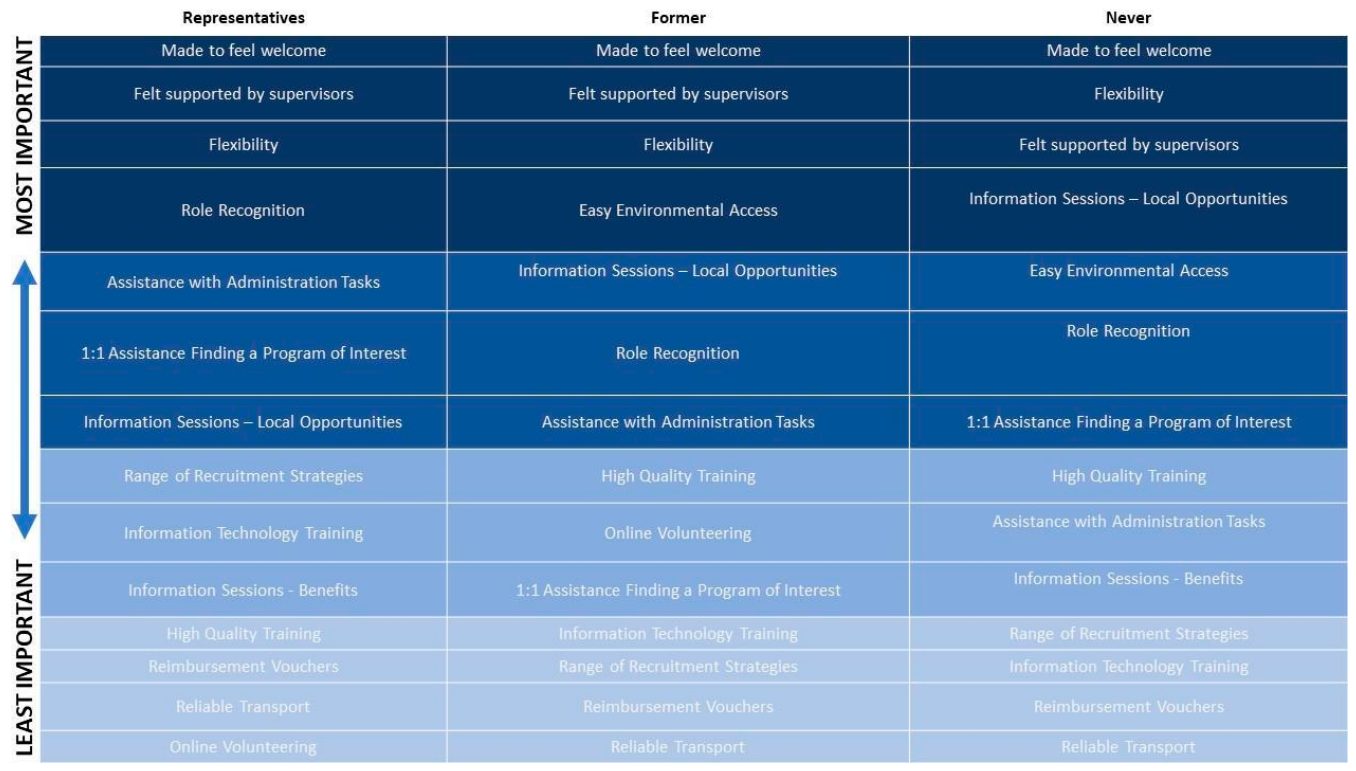
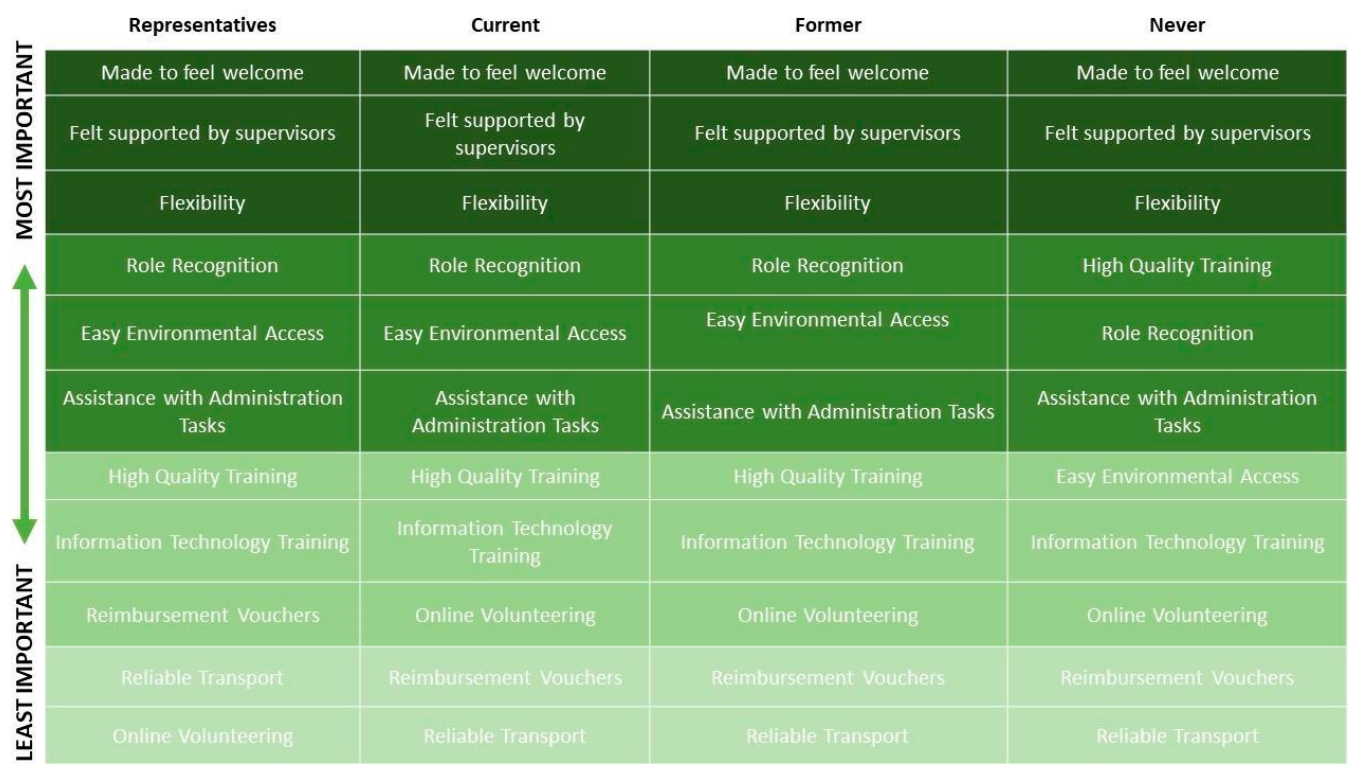
The median (IQR) for responses to each item by each participant group are included in Table 3 (volunteering commencement) and Table 4 (volunteering continuation). The highest scoring items for commencement or recommencement for each group were that volunteers were made to feel welcome (Participant Group (Median, IQR): Representatives (5, 5-5), Former (5, 4-5) and Never volunteers (5, 5-5)). The second highest scoring priority for representatives and former volunteers was that volunteers felt supported by supervisors (Participant Group (Median, IQR): Representatives (5, 5-5), Former (5, 4-5), whereas for never volunteers it was programme flexibility (Median, IQR) (5, 4-5) (see Table 3). The highest scoring items for each group for continuation were also volunteers made to feel welcome (Participant Group (Median, IQR): Representatives (5, 5-5); Current (5, 5-5); Former (5, 4-5); Never (5, 4-5) and volunteers felt supported by supervisors for the Former group (5, 4-5). Lowest scoring items for commencement were reliable transport for former (2, 1-3) and never volunteers (1, 1-3) and online volunteering for representatives (3, 2-3). The lowest-scoring items for continuation were the same (Median, IQR): reliable transport for the current (1, 1-3); former (2, 1-3) and never (3, 1-3) volunteers and online volunteering for representatives (3, 2-3) (see Table 4).
Table 3.
Median (IQR) for volunteering (re)commencement. 1 = Not At All Important, 2 = Slightly Important, 3 = Neutral, 4 = Moderately Important, 5 = Very Important.
Table 4.
Median (IQR) for volunteering continuation. 1 = Not At All Important, 2 = Slightly Important, 3 = Neutral, 4 = Moderately Important, 5 = Very Important.
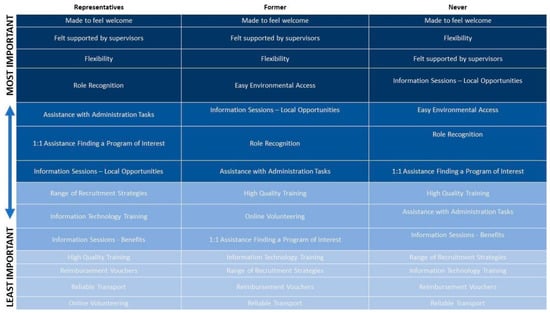
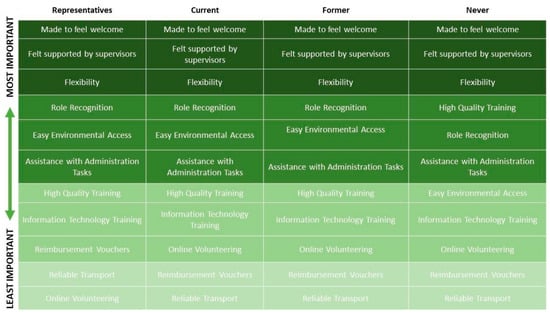
The priorities of each group are displayed in order from most important to least important for (re)commencement (Figure 1) and continuation (Figure 2).
Figure 1.
Ranked priorities of each group for volunteering (re)commencement.
Figure 2.
Ranked priorities of each group for volunteering continuation.
Differences between participant groups are outlined in Table 5, Table 6 and Table 7. Pairwise comparisons were conducted between current volunteers and former volunteers on survey items regarding continuation of volunteering. Former volunteers gave significantly higher importance scores for items of reimbursement vouchers, information technology training, reliable transport (q = 0.003) and the option for online volunteering (q = 0.044). Current volunteers scored being made to feel welcome significantly higher (q = 0.003).
Table 5.
Current Volunteers vs. Former Volunteers on survey items regarding continuation of volunteering. (Positive coef scores indicate former volunteers scored items as more important).
Table 6.
Representatives vs. former volunteers on items regarding volunteer commencement. (Negative coef scores indicate former volunteers scored items as less important).
Table 7.
Representatives vs. Never Volunteers on items regarding volunteer commencement. (Negative scores indicate Never volunteers scored items as less important).
Pairwise comparisons were conducted between representatives and former volunteers regarding volunteering commencement. Former volunteers had significantly lower (q = 0.001) importance scores for all but one item (online volunteering). Pairwise comparisons were also conducted between representatives and never volunteers regarding commencement. Never volunteers had significantly lower importance scores (q < 0.05) for all but four items (1:1 assistance, finding a programme, programme flexibility, volunteers made to feel welcome and online volunteering).
4. Discussion and Conclusions
Potential and current older adult volunteers value programs and organisations with an inclusive culture and with supportive management as the most important factors in their decisions to commence and continue volunteering. Our research indicates that there are factors that volunteers find important that relate to how an organisation interacts with them at an interpersonal level and may be a useful starting point for considering how to maximise participation. There is a need to investigate what volunteer organisations and programs can tangibly action to make their volunteers feel more welcome and supported.
Former volunteers valued four items higher than current volunteers: reimbursement vouchers, reliable transport, information technology training and the opportunity to volunteer online. These differences may explain why some older adults continue volunteering and others cease; however, causal inference should not be assumed given the cross-sectional design of this study. In addition, it is possible that the participants’ current experiences with volunteering or not volunteering are the influencing factors for their ratings of different items. Volunteer organisations and governments may choose to explicitly address these items to encourage continued participation and when targeting recruitment towards the re-commencement of former volunteers. Online volunteering was rated more important by former volunteers compared with current volunteers. This may imply that online volunteering is more highly regarded by those who are not currently volunteering. There is a need to further investigate opportunities to volunteer online for former volunteers, which points to a potential solution to increase volunteer rates [21]. Recent studies report that older adults’ willingness to volunteer online is associated with their perceived usefulness of digital technologies, their self-efficacy with using information technology and their willingness to improve their technical competence [22,23]. Older adults perceive both benefits and challenges to online volunteering, including increased opportunities and potentially decreased personal connections [24,25]. In addition, these differences suggest that it is inappropriate to only seek input from current volunteers about what is important to their continued participation, as their responses seemingly do not apply to all older adults.
Representatives significantly overestimated how highly former and never volunteers value almost all items. Representatives were predominantly younger or middle-aged adults who did not share the life stages or experiences of former volunteers or never volunteers, potentially limiting the relevance of their insights for these groups. Their perspectives may also reflect cognitive bias, given that they primarily work with current volunteers who do not require recruitment. They may also assume that their current strategies are both appropriate and important, given their involvement in implementing them. Compounding this issue, existing training and policy frameworks may be outdated and insufficient, leaving representatives unable to accurately identify what former and never volunteers value. These limitations underscore the importance of this research in addressing critical knowledge gaps and informing more effective recruitment strategies. Current recruitment and retention strategies addressing these items may not be the best use of funding and resources, as they may not be considered important by potential volunteers. These results suggest that the priorities of Never and Former volunteers may be misunderstood, and there may be priorities that are currently being over-represented and others that are being unaddressed.
Governments and volunteer organisations may be able to use the results of this research to inform their older adult volunteer recruitment and retention strategies. Policy-makers should consider these priority enabling factors when creating strategies to recruit volunteers and when allocating funds. Existing programs and organisations that aim to increase volunteering have already adopted strategies that align with some of the highly ranked enablers and barriers in this study. For example, Volunteer Resource Centres in Victoria [26] offer one-to-one assistance to prospective volunteers, helping them identify suitable roles and organisations. However, whether these individuals ultimately feel welcomed, supported by supervisors, and able to access flexible opportunities depends on their direct experience within the volunteer organisation rather than the support provided by the Resource Centre. Another example of a current recruitment strategy is Volunteering Australia’s mobile phone application [27]. This research did not address the use of mobile phone applications; this may be an area for future research. What is not clear with the implementation of these recruitment and retention strategies is whether volunteers perceive them as achieving their aims and whether they are effective. These investigations could be areas for future research. This study supports previous work investigating enablers and barriers to older adult volunteering. Multiple papers reported on the importance of volunteer organisations having an inclusive culture [12,28,29,30,31,32,33]; supportive supervisors [29,34,35,36,37,38,39,40,41,42,43]; and flexibility [12,13,29,34,35,36,42,44,45,46] as enabling factors to increased and maintained volunteering participation. This paper further contributes to the literature by prioritising these previously identified modifiable enabling factors, which may inform government and volunteer organisation policy and practice.
This study has some limitations. The study was conducted in the Australian context, so survey results may only be applicable to older adults of a similar demographic and may not apply to different cultures or older adults with different socioeconomic backgrounds and health statuses. There were imbalances across the recruited participants, including for gender (predominantly female), geographic concentration (predominantly metropolitan areas in the state of Victoria) and participant group numbers (never volunteers represented 5.4% of the total sample). There was sampling bias, whereby only those willing to voluntarily complete the survey were likely to share their opinions. Results should be interpreted with caution because they may not fully capture the perspectives of never volunteers, a group that remains largely unexplored yet holds considerable potential for strengthening older adult participation.
In addition, people with no volunteering experience or interest may be less inclined to complete this survey, and therefore their perspectives may be under-represented. Questions in this survey were hypothetical in nature, measuring the potential importance of each item. No true measure of actual behaviour change was measured. There was an increased risk of a Type I statistical error due to conducting multiple pairwise comparisons in the analysis. Participants were predominantly based in metropolitan areas and in Victoria, despite the online survey being available to all of Australia. There is a need for further research in rural areas and different socioeconomic and cultural community contexts.
Current volunteers were not asked which factors were important to their potential commencement because they had already commenced volunteering. On reflection, current volunteers could have been asked to rank the importance of each factor to their initial volunteering commencement. There were issues with validation of the survey as a new instrument due to study constraints. The survey was pilot tested by only two older adults but not formally evaluated and validated by an expert. These validity limitations introduce uncertainty about whether the instrument measured the intended concepts consistently across participants, which in turn reduces confidence in the reliability and interpretability of the study’s conclusions. Without these foundational checks, any observed group differences may partly reflect measurement artefacts rather than true underlying differences. In addition, the survey was not available in languages other than English, and digital exclusion was not addressed, although it is a relevant consideration for the older adult population. This likely affected access and inclusion of part of the community, including those who may potentially be never volunteers due to such examples of societal exclusion. Results should be interpreted with caution, as they may not be truly reflective of the entire Australian older adult community.
Future research should investigate how volunteer organisations and other stakeholders can practically implement ways to make volunteers feel welcome and supported. Future research would likely assist in gaining various perspectives to potentially make these concepts more actionable. There is an opportunity to further investigate online volunteering and whether it would increase the participation of older adults who have formerly or never volunteered. It would be appropriate to conduct similar studies in different cultural contexts and in areas with known socioeconomic and health disparities. There is also a need to target recruitment of Never volunteers to more adequately investigate their views. Further analysis of the reasoning behind the highest-rated priorities is needed to inform interventions that may enhance participation. The impact of such interventions on actual older adult volunteer participation rates could then be investigated.
Author Contributions
All authors contributed to conception and methodology. N.W. contributed to data curation, investigation, administration, resources, validation and visualisation. N.W. and T.H. contributed to analysis. D.P., M.M., D.M. and T.H. (lead) contributed to supervision. All authors contributed to writing original draft preparation, review and editing, led by N.W. All authors have read and agreed to the published version of the manuscript.
Funding
This research received no external funding.
Institutional Review Board Statement
The study was conducted in accordance with the Declaration of Helsinki. Ethics approval for this study was obtained from the Monash University Human Research Ethics Committee (Project ID 47057, date: 6 June 2025) in accordance with the provisions of Australia’s National Statement on Ethical Conduct in Human Research 2025 [11].
Informed Consent Statement
Informed consent was obtained from all subjects involved in the study.
Data Availability Statement
The data supporting the findings of this study are openly available in Bridges at https://doi.org/10.26180/32583231.
Acknowledgments
This work was supported by the Australian Government Research Training Program and Monash University.
Conflicts of Interest
The authors declare no conflicts of interest.
Abbreviations
The following abbreviations are used in this manuscript:
| SD | Standard Deviation |
| IQR | Interquartile Range |
| UK | United Kingdom |
Appendix A. Survey Questionnaire
Appendix A.1. Demographics
| Q2 Please select your age bracket: |
|
| Q3 Please select your gender: |
|
| Q4 Please enter your postcode: ________________________________________________________________ |
| Q5 How recently did you retire? |
|
| Q6 Please select which one of the following best applies to you |
|
| Q7 How would you best describe your current volunteer activity? For example, food kitchen, teaching children, environmental, healthcare (Current volunteers only). ________________________________________________________________ ________________________________________________________________ ________________________________________________________________ ________________________________________________________________ ________________________________________________________________ |
| Q31 How would you best describe your previous volunteer activity? For example, food kitchen, teaching children, environmental, healthcare (Former volunteers only). ________________________________________________________________ ________________________________________________________________ ________________________________________________________________ ________________________________________________________________ ________________________________________________________________ |
| Q8 How would you best describe the volunteer activity your program or organisation coordinates (Representatives only)? ________________________________________________________________ ________________________________________________________________ ________________________________________________________________ ________________________________________________________________ ________________________________________________________________ |
| Q9 How many years have you volunteered in your current role (Current vounteers only)? |
|
| Q10 How many years have you volunteered overall in any role (Current volunteers only)? |
|
| Q11 How many years had you previously volunteered in total before stopping (Former volunteers only)? |
|
Appendix A.2. Representatives
| Q12 How important do you believe each of the following items would be for older adults to commence participation in a volunteer program? | |||||
| Not At All Important | Slightly Important | Neutral | Moderately Important | Very Important | |
| If there were information sessions about the benefits of volunteering |  | | | | |
| If there were information sessions about local volunteering opportunities | | | | | |
| If they had one-on-one assistance to find a program of interest | | | | | |
| If they were given vouchers reimbursing them for associated costs | | | | | |
| If they had training until they were confident with using computers and technology in their role | | | | | |
| If they were provided with reliable transport (e.g., carpooling) | | | | | |
| If the program had high quality, targeted training | | | | | |
| If the program was flexible with their schedule and other life activities | | | | | |
| If organisations used a wide range of recruitment strategies (e.g., newspaper ads, approaching community groups) | | | | | |
| If an organisation made volunteers feel welcome | | | | | |
| If an organisation was easy to access (e.g., disabled parking, ramps) | | | | | |
| If an organisation recognised the role of volunteers (e.g., Volunteer Appreciation Month, certificates) | | | | | |
| If volunteers felt supported by supervisors and managers | | | | | |
| If an organisation assisted them with administration tasks (e.g., organising their Police Check) | | | | | |
| If they could volunteer online | | | | | |
| Q13 How important do you believe each of the following items would be for older adults to continue participating in a volunteer program? | |||||
| Not At All Important | Slightly Important | Neutral | Moderately Important | Very Important | |
| If they were given vouchers reimbursing them for associated costs | | | | | |
| If they had training until they were confident with using computers and technology in their role | | | | | |
| If they were provided with reliable transport (e.g., carpooling) | | | | | |
| If the program had high quality, targeted training | | | | | |
| If the program was flexible with their schedule and other life activities | | | | | |
| If an organisation made volunteers feel welcome | | | | | |
| If an organisation was easy to access (e.g., disabled parking, ramps) | | | | | |
| If an organisation recognised the role of volunteers (e.g., Volunteer Appreciation Month, certificates) | | | | | |
| If volunteers felt supported by supervisors and managers | | | | | |
| If an organisation assisted them with administration tasks (e.g., organising their Police Check) | | | | | |
| If they could volunteer online | | | | | |
Appendix A.3. Current Volunteers
| Q14 How important would each of the following items be to your continued participation in a volunteer program? | |||||
| Not At All Important | Slightly Important | Neutral | Moderately Important | Very Important | |
| If you were given vouchers reimbursing you for associated costs | | | | | |
| If you had training until you were confident with using computers and technology in your role | | | | | |
| If you were provided with reliable transport (e.g., carpooling) | | | | | |
| If the program had high quality, targeted training | | | | | |
| If the program was flexible with your schedule and other life activities | | | | | |
| If an organisation made you feel welcome | | | | | |
| If an organisation was easy to access (e.g., disabled parking, ramps) | | | | | |
| If an organisation recognised the role of volunteers (e.g., Volunteer Appreciation Month, certificates) | | | | | |
| If you felt supported by supervisors and management | | | | | |
| If an organisation assisted you with administration tasks (e.g., renewing your Police Check) | | | | | |
| If you could volunteer online | | | | | |
Appendix A.4. Former Volunteers
| Q15 How important would each of the following items be for you to re-commence participating in a volunteer program? | |||||
| Not At All Important | Slightly Important | Neutral | Moderately Important | Very Important | |
| If there were information sessions about the benefits of volunteering | | | | | |
| If there were information sessions about local volunteering opportunities | | | | | |
| If you had one-on-one assistance to find a program that interests you | | | | | |
| If you were given vouchers reimbursing you for associated costs | | | | | |
| If you had training until you were confident with using computers and technology in your role | | | | | |
| If you were provided with reliable transport (e.g., carpooling) | | | | | |
| If the program had high quality, targeted training | | | | | |
| If the program was flexible with your schedule and other life activities | | | | | |
| If organisations used a wide range of recruitment strategies (e.g., newspaper ads, approaching community groups) | | | | | |
| If an organisation made volunteers feel welcome | | | | | |
| If an organisation was easy to access (e.g., disabled parking, ramps) | | | | | |
| If an organisation recognised the role of volunteers (e.g., Volunteer Appreciation Month, certificates) | | | | | |
| If you felt supported by supervisors and management | | | | | |
| If an organisation assisted you with administration tasks (e.g., organising your Police Check) | | | | | |
| If you could volunteer online | | | | | |
| Q16 How important would each of the following items be for you to continue participating in a volunteer program? | |||||
| Not At All Important | Slightly Important | Neutral | Moderately Important | Very Important | |
| If you were given vouchers reimbursing you for associated costs | | | | | |
| If you had training until you were confident with using computers and technology | | | | | |
| If you were provided with reliable transport (e.g., carpooling) | | | | | |
| If the program had high quality, targeted training | | | | | |
| If the program was flexible with your schedule and other life activities | | | | | |
| If organisations used a wide range of recruitment strategies (e.g., newspaper ads, approaching community groups) | | | | | |
| If an organisation made volunteers feel welcome | | | | | |
| If an organisation was easy to access (e.g., disabled parking, ramps) | | | | | |
| If an organisation recognised the role of volunteers (e.g., Volunteer Appreciation Month, certificates) | | | | | |
| If you felt supported by Supervisors and Management | | | | | |
| If an organisation assisted you with administration tasks (e.g., organising your Police Check) | | | | | |
| If you could volunteer online | | | | | |
Appendix A.5. Never Volunteers
| Q17 How important would each of the following items be for you to commence participating in a volunteer program? | |||||
| Not At All Important | Slightly Important | Neutral | Moderately Important | Very Important | |
| If there were information sessions about the benefits of volunteering | | | | | |
| If there were information sessions about local volunteering opportunities | | | | | |
| If you had one-on-one assistance to find a program that interests you | | | | | |
| If you were given vouchers reimbursing you for associated costs | | | | | |
| If you had training until you were confident with using computers and technology in your role | | | | | |
| If you were provided with reliable transport (e.g., carpooling) | | | | | |
| If the program had high quality, targeted training | | | | | |
| If the program was flexible with your schedule and other life activities | | | | | |
| If organisations used a wide range of recruitment strategies (e.g., newspaper ads, approaching community groups) | | | | | |
| If an organisation made you feel welcome | | | | | |
| If an organisation was easy to access (e.g., disabled parking, ramps) | | | | | |
| If an organisation recognised the role of volunteers (e.g., Volunteer Appreciation Month, certificates) | | | | | |
| If you felt supported by supervisors and management | | | | | |
| If an organisation assisted you with administration tasks (e.g., organising your Police Check) | | | | | |
| If you could volunteer online | | | | | |
| Q18 How important would each of the following items be for you to continue participating in a volunteer program? | |||||
| Not At All Important | Slightly Important | Neutral | Moderately Important | Very Important | |
| If you were given vouchers reimbursing you for associated costs | | | | | |
| If you had training until you were confident with using computers and technology in your role | | | | | |
| If you were provided with reliable transport (e.g., carpooling) | | | | | |
| If the program had high quality, targeted training | | | | | |
| If the program was flexible with your schedule and other life activities | | | | | |
| If organisations used a wide range of recruitment strategies (e.g., newspaper ads, approaching community groups) | | | | | |
| If an organisation made you feel welcome | | | | | |
| If an organisation was easy to access (e.g., disabled parking, ramps) | | | | | |
| If an organisation recognised the role of volunteers (e.g., Volunteer Appreciation Month, certificates) | | | | | |
| If you felt supported by supervisors and management | | | | | |
| If an organisation assisted you with administration tasks (e.g., organising your Police Check) | | | | | |
| If you could volunteer online | | | | | |
Appendix B. Explanatory Statement and Consent
| Project ID: 47057 |
| Project Title: Co-Designing an Intervention to Maximise Older Adult Participation in Volunteering. |
| This research is being conducted by researchers at Monash University, including Mr Nathan Williams, Dr Dai Pu, Dr Marcelo Maghidman, Dr Debra Mitchell and Prof Terry Haines. You are invited to take part in this study. Please read this Explanatory Statement in full before deciding whether or not to participate in this research. If you would like further information regarding any aspect of this project, you are encouraged to contact the researchers via the phone numbers or email addresses listed at the end of this Explanatory Statement. |
| What does the research involve? |
| This project is investigating and prioritising the factors that impact upon older adults’ participation in volunteering activities to assist in better understanding why people commence, continue and stop volunteering. This involves an online survey asking you to rank the importance of a range of listed enablers and barriers to older adult volunteering participation. You will complete an online questionnaire including consent to participate and demographic questions. The survey will then provide a list of hypothetical volunteer program features and participants will be asked to rate how important each feature would be for them to commence or continue volunteering. Volunteer program representatives will be asked to rate based upon their perception of what might maximise participation for older adults. You will then be invited to enter your contact details if you are interested in participating in future research (focus groups). Completing this section is completely voluntary. All contact details are separate to the initial survey, so all answers to the initial survey remain confidential. |
| Why were you invited for this research? |
| You have been invited because you are a volunteer program representative or someone aged 60 years and over (or 50 years and over if you are Aboriginal or Torres Strait Islander). You are either a volunteer program representative, current volunteer, former volunteer or someone who has never volunteered. Volunteer program representatives must be aged 18 years or older. |
| Consenting to participate in the project and withdrawing from the research |
| You will be asked to complete an initial demographics survey. The first question in this survey will include this Explanatory Statement and consent can be completed by clicking the next button indicating that you understand and consent to participate. You can withdraw from this research at any time, without any implications by closing the survey at any time. |
| Possible benefits and risks to participants |
| Possible benefits of this research include a better understanding of why older adults may choose to volunteer or not. You may be contributing to your community and the health of older adults by helping us better understand how we might be able to maximise older adult participation in volunteering activities. Participation in this project is low risk and no adverse events are expected, including any psychological distress throughout its completion. If reflecting on any past experiences brings up any distressing memories or emotions, you are able to withdraw at any time, you are able to discuss any issues with the investigating team and you are encouraged to contact any of the support services below. |
| Services on offer if adversely affected |
| In the event that you feel psychological or emotional discomfort from reflecting on past experiences with volunteering, you are encouraged to contact: |
| Beyond Blue |
| beyondblue.com.au |
| 1300 22 4636 |
| Lifeline |
| lifeline.org.au |
| 13 11 14 |
| Alternatively, you can contact a researcher directly via the details provided at the bottom of this explanatory statement. |
| Payment |
| There is no financial reimbursement for completing the survey. Participation in this research is voluntary. |
| Confidentiality |
| All data will be stored confidentially on Qualtrics and Lab Archives, secure data storage systems that are only accessible by the research team. No confidential data will be published. Data will be reported via publication in a peer-reviewed journal, a report of summary of findings and conferences. |
| Storage of Data |
| Data will be stored on Lab Archives, Bridges and Qualtrics for a minimum of 5 years after the completion of the project. Data will only be accessible to members of the research team (present and future). The collected responses will be stored in accordance with Australian Privacy Regulations, and will be stored on a secure cloud-based server for 5 years. After this it will be deleted. Answers are being collected through Qualtrics (an online platform that allows surveys to be conducted) and you can access the privacy policy here: https://www.qualtrics.com/privacy-statement/ (accessed date 21 September 2026). |
| Results |
| A summary of results will be made available upon completion of the project. Results will be available via Monash University publications and in peer-reviewed journals once the research is approved for publication. |
| Complaints |
| Should you have any concerns or complaints about the conduct of the project, you are welcome to contact the Principal Investigator or Executive Officer, Monash University Human Research Ethics Committee (MUHREC), depending on your concern: |
| Principal Investigator: |
| Prof Terry Haines |
| Head of School School of Primary and Allied Health Care& National Centre for Healthy Ageing, Monash University |
| Email: terry.haines@monash.edu |
| Executive Officer Monash University Human Research Ethics Committee (MUHREC) Office of Research Ethics and Integrity Room 116, Administration Building B (3D) 26 Sports Walk, Clayton Campus Monash University VIC 3800 Tel.: +61 3 9905 2052 Email: muhrec@monash.edu |
| I have read and understood the information above, I am aged 18 and over, I am living in Australia and I consent to participate. |
References
- World Health Organization. Progress Report on the United Nations Decade of Healthy Ageing, 2021–2023; The World Health Organization: Geneva, Switzerland, 2023. Available online: https://iris.who.int/bitstream/handle/10665/374192/9789240079694-eng.pdf?sequence=1 (accessed on 18 April 2026).
- UK Government. Volunteer Opportunities, Rights and Expenses. 2026. Available online: https://www.gov.uk/volunteering (accessed on 18 April 2026).
- Williams, N.; Maghidman, M.; Pu, D.; Mitchell, D.; Haines, T. Health Benefits and Harms of Older Adult Volunteering: Mixed Methods Systematic Review. Gerontologist 2026, 66, gnag043. [Google Scholar] [CrossRef] [Scilit]
- National Seniors Australia. Older Australians and Volunteering. 2022. Available online: https://nationalseniors.com.au/uploads/NSA-2022-Volunteering-Report-final-July.pdf (accessed on 22 April 2026).
- Grotz, J.; Dyson, S.; Birt, L. Pandemic policy making: The health and wellbeing effects of the cessation of volunteering on older adults during the COVID-19 pandemic. Qual. Ageing Older Adults 2020, 21, 261–269. [Google Scholar] [CrossRef] [Scilit]
- Dederichs, K. Volunteering in the United Kingdom during the COVID-19 pandemic: Who started and who quit? Nonprofit Volunt. Sect. Q. 2023, 52, 1458–1474. [Google Scholar] [CrossRef] [Scilit]
- Organisation for Economic Cooperation and Development (OECD). How’s Life? 2024; OECD Publishing: Pairs, France, 2024. Available online: https://www.oecd.org/en/publications/2024/11/how-s-life-2024_bdcf2f9f.html (accessed on 23 April 2026).
- Biddle, N.; Gray, M. Ongoing Trends in Volunteering in Australia; ANU Centre for Social Research and Methods, Australian National University: Canberra, Australia, 2023; Available online: https://www.volunteeringaustralia.org/wp-content/uploads/Ongoing-trends-in-volunteering-in-Australia-November-2023.pdf (accessed on 22 September 2026).
- Australian Bureau of Statistics. General Social Survey: Summary Results, Australia. 2026. Available online: https://www.abs.gov.au/statistics/people/people-and-communities/general-social-survey-summary-results-australia/latest-release#voluntary-work-and-community-involvement (accessed on 29 April 2026).
- Dakanalis, A.; Psara, E.; Pavlidou, E.; Papadopoulou, S.K.; Antasouras, G.; Voulgaridou, G.; Kosti, R.I.; Vorvolakos, T.; Mentzelou, M.; Ntovoli, A.; et al. The impact of the COVID-19 pandemic in the interrelationships among mental health, nutritional status and lifestyle factors of older adults: A cross-sectional study in the pre-and post-Covid periods. Nutrients 2025, 17, 249. [Google Scholar] [CrossRef] [Scilit]
- Petriwskyj, A.M.; Warburton, J. Motivations and barriers to volunteering by seniors: A critical review of the literature. Int. J. Volunt. Adm. 2007, 24, 3–25. [Google Scholar]
- Warburton, J.; Stirling, C. Factors affecting volunteering among older rural and city dwelling adults in Australia. Educ. Gerontol. 2007, 33, 23–43. [Google Scholar] [CrossRef] [Scilit]
- Hansen, T.; Slagsvold, B. An “army of volunteers”? Engagement, motivation, and barriers to volunteering among the baby boomers. J. Gerontol. Soc. Work 2020, 63, 335–353. [Google Scholar] [CrossRef] [Scilit]
- Williams, N.; Pu, D.; Maghidman, M.; Mitchell, D.; Haines, T. Enablers and Barriers to Older Adult Participation in Volunteering: Mixed Methods Systematic Review. Australas. J. Ageing. 2026; Under review.
- National Health and Medical Research Council ARCaUA. National Statement on Ethical Conduct in Human Research; National Health and Research Council: Canberra, Australia, 2025.
- Cnaan, R.A.; Handy, F.; Wadsworth, M. Defining who is a volunteer: Conceptual and empirical considerations. Nonprofit Volunt. Sect. Q. 1996, 25, 364–383. [Google Scholar] [CrossRef] [Scilit]
- World Health Organization. World Report on Ageing and Health; WHO: Geneva, Switzerland, 2015. Available online: https://iris.who.int/server/api/core/bitstreams/5174879e-b0dc-43fc-b3a8-b1db31c51d4c/content (accessed on 29 April 2026).
- Australian Institute of Health and Welfare. Older Aboriginal and Torres Strait Islander People. 2024. Available online: https://www.aihw.gov.au/reports/older-people/older-australians/contents/population-groups-of-interest/indigenous-australians (accessed on 29 April 2026).
- Qualtrics XM Platform; Qualtrics: Provo, UT, USA, August 2025.
- Monash City Council. Community Grants and Partnerships. 2026. Available online: https://www.monash.vic.gov.au/Community/Grants-and-Funding/Community-Grants-and-Partnerships (accessed on 2 May 2026).
- Ackermann, K.; Manatschal, A. Online volunteering as a means to overcome unequal participation? The profiles of online and offline volunteers compared. New Media Soc. 2018, 20, 4453–4472. [Google Scholar] [CrossRef] [Scilit]
- Sui, L.; Crittenden, J.A.; Hager, M.A. Exploring Older Adults’ Interest in Virtual Volunteering: Evidence from a Multi-Theoretical Model Combining TAM, Self-Efficacy, and Digital Divide Perspectives. Behav. Sci. 2025, 15, 1340. [Google Scholar] [CrossRef] [Scilit]
- Jokisch, M.R.; Göbl, L.; Schlichting, J.; Leopold, D.; Doh, M. ICT volunteering as a protective factor for older adults: Investigating motives of internet use, internet self-efficacy and perceived obsolescence. Educ. Gerontol. 2023, 49, 387–399. [Google Scholar] [CrossRef] [Scilit]
- Sun, P.C.; Morrow-Howell, N.; Pawloski, E.; Helbach, A. Older adults’ attitudes toward virtual volunteering during the COVID-19 pandemic. J. Appl. Gerontol. 2021, 40, 953–957. [Google Scholar] [CrossRef] [Scilit]
- Sun, P.C.; Morrow-Howell, N.; Pawloski, E. Pandemic pivots for older volunteers: Online tutoring and pen pal programs. J. Gerontol. Soc. Work. 2023, 66, 548–566. [Google Scholar] [CrossRef] [Scilit]
- Volunteering Victoria. Volunteer Support in Your Region. 2026. Available online: https://www.volunteeringvictoria.org.au/for-volunteers/volunteer-support-in-your-region/ (accessed on 2 May 2026).
- Volunteering Australia. Volunteering Resource Hub. 2026. Available online: https://volunteeringhub.org.au/ (accessed on 2 May 2026).
- Landry, C. A Phenomenological Investigation of the Factors That Influence Motivation, Recruitment and Retention of Volunteers Age 65 and Over; Pepperdine University: Malibu, CA, USA, 2017. [Google Scholar]
- Sellon, A. The importance of meaningful participation: Health benefits of volunteerism for older adults with mobility-limiting disabilities. Ageing Soc. 2023, 43, 878–901. [Google Scholar] [CrossRef] [Scilit]
- Cheung, C.-K.; Kwan, A.-H. Inducting older adults into volunteer work to sustain their psychological well-being. Ageing Int. 2006, 31, 44–58. [Google Scholar] [CrossRef] [Scilit]
- Lee, S.; Saito, T.; Takahashi, M.; Kai, I. Volunteer participation among older adults in Japan: An analysis of the determinants of participation and reasons for non-participation. Arch. Gerontol. Geriatr. 2008, 47, 173–187. [Google Scholar] [CrossRef] [Scilit]
- Withall, J.; Thompson, J.L.; Fox, K.R.; Davis, M.; Gray, S.; De Koning, J.; Lloyd, L.; Parkhurst, G.; Stathi, A. Participant and public involvement in refining a peer-volunteering active aging intervention: Project ACE (Active, Connected, Engaged). Gerontologist 2018, 58, 362–375. [Google Scholar] [CrossRef] [Scilit]
- Chang, S.-H.; Wang, S.-C.; Lin, H.-H.; Chao, C.-H.; Yu, C.-L. Lohas Living for Seniors: The Journey of Older Adults Participating in Volunteer Activities. Tzu Chi Nurs. J. 2019, 18, 63–73. [Google Scholar]
- Mehta, K.K.; Yunong, H. A cross-national study of senior volunteers in two non-governmental organisations in Singapore and PR China. Hallym Int. J. Aging 2004, 6, 157–173. [Google Scholar] [CrossRef] [Scilit]
- Kritz, M.; Ntoumanis, N.; Mullan, B.; Stathi, A.; Thøgersen-Ntoumani, C. Volunteer motivation and retention of older peer walk leaders: A 4-month long investigation. Gerontologist 2021, 61, 1118–1130. [Google Scholar] [CrossRef] [Scilit]
- McBride, A.M.; Greenfield, J.C.; Morrow-Howell, N.; Lee, Y.S.; McCrary, S. Engaging older adult volunteers in national service. Soc. Work Res. 2012, 36, 101–112. [Google Scholar] [CrossRef] [Scilit]
- Varma, V.R.; Carlson, M.C.; Parisi, J.M.; Tanner, E.K.; McGill, S.; Fried, L.P.; Song, L.H.; Gruenewald, T.L. Experience Corps Baltimore: Exploring the stressors and rewards of high-intensity civic engagement. Gerontologist 2015, 55, 1038–1049. [Google Scholar] [CrossRef] [Scilit]
- Bronstein, L.R.; Mason, S.E. A serial focus group model for understanding experiences of older adult volunteers and non-profit agency managers. Groupwork 2013, 23, 67–87. [Google Scholar] [CrossRef] [Scilit]
- Tiittanen, U.; Turjamaa, R. Social Inclusion and Communality of Volunteering: A Focus Group Study of Older People’s Experiences. Int. J. Environ. Res. Public Health 2022, 19, 5141. [Google Scholar] [CrossRef] [Scilit]
- Sellon, A.M. Volunteerism Among Older Adults with Mobility-limiting Disabilities: An Exploratory Study; University of Kansas: Lawrence, KS, USA, 2018. [Google Scholar]
- Misener, K.; Doherty, A.; Hamm-Kerwin, S. Learning from the experiences of older adult volunteers in sport: A serious leisure perspective. J. Leis. Res. 2010, 42, 267–289. [Google Scholar] [CrossRef] [Scilit]
- Stathi, A.; Withall, J.; Agyapong-Badu, S.; Barrett, E.; Kritz, M.; Wills, D.; Thogersen-Ntoumani, C.; Fox, K.R. Mobilising people as assets for active ageing promotion: A multi-stakeholder perspective on peer volunteering initiatives. BMC Public Health 2021, 21, 150. [Google Scholar] [CrossRef] [Scilit]
- Han, A.; Brown, D.; Richardson, A. Older adults’ perspectives on volunteering in an activity-based social program for people with dementia. Act. Adapt. Aging 2019, 43, 145–163. [Google Scholar] [CrossRef] [Scilit]
- Celdrán, M.; Villar, F. Volunteering among older Spanish adults: Does the type of organization matter? Educ. Gerontol. 2007, 33, 237–251. [Google Scholar] [CrossRef] [Scilit]
- Tang, F.; Morrow-Howell, N.; Choi, E. Why do older adult volunteers stop volunteering? Ageing Soc. 2010, 30, 859–878. [Google Scholar] [CrossRef] [Scilit]
- Pardasani, M. Motivation to volunteer among senior center participants. J. Gerontol. Soc. Work 2018, 61, 313–333. [Google Scholar] [CrossRef] [Scilit]

Disclaimer/Publisher’s Note: The statements, opinions and data contained in all publications are solely those of the individual author(s) and contributor(s) and not of MDPI and/or the editor(s). MDPI and/or the editor(s) disclaim responsibility for any injury to people or property resulting from any ideas, methods, instructions or products referred to in the content. |
© 2026 by the authors. Licensee MDPI, Basel, Switzerland. This article is an open access article distributed under the terms and conditions of the Creative Commons Attribution (CC BY) license.