


Abstract
Background: Vision is essential for ageing well, supporting the independence and quality of life of older people. The aim of this study is to define the role of an optometrist in an embedded allied health multidisciplinary team (EAHOP). Methods: This was a mixed-methods implementation study conducted within a pragmatic paradigm with optometrists conducting comprehensive vision and eye health assessments for all residents. The impact of visual function was measured using the National Eye Institute Visual Functioning Questionnaire–25 (NEI VFQ-25). Results: Twenty-nine of the 36 recruited participants opted in for optometry assessments. Vision impairment was identified in most participants (65%), defined as best-corrected visual acuity > 0.3 logMAR in the better eye. Participants with vision impairment had lower scores on vision-specific items on NEI VFQ-25 than those without impairment but scored higher for general health items (45.6 ± 6.8 vs. 39.4 ± 15.3); however, the NEI VFQ-25 has not been validated in this population. Optometry interventions were provided for 24 (82.7%) of the participants who received assessments, including new or updated spectacle prescriptions, referrals to ophthalmologists, eye care, vision aids, and environmental modification. Conclusions: This novel study suggests the important role of optometrists in promoting eye health and vision assessment in nursing homes, and the value of their inclusion in multidisciplinary teams.
1. Introduction
Australia’s ageing population is increasing. There are currently 1.2 million people aged 80 years and over, which is expected to double within 20 years [1], leading to greater demand for aged-care services [2]. Visual impairment, classified as impairments impacting distance, near visual acuity and contrast sensitivity, is common in older people [3], and is expected to increase with advancing age [4]. Vision impairment is high in nursing homes in Australia (called Residential Aged Care in Australia), with around 78% of residents having some form of eye disease [5]. Mobility [6], self-care ability [7], social integration [8], and cognition [9] are all affected in older people experiencing vision impairment. Older people with vision impairment are more likely to enter nursing homes [10,11], have an increased incidence of falls [12] and dementia [13,14], and poorer mental health [15,16] and quality of life [17]. Moreover, there is a bidirectional relationship between vision–cognitive impairment and frailty, where each condition amplifies the effects of the other [18,19]. Understandably, blindness has been ranked as the worst impairment or disease to be afflicted with [20]. However, over 90% of people with vision impairment have either preventable or correctable causes [21].
As older people living in nursing homes are more likely to experience vision impairment [16], correctable or treatable optometry services need to be provided to optimise residents’ vision to support independence and quality of life. Currently, there is poor accessibility to optometry services for older people in Australian nursing home settings [5]. Residents often require transport to clinics, which poses a considerable challenge due to physical and cognitive impairments commonly experienced by the population. Additionally, there is no routine screening for vision impairment in nursing home services [22], increasing reliance on either the residents, their families, or an already under-resourced system to identify and initiate services for eye care. In Australia, optometrists who provide services in nursing homes can be paid through the relevant Medicare Benefit Scheme item, although fewer than 5% of optometrists regularly provide services in nursing homes [23]. The Royal Commission into Aged Care Quality and Safety [24] recommended implementing novel models of allied health to reduce the rates of falls and improve quality of life in residents, including provision of optometry services [25]. To date, only one Australian intervention has published results on the provision of onsite, comprehensive eye services in nursing home settings, which found significant improvements in those presenting with near visual acuity, emotional impact of vision impairment, and quality of vision [22]. However, this was a single-discipline intervention that excluded residents with greater than moderate cognitive impairment and limited the generalisability of findings to the nursing home population, where many are living with dementia [26]. Despite the vital role of vision in maintaining health and wellbeing, optometrists are rarely included in multidisciplinary teams.
The enhanced allied health for older people in residential care (EAHOP) is the first known trial to include an optometrist as part of the multidisciplinary team to provide onsite, mobile comprehensive eyecare for residents in nursing homes [27]. The aim of this study is to define the role of an optometrist within an embedded allied health multidisciplinary team (EAHOP), with secondary aims of identifying ocular problems and their impact, describing perceived learning opportunities for optometry students, and detailing the implementation of the optometry role.
2. Materials and Methods
2.1. Study Design and Setting
This implementation study reports on the optometry arm of the EAHOP trial, which aimed to implement an evidence-based, multidisciplinary allied health model of care in nursing homes [27]. The model of care involved a general practitioner, a registered nurse (clinical liaison manager), allied health clinicians (occupational therapist, physiotherapist, dietitian, optometrist, speech therapist, and pharmacist), and allied health assistants who implemented evidence-based interventions related to managing frailty, preventing falls, and maintaining engagement in everyday activities [27]. The EAHOP trial was a pre–post study, with a baseline period of 6 weeks, intervention period of up to 36 weeks, and a follow-up period of 24 weeks. The study reported in this manuscript was a convergent mixed-methods evaluation of the optometry intervention within the EAHOP trial, where quantitative and qualitative data were collected in parallel and integrated during analysis [28]. This research was situated in the pragmatism paradigm, which embraces a plurality of methods and focuses on solving practical problems within the real world [29]. The qualitative component of this study was conducted with a qualitative descriptive approach [30]. This approach is useful for addressing problems that are not focused on theoretical understanding, but rather focused on quality improvements and change within the practical setting by providing straightforward description of perceptions and experiences [31]. Qualitative description is best aligned with relativism and interpretive ontology and epistemology [32]. Relativism posits that “no one reality can exist as each individual will assign their own interpretation and meaning” [33], and interpretivism argues that truth and knowledge are subjective, and as such, embraces the subjectivity of the researcher and its participants [34]. This study was approved by the University of Canberra Human Research Ethics Committee (App #11658) and conducted according to the Declaration of Helsinki.
2.2. Model of Care
The broader study’s model of care was informed by the Institute for Healthcare’s Improvement 4 Ms framework for an age-friendly health system [35]. The four Ms include (1) what matters, (2) mentation, (3) medication, and (4) mobility. The detailed model of care for the trial, including the multidisciplinary workflow, is described in the published protocol [27]. The optometry arm of the trial involved providing a comprehensive onsite, mobile assessment of visual function to address visual impairments that could contribute to the risk of falls. It is described in detail below.
2.3. Participant Recruitment
This study was conducted at a not-for-profit, nursing home in Canberra, Australia. The nursing home provides 100 beds across six households, including one dedicated memory support unit providing care for some residents with dementia. The home provides 24 h care as well as support for personal care, clinical, and leisure activities. Residents requiring optometry services usually need to organise appointments in the community; otherwise, a local optometrist provides ad hoc visits based on availability. This study had five participant groups: (1) residents participating in the EAHOP trial; (2) the study optometrist; (3) the student optometrists who performed assessments and prescribed interventions as part of their clinical placement; (4) nursing home staff; and (5) a subgroup of resident participants and their family members who were included to explore their experiences of living in nursing homes and participating in EAHOP.
All new or existing permanent residents of the home were eligible to participate in the trial, including those with a diagnosis of dementia or cognitive impairment. For residents with severe dementia or those on an end-of-life pathway, consultation with the medical and nursing team was conducted to determine if they could be ethically included. The trial was promoted through the nursing home’s usual communication pathways, including newsletters, resident meetings, and flyers distributed throughout the home. We also promoted the programme at multiple resident meetings prior to recruitment. We had ethics-approved flyers promoted in the facility’s e-newsletter and printed versions placed around the facility. Residents presenting with severe dementia, end-of-life status, communication impairment, or low capacity were not excluded from participating in the study. Resident participants were recruited through self-volunteering, nomination by family members, Enduring Power of Attorney (EPOA), staff, or through word of mouth from enrolled participants. Residents who were nominated by staff were contacted by EAHOP staff to discuss participation. Residents were recruited into seven groups of up to seven people, with each group starting the intervention two weeks after the preceding group. Since the recruitment strategy was an opt-in program, no one “declined” to participate; however, we had 1 resident who signed the consent form but later withdrew before the program started due to conflicting medical appointments. A nurse team leader conducted screening of allied health needs with participating residents and referred to each discipline in an opt-in approach. All residents or their EPOA provided written informed consent for their participation, including for participating in interviews. In the case of residents with a diagnosis of dementia, their designated family member or EPOA were contacted and consent was obtained.
2.4. Data Collection
2.4.1. Screening and Vision Assessment
In the baseline period, each participant was screened by the study’s clinical liaison manager to determine allied health needs. Participants screened during the initial interview as having vision impairment were offered a vision assessment as part of their intervention, and those who consented were referred to the optometrist in the trial for vision assessments. All ocular assessments were conducted by final-year optometry students at the University of Canberra, as part of their external placements for meeting accreditation requirements of endorsement by the Optometry Council of Australia and New Zealand, under the supervision of a qualified clinical optometrist. Visual function measures included refraction, distance and near visual acuity, on logMAR charts [36] and contrast sensitivity on a Pelli–Robson contrast sensitivity chart [37] with lower values representing better visual performance. Trial frame subjective refraction was completed at a 3 m testing distance and threshold termination rules included >2 errors on a single line [38]. If the participant could not resolve the largest set of letters on the acuity chart, the chart was moved to 1 m and repeated with an addition of +0.75D to correct for the test distance. If participants could not resolve any letters at 1 m, then the participant’s ability to count fingers, detect hand motions, or perceive light was evaluated in that order.
A neurological assessment was conducted by the assessment of confrontation fields, pupil responses, and ocular motilities. Ocular health was measured by direct ophthalmoscopy for assessment of the macula and media opacities following dilation with 2.5% Phenylephrine and 1.0% Tropicamide where not contraindicated. Lenticular opacities were assessed according to the Lens Opacities Classification System III [39]. Ocular surface disease was measured with fluorescein staining of the anterior segment according to the EFRON grading scales [40]. Intraocular pressure was measured with rebound tonometry (I-care, Helsinki, Finland).
Each participant and their relevant family/carer were involved in at least one case conference where the results of all allied health initial assessments, including optometry, were discussed and integrated. The results in consultation with the GP, the resident and their family were used to identify appropriate management strategies, any allied health team collaborative management required, and support interprofessional collaboration. Following the case conference, any optometry interventions were implemented.
2.4.2. Optometry Interventions
Interventions included prescribing spectacles, low-vision aids and environmental modification, or referral to ophthalmology. Spectacles and low-vision aids were ordered from the University of Canberra optometry clinic and delivered to the resident. Environmental modifications were conducted in collaboration with the occupational therapist on the EAHOP team and included adjustments in lighting and contrast of furniture and walls. If visual impairment was due to ocular pathology identified during examination, an appropriate referral to a medical specialist was drafted by the attending optometrist and forwarded to the nominated health professionals. Reports of the outcomes of vision assessment and recommendations were documented in the resident’s case notes. Follow-up appointments were arranged as necessary in response to review triggers.
2.4.3. Outcome Measures
The National Eye Institute Visual Functioning Questionnaire–25 (NEI VFQ-25) is a commonly used quality of life questionnaire in ophthalmology. We selected this patient-reported outcome measure due to its ease of administration and utility of the questionnaire for understanding the relationships between management of ocular disease and self-reported vision-related function. The vision-specific outcome measures were conducted in the baseline period prior to intervention. The impact of ocular pathology on visual function was measured with the NEI VFQ-25 [41]. The NEI VFQ-25 results are primarily driven by binocular vision status [42], which is often used as a measure of visual function in chronic eye diseases [41]. It includes eight subscales of near vision, distance vision, driving, ocular pain, role limitations, dependency, social function, and mental health, with single items for general health, general vision, peripheral vision, and coloured vision. Each subscale is scored on a scale of 0 (worst) to 100 (best).
The questionnaire was read out and recorded by the attending optometrist. Participants were given unrestricted time and privacy to understand and respond to the questions. If additional time was needed, a subsequent appointment was scheduled for this purpose. The questionnaire was scored manually according to the scoring algorithm. Both eyes were completed together and not considered separately. Quantitative data regarding implementation of the model of care were recorded, including the number of participants who had vision assessments conducted, interventions prescribed and accepted, ophthalmology referrals, and the direct and indirect time optometrists spent on resident care.
Secondary analysis of the interviews was performed for this study, where text relevant to the optometry arm of the EAHOP trial was extracted from the transcripts. The original purpose of the interviews was to obtain information on process evaluation, student placement experience, and resident and family member experiences before and during the trial. The process evaluation involved convenience sample of all EAHOP intervention staff and purposive sampling of leadership staff within the nursing home. The student placement experience involved purposive sampling of allied health students who experienced a placement at the nursing home through the EAHOP trial. A purposively sampled subgroup of residents and family members who participated in the EAHOP trial was interviewed to explore their experiences of living in the nursing home before and during the EAHOP trial. Unstructured, narrative interviews were conducted with the residents and their families to explore their experience of living in nursing homes before and during the trial, using an interpretive phenomenological analysis approach. Interviews were conducted by AP, an experienced qualitative researcher who was known to some participants. Semi-structured interviews were conducted with the optometrist, optometry students, and nursing home staff. Semi-structured interviews were conducted for the process evaluation and exploration of student placement experience in a nursing home, with interview guides supplied in the Supplementary File S1.
Data adequacy was determined by information power for the process evaluation and student placement experience interviews [43], and by interpretive phenomenological analysis principles for the resident and family interviews [44]. Whilst information power guided interpretation of data adequacy for the present study, the nature of secondary analysis of qualitative data limited the ability to achieve adequacy. The highly specific nature of this study meant fewer participants were needed; however, depth of resident and family interview data specifically relevant to the optometry service meant a higher number were needed than was available. This is primarily related to the unstructured interview approach, as the residents chose what to discuss rather than the interviewer. Interviews with the optometrist, optometry students, and nursing home staff were conducted following completion of their involvement in the trial. For residents and their family members, interviews were conducted around the time of completing their intervention period. The studies described have not yet been published. Using secondary data for analysis of discipline-specific evaluations was chosen to minimise participant burden. All interviews were transcribed using a third-party service and checked for accuracy by the AP. A researcher reviewed all transcripts and extracted data pertaining to the optometry arm of the EAHOP trial. Complete transcripts from the optometrist and optometry students were included, and sections from the transcripts of other participants’ interviews were contributed, discussing the optometry service or outcomes. Interviews were conducted between July 2024 and April 2025.
2.4.4. Statistical Analysis
We first assessed the normal distribution of continuous variables based on Skewness value. Accordingly, the variables with a Skewness value between −1 and 1 were considered normal. Categorical data were summarised using frequency statistics and visualisation. Continuous data were summarised using the mean ± SD or median (IQR) based on the normal distribution. To compare participant-level characteristics between those with and without vision impairment, we used independent sample t-tests for normally distributed continuous variables and the Mann–Whitney U test for non-normally distributed variables. Chi-squared tests (or Fisher’s exact test when expected cell counts were < 5) were used for categorical variables. Vision impairment was defined as best-corrected distance or near visual acuity in the better eye >0.3 logMAR [45]. A p-value of less than 0.05 was considered statistically significant. Pearson’s tests were utilised to evaluate correlations between ocular measures. To determine factors affecting vision impairment, we used generalised linear mixed models with participant ID as a random intercept to account for the correlation between the two eyes of the same participant. All ocular variables were defined as fixed effects. Based on clinical reasoning and the prior literature, we pre-specified a limited set of hypothesis-driven correlations between key ocular and participant-level variables. Only these pre-specified correlations are reported in the main text; a full correlation matrix is provided in the Supplementary Materials (Table S2). We used Spearman correlation in this analysis.
Given the small sample size and the exploratory nature of this study, all statistical tests were two-sided, and p-values < 0.05 were considered statistically significant without adjustment for multiple comparisons. However, findings with p-values approaching 0.05 should be interpreted with caution, and all results are presented with 95% confidence intervals to provide a more complete picture of the effect estimates.
Analysis of interviews was conducted using the manifest qualitative content analysis according to the methods outlined by Graneheim and Lundman [46]. This involved (1) familiarisation with interview transcripts; (2) extracting meaning units; (3) condensing meaning units; (4) labelling condensed meaning units with codes; and (5) grouping codes into sub-categories and categories. Qualitative analysis was led by the AP, an experienced qualitative researcher, and supported by the SI. Two interview transcripts were coded independently, and interpretations were discussed to deepen insights and explore alternative interpretations. Data analysis was conducted using NVIVO software (QSR International Version 12). Refer to Supplementary Table S1 for the qualitative coding tree.
2.4.5. Study Rigour
Validity and reliability of quantitative data were supported using trained assessors in data collection, audits of data accuracy, and selection of valid and reliable outcome measures and assessments. Trustworthiness of qualitative data was enhanced through fulfilment of the criteria outlined by Graneheim and Lundman [46]. Credibility was fulfilled through careful attention to participants’ views in analysis, achieved through the representativeness of categories and findings. Privacy and confidentiality were upheld throughout data collection, ensuring participants felt free to speak openly, and participant’s perspectives were accurately depicted through verbatim transcription and checking for understanding throughout interviews. Dependability was supported through peer debriefing and reflexive analysis journals during analysis. Transferability is supported by detailed description of the study setting and the implementation of the optometry model. The Standards for Reporting Qualitative Research guidelines were used to support reporting the qualitative component of this study [46] (Supplementary File S1).
3. Results
3.1. Sample Characteristics
A summary of participant demographics is presented in Table 1. In total, 36 participants were recruited for the trial, of which 29 (81%) consented to vision assessments. Most participants who agreed to vision assessments were vision-impaired (66%), and nine participants (31%) were pseudophakic. Most participants in vision assessments presented with only one ocular condition (41%). Optometry participants had a mean age of 86 (SD 6) years with a symmetrical distribution between genders (females, 50%). The prevalence of dementia among the participants was 44%. Table 1 provides data on participant characteristics.
Table 1.
Participant characteristics.
3.2. Implementation of the Model of Care
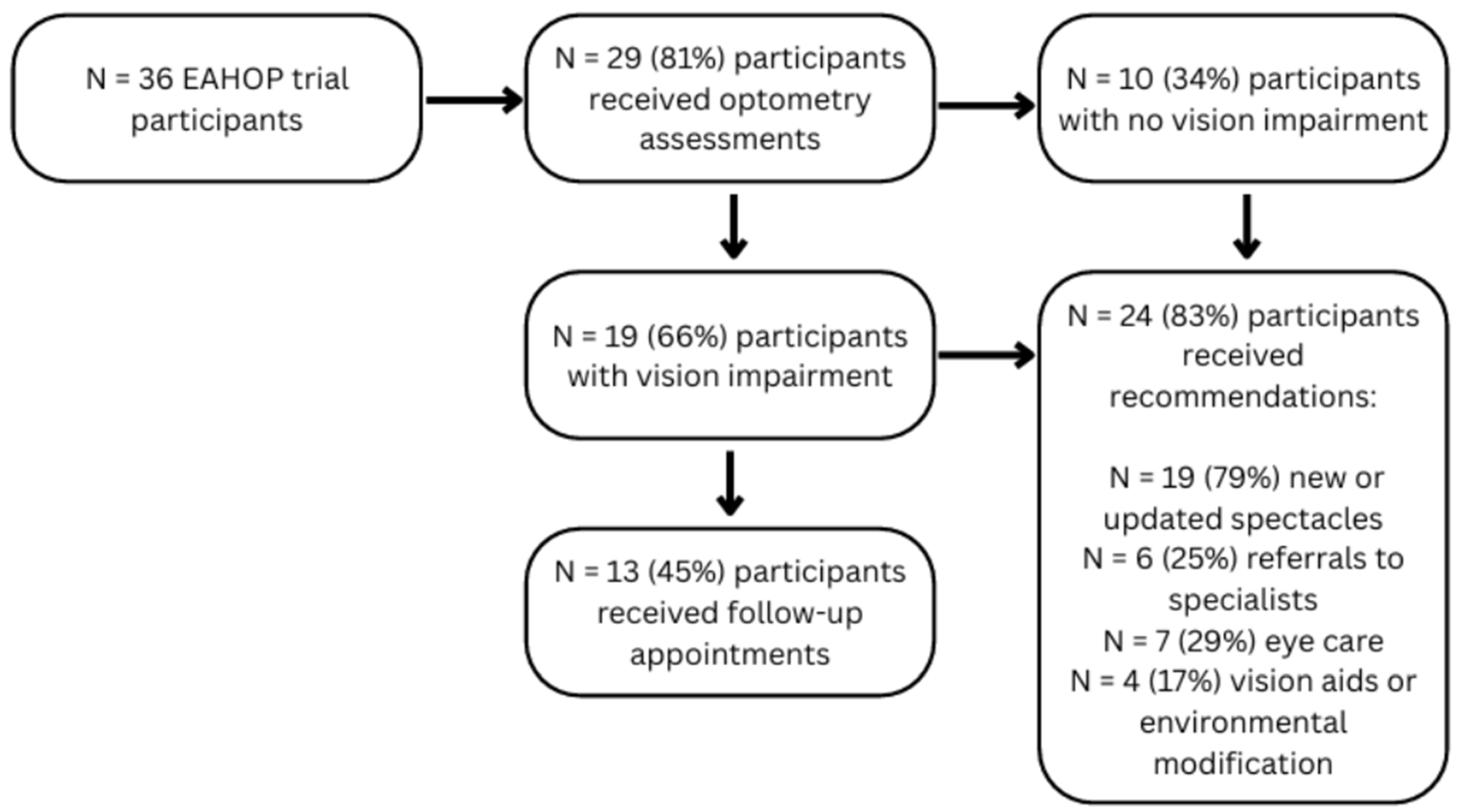
Optometrists delivered 2020 min of direct care and 450 min of indirect care, equating to 70 direct minutes and 16 indirect minutes per resident. Direct care involved conducting vision assessments, follow-up appointments, and case conferencing. Indirect care involved documenting assessments and collaboration with other members of the multidisciplinary team for intervention tailoring. Figure 1 provides an overview of the optometry service, including the assessments, interventions, and follow-up appointments made. The optometrist collaborated with the occupational therapist for four (14%) participants to support aid prescription, environmental modification, and quality of life. Of the thirteen residents who had follow-up appointments, nine had one follow-up, three had two follow-ups, and one had four follow-up appointments.
Figure 1.
Flowchart of optometry service.
3.3. Qualitative Results
Optometry-specific data were extracted from nine interviews; optometrist (n = 1), student optometrists (n = 3), nursing home staff (n = 1), resident (n = 1), and family members (n = 3). The optometrist had 11 years of industry experience, including 7 years as an optometrist. Interview duration for optometrist and optometry students ranged from 14.52 to 34.51 min. Interview participants were mostly female (78%).
3.4. Importance of Vision Health Services for Older People
Most participants discussed the importance of vision health services for older people. This included how assessing visual health played an important role in preventing and detecting other health conditions, such as diabetes or infections, that older people may be more predisposed to. Visual health was also discussed as being important for supporting cognition, safe mobility and quality of life. For example, one student optometrist reported how a resident was not comfortable walking at night due to their astigmatism, and in contrast another student stated that the programme helped them support patient choices, e.g., it is “nice to give a patient more autonomy or able to do their own tasks and have confidence to be able to do it” (Student 2).
3.5. Service Delivery
Participants reported key limitations with the current optometry services for older people living in nursing homes. Among the most notable were the many barriers impacting accessibility of optometry services, which included reliance on family members organising appointments, transport to and from appointments, and impaired mobility of residents impacting the journey between transport and storefronts.
“There aren’t many optometrists who would come to aged care facility, so the families would have to make an appointment and take them to see the optometrist and then have to take them back if they needed new prescription, when their glasses were ready … and that can be quite a challenge.”(Nursing Home Staff)
Additionally, the standard 30 min appointment times meant that there was limited time to discuss the results of eye assessments as residents often need additional time to allow for effective communication. The optometrist reflected that “I have a feeling that’s where a lot of their kind of misunderstanding or confusion lies because the practitioner needs to get everything done in about 28 min and then spend two minutes talking to them”. The final limitation reported by participants with usual optometry services for nursing homes is the widespread absence of funding and access to optometrists in multidisciplinary team-based care in nursing homes.
Providing onsite, comprehensive assessments as part of the EAHOP model of care was identified as a key contributor to improving access to optometry services for residents. This was reported to reduce the physical demand on residents and increase their comfortability during appointments. Additionally, the flexibility in scheduling and ongoing presence of the optometrists as part of the multidisciplinary team provided opportunities to accommodate residents’ schedules and fluctuating health, as well as being able to reiterate outcomes of assessments or recommendations.
The optometrists described a range of interventions prescribed to help residents with vision impairment. Most commonly, this included updating glasses prescriptions and prescribing low-vision aids, which included magnifying glasses or additional lighting, as well as other environmental modifications (e.g., contrasting colours in bathrooms, or the use of tape on silver handrails to increase usability and safety of residents’ rooms). Interventions also included education for eye health, such as eyelid hygiene to manage blepharitis, both for the residents and personal care workers looking after the residents. Most importantly, optometrists described health counselling as a key point of difference in this model compared to usual services. Most participants described how residents commonly had cognitive or communication impairments, requiring extended counselling to ensure comprehension. Counselling was also supported by family members or care workers attending appointments.
“Sometimes you don’t know what made sense to them [residents], what didn’t make sense to them, and sometimes they struggle to articulate that to you, but I think someone who knows them better is able to articulate for them sometimes if they had a family member with them, I found that it moves a little bit easier for them”.(Student 2)
This counselling was especially beneficial for some residents who were no longer able to access optometrists due to declining health, as it gave a “reference point” for the residents’ current vision, which provided a “level of reassurance that she had what she needed” (Family member 3). Intervention and counselling effectiveness was reported to be enhanced through multidisciplinary collaboration. The optometrist described how the multidisciplinary nature of the trial supported professional learning opportunities that are not provided during training or professional development (“So I think one of the main things is when we’re dealing with dementia patients or memory support, how do we actually get the subjective and objective kind of results we need?” Optometrist). They also described collaboration with an occupational therapist for environmental modification and the ability to receive feedback on the effectiveness of their recommendations as additional opportunities for professional development.
3.6. Student Learning
The optometry students spoke about how their placement provided unique learning opportunities, supporting skill development and learning that otherwise would not have been provided during their training. Some reflected that with other placements, they had not encountered age-related conditions. Students were provided with an opportunity to develop communication skills by working with older people with cognitive or communication impairments. The optometrist spoke of the opportunity to teach the students manual techniques with equipment for the trial frame refraction, with one student reflecting that “it was a bit more difficult, but it did definitely help us with our skills and also being able to explain it because we wouldn’t really normally use this equipment outside of this placement” (Student 2). Additionally, the placement was described as unique for being a purely health-focused appointment, which supported students in advocating for the importance of vision health. The students emphasised the importance of having a skilled clinical educator during their placement to facilitate these learning experiences and help them navigate how to use the new equipment. All students described their placement as rewarding, resulting from observing the positive impact they had on residents.
“I really feel like I gained a lot from it because I learned that we have a very notable role in helping people who have less access or less easy access to healthcare”.(Student 1)
3.7. Improvements and Sustainability
Overall, most participants thought the optometry service ran well at the nursing homes. The optometrist commented that the NEI VFQ-25 included some irrelevant questions for the driving-related population; however, they noted that there were no alternative vision-related questionnaires for the population. Some students had suggestions for improvements to their placement or the residents’ experiences. These included more training on the equipment prior to use during an appointment with a resident and increasing comfort for some residents. Both were in response to the equipment requiring manual changes, which was time-consuming and resulted in longer appointments. Students also expressed a desire for their placement to be longer.
Whilst the service was described as well set up, the optometrist identified considerations needed for future iterations of the programme if conducted in different settings. The first was the need for a fixed distance for assessments, which will influence where appointments can run in the nursing home. The second point was access to optometry equipment, which was facilitated through the university but may pose challenges for independent practitioners wanting to provide onsite assessments. The third point was the university clinic’s ability to provide spectacles through the spectacle subsidy scheme, which often meant no cost to residents. The final consideration is that a practitioner is needed who would be willing and capable of operating with a flexible schedule to support residents’ needs.
3.8. Effect of Vision Impairment on Study Variables
Table 2 presents the effect of vision impairment on ocular measures. We used the ocular measures recorded during vision assessments to evaluate the variables that might determine the assessment outcomes and the value of vision assessments as part of the multidisciplinary team. As expected, near visual acuity and contrast sensitivity declined in participants with vision impairment (+3.27 ± 2.11 LogMAR; +0.11 ± 0.09 LogMAR, +2.09 ± 2.42 LogCS, respectively); however, these functional measures failed to reach significance. The small effect on the prescribing of updated spectacles and referrals to ophthalmology for subjects participating in vision assessments also did not reach significance (0.08 ± 0.83, p = 0.92; −0.56 ± 1.57, p = 0.72, respectively) for managing undiagnosed ocular conditions.
Table 2.
The associations of ocular variables with vision impairment based on generalised linear mixed models.
3.9. VFQ-25 Measures
Table 3 presents the mean scores of the NEI VFQ-25 questionnaire conducted on all participants, measured at their first examination. The cohort was divided into those presenting with and without vision impairment. For the general health subscales, all visual function subscales were higher for participants with vision impairment relative to no vision impairment with distance activities reaching significance. When vision-specific functions were evaluated, no significant difference between groups was found.
Table 3.
NEI VFQ-25 items between participants with and without vision impairment.
We also evaluated correlations between ocular measures among participants with one or more vision impairments (Table 4) and found that participants with more than one functional vision impairment had a statistically significant positive correlation with the prescribing of new vision aids (r = 0.48, p = 0.01). Reduced distance visual acuity was positively correlated with any vision impairment (r = 0.54, p = 0.003). As expected, the eyes were highly correlated with one another, as evidenced by significant correlations in corneal, conjunctival, and intraocular pressure measures between the eyes. The number of referrals was negatively and significantly correlated with contrast sensitivity (r = −0.63, p < 0.01).
Table 4.
Spearman correlation coefficients for some visual assessment variables for participants.
4. Discussion
This implementation study provides valuable insights and information on the role of a mobile optometry team integrated into a multidisciplinary allied health service model aimed at improving outcomes focused on falls, frailty and engagement. The results of this study suggest that people living in nursing homes with vision impairment that participated in vision assessment had higher rates of visual aids prescribed to them. A recent report by Smith et al. [14] confirmed the impact of vision impairment on dementia in older people. Identifying and managing vision impairment by prescribing visual aids and suggesting appropriate referrals to ophthalmology for management of degenerative ocular disease reduces the rate of vision impairment in older people, potentially modifying the association with dementia and loss of independence. Overall, this study presents foundational insights into how an embedded optometry service for nursing homes may address widespread gaps in optometric care for older adults.
Contrast sensitivity, a key measure of visual function and mobility [47], was significantly negatively correlated with near acuity, demonstrating that lower logMAR near acuity, representing greater acuity, is associated with higher contrast sensitivity. An inverse relationship was found with distance acuity. These mixed results may be due to the fact that visual function was characterised differently between contrast sensitivity and spatial resolution measures [48], especially in the presence of early eye disease [49]. Interestingly, our evaluation of residents found a significant positive correlation between participants presenting with greater than one vision impairment and the prescribing of new vision aids, suggesting that residents with reduced visual function experienced advanced vision loss and were prescribed updated vision aids. We hypothesise that the unexpected NEI VFQ-25 results showing higher scores for participants with vision impairment for general health scales may be due to participants with long-term vision loss having accepted their visual limitations and developing behaviour modification to overcome the limitations encountered in their day-to-day function. Alternative explanations may include the response bias introduced by our recruitment strategy, potential cognitive impairment of participants and limitations of the questionnaire in this cohort. Results from this study suggest that the participants in the EAHOP trial had ocular features consistent with those that are associated with reduced mobility and independence [47,50], and therefore, may support the potential value of the optometrist’s role in achieving the model of care’s aim to reduce frailty, falls, and improve engagement [27]. Overall, findings from this study contribute to the body of literature supporting the increased rates of vision impairment in older people and emphasise the importance of increasing accessibility to optometry services for those living in nursing homes.
Our findings showed improved perceived visual function in participants with impaired vision for general health scales; however, previous studies have associated a >15 letter change in visual acuity as a meaningful change in the NEI VFQ-25 score [41,51]. Although unexpected, our results must be considered in the context that the NEI VFQ-25 has not been previously validated in a similar population of nursing home residents. The VFQ-25 was not developed specifically for use in nursing homes with frail residents and this may have affected the results. In agreement with previous reports, our findings of high prevalence rates of vision impairment in nursing homes [10,52] justifies the need to validate the NEI VFQ-25 in this population or consider adaptation to capture the specific impacts of vision impairment on older people living in nursing homes. In addition, the NEI VFQ-25 may also be poorly suited to older residents with dementia, frailty, restricted mobility and engagement. Further work is needed to develop a suitable screening tool for this specific population.
Currently, there is low identification of vision impairment and access to optometrists in nursing homes despite its impact on resident health, safety and quality of life [53,54], which are factors also discussed in this study. Without the EAHOP model, twenty-nine of the thirty-six (81%) participants would have had continued unmet optometry needs, and those accessing optometry services in the community may not have had a service that accommodates the cognitive and mobility impairments highly prevalent in a nursing home population. A recent scoping review [55] found that lack of knowledge, screening tools, environmental modifications, links to external organisations, assistive devices, medical treatments, and cognition were barriers to effective management of vision loss in nursing homes. Our study supports that an optometrist embedded into a nursing home as part of a multidisciplinary team may address some of these barriers, presenting a solution to identify and manage vision impairment in older people. Notably, this model supported interprofessional management of residents with occupational therapists. With increasingly complex healthcare needs, including vision impairment, interprofessional collaborative care for older people will become increasingly important to deliver quality care and outcomes [56]. This requires a workforce that is prepared to assess, diagnose, and manage ocular conditions commonly present in older populations. A recent study found that students obtained experiences with a greater number of ocular conditions and patient ages in rural settings compared to metropolitan settings [57]. This may be further supported through the student placement model in nursing homes, where students were provided with experiences in managing complex conditions and developing communication skills for people with cognitive impairment, which may enhance the optometry workforce skillset to be better prepared for an ageing population.
There were several limitations in this study. Firstly, the participants in the study were recruited based on specific eligibility criteria, including vision impairment standards and may not be representative of the broader population of residents in nursing homes. In addition, our recruitment strategy may have introduced bias in our results and therefore must be interpreted with caution. Only residents who opted into the optometry assessment were evaluated which may have introduced bias in the results. Follow-up quantitative and questionnaire measures were not completed and therefore the impact of optometric management on visual function and quality of life were not captured, including assessment of peripheral retinal sensitivity. Also, the limited sample size restricts the interpretation of our findings across quantitative and qualitative data. The secondary analysis approach may have limited resident and family member perspectives in comparison to an approach that conducted interviews specifically for this study. Follow-up evaluations, confirming our results in a larger sample size of residents, are required as well as validation of the NEI VFQ-25 in an aged-care residence population. Additionally, there was a small sample size for qualitative data, limiting representativeness and transferability of the findings. Also, new spectacles obtained by participants may have contributed to an increase in the risk of falls due to magnification effects [58,59] and this was not captured in the study. Finally, only one optometrist (MT) was responsible for data curation of ocular measures, and this introduces a potential source of bias; however, optometry students were also involved in data collection with supervision by the attending optometrist.
This study has several notable strengths related to its novel contributions to the field of optometry. First, this study evaluated the contribution of optometric assessments of vision and ocular health in a multidisciplinary model of care for residents in nursing homes, providing novel evidence of the significant positive correlation that the prescription of visual aids and referrals to specialist care provided to residents with more than one visual impairment. Second, utilising students enrolled in a master’s-level optometry program provided an opportunity for students to gain unique clinical and soft skills by evaluating and communicating with older people with comorbidities and impaired vision. Finally, this study allowed for a broader evaluation of mobility and function by including optometry evaluations of visual function, providing a greater perspective for the recommendations of improving quality of care. Therefore, the key outcome of this study was that we demonstrated that a proportion of residents in a nursing home were supported with optometry assessment and management in an embedded allied health multidisciplinary team utilising optometry students on placement training and assessment. Future research should explore inclusion of optometrists in multidisciplinary teams across different settings and the cost-effectiveness of this model. In addition, investigation of the long-term health outcomes of participants that enrolled in vision assessments and who received optometric intervention is needed to inform the development of implementation guidelines.
5. Conclusions
Our proposed model of allied health includes optometrists in a multidisciplinary team. The findings support the important role that optometrists play in promoting quality of life in nursing homes, and the value of their inclusion in multidisciplinary teams. The use of a student placement model may increase the accessibility of optometry services for older people in nursing homes whilst also providing unique skills development for students. Inclusion of optometrists in multidisciplinary teams is valuable for supporting clinicians’ shared learning and for providing comprehensive, timely care to residents. Future research should quantitatively evaluate the value of optometrists within multidisciplinary teams and explore how to support this model in usual practice.
Supplementary Materials
The following supporting information can be downloaded at https://www.mdpi.com/article/10.3390/jal6040066/s1.
Author Contributions
F.S., A.P. and M.T. wrote the manuscript text. F.S. and M.T. were involved in data curation, D.G., N.M.D., K.B. and S.I. conceptualised the project. H.H. was responsible for project management, C.A. completed data analysis. All authors have read and agreed to the published version of the manuscript.
Funding
This trial is funded by a Medical Research Future Fund (MRFF) Grant [MRF2024414]; the MRFF did not have any input in the design of the trial and will not have authority over any subsequent publication.
Institutional Review Board Statement
The study was conducted in accordance with the Declaration of Helsinki and approved by the University of Canberra Human Research Ethics Committee (App #11658; approval date:14 April 2023).
Informed Consent Statement
Informed consent was obtained from all subjects involved in the study.
Data Availability Statement
The datasets used in the current study are available from the corresponding author on reasonable request.
Acknowledgments
We wish to acknowledge the contribution of staff and residents at the Calvary Aged Care residence for the contribution of their time and their support of our project.
Conflicts of Interest
The authors declare no competing interests.
Abbreviations
The following abbreviations are used in this manuscript:
| RE | Right Eye |
| LE | Left Eye |
| EAHOP | Enhanced Allied Health for Older People in Residential Care |
| logMAR | Log Minimum Angle of Resolution |
| NEI VFQ-25 | National Eye Institute Visual Functioning Questionnaire–25 |
References
- Australian Bureau of Statistics. Population Projections, Australia; Australian Bureau of Statistics: Belconnen, Australia, 2023.
- Australian Institute of Health and Welfare. Older Australians; Australian Institute of Health and Welfare: Canberra, Australia, 2024.
- Flaxman, A.D.; Wittenborn, J.S.; Robalik, T.; Gulia, R.; Gerzoff, R.B.; Lundeen, E.A.; Saaddine, J.; Rein, D.B. Prevalence of Visual Acuity Loss or Blindness in the US: A Bayesian Meta-analysis. JAMA Ophthalmol. 2021, 139, 717–723. [Google Scholar] [CrossRef] [Scilit] [PubMed]
- Evans, J.R.; Fletcher, A.E.; Wormald, R.P.L.; Ng, E.S.-W.; Stirling, S.; Smeeth, L.; Breeze, E.; Bulpitt, C.J.; Nunes, M.; Jones, D.; et al. Prevalence of visual impairment in people aged 75 years and older in Britain: Results from the MRC trial of assessment and management of older people in the community. Br. J. Ophthalmol. 2002, 86, 795–800. [Google Scholar] [CrossRef] [Scilit] [PubMed]
- Cummins, R.; Heraghty, J. Vision and Eye Healthcare Study in Residential Aged Care Facilities; Macular Disease Foundation Australia: Sydney, Australia, 2018. [Google Scholar]
- Swenor, B.K.; Wang, J.; Varadaraj, V.; Rosano, C.; Yaffe, K.; Albert, M.; Simonsick, E.M. Vision Impairment and Cognitive Outcomes in Older Adults: The Health ABC Study. J. Gerontol. A Biol. Sci. Med. Sci. 2019, 74, 1454–1460. [Google Scholar] [CrossRef] [Scilit] [PubMed]
- O’Conor, R.; Smith, S.G.; Curtis, L.M.; Benavente, J.Y.; Vicencio, D.P.; Wolf, M.S. Mild Visual Impairment and Its Impact on Self-Care Among Older Adults. J. Aging Health 2018, 30, 327–341. [Google Scholar] [CrossRef] [Scilit] [PubMed]
- Brown, R.L.; Barrett, A.E. Visual impairment and quality of life among older adults: An examination of explanations for the relationship. J. Gerontol. B Psychol. Sci. Soc. Sci. 2011, 66, 364–373. [Google Scholar] [CrossRef] [Scilit] [PubMed]
- Nagarajan, N.; Assi, L.; Varadaraj, V.; Motaghi, M.; Sun, Y.; Couser, E.; Ehrlich, J.R.; Whitson, H.; Swenor, B.K. Vision impairment and cognitive decline among older adults: A systematic review. BMJ Open 2022, 12, e047929. [Google Scholar] [CrossRef] [Scilit] [PubMed]
- Owsley, C.; McGwin, G.; Scilley, K.; Meek, G.C.; Dyer, A.; Seker, D. The visual status of older persons residing in nursing homes. Arch. Ophthalmol. 2007, 125, 925–930. [Google Scholar] [CrossRef] [Scilit] [PubMed]
- Wang, J.J.; Mitchell, P.; Cumming, R.G.; Smith, W. Visual impairment and nursing home placement in older Australians: The Blue Mountains Eye Study. Ophthalmic Epidemiol. 2003, 10, 3–13. [Google Scholar] [CrossRef] [Scilit] [PubMed]
- Reed-Jones, R.J.; Solis, G.R.; Lawson, K.A.; Loya, A.M.; Cude-Islas, D.; Berger, C.S. Vision and falls: A multidisciplinary review of the contributions of visual impairment to falls among older adults. Maturitas 2013, 75, 22–28. [Google Scholar] [CrossRef] [Scilit] [PubMed]
- Shang, X.; Zhu, Z.; Wang, W.; Ha, J.; He, M. The Association between Vision Impairment and Incidence of Dementia and Cognitive Impairment: A Systematic Review and Meta-analysis. Ophthalmology 2021, 128, 1135–1149. [Google Scholar] [CrossRef] [Scilit] [PubMed]
- Smith, J.R.; Huang, A.R.; Zhou, Y.; Varadaraj, V.; Swenor, B.K.; Whitson, H.E.; Reed, N.S.; Deal, J.A.; Ehrlich, J.R. Vision Impairment and the Population Attributable Fraction of Dementia in Older Adults. JAMA Ophthalmol. 2024, 142, 900–908. [Google Scholar] [CrossRef] [Scilit] [PubMed]
- Demmin, D.L.; Silverstein, S.M. Visual Impairment and Mental Health: Unmet Needs and Treatment Options. Clin. Ophthalmol. 2020, 14, 4229–4251. [Google Scholar] [CrossRef] [Scilit] [PubMed]
- Lamoureux, E.L.; Fenwick, E.; Moore, K.; Klaic, M.; Borschmann, K.; Hill, K. Impact of the severity of distance and near-vision impairment on depression and vision-specific quality of life in older people living in residential care. Invest. Ophthalmol. Vis. Sci. 2009, 50, 4103–4109. [Google Scholar] [CrossRef] [Scilit] [PubMed]
- Dev, M.K.; Paudel, N.; Joshi, N.D.; Shah, D.N.; Subba, S. Impact of visual impairment on vision-specific quality of life among older adults living in nursing home. Curr. Eye Res. 2014, 39, 232–238. [Google Scholar] [CrossRef] [Scilit] [PubMed]
- Tianxue, H.; Minhui, L.; Jinghui, Z. Bidirectional association between visual impairment and frailty among community-dwelling older adults: A longitudinal study. BMC Geriatr. 2022, 22, 672. [Google Scholar] [CrossRef] [Scilit] [PubMed]
- Dinarvand, D.; Panthakey, J.; Hassan, A.; Ahmed, M.H. Frailty and Visual Impairment in Elderly Individuals: Improving Outcomes and Modulating Cognitive Decline Through Collaborative Care Between Geriatricians and Ophthalmologists. Diseases 2024, 12, 273. [Google Scholar] [CrossRef] [Scilit] [PubMed]
- Scott, A.W.; Bressler, N.M.; Ffolkes, S.; Wittenborn, J.S.; Jorkasky, J. Public Attitudes About Eye and Vision Health. JAMA Ophthalmol. 2016, 134, 1111–1118. [Google Scholar] [CrossRef] [Scilit] [PubMed]
- Burton, M.J. The Lancet Global Health Commission on Global Eye Health: Vision beyond 2020. Lancet Glob. Health 2021, 9, e489–e551. [Google Scholar] [CrossRef] [Scilit] [PubMed]
- Man, R.E.K.; Gan, A.T.L.; Constantinou, M.; Fenwick, E.K.; Holloway, E.; A Finkelstein, E.; Coote, M.; Jackson, J.; Rees, G.; Lamoureux, E.L. Effectiveness of an innovative and comprehensive eye care model for individuals in residential care facilities: Results of the residential ocular care (ROC) Multicentred Randomised Control Trial. Br. J. Ophthalmol. 2020, 104, 1585–1590. [Google Scholar] [CrossRef] [Scilit] [PubMed]
- Carter, H. Aged Care Commission Recommends Arrangements with Optometrists and More Accessible Vision Aids. 2021. Available online: https://www.optometry.org.au/advocacy_government/aged-care-commission-recommends-arrangements-with-optometrists-and-more-accessible-vision-aids/ (accessed on 30 March 2025).
- Final Report: Care, Dignity and Respect, D.a.r.V. Final Report: Care, Summary and Recommendations/Royal Commission into Aged Care Quality and Safety. Commonwealth of Australia, 2021. Available online: https://www.royalcommission.gov.au/aged-care/final-report (accessed on 30 March 2025).
- Lewis, L.K.; Henwood, T.; Boylan, J.; Hunter, S.; Lange, B.; Lawless, M.; Milte, R.; Petersen, J. Re-thinking reablement strategies for older adults in residential aged care: A scoping review. BMC Geriatr. 2021, 21, 667. [Google Scholar] [CrossRef] [Scilit] [PubMed]
- Harrison, S.L.; Lang, C.; Whitehead, C.; Crotty, M.; Ratcliffe, J.; Wesselingh, S.; Inacio, M.C. Trends in Prevalence of Dementia for People Accessing Aged Care Services in Australia. J. Gerontol. A Biol. Sci. Med. Sci. 2020, 75, 318–325. [Google Scholar] [CrossRef] [Scilit] [PubMed]
- Isbel, S.; D’cunha, N.M.; Wiseman, L.; Dawda, P.; Kosari, S.; Pearce, C.; Fearon, A.; Sabeti, F.; Hewitt, J.; Kellett, J.; et al. A Protocol for Enhancing Allied Health Care for Older People in Residential Care: The EAHOP Intervention. Healthcare 2025, 13, 341. [Google Scholar] [CrossRef] [Scilit] [PubMed]
- Fetters, M.D.; Curry, L.A.; Creswell, J.W. Achieving integration in mixed methods designs—Principles and practices. Health Serv. Res. 2013, 48, 2134–2156. [Google Scholar] [CrossRef] [Scilit] [PubMed]
- Feilzer, M. Doing Mixed Methods Research Pragmatically: Implications for the Rediscovery of Pragmatism as a Research Paradigm. J. Mix. Methods Res. 2010, 4, 6–16. [Google Scholar] [CrossRef] [Scilit]
- Sandelowski, M. Whatever happened to qualitative description? Res. Nurs. Health 2000, 23, 334–340. [Google Scholar] [CrossRef] [Scilit] [PubMed]
- Chafe, R. The Value of Qualitative Description in Health Services and Policy Research. Healthc. Policy 2017, 12, 12–18. [Google Scholar] [CrossRef] [Scilit]
- Doyle, L.; McCabe, C.; Keogh, B.; Brady, A.; McCann, M. An overview of the qualitative descriptive design within nursing research. J. Res. Nurs. 2020, 25, 443–455. [Google Scholar] [CrossRef] [Scilit] [PubMed]
- Bradshaw, C.; Atkinson, S.; Doody, O. Employing a Qualitative Description Approach in Health Care Research. Glob. Qual. Nurs. Res. 2017, 4, 2333393617742282. [Google Scholar] [CrossRef] [Scilit] [PubMed]
- Ryan, G. Introduction to positivism, interpretivism and critical theory. Nurse Res. 2018, 25, 41–49. [Google Scholar] [CrossRef] [Scilit] [PubMed]
- Lundy, J.; Hayden, D.; Pyland, S.; Berg-Weger, M.; Malmstrom, T.K.; Morley, J.E. An Age-Friendly Health System. J. Am. Geriatr. Soc. 2021, 69, 806–812. [Google Scholar] [CrossRef] [Scilit] [PubMed]
- Bailey, I.L.; Lovie-Kitchin, J.E. Visual acuity testing. From the laboratory to the clinic. Vis. Res. 2013, 90, 2–9. [Google Scholar] [CrossRef] [Scilit] [PubMed]
- Elliott, D.B.; Sanderson, K.; Conkey, A. The reliability of the Pelli-Robson contrast sensitivity chart. Ophthalmic Physiol. Opt. 1990, 10, 21–24. [Google Scholar] [CrossRef] [Scilit]
- Carkeet, A. Modeling logMAR visual acuity scores: Effects of termination rules and alternative forced-choice options. Optom. Vis. Sci. 2001, 78, 529–538. [Google Scholar] [CrossRef] [Scilit] [PubMed]
- Chylack, L.T., Jr.; Wolfe, J.K.; Singer, D.M.; Leske, M.C.; Bullimore, M.A.; Bailey, I.L.; Friend, J.; McCarthy, D.; Wu, S.Y. The Lens Opacities Classification System III. The Longitudinal Study of Cataract Study Group. Arch. Ophthalmol. 1993, 111, 831–836. [Google Scholar] [PubMed]
- Efron, N. Contact Lens Complications, 2nd ed.; Butterworth-Heinimann: Oxford, UK, 2004. [Google Scholar]
- Mangione, C.M.; Lee, P.P.; Gutierrez, P.R.; Spritzer, K.; Berry, S.; Hays, R.D.; National Eye Institute Visual Function Questionnaire Field Test Investigators. Development of the 25-item National Eye Institute Visual Function Questionnaire. Arch. Ophthalmol. 2001, 119, 1050–1058. [Google Scholar] [PubMed]
- Suner, I.J.; Bressler, N.M.; Varma, R.; Dolan, C.M.; Ward, J.; Turpcu, A. Responsiveness of the National Eye Institute Visual Function Questionnaire-25 to Visual Acuity Gains in Patients with Diabetic Macular Edema: Evidence from the RIDE and RISE Trials. Retina 2017, 37, 1126–1133. [Google Scholar] [PubMed]
- Malterud, K.; Siersma, V.D.; Guassora, A.D. Sample Size in Qualitative Interview Studies: Guided by Information Power. Qual. Health Res. 2016, 26, 1753–1760. [Google Scholar] [PubMed]
- Pietkiewicz, I.; Smith, J.A. A Practical Guide to Using Interpretative Phenomenological Analysis in Qualitative Research Psychology; Psychology and Architecture Association: London, UK, 2014. [Google Scholar]
- Taylor, H.R.; Pezzullo, M.L.; Keeffe, J.E. The economic impact and cost of visual impairment in Australia. Br. J. Ophthalmol. 2006, 90, 272–275. [Google Scholar] [CrossRef] [Scilit] [PubMed]
- Graneheim, U.H.; Lundman, B. Qualitative content analysis in nursing research: Concepts, procedures and measures to achieve trustworthiness. Nurse Educ. Today 2004, 24, 105–112. [Google Scholar] [CrossRef] [Scilit] [PubMed]
- Thompson, A.C.; Chen, H.; Miller, M.E.; Webb, C.C.; Williamson, J.D.; Marsh, A.P.; Hugenschmidt, C.E.; Baker, L.D.; Laurienti, P.J.; Kritchevsky, S.B. Association Between Contrast Sensitivity and Physical Function in Cognitively Healthy Older Adults: The Brain Networks and Mobility Function Study. J. Gerontol. Ser. A 2023, 78, 1513–1521. [Google Scholar] [CrossRef] [Scilit] [PubMed]
- Lu, Z.L.; Zhao, Y.; Lesmes, L.A.; Dorr, M. Quantifying the Functional Relationship Between Visual Acuity and Contrast Sensitivity Function. Invest. Ophthalmol. Vis. Sci. 2024, 65, 33. [Google Scholar] [CrossRef] [Scilit] [PubMed]
- Wai, K.M.; Vingopoulos, F.; Garg, I.; Kasetty, M.; Silverman, R.F.; Katz, R.; Laíns, I.; Miller, J.W.; Husain, D.; Vavvas, D.G.; et al. Contrast sensitivity function in patients with macular disease and good visual acuity. Br. J. Ophthalmol. 2022, 106, 839–844. [Google Scholar] [CrossRef] [Scilit] [PubMed]
- Turano, K.A.; Broman, A.T.; Bandeen-Roche, K.; Munoz, B.; Rubin, G.S.; West, S.K. Association of visual field loss and mobility performance in older adults: Salisbury Eye Evaluation Study. Optom. Vis. Sci. 2004, 81, 298–307. [Google Scholar] [CrossRef] [Scilit] [PubMed]
- Lloyd, A.J.; Loftus, J.; Turner, M.; Lai, G.; Pleil, A. Psychometric validation of the Visual Function Questionnaire-25 in patients with diabetic macular edema. Health Qual. Life Outcomes 2013, 11, 10. [Google Scholar] [CrossRef] [Scilit] [PubMed]
- Mitchell, P.; Hayes, P.; Wang, J.J. Visual impairment in nursing home residents: The Blue Mountains Eye Study. Med. J. Aust. 1997, 166, 73–76. [Google Scholar] [CrossRef] [Scilit] [PubMed]
- Ma, N.; Low, S.; Hasan, S.; Banna, S.; Patel, S.; Kalsi, T. Provision of eye care services and interventions in care homes: A narrative synthesis review. Eur. Geriatr. Med. 2023, 14, 153–164. [Google Scholar] [CrossRef] [Scilit] [PubMed]
- Sloane, P.D.; Whitson, H.; Williams, S.W. Addressing Hearing and Vision Impairment in Long-Term Care: An Important and Often-Neglected Care Priority. J. Am. Med. Dir. Assoc. 2021, 22, 1151–1155. [Google Scholar] [CrossRef] [Scilit] [PubMed]
- Andrusjak, W.; Barbosa, A.; Mountain, G. Identifying and Managing Hearing and Vision Loss in Older People in Care Homes: A Scoping Review of the Evidence. Gerontologist 2020, 60, e155–e168. [Google Scholar] [CrossRef] [Scilit] [PubMed]
- Tsakitzidis, G.; Timmermans, O.; Callewaert, N.; Verhoeven, V.; Lopez-Hartmann, M.; Truijen, S.; Meulemans, H.; Van Royen, P. Outcome Indicators on Interprofessional Collaboration Interventions for Elderly. Int. J. Integr. Care 2016, 16, 5. [Google Scholar] [CrossRef] [Scilit] [PubMed]
- Kirkman, J.M.; Wood-Bradley, R.J.; Bentley, S.A.; Woods, C.A.; Armitage, J.A. Clinical experience gained by optometry students during placement: Analysis by geographic location. Clin. Exp. Optom. 2026, 109, 221–229. [Google Scholar] [CrossRef] [Scilit] [PubMed]
- Elliott, D.B.; Chapman, G.J. Adaptive gait changes due to spectacle magnification and dioptric blur in older people. Invest. Ophthalmol. Vis. Sci. 2010, 51, 718–722. [Google Scholar] [CrossRef] [Scilit] [PubMed]
- Supuk, E.; Alderson, A.; Davey, C.J.; Green, C.; Litvin, N.; Scally, A.J.; Elliott, D.B. Dizziness, but not falls rate, improves after routine cataract surgery: The role of refractive and spectacle changes. Ophthalmic Physiol. Opt. 2016, 36, 183–190. [Google Scholar] [CrossRef] [Scilit] [PubMed]

Disclaimer/Publisher’s Note: The statements, opinions and data contained in all publications are solely those of the individual author(s) and contributor(s) and not of MDPI and/or the editor(s). MDPI and/or the editor(s) disclaim responsibility for any injury to people or property resulting from any ideas, methods, instructions or products referred to in the content. |
© 2026 by the authors. Licensee MDPI, Basel, Switzerland. This article is an open access article distributed under the terms and conditions of the Creative Commons Attribution (CC BY) license.