


Abstract
Older adults face increasing challenges related to healthcare access, social isolation, and digital exclusion. Community-based interventions such as time banking offer a potential approach to addressing these interconnected needs. This study examined changes in social well-being, perceived healthcare access, and technology acceptance of a digital time banking platform following participation in a community-based intervention in Malaysia. A pre–post intervention study was conducted among 184 participants, including older adults, caregivers, volunteers, and community support personnel recruited from community centres in Perak, Malaysia. Following the six-month intervention, 145 participants completed the post-intervention assessment. Participant records were retrospectively matched across both assessments, resulting in 93 matched participants for the paired pre–post analysis. Paired-samples t-tests showed significant improvements in healthcare access, social participation and social well-being, and technology acceptance of time banking, with the largest improvement observed in technology acceptance. A total of 1812 service exchanges were completed, representing 2347 h of community-based support. These findings suggest that community-based time banking may support social participation, perceived healthcare access, and technology acceptance among participants. However, the absence of a control group means that the observed changes cannot be attributed solely to the intervention. Time banking may represent a feasible community-based approach for supporting healthy ageing and community engagement in Malaysia.
1. Introduction
Population ageing presents increasing challenges globally, particularly to ensure adequate access to healthcare, social support, and community engagement for older adults. As populations age, there is growing pressure on health and social care systems to provide sustainable and accessible support [1,2,3]. In Malaysia, the older adults are rising rapidly, placing additional strain on healthcare systems and traditional family-based caregiving structures.
Although healthcare services are generally available, older adults still face barriers related to transportation, mobility, and system navigation, limiting effective utilization [4]. This highlights a gap between service availability and actual access, suggesting that accessibility is shaped by both structural provision and functional factors.
In addition to healthcare challenges, social isolation remains a significant concern affecting the mental and emotional well-being of older adults. Loneliness has been associated with increased risks of morbidity and mortality [5,6], while social isolation itself is often under-recognized despite its substantial impact on health outcomes [7]. Meaningful social participation is therefore critical for maintaining quality of life in later years [8,9]. In addition, age-friendly environments and community structures play a crucial role in facilitating participation and inclusion among older adults [10].
Time banking has emerged as a community-based approach that enables individuals to exchange services based on time, fostering reciprocity and social capital within communities [11,12,13]. By encouraging active participation and mutual support, time banking can address both social and practical needs among older adults. However, despite its conceptual appeal, empirical evidence on its effectiveness, particularly in middle-income country contexts, remains limited.
In parallel, digital technologies are increasingly being integrated into community-based interventions, offering new opportunities for coordination and engagement. However, older adults often face barriers to technology adoption, including usability concerns and a lack of confidence [14,15]. Differences in access, skills, and patterns of use further contribute to digital exclusion among older adults [16]. Understanding how digital tools can be effectively integrated into community-based social interventions is therefore essential.
Despite growing interest in time banking, empirical evidence regarding its effectiveness remains limited, particularly in low- and middle-income countries. Existing studies have largely focused on conceptual discussions or single outcome domains, with relatively few evaluations examining healthcare access, social well-being, and technology acceptance of digitally enabled time banking platforms simultaneously. Furthermore, limited evidence exists regarding the feasibility of digitally enabled time banking platforms for older adults.
This study aimed to evaluate the effectiveness of a six-month community-based time banking intervention on healthcare access, social well-being, and technology acceptance of the time banking platform among older adults and community support participants in Malaysia. The study further examined the feasibility of implementing a digitally enabled time banking platform within a middle-income country context.
2. Conceptual Framework
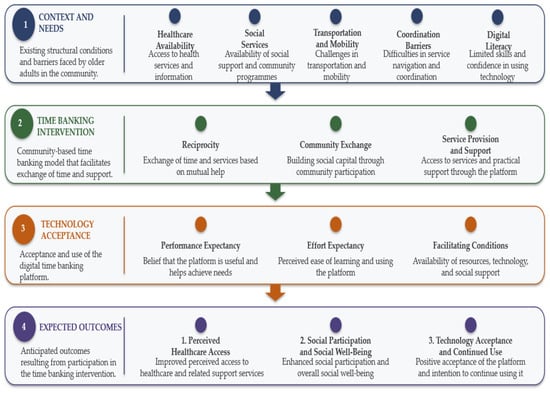
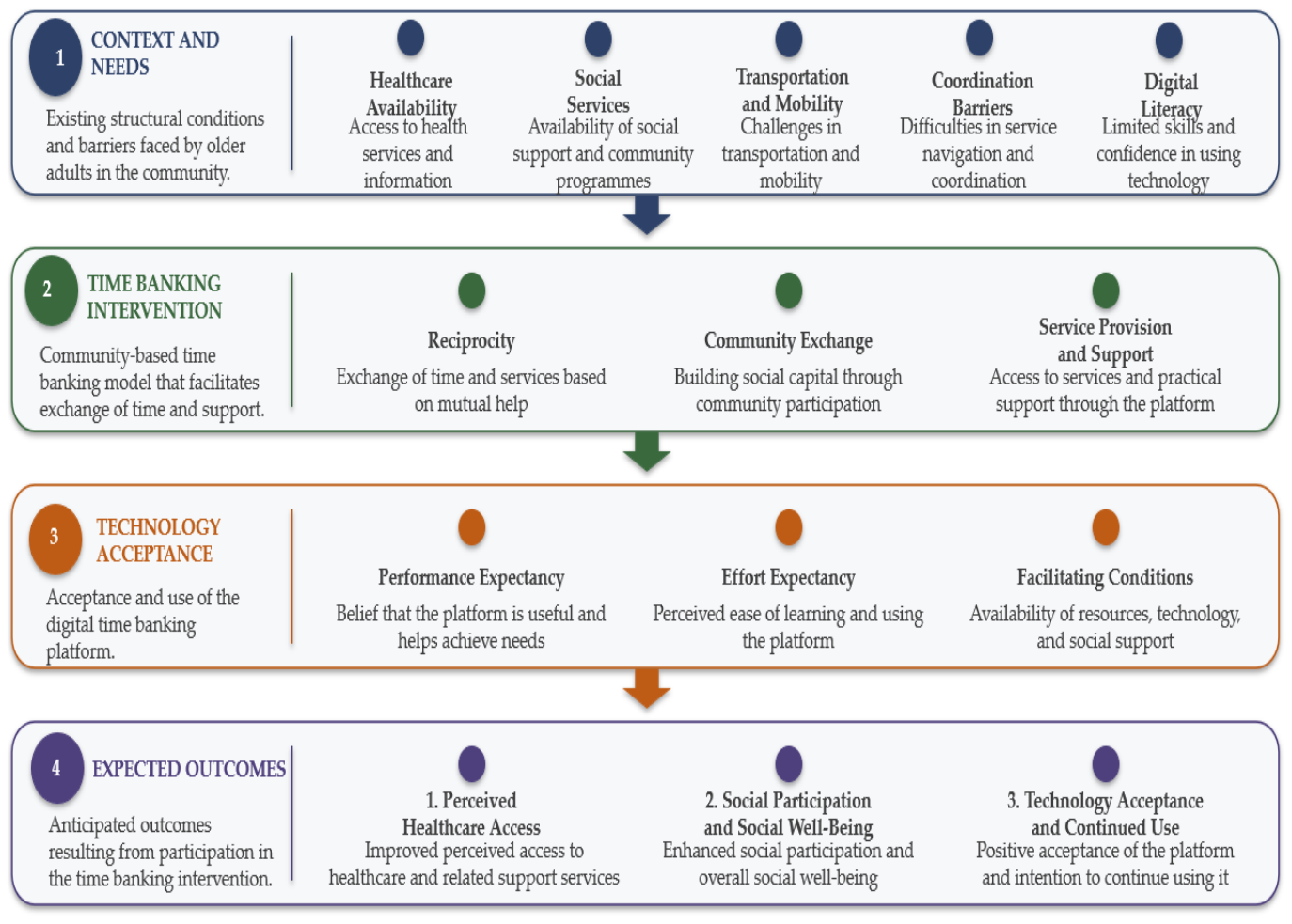
Based on the conceptual framework (Figure 1), it was hypothesized that participation in the time banking intervention would improve healthcare accessibility, enhance social connectedness, and strengthen technology acceptance of the time banking platform. This study is informed by Social Capital Theory and the Unified Theory of Acceptance and Use of Technology (UTAUT).
Figure 1.
Conceptual Framework of time banking intervention.
Social Capital Theory emphasises the importance of trust, reciprocity, and social networks in promoting individual well-being and collective action [11]. Time banking operationalises these principles through reciprocal service exchanges that strengthen community ties and social connectedness among participants.
The digital component of the intervention is guided by UTAUT, which highlights the roles of effort expectancy, facilitating conditions, and social influence in shaping technology adoption [17]. Improvements in ease of use, digital confidence, and intention to use the platform suggest that these factors supported participant engagement.
Together, these theoretical perspectives position time banking as a community-based intervention that addresses interconnected challenges related to healthcare access, social isolation, and digital exclusion.
3. Materials and Methods
3.1. Study Design and Setting
A pre–post intervention study design was employed to evaluate the impact of the time banking intervention on healthcare access, social well-being, and technology acceptance of the time banking platform among older adults. This design was selected to assess changes in outcomes over time following exposure to the intervention.
The study was conducted at selected community-based centres, including senior activity centres and a government social welfare agency in a northern state of Malaysia. These centres serve as key community hubs providing social, welfare, and health-related support services for older adults, making them appropriate settings for implementing and evaluating community-based interventions.
3.2. Study Participants
Participants comprised older adults aged 60 years and above in accordance with Malaysia’s National Policy for Older Persons [18], together with caregivers, volunteers, and community support personnel aged 18–59 years, as specified in the study’s predefined eligibility criteria (Table 1). The inclusion of older adults, caregivers, volunteers, and community support personnel reflected the reciprocal community-based design of the time banking intervention. Unlike conventional service models in which older adults are solely recipients of care, the time banking model enabled all registered participants to both provide and receive services according to their needs, abilities, and availability. Participants engaged in reciprocal exchanges involving transportation, companionship, emotional support, health education, home assistance, technology support, and other community-based services while earning and redeeming time credits through the platform. Consequently, all participant groups collectively formed the intervention community and were considered integral to evaluating the overall effectiveness of the time banking model.
Table 1.
Role of Participants in the Time Banking Intervention.
Inclusion criteria included willingness to participate, ability to provide informed consent, and availability to engage in the intervention period. Participants were recruited using convenience sampling from the participating community centres.
A total of 184 participants completed the baseline assessment, including older adults, caregivers, volunteers, and support staff. Of these, 157 participants entered the intervention phase and 145 completed the post-intervention assessment. Participants were informed of the study objectives and provided written informed consent prior to enrolment.
3.3. Intervention
The intervention consisted of a six-month community-based time banking programme implemented through a mobile application. Time banking is based on the principle of reciprocal service exchange, whereby participants earn time credits for providing services and redeem credits for services provided by other participants.
Prior to implementation, participants attended orientation sessions introducing the principles of time banking, procedures for earning and redeeming time credits, and instructions on using the mobile application. Technical support was provided throughout the intervention period to facilitate participation and address digital literacy challenges.
Participants exchanged services across several domains, including transportation assistance, companionship, social support, household assistance, health-related support, technology assistance, recreational activities, and knowledge-sharing activities. Service requests and complete exchanges were coordinated through the mobile platform.
Participant engagement was monitored throughout the intervention period through activity records, monthly follow-up sessions, and technical support. Intervention fidelity was assessed using service utilisation records captured by the platform. During the intervention period, 2298 service transactions were recorded, including 1812 completed service exchanges involving 95 service requestors and 90 service providers. The most frequently utilised services were social support, transportation assistance, companionship activities, and knowledge-sharing services.
3.4. Data Collection
Data was collected using structured questionnaires administered at two points: baseline (pre-intervention) and after completion of the intervention (post-intervention). The questionnaire was developed based on relevant literature and aligned with the study’s objectives.
The instrument comprised three main domains:
- Healthcare needs, including access to services, transportation, and communication with healthcare providers.
- Social well-being, including social participation, interpersonal interaction, and perceived loneliness; and
- Technology acceptance of the time banking platform, including perceived usefulness, perceived ease of use, ease of learning, facilitating conditions (availability of internet access and smartphones), and social influence (support from family and friends). These constructs were used to assess participants’ acceptance and readiness to adopt the digital time banking platform.
All items were measured using a Likert-type scale ranging from 1 (strongly disagree) to 5 (strongly agree), with higher scores indicating more positive perceptions. The questionnaire was administered in a language appropriate to participants’ comprehension.
The questionnaire was developed by adapting items from existing literature and contextualising them for the Malaysian community-based time banking setting. The healthcare needs section was adapted from the World Health Organization (WHO) survey on older adults (2019) [19], while the social needs items were adapted from a previous time banking study conducted in Thailand [20]. Technology acceptance items were developed based on the Unified Theory of Acceptance and Use of Technology (UTAUT). In addition, the time banking service categories were informed by the Kano Model [21] and feedback obtained during the pilot study (Appendix A).
Content validity was assessed through expert review by a public health expert, who evaluated the relevance, clarity, and contextual appropriateness of the questionnaire items. A pilot test involving 34 older adults aged 60 years and above in Bagan Serai, Perak, was subsequently conducted to assess the clarity and suitability of the instrument. Minor revisions were made based on participant feedback before the main data collection. Internal consistency of the multi-item questionnaire domains was assessed using Cronbach’s alpha, with coefficients of α = 0.769 for healthcare needs, α = 0.850 for social needs, and α = 0.837 for technology acceptance, indicating acceptable to good internal consistency.
3.5. Data Analysis
Data was analysed using IBM SPSS Statistics (Version 27). Descriptive statistics were used to summarise participant characteristics and baseline measures. To evaluate intervention outcomes, baseline and post-intervention scores were compared across three main domains: healthcare needs (HN), social needs (SN), and technology acceptance of time banking (TATB). The technology acceptance construct was assessed at both baseline and post-intervention using comparable Likert-scale items reflecting participants’ perceptions of the usefulness, usability, facilitating conditions, and intention to use the time banking platform. For consistency, this construct is referred to throughout the manuscript as technology acceptance of time banking (TATB).
The primary objective of this study was to evaluate the effectiveness of the time banking intervention at the community level rather than compare outcomes between individual participant categories. As all participants were eligible to both provide and receive services through the reciprocal time banking platform, they collectively represented a single intervention community. Therefore, the analyses were conducted using the combined participant population to evaluate the changes associated with participation of the community-based intervention.
Following re-examination of the original baseline and post-intervention datasets, participant records were retrospectively matched using participant codes assigned during data collection. Where necessary, the matching was checked against available demographic information, including age and gender, to ensure consistency. Only unique and defensible matches were included in the paired analysis. A total of 93 participants were successfully matched between the baseline and post-intervention assessments.
Paired-samples t-tests were used to compare mean scores between baseline and post-intervention assessments. Mean differences, 95% confidence intervals, t statistics, degrees of freedom, p values, and Cohen’s dz were reported. Statistical significance was set at p < 0.05.
For the social needs’ domain, the negatively worded item assessing loneliness and stress was reverse-coded before calculating the domain score so that higher scores consistently represented more favorable outcomes.
3.6. Ethical Considerations
Ethical approval for this study was obtained from an institutional research ethics committee. The study was also registered with a national medical research registry.
All participants provided written informed consent prior to participation. Participants were informed of their right to withdraw from the study at any time without penalty. Confidentiality and anonymity were strictly maintained, and all data were securely stored and accessible only to the research team.
4. Results
4.1. Participants Characteristics
A total of 184 participants completed the baseline assessment, comprising 109 older adults (59.2%), 12 caregivers (6.5%), 47 community support personnel from the Department of Social Welfare (25.5%), and 16 community volunteers (8.7%). These participant groups collectively formed the reciprocal time banking community, with both older adults and community participants contributing as service providers and service recipients throughout the intervention (Table 2). Educational attainment is presented for the overall study population because the primary objective of this study was to describe the intervention cohort rather than compare demographic characteristics across participant categories.
Table 2.
Participant Characteristics at Baseline and Post-Intervention.
Twenty-seven participants did not proceed to the intervention phase, primarily due to the absence of Android-compatible smartphones or difficulties accessing the digital platform. A further 12 participants were lost to follow-up during the intervention period, resulting in 145 participants completing the post-intervention assessment. Although 157 participants entered the intervention phase, engagement levels varied. While 95 participants submitted service requests and 90 participants provided services through the platform, other participants engaged primarily through community activities, training sessions, or occasional use of the time banking platform, reflecting varying levels of engagement typical of community-based interventions.
4.2. Perceived Healthcare Access
At baseline, participants generally reported favourable perceptions of healthcare access and service availability based on self-reported measures. However, lower mean scores were observed for transportation access (M = 3.74) and satisfaction with communication between healthcare providers and older adult patients (M = 3.78), suggesting potential limitations in participants perceived functional access to healthcare services. At the post-intervention assessment, higher mean scores were observed for transportation access (M = 3.74 to 4.10), satisfaction with communication (M = 3.78 to 4.15), and clarity of healthcare information (M = 3.97 to 4.28). In contrast, perceived availability of healthcare services remained relatively stable (M = 4.16 to 4.17). These findings indicate higher post-intervention perceptions of functional access despite stable perceptions of service availability (Table 3).
Table 3.
Comparison of Perceived Healthcare Access at Baseline and Post-Intervention.
4.3. Social Outcomes
At baseline, participants generally reported favourable levels of social participation and social well-being, although lower mean scores were observed for time spent with friends (M = 3.71) and perceived loneliness and stress related to limited social connections (M = 2.47). At the post-intervention assessment, higher mean scores were observed across several social indicators, including participation in activities related to older adults (M = 3.87 to 4.17), availability of activities (M = 3.97 to 4.23), time spent with family (M = 4.08 to 4.26), participation in festive events (M = 4.15 to 4.26), and time spent with friends (M = 3.71 to 4.20). The reverse-coded loneliness item also showed a higher post-intervention score (M = 2.47 to 4.21), indicating lower perceived loneliness and stress. Overall, the post-intervention assessment showed higher scores across several aspects of social participation and social well-being (Table 4).
Table 4.
Comparison of Social Participation and Social Well-Being at Baseline and Post-Intervention.
4.4. Technology Acceptance of the Time Banking Platform
Post-intervention findings showed generally high levels of technology acceptance of the time banking platform. Participants reported favourable perceptions of the platform’s usefulness in accessing needed services (M = 4.21) and making daily life easier (M = 4.23). Higher mean scores were also observed for ease of use (M = 4.23), ease of learning (M = 4.21), availability of the necessary technology (M = 4.28), support from family and friends (M = 4.16), skills needed to use the platform (M = 4.12), and intention to use time banking in the future (M = 4.27) (Table 5). Overall, these findings indicate favourable post-intervention perceptions and acceptance of the time banking platform among participants who completed the assessment.
Table 5.
Participants’ Technology Acceptance of the Time Banking Platform Following the Six-Month Intervention.
4.5. Pre–Post Comparative Analysis
Descriptive results presented in the preceding sections were based on all available responses at baseline (n = 184) and post-intervention (n = 145). For the pre–post comparative analysis, a subset of 93 participants whose responses were successfully matched across both assessments was included. Paired-samples t-tests were conducted to examine changes between baseline and post-intervention assessments.
As shown in Table 6, statistically significant improvements were observed across all three study domains. Healthcare access increased significantly from baseline to post-intervention, t(92) = 3.67, p < 0.001, mean difference = 0.20. Social participation and social well-being also showed a significant improvement, t(92) = 3.13, p = 0.002, mean difference = 0.15. The largest improvement was observed for technology acceptance of time banking, t(92) = 8.38, p < 0.001, mean difference = 0.56.
Table 6.
Pre–Post Comparison of Study Outcomes and Intervention Utilisation.
Overall, the paired analysis indicated significantly higher post-intervention scores across healthcare access, social participation and social well-being, and technology acceptance of time banking.
4.6. Intervention Utilisation
During the six-month intervention period, a total of 2298 service transactions were recorded through the time banking platform. Of these, 1812 services were successfully completed and 486 transactions were cancelled. Participants exchanged a total of 2347 time credits, equivalent to 2347 h of community-based support. Table 6, Panel B shows social support services accounted for nearly half of all completed exchanges (48.2%), followed by transportation assistance (22.5%) and knowledge-sharing activities (15.1%). These findings indicate sustained participant engagement and active utilisation of the time banking intervention throughout the study period.
5. Discussion
This study found significant improvements in healthcare access, social participation and social well-being, and technology acceptance of the time banking platform among the matched participants following the six-month time banking intervention. The paired pre–post analysis showed improvements across all three domains, with the largest change observed in technology acceptance. These findings suggest that participation in the time banking intervention was associated with positive changes across social, healthcare, and technology-related outcomes among older adults and community participants in Malaysia. The findings highlight the importance of addressing both the functional and relational dimensions of ageing, rather than focusing solely on the structural availability of services. In this context, improving access to support may require not only the availability of services but also the ability of individuals to utilise them effectively within their daily lives.
A key finding of this study is the gap between the availability and usability of healthcare services. Although participants reported that healthcare services were generally available at baseline, lower scores related to transportation access and communication indicated barriers to their effective utilisation. These findings suggest that access to healthcare is not solely determined by service provision but also by individuals’ ability to navigate and utilise available services in practice. Transportation barriers have been widely recognised as a critical factor limiting healthcare access among older adults [4]. The significant improvement in healthcare access scores observed in the paired pre–post analysis suggests that participation in the time banking intervention may have helped address some of these practical barriers through community-based support.
The paired pre–post analysis showed a significant improvement in social participation and social well-being among the matched participants. Improvements were observed in social interaction and perceived loneliness, suggesting that participation in the time banking intervention was associated with more favourable social outcomes. These findings are consistent with previous research demonstrating that social connectedness is a key determinant of health and well-being among older adults [5,6]. Importantly, the findings highlight the distinction between social participation and meaningful social connectedness. Through reciprocal service exchanges, the time banking intervention may have encouraged more frequent and sustained interactions by promoting mutual engagement, shared responsibility, and community participation.
The observed improvements may be associated with several interconnected mechanisms. The reciprocal nature of time banking promotes active participation and enables individuals to act as both contributors and recipients of support. This reciprocal exchange may reinforce a sense of purpose, self-efficacy, and social identity among older adults while strengthening social relationships, trust, and reciprocity, which are key components of social capital [11,12,22]. By creating repeated opportunities for interaction and mutual assistance, these social relationships may provide not only emotional support but also practical and informational resources. At the same time, peer-based exchanges can help address barriers such as transportation and communication that may limit access to healthcare and other community services [4,23].
In addition, the paired pre–post analysis showed a significant improvement in technology acceptance of the time banking platform among the matched participants. Participants reported increasingly favourable perceptions of the platform’s usefulness, ease of use, ease of learning, facilitating conditions, and social support for technology adoption. These findings suggest that participants were receptive to adopting the digital platform when appropriate technical support and community facilitation were provided. This observation is consistent with the Unified Theory of Acceptance and Use of Technology (UTAUT), which emphasises the importance of effort expectancy, facilitating conditions, and social influence in technology adoption.
The intervention utilisation data further support the feasibility and acceptability of the time banking approach within the study population. During the six-month intervention period, participants completed 1812 service exchanges and accumulated 2347 h of community-based support. Social support and transportation services accounted for the largest proportion of completed exchanges, suggesting that participants actively engaged in activities that addressed common challenges experienced by older adults, including social isolation and access to essential services. The high level of participation observed throughout the intervention period indicates that the time banking model was both practical and acceptable within the community setting.
The findings indicate that the magnitude of improvement differed across the three study domains. The largest change was observed in technology acceptance, while more modest improvements were observed in healthcare access and social participation and social well-being. These differences suggest that some outcomes may be more responsive to a community-based time banking intervention than others.
This variation highlights the importance of aligning intervention design with specific participant needs and targeted outcomes. While community-based time banking may support social engagement and help address practical barriers to healthcare access, additional structural and institutional support may be needed to achieve broader improvements in healthcare-related outcomes.
5.1. Mechanisms of Impact
The findings suggest that the effects of time banking may arise through a reciprocal process in which older adults are not only recipients of support but also contributors to the community. By exchanging time and assistance, participants have opportunities for repeated social interaction and reciprocal engagement, which may strengthen interpersonal relationships, trust, and a sense of belonging [11,24]. Thus, participation in reciprocal exchanges may contribute to improved social connectedness and social well-being.
Stronger social connections may subsequently facilitate emotional, informational, and practical support. Through community relationships, older adults may become more aware of available services, communicate their needs, and receive assistance from other participants. Practical exchanges such as transportation and household assistance may help reduce everyday functional barriers to community participation and healthcare access [4,23]. In this way, time banking may complement formal healthcare and welfare services by mobilising community resources to support ageing in place [3].
The digital component may further reinforce these processes by enabling participants to request, provide, and coordinate services. Peer and facilitator support may improve confidence and familiarity with the platform, while meaningful use of the application may increase its perceived usefulness and technology acceptance [17,24]. Technology acceptance may therefore be supported not simply by exposure to the platform, but by its integration into meaningful reciprocal community activities.
Taken together, the proposed mechanism can be understood as a reinforcing pathway: time banking facilitates reciprocal participation; reciprocal participation strengthens social relationships; social networks facilitate emotional, informational, and practical support; practical assistance may reduce barriers to service access; and meaningful digital engagement may promote technology acceptance and continued participation. However, as these mechanisms were not directly tested, they should be interpreted as theoretically informed explanations rather than confirmed causal pathways.
5.2. Significance of the Malaysian Findings and International Relevance
This study provides context-specific evidence from Malaysia that the challenges experienced by older adults may arise not only from the availability of healthcare and social services, but also from functional barriers such as transportation, service navigation, and limited social support. In the Kinta District context, the time-banking approach demonstrates how reciprocal community exchange can mobilise local resources to address these gaps while strengthening social participation and community connectedness. This extends existing time-banking research, which has primarily been examined in other settings, including the United Kingdom and Japan, by providing evidence from a Malaysian middle-income context [12,13,25].
The Malaysian findings also have relevance to other ageing societies because similar functional barriers to healthcare access have been reported internationally, including transportation and mobility constraints in the United States, United Kingdom, Japan, and Canada [4,10,23,26]. Thus, while the specific implementation of time banking intervention was shaped by Malaysia’s healthcare, community, cultural, and digital environment, its underlying principles for the reciprocity, community participation, mobilisation of local resources, and complementary support to formal services that may inform community-based approaches in other ageing settings. However, such application requires contextual adaptation to differences in healthcare systems, community structures, cultural expectations, digital literacy, and institutional support. The significance of the Malaysian experience therefore lies in contributing an adaptable model and implementation experience that can inform further research and locally tailored interventions in other countries and regions.
5.3. Scalability and Sustainability
The scalability of time banking may be supported by its reliance on existing community infrastructure and participant contributions. The digital platform may facilitate coordination across larger networks, while the reciprocal exchange model may encourage sustained engagement. However, long-term sustainability will require ongoing facilitation, digital support, and institutional commitment.
The findings also have important implications for policy and practice. As older adults continue to grow, there is a need to develop innovative and sustainable approaches that extend beyond traditional healthcare systems [1]. Community-based interventions such as time banking offer a cost-effective and scalable solution by leveraging existing community resources and promoting active participation. Integrating social, healthcare, and digital components within a single intervention provides a more holistic approach to improving the quality of life of older adults. Policymakers may consider incorporating such intervention into existing ageing and social care frameworks to enhance accessibility, community resilience, and long-term sustainability.
From a policy and implementation perspective, time banking represents a potentially cost-effective community-based approach that leverages existing community resources while promoting active participation and mutual support. The integration of digital platforms also highlights the importance of digital inclusion, particularly among older adults who may face structural and skill-related barriers to technology use [16,27].
Successful implementation therefore requires more than technological infrastructure. Community coordinators and facilitators may play an important role in supporting participation, resolving coordination challenges, and ensuring inclusivity. Integrating time banking within existing community institutions, such as senior activity centres and welfare organisations, may enhance feasibility and reduce operational demands. Partnerships with healthcare providers, government agencies, community organisations, and other stakeholders may further support programme continuity, service availability, and long-term sustainability.
5.4. Integration of Findings with Existing Literature
The findings of this study are consistent with and extend existing literature on ageing, social participation, and healthcare access. Previous studies have highlighted the importance of social relationships in influencing health outcomes among older adults [5,6]. The present study builds on this evidence by suggesting that structured, community-based interventions such as time banking may help facilitate these relationships.
In addition, research on ageing-in-place has emphasised the need for community support systems that enable older adults to remain active and engaged within their environments [3]. The time banking intervention aligns with this perspective by providing a platform for reciprocal engagement, with the potential to support both social and functional support networks.
From a healthcare perspective, barriers related to transportation and system navigation have been widely recognised [4]. The improvements observed in this study suggest that community-based interventions may complement formal healthcare services by helping to address these practical barriers. Importantly, time banking does not replace formal healthcare provision; rather, it may mobilise community resources to support older adults with practical needs that can influence their ability to access and engage with existing services.
The intervention also incorporated a digital platform to coordinate service exchanges and facilitate communication between participants. The largest improvement was observed in technology acceptance of the time banking platform. The paired pre–post analysis showed a significant increase in technology acceptance scores among the matched participants following the intervention. This finding suggests that participation in the time banking programme, including repeated exposure to and use of the digital platform, was associated with increased acceptance of the technology.
This study makes three contributions to the literature on community-based support for older adults. First, it provides an integrated perspective by examining social well-being, perceived healthcare access, and technology acceptance within a single digitally enabled time banking intervention. Previous research has examined social participation, reciprocal exchange, and social capital [11,12,13], as well as technology acceptance among older adults [14,17]. Research on digitally mediated time banking has also highlighted the potential of mobile platforms to facilitate community exchange and accessibility [27,28]. By bringing these domains together, the present study highlights the interconnected nature of social, functional, and digital needs in community-based support for older adults.
Second, the study extends the empirical literature on time banking by providing evidence of its operationalisation among older adults in a Malaysian middle-income community setting. Consistent with the reciprocal principles of time banking [12,13], the intervention enabled participants to exchange practical and social support, including transportation, companionship, daily assistance, and knowledge sharing. This adds contextual evidence to previous research on community-based and digitally supported time banking [27,28], particularly in a setting where empirical evidence remains limited.
Third, the study offers an integrative theoretical contribution by bringing Social Capital Theory and the Unified Theory of Acceptance and Use of Technology (UTAUT) together to interpret a digitally enabled reciprocal intervention. Social Capital Theory emphasises networks, trust, and reciprocity as resources for community participation [11], while UTAUT provides a framework for understanding engagement with the digital platform [17]. The findings suggest that these perspectives can be considered together: reciprocal community engagement may support participation and confidence in technology use, while the digital platform may facilitate communication, coordination, and continued exchange. This contribution is therefore integrative rather than theory-generating and does not imply a causal relationship between social interaction and technology adoption.
The study also offers practical insights for policymakers and community organisations. The high level of intervention utilisation, reflected by 1812 completed service exchanges and 2347 h of community support, supports the feasibility of implementing time banking within existing community infrastructures. These findings suggest that community-based time banking programmes may serve as a scalable and sustainable complement to formal health and social care services, particularly in middle-income settings facing increasing demands associated with population ageing.
6. Conclusions and Research Prospects
6.1. Conclusions
The findings suggest that community-based time banking has the potential to support social participation and social well-being, perceived healthcare access, and technology acceptance among older adults and community participants in Malaysia. Among participants with matched baseline and post-intervention assessments, significant improvements were observed across all three outcome domains, with the largest improvement observed in technology acceptance of the time banking platform.
The substantial number of completed service exchanges and hours contributed through the programme further supports the feasibility of implementing a community-based time banking model within existing community infrastructure. By addressing social, healthcare, and digital needs simultaneously, the intervention demonstrates the potential value of an integrated community-based approach to supporting healthy ageing. The findings also suggest that time banking may help address social and practical needs while facilitating engagement with digital services.
However, due to the absence of a control group, the observed pre–post improvements cannot be attributed solely to the intervention. The findings should therefore be interpreted as evidence of potential benefit and feasibility rather than causal effectiveness. Future controlled and longitudinal studies are needed to further examine the effectiveness, long-term sustainability, and scalability of community-based time banking interventions.
6.2. Limitations
Several limitations should be considered when interpreting the findings. First, the absence of a control group limits the ability to establish causality, and the observed pre–post changes cannot be attributed solely to the intervention. Second, although the pre–post comparative analysis was conducted among participants whose baseline and post-intervention responses were successfully matched, participant attrition occurred during the intervention period. This may have introduced attrition bias if participants who completed the post-intervention assessment differed systematically from those who did not.
Third, the reliance on self-reported data may have introduced response bias. In particular, healthcare access was assessed based on participants’ self-reported perceptions and did not include objective indicators of healthcare access. Fourth, the use of convenience sampling may have resulted in selection bias, as participants who were more motivated or socially active may have been more likely to participate, thereby limiting the representativeness of the sample. Finally, the study was conducted within a specific regional context, which may limit the generalisability of the findings to other settings.
Longer-term follow-up is needed to determine whether the observed improvements and participant engagement can be sustained over time. Future studies should consider longitudinal designs and controlled comparisons to further examine the potential effects and long-term sustainability of community-based time banking interventions.
6.3. Future Research Recommendations
Future studies should include a control group (or stepped-wedge design) to strengthen causal claims. A larger sample would permit more robust subgroup comparisons (e.g., by specific age bands or rural/urban status). Longitudinal follow-up beyond 6 months would show if gains were maintained. It would also be valuable to measure objective health outcomes (e.g., healthcare utilization) and to track the number of time-bank exchanges to see whether behavioural changes accompany the survey responses. Finally, given the promising link between digital skill gain and social well-being, future interventions might incorporate targeted digital literacy training as part of ageing support [24]. Future studies should also examine the relationship between intervention utilisation (e.g., service exchanges and time credits earned) and participant outcomes.
Author Contributions
Conceptualization, A.A. and H.R.A.S.; methodology, A.A.; software, A.A.; validation, D.S.B.S., H.R.A.S. and S.I.; formal analysis, A.A.; investigation, A.A.; resources, A.A.; data curation, A.A.; writing—original draft preparation, A.A.; writing—review and editing, H.R.A.S.; visualization, S.C.C.; supervision, H.R.A.S.; project administration, S.L.L.; funding acquisition, H.R.A.S. All authors have read and agreed to the published version of the manuscript.
Funding
This research was funded by the Fundamental Research Grant Scheme (FRGS) under grant number FRGS/1/2020/SKK04/UNIKL/02/1. The FRGS funding supported the research and did not cover the publication fee.
Institutional Review Board Statement
The study was conducted in accordance with the Declaration of Helsinki and approved by the UniKL Research Ethics Committee, Royal College of Medicine, Perak, on 1 April 2024 (Ref. UNIKL REC/2024/PG/TCA/02). The research was also approved by the Medical Research & Ethics Committee (MREC) on 27 September 2024 (Ref. 23-02911-NAO) and by the Department of Social Welfare on 26 September 2024 (Ref. JKMM 100/12/5/2: 2024/092). The study was registered with the National Medical Research Register (NMRR) under ID NMRR-23-02911-NAO.
Informed Consent Statement
Informed consent was obtained from all subjects involved in the study.
Data Availability Statement
The data supporting the findings of this study are available on request from the corresponding author. The data are not publicly available due to privacy and ethical considerations.
Acknowledgments
The authors would like to thank all participants, including older adults, volunteers, and caregivers, who took part in this study. Appreciation is also extended to the staff of PAWE Tambun, PAWE Gopeng, and Jabatan Kebajikan Masyarakat Perak for their support and cooperation throughout the implementation of the time banking intervention. During the preparation of this work, the author(s) used AI-assisted tools, such as ChatGPT (GPT-5.6 Luna), solely for language editing and manuscript refinement. The authors have reviewed and edited the output and take full responsibility for the content of this publication.
Conflicts of Interest
The authors declare no conflicts of interest.
Appendix A
Research Survey Questionnaire
Improving Elderly Care through Time Banking: A Pilot Project in Addressing Healthcare and Social Needs in Kinta District
Appendix A.1. Sociodemographic Data
Please fill in the blank or tick (√) in the box given.
| Code Num | |
| Age | |
| Gender | ☐ Male ☐ Female |
| Educational Background | ☐ Primary School ☐ High School ☐ Diploma ☐ Degree ☐ Master ☐ PhD ☐ Others:___________________ |
Appendix A.2. Healthcare Needs
| Question | Strongly Disagree | Disagree | Unsure | Agree | Strongly Agree |
| There are many health services available in my area. | 1 | 2 | 3 | 4 | 5 |
| Information about health and support services is clear and accessible. | 1 | 2 | 3 | 4 | 5 |
| I know how to request healthcare services. | 1 | 2 | 3 | 4 | 5 |
| Healthcare delivery and support is easy and well-organized. | 1 | 2 | 3 | 4 | 5 |
| I can easily get any transportation to healthcare and social services. | 1 | 2 | 3 | 4 | 5 |
| I am satisfied with the communication between healthcare providers and elderly patients. | 1 | 2 | 3 | 4 | 5 |
Appendix A.3. Social Needs
Please indicate your best opinion.
| Question | Strongly Disagree | Disagree | Unsure | Agree | Strongly Agree |
| There are many options to volunteer in my area. | 1 | 2 | 3 | 4 | 5 |
| I can participate in the development of policies related to the elderly, such as health, welfare, education, housing, transportation, employment, and social participation. | 1 | 2 | 3 | 4 | 5 |
| There is many activities offered to older adults. | 1 | 2 | 3 | 4 | 5 |
| Activities held at suitable times for older adults. | 1 | 2 | 3 | 4 | 5 |
| I spend my holiday with my family. | 1 | 2 | 3 | 4 | 5 |
| I join festive events in my place. | 1 | 2 | 3 | 4 | 5 |
| I spend my free time with my friends. | 1 | 2 | 3 | 4 | 5 |
Appendix A.4. Technology Acceptance on Time Banking Intervention
Please indicate your best opinion.
Note: Time banking is the use of an application that employs a method of giving and receiving rewards to individuals who dedicate their time and energy to community programs such as caregiving and assistance in nursing homes.
| Question | Strongly Disagree | Disagree | Unsure | Agree | Strongly Agree |
| Time banking helps me access the services I need. | 1 | 2 | 3 | 4 | 5 |
| Time banking makes my life easier. | 1 | 2 | 3 | 4 | 5 |
| Time banking is easy to use. | 1 | 2 | 3 | 4 | 5 |
| I find it easy to learn how to use time banking. | 1 | 2 | 3 | 4 | 5 |
| Family and friends support my use of time banking. | 1 | 2 | 3 | 4 | 5 |
| I have the necessary technology to use time banking (e.g., internet, smartphone) | 1 | 2 | 3 | 4 | 5 |
| I have the skills needed to use time banking | 1 | 2 | 3 | 4 | 5 |
| I intend to use time banking in the future. | 1 | 2 | 3 | 4 | 5 |
Appendix A.5. Time Banking Pilot Project
Please tick (√) in the box given. You can select more than one answer.
| Question | Answer |
| Safety and Health Requirements |
|
| Life Requirements |
|
| Transportation |
|
| How can time banking help your daily life? |
|
| What is the effective way to run the Time Banking project? |
|
References
- World Health Organization. Box 1: Key Ageing Facts 2019. Available online: https://www.who.int/docs/default-source/documents/decade-of-health-ageing/decade-ageing-proposal-en.pdf (accessed on 16 August 2024).
- Beard, J.R.; Officer, A.; de Carvalho, I.A.; Sadana, R.; Pot, A.M.; Michel, J.-P.; Lloyd-Sherlock, P.; Epping-Jordan, J.E.; Peeters, G.M.E.E.; Mahanani, W.R.; et al. The World report on ageing and health: A policy framework for healthy ageing. Lancet 2016, 387, 2145–2154. [Google Scholar] [CrossRef] [Scilit]
- Wiles, J.L.; Leibing, A.; Guberman, N.; Reeve, J.; Allen, R.E.S. The Meaning of “Aging in Place” to Older People. Gerontol. 2012, 52, 357–366. [Google Scholar] [CrossRef] [Scilit]
- Syed, S.T.; Gerber, B.S.; Sharp, L.K. Traveling Towards Disease: Transportation Barriers to Health Care Access. J. Community Health 2013, 38, 976–993. [Google Scholar] [CrossRef] [Scilit]
- Holt-Lunstad, J.; Smith, T.B.; Baker, M.; Harris, T.; Stephenson, D. Loneliness and social isolation as risk factors for mortality: A meta-analytic review. Perspect. Psychol. Sci. 2015, 10, 227–237. [Google Scholar] [CrossRef] [Scilit]
- Cacioppo, J.T.; Cacioppo, S. Social relationships and health: The toxic effects of perceived social isolation. Soc. Personal. Psychol. Compass 2014, 8, 58–72. [Google Scholar] [CrossRef] [Scilit]
- Nicholson, N.R. A review of social isolation: An important but underassessed condition in older adults. J. Prim. Prev. 2012, 33, 137–152. [Google Scholar] [CrossRef] [Scilit]
- Levasseur, M.; Richard, L.; Gauvin, L.; Raymond, É. Inventory and analysis of definitions of social participation found in the aging literature: Proposed taxonomy of social activities. Soc. Sci. Med. 2010, 71, 2141–2149. [Google Scholar] [CrossRef] [Scilit]
- Adams, K.; Leibbrandt, S.; Moon, H. A critical review of the literature on social and leisure activity and wellbeing in later life. Ageing Soc. 2010, 31, 683–712. [Google Scholar] [CrossRef] [Scilit]
- Arai, H.; Ouchi, Y.; Toba, K.; Endo, T.; Shimokado, K.; Tsubota, K.; Matsuo, S.; Mori, H.; Yumura, W.; Yokode, M.; et al. Japan as the front-runner of super-aged societies: Perspectives from medicine and medical care in Japan. Geriatr. Gerontol. Int. 2015, 15, 673–687. [Google Scholar] [CrossRef] [Scilit]
- Putnam, R.D. Bowling Alone: The Collapse and Revival of American Community; Simon & Schuster: New York, NY, USA, 2000. [Google Scholar]
- Seyfang, G. Time banks: Rewarding community self-help in the inner city? Research Gate. Community Dev. J. 2004, 39, 62–71. [Google Scholar] [CrossRef] [Scilit]
- Collom, E. Motivations and Differential Participation in a Community Currency System: The Dynamics Within a Local Social Movement Organization1. Sociol. Forum 2011, 26, 144–168. [Google Scholar] [CrossRef] [Scilit]
- Chen, K.; Chan, A.H.S. Gerontechnology acceptance by elderly Hong Kong Chinese: A senior technology acceptance model (STAM). Ergonomics 2014, 57, 635–652. [Google Scholar] [CrossRef] [Scilit]
- Tsai, H.Y.S.; Shillair, R.; Cotten, S.R.; Winstead, V.; Yost, E. Getting Grandma Online: Are Tablets the Answer for Increasing Digital Inclusion for Older Adults in the U.S.? Educ. Gerontol. 2015, 41, 695–709. [Google Scholar] [CrossRef] [Scilit]
- van Deursen, A.J.; Helsper, E.J. A nuanced understanding of Internet use and non-use among the elderly. Eur. J. Commun. 2015, 30, 171–187. [Google Scholar] [CrossRef] [Scilit]
- Venkatesh, V.; Thong, J.Y.L.; Xu, X. Consumer acceptance and use of Information technology: Extending the unified theory of acceptance and use of technology. MIS Q. 2012, 36, 157–178. [Google Scholar] [CrossRef] [Scilit]
- National Digital Department. National Policy for Senior Citizens Malaysia.gov.my. 2026. Available online: https://www.malaysia.gov.my/en/categories/law--safety/vulnerable-groups/national-policy-for-senior-citizens (accessed on 18 August 2026).
- World Health Organization. Surveying Older Adults. Age-Friendly World. 2014. Available online: https://extranet.who.int/agefriendlyworld/afp/surveying-older-adults/ (accessed on 8 March 2023).
- Sasananan, M.; Channarong, K.; Kingnakhonthong, S. Preliminary study of time banking participation. Qual. Prod. Improv. QPI 2019, 1, 618–622. [Google Scholar] [CrossRef]
- Doryab, A.; Bellotti, V.; Yousfi, A.; Wu, S.; Carroll, J.M.; Dey, A.K. If it’s convenient. Pro ACM Interact. Mob. Wearable Ubiquitous Technol. 2017, 1, 48. [Google Scholar] [CrossRef] [Scilit]
- Ozanne, L.K.; Ozanne, J.L. How alternative consumer markets can build community resiliency. Eur. J. Mark. 2016, 50, 330–357. [Google Scholar] [CrossRef] [Scilit]
- Wallace, R.; Hughes-Cromwick, P.; Mull, H.; Khasnabis, S. Access to Health Care and Nonemergency Medical Transportation. Transp. Res. Rec. J. Transp. Res. Board 2005, 1924, 76–84. [Google Scholar] [CrossRef]
- Van Dijk, J.A.G.M. The Digital Divide; Polity Press: Cambridge, UK, 2019. [Google Scholar]
- Hayashi, M. Japan’s Fureai Kippu time-banking in elderly care: Origins, development, challenges and impact. Int. J. Community Curr. Res. 2012, 16, 30. [Google Scholar]
- Krasniuk, S.; Crizzle, A.M. Impact of health and transportation on accessing healthcare in older adults living in rural regions. Transp. Res. Interdiscip. Perspect. 2023, 21, 100882. [Google Scholar] [CrossRef] [Scilit]
- Wu, Y.; Ding, Y.; Hu, C.; Wang, L. The Influencing Factors of Participation in Online Timebank Nursing for Community Elderly in Beijing. China Front. Public Health 2021, 9, 650018. [Google Scholar] [CrossRef] [Scilit]
- Han, K.; Shih, P.C.; Bellotti, V.; Carroll, J.M. It’s Time There Was an App for That Too. Int. J. Mob. Hum. Comput. Interact. 2015, 7, 22. [Google Scholar] [CrossRef] [Scilit][Green Version]

Disclaimer/Publisher’s Note: The statements, opinions and data contained in all publications are solely those of the individual author(s) and contributor(s) and not of MDPI and/or the editor(s). MDPI and/or the editor(s) disclaim responsibility for any injury to people or property resulting from any ideas, methods, instructions or products referred to in the content. |
© 2026 by the authors. Licensee MDPI, Basel, Switzerland. This article is an open access article distributed under the terms and conditions of the Creative Commons Attribution (CC BY) license.