


Abstract
Older adults perceived various benefits of Information and Communication Technology (ICT) use during and after the COVID-19 pandemic, including benefits related to social connectedness and everyday life. The research aimed to identify a multidimensional set of benefits that older adults perceive when using ICT in the post-COVID-19 era. We used a qualitative research paradigm. We compiled the views of 15 older adults on the benefits of ICT use through semi-structured, in-depth, and individual interviews. The interviewees ranged in age from 65 to 87 years. We analyzed the data using a qualitative content analysis. The analysis identified eight main categories, which were subsequently organized into four higher-order analytical domains according to their conceptual focus. These include social and psychological benefits; functional benefits; economic and practical benefits; cognitive and experiential benefits; changes in benefit perception; altered learning and support processes; factors that shape these changes; and risks and limitations. When understanding the perceived benefits of ICT use in an aging society after the COVID-19 pandemic, a holistic approach that considers individual, social, educational, and technological factors is necessary. Such an understanding provides better insight into the benefits of ICT use for active, safe, and dignified aging.
Keywords:
older adults; ICT; ICT use; benefits of ICT use; COVID-19; digitalization; aging; project DIGOLD 1. Introduction
The perceived benefits of information communication technology (ICT) for older adults are multi-layered and encompass social, psychological, cognitive, medical, physical, and functional areas. The perceived benefits of ICT use among older adults can include improved social inclusion, emotional well-being, independence, learning opportunities, and quality of life. Understanding the perceived benefits of ICT use among older adults during and after the COVID-19 pandemic is based on multiple theoretical approaches. Two models and three theories were relevant for our research. They are complementary in the field of research, and we present them below.
Technology Acceptance Model (TAM) [1] and the Unified Theory of Acceptance and Use of Technology (UTAUT) [2,3] explain factors that affect the acceptance and use of digital technologies. TAM highlights perceived usefulness and perceived ease of use as key factors in a person’s willingness to use ICT. The acceptance and sustained use of ICT can empower older adults by increasing perceived usefulness, self-confidence, and autonomy in managing their daily lives and health. Longitudinal studies have revealed that older adults who perceive ICT as useful and easy to use tend to use technology more frequently and report an improved sense of well-being, consistent with empowerment through management and self-confidence in digital skills [4,5]. This empowerment is the key benefit that enables continuous cooperation across social, medical, and civic areas through ICT [6]. ICT use is linked to cognitive and learning benefits and an increased sense of self-confidence among older adults, as educational programs, guided learning, and intergenerational initiatives reduce anxiety about technology use and encourage self-confidence, competency, and consistent use of digital tools [4,5]. Furthermore, exposure to ICT through learning experiences and a supportive environment strengthens self-confidence and encourages greater ICT use, enabling greater cooperation in digital life [7].
UTAUT expands on this understanding by including expected success, expected efforts, social influence, and facilitating conditions. Both theories help explain how older adults valued the benefits of ICT for maintaining their everyday functioning, social connections, and access to services during and after the pandemic. We must emphasize that the personal benefits of ICT use are not universal and depend on context, design, training, and support. Some studies highlight persistent digital disparities and obstacles that can curtail benefits for certain groups, such as homebound older adults, persons with lower levels of education or income, and those without social support or training [8,9]. Furthermore, some studies from the pandemic era reported on the negative emotional consequences and increased stress among older adults tied to high-level engagement with ICT [10]. Despite this, when barriers are remedied through accessible design, goal-oriented training, and support mentoring, this balance tips towards significant personal benefits in multiple areas of life [11,12]. To increase the personal benefits of ICT use among older adults, ICT measures must emphasize user-centered design, accessible interfaces, and training that builds self-confidence as well as training that reduces anxiety related to use. Evidence supports that it would be sensible to combine teaching approaches, intergenerational training, and practical learning with real-life applications, such as medical portals and social communication tools, in order to encourage meaningful and sustainable participation in ICT. Training models that connect older adults with peer mentors or volunteers show particular promise for fostering positive relationships and reducing barriers to acceptance. Finally, the inclusion of ICT-enabled social and medical interventions, specifically those emphasizing autonomy and intergenerational cooperation, into broader care pathways helps ensure that personal benefits are realized in their everyday lives [13]. Perceptions that older adults lack the skills or desire to learn ICT are unfounded, as numerous studies have documented interest and willingness when appropriate support is provided. Researchers have determined that general beliefs about older adults lacking capabilities or the desire to learn ICT are inaccurate and that pedagogic training and support can increase inclusivity [14]. Additionally, training experiences revealed the willingness to learn, even among those previously assumed to be reserved [15]. These findings align with studies that identify fear and anxiety associated with low digital literacy as an obstacle, suggesting this is not a matter of intrinsic disinterest in learning [15]. The COVID-19 era strengthened interest in digital pedagogy for older adults and revealed sustained interest in learning ICT use as a tool for maintaining social connectedness and access to essential services during times of physical distancing [14]. Empirical evidence stating that frequent ICT use protected some older adults from loneliness during the pandemic and reduced their quality of life further emphasizes the value of training that enables meaningful inclusion in ICT, both in crisis and non-crisis contexts [15].
The Uses and Gratifications Theory [16] treats users as active individuals who opt for ICT use to meet specific needs. In the context of aging and pandemic restrictions, the theory is especially relevant because it helps explain how ICT use contributed to meeting needs for staying informed, social connectivity, emotional support, and leisure activities. As such, the perceived benefits of ICT use reflect the extent to which digital technologies successfully met these needs. Studies show that ICT helps users monitor their medical status and stay informed on health-related issues, thereby promoting more effective self-management and communication with caregivers and experts [17]. In the context of managing chronic illnesses or making health-related decisions, ICT-supported tools (including patient portals and telehealth platforms) facilitate access to information, support self-care planning, and enable older adults to participate more actively in health-related decisions [6,9]. ICT can be a valuable ally for personal health management and informed decision-making in health care in later life [17].
Understanding the importance of social relations and emotional well-being in later life is key, and socioemotional selectivity theory is important [18,19]. It posits that aging individuals place an ever higher value on emotionally important relationships and activities that contribute to their subjective well-being. During the pandemic, digital technologies allowed many older adults to maintain connections with family and friends and reduced feelings of loneliness, which helps explain an important part of the perceived benefits of their use. ICT use is often connected with stronger social bonds and reduced loneliness, which contributes to better emotional well-being and a sense of belonging. For instance, the use of mobile phones among older adults was associated with increased feelings of security and independence, which in turn supported a broader sense of social connectedness and functional ability [20]. Furthermore, ICT-enabled communication and online social activities have been shown to mitigate social isolation and loneliness, especially during physical distancing, such as during the COVID-19 pandemic [21,22]. Empirical research shows that ICT-enabled social engagement mitigates symptoms of depression and supports the quality of life of older adults who are homebound if it is supported by appropriate programs and training [21]. Systematic research on social participation through ICT in later life, including studies on social networking and intergenerational interactions, further supports the potential of ICT to maintain and strengthen social networks [4,12]. In addition to social bonds, ICT use is related to more positive emotional experiences and improved psychological adaptability. Research highlights that ICT use among older adults is associated with more positive emotional experiences, especially when basic psychological needs, such as autonomy, competency, and connectivity, are met [23]. ICT use and related digital activities can improve mood and well-being, in part by strengthening social connectivity and enabling targeted collaboration, for instance, during online cognitive interventions [21,24]. Some intervention studies explicitly report decreases in loneliness and depression, and improvements in quality of life, when ICT is used to support social and educational activities, such as technology-use training programs and psychoeducational interventions [21,25]. Despite nuanced findings in specific contexts, such as some studies that were conducted during the COVID-19 pandemic finding potential negative emotional effects of high ICT use, most corroborate a positive effect on mood and well-being when ICT is available and used appropriately [10,21]. ICT supports intergenerational connectedness, bringing personal benefits in the form of a sense of purpose, belonging, and social inclusivity for older adults. Intergenerational learning and ICT-based activities encourage social inclusivity and mutual understanding between generations, benefiting both older and younger participants [4]. Technology-supported socialization and online interaction can maintain or broaden social networks, enrich everyday life, and enhance perceived social support among older adults [12]. These intergenerational interactions not only reduce loneliness but also contribute to a more engaged and meaningful everyday life through the access channels enabled by ICT [12].
The Selective Optimization with Compensation (SOC) model [26] provides an additional theoretical framework for interpreting ICT use. It understands aging as the process of adapting to limitations and changes through selection, optimization, and compensation. We can interpret ICT through this model as an important compensatory resource that enables older adults to retain independence, social inclusion, and access to various services despite possible functional limitations. All of the mentioned theoretical approaches provide a comprehensive understanding of the factors that influence acceptance of ICT and their role in meeting needs, maintaining social relations, and supporting active aging during the COVID-19 pandemic and the period after it. Evidence highlights that cognitive interventions based on ICT significantly reduce symptoms of depression among older adults, which confirms potential cognitive and emotional benefits of cognitive training enabled by ICT [24]. Overall, ICT-supported learning experiences contribute to a sense of mastery and sustained cognitive engagement during the aging process [4,5]. The personal benefits of ICT use are greater independence and safety in everyday life. Cross-sectional and longitudinal studies show that ICT and supportive technologies increase independence, improve home safety, and help older adults remain socially connected, thereby enabling a more autonomous life [17]. In long-term care and community environments, control, communication tools, and support devices that enable ICT were described as accessories that facilitate safer self-management and more autonomous routines, which contribute to a higher perceived quality of everyday life [27,28]. Studies [29,30] highlight the potential benefits for self-management and independence when technologies are adapted to the users. ICT use supports health management, proactive self-sufficiency, and informed decision-making on medical and care services.
This is why we focus on older adults within the research problem framework, who, as a highly heterogeneous group, faced various digital challenges and potential benefits of ICT use during the COVID-19 pandemic and afterward. The research aimed to identify a multidimensional set of concrete benefits that older adults perceive when using ICT on a personal level in the post-COVID-19 era. We interpreted the COVID-19 pandemic in the context of our research as a synonym for a crisis period. The frequency and duration of various crisis events have been increasing over the last few decades, especially in the context of globally unstable socio-political, economic, and business conditions. Thus, one of the goals of the research was to examine the benefits of ICT use among older adults during crises, which are factors in digital empowerment and digital resilience. Thus, we posited the following research question: “What are the key dimensions of the perceived benefits of ICT use for older adults during and after the COVID-19 pandemic?”
2. Materials and Methods
We applied a qualitative approach as well as semi-structured, in-depth individual interviews to explore the experiences of older adults with ICT use and their perceived benefits during and after the COVID-19 pandemic. We conducted the interviews in 2024. Participation in the study was voluntary. We conducted the interviews in the homes of the participants and ensured their anonymity. We obtained informed consent from each participant before the interview. We transcribed the audio recordings using the Beey transcription tool. Because of the linguistic characteristics of individual participants’ speech, we manually checked all transcripts against the audio recordings and corrected them as needed to ensure transcription accuracy. The audio recordings were subsequently deleted.
We conducted the interviews using a 45-question semi-structured interview guide developed based on a review of the relevant literature. The interview guide covered several areas related to digitalization and ICT use, including experiences with ICT, motivation for ICT use, digital knowledge and skills, perceived benefits and barriers, and ICT use in the context of the COVID-19 pandemic. For the present study, we restricted the analytical corpus to participants’ responses to the interview question “What are the personal benefits of ICT use for you?” and to the questions included in the COVID-19 and ICT section of the interview guide. We did not include the responses to other sections of the 45-question interview guide in the coding and category development for the present study.
We explicitly incorporated the temporal dimension into the COVID-19 and ICT section of the interview guide. Participants were asked retrospectively whether and how their acceptance and use of ICT had changed across the periods before, during, and after the COVID-19 pandemic. We also asked whether they perceived changes between the pre-pandemic and pandemic periods, whether they viewed these changes as positive, negative, or neutral, and whether increased ICT use during the pandemic persisted afterward. Thus, the distinction between the pandemic and post-pandemic periods was based on participants’ retrospective temporal accounts elicited through explicitly comparative interview questions rather than on researcher-imposed calendar cut-off dates. Temporal references to the pre-pandemic, pandemic, and post-pandemic periods were retained during the analysis and used to distinguish participants’ accounts across these periods.
The data were analyzed using conventional qualitative content analysis following an inductive approach [31]. The analytical process moved from coding the empirical material to developing subcategories and, subsequently, broader main categories. Codes, subcategories, and categories were derived inductively from participants’ accounts and were not based on predefined theoretical concepts or categories. We did not use the theoretical frameworks presented in the Introduction to guide the coding process or the development of subcategories and categories. We applied them only after completing the inductive analysis, as post hoc interpretive frameworks in the Discussion to contextualize the empirically derived findings in relation to the existing theoretical literature. Thus, the theoretical frameworks did not form part of the analytical coding procedure.
We conducted the qualitative content analysis in six phases. In the first phase, we prepared and organized the research material. We reviewed, corrected, and anonymized the interview transcripts, and assigned each participant an identification code. In the second phase, we determined the coding units. The third phase consisted of open coding of the relevant material. In the fourth phase, we grouped conceptually related codes into subcategories and organized them into broader main categories. In the fifth phase, we interpreted and defined the categories, whilst paying particular attention to their internal coherence and conceptual distinctions. In the sixth phase, we formulated the final conceptual interpretation based on the relationships among the empirically derived codes, subcategories, and categories [32,33,34]. This is consistent with the six-step research process for content analysis [35], as defined by [36]: (1) unitizing as the process of classifying the data via scheme selection, (2) sampling and selecting a conceptually representative sample population, (3) coding with multiple data assessments, (4) reducing and simplifying the data for management, (5) abductive inferring with understanding the phenomenon withing the context of the situation during the data analysis for, and (6) narrating as presenting the research results in narrative form that is accessible to the audience. Throughout the analytical process, we compared codes for similarities and differences, and retained temporal references to the pre-pandemic, pandemic, and post-pandemic periods where relevant.
For the presentation of the findings, we subsequently organized the eight inductively derived main categories into four higher-order analytical domains according to their conceptual focus: perceived benefits of ICT use; temporal changes in ICT use and perceived benefits; learning, support, and factors shaping ICT use; and risks and limitations of ICT use. We introduced this higher-order organization only after completing inductive coding and category development, and we did not use it as an a priori framework for coding or category formation.
Two researchers conducted the analysis independently. They then compared the codes, subcategories, and categories they had developed. When they disagreed, the re-searchers discussed the differences and reached consensus on the final coding and categorization. Two additional researchers independently reviewed the analytical structure and confirmed the final categories and subcategories. The credibility of the findings was further supported through member checking. We provided all participants with the opportunity to review a summary of the findings and comment on whether the interpretations reflected their experiences. No participant requested changes to the interpretations.
The research was conducted as part of the research project Effects of Digitalisation in the (Post-)COVID-19 Era on the Quality of Life and Social Inclusion of Older Adults (DI-GOLD, J5-4580), funded by the Slovenian Research and Innovation Agency. Non-probability purposive sampling was used. The study included 15 adults aged 65 years or older, regardless of their ICT-user status. Participants ranged in age from 65 to 87 years, with a mean age of 74.33 years (SD = 7.27). Twelve participants were women, and three were men. Of the 15 participants, 12 were ICT users, and three were non-users. We determined ICT-user status based on participants’ self-reported ICT use during the interview. We classified participants who reported using ICT as ICT users, and those who reported not using ICT as non-users. We included both groups in the same qualitative content analysis and did not analyze them as separate comparison groups.
Participants lived independently in their home environments in both urban and rural areas of Slovenia and were recruited through non-governmental organizations and associations in which they regularly participated. This recruitment strategy may have resulted in the inclusion of comparatively more socially engaged older adults. Consequently, the sample may underrepresent older adults with limited social networks, those experiencing social isolation, and those who do not participate in organized community activities. We considered this potential selection bias when interpreting the findings and further addressed it in the study limitations.
3. Results
Table 1 presents the results of the conventional qualitative content analysis, showing the inductively derived codes, subcategories, and main categories related to older adults’ ICT use and perceived benefits during and after the COVID-19 pandemic.
Table 1.
The results of coding, forming subcategories and categories to identify the perceived benefits of ICT use among older adults during and after the COVID-19 pandemic.
The qualitative content analysis resulted in eight main categories and 28 subcategories (Table 1). The first four main categories represent participants’ perceived benefits of ICT use, whereas the remaining categories capture temporal changes in ICT use and perceived benefits, learning and support processes, factors shaping perceptions of ICT use, and risks and limitations. To distinguish these conceptually different aspects of the findings, the eight inductively derived main categories were subsequently organized into four higher-order analytical domains by conceptual focus. The findings are presented below according to these four analytical domains, while retaining the underlying structure of the main categories and subcategories shown in Table 1.
3.1. Perceived Benefits of ICT Use
We divided the first higher-order analytical domain into four main categories that reflected the perceived benefits of ICT use by the participants. These are social and psychological benefits, functional benefits, economic and practical benefits, and cognitive and experiential benefits. Although these categories were interrelated, they represented distinct dimensions of how participants perceived ICT as beneficial in their everyday lives.
Social and psychological benefits of ICT use were reflected in social connectedness, reduction in social isolation, and ICT-mediated communication. Participants described ICT as a means of maintaining contact with others, communicating across geographical distances, and reducing feelings of loneliness. In this sense, the perceived benefit was not limited to communication itself but also involved the experience of remaining socially connected through ICT. One participant described this role of ICT as follows:
“… this is some kind of entertainment… that you are not alone… this is positive… also communicating… and I talked to them, you can also contact them, and we wrote back and forth, I found it interesting…”(Participant 8, female, 78 years.)
Functional benefits of ICT use concerned how ICT facilitated access to information, provided information support in everyday life, and enabled access to services. Participants described searching for information online as a practical resource that reduced the need to obtain information in person and supported various everyday activities, including cooking, health-related information seeking, and communication with healthcare providers. As one participant explained:
“Well, there are definite benefits, you can get something you need faster without going anywhere, you get information, maybe not the way you want it immediately, but if you are persistent and, well, you get the information faster than going out and trying to get it.”(Participant 4, female, 86 years.)
Another participant illustrated how access to online information had become integrated into everyday activities:
“Look, for instance, I go cook something, want to know something, I go online, check the recipe, forget how bread is baked, go on the Internet, let’s look at bread, aha!, then, then I look at various pieces of advice on, say, care, and I also take a peek, and when I get medicine, I check that as well for a bit…”(Participant 10, female, 75 years.)
Access to services constituted another functional benefit. Participants referred, among other things, to using ICT to communicate with healthcare providers and arrange healthcare services, illustrating how digital access could facilitate managing everyday needs.
Economic and practical benefits of ICT use differed from functional benefits in that they concerned the perceived efficiency and practical advantages resulting from ICT use rather than access to information or services themselves. These benefits included saving time, saving money, and optimizing everyday tasks. Participants described how activities such as online banking, checking prices, and obtaining information digitally could reduce the time, effort, and financial resources required for everyday activities. One participant described these interconnected benefits as follows:
“Well, I said, if you save time, and money, if you look at it, if I look at, say banks, the bank took a lot of, and I’m very proud of myself for knowing how to do this, time, as well as, looking from a broader perspective, how you run from one store to another with varying prices, and you can check all of this now, no? And, I think, you can save time, money.”(Participant 10, female, 75 years.)
Cognitive and experiential benefits of ICT use encompassed learning and competencies as well as interest and enjoyment in ICT use. Participants described ICT as an opportunity to acquire knowledge and develop competencies, while engagement with ICT could also be associated with interest, satisfaction, and enjoyment. These perceived benefits therefore concerned not only what participants could accomplish through ICT but also their experiences of learning and engaging with digital technologies. One participant emphasized the learning dimension of ICT use.
“… it is surely of benefit to us, to write something somewhere and you don’t need to go anywhere or whatever, these things are very handy… you have to think about it for a bit, you have to think on how.”(Participant 14, female, 66 years.)
3.2. Temporal Changes in ICT Use and Perceived Benefits
The second higher-order analytical domain captured temporal changes in ICT use and perceived benefits during and after the COVID-19 pandemic. These changes were reflected in two related aspects: the increased role of ICT during the pandemic and the reduction or transformation of ICT use after the pandemic. Participants’ accounts indicated that ICT became particularly important during the pandemic by enabling communication, access to information without physical mobility, and the maintenance of social contact. After the pandemic, however, some participants reported reducing particular forms of ICT-mediated communication or no longer perceiving the same need for increased ICT use.
One participant described how ICT-mediated communication had become integrated into everyday social contact:
“I can’t imagine… not socializing, meeting, no, so, for it to be like it used to be… when you didn’t call each other all week, for instance, that is impossible now.”(Participant 15, female, 82 years.)
Another participant explicitly described a reduction in ICT-mediated communication after its earlier use for maintaining contact:
“… we communicated, and I found it interesting, but I don’t use that this much.”(Participant 8, female, 78 years.)
3.3. Learning, Support, and Factors Shaping ICT Use
The third higher-order analytical domain comprised learning and support processes in ICT use and factors shaping perceptions of ICT use. Unlike the categories describing perceived benefits, these categories reflected the conditions and processes associated with participants’ engagement with ICT. Learning and support processes included adapted learning, motivation for organized forms of education, formal forms of education, social support for learning, and the quality and dynamics of support.
Participants emphasized the importance of personalized learning opportunities adapted to their learning pace, prior knowledge, and their individual needs. Some expressed an interest in further organized education:
“If I went, yes,” and “sometimes I’m drawn to it, I see it’s starting slowly,”(Participant 15, female, 82 years.)
The quality and pace of support were also deemed to be important. Participants described having difficulties when they were provided with too much information at once and emphasized the need for gradual and understandable guidance:
“If someone would slowly tell me one thing at a time, but, my daughter-in-law already tried, she listed a few things, but you can’t pick up on things this fast, there’s too many definitions, too many expressions, too much of everything. I was really happy she taught me how to use my phone.”(Participant 15, female, 82 years.)
Organized workshops represented another form of learning support and provided opportunities to participate regardless of participants’ existing level of ICT knowledge:
“… we’ll have the workshop, they’ll bring the laptops now… she will attend the workshop as well, and she’ll have her smartphone, and that’s when you get involved, and it’s not important how much you know now.”(Participant 15, female, 82 years.)
Participants also described limitations of informal intergenerational support when assistance was provided too quickly to follow:
“Yes, I have something of a wish for someone to show me things, as your grandchild only shows you 123, turns around, and is gone, and I have no idea what’s going on.”(Participant 14, female, 66 years.)
The second main category within this analytical domain concerned factors shaping perceptions of ICT use. These included digital literacy, technological characteristics, motivation for ICT use, and attitudes towards ICT. Participants’ accounts indicated that perceptions of ICT were shaped not only by their competencies but also by the accessibility and complexity of technologies and services, their motivation to use them, and their assessment of ICT usefulness. Participants referred, for example, to opportunities for developing digital literacy:
“… we have digital literacy courses…”(Participant 15, female, 82 years)
They also described how the characteristics and accessibility of digital services could influence their engagement with ICT:
“E-health… How did these doctors envision this, as if I was a bit more inquisitive, I’d also be able to access it…”(Participant 1, female, 66 years.)
The perceived complexity and abundance of digital options could, however, present difficulties:
“I don’t know cause there’s so much of it nowadays.”(Participant 1, female, 66 years.)
3.4. Risks and Limitations of ICT Use
The fourth higher-order analytical domain comprised the risks and limitations of ICT use, as participants also identified potentially negative aspects of ICT use, in contrast to the perceived benefits described in the first analytical domain. These included technological and safety risks, information and media risks, societal and developmental risks, structural limitations and access restrictions, and intergenerational risk aspects, among others. The accounts also reflected concerns about the reliability and security of digital technologies, the credibility of online information, emerging technological developments, and barriers to equitable and reliable access.
Some of the participants expressed concerns about misuse, data loss, and dependence on digital technologies, as well as technological and safety risks. One participant described becoming aware of the potential for misuse:
“Misused, highly misused, and I knew that immediately after looking into it myself a bit, and then I saw, oh Jesus.”(Participant 1, female, 66 years.)
Another participant highlighted concerns about the reliability of digital storage and the possibility of losing access to important information:
“When the computer dies, when you don’t know… how to access that letter you lost, it’s OK on one hand, even a big loss, if you need something, write it into your diary, it’s safe there.”(Participant 7, female, 70 years.)
Information and media risks were associated with difficulties in distinguishing reliable from unreliable online content. As one participant explained:
“Everywhere you push, it’s just the same commercial… but people who can’t distinguish what’s right, or rather, what’s true and what’s not, that’s not good…”(Participant 1, female, 66 years.)
Participants also emphasized the need for clearer warnings and greater awareness of potential risks:
“Yes, everything should be prepared this way and warn you at the same time, but not something that tiny, that small…”(Participant 1, female, 66 years.)
Concerns about emerging technologies and their potential consequences reflected societal and developmental risks. One participant expressed reservations pertaining to artificial intelligence:
“… what they have now, these artificial intelligences and everything going on, I personally don’t like it.”(Participant 4, female, 86 years.)
Participants also referred to the importance of making others aware of potential risks:
“To warn more and more people to really watch out and I did that already with my partner and I think it’s important.”(Participant 1, female, 66 years.)
Concerns about access to social media platforms illustrated structural limitations and access restrictions:
“I think this Facebook is too much already, the fact it blocks some people in some way, even though it should be accessible to everyone, why is it blocking someone, why would you erase someone.”(Participant 1, female, 66 years.)
4. Discussion
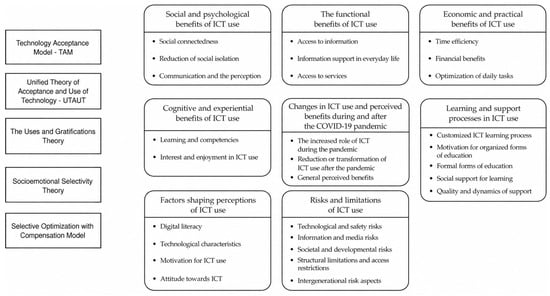
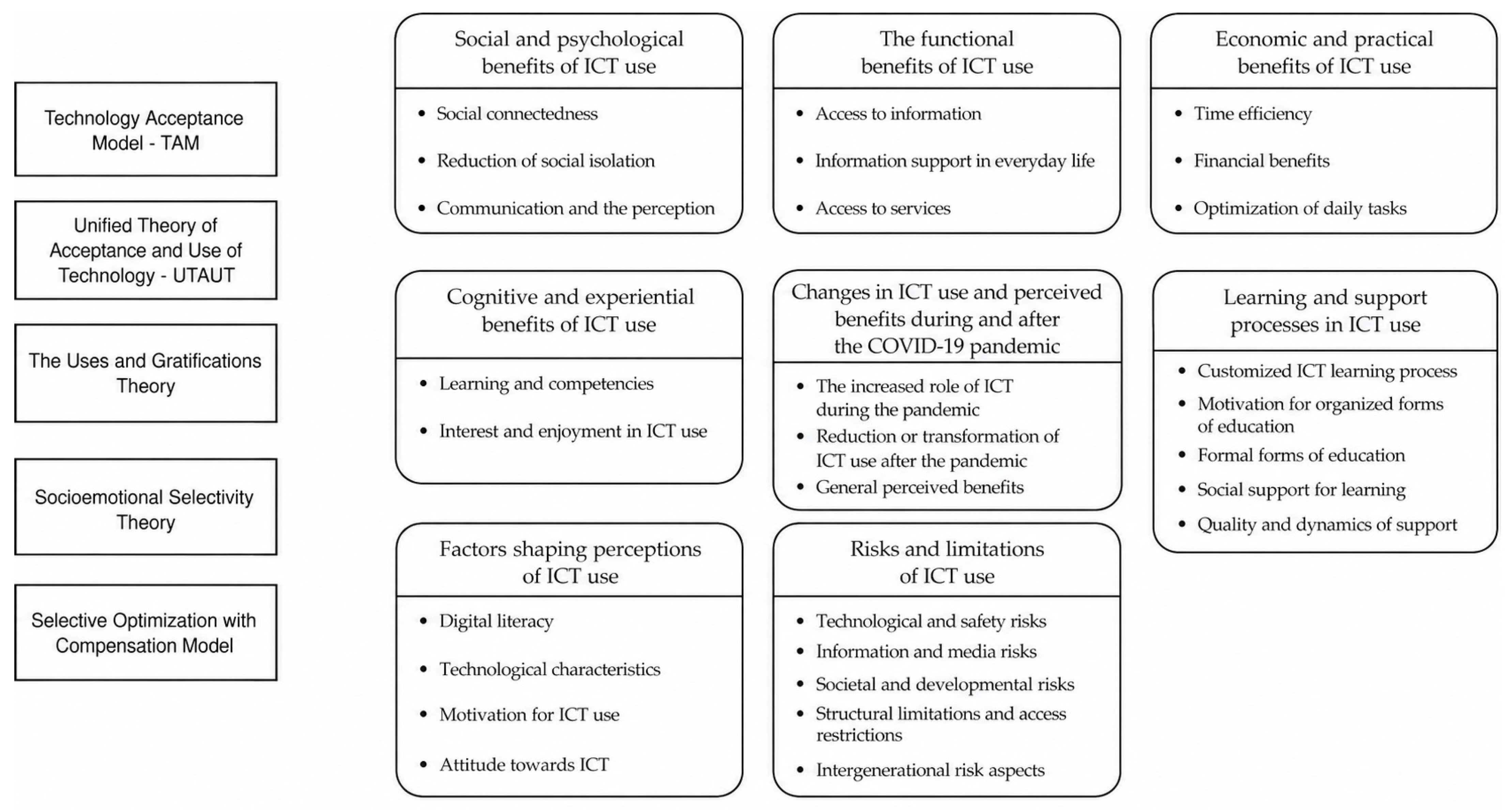
Our findings addressing the research question, “What are the key dimensions of the perceived benefits of ICT use for older adults during and after the COVID-19 pandemic?”, indicate that the perceived benefits of ICT use by the participants were embedded within a broader context of temporal changes, learning and support processes, factors shaping ICT use, and perceived risks and limitations. Therefore, the eight inductively derived main categories, which we subsequently organized into four higher-order analytical domains, as shown in Figure 1, point to a multidimensional and context-dependent understanding of ICT use among older adults. Rather than treating all eight categories as dimensions of perceived benefits, the findings distinguish perceived benefits from the conditions, processes, temporal changes, and limitations associated with their development and experience.
Figure 1.
Conceptual framework of the higher-order analytical domains and main categories of ICT use and perceived benefits among older adults during and after the COVID-19 pandemic.
The first analytical domain, the perceived benefits of ICT use, comprised social and psychological, functional, economic and practical, and cognitive and experiential benefits. In relation to TAM [1] and UTAUT [2,3], the findings support the relevance of perceived usefulness and performance-related expectations, but also suggest that perceived benefits extend beyond instrumental utility for older adults. Social connectedness, reduced social isolation, and ICT-mediated communication indicate that the perceived value of ICT also involved maintaining social relationships and meaningful communication. These dimensions were particularly salient during the COVID-19 pandemic, when ICT provided an important means of maintaining social contact, consistent with empirical studies reporting an increased role of digital technologies in reducing loneliness and maintaining social capital among older adults [37]. Functional benefits, which include access to information, information support in everyday life, and access to services, combined with economic and practical benefits, such as time efficiency, financial benefits, and optimization of daily tasks, further highlight how perceived usefulness was embedded in concrete everyday practices rather than being limited to technology acceptance itself.
The category of cognitive and experiential benefits, encompassing learning and competencies as well as interest and enjoyment in ICT use, further broadens this understanding of perceived benefits. Participants’ accounts suggest that ICT was perceived not only as a functional tool but also as a resource for learning, engagement, and personally meaningful experiences. This finding extends a purely instrumental interpretation of technology acceptance and aligns with Uses and Gratifications Theory [16], which highlights the needs individuals seek to satisfy through media and technology use. In this respect, the findings suggest that the perceived benefits of ICT among older adults may encompass experiential and learning-related dimensions alongside functional utility.
The second analytical domain, temporal changes in ICT use and perceived benefits, highlights the context-dependent nature of these perceptions. The retrospective accounts of the participants indicated an increased role of ICT during the COVID-19 pandemic, particularly for the maintenance of communication and access to information when physical mobility and social contact were restricted, which was occasionally followed by reduced or more selective use after the pandemic. This pattern is consistent with longitudinal research documenting changes in ICT use among older adults [8]. We can also interpret the findings in relation to Socioemotional Selectivity Theory [18,19], and the Selective Optimization with Compensation model [26], as the participants’ accounts suggest selective engagement with technologies that supported personally relevant activities or compensated for situational restrictions. These theories were used as post hoc interpretive frameworks and did not inform the inductive coding or category development. The third analytical domain comprised learning and support processes in ICT use and factors shaping perceptions of ICT use. Participants’ accounts highlighted the importance of adapted learning processes, motivation for organized forms of education, participation in formal education, social support for learning, and the quality and dynamics of ICT support. Digital literacy, technological characteristics, motivation for ICT use, and attitudes towards ICT also emerged as factors associated with how participants perceived and engaged with digital technologies. These findings highlight the conditions surrounding ICT use rather than additional categories of perceived benefits.
Learning and support processes, and the factors shaping perceptions of ICT use, can be interpreted in relation to the facilitating conditions proposed by UTAUT [2,3] and within the broader framework of digital inequality [38]. The findings suggest that we cannot understand perceived benefits solely in terms of access to technology; participants’ accounts also highlighted the relevance of digital competencies, motivation, social support, and the quality of learning opportunities. Recent research in the context of the pandemic similarly indicates that digital inequalities extend beyond differences in access to differences in how individuals can use and benefit from digital technologies, conceptualized as a “benefit divide” [37,39,40]. The fourth analytical domain, risks and limitations of ICT use, adds an important counterpoint to participants’ perceived benefits. Participants identified technological and safety risks, information and media risks, societal and developmental risks, structural limitations and access restrictions, and intergenerational risk aspects. Subsequently, their accounts indicate that perceived benefits coexist with concerns, restrictions, and constraints associated with ICT use. This finding challenges an exclusively positive interpretation of digital technology use in later life and highlights the perceived ambivalence of ICT use. Together, the four analytical domains suggest that the perceived benefits of ICT by older adults are embedded within the framework of a dynamic and context-dependent configuration of everyday utility, temporal change, learning and support conditions, factors shaping ICT use, and perceived risks as well as limitations.
Several methodological limitations should be considered when interpreting the findings. First, the purposively selected and relatively small sample limits the transferability of the findings to the broader population of older adults. In addition, recruitment through organizations and networks involving older adults may have introduced selection bias towards participants who were relatively socially engaged and connected. Consequently, the experiences of socially isolated older adults, older adults with fewer social connections, or those who do not participate in organizational activities may be underrepresented. Furthermore, the retrospective nature of accounts by the participants represents an additional limitation, particularly for comparisons between ICT use during and after the COVID-19 pandemic. Finally, the study focused on the subjective perceptions and reported experiences of the participants and did not directly measure the effects ICT use has on quality of life, independence, cognitive functioning, health, active aging, or longevity. The findings should therefore be interpreted as perceived or reported benefits rather than empirically demonstrated effects on these outcomes. Future research could integrate the qualitative findings on older adults’ perceived benefits of ICT use during and after the COVID-19 pandemic obtained within the DIGOLD project with quantitative approaches. Mixed-methods and longitudinal research involving larger, more diverse samples, including socially isolated older adults and those less engaged in organizational activities, could examine the relationships between the perceived benefits identified in this study and measurable outcomes related to well-being, independence, social participation, and quality of life. Such research could further contribute to the development of socially and gerontologically responsive approaches to digital inclusion in later life.
5. Conclusions
Our findings contribute to a deeper understanding of the perceived benefits of ICT use during and after the COVID-19 pandemic among older adults. The eight inductively determined main categories and twenty-eight subcategories, which we subsequently organized into four higher-order analytical domains, indicate that perceived benefits were embedded within the broader context of temporal changes, learning and support processes, factors shaping ICT use, and perceived risks and limitations. The perceived benefits identified in the accounts extended beyond the functional and instrumental aspects, as they also included social and psychological, economic, practical, cognitive, and experiential dimensions. Specifically, participants associated ICT use with maintaining social connectedness, reducing loneliness, accessing information and services, facilitating everyday tasks, supporting learning, and developing digital competences. These findings reflect perceived and reported benefits, not objectively measured effects on quality of life, independence, or active aging. Within this context, their retrospective accounts imply that the COVID-19 pandemic increased the importance of ICT use in everyday life, especially when opportunities for physical mobility and in-person social contact were restricted. After the pandemic, some participants reported reduced or more selective forms of ICT use, which reflected their specific changing needs and priorities, as well as life circumstances. Therefore, these findings point to a dynamic, context-dependent relationship between ICT use and perceived benefits in later life, rather than a uniform or permanent effect or consequence of digital technology. A further contribution of the study lies in showing that perceived benefits of ICT use should be considered in relation to the conditions under which older adults engage with digital technologies. The participants also highlighted digital literacy, motivation, social support, learning opportunities, and technological characteristics as relevant factors that shaped their engagement with and perceptions of ICT. This broader perspective suggests that digital inclusion involves more than mere access to technology. This highlights the need to address differences in opportunities when it comes to developing competencies, accessing appropriate support, and deriving perceived benefits from ICT use. As such, these findings are pertinent to developing policies and interventions aimed at promoting more equitable digital inclusion for older adults. At the same time, participants identified risks and concerns pertaining to ICT use, such as technological and safety risks, information and media risks, societal and developmental concerns, structural limitations and access restrictions, and intergenerational risk aspects. The coexistence of perceived benefits and perceived risks highlights the importance of a balanced approach to digitalization in later life. Rather than assuming that ICT use itself improves active aging, independence, quality of life, cognitive functioning, or longevity, our findings indicate that older adults are more likely to perceive ICT as a useful resource within the framework of particular social, educational, technological, and everyday contexts. In conclusion, our findings support a multidimensional and context-sensitive understanding of ICT use among older adults. The perceived benefits are intertwined with temporal changes, learning and support processes, individual and technological factors, and perceived risks and limitations. This understanding moves beyond a technologically deterministic perspective and could provide a foundation for developing more inclusive and age-sensitive approaches to digitalization. Further research using larger and more diverse samples, longitudinal designs, and quantitative or mixed-methods approaches is needed to examine whether, and under what conditions, the perceived benefits identified in this study are associated with measurable outcomes related to well-being, independence, social participation, active aging, and quality of life.
Author Contributions
Conceptualization, N.L. and M.B.; methodology, N.L.; validation, N.L. and M.B.; formal analysis, M.B.; investigation, N.L. and M.B.; resources, M.B.; data curation, N.L. and M.B.; writing—original draft preparation, M.B. and N.L.; writing—review and editing, N.L. and M.B.; visualization, N.L.; supervision, M.B.; project administration, N.L. and M.B. All authors have read and agreed to the published version of the manuscript.
Funding
The project titled “Digitalization in the (post)COVID-19 era and its effect on quality of life and social inclusion of older adults (DIGOLD)” (J5-4580) in the period 2022–2025 was funded by the Slovenian Research and Innovation Agency.
Institutional Review Board Statement
The Ethics Committee for Research at Masaryk University approved the study protocol (approval number: EKV-2022-007; approved on 9 January 2023). The study was conducted in accordance with the Declaration of Helsinki and relevant national ethical guidelines.
Informed Consent Statement
Given the qualitative nature of the study, the Ethics Committee waived the requirement for written informed consent. All participants provided informed consent before participating in the study; for in-person data collection, trained interviewers obtained verbal consent.
Data Availability Statement
Data collection in DIGOLD has ensured compliance with legal norms and international ethical standards, including the Respect Code of Practice for Socio-Economic Research and the Declaration of Helsinki. The data used in this study were collected as part of the DIGOLD project (»Digitalisation in the (post)COVID-19 era and its effect on quality of life and social inclusion of older adults«). The authors are members of the DIGOLD research consortium and have full authorization to access and use the data for scientific analysis and publication in accordance with project governance and the approved ethical protocol.
Acknowledgments
Thanks are due to the members of the DIGOLD project group at the Alma Mater Europaea University in Slovenia and Masaryk University Brno, Czech Republic. Thanks are also due to all 15 older adults who participated in the study.
Conflicts of Interest
The authors declare no conflicts of interest.
Abbreviations
The following abbreviations are used in this manuscript:
| ICT | Information Communication Technology |
| DIGOLD | The project »Digitalisation in the (post)COVID-19 era and its effect on quality of life and social inclusion of older adults« |
| TAM | Technology Acceptance Model |
| UTAUT | Unified Theory of Acceptance and Use of Technology |
| SOC | Selective Optimization with Compensation |
References
- Davis, F.D. Perceived Usefulness, Perceived Ease of Use, and User Acceptance of Information Technology. MIS Q. 1989, 13, 319–340. [Google Scholar] [CrossRef] [Scilit]
- Venkatesh, V.; Thong, J.Y.; Xu, X. Consumer Acceptance and Use of Information Technology: Extending the Unified Theory of Acceptance and Use of Technology1. MIS Q. 2012, 36, 157–178. [Google Scholar] [CrossRef] [Scilit]
- Venkatesh, V.; Morris, M.G.; Davis, G.B.; Davis, F.D. User Acceptance of Information Technology: Toward A Unified View1. MIS Q. 2003, 27, 425–478. [Google Scholar] [CrossRef] [Scilit]
- Patrício, M.R.; Osório, A. Intergenerational Learning with ICT: A Case Study. Stud. Paedagog. 2016, 21, 83–99. [Google Scholar] [CrossRef] [Scilit]
- Woodward, A.T.; Freddolino, P.P.; Blaschke-Thompson, C.M.; Wishart, D.J.; Bakk, L.; Kobayashi, R.; Tupper, C. Technology and Aging Project: Training Outcomes and Efficacy from a Randomized Field Trial. Ageing Int. 2011, 36, 46–65. [Google Scholar] [CrossRef] [Scilit]
- Kong, H.; Liu, H. The Relationship between ICT Use and Perceived Life Satisfaction among Older People in Korea: The Mediating Effect of Social Capital. Sustainability 2023, 15, 9353. [Google Scholar] [CrossRef] [Scilit]
- Elliot, A.J.; Mooney, C.J.; Douthit, K.Z.; Lynch, M.F. Predictors of Older Adults’ Technology Use and Its Relationship to Depressive Symptoms and Well-Being. J. Gerontol. B Psychol. Sci. Soc. Sci. 2014, 69, 667–677. [Google Scholar] [CrossRef] [Scilit]
- Choi, N.G.; Choi, B.Y.; Marti, C.N. Digital Divide Among Homebound and Semi-Homebound Older Adults. J. Appl. Gerontol. 2025, 44, 970–980. [Google Scholar] [CrossRef] [Scilit]
- Nordin, S.; Sturge, J.; Ayoub, M.; Jones, A.; McKee, K.; Dahlberg, L.; Meijering, L.; Elf, M. The Role of Information and Communication Technology (ICT) for Older Adults’ Decision-Making Related to Health, and Health and Social Care Services in Daily Life-A Scoping Review. Int. J. Environ. Res. Public Health 2021, 19, 151. [Google Scholar] [CrossRef] [Scilit]
- Cone, N.; Lee, J.E. Older Adult Communication Types and Emotional Well-Being Outcomes during COVID-19 Pandemic. BMC Geriatr. 2023, 23, 178. [Google Scholar] [CrossRef] [Scilit]
- Arthanat, S. Promoting Information Communication Technology Adoption and Acceptance for Aging-in-Place: A Randomized Controlled Trial. J. Appl. Gerontol. 2021, 40, 471–480. [Google Scholar] [CrossRef] [Scilit]
- Müller, J.; Zhao, X.; Foran, H.M. A Technology-Supported Psychoeducational Intervention for Older Adults and Their Families to Improve Social Isolation, Loneliness, and Intergenerational Connectedness-A Randomized Controlled Study. Cyberpsychol Behav. Soc. Netw. 2024, 27, 835–845. [Google Scholar] [CrossRef] [Scilit]
- Gauthier-Beaupré, A.; Kuziemsky, C.; Battistini, B.J.; Jutai, J.W. Framework for Policymaking on Self-Management of Health by Older Adults Using Technologies. Health Res. Policy Syst. 2024, 22, 32. [Google Scholar] [CrossRef] [Scilit]
- Finkelstein, R.; Wu, Y.; Brennan-Ing, M. Older Adults’ Experiences with Using Information and Communication Technology and Tech Support Services in New York City: Findings and Recommendations for Post-Pandemic Digital Pedagogy for Older Adults. Front. Psychol. 2023, 14, 1129512. [Google Scholar] [CrossRef] [Scilit]
- Jo, H.S.; Hwang, Y.S. Psychological Factors That Affect the Acceptance and Need for ICT Services for Older Adults with Chronic Diseases. Gerontechnology 2021, 20, 1–11. [Google Scholar] [CrossRef] [Scilit]
- Blumler, J.G.; Katz, E. The Uses of Mass Communications: Current Perspectives on Gratifications Research; SAGE Publications: Thousand Oaks, CA, USA, 1974; ISBN 978-0-8039-0340-1. [Google Scholar]
- Fotteler, M.L.; Kocar, T.D.; Dallmeier, D.; Kohn, B.; Mayer, S.; Waibel, A.-K.; Swoboda, W.; Denkinger, M. Use and Benefit of Information, Communication, and Assistive Technology among Community-Dwelling Older Adults—A Cross-Sectional Study. BMC Public Health 2023, 23, 2004. [Google Scholar] [CrossRef] [Scilit]
- Carstensen, L.L. Social and Emotional Patterns in Adulthood: Support for Socioemotional Selectivity Theory. Psychol. Aging 1992, 7, 331–338. [Google Scholar] [CrossRef] [Scilit]
- Carstensen, L.L.; Isaacowitz, D.M.; Charles, S.T. Taking Time Seriously. A Theory of Socioemotional Selectivity. Am. Psychol. 1999, 54, 165–181. [Google Scholar] [CrossRef]
- Petersen, B.; Khalili-Mahani, N.; Murphy, C.; Sawchuk, K.; Phillips, N.; Li, K.Z.H.; Hebblethwaite, S. The Association between Information and Communication Technologies, Loneliness and Social Connectedness: A Scoping Review. Front. Psychol. 2023, 14, 1063146. [Google Scholar] [CrossRef] [Scilit]
- Jiménez, F.N.; Brazier, J.F.; Davoodi, N.M.; Florence, L.C.; Thomas, K.S.; Gadbois, E.A. A Technology Training Program to Alleviate Social Isolation and Loneliness Among Homebound Older Adults: A Community Case Study. Front. Public Health 2021, 9, 750609. [Google Scholar] [CrossRef] [Scilit]
- Seifert, A.; Cotten, S.R.; Xie, B. A Double Burden of Exclusion? Digital and Social Exclusion of Older Adults in Times of COVID-19. J. Gerontol. B Psychol. Sci. Soc. Sci. 2021, 76, e99–e103. [Google Scholar] [CrossRef] [Scilit]
- Liu, C.-C.; Wang, Y.-L. Does ICT Usage Have a Positive or Negative Effect on Taiwanese Older Adults’ Emotional Experiences? The Moderating Role of Basic Psychological Needs Satisfaction. J. Intell. 2023, 11, 46. [Google Scholar] [CrossRef] [Scilit]
- Chae, H.J.; Lee, S.H. Effectiveness of Online-Based Cognitive Intervention in Community-Dwelling Older Adults with Cognitive Dysfunction: A Systematic Review and Meta-Analysis. Int. J. Geriatr. Psychiatry 2023, 38, e5853. [Google Scholar] [CrossRef] [Scilit]
- Francis, J.; Kadylak, T.; Makki, T.W.; Rikard, R.V.; Cotten, S.R. Catalyst to Connection: When Technical Difficulties Lead to Social Support for Older Adults. Am. Behav. Sci. 2018, 62, 1167–1185. [Google Scholar] [CrossRef] [Scilit]
- Baltes, P.B.; Baltes, M.M. Successful Aging: Perspectives from the Behavioral Sciences; Cambridge University Press: Cambridge, UK, 1993; ISBN 978-0-521-43582-6. [Google Scholar]
- Cevallos, N.; Ramadhani, W.A.; Lindgren, J.; Bell, B.; Martinez-Cosio, M.; Harvey, T.E.; Nanda, U.; Mustata Wilson, G. (St)Aging in Place: Information and Communication Technologies for a Health-Centered Agile Dwelling Unit. Front. Public Health 2023, 11, 1057689. [Google Scholar] [CrossRef] [Scilit]
- Seifert, A.; Batsis, J.A.; Smith, A.C. Telemedicine in Long-Term Care Facilities During and Beyond COVID-19: Challenges Caused by the Digital Divide. Front. Public Health 2020, 8, 601595. [Google Scholar] [CrossRef] [Scilit]
- Arthanat, S.; Vroman, K.G.; Lysack, C.; Grizzetti, J. Multi-Stakeholder Perspectives on Information Communication Technology Training for Older Adults: Implications for Teaching and Learning. Disabil. Rehabil. Assist Technol. 2019, 14, 453–461. [Google Scholar] [CrossRef] [Scilit]
- Tian, Y.; Wang, S.; Zhang, Y.; Meng, L.; Li, X. Effectiveness of Information and Communication Technology-Based Integrated Care for Older Adults: A Systematic Review and Meta-Analysis. Front. Public Health 2023, 11, 1276574. [Google Scholar] [CrossRef] [Scilit]
- Hsieh, H.-F.; Shannon, S.E. Three Approaches to Qualitative Content Analysis. Qual. Health Res. 2005, 15, 1277–1288. [Google Scholar] [CrossRef] [Scilit]
- Mesec, B. Uvod V Kvalitativno Raziskovanje V Socialnem Delu; Visoka Šola za Socialno Delo: Ljubljana, Slovenia, 1998. [Google Scholar]
- Vogrinc, J. Kvalitativno Raziskovanje Na Pedagoškem Področju; Pedagoška Fakulteta Univerze v Ljubljani: Ljubljana, Slovenia, 2008. [Google Scholar]
- Lamut, U.; Macur, M. Metodologija Družboslovnega Raziskovanja: Od Zasnove Do Izvedbe; Vega: Ljubljana, Slovenia, 2012. [Google Scholar]
- Im, D.; Pyo, J.; Lee, H.; Jung, H.; Ock, M. Qualitative Research in Healthcare: Data Analysis. J. Prev. Med. Public Health 2023, 56, 100–110. [Google Scholar] [CrossRef] [Scilit]
- Krippendorff, K. Content Analysis: An Introduction to Its Methodology; SAGE: Thousand Oaks, CA, USA, 2013; ISBN 978-1-4129-8315-0. [Google Scholar]
- Xie, B.; Charness, N.; Fingerman, K.; Kaye, J.; Kim, M.T.; Khurshid, A. When Going Digital Becomes a Necessity: Ensuring Older Adults’ Needs for Information, Services, and Social Inclusion During COVID-19. J. Aging Soc. Policy 2020, 32, 460–470. [Google Scholar] [CrossRef] [Scilit]
- Helsper, E.J. A Corresponding Fields Model for the Links Between Social and Digital Exclusion. Commun. Theory 2012, 22, 403–426. [Google Scholar] [CrossRef] [Scilit]
- Liang, S. Digital Divide Faced by the Elderly Under the COVID-19 Pandemic. In Social Vulnerability to COVID-19: Impacts of Technology Adoption and Information Behavior; Yuan, X., Wu, D., Bennett Gayle, D., Eds.; Springer International Publishing: Cham, Switzerland, 2023; pp. 75–87. ISBN 978-3-031-06897-3. [Google Scholar]
- Fang, Z.; Liu, Y.; Peng, B. Empowering Older Adults: Bridging the Digital Divide in Online Health Information Seeking. Humanit. Soc. Sci. Commun. 2024, 11, 1748. [Google Scholar] [CrossRef] [Scilit]

Disclaimer/Publisher’s Note: The statements, opinions and data contained in all publications are solely those of the individual author(s) and contributor(s) and not of MDPI and/or the editor(s). MDPI and/or the editor(s) disclaim responsibility for any injury to people or property resulting from any ideas, methods, instructions or products referred to in the content. |
© 2026 by the authors. Licensee MDPI, Basel, Switzerland. This article is an open access article distributed under the terms and conditions of the Creative Commons Attribution (CC BY) license.