


Abstract
Mild cognitive impairment (MCI), also known as mild neurocognitive disorder, represents a transitional stage between normal cognitive aging and dementia and often signals early neurodegenerative change. Despite its clinical importance, MCI remains poorly understood by the public and family care partners, leading to uncertainty and distress following diagnosis. This study evaluated UnderstandingMCI.ca, a brief multimedia e-learning lesson designed to improve MCI literacy among the public and care partners. The lesson was disseminated through the McMaster Optimal Aging Portal, with web analytics tracking uptake, progress, and completion, and a post-lesson survey incorporating the Net Promoter Score (NPS), the Information Assessment Method for all (IAM4all) questionnaire, and open-text feedback assessing perceived impact. Between 15 January and 7 February 2025, over 5000 users initiated the lesson, 1537 completed it, and 984 responded to the survey. Respondents were predominantly women aged 65 years or older. The NPS was 72 (“excellent”); 942 respondents (96%) found the lesson relevant, 937 (95%) anticipated benefits from using the information, and nearly all (982 respondents) reported understanding the material. Thematic analysis of 296 comments identified greater understanding of MCI versus normal aging and dementia, emotional reassurance, and motivation for proactive brain-health behaviors. UnderstandingMCI.ca was well-received, with respondents reporting that the lesson was understandable and relevant, and that they intended to use the information, suggesting it may be a feasible and scalable approach to public and care partner education about MCI.
1. Introduction
Mild cognitive impairment (MCI), also known as mild neurocognitive disorder, is a clinical condition characterized by measurable cognitive decline that exceeds age-related expectations but does not meet criteria for dementia due to preserved functional independence [1,2,3,4]. It is estimated that 3–19% of individuals over the age of 65 are affected by MCI, and approximately 5–10% of those individuals progress to dementia annually [4,5]. Early identification of MCI offers a critical opportunity to adopt lifestyle changes and management strategies that may delay further decline or support planning for future care needs [6].
Despite its clinical importance, public understanding of MCI remains limited. Confusion between normal cognitive aging, MCI, and dementia is common, and misinformation may lead to delays in seeking care, increased anxiety, or underutilization of preventative health strategies [7,8]. Increasing public knowledge of MCI is therefore vital in promoting early detection, reducing stigma, and empowering individuals and care partners to take proactive steps toward brain health.
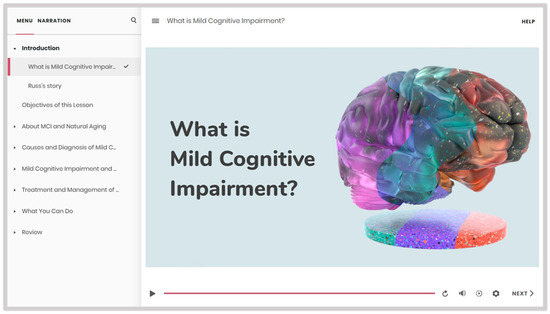
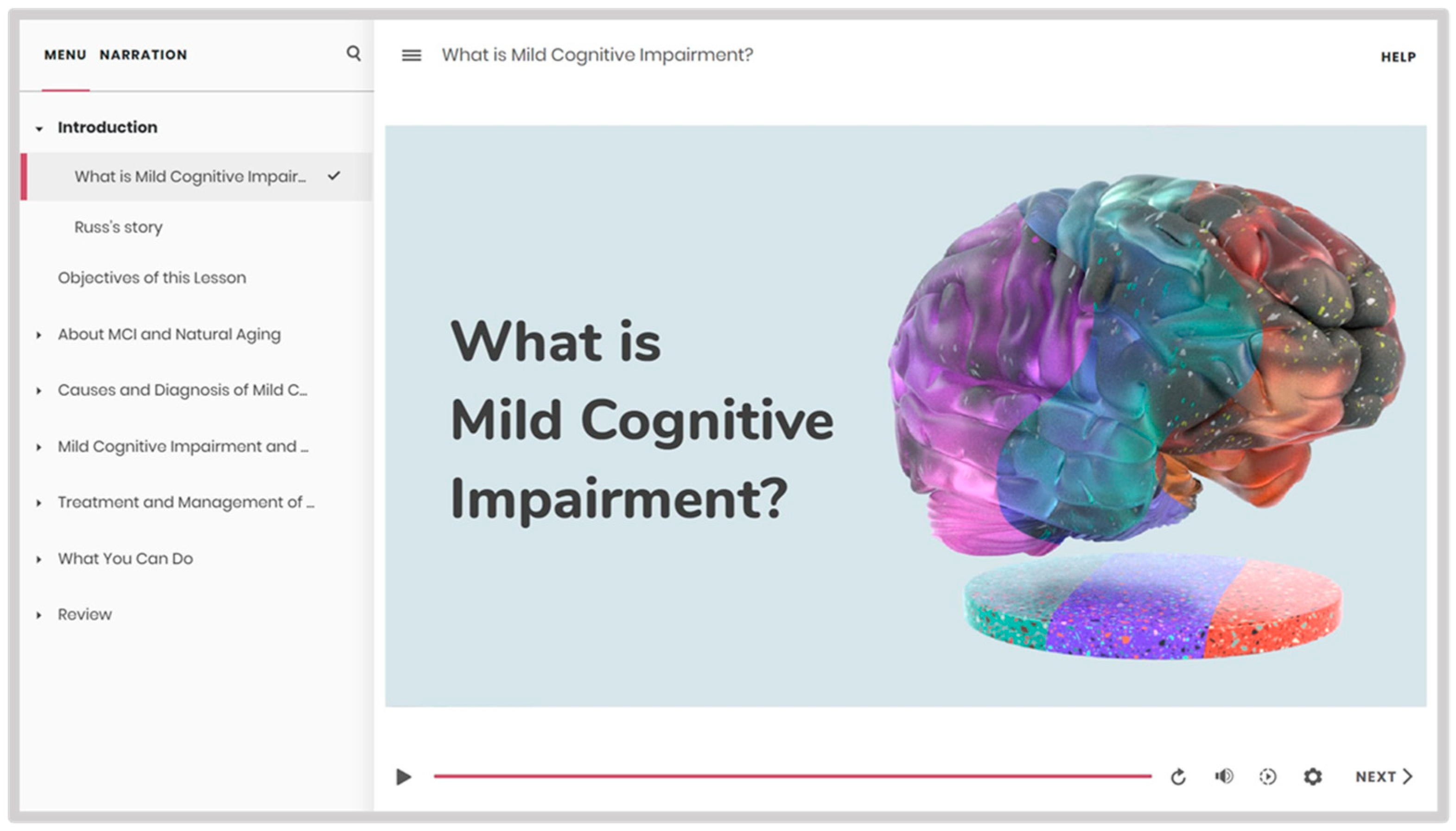
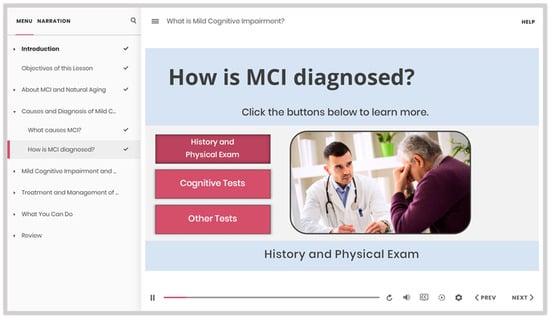
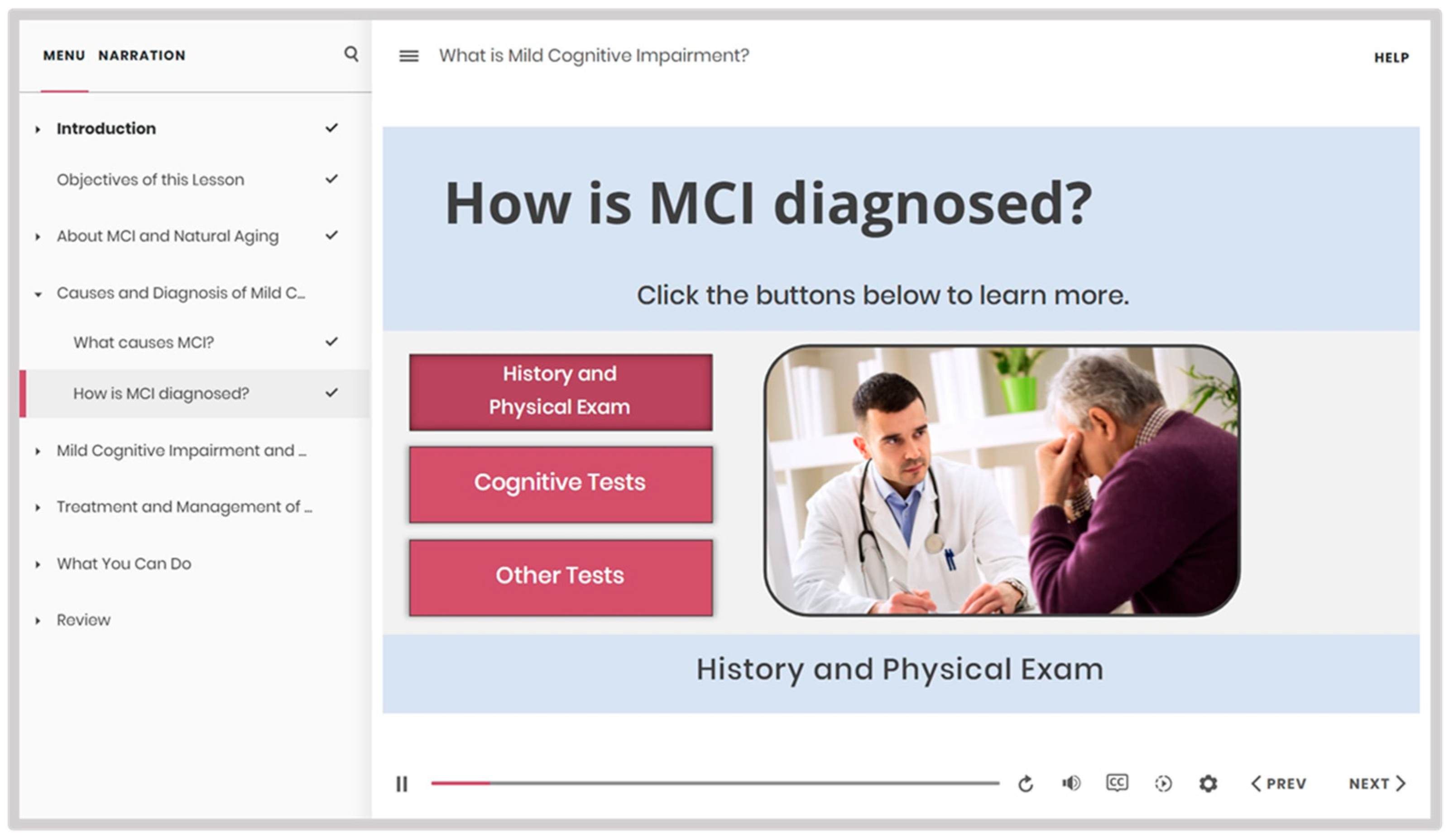
To address this knowledge gap, we developed UnderstandingMCI.ca (Figure 1), an online, 15 min multimedia lesson designed to improve MCI literacy among the public and family/friend care partners. The lesson was developed using evidence-based best practices in multimedia e-learning instructional design, including interactive content, multimedia elements and audio narration; plain language explanations; segmenting the content into manageable topics to reduce cognitive load; authentic scenarios and worked examples; review questions; and learner control over navigation, as displayed in Figure 2 [9]. Development was informed by a range of experts in MCI and e-learning, and was reviewed extensively with family care partners to ensure their feedback was incorporated. Lesson content includes how to recognize MCI; distinctions from dementia and normal aging; and MCI prevention, diagnosis, and management. It is currently hosted on the McMaster Optimal Aging Portal, a free, publicly accessible, evidence-based health information website for adults and older adults. The Portal curates high-quality health evidence in user-friendly formats (e.g., evidence summaries, blog posts, videos) and disseminates content primarily through its website and subscription e-newsletter. Previous evaluations of the Portal have demonstrated high usability and satisfaction, and have described its users as predominantly female, highly educated, and typically aged 55 years and older, many of whom self-identify as caregivers or individuals managing their own chronic conditions [10,11,12,13].
Figure 1.
UnderstandingMCI.ca e-learning lesson.
Figure 2.
Exemplar of interactive components of e-learning lesson.
The objective of this program evaluation is to describe lesson uptake and engagement and to assess perceived value and improvement needs using web/learning analytics, validated questionnaires, and open-text feedback.
2. Materials and Methods
2.1. Study Design
A single-group, post-intervention mixed-methods observational evaluation using a post-lesson survey was conducted.
2.2. Participants and Recruitment
Potential participants were recruited from the McMaster Optimal Aging Portal subscriber list with a link to the UnderstandingMCI.ca e-learning lesson. Eligible participants were limited to those who completed the lesson and voluntarily opted into the post-lesson survey. Incomplete survey responses were excluded from analysis.
2.3. Outcomes
Participants who completed the lesson were invited to complete a brief survey. The post-lesson survey included a collection of quantitative and qualitative data. The data collection period spanned from 15 January 2025 to 7 February 2025. All data was anonymized prior to analysis.
Quantitative data was collected from four sources: (1) web and e-learning analytics tracking lesson uptake and engagement; (2) the Net Promoter Score (NPS), which is a consumer experience metric assessing the likelihood of users recommending the lesson on a scale of 0 to 10; (3) a short demographic survey; and (4) the content-validated Information Assessment Method for all (IAM4all) questionnaire, which evaluates the perceived relevance, understandability, intention to use, and anticipated benefit of consumer health information [14,15,16]. Quantitative data were summarized descriptively (counts/percentages), and NPS was calculated as the proportion of promoters (9–10) minus detractors (0–6).
2.4. Data Analysis
A convergent mixed-methods research design was used to evaluate user feedback. We examined quantitative ratings and qualitative comments to provide a more complete picture of the perceived impact of the lesson and opportunities for improvement.
2.4.1. Quantitative Data Analysis
The NPS was collected via SurveyMonkey. NPS scoring stratified respondents into three categories, based on their self-reported likelihood to recommend to others on a scale of 1–10—promoters (score 9–10), passives (score 7–8) and detractors (score 0–6)—and was calculated using the standard scoring method by subtracting the percentage of detractors from promoters, resulting in a single score for the entire program ranging from −100 to +100. Scores above 0 are considered good (i.e., more promoters than detractors), scores above 20 are considered favorable, scores above 50 are considered excellent and signal strong user engagement, while scores above 80 are considered world-class [17,18]. Quantitative data from the IAM4all questionnaire were collected using SurveyMonkey and analyzed using IBM SPSS Version 30. Data were summarized descriptively (counts/percentages) and were used to summarize participants’ responses across four domains: perceived relevance, understandability, intention to use the information, and anticipated benefit.
2.4.2. Qualitative Data Analysis
Data were collected through open-text feedback in the IAM4all questionnaire. Responses were manually coded using Microsoft Excel and analyzed inductively using reflexive thematic analysis. Two analysts (VJM, DH) coded independently, then reached consensus agreement and iteratively developed themes with input from the principal investigator (AJL). To enhance trustworthiness, analysts maintained reflective notes, and themes were reviewed in team meetings until conceptual saturation was achieved.
2.4.3. Data Integration
Data integration occurred at both the design and interpretation stages within a convergent mixed-methods framework. Predefined research objectives guided alignment of the quantitative survey data and qualitative free-text comments [19]. After independent analyses, results from both components were integrated narratively to compare and relate findings and to provide a more comprehensive understanding of the lesson’s perceived impact.
2.5. Ethics Approval
The Hamilton Integrated Research Ethics Board deemed the project exempt from full review on the basis that it constitutes quality improvement/program evaluation activity.
3. Results
3.1. Data Trends and Respondent Characteristics
A total of 5026 users started the UnderstandingMCI.ca lesson following its launch on 15 January 2025. Of those, 1537 users completed the full lesson (30.6% of lesson starters). Among those who completed the lesson, 984 participants completed the post-lesson survey (64.0% of lesson completers). Survey respondents were primarily older adults, with 79% identifying as women aged 65 years or older. The average time spent on survey completion was 3 min and 6 s. Many users reported personal interest in monitoring cognitive changes, either for themselves or loved ones.
3.2. Quantitative Analysis
Quantitative outcomes demonstrated high levels of satisfaction and strong intentions to use the information. The Net Promoter Score (NPS) was 72, which is considered ‘excellent’ using commonly used benchmarks.
From the IAM4all survey, also displayed in Table 1, 96% of respondents found the lesson relevant to their needs, while nearly 100% reported understanding the information well. Furthermore, 99% of users stated that they intended to use the information, and 95% anticipated benefits, such as improved health behavior, reduced anxiety, or improved support for a loved one.
Table 1.
Selected summary of IAM4all questions and participant responses.
3.3. Qualitative Analysis
Thematic analysis of 296 open-text responses yielded three primary themes. The first theme pertained to new knowledge gained, and informative content. Many users expressed that the lesson demystified distinctions between MCI, dementia, and normal aging. Second, emotional reassurance also emerged as a dominant theme, with users describing feelings of relief and decreased anxiety that came with an increased understanding of cognitive aging. Third, many users also reported a sense of motivation and proactivity. These users felt motivated to discuss cognitive health with healthcare providers or family members, or to adopt health-promoting behaviors, such as cognitive stimulation, physical activity, and dietary changes. Although most comments were favorable, a small group of respondents identified suggestions for improvement. A more detailed list of themes and sub-themes, their descriptions, and representative quotations illustrating each are provided in Appendix A.
3.4. Integration of Quantitative and Qualitative Findings
Integrated findings converged across three distinct domains: (1) MCI literacy, (2) emotional response, and (3) behavioral intention. First participants’ descriptions of the lesson as clear, informative, and improving their knowledge were consistent with high IAM4all ratings, indicating that participants learned something new and planned to use the content to better understand cognitive changes. Second, comments related to emotional reassurance were consistent with the high percentage of respondents answering that the information reassured them and helped them to be less worried. Finally, in the behavioral intention domain, qualitative comments about discussing concerns with family or healthcare providers and taking proactive steps were consistent with quantitative indicators of intended use, including motivation to learn more, do things differently, improve their health or health of a family member, and prevent a problem. Taken together, these convergent findings suggest that the lesson was perceived as understandable, relevant, useful, and emotionally supportive, reinforcing its perceived value in helping the public navigate concerns about cognitive changes. However, these integrated findings should be interpreted as self-reported perceptions and intentions in a post-lesson evaluation, rather than objective evidence of knowledge retention, behavioral change, or clinical effect.
4. Discussion
Public and family care partner understanding of MCI remains limited, with frequent confusion between normal cognitive aging, MCI, and dementia. This gap has clinical relevance because misunderstanding may contribute to delayed help-seeking, unnecessary distress, and missed opportunities for early counseling, risk reduction, and care planning. The primary purpose of this project was program evaluation to assess the uptake, engagement, and user-perceived value of a brief web-based MCI lesson delivered through the McMaster Optimal Aging Portal. The findings of this evaluation suggest that UnderstandingMCI.ca is a well-received and accessible educational resource that communicates clear, credible information about mild cognitive impairment. The positive feedback across both quantitative and qualitative measures indicates that the lesson addresses a need for reliable, easy-to-understand information about MCI.
The excellent NPS (72) reflects an excellent likelihood to recommend, while the IAM4all data showed that a vast majority of respondents found the content relevant and understandable, intended to use the information, and anticipated benefits.
The results of qualitative measures also suggest positive impacts. Many users described feeling reassured after completing the lesson. The qualitative findings also suggested perceived psychosocial value. Many users described feeling reassured after completing the lesson, and others reported intentions to seek assessment or counselling from healthcare providers, or to consider lifestyle changes consistent with evidence-informed dementia risk-reduction strategies [20]. These outcomes suggest that the lesson may have both educational and psychosocial value for learners.
Furthermore, caregivers who completed the lesson highlighted its practical value, noting how it clarified their role and helped them better support their loved ones. This aligns with research showing that caregiver education reduces stress and improves care quality [21].
Importantly, limitations of this study must be considered. First, because this was a single-group, post-intervention evaluation with no baseline measurement or comparator group, the findings cannot establish causal effects of the lesson and should be interpreted as perceived post-lesson outcomes. Likewise, the NPS and IAM4all primarily assess the user experience, perceived relevance, and anticipated utility. These are important implementation outcomes, but they are not direct measures of knowledge acquisition, sustained behavior change, or clinical impact. Additionally, the sample was self-selected and composed primarily of health-engaged older adults, particularly older women, which may not accurately reflect the target population, limiting its generalizability. Uptake, usability, and perceived value may differ in populations with lower digital literacy, different linguistic or cultural contexts, or lower baseline engagement with preventative health information. Moreover, the evaluation relied on self-report data and was restricted to a short follow-up period. Future research should incorporate objective indicators such as pre/post knowledge assessments, follow-up measures, and longer-term outcomes to investigate its long-term impact on knowledge retention, behavior change, and outcomes in diverse populations at elevated risk of cognitive disorders.
5. Conclusions
UnderstandingMCI.ca demonstrates promise as an evidence-based resource for communicating clear, credible information about MCI. In this post-lesson evaluation, respondents reported that the lesson was understandable, relevant and useful, and many described intentions to discuss concerns with others or consider brain-health behaviors. Its concise, user-friendly format and evidence-based content were well-received by a large sample of older adults and care partners. Given its scalability and accessibility, UnderstandingMCI.ca may be a useful resource for public education and clinical settings, providing a structured foundation for conversations about MCI and available next steps.
Author Contributions
Conceptualization, A.J.L., S.A. and S.C.; methodology, A.J.L., S.A., S.C., D.H. and R.G.; formal analysis, V.J.M. and D.H.; investigation, A.J.L., S.A., and S.C.; data curation, S.A., S.C. and R.W.; writing—original draft preparation, V.J.M., S.A. and A.J.L.; writing—review and editing, V.J.M., S.A. and A.J.L.; visualization, V.J.M.; supervision, A.J.L.; project administration, S.A. and A.J.L.; funding acquisition, A.J.L. All authors have read and agreed to the published version of the manuscript.
Funding
This research received no external funding.
Institutional Review Board Statement
The Hamilton Integrated Research Ethics Board reviewed the study protocol and granted exemption from full review per their review process, as this was considered a quality improvement evaluation.
Informed Consent Statement
Not applicable.
Data Availability Statement
The data presented in this study are available upon reasonable request from the corresponding author due to privacy restrictions.
Acknowledgments
This work was supported by the research team at the Division of e-Learning Innovation at McMaster University. Richard Sztramko is a co-creator of the UnderstandingMCI lesson. The authors would like to thank Amy Schneeberg for her feedback with respect to the quantitative reporting. A.J.L. receives support through the John R Evans Chair in Health Sciences Educational Research and Instructional Development, Faculty of Health Sciences, McMaster University. The authors would like to thank all who participated in this project for their time.
Conflicts of Interest
A.J.L. and McMaster University are the co-owners of UnderstandingMCI.ca. The authors declare that the research was conducted in the absence of any commercial or financial relationships that could be construed as potential conflicts of interest.
Abbreviations
The following abbreviations are used in this manuscript:
| MCI | Mild Cognitive Impairment |
| NPS | Net Promoter Score |
| IAM4all | Information Assessment Method for patients and consumers |
Appendix A
Table A1.
Full list of themes identified from open-text responses on thematic analysis and selected associated quotes.
References
- Petersen, R.C. Mild cognitive impairment as a diagnostic entity. J. Intern. Med. 2004, 256, 183–194. [Google Scholar] [CrossRef] [Scilit] [PubMed]
- Petersen, R.C.; Negash, S. Mild cognitive impairment: An overview. CNS Spectr. MBL Commun. 2008, 13, 45–53. [Google Scholar] [CrossRef] [Scilit] [PubMed]
- Whitehouse, P.; Brodaty, H. Mild cognitive impairment. Lancet 2006, 367, 1979. [Google Scholar] [CrossRef] [Scilit] [PubMed]
- Gauthier, S.; Reisberg, B.; Zaudig, M.; Petersen, R.C.; Ritchie, K.; Broich, K.; Belleville, S.; Brodaty, H.; Bennett, D.; Chertkow, H.; et al. Mild cognitive impairment. Lancet 2006, 367, 1262–1270. [Google Scholar] [CrossRef] [Scilit] [PubMed]
- Mitchell, A.J.; Shiri-Feshki, M. Rate of progression of mild cognitive impairment to dementia--meta-analysis of 41 robust inception cohort studies. Acta Psychiatr. Scand. 2009, 119, 252–265. [Google Scholar] [CrossRef] [Scilit] [PubMed]
- Roberts, R.; Knopman, D.S. Classification and epidemiology of MCI. Clin. Geriatr. Med. 2013, 29, 753–772. [Google Scholar] [CrossRef] [Scilit] [PubMed]
- Cations, M.; Radisic, G.; Crotty, M.; Laver, K.E. What does the general public understand about prevention and treatment of dementia? A systematic review of population-based surveys. PLoS ONE 2018, 13, e0196085. [Google Scholar] [CrossRef] [Scilit] [PubMed]
- Ayalon, L.; Areán, P.A. Knowledge of Alzheimer’s disease in four ethnic groups of older adults. Int. J. Geriatr. Psychiatry 2004, 19, 51–57. [Google Scholar] [CrossRef] [Scilit] [PubMed]
- Clark, R.; Mayer, R. E-Learning and the Science of Instruction, 5th ed.; Wiley: Hoboken, NJ, USA, 2023. [Google Scholar]
- Barbara, A.M.; Dobbins, M.; Haynes, R.B.; Iorio, A.; Lavis, J.N.; Raina, P.; Levinson, A.J. The McMaster Optimal Aging Portal: Usability Evaluation of a Unique Evidence-Based Health Information Website. JMIR Hum. Factors 2016, 3, e14, Erratum in JMIR Hum. Factors 2016, 3, e4800. https://doi.org/10.2196/HUMANFACTORS.4800. [Google Scholar] [CrossRef] [Scilit] [PubMed]
- Barbara, A.M.; Dobbins, M.; Haynes, R.B.; Iorio, A.; Lavis, J.N.; Levinson, A.J. User Experiences of the McMaster Optimal Aging Portal’s Evidence Summaries and Blog Posts: Usability Study. JMIR Hum. Factors 2016, 3, e22, Erratum in JMIR Hum. Factors 2016, 3, e6208. https://doi.org/10.2196/HUMANFACTORS.6208. [Google Scholar] [CrossRef] [Scilit] [PubMed]
- Barbara, A.M.; Dobbins, M.; Brian Haynes, R.; Iorio, A.; Lavis, J.N.; Raina, P.; Levinson, A.J. McMaster Optimal Aging Portal: An evidence-based database for geriatrics-focused health professionals. BMC Res. Notes 2017, 10, 271. [Google Scholar] [CrossRef] [Scilit] [PubMed]
- Neil-Sztramko, S.E.; Farran, R.; Watson, S.; Levinson, A.J.; Lavis, J.N.; Iorio, A.; Dobbins, M. If You Build It, Who Will Come? A Description of User Characteristics and Experiences with the McMaster Optimal Aging Portal. Gerontol. Geriatr. Med. 2017, 3, 2333721417737681. [Google Scholar] [CrossRef] [Scilit] [PubMed]
- Reichheld, F.F. The One Number You Need to Grow. 2003. Available online: www.hbr.org (accessed on 3 December 2025).
- Pluye, P.; Granikov, V.; Bartlett, G.; Grad, R.M.; Tang, D.L.; Johnson-Lafleur, J.; Shulha, M.; Galvão, M.C.B.; Ricarte, I.L.M.; Stephenson, R.; et al. Development and content validation of the information assessment method for patients and consumers. JMIR Res. Protoc. 2014, 3, e2908. [Google Scholar] [CrossRef] [Scilit] [PubMed]
- Pluye, P.; Grad, R.; Repchinsky, C.; Jovaisas, B.; Johnson-Lafleur, J.; Carrier, M.E.; Granikov, V.; Farrell, B.; Rodriguez, C.; Bartlett, G.; et al. Four levels of outcomes of information-seeking: A mixed methods study in primary health care. J. Am. Soc. Inf. Sci. Technol. 2013, 64, 108–125. [Google Scholar] [CrossRef] [Scilit]
- Net Promoter Score: Calculation, Best Practices & Survey Tips. Available online: https://www.surveymonkey.com/learn/customer-feedback/net-promoter-score/ (accessed on 10 February 2026).
- Net Promoter Score (NPS): The Ultimate Guide—Qualtrics. Available online: https://www.qualtrics.com/articles/customer-experience/net-promoter-score/ (accessed on 10 February 2026).
- Creswell, J.W.; Plano Clark, V.L. Designing and Conducting Mixed Methods Research, 3rd ed.; SAGE Publications: Los Angeles, CA, USA, 2017. [Google Scholar]
- Livingston, G.; Huntley, J.; Liu, K.Y.; Costafreda, S.G.; Selbæk, G.; Alladi, S.; Ames, D.; Banerjee, S.; Burns, A.; Brayne, C.; et al. Dementia prevention, intervention, and care: 2024 report of the Lancet standing Commission. Lancet 2024, 404, 572–628. [Google Scholar] [CrossRef] [Scilit] [PubMed]
- Tremont, G.; Davis, J.D.; Bishop, D.S. Unique Contribution of Family Functioning in Caregivers of Patients with Mild to Moderate Dementia. Dement. Geriatr. Cogn. Disord. 2006, 21, 170. [Google Scholar] [CrossRef] [Scilit] [PubMed]

Disclaimer/Publisher’s Note: The statements, opinions and data contained in all publications are solely those of the individual author(s) and contributor(s) and not of MDPI and/or the editor(s). MDPI and/or the editor(s) disclaim responsibility for any injury to people or property resulting from any ideas, methods, instructions or products referred to in the content. |
© 2026 by the authors. Licensee MDPI, Basel, Switzerland. This article is an open access article distributed under the terms and conditions of the Creative Commons Attribution (CC BY) license.