1. Introduction
Fear of falling (FoF) is a common and clinically relevant concern among older adults, often leading to reduced physical activity, loss of confidence, impaired mobility, and decreased quality of life [
1,
2]. The prevalence of FoF in adults aged 60 years and over was estimated as 50%, with reported rates ranging from 7% to 90% in a systematic review. In addition to older age and female sex, a history of falls was identified as a particularly significant risk factor for FoF [
3]. The persistent worry about falling can contribute to a vicious cycle of functional decline, increased fall risk, and ultimately loss of independence [
4]. Falls are a major health issue in older populations, associated with injuries, care dependency, mortality, and are considered a key indicator of frailty [
5]. Notably, a substantial proportion of falls occur indoors, highlighting the importance of assessing and addressing indoor-specific FoF [
6]. Indoor FoF may also impact social participation and psychological well-being.
Previous research has examined the prevalence and consequences of FoF, but studies focusing specifically on indoor FoF and its determinants remain limited [
6,
7]. At the same time, the rapid development and increasing availability of digital health technologies such as wearable devices, smart home systems, and voice assistants offer novel opportunities to improve quality of life [
8] and might support fall prevention and safety [
9] in older adults. The adoption and effective use of these technologies largely depend on older adults’ digital literacy and competence, which still have considerable room for improvement [
10]. Technology acceptance encompasses positive attitudes and curiosity towards technology (TechEnthusiasm) as well as anxieties and concerns about its use (TechAnxiety) [
11].
While technology acceptance has been linked to general technology adoption and health behaviours in older adults, its relationship with FoF has not been thoroughly investigated. Understanding how attitudes towards technology relate to FoF is critical for designing and implementing digital interventions that are acceptable and effective in this population. Although both fear of falling and technology-related anxiety may involve elements of anxiety, it remains unclear whether concerns in one domain are related to fears in another. This uncertainty motivates the present study to explore their potential association. Austria, with its ageing population and increasing urbanisation, provides a relevant context for studying these associations.
The present study therefore aimed to determine the prevalence of indoor FoF among Austrian adults aged 65 to 85 years and to examine socio-demographic correlates of FoF, such as age, sex, and urbanicity. A further objective was to explore how technology acceptance, particularly the dimensions of technology enthusiasm and technology anxiety, is associated with FoF, under the hypothesis that greater acceptance (more enthusiasm, less anxiety) would be linked to lower FoF. In addition, we investigated whether familiarity with, use of, perceived ability to handle, and perceived usefulness of various technologies and assistive systems differed between individuals with high and low levels of FoF, and whether these associations varied by sex.
2. Methods
We conducted a cross-sectional survey among the Austrian population aged 65 to 85 years. The survey was administered using Computer-Assisted Web Interviewing (CAWI). Participants were recruited by a professional market research institute using an existing online panel of adults who had previously agreed to be contacted for survey-based research. The sample, therefore, represents a non-probabilistic convenience sample. The participants were drawn from the institute’s panel and received a link to the survey, allowing them to decide voluntarily whether to take part. Responses were collected anonymously and securely managed by the market research institute. The authors received only an anonymised dataset for analysis. To ensure that the sample structurally resembled the target population, quotas were specified for sex, age, educational level, and federal state. The CAWI questionnaire was designed to take approximately 15–18 min to complete.
Inclusion criteria were age between 65 and 85 years, residence in Austria, and the ability to independently complete an online questionnaire in German. Exclusion criteria were not explicitly defined; however, individuals without internet access or insufficient digital literacy to complete a CAWI survey were implicitly excluded.
Both validated instruments and self-developed items were used in the survey. To assess FoF, the Falls Efficacy Scale-International (FES-I) [
12] was administered. Specifically, only the eight indoor-related items from the original 16-item version were used, following a similar approach previously described [
7]. The FES-I items are rated on a four-point Likert scale with the following response options: ‘very concerned’ (1), ‘quite concerned’ (2), ‘somewhat concerned’ (3), and ‘not concerned at all’ (4). The resulting FES-I (indoor version) total score ranges from 8 to 32 points, with higher scores indicating less FoF. For descriptive group comparisons and for the logistic regression analyses, indoor FoF was dichotomised using a median split to allow modelling as a binary outcome. In addition, FoF was treated as a continuous variable in the figures, which confirmed the robustness of the results.
Additionally, the TechPH questionnaire [
11] was used to assess older adults’ attitudes and enthusiasm towards health information technology across two dimensions: TechEnthusiasm (3 items) and TechAnxiety (3 items). Items are rated on a five-point Likert scale ranging from ‘strongly agree’ (1) to ‘strongly disagree’ (5). Psychometric evaluations conducted in Sweden demonstrated good reliability and validity of the instrument. For this study, the questionnaire was translated from English into German, with translation and back-translation processes coordinated with the original Swedish authors to ensure accuracy. No items were modified. Although a formal cross-cultural adaptation was not conducted, these procedures were implemented to preserve the validity of the instrument in the German-speaking Austrian context. Following the original protocol, a composite TechPH index score was calculated by weighting each item by its factor loading, summing the weighted scores, and rescaling the total to a 1–5 range. This standardisation allows interpretation of the index on a 1–5 scale, comparable to the original Swedish validation. The TechAnxiety items were reverse-scored because they correlated negatively with TechEnthusiasm. This standardisation permits interpretation of the index on a five-point scale, where higher scores indicate lower technology acceptance for both dimensions (higher scores for TechAnxiety mean more anxiety, and higher scores for TechEnthusiasm mean lower enthusiasm) and the overall TechPH score.
Furthermore, familiarity with and use of technology and assistive systems were assessed for four types of technologies: (1) voice assistants (e.g., Amazon Alexa, Apple Siri), (2) robotic vacuum cleaners, (3) wearables (e.g., emergency call buttons, smartwatches), and (4) smart home technologies (e.g., control of lighting, blinds, heating). For each of these four systems, participants were asked whether they had heard of them, whether they use them, whether they felt confident using them, and whether they considered the technology useful.
Sociodemographic variables collected included sex (male, female, other) and age in years. Education was categorised into three levels: primary (compulsory schooling), secondary (completed apprenticeship or A-level equivalent), and tertiary (university or university of applied sciences). Urbanisation was classified into three categories: living in villages with up to 5000 inhabitants, towns with up to 400,000 inhabitants, and Vienna, Austria’s only metropolitan city with over 2 million inhabitants. Household size (including the respondent) was also recorded.
The analysis was performed using the weighted study sample, with the weighting factors being the geographical region, age, sex, educational level, and federal states. Descriptive and inferential statistics were applied. Group comparisons were conducted using cross-tabs and the Chi
2 test for categorical variables and the
t-test for continuous variables. Binary logistic regression analyses were performed with the dichotomised FES-I indoor score as the dependent variable. All variables were entered simultaneously into the model. Results are presented as odds ratios (ORs) with 95% confidence intervals (CIs), alongside R
2 as a measure of model fit. To examine interactions between sex and the TechPH dimensions, additional binary logistic regression models were computed, including the interaction terms sex × TechEnthusiasm or sex × TechAnxiety. Corresponding
p-values for the interaction terms are reported. Finally, the association between indoor FES-I scores and technology acceptance was illustrated graphically using scatter plots. All analyses were performed in IBM SPSS Statistics Version 29.0 [
13].
3. Results
Table 1 presents the key characteristics of the 500 participants. The mean age was approximately 74 years, and 55% were female. Around two-thirds had completed secondary education as their highest level of schooling, while less than 10% had attained tertiary education. Approximately one-third lived in predominantly rural areas, and about one-fifth resided in Austria’s only major city, Vienna. The average household size (including the participant) was 1.7 persons.
When comparing the characteristics of individuals with FoF scores above and below the median, those with more fear were significantly more likely to be female and older. They also resided in Vienna more frequently. The mean score of the TechAnxiety domain of the TechPH was significantly higher among individuals with more FoF, whereas no significant differences were observed in the mean scores of the TechEnthusiasm dimension or the overall TechPH score.
Table 2 presents results on knowledge, use, ability to handle, and perceived usefulness of different technologies and assistive systems among all participants, as well as stratified by low and high levels of FoF. Almost all participants were aware of the systems in question; however, only about one-fifth, respectively, reported using each system, feeling able to handle it, or perceiving it as useful. The respective values were highest for voice assistants, which were most known, used, perceived as good to handle and useful. Participants with FoF levels below the median were significantly more likely to be familiar with voice assistants and wearables than those with levels above the median. No significant differences were observed between the two groups regarding actual use of these systems. Participants with FoF levels below the median were more likely to report feeling confident using voice assistants. Regarding the perceived usefulness of the systems, no major differences were found between the groups.
Table 3 presents the results of a binary logistic regression model with the dichotomous FoF variable (median split), including all parameters simultaneously. Female participants had 55% elevated odds of high FoF scores. The odds of high FoF increased by 8% with each additional year of age. Each one-point increase in the TechEnthusiasm score decreased the odds of having a high FoF by 35%, while higher levels of technology anxiety were significantly associated with higher odds of high FoF (79% increase per additional point).
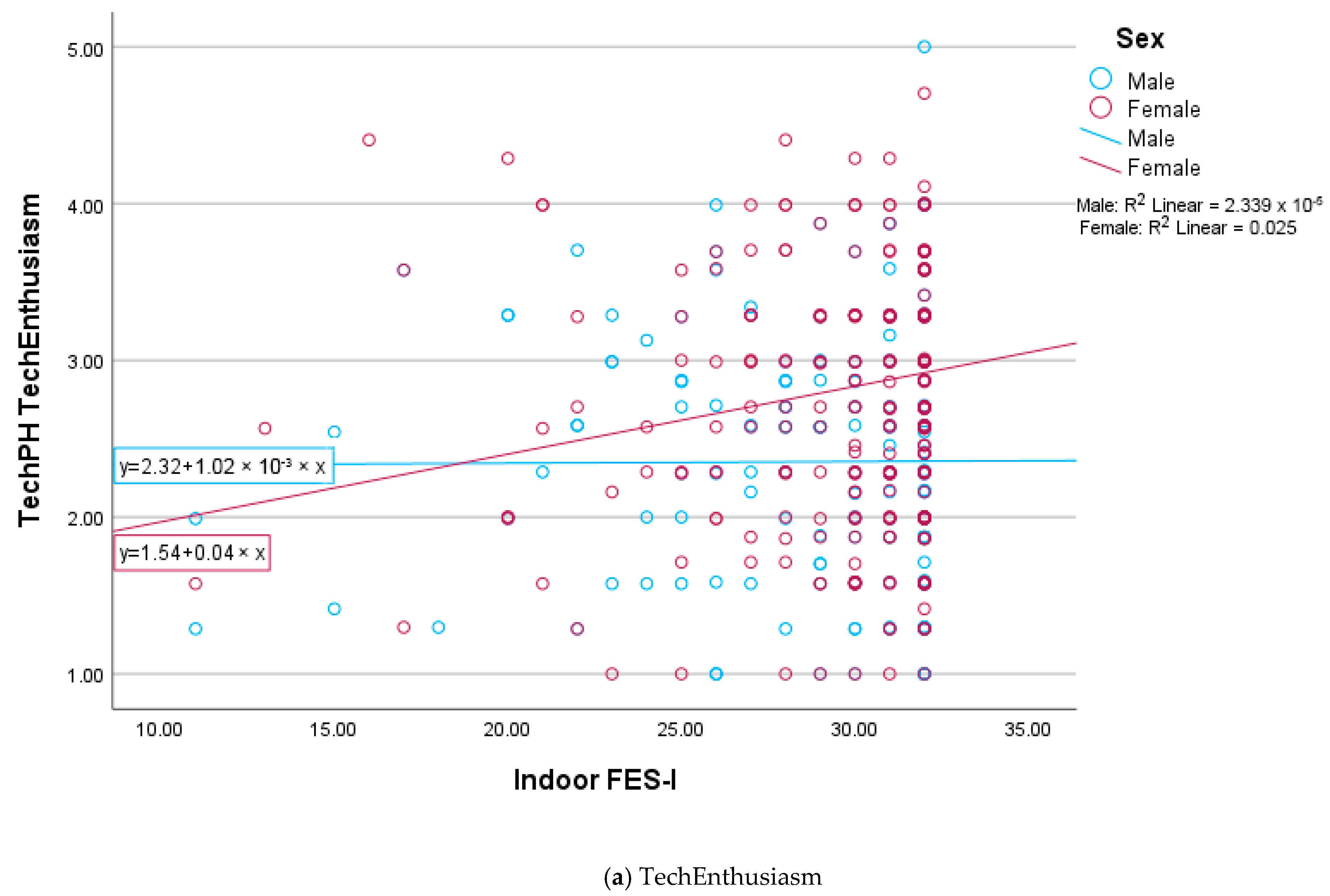
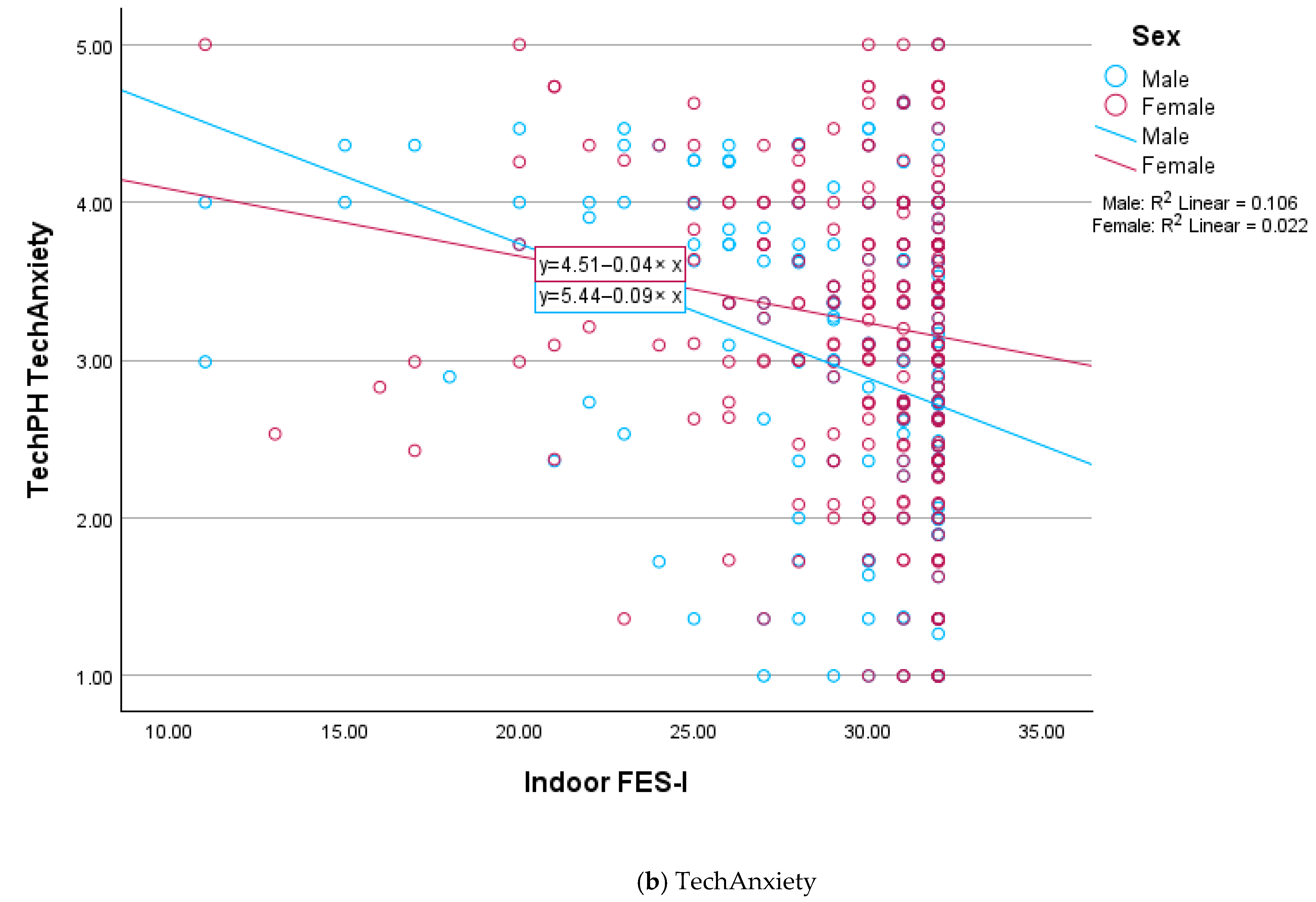
When treating FoF as a continuous score and investigating sex differences, bivariate scatterplots indicate a positive association between less FoF and TechEnthusiasm only among female participants, not among men. Conversely, the relationship between low FoF and TechAnxiety showed a negative trend in both sexes and was stronger in men (
Figure 1).
These observations were confirmed in the fully adjusted linear regression models: There was a significant interaction between sex and TechEnthusiasm on FoF (p = 0.046). Furthermore, TechAnxiety was negatively associated with FoF, meaning that higher TechAnxiety levels corresponded with greater FoF. The interaction between TechAnxiety and sex was not statistically significant in the fully adjusted model (p = 0.074).
4. Discussion
This study examined the prevalence of indoor FoF among Austrian adults aged 65 to 85 years and explored its associations with socio-demographic factors and technology acceptance, including TechEnthusiasm and TechAnxiety. The findings indicate significant relationships between FoF and these dimensions of technology acceptance. These results are important because the previous literature has identified clear gaps in understanding FoF in older people [
2], and FoF has been shown to negatively impact health-related quality of life in older adults [
1].
Higher enthusiasm for technology was reflected in our results, as individuals with lower FoF were more familiar with various technologies and assistive systems and reported greater ability to use them. This suggests that increased confidence in technology, which includes safety-related devices such as emergency call buttons and voice assistants, may contribute to reduced FoF. This aligns with previous research showing that not only attitudes but also perceived usefulness, self-efficacy, and social support shape older adults’ intentions to adopt digital technologies, and that older adults with higher technology enthusiasm report greater familiarity and confidence with digital devices and are more likely to engage with technology in daily life [
14,
15]. Consequently, those who are more comfortable and trusting of these technologies might feel better supported and safer in their daily environment. Additional explanations for the positive association between TechEnthusiasm and lower FoF may include a general openness to innovation and problem-solving, which could translate into more proactive health behaviours, such as physical exercise, which in turn enhances physical fitness and strengthens trust in one’s own body, thereby reducing FoF [
16]. Enthusiastic users often benefit from greater access to information and social networks that facilitate technology use, thereby enhancing their sense of security and fostering digital health literacy [
17].
Older adults with higher FoF, often those with prior fall experiences [
3] and potentially most likely to benefit from fall detection technologies, tended to report lower technology acceptance. This finding highlights a potential barrier for implementing such interventions, though causality cannot be inferred. Building trust in both the functionality and ease of use of these technologies appears essential before these individuals can fully engage with them. Practical implications include the need for tailored educational interventions, user-friendly design, and perhaps guided introductions or support programs to increase technological acceptance among this vulnerable group.
Explaining the observed association between technology anxiety and higher FoF requires careful interpretation, because anxiety and fear in older adults are complex constructs [
18]. A systematic review of digital health technology anxiety in older adults highlighted that age, digital health literacy, social support, self-efficacy, and other factors contribute to technology anxiety, confirming that it is a multifactorial phenomenon that can hinder technology adoption in this population [
19]. Consequently, individuals with higher FoF may have lower engagement with digital technologies, which can reinforce technology-related anxiety, due to limited experiences and familiarity with technological systems.
Our study revealed clear gender-related patterns. Consistent with the previous literature, female sex was strongly associated with FoF [
3,
20]. Beyond this well-established link, we also identified sex differences in the relationship between FoF and technology acceptance. Specifically, TechEnthusiasm was associated with FoF only among women, not men, and this interaction effect was statistically significant. Conversely, the association between TechAnxiety and FoF appeared to be more pronounced in men than in women. Interestingly, a systematic review did not find a consistent association between gender and digital health literacy, although individual study results were highly heterogeneous [
21]. These divergent findings raise important questions about underlying mechanisms. In our sample, one possible explanation could be that women with higher FoF are more motivated to engage with technology due to safety concerns. Further research is needed to explore the social, psychological, and contextual factors that may drive these gender-specific patterns.
The results of this study were collected in the context of developing a vacuum cleaning robot equipped with voice interaction and fall detection, to which they are directly applicable. This system not only performs household tasks but also recognises when a person is lying on the floor, initiates verbal contact, and alerts emergency services if needed [
22,
23]. Our findings highlight the need to build confidence in the usefulness and reliability of such systems in the target population. This need is underscored by qualitative research demonstrating that the adoption of fall detection technology is often limited by concerns about device safety and user comfort, as well as a strong preference for human caregivers over technological solutions [
24]. The robot’s interactive voice feature could play a key role in reducing barriers by offering a more human-like, reassuring interaction. Overall, integrating fall detection and emergency response into everyday devices may help reduce FoF and support independent living, provided that usability and trust are actively addressed, especially among those most affected.
The exclusive use of CAWI in our survey likely resulted in a sample with above-average digital literacy and high technology affinity, which naturally entails a selection bias. Previous studies have also demonstrated clear differences between individuals reached via CAWI and those surveyed through alternative methods [
25,
26]. This elevated technology affinity is reflected in participants’ near-universal awareness of assistive technologies. Indeed, TechPH scores in our study suggested marginally higher technology acceptance compared to the original Swedish validation study [
11]. Indoor FoF was generally low, with many respondents reaching the maximum score on the FES-I, suggesting minimal concern. Compared with other older populations, particularly an Austrian sample that included pre-frail or frail individuals [
7], these findings suggest a selection bias toward more robust and digitally competent participants.
A key strength of this study lies in its focus on the largely unexplored association between technology acceptance and indoor FoF in older adults. The use of established and validated instruments, even if not originally developed in German, adds methodological rigour. A limitation of this study is that only the eight indoor-related items from the original 16-item FES-I were used. While this approach has been applied in previous research, it may affect the reliability and interpretability of the outcome measure. As another limitation, the sample is likely to overrepresent digitally literate and health-competent individuals, limiting the generalisability of the findings. Future studies should aim to include more diverse and less digitally engaged populations to better reflect the broader spectrum of older adults. Participant recruitment relied on an existing online panel, which inherently introduces selection bias. To reduce this risk, quotas were applied for sex, age, educational level, and federal state. Despite these measures, the sample remains a non-probabilistic convenience sample, and selection bias cannot be fully excluded. Furthermore, the questionnaire may have been too demanding for some participants. In particular, we cannot exclude the possibility that individuals with cognitive limitations were included in the sample, which may have influenced the results.
5. Conclusions
In conclusion, this study demonstrates that technology acceptance, particularly technology enthusiasm, is associated with lower indoor fear of falling among community-dwelling older adults. In contrast, anxiety related to technology us is linked to higher lefels of FoF. These findings highlight the importance of addressing attitudes toward technology when designing fall-prevention and assistive interventions for older adults.
Author Contributions
Conceptualisation: T.E.D., M.C., C.F., S.L. and A.J.; Data curation: T.E.D. and M.C.; Formal analysis: T.E.D.; Funding acquisition: T.E.D., S.L. and A.J.; Investigation: T.E.D., M.C. and C.F.; Methodology: T.E.D., M.C., C.F., S.L. and A.J.; Project administration: T.E.D. and M.C.; Visualisation: T.E.D., M.C. and C.F.; Writing—original draft: T.E.D.; Writing—review and editing: T.E.D., M.C., C.F., S.L. and A.J. All authors have read and agreed to the published version of the manuscript.
Funding
The project “Smart Companion 2”, within the framework of which the present study was conducted, was funded under the “ICT of the Future” program by the Austrian Federal Ministry for Climate Action, Environment, Energy, Mobility, Innovation and Technology (BMK) via the Austrian Research Promotion Agency (FFG), project number 887562. The project was carried out by a consortium that, in addition to the authors’ institutions, included the Arbeiter-Samariter-Bund Gruppe Linz and Robert Bosch AG.
Institutional Review Board Statement
The study was conducted in accordance with the Declaration of Helsinki. The survey protocol was submitted to and approved by the Ethics Committee of Haus der Barmherzigkeit. Approval was granted on 21 October 2024. The overall project “Smart Companion”, within the framework of which the present study was conducted, underwent ethical review and was approved by the Ethics Committee of the Medical Faculty of Johannes Kepler University Linz (Approval No.: 1022/2024).
Informed Consent Statement
Informed consent was obtained from all subjects involved in the study.
Data Availability Statement
The raw data supporting the conclusions of this article will be made available by the authors on request.
Conflicts of Interest
The authors declare no conflict of interest.
References
- Lee, E.S.; Kim, B. The Impact of Fear of Falling on Health-Related Quality of Life in Community-Dwelling Older Adults: Mediating Effects of Depression and Moderated Mediation Effects of Physical Activity. BMC Public Health 2024, 24, 2459. [Google Scholar] [CrossRef] [PubMed]
- MacKay, S.; Ebert, P.; Harbidge, C.; Hogan, D.B. Fear of Falling in Older Adults: A Scoping Review of Recent Literature. Can. Geriatr. J. 2021, 24, 379–394. [Google Scholar] [CrossRef] [PubMed]
- Xiong, W.; Wang, D.; Ren, W.; Liu, X.; Wen, R.; Luo, Y. The Global Prevalence of and Risk Factors for Fear of Falling among Older Adults: A Systematic Review and Meta-Analysis. BMC Geriatr. 2024, 24, 321. [Google Scholar] [CrossRef]
- Friedman, S.M.; Munoz, B.; West, S.K.; Rubin, G.S.; Fried, L.P. Falls and Fear of Falling: Which Comes First? A Longitudinal Prediction Model Suggests Strategies for Primary and Secondary Prevention. J. Am. Geriatr. Soc. 2002, 50, 1329–1335. [Google Scholar] [CrossRef] [PubMed]
- Fried, L.P.; Tangen, C.M.; Walston, J.; Newman, A.B.; Hirsch, C.; Gottdiener, J.; Seeman, T.; Tracy, R.; Kop, W.J.; Burke, G.; et al. Frailty in Older Adults: Evidence for a Phenotype. J. Gerontol. A Biol. Sci. Med. Sci. 2001, 56, M146–M157. [Google Scholar] [CrossRef]
- Parab, K.V.; Arora, A.; Kang, J.; Mahajan, H.P. Exploring Indoor Home Environment Factors Influencing Fear of Falling: A Systematic Review. J. Appl. Gerontol. 2025, 44, 702–714. [Google Scholar] [CrossRef]
- Kapan, A.; Luger, E.; Haider, S.; Titze, S.; Schindler, K.; Lackinger, C.; Dorner, T.E. Fear of Falling Reduced by a Lay Led Home-Based Program in Frail Community-Dwelling Older Adults: A Randomised Controlled Trial. Arch. Gerontol. Geriatr. 2017, 68, 25–32. [Google Scholar] [CrossRef]
- Siegel, C.; Dorner, T.E. Information Technologies for Active and Assisted Living—Influences to the Quality of Life of an Ageing Society. Int. J. Med. Inform. 2017, 100, 32–45. [Google Scholar] [CrossRef]
- Eost-Telling, C.; Yang, Y.; Norman, G.; Hall, A.; Hanratty, B.; Knapp, M.; Robinson, L.; Todd, C. Digital Technologies to Prevent Falls in People Living with Dementia or Mild Cognitive Impairment: A Rapid Systematic Overview of Systematic Reviews. Age Ageing 2024, 53, afad238. [Google Scholar] [CrossRef]
- Wang, X.; Luan, W. Research Progress on Digital Health Literacy of Older Adults: A Scoping Review. Front. Public Health 2022, 10, 906089. [Google Scholar] [CrossRef]
- Anderberg, P.; Eivazzadeh, S.; Berglund, J.S. A Novel Instrument for Measuring Older People’s Attitudes Toward Technology (TechPH): Development and Validation. J. Med. Internet Res. 2019, 21, e13951. [Google Scholar] [CrossRef]
- Delbaere, K.; Close, J.C.T.; Mikolaizak, A.S.; Sachdev, P.S.; Brodaty, H.; Lord, S.R. The Falls Efficacy Scale International (FES-I). A Comprehensive Longitudinal Validation Study. Age Ageing 2010, 39, 210–216. [Google Scholar] [CrossRef] [PubMed]
- IBM Corp. IBM SPSS Statistics for Windows, Version 29; IBM Corp.: Armonk, NY, USA, 2022.
- Jokisch, M.R.; Schmidt, L.I.; Doh, M. Acceptance of Digital Health Services among Older Adults: Findings on Perceived Usefulness, Self-Efficacy, Privacy Concerns, ICT Knowledge, and Support Seeking. Front. Public Health 2022, 10, 1073756. [Google Scholar] [CrossRef] [PubMed]
- Vaportzis, E.; Giatsi Clausen, M.; Gow, A.J. Older Adults Perceptions of Technology and Barriers to Interacting with Tablet Computers: A Focus Group Study. Front. Psychol. 2017, 8, 1687. [Google Scholar] [CrossRef] [PubMed]
- Di Lorito, C.; Long, A.; Byrne, A.; Harwood, R.H.; Gladman, J.R.F.; Schneider, S.; Logan, P.; Bosco, A.; van der Wardt, V. Exercise Interventions for Older Adults: A Systematic Review of Meta-Analyses. J. Sport. Health Sci. 2021, 10, 29–47. [Google Scholar] [CrossRef]
- Dong, Q.; Liu, T.; Liu, R.; Yang, H.; Liu, C. Effectiveness of Digital Health Literacy Interventions in Older Adults: Single-Arm Meta-Analysis. J. Med. Internet Res. 2023, 25, e48166. [Google Scholar] [CrossRef]
- Bryant, C.; Mohlman, J.; Gum, A.; Stanley, M.; Beekman, A.T.; Wetherell, J.L.; Thorp, S.R.; Flint, A.J.; Lenze, E.J. Anxiety Disorders in Older Adults: Looking to DSM5 and Beyond. Am. J. Geriatr. Psychiatry 2013, 21, 872–876. [Google Scholar] [CrossRef]
- Han, Y.; Zhang, J.; Qing, W.; Zheng, S.; Xia, L.; Li, Y.; He, L. Influencing Factors of Digital Health Technology Anxiety in the Elderly: A Systematic Review and Meta-Analysis. Front. Psychol. 2025, 16, 1645753. [Google Scholar] [CrossRef]
- Lavedán, A.; Viladrosa, M.; Jürschik, P.; Botigué, T.; Nuín, C.; Masot, O.; Lavedán, R. Fear of Falling in Community-Dwelling Older Adults: A Cause of Falls, a Consequence, or Both? PLoS ONE 2018, 13, e0194967. [Google Scholar] [CrossRef]
- Estrela, M.; Semedo, G.; Roque, F.; Ferreira, P.L.; Herdeiro, M.T. Sociodemographic Determinants of Digital Health Literacy: A Systematic Review and Meta-Analysis. Int. J. Med. Inform. 2023, 177, 105124. [Google Scholar] [CrossRef]
- Dorner, T.E.; Lehner, S.; Capatu, M.; Jakl, A. Ein Projekt Geht in Die Zielgerade: Smart Companion—Ein Roboter Saugt Staub Und Bringt Sicherheit. Z. Gerontol. Geriatr. 2025, 58, 80. [Google Scholar] [CrossRef]
- Lehner, S. The Design and Discursive Construction of a ‘Speaking’ Vacuum Cleaning Robot for Assistive Purposes: Findings on Communication Ideologies from a Current Research and Development Project. AI-Linguist. Linguist. Stud. AI-Gener. Texts Discourses 2025, 2. [Google Scholar] [CrossRef]
- Huang, H.-H.; Chang, M.-H.; Chen, P.-T.; Lin, C.-L.; Sung, P.-S.; Chen, C.-H.; Fan, S.-Y. Exploring Factors Affecting the Acceptance of Fall Detection Technology among Older Adults and Their Families: A Content Analysis. BMC Geriatr. 2024, 24, 694. [Google Scholar] [CrossRef]
- Titze, S.; Strain, T.; Wagner, P.; Schuster, A.; Karner, J.; Dorner, T.E. The Impact of Removing the 10-Minute Bout Requirement and of Different Survey Administration Methods on National Physical Activity Estimates in Austria. J. Phys. Act. Health 2024, 21, 491–499. [Google Scholar] [CrossRef]
- Braekman, E.; Charafeddine, R.; Demarest, S.; Drieskens, S.; Berete, F.; Gisle, L.; Van der Heyden, J.; Van Hal, G. Comparing Web-Based versus Face-to-Face and Paper-and-Pencil Questionnaire Data Collected through Two Belgian Health Surveys. Int. J. Public Health 2020, 65, 5–16. [Google Scholar] [CrossRef]
| Disclaimer/Publisher’s Note: The statements, opinions and data contained in all publications are solely those of the individual author(s) and contributor(s) and not of MDPI and/or the editor(s). MDPI and/or the editor(s) disclaim responsibility for any injury to people or property resulting from any ideas, methods, instructions or products referred to in the content. |