

Measuring Cognition and Cognitive Impairment in the Survey of Health, Ageing and Retirement in Europe (SHARE): A Scoping Review and Instrument Mapping Study



Abstract
1. Introduction
- (1)
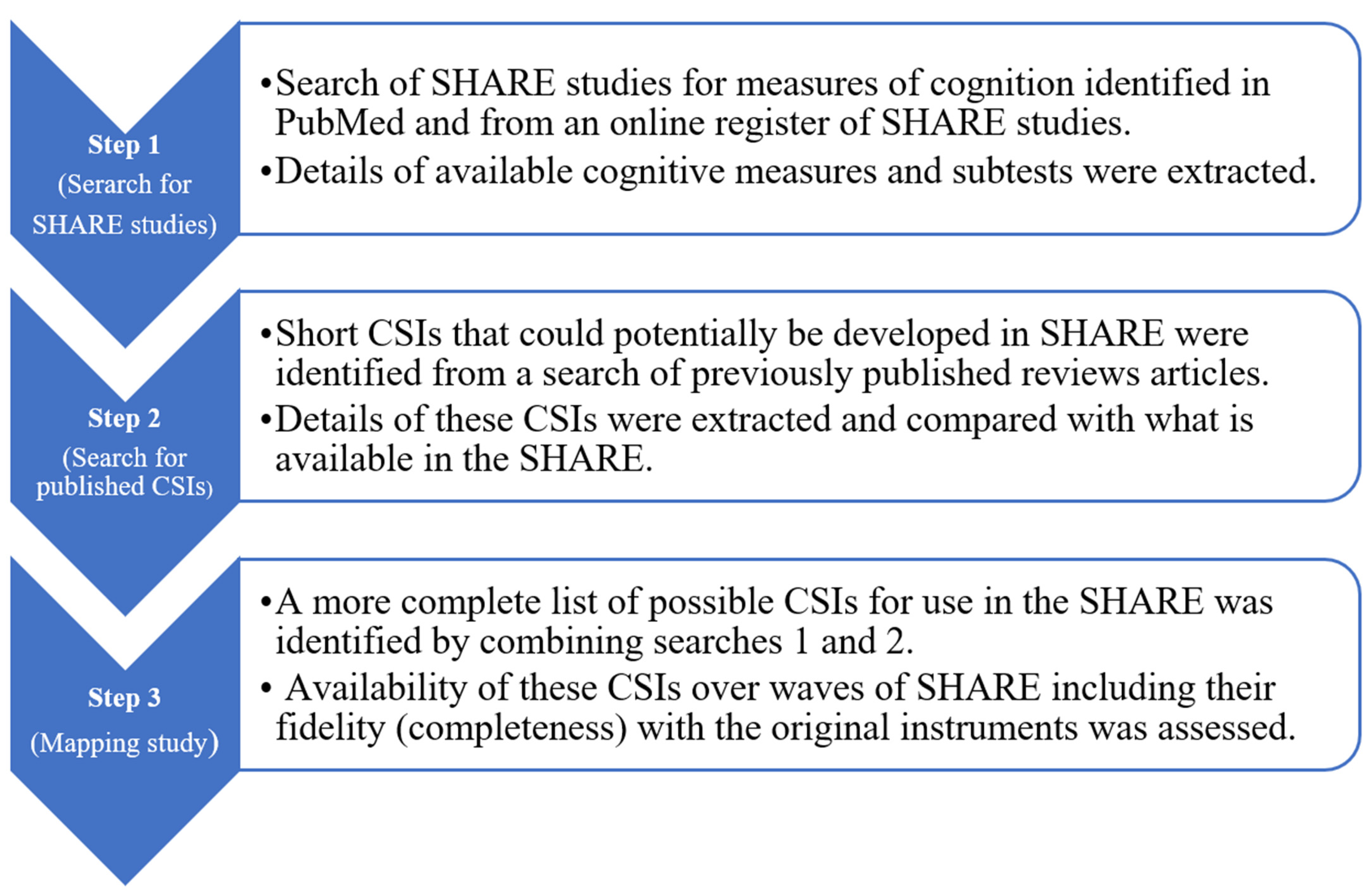
- To review how cognitive function and cognitive impairment have been assessed in previous SHARE publications including any details on what subtests were used, any cut-offs applied, the number of studies using the approach, and the longitudinal availability of each approach across study waves.
- (2)
- To identify which, if any, CSIs and measures of cognitive impairment have been validated internally or externally for use in the SHARE.
- (3)
- To explore which additional CSIs could be operationalised for use within the SHARE based on cognitive subtests (items) available and cross-referenced with previously published reviews of brief CSIs.
2. Materials and Methods
2.1. Eligibility Criteria for the Scoping Review
2.2. Information Sources, Search Terms and Screening for the Scoping Review
2.3. Data Extraction (Charting) Process and Items
2.4. Instrument Mapping Study
2.5. Synthesis of Results
2.6. Terminology and Available Subtests
3. Results
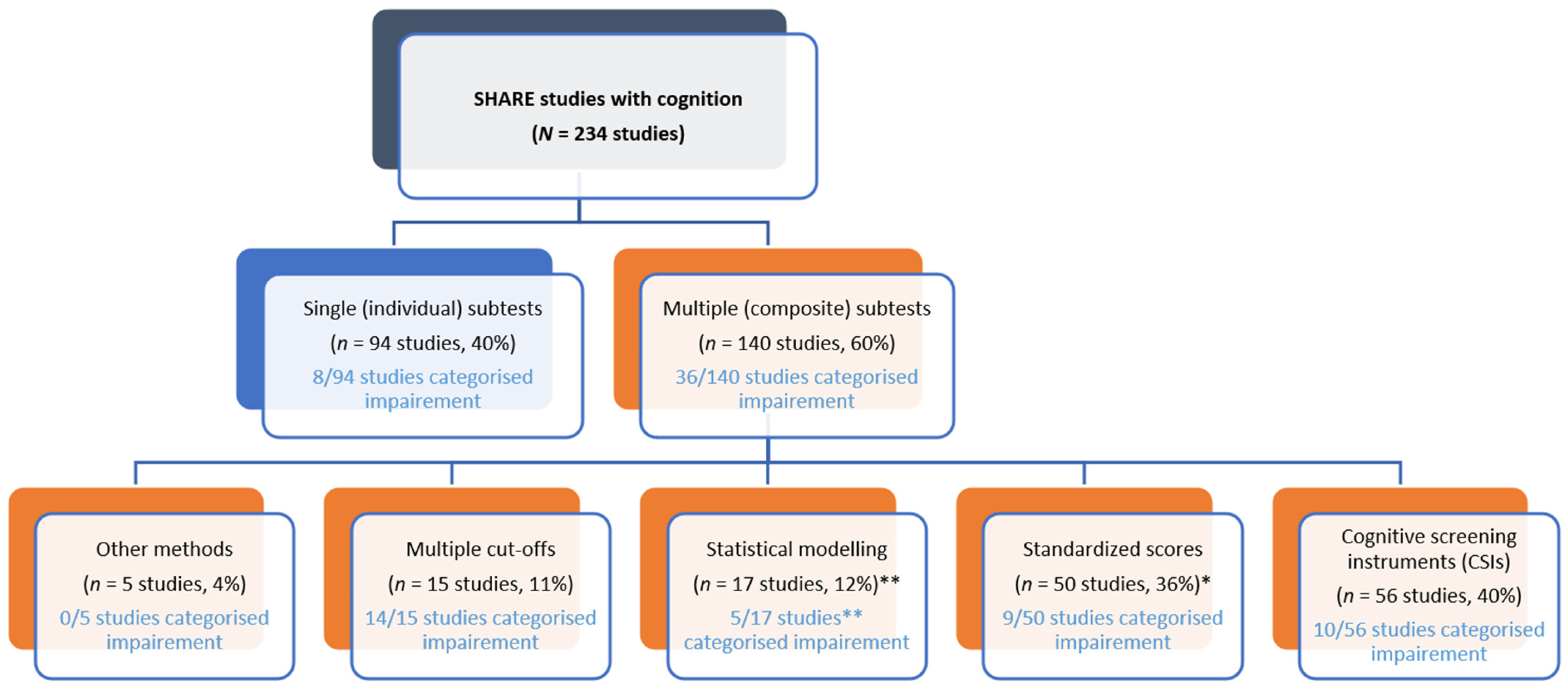
3.1. Approaches to Measuring Cognition in the SHARE Studies
3.2. Cognitive Subtests Used in the SHARE
3.3. Use of Individual Cognitive Subtests (n = 94)
3.4. Use of Cognitive Screening Instruments (n = 56)
3.5. Identification of Additional CSIs for the SHARE (n = 24)
3.6. Use of Standardised Cognitive Scores (n = 50)
3.7. Use of Statistical Modelling (n = 17)
3.8. Using Cut-Offs to Measure Global Cognitive Impairment (n = 15)
3.9. Other Approaches (n = 5)
3.10. Use of Cut-Offs
3.11. Classifying Stages of Cognitive Impairment

| Probable Dementia Criteria Description | Studies (n = 7) Criteria (n = 21) | Cognitive Measure Classification Approach | Terminology Used | Validation Status Notes |
| Langa–Weir criteria [33] Langa–Weir (registration, recall, serial 7s, counting backwards) ≤ 6/27 | 1 | CSI cut-off Selected cut-off | Probable dementia | Validated in United States Best cut-off based on a gold standard diagnosis in the ADAMS [33]. |
| Langa–Weir criteria (modified) [57] CSI (registration, recall, serial 7s, verbal fluency) ≤ 6/26 | 1 | CSI cut-off Selected cut-off | CI consistent with dementia | Not validated Cut-off from Langa–Weir. (swapped 2-point counting with 1-point fluency). |
| Modified DSM-5 [38] Non-amnestic battery ≥ 2 SDs below mean by age/education (or self-reported dementia/memory disorder) with self-reported IADL difficulty (≥1 of telephone calls, taking medications, managing finances) | 1 | CSI cut-off SDs below mean + ADLs | Dementia | Not validated Cognitive battery did not include memory issues. IADL difficulty for cognitively orientated tasks only, not necessarily loss of independence. Prevalence was low. |
| LW algorithms (X2) [37] 20-point word recall 2.5% percentile (i.e., ≥2 SD below mean). Applied with or without IADL difficulties taking a cut-off of 1.5 interquartile ranges above Q3 (by country) | 1 | CSI cut-off Percentile + ADLs | Probable dementia | Percentile LW algorithms with ADLs recommended Cognitive battery only included memory issues. IADL difficulty had different cut-offs by country, not loss of independence. Performed well in this study. |
| 1.5 SD below adjusted mean [51] 1.5 SD below 25-point CSI (registration, recall, serial7s) by age, education, sex, proxy status of interviews | 1 | CSI cut-off SDs below mean | Probable dementia | Not validated No normative sample used for memory. 1.5 SDs below a mean for MCI/CIND. |
| LW algorithms (X2) [37] Used 20-point word recall cut-offs from equipercentile with country prevalence values in OECD. Applied with or without IADL difficulties taking a cut-off of 1.5 interquartile ranges above Q3 (by country) | 1 | CSI cut-off equipercentile | Probable dementia | Percentile LW algorithms with ADLs recommended Cognitive battery only included memory issues. IADL difficulty had different cut-offs by country, not loss of independence. |
| Cut-off/1.5 SDs below adjusted mean [112] Memory (20-word recall) 1.5 SDs below the mean by age or verbal fluency < 15 | 1 | Cut-offs (domains) SDs below mean / cut-off | Dementia | Not validated No normative sample used for memory. Not adjusted for age/education for fluency. 1.5 SDs below a mean for MCI/CIND. |
| 1.5 SDs below mean [110] Standardised score (registration, recall, fluency, orientation) 1.5 SDs below mean and BADL difficulty (bathing, eating, dressing, transferring, or walking) or self-reported dementia | 1 | Standardised score SDs below mean + ADLs | Dementia | Not validated Not adjusted for age/education. |
| Random forest (X3) [37] Random Forest fitted using three training dataset approaches (registration, recall, ADLs) | 1 | Statistical model Machine learning | Probable dementia | Percentile LW algorithms with ADLs recommended Complex method but the authors provide R codes for it. |
| XGBoost classifier (X3) [37] XGBoost classifier in three training dataset approaches (registration, recall, ADLs) | 1 | Statistical model Machine learning | Probable dementia | Percentile LW algorithms with ADLs recommended Complex method but the authors provide R codes for it. |
| Logistic regression model (X3) [37] logistic regression fitted to self-reported cases (registration, recall, ADLs) | 1 | Statistical model Regression | Probable dementia | Percentile LW algorithms with ADLs recommended Complex method but the authors provide R codes for it. |
| Weighted logistic regression [37] Weighted logistic regression fitted to self-reported cases (registration, recall, ADLs) | 1 | Statistical model Regression | Probable dementia | Percentile LW algorithms with ADLs recommended Complex method but the authors provide R codes for it. |
| Predicted probabilities [33] (SHARE-HCAP) A predictive model was fitted between wave 9 items (cognition, ADLs, etc.) and HCAP cognitive categories | 1 | Statistical model Multivariate regression | Dementia | Categorical status not validated Average of predicted probabilities matched HCAP prevalences very well. Strong association with education. |
| CIND criteria Description | Studies (n = 2) Criteria (n = 2) | Cognitive measure Classification approach | Terminology used | Validation status Notes |
| Langa–Weir criteria [33] Langa–Weir (registration, recall, serial 7s, counting backwards) 7–11 out of 27 | 1 | CSI cut-off Selected cut-off | CIND | Validated in United States Best cut-off based on a gold standard diagnosis in the ADAMS [33]. |
| Langa–Weir criteria (modified) [57] CSI (registration, recall, serial 7s, verbal fluency) 7–11 out of 26 | 1 | CSI cut-off Selected cut-off | Probable dementia | Not validated Cut-off from Langa–Weir. (swapped 2-point counting with 1-point fluency). |
| MCI criteria Description | Studies (n = 6) Criteria (n = 4) | Cognitive measure Classification approach | Terminology used | Validation status Notes |
| Modified Petersen’s criteria [38] Non-amnestic battery and self-reported questions on ADLs, memory, dementia used to define subjective memory complaints, MCI and dementia | 1 | CSI cut-off SDs below mean | MCI | Not validated MCI definition incomplete—missing amnestic MCI single domain. |
| Predicted probabilities [33] (SHARE-HCAP) A predictive model was fitted between wave 9 items (cognition, ADLs, etc.) and HCAP cognitive categories | 1 | Statistical model Multivariate regression | MCI | Categorical status not validated Average of predicted probabilities matched HCAP prevalences very well. Strong association with education. |
| 1.5 SDs below adjusted mean score [114,115,116] 1.5 SD below the mean adjusted (age/education) standardised score (registration, recall, fluency) | 3 | Standardised score SDs below mean | MCI | Not validated No normative sample used. |
| 1.5 SDs below adjusted mean score [113] 1.5 SD below the mean adjusted (age/education) standardised score (registration, recall, fluency, serial7s) | 1 | Standardised score SDs below mean | MCI | Not validated No normative sample used. |
| CI criteria Description | Studies (n = 23) Criteria (n = 17) | Cognitive measure Classification approach | Terminology used | Validation status Notes |
| Modified DemTect [54,55] Modified DemTect (registration, recall, verbal fluency, orientation, numeracy). Cut-off ≤ 14/20 | 2 | CSI cut-off Selected cut-off | Poor cognitive functioning | Not validated Not adjusted for age/education. |
| 1.5 SDs below adjusted mean [63] 1.5 SDs below mean for 34-point CSI (registration, recall, fluency, orientation) by country of residence | 1 | CSI cut-off SDs below mean | Cognitive impairment | Not validated No normative sample used. Not adjusted for age/education. |
| 1 SD below adjusted mean [52] 1 SD below mean for a 29-point CSI (registration, recall, orientation, serial7s) by age | 1 | CSI cut-off SDs below mean | Ageing-associated cognitive decline | Not validated No normative sample used. |
| Cut-offs (≥1 domain) [99] Orientation < 3/4 or numeracy < 2/5 | 1 | Cut-offs (domains) ≥1/2 cut-offs | Limited cognitive function | Not validated Not adjusted for age/education. |
| Cut-offs (2 domains) [101] (Also had number of impairments: 0, 1, 2) Both memory (registration < 5 and/or recall < 4) and fluency (<15) | 1 | Cut-offs (domains) Multiple cut-offs | Cognitive impairment | Not validated Not adjusted for age/education. Two domains typical of Alzheimer’s. |
| 1.5 SDs below adjusted mean [117,118,119,120] Both memory (registration and/or recall) and fluency are 1.5 SDs below the mean by age | 4 | Cut-offs (domains) SDs below mean | Cognitive disorder; cognitive impairment | Not validated No normative sample used. |
| Cut-off/1.5 SDs below adjusted mean [121] Memory (20-word recall) 1.5 SDs below the mean by age and country (1 SD 75 years) or verbal fluency < 15 | 1 | Cut-offs (domains) SDs below mean/cut-off | Cognitive impairment | Not validated No normative sample used for memory. Fluency not adjusted for age/education. |
| 25th percentile (1 subtests) [16] [ATHLOS Project] One of the following tests in the lowest 25%/quartile (registration; recall; fluency) | 1 | Cut-offs (subtests) 25th percentile | Low cognitive functioning | Not validated Not adjusted for age/education. High cut-off for CI (false positives). |
| 1.5 SDs below adjusted mean (≥2 subtests) [122] Two or more subtests (registration, recall, orientation) 1.5 SDs below mean by education. | 1 | Cut-offs (subtests) SDs below mean | Cognitive impairment | Not validated No normative sample used. |
| 1.5 SDs below adjusted mean (≥2 subtests) [123] Two or more subtests (registration, recall, fluency orientation) 1.5 SDs below mean by education. | 1 | Cut-offs (subtests) SDs below mean | Cognitive impairment | Not validated No normative sample used. |
| Multiple selected cut-offs (≥3 subtests) [102] Three or more low scores (registration < 5/10, recall < 4/10, fluency < 15/100, orientation < 2/4, serial7s < 2/5). | 1 | Cut-offs (subtests) Multiple cut-offs | Cognitive impairment | Not validated Not adjusted for age/education. |
| 1.5 SDs below adjusted mean [124] 1.5 SDs below mean in at least 1 subtest (registration, recall, fluency, orientation) by age | 1 | Cut-offs (subtests) SDs below mean | Cognitive condition | Not validated No normative sample used. |
| 1.5 SDs below adjusted mean [125] 1.5 SDs below the mean standardised score (registration, recall, fluency) by education | 1 | Standardised score SDs below mean | Cognitive impairment | Not validated No normative sample used. |
| ≤10% percentile [126] ≤10% percentile on standardised z-score (registration, recall, fluency, orientation, numeracy) | 1 | Standardised score percentile | Cognitive impairment | Not validated Not adjusted for age/education. |
| ≤10% percentile [127] ≤10% percentile on standardised z-score (registration, recall, fluency, orientation, serial 7s) | 1 | Standardised score percentile | Impaired cognition | Not validated Not adjusted for age/education. |
| ≤10% percentile by sex [128] ≤10% percentile by sex on standardised t-score | 1 | Standardised score percentile | Poor cognitive function | Not validated Not adjusted for age/education. |
| Machine learning with principal components [129,130,131] Unsupervised machine learning classification (hierarchical clustering on principal components). Both used registration and recall and one included orientation | 3 | Statistical model Machine learning | High likelihood of dementia | Used R packages FactoMineR, NbClust and missMDA. |
| Amnestic impairment criteria Description | Studies (n = 2) Criteria (n = 2) | Cognitive measure Classification approach | Terminology used | Validation status Notes |
| Memory cut-offs [41] 1.5 SDs below mean 20-point recall score by age | 1 | CSI cut-off SDs below mean | Mild memory impairment | Not validated But multiple papers have applied the same cut-offs of <5 and <4, respectively. |
| Memory cut-offs [100] Registration < 5 or recall < 4 | 1 | Cut-offs (subtests) ≥1/2 cut-offs | Memory impairment | Not validated But multiple papers have applied the same cut-offs of <5 and <4, respectively. |
4. Discussion
5. Conclusions
Supplementary Materials
Author Contributions
Funding
Institutional Review Board Statement
Informed Consent Statement
Data Availability Statement
Conflicts of Interest
Abbreviations
| SHARE | Survey of Health, Ageing and Retirement in Europe |
| SHARE-Cog | SHARE Cognitive Instrument |
| CSI | Cognitive screening instrument |
| MCI | Mild cognitive impairment |
| HRS | Health and Retirement Study |
| HCAP | Harmonized Cognitive Assessment Protocol |
| MMSE | Mini Mental State Examination |
| MoCA | Montreal Cognitive Assessment |
| TICS | Telephone Interview for Cognitive Status |
| CSI-D | Community Screening Instrument for Dementia |
| PRISMA | Preferred Reporting Items for Systematic reviews and Meta-Analyses |
| MO’D | Mark O’Donovan (author) |
| RO’C | Rónán O’Caoimh (author) |
| ACE-III | Addenbrooke’s Cognitive Examination III |
| SD | Standard deviation |
| ADL | Activities of daily living |
| IADL | Instrumental activities of daily living |
| DSM | Diagnostic and Statistical Manual of Mental Disorders |
| ADAMS | Aging, Demographics, and Memory Study |
| OECD | Organisation for Economic Co-operation and Development |
| CI | Cognitive impairment |
| CIND | Cognitive impairment no dementia |
| NC | Nicola Cornally (author) |
References
- Pais, R.; Ruano, L.; Carvalho, O.P.; Barros, H. Global Cognitive Impairment Prevalence and Incidence in Community Dwelling Older Adults—A Systematic Review. Geriatrics 2020, 5, 84. [Google Scholar] [CrossRef] [PubMed]
- Bai, W.; Chen, P.; Cai, H.; Zhang, Q.; Su, Z.; Cheung, T.; Jackson, T.; Sha, S.; Xiang, Y.-T. Worldwide Prevalence of Mild Cognitive Impairment among Community Dwellers Aged 50 Years and Older: A Meta-Analysis and Systematic Review of Epidemiology Studies. Age Ageing 2022, 51, afac173. [Google Scholar] [CrossRef] [PubMed]
- Nichols, E.; Steinmetz, J.D.; Vollset, S.E.; Fukutaki, K.; Chalek, J.; Abd-Allah, F.; Abdoli, A.; Abualhasan, A.; Abu-Gharbieh, E.; Akram, T.T.; et al. Estimation of the Global Prevalence of Dementia in 2019 and Forecasted Prevalence in 2050: An Analysis for the Global Burden of Disease Study 2019. Lancet Public Health 2022, 7, e105–e125. [Google Scholar] [CrossRef] [PubMed]
- Karimi, L.; Mahboub–Ahari, A.; Jahangiry, L.; Sadeghi-Bazargani, H.; Farahbakhsh, M. A Systematic Review and Meta-Analysis of Studies on Screening for Mild Cognitive Impairment in Primary Healthcare. BMC Psychiatry 2022, 22, 97. [Google Scholar] [CrossRef]
- Roebuck-Spencer, T.M.; Glen, T.; Puente, A.E.; Denney, R.L.; Ruff, R.M.; Hostetter, G.; Bianchini, K.J. Cognitive Screening Tests Versus Comprehensive Neuropsychological Test Batteries: A National Academy of Neuropsychology Education Paper. Arch. Clin. Neuropsychol. 2017, 32, 491–498. [Google Scholar] [CrossRef]
- Brown, J. The Use and Misuse of Short Cognitive Tests in the Diagnosis of Dementia: Table 1. J. Neurol. Neurosurg. Psychiatry 2015, 86, 680–685. [Google Scholar] [CrossRef]
- Meijs, A.P.; Claassen, J.A.H.R.; Olde Rikkert, M.G.M.; Schalk, B.W.M.; Meulenbroek, O.; Kessels, R.P.C.; Melis, R.J.F. How Does Additional Diagnostic Testing Influence the Initial Diagnosis in Patients with Cognitive Complaints in a Memory Clinic Setting? Age Ageing 2015, 44, 72–77. [Google Scholar] [CrossRef][Green Version]
- Börsch-Supan, A.; Brandt, M.; Hunkler, C.; Kneip, T.; Korbmacher, J.; Malter, F.; Schaan, B.; Stuck, S.; Zuber, S. Data Resource Profile: The Survey of Health, Ageing and Retirement in Europe (SHARE). Int. J. Epidemiol. 2013, 42, 992–1001. [Google Scholar] [CrossRef]
- Juster, F.T.; Suzman, R. An Overview of the Health and Retirement Study. J. Hum. Resour. 1995, 30, S7. [Google Scholar] [CrossRef]
- Lee, J.; Phillips, D.; Wilkens, J. Gateway to Global Aging Data Team. Gateway to Global Aging Data: Resources for Cross-National Comparisons of Family, Social Environment, and Healthy Aging. J. Gerontol. Ser. B 2021, 76, S5–S16. [Google Scholar] [CrossRef]
- De Looze, C.; Feeney, J.; Seeher, K.M.; Amuthavalli Thiyagarajan, J.; Diaz, T.; Kenny, R.A. Assessing Cognitive Function in Longitudinal Studies of Ageing Worldwide: Some Practical Considerations. Age Ageing 2023, 52, iv13–iv25. [Google Scholar] [CrossRef]
- Langa, K.M.; Ryan, L.H.; McCammon, R.J.; Jones, R.N.; Manly, J.J.; Levine, D.A.; Sonnega, A.; Farron, M.; Weir, D.R. The Health and Retirement Study Harmonized Cognitive Assessment Protocol Project: Study Design and Methods. Neuroepidemiology 2020, 54, 64–74. [Google Scholar] [CrossRef]
- Börsch-Supan, A.; Douhou, S.; Fernández, I.; Otero, M.C.; Tawiah, B.B. Release Note 1.0 to SHARE-HCAP Data; MEA Discussion Paper 02/2025; MEA-SHARE gGmbH: Munich, Germany, 2025. [Google Scholar]
- Gruber, S.; Wagner, M.; Batta, F. Scales and Multi-Item Indicators; SHARE Berlin Institute: Berlin, Germany, 2024; pp. 1–53. [Google Scholar]
- Céline, D.L.; Feeney, J.; Kenny, R.A. The CANDID Initiative: Leveraging Cognitive Ageing Dementia Data from Around the World; The Irish Longitudinal Study on Ageing: Dublin, Ireland, 2021. [Google Scholar]
- Stefler, D.; Prina, M.; Wu, Y.-T.; Sánchez-Niubò, A.; Lu, W.; Haro, J.M.; Marmot, M.; Bobak, M. Socioeconomic Inequalities in Physical and Cognitive Functioning: Cross-Sectional Evidence from 37 Cohorts across 28 Countries in the ATHLOS Project. J. Epidemiol. Community Health 2021, 75, 980–986. [Google Scholar] [CrossRef]
- Folstein, M.F.; Folstein, S.E.; McHugh, P.R. “Mini-Mental State”. A Practical Method for Grading the Cognitive State of Patients for the Clinician. J. Psychiatr. Res. 1975, 12, 189–198. [Google Scholar] [CrossRef]
- Nasreddine, Z.S.; Phillips, N.A.; Bédirian, V.; Charbonneau, S.; Whitehead, V.; Collin, I.; Cummings, J.L.; Chertkow, H. The Montreal Cognitive Assessment, MoCA: A Brief Screening Tool for Mild Cognitive Impairment. J. Am. Geriatr. Soc. 2005, 53, 695–699. [Google Scholar] [CrossRef] [PubMed]
- Brandt, J.; Spencer, M.; Folstein, M. The Telephone Interview for Cognitive Status. Cogn. Behav. Neurol. 1988, 1, 111–117. [Google Scholar]
- Prince, M.; Acosta, D.; Ferri, C.P.; Guerra, M.; Huang, Y.; Jacob, K.S.; Llibre Rodriguez, J.J.; Salas, A.; Sosa, A.L.; Williams, J.D.; et al. A Brief Dementia Screener Suitable for Use by Non-specialists in Resource Poor Settings—The Cross-cultural Derivation and Validation of the Brief Community Screening Instrument for Dementia. Int. J. Geriat. Psychiatry 2011, 26, 899–907. [Google Scholar] [CrossRef] [PubMed]
- Cullen, B.; O’Neill, B.; Evans, J.J.; Coen, R.F.; Lawlor, B.A. A Review of Screening Tests for Cognitive Impairment. J. Neurol. Neurosurg. Psychiatry 2007, 78, 790–799. [Google Scholar] [CrossRef]
- De Roeck, E.E.; De Deyn, P.P.; Dierckx, E.; Engelborghs, S. Brief Cognitive Screening Instruments for Early Detection of Alzheimer’s Disease: A Systematic Review. Alzheimers Res. Ther. 2019, 11, 21. [Google Scholar] [CrossRef]
- Peters, M.D.J.; Godfrey, C.M.; Khalil, H.; McInerney, P.; Parker, D.; Soares, C.B. Guidance for Conducting Systematic Scoping Reviews. Int. J. Evid.-Based Healthc. 2015, 13, 141–146. [Google Scholar] [CrossRef]
- Tricco, A.C.; Lillie, E.; Zarin, W.; O’Brien, K.K.; Colquhoun, H.; Levac, D.; Moher, D.; Peters, M.D.J.; Horsley, T.; Weeks, L.; et al. PRISMA Extension for Scoping Reviews (PRISMA-ScR): Checklist and Explanation. Ann. Intern Med. 2018, 169, 467–473. [Google Scholar] [CrossRef] [PubMed]
- Haddaway, N.R.; Page, M.J.; Pritchard, C.C.; McGuinness, L.A. PRISMA2020: An R Package and Shiny App for Producing PRISMA 2020-compliant Flow Diagrams, with Interactivity for Optimised Digital Transparency and Open Synthesis. Campbell Syst. Rev. 2022, 18, e1230. [Google Scholar] [CrossRef] [PubMed]
- Page, M.J.; McKenzie, J.E.; Bossuyt, P.M.; Boutron, I.; Hoffmann, T.C.; Mulrow, C.D.; Shamseer, L.; Tetzlaff, J.M.; Akl, E.A.; Brennan, S.E.; et al. The PRISMA 2020 Statement: An Updated Guideline for Reporting Systematic Reviews. BMJ 2021, n71. [Google Scholar] [CrossRef]
- Colsher, P.L.; Wallace, R.B. Data Quality and Age: Health and Psychobehavioral Correlates of Item Nonresponse and Inconsistent Responses. J. Gerontol. 1989, 44, P45–P52. [Google Scholar] [CrossRef] [PubMed]
- Jorm, A.F. A Short Form of the Informant Questionnaire on Cognitive Decline in the Elderly (IQCODE): Development and Cross-Validation. Psychol. Med. 1994, 24, 145–153. [Google Scholar] [CrossRef]
- SHARE-ERIC Conditions of Use. Available online: https://share-eric.eu/data/data-access/conditions-of-use (accessed on 23 July 2025).
- R Core Team. R: A Language and Environment for Statistical Computing; R Core Team: Vienna, Austria, 2024. [Google Scholar]
- Gross, A.L.; Khobragade, P.Y.; Meijer, E.; Saxton, J.A. Measurement and Structure of Cognition in the Longitudinal Aging Study in India–Diagnostic Assessment of Dementia. J. Am. Geriatr. Soc. 2020, 68, S11–S19. [Google Scholar] [CrossRef]
- Jones, R.N.; Manly, J.J.; Langa, K.M.; Ryan, L.H.; Levine, D.A.; McCammon, R.; Weir, D. Factor Structure of the Harmonized Cognitive Assessment Protocol Neuropsychological Battery in the Health and Retirement Study. J. Int. Neuropsychol. Soc. 2024, 30, 47–55. [Google Scholar] [CrossRef]
- Börsch-Supan, A.; Douhou, S.; Otero, M.C.; Tawiah, B.B. Harmonized Prevalence Estimates of Dementia in Europe Vary Strongly with Childhood Education. Sci. Rep. 2025, 15, 14024. [Google Scholar] [CrossRef]
- Hsieh, S.; Schubert, S.; Hoon, C.; Mioshi, E.; Hodges, J.R. Validation of the Addenbrooke’s Cognitive Examination III in Frontotemporal Dementia and Alzheimer’s Disease. Dement. Geriatr. Cogn. Disord. 2013, 36, 242–250. [Google Scholar] [CrossRef]
- Henley, N.M. A Psychological Study of the Semantics of Animal Terms. J. Verbal Learn. Verbal Behav. 1969, 8, 176–184. [Google Scholar] [CrossRef]
- Formanek, T.; Kagstrom, A.; Winkler, P.; Cermakova, P. Differences in Cognitive Performance and Cognitive Decline across European Regions: A Population-Based Prospective Cohort Study. Eur. Psychiatr. 2019, 58, 80–86. [Google Scholar] [CrossRef]
- Klee, M.; Langa, K.M.; Leist, A.K. Performance of Probable Dementia Classification in a European Multi-Country Survey. Sci. Rep. 2024, 14, 6657. [Google Scholar] [CrossRef] [PubMed]
- O’Donovan, M.R.; Cornally, N.; O’Caoimh, R. Validation of a Harmonised, Three-Item Cognitive Screening Instrument for the Survey of Health, Ageing and Retirement in Europe (SHARE-Cog). IJERPH 2023, 20, 6869. [Google Scholar] [CrossRef]
- Cheng, M.; Sommet, N.; Jopp, D.S.; Spini, D. Evolution of the Income-Related Gap in Health with Old Age: Evidence from 20 Countries in European and Chinese Panel Datasets. Eur. J. Ageing 2023, 20, 33. [Google Scholar] [CrossRef] [PubMed]
- Meda, N.; Zammarrelli, J.; Sambataro, F.; De Leo, D. Late-Life Suicide: Machine Learning Predictors from a Large European Longitudinal Cohort. Front. Psychiatry 2024, 15, 1455247. [Google Scholar] [CrossRef]
- Zheng, H.; Jia, C. Gender Differences in the Association of Depression Trajectories with Executive and Memory Functions: Evidence from the Longitudinal Study of the Survey of Health, Ageing and Retirement in Europe (2004–2017). J. Psychiatr. Res. 2022, 149, 177–184. [Google Scholar] [CrossRef] [PubMed]
- Crimmins, E.M.; Kim, J.K.; Langa, K.M.; Weir, D.R. Assessment of Cognition Using Surveys and Neuropsychological Assessment: The Health and Retirement Study and the Aging, Demographics, and Memory Study. J. Gerontol. Ser. B Psychol. Sci. Soc. Sci. 2011, 66B, i162–i171. [Google Scholar] [CrossRef]
- Petersen, R.C. Mild Cognitive Impairment as a Diagnostic Entity. J. Intern. Med. 2004, 256, 183–194. [Google Scholar] [CrossRef]
- Tetzner, J.; Schuth, M. Anxiety in Late Adulthood: Associations with Gender, Education, and Physical and Cognitive Functioning. Psychol. Aging 2016, 31, 532–544. [Google Scholar] [CrossRef]
- Ren, Z.; Xu, Y.; Sun, J.; Han, Y.; An, L.; Liu, J. Chronic Diseases and Multimorbidity Patterns, Their Recent Onset, and Risk of New-Onset Parkinson’s Disease and Related Functional Degeneration in Older Adults: A Prospective Cohort Study. eClinicalMedicine 2023, 65, 102265. [Google Scholar] [CrossRef]
- Cui, M.; Wang, J.; Deng, M.; Meng, H.; Fan, Y.; Ku, C.; Wang, R.; Wu, B.; Dai, M.; Ping, Z. Longitudinal Relationship between Grip Strength and Cognitive Function in a European Population Older than 50 Years: A Cross-Lagged Panel Model. Arch. Gerontol. Geriatr. 2024, 122, 105396. [Google Scholar] [CrossRef] [PubMed]
- Kouraki, A.; Bast, T.; Ferguson, E.; Valdes, A.M. The Association of Socio-Economic and Psychological Factors with Limitations in Day-to-Day Activity over 7 Years in Newly Diagnosed Osteoarthritis Patients. Sci. Rep. 2022, 12, 943. [Google Scholar] [CrossRef]
- Keenan, K.; Grundy, E. Fertility History and Physical and Mental Health Changes in European Older Adults. Eur. J. Popul. 2019, 35, 459–485. [Google Scholar] [CrossRef] [PubMed]
- Ayalon, L.; Litwin, H. What Cognitive Functions Are Associated with Passive Suicidal Ideation? Findings from a National Sample of Community Dwelling Israelis. Int. J. Geriat. Psychiatry 2009, 24, 472–478. [Google Scholar] [CrossRef] [PubMed]
- Tan, X.; Lebedeva, A.; Åkerstedt, T.; Wang, H.-X. Sleep Mediates the Association Between Stress at Work and Incident Dementia: Study from the Survey of Health, Ageing and Retirement in Europe. J. Gerontol. Ser. A 2023, 78, 447–453. [Google Scholar] [CrossRef]
- Yu, J.; Wang, P.; Xie, S.; Amin, J.; Mueller, C.; Hou, X.; Chen, X.; Underwood, B.R.; Tang, S.; Chen, S. Prevalence and Progress of Underdiagnosis of Probable Dementia: A Repeated Cross-Sectional Study in 19 European Countries. BMC Med. 2025, 23, 395. [Google Scholar] [CrossRef]
- Wang, Y.; Wu, Z.; Duan, L.; Liu, S.; Chen, R.; Sun, T.; Wang, J.; Zhou, J.; Wang, H.; Huang, P. Digital Exclusion and Cognitive Impairment in Older People: Findings from Five Longitudinal Studies. BMC Geriatr. 2024, 24, 406. [Google Scholar] [CrossRef]
- Jin, Y.; Liang, J.; Hong, C.; Liang, R.; Luo, Y. Cardiometabolic Multimorbidity, Lifestyle Behaviours, and Cognitive Function: A Multicohort Study. Lancet Healthy Longev. 2023, 4, e265–e273. [Google Scholar] [CrossRef]
- Fritze, T.; Doblhammer, G.; Van Den Berg, G.J. Can Individual Conditions during Childhood Mediate or Moderate the Long-Term Cognitive Effects of Poor Economic Environments at Birth? Soc. Sci. Med. 2014, 119, 240–248. [Google Scholar] [CrossRef]
- Doblhammer, G.; Van Den Berg, G.J.; Fritze, T. Economic Conditions at the Time of Birth and Cognitive Abilities Late in Life: Evidence from Ten European Countries. PLoS ONE 2013, 8, e74915. [Google Scholar] [CrossRef]
- Ice, E.; Ang, S.; Greenberg, K.; Burgard, S. Women’s Work-Family Histories and Cognitive Performance in Later Life. Am. J. Epidemiol. 2020, 189, 922–930. [Google Scholar] [CrossRef]
- Morris, Z.A.; Zaidi, A.; McGarity, S. The Extra Costs Associated with a Cognitive Impairment: Estimates from 15 OECD Countries. Eur. J. Public Health 2021, 31, 647–652. [Google Scholar] [CrossRef] [PubMed]
- Huang, Y.; Chen, H.; Gao, M.; Lv, X.; Pang, T.; Rong, S.; Xu, X.; Yuan, C. Self- and Interviewer-Reported Cognitive Problems in Relation to Cognitive Decline and Dementia: Results from Two Prospective Studies. BMC Med. 2024, 22, 23. [Google Scholar] [CrossRef]
- Zhou, Y. Development over Time in Cognitive Function among European 55-69-Year-Olds from 2006 to 2015, and Differences of Region, Gender, and Education. CPoS 2022, 47, 119–142. [Google Scholar] [CrossRef]
- Bertogg, A.; Leist, A.K. Gendered Life Courses and Cognitive Functioning in Later Life: The Role of Context-Specific Gender Norms and Lifetime Employment. Eur. J. Ageing 2023, 20, 7. [Google Scholar] [CrossRef] [PubMed]
- Conde-Sala, J.L.; Garre-Olmo, J.; Calvó-Perxas, L.; Turró-Garriga, O.; Vilalta-Franch, J.; López-Pousa, S. CAUSES, Mortality Rates and Risk Factors of Death in Community-Dwelling Europeans Aged 50 Years and over: Results from the Survey of Health, Ageing and Retirement in Europe 2013–2015. Arch. Gerontol. Geriatr. 2020, 89, 104035. [Google Scholar] [CrossRef] [PubMed]
- Portellano-Ortiz, C.; Conde-Sala, J.L. Cognition and Its Association with the Factors of the EURO-D: Suffering and Motivation. Findings from SHARE Wave 6. Int. J. Geriat. Psychiatry 2018, 33, 1645–1653. [Google Scholar] [CrossRef]
- Lewis, N.A.; Yoneda, T.; Melis, R.J.F.; Mroczek, D.K.; Hofer, S.M.; Muniz-Terrera, G. Availability of Cognitive Resources in Early Life Predicts Transitions Between Cognitive States in Middle and Older Adults From Europe. Innov. Aging 2023, 7, igad124. [Google Scholar] [CrossRef]
- Khalaila, R.; Vitman-Schorr, A.; Cohn-Schwartz, E. A Prospective Association between Tooth Status and Cognitive Performance among Older Adults in Europe. Aging Ment. Health 2022, 26, 499–506. [Google Scholar] [CrossRef]
- Yan, B.; Gao, S.; Dai, M.; Gill, T.M.; Chen, X. Early-Life Circumstances and Cross-Country Disparities in Cognition Among Older Populations—China, the US, and the EU, 2008–2018. China CDC Wkly. 2022, 4, 1013–1018. [Google Scholar] [CrossRef]
- Wang, T.; Wu, Y.; Li, W.; Li, S.; Sun, Y.; Li, S.; Zhang, D.; Tan, Q. Weak Grip Strength and Cognition Predict Functional Limitation in Older Europeans. J. Am. Geriatr. Soc. 2019, 67, 93–99. [Google Scholar] [CrossRef] [PubMed]
- Gannon, B.; Banks, J.; Nazroo, J.; Munford, L. An Econometric Analysis of Cognitive Impairment and Healthcare Utilization in the Ageing Population. Appl. Econ. 2018, 50, 5454–5463. [Google Scholar] [CrossRef]
- Olivera, J.; Andreoli, F.; Leist, A.K.; Chauvel, L. Inequality in Old Age Cognition across the World. Econ. Hum. Biol. 2018, 29, 179–188. [Google Scholar] [CrossRef] [PubMed]
- Fawaz, Y.; Mira, P. Social Isolation, Health Dynamics, and Mortality: Evidence across 21 European Countries. J. Popul. Econ. 2023, 36, 2483–2518. [Google Scholar] [CrossRef]
- Apolinario, D.; Lichtenthaler, D.G.; Magaldi, R.M.; Soares, A.T.; Busse, A.L.; das Gracas Amaral, J.R.; Jacob-Filho, W.; Brucki, S.M.D. Using Temporal Orientation, Category Fluency, and Word Recall for Detecting Cognitive Impairment: The 10-Point Cognitive Screener (10-CS). Int. J. Geriatr. Psychiatry 2016, 31, 4–12. [Google Scholar] [CrossRef]
- Borson, S.; Scanlan, J.; Brush, M.; Vitaliano, P.; Dokmak, A. The Mini-Cog: A Cognitive ‘Vital Signs’ Measure for Dementia Screening in Multi-Lingual Elderly. Int. J. Geriat. Psychiatry 2000, 15, 1021–1027. [Google Scholar] [CrossRef]
- Callahan, C.M.; Unverzagt, F.W.; Hui, S.L.; Perkins, A.J.; Hendrie, H.C. Six-Item Screener to Identify Cognitive Impairment Among Potential Subjects for Clinical Research. Med. Care 2002, 40, 771–781. [Google Scholar] [CrossRef]
- Belle, S.H.; Mendelsohn, A.B.; Seaberg, E.C.; Ratcliff, G. A Brief Cognitive Screening Battery for Dementia in the Community. Neuroepidemiology 2000, 19, 43–50. [Google Scholar] [CrossRef]
- Molloy, D.W.; Standish, T.I.; Lewis, D.L. Screening for Mild Cognitive Impairment: Comparing the SMMSE and the ABCS. Can. J. Psychiatry 2005, 50, 52–58. [Google Scholar] [CrossRef]
- Malmstrom, T.K.; Voss, V.B.; Cruz-Oliver, D.M.; Cummings-Vaughn, L.A.; Tumosa, N.; Grossberg, G.T.; Morley, J.E. The Rapid Cognitive Screen (RCS): A Point-of-Care Screening for Dementia and Mild Cognitive Impairment. J. Nutr. Health Aging 2015, 19, 741–744. [Google Scholar] [CrossRef]
- Inoue, M.; Jinbo, D.; Nakamura, Y.; Taniguchi, M.; Urakami, K. Development and Evaluation of a Computerized Test Battery for Alzheimer’s Disease Screening in Community-Based Settings. Am. J. Alzheimers Dis. Other Demen. 2009, 24, 129–135. [Google Scholar] [CrossRef] [PubMed]
- Dougherty, J.H.; Cannon, R.L.; Nicholas, C.R.; Hall, L.; Hare, F.; Carr, E.; Dougherty, A.; Janowitz, J.; Arunthamakun, J. The Computerized Self Test (CST): An Interactive, Internet Accessible Cognitive Screening Test for Dementia. JAD 2010, 20, 185–195. [Google Scholar] [CrossRef] [PubMed]
- Larner, A.J. Short Montreal Cognitive Assessment: Validation and Reproducibility. J. Geriatr. Psychiatry Neurol. 2017, 30, 104–108. [Google Scholar] [CrossRef]
- Artero, S.; Ritchie, K. The Detection of Mild Cognitive Impairment in the General Practice Setting. Aging Ment. Health 2003, 7, 251–258. [Google Scholar] [CrossRef] [PubMed]
- Kalbe, E.; Kessler, J.; Calabrese, P.; Smith, R.; Passmore, A.P.; Brand, M.; Bullock, R. DemTect: A New, Sensitive Cognitive Screening Test to Support the Diagnosis of Mild Cognitive Impairment and Early Dementia. Int. J. Geriat. Psychiatry 2004, 19, 136–143. [Google Scholar] [CrossRef]
- Mendiondo, M.S.; Ashford, J.W.; Kryscio, R.J.; Schmitt, F.A. Designing a Brief Alzheimer Screen (BAS). JAD 2003, 5, 391–398. [Google Scholar] [CrossRef]
- Mahoney, R.; Johnston, K.; Katona, C.; Maxmin, K.; Livingston, G. The TE4D-Cog: A New Test for Detecting Early Dementia in English-Speaking Populations. Int. J. Geriat. Psychiatry 2005, 20, 1172–1179. [Google Scholar] [CrossRef]
- Srinivasan, S. The Concise Cognitive Test for Dementia Screening: Reliability and Effects of Demographic Variables as Compared to the Mini Mental State Examination. Neurol. India 2010, 58, 702. [Google Scholar] [CrossRef]
- Yu, K.; Zhang, S.; Wang, Q.; Wang, X.; Qin, Y.; Wang, J.; Li, C.; Wu, Y.; Wang, W.; Lin, H. Development of a Computerized Tool for the Chinese Version of the Montreal Cognitive Assessment for Screening Mild Cognitive Impairment. Int. Psychogeriatr. 2015, 27, 213–219. [Google Scholar] [CrossRef]
- O’Caoimh, R.; Gao, Y.; McGlade, C.; Healy, L.; Gallagher, P.; Timmons, S.; Molloy, D.W. Comparison of the Quick Mild Cognitive Impairment (Qmci) Screen and the SMMSE in Screening for Mild Cognitive Impairment. Age Ageing 2012, 41, 624–629. [Google Scholar] [CrossRef]
- Kalbe, E.; Calabrese, P.; Schwalen, S.; Kessler, J. The Rapid Dementia Screening Test (RDST): A New Economical Tool for Detecting Possible Patients with Dementia. Dement. Geriatr. Cogn. Disord. 2003, 16, 193–199. [Google Scholar] [CrossRef]
- Storey, J.E.; Rowland, J.T.J.; Conforti, D.A.; Dickson, H.G. The Rowland Universal Dementia Assessment Scale (RUDAS): A Multicultural Cognitive Assessment Scale. Int. Psychogeriatr. 2004, 16, 13–31. [Google Scholar] [CrossRef] [PubMed]
- Hopkins, R.W.; Kilik, L.A. The Mini-Kingston Standardized Cognitive Assessment. Am. J. Alzheimers Dis. Other Demen. 2013, 28, 239–244. [Google Scholar] [CrossRef] [PubMed]
- Brandt, J.; Welsh, K.A.; Breitner, J.C.; Folstein, M.F.; Helms, M.; Christian, J.C. Hereditary Influences on Cognitive Functioning in Older Men. A Study of 4000 Twin Pairs. Arch. Neurol. 1993, 50, 599–603. [Google Scholar] [CrossRef] [PubMed]
- Hsieh, S.; McGrory, S.; Leslie, F.; Dawson, K.; Ahmed, S.; Butler, C.R.; Rowe, J.B.; Mioshi, E.; Hodges, J.R. The Mini-Addenbrooke’s Cognitive Examination: A New Assessment Tool for Dementia. Dement. Geriatr. Cogn. Disord. 2015, 39, 1–11. [Google Scholar] [CrossRef]
- Julayanont, P.; Tangwongchai, S.; Hemrungrojn, S.; Tunvirachaisakul, C.; Phanthumchinda, K.; Hongsawat, J.; Suwichanarakul, P.; Thanasirorat, S.; Nasreddine, Z.S. The Montreal Cognitive Assessment—Basic: A Screening Tool for Mild Cognitive Impairment in Illiterate and Low-Educated Elderly Adults. J. Am. Geriatr. Soc. 2015, 63, 2550–2554. [Google Scholar] [CrossRef]
- Andrade, C. Z Scores, Standard Scores, and Composite Test Scores Explained. Indian J. Psychol. Med. 2021, 43, 555–557. [Google Scholar] [CrossRef]
- Campbell, D. T Scores. In Encyclopedia of Autism Spectrum Disorders; Volkmar, F.R., Ed.; Springer International Publishing: Cham, Switzerland, 2021; p. 4729. [Google Scholar]
- Greenacre, M.; Groenen, P.J.F.; Hastie, T.; D’Enza, A.I.; Markos, A.; Tuzhilina, E. Principal Component Analysis. Nat. Rev. Methods Primers 2022, 2, 100. [Google Scholar] [CrossRef]
- Fries, J.; Pietschnig, J. An Intelligent Mind in a Healthy Body? Predicting Health by Cognitive Ability in a Large European Sample. Intelligence 2022, 93, 101666. [Google Scholar] [CrossRef]
- Lifshitz-Vahav, H.; Shrira, A.; Bodner, E. The Reciprocal Relationship between Participation in Leisure Activities and Cognitive Functioning: The Moderating Effect of Self-Rated Literacy Level. Aging Ment. Health 2017, 21, 524–531. [Google Scholar] [CrossRef]
- Orsholits, D.; Cullati, S.; Ghisletta, P.; Aartsen, M.J.; Oris, M.; Studer, M.; Maurer, J.; Perna, L.; Gouveia, É.R.; Gouveia, B.R.; et al. How Welfare Regimes Moderate the Associations Between Cognitive Aging, Education, and Occupation. J. Gerontol. Ser. B 2022, 77, 1615–1624. [Google Scholar] [CrossRef]
- Biau, G.; Scornet, E. A Random Forest Guided Tour. TEST 2016, 25, 197–227. [Google Scholar] [CrossRef]
- Seidel, D.; Brayne, C.; Jagger, C. Limitations in Physical Functioning among Older People as a Predictor of Subsequent Disability in Instrumental Activities of Daily Living. Age Ageing 2011, 40, 463–469. [Google Scholar] [CrossRef] [PubMed]
- Barbosa, R.; Midão, L.; Almada, M.; Costa, E. Cognitive Performance in Older Adults across Europe Based on the SHARE Database. Aging Neuropsychol. Cogn. 2021, 28, 584–599. [Google Scholar] [CrossRef] [PubMed]
- Sterniczuk, R.; Theou, O.; Rusak, B.; Rockwood, K. Cognitive Test Performance in Relation to Health and Function in 12 European Countries: The SHARE Study. Can. Geriatr. J. 2015, 18, 144–151. [Google Scholar] [CrossRef] [PubMed]
- Rikos, N.; Linardakis, M.; Smpokos, E.; Spiridaki, E.; Symvoulakis, E.K.; Tsiligianni, I.; Philalithis, A. Assessment of Cognitive Function in European Adults Aged 50+in Relation to Their Handgrip Strength and Physical Inactivity: The SHARE Study During 2019-2020. J. Res. Health Sci. 2024, 24, e00611. [Google Scholar] [CrossRef]
- Sterniczuk, R.; Theou, O.; Rusak, B.; Rockwood, K. Sleep Disturbance Is Associated with Incident Dementia and Mortality. CAR 2013, 10, 767–775. [Google Scholar] [CrossRef]
- Bourassa, K.J.; Memel, M.; Woolverton, C.; Sbarra, D.A. Social Participation Predicts Cognitive Functioning in Aging Adults over Time: Comparisons with Physical Health, Depression, and Physical Activity. Aging Ment. Health 2017, 21, 133–146. [Google Scholar] [CrossRef]
- Zhang, X.; Zeng, R.; Zhu, A.; Xie, F.; Ye, D.; Chen, L.; Xiao, Y.; Zhu, K.; Fan, T.; Zhu, W.; et al. Association between Sensory Impairment and Cognitive Frailty among Older People: Evidence from Four Nationwide Cohort Studies. J. Nutr. Health Aging 2025, 29, 100590. [Google Scholar] [CrossRef]
- Godin, J.; Armstrong, J.J.; Rockwood, K.; Andrew, M.K. Dynamics of Frailty and Cognition After Age 50: Why It Matters That Cognitive Decline Is Mostly Seen in Old Age. JAD 2017, 58, 231–242. [Google Scholar] [CrossRef]
- Godin, J.; Armstrong, J.J.; Wallace, L.; Rockwood, K.; Andrew, M.K. The Impact of Frailty and Cognitive Impairment on Quality of Life: Employment and Social Context Matter. Int. Psychogeriatr. 2019, 31, 789–797. [Google Scholar] [CrossRef] [PubMed]
- Hernandez, R.; Jin, H.; Lee, P.-J.; Schneider, S.; Junghaenel, D.U.; Stone, A.A.; Meijer, E.; Gao, H.; Maupin, D.; Zelinski, E.M. Attrition from Longitudinal Ageing Studies and Performance across Domains of Cognitive Functioning: An Individual Participant Data Meta-Analysis. BMJ Open 2024, 14, e079241. [Google Scholar] [CrossRef] [PubMed]
- Mitnitski, A.B.; Mogilner, A.J.; Rockwood, K. Accumulation of Deficits as a Proxy Measure of Aging. Sci. World J. 2001, 1, 323–336. [Google Scholar] [CrossRef] [PubMed]
- Jiang, Y.; Ding, Y.; Cao, Q.; Wu, X.; Li, X.; Xu, Y.; Zhao, Z.; Xu, M.; Lu, J.; Wang, T.; et al. Trajectories of Muscle Strength and Physical Performance Preceding Dementia in Older US and European Populations. J. Prev. Alzheimer’s Dis. 2025, 12, 100296. [Google Scholar] [CrossRef]
- American Psychiatric Association. Diagnostic and Statistical Manual of Mental Disorders: DSM-5, 5th ed.; American Psychiatric Association: Washington, DC, USA, 2013. [Google Scholar]
- Du, M.; Liu, M.; Liu, J. Effects of Physical and Psychological Multimorbidity on the Risk of Dementia: Multinational Prospective Cohorts and a Meta-Analysis. BMC Med. 2024, 22, 423. [Google Scholar] [CrossRef]
- Liu, G.; Hong, C.; Xu, S.; Huang, Y.; Zheng, F.; Gao, Y.; Luo, Y. Association of Sarcopenia with Parkinson’s Disease and Related Functional Degeneration among Older Adults: A Prospective Cohort Study in Europe. J. Affect. Disord. 2025, 374, 553–562. [Google Scholar] [CrossRef]
- Han, F.-F.; Wang, H.-X.; Wu, J.-J.; Yao, W.; Hao, C.-F.; Pei, J.-J. Depressive Symptoms and Cognitive Impairment: A 10-Year Follow-up Study from the Survey of Health, Ageing and Retirement in Europe. Eur. Psychiatr. 2021, 64, e55. [Google Scholar] [CrossRef]
- Werneck, A.O.; Araujo, R.H.O.; Silva, D.R.; Vancampfort, D. Handgrip Strength, Physical Activity and Incident Mild Cognitive Impairment and Dementia. Maturitas 2023, 176, 107789. [Google Scholar] [CrossRef]
- Meier, C.; Wieczorek, M.; Aschwanden, D.; Ihle, A.; Kliegel, M.; Maurer, J. Physical Activity Partially Mediates the Association between Health Literacy and Mild Cognitive Impairment in Older Adults: Cross-Sectional Evidence from Switzerland. Eur. J. Public Health 2025, 35, 134–140. [Google Scholar] [CrossRef]
- Luchetti, M.; Terracciano, A.; Aschwanden, D.; Lee, J.H.; Stephan, Y.; Sutin, A.R. Loneliness Is Associated with Risk of Cognitive Impairment in the Survey of Health, Ageing and Retirement in Europe. Int. J. Geriat. Psychiatry 2020, 35, 794–801. [Google Scholar] [CrossRef]
- You, Y.; Wu, X.; Zhang, Z.; Zhao, Z.; Lv, D.; Xie, F.; Lin, Y.; Xie, W.; Shang, Q.; Meng, X.; et al. Impact of Early-Life Deprivation and Threat on Physical, Psychological, and Cognitive Multimorbidity: Evidence from Multinational Prospective Cohorts. J. Affect. Disord. 2025, 391, 119877. [Google Scholar] [CrossRef]
- Ni, Y.; Zhou, Y.; Kivimäki, M.; Cai, Y.; Carrillo-Larco, R.M.; Xu, X.; Dai, X.; Xu, X. Socioeconomic Inequalities in Physical, Psychological, and Cognitive Multimorbidity in Middle-Aged and Older Adults in 33 Countries: A Cross-Sectional Study. Lancet Healthy Longev. 2023, 4, e618–e628. [Google Scholar] [CrossRef]
- Sutin, A.R.; Luchetti, M.; Stephan, Y.; Terracciano, A. Meaning in Life and Risk of Cognitive Impairment: A 9-Year Prospective Study in 14 Countries. Arch. Gerontol. Geriatr. 2020, 88, 104033. [Google Scholar] [CrossRef]
- Lugo-Palacios, D.G.; Gannon, B. Health Care Utilisation amongst Older Adults with Sensory and Cognitive Impairments in Europe. Health Econ. Rev. 2017, 7, 44. [Google Scholar] [CrossRef]
- Yan, R.; Liu, X.; Xue, R.; Duan, X.; Li, L.; He, X.; Cui, F.; Zhao, J. Association between Internet Exclusion and Depressive Symptoms among Older Adults: Panel Data Analysis of Five Longitudinal Cohort Studies. eClinicalMedicine 2024, 75, 102767. [Google Scholar] [CrossRef]
- Seblova, D.; Brayne, C.; Machů, V.; Kuklová, M.; Kopecek, M.; Cermakova, P. Changes in Cognitive Impairment in the Czech Republic. JAD 2019, 72, 693–701. [Google Scholar] [CrossRef] [PubMed]
- Zhou, Y.; Kivimäki, M.; Yan, L.L.; Carrillo-Larco, R.M.; Zhang, Y.; Cheng, Y.; Wang, H.; Zhou, M.; Xu, X. Associations between Socioeconomic Inequalities and Progression to Psychological and Cognitive Multimorbidities after Onset of a Physical Condition: A Multicohort Study. eClinicalMedicine 2024, 74, 102739. [Google Scholar] [CrossRef] [PubMed]
- Han, B.; Zeng, Z.; Wen, Y.; Chen, C.; Cheng, D.; Li, Y.; Huang, N.; Ruan, J.; Zhao, D.; Xue, Q. Cumulative Handgrip Strength and Longitudinal Changes in Cognitive Function and Daily Functioning among People Aged 50 Years and Older: Evidence from Two Longitudinal Cohort Studies. Arch. Public Health 2025, 83, 150. [Google Scholar] [CrossRef] [PubMed]
- Hofbauer, L.M.; Rodriguez, F.S. The Role of Social Deprivation and Depression in Dementia Risk: Findings from the Longitudinal Survey of Health, Ageing and Retirement in Europe. Epidemiol. Psychiatr. Sci. 2023, 32, e10. [Google Scholar] [CrossRef]
- Franse, C.B.; Rietjens, J.A.; Burdorf, A.; van Grieken, A.; Korfage, I.J.; van der Heide, A.; Raso, F.M.; van Beeck, E.; Raat, H. A Prospective Study on the Variation in Falling and Fall Risk among Community-Dwelling Older Citizens in 12 European Countries. BMJ Open 2017, 7, e015827. [Google Scholar] [CrossRef]
- Nielsen, C.R.; Ahrenfeldt, L.J.; Jeune, B.; Christensen, K.; Lindahl-Jacobsen, R. Development in Life Expectancy with Good and Poor Cognitive Function in the Elderly European Population from 2004-05 to 2015. Eur. J. Epidemiol. 2022, 37, 495–502. [Google Scholar] [CrossRef] [PubMed]
- Cleret De Langavant, L.; Bayen, E.; Yaffe, K. Unsupervised Machine Learning to Identify High Likelihood of Dementia in Population-Based Surveys: Development and Validation Study. J. Med. Internet Res. 2018, 20, e10493. [Google Scholar] [CrossRef] [PubMed]
- Cleret De Langavant, L.; Bayen, E.; Bachoud-Lévi, A.; Yaffe, K. Approximating Dementia Prevalence in Population-based Surveys of Aging Worldwide: An Unsupervised Machine Learning Approach. AD Transl. Res. Clin. Interv. 2020, 6, e12074. [Google Scholar] [CrossRef] [PubMed]
- Gharbi-Meliani, A.; Husson, F.; Vandendriessche, H.; Bayen, E.; Yaffe, K.; Bachoud-Lévi, A.-C.; Cleret De Langavant, L. Identification of High Likelihood of Dementia in Population-Based Surveys Using Unsupervised Clustering: A Longitudinal Analysis. Alzheimers Res. Ther. 2023, 15, 209. [Google Scholar] [CrossRef]
- Molloy, D.W.; Standish, T.I. A Guide to the Standardized Mini-Mental State Examination. Int. Psychogeriatr. 1997, 9, 87–94. [Google Scholar] [CrossRef]
- Hu, Y.; Ruiz, M.; Bobak, M.; Martikainen, P. Four-Year Trajectories of Episodic Memory Decline in Mid-Late Life by Living Arrangements: A Cross-National Comparison between China and England. J. Epidemiol. Community Health 2021, 75, 881–889. [Google Scholar] [CrossRef]
- Manly, J.J.; Jones, R.N.; Langa, K.M.; Ryan, L.H.; Levine, D.A.; McCammon, R.; Heeringa, S.G.; Weir, D. Estimating the Prevalence of Dementia and Mild Cognitive Impairment in the US: The 2016 Health and Retirement Study Harmonized Cognitive Assessment Protocol Project. JAMA Neurol. 2022, 79, 1242. [Google Scholar] [CrossRef]
- Piccininni, M.; Rohmann, J.L.; Wechsung, M.; Logroscino, G.; Kurth, T. Should Cognitive Screening Tests Be Corrected for Age and Education? Insights From a Causal Perspective. Am. J. Epidemiol. 2023, 192, 93–101. [Google Scholar] [CrossRef]
- Padovani, A.; Benussi, A.; Cantoni, V.; Dell’Era, V.; Cotelli, M.S.; Caratozzolo, S.; Turrone, R.; Rozzini, L.; Alberici, A.; Altomare, D.; et al. Diagnosis of Mild Cognitive Impairment Due to Alzheimer’s Disease with Transcranial Magnetic Stimulation. JAD 2018, 65, 221–230. [Google Scholar] [CrossRef]
- Frisoni, G.B.; Boccardi, M.; Barkhof, F.; Blennow, K.; Cappa, S.; Chiotis, K.; Démonet, J.-F.; Garibotto, V.; Giannakopoulos, P.; Gietl, A.; et al. Strategic Roadmap for an Early Diagnosis of Alzheimer’s Disease Based on Biomarkers. Lancet Neurol. 2017, 16, 661–676. [Google Scholar] [CrossRef]
- Antonioni, A.; Raho, E.M.; Granieri, E.; Koch, G. Frontotemporal Dementia. How to Deal with Its Diagnostic Complexity? Expert Rev. Neurother. 2025, 25, 323–357. [Google Scholar] [CrossRef]


| Alternative Names/Details | Subtest Description | Original Instrument | w1 | w2 | w3 | w4 | w5 | w6 | w7 | w8 | w9 |
|---|---|---|---|---|---|---|---|---|---|---|---|
| 10-word registration (immediate recall or verbal learning) | The participant is read a list of 10 words and asked to recall as many as possible. One attempt is given, but the need to remember the words is explained before starting. One of 4 random word lists is selected. | TICS | ✓ | ✓ | X | ✓ | ✓ | ✓ | ✓ | ✓ | ✓ |
| 10-word recall (delayed recall) | The participant is asked to recall as many of the words as they can from the 10-word registration task earlier. | TICS | ✓ | ✓ | X | ✓ | ✓ | ✓ | ✓ | ✓ | ✓ |
| Verbal fluency (semantic) | Animal naming in exactly one minute (timed). All creatures within the animal kingdom, mythical, species, breeds, as well as male, female, infant name variations were accepted (max 100). Excluded repetitions and proper nouns. | Henley et al. 1969 [35] | ✓ | ✓ | X | ✓ | ✓ | ✓ | * | ✓ | ✓ |
| Orientation (4 items) | Four temporal orientation questions were asked: date, month, year, day of the week. | MMSE | ✓ | ✓ | X | * | * | ✓ | * | ✓ | ✓ |
| Serial 7s (calculation) | Numerical subtraction question: “One hundred minus 7 equals what? And 7 from that, And 7 from that, And 7 from that, And 7 from that.” Scored from 0 to 5. | TICS MMSE | X | X | X | ✓ | ✓ | ✓ | * | ✓ | ✓ |
| Numeracy (5 items) | Numerical percentage questions scored from 1 to 5 [note the score may also be recoded as 0 to 4 in SHARE publications]. | Unique to SHARE | ✓ | ✓ | X | * | * | * | * | * | * |
| Counting backwards | The participant is asked to count backward as quickly as possible starting at 20. Correct if counted from 19 to 10 or from 20 to 11 without error. Option for a second attempt was given. | TICS | X | X | X | X | X | X | X | 60+ | 60+ |
| Copying infinity loop | The participant is asked to draw a copy of an infinity loop diagramprovided to them. A second attempt was allowed. | ACE-III | X | X | X | X | X | X | X | *60+ | *60+ |
| Copying cube | The participant is asked to draw a copy of a cube diagram provided to them. A second attempt was allowed. | ACE-III | X | X | X | X | X | X | X | *60+ | *60+ |
| Clock drawing test | The participant is asked to draw a clock face (second attempt allowed). If the contour or numbers were drawn correctly then the patient was asked to add hands pointing to ten past five. | ACE-III | X | X | X | X | X | X | X | *60+ | *60+ |
| Object naming (3 items) | This is a language rather than a visual test. The three objects to be named were as follows: scissors: “What do people usually use to cut paper?”, cactus: “What do you call the kind of prickly plant that grows in the desert?”, pharmacy: “Where do people usually go to buy medicine?”. Synonyms and specific cactus names were accepted. | TICS (scissors, cactus) and CSI-D (pharmacy) | X | X | X | X | X | X | X | *65+ | *65+ |
| Cognitive Domain Cognitive Test | All (N = 234) | Subtest Only (n = 94) | Composite Scores (n = 140) | CSIs (n = 56) * | Standardised Scores (n = 50) * | Statistical Modelling (n = 17) * | Cut-Offs (n = 15) | Other Methods (n = 5) |
|---|---|---|---|---|---|---|---|---|
| Memory | 223 (95%) | 85 (90%) | 138 (99%) | 56 (100%) | 49 (98%) | 17 (100%) | 14 (93%) | 5 (100%) |
| Registration (immediate word recall) | 193 (82%) | 56 (60%) | 137 (98%) | 56 (100%) | 48 (96%) | 17 (100%) | 14 (93%) | 5 (100%) |
| Delayed word recall | 217 (93%) | 79 (84%) | 138 (99%) | 56 (100%) | 49 (98%) | 17 (100%) | 14 (93%) | 5 (100%) |
| Language/fluency | 180 (77%) | 68 (72%) | 112 (80%) | 33 (59%) | 50 (100%) | 14 (82%) | 13 (87%) | 4 (80%) |
| Verbal fluency | 180 (77%) | 68 (72%) | 112 (80%) | 33 (59%) | 50 (100%) | 14 (82%) | 13 (87%) | 4 (80%) |
| Naming descriptions | 1 (<1%) | - | 1 (1%) | 1 (2%) | - | - | - | - |
| Orientation | 60 (26%) | 14 (15%) | 46 (33%) | 15 (27%) | 18 (36%) | 2 (12%) | 7 (47%) | 4 (80%) |
| Date/day | 60 (26%) | 14 (15%) | 46 (33%) | 15 (27%) | 18 (36%) | 2 (12%) | 7 (47%) | 4 (80%) |
| Executive functioning | 99 (42%) | 28 (30%) | 71 (51%) | 32 (57%) | 23 (46%) | 10 (59%) | 4 (27%) | 4 (80%) |
| Clock drawing | 1 (<1%) | - | 1 (1%) | 1 (2%) | - | - | - | - |
| Serial 7 | 53 (23%) | 11 (12%) | 42 (30%) | 23 (41%) | 11 (22%) | 4 (24%) | 2 (13%) | 4 (80%) |
| Numeracy | 51 (22%) | 18 (19%) | 33 (24%) | 10 (18%) | 12 (24%) | 8 (47%) | 2 (13%) | 1 (20%) |
| Counting backwards | 2 (1%) | 2 (1%) | 2 (4%) | - | 1 (6%) | - | - | |
| Visuospatial | 1 (<1%) | 1 (1%) | 1 (2%) | - | - | - | - | |
| Copy cube | 1 (<1%) | 1 (1%) | 1 (2%) | - | - | - | - | |
| Copy infinity loop | 1 (<1%) | 1 (1%) | 1 (2%) | - | - | - | - |
| Cognitive Screening Instruments (CSIs) in SHARE Studies (n = 22) | Number of Studies (n = 56) | Number of Waves Fully Available | Wave 1 | Wave 2 | Wave 4 | Wave 5 | Wave 6 | Wave 7 | Wave 8 | Wave 9 | Number Cognitive Domains | Memory | Language | Orientation | Executive Function | Visuospatial |
|---|---|---|---|---|---|---|---|---|---|---|---|---|---|---|---|---|
| Validated internally/externally (n = 2) | ||||||||||||||||
| SHARE-Cog (0–45) [38] | 1 ** | 7 | ✓ | ✓ | ✓ | ✓ | ✓ | * | ✓ | ✓ | 2 | ✓ | ✓ | X | X | X |
| Langa–Weir criteria (0–27) [33] | 1 | 0 | X | X | X | X | X | X | * | * | 2 | ✓ | X | X | ✓ | X |
| Used in multiple studies (n = 5) | ||||||||||||||||
| CSI 0–125 (serial 7s) [44,45,46,47] | 4 | 5 | X | X | ✓ | ✓ | ✓ | * | ✓ | ✓ | 3 | ✓ | ✓ | X | ✓ | X |
| CSI 0–129 [48,49] | 2 | 2 | ✓ | ✓ | * | * | * | * | * | * | 4 | ✓ | ✓ | ✓ | ✓ | X |
| CSI 0–25 [50,51] | 2 | 5 | X | X | ✓ | ✓ | ✓ | * | ✓ | ✓ | 2 | ✓ | X | X | ✓ | X |
| CSI 0–29 (serial 7s) [52,53] | 2 | 3 | X | X | * | * | ✓ | * | ✓ | ✓ | 3 | ✓ | X | ✓ | ✓ | X |
| DemTect modified (0–20) [54,55] | 2 | 2 | ✓ | ✓ | * | * | * | * | * | * | 4 | ✓ | ✓ | ✓ | ✓ | X |
| Used in a single study (n = 13) | ||||||||||||||||
| Recall and fluency (0–65) [58] | 1 | 7 | ✓ | ✓ | ✓ | ✓ | ✓ | * | ✓ | ✓ | 2 | ✓ | ✓ | X | X | X |
| Recall and fluency (0–20) [59] | 1 | 7 | ✓ | ✓ | ✓ | ✓ | ✓ | * | ✓ | ✓ | 2 | ✓ | ✓ | X | X | X |
| Recall and fluency (0–20 weighted) [60] | 1 | 7 | ✓ | ✓ | ✓ | ✓ | ✓ | * | ✓ | ✓ | 2 | ✓ | ✓ | X | X | X |
| Recall and fluency (0–30 weighted) [36] | 1 | 7 | ✓ | ✓ | ✓ | ✓ | ✓ | * | ✓ | ✓ | 2 | ✓ | ✓ | X | X | X |
| CSI 0–35 [61] | 1 | 5 | X | X | ✓ | ✓ | ✓ | * | ✓ | ✓ | 3 | ✓ | ✓ | X | ✓ | X |
| Langa–Weir modified (0–26) [57] | 1 | 5 | X | X | ✓ | ✓ | ✓ | * | ✓ | ✓ | 3 | ✓ | ✓ | X | ✓ | X |
| CSI 0–39 [62] | 1 | 3 | X | X | * | * | ✓ | * | ✓ | ✓ | 4 | ✓ | ✓ | ✓ | ✓ | X |
| CSI 0–34 [63] | 1 | 5 | ✓ | ✓ | * | * | ✓ | * | ✓ | ✓ | 3 | ✓ | ✓ | ✓ | X | X |
| CSI 0–70 [64] | 1 | 5 | X | X | ✓ | ✓ | ✓ | * | ✓ | ✓ | 3 | ✓ | ✓ | X | ✓ | X |
| CSI 0–29 (numeracy) [65] | 1 | 2 | ✓ | ✓ | * | * | * | * | * | * | 3 | ✓ | X | ✓ | ✓ | X |
| CSI 1–125 (numeracy) [66] | 1 | 2 | ✓ | ✓ | * | * | * | * | * | * | 3 | ✓ | ✓ | X | ✓ | X |
| DemTect modified (0–19) [56] | 1 | 2 | ✓ | ✓ | * | * | * | * | * | * | 4 | ✓ | ✓ | ✓ | ✓ | X |
| Non-amnestic battery (0–16) [38] | 1 ** | 2 | X | X | X | X | X | X | ✓ | ✓ | 4 | X | ✓ | ✓ | ✓ | ✓ |
| Monodomain—2 tests (n = 2) | ||||||||||||||||
| 20-point word recall test | 27 | 8 | ✓ | ✓ | ✓ | ✓ | ✓ | ✓ | ✓ | ✓ | 1 | ✓ | X | X | X | X |
| 10-point average recall [67,68,69] | 3 | 8 | ✓ | ✓ | ✓ | ✓ | ✓ | ✓ | ✓ | ✓ | 1 | ✓ | X | X | X | X |
| Cognitive Screening Instrument (Potentially Available But Not Used in SHARE Yet) | Fidelity 1 in the SHARE | Number of Waves Fully Available | Wave 1 | Wave 2 | Wave 4 | Wave 5 | Wave 6 | Wave 7 | Wave 8 | Wave 9 | Number Cognitive Domains | Memory (SHARE) | Language (SHARE) | Orientation (SHARE) | Executive function (SHARE) | Visuospatial (SHARE) |
|---|---|---|---|---|---|---|---|---|---|---|---|---|---|---|---|---|
| 10-point Cognitive Screener (10-CS) [70] | 100% | 5 | ✓ | ✓ | * | * | ✓ | * | ✓ | ✓ | 3 | ✓ | ✓ | ✓ | X | X |
| Mini-Cog [71] | 100% | 0 | X | X | X | X | X | X | * | * | 2 | ✓ | X | X | ✓ | X |
| Six Item Screener (SIS) [72] | 100% | 5 | ✓ | ✓ | * | * | ✓ | * | ✓ | ✓ | 2 | ✓ | X | ✓ | X | X |
| AB Cognitive Screen (ABCS) 135 [74] | 96% | 0 | X | X | X | X | X | X | * | * | 4 | ✓ | ✓ | ✓ | ✓ | X |
| Rapid Cognitive Screen [75] | 90% | 0 | X | X | X | X | X | X | * | * | 2 | ✓ | X | X | ✓ | X |
| Computer test battery by Inoue et al. [76] | 87% | 5 | ✓ | ✓ | * | * | ✓ | * | ✓ | ✓ | 2 | ✓ | X | ✓ | X | X |
| Computer Self-Test [77] | 83% | 0 | X | X | X | X | X | X | * | * | 4 | ✓ | ✓ | ✓ | ✓ | X |
| Short MoCA [78] | 81% | 0 | X | X | X | X | X | X | * | * | 4 | ✓ | ✓ | ✓ | ✓ | X |
| Montpellier Screen [79] | 80% | 0 | X | X | X | X | X | X | * | * | 2 | X | ✓ | X | X | ✓ |
| DemTect [80] | 75% | 7 | ✓ | ✓ | ✓ | ✓ | ✓ | * | ✓ | ✓ | 3 | ✓ | ✓ | X | ✓ | X |
| Brief Alzheimer Screen [81] | 73% | 5 | ✓ | ✓ | * | * | ✓ | * | ✓ | ✓ | 3 | ✓ | ✓ | ✓ | X | X |
| Test for the Early Detection of Dementia from Depression [82] | 73% | 0 | X | X | X | X | X | X | * | * | 4 | ✓ | ✓ | ✓ | ✓ | X |
| Concise Cognitive Test [83] | 70% | 0 | X | X | X | X | X | X | * | * | 4 | ✓ | ✓ | ✓ | X | ✓ |
| Montreal Cognitive Assessment (MoCA) [18] | 67% | 0 | X | X | X | X | X | X | * | * | 5 | ✓ | ✓ | ✓ | ✓ | ✓ |
| MoCA computer tool [84] | 67% | 0 | X | X | X | X | X | X | * | * | 5 | ✓ | ✓ | ✓ | ✓ | ✓ |
| Quick Mild Cognitive Impairment (Qmci) Screen [85] | 67% | 0 | X | X | X | X | X | X | * | * | 4 | ✓ | ✓ | ✓ | ✓ | X |
| Rapid Dementia Screening Test [86] 2 | 67% | 7 | ✓ | ✓ | ✓ | ✓ | ✓ | * | ✓ | ✓ | 1 | X | ✓ | X | X | X |
| Rowland Universal Dementia Assessment Scale (RUDAS) [87] | 63% | 0 | X | X | X | X | X | X | * | * | 2 | ✓ | ✓ | X | X | ✓ |
| Mini-Mental State Examination (MMSE) [17] | 60% | 0 | X | X | X | X | X | X | * | * | 5 | ✓ | ✓ | ✓ | ✓ | ✓ |
| Mini-Revised Kingston Standardized Cognitive Assessment [88] | 55% | 0 | X | X | X | X | X | X | * | * | 4 | ✓ | ✓ | ✓ | ✓ | X |
| Telephone Interview of Cognitive Status (TICS)—Modified [89] | 54% | 0 | X | X | X | X | X | X | * | * | 4 | ✓ | ✓ | ✓ | ✓ | X |
| M-ACE [90] | 53% | 0 | X | X | X | X | X | X | * | * | 3 | X | ✓ | ✓ | ✓ | X |
| MoCA Basic Version [91] | 53% | 0 | X | X | X | X | X | X | * | * | 4 | ✓ | ✓ | ✓ | ✓ | X |
| Short and Sweet Screening Instrument [73] | 53% | 0 | X | X | X | X | X | X | * | * | 5 | ✓ | ✓ | ✓ | ✓ | ✓ |
Disclaimer/Publisher’s Note: The statements, opinions and data contained in all publications are solely those of the individual author(s) and contributor(s) and not of MDPI and/or the editor(s). MDPI and/or the editor(s) disclaim responsibility for any injury to people or property resulting from any ideas, methods, instructions or products referred to in the content. |
© 2026 by the authors. Licensee MDPI, Basel, Switzerland. This article is an open access article distributed under the terms and conditions of the Creative Commons Attribution (CC BY) license.
Share and Cite
O’Donovan, M.R.; Cornally, N.; O’Caoimh, R. Measuring Cognition and Cognitive Impairment in the Survey of Health, Ageing and Retirement in Europe (SHARE): A Scoping Review and Instrument Mapping Study. J. Ageing Longev. 2026, 6, 30. https://doi.org/10.3390/jal6010030
O’Donovan MR, Cornally N, O’Caoimh R. Measuring Cognition and Cognitive Impairment in the Survey of Health, Ageing and Retirement in Europe (SHARE): A Scoping Review and Instrument Mapping Study. Journal of Ageing and Longevity. 2026; 6(1):30. https://doi.org/10.3390/jal6010030
Chicago/Turabian StyleO’Donovan, Mark R., Nicola Cornally, and Rónán O’Caoimh. 2026. "Measuring Cognition and Cognitive Impairment in the Survey of Health, Ageing and Retirement in Europe (SHARE): A Scoping Review and Instrument Mapping Study" Journal of Ageing and Longevity 6, no. 1: 30. https://doi.org/10.3390/jal6010030
APA StyleO’Donovan, M. R., Cornally, N., & O’Caoimh, R. (2026). Measuring Cognition and Cognitive Impairment in the Survey of Health, Ageing and Retirement in Europe (SHARE): A Scoping Review and Instrument Mapping Study. Journal of Ageing and Longevity, 6(1), 30. https://doi.org/10.3390/jal6010030