


Abstract
Although theatre is often described as a threshold practice, studies of theatre space usually consider the threshold in isolation, focusing on a single period, practice, or building. This article compares the spatial construction of thresholds between performance and viewing areas in four regimes: the fourth wall, the avant-garde, environmental theatre, and digital performance. The threshold is defined as a zone of transition articulated by material, perceptual, or operational means, and addressed by bodies. Seventeen cases are qualitatively coded along four dimensions (spatial configuration, sensory regulation, bodily position, and operational temporality), with evidence categorised as intended, documented, or interpreted and related to Lefebvre’s conceived and perceived space. No audience data are used. The regimes articulate the threshold in different ways: the proscenium, light and exposed structure, found conditions, and technical interfaces. The spectator positions they offer differ, but they do not form a line ranging from passive to active. In the cases that were examined, thresholds are redistributed across dimensions and persist across regimes; they are not eliminated. For architectural design, the question shifts from whether a boundary should be removed to how, by what means, and for whom the relationship between performance and viewing is articulated. The comparison yields design propositions for flexible performance spaces, adaptive reuse, participatory arrangements, and hybrid physical–digital environments.
1. Introduction
In Architecture from the Outside, Grosz writes, “The in-between is what fosters and enables the other’s transition from being the other of the one, to its own becoming and reconstituting another relation in indifferent terms” [1] (p. 93). This formulation offers a distinctive lens through which to understand theatre, which is, by its very nature, a threshold practice. Theatre perpetually produces and crosses boundaries between the real and the fictional, the act of watching and being watched, the everyday and the aesthetic, the interior and the exterior. As Kobialka observes, theatre inherently involves borders between illusion and reality, between the stage and the audience, and between the actor and their role [2]. These borders are not merely given conditions to be analysed. They are actively constructed, manipulated and experienced in every performance.
The threshold has a long conceptual lineage. Van Gennep’s study of rites of passage, whose original French title refers explicitly to door and threshold rites, described transitions as unfolding in three phases: separation, liminality and incorporation [3]. Turner later distinguished the collective, ritual liminal from the voluntary, leisure-based liminoid, a distinction that proved especially productive for theatre [4]. In architectural theory, Boettger analyses threshold spaces as places that depend on the ambivalence between opening and closing [5], and Tschumi argues that architecture cannot be separated from everyday life, movement and action [6]. For architecture, this means that theatre buildings and performance spaces are not only containers for performances but instruments that produce thresholds. The threshold operates at several levels: as an element that organises movement; as a material articulation that configures sensory conditions, including what Böhme describes as atmosphere [7]; and as a phenomenological condition that structures the spectator’s bodily orientation towards the performance. Where the spectator may sit or stand, what they can see and hear, how close they are to the action, and whether they may cross into the performance area are all spatial decisions made before a single actor appears.
Scholarship on theatre space has developed along several lines. Carlson offers a semiotic reading of theatre architecture [8] and a broader survey of space and theatre [9], while Mackintosh [10] and Bowler [11] examine the design of auditoria and the phenomenology of theatre buildings. McAuley frames theatre as a relationship between performer, spectator and the space in which both come together, and analyses how buildings frame the performance event and how audience and practitioner spaces are organised [12]. Hannah reads the absolute, abstract and abject spatial models of the symbolist, constructivist and surrealist avant-garde as the basis of a performance model for architecture [13]. Aronson traces environmental scenography from reactions against the proscenium through found and transformed spaces to site-specific and immersive work [14], and edits a broad survey that extends from classical poetics to contemporary immersive theatre and digital media [15].
A second body of work takes a different approach to the same field, focusing on the spectator’s experience. Bennett places the spectator’s creative involvement at the centre of theatre analysis, considering the architecture and staging of particular theatres and discussing the theatre’s threshold [16]. Fischer-Lichte frames performance as an event that blurs the distinctions between artist and audience, body and mind, and art and life [17]. White theorises that the invitation to participate is a performance feature in its own right [18], and Machon surveys immersive theatres within a lineage running through Artaud’s theatre, happenings, and environmental theatre [19]. In the context of digital practice, Dixon explores how new media transform the representation of the body, space, and time in performance [20].
Studies that place the threshold itself at the centre of the theatre space are comparatively rare. Beyond Kobialka’s work on borders [2] and Chothia’s account of permeable walls [21], Viglialoro develops an aesthetics of the threshold based on the collaboration between Ruhnau and Klein on the Musiktheater im Revier [22]. Together, these studies shed light on specific periods, practices, and individual buildings. However, in the sources reviewed for this study, the threshold has not been used as a single comparative category across the entire spectrum, from the fourth wall to digital performance. Nor has such a comparison been translated into design implications for architects. This article addresses this gap. As Hannah [13] and Aronson [14] have already provided detailed accounts of the avant-garde and environmental regimes respectively, the main contribution of this article lies in cross-regime comparisons, the inclusion of the digital regime, and the derivation of design strategies.
A familiar narrative describes the evolution of theatrical space in the twentieth and twenty-first centuries as an effort to shatter the invisible wall between actor and spectator, transforming space from a static backdrop into an experience field (Figure 1). Rather than accepting this narrative as a conclusion, this article treats it as a starting point to be tested. It examines four threshold regimes: (1) the fourth wall as a foundational threshold and its paradoxical permeability; (2) the avant-garde’s renegotiation of the threshold as a technological and atmospheric variable; (3) environmental theatre’s externalisation of the threshold into urban and found spaces; and (4) digital performance’s virtualisation of the threshold and its limits. The late-nineteenth-century fourth wall serves as the baseline against which later regimes are read. The regimes are understood as distinct spatial grammars rather than strictly successive stages. They overlap chronologically and continue to coexist in contemporary practice. The study is based on the working hypothesis that the history of the threshold is one of redistribution rather than elimination, a hypothesis that is critically examined in Section 6.
Figure 1.
Conventional narrative of actor–spectator relations. Schematic of the narrative commonly told about modern theatre space: from the frontal separation of the fourth wall (left), through the fragmentation of the wall (centre), to intermingled positions of actors and spectators (right). The diagram is the author’s interpretive representation of the narrative examined in this article; it is not a measurement or an empirical finding.
The aim of the article is to develop a comparative reading of how thresholds between performance and viewing areas have been spatially produced across these four regimes, and to derive implications for the architectural design of performance spaces. It addresses three research questions:
- RQ1: How have the thresholds between performance and viewing areas been spatially constructed in each regime?
- RQ2: What positions, movements and sensory conditions do these spatial configurations make available to the spectator’s body?
- RQ3: What design strategies for contemporary performance and hybrid spaces can be derived from this comparison?
The scope and limits of the inquiry should be stated at the outset. This qualitative, interpretive, comparative study analyses documented cases, and its procedure is set out in Section 3. It does not collect audience data. “Spectator experience” is therefore used here to mean the experience that a spatial configuration is designed to make possible, as documented in architectural drawings, manifestos, production records and the scholarly literature. It does not refer to measured audience response. However, empirical reception research remains an important area for future work.
The article makes three key contributions. Firstly, it proposes an analytical matrix through which theatre thresholds can be read across four dimensions: spatial configuration, sensory regulation, bodily position and operational temporality. Secondly, it provides a comparative analysis of four threshold regimes, demonstrating how each establishes a distinct relationship between the body, space, and perception. It achieves this by bringing together built spaces, staged performances and unbuilt projects as spatial propositions about the relationship between performance and viewing. These propositions are analysed using Lefebvre’s triad (see Section 3.3). Thirdly, it translates this synthesis into implications for the design of flexible performance spaces, adaptive reuse of heritage and industrial buildings, participatory spatial arrangements, and hybrid physical–digital environments, with the conditions and limits under which they apply.
The rest of the article is organised as follows: Section 2 presents the theoretical framework, the historical and spatial background of the four regimes, and the analytical dimensions. Section 3 describes the research design, case selection, the comparability rule and the analytical procedure. Section 4 analyses the four threshold regimes individually. Section 5 presents the comparative synthesis. Section 6 summarises the findings, discusses the conceptual propositions, positions the threshold in relation to the theory reviewed, derives implications for architectural design, states the significance and limitations of the study, and outlines future trajectories. Section 7 concludes.
2. Theoretical Framework: Threshold, Regime and Analytical Dimensions
This section outlines the concepts on which the comparative analysis is based. First, it clarifies the meaning of the term ‘threshold’ and proposes a working definition. It then defines a regime and gives the historical and spatial background of the four regimes studied. Finally, it derives the four analytical dimensions that structure the case analyses in Section 4 and the synthesis in Section 5.
2.1. From Boundary to Threshold
The term ‘threshold’ is used in at least five senses in the literature on which this article draws (Table 1). Making these senses explicit is necessary to avoid treating every spatial feature of a theatre as a threshold.
Table 1.
Senses of “threshold” in the literature and their use in this article.
Benjamin insists that the threshold should be clearly distinguished from the boundary and views it as a zone rather than a limit or frontier [23]. Grosz extends this idea philosophically. For her, the in-between is the locus of transformation, becoming, and openness to the future [1]. Kobialka incorporates this concept into theatre history, arguing that borders materialise and take on meaning at the point of crossing [2].
The anthropological lineage adds a temporal structure. Van Gennep described transitions as involving separation, liminality, and incorporation, and the original title of his work refers explicitly to door and threshold rites [3]. Turner distinguished the liminal, which is collective and embedded in ritual, from the liminoid, which is voluntary and associated with leisure and art [4]. The essay in which he does so was later reprinted as the opening essay of From Ritual to Theatre [24]. In architecture, Boettger provides phenomenological analyses of spatial transitions and emphasises the temporal sequence of experiences. He presents threshold spaces as spatial agents that receive and bid farewell [5]. He characterises these spaces by their spatial ambivalence between open and closed, and by the expectations they create regarding what is to come. Finally, Tschumi argues that architecture cannot be separated from everyday life, movement, and action [6], and Fischer-Lichte treats performance as an event in which the boundaries between the artist, the audience, and art and life are blurred [17].
Building on these positions, this article defines a theatrical threshold as a spatially articulated zone of transition through which the relationship between performance and viewing is established, regulated or contested. A feature is treated as a threshold only if it satisfies three conditions:
- It mediates between two conditions (for example performer and spectator, fiction and everyday life, physical and virtual presence);
- It is articulated by material, perceptual or operational means;
- It is addressed or crossed by bodies, whether physically or perceptually.
For example, decoration is not a threshold, nor is a barrier that nobody ever addresses. This three-part test is applied as a coding rule in the analytical procedure.
Here, the relational nature of the threshold is adopted as a premise rather than a result. This follows from Brook’s minimalist definition of theatre as someone crossing a space while being observed [25], and from event-based theories of performance [17]. The Discussion revisits this premise and examines whether the cases support it.
2.2. Threshold Regimes
The term ‘regime’ is used in a descriptive sense. It refers to a recurring configuration of spatial, sensory, bodily and operational conditions that stabilises a specific relationship between performance and viewing. It is not a historical period. As regimes overlap in time and continue to coexist, the periodisation used in Section 2, Section 3 and Section 4 merely serves to order the presentation.
The four regimes examined here build on existing distinctions in the literature rather than creating new ones. These are the fourth wall, avant-garde spatial models, environmental theatre, and digital performance. The first draws on Carlson’s interpretation of theatre architecture as a system of signs [8]. The second draws on Hannah’s account of symbolist, constructivist and surrealist spatial models [13]. The third draws on Aronson’s history of the environmental tradition [14]. The fourth draws on Dixon’s analysis of how new media change the representation of the body, space, and time [20]. The novel aspect here is the use of the threshold as a single comparative category across all four. Each regime is defined by the relationship identified by McAuley as forming the basis of theatre: the relationship between the performer, the spectator, and the space in which they come together [12].
Two cautions follow from this framing. Firstly, Lefebvre’s distinction between conceived, perceived and lived space [26] is a reminder that drawings, manifestos and plans mostly document conceived space. The lived space of actual audiences cannot be directly inferred from them. This is why Section 1 restricts ‘spectator experience’ to the experience that a configuration is designed to make possible. Secondly, Rancière challenges the common depiction of the spectator as passive [27]. Therefore, the article does not assume that spectators who break the fourth wall are passive, while those in later regimes are active. Instead, it asks what positions, movements and sensory conditions each configuration makes available to the spectator.
Lefebvre’s three terms do not refer to three types of building. Rather, they are three stages in the production of one and the same space: spatial practice (the perceived, i.e., what is built, arranged and used); representations of space (the conceived, i.e., what is drawn, planned and theorised); and representational spaces (the lived) [26]. This article uses the triad to analyse evidence and explain why built, staged and unbuilt cases can be compared (Section 3.2 and Section 3.3), rather than sorting cases into three categories.
2.3. The Four Regimes: Historical and Spatial Background
This section provides the historical and spatial context of the four regimes. The regimes are ideal-typical groupings of configurations. They overlap in time (Figure 2), and the following information provides context for the analysis, rather than being a result of it.
Figure 2.
Indicative, overlapping periods of the four regimes. Dark bars mark the period of the cases analysed (Table 3); light bars mark precursors or continued use. The periodisation is interpretive and serves only to show that the regimes overlap; it is not a chronology of stages.
The concept of an imaginary barrier between actors and audience is typically attributed to Denis Diderot, who instructed actors to act as if the audience were not present and as if a great wall separated them from the audience pit [28]. The formula ‘fourth wall’ became popular with naturalist theatre when Jullien described the proscenium as transparent to the public but opaque to the actors [29]. Jullien was responding to stagings at Antoine’s Théâtre Libre in Paris, and the term quickly became shorthand for the new realist theatre.
The historical context illustrates why the wall was significant. In eighteenth-century France, distinguished spectators were seated on the stage itself, making the boundary between actors and spectators permeable and displaying social hierarchy [21]. Diderot’s wall has therefore been interpreted as a political statement. By proposing a barrier, he was implicitly arguing for the removal of privileged spectators from the stage and the autonomy of the actors’ art.
The wall became a structural principle in late nineteenth-century realism. The characteristic setting was a room enclosed on three sides, with the fourth side open to the auditorium [21]. The progressive darkening of the auditorium focused attention on a parallel world, rather than on one that interacted with the spectator’s own [9].
The avant-garde transformed the threshold from a fixed physical boundary into a technical and atmospheric variable that could be manipulated. This emerged against a backdrop of interconnected changes [9,30]. Socially, the shift from aristocratic to bourgeois society generated demands for spatial equality, and the hierarchical horseshoe theatre was seen as an obstacle to a unified public [10]. Technologically, electric lighting turned stage illumination into a controllable, expressive medium, while projection and mechanical apparatus made the stage a variable element [30]. Cinema forced theatre to reconsider its medium-specificity [31]. The cases addressed in Section 4.2 demonstrate five approaches: Appia (light), Meyerhold (visible structure), the Bauhaus circle (programmable apparatus), Artaud (a single undivided site) and Kiesler (an open spatial structure).
Two strands are often considered separately from the stage-technical experiments of Appia, Meyerhold and the Bauhaus. Artaud’s Theatre of Cruelty belongs to the surrealist tradition, which Hannah refers to as the ‘abject’, alongside the absolute and abstract spatial models of the Symbolists and Constructivists [13]. The Theatre of Cruelty proposed abolishing the division between stage and auditorium, placing the spectators at the centre of the action [32]. Kiesler’s 1924 Space Stage replaced the framed stage with an open structure of levels and ramps [33]. These proposals were more openly transgressive than the experiments of Appia or the Bauhaus circle because they challenged the concept of the spectator. They link the avant-garde to theatre technology and politics, and connect the discussion to Tschumi’s assertion that space and event are inseparable [6].
The environmental regime shifts the boundary beyond the theatre building into found, transformed, and public spaces, replacing the fixed auditorium with fields, zones, and routes.
Following the 1960s, the threshold was no longer confined to theatre buildings. This was due to a number of factors: the politicisation of art; the influence of happenings and performance art, which blurred the distinction between art and life; and a generational rejection of institutional authority, which made theatre buildings appear complicit with the very structures that performers wished to criticise [9,30]. Aronson traces such practices back to an earlier environmental tradition, beginning with reactions against the proscenium [14], while Machon situates immersive work within a similar lineage [19]. For the spectator, this shift meant leaving their seat. They had to navigate the performance environment, make choices, and cross boundaries. Brook’s formulation anticipates this, stating that any empty space becomes a stage when one person crosses it while another watches [25]. Therefore, the threshold does not require architectural framing, and the boundary between performance and everyday life is contingent.
The digital regime links, layers or replaces the physical relation between stage and auditorium by means of screens, interfaces and networks.
Digital technologies have entered the world of performance in three phases, each with a different relationship between threshold, body, and technology. From the 1950s onwards, multimedia augmented the physical stage without challenging the building’s architecture [34]. From the 1990s onwards, virtual environments and telematic performances transformed the threshold into a technological interface distributed across locations [35,36]. Then, in the 2020s, the pandemic forced a mass migration to digital platforms [37]. Dixon’s study of how new media change the representation of the body, space, and time frames the regime as a whole [20]. These three phases categorise the sources and should not be interpreted as a strict chronology.
2.4. Four Analytical Dimensions
To compare regimes systematically, the threshold is read along four dimensions (Table 2). They combine the spatial, sensory, bodily and temporal aspects that the literature above treats separately.
Table 2.
Analytical matrix used for the case analyses.
Spatial configuration refers to the geometric and organisational relationship between the performance and viewing areas, including frontality, surround, openings, circulation and the separation or merging of the stage and auditorium [8,12,26]. Sensory regulation concerns what can be seen, heard and felt, and how light, darkness, sound and material conditions influence these sensations. The notion of atmosphere is useful here: Böhme proposes atmosphere as the fundamental concept of a new aesthetics [7], and his work on stage sets as a paradigm for an aesthetics of atmospheres is directly relevant to the atmospheric thresholds of the avant-garde [38]. Pallasmaa’s critique of the dominance of sight in architectural culture reminds us that sensory regulation is never only visual [39].
Bodily position encompasses posture, mobility, proximity, and role, such as whether the spectator remains seated, moves around, is surrounded by others, is invited to participate, or is connected to a technical system. This concept draws on phenomenological studies of theatre architecture [11], Fischer-Lichte’s analysis of co-presence [17], and research into participation and immersion. White theorises the invitation to participate as a performance feature in its own right [18], and Machon situates immersive theatres within a lineage that includes Artaud, happenings, and environmental theatre [19]. Operational temporality concerns whether the threshold is fixed, variable, or programmable and how the experience of crossing it unfolds over time. This concept builds upon Boettger’s focus on temporal sequence [5], Tschumi’s concept of the event [6], and theories of liveness in digital performance [40].
These four dimensions serve two purposes within the scope of this article. Firstly, they are the categories used to code the cases. Secondly, they are the parameters through which the findings are later translated into design propositions. They are drawn from different bodies of literature and are not intended to be exhaustive. Any evidence that does not fit these categories is recorded during the coding process and reported in the Discussion section.
3. Materials and Methods
This section describes the research design and corpus, including its evidence levels; the selection of cases and the rule that makes them comparable; the analytical procedure; the process of translating findings into design propositions; and the limitations of the approach.
3.1. Research Design
This qualitative, interpretive, comparative study analyses documented cases. It combines two strategies that are usually treated separately in architectural research methodology: historical research and case studies [41]. The unit of analysis is the threshold configuration of a documented performance space or staging area, be it a building, an unbuilt project, a production or a digital system. The cases are categorised into the four regimes defined in Section 2.2 and are then compared based on the four dimensions presented in Table 2. The aim is to make conceptual comparisons and derive design propositions, not to make statistical generalisations. Case studies are often criticised for their supposed bias towards verification and weak grounds for generalisation. Therefore, the study follows Flyvbjerg’s arguments on case selection and the validity of case studies [42], and includes an explicit counter-reading step (Section 3.4). No audience data were collected and no human participants were involved.
The three research questions are answered by different parts of the procedure (Figure 3). RQ1 is addressed by case profiling, threshold identification and dimensional coding (steps 1 to 3, reported in Section 4). RQ2 is addressed mainly through the dimension of bodily position and the cross-regime comparison (steps 3 to 5, reported in Section 5). RQ3 is addressed by the translation of findings into design propositions (Section 3.5, reported in Section 6.4). The working proposition is tested separately by the counter-reading (step 6, reported in Section 6.2).
Figure 3.
Research design. The research questions, the evidence (seventeen cases of three kinds, three evidence levels, and three kinds of source), the six analytical steps of Section 3.4 with the design translation of Section 3.5, and the outputs in which each is reported. The working proposition is tested at step 6.
3.2. Corpus and Evidence Levels
The corpus comprises three groups of sources. Primary sources include manifestos, writings, plans, sections, models, production documentation and technical descriptions. Examples include the texts of Appia [43], Meyerhold [44,45], Gropius [46], Molnár [47], Schechner [48,49], Grotowski [50] and Sparacino et al. [51]. Secondary sources include histories and analyses of theatre architecture, scenography and performance [8,9,10,13,14,20,52,53]. Theoretical sources are those of Section 2. The sources were identified through an iterative review of the literature on theatre architecture, scenography, performance studies, architectural theory, and digital performance. Several primary texts by Meyerhold and Piscator were consulted in translation [44,45,54,55]. Artaud’s text was consulted in English translation [32], and Kiesler’s Space Stage is documented through secondary sources [13,33].
Every coded statement is tagged with one of three evidence levels:
- Intended: What a design, manifesto or programme states should happen.
- Documented: What drawings, photographs, production records or technical descriptions show was built or staged.
- Interpreted: What scholarly readings conclude about how a space or system worked.
The evidence levels are related to Lefebvre’s triad [26], which treats space as produced in three interrelated stages: spatial practice (perceived space), representations of space (conceived space), and representational spaces (lived space). Intended statements document conceived space because they record the proposals set out in plans, models and manifestos. Documented statements capture perceived space because they record what was built or staged and how it was arranged. Interpreted statements are scholarly readings of either perceived or conceived space. As audience data is required to capture lived space, this is outside the scope of the study and therefore statements about measured audience response are not coded. The Lefebvrian stage of every coded statement is recorded in Table S1.
3.3. Case Selection
Cases were selected purposively against four criteria:
- The case involves a deliberate spatial or technical intervention in the relationship between performance and viewing;
- (b) It is documented well enough to be coded along the four dimensions;
- (c) It is discussed in the scholarly literature, so that interpretations can be cross-checked;
- (d) The set as a whole covers the four regimes and different articulations of the threshold (built, unbuilt, found, ephemeral, networked).
Table 3 lists the cases.
Table 3.
Cases analysed by regime.
The selection is purposive and not representative. The set is drawn mainly from European and North American practice, and the digital regime is represented by a small number of systems and genres. These limits are discussed in Section 3.6.
Table 3 brings together three types of case study: built or found spaces (for example, Hellerau and the Cartoucherie); staged performances (for example, The Magnanimous Cuckold and Dionysus in 69); and unbuilt projects or proposals (for example, Total Theatre, U-Theatre, and the Theatre of Cruelty). The first two types document perceived space, i.e., what was built, arranged and staged. The third type documents conceived space, i.e., what was proposed. According to Lefebvre, they are not different types of object, but rather different stages in the creation of space [26]. Each type makes a contribution to the way in which performance and viewing are related. This is why the unbuilt projects remain in the sample. They are among the most explicit spatial propositions of the period and excluding them from a comparison would mean missing some of the avant-garde’s most radical proposals about the threshold. They cannot demonstrate how a space was utilised, nor are they interpreted as if they could. The Surrealist and spatially transgressive strand of the avant-garde is represented by Artaud’s Theatre of Cruelty and Kiesler’s Space Stage. These connect the sample to Hannah’s account of the historical avant-garde [13].
Comparability is secured by four rules. Firstly, the unit of comparison is the threshold configuration, not the building or the event; what is being compared is how a configuration relates performance to viewing. Secondly, every case is coded using the same three-part test and four dimensions. Thirdly, every statement carries its evidence level and its Lefebvrian stage, and levels are never pooled: a statement about an unbuilt project is reported as an intention, never as an effect. Fourthly, where a pattern rests on one kind of evidence, this is stated and tested (Section 5.2).
3.4. Analytical Procedure
The analysis proceeds in six steps:
- Case profiling: For each case, the following information is compiled: location, date, status and sources. Evidence is then separated by level and Lefebvrian stage (Section 3.2).
- Threshold identification: The three-part test of Section 2.1 is applied. Features that do not mediate between two conditions, are not articulated by material, perceptual or operational means, or are not addressed or crossed by bodies, are not coded as thresholds.
- Dimensional coding: Each threshold is coded along the four dimensions of Table 2. Each coded statement records its evidence level and source.
- Within-regime synthesis: Recurrent configurations are identified within each regime and exceptions are noted: examples include the seated spectators of Grotowski’s work within the environmental regime, and the limited physical participation in Meyerhold’s constructivist staging.
- Counter-reading: Before accepting the working proposition of threshold redistribution, every coded statement is scanned for removal language (‘abolish’, ‘eliminate’, ‘remove’, ‘no proscenium’, ‘without’, ‘single’, etc.). The three-part test of Section 2.1 is then applied to the configuration after the intervention in each case containing it. The outcome is recorded as ‘relocated’, ‘counterexample’ or ‘unresolved’, and candidate counterexamples outside the sample are listed. The full log is in Supplementary Table S2; a summary is in Table 5, and the results are reported in Section 6.2.
3.5. From Findings to Design Propositions
RQ3 requires a stated route from analysis to design, asking for design strategies. Architectural scholarship has already addressed stage–audience relations as a design problem [5,61,62]. Similarly, Groat and Wang treat the transition from theory building to design application as a distinct research objective [41]. In Frayling’s terms, this study is research into design, based on historical and theoretical analysis, rather than research through design [63]. As design has its own methods of knowledge acquisition [64], implications cannot be mechanically deduced from the cases. They are therefore formulated as design-relevant propositions, not prescriptions. The examples used in Section 6.4 are real buildings and productions. They illustrate the propositions and are not part of the coded sample.
The translation process comprises four steps. First, a threshold condition is identified at the regime level. Second, the dimension in which it operates is named. Third, a design strategy is formulated. Finally, the strategy is expressed as parameters that can be specified in a project. Four safeguards apply:
- Each proposition must be traceable to a case, a dimension, and an evidence level.
- No claims are made about actual audience response.
- The propositions are context-bound and open to testing through audience research or design practice.
- Each proposition is stated with the conditions under which it may apply and its practical limitations, and is illustrated with examples that are not coded cases (Section 6.4).
Section 6.4 presents the propositions by design domain.
3.6. Limitations and Reproducibility
The study has six main limitations:
- The case selection is purposive and Euro-American.
- No audience data were collected.
- Coding is carried out by a single researcher.
- Some primary sources were consulted in translation.
- The digital regime is represented by a few systems and genres.
- Unbuilt projects and manifestos document conceived space only, so claims based on them are claims about intentions (Section 3.3).
To make the analysis open to challenge, the coding table (case, threshold, dimension, statement, evidence level, source) is provided as Supplementary Material (Table S1), The study involved no human participants, which also records the Lefebvrian stage of each statement, together with the counter-reading log (Table S2) and the list of primary sources. The study involved no human participants, and no ethical approval was required.
4. Results: Four Threshold Regimes
Each regime is presented in the same way: first, a short orientation is provided, covering the historical and spatial background (see Section 2.3). Next, the coded cases of Table 3 are presented, along with a diagram of the coded configurations. Finally, a concluding overview of the four dimensions of Table 2 is provided. Where distinction is important, statements are labelled as intended, documented, or interpreted (see Section 3.2). The Lefebvrian stage of each statement is recorded in Table S1. Section 5 compares the regimes.
4.1. The Fourth Wall as Foundational Threshold
Two cases are coded in this section (Table 3): Diderot’s imaginary wall, as a concept, and the realist staging of the Théâtre Libre, as a staged configuration. Their historical setting is given in Section 2.3.
The wall is semi-permeable, which is its paradox. It has no physical existence, yet it separates two positions. For the actor, it demands performing while pretending not to be watched. For the audience, it establishes a viewing contract whereby they are present yet treated as absent [8,11,21]. The threshold is asymmetrical: the stage is transparent to the audience, but the audience is opaque to the stage. In Grosz’s terms, this in-between space is not neutral, but disciplined, and its boundaries are controlled by the machinery of illusion [1].
This configuration offers the spectator a position of a seated body in darkness, with attention directed outward to a framed rectangle of light [11]. Boettger’s temporal sequence is organised accordingly, beginning with the audience entering and being seated, then waiting for the opening, before being transported into a world that unfolds at a distance [5]. This is a designed position, not an account of how all audiences behaved. Historical research on American theatre audiences shows that, in the nineteenth century, they were active and exercised sovereignty over performances. Their pacification came later [65]. Rancière’s argument that the spectator is not inherently passive supports this view [27]. The stilled spectator is therefore the position that the configuration was designed to produce.
The avant-garde did not simply eliminate this threshold. Meyerhold sought to remove or minimise the fourth wall, as he believed it turned spectators into passive observers [54]. Brecht observed that Chinese performers never act as if a fourth wall surrounded them, and they express awareness of being watched [66]. However, Brecht’s reading of Chinese acting has been criticised as a misinterpretation [67]. Here, it is used only as evidence of how Brecht conceptualised the European stage, not as evidence about Chinese practice.
Figure 4 diagrams the two coded configurations and the asymmetry of the threshold.
Figure 4.
The fourth-wall regime: (a) Diderot’s imagined wall, (b) the room closed on three sides in realist staging (Théâtre Libre), and (c) the asymmetrical threshold, transparent for the audience and opaque for the actor. The diagrams are interpretive representations of the coded configurations (Table S1), not plans or measurements.
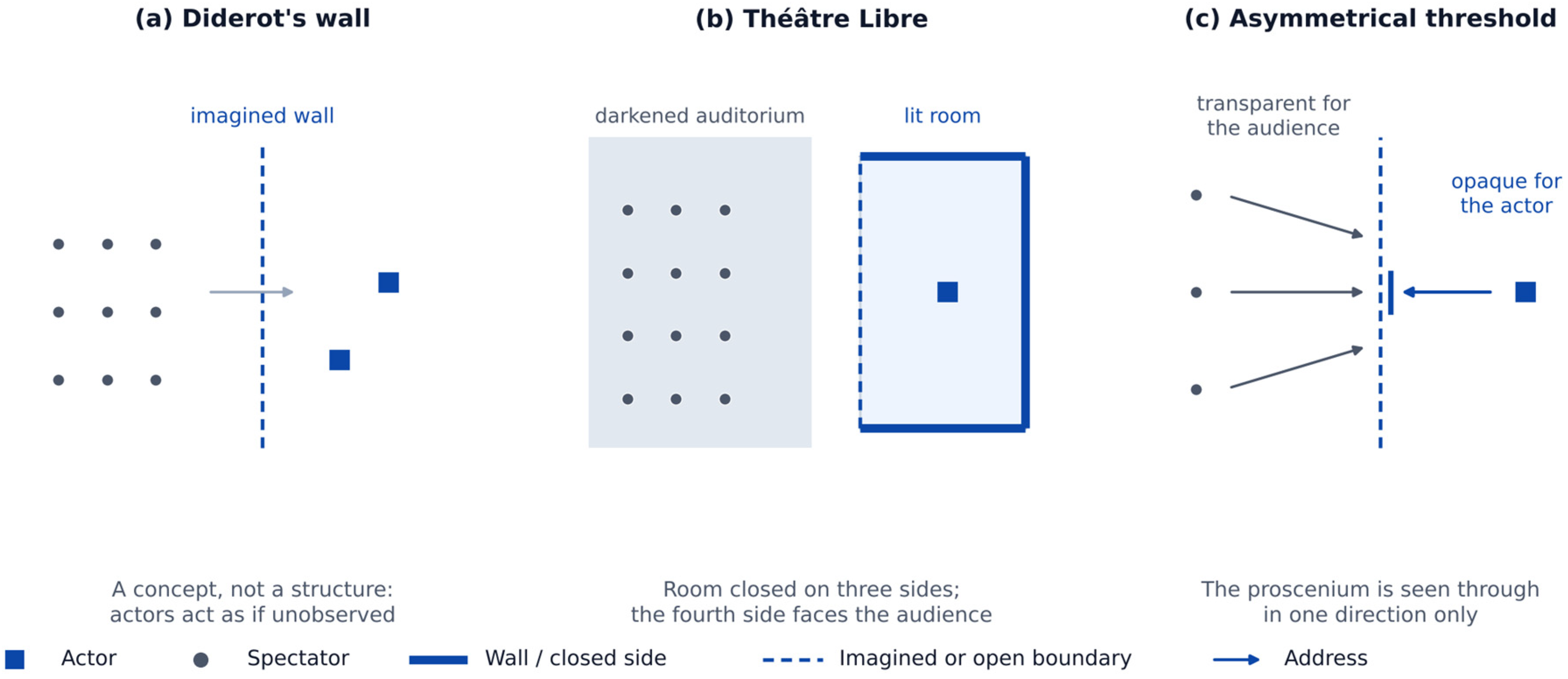
The fourth-wall regime can be summarised as follows when read along the four dimensions of Table 2. In spatial terms, the regime is frontal and fixed: the stage and the auditorium are separated by the proscenium. In terms of the senses, light is concentrated on the stage and the auditorium is darkened. In terms of bodily position, the spectator is seated and stationary, with sight being the primary sense. In terms of time, the threshold is fixed and the experience follows the sequence of arrival, seating, waiting, and absorption.
4.2. Dismantling the Frame: The Avant-Garde Renegotiation of Threshold
Seven cases are coded in this section (Table 3): two built or exhibited (Hellerau and Kiesler’s Space Stage), two staged (The Magnanimous Cuckold and Piscator’s projections) and three unbuilt projects or proposals (Total Theatre, U-Theatre and Theatre of Cruelty). The evidence level and the Lefebvrian stage of every statement are recorded in Table S1.
Appia’s contribution was the concept of an ‘atmospheric threshold’. After seeing Parsifal at Bayreuth in 1882, he described a living thing presented in a lifeless atmosphere [52]. His central idea was to treat light as a fundamental element of theatrical space [11,43]. He argued that painted, two-dimensional backdrops should be replaced by three-dimensional elements (praticables), which are made visible by directional lighting [43,52]. In Böhme’s terms, such light is a medium for producing atmosphere [7]. It has no fixed boundary and cannot be touched; however, it can be perceived, and it guides attention.
The most complete documented realisation is the Jaques-Dalcroze Institute at Hellerau, completed in 1911. Measuring 49 by 16 metres and standing 12 metres high, it could accommodate 600 spectators [52]. There was no proscenium arch or footlights, and the seating was designed to treat all spectators equally [9]. The walls and ceiling were covered in white fabric, which was lit from behind so that no light source was visible. The ceiling consisted of movable panels [52]. Hannah’s account of Hellerau and the avant-garde’s concept of absolute space provides an additional architectural perspective [13]. Interpreted in threshold terms, Appia made two shifts. First, the threshold moved from a spatial boundary to a temporal transition because the experience is defined by continuous changes in light. Secondly, it became perceptual because the boundary is no longer an identifiable object, but rather a qualitative change experienced by the body. As the spectators at Hellerau remained seated, ‘envelopment’ here was perceptual rather than locomotive.
Meyerhold offers an alternative approach: the Constructivist Threshold. Although he trained under Stanislavski, Meyerhold came to question the implicit assumption of the fourth wall [53,68]. In his biomechanics, he treated the actor’s body as a precise instrument [44]. As interpreted in [44] and [69], movement in his system is governed by the physical properties of the space, such as the height of platforms and the angle of ramps. This means that actors perform through space, rather than simply in it. This concept was realised in the 1922 production of The Magnanimous Cuckold, for which Popova designed scaffolds, platforms, ramps and wheels with virtually no decorative elements [9,45]. Lodder provides a structural and historical analysis of this staging. She demonstrates that Popova’s apparatus of scaffolding, platforms, revolving doors, and mill wheels functioned as a utilitarian mechanical structure that embodied urban industrial life and modular spatial construction rather than serving as mere decorative scenery [70]. Interpreted in this manner, the stage becomes an industrial micro-environment, constructed from modular components. This provides the architectural foundation for the Constructivist Threshold, which is formed by the stage’s operational apparatus rather than a painted or framed boundary. For the spectator, the threshold becomes topological. The eye follows trajectories through depth, height, and distance; spectators cannot physically enter the stage, but they are invited to do so perceptually [11,69]. Meyerhold also advocated extending the proscenium and treating the auditorium as an extension of the stage. In his 1932 design with Barkhin and Vakhtangov, the auditorium was arranged in a semicircle with the stage extending into it [68]. The underlying principle is that the threshold should be displayed, not hidden. In traditional theatre, the transition from backstage to stage is concealed by curtains and wings, but in this design, it becomes visible content of the performance.
The third approach, that of the Bauhaus circle, treats the threshold as programmable. Gropius’s Total Theatre (1926) was never built, so only its intended effect is documented. A rotating stage would enable the theatre to shift between proscenium, thrust and arena configurations [46]. The threshold thereby becomes temporal: it appears, disappears, and reappears with the rotation. Spectators can no longer rely on a stable viewing experience. Gropius expected such transformations to cause spectators to lose their inertia [46]. Moholy-Nagy argued against the clear distinction between active and passive roles of the stage and auditorium, instead proposing suspended bridges, rotating mechanisms, and movable surfaces [11,71]. Similarly, Molnár’s U-Theatre was a project involving platforms moved by elevators, suspended bridges, and devices producing water and scent [47,72]. Piscator’s projections added a layered threshold. Projected images could supplement, comment on or replace the action, meaning spectators had to consider the relationship between actors, images and themselves [55]. Total Theatre and the U-Theatre, like Artaud’s proposal below, document conceived space in Lefebvre’s sense: they propose a spatial relation and cannot show how it was used.
Artaud and Kiesler expand the repertoire of the avant-garde in two more transgressive directions than the first three. Artaud’s Theatre of Cruelty is presented here as an unrealised proposal and is categorised accordingly. The manifesto proposes replacing the stage and auditorium with a single, unpartitioned space, with spectators seated in the centre on movable chairs while the action unfolds around and above them [32]. This proposal does not remove the threshold. Instead, it is relocated into the relationship between a centre and a surround, and is intended to affect the body through sound, light and noise rather than the eye alone. This is also the most overtly political avant-garde position because it seeks to shake the spectator out of the role of detached observer. As the evidence is textual, the case describes what the configuration was intended to do, rather than how it functioned.
Kiesler’s Space Stage, built for the 1924 Vienna exhibition of new theatre techniques, took the opposite route. It was a physically realised open framework of platforms and ramps without a proscenium frame or curtain [33]. The transition between performer and spectator is facilitated by the structure itself and by performers’ vertical movement across levels. Compared with Meyerhold’s constructions, which stage the transition from backstage to the stage, Kiesler’s structure renders the transition three-dimensional. This is a clear example of a case in which the frame disappears, but the transition does not (see Supplementary Table S2). Both cases are consistent with Tschumi’s argument that space and event cannot be separated [6] and with Benjamin’s understanding of the threshold as a zone [23].
Figure 5 illustrates the configurations of the avant-garde cases using a common visual language.
Figure 5.
The avant-garde regime: (a) Hellerau, with light as the transition (documented); (b) the 1932 design for Meyerhold’s theatre, with a semicircular auditorium and exposed platforms (intended); (c) Total Theatre, rotating between proscenium, thrust and arena (unbuilt, intended); (d) the single undivided site of Artaud’s Theatre of Cruelty (unbuilt proposal, intended); and (e) Kiesler’s open Space Stage (1924, documented). The diagrams are interpretive representations of the coded configurations, not plans or measurements.
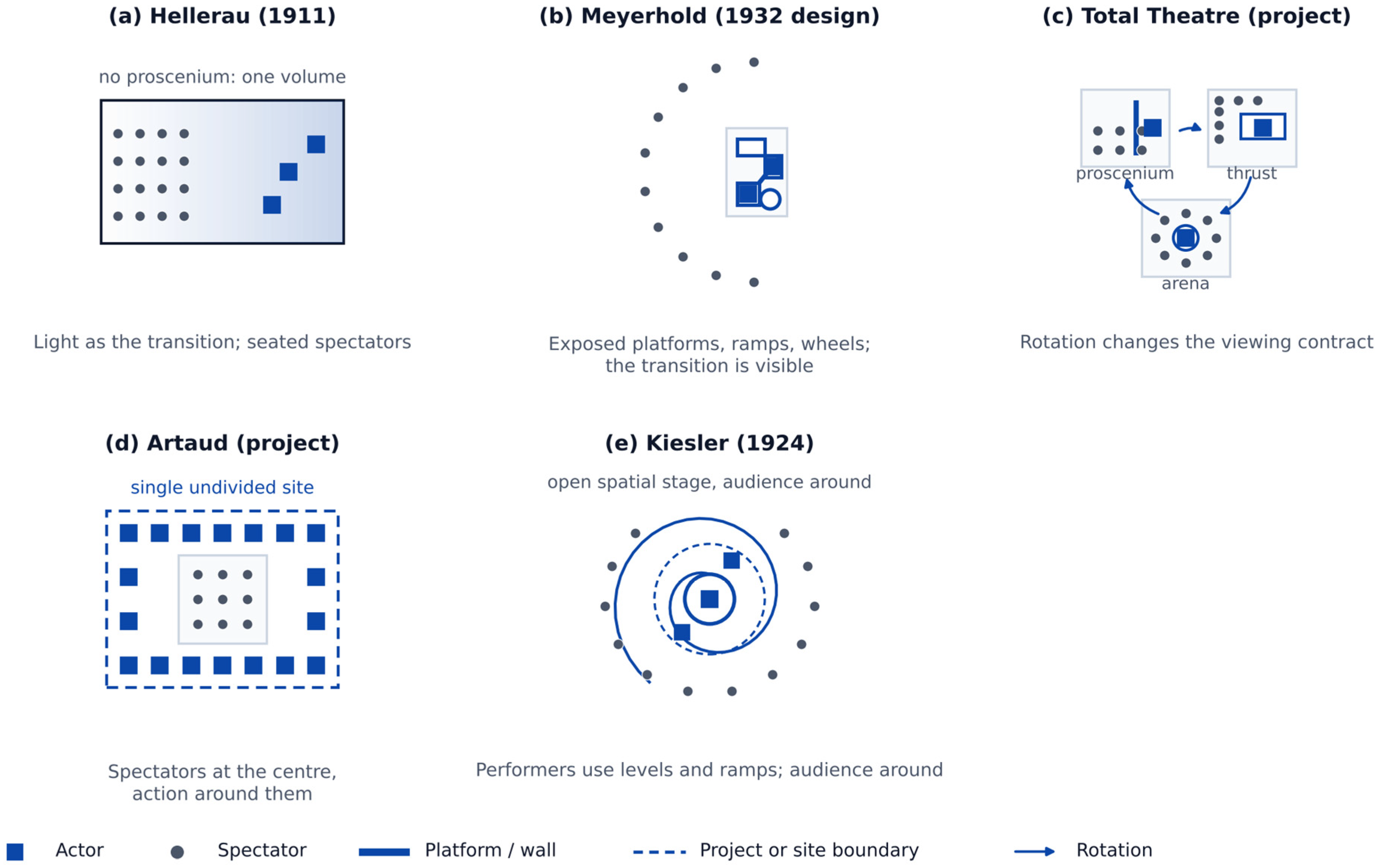
The avant-garde regime can be summarised as follows when read along the four dimensions of Table 2. In spatial terms, the regime evolves from a fixed frame to a unified volume (Hellerau), a visible structure (Meyerhold), a reconfigurable arrangement (Total Theatre), a single undivided site (Artaud) and an open spatial structure (Kiesler). In terms of the senses, light becomes an atmospheric medium and projections add layers to the image. In terms of bodily position, spectators are enveloped by light and invited to track trajectories. In the unbuilt projects, they are unsettled by a changing configuration or, in Artaud’s proposal, placed at the centre of the action. In practice, however, they remained largely seated. Temporally, the threshold becomes variable and programmable in the unbuilt projects. The trajectory runs from a visual frame to a perceptual atmosphere and a visible structure, and then to a programmable variable.
4.3. Environmental Theatre and the Externalisation of the Threshold
Four cases are coded in this section (Table 3): the Cartoucherie, The Legacy of Cain cycle, Dionysus in 69 and Faustus. They illustrate three strategies: found space, the environment as atmosphere, and the laboratory.
The first strategy is found space. Mnouchkine’s Théâtre du Soleil occupies the Cartoucherie, a disused munitions factory in the Paris suburbs [56]. In terms of thresholds, the audience enters a space that still bears traces of its non-theatrical past, rather than being defined by architectural features intended for theatre. Mnouchkine herself describes how laying a carpet on the floor transforms the space into the actors’ universe, creating a clearly defined frontier that can be crossed [57]. The threshold here is performative rather than architectural. The spectator’s response to scale, texture, and industrial residue differs from that in a conventional theatre, because past and present uses coexist as layers. Adaptive reuse of heritage buildings is a field with its own intervention strategies [73]. The Living Theatre took this logic further by politicising it. In the 1970s, the company developed ‘The Legacy of Cain’, a series of plays intended for non-traditional venues, which they performed for free in public spaces. These ranged from prisons in Brazil and the gates of Pittsburgh steel mills to the slums of Palermo and schools in New York City [58]. In Brazil, from 1970 to 1971, the company performed in the streets. Its members were arrested and imprisoned, but later staged Six Public Acts and The Money Tower in Pittsburgh. Kaminski examines the group’s arrest in Ouro Preto in 1971, as well as the artists’ performative conduct in the face of incarceration [59]. In 1975, Six Public Acts was staged at the former stock exchange in Venice and in St Mark’s Square. It then moved through the streets of the city like a procession. Interpreted in threshold terms, the performance area coincides with sites where power is exercised or contested, and the spectator becomes a passer-by, witness, or participant. The spectator’s bodily position is therefore ethically charged, and the question of who watches and who is watched changes when the performers are imprisoned themselves [59].
A second strategy treats the entire environment as an atmosphere. Schechner systematised these practices. In Dionysus in 69, for example, the audience moved through the space, traversing different performance zones, rather than sitting in fixed seats [48]. The second of the Six Axioms holds that the entire space is used for performance and audience participation [49]. This abolishes the distinction between the stage and the auditorium, replacing them with a single field. Schechner asked what would happen if actors and audience entered through the same door, if all equipment were always visible and if distinctions between onstage and backstage were eliminated [48]. Moving around, choosing where to stand and deciding when to move activates spectators’ kinaesthetic sense, making them aware of their body as a spatial agent [69]. Schechner’s approach also has an anthropological dimension [48,74]. He compares performers to shamans and seeks to recreate the dissolution of the boundary between the shaman and the audience in contemporary urban contexts.
Grotowski’s poor theatre is an exception within this regime. It rejects technological thresholds and intensifies bodily ones [75]. His theatre was a laboratory in which spectators sat in close proximity to the actors. Grotowski regarded the actor and the spectator as the only two necessary elements, asking what happens between them [50]. In Faustus, the audience sat at a large dining table, much like the guests at the banquet depicted in the play [60]. They remained spectators, but could not safely observe. According to Fischer-Lichte’s account of co-presence as a feedback loop that transforms both parties [17], the threshold becomes a bodily state of tension. The spectator is close enough to be seen and therefore implicated.
Figure 6 diagrams the four environmental configurations.
Figure 6.
The environmental regime: (a) the Cartoucherie, where a carpet marks a frontier that can be crossed; (b) Dionysus in 69, with performance zones and spectator routes instead of fixed seats; (c) The Legacy of Cain, in which the performance area coincides with public sites; and (d) Grotowski’s Faustus, in which the spectators sit at the banquet table. The diagrams are interpretive representations of the coded configurations, not plans or measurements.
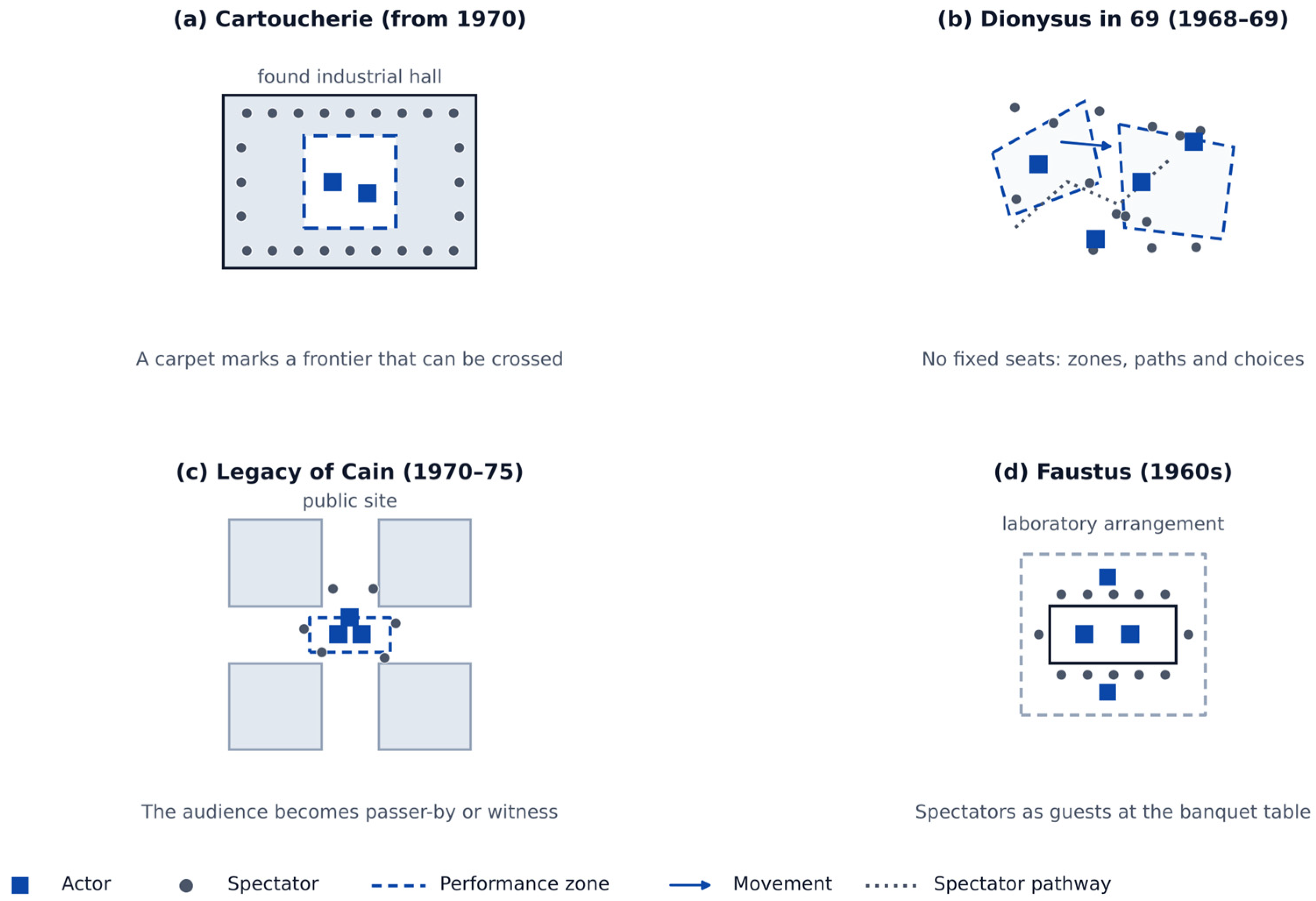
The environmental regime can be summarised as follows when read along the four dimensions of Table 2. Spatially, the stage and auditorium merge to form a single space, or a laboratory-style arrangement in Grotowski’s case. Sensorially, material history, scale and residue replace the controlled theatre environment. In terms of bodily position, Schechner’s spectators navigate and make choices, whereas in Grotowski’s approach, spectators are seated but implicated; therefore, the ‘navigating body’ is not a feature of the entire regime. Temporally, the threshold is negotiated during the performance and is not fixed in advance. Here, the threshold is externalised and inhabited, and in Grotowski’s case, internalised.
4.4. Digital Thresholds
Four cases are coded in this section (Table 3): Laterna Magika, the Improvisational Theater Space, telematic performance and pandemic video-platform theatre. The three phases distinguished in Section 2.3 organise the presentation.
Multimedia augmentation is the earliest form. Svoboda’s Laterna Magika at Expo 58 combined live actors with synchronised projected film, creating what has been described as a new organic whole from the interaction of the two media [34]. The threshold became layered, with the screen and stage functioning as parallel performance spaces, with actors moving between them. However, the architectural threshold of the auditorium remained intact, and spectators still sat in fixed positions facing a framed performance.
A second form is the interface threshold. The Improvisational Theatre Space, developed by Sparacino and his colleagues at the MIT Media Lab, created a stage on which human performers acted alongside virtual ‘Media Creatures’. These were behaviour-based software agents that could perceive gestures, words, and tone of voice, responding in real time. Performers did not need to wear special suits or wires [51]. In this context, the threshold functions as an interface, serving as a technological membrane that translates bodily actions into digital responses. The source documents describe the coupling between performer and system. However, the position of the spectator in this arrangement is not described in [51], so the idea of a ‘coupled’ spectator cannot be supported by this case.
Telematic and distributed thresholds form a third group. Telematic performance, such as Company in Space’s use of video conferencing, connects performers in different locations, producing a third space accessible to all involved [35]. The threshold becomes distributed, meaning the performance exists simultaneously in several places. Auslander argues that liveness is not an ontological condition, but rather a quality that is attributed through audience engagement and their willingness to bring the mediated event into presence [40]. Therefore, a telematic threshold is not a false threshold, but a different kind whose conditions are set jointly by perceptual habits and technical interfaces.
A further form emerged during the pandemic. Fuchs’s study of pandemic-era digital performance highlights how such productions transcended geographical and financial boundaries, reaching new audiences and prompting a re-evaluation of the concept of liveness [37]. Those who could not attend in person due to disability, geography or cost were able to participate. The screen interface arranges participants in a grid of separate frames [37]. In threshold terms, the audience no longer crosses a physical boundary together, but instead watches a transmitted event from their own space. This creates an intimate yet distant mediated co-presence, where faces fill the screen but bodies are elsewhere. The sources do not establish whether this arrangement reduces the transformative potential of the threshold.
Figure 7 diagrams the four digital configurations.
Figure 7.
The digital regime: (a) Laterna Magika, with screen and stage as layered spaces and fixed seating; (b) the Improvisational Theater Space, in which a performer is coupled to software agents (the spectator’s position is not documented); (c) telematic performance, which produces a third space between two sites; and (d) video-platform theatre, in which each spectator watches from a separate frame. The diagrams are interpretive representations of the coded configurations, not plans or measurements.
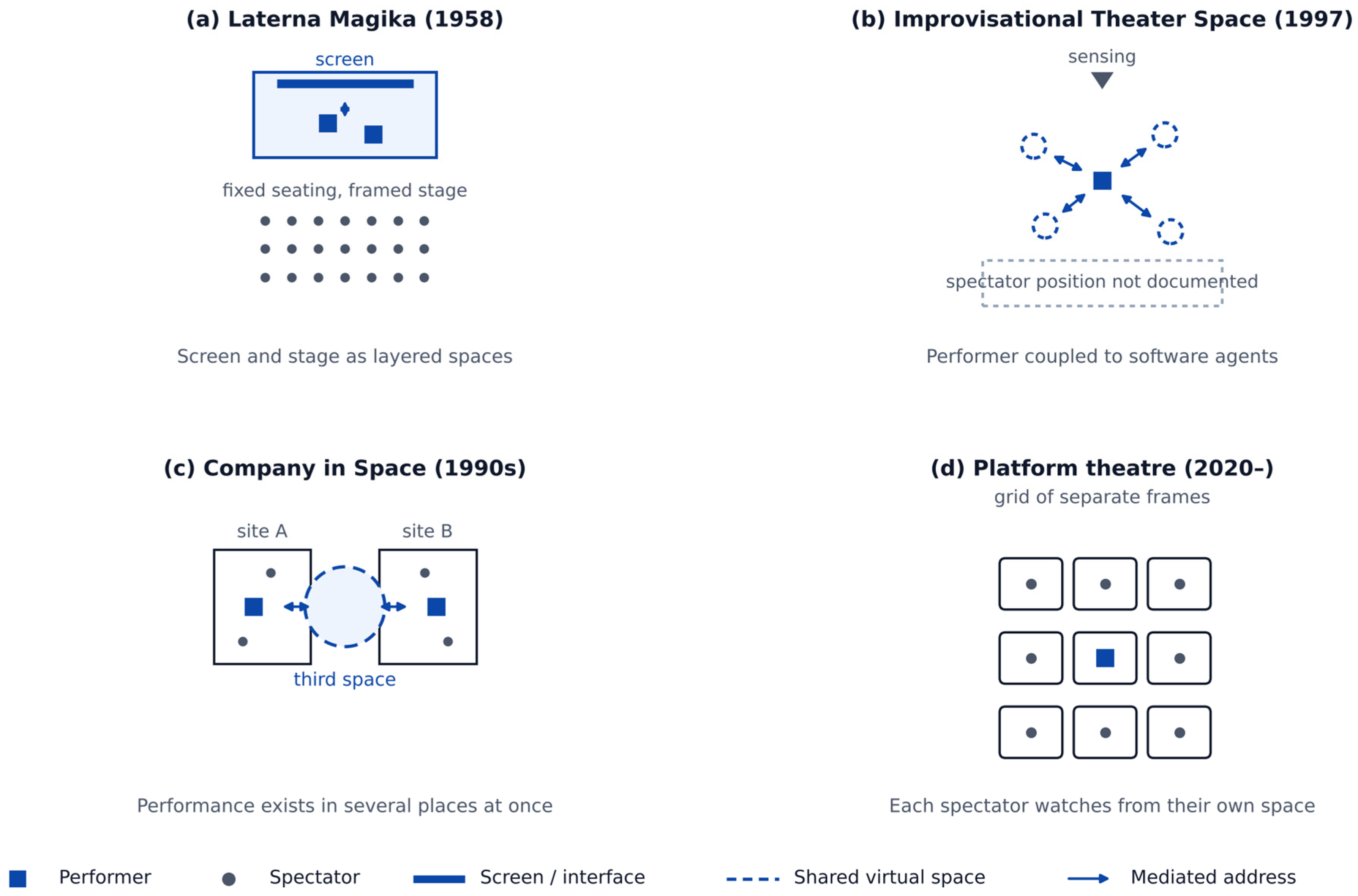
The digital regime can be summarised as follows when read along the four dimensions of Table 2. Spatially, physical and virtual spaces are either linked or fragmented into separate frames. In terms of the senses, the interface determines what is seen and heard, including delay and framing. In terms of bodily position, performers are coupled to systems and spectators are either telepresent nodes or located individually at home. In terms of time, the threshold is programmable and networked, and its conditions include latency and synchronisation.
5. Comparative Synthesis
This section brings together the codings of Section 4. It presents a comparative matrix, describes patterns across the four regimes, and notes the limits of the evidence. Interpretation of the patterns is left to the Discussion.
5.1. Comparative Matrix
Figure 8 provides a diagrammatic summary of the four regimes; Table 4 presents the coded comparison on which the diagrams are based, summarising the dominant configuration of each regime across the four dimensions of Table 2. Two additional rows record the main evidence level and exceptions found within each regime. The matrix describes the analysed cases. It does not cover all theatres of a given period, and statements about bodily position refer to the positions made available by the configurations, not to measured audience behaviour.
Figure 8.
Four spatial regimes of theatrical thresholds. Simplified diagrams of (a) the fourth wall, (b) the avant-garde, (c) environmental theatre and (d) digital performance, in the visual language of Figure 4, Figure 5, Figure 6 and Figure 7 and derived from the configurations coded in Table 4. The panels show spatial configuration and bodily position; sensory regulation and operational temporality are reported in Table 4 only. The diagrams are interpretive representations, not measurements.
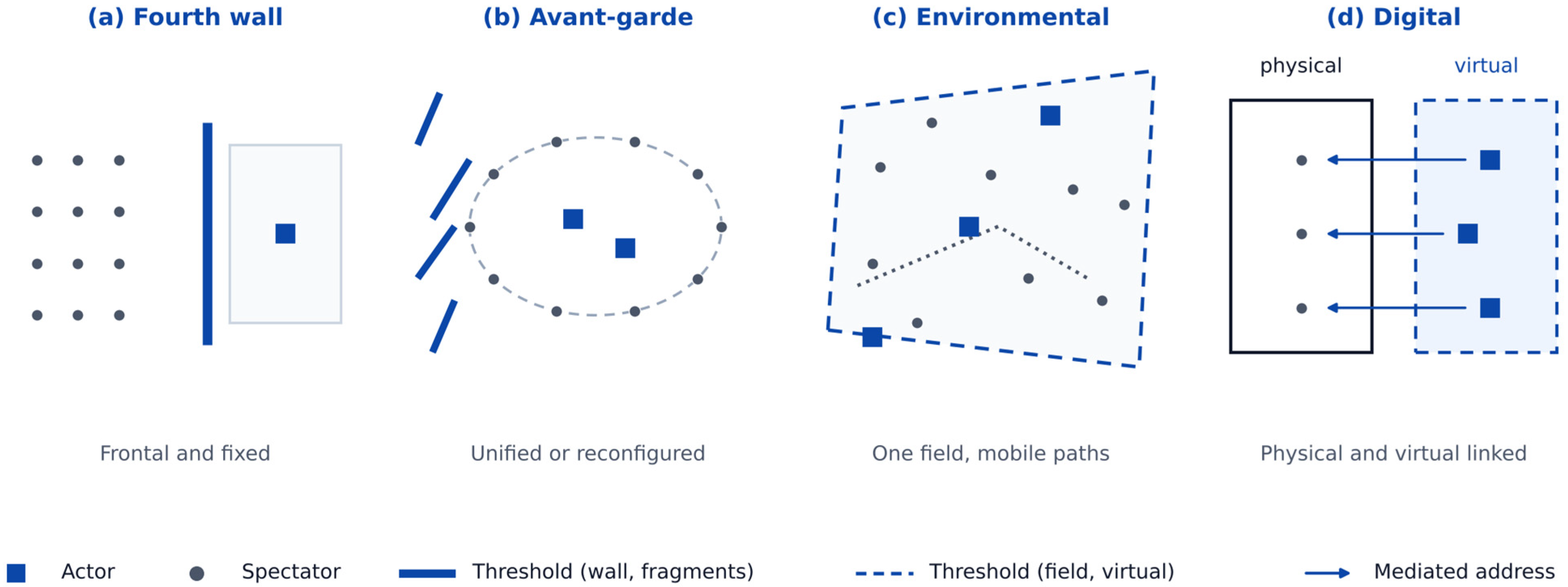
Table 4.
Comparative matrix of the four threshold regimes (based on the codings of Section 4). The text in italic is the proper name of the play staged.
5.2. Patterns Across the Regimes
The matrix presented in the previous section reveals five patterns:
- Firstly, the way in which the threshold is articulated changes from regime to regime. In the fourth-wall regime, for example, the threshold is articulated by the architecture, the proscenium, and the darkened auditorium. In the avant-garde, it is articulated by light, exposed structure, and mechanisms. In the environmental regime, it is articulated by found conditions and the performance itself, as exemplified by Mnouchkine’s carpet. In the digital regime, it is articulated by technical interfaces. These correspond to the material, perceptual, and operational means mentioned in the second condition of the definition in Section 2.1.
- Secondly, the dimensions did not change at the same pace. In avant-garde cases, the sensory and temporal dimensions changed first through the use of light, projection, and reconfiguration, while the spectator’s position largely remained seated. Locomotion and choice only became characteristics in the environmental regime.
- Thirdly, earlier configurations persist within later regimes. For example, frontal viewing from fixed seats survives in the multimedia phase of digital performance (Laterna Magika), while close seating persists in Grotowski’s laboratory arrangement within the environmental regime. The regimes therefore overlap in practice as well as in time.
- Fourthly, the exceptions listed in the final column demonstrate that no regime is homogeneous. The ‘navigating body’ is not a feature of the entire environmental regime; avant-garde spectators were mostly seated; and the fourth-wall spectator, as a still, silent figure, is a designed position, not a general description.
- Fifthly, the evidence differs in kind between regimes. The avant-garde cases combine built and unbuilt work, so part of the evidence relates to intended effects. The digital cases are based mainly on system descriptions, and none of the regimes are supported by audience data. These asymmetries are discussed in Section 3.3 and Section 6.6.
These patterns underwent a transparency check. The programmable threshold of the avant-garde column is based solely on intended evidence, i.e., conceived space in Lefebvre’s sense (Total Theatre, U-Theatre, and Artaud’s proposal in a different form). If the three unbuilt cases are disregarded, the remaining four patterns are revealed. The articulation of the threshold varies by regime; the dimensions change at different paces (light and projection already alter the sensory and temporal dimensions in Hellerau and Piscator’s staging); earlier configurations persist; and exceptions remain. The threshold that varies by mechanism disappears, which neither Hellerau nor Kiesler’s structure provides. The check is a transparency device, not a reason to exclude the cases (Section 3.3).
Section 6.2 examines whether these patterns amount to a redistribution of thresholds rather than their elimination.
6. Discussion
This section summarises the findings, examines the working proposition stated in the Introduction, positions the threshold in relation to the theory reviewed, derives design propositions with their conditions and limits, states the significance and limitations of the study, and outlines future trajectories.
6.1. Summary of Findings
The seventeen cases yielded 80 coded statements: 15 were intended, 25 were documented, and 24 were interpreted. In a further 16 case–dimension pairs, the sources did not describe the dimension and no statement was coded (see Table S1). Four findings follow. Firstly, each regime articulates the threshold in different ways: the proscenium and the darkened auditorium (fourth wall); light and exposed structures and mechanisms (avant-garde); found conditions and the performance itself (environmental); and technical interfaces (digital). Secondly, the dimensions did not change at the same pace: sensory and temporal conditions changed before the spectator’s position did, and locomotion and choice only became characteristics of the environmental regime. Thirdly, earlier configurations persist inside later regimes, and every regime contains exceptions; therefore, the positions offered to spectators do not form a line from passive to active. Fourthly, the counter-reading found no case in which a threshold was removed without a displaced counterpart (Section 6.2), although this rests on a definition and sample with stated limitations (Section 6.6). Taken together, these findings suggest that the threshold in theatre is not a wall that dissolves gradually, but rather a zone that is articulated differently in each regime.
6.2. Conceptual Propositions
The working proposition stated in the Introduction, that the history of theatrical space is one of threshold redistribution and not elimination, was tested first by a counter-reading (Section 3.4, step 6; Table 5; Supplementary Table S2). Nine of the 80 coded statements in five cases (Diderot’s wall, Hellerau, Dionysus in 69, the Theatre of Cruelty, and the Space Stage) contained language indicating removal. The three-part test, applied to the configuration after the intervention in each of these cases, found that something still mediated between performance and viewing. This was articulated by material, perceptual or operational means and addressed or crossed by bodies. Therefore, no counterexample was found among the cases in Table 3. Table 5 shows the configuration after the intervention and the outcome for each case. Hellerau is the clearest example, as the proscenium and footlights were replaced by an atmospheric transition of light.
Table 5.
Counter-reading of the cases whose coded statements contain removal language (Supplementary Table S2).
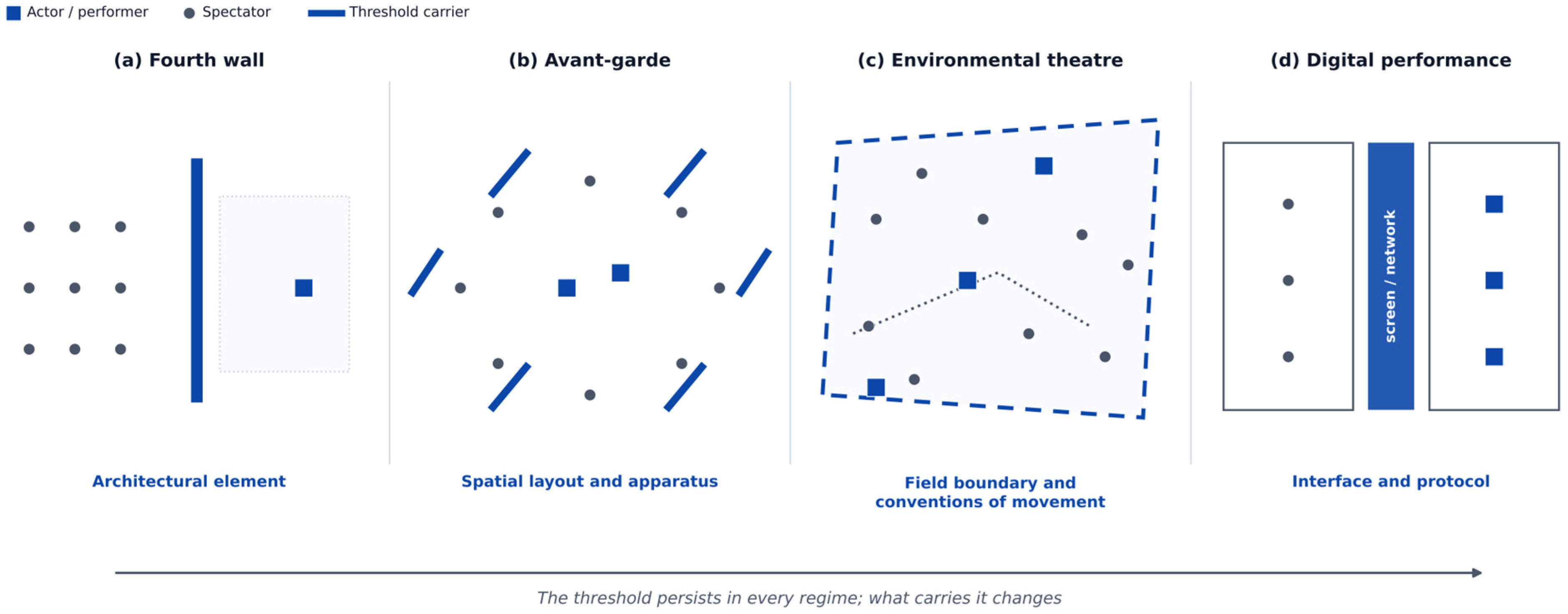
The three limits of this test must be stated. Firstly, the definition in Section 2.1 classifies perceptual and operational articulations as thresholds; therefore, the removal of a physical boundary will almost always be interpreted as displacement, making the test partly circular. Secondly, the cases were selected due to their spatial involvement in the performer–spectator relationship (see Section 3.3), which means that forms in which performance and viewing are not spatially differentiated are excluded. Thirdly, the scan is a transparency device applied by one researcher to their own coding, and the Artaud result is based on intended evidence only. Therefore, the proposition is retained as conditional: under the adopted definition and in the examined cases, thresholds were redistributed, not eliminated. Candidates for genuine counterexamples lie outside the sample, for example in Kaprow’s Happenings [76], where the distinction between performer and spectator was contested. These are listed in Table S2, but were not coded because their primary documentation was not consulted. Figure 9 restates the working proposition using the visual vocabulary of Figure 1: the threshold is not removed, but instead carried by different means in each regime.
The comparison yields five propositions:
- P1: The threshold is articulated through a relationship, and the means of articulation vary. While the cases are consistent with the premise that a threshold exists in the relationship between performers, spectators and space, they cannot confirm an adopted a priori premise. Mnouchkine’s carpet and Brook’s empty space demonstrate that a minimal marker can suffice [25,57]. Hellerau demonstrates that removing the proscenium does not eliminate the threshold, merely altering the manner in which it is articulated. The comparison reveals that the same relationship can be expressed through architecture, light, exposed structures, found conditions or interfaces (See Section 5.2).
- P2: Thresholds are redistributed across dimensions and persist across regimes. Section 5.2 shows that the sensory and temporal dimensions changed first in the avant-garde; that locomotion and choice became characteristic later; and that earlier configurations persist inside later ones. This supports the idea that history is layered rather than sequential, as set out in the counter-reading.
- P3: Spectator positions are determined by the configuration and vary along several axes. The positions made available by the regimes (e.g., seated and still, enveloped, navigating, coupled or telepresent) differ in terms of locomotion, proximity and coupling. These positions do not form a line from passive to active, which is consistent with Rancière’s argument that spectators are not inherently passive [27]. These positions are designed, and Table 4 records exceptions, such as seated spectators at Hellerau and implicated but seated spectators in Grotowski’s work. There is also an undocumented spectator position in the interactive system of Sparacino et al. [51].
- P4: Theatrical thresholds are liminoid, and the digital case is open. Following Turner [4,24], the examined thresholds are voluntary and temporary, not obligatory. This liminoid framing is consistent with Auslander’s assertion that liveness is attributed through audience engagement rather than being inherent in a medium [40]. Therefore, mediated thresholds cannot be dismissed as ‘false’. Whether the video-platform grid reduces the transformative potential of the threshold by removing the unpredictability that Grosz associates with the in-between [1] is not established by the sources [37]. Grotowski’s work demonstrates that liminoid experiences can involve discomfort and implication. This requires audience research.
- P5: Ambiguity is a recurring feature of threshold configurations, and its productivity is a hypothesis. The fourth wall is transparent and opaque at once. Grotowski’s spectators can only watch, not safely observe. Laterna Magika layers image and actor, and the video platform is both intimate and distant. Such simultaneous opposites recur across all four regimes. However, the data cannot demonstrate that this ambiguity enhances the experience, as no audience data were collected. This is therefore presented as a hypothesis for future empirical research.
Figure 9.
Redistribution of the threshold across regimes. In the visual vocabulary of Figure 1, the diagram shows what carries the threshold in each regime: (a) an architectural element, (b) spatial layout and apparatus, (c) a field boundary and conventions of movement, and (d) an interface and protocol. It illustrates the working proposition that the threshold is redistributed rather than eliminated. It is an interpretive synthesis of Table 4, not an empirical result.
In comparison to existing work, P1 and P4 apply concepts that have already been established by Brook, Kobialka and Turner. Furthermore, Hannah [13] and Aronson [14] have examined avant-garde and environmental regimes in detail. The value of this comparison lies in the use of a single threshold category across four regimes, the inclusion of the digital regime, and the design translation below.
6.3. Positioning the Threshold
Three arguments from the reviewed theory in Section 2 help to contextualise the term. Firstly, within a theatrical context, the threshold is better understood as a designed relationship than as a boundary. Benjamin’s distinction between a threshold and a boundary [23], and Grosz’s notion of the in-between [1], describe a zone of transition and becoming. The cases demonstrate that, in theatre, this zone is always produced by an element, such as a convention (Diderot’s wall), light (Hellerau), a carpet (Mnouchkine), or an interface (telematics performance). Secondly, the threshold only acquires meaning when it is engaged with by bodies. This idea is explored by Kobialka in relation to borders [2], Tschumi in relation to the inseparability of space and event [6], and Fischer-Lichte in relation to co-presence [17]. This is why the three-part test requires bodies and why the spectator positions in Table 4 are properties of configurations rather than audiences. This is in line with Rancière’s rejection of the passive spectator [27]. Thirdly, Lefebvre’s account of produced space [26] explains why proposals and buildings can be compared. A threshold is conceived (Total Theatre, Artaud), built and used (Hellerau, Kiesler), and experienced, which is beyond the scope of this study. Design is the stage that connects the first two stages.
Both Artaud’s proposal and the Living Theatre’s street performances treat the threshold as a site of contest rather than comfort: the former by placing the spectator inside the action and the latter by moving the performance to places where power is exercised, exposing the performers to the risk of arrest [58,59]. In these cases, the threshold is political as well as spatial and the question of who can cross it and the risks involved are part of its design. Turner’s distinction between the liminal and the liminoid is useful here [4,24]. The examined thresholds are voluntary and temporary, but the examples of Grotowski and the Living Theatre demonstrate that ‘voluntary’ does not necessarily equate to ‘comfortable’. When repositioned in this way, ‘threshold’ refers to the zone in which the relationship between performance and viewing is formed, regulated, or contested. It is not a barrier whose removal measures the progress of theatre. The term is then available to architects as a design category with four parameters, the four dimensions, and not only as a metaphor.
6.4. Implications for Architectural Design
Following Section 3.5, the implications are stated as design propositions. Each is traceable to a case, a dimension and an evidence level, and none makes claims about actual audience response. Table 6 presents them by design domain. Table 7 then states the conditions under which each applies, its practical limitations, and an example of a real building or production. The examples are illustrations drawn from public descriptions. They are not coded cases and are not evidence for the propositions.
Table 6.
Design propositions derived from the comparison. The text in italic is the proper name of the play staged.
Three comments qualify the table. Firstly, the first proposition is based on an unrealised project, so it represents an intention rather than a demonstrated effect. Secondly, proximity implicates spectators, as demonstrated by the work of Grotowski and the Legacy of Cain [58,60]. Participatory arrangements should therefore allow spectators to opt out; this is a design decision rather than a finding. Thirdly, the accessibility gains reported for digital performances during the pandemic era [37] must be weighed against the fragmentation of the spectator’s space. These domains also connect to the literature on stage–audience conventions [61], adaptive reuse as a design field [73], and work on participation and immersion [18,19].
Table 7 qualifies the propositions of Table 6. The conditions and limitations are the author’s reasoning from the cases and from the examples, and they should be tested in practice.
Table 7.
Conditions, practical limitations and illustrative examples for the design propositions of Table 6. The examples are not coded cases.
Taken together, the examples demonstrate that the propositions are not confined to a single typology. The Shed demonstrates a flexible volume that relies on mechanisation. The Bouffes du Nord demonstrates that deliberate intervention in the relationship between audience and performers can be minimal while retaining legible traces of earlier use. Sleep No More demonstrates that participatory routes require a building with multiple rooms and trained staff. Dream demonstrates that the interface must be designed alongside the physical performance space. Each example also demonstrates a limitation: none of them eliminate the threshold, and each one addresses it in a different way.
6.5. Impact and Significance
The contribution can be made in terms of research, design practice and teaching. In terms of research, the study provides a single comparative category, the threshold, which is applied to configurations that are typically considered in different bodies of literature. It also offers a coding scheme comprising four dimensions, three levels of evidence and the Lefebvrian stage of production of space, which others can reuse or challenge via Supplementary Tables S1 and S2. The study also provides a conditional response to the well-known narrative that theatre history is the progressive removal of a wall. For design practice, the findings transform the questions that a design brief can pose. Instead of asking whether the boundary between stage and audience should be removed, designers can ask which threshold dimension a project will change, how it will be changed and for whom. They can also use the parameter families in Table 6 to specify this. For heritage and adaptive reuse, the findings support interventions that mark thresholds minimally. For education, the four dimensions provide a vocabulary for interpreting existing performance spaces. These claims are subject to the limitations outlined in Section 6.6: the propositions are derived from documented intentions and configurations rather than audience response, and require testing in practice.
6.6. Limitations
The limitations listed in Section 3.6 apply to these findings. Three of these deserve emphasis. First, the sample is Euro-American and purposive, so the propositions may not apply to performance traditions that organise the relationship between performers and spectators differently. Unbuilt projects and manifestos only document conceived space, which is why the claim about programmable thresholds is stated as an intention (Section 5.2). Furthermore, as no audience data were collected, the study cannot determine whether the spectator positions it describes were adopted, rejected or overlooked.
6.7. Future Trajectories
The comparison suggests six areas for further work, presented as questions rather than predictions. Firstly, audience research in the form of observational and interview-based studies could investigate whether the spectator positions presented in Table 4 are adopted, and whether the ambiguity described in Proposition P5 (Section 6.2) enhances the experience. Secondly, an extended case set would test the counter-reading beyond the present sample by including non-European and non-North American traditions, further transgressive practices such as Happenings, and recent immersive and site-specific work. Thirdly, hybridisation: as contemporary work increasingly combines elements of several regimes, a useful question is which dimensions each combination changes and which it retains. Fourthly, the embodiment of digital thresholds: if virtual and augmented environments address the body as well as the eye, the question arises as to whether they offer the navigating or implicated positions that Table 4 attributes to the environmental regime. This study provides no evidence on this point. Fifthly, testing the design propositions: post-occupancy studies and research through design could examine the conditions and limits stated in Table 7. Sixthly, extending threshold thinking beyond theatre, the production of transitional zones that structure perception can be seen in urban design, installation art, and digital environments. The framework of Section 2 could be tested in these fields. In each case, the four dimensions provide a means of identifying what has changed and what has been displaced.
7. Conclusions
This article asks how thresholds between performance and viewing areas have been constructed spatially across four theatre space regimes, what positions and sensory conditions they make available to spectators, and what design implications this has. A theatrical threshold is defined as a spatially articulated zone of transition that mediates between two conditions, articulated by material, perceptual or operational means, and addressed or crossed by bodies. Seventeen cases (built, staged and unbuilt) were compared along four dimensions: spatial configuration, sensory regulation, bodily position, and operational temporality.
In answer to the first question, the regimes construct thresholds in different ways. The fourth wall uses the proscenium and the darkened auditorium; the avant-garde uses light, exposed structures and mechanisms; environmental theatre uses found conditions and the performance itself; and digital performance uses technical interfaces. In answer to the second question, the positions made available differ in terms of locomotion, proximity, and coupling. However, they do not form a line from passive to active, and each regime contains exceptions. Under the adopted definition, and in the examined cases, thresholds were redistributed across the four dimensions and persisted across the four regimes. They were not eliminated. In answer to the third question, the comparison yields design propositions in four areas: flexible performance spaces, adaptive reuse, participatory arrangements and hybrid physical–digital environments. These propositions are for design practice, not prescriptions, and rest partly on unbuilt projects and documented intentions.
Three points follow beyond the individual answers. Firstly, thresholds operate as a single analytical category across configurations that are usually discussed separately, such as realist staging, historical avant-garde, environmental theatre, and digital performance. This makes them comparable along the same four dimensions. Secondly, rather than eliminating thresholds, redistributing them results in a more appropriate narrative than that of a wall gradually dissolving, as the same relationship between performance and viewing is carried by different means. In architectural design, the question then shifts from whether a boundary should be removed to how and by what means that relationship is articulated, and for whom. Thirdly, the four dimensions and three levels of evidence make it possible to determine what a spatial intervention changes and displaces, and to distinguish between what a configuration was designed to do and what has been documented. The counter-reading found no case in which a threshold was removed without a displaced counterpart, although the programmable thresholds of the unbuilt projects rest on conceived-space evidence only.
These findings have limitations. The case selection is Euro-American and purposive; a few systems represent the digital regime, coding was carried out by one researcher and no audience data were collected. Therefore, the study makes no claim about actual audience experience. The most useful next steps are: audience research to test spectator positions and hypotheses on ambiguity and mediated liveness; post-occupancy studies to test design propositions; and an extended case set.
Theatre space is better understood as a set of thresholds to be articulated than as a boundary to be overcome. These are the zones in which the relationship between performance and viewing is formed, controlled or disputed: between actor and spectator; between inside and outside; and between here and elsewhere. This study cannot demonstrate the effect of such thresholds on those who cross them. However, it does demonstrate that they were present in every case examined, and that their construction was a design decision. The task for architects and theatre-makers is therefore not to dissolve the threshold, but to articulate it carefully.
Supplementary Materials
The following supporting information can be downloaded at https://www.mdpi.com/article/10.3390/architecture6040230/s1. Table S1: Coding table of the seventeen cases along the four analytical dimensions, with evidence levels (intended, documented, interpreted) and source references. Table S2: Counter-reading log of the cases whose coded statements contain removal language.
Funding
This research received no external funding.
Institutional Review Board Statement
Not applicable. The study did not involve humans or animals.
Informed Consent Statement
Not applicable.
Data Availability Statement
No new datasets were generated. The analysis is based on published historical, archival and secondary sources listed in the References. The coding of the seventeen cases and the counter-reading log are provided in Supplementary Tables S1 and S2.
Acknowledgments
During the preparation of this manuscript, the author used Claude (Anthropic)—Sonnet 5.5 version and DeepL in order to check grammar and spelling, and Claude (Anthropic)—Sonnet 5.5 version for generating figure drawings from the author’s own diagrams. The author reviewed and edited all output and takes full responsibility for the content of the publication.
Conflicts of Interest
The author declares no conflicts of interest.
References
- Grosz, E. Architecture from the Outside: Essays on Virtual and Real Space; MIT Press: Cambridge, MA, USA, 2001. [Google Scholar]
- Kobialka, M. Of Borders and Thresholds: Theatre History, Practice, and Theory; University of Minnesota Press: Minneapolis, MN, USA, 1999. [Google Scholar]
- van Gennep, A. The Rites of Passage; University of Chicago Press: Chicago, IL, USA, 2019. [Google Scholar]
- Turner, V. Liminal to Liminoid, in Play, Flow, and Ritual: An Essay in Comparative Symbology. Rice Inst. Pam.-Rice Univ. Stud. 1974, 60, 53–91. [Google Scholar]
- Boettger, T. Threshold Spaces: Transitions in Architecture. Analysis and Design Tools; Birkhäuser: Basel, Switzerland, 2014. [Google Scholar]
- Tschumi, B. Architecture and Disjunction; MIT Press: Cambridge, MA, USA, 1994. [Google Scholar]
- Böhme, G. Atmosphere as the Fundamental Concept of a New Aesthetics. Thesis Elev. 1993, 36, 113–126. [Google Scholar] [CrossRef] [Scilit]
- Carlson, M. Places of Performance: The Semiotics of Theatre Architecture; Cornell University Press: Ithaca, NY, USA; London, UK, 1989. [Google Scholar]
- Carlson, M. Space and Theatre. Focus Pap. Engl. Lit. Cult. Stud. 2012, 8, 13–23. [Google Scholar] [CrossRef] [Scilit]
- Mackintosh, I. Architecture, Actor and Audience; Routledge: London, UK; New York, NY, USA, 1993. [Google Scholar]
- Bowler, L.M. Theatre Architecture as Embodied Space: A Phenomenology of Theatre Buildings in Performance. Doctoral Dissertation, Ludwig-Maximilians-Universität, München, German, 2015. [Google Scholar]
- McAuley, G. Space in Performance: Making Meaning in the Theatre; University of Michigan Press: Ann Arbor, MI, USA, 1999. [Google Scholar]
- Hannah, D. Event-Space: Theatre Architecture and the Historical Avant-Garde; Routledge: Abingdon UK; New York, NY, USA, 2019. [Google Scholar]
- Aronson, A. The History and Theory of Environmental Scenography; Routledge: London, UK; New York, NY, USA, 2018. [Google Scholar]
- Aronson, A. The Routledge Companion to Scenography; Routledge: London, UK; New York, NY, USA, 2018. [Google Scholar]
- Bennett, S. Theatre Audiences: A Theory of Production and Reception; Routledge: London, UK; New York, NY, USA, 1997. [Google Scholar]
- Fischer-Lichte, E. The Transformative Power of Performance: A New Aesthetics; Routledge: London, UK; New York, NY, USA, 2008. [Google Scholar]
- White, G. Audience Participation in Theatre: Aesthetics of the Invitation; Palgrave Macmillan: Basingstoke, UK, 2013. [Google Scholar]
- Machon, J. Immersive Theatres: Intimacy and Immediacy in Contemporary Performance; Palgrave Macmillan: Basingstoke, UK, 2013. [Google Scholar]
- Dixon, S. Digital Performance: A History of New Media in Theater, Dance, Performance Art, and Installation; MIT Press: London, UK, 2007. [Google Scholar]
- Chothia, J. ‘Zero…Zero…and Zero’: Permeable Walls and Off-stage Spaces. In Thinking on Thresholds: The Poetics of Transitive Spaces; Mukherji, S., Ed.; Anthem Press: London, UK; New York, NY, USA; Delhi, India, 2011; pp. 17–28. [Google Scholar]
- Viglialoro, L. Zu einer Ästhetik der Schwelle. Philosophische Reflexionen am Beispiel vom Musiktheater im Revier [Toward an Aesthetics of the Threshold: Philosophical Reflections Based on the Example of Musical Theater in the Revier]. Itinera 2023, 25, 140–153. [Google Scholar]
- Benjamin, W. The Arcades Project; Harvard University Press: Cambridge, MA, USA, 1999. [Google Scholar]
- Turner, V. From Ritual to Theatre: The Human Seriousness of Play; PAJ Publications: New York, NY, USA, 1982. [Google Scholar]
- Brook, P. The Empty Space; Touchstone: New York, NY, USA, 1996. [Google Scholar]
- Lefebvre, H. The Production of Space; Blackwell: Oxford, UK, 1991. [Google Scholar]
- Rancière, J. The Emancipated Spectator; Verso: London, UK, 2009. [Google Scholar]
- Diderot, D. Discours sur la poésie dramatique [A Discourse on Dramatic Poetry]. In Œuvres esthétiques [Aesthetic Works]; Vernière, P., Ed.; Garnier: Paris, France, 1957; pp. 183–287. [Google Scholar]
- Jullien, J. Le Théâtre Vivant: Essai Théorique et Pratique [Live Theater: A Theoretical and Practical Essay]; G. Charpentier & E. Fasquelle: Paris, France, 1892. [Google Scholar]
- Dinulović, R. Space in the 20th Century Theatre: 1. Theatre and Architecture. South East Eur. J. Archit. Des. 2015, 2015, 1–6. [Google Scholar] [CrossRef] [Scilit]
- Pringle, T. The Space of Stage Magic. Space Cult. 2002, 5, 333–345. [Google Scholar] [CrossRef] [Scilit]
- Artaud, A. The Theater and Its Double; Grove Press: New York, NY, USA, 1958. [Google Scholar]
- Philips, L. Frederick Kiesler; Whitney Museum of American Art in association with W. W. Norton: New York, NY, USA, 1989. [Google Scholar]
- Tajtáková, M. Theatre in the Digital Age: When Technology Meets the Arts. 2014. Available online: https://www.academia.edu/109889675/Theatre_in_the_Digital_Age_When_Technology_Meets_the_Arts (accessed on 10 October 2026).
- Kase, D. New Theatre of the 21st Century. Art. Hist. Crit. 2006, 2, 72–75. [Google Scholar]
- Sparacino, F.; Davenport, G.; Pentland, A. Media in Performance: Interactive Spaces for Dance, Theater, Circus, and Museum Exhibits. IBM Syst. J. 2000, 39, 479–510. [Google Scholar] [CrossRef] [Scilit]
- Fuchs, B. Theater of Lockdown: Digital and Distanced Performance in a Time of Pandemic; Methuen Drama: London, UK, 2022. [Google Scholar]
- Böhme, G. The Aesthetics of Atmospheres; Routledge: London, UK; New York, NY, USA, 2017. [Google Scholar]
- Pallasmaa, J. The Eyes of the Skin: Architecture and the Senses; Wiley: Chichester, UK, 2012. [Google Scholar]
- Auslander, P. Liveness: Performance in a Mediatized Culture; Routledge: London, UK, 1999. [Google Scholar]
- Groat, L.N.; Wang, D. Architectural Research Methods; Wiley: Hoboken, NJ, USA, 2013. [Google Scholar]
- Flyvbjerg, B. Five misunderstandings about case-study research. Qual. Inq. 2006, 12, 219–245. [Google Scholar] [CrossRef] [Scilit]
- Beacham, R.C. Adolphe Appia: Texts on Theatre; Routledge: London, UK; New York, NY, USA, 1993. [Google Scholar]
- Meyerhold, V. Geleceğin Oyuncusu ve Biyomekanik [The Actor of the Future and Biomechanics]. In 20. Yüzyılda Tiyatro [Theatre in Twentieth Century]; Çalışlar, A., Ed.; Mitos Boyut: İstanbul, Türkiye, 1993; pp. 160–163. [Google Scholar]
- Meyerhold, V. Tiyatronun Yeniden Yapılanması [Restructuring of the Theater]. In 20. Yüzyılda Tiyatro [Theatre in Twentieth Century]; Çalışlar, A., Ed.; Mitos Boyut: İstanbul, Türkiye, 1993; pp. 168–176. [Google Scholar]
- Gropius, W. Introduction. In The Theater of the Bauhaus; Gropius, W., Wensinger, A.S., Eds.; Johns Hopkins University Press: Baltimore, MD, USA, 1961; pp. 7–16. [Google Scholar]
- Molnár, F. U-Theater. In The Theater of the Bauhaus; Gropius, W., Wensinger, A.S., Eds.; Johns Hopkins University Press: Baltimore, MD, USA, 1961; pp. 73–80. [Google Scholar]
- Schechner, R. Environmental Theater; Hawthorn Books: New York, NY, USA, 1973. [Google Scholar]
- Schechner, R. 6 Axioms for Environmental Theater. Drama Rev. 1968, 12, 41–64. [Google Scholar] [CrossRef] [Scilit]
- Grotowski, J. Towards a Poor Theatre; Routledge: London, UK, 2002. [Google Scholar]
- Sparacino, F.; Hall, K.; Wren, C.; Davenport, G.; Pentland, A. Improvisational Theater Space. In The Sixth Biennial Symposium for Arts and Technology; Connecticut College: New London, CT, USA, 1997. [Google Scholar]
- Beacham, R.C. Adolphe Appia: Artist and Visionary of the Modern Theatre; Harwood Academic Publishers: Chur, Switzerland, 1994. [Google Scholar]
- Innes, C. Avant-Garde Theatre 1892–1992; Routledge: London, UK; New York, NY, USA, 1993. [Google Scholar]
- Meyerhold, V. Koşullanmış Tiyatro [Conditioned Theater]. In 20. Yüzyılda Tiyatro. [Theatre in Twentieth Century]; Çalışlar, A., Ed.; Mitos Boyut: İstanbul, Türkiye, 1993; pp. 156–159. [Google Scholar]
- Piscator, E. Çağımızın Geleceği ve Geleceğin Sahnesi [The Future of Our Age and the Stage of the Future). In 20. Yüzyılda Tiyatro [Theatre in Twentieth Century]; Mitos Boyut: İstanbul, Türkiye, 1993; pp. 185–190. [Google Scholar]
- Breton, G. Theaters; Princeton Architectural Press: New York, NY, USA, 1989. [Google Scholar]
- Mnouchkine, A. L’Art du Présent: Entretiens Avec Fabienne Pascaud [The Art of the Present: Interviews with Fabienne Pascaud]; Babel; Actes Sud: Arles, France, 2016. [Google Scholar]
- Tytell, J. The Living Theatre: Art, Exile, and Outrage; Grove Press: New York, NY, USA, 1995. [Google Scholar]
- Kaminski, L. Prisão, arte e vida: O Living Theatre no Brasil [Prison, Art, and Life: The Living Theatre in Brazil]. ArtCultura 2023, 25, 106–126. [Google Scholar] [CrossRef] [Scilit]
- Çamurdan, E. Çağdaş Tiyatro ve Dramaturji [Contemporary Theater and Dramaturgy]; Mitos Boyut: İstanbul, Türkiye, 1996. [Google Scholar]
- Weinstein, B. Stage and audience: Constructing relations and opportunities. In The Routledge Companion to Scenography; Aronson, A., Ed.; Routledge: London, UK; New York, NY, USA, 2018; pp. 19–32. [Google Scholar]
- Hannah, D. Absolute, abstract and abject: Learning from the event-space of the historical avant-garde. In The Routledge Companion to Scenography; Aronson, A., Ed.; Routledge: London, UK; New York, NY, USA, 2018; pp. 119–134. [Google Scholar]
- Frayling, C. Research in art and design. R. Coll. Art. Res. Pap. 1993, 1, 1–5. [Google Scholar] [CrossRef] [Scilit]
- Cross, N. Designerly ways of knowing. Des. Stud. 1982, 3, 221–227. [Google Scholar] [CrossRef] [Scilit]
- Butsch, R. The Making of American Audiences: From Stage to Television, 1750–1990; Cambridge University Press: Cambridge, UK, 2000. [Google Scholar]
- Brecht, B. Alienation Effects in Chinese Acting. In Brecht on Theatre; Willett, J., Ed.; Hill and Wang: New York, NY, USA, 1964; pp. 91–99. [Google Scholar]
- Tian, M. Alienation-effect’ for whom? Brecht’s (mis)interpretation of the classical Chinese theatre. Asian Theatre J. 1997, 14, 200–222. [Google Scholar] [CrossRef] [Scilit] [PubMed]
- Nutku, Ö. Dünya Tiyatrosu Tarihi [The History of World Theater]; Remzi Kitabevi: İstanbul, Türkiye, 1985; Volume 2. [Google Scholar]
- Yeşilyurt, K.; Çebi, P.D. Body and Space Interactions in the Art of Theatre. In 3rd Arts & Humanities Conference; International Institute of Social and Economic Sciences: Baltimore, MD, USA, 2018. [Google Scholar] [CrossRef] [Scilit]
- Lodder, C. Russian Constructivism; Yale University Press: New Haven, CT, USA; London, UK, 1983. [Google Scholar]
- Moholy-Nagy, L. Theater, Circus, Variety. In The Theater of the Bauhaus; Gropius, W., Wensinger, A.S., Eds.; Johns Hopkins University Press: Baltimore, MD, USA, 1961; pp. 49–72. [Google Scholar]
- Teksöz, D. Beden ve Mekan Bauhaus Tiyatro Çalışmalarının Mimarlık Eğitimi Açısından Değerlendirilmesi [Body and Space: An Evaluation of Bauhaus Theater Practices from the Perspective of Architectural Education]. Master’s Thesis, Istanbul Technical University, İstanbul, Türkiye, 2001. [Google Scholar]
- Plevoets, B.; van Cleempoel, K. Adaptive Reuse of the Built Heritage: Concepts and Cases of an Emerging Discipline; Routledge: London, UK; New York, NY, USA, 2019. [Google Scholar]
- Schechner, R. Performance Studies: An Introduction; Routledge: London, UK; New York, NY, USA, 2012. [Google Scholar]
- Schechner, R. Jerzy Grotowski: 1933–1999. Drama Rev. 1999, 43, 5–8. [Google Scholar] [CrossRef] [Scilit]
- Kaprow, A. Assemblage, Environments & Happenings; Abrams: New York, NY, USA, 1966. [Google Scholar]
- The Shed. About Us. Available online: https://theshed.org/about (accessed on 18 November 2026).
- Bouffes du Nord. History of the Theatre. Available online: https://www.bouffesdunord.com/ (accessed on 18 November 2026).
- Punchdrunk. Sleep No More. (2011–2025). Available online: https://www.punchdrunk.com/work/sleep-no-more-new-york/ (accessed on 18 November 2026).
- Royal Shakespeare Company. Dream. 2021. Available online: https://www.dreem.org.uk/experience/dream-royal-shakespeare-company/ (accessed on 18 November 2026).
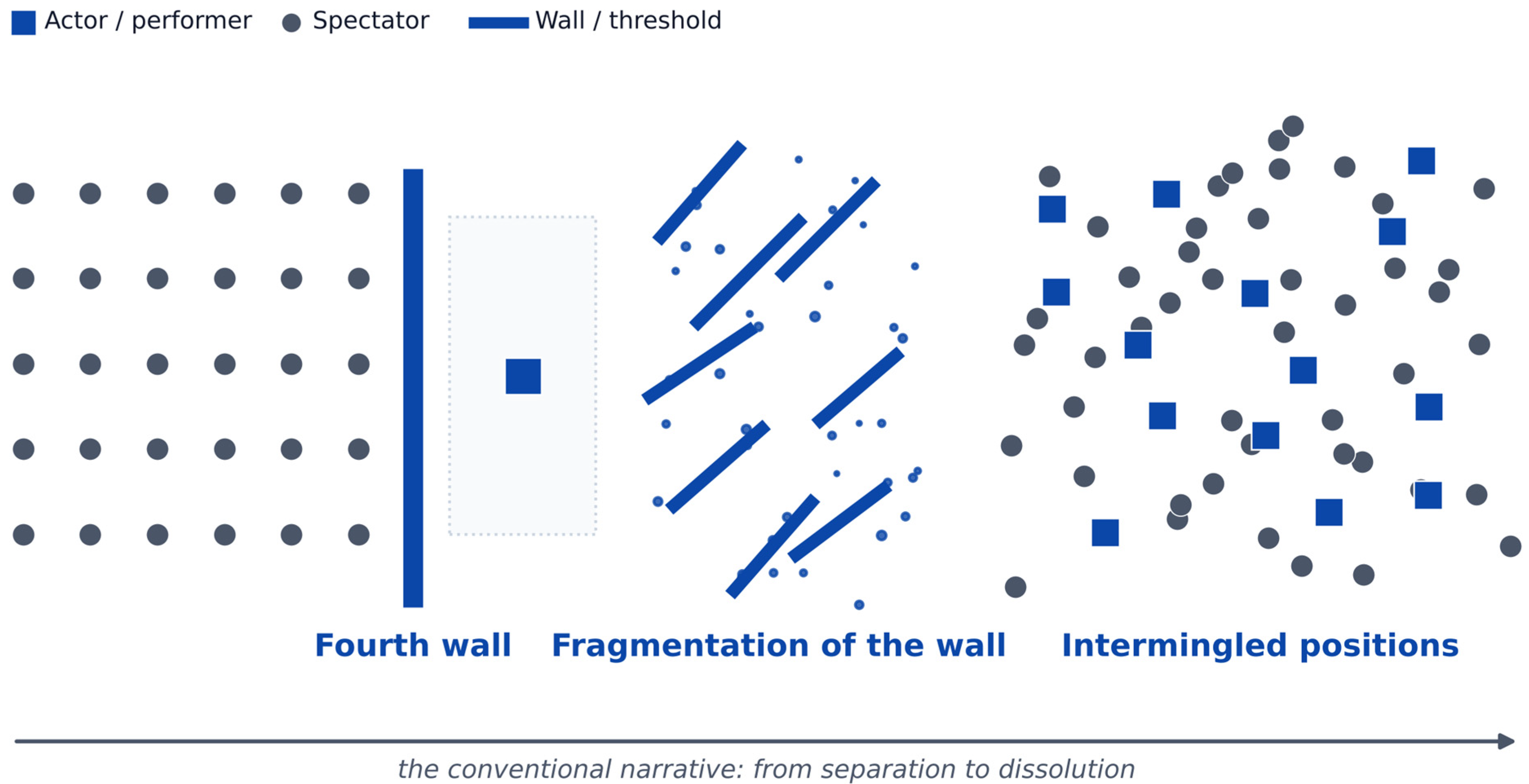
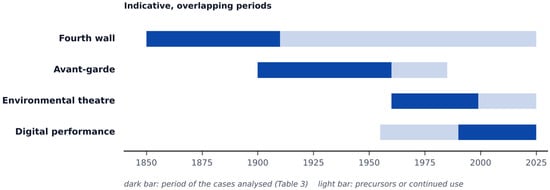
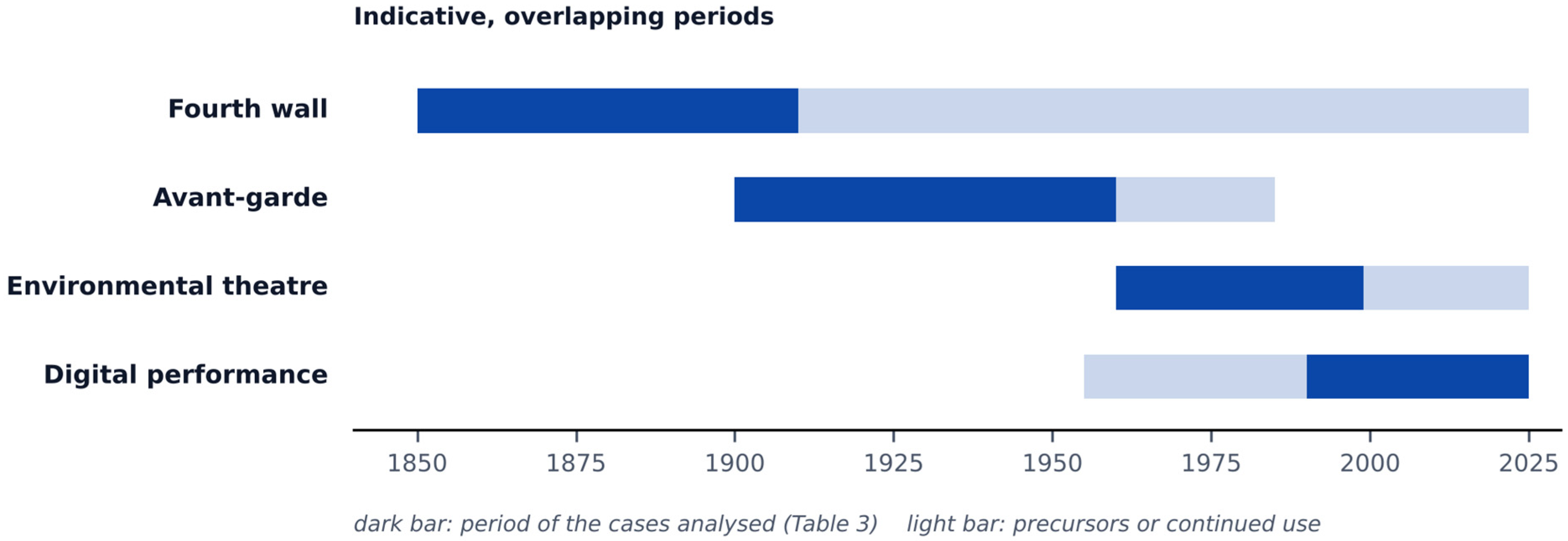
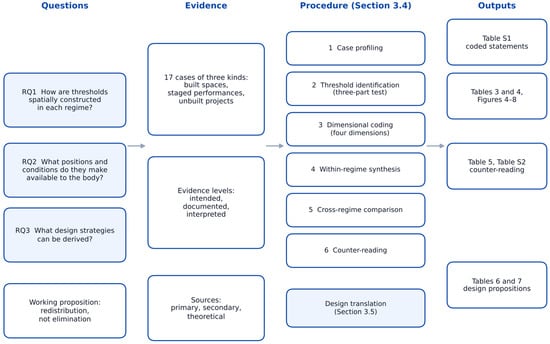
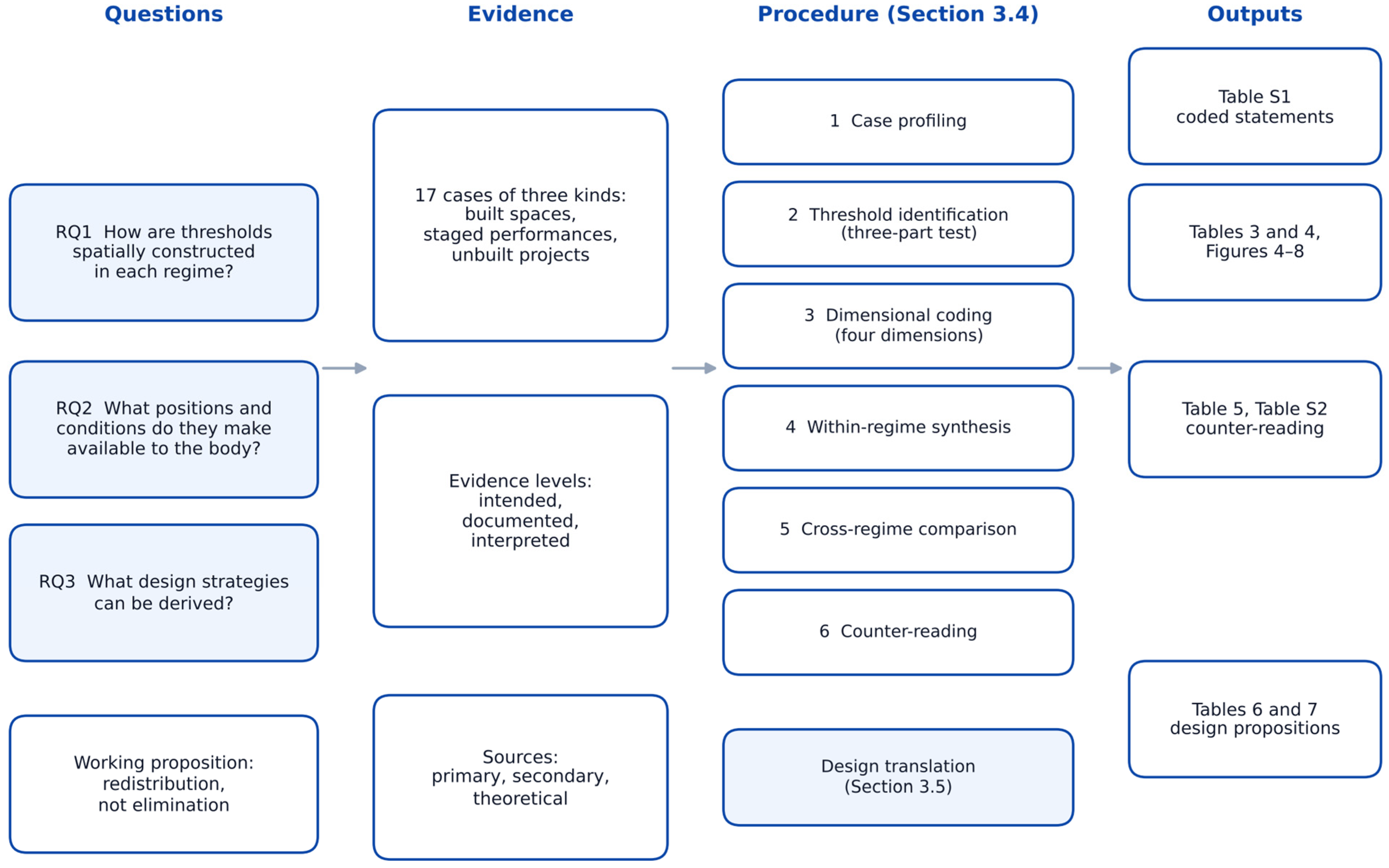

Disclaimer/Publisher’s Note: The statements, opinions and data contained in all publications are solely those of the individual author(s) and contributor(s) and not of MDPI and/or the editor(s). MDPI and/or the editor(s) disclaim responsibility for any injury to people or property resulting from any ideas, methods, instructions or products referred to in the content. |
© 2026 by the author. Licensee MDPI, Basel, Switzerland. This article is an open access article distributed under the terms and conditions of the Creative Commons Attribution (CC BY) license.