


Abstract
This article compares the location of administrative buildings in Siamese Lanna from 1874 to 1932 with that in the French Protectorates of Annam and Tonkin from 1883 to 1945. It examines Chiang Mai and Nan in Siam, and Huế and Hanoi in the French Protectorates, through location, land transfer, orientation, use, and the institutional tools that enabled spatial change. France maintained an external colonial project throughout the period. It kept a parallel administrative center in Huế, where the Nguyễn court remained useful to the protectorate, and in Hanoi moved from a riverside concession to the occupation and partial demolition of the citadel. Siam followed a different sequence. Under King Chulalongkorn, the Siamese commissioner governed Lanna from a riverside compound outside Chiang Mai’s inner walls, while part of the former royal compound of Wiang Kaew acquired a penal use. Under Kings Vajiravudh and Prajadhipok, the objective of national integration replaced this short-lived external colonial approach. The government hall completed in central Chiang Mai in 1924 and the reuse of the Nan ruler’s hall in 1932 occupied former centers more directly. The comparison shows that spatial strategy followed the political aim of rule rather than the ruler’s nationality. Architecture generally consolidated institutional changes already achieved through law, finance, administration, and coercion.
1. Introduction
In 1932, Emperor Bảo Đại crossed the Perfume River from the Imperial City of Huế to visit the French Resident Superior of Annam. Eight years earlier, Siam had completed a government hall near the center of Chiang Mai on land associated with the former Lanna court. These arrangements reverse a familiar expectation: a foreign empire retained a royal court, while a state that increasingly claimed a shared national identity occupied a former royal center.
Architectural style alone cannot explain this difference. Research on Vietnam has examined colonial planning, French architecture, and hybrid design [1,2,3,4]. Studies of Lanna have addressed territorial mapping, administrative centralization, documentary practices, and the changing meaning of official architecture [5,6,7,8]. The two literature bases are rarely compared through the position of new administrative buildings in relation to palaces, citadels, walls, rivers, and ceremonial centers. Similar European forms could serve different political purposes when one occupied a former court site and another stood across a river from a palace that remained active.
Anthropologists and historians of colonialism have also shown that colonial rule worked through the reorganization of ordinary life: town plans, mission grounds, and even the arrangement of houses became sites where new habits of order were introduced [9]. Administrative buildings belong to this everyday dimension. They determined where taxes were paid, cases were heard, prisoners were held, and officials met the public. Their location therefore shaped how authority was encountered in daily life as well as how it was represented.
The article asks how new administrative buildings were placed in relation to earlier centers of power, which legal and administrative tools enabled these changes, and why France preserved the emperor in Huế while Siam moved from supervision to the replacement of Lanna’s centers of local power. The comparison covers 1874 to 24 June 1932 in Lanna and 1883 to 9 March 1945 in Annam and Tonkin.
The argument is that spatial strategy followed the aim of rule. France pursued external colonial control throughout the period and retained existing local institutions when they reduced the cost of governing. Siam initially applied a similar external colonial approach in Lanna, though only briefly under King Chulalongkorn; national integration under Kings Vajiravudh and Prajadhipok turned the same administrative tools toward internal colonialism. The change is visible in Chiang Mai’s movement from a riverside administrative compound to a government hall inside the walled city. Architecture did not initiate this transition. Rather, it gave durable and visible form to changes that had already been made in law, revenue, the official hierarchy, and coercive power.
2. Conceptual Framework
2.1. External and Internal Colonialism
External colonialism is used here for control exercised by an imperial center outside the governed society through military force, treaties, and unilateral law. French rule divided Vietnam into the colony of Cochinchina and the protectorates of Annam and Tonkin. Internal colonialism refers to control by a state center over a peripheral region that is being incorporated into the same country. Authority over law, appointments, revenue, resources, and culture moves toward the center, usually through the language of national integration or development [10,11].
The distinction makes centralization in Lanna visible as a transfer of power and resources rather than a natural stage of nation building. Mapping and civilizational discourse turned overlapping political spaces into state territory [5,12]. Siam faced Western imperial pressure while adopting several imperial techniques in its tributary regions [13,14]. Studies that describe Siam as semi-colonial or crypto-colonial likewise note the coexistence of formal independence and Western institutional standards [15,16]. The terms used here are analytical. They do not imply that Lanna and Vietnam had the same legal status or historical experience.
2.2. Space and Former Centers of Power
Space both reflects and reproduces social relations [17]. Government buildings form an image of the state [18], while colonial rule organizes people and territory through boundaries, classifications, and ordered space [19]. A former center of power therefore means more than a valuable parcel. It combines residence, administration, ritual, and public recognition. Its occupation, separation, demolition, or reassignment changes the visible location of authority.
Location does not always prove intention. An office that faces a palace may have a measurable geometric relation to it, but this does not demonstrate a plan of surveillance. Such a claim requires design records or administrative correspondence. The analysis therefore distinguishes observable spatial relations from claims about motive.
To move beyond the position of a single building, each case is also read through four ordinary spatial relations that structured daily encounters with authority. Access refers to the routes, gates, and landing places by which officials, petitioners, and goods reached the office. Frontage refers to what the building faced and what it turned away from. Threshold refers to the walls, rivers, fences, or courtyards that separated the office from the former center. Routine use refers to who worked, waited, was confined, or performed ceremonies there. These relations connect the placement of administrative buildings to the wider reorganization of everyday life described in studies of colonialism [9,19]. They remain qualitative because measured plans and use records are incomplete.
2.3. Three Spatial Strategies
The comparison uses three analytical strategies (Table 1). A site may move from one strategy to another as institutions change.
Table 1.
Spatial strategies and the evidence needed to identify them.
2.4. Administrative Tools and Political Goals
Spatial change formed only one part of governance. The comparison also considers territorial law, official hierarchy, revenue and labor, maps and records, transport, the treatment of former rulers, and coercive force. These tools changed the political status of earlier rulers and institutions. Their effects then appeared in the location, ownership, orientation, and use of administrative buildings.
The central hypothesis is chronological. Under King Chulalongkorn, Siam briefly governed Lanna as a tributary territory inhabited by people still described as Lao. Under King Vajiravudh, royal nationalism, compulsory education, administration, and transport redefined Lanna as part of a single Thai nation. France did not make an equivalent transition in Annam and Tonkin. If political goals shaped urban strategy, the Siamese pattern should change over time while the French pattern should remain comparatively stable.
3. Materials and Methods
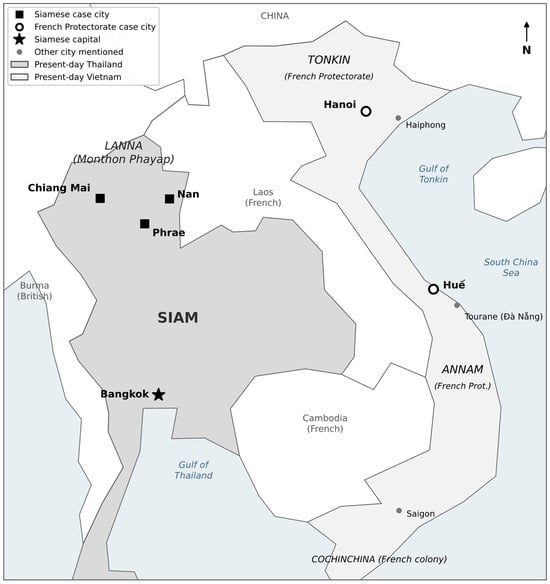
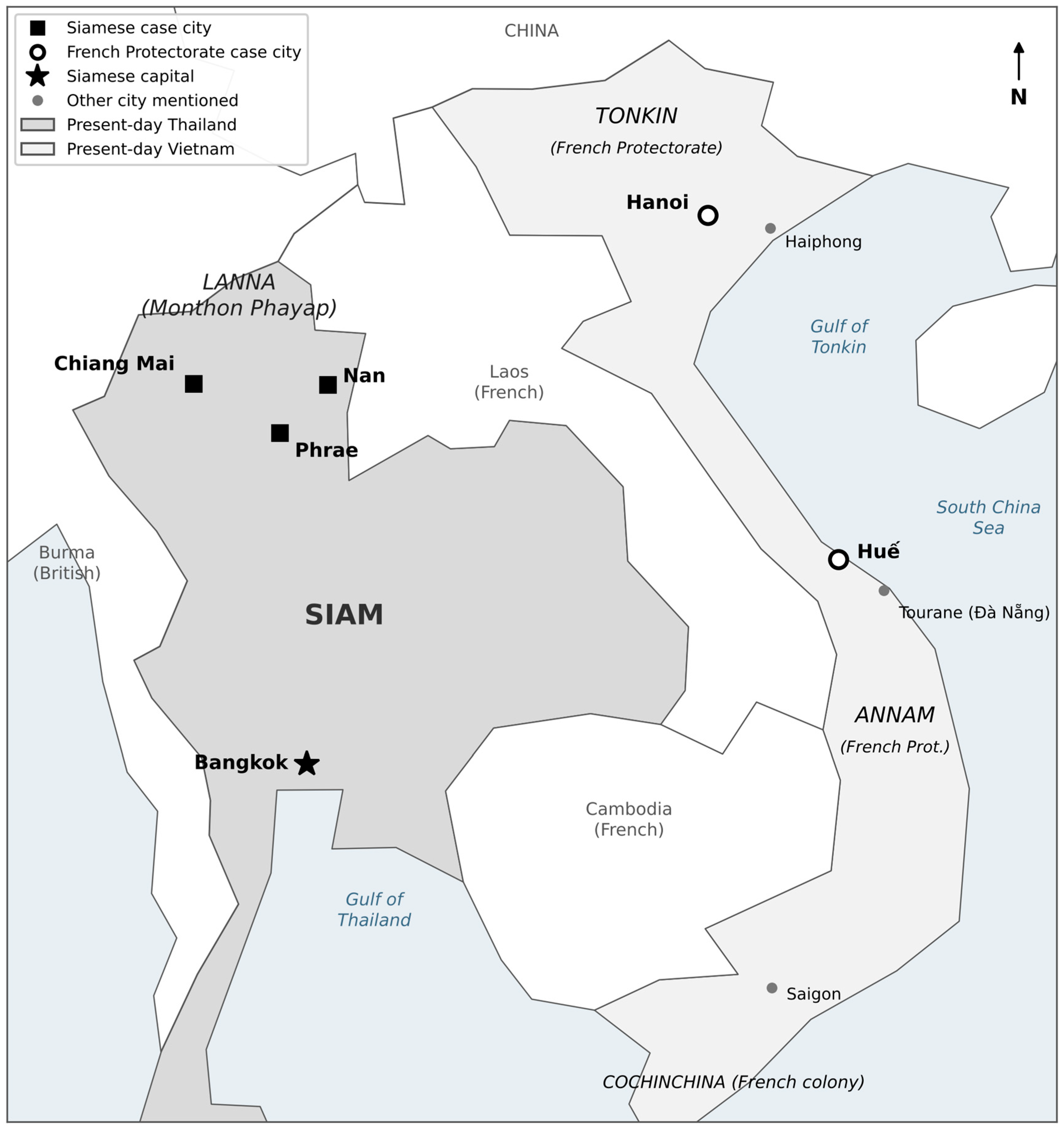
The study uses comparative historical case analysis [20,21]. Chiang Mai (Siam) and Huế (French Protectorate of Annam) are the principal cases because local rulers and royal sites remained present while a new regime expanded. Nan (Siam) and Hanoi (French Protectorate of Tonkin) provide contrasts: Nan shows direct reuse of a royal building, while Hanoi shows a move from a riverside concession to the occupation and partial demolition of a fortified center where the emperor did not reside. Wiang Kaew is a secondary case within Chiang Mai. Phrae (Siam) is retained only as contextual evidence because the available material does not establish the sequence of reuse after the 1902 conflict. Figure 1 shows the location of the cities and of Lanna and the French Protectorates of Annam and Tonkin.
Figure 1.
Location of the case cities. Chiang Mai, Nan, and Phrae lay in Lanna (Monthon Phayap) under Siam; Huế and Hanoi lay in the French Protectorates of Annam and Tonkin. Blue areas indicate seas and gulfs. Source: Author’s drawing; present-day national boundaries from Natural Earth (public domain) are shown for orientation only and do not represent boundaries of the study period.
Evidence includes published histories, architectural and urban planning studies, historical maps and photographs, field observations reported by the author, and information from heritage institutions. Studies of provincial administration and state knowledge provide the principal institutional evidence for Siam [6,7,14,22,23]. Research on colonial cities, architecture, and monarchy provides the main evidence for Vietnam [1,2,3,4,24,25,26].
Each case was read in four steps. First, the locations of the former center and of the new administrative center were identified on the best available historical plan. Second, ownership and use were reconstructed from published evidence. Third, the plan was examined for rivers, walls, roads, gates, and other barriers or connections, and for the access, frontage, threshold, and routine use defined in Section 2.2. Fourth, the spatial relation was compared with changes in law, finance, administration, and force. Because survey data and archival identifiers remain incomplete, the article does not report precise distances, axis angles, or quantitative scores.
Generative artificial intelligence was used in preparing this manuscript. The author used Claude Opus 5.5 (Anthropic, San Francisco, CA, USA) to translate the author’s Thai drafts into English, to search for and summarize published secondary sources, to draft and revise passages based on the author’s argument and sources, and to format the manuscript. The research questions, case selection, field knowledge, interpretation, and conclusions are the author’s. All AI-assisted text and every cited source were checked by the author.
4. Institutional Context
4.1. Siam Under King Chulalongkorn
Siamese control of Lanna developed in stages. The Chiang Mai Treaty of 1874 made Bangkok responsible for disputes and teak concessions involving British subjects, and Siam placed a special commissioner in Chiang Mai. Prince Phichit Prichakorn introduced six administrative departments and fiscal reform in 1884. After the Franco-Siamese crisis of 1893, Siam formed Monthon Lao Chiang. A monthon was a regional administrative unit that grouped several provinces under a high commissioner appointed by Bangkok. The thesaphiban system was the Ministry of the Interior’s hierarchy of monthon, province, district, and subdistrict officials, through which salaried officials replaced the authority of local rulers. In 1899 the unit was renamed the North-Western Monthon, and it soon became known as Monthon Phayap, a term with the same meaning. Decision making moved toward the commissioner and the Ministry of the Interior [6,22].
Revenue was central. The Royal Forest Department, established in 1896, brought teak concessions under central control; taxes replaced labor obligations; and allowances made former rulers financially dependent on Bangkok. Kinship, titles, and ceremony presented the transfer as loyalty within one kingdom. When negotiation failed, the state used force, including the suppression of the Phaya Phap rebellion in 1889 and resistance in Phrae in 1902 [6,14,22].
This phase resembled external colonial rule. Siamese elites had studied British and Dutch colonial administration and worked with Western advisers [13,16]. Commissioners supervised rulers who remained in office, extracted resources, and asserted effective sovereignty before Western powers. Lanna’s population was still described as Lao, as the name Monthon Lao Chiang indicates [12]. The removal of “Lao” from the unit’s name in 1899 nevertheless signaled that this approach was beginning to change.
4.2. Siam Under Kings Vajiravudh and Prajadhipok
Royal nationalism under King Vajiravudh defined nation, religion, and monarchy as a shared framework for subjects across the kingdom [27]. Lanna was increasingly governed as part of the nation rather than as a tributary territory. Compulsory education, print, standardized administration, and the northern railway strengthened its connection to Bangkok. Under King Prajadhipok, the policy of not appointing a successor when a local ruler’s position became vacant allowed the offices to end gradually [12,13,23].
The unequal relation did not disappear. Bangkok continued to control law, personnel, and revenue. What changed was the political language and spatial expectation. A state that claimed Lanna as part of one nation had a stronger reason to occupy the urban center rather than govern from a separate riverside compound.
4.3. France in Annam and Tonkin
French control began with military pressure. The Treaty of Huế in 1883 and the Patenôtre Treaty in 1884 made Annam and Tonkin French Protectorates nominally ruled by the Nguyễn dynasty. France controlled foreign affairs, military power, and provincial representatives, while the emperor remained the formal head of internal government [24,25]. After the Nguyễn court attacked the French position in Huế, the capital of the Nguyễn dynasty, in July 1885, French forces occupied the palace, Emperor Hàm Nghi left the city, and France installed Emperor Đồng Khánh. Hanoi, Haiphong, and Tourane became French concessions in 1888. France later removed Thành Thái in 1907 and exiled Duy Tân in 1916; both are remembered in Vietnam as patriotic emperors.
Administrative reforms in 1897–1898 placed the Resident Superior at the center of government and brought revenue under French control. The office of Kinh lược, or Viceroy, of Tonkin, created in 1886 to represent the emperor in the north, was abolished in 1897, and its powers passed to the Resident Superior of Tonkin. An agreement of 6 November 1925 transferred most administrative power to the Resident Superior of Annam while leaving the emperor mainly ceremonial authority [24,26]. The throne remained useful because it linked the protectorate to officials, ritual, and public loyalty. France controlled the institution by removing resistant rulers, selecting successors, and educating Bảo Đại, the thirteenth and final emperor of the Nguyễn dynasty, for a dependent colonial monarchy [25,26].
The political objective remained external colonial control. French policy shifted from assimilation toward association, but it did not seek to incorporate Vietnamese subjects into the French nation [24,28]. Vietnam remained divided among three legal regimes within French Indochina, and the colonial budget relied on monopolies, taxes, and exports. Later reforms increased control without changing the project’s basic aim. Table 2 compares the administrative tools used by both regimes and their spatial implications.
Table 2.
Shared administrative tools and their different political effects.
5. Location of Administrative Buildings in Lanna and the French Protectorates
Section 5.1, Section 5.2, Section 5.3 and Section 5.4 examine Lanna under Siam in chronological order, and Section 5.5 and Section 5.6 examine the French Protectorates of Annam and Tonkin. Each heading names the city, its political setting, and the spatial strategy from Table 1 that best describes it.
5.1. Chiang Mai, Lanna (Siam): The Riverside Office as a Parallel Center
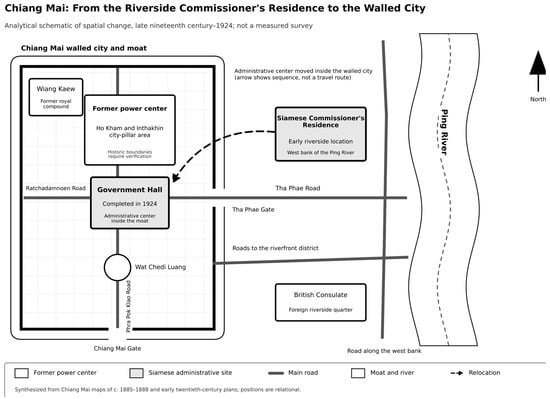
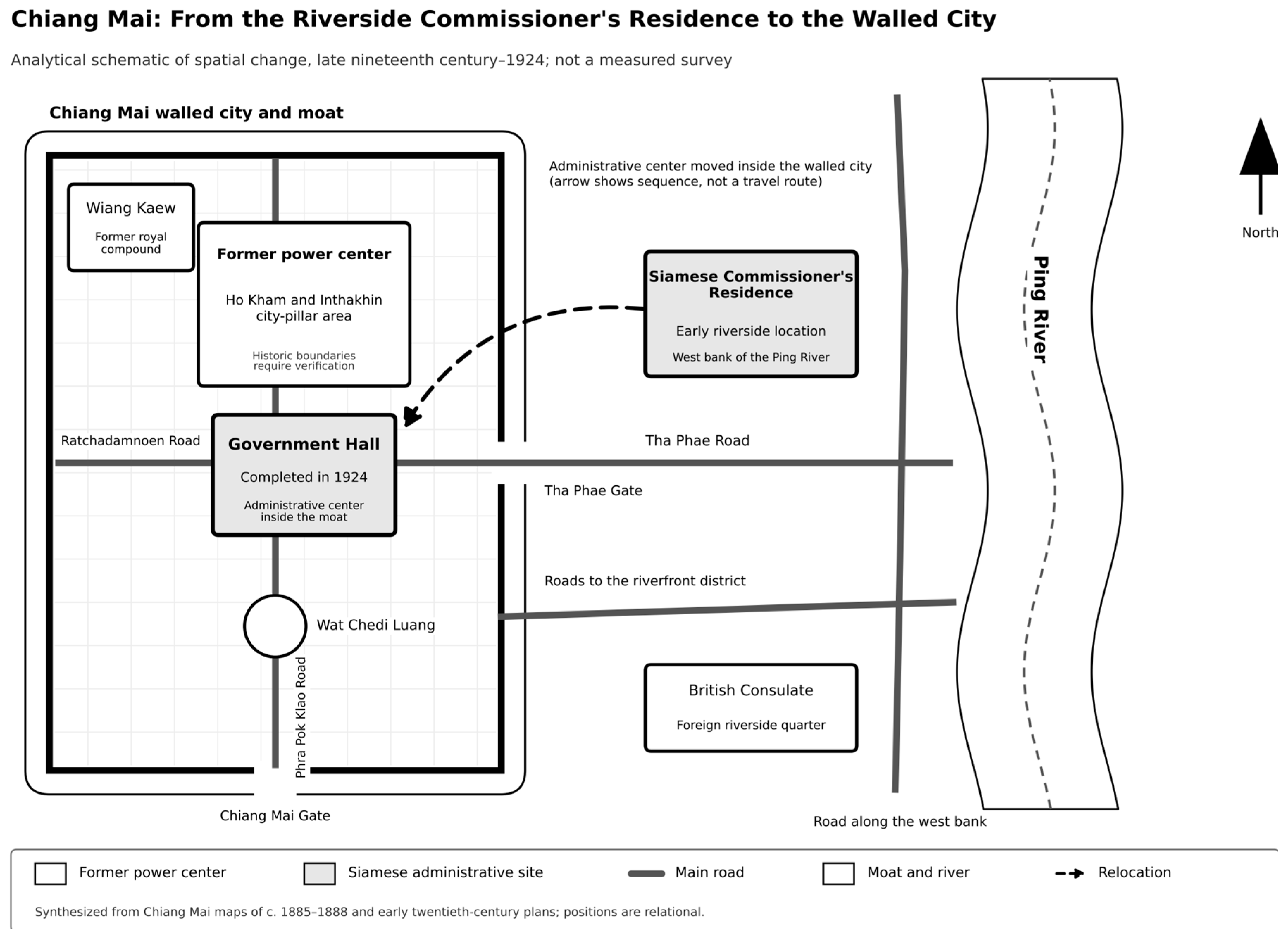
Under King Chulalongkorn, Siamese representatives did not initially occupy Chiang Mai’s inner center. The Monthon Phayap administrative compound stood beside the Ping River, outside the inner walls that enclosed the ruler’s hall, elite residences, and major temples [29]. The location was close to the main route to Bangkok and to the riverside commercial district. It functioned as a parallel center: the Siamese commissioner supervised Lanna’s ruler from a separate office while the ruler continued to reside and perform ceremonies within the walled city.
The arrangement matched the political system. The commissioner drew forestry revenue and taxes toward Bangkok but still relied on the ruler for local legitimacy. Siam therefore gained little by immediately occupying the symbolic center. Evidence for the precise location of successive riverside offices remains incomplete, so Figure 2 shows relative relations among the walls, river, roads, and identified sites rather than measured distances.
Figure 2.
Chiang Mai showing the early Siamese commissioner’s riverside location and the later movement of the administrative center into the walled city. Source: Author’s analytical drawing based on Chiang Mai maps of c. 1885–1888 and early twentieth-century plans; not to scale. The dashed arrow indicates the sequence in which the administrative center moved, not a travel route; the dashed line marks the course of the Ping River.
The riverside location also organized ordinary movement. Before the northern railway reached Chiang Mai in 1921, officials, mail, and goods from Bangkok arrived mainly by boat on the Ping River, so the commissioner’s office stood at the point of arrival rather than at the city’s ceremonial center. The zone between the eastern walls and the river was also where foreign teak firms, the American Presbyterian mission, and the British consulate, opened in 1884, were located [6]. The commissioner’s daily work on treaty disputes involving British subjects, forestry concessions, and revenue was therefore carried out among the actors for whom the 1874 treaty had made Siam responsible. The ruler’s court, the principal temples, and the city pillar remained inside the walls. The threshold between the two centers was the eastern side of the walled city, which officials had to cross to attend the ruler’s ceremonies.
5.2. Wiang Kaew, Chiang Mai (Siam): Reassignment as a Prison
Wiang Kaew followed a different strategy in the same reign. It had ceased to be the ruler’s principal residence by about 1870, and a later ruler built a new compound [29,30]. When Siam reorganized provincial prisons, the southern part of Wiang Kaew became the Monthon Phayap prison after 1903 [29]. The name and some physical traces survived, but a royal site acquired an association with confinement and punishment. This reassignment prevented the compound from operating as an alternative center of authority.
The riverside office and the prison served complementary functions: one supervised the ruler from outside the center, while the other lowered the status of a royal site that no longer housed the ruler. The dates, boundaries, and decision process at Wiang Kaew still rely mainly on secondary evidence. The case therefore supports the argument but does not prove it independently.
In terms of routine use, the reassignment changed who entered the site. Prisoners, guards, and penal officials replaced the ruler’s household and retainers, and the compound’s walls now served to confine rather than to protect a court. The penal use continued long after the study period, which shows how a reassignment could outlast the political conditions that produced it [29].
5.3. Chiang Mai, Lanna (Siam): Replacement by the Government Hall
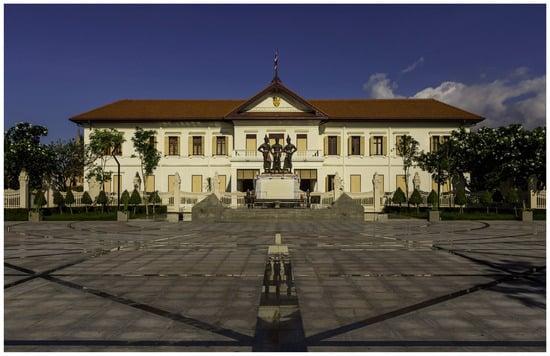
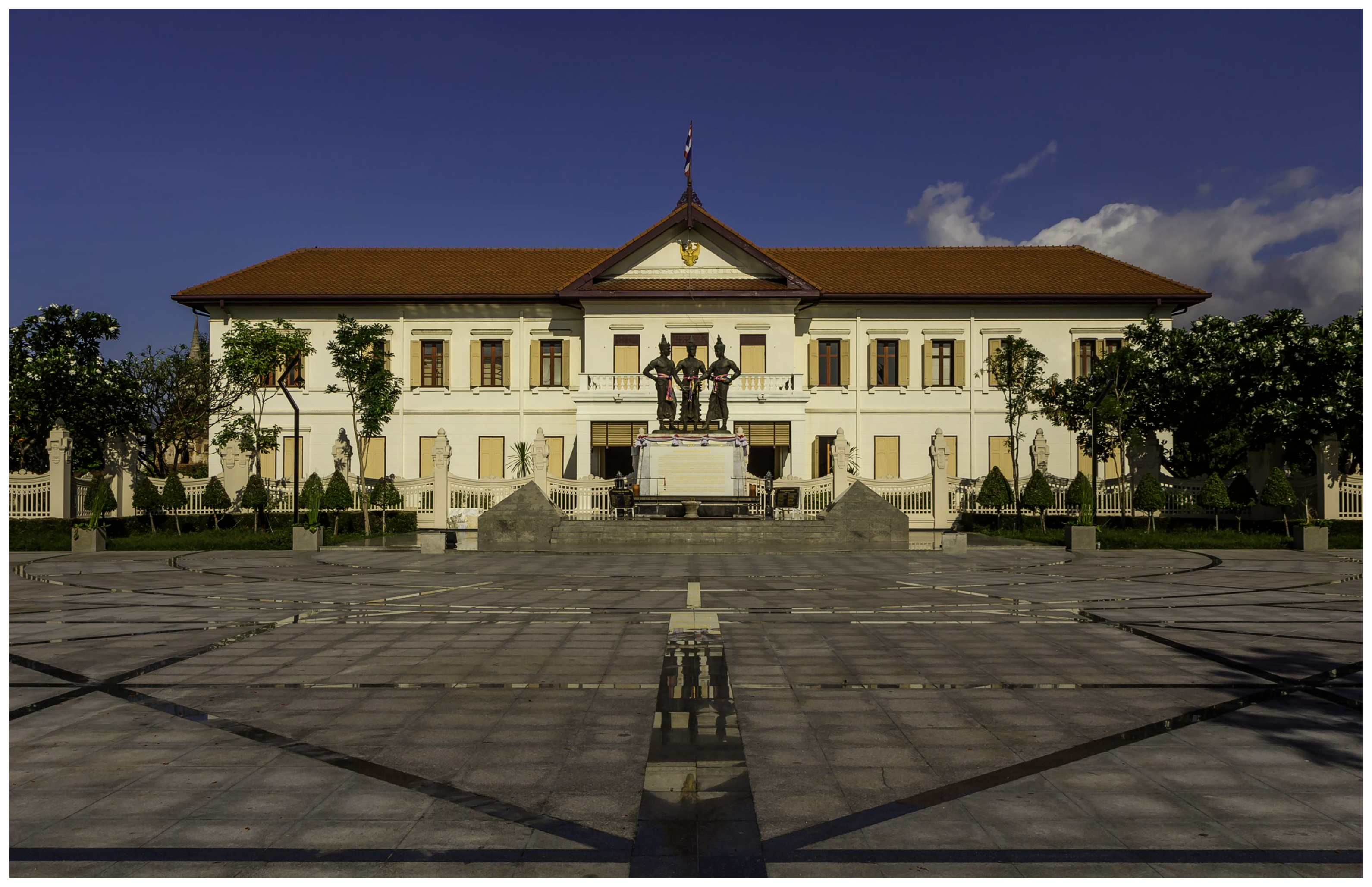
The move into the walled city began after the riverside office flooded in September 1905. The administration temporarily shared premises with the office of the Khao Sanam Luang, the council of senior Lanna nobles that had handled administration and justice for the ruler, and later received land across from it for the construction of a permanent government hall [29]. Practical necessity initiated the move, but the completed building acquired a wider political meaning. Finished in 1924 under King Vajiravudh, it stood in a central area associated with the ruler’s hall and with the earlier location of the Inthakhin pillar, the guardian city pillar that marked the ritual center of Chiang Mai before it was moved to Wat Chedi Luang [8,31]. The building is referred to here as the Government Hall: it was built as the Monthon Phayap Government Hall, became Chiang Mai Provincial Hall after the monthon system was abolished in 1933, and now houses the Chiang Mai City Arts and Cultural Centre (Figure 3).
Figure 3.
Monthon Phayap Government Hall, completed in 1924; later Chiang Mai Provincial Hall and now the Chiang Mai City Arts and Cultural Centre. Source: Stefan Fussan, Wikimedia Commons, “Chiang Mai City Art and Cultural Center 0001.jpg,” CC BY-SA 3.0; photograph taken in 2014.
By then, courts, taxation, forestry, police, post, and roads had already transferred administrative work from the ruler to the state. The building did not create central power; it placed an established hierarchy at the symbolic center. Accounts describe more than one transfer involving Lanna elites, including land associated with Princess Dara Rasmi and Chao Inthawarorot Suriyawong [29,30,31]. The language of donation records a legal form but not the full political setting. The thesaphiban system had already reduced local revenue, administrative authority, and control over succession.
The building combined Western forms with selected local elements and followed models adapted by Siam rather than copied directly from Europe [8,32]. It represented a modern state and a standardized national administration. Unlike the earlier riverside compound, it had no river, wall, or long distance separating it from the former center. The change from parallel administration to direct occupation corresponds to the transition from external supervision to internal colonial integration.
The change can also be read through access and routine use. Petitioners, taxpayers, and local officials who had dealt with the commissioner at the river now came to an office inside the walls, close to the temples and the former ruler’s residence that structured the city’s ritual life. State ceremonies could now be staged at the center of the old city rather than at its riverside edge. The building thus joined the ordinary routine of provincial administration to the symbolic geography of the former Lanna capital.
5.4. Nan, Lanna (Siam): Replacement by Direct Reuse
Nan presents the clearest replacement because the state reused the royal building itself. The ruler’s hall was completed in 1903 under Chao Suriyaphong Pharitdet and later passed to Chao Mahaphrom Surathada, the last ruler of Nan. After his death, the heirs transferred the building and land for use as the provincial hall in 1932 [33]. The bureaucracy entered the residence and administrative center of the former ruler without changing its position near Wat Phumin and Wat Phra That Chang Kham.
Ownership, users, access, and command changed while the building remained. Material continuity therefore concealed a political break. The available source identifies 1932 as the year of transfer but does not establish whether it occurred before or after 24 June. The case belongs at the end of the study period until a dated deed or official record is found.
The reuse also changed the building’s everyday thresholds. The ruler’s hall had received relatives, retainers, and petitioners according to court rank; as provincial hall, it received the public as clients of a bureaucracy staffed by officials appointed from Bangkok. Its frontage toward Wat Phumin, which had placed the ruler beside one of the city’s principal royal temples, now placed the provincial administration there instead.
5.5. Huế, French Protectorate of Annam: A Controlled Parallel Center
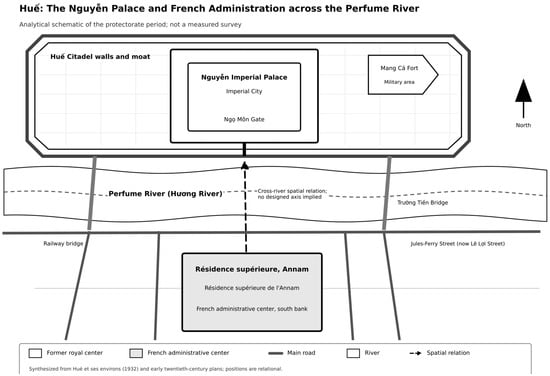
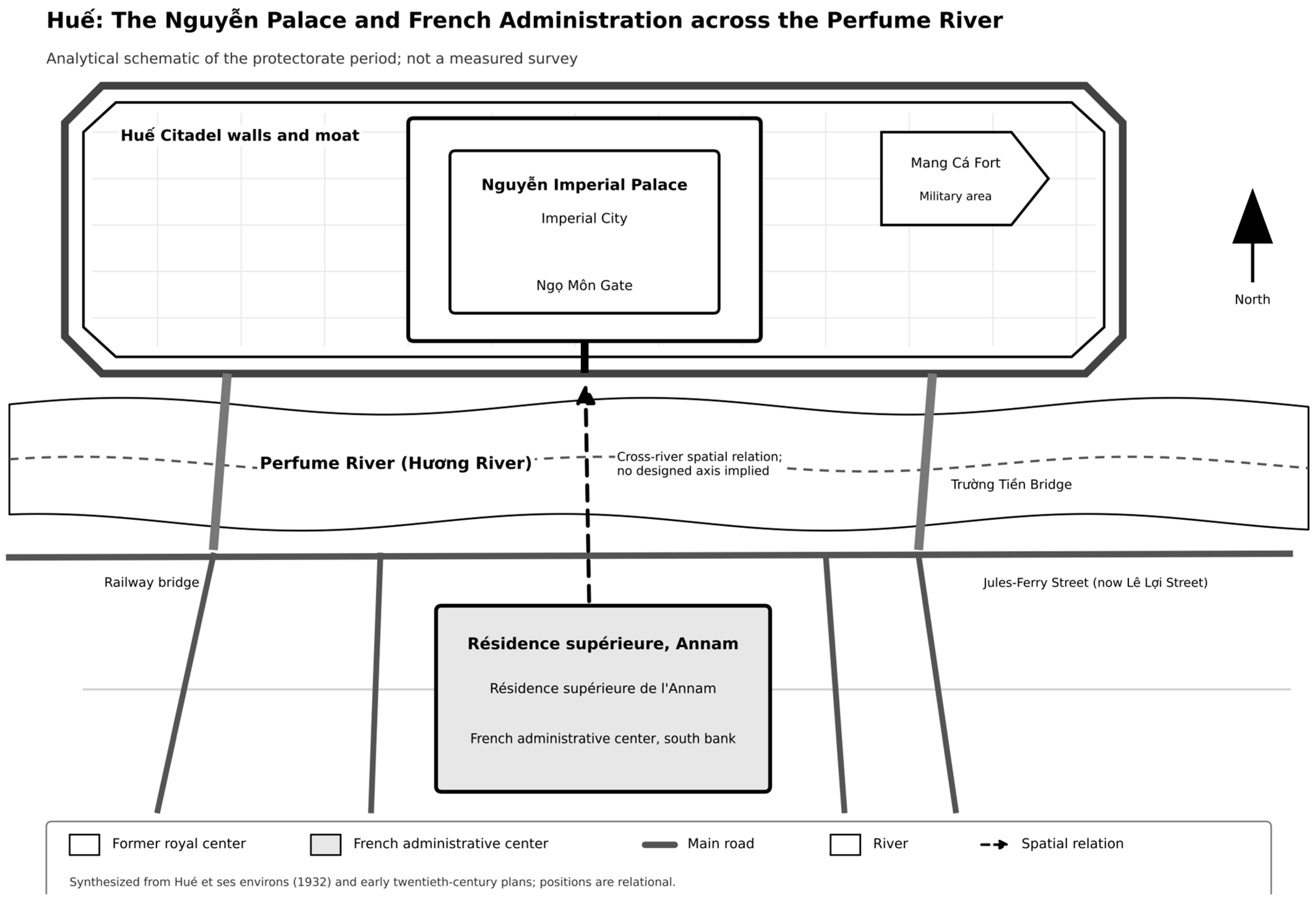
Huế differed because the Nguyễn court remained useful to the protectorate. The emperor continued to reside in the Imperial City after administrative decisions moved to the Resident Superior. The French residence and offices occupied the south bank of the Perfume River, while the citadel and palace stood to the north. The southern bank developed as a French administrative and residential quarter [34].
The south bank was organized as a separate French quarter rather than as an extension of the citadel. Along the riverfront road, then called Jules Ferry Street and now Lê Lợi Street, stood the offices of the Résidence supérieure, the Resident Superior’s residence, and, from 1896, the Quốc Học school, while European houses, hotels, and commercial buildings occupied the blocks behind them [34]. The steel Thành Thái Bridge, now the Trường Tiền Bridge, opened in 1899–1900 and gave the French quarter a fixed connection to the citadel’s eastern districts. The ordinary route between the two centers therefore crossed the river at a point anchored on the French bank. Inside the citadel, a French garrison at the Mang Cá fort in the northeastern corner provided a military foothold, but the palace itself remained the emperor’s residence (Figure 4) [24,34].
Figure 4.
Huế showing the Nguyễn palace north of the Perfume River and the French administrative center on the south bank. Source: Author’s analytical drawing based on Hué et ses environs (1932) and early twentieth-century plans; not to scale. The dashed arrow indicates the cross-river spatial relation between the two centers and does not imply a designed axis; the dashed line marks the course of the Perfume River.
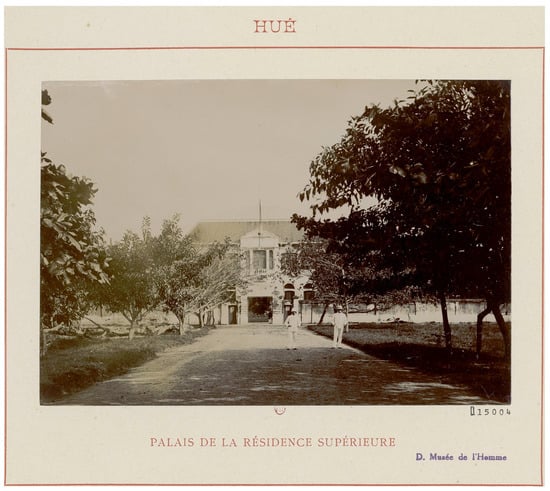
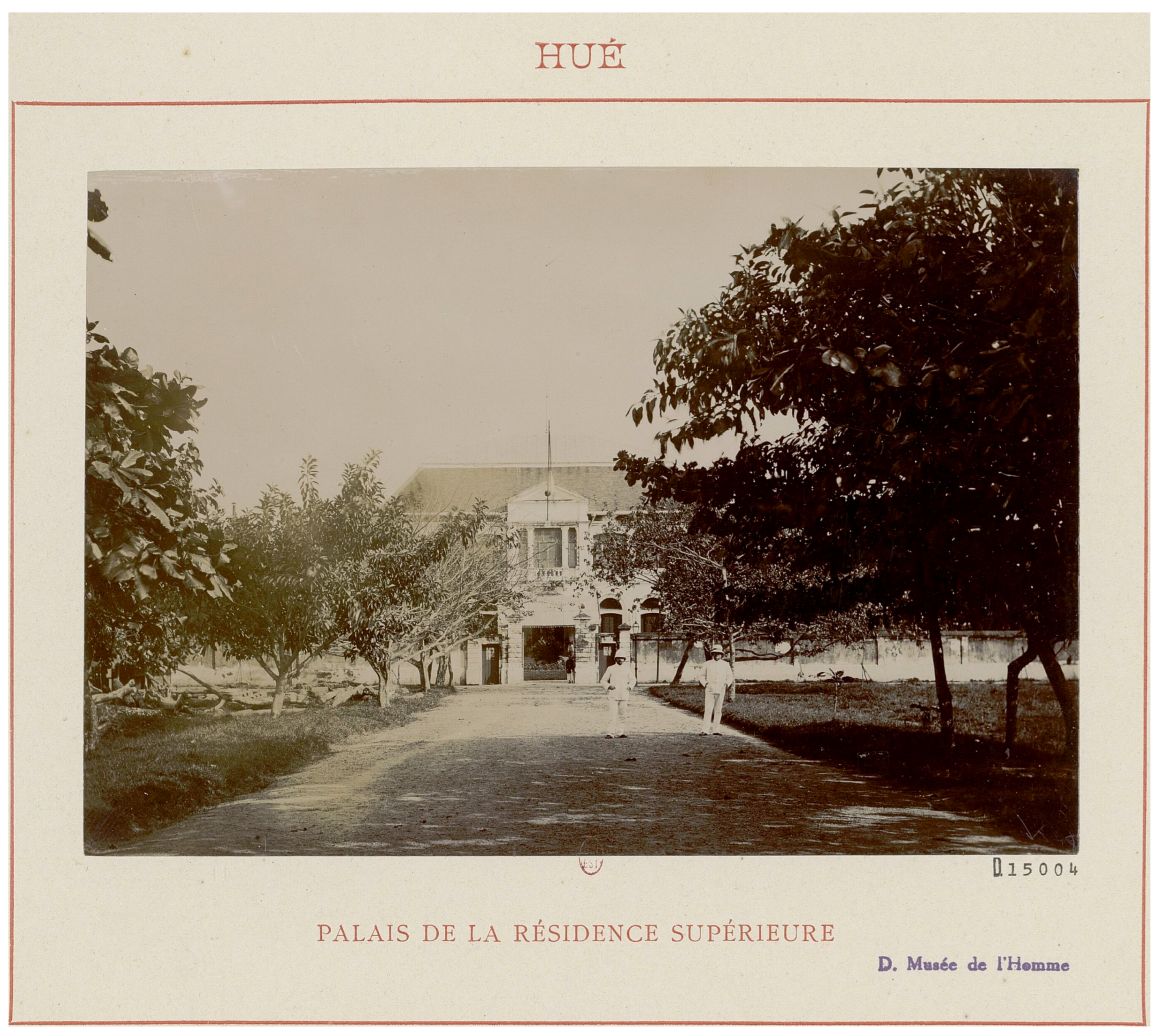
The term parallel center does not imply equal power. It describes the continued institutional and visual presence of two centers. France retained the palace because the emperor provided legitimacy and access to court officials. The Résidence supérieure gave French supervision a permanent place outside the walls (Figure 5). The river preserved a formal separation while connecting the two banks through bridges, roads, and ceremony.
Figure 5.
Palace of the Résidence supérieure (seat of the French Resident Superior) in Annam at Huế, c. 1891–1898. Source: Musée de l’Homme collection, Wikimedia Commons, “HUÉ PALAIS DE LA RÉSIDENCE SUPÉRIEURE,” public domain.
Bảo Đại’s 1932 visit records this ceremonial relation, but a single recorded occasion cannot establish a repeated protocol. Likewise, the orientation and layout of the residence confirm a spatial relation to the palace area, but they do not by themselves prove an intention to monitor the court. The supported conclusion is narrower: the French center was placed across the river from an institution still required by the protectorate.
5.6. Hanoi, French Protectorate of Tonkin: From Riverside Concession to Erasure
Hanoi, the capital of the French Protectorate of Tonkin and, from 1902, of French Indochina, differed from Huế because the emperor did not reside there. Its citadel had been rebuilt by Emperor Gia Long from 1805 on the site of the earlier Thăng Long citadel, at a reduced size and with bastioned walls inspired by the fortifications of the French engineer Vauban. Under the Nguyễn dynasty it served as the seat of the governor of the north and as a military stronghold rather than as a royal residence [2,35].
French presence in Hanoi began as a parallel center. After the Treaty of Saigon of 1874, France obtained a small concession on the bank of the Red River, southeast of the citadel and the commercial quarter, where a consulate was built in 1875 [2]. Like the Siamese commissioner’s compound in Chiang Mai, this riverside enclave was separated from the former center and linked to river traffic. French troops had already captured the citadel briefly in 1873; they took it again in 1882 and after 1883 used it as their main garrison, combining existing buildings with new barracks [2,35].
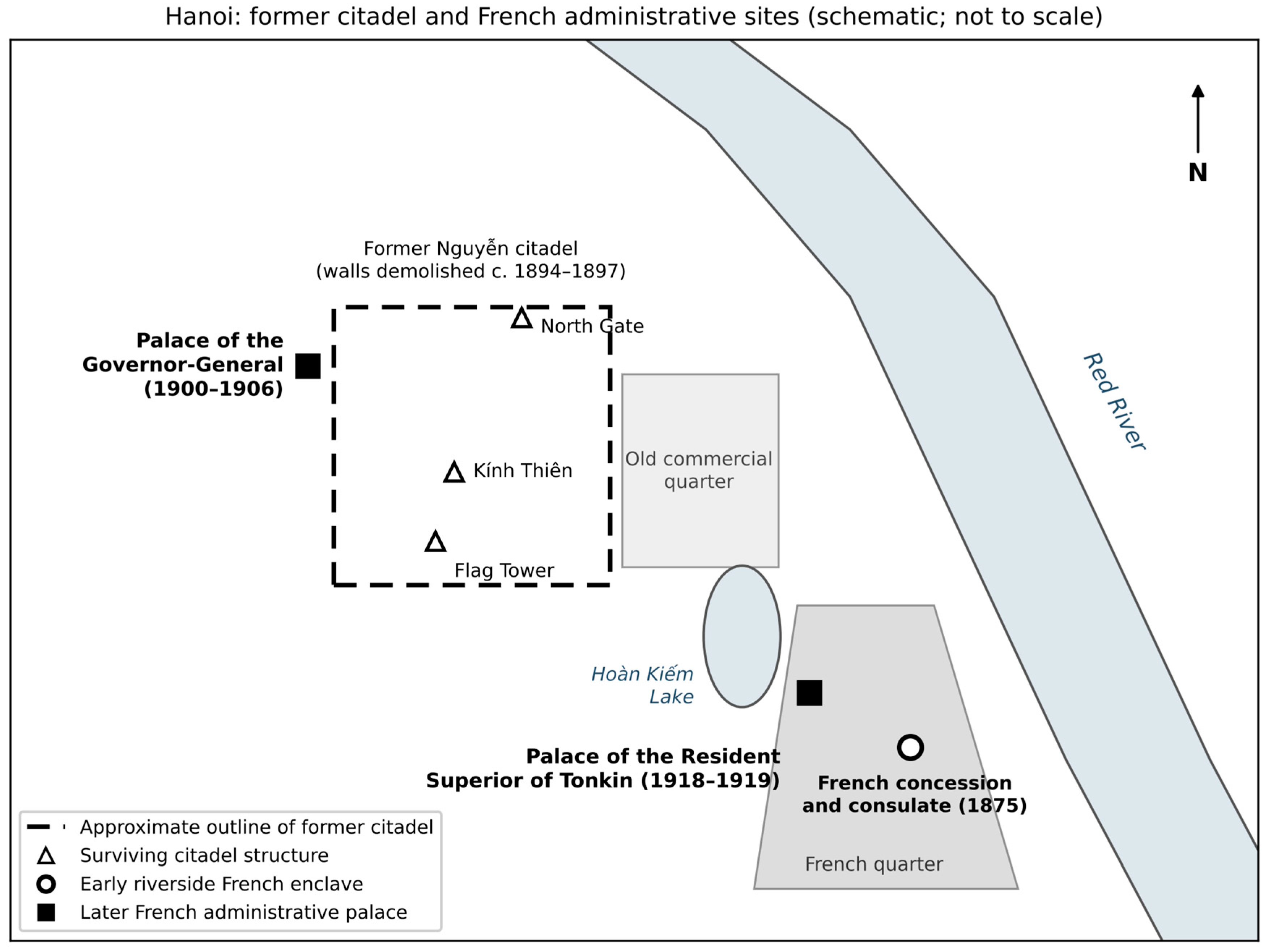
The relation changed after Hanoi was ceded to France as a concession in 1888. The citadel walls were demolished between about 1894 and 1897. The available secondary sources attribute the initiative to the French municipal authorities, who sought land for urban development and new streets, with the approval of the colonial government, while the army retained part of the enclosure as a military zone [2,35]. Only a few structures survived, including the North Gate, the Flag Tower, and the platform of the Kính Thiên Palace. Demolition answered military, transport, and sanitary concerns, but it also prevented the fortified order from operating as before. Who authorized each stage, and with what stated purpose, still needs to be confirmed in the municipal and Résidence supérieure records.
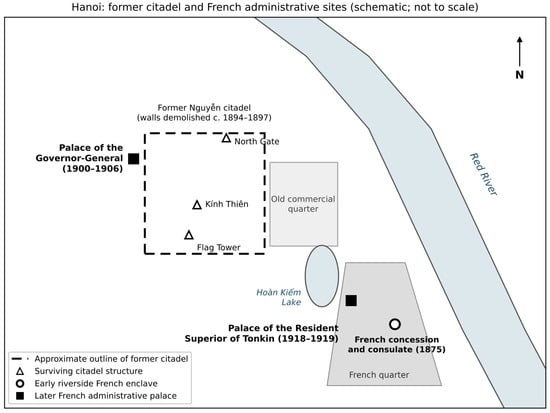
The new French administrative landscape was divided between two locations (Figure 6). The Palace of the Governor-General of Indochina, built in 1900–1906 and now the Presidential Palace, stood northwest of the surviving Flag Tower, on the western side of the former citadel area. The Palace of the Resident Superior of Tonkin, built in 1918–1919 and now the State Guest House at 12 Ngô Quyền Street, stood in the French quarter southeast of Hoàn Kiếm Lake, near the original riverside concession [2,36]. After the office of Kinh lược ended in 1897, no equivalent court institution governed Tonkin from Hanoi. The case therefore moved from a parallel center to erasure and urban rewriting, rather than to replacement by a single building.
Figure 6.
Hanoi showing the former citadel, its surviving structures, the early French riverside concession, and the later palaces of the Governor-General and the Resident Superior of Tonkin. Source: Author’s analytical drawing based on [2,35] and present-day locations; not to scale.
The Hanoi sequence qualifies the claim that French spatial practice was stable. In Hanoi, practice changed from a riverside parallel center to erasure as the city’s legal status changed from a treaty concession to a protectorate city and then to French territory. What remained stable was the aim of external control. At no stage did France seek to incorporate Hanoi’s population into the French nation, and the change in method followed changes in legal status and military security rather than a new national project. In this article, stability therefore refers to the political aim, not to a single spatial form.
5.7. Cross-Case Results
The strategies do not correspond to the nationality of the governing power (Table 3). Siam under King Chulalongkorn used a parallel center and reassignment, resembling French practice in Huế and Hanoi. Under Kings Vajiravudh and Prajadhipok, Siam turned toward replacement. French spatial practice changed in Hanoi as the city’s legal status changed, but its political aim of external control remained unchanged.
Table 3.
Relation between political aims and spatial strategies.
6. Discussion
6.1. Siam Changed Its Political Project While France Did Not
France governed Annam through a protectorate that formally preserved the emperor’s internal authority. Abolishing the throne would have weakened that legal form, increased the cost of direct rule, and risked turning the monarchy into a focus of resistance [25,26]. Because the political project remained unchanged, the Résidence supérieure remained outside the Imperial City. Preservation in Huế did not indicate a general respect for older places. French municipal and colonial authorities demolished most of Hanoi’s citadel walls in a city where no active court served the colonial regime.
Siam initially followed a similar logic. The Lanna ruler remained useful as a source of legitimacy, and the commissioner governed from the riverside. National integration later changed the value of this arrangement. Separate local centers became inconsistent with a nation imagined as having one sovereign center. Bangkok could absorb several Lanna ruling houses through rank, kinship, and allowances, then allow the offices to lapse city by city. The government hall’s movement into central Chiang Mai materialized this change in political purpose.
6.2. Transfer in the Form of a Gift
Chiang Mai and Nan show that the loss of an important site did not need to be recorded as seizure. Donation, gift, and consent could describe transfers made within unequal political relations. Donors retained agency and may have sought to protect family status or honor. The phrase transfer in the form of a gift does not deny those choices. It asks which alternatives remained realistic after revenue, appointments, and succession had moved under central control.
This form suited internal colonialism because the state represented former rulers as members of one national elite. Kinship, ceremony, and loyalty framed the transfer as participation rather than defeat. The spatial outcome remained visible even when the official language did not name domination.
6.3. Colonial Type Did Not Determine Violence
The cases do not support a simple contrast between mild internal rule and violent external colonialism. France preserved the palace in Huế, while Siam assigned part of Wiang Kaew to a prison. Nan retained its building but experienced a complete transfer of political control. The distinction concerns how each regime made change legitimate, not a fixed quantity of violence. France preserved the form of a court while removing much of its authority. Siam used the form of voluntary transfer while occupying local centers.
6.4. Architecture Followed Institutional Change
In the principal cases, institutional change preceded architectural change. Revenue, forestry, labor, police, records, and transport moved toward Bangkok decades before the 1924 hall. In Huế, fiscal and administrative reforms placed decisions under the Resident Superior before ceremonies displayed that relation. In Hanoi and Wiang Kaew, legal and coercive power enabled demolition or reassignment. Architecture did not cause centralization or colonial rule; it gave durable form to changes already achieved through law, finance, administration, and force.
This sequence also explains why style alone is insufficient. The Chiang Mai hall and the Huế residence used European forms but occupied different political positions. The Nan building retained a local architectural form while control changed completely. The survival of a building therefore does not demonstrate the survival of the institution that created it.
6.5. Administrative Space and Everyday Rule
The placement of administrative buildings was one layer of a wider reorganization of everyday space. Comaroff and Comaroff argue that colonial transformation in southern Africa worked as much through ordinary habits, including town layouts, mission grounds, and domestic arrangements, as through dramatic acts of conquest [9]. The present cases show the administrative side of that process. In Chiang Mai, the move of the Government Hall changed where taxes were paid, cases were heard, and officials met the public. In Nan, the ruler’s hall acquired the routines of a provincial office. In Huế, daily movement between the two banks reproduced the dual structure of the protectorate, and in Hanoi new boulevards replaced the citadel’s gates and walls as the framework of ordinary circulation.
Wright and Cooper show that French urban planning in Indochina combined modernizing improvements with the separation of European and local quarters under the policy of association [1,4]. Siam used comparable instruments, including surveys, roads, schools, and standardized offices. From the 1910s, however, it placed them within a project of national integration rather than separation. The difference lay less in the instruments than in whether the state sought to keep the governed population apart or to incorporate it.
7. Limitations and Further Research
The evidence is uneven. Chiang Mai is supported by the author’s earlier research, whereas the land history and design decisions of the Vietnamese sites require further work in Vietnamese and French archives. Maps and orientations show observable relations but cannot replace design records or administrative minutes. In particular, documents showing the conscious spatial intentions of French or Siamese officials, such as site-selection minutes or design briefs, have not yet been identified, and the Hanoi and Huế cases rely on secondary sources. Five cases cannot establish a general rule, and the chronological division by reign simplifies changes that overlapped. The riverside office moved after the 1905 flood, late in King Chulalongkorn’s reign, while the broader national project developed gradually.
Further research should identify the successive commissioner compounds on late-nineteenth-century Chiang Mai maps, including the 1893 map, locate the official decision to end new appointments of Lanna rulers, date the Nan transfer, document Wiang Kaew’s prison use from primary records, establish the first date and legal status of the French residence in Huế, and identify the decisions that authorized each stage of the Hanoi citadel demolition. Comparable georeferenced plans should state map sources, scale, coordinate method, survey date, and uncertainty. Relevant French collections include the records of the Résidence supérieure en Annam, the Résidence supérieure du Tonkin, the Gouvernement général de l’Indochine, and the Bulletin des Amis du Vieux Hué.
8. Conclusions
New regimes used three main strategies in cities with established centers of power: replacement, a parallel center, and erasure or reassignment. The choice followed the political aim of rule rather than a simple division between foreign and neighboring powers. France maintained an external colonial project and kept the Nguyễn court where it remained useful. In Hanoi, where no active court performed that function, it moved from a riverside concession to the occupation and rewriting of the fortified center.
Siam changed its project. Under King Chulalongkorn, the riverside commissioner’s compound and the reassignment of Wiang Kaew resembled external colonial supervision. Under Kings Vajiravudh and Prajadhipok, national integration turned the same administrative tools toward internal colonialism. The government hall in central Chiang Mai and the reuse of the Nan ruler’s hall occupied earlier centers more directly. In each case, architecture followed institutional change and made the new order visible in the city.
Siam adopted colonial tools partly to resist external colonization, then used those tools to create an internal colonial relation in Lanna. The movement of Chiang Mai’s administrative center from the Ping River into the walled city provides the clearest architectural record of that transition.
Funding
This research received no external funding.
Institutional Review Board Statement
Not applicable.
Informed Consent Statement
Not applicable.
Data Availability Statement
The original contributions presented in this study are included in the article. Further inquiries can be directed to the corresponding author.
Acknowledgments
During the preparation of this manuscript, the author used Claude Opus 5.5 (Anthropic) for the purposes of translating the author’s Thai drafts into English, searching for and summarizing secondary sources, drafting and revising text based on the author’s argument, and formatting. The author has reviewed and edited the output and takes full responsibility for the content of this publication.
Conflicts of Interest
The author declares no conflicts of interest.
References
- Wright, G. The Politics of Design in French Colonial Urbanism; University of Chicago Press: Chicago, IL, USA, 1991. [Google Scholar]
- Logan, W.S. Hanoi: Biography of a City; UNSW Press: Sydney, Australia, 2000. [Google Scholar]
- Herbelin, C. Architectures du Vietnam Colonial: Repenser le Métissage; CTHS/INHA: Paris, France, 2016. [Google Scholar]
- Cooper, N. Urban planning and architecture in colonial Indochina. Fr. Cult. Stud. 2000, 11, 75–99. [Google Scholar] [CrossRef] [Scilit]
- Winichakul, T. Siam Mapped: A History of the Geo-Body of a Nation; University of Hawaiʻi Press: Honolulu, HI, USA, 1994. [Google Scholar]
- Ongsakul, S. History of Lan Na; Tanratanakul, C., Translator; Silkworm Books: Chiang Mai, Thailand, 2005. [Google Scholar]
- Suwannakij, S.; Ivarsson, S. Inscribing Siam: The state of documentary and spatial practices. Mod. Asian Stud. 2020, 54, 1596–1630. [Google Scholar] [CrossRef] [Scilit]
- Arkarapotiwong, P. Chiang Mai City Hall: Western or Siamese architecture in Lanna. Nakhara J. Environ. Des. Plan. 2021, 20, 104. [Google Scholar] [CrossRef] [Scilit]
- Comaroff, J.L.; Comaroff, J. Of Revelation and Revolution, Volume 2: The Dialectics of Modernity on a South African Frontier; University of Chicago Press: Chicago, IL, USA, 1997. [Google Scholar]
- Horvath, R.J. A definition of colonialism. Curr. Anthropol. 1972, 13, 45–57. [Google Scholar] [CrossRef] [Scilit] [PubMed]
- Hechter, M. Internal Colonialism: The Celtic Fringe in British National Development, 1536–1966; University of California Press: Berkeley, CA, USA, 1975. [Google Scholar]
- Winichakul, T. The quest for ‘Siwilai’: A geographical discourse of civilizational thinking in the late nineteenth and early twentieth-century Siam. J. Asian Stud. 2000, 59, 528–549. [Google Scholar] [CrossRef] [Scilit]
- Loos, T. Subject Siam: Family, Law, and Colonial Modernity in Thailand; Cornell University Press: Ithaca, NY, USA, 2006. [Google Scholar]
- Khrouthongkhieo, N.; Chularatana, J. The Siamese State and Lanna, 1874–1933. SWU Res. Dev. J. Humanit. Soc. Sci. 2014, 6, 63–77. (In Thai) [Google Scholar]
- Herzfeld, M. The absent presence: Discourses of crypto-colonialism. S. Atl. Q. 2002, 101, 899–926. [Google Scholar] [CrossRef] [Scilit]
- Harrison, R.V.; Jackson, P.A. (Eds.) The Ambiguous Allure of the West: Traces of the Colonial in Thailand; Hong Kong University Press: Hong Kong, China, 2010. [Google Scholar] [CrossRef] [Scilit]
- Lefebvre, H. The Production of Space; Nicholson-Smith, D., Translator; Blackwell: Oxford, UK, 1991. [Google Scholar]
- Vale, L.J. Architecture, Power, and National Identity; Yale University Press: New Haven, CT, USA, 1992. [Google Scholar]
- Mitchell, T. Colonising Egypt; Cambridge University Press: Cambridge, UK, 1988. [Google Scholar]
- Groat, L.N.; Wang, D. Architectural Research Methods, 2nd ed.; Wiley: Hoboken, NJ, USA, 2013. [Google Scholar]
- Yin, R.K. Case Study Research and Applications: Design and Methods, 6th ed.; SAGE: Thousand Oaks, CA, USA, 2018. [Google Scholar]
- Bunnag, T. The Provincial Administration of Siam, 1892–1915: The Ministry of the Interior Under Prince Damrong Rajanubhab; Oxford University Press: Kuala Lumpur, Malaysia, 1977. [Google Scholar]
- Paik, C.; Vechbanyongratana, J. Path to centralization and development: Evidence from Siam. World Polit. 2019, 71, 289–331. [Google Scholar] [CrossRef] [Scilit]
- Brocheux, P.; Hémery, D. Indochina: An Ambiguous Colonization, 1858–1954; Dill-Klein, L.L.; Jennings, E.; Taylor, N.; Tousignant, N., Translators; University of California Press: Berkeley, CA, USA, 2009. [Google Scholar]
- Goscha, C. Colonial monarchy and decolonisation in the French Empire: Bao Dai, Norodom Sihanouk and Mohammed V. In Monarchies and Decolonisation in Asia; Aldrich, R., McCreery, C., Eds.; Manchester University Press: Manchester, UK, 2020; pp. 152–174. [Google Scholar] [CrossRef] [Scilit]
- Nguyễn, T.A. The Vietnamese monarchy under French colonial rule, 1884–1945. Mod. Asian Stud. 1985, 19, 147–162. [Google Scholar] [CrossRef] [Scilit]
- Vella, W.F. Chaiyo! King Vajiravudh and the Development of Thai Nationalism; University Press of Hawaii: Honolulu, HI, USA, 1978. [Google Scholar]
- Harmand, J. Domination et Colonisation; Flammarion: Paris, France, 1910. [Google Scholar]
- Silpa Wattanatham. ‘Wiang Kaew’ from ‘Khum Luang’ to ‘Khok Luang’ of Chiang Mai. Available online: https://www.silpa-mag.com/?p=5445 (accessed on 23 October 2026). (In Thai)
- Kraipakorn, D. King of Chiang Mai’s ‘Khum Luang’/‘Wiang Khaew’ in the era of King Chulalongkorn. NAJUA Hist. Archit. Thai Archit. 2013, 10, 10–25. Available online: https://so04.tci-thaijo.org/index.php/NAJUA/article/download/10625/11328/26797 (accessed on 23 October 2026). (In Thai)
- ASA Architectural Conservation Award. Chiang Mai City Arts and Cultural Centre. Available online: https://asaconservationaward.com/index.php/2016-06-13-15-21-44/building-2542/49-chiang-mai-hall-of-art-and-culture (accessed on 23 October 2026). (In Thai)
- Peleggi, M. Lords of Things: The Fashioning of the Siamese Monarchy’s Modern Image; University of Hawaiʻi Press: Honolulu, HI, USA, 2002. [Google Scholar]
- ASA Architectural Conservation Award. Nan National Museum. Available online: https://asaconservationaward.com/index.php/2016-06-13-15-21-44/building-2532/38-nan-national-museum (accessed on 23 November 2026). (In Thai)
- Nguyễn, T.H.; Lê, M.S. Nhận diện sự giao thoa văn hóa, kiến trúc Pháp—Việt, trường hợp các công trình thuộc địa tại Huế. Tạp Chí Xây Dựng 2023, 1, 136–140. [Google Scholar]
- Thăng Long–Hà Nội Heritage Conservation Centre. Exhibition ‘The Citadel of Hà Nội—Glimpses of an Epoch’, 23 November 2019. Available online: https://hoangthanhthanglong.vn/en/exhibition-the-citadel-of-ha-noi-glimpses-of-an-epoch/ (accessed on 23 October 2026).
- Hanoi Department of Tourism. Tonkin Palace. Available online: https://sodulich.hanoi.gov.vn/?p=15076 (accessed on 20 November 2026).

Disclaimer/Publisher’s Note: The statements, opinions and data contained in all publications are solely those of the individual author(s) and contributor(s) and not of MDPI and/or the editor(s). MDPI and/or the editor(s) disclaim responsibility for any injury to people or property resulting from any ideas, methods, instructions or products referred to in the content. |
© 2026 by the author. Licensee MDPI, Basel, Switzerland. This article is an open access article distributed under the terms and conditions of the Creative Commons Attribution (CC BY) license.