


Abstract
This study examines how spatial thresholds are produced in nomadic dwelling interiors where permanent partitions are limited. It focuses on the role of material arrangements and portable objects in mediating spatial, functional, social, and ritual conditions, while considering how circular-design-related capacities may contribute to these relationships. Ten documented nomadic dwelling interiors are comparatively analyzed through a Data–Decode–Analysis–Recode framework that translates object–spatial relationships into interpretable design propositions. The findings identify two recurring forms of material mediation: thresholds formed through discrete dividers and those emerging from relational object assemblages. The analysis further shows that portability, adaptability, and other circular-design-related capacities should be understood as enabling conditions rather than threshold-producing mechanisms in themselves. By distinguishing material capacities, spatial operations, and relational outcomes, the study proposes an evidence-aware framework for interpreting how material culture contributes to spatial organization. The research ultimately offers a basis for translating historically situated nomadic design knowledge into explicit rule-based design propositions that can be tested for transferability in future research.
1. Introduction
A significant portion of human history has unfolded within mobile ways of living rather than fixed settlements. Yet architectural and interior theory has largely developed through the spatial logic of settled life, often privileging walls, rooms, doors, and other permanent structural elements as the primary means through which spatial organization is articulated [1]. Nomadic ways of life present a productive counterpoint to this perspective. Even in dwelling units where permanent interior partitions are limited, privacy can be established, circulation can be directed, use zones can be differentiated, and daily life can be sustained within coherent spatial orders. This is not merely an empirical observation concerning nomadic life, but a broader design problem concerning the material production of spatial relationships: How are spatial thresholds materially mediated in documented nomadic dwelling interiors where permanent partitions are limited? Addressing this question requires threshold to be understood not merely as a fixed structural component, but as a relational spatial condition produced through interactions among material elements, users, and everyday practices. Interior space can therefore be conceived as a product not only of constructed architectural shells, but also of the material arrangements and relational patterns through which spatial distinctions are established.
In nomadic living environments, portable and semi-mobile objects constitute important components of these arrangements. Rugs, chests, storage elements, weaving looms, and portable partitions do not merely serve practical functions; through their position, orientation, clustering, or separating role, they may also participate in the spatial organization of the dwelling. Spatial order in such settings is therefore produced not exclusively by the architectural shell, but through relationships among objects, structural and semi-fixed elements, users, and everyday practices. Rather than assuming that portable objects inherently produce spatial thresholds, this study examines how such material arrangements mediate spatial, functional, social, or ritual conditions in the documented interiors.
This relational perspective raises a second question relevant to contemporary design debates. Many objects and material systems associated with nomadic living exhibit capacities also emphasized in circular design approaches, including portability, multi-functionality, disassemblability, and adaptability. Circular design literature has primarily examined such capacities in relation to resource efficiency, reuse, extended product life, and environmental sustainability [2]. Their possible role in spatial organization, however, has received considerably less attention. The relevant question is therefore not whether these capacities themselves constitute threshold-production mechanisms but whether, under specific evidentiary conditions, they enable spatial operations that contribute to threshold formation. This distinction is central to the present study: material capacity, spatial operation, and relational outcome are treated as analytically separate rather than interchangeable dimensions.
A conceptual gap therefore emerges between circular design research and scholarship on nomadic material culture. Circular design research explains how material and product capacities contribute to resource efficiency, reuse, and extended service life, but pays limited attention to their possible role in spatial organization. Conversely, studies of nomadic material culture document the use, cultural meaning, and historical transformation of portable objects but do not systematically formalize how material arrangements mediate spatial thresholds. What remains underdeveloped is an analytical framework capable of relating material capacities to spatial operations and relational outcomes while preserving the historically situated and evidentiary character of the source material.
Addressing this gap also involves a broader methodological problem within design research: how tacit or implicitly embedded design knowledge can be made explicit, interpretable, and communicable. Contemporary interior architecture research has increasingly addressed this problem through computational and digitally mediated approaches [3,4,5,6]. The present study extends this concern to the spatial logic embedded in documented nomadic dwelling interiors, using rule-based design as an interpretive means of formalizing recurring material–spatial relationships into explicit and inspectable analytical propositions.
Accordingly, this study asks how documented material arrangements mediate distinguishable spatial, functional, social, or ritual conditions, and under what evidentiary conditions circular-design-related capacities enable such mediation. Using ten documented nomadic dwelling interiors, the study develops an evidence-aware analytical framework that distinguishes material capacity, spatial operation, relational outcome, and threshold mediation. Through a Data–Decode–Analysis–Recode process, recurring relationships are identified comparatively and translated into candidate, evidence-graded design propositions. The study thereby proposes a systematic means of making historically situated spatial knowledge explicit while preserving the evidentiary limits of the documentary material.
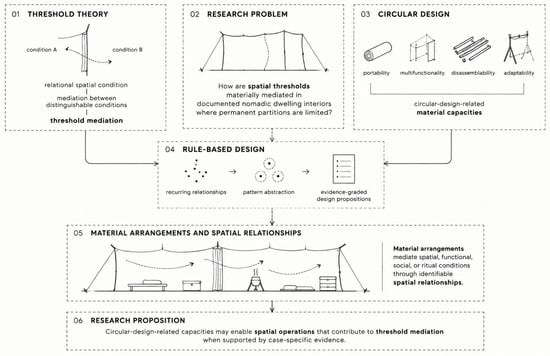
Figure 1 summarizes the conceptual structure of the study, bringing threshold theory, circular design, and rule-based design into a shared analytical framework. A cross-cultural corpus of ten documented nomadic dwelling interiors provides the empirical material (Section 3.1), from which recurring object–spatial relationships are identified and translated into evidence-graded analytical propositions.
Figure 1.
Conceptual framework of the research.
2. Theoretical Background
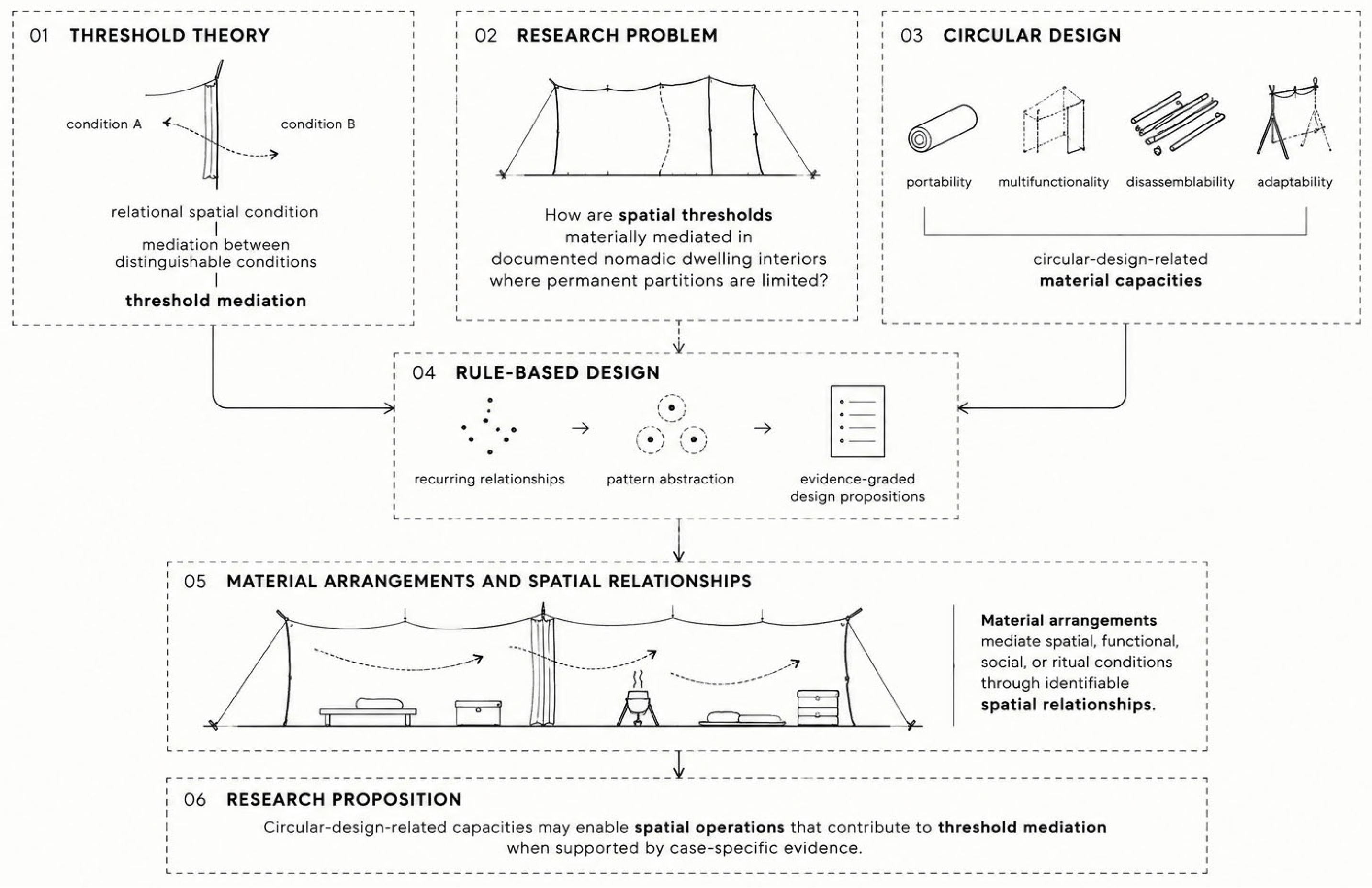
The theoretical framework integrates threshold theory, material-culture scholarship, circular design, and rule-based design through four complementary perspectives: Theory, Act, Condition, and System. These perspectives operate as interconnected analytical layers. Threshold as Theory establishes a relational definition; Threshold as Act examines situated practices and material mediation; Threshold as Condition addresses the capacities and constraints of objects and material systems; and Threshold as System translates supported relationships into conditional design propositions. Together, these perspectives provide a framework for examining how material arrangements participate in the formation of spatial thresholds (Figure 2).
Figure 2.
Theoretical framework of the study. Threshold production is conceptualized through four complementary analytical perspectives: Theory, Act, Condition, and System.
2.1. Threshold as Theory
The concept of threshold has long been used in architectural theory to explain relationships between distinct spatial conditions. In relational terms, threshold describes a spatial condition through which passage, encounter, negotiation, and transformation may occur. It therefore functions as a spatial device through which relationships between different conditions are established [7].
An early theoretical foundation for this relational understanding can be found in interpretations of the door as a cultural mechanism through which humans separate, connect, and give meaning to space [8]. The door simultaneously enables separation and connection, demonstrating the relational character of closure and passage. This ambiguity was given spatial expression in Marcel Duchamp’s 1927 door for his Paris studio at 11 Rue Larrey, where a single door positioned between two rooms could close one opening while simultaneously opening another [9]. The example illustrates how a threshold can operate as an interface regulating relationships between spatial conditions.
This understanding was subsequently extended beyond the physical boundary itself. Threshold has been described as an in-between realm that enables encounter, waiting, and interaction [10], while architectural accounts of inhabitation have emphasized the significance of intermediate zones between conventionally defined rooms [11]. Threshold spaces can consequently be understood as indeterminate zones through which different spatial conditions are negotiated and related.
This relational interpretation is particularly relevant to interior architecture. Interiority has been described as a condition produced through relationships among people, objects, surfaces, and spatial boundaries [12]. The experience of interior space may therefore emerge through material and perceptual relationships across varying degrees of architectural enclosure [13]. Interiority can further be understood as an ongoing process of interiorization [14], through which interior space is continuously constituted through interactions among people, material elements, and everyday practices.
Taken together, these approaches position threshold as a relational spatial condition and provide a theoretical basis for examining how such conditions are materially mediated where permanent interior partitions are limited. Section 2.2 extends this relational understanding to nomadic material culture and examines the role of objects and everyday practices in spatial organization.
2.2. Threshold as Act
Although nomadic ways of life have often been defined through seasonal mobility and relocation, more recent studies emphasize the capacity of mobile living systems to reorganize themselves across successive sites [15]. Nomadic settlements may reproduce recognizable spatial relationships as they are relocated. Vernacular environments have been shown to reflect environmental conditions, social structures, everyday habits, and cultural values [1], while the positioning, interior organization, and use of tents may recur according to culturally situated spatial patterns [16]. Nomadic space can thus be approached as a relational system in which spatial organization is repeatedly constituted under conditions of mobility.
Material objects are important components of this process. Material-culture scholarship provides a basis for understanding objects as participants in the organization of social relationships and everyday practices. Thing theory draws attention to the ways in which ordinary objects can make relationships and meanings perceptible when their habitual status is disrupted [17]. Other approaches similarly emphasize the role of everyday objects in structuring daily life [18,19] and participating in social relations [20]. Actor-network theory further draws human and non-human actors into a shared account of how social order is constituted [21]. Together, these perspectives provide a basis for examining objects as material participants in the relationships through which spatial organization is produced.
This position is consistent with relational approaches to space. Space has been conceptualized as a dynamic phenomenon produced through social relations and practices [22], while everyday practices participate in the continuous constitution and reorganization of spatial orders [23]. Dwelling has similarly been approached as an ongoing process emerging through interactions among people, objects, and environments [24,25]. Spatial order, from this perspective, is repeatedly constituted through material relationships and practices.
Nomadic dwelling interiors provide a particularly relevant context for examining these relationships. Where permanent interior partitions are limited, elements such as rugs, weavings, chests, hearths, storage units, structural components, and portable partitions may participate in differentiating use zones, regulating access, or mediating social and ritual distinctions. Their spatial role emerges through the relationships they establish within the documented interior arrangement. The analysis therefore examines how material arrangements mediate distinguishable conditions and, where supported by the evidence, how identifiable operations alter these relationships.
Threshold as Act concerns the situated relationship between material arrangements and practices. The analysis distinguishes the conditions being mediated, the material arrangement involved, and any documented or inferable operation affecting their relationship. Fixed, semi-fixed, and movable elements may participate in the same spatial organization while possessing different material and operational capacities.
2.3. Threshold as Condition
Circular design provides a theoretical basis for examining how the capacities of objects and material systems support change over time. At its broadest level, circular design seeks to preserve product and material value for as long as possible by extending service life and increasing the potential for reuse [26]. Design for disassembly, modularity, adaptability, repairability, and material recovery consequently enables products and systems to respond to changing conditions across their life cycles [27].
Within this framework, circularity has increasingly been associated with the capacity of products to undergo multiple cycles of use, maintenance, repair, reuse, remanufacturing, or recycling [28,29]. At the building and spatial scale, design-for-adaptability approaches similarly identify spatial transformability, multifunctionality, and reversibility as important dimensions of circular building strategies [30,31]. These approaches extend circular thinking from material recovery toward the capacity of designed systems to accommodate change.
Research at the furniture scale further demonstrates the importance of service life, functional flexibility, component structure, maintenance, and connection systems. Durability, modular construction, ease of maintenance, and component replaceability have been identified as important determinants of furniture life cycles [32], while mechanical and disassemblable connections can facilitate reassembly, repair, and reuse in different contexts [33]. Recent work additionally emphasizes maintenance, repair, and material continuity as dimensions of circular care [34]. Collectively, this literature shows how material and constructive configurations shape the capacity of products and systems to remain in use and accommodate transformation over time.
In the present study, circular-design principles provide a theoretical vocabulary for identifying material capacities relevant to spatial organization. Portability, multifunctionality, disassemblability, and adaptability are evaluated at the level of specific documented objects or material systems. These capacities may enable spatial operations such as displacement, assembly, reconfiguration, or alternative use, whose spatial consequences can then be examined within the documented interior arrangement.
The relationship proposed here is conditional: where a documented material capacity enables an identifiable spatial operation, that operation may mediate or alter a relationship between distinguishable conditions and thereby contribute to the formation or transformation of a threshold. The analysis therefore examines the sequence from material capacity to spatial operation and relational outcome, establishing the conceptual basis for evaluating how circular-design-related capacities participate in threshold mediation.
2.4. Threshold as System
The possibility of interpreting recurring spatial relationships as forms of design knowledge has a long history in architectural and design theory. Pattern-based approaches propose that recurring design problems can be addressed through identifiable relationships that persist across different contexts [35]. Subsequent interpretations have emphasized that design knowledge may reside in the relationships through which forms are organized [36]. This provides a basis for treating recurring spatial relationships as forms of design knowledge that can be made explicit and systematically described.
Computational thinking extends this premise by providing a means of translating complex and partly implicit relationships into explicit and inspectable structures [37]. In design research, this orientation supports the externalization and systematic interpretation of tacit or situated design knowledge. Rule-Based Design (RBD) operationalizes this orientation by expressing recurring relationships as conditional structures. Its historical precedents can be traced to systems of architectural proportion and composition in which components and their relationships were governed by explicit principles [38]. Shape grammar theory subsequently demonstrated how design knowledge could be formalized through rule systems capable of generating families of design outcomes [39,40]. Within this broader tradition, rules can describe conditional relationships that delimit a field of possible design outcomes [41,42], while their recombination and application across different configurations provide a basis for generative design processes [43,44].
This perspective is particularly relevant to vernacular and nomadic material culture, where design knowledge is embedded in practices, object arrangements, construction systems, and recurring spatial relationships. Studies of vernacular architecture have demonstrated recurring organizational principles across different contexts [15,45,46,47]. Research on nomadic environments has similarly examined Central Asian steppe settlement patterns through spatial concepts [48] and Anatolian Yörük settlements through visual grammar, identifying recurring spatial relationships at the settlement scale [49]. Recent research in interior architecture has further explored the formalization of design knowledge through hybrid digital–manual computational frameworks and rule-based and generative pedagogical models [50,51]. Together, these studies indicate a broader disciplinary interest in making situated design knowledge explicit, interpretable, and applicable through systematic structures.
In the present study, RBD provides an interpretive structure for formalizing documented condition–operation–outcome relationships. Recurring relationships supported by the corpus are expressed as candidate, evidence-graded design propositions. These propositions constitute an interpretable representation of the spatial logic identified in the documentary material. Their subsequent computational implementation, validation, and testing across additional cases provide directions for future research.
3. Materials and Methods
This research adopts an interpretive, comparative, and rule-based research design to examine how material arrangements mediate spatial thresholds in documented nomadic dwelling interiors. The primary aim is to identify recurring object–spatial relationships across different nomadic dwelling traditions and to translate relationships supported by the documentary evidence into explicit, evidence-graded design propositions. The primary unit of analysis is therefore the documented object–spatial relationship through which a material element or arrangement mediates between distinguishable spatial, functional, social, or ritual conditions.
The methodological problem concerns how spatial relationships embedded in historical documentary representations can be made explicit, systematically compared across cases, and formalized as interpretable design knowledge. Rule-Based Design (RBD) provides the analytical structure for this process by enabling recurring relational patterns to be expressed through conditional propositions. The study focuses on the positions, configurations, and relationships of material elements within documented interiors, together with the spatial operations supported by the available evidence.
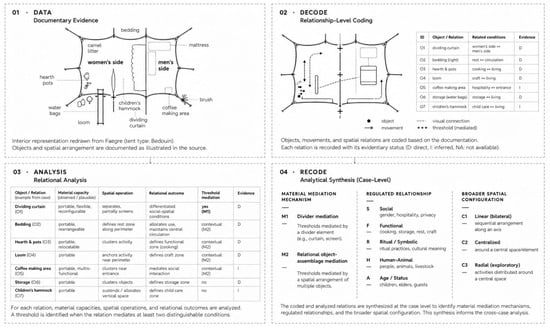
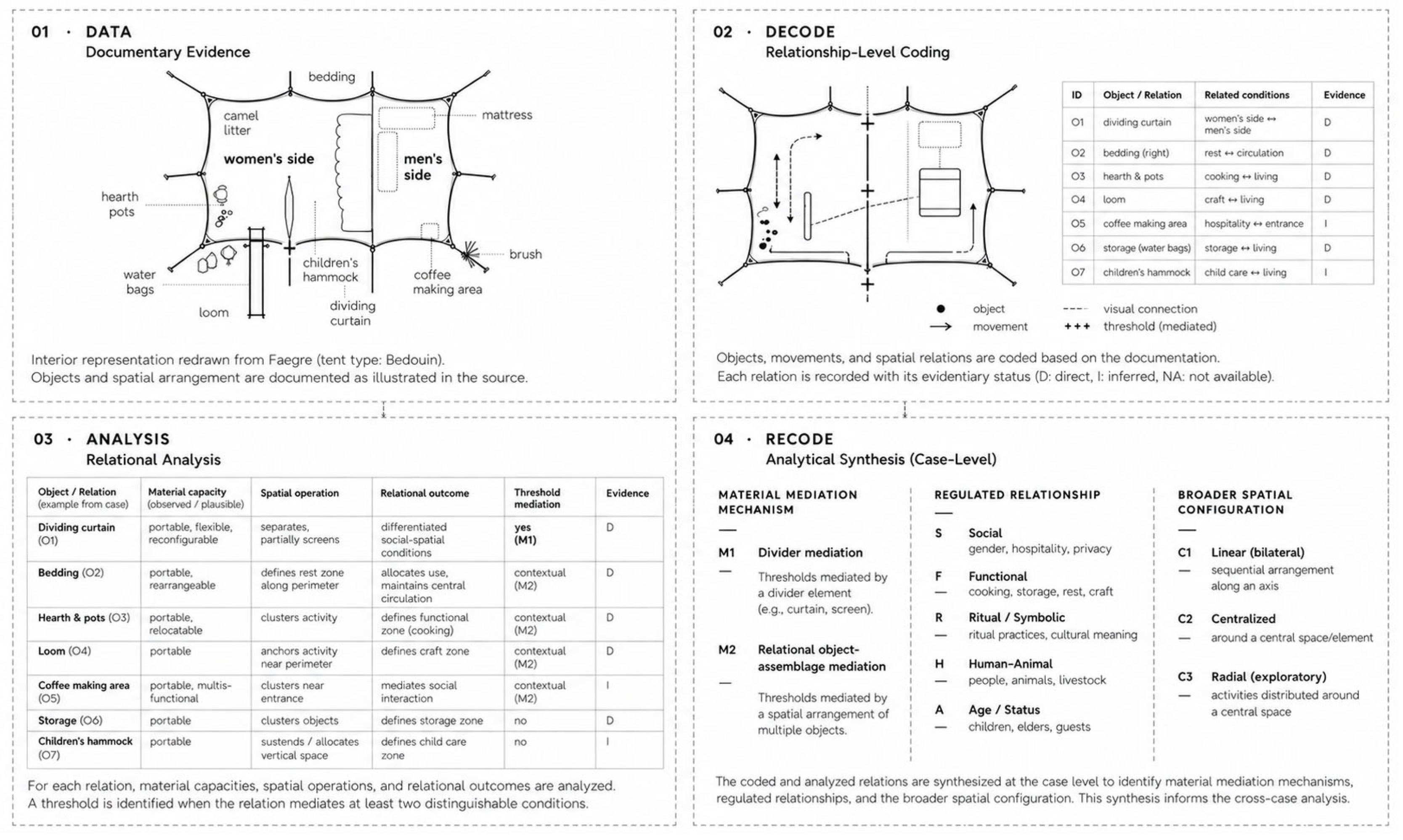
The research process consists of four sequential stages: Data, Decode, Analysis, and Recode (Figure 3). The Data stage establishes the documentary corpus and the cases included in the comparative analysis. The Decode stage translates heterogeneous source representations into a shared analytical representation and records relevant material and spatial relationships. The Analysis stage examines each decoded relationship through a sequence connecting material capacity, spatial operation, relational outcome, and threshold mediation, while classifying the evidentiary status of each analytical variable. Finally, the Recode stage translates supported relational patterns into candidate design propositions structured through condition–operation–outcome relationships. Together, these stages provide an evidence-aware analytical procedure for deriving explicit and inspectable design knowledge from historically situated documentary material.
Figure 3.
Methodological workflow illustrated through a Bedouin dwelling interior.
3.1. Research Corpus and Case Selection
The empirical corpus comprises ten historical representations of nomadic dwelling interiors selected through purposive sampling. Case selection was guided by four criteria: traceability to a documented source, availability of an interpretable interior representation, sufficient information to identify material–spatial relationships, and variation in geographical and structural context. The corpus was constructed to support comparative relational analysis across different nomadic dwelling traditions. The primary unit of analysis is the documented object–spatial relationship, while the dwelling case provides the level at which these relationships are comparatively synthesized.
The ten representations analyzed in the study are traceable to Faegre’s Tents: Architecture of the Nomads [52]. Oliver [53] and Rudofsky [54] provide contextual and comparative material. Faegre’s publication date is treated as the date of the documentary source and is distinguished from the period of the original ethnographic observation. Where Faegre attributes a representation to an earlier ethnographer or source, this information is recorded in Table 1. Table 1 identifies the geographical context, documentary attribution, and original source location of each case.
Table 1.
Documentary corpus, geographical context, source attribution, and original source location for the ten cases. All representations are redrawn from Faegre [52]. Earlier ethnographic sources credited by Faegre are identified where available.
The social and spatial categories represented in the source material require particular attention. Labels such as “men’s side,” “women’s side,” “servants,” and “honored guests,” together with comparable age-, gender-, and status-based designations, are retained as historically situated categories derived from the original plans, captions, and descriptions. The analysis examines how these categories are spatially represented within the documents. They are therefore recorded as source-derived regulatory categories and interpreted within the documentary context from which they originate. Similarly, broad group labels such as “Moor” and “Kurd” follow Faegre’s terminology and identify the specific representations included in the corpus [52].
The corpus includes eight membrane-based dwelling representations and two radially organized cases, the Mongolian yurt and Sámi kata. The membrane-based group includes black-tent, skin-tent, and mat-tent traditions based primarily on tensioned systems, while the radial cases employ rigid lattice or frame structures. This structural variation allows relationships identified within the corpus to be examined across differing spatial organizations. The 8:2 distribution provides only limited support for morphological comparison; consequently, relationships involving the two radial cases are treated as exploratory observations requiring examination within a larger and more balanced corpus.
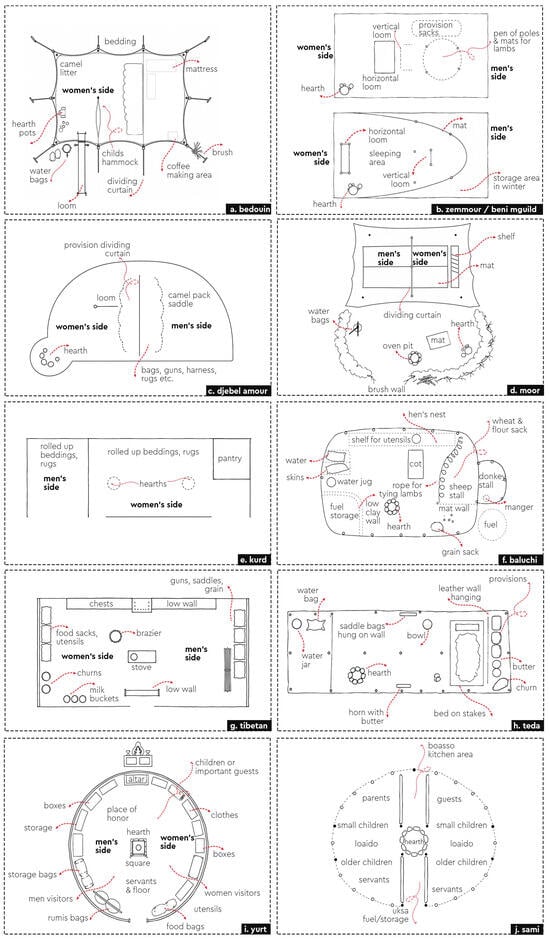
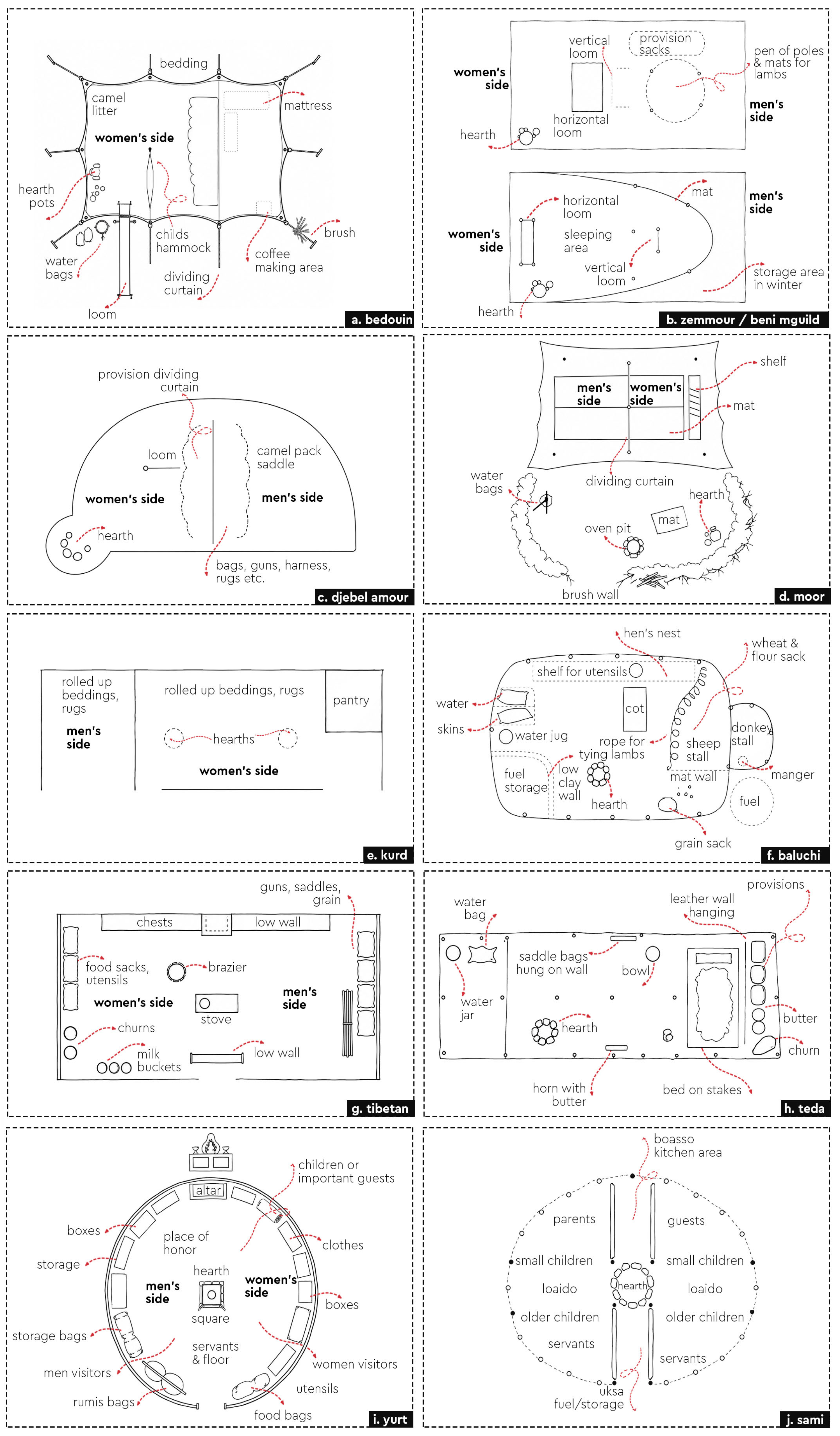
Plan drawings were selected as the primary documentary material because they provide comparable information on the positions, proximities, orientations, boundaries, circulation relationships, and use-zone associations of material elements. These spatial relationships constitute the principal evidence examined in the study. The primary unit of analysis is the documented object–spatial relationship through which an object, object cluster, structural component, or other material element mediates between at least two distinguishable spatial, functional, social, or ritual conditions. Each dwelling therefore functions as a comparative case containing one or more relationship-level analytical records. The standardized representations of the ten cases are presented comparatively in Figure 4.
Figure 4.
Comparative analytical atlas of ten documented nomadic dwelling interiors. Redrawn and adapted from Faegre [52]. Figure 4. Comparative analytical atlas of ten documented nomadic dwelling interiors: (a) Bedouin; (b) Zemmour/Beni Mguild; (c) Djebel Amour; (d) Moor; (e) Kurd; (f) Baluchi; (g) Tibetan; (h) Teda; (i) Mongolian yurt; (j) Sámi/Lapp. Redrawn and adapted from Faegre [52].
3.2. Decode: Analyzing and Standardizing the Data
The Decode stage translates heterogeneous documentary representations into comparable analytical records. Each source plan was redrawn and standardized through a shared representational system that preserves the spatial relationships relevant to the analysis. Boundaries, entrances, structural components, fixed and movable material elements, furnishings, labelled activities, and documented spatial distinctions were identified consistently across the ten cases. Fixed, semi-fixed, and movable elements were all retained so that different forms of material mediation could be compared within the same analytical framework.
Each standardized representation was then examined for candidate threshold relationships. A candidate relationship required two components: at least two distinguishable spatial, functional, social, or ritual conditions and an identifiable material element or arrangement mediating between them. Mediation was recorded where the documentary material supported separation, connection, filtering, access regulation, spatial differentiation, or a comparable relational effect. A labelled zone or the presence of an object alone was therefore insufficient to establish a threshold relationship.
Static mediation and temporal transformation were recorded separately. A plan may document an arrangement in which a material element mediates between distinguishable conditions, while evidence of opening, closing, displacement, regrouping, reorientation, assembly, or other spatial operations requires additional case-specific support. This distinction allows the analysis to identify material mediation from static documentary evidence while separately evaluating claims concerning spatial transformation.
Each accepted relationship was recorded as an individual analytical entry containing the source location, mediating material element or arrangement, conditions mediated, relevant material capacity, spatial operation, relational outcome, regulatory category, spatial configuration, fixed constraints, and alternative interpretation. Evidence was therefore evaluated at the relationship level before being synthesized at the dwelling-case level.
Two forms of material mediation were distinguished during decoding. Discrete divider mediation describes relationships in which a materially legible element separates, filters, or regulates conditions. Relational object-assemblage mediation describes relationships emerging through the position, orientation, density, or clustering of multiple material elements within the interior arrangement. These categories provide the initial analytical distinction for subsequent relational coding in the Analysis stage.
3.3. Analysis: Relational Coding and Evidence Classification
In the Analysis stage, each decoded object–spatial relationship was examined through a sequential analytical structure consisting of four levels: material capacity, spatial operation, relational outcome, and threshold mediation. This sequence provides a consistent procedure for tracing how documented material characteristics participate in spatial organization and for distinguishing the capacity of an object or system from the operation and relational effect associated with it.
At the first level, each object or material system was examined for capacities relevant to the theoretical framework. Four capacities were considered: portability, multifunctionality, adaptability, and disassemblability. These capacities describe properties of the documented object or material system that may enable spatial operations such as displacement, opening or closing, regrouping, reorientation, rearrangement, or reassembly.
At the second level, the analysis identified the spatial operation associated with the documented capacity. At the third level, the relational outcome of that operation was evaluated in terms of changes in visibility, access, circulation, proximity, functional differentiation, privacy, enclosure, or center–periphery organization. At the fourth level, threshold mediation was identified where the resulting relationship mediated between at least two distinguishable spatial, functional, social, or ritual conditions.
The analytical sequence therefore begins with the identification of a material capacity, followed by the spatial operation it enables, the resulting relational outcome, and the threshold mediation associated with that outcome.
The four material capacities were coded through explicit criteria. Portability was recorded where an element could be displaced, repositioned, opened, closed, or regrouped according to the case-specific documentation. Multifunctionality was recorded where the same element had both an ordinary use role and a distinct spatial-regulatory role supported by the source material. Disassemblability was recorded where separation and reassembly of components were explicitly represented or described. Adaptability was recorded where the documentation supported a change in material or spatial arrangement associated with temporal, seasonal, social, or functional conditions. Each capacity was evaluated independently at the object or system level, and its relationship to a spatial operation was established through case-specific evidence.
Repairability was excluded from empirical coding because the plan-based documentation provides insufficient case-specific evidence concerning maintenance, component replacement, repair processes, and service life. The documentary corpus similarly provides no direct measures of material cycles or environmental performance. Circular-design-related capacities are therefore examined as material and spatial characteristics within the analytical framework.
The analysis also distinguishes the mechanism of material mediation from the relationship regulated through that mediation. The mechanism describes how material arrangements participate in threshold formation, while the regulatory axis records what relationship is being mediated. Regulatory categories include social, functional, ritual, environmental, gender-, age-, status-, and human–animal relationships, where these distinctions are supported by the source documentation. Source-derived social categories retain the evidentiary qualifications established in Section 3.1.
Three contrasting cases illustrate the coding procedure. In the Bedouin case, the central dividing curtain and the source-designated men’s and women’s sides are directly represented in Faegre [52] (p. 24), supporting a relationship of material mediation between differentiated conditions. The spatial arrangement is directly documented, while movement or repositioning of the curtain is recorded as a case-specific inference in the absence of explicit temporal documentation. In the Baluchi case, seasonal mat walls are documented in different winter and summer conditions, providing direct evidence of a spatial operation associated with seasonal adaptation. In the Tibetan case, the low wall and altar are documented together with differentiated domestic and ritual conditions [52] (pp. 58–59), providing evidence of fixed material mediation without evidence of temporal reconfiguration. These examples demonstrate how the same analytical sequence accommodates different levels and types of documentary support.
To maintain consistency across the corpus, documentary support was classified separately for each analytical variable using three evidence categories: D (directly documented), I (case-specific inference), and NA (insufficient evidence). D indicates that the relevant feature, operation, or relationship is explicitly represented or described in the case-specific source. I identifies an interpretation supported by the configuration and contextual evidence of the individual case but lacking direct documentation of the relevant operation. NA indicates that the available documentary material provides insufficient evidence for classification. These categories describe the status of documentary support and are not ordinal measures of material or spatial performance.
Static arrangements and temporal operations were coded independently. A source-visible arrangement may establish material mediation between distinguishable conditions, while temporal operations such as displacement, opening, closing, rearrangement, or reassembly require corresponding documentary support. System-level capacities were likewise evaluated at the scale at which they were documented and were transferred to individual interior elements only where case-specific evidence supported that relationship.
The evidence classification resulting from this procedure is summarized in Table 2. For each case, the table distinguishes the source-visible material feature, evidence for the associated operation, evidence for relational mediation, and the resulting analytical status. This provides a case-level overview of the evidentiary basis before recurring relationships are synthesized across the corpus.
Table 2.
Source-based evidence matrix for the ten cases. D = directly documented; I = case-specific inference; NA = insufficient evidence. Material features, spatial operations, and relational mediation are evaluated separately.
Following evidence classification, the cases were compared through relational equivalence. This comparison focused on whether materially different arrangements exhibited comparable relational logics under consistent analytical criteria. Case-level synthesis followed a presence criterion: a mechanism was considered supported within a case when at least one qualifying relationship provided sufficient evidence for its defining mediation and relational outcome. D, I, and NA classifications remained attached to the relevant analytical variables throughout this process.
Table 3 presents the resulting case-level synthesis. It brings together the analytical status of divider mediation, relational object-assemblage mediation, and fixed material mediation across the ten cases. At this stage, the table functions as a comparative synthesis of the coding decisions and provides the basis for assessing recurrence in the subsequent Recode stage.
Table 3.
Case-level synthesis of supported, candidate, unresolved, and fixed material mediation relationships across the ten cases.
Because case-level synthesis necessarily compresses the evidence associated with individual relationships, a relationship-level audit was also maintained. For every coded relationship, the audit records the source-visible feature, the conditions mediated, the relevant material capacity where applicable, the evidence status of the spatial operation, the regulatory category, and the final analytical decision. This structure preserves the connection between the comparative classifications and the documentary evidence from which they were derived.
The complete audit is presented in Table 4. It provides the most detailed level of the analytical record and makes it possible to trace each case-level classification in Table 3 back to the specific object-spatial relationship and evidence status on which it is based.
Table 4.
Relationship-level analytical audit of the ten cases, recording source-visible relationships, mediated conditions, material capacities, operation-evidence status, regulatory categories, and analytical decisions. N/A: not applicable.
3.4. Recode: Analytical Proposition Development
The Recode stage translates the relationships identified through comparative analysis into explicit analytical propositions. A relationship was eligible for recoding when the preceding stages established a traceable connection among the conditions being mediated, the material arrangement involved, the associated spatial operation, and the resulting relational outcome. Evidence classifications established during the Analysis stage were retained throughout this process so that each proposition remained linked to its documentary basis.
Recurring relationships were identified through relational equivalence across independent cases. Relationships were considered comparable when they exhibited a shared relational logic, even where the objects, materials, or dwelling configurations involved differed. A recurring mechanism required the same underlying relational logic to be supported in more than one independent case. Relationships with plausible relational structures but limited operation-level evidence were retained as candidate propositions for further examination.
Each supported recurring relationship was then reformulated through a condition–operation–outcome structure. The condition specifies the spatial, functional, social, or ritual relationship involved; the operation identifies the material or spatial action through which that relationship is mediated; and the outcome describes the resulting threshold condition. This structure provides a consistent format for translating case-specific observations into explicit and comparable design propositions.
The Recode stage therefore produces a set of candidate, evidence-graded design propositions grounded in the documentary corpus. These propositions provide an explicit representation of recurring relational logic and establish a basis for subsequent computational implementation, testing across additional cases, and evaluation in new design contexts.
4. Findings and Discussion
The comparative analysis reveals that threshold mediation in the documented nomadic dwelling interiors operates across multiple analytical dimensions. The findings identify two recurring forms of material mediation, together with a regulatory dimension and an exploratory spatial configuration. These dimensions describe different aspects of threshold formation: the material arrangement through which mediation occurs, the relationship being regulated, and the broader spatial organization within which that relationship is situated.
The findings are presented first through the recurring material mediation mechanisms identified across the corpus. Fixed and boundary cases are then considered to clarify the analytical limits of these mechanisms. The subsequent sections examine the regulatory and configurational dimensions of the documented relationships and synthesize these findings in relation to material capacity, spatial operation, and relational threshold formation.
4.1. Material Mediation Mechanisms
The comparative analysis identified two recurring material mediation mechanisms: divider mediation (M1) and relational object-assemblage mediation (M2). Both describe ways in which material arrangements mediate between distinguishable conditions, but they operate through different spatial logics. M1 depends on a materially legible separating or filtering element, while M2 emerges through the relational organization of multiple objects within the interior.
4.1.1. Divider Mediation (M1)
Divider mediation is supported in four of the eight structurally comparable membrane-based cases: Bedouin, Djebel Amour, Moor, and Baluchi. In each case, the documentary source identifies a materially legible element positioned between distinguishable spatial or social conditions.
In the Bedouin interior, a labelled qata dividing curtain separates the documented men’s and women’s sides, with rugs and bedding stacked against it [52] (p. 24). In the Djebel Amour interior, the tent is similarly divided into men’s and women’s sides by a curtain suspended from the centre poles, with a second curtain screening the women’s side [52] (pp. 36–38). The Moor interior documents a dividing curtain within an arrangement that also includes a fixed oven pit and brushwood wall [52] (pp. 38–40). In the Baluchi case, plaited mat walls form a seasonally changing enclosure [52] (p. 51).
These cases support a recurring relational logic in which a discrete material element mediates between distinguishable conditions. The evidence for the associated operation, however, varies across the four cases. In the Bedouin, Djebel Amour, and Moor interiors, the dividing element and the conditions it mediates are documented, while its movement or repositioning remains a case-specific inference. The Baluchi seasonal mat walls provide the strongest operation-level evidence: their attachment in winter and removal in summer directly document a temporal change in the enclosure. The recurrence count for M1 therefore refers specifically to divider mediation, with temporal reconfiguration established directly in the Baluchi case. This distinction follows the operation-level evidence recorded in Table 2 and Table 4.
The four supported cases also occur across geographically distinct traditions represented in the corpus, including the Arabian Peninsula, the Saharan Atlas, Mauritania and the western Sahara, and Baluchistan. Within the limits of the selected corpus, this distribution shows that divider mediation occurs across multiple documented nomadic dwelling traditions.
4.1.2. Relational Object-Assemblage Mediation (M2)
The second recurring mechanism, relational object-assemblage mediation, is supported in three cases: Zemmour/Beni Mguild, Bedouin, and Djebel Amour. Here, threshold mediation emerges through the relative position, orientation, and clustering of multiple objects within the interior.
The Zemmour/Beni Mguild representations provide the clearest example. Two documented configurations organize looms, bedding, storage elements, and a pen for young animals in relation to differentiated use zones [52] (p. 34). No discrete divider is required for these zones to become spatially legible within the documented arrangement. In the Bedouin interior, the bedding roll, water container, and loom cluster participates in differentiating living and working zones. A comparable assemblage logic occurs in the Djebel Amour interior, where harnesses, clothing, rugs, and saddles form differentiated sub-zones alongside the dividing curtain. Together, these three cases support M2 as a recurring form of material mediation.
The evidence supports static assemblage mediation in these cases. The two Zemmour/Beni Mguild configurations document distinct arrangements, but the source does not establish them as successive temporal states of a single household. The spatial significance of M2 therefore lies in the relational organization of the assemblage itself. Temporal transformation remains undocumented in the present corpus.
4.1.3. Fixed Mediation and Boundary Cases
The corpus also contains relationships that clarify the analytical boundaries of M1 and M2. Fixed material mediation provides an important comparison category. In the Baluchi case, a low clay wall mediates between human and animal zones, while the Tibetan low wall and altar articulate differentiated domestic and ritual conditions. These arrangements demonstrate that relational thresholds may also be materially articulated through fixed elements. Their inclusion provides a comparative reference for interpreting the operational capacities associated with movable or adaptable arrangements.
The Teda and Kurd cases further clarify the inclusion criteria. In the Teda interior, the leather wall-hanging functions as a focal element within a use area, but the documentary evidence does not establish a separating or filtering relationship comparable to M1. The Teda case therefore remains outside divider mediation. In the Kurd case, the source documents tent construction, the raising of a tent side, and labelled interior distinctions, while evidence for a corresponding interior object-assemblage relationship remains unresolved. These cases demonstrate how the evidence criteria distinguish documented material presence from supported threshold mediation.
4.2. Regulatory Relationships and Spatial Configuration
The material mechanisms identified in Section 4.1 describe how threshold mediation is materially produced. A second analytical dimension concerns what relationship is being mediated. Across the corpus, material arrangements participate in the differentiation of social, functional, ritual, environmental, and human–animal conditions. These relationships constitute the regulatory axis of the analytical framework and may occur through different material mechanisms and spatial configurations.
4.2.1. Regulatory Relationships
Social regulation is particularly visible in the documented gender-based organization of several membrane-based dwellings. The Bedouin and Djebel Amour cases explicitly distinguish men’s and women’s sides, with dividing curtains participating in the material articulation of these categories. Comparable source-derived distinctions based on age, status, activity, ritual practice, and human–animal relationships occur elsewhere in the corpus. As established in Section 3.1, these categories are treated as historically situated source designations and provide evidence of how categorical spatial organization is represented in the documentary material.
The recurrence of gender-based spatial distinctions can be situated within broader scholarship on gendered domestic space. Bourdieu’s analysis of the Kabyle house [55] demonstrates how spatial organization can participate in the expression and reproduction of socially differentiated domains, while Spain [56] comparatively examines the relationship between spatial segregation, access, and gendered social organization. Read in relation to this literature, the documented men’s and women’s divisions in the present corpus illustrate how material arrangements can participate in the spatial articulation of social distinctions. The present analysis contributes a material-relational perspective by examining the specific arrangements through which these documented distinctions become spatially legible.
The regulatory axis extends beyond social distinctions. In the Baluchi case, material boundaries participate in differentiating human and animal zones, while the Tibetan low wall and altar articulate a relationship between domestic and ritual conditions. Functional differentiation is also visible in object assemblages associated with sleeping, storage, weaving, and circulation. These examples indicate that similar forms of material mediation can participate in different regulatory relationships, while comparable regulatory relationships may be articulated through different material arrangements.
The regulatory axis therefore complements the material mechanisms identified in Section 4.1. M1 and M2 describe the material organization through which mediation occurs, whereas the regulatory axis identifies the spatial, functional, social, or ritual relationship articulated through that organization. This distinction enables materially similar arrangements to be compared according to the relationships they mediate and materially different arrangements to be examined for comparable regulatory roles.
4.2.2. Exploratory Spatial Configuration
A further analytical dimension concerns the broader spatial configuration within which threshold relationships occur. The Mongolian yurt and Sámi kata differ structurally from the eight membrane-based cases and document a predominantly radial organization structured around a central hearth and differentiated peripheral positions. These two cases support an exploratory centre–periphery configuration within the corpus.
In the yurt, the central hearth provides a spatial reference around which differentiated peripheral positions are organized. The Sámi representation similarly documents a central hearth together with differentiated household positions and a smoke-related spatial division. In both cases, threshold relationships can therefore be interpreted through relative position within a radial spatial order. The documentary evidence supports this configurational reading at the level of the represented arrangement; temporal rearrangement is not documented.
The radial cases are treated as an exploratory configurational category because the corpus contains two radial examples compared with eight membrane-based dwellings. This distribution provides sufficient evidence to identify centre–periphery organization as a distinct spatial configuration within the selected corpus, while broader morphological comparison requires a more balanced sample of radial and membrane-based dwelling traditions.
Importantly, spatial configuration operates at a different analytical level from material mediation. Divider mediation and relational object-assemblage mediation describe how a threshold is materially articulated; the regulatory axis identifies the relationship being mediated; and spatial configuration describes the broader organizational structure within which that mediation occurs. A radial configuration may therefore contain threshold relationships without constituting an additional material mechanism.
4.3. Cross-Axis Synthesis
The findings indicate that threshold mediation can be understood through three complementary analytical dimensions: material mechanism, regulatory relationship, and spatial configuration. These dimensions describe different aspects of the same spatial relationship and can occur in combination within a single documented arrangement. The material mechanism identifies how mediation is materially articulated, the regulatory relationship identifies what conditions are being mediated, and the spatial configuration identifies the broader organizational structure within which the relationship occurs.
Within the material dimension, M1 describes mediation through a discrete divider, while M2 describes mediation through the relative organization of multiple objects. The regulatory dimension identifies the social, functional, ritual, environmental, or other relationship articulated through that material organization. Spatial configuration describes the broader organizational logic, including the exploratory centre–periphery configuration identified in the yurt and Sámi cases.
The dimensions can intersect in different combinations. In the Baluchi case, for example, the seasonal mat wall operates as a discrete divider under M1 while mediating a human–animal relationship. In the Bedouin case, divider mediation and relational object-assemblage mediation coexist within the same interior while participating in the articulation of differentiated social and functional conditions. These combinations demonstrate that the analytical dimensions are complementary and allow the same dwelling to contain multiple forms and levels of threshold mediation.
The case-level synthesis presented in Table 3 further clarifies the distribution of these relationships across the corpus. Cases in which a mechanism is not established represent different evidentiary situations. In several cases, the documented interior does not contain the material configuration required by the defining criteria of M1 or M2. In the Kurd case, by contrast, the available documentation leaves the relevant interior assemblage unresolved. The synthesis therefore distinguishes between relationships that are unsupported because the defining material configuration is absent from the documented representation and relationships that remain unresolved because the available evidence is insufficient.
Taken together, the three analytical dimensions provide a relational account of threshold formation that can accommodate materially different spatial arrangements without reducing them to formal similarity. Curtains, mat walls, object clusters, and fixed elements differ in material form and operational capacity, yet they can be compared according to the relationships through which they participate in spatial mediation. This cross-axis structure therefore provides the basis for interpreting the recurring relational logic identified across the corpus.
4.4. Discussion: From Material Capacity to Relational Threshold
The findings suggest that the spatial significance of material elements emerges through the relationships they establish within an interior arrangement. Across the corpus, materially different elements, including curtains, mat walls, fixed boundaries, and object assemblages, participate in threshold mediation through different spatial operations and relational configurations. Threshold formation can therefore be interpreted as a relational process in which material characteristics acquire spatial significance through their capacity to organize, differentiate, connect, or regulate distinguishable conditions.
This finding clarifies the role of circular-design-related capacities within the proposed framework. Portability, multifunctionality, adaptability, and disassemblability describe material capacities that can enable changes in spatial organization. Their relevance to threshold formation emerges when a capacity is associated with an identifiable spatial operation and a corresponding relational outcome. Portability, for example, becomes spatially significant when displacement or repositioning alters a relationship between conditions, while adaptability becomes relevant when a documented change in material configuration modifies enclosure, access, differentiation, or another spatial relationship. Circular-design-related capacities therefore function as enabling conditions whose spatial consequences depend on the operations and relational outcomes supported by case-specific evidence.
This distinction expands the architectural relevance of circular design beyond the characterization of material or product properties. Within the present corpus, circular-design-related capacities can also be interpreted as potential spatial capacities because they affect how material arrangements may participate in the organization of interior relationships. The contribution is particularly relevant to nomadic dwelling interiors, where spatial differentiation can be produced through material arrangements with varying degrees of permanence, mobility, and adaptability. At the same time, the present analysis concerns the spatial implications of these capacities; their environmental performance requires forms of evidence beyond the documentary corpus examined here.
The relational perspective also provides a basis for comparison across materially and culturally different cases. Formal similarity is not required for two arrangements to perform comparable spatial-regulatory work. A curtain, a seasonal mat wall, and an assemblage of furnishings may differ substantially in material form, cultural meaning, and mode of use, yet their documented relationships can be compared according to the conditions they mediate and the spatial outcomes associated with them. This shifts the comparative emphasis from object type to relational structure, allowing recurring spatial logic to be identified while preserving differences in material form and documentary context.
This comparative layer complements material-culture approaches concerned with the culturally situated meanings, practices, and identities associated with objects. The framework developed here focuses specifically on the spatial relationships through which documented material arrangements participate in interior organization. It therefore adds a relational design perspective by examining whether materially and culturally distinct arrangements perform comparable spatial-regulatory work. Cultural interpretation and relational comparison operate at different analytical levels and together provide a richer understanding of the spatial role of material culture.
The findings also clarify the methodological role of Rule-Based Design in this translation. Once recurring relationships are distinguished at the levels of material capacity, spatial operation, relational outcome, regulatory relationship, and spatial configuration, they can be reformulated as explicit condition–operation–outcome propositions. RBD thus provides a means of translating relational patterns embedded in documentary material into structured and inspectable design knowledge. In this study, these propositions remain evidence-graded analytical formulations grounded in the historical corpus. Their computational implementation and testing across additional cases constitute subsequent stages of research.
The principal contribution of the framework therefore lies in connecting material capacity, spatial operation, and relational outcome within a single evidence-aware analytical structure. Threshold theory provides the relational problem, material-culture scholarship situates material arrangements within documented practices, circular design identifies capacities relevant to spatial organization, and RBD provides a structure for making recurring relationships explicit. Their integration enables historically situated material–spatial knowledge to be comparatively interpreted and translated into candidate design propositions while retaining the evidentiary status of the relationships from which those propositions are derived.
5. Conclusions
This study demonstrates that spatial thresholds in documented nomadic dwelling interiors are materially mediated through both discrete dividers and relational object assemblages. Across the ten-case corpus, divider mediation (M1) is supported in four of the eight structurally comparable membrane-based cases, while relational object-assemblage mediation (M2) is supported in three cases. Within M1, temporal reconfiguration is directly documented in the Baluchi seasonal mat walls, while the hung curtains support divider mediation with their movement remaining inferential. M2 is supported as static assemblage mediation, with temporal transformation remaining undocumented in the present corpus. Fixed material mediation provides a further comparison category, demonstrating that threshold relationships can also be articulated through materially stable arrangements.
The findings further indicate that circular-design-related capacities function as enabling conditions whose spatial significance emerges through identifiable operations and relational outcomes. By distinguishing material capacity, spatial operation, relational outcome, regulatory relationship, and spatial configuration, the framework provides an evidence-aware means of tracing how material characteristics acquire spatial significance within documented interior arrangements. The principal methodological contribution is a procedure for translating documented object–spatial relationships into explicit and inspectable analytical propositions structured through condition–operation–outcome relationships. The resulting evidentiary map across the ten cases preserves supported, candidate, unresolved, and fixed relationships within the same analytical structure and provides a basis for subsequent computational implementation and validation across additional cases.
The scope of these findings is defined by the character of the documentary corpus. The study examines a small, purposively selected set of historical representations derived from a single principal source, and its findings are therefore interpreted at the level of the selected corpus, with the radial comparison remaining exploratory. Published plans and descriptions provide evidence of documented spatial arrangements but offer limited access to temporal practices and transformations. The corpus also provides no direct measures of material flows, service life, repair frequency, or environmental performance, limiting the interpretation of circular-design-related capacities to their documented spatial implications. Finally, the analysis was conducted by a single researcher. The relationship-level audit and explicit coding criteria support analytical transparency, while independent coding would provide an additional test of reliability.
Future research can extend the framework through additional documentary and ethnographic cases, independent coding, and more balanced comparisons across dwelling configurations. The analytical propositions developed here can also be computationally implemented and tested through the generation and evaluation of new spatial configurations, while material and life-cycle evidence can be incorporated to examine the environmental implications of the identified capacities. These extensions would allow the transferability of the framework to be evaluated beyond the present corpus while preserving the distinction between documented evidence and analytical inference established in this study. By making recurring material–spatial relationships explicit and inspectable, the framework provides a basis for translating historically situated nomadic spatial knowledge into interpretable and potentially transferable rule-based design knowledge.
Funding
This research received no external funding.
Institutional Review Board Statement
Not applicable.
Informed Consent Statement
Not applicable.
Data Availability Statement
No new data were created or generated in this study. All materials analyzed in this study are derived from the published sources cited in the article.
Conflicts of Interest
The author declares no conflict of interest.
References
- Rapoport, A. House Form and Culture; Prentice-Hall: Englewood Cliffs, NJ, USA, 1969. [Google Scholar]
- Bocken, N.M.P.; de Pauw, I.; Bakker, C.; van der Grinten, B. Product design and business model strategies for a circular economy. J. Ind. Prod. Eng. 2016, 33, 308–320. [Google Scholar] [CrossRef] [Scilit]
- Uçar, U.E. GEN-AI + VR: Toward an experiential visual communication framework in interior architecture. In AI and the Transformation of Visual Culture, Art, and Design; IGI Global Scientific Publishing: Hershey, PA, USA, 2026; pp. 229–254. [Google Scholar] [CrossRef] [Scilit]
- Uçar, U.E.; Gökdemir, G.; Garip, E. A study of the application of virtual reality technology as an anthropometric measurement tool. Interact. Des. Archit. J. 2023, 55, 194–211. [Google Scholar] [CrossRef] [Scilit]
- Gökdemir, G.; Kayan, H.Z. Artificial intelligence as a linguistic interface in interior design education: Reconceiving design tools as communication media. Int. J. Archit. Comput. 2025. Online First. [Google Scholar] [CrossRef] [Scilit]
- Gökdemir, G. Cognitive divergence in design communication: Human reasoning and artificial intelligence in interior architecture. In AI and the Transformation of Visual Culture, Art, and Design; IGI Global Scientific Publishing: Hershey, PA, USA, 2026; pp. 255–279. [Google Scholar] [CrossRef] [Scilit]
- Boettger, T. Threshold Spaces: Transitions in Architecture. Analysis and Design Tools; Birkhäuser: Basel, Switzerland, 2014. [Google Scholar]
- Simmel, G. Bridge and door. Theory Cult. Soc. 1994, 11, 5–10. [Google Scholar] [CrossRef] [Scilit]
- Schwarz, A. The Complete Works of Marcel Duchamp; Thames and Hudson: London, UK, 1969. [Google Scholar]
- Van Eyck, A. Steps toward a configurative discipline. Forum 1962, 3, 81–94. [Google Scholar]
- Hertzberger, H. Lessons for Students in Architecture; 010 Publishers: Rotterdam, The Netherlands, 1991. [Google Scholar]
- Rice, C. The Emergence of the Interior: Architecture, Modernity, Domesticity; Routledge: London, UK, 2007. [Google Scholar]
- Pimlott, M. Interiority and the conditions of interior. Interiority 2018, 1, 5–20. [Google Scholar] [CrossRef] [Scilit]
- Attiwill, S. Between representation and the mirror: Tactics of interiorization. In Interior Design and Architecture: Critical and Primary Sources; Taylor, M., Ed.; Berg Publishers: Oxford, UK, 2013. [Google Scholar]
- Uçar, U.E.; Gürer, E. A heritage ecosystem in motion: Yörük spatial practices and the ecology of mobility. J. Cult. Herit. Manag. Sustain. Dev. 2026, 1–19. [Google Scholar] [CrossRef] [Scilit]
- Cribb, R. Nomads in Archaeology; Cambridge University Press: Cambridge, UK, 1991. [Google Scholar]
- Brown, B. Thing theory. Crit. Inq. 2001, 28, 1–22. [Google Scholar] [CrossRef] [Scilit]
- Miller, D. Materiality; Duke University Press: Durham, NC, USA, 2005. [Google Scholar]
- Miller, D. Stuff; Polity Press: Cambridge, UK, 2010. [Google Scholar]
- Gell, A. Art and Agency: An Anthropological Theory; Clarendon Press: Oxford, UK, 1998. [Google Scholar]
- Latour, B. Reassembling the Social: An Introduction to Actor-Network-Theory; Oxford University Press: Oxford, UK, 2005. [Google Scholar]
- Lefebvre, H. The Production of Space; Nicholson-Smith, D., Translator; Blackwell: Oxford, UK, 1991. [Google Scholar]
- de Certeau, M. The Practice of Everyday Life; University of California Press: Berkeley, CA, USA, 1984. [Google Scholar]
- Ingold, T. The Perception of the Environment: Essays on Livelihood, Dwelling and Skill; Routledge: London, UK, 2000. [Google Scholar]
- Ingold, T. Being Alive: Essays on Movement, Knowledge and Description; Routledge: London, UK, 2011. [Google Scholar]
- den Hollander, M.C.; Bakker, C.A.; Hultink, E.J. Product design in a circular economy: Development of a typology of key concepts and terms. J. Ind. Ecol. 2017, 21, 517–525. [Google Scholar] [CrossRef] [Scilit]
- Moreno, M.; De los Rios, C.; Rowe, Z.; Charnley, F. A conceptual framework for circular design. Sustainability 2016, 8, 937. [Google Scholar] [CrossRef] [Scilit]
- Shahbazi, S.; Jönbrink, A.K. Design guidelines to develop circular products: Action research on Nordic industry. Sustainability 2020, 12, 3679. [Google Scholar] [CrossRef] [Scilit]
- Mesa, J.; Esparragoza, I.; Maury, H. Developing a set of sustainability indicators for product families based on the circular economy model. J. Clean. Prod. 2018, 196, 1429–1442. [Google Scholar] [CrossRef] [Scilit]
- Askar, R.; Bragança, L.; Gervásio, H. Design for adaptability (DfA)—Frameworks and assessment models for enhanced circularity in buildings. Appl. Syst. Innov. 2022, 5, 24. [Google Scholar] [CrossRef] [Scilit]
- Hamida, M.B.; Jylhä, T.; Remøy, H.; Gruis, V. Circular building adaptability and its determinants: A literature review. Int. J. Build. Pathol. Adapt. 2022, 41, 47–69. [Google Scholar] [CrossRef] [Scilit]
- Yang, D.; Vezzoli, C. Designing environmentally sustainable furniture products: Furniture-specific life cycle design guidelines and a toolkit to promote environmental performance. Sustainability 2024, 16, 2628. [Google Scholar] [CrossRef] [Scilit]
- Sydor, M.; Stańczyk, K. Analyzing joinery for furniture designed for disassembly. J. Manuf. Mater. Process. 2025, 9, 162. [Google Scholar] [CrossRef] [Scilit]
- Yasar, D.; Kucukali, U.F.; Matin, S.; Rezaeifam, S. From restoration to circular care: Maintenance, repair and material continuity in sustainable heritage management. J. Cult. Herit. Manag. Sustain. Dev. 2026, ahead of print. [Google Scholar] [CrossRef] [Scilit]
- Alexander, C.; Ishikawa, S.; Silverstein, M. A Pattern Language: Towns, Buildings, Construction; Oxford University Press: New York, NY, USA, 1977. [Google Scholar]
- Alexander, C. The origins of pattern theory: The future of the theory, and the generation of a living world. IEEE Softw. 1999, 16, 71–82. [Google Scholar] [CrossRef] [Scilit]
- Wing, J.M. Computational thinking. Commun. ACM 2006, 49, 33–35. [Google Scholar] [CrossRef] [Scilit]
- Carpo, M. Drawing with numbers: Geometry and numeracy in early modern architectural design. J. Soc. Archit. Hist. 2003, 62, 448–469. [Google Scholar] [CrossRef] [Scilit]
- Stiny, G. Introduction to shape and shape grammars. Environ. Plan. B Plan. Des. 1980, 7, 343–351. [Google Scholar] [CrossRef] [Scilit]
- Knight, T.; Stiny, G. Making grammars: From computing with shapes to computing with things. Des. Stud. 2015, 41, 8–28. [Google Scholar] [CrossRef] [Scilit]
- Özkar, M. Rule-based design in honour of Lionel March. Nexus Netw. J. 2015, 17, 693–696. [Google Scholar] [CrossRef] [Scilit][Green Version]
- Lee, H.; Yeo, C.; Lim, S.; Kim, B.C.; Bae, K.C.; Mun, D. Rule-based design verification for mechanical parts with dynamic rule subset selection. Sci. Rep. 2025, 15, 17153. [Google Scholar] [CrossRef] [Scilit]
- Sydora, C.; Stroulia, E. Rule-based compliance checking and generative design for building interiors using BIM. Autom. Constr. 2020, 120, 103368. [Google Scholar] [CrossRef] [Scilit]
- Yazıcı, S. Rule-based rationalization of form: Learning by computational making. Int. J. Technol. Des. Educ. 2020, 30, 613–633. [Google Scholar] [CrossRef] [Scilit]
- Çağdaş, G. A shape grammar: The language of traditional Turkish houses. Environ. Plan. B Plan. Des. 1996, 23, 443–464. [Google Scholar] [CrossRef] [Scilit]
- Erem, Ö.; Abbasoğlu Ermiyagil, M.S. Adapted design generation for Turkish vernacular housing grammar. Environ. Plan. B Plan. Des. 2016, 43, 893–919. [Google Scholar] [CrossRef] [Scilit]
- Rezoug, A.; Özkar, M. A lived-in shape grammar: Parsing the dwelling activities in a modernist residential building in Algiers. Des. Cult. 2024, 16, 145–172. [Google Scholar] [CrossRef] [Scilit]
- Zámolyi, F. Spatial concepts and architecture of nomadic camps among the steppe peoples of Inner Asia. Built Herit. 2025, 9, 25. [Google Scholar] [CrossRef] [Scilit]
- Uçar, U.E.; Gürer, E. Integrating vernacular architectural knowledge into genetic algorithms: A case study on Karaçadır. Int. J. Archit. Comput. 2025. Online First. [Google Scholar] [CrossRef] [Scilit]
- Uçar, U.E.; Gökdemir, G.; Güzelci, O.Z.; Garip, E. Integrating digital and manual modes of design: A computational design framework. Period. Polytech. Arch. 2023, 54, 37–49. [Google Scholar] [CrossRef] [Scilit]
- Uçar, U.E.; Gökdemir, G.; Güzelci, O.Z.; Garip, S.B.; Garip, E. Enhancing design pedagogy with architectural technology: Integrating rule-based and generative approaches. Open House Int. 2025, 50, 526–542. [Google Scholar] [CrossRef] [Scilit]
- Faegre, T. Tents: Architecture of the Nomads; John Murray: London, UK, 1979. [Google Scholar]
- Oliver, P. Dwellings: The Vernacular House World Wide; Phaidon Press: London, UK, 2003. [Google Scholar]
- Rudofsky, B. Architecture Without Architects: A Short Introduction to Non-Pedigreed Architecture; Museum of Modern Art: New York, NY, USA, 1964. [Google Scholar]
- Bourdieu, P. The Berber house or the world reversed. Soc. Sci. Inf. 1970, 9, 151–170. [Google Scholar] [CrossRef] [Scilit]
- Spain, D. Gendered Spaces; University of North Carolina Press: Chapel Hill, NC, USA, 1992. [Google Scholar]

Disclaimer/Publisher’s Note: The statements, opinions and data contained in all publications are solely those of the individual author(s) and contributor(s) and not of MDPI and/or the editor(s). MDPI and/or the editor(s) disclaim responsibility for any injury to people or property resulting from any ideas, methods, instructions or products referred to in the content. |
© 2026 by the author. Licensee MDPI, Basel, Switzerland. This article is an open access article distributed under the terms and conditions of the Creative Commons Attribution (CC BY) license.