


Abstract
We compare six purposively selected term pairs using an English-language web corpus composed mainly of encyclopedic sources: engawa/veranda, tsuboniwa/impluvium, shōji/fusuma, tokonoma/chigaidana, ma/mu, and wabi/sabi. The pairs form three groups: cross-cultural comparisons, related Japanese architectural elements, and conceptual or aesthetic pairings. The study applies an audited corpus-based Bidirectional Encoder Representations from Transformers (BERT) analysis. Each pair is tested across predefined seed-based fields under FULL corpus conditions and CLEAN conditions that remove glossary-like and explicitly definitional sentences. In the tested corpus, the pairs do not behave as simple equivalents or oppositions. In cross-cultural comparisons, engawa is more strongly associated with indoor–outdoor boundary vocabulary, while narrowly specified boundary and transitional probes also favor engawa; veranda is more strongly linked to circulation and sheltered outdoor use. Tsuboniwa leans toward meanings of miniature gardens, whereas impluvium is strongly associated with water, basins, and Roman domestic systems. Within Japanese architectural vocabulary, fusuma dominates partition-related fields, whereas tokonoma and chigaidana remain mostly weak or non-separating. Among abstract terms, ma and mu show an asymmetric bidirectional pattern, with correction-supported separation more consistent for ma-directed than for mu-directed fields. Wabi and sabi show high contextual similarity in the selected English-language corpus, with correction-supported separation only for impermanence and melancholy. The field comparisons identify where the paired terms differ, where no difference was detected, and where one term was more strongly associated with several fields. The findings concern contextual usage in this corpus rather than definitive architectural, historical, or philosophical meanings of the terms.
1. Introduction
Architectural discourse frequently depends on comparison. Buildings, spatial elements, and architectural terms are explained through analogy, contrast, translation, and conceptual pairing. This kind of explanation is especially visible in discussions of Japanese architecture, where terms such as engawa, ma, wabi, sabi, shōji, and fusuma are often interpreted through neighboring concepts or through more familiar cross-cultural labels. Comparison can clarify architectural vocabulary, although it also raises a methodological problem when the grounds of similarity and difference remain assumed rather than explicitly tested.
Architectural theory has long shown that architectural meaning cannot be reduced to technical description. Bachelard’s account of inhabited space, memory, dwelling, and intimate experience shows why buildings exceed geometrical or technical description, while related architectural and semiotic theories explain how buildings also operate through signs, cultural interpretation, and social use [1,2,3,4,5,6,7]. These approaches remain essential because they explain why architectural language carries more than object labels. They also leave open a more specific research problem: interpretive claims about analogy, overlap, fusion, and distinction are difficult to accumulate or evaluate when they are not tied to explicit comparison criteria, theoretical framing, and procedures for testing and refining claims [8].
Assuming similarity and difference without explicit comparison criteria is especially problematic in architectural discourse on Japanese spatial and aesthetic terms. Studies of the traditional Japanese house and contemporary Japanese architecture have repeatedly emphasized flexible relations between interior and exterior, mediated boundaries, spatial intervals, atmosphere, and the connection between architecture and nature; Garda et al. [9] support these claims for the traditional Japanese house, while Ek [10], Kurokawa [11], Li et al. [12], Nuijsink [13], and Shigaki [14] extend related concerns into contemporary Japanese architectural interpretation. Related work on spatial configuration and boundaries also shows that architectural meaning often emerges through relational conditions among spaces, boundaries, and uses. Hillier and Hanson’s spatial theory links spatial configuration to social organization, Hensel’s boundary theory treats spatial and material boundaries as active performative regions, and Kim’s space-syntax analysis of Edo samurai residences shows how engawa and doma function as mediating spatial hinges between interior, exterior, Omote, and Ura domains [15,16,17]. Related Japanese spatial scholarship on atmosphere, nature, interval, and borrowed scenery further explains why terms such as engawa, doma, shakkei, and ma cannot be reduced to fixed physical definitions [10,11,12,18,19,20].
Cross-cultural translation presents the same issue in the engawa/veranda comparison. Scholarship treats engawa as an intermediary condition between interior and exterior rather than as a simple exterior appendage [10,11,12]. A deliberately more exploratory cross-cultural case is the comparison between tsuboniwa and impluvium. The literature review identified no previous study that treats these terms as an established architectural pair, and the present study does not claim that they are functionally, historically, or culturally equivalent.
Nevertheless, the absence of an established precedent does not in itself invalidate a comparison. Comparative inquiry should not be restricted to objects already recognized as equivalents; it may also test explicitly stated partial correspondences between non-equivalent architectural configurations. In this case, the proposed correspondence concerns an inward-facing environmental condition embedded within domestic space. A tsuboniwa introduces a small garden into an enclosed or compact spatial arrangement, where it may contribute daylight and ventilation while framing vegetation, weather, and seasonal change as part of the interior experience [21]. Seasonal change becomes perceptible, for example, when rain darkens moss and stone, autumn foliage alters the garden’s composition, or accumulated snow temporarily covers its surfaces and transforms the view from adjoining rooms. The Roman comparison concerns not the impluvium basin in isolation, but its role as the central receiving element within the atrium [22]. More specifically, the impluvium is treated in this study as the lexical anchor of the compluvium–impluvium–cistern configuration. In this arrangement, rainwater drains inward through the roof opening or compluvium, which also admits light; the impluvium receives the water, which is then channeled into an underground cistern and retained for household use [23].
The term impluvium was selected instead of atrium for reasons of corpus specificity. The word atrium denotes both the central space of an ancient Roman house and, in contemporary architectural usage, a central, often glass-roofed hall extending through several stories [24]. These contemporary atria need not have any relationship to rainwater collection. Using atrium as the target term would therefore combine ancient Roman and modern architectural referents and dilute the particular environmental operation under examination. The historically narrower term impluvium provides a more specific lexical anchor for the Roman rainwater-reception system.
A Roman peristyle garden would provide a more immediate comparison with the tsuboniwa at the object-category level, since the peristyle was commonly organized as an open-air garden [22]. Such a pairing would be legitimate, but it would address a different question by comparing two spaces already identified categorically as gardens. The deliberately asymmetrical tsuboniwa–impluvium pairing instead tests whether partial compositional and environmental correspondences can produce contextual overlap despite substantial differences in material content, cultural framing, and practical purpose. Both configurations make exterior environmental phenomena present within an inward-facing architectural condition, but they organize those phenomena differently. This study, therefore, presents this pairing as an exploratory comparison.
Conceptual and aesthetic terms raise a related problem. Ma is often translated as space, interval, pause, void, or negative space; scholarship more precisely frames it as a spatiotemporal, interstitial, relational, and experiential condition [18,19,20]. Likewise, wabi and sabi are often discussed together. Still, Japanese aesthetic scholarship treats them as historically and conceptually differentiated aesthetic terms: Marra [25] supports the broader treatment of Japanese aesthetic vocabulary as a field of aesthetic categories, including sabi, while Saito [26] links wabi and wabi-sabi aesthetics to imperfection, insufficiency, aging, material condition, and transience. These examples show why architectural comparison needs to move beyond intuitive pairing. Some terms may separate clearly, some may overlap, and others may be so tightly coupled in discourse that treating them as sharply distinct becomes misleading.
Computational approaches have already been used in adjacent built-environment and text-analysis research. Caetano et al. [27] clarify the terminology of computational design. Ding et al. [28] review NLP applications to construction-related texts. Horvath [29] analyzes the discourse on computational architecture using corpus-based methods. Klavans et al. [30] use text mining to extract metadata. In the digital humanities, Moretti’s account of distant reading also shows how cultural patterns can be studied at scales beyond those allowed by close reading [31]. Following Cash’s argument that design research requires explicit theoretical framing, methodological standards, and procedures for evaluating evidence, computational comparison functions here as auditable support, with interpretive judgment remaining necessary [8]. Da’s critique of computational literary studies further motivates caution when statistical or text-mining outputs are used to make claims about complex cultural and interpretive objects, since such outputs can invite overclaims when method, object, and interpretation are not properly aligned [32]. In this study, BERT serves as a technical basis for context-dependent text representation because its bidirectional representations condition tokens on left- and right-context, allowing word meaning to be modeled contextually across uses [33,34]. Distributional vector semantics research supports the premise that word meaning can be modeled from observed patterns of use, while contextualized embedding and polysemy research show that word representations and sense interpretations vary across individual contexts [35,36,37].
This article builds on two earlier studies in the same research sequence, but its purpose is narrower. The first established a reproducible computational framework for Japanese architectural semantics and introduced the FULL/CLEAN audit for testing whether results depend on glossary-like or explicitly definitional language [38]. The second extended that framework to a 28-term mapping of Japanese architectural concepts [39]. This study uses this inherited framework to test a fixed set of pairwise comparisons, without revalidating the framework, or any other computation done in these two studies.
Pair selection followed a purposive, three-part design rather than an attempt to represent the full range of Japanese architectural terminology. First, the cross-cultural family comprises one recurrent translation problem, engawa/veranda, and one author-proposed exploratory comparison, tsuboniwa/impluvium. These pairs test whether architectural elements placed in cross-cultural comparison retain distinct contextual associations or become partially assimilated through explanatory analogy. Second, the within-culture architectural family, shōji/fusuma and tokonoma/chigaidana, examines elements that are historically, spatially, or functionally related and are frequently co-described within discussions of Japanese interiors. Third, the conceptual and aesthetic family, comprising ma/mu and wabi/sabi, examines abstract terms whose scholarly distinctions may be preserved, attenuated, or blurred in English-language architectural and aesthetic discourse.
The six pairs are therefore illustrative test cases rather than a representative or exhaustive sample. Their intentional heterogeneity allows the same field-based procedure to be applied to four different relationships between terms: translation, cross-cultural comparison, physical or historical association, and conceptual co-description. Future studies may apply the same design to other purposively justified pairs to test different architectural relations. The unifying problem is not that all six pairs belong to a single architectural category, but that comparative framing can alter how relations between terms are presented and interpreted. Translation, analogy, and repeated co-description may preserve distinctions, simplify them, suppress them, amplify them, or redistribute semantic emphasis between paired terms. For example, rendering engawa simply as veranda may preserve an edge-related resemblance while underrepresenting its indoor–outdoor boundary role, whereas reducing shōji and fusuma to translucent versus opaque panels may amplify material contrast while obscuring their shared sliding-partition discourse. The study consequently treats the relation between terms as its object of analysis, rather than treating any one pair as a definitive account of the terms involved.
This study makes two linked contributions. Methodologically, it provides a reusable procedure for testing where a proposed architectural comparison holds, becomes reductive, or remains unresolved. Architecturally, its empirical findings show how familiar translations, analogies, and paired concepts are reorganized across spatial, material, functional, and experiential fields in English-language discourse. Across the six pairs, each field is constructed around an association hypothesized for one term and tests whether that association is stronger for that term, does not clearly distinguish the pair, or is stronger for the other term. Separate similarity measures then assess how closely the two terms are used across their broader corpus contexts. These findings are relevant to cross-cultural architectural interpretation, historiography, glossary preparation, architectural education, and heritage communication. The computational results, however, do not independently establish architectural function, historical development, or philosophical meaning.
Although sources on traditional houses and formal interiors frequently discuss several physical terms targeted by this study, the analysis does not restrict them to domestic architecture. The study analyses all retained occurrences regardless of building type. Because the corpus was not stratified by building type, the study cannot determine whether the terms occur more frequently in domestic, religious, cultural, hospitality, or public architecture. The conclusions therefore concern the contextual behavior of the selected terms across the English-language corpus, not Japanese domestic architecture alone and not the totality of Japanese architectural practice.
This study addresses the following research questions:
RQ1: Do the cross-cultural architectural comparison pairs engawa/veranda and tsuboniwa/impluvium show statistically recoverable separation, overlap, or asymmetric pull across declared pair-specific concept fields under FULL and CLEAN corpus conditions?
RQ2: Does the within-culture architectural pair shōji/fusuma show within-vocabulary differentiation, shared-field behavior, or corpus-dominance effects under the same audit logic?
RQ3: Do the conceptual and aesthetic pairs behave differently, with ma/mu showing structured conceptual contrast and wabi/sabi showing tighter coupling or high contextual similarity?
RQ4: What pattern does the within-culture architectural pair tokonoma/chigaidana show under the same FULL/CLEAN audit logic, and how should weak, non-separating, or selectively separating results be interpreted?
The article is organized as follows. Section 2 describes the corpus, FULL/CLEAN audit design, comparison battery, concept fields, and statistical procedure. Section 3 reports the audited pairwise results. Section 4 discusses implications for architectural comparison, cross-cultural analogy, internal semantic differentiation, and methodological caution. Section 5 returns to the research questions and summarizes the contribution of controlled pairwise comparison.
2. Materials and Methods
The complete codebase, configuration files, filtering settings, logs, run manifests, CSV outputs, context-audit files, diagnostic files, and exported figures for the reported run are available in the public repository listed in the Data and code availability statement. This study inherits the corpus files and fine-tuned BERT (Bidirectional Encoder Representations from Transformers) model from the reproducibility framework study published by the same authors [38]. They are available through the public repository released with Gjata and Yamada [38]. This section describes the analytical design and run settings, while the repository provides the full implementation record required for exact reruns. This section omits the full corpus-construction and model-training procedure reported in Gjata and Yamada [38]. Instead, it specifies the pairwise comparison design, the concept-field operationalization, the run settings, and the reporting logic used here.
2.1. Research Design
This study uses an audited corpus-based semantic framework previously applied to Japanese architectural concepts and extends it to selected cross-cultural, within-culture, and conceptual/aesthetic comparisons. This study applies the workflow to Japanese architectural vocabulary, but future studies can reuse the same pairwise design for other architectural term sets. An earlier methodological study established the reproducible corpus, the FULL/CLEAN audit, the model-training procedure, and the validation logic for Japanese architectural terms, as reported by Gjata and Yamada [38]. A subsequent taxonomy study reused the same framework to map broader conceptual hierarchy and data-driven structure across a 28-term Japanese architectural vocabulary [39].
For each field, both terms are compared with the same field centroid. The direction of the resulting difference shows whether the field favors the term named in the field label or the paired term. A difference is classified as FDR-supported when its 95% bootstrap confidence interval excludes zero, and its Benjamini–Hochberg adjusted p-value is below 0.05. When the confidence interval excludes zero, but the adjusted p-value is at least 0.05, the direction is reported as CI-only. When the confidence interval crosses zero, the comparison is treated as unresolved. Neither a CI-only result nor an unresolved result is evidence that the terms overlap or are equivalent. Correction-supported separation indicates that one term is more strongly associated with the declared field than the other. A non-correction-supported result indicates that the field does not provide clear evidence of higher cosine similarity for one term; it is not, by itself, evidence of semantic overlap or equivalence. Shared participation or high contextual similarity is inferred only when the directional result is accompanied by additional contextual, architectural, corpus-support, or interchangeability evidence. Asymmetric dominance describes a repeated correction-supported pattern in which one term aligns more strongly across several fields, including fields initially hypothesized for the other term.
The six pairs fall into three analytical families, although the computational procedure remains the same across them. The two cross-cultural comparisons have different bases. Engawa/veranda examines a familiar translation analogy, whereas tsuboniwa/impluvium examines a researcher-defined compositional correspondence between non-equivalent configurations. Within-culture Japanese comparisons, shōji/fusuma and tokonoma/chigaidana, address related or co-described architectural elements within the same spatial vocabulary. Clean separation is not expected in every field, since shōji and fusuma often belong to the same partition discourse. At the same time, tokonoma and chigaidana are historically and spatially adjacent within formal interiors. Conceptual and aesthetic comparisons, ma/mu and wabi/sabi, extend the same procedure to abstract relations, including structured conceptual contrast and high contextual similarity, without forcing Western equivalents.
Broad seed words often occur in contexts associated with both terms and produce differences close to zero. The analysis therefore uses narrower seed-based fields. Results near zero are not treated as automatic evidence of shared semantic territory. They may be consistent with shared participation, but they may also reflect insufficiently specific fields, heterogeneous contexts, limited corpus support, or statistical uncertainty. Figure 1 summarizes the analytical design of this study.
Figure 1.
Study-specific analytical design. The figure distinguishes the published FULL/CLEAN analytical base from the steps specific to this pairwise comparison study: target-pair selection, pair-specific concept-field definition, FULL/CLEAN bootstrap comparison, and article-level outputs.
The analysis reuses the published FULL/CLEAN corpus framework and fine-tuned BERT model, applying them to a narrower pairwise-comparison battery. The workflow has five stages: reuse of the published analytical base, selection of target pairs, definition of pair-specific concept fields, FULL/CLEAN cosine similarity to the field centroid comparison with bootstrap estimation and correction-based support labeling, and export of the figures, matrices, and audit files reported in the article.
The Results section uses the synthesized figure set as the main presentation of the findings, while the archived master CSV provides the underlying numerical values. The context-audit CSV is treated separately as qualitative evidence used to justify the interpretation for the discussion, not as an additional statistical result.
2.2. Corpus Basis and FULL/CLEAN Audit
The study reuses the English-language corpus created and validated by Gjata and Yamada [38] and subsequently reused in the 28-term taxonomy study [39]. The corpus is a dated July 2025 web snapshot assembled from 845 source records. As documented in the original methodological study, collection began with the search term “architecture” in Wikipedia and Britannica and expanded recursively through linked material concerning architecture, history, philosophy, religion, and aesthetics. The main body retains prose and relevant technical captions, while excluding navigation material and tables. Ten additional records were also manually added through the J-STAGE and ProQuest search-and-selection procedure reported in [38], using the query terms “Japanese,” “space,” and “engawa.” A record-level audit undertaken for the present revision classifies nine of these records as academic sources and one as a newspaper source; the manually added set is therefore not described as ten peer-reviewed journal articles.
Examination of the archived source inventory shows that the corpus draws primarily, by number of source records, from English-language encyclopedic sources. Of the 845 non-empty records, 608 are English Wikipedia pages, and 150 are Encyclopaedia Britannica pages. The complete inventory contains ten academic sources: nine from the manually added set and one additional academic source elsewhere in the inventory. It also contains 14 specialist dictionary entries from the Japanese Architecture and Art Net Users System (JAANUS), 11 specialist essays from Kogei Standard, and 52 other online and expository sources. The latter group includes cultural and institutional websites, professional criticism, journalism, design publications, blogs, social-media pages, commercial sites, and other popular explanatory materials. Table 1 summarizes this composition by record count. Because individual records vary substantially in length, these counts should not be interpreted as proportional contributions to the corpus text.
Table 1.
Broad composition of the archived corpus inventory by number of source records. Record counts do not indicate each group’s contribution to the corpus word count.
For example, an academic paper may contribute considerably more text than a short encyclopedia entry. Because per-source word and token totals were not retained as analytical metadata, reliable content-weighted proportions cannot be reconstructed retrospectively. The original construction protocol reports that URL, title, site, access date, and content checksum were logged [38]. Broad source groups could be reconstructed for the present audit from the archived URLs and titles, but publication type, author nationality, professional or disciplinary affiliation, geographic origin, and historical period were not originally encoded as structured source-level analytical variables. The relative contribution of English-language material written by Japanese architects, historians, cultural institutions, or scholars therefore cannot be quantified from the preserved metadata. Likewise, the corpus cannot be divided retrospectively into reliable Japanese-authored and externally authored subcorpora without a new source-level classification exercise.
For the contextual BERT pathway used here, the FULL corpus contains 1,975,868 words. The CLEAN corpus contains 1,968,370 words after the removal of glossary-like and explicitly definitional sentences, a reduction of 7498 words or 0.38%. FULL and CLEAN are two versions of the same source snapshot; the contrast does not alter source composition or topic coverage. FULL retains the explanatory environment in which the terms circulate, while CLEAN audits whether directional findings remain after removing the sentences most likely to state explicit definitions or translations.
The use of a broad English-language expository corpus is deliberate. The analysis tests whether field-specific associations remain recoverable across heterogeneous explanatory usage, rather than only within specialist scholarship that states distinctions through highly controlled technical vocabulary. The CLEAN condition provides a related audit by excluding glossary-like and explicitly definitional sentences and testing whether the observed directions depend on such direct explanatory shortcuts. Persistence, and in some fields strengthening, after this removal indicates that the contrasts are not produced solely by explicit definitions. This design does not make the corpus representative of Japanese specialist scholarship. Its heterogeneity may attenuate distinctions that would be sharper in a specialist corpus; consequently, weak or non-separating results may reflect broad English-language circulation as well as seed construction, limited contextual support, or genuine high contextual similarity.
The corpus is therefore a legitimate object for studying how Japanese architectural terminology circulates in broad English-language online explanation. Still, it is not a representative corpus of Japanese architectural scholarship. Encyclopedic sources dominate the source inventory by record count, although their precise contribution to the corpus text cannot be determined from the preserved metadata. The corpus may consequently reproduce translation conventions, simplified definitions, and editorial structures characteristic of Wikipedia, Britannica, and related English-language expository sources. Throughout this study, results are interpreted as contextual patterns within the selected English-language corpus rather than as direct evidence of the complete architectural, historical, or philosophical meanings of the terms.
2.3. Preprocessing and Normalization
The analysis loads the active configuration and filtering file before preprocessing. Text processing is deterministic. The corpus was represented in three aligned forms: raw sentence lists, tokenized sentence lists, and lemma-based sentence lists. These parallel representations enabled consistent location of target terms and concept seeds while preserving the full-sentence context required for BERT-based extraction.
This step is necessary because the corpus contains mixed forms of the same architectural term. A term may appear in Japanese characters, standard romanization, simplified romanization, or English explanatory wording. Normalization aligns equivalent surface forms across Japanese-script forms, romanized forms, macron variants, and common spelling variants. Sentence-level contexts then provide the main unit of evidence. Each target occurrence is represented through its local sentence context, not through an isolated dictionary entry or a single static word vector. When the tokenizer divides a target term into subword units, the relevant pieces are recombined so that the target occurrence remains the unit entering the analysis.
The script also limits circularity in concept-field construction. When testing a pair, direct pair terms are removed from the corresponding concept seed lists, preventing the comparison from becoming a keyword-matching exercise and keeping the analysis focused on contextual semantic behavior.
2.4. Model, Runtime Settings, and Software Environment
The reported analysis used the fine-tuned cased BERT masked language model inherited from the reproducibility framework developed by Gjata and Yamada [38]. The inherited model was loaded as the source of contextual representation for all pairwise comparisons under both corpus conditions. The inherited fine-tuning settings were a learning rate of 3 × 10⁻⁵, a per-device training batch size of 32, three training epochs, a warm-up ratio of 0.06, weight decay of 0.01, a maximum sequence length of 128, a masked-language-modeling probability of 0.15, and gradient accumulation over two steps.
Contextual representations were extracted from the last hidden layer of the fine-tuned model using target-occurrence mean pooling. The analysis retained up to 256 contexts per term. Contextual embeddings were precomputed in batches of 128 before bootstrap testing, thereby avoiding the repeated encoding of the same sentences during resampling. The analysis used 2000 bootstrap iterations and 50,000 permutation iterations. Context sampling preserved the observed context distribution of each term without forcing equal context counts across paired terms, because uneven term circulation is treated as part of the corpus evidence.
The analysis was run in Python 3.11. The core software environment used PyTorch 2.2.2+cu121, Transformers 4.51.3, Tokenizers 0.21.4, NumPy 1.26.4, pandas 2.2.2, SciPy 1.13.1, scikit-learn 1.4.2, spaCy 3.8.7 with en_core_web_sm 3.8.0, regex 2025.9.1, PyYAML 6.0.2, matplotlib 3.10.6, tqdm 4.67.1, Pillow 11.0.0, packaging 25.0, safetensors 0.6.2, and accelerate 1.10.1. The full package list, including inactive or supporting dependencies, is archived with the reproducibility materials.
Reproducibility controls were fixed across the run; the seed was set to 42; the script set the Python hash seed, forced single-thread BLAS/OMP behavior where applicable, enabled deterministic PyTorch algorithms, disabled cuDNN benchmarking, disabled TF32 fast paths, and recorded the execution environment in the run manifest. The run logs and manifest also record corpus paths and hashes, model-cache locations, checkpoint source paths, BERT weight-file hashes, bootstrap settings, sampling mode, output paths, and the unique run tag.
2.5. Target Pairs and Concept Fields
The study tests six predefined pairs: engawa/veranda, tsuboniwa/impluvium, shōji/fusuma, tokonoma/chigaidana, ma/mu, and wabi/sabi. As explained in Section 1, selection was purposive rather than statistically representative. We selected the six pairs before examining the computational results and did not choose them from a larger set based on favorable outcomes.
Pair inclusion followed four entry conditions. First, each pair required an architectural, historical, translational, or conceptual rationale independent of the computational result. Second, it had to contain a plausible partial correspondence so that the analysis would not test a trivial opposition. Third, it had to contain at least one defensible difference that could be operationalized through declared concept fields. Fourth, both target terms had to yield retrievable contextual evidence under the FULL and CLEAN corpus conditions, while cases with limited support were retained only with explicit interpretive caution. These conditions define a set of testable relations; they do not imply that every pair is an established equivalence in the literature. No pair was included or excluded because of the direction or apparent strength of its final result.
We included tsuboniwa/impluvium as a deliberately asymmetrical cross-cultural comparison between non-equivalent configurations. Before examining the results, we defined the limited basis of the comparison: both bring outdoor environmental elements into an inward-facing domestic setting, but tsuboniwa emphasizes garden composition and seasonal perception, whereas impluvium emphasizes rainwater collection and management. We selected the pair in advance to examine this specific correspondence and did not derive it retrospectively from the results.
Each pair is tested against declared, pair-specific concept fields. For engawa and veranda, the fields are transitional threshold, indoor–outdoor boundary, light and ventilation, garden viewing, perimeter circulation, sheltered outdoor space, social leisure, and outdoor dining. For tsuboniwa and impluvium, the fields are a miniature garden, light and ventilation, interior garden view, rainwater catchment, atrium basin, and Roman domestic water system. For shōji and fusuma, the fields are light diffusion, paper lattice, filtered privacy, opaque partition, painted decorative panel, and flexible room division. For tokonoma and chigaidana, the fields are recessed alcove, ritual display, focal display, staggered shelving, built-in storage and display, and formal shoin setting. For ma and mu, the fields are relational spacing, temporal pause, compositional balance, negative space, nothingness and nonbeing, and indeterminate potentiality. For wabi and sabi, the fields are austere simplicity, humble plainness, rustic materiality, aging and patina, impermanence and melancholy, and material decay.
These fields represent specific associations used for comparison; they are analytical probes, not exhaustive definitions of the terms. The analysis distinguishes between fields representing an association hypothesized for one term and the seed terms used to operationalize them. A label such as Engawa_TransitionalThreshold identifies the architectural probe being tested, while the associated seed terms, such as threshold, liminal, in-between, intermediary, transitional, and mediating-space, provide the lexical evidence used to construct that probe’s concept centroid. The seed terms were therefore not intended as dictionary definitions of engawa, veranda, or any other target term. They were selected as architectural indicators of the specific semantic domain being tested. This distinction follows a measurement-validity logic in which systematized concepts are operationalized through indicators, and those indicators are evaluated by whether the resulting observations meaningfully capture the concept being measured [40].
Concept fields were operationalized through clusters of lexical indicators rather than single keywords because the analysis tests broader semantic fields, not association with one particular word. The indicators represent related expressions of the architectural association under examination and are combined into an equal-weight field centroid. Combining multiple lexical indicators into an equal-weight centroid reduces the influence of any single keyword. However, the choice and combination of indicators can still affect the field centroid and the resulting comparison. Accordingly, single-word configurations were used as diagnostic component probes in the sensitivity analysis, while the main analysis retained multi-indicator fields intended to represent broader architectural domains.
The lead author constructed seed fields through an iterative calibration stage. The seed terms were author-defined lexical indicators of the intended concept fields. First, we tested initial broad, non-targeted fields such as boundary, nature, space, and enclosure, but their vocabulary applied readily to both terms and produced predominantly centered contrasts. We subsequently examined several seed lists for each narrower field, and the authors retained the list that produced the largest interpretable difference in cosine similarity. Because outputs from the same corpus informed this choice, the selected configuration may affect the estimated direction and magnitude. The reported contrasts are therefore treated as exploratory results conditional on the retained seed list, not as seed-independent confirmatory estimates. Some fields nevertheless remained centered or favored the other term despite repeated refinement. Once calibration was complete, the selected configuration was fixed and applied without further alteration under FULL and CLEAN conditions.
Seed selection was conducted as an author-designed calibration process and was not blind to target identity. It did not involve an independent rating exercise, and no inter-rater agreement statistic was calculated. The final seed lists are therefore treated as declared seed lists used to represent the field rather than as independently validated measurement instruments. The confidence intervals and corrected values quantify contextual sampling uncertainty after the final configurations were fixed; they do not incorporate uncertainty introduced during seed calibration.
The field label identifies the hypothesis represented by its seed list. For example, Engawa_Transitional Threshold tests whether engawa is more similar than veranda to a centroid constructed from threshold and mediation vocabulary. The label does not affect the calculation: engawa and veranda are both compared with the same centroid using the same formula.
Broad or symmetrically mixed seed fields would operationalize a different question. Combining lexical indicators associated with both terms into one centroid primarily tests their participation in a composite shared domain and tends to reduce directional discrimination. The target-oriented fields instead test individual architectural claims separately. For example, mediation and threshold vocabulary tests whether an association commonly attributed to engawa is selectively aligned with engawa or also participates in veranda discourse, while shelter and exterior-occupation vocabulary tests the corresponding specificity of associations commonly attributed to veranda.
Although target orientation does not mechanically determine the observed direction, the estimated direction and magnitude remain conditional on the lexical indicators used to construct each field. Replacing, removing, or adding seed terms can shift the field centroid and affect the plotted directional value. The analysis treats this constraint explicitly, consistent with vector-space semantic research showing that semantic representations are sensitive to corpus choice, context definition, weighting, similarity metrics, and other model-construction parameters. Hamilton et al. [41] further show that seed sets can influence propagated scores in domain-specific lexical graph methods. To document the final operationalization, the complete seed lists are reported in Appendix C and preserved in the archived configuration. They were constructed from multiple related indicators, and direct target terms were removed from the relevant fields. The reported confidence intervals and corrected values quantify contextual sampling uncertainty conditional on the final selected configuration; they do not incorporate uncertainty introduced by the preceding seed-calibration process. The effects are conditional on these declared probes. Each target-oriented probe encodes an architecturally motivated expected direction, while allowing that expected direction to fail. A target-oriented field that remains near zero is interpreted as shared, weakly separating, or insufficiently specific under the declared seeds. A field that leans toward the opposite term may indicate corpus dominance, co-description, or a seed set that captures a semantic domain more strongly associated with the other term.
We conducted a targeted seed-sensitivity analysis for the Engawa_TransitionalThreshold field on eight configurations: the reported baseline, three reduced multi-indicator configurations, the individual indicators in-between, boundary, and transitional, and a combined boundary–transitional configuration. The diagnostic component probes used single-word and two-word configurations. Their purpose was to determine whether individual lexical components behaved differently from the broader cluster. Every configuration was tested identically with engawa and veranda under the same FULL/CLEAN, bootstrap, permutation, and correction settings as the main analysis. The complete configurations are reported in Appendix D, while the results are presented in Section 3.2. The sensitivity analysis was limited to the Engawa_TransitionalThreshold field.
2.6. Contextual Comparison Procedure
For each corpus condition, the pipeline collected contextual occurrences of the two target terms in a pair and of the seed terms assigned to each concept field. The fine-tuned BERT model then generated contextual representations for each sentence in which a target or seed term occurred. The comparison was target-centered: when a term was split into subword units by the tokenizer, the relevant subword vectors were mean-pooled so that the target occurrence remained the unit entering the analysis.
In the precomputed contextual pathway used for the reported results, each target term was calculated as the mean of its retained occurrence embeddings. In contrast, each concept field was calculated as an equal-weight centroid across seed words. The analysis first calculated a mean embedding for each seed word, then averaged those seed-word means to form the concept-field centroid. Averaging occurrence embeddings within each seed word before averaging across seed-word means prevented seed words with more corpus occurrences from automatically dominating the concept field.
The stored directional statistic was calculated as Δ = cosine(term1, concept centroid) − cosine(term2, concept centroid). In all figures, the effect equals the cosine similarity of term 2 minus that of term 1: plotted Δ = term2 − term1. Therefore, negative plotted values fall toward the first term in the pair title, while positive plotted values fall toward the second term. This sign convention affects only the presentation of the figure, not the underlying stored comparison. Because each cosine-similarity component is bounded between −1 and +1, the difference in cosine similarity is theoretically bounded between −2 and +2. Values near these extremes would require one term to be perfectly aligned with the concept centroid and the other perfectly opposed, which is not a realistic reference condition for averaged contextual BERT representations. The analysis therefore does not apply conventional small, medium, or large thresholds to this raw contrast.
2.7. Bootstrap Assessment and Overlap Logic
Bootstrap resampling is used to estimate the sampling uncertainty of each difference in cosine similarity, following standard resampling logic in which replicate datasets are generated from the observed data and the statistic is recalculated across those replicates [42]. The script repeatedly resamples the available contexts and recalculates the comparison. This stage used 2000 bootstrap iterations. Bootstrap intervals remain the main summary of uncertainty. When label-permutation p-values are available, they provide the primary null-test values used for multiple-testing correction; if permutation p-values are unavailable for a given result, the pipeline falls back to the configured bootstrap p-value.
When support is too sparse, the pipeline skips the result or assigns a low-support label, so strong claims remain limited to adequately supported comparisons. Because target_context_sampling was set to observed, target contexts were not artificially equalized across paired terms. This choice preserves differences in corpus circulation as evidence, while the corpus-support audit reports the resulting imbalance in context counts. Concept centroids were recomputed during resampling from the retained concept-seed occurrence embeddings. Permutation p-values were used as the primary null-test values when available, and bootstrap confidence intervals were retained as the main uncertainty summary.
Interpretation follows the study’s design. A result is classified as correction-supported separation only when its 95% bootstrap confidence interval excludes zero, and its BH-FDR-adjusted value is below 0.05. When the confidence interval excludes zero, but the corrected value does not pass the declared threshold, the result is retained as a CI-only descriptive directional pattern and is not treated as evidence of established separation. A result whose confidence interval crosses zero establishes only that the declared probe does not provide clear evidence of higher cosine similarity for one term with either term. When the field is theoretically shared, or the terms are architecturally adjacent, adequate corpus support and contextual evidence may make this pattern consistent with shared participation. The same result may also reflect weak discrimination, insufficiently specific seeds, heterogeneous contexts, limited corpus support, or statistical uncertainty. It is therefore not treated by itself as proof of semantic overlap or equivalence.
Distinguishing correction-supported separation from unresolved non-separation prevents a result whose confidence interval crosses zero, or whose BH-FDR-adjusted value does not pass the declared threshold, from being interpreted as evidence that the terms either differ or overlap. Positive claims of shared participation or high contextual similarity are made only when non-separation is accompanied by additional contextual, architectural, corpus-support, or interchangeability evidence. The method therefore distinguishes among correction-supported differences, comparisons that remain unresolved under the declared field, and correction-supported cases in which one term carries greater contextual weight than the other.
2.8. Contextual-Proximity Diagnostics
Two supplementary measures assess how closely the terms in each pair occur across corpus contexts. Global centroid similarity compares the mean embedding of all retained contexts for one term with the mean embedding of all retained contexts for the paired term. Symmetric nearest-neighbor overlap measures the extent to which the individual contexts of the two terms occupy the same local neighborhoods in the embedding space.
The concept-conditioned analysis repeats these comparisons using only the contexts most closely associated with the relevant field, defined by the 0.67 concept quantile. Higher values indicate that the terms occur in more similar corpus contexts. They do not demonstrate that one term can replace the other in a sentence without changing its meaning, nor do they establish conceptual equivalence.
The active interchangeability settings keep the top concept-nearest portion of contexts using a concept quantile of 0.67. The module requires at least ten usable instances, at least twenty term contexts, and at least forty total concept contexts before reporting a result. If support is too sparse, the module skips the result or assigns a low-support label. If no separate interchangeability bootstrap count is specified, the module reuses the main bootstrap count.
2.9. Multiple-Testing Correction and Reporting Logic
Because the study tests several pairs, concept fields, and corpus conditions, multiple-testing correction is required. The pipeline applies Benjamini–Hochberg false-discovery-rate correction, Benjamini–Yekutieli correction, and Holm’s sequentially rejective multiple-test correction to the primary test results [43,44,45]. Corrected values are used to identify the strongest correction-supported effects. Statistical correction determines the strength of the inferential claim, not whether a concept is architecturally meaningful.
The interpretation uses a tiered reporting logic defined for this study. Results that survive multiple-testing correction are treated as the strongest inferential findings, while results with bootstrap confidence intervals that exclude zero but without corrected significance are treated as descriptive or supportive patterns [42,43,44,45]. Directionally consistent results that do not survive correction remain visible as descriptive patterns but are not classified as established separation or overlap. Supported results favoring the less expected term are examined as possible corpus-dominance or co-description effects.
This tiered logic fits the dataset because some pairs separate only on selected fields, while others blur through physical adjacency, shared translation practice, or repeated co-description. The analysis produces a diagnostic map of separation, overlap, and dominance, avoiding the imposition of a forced taxonomy.
2.10. Output Structure and Audit Record
The pipeline produced the figures and matrices presented in the article, together with a more extensive reproducibility archive. The Results section uses the synthesized figure set, which groups the comparisons into cross-cultural architectural pairs, within-culture architectural pairs, conceptual/aesthetic pairs, a directional support matrix, and a corpus-support audit. The numerical source for these figures is paper_master_results.csv, which is archived in the public repository. The main manuscript reports the plotted effects and the directional support matrix. Appendix A Figure A1 reports the row-level confidence-interval tests, permutation p-values, and Benjamini–Hochberg FDR-adjusted values used to audit the support labels.
The context-audit file, paper_context_audit_master.csv, is used only as qualitative support in the discussion. It contains sampled target-term and concept-seed contexts that help interpret co-description, corpus dominance, high contextual similarity, homographic noise, and low-support cases. These examples are not treated as additional statistical evidence and are not used to revise the reported effect sizes, confidence intervals, or support labels.
3. Results
3.1. Overview of the Audited Comparison Results
Results were classified according to their confidence intervals and Benjamini–Hochberg-adjusted p-values. “Correction-supported” refers to results whose 95% bootstrap confidence interval excludes zero and whose Benjamini–Hochberg FDR-adjusted value is below 0.05. All remaining results are classified as “no separation supported after correction.” This second category includes both confidence intervals crossing zero and directional patterns that do not survive multiple-comparison correction; neither is treated as established evidence of separation. Low-support cases are interpreted separately when the retained context count is limited. In the directional-effect plots, effects are plotted as term 2 minus term 1, matching the left-to-right axis in each panel. Negative values fall toward the first term in the pair, and positive values fall toward the second. Horizontal intervals report 95% bootstrap confidence intervals. Filled markers indicate intervals excluding zero, while open markers indicate intervals crossing zero. Marker fill reports the confidence-interval result independently of the correction-based classification; a filled marker is classified as correction-supported only when the BH-FDR-adjusted value is also below 0.05. Blue markers indicate FULL results, and orange markers indicate CLEAN results; color provides the same distinction visually. FULL refers to the original corpus condition, while CLEAN refers to the corpus condition after removal of glossary-style and explicitly definitional sentences.
The plotted quantities are raw directional cosine-difference contrasts, not standardized effect sizes or distances between the paired terms. Because each cosine-similarity component is bounded between −1 and +1, the contrast is theoretically bounded between −2 and +2. Values near these extremes would require one term to be perfectly aligned with the concept centroid and the other perfectly opposed, which is not a realistic reference condition for averaged contextual BERT representations. The analysis does not apply conventional small, medium, or large thresholds to this raw contrast. The correction-supported absolute contrasts in the main comparison battery range from 0.017 to approximately 0.080 and are described as modest field-specific shifts. Their interpretation considers directional stability, bootstrap uncertainty, persistence across FULL and CLEAN, sensitivity to seed composition, and architectural plausibility. A small stable negative value indicates that the first term is more consistently associated with the declared field than the second, while a small stable positive value indicates the reverse. A value near zero establishes only that the declared probe does not provide clear evidence of higher cosine similarity for one term. It may reflect shared participation, insufficiently discriminating seeds, heterogeneous contexts, limited corpus support, or statistical uncertainty. Because the tested pairs are near-neighbor concepts, the analysis uses these contrasts to identify relative contextual emphasis within particular fields rather than to claim large overall semantic or practical differences between the terms. This interpretation is consistent with statistical guidance that effect magnitude, uncertainty, and substantive importance should be considered together rather than reduced to statistical significance alone [46,47].
Across the comparison battery, supported separation appeared in specific concept fields. The cross-cultural architectural comparisons separated only in selected concept fields. The within-culture architectural comparisons split into two patterns: shōji/fusuma produced uniform fusuma-directed effects, while tokonoma/chigaidana remained mostly non-separating, except for the formal shoin setting. The conceptual and aesthetic comparisons also differed: ma/mu showed an asymmetric bidirectional pattern, with correction-supported separation more consistent for ma-directed fields. In contrast, wabi/sabi showed high contextual similarity except for impermanence and melancholy. The complete numerical output is archived in paper_master_results.csv, while the manuscript-facing figures report the directional effects, confidence intervals, FULL/CLEAN audit readings, and retained corpus support.
3.2. Cross-Cultural Architectural Comparisons
The cross-cultural architectural comparisons showed selective, field-specific separation. In the engawa/veranda comparison, engawa had higher similarity than veranda to the indoor–outdoor-boundary field in both conditions, with effects of −0.043 in FULL and −0.042 in CLEAN. Perimeter circulation, sheltered outdoor space, and outdoor dining favored the veranda, with FULL/CLEAN effects of +0.023/+0.021, +0.017/+0.015, and +0.026/+0.026, respectively. Social leisure favored engawa, with effects of −0.028 in FULL and −0.030 in CLEAN. The transitional threshold, light and ventilation, and garden viewing did not clearly separate.
The seed-sensitivity analysis clarified this non-separating result. The baseline, core, and no-in-between configurations showed small veranda-directed effects of +0.013/+0.012, +0.014/+0.012, and +0.015/+0.014 in FULL/CLEAN, respectively, but all corresponding confidence intervals crossed zero. The reduced configuration and in-between alone remained approximately centered. By contrast, boundary alone favored engawa by −0.036 in both conditions, transitional alone favored engawa by −0.068/−0.070, and the combined boundary–transitional configuration favored engawa by −0.054/−0.055. For these three configurations, the confidence intervals excluded zero, and BH-FDR q was below 0.001 under both corpus conditions. The broad transitional-threshold field is therefore not uniformly separating: narrowly specified boundary and transitional components align strongly with engawa, whereas broader composite seed sets include vocabulary that weakens or reverses that alignment.
In the tsuboniwa/impluvium comparison, separation was concentrated on the impluvium-facing fields. Rainwater catchment, atrium basin, and Roman domestic water system favored impluvium in both conditions, with effects of +0.036/+0.036, +0.036/+0.036, and +0.032/+0.032. Tsuboniwa had higher similarity than impluvium to the miniature-garden field, with an effect of −0.019 in both FULL and CLEAN. Light, ventilation, and interior garden view did not separate clearly (Figure 2).
Figure 2.
Cross-cultural architectural comparison effects. Directional effects are shown for engawa/veranda and tsuboniwa/impluvium under FULL and CLEAN corpus conditions. Effects are plotted as term 2 minus term 1, with 95% bootstrap confidence intervals. Blue markers indicate FULL results, and orange markers indicate CLEAN results. Filled markers indicate that the 95% bootstrap confidence interval excludes zero, whereas open markers indicate that the interval crosses zero.
Engawa/veranda showed FDR-supported differences in the boundary, circulation, occupation, and social-use fields. For tsuboniwa/impluvium, the rainwater-catchment, atrium-basin, and Roman-domestic-water-system fields showed FDR-supported differences favoring impluvium. The miniature-garden field pointed toward tsuboniwa, but the result did not survive FDR correction. The remaining fields showed no detected difference.
3.3. Within-Culture Architectural Comparisons
The within-culture architectural comparisons did not produce a single internal pattern. The shōji/fusuma comparison yielded the most uniform architectural result in the study. In this comparison, all six tested fields favored fusuma. Under FULL, effects ranged from +0.022 for light diffusion to +0.055 for opaque partition. Under CLEAN, the same fields remained fusuma-directed and increased in magnitude, ranging from +0.047 for light diffusion to about +0.080 for filtered privacy and opaque partition.
This pattern included fields for shōji, light diffusion, paper lattice, and filtered privacy, as well as for fusuma, opaque partition, painted decorative panel, and flexible room division. Across the tested partition vocabulary, the result is fusuma-dominant.
The tokonoma/chigaidana comparison showed weaker separation. Recessed alcove, ritual display, focal display, staggered shelving, and built-in storage and display produced no clear split, with confidence intervals crossing zero under both FULL and CLEAN. The formal shoin setting was the only supported directional result, favoring chigaidana with an effect of +0.055 in both conditions (Figure 3).
Figure 3.
Within-culture architectural comparison effects. Directional effects are shown for shōji/fusuma and tokonoma/chigaidana under FULL and CLEAN corpus conditions. Effects are plotted as term 2 minus term 1, with 95% bootstrap confidence intervals. Blue markers indicate FULL results, and orange markers indicate CLEAN results. Filled markers indicate that the 95% bootstrap confidence interval excludes zero, whereas open markers indicate that the interval crosses zero.
The within-culture results show two different patterns. Shōji/fusuma showed supported fusuma dominance across all tested fields. Tokonoma/chigaidana remained mostly non-separating, with only the formal shoin setting producing a supported chigaidana-directed result.
3.4. Conceptual Comparisons
The conceptual and aesthetic comparisons produced two different patterns. The ma/mu comparison showed a clear bidirectional structure. The Ma-labeled fields pointed toward ma, while the Mu-labeled fields pointed toward mu. Temporal pause, compositional balance, and negative space favored ma in both conditions, with effects of −0.036/−0.040, −0.039/−0.044, and −0.047/−0.051, respectively. Relational spacing was weaker: it pointed toward ma in both corpus conditions, but the FULL confidence interval crossed zero, while CLEAN did not. On the mu-facing side, nothingness, nonbeing, and indeterminate potentiality all pointed toward mu under FULL and CLEAN, with confidence intervals excluding zero in the plotted results.
Wabi/sabi had the highest global centroid similarity and nearest-neighbor overlap among the six pairs. The analysis detected no difference between wabi and sabi in the austere-simplicity, humble-plainness, rustic-materiality, aging-and-patina, and material-decay fields across FULL and CLEAN. Only impermanence and melancholy were clearly separated, favoring sabi with an effect of +0.017 under both corpus conditions (Figure 4).
Figure 4.
Conceptual/aesthetic comparison effects. Directional effects are shown for ma/mu and wabi/sabi under FULL and CLEAN corpus conditions. Effects are plotted as term 2 minus term 1, with 95% bootstrap confidence intervals. Blue markers indicate FULL results, and orange markers indicate CLEAN results. Filled markers indicate that the 95% bootstrap confidence interval excludes zero, whereas open markers indicate that the interval crosses zero.
The conceptual comparison results show that ma/mu produced the clearest bidirectional conceptual split among the abstract pairs. Apart from the weaker FULL result for relational spacing, the Ma-labeled fields separated toward ma, and the Mu-labeled fields separated toward mu. The ma/mu bidirectional split differs from wabi/sabi, where most fields remained near the zero line, and only impermanence and melancholy showed supported separation toward sabi.
3.5. Directional Support Matrix
Figure 5 records the statistical status of the comparison battery, while Figure 2, Figure 3 and Figure 4 report the continuous effects and confidence intervals. This distinction is especially important for ma/mu: the plotted effects show a bidirectional pattern, whereas only the blue cells satisfy both the confidence-interval and BH-FDR criteria. Orange cells preserve CI-level directional information but are not interpreted as correction-supported separation. Neither an orange cell nor a confidence interval that crosses zero demonstrates semantic equivalence or overlap. Such results may occur because both terms are associated with the field, the field does not distinguish them adequately, the contexts are heterogeneous, the number of retained occurrences is limited, or the estimate is statistically uncertain.
Figure 5.
Directional support matrix for the pair-concept comparison battery. Blue cells indicate correction-supported separation in the named direction: the 95% bootstrap confidence interval excludes zero, and the BH-FDR-adjusted value is below 0.05. Orange cells indicate a CI-only directional pattern: the bootstrap confidence interval excludes zero, but the result does not survive BH-FDR correction. Orange cells are retained to document disagreement between the uncertainty summaries and are not interpreted as evidence of established separation. White cells indicate that the bootstrap confidence interval crosses zero. Effect estimates and confidence intervals are reported in Figure 2, Figure 3 and Figure 4, while permutation p-values and BH-FDR-adjusted values are reported in Appendix A (Figure A1).
Support was uneven across the comparison battery. Engawa/veranda comparison separated in the boundary, circulation, occupation, and social-use fields. Tsuboniwa/impluvium separated most clearly through the impluvium-facing water, basin, and Roman domestic-system fields. Shōji/fusuma produced the strongest within-culture pattern, with all six fields favoring fusuma. The tokonoma/chigaidana pair showed an FDR-supported difference only in the formal-shoin field. Ma/mu showed a bidirectional pattern, but correction-supported separation was asymmetric. Temporal pause, compositional balance, and negative space favored ma under both corpus conditions, whereas indeterminate potentiality favored mu with correction support only under FULL. Relational spacing and nothingness/nonbeing did not show correction-supported separation. Wabi/sabi showed high contextual similarity across most tested fields, with correction-supported separation only for impermanence and melancholy, which favored sabi.
Figure 5 records the correction-based classification, while Figure 2, Figure 3 and Figure 4 report the continuous effects and confidence intervals. This distinction is especially important for ma/mu: the plotted effects show a bidirectional pattern, whereas the matrix identifies only those fields satisfying both the confidence-interval and BH-FDR criteria. Results not classified as correction-supported after correction should not be converted into strong negative claims. They may reflect shared participation, insufficiently discriminating fields, heterogeneous contexts, limited corpus support, or statistical uncertainty.
3.6. Corpus Support and Interpretation Limits
The corpus-support audit reports the retained target-term contexts available under FULL and CLEAN. These counts were not equalized across terms. Unequal support is treated as part of the corpus condition because the study examines how terms circulate in broad online encyclopedic discourse rather than in an artificially balanced sample.
Although CLEAN removed only 7498 words, or 0.38% of the corpus, the removal was concentrated around definitional contexts associated with particular targets. Retained engawa contexts declined from 171 to 138, fusuma from 49 to 37, and wabi from 68 to 58. Across the 38 tested fields, FULL and CLEAN agreed in directional sign for 37 fields, in confidence-interval classification for 37 fields, and in correction-supported classification for 37 fields. The median absolute change in Δ was 0.0014. The similarity of the results therefore indicates that the findings were generally not dependent on the removed definitional sentences.
Corpus support varied across the tested pairs. Engawa and veranda both had high retained-context support, with moderate reduction after CLEAN filtering. Ma reached the retained-context ceiling in both conditions, while mu had lower but still usable support. Shōji had substantially more retained contexts than fusuma, yet the directional effects consistently favored fusuma. The fusuma-dominant result is therefore unlikely to be a simple artifact of retained-context count.
Tsuboniwa/impluvium and wabi/sabi received moderate support. Tokonoma/chigaidana received less support, especially for chigaidana, so its weaker results warrant cautious interpretation (Figure 6).
Figure 6.
Pair-level corpus support in broad online encyclopedic discourse. Bars show retained target-term context counts under FULL and CLEAN corpus conditions. Counts report available documentation support and were not equalized across terms.
3.7. Contextual-Proximity and Seed-Sensitivity Diagnostics
Global centroid similarities under FULL/CLEAN were 0.723/0.725 for engawa/veranda, 0.670/0.670 for tsuboniwa/impluvium, 0.773/0.767 for shōji/fusuma, 0.870/0.869 for tokonoma/chigaidana, 0.843/0.845 for ma/mu, and 0.919/0.918 for wabi/sabi. The corresponding symmetric nearest-neighbor overlaps were 0.705/0.699, 0.657/0.657, 0.758/0.751, 0.838/0.836, 0.747/0.744, and 0.869/0.869. Wabi/sabi therefore showed the highest contextual proximity, while tsuboniwa/impluvium showed the lowest. For engawa/veranda, concept-conditioned centroid similarity within the transitional-threshold field was 0.778/0.777, with nearest-neighbor overlap of 0.732/0.725. These diagnostics qualify rather than replace the directional results: high contextual similarity can coexist with field-specific separation, while a non-separating directional result does not by itself establish interchangeability. Figure 7 visualizes the targeted seed-sensitivity analysis described in Section 2.5 using the eight configurations listed in Appendix D; Section 3.2 summarizes the corresponding effect estimates and inferential results.
Figure 7.
Seed-sensitivity analysis for the Engawa_TransitionalThreshold field under FULL and CLEAN corpus conditions. This sensitivity check compares eight seed configurations. Effects are plotted as veranda minus engawa; negative values favor engawa and positive values favor veranda. Blue markers show FULL estimates, orange markers show CLEAN estimates, and horizontal bars show 95% bootstrap confidence intervals. Filled markers indicate intervals excluding zero, whereas open markers indicate intervals crossing zero. Boundary, transitional, and combined boundary–transitional configurations favored engawa. They met the BH-FDR threshold in both corpus conditions, whereas the broader configurations and the in-between-only probe did not clearly separate the terms.
4. Discussion
The results suggest that architectural comparison becomes clearer when treated field by field. The analysis detected differences between the paired terms only in selected fields, while the remaining fields were non-separating and could reflect shared participation, weak discrimination, corpus limitations, or statistical uncertainty. For some comparisons, however, architectural adjacency, recurrent co-description, or high contextual proximity provided additional grounds for interpreting non-separation as shared participation or high contextual similarity. In several cases, one term carried more contextual weight than its counterpart. Architectural discourse often relies on analogy, translation, and near-equivalence, but these relations are rarely evaluated against explicit criteria. The present findings suggest that audited field-by-field semantic comparison can make those interpretive moves more explicit and auditable.
The FULL/CLEAN audit adds methodological weight because patterns that persist under CLEAN are less likely to be driven by glossary-like or explicitly definitional sentences. Such patterns indicate that some associations remain embedded in broader explanatory discourse. Weak or centered results remain diagnostically relevant, but their interpretation is conditional. Non-separation may reflect shared use, physical adjacency, co-description, insufficient field discrimination, limited corpus support, or statistical uncertainty. The discussion therefore distinguishes correction-supported separation, unresolved non-separation, and high contextual similarity supported by additional evidence.
4.1. Cross-Cultural Comparisons
The two cross-cultural comparisons represent different types of relation. Engawa/veranda evaluates the limits of a familiar translation analogy. Tsuboniwa/impluvium evaluates a researcher-defined compositional comparison and does not assume lexical, functional, historical, or cultural equivalence.
The engawa/veranda analysis examines whether the English gloss veranda and the Japanese term engawa show the same associations across the predefined fields. Architectural literature treats engawa as an intermediary condition between interior and exterior. Kim describes engawa and doma as spatial hinges mediating between interior and exterior domains [17], while Kurokawa defines engawa as a third space positioned between interior and exterior [11]. This interpretation also agrees with recent accounts of Japanese spatial mediation, transparency, layered permeability, and interpenetration, in which boundary zones organize relationships among interior, exterior, architecture, nature, and the experiencer. This reading is consistent with Ek’s account of spatial narration and atmosphere [10] and Li et al.’s analysis of layered permeability and boundary expansion [12]. Kurokawa provides the most direct architectural formulation by describing engawa as a third space positioned between interior and exterior, under the eaves and open toward the garden [11]. The computational evidence is more specific. In the main analysis, the indoor–outdoor boundary field favored engawa, whereas the broader transitional-threshold field remained non-separating. The sensitivity analysis further showed that boundary and transitional vocabulary, tested separately and together, favored engawa, while the broader composite configurations remained non-separating or leaned slightly toward veranda. The corpus therefore supports engawa’s boundary–transition association most clearly when it is operationalized narrowly. This finding is consistent with the broader mediation interpretation established in the literature. Still, it does not demonstrate that all threshold, liminality, intermediary, and passage vocabulary forms a single uniformly engawa-specific field.
“Veranda” is not wrong as a partial translation. It captures edge, shelter, and exterior occupation. The limitation is that it narrows engawa’s architectural role: veranda emphasizes sheltered use, circulation, and outdoor occupation, while engawa aligns more strongly with the indoor–outdoor boundary and with narrowly specified boundary–transition vocabulary. The result qualifies common translation practice by showing that veranda explains part of engawa’s physical form without fully capturing its boundary-making function.
English sources sometimes explain engawa using the word veranda, which may increase the contextual similarity between the two terms. Because JAANUS introduces engawa through the English category “veranda,” the comparator term may absorb part of the contextual field through which engawa is explained [48]. Translation-mediated proximity between engawa and veranda does not make “veranda” an incorrect translation, but it means that veranda-directed fields are not fully independent of engawa’s English-language circulation. Some of veranda’s strengths in exterior occupation, shelter, and circulation may reflect veranda’s own semantic field. At the same time, some associations may also result from using veranda-like wording to explain engawa to English-language readers. The comparison is asymmetrical because veranda explains part of engawa’s edge and exterior-use profile. In contrast, engawa retains stronger alignment with indoor–outdoor boundary vocabulary and with the narrowly specified boundary–transition probes.
Kurokawa uses the gloss “engawa verandah” but distinguishes engawa from a Western terrace and defines it as a third, intermediary space between interior and exterior [11]. The present results are consistent with, but do not independently establish, that broader mediation account. The main indoor–outdoor boundary field and the narrowly specified sensitivity probes favored engawa, whereas the composite transitional-threshold field remained non-separating. Veranda may therefore absorb part of engawa’s contextual meaning in English discourse without reproducing the full architectural interpretation established in the literature.
The tsuboniwa/impluvium result evaluates an exploratory and deliberately asymmetrical comparison, not an established analogy or a test of presumed equivalence. The supported results substantially restrict the proposed correspondence: tsuboniwa is more strongly associated with miniature garden composition, whereas impluvium is more strongly associated with rainwater catchment, the atrium basin, and Roman domestic water infrastructure. The lack of clear separation in the light-and-ventilation and interior-garden-view fields does not by itself demonstrate semantic overlap; it may also reflect limited discrimination within those fields or insufficient corpus evidence. The analysis therefore neither establishes equivalence nor renders the comparison meaningless. Instead, it identifies which parts of the proposed compositional correspondence are supported, which remain unresolved, and where the functional and cultural differences between the configurations become dominant. In this respect, the unconventional comparison therefore identifies where the two configurations differ clearly and where the selected fields do not distinguish them. Its basis is limited to the proposed compositional and environmental correspondence.
Together, the two cases show that cross-cultural comparisons may have different foundations. Engawa/veranda evaluates the limits of a familiar translation analogy. Tsuboniwa/impluvium tests a limited compositional correspondence between configurations that remain functionally, historically, and culturally distinct. Each comparison must therefore be interpreted according to its stated basis rather than treated as evidence of general equivalence.
4.2. Within-Culture Architectural Comparison
Within-culture architectural pairs show that terms from the same cultural and spatial vocabulary do not necessarily produce balanced differentiation. The shōji/fusuma result is especially instructive because fusuma dominated all tested partition-related fields, including fields that might have been expected to favor shōji. Architecturally, fusuma and shōji remain distinct. Shōji is associated with translucent paper screens, filtered light, and variable enclosure; fusuma with opaque sliding partitions and decorated panels. The corpus results suggest something narrower: partition discourse is more strongly organized through fusuma. This finding concerns corpus discourse, not the built-form distinction between shōji and fusuma. Shōji remains architecturally tied to translucent paper, filtered light, permeability, and atmospheric modulation, while fusuma remains tied to opacity, sliding partitioning, and room division [49,50,51,52]. Tanizaki’s account of Japanese interiors links shōji, paper surfaces, eaves, dimness, and shadow to a broader aesthetic of indirect light [53]. Pallasmaa’s sensory theory of architecture similarly frames spatial experience as multisensory rather than primarily visual [5]. The fusuma-directed pattern therefore indicates that fusuma has higher similarity to the partition and room-division fields in this corpus, even though shōji retains a distinct sensory and material role in architectural interpretation.
The corpus results do not determine the established physical and material characteristics of the architectural elements. The model measures contextual use in textual sources. Built-form identity remains a separate architectural question. A term can dominate a field when it appears in contexts that more explicitly organize the relevant discourse. Fusuma appears to carry a stronger semantic role in relation to room division, partitioning, and flexible enclosure. At the same time, shōji may be distributed across a wider range of material, atmospheric, and constructional descriptions. The finding cautions against assuming that architectural taxonomy and corpus-based semantic alignment will always match.
The context audit supports this cautious reading. The sampled shōji contexts often foreground paper, translucency, latticework, light, or openings, while sampled fusuma contexts more often describe sliding doors, partitions, wall substitution, and flexible room configuration. Some fusuma contexts also co-mention shōji, suggesting that the result is partly shaped by shared partition discourse rather than by a simple one-term/one-field mapping. This proximity in wording is also evident in architectural reference sources. Fusuma is defined as an opaque sliding screen, while akari-shōji is defined as a translucent screen or sliding door made with white Japanese paper on a light wooden or bamboo frame [49,50]. At the same time, shoin-style descriptions place fusuma and shōji together within the same interior system of sliding doors and room division [54,55,56]. The result should be interpreted through both close wording distance and corpus-level dominance, as they may reflect both similar descriptive language and fusuma’s consistently higher similarity across the tested fields. The tested English explanatory corpus recovers their shared sliding-partition environment and assigns stronger partition and room-division responsibility to fusuma, without collapsing their architectural roles.
Tokonoma/chigaidana shows the opposite pattern. Most fields remained weak or non-separating, with only formal shoin settings clearly favoring chigaidana. This pattern is plausible in architectural terms, but it requires precise interpretation. Tokonoma and chigaidana both belong to the formal Japanese interior composition and are associated with shoin-style settings [54,57,58,59]. The supported chigaidana direction for formal shoin settings points to a narrower corpus association with built-in shelving and shoin-style room composition. At the same time, tokonoma remains part of the same architectural system. Tokonoma serves a broader display alcove function, especially through scrolls, flowers, incense containers, and other selected objects in tea and formal reception contexts [60]. Chigaidana, by contrast, is described more specifically as part of shoin-style built-in room composition. The formal shoin-setting field aligns with chigaidana because it prioritizes built-in compositional settings over display function [54,57]. Their weak separation points to co-description within the same formal interior system.
The weak separation between tokonoma and chigaidana is consistent with their frequent co-description in shoin-style interiors. Britannica describes shoin, tokonoma, and chigai-dana as formative elements of shoin-zukuri. It identifies chigai-dana as built-in wall shelving and a companion bay to the tokonoma [54,57]. Nabunken similarly defines the shoin room through the co-presence of tokonoma, chigaidana, and tsukeshoin [55]. At the same time, JAANUS describes chigaidana as staggered shelves belonging to shoin-style decoration and established together with the decorative alcove [58]. JAANUS also identifies tokonoma and chigaidana as characteristic features of the main reception room in shoin-zukuri [61]. Their shared room type, style history, display environment, and built-in furnishing vocabulary do not make the two terms equivalent. They do explain why the English explanatory corpus often places them in the same frame, making fine-grained separation across several tested fields difficult.
The pair requires a restrained interpretation. Some architectural relations are too adjacent, too shared, or too unevenly documented to support strong separation across many fields.
Taken together, the internal pairs show that within-culture comparison is not automatically easier than cross-cultural comparison. Shōji/fusuma reveals corpus dominance, while tokonoma/chigaidana reveals a shared setting and co-description. Both outcomes are useful because they prevent a forced taxonomy in which every pair must separate cleanly.
4.3. Conceptual and Aesthetic Pairs
Conceptual and aesthetic pairs show two different kinds of abstract relations. Ma/mu produced a coherent bidirectional tendency, although correction-supported separation was asymmetric. Temporal pause, compositional balance, and negative space favored ma under both corpus conditions, with effects of −0.036/−0.040, −0.039/−0.044, and −0.047/−0.051, respectively. Relational spacing also pointed toward ma, although it did not produce correction-supported separation. On the mu-directed side, nothingness and nonbeing pointed toward mu without correction-supported separation, while indeterminate potentiality received correction support only under FULL. The continuous results therefore suggest a bidirectional pattern, but the conservative inferential classification provides more consistent support for the ma-directed fields than for the mu-directed fields.
The ma-directed pattern is consistent with established accounts of ma as a spatial-temporal and relational condition rather than simple emptiness. Nitschke connects ma with Japanese place and architectural planning, while Pilgrim treats it through interval, pause, and experiential relation [19,20]. Isozaki provides a broader architectural framework in which Japanese architectural forms are understood through historically layered spatial and textual relations [18]. These sources help distinguish ma from an undifferentiated void. English-language explanatory discourse may compress ma into familiar terms such as “void,” “gap,” or “negative space,” but the corpus results indicate a more specific contextual orientation toward temporal pause, compositional balance, spacing, and relational interval. Mu, by contrast, points more strongly toward nothingness, nonbeing, and potentiality. The continuous estimates suggest an interval-oriented tendency for ma and a nothingness-oriented tendency for mu, although FDR-supported evidence is more consistent for the ma-directed fields. The further interpretation of mu as more than physical emptiness comes from the philosophical literature discussed below, not from the computational results.
The corpus-level contrast should not be equated with a complete philosophical account of mu. In Nishida’s logic of place, absolute nothingness is not merely physical emptiness, nonexistence, or privative absence. It is the non-objectifiable place within which being, nonbeing, and particular determinations arise, while not itself becoming one more determinate object [62]. Watsuji offers a related but more explicitly relational account. His treatment of emptiness and betweenness does not understand negation as the complete elimination of the individual elements involved. Instead, emptiness makes possible the relations through which individuals, communities, and their mutual determinations exist [63]. Although neither account establishes the particular relationship between ma and mu proposed below, both caution against reducing mu to a physically empty location or an isolated absence.
The interpretation advanced here aligns with Nishida and Watsuji in treating nothingness or emptiness as more than a material vacancy. It aligns with Nishida insofar as mu cannot be isolated as a determinate object alongside other objects; determinate presences instead arise within a more comprehensive, non-objectifiable place [62]. It aligns with Watsuji in treating emptiness as relational and in understanding negation as something that does not simply annihilate the elements being related [63]. Nevertheless, the present interpretation also diverges from both accounts. Nishida’s absolute nothingness is not a negative component contained within a larger system, but the ultimate place encompassing the opposition between being and nonbeing. Watsuji’s account is principally concerned with ethical and interpersonal betweenness, whereas the present discussion extends relational emptiness into spatial composition, rhythm, light, and shadow. The proposed ma–mu relationship should therefore be understood as an interpretive development made in dialogue with these sources, rather than as a direct restatement of either philosopher.
On that basis, the present discussion proposes a relational interpretation of ma and mu. Ma is frequently approached as an interval: an unoccupied distance between objects, a temporal pause, or an interruption between events. Nevertheless, an interval cannot exist as an isolated object. It is recognizable only through the elements between which it occurs. Similarly, absence is indispensable to the production of temporal and spatial relations. A rhythm, for example, cannot be produced by pitches alone. Its structure arises through the sequence pitch–pause–pitch, in which silence is not incidental but participates in the formation of the melody. At the scale of the individual element, the pause may be interpreted as a mu-like moment of absence or non-assertion. At the scale of the complete sequence, however, the organized relationship among pitch, pause, and pitch constitutes ma. In this interpretive model, mu can be understood as a negative or absent moment operating within ma. In contrast, ma is the larger relational system through which that absence becomes perceptible and meaningful. Interpreting the pause as a mu-like moment within the larger relational structure of ma does not mean that the philosophical meaning of mu is exhausted by an isolated pause. Rather, the analogy shows how absence becomes experientially significant only within a structured field of relations.
The phenomenon of komorebi (木漏れ日) extends this argument from rhythm to visual and spatial experience. Komorebi describes sunlight filtered through foliage, but its experiential quality cannot be attributed exclusively to either the illuminated patches or the intervening shadows. Light becomes perceptible through shadow, while shadow acquires form through its contrast with light. During the day, light ordinarily constitutes the dominant environmental condition. Against that luminous field, patches of shadow appear as interruptions or local absences of light and can therefore function as mu-like moments within the broader light-shadow configuration. Komorebi, however, is not reducible to those shadows alone. Like the sequence pitch–pause–pitch, it is the complete and changing system of illumination, obstruction, movement, and contrast. In this sense, the relationship between light and shadow may be approached as ma, while the locally absent or interrupted component performs a mu-like role within it.
Although komorebi is commonly translated as “sunlight filtering through trees” [64], this translation grammatically privileges light without determining the actual object of aesthetic attention. It cannot be established from the translated definition, or from the present study, whether an observer admires the illuminated patches, the shadows that give those patches their form, or the inseparable relation between them. Light alone would eliminate the patterned contrast, while uninterrupted shadow would similarly eliminate the phenomenon as it is ordinarily experienced. What is admired may therefore be neither light nor shadow as an independent object, but their reciprocal production of a changing visual field. The experience cannot be assigned exclusively to one side because the light and shadow become perceptually meaningful through one another.
The relationship becomes more revealing when the environmental condition is reversed. At night, darkness is physically associated with the absence of light, but it may become the perceptually present and continuous field within which experience is organized. A patch of artificial or filtered light is physically present, yet it can function phenomenologically as an interruption or absence within the continuity of darkness. Darkness, although materially defined by missing light, becomes experientially present, while the physically present light becomes a break in that field. The example therefore turns physical absence into perceptual presence and physical presence into relational absence. What counts as the absent moment cannot be assigned permanently to darkness, shadow, silence, or emptiness as material properties. It depends on the larger field within which something appears as continuous, interrupted, present, or absent. Ma may consequently be understood here as the organized relational configuration, while mu identifies its negative, non-fixed, or self-negating moment.
Several parts of this interpretation have precedents in other fields, although no source identified here advances the complete day-night komorebi reversal proposed in this study. Pilgrim defines ma through intervals between spatial or temporal things and specifically identifies both the room between walls and the rest between musical sounds as forms of ma [20]. More recent music scholarship similarly describes ma through the temporal interplay of sound and silence rather than through silence considered independently [65]. These accounts align closely with the proposed pitch–pause–pitch model, in which the pause contributes to a larger organized relation. Tanizaki’s treatment of Japanese interiors similarly presents shadow as an active constituent of aesthetic experience rather than merely a deficiency of illumination [53]. At a different disciplinary level, research on figure-ground organization demonstrates that perceptual significance depends on how a visual field is organized and that the same available information can support changing relations between figure and background [66]. The figure-ground account provides an analogous perceptual framework for the proposed reversal between daylight and nighttime conditions. It does not, however, independently establish that a patch of light becomes mu at night. The particular claim that physical absence can become experiential presence, while physical presence can function as relational absence, remains the interpretive contribution developed here.
This interpretation is compatible with several aspects of the computational results, but they do not demonstrate it. The correction-supported alignment of temporal pause, compositional balance, and negative space with ma is consistent with the interpretation of ma as an organized spatial or temporal relation rather than undifferentiated emptiness. The mu-directed fields provide less consistent support: nothingness and nonbeing did not produce correction-supported separation, while indeterminate potentiality received correction support only under FULL. The results therefore do not establish that mu operates as a negative moment within ma. At the pair level, ma and mu nevertheless retained relatively high contextual proximity, with global centroid similarities of 0.843/0.845 and symmetric nearest-neighbor overlaps of 0.747/0.744 under FULL/CLEAN. The coexistence of contextual proximity and field-specific directional separation is compatible with a relationship in which ma and mu are neither synonymous nor completely independent. Still, it does not prove the more specific relational interpretation proposed here.
This study did not test rhythm and komorebi analogies as variables in the computational analysis, and the present results do not provide empirical support for the proposed day–night reversal or for the claim that mu operates as a constituent negative moment within ma. These ideas represent a post-analysis interpretive proposition developed by the lead author through reflection on the computational findings and their comparison with established accounts of ma, nothingness, emptiness, and relationality. They are presented as an untested philosophical interpretation of the results, not as conclusions generated by the model or as definitions established by the corpus. Their value lies in identifying a possible relationship between ma and mu that may be examined more directly through future philosophical, perceptual, architectural, or corpus-based research.
The ma/mu distinction affects how empty space, intervals, pauses, and spatial relationships are described and interpreted in architecture. If the two terms are collapsed into a general language of emptiness, the relational and temporal force of ma is weakened. At the same time, the philosophical complexity of mu is reduced to physical vacancy. The corpus results indicate that broad English-language discourse preserves a difference between interval-oriented and nothingness-oriented contexts. However, the correction-supported evidence is stronger for the ma-directed fields. The distinction is relevant to architectural interpretation because spatial emptiness is rarely experienced as an isolated absence. It is organized through boundaries, sequences, rhythms, illumination, movement, material presence, and the relationships among occupied and unoccupied conditions. The ma/mu comparison therefore provides a case in which corpus-based analysis is broadly consistent with distinctions argued in the literature while also showing which dimensions are clearly recovered and which remain unresolved.
The context audit further shows why the ma/mu result should be interpreted with restraint. Sampled ma contexts are mostly aligned with Japanese spatial, aesthetic, or compositional uses, including interval, emptiness, balance, and pause. Sampled mu contexts include intended philosophical uses connected to nothingness or nonbeing, together with off-target or homographic cases such as Chinese land-area usage and proper-name occurrences. These cases do not overturn the directional pattern, but they restrict its interpretation. The evidence supports a corpus-level contrast between interval-oriented and nothingness-oriented contexts, not a fully disambiguated lexical account of mu or a comprehensive reconstruction of its meaning in Japanese philosophy.
The corpus results do not alter the historical distinction between wabi and sabi in Japanese aesthetic scholarship. The study narrows their interpretation to the corpus-level claim. In this corpus, sabi remains most clearly separable through impermanence and melancholy, while much of the surrounding vocabulary of rusticity, simplicity, material aging, and decay circulates as shared aesthetic territory. The finding describes contemporary English-language explanatory discourse while leaving broader historical treatments of Japanese aesthetic categories and specific wabi/sabi distinctions intact [25,26]. The high interchangeability values reported in Section 3.7 support corpus-level high contextual similarity rather than historical or conceptual identity between wabi and sabi.
4.4. Contributions to Architectural Interpretation and Research
The main interpretive contribution is that architectural comparison is evaluated by concept field, not by assuming that two whole terms are either equivalent or different. The comparison becomes clearer when each relation is broken down into concept fields. Engawa and veranda overlap, but not across all architectural fields. Tsuboniwa and impluvium share an interiorized spatial resemblance as both configurations bring an exterior environmental element into an inward-facing domestic space. Still, tsuboniwa is primarily associated with garden experience and impluvium with water infrastructure. Shōji and fusuma belong to the same partition discourse, although fusuma carries stronger contextual weight in the tested corpus.
Tokonoma and chigaidana remain close because of historical and spatial co-description. The ma/mu results support a distinction between interval-oriented and nothingness-oriented contexts. In contrast, the wabi/sabi results suggest that historically distinguishable aesthetic terms may become tightly coupled in contemporary English-language explanatory use.
The findings refine existing architectural interpretations by qualifying familiar comparisons within the selected English-language corpus, without proposing universal definitions of the six terms. In the engawa/veranda comparison, the results support a partial edge-related analogy: the terms share some associations. In contrast, engawa aligns more strongly with boundary mediation and veranda with circulation and sheltered exterior use. For tsuboniwa/impluvium, the results indicate that an inward-facing spatial resemblance coexists with different contextual centers, namely garden experience and water infrastructure. Within the tested Japanese architectural vocabulary, fusuma’s dominance across the partition fields suggests a corpus-level asymmetry that supplements, but does not displace, the conventional physical distinction between translucent shōji and opaque fusuma. The weak separation of tokonoma/chigaidana is consistent with, although it does not independently demonstrate, their historical and spatial co-description within the shoin ensemble. Among the abstract pairs, ma showed stronger alignment with interval-oriented fields than mu.
In contrast, wabi and sabi showed high contextual similarity across most tested fields, with clearer separation only in relation to impermanence and melancholy. These patterns help formulate more precise questions about which dimension supports an architectural analogy, whether apparent similarity reflects shared architectural properties or repeated co-description, and where English-language explanation may preserve, redistribute, or blur established distinctions. Architectural historians could apply the framework to period- or source-stratified corpora; theorists could examine which relational, spatial, material, or experiential fields organize a concept; and practitioners could use the corpus-specific findings to qualify translations, interpretive labels, and educational texts. These interpretations are supported within the sampled corpus and may reflect broader patterns in Japanese architectural discourse. Their generalizability beyond this corpus, however, remains an open empirical question requiring validation through multilingual, specialist, and source-stratified corpora.
Small directional shifts should not be interpreted as large semantic differences between the terms. Their potential architectural relevance depends on directional stability, statistical uncertainty, consistency across corpus conditions, and agreement with independent architectural evidence. In this study, they are used to qualify relative contextual emphasis within particular fields, rather than to claim large or standardized practical effects. This field-specific reading is consistent with architectural theory that treats meaning as relational. Eco’s semiotic account supports treating architecture as a signifying system, while Forty’s account of architectural vocabulary shows that architectural words shape how buildings are thought, described, and valued [2,3]. Hensel’s work on spatial and material boundaries supports the idea that boundaries have an active, performative capacity, and Hillier and Hanson’s spatial theory treats configuration as part of social organization [15,16]. Field-specific corpus comparison extends this theoretical position by making selected semantic relations explicit and auditable through contextual association.
The results also refine spatial and boundary-oriented interpretations. Engawa and ma serve as central cases because both show that architectural meaning often lies in mediation, relation, and interval. These patterns agree with wider spatial theory: Hensel [15] treats spatial and material boundaries as extended, active regions of action, while Hillier and Hanson [16] treat configuration as socially organized. The tsuboniwa/impluvium and tokonoma/chigaidana cases add a necessary limit to that reading. Spatial resemblance and spatial adjacency can support comparison, but they can also produce weak separation, co-description, or limited cross-cultural comparison.
The practical value of this field-specific approach lies in qualifying architectural explanations rather than automatically generating translations. For example, a bilingual glossary need not reject veranda as an initial orientation for engawa, but it should identify what that familiar gloss captures and what it leaves underexplained. In the tested corpus, the two terms participate in a shared edge-related field, while engawa is more strongly associated with the indoor–outdoor boundary and veranda with perimeter circulation, sheltered exterior use, and outdoor dining. A layered glossary entry, museum label, or teaching text could therefore retain the familiar comparison while explicitly identifying its limits. The same procedure can be used to evaluate whether apparently simple distinctions, such as translucent shōji versus opaque fusuma, adequately represent how the terms are organized in a broader body of explanatory discourse. In museum, heritage, conservation, and educational contexts, the framework can function as an audit of potentially reductive analogies by separating shared fields, term-specific associations, and unresolved fields. It should be used as evidence supporting expert interpretation, not as an automatic translator or a substitute for architectural-historical scholarship.
4.5. Methodological Significance, Limitations, and Future Research
The study examines six term pairs across 38 fields, a scope between single-term close reading and large-vocabulary mapping. It is not a broad distant-reading map of architectural discourse, and it is not a close reading of one term or building. It tests fixed, architecturally motivated pairs through final calibrated concept fields, paired corpus conditions, uncertainty estimation, and correction-based support labels. That structure allows the study to identify several different outcomes: defensible analogy, partial equivalence, semantic dominance, co-description, high contextual similarity, and weak support.
Seed configurations were calibrated using outputs from the same corpus. The reported contrasts are exploratory estimates obtained after author-guided seed calibration, not confirmatory estimates based on independently selected seeds. The persistence of centered and reversed results nevertheless demonstrates that target orientation did not mechanically determine every outcome.
The targeted sensitivity analysis demonstrates this dependence directly. Boundary, transitional, and their combination produced correction-supported engawa-directed effects, whereas broader composite configurations remained non-separating and in-between alone was centered. Seed composition therefore affects both effect direction and field interpretation. The results should be understood as evidence about explicitly declared lexical operationalizations, not as seed-independent measurements of the complete architectural concept. Because the sensitivity analysis was limited to one field, it shows how seed composition affected that field but does not measure the stability of the remaining fields under alternative configurations. Those results remain conditional on their declared seed lists.
A middle-scale approach fits this problem because architectural scholarship often works through comparison. Engawa is compared with veranda, ma with void, wabi with sabi, and Japanese partition terms with one another. These comparisons are often persuasive, but the basis of comparison is not always made explicit. The present framework makes the comparison itself the object of analysis. It asks not whether two terms are simply similar, but where, under which concept field, and with what level of statistical and evidentiary support the interpretation is justified. The results also show that target orientation did not mechanically determine empirical direction. The engawa-oriented transitional-threshold probe remained non-separating, the shōji-oriented probes leaned toward fusuma, and several tokonoma- and chigaidana-oriented probes remained centered. These outcomes demonstrate that the target-oriented fields operated as falsifiable tests of attributed architectural associations: the expected direction could be supported, remain unresolved, or reverse.
The study shows that several architectural comparisons depend on specific concept fields rather than whole-term equivalence. Engawa/veranda and tsuboniwa/impluvium are usable comparisons when their limits are made explicit. It also qualifies common interpretive habits that treat partial translations or adjacent concepts as if they were full equivalents. The translation of engawa as veranda captures edge, shelter, and exterior occupation only partially; it leaves engawa’s stronger association with indoor–outdoor boundary vocabulary and the boundary–transition pattern identified by the targeted sensitivity analysis underexplained. The physical distinction between shōji and fusuma remains architecturally meaningful, but the corpus organizes the tested partition discourse more strongly through fusuma. The distinction between wabi and sabi also remains historically meaningful, but broad English-language explanatory discourse often treats them as a shared or co-described aesthetic field.
The broad expository character of the corpus may also attenuate distinctions maintained more consistently in specialist architectural or philosophical discourse. An unexpected or centered contrast should therefore not automatically be treated as a modeling error, but neither does it establish semantic overlap. It may indicate that the distinction is weakly or inconsistently encoded in the sampled English-language discourse. Comparison with a specialist corpus would be required to distinguish this corpus effect from limitations in field operationalization or contextual support.
Several limitations follow from the corpus design described in Section 2.2. Because encyclopedic sources dominate the inventory by record count, the recovered associations may reflect not only English-language usage but also editorial conventions and explanatory strategies characteristic of encyclopedic writing. Definitional compression, comparison through familiar English analogs, categorical summaries, and repeated co-description may reinforce particular associations or make paired concepts appear more tightly coupled than they would in specialist historical or theoretical writing. Centered, dominant, or near-fused patterns may therefore reflect editorial organization as well as architectural-semantic relations. The corpus also does not contain a systematically curated body of Japanese-language architectural-historical scholarship. Moreover, author nationality, disciplinary affiliation, geographic origin, and publication period were not encoded as analytical metadata. The study therefore cannot quantify the relative contribution of English-language texts produced by Japanese architects, scholars, or cultural institutions and explanations produced outside Japan. The findings should consequently be interpreted as evidence about the contextual circulation of the selected terms in this corpus, not as a complete account of their architectural, historical, or philosophical meanings. The concept fields are diagnostic probes, not complete definitions. Their results are also conditional on seed-word construction: narrower, target-oriented seeds make field-specific separation more visible, but they also increase the importance of transparent seed justification, since alternative seed lists could yield different centroid positions. Other fields, such as seasonality, ritual practice, construction detail, bodily posture, visual framing, or urban density, could shift parts of the interpretation. The context audit also indicates that some target terms, especially highly compact romanized forms such as ma and mu, are vulnerable to homographic or off-target contexts. Low-support cases, especially tokonoma/chigaidana, require similar restraint because a more specialized corpus might sharpen distinctions that remain weak here.
The strongest implication is that audited concept-field comparison can expose the structure of an architectural analogy: where it holds, where it weakens, where one term dominates, and where shared discourse prevents a clean separation. The method contributes to architectural semantics when its results remain tied to architectural interpretation and evidential limits.
Future research should test these patterns through source-stratified and multilingual corpora. At minimum, subsequent corpus construction should distinguish among: (i) Japanese-language architectural and architectural-historical texts; (ii) English-language texts written by Japanese architects, scholars, historians, and cultural institutions; (iii) English-language explanations produced outside Japan; and (iv) encyclopedic, academic, professional, heritage, journalistic, and popular publication types. Authorship, disciplinary background, geographic origin, publication type, and historical period should be recorded as source-level metadata so that their effects can be evaluated rather than inferred. Comparing these strata would help determine whether weak separation, apparent fusion, or asymmetric dominance reflects broader discourse patterns or the editorial and translational structure of the present corpus. Further studies should also extend the pairwise framework to additional architectural analogies and connect corpus-based findings with built-form and historical analysis, including spatial organization, material detail, circulation, enclosure, visual framing, and change across periods. The archived workflow allows other researchers to substitute alternative indicators and examine how the results change. Future research could extend the framework from six selected pairs to larger vocabularies through staged screening followed by detailed pairwise audits. Multilingual and source-stratified corpora could test whether the same associations persist across languages, periods, and publication types, while applications to other architectural traditions could examine how locally specific spatial, material, and aesthetic concepts are preserved, reformulated, or collapsed through translation and comparative interpretation.
5. Conclusions
The study examined selected architectural, conceptual, and aesthetic term pairs through an audited corpus-based semantic framework that complements interpretive analogy with explicit field-based evidence. The pairs separated in specific concept fields, while other fields remained shared, asymmetric, weakly supported, or nearly fused. The main conclusion is that architectural comparison becomes more explicit and auditable when evaluated field by field rather than term by term.
For RQ1, the cross-cultural pairs showed selective, field-specific separation. The engawa/veranda pair was treated as an edge-related and exterior-adjacent comparison. Within that shared edge condition, the main analysis aligned engawa more strongly with indoor–outdoor boundary vocabulary. In contrast, the targeted sensitivity analysis showed that narrowly specified boundary and transitional probes also favored engawa. Veranda leaned toward circulation, sheltered outdoor use, and dining. The exploratory tsuboniwa/impluvium comparison produced a different pattern: tsuboniwa showed a CI-only direction toward the miniature-garden field, while impluvium showed FDR-supported differences in the rainwater, basin, and Roman-domestic-system fields. These findings show that cross-cultural analogs are strongest when their limits are made explicit.
RQ2 produced a different pattern: shōji/fusuma did not yield balanced internal differentiation. Instead, fusuma dominated all tested partition-related fields under both corpus conditions. Fusuma’s higher similarity across the tested fields does not negate the established physical distinction between shōji and fusuma. It shows that fusuma carried greater semantic weight as the organizing term for discourse on partition, enclosure, and room division.
The two pairs examined in RQ3 produced different results. Ma/mu produced a bidirectional pattern in the continuous estimates, but correction-supported separation was more consistent for the ma-directed fields. Temporal pause, compositional balance, and negative space favored ma with correction support under both corpus conditions, whereas relational spacing was CI-only under CLEAN. On the mu-directed side, the nothingness-and-nonbeing field showed a CI-level separation that was not supported after FDR correction under both corpus conditions. At the same time, indeterminate potentiality was correction-supported under FULL but CI-only under CLEAN. Wabi/sabi, by contrast, showed high contextual similarity across most tested fields, with correction-supported separation only for impermanence and melancholy, which favored sabi. Abstract Japanese terms, therefore, do not form one uniform semantic type: some show field-specific differentiation. In contrast, others circulate as tightly coupled contextual fields without thereby becoming historically or conceptually identical.
RQ4 addresses the tokonoma/chigaidana pair, which remained weakly separated, with only the formal shoin-setting field favoring chigaidana. This pattern supports a methodologically restrained interpretation: some terms resist broad statistical separation because they are historically adjacent, spatially co-described, or unevenly represented in the corpus. Here, historical adjacency and co-description provide a plausible interpretation of the weak separation, although corpus imbalance, field specificity, and statistical uncertainty cannot be excluded.
Within the selected English-language corpus, the study demonstrates how audited semantic comparison can identify where an architectural translation or analogy is supported, where it remains unresolved, and where it reduces or redistributes the meanings associated with the paired terms. For architectural scholarship, this approach evaluates each pairing separately for each predefined semantic field and reveals where English-language explanation preserves, redistributes, or compresses architectural distinctions. Its primary contribution is a field-specific diagnostic for computational architectural semantics, shifting analysis from whole-term equivalence to focused testing of individual semantic relations. The framework can support bilingual glossary development, architectural education, museum and heritage communication, and critical evaluation of cross-cultural analogies, provided that its outputs remain subordinate to architectural, historical, and linguistic interpretation. The findings show which fields distinguish the paired terms and which fields show no detected difference in this corpus.
Author Contributions
Conceptualization, G.G. and S.Y.; methodology, G.G.; software, G.G.; validation, G.G. and S.Y.; formal analysis, G.G.; investigation, G.G.; resources, G.G.; data curation, G.G.; writing—original draft preparation, G.G.; writing—review and editing, G.G.; visualization, G.G.; supervision, S.Y.; project administration, G.G.; funding acquisition, S.Y. All authors have read and agreed to the published version of the manuscript.
Funding
The APC was funded by JSPS KAKENHI Grant Number JP23K04201 (“Co-Creation Between Deep Learning-Based Generative AI and Humans”) and the Institute of Disaster Mitigation for Urban Cultural Heritage, Ritsumeikan University.
Data Availability Statement
The scripts, configuration files, runtime log, generated CSV outputs, provenance files, manuscript figures, additional diagnostic figures, and archived results from the reported run are publicly available in the GitHub release v1.0.0: https://github.com/ArchiScrub/Semantic-Comparison-of-Architectural-Terms-A-Computational-Contextual-Analysis (accessed on 8 June 2026). The release preserves the analysis code, run configuration, output files, and exported figures that support the findings.
Acknowledgments
During the preparation of this manuscript, the authors used generative AI tools (OpenAI’s GPT-5.5) to assist with code debugging and language polishing. The authors have reviewed and edited all AI-generated content and take full responsibility for the published text.
Conflicts of Interest
The authors declare no conflicts of interest. The funders had no role in the design of the study; in the collection, analyses, or interpretation of data; in the writing of the manuscript; or in the decision to publish the results.
Abbreviations
The following abbreviations are used in this manuscript:
| AI | Artificial intelligence |
| APC | Article processing charge |
| BERT | Bidirectional Encoder Representations from Transformers |
| BLAS | Basic Linear Algebra Subprograms |
| CBOW | Continuous bag of words |
| CI | Confidence interval |
| CLEAN | Corpus condition after removal of glossary-style and explicitly definitional sentences |
| CSV | Comma-separated values |
| FDR | False discovery rate |
| FULL | Original corpus condition |
| FULL/CLEAN | Audit comparison between the original corpus and the cleaned corpus |
| GPT | Generative Pre-trained Transformer |
| JAANUS | Japanese Architecture and Art Net Users System |
| JSPS | Japan Society for the Promotion of Science |
| KAKENHI | Grants-in-Aid for Scientific Research |
| NLP | Natural language processing |
| OMP | OpenMP |
| RQ | Research question |
| TF32 | TensorFloat-32 |
Appendix A. Statistical Reference Matrix
Appendix A reports the statistical reference matrix used to audit the support labels summarized in Figure 5. The matrix provides the confidence-interval test, row-level permutation p-value, and Benjamini–Hochberg FDR-adjusted value for each FULL and CLEAN result.
Figure A1.
Statistical reference matrix for support labels. For each FULL and CLEAN result summarized in Figure 5, the matrix reports whether the 95% confidence interval crosses or excludes zero, the row-level permutation p-value (p_perm), and the Benjamini–Hochberg FDR-adjusted value (qBH).
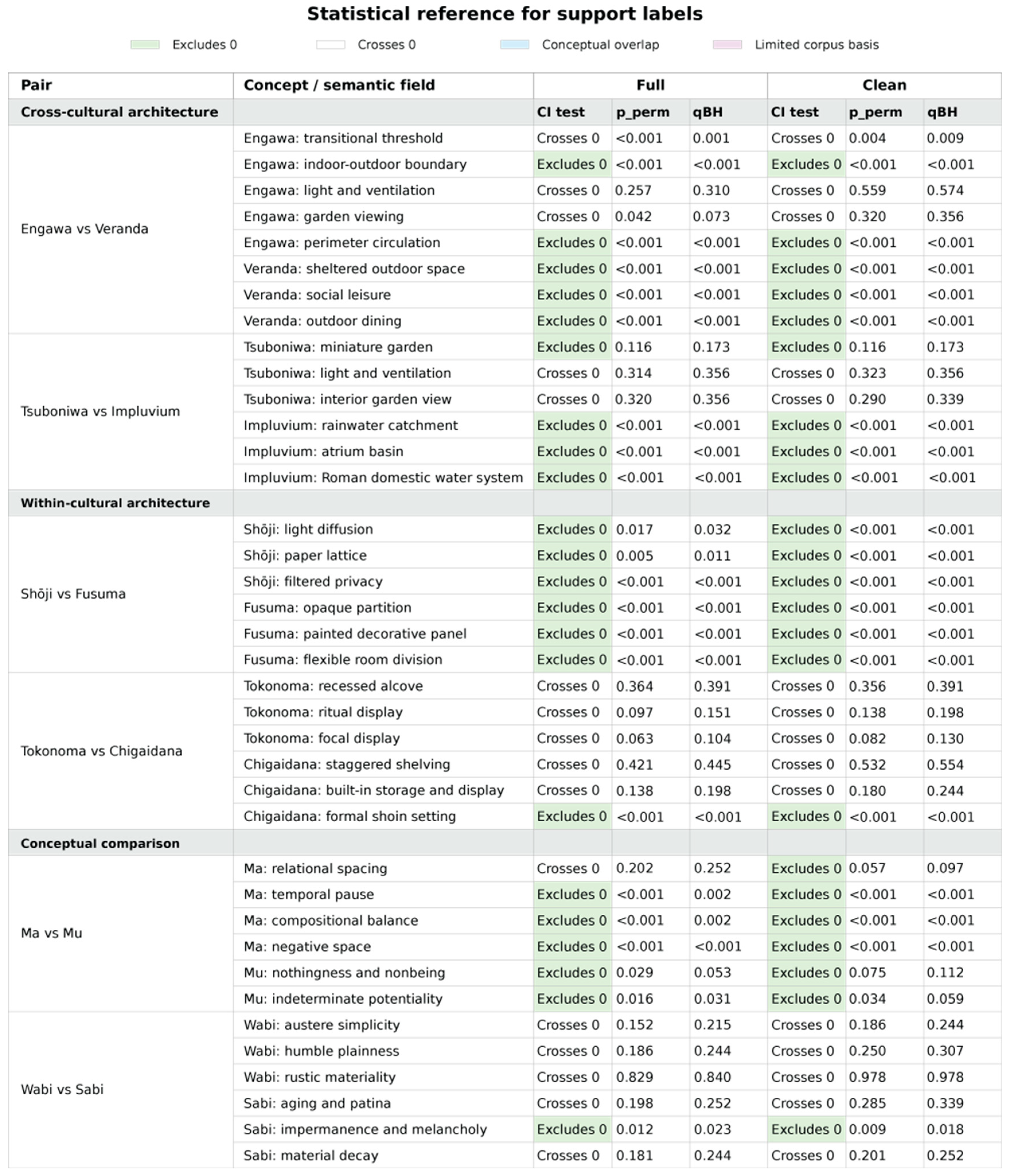
Appendix B. Reference Meanings of Selected Japanese Architectural Terms
Appendix B provides brief dictionary-based reference meanings for selected Japanese terms relevant to the study context. These entries are included as lexical orientation for readers, not as definitions imposed on the model or as statistical evidence. The computational analysis relies on contextual corpus occurrences, pair-specific concept fields, and the FULL/CLEAN audit, not on dictionary meanings.
- Chigaidana (違い棚): Set of staggered shelves [67].
- Engawa (縁側): (n) veranda; porch; balcony; open corridor [67].
- Fusuma (襖): (n) fusuma (Japanese sliding screen) [67].
- Impluvium: (in an ancient Roman building) a pool under an opening in the roof [68].
- Ma (間): (n-adv, n) space (between); gap; interval; distance; (n-adv, n-t) time (between); pause; break; (n-adv, n, n-t) span (temporal or spatial); stretch; period (while); (n-adv, n) relationship (between, among); (n) space; room; time; pause; (n, suf) interval; period of time; among; between; inter- [67].
- Mu (無): (n) nothing; naught nil; zero [67].
- Shōji (障子): (n) shōji (paper sliding door) [67].
- Tokonoma (床の間): (n) tokonoma (alcove where art or flowers are displayed) [67].
- Sabi (寂): (n) patina; antique look; elegant simplicity [67].
- Tsuboniwa (坪庭): (n) inner garden (esp. small, traditional); courtyard [67].
- Veranda/Verandah: A veranda is a roofed platform along the outside of a house [69].
- Wabi-Sabi (わびさび/侘寂): (n) aesthetic sense in Japanese art emphasizing quiet simplicity and subdued refinement [67].
Appendix C. Concept-Field Seed Lists
Appendix C provides the concept-field seed lists used to construct the tested semantic probes. In each field heading, the term named before the field identifies the hypothesized orientation of the probe, not an exclusive assignment of the seed list to that target. Every field centroid listed below was compared identically with both terms in the corresponding pair. The lead author constructed these seed lists during iterative calibration; they were not directly extracted from published sources or independently selected by multiple raters.
Appendix C.1. Engawa/Veranda
- -
- Engawa: transitional thresholdSeed terms: threshold; threshold-space; liminal; liminality; in-between; intermediary; transitional; transitional-zone; passage-between; mediating-space.
- -
- Engawa: indoor–outdoor boundarySeed terms: interior; exterior; indoors; outdoors; inside; outside; boundary; interface; adjacent; garden.
- -
- Engawa: light and ventilationSeed terms: daylight; filtered-light; light-admission; natural-light; ventilation; airflow; breeze; passive-cooling; cross-ventilation; seasonal-cooling.
- -
- Engawa: garden viewingSeed terms: garden; viewing; view; observation; contemplation; sitting; resting; prospect; seasonal; landscape.
- -
- Engawa: perimeter circulationSeed terms: perimeter; peripheral; corridor; walkway; passage; circulation; edge; route; exterior-corridor; covered-passage.
- -
- Veranda: sheltered outdoor spaceSeed terms: porch; roofed; covered; shelter; shade; protection; weather; rain; sun; outdoor.
- -
- Veranda: social leisureSeed terms: socializing; conversation; guests; entertaining; leisure; outdoor-living; relaxation; gathering; hospitality; recreation.
- -
- Veranda: outdoor diningSeed terms: dining; meal; breakfast; lunch; tea; coffee; drinks; table; refreshment; serving.
Appendix C.2. Tsuboniwa/Impluvium
- -
- Tsuboniwa: miniature gardenSeed terms: miniature-garden; small-garden; enclosed-garden; courtyard-garden; planted-court; moss; stones; planting; garden-composition; landscape-composition.
- -
- Tsuboniwa: light and ventilationSeed terms: daylight; light; ventilation; airflow; air; breeze; cooling; domestic; interior; opening; indirect-light.
- -
- Tsuboniwa: interior garden viewSeed terms: view; viewing; observation; prospect; visual; relief; interior; room; enclosed; outlook.
- -
- Impluvium: rainwater catchmentSeed terms: rainwater; collection; catchment; runoff; drainage; drain; channel; cistern; water-control; water-collection.
- -
- Impluvium: atrium basinSeed terms: atrium; basin; sunken-basin; pool; shallow-pool; courtyard; opening; roof; central; court; compluvium; collecting-basin.
- -
- Impluvium: Roman domestic water systemSeed terms: roman; domus; atrium; columns; house; villa; antiquity; household; drainage; water-system; domestic-water.
Appendix C.3. Shōji/Fusuma
- -
- Shōji: light diffusionSeed terms: translucent; translucency; daylight; light; light-filtering; filtered-light; filtering; diffused-light; diffusion; soft-light; glow.
- -
- Shōji: paper latticeSeed terms: paper; lattice; wooden-lattice; grid; frame; paper-frame; thin-paper; latticework; panel-frame; wooden-grid; japanese-paper; washi; light-diffusing.
- -
- Shōji: filtered privacySeed terms: partial-privacy; privacy; screen; barrier; translucent; semi-transparent; visual-filter; filtered-view; veiled; soft-boundary.
- -
- Fusuma: opaque partitionSeed terms: opaque; opacity; concealment; enclosure; closed; visual-barrier; private; seclusion; solid; blocked-view.
- -
- Fusuma: painted decorative panelSeed terms: painting; painted; decoration; decorative; artwork; image; motif; ornament; pictorial; decorated-panel.
- -
- Fusuma: flexible room divisionSeed terms: sliding; track; movable; partition; divider; room-divider; movable-wall; room-separation; flexible-space; interior-layout.
Appendix C.4. Tokonoma/Chigaidana
- -
- Tokonoma: recessed alcoveSeed terms: alcove; recess; niche; recessed-space; wall-recess; formal-alcove; focal-recess; architectural-recess; honored-alcove; alcove-space.
- -
- Tokonoma: ritual displaySeed terms: ritual; ceremonial; ceremony; sacred; offering; reverence; honorific; solemn; devotional; formal-placement.
- -
- Tokonoma: focal displaySeed terms: scroll; hanging-scroll; flower; ikebana; artwork; calligraphy; presentation; focal-point; ornamental-focus; contemplative-focus.
- -
- Chigaidana: staggered shelvingSeed terms: shelf; shelves; shelving; staggered-shelves; tiered-shelf; built-in-shelf; ledge; shelf-display; shelf-composition; stepped-shelves.
- -
- Chigaidana: built-in storage and displaySeed terms: storage; cabinet; built-in-furnishing; furnishing; fixture; interior-fitting; storage-display; decorative-storage; display-furniture; architectural-furniture.
- -
- Chigaidana: formal shoin settingSeed terms: shoin; shoin-zukuri; reception-room; tatami-room; zashiki; formal-room; traditional-room; elite-residence; room-composition; built-in-composition.
Appendix C.5. Ma/Mu
- -
- Ma: relational spacingSeed terms: interval; spacing; gap; distance; between; relation; adjacency; proportion; rhythm; measured-distance.
- -
- Ma: temporal pauseSeed terms: pause; silence; stillness; quiet; rest; suspension; breath; waiting; temporal-pause; hush.
- -
- Ma: compositional balanceSeed terms: relation; arrangement; composition; balance; proportion; rhythm; adjacency; coordination; relational-field; compositional-order.
- -
- Ma: negative spaceSeed terms: void; emptiness; blank; vacant; hollow; unfilled; negative-space; blankness; empty-field; spatial-void.
- -
- Mu: nothingness and nonbeingSeed terms: nothingness; nonbeing; nonexistence; nullity; negation; nihil; no-thing; unbeing; nonentity; ontological-absence.
- -
- Mu: indeterminate potentialitySeed terms: potential; possibility; latent; indeterminate; undefined; receptive; open-ended; emergence; unrealized; formless.
Appendix C.6. Wabi/Sabi
- -
- Wabi: austere simplicitySeed terms: austere; spare; minimal; simplicity; reduced; bare; ascetic; unembellished; severe; restrained.
- -
- Wabi: humble plainnessSeed terms: humble; modest; plain; unpretentious; frugal; unassuming; self-effacing; poverty; ordinary; simple.
- -
- Wabi: rustic materialitySeed terms: rustic; raw; natural; earth; wood; stone; texture; handmade; grain; tactile.
- -
- Sabi: aging and patinaSeed terms: aged; weathered; patina; oxidation; faded; worn; surface; time-marked; tarnish; mellowed.
- -
- Sabi: impermanence and melancholySeed terms: transient; impermanent; fleeting; ephemeral; melancholy; solitude; loneliness; wistful; contemplative; passing.
- -
- Sabi: material decaySeed terms: decay; deterioration; withering; desolation; ruin; erosion; crumbling; dilapidation; oldness; decline.
Appendix D. Engawa/Veranda Seed-Sensitivity Configurations
Appendix D lists the lexical composition of the eight Engawa_TransitionalThreshold configurations used in the targeted seed-sensitivity analysis. The baseline configuration reproduces the “Engawa: transitional threshold” seed set listed in Appendix C.1 and is repeated here so that all sensitivity-analysis configurations are documented together. The configurations comprise the reported baseline, three reduced multi-indicator variants, three single-indicator component probes, and one two-indicator boundary–transitional probe. All eight configurations were applied identically to engawa and veranda under FULL and CLEAN using the same context-level tokenization, bootstrap, permutation, and multiple-comparison-correction settings as the main analysis. The results of this test are summarized in Section 3.2 and visualized with 95% bootstrap confidence intervals in Figure 7.
- -
- Engawa: transitional threshold “Baseline”Seed terms: threshold; threshold-space; liminal; liminality; in-between; intermediary; transitional; transitional-zone; passage-between; mediating-space.
- -
- Engawa: transitional threshold “No-in-between”Seed terms: threshold; threshold-space; liminal; liminality; intermediary; transitional; transitional-zone; passage-between; mediating-space.
- -
- Engawa: transitional threshold “Reduced”Seed terms: threshold; threshold-space; in-between; transitional; transitional-zone; passage-between; mediating-space.
- -
- Engawa: transitional threshold “Core”Seed terms: threshold; in-between; transitional; passage-between; mediating.
- -
- Engawa: transitional threshold “Boundary & transitional only”Seed terms: boundary; transitional.
- -
- Engawa: transitional threshold “Boundary only”Seed terms: boundary.
- -
- Engawa: transitional threshold “Transitional only”Seed terms: transitional.
- -
- Engawa: transitional threshold “In-between only”Seed terms: in-between.
References
- Bachelard, G. The Poetics of Space; Beacon Press: Boston, MA, USA, 1994; ISBN 0-8070-6473-4. [Google Scholar]
- Eco, U. Function and Sign: Semiotics of Architecture. In The City and the Sign: An Introduction to Urban Semiotics; Gottdiener, M., Lagopoulos, A.P., Eds.; Columbia University Press: Chichester, NY, USA, 1986; pp. 55–86. ISBN 978-0-231-89254-4. [Google Scholar]
- Forty, A. Words and Buildings: A Vocabulary of Modern Architecture; Thames & Hudson: New York, NY, USA, 2004; ISBN 978-0-500-28470-4. [Google Scholar]
- Norberg-Schulz, C. Genius Loci: Towards a Phenomenology of Architecture; Rizzoli International Publications Inc.: New York, NY, USA, 1980; ISBN 978-0-8478-0287-6. [Google Scholar]
- Pallasmaa, J. The Eyes of the Skin: Architecture and the Senses, 4th ed.; Wiley: Hoboken, NJ, USA, 2024; ISBN 978-1-394-20070-2. [Google Scholar]
- Rossi, A. The Architecture of the City; MIT Press: Cambridge, MA, USA, 1982; ISBN 978-0-262-18101-3. [Google Scholar]
- Venturi, R. Complexity and Contradiction in Architecture, 2nd ed.; Museum of Modern Art: New York, NY, USA, 1977; ISBN 0-8109-6023-0. [Google Scholar]
- Cash, P.J. Developing Theory-Driven Design Research. Des. Stud. 2018, 56, 84–119. [Google Scholar] [CrossRef] [Scilit]
- Garda, E.; Mangosio, M.; Pastore, L. Learning from the Past: The Lesson of the Japanese House. WIT Trans. Built Environ. 2017, 171, 275–284. [Google Scholar] [CrossRef] [Scilit]
- Ek, F.İ. The Narration of Architectural Space as a Way of Constructing the Spatial Atmosphere: Two Readings of Contemporary Japanese Architecture. Philos. East West 2022, 72, 99–117. [Google Scholar] [CrossRef] [Scilit]
- Kurokawa, K. Each One A Hero: The Philosophy of Symbiosis, Chapter 8: Intermediary Space. Available online: https://www.kisho.co.jp/page/305.html (accessed on 12 May 2026).
- Li, L.; Chen, Y.; Li, H. Reimagining Kyokai: Layered Permeability in Yoshiji Takehara’s Modern Residences. Buildings 2025, 15, 1591. [Google Scholar] [CrossRef] [Scilit]
- Nuijsink, C. From “Container” to “Lifestyle:“ Kazuyo Sejima, Sou Fujimoto and the Destruction of the Nuclear Family Box. Interiors 2021, 11, 132–156. [Google Scholar] [CrossRef] [Scilit]
- Shigaki, T. GROUND HOUSE: A Case Study of a Cognitively Diverse Space. Jpn. Archit. Rev. 2023, 6, e12360. [Google Scholar] [CrossRef] [Scilit]
- Hensel, M.U. Performance-Oriented Architecture and the Spatial and Material Organisation Complex: Rethinking the Definition, Role and Performative Capacity of the Spatial and Material Boundaries of the Built Environment. FORMakademisk 2011, 4, 3–23. [Google Scholar] [CrossRef] [Scilit]
- Hillier, B.; Hanson, J. The Social Logic of Space; Cambridge University Press: Cambridge, UK, 1984; ISBN 978-0-521-36784-4. [Google Scholar]
- Kim, J. A Reexamination of Sekkyaku-Honi (接客本位) in Edo Middle-Lower Samurai Residences from a Space Syntax Perspective: Reinterpreting Spatial Evolution in Modern Japanese Urban Housing. J. Asian Archit. Build. Eng. 2025, 1–33. [Google Scholar] [CrossRef] [Scilit]
- Isozaki, A. Japan-Ness in Architecture; Stewart, D.B., Ed.; MIT Press: Cambridge, MA, USA, 2006; ISBN 978-0-262-09038-4. [Google Scholar]
- Nitschke, G. From Shinto to Ando: Studies in Architectural Anthropology in Japan; Academy Editions: London, UK; Ernst & Sohn: Berlin, Germany, 1993; ISBN 978-1-85490-289-4. [Google Scholar]
- Pilgrim, R.B. Intervals (“Ma”) in Space and Time: Foundations for a Religio-Aesthetic Paradigm in Japan. Hist. Relig. 1986, 25, 255–277. [Google Scholar] [CrossRef] [Scilit] [PubMed]
- Keane, M.P. Japanese Courtyard Gardens. Kyoto J. 2016. Available online: https://kyotojournal.org/gardens/tsubo-niwa-japanese-courtyard-gardens/ (accessed on 12 May 2026).
- Lockey, I. Roman Housing. Available online: https://www.metmuseum.org/essays/roman-housing (accessed on 12 May 2026).
- Roman Housing (Houses and Villas). Available online: https://pompeiisites.org/en/pompeii-map/analysis/roman-housing/ (accessed on 12 May 2026).
- HarperCollins Publishers Atrium. Collins English Dictionary. Available online: https://www.collinsdictionary.com/dictionary/english/atrium (accessed on 10 March 2026).
- Marra, M. Modern Japanese Aesthetics: A Reader; University of Hawai’i Press: Honolulu, HI, USA, 1999; ISBN 978-0-8248-2173-9. [Google Scholar]
- Saito, Y. Everyday Aesthetics; Oxford University Press: Oxford, NY, USA, 2007; ISBN 978-0-19-957567-1. [Google Scholar]
- Caetano, I.; Santos, L.; Leitão, A. Computational Design in Architecture: Defining Parametric, Generative, and Algorithmic Design. Front. Archit. Res. 2020, 9, 287–300. [Google Scholar] [CrossRef] [Scilit]
- Ding, Y.; Ma, J.; Luo, X. Applications of Natural Language Processing in Construction. Autom. Constr. 2022, 136, 104169. [Google Scholar] [CrossRef] [Scilit]
- Horvath, A.-S. How We Talk(Ed) about It: Ways of Speaking about Computational Architecture. Int. J. Archit. Comput. 2022, 20, 150–175. [Google Scholar] [CrossRef] [Scilit]
- Klavans, J.L.; Sheffield, C.; Abels, E.; Lin, J.; Passonneau, R.; Sidhu, T.; Soergel, D. Computational Linguistics for Metadata Building (CLiMB): Using Text Mining for the Automatic Identification, Categorization, and Disambiguation of Subject Terms for Image Metadata. Multimed. Tools Appl. 2009, 42, 115–138. [Google Scholar] [CrossRef] [Scilit]
- Moretti, F. Distant Reading; Verso: London, UK, 2013; ISBN 978-1-78168-084-1. [Google Scholar]
- Da, N.Z. The Computational Case against Computational Literary Studies. Crit. Inq. 2019, 45, 601–639. [Google Scholar] [CrossRef] [Scilit] [PubMed]
- Devlin, J.; Chang, M.-W.; Lee, K.; Toutanova, K. BERT: Pre-Training of Deep Bidirectional Transformers for Language Understanding. In Proceedings of the 2019 Conference of the North American Chapter of the Association for Computational Linguistics: Human Language Technologies, Volume 1 (Long and Short Papers); Burstein, J., Doran, C., Solorio, T., Eds.; Association for Computational Linguistics: Minneapolis, MN, USA, 2019; pp. 4171–4186. [Google Scholar]
- Vaswani, A.; Shazeer, N.; Parmar, N.; Uszkoreit, J.; Jones, L.; Gomez, A.N.; Kaiser, Ł.; Polosukhin, I. Attention Is All You Need. In Proceedings of the Advances in Neural Information Processing Systems; Curran Associates, Inc.: Long Beach, CA, USA, 2017; Volume 30. [Google Scholar]
- Erk, K. Vector Space Models of Word Meaning and Phrase Meaning: A Survey. Lang. Linguist. Compass 2012, 6, 635–653. [Google Scholar] [CrossRef] [Scilit]
- Ethayarajh, K. How Contextual Are Contextualized Word Representations? Comparing the Geometry of BERT, ELMo, and GPT-2 Embeddings. In Proceedings of the 2019 Conference on Empirical Methods in Natural Language Processing and the 9th International Joint Conference on Natural Language Processing (EMNLP-IJCNLP); Inui, K., Jiang, J., Ng, V., Wan, X., Eds.; Association for Computational Linguistics: Hong Kong, China, 2019; pp. 55–65. [Google Scholar]
- Haber, J.; Poesio, M. Polysemy—Evidence from Linguistics, Behavioral Science, and Contextualized Language Models. Comput. Linguist. 2024, 50, 351–417. [Google Scholar] [CrossRef] [Scilit]
- Gjata, G.; Yamada, S. Reproducibility and Validation of a Computational Framework for Architectural Semantics: A Methodological Study with Japanese Architectural Concepts. Buildings 2025, 15, 4107. [Google Scholar] [CrossRef] [Scilit]
- Gjata, G.; Yamada, S. Quantitative Mapping of Conceptual Hierarchies and Data-Driven Taxonomies of Japanese Architectural Concepts: A 28-Term Testbed. Architecture 2026, 6, 62. [Google Scholar] [CrossRef] [Scilit]
- Adcock, R.; Collier, D. Measurement Validity: A Shared Standard for Qualitative and Quantitative Research. Am. Political Sci. Rev. 2001, 95, 529–546. [Google Scholar] [CrossRef] [Scilit]
- Hamilton, W.L.; Clark, K.; Leskovec, J.; Jurafsky, D. Inducing Domain-Specific Sentiment Lexicons from Unlabeled Corpora. In Proceedings of the 2016 Conference on Empirical Methods in Natural Language Processing; Su, J., Duh, K., Carreras, X., Eds.; Association for Computational Linguistics: Austin, TX, USA, 2016; pp. 595–605. [Google Scholar]
- Davison, A.C.; Hinkley, D.V. Bootstrap Methods and Their Application; Cambridge Series in Statistical and Probabilistic Mathematics; Cambridge University Press: Cambridge, UK, 1997; ISBN 978-0-521-57471-6. [Google Scholar]
- Benjamini, Y.; Hochberg, Y. Controlling the False Discovery Rate: A Practical and Powerful Approach to Multiple Testing. J. R. Stat. Soc. Ser. B (Methodol.) 1995, 57, 289–300. [Google Scholar] [CrossRef] [Scilit]
- Benjamini, Y.; Yekutieli, D. The Control of the False Discovery Rate in Multiple Testing under Dependency. Ann. Stat. 2001, 29, 1165–1188. [Google Scholar] [CrossRef] [Scilit]
- Holm, S. A Simple Sequentially Rejective Multiple Test Procedure. Scand. J. Stat. 1979, 6, 65–70. [Google Scholar]
- Sullivan, G.M.; Feinn, R. Using Effect Size—Or Why the P Value Is Not Enough. J. Grad. Med. Educ. 2012, 4, 279–282. [Google Scholar] [CrossRef] [Scilit] [PubMed]
- Wasserstein, R.L.; Lazar, N.A. The ASA Statement on P-Values: Context, Process, and Purpose. Am. Stat. 2016, 70, 129–133. [Google Scholar] [CrossRef] [Scilit]
- Parent, M.N. Engawa 縁側. JAANUS: Japanese Architecture and Art Net Users System 2001. Available online: https://www.aisf.or.jp/~jaanus/deta/e/engawa.htm (accessed on 19 February 2026).
- Parent, M.N. Fusuma 襖. JAANUS: Japanese Architecture and Art Net Users System 2001. Available online: https://www.aisf.or.jp/~jaanus/deta/f/fusuma.htm (accessed on 19 February 2026).
- Parent, M.N. Akarishouji 明障子. JAANUS: Japanese Architecture and Art Net Users System 2001. Available online: https://www.aisf.or.jp/~jaanus/deta/a/akarishouji.htm (accessed on 19 February 2026).
- Parent, M.N. Kakeshouji 掛障子. JAANUS: Japanese Architecture and Art Net Users System 2001. Available online: https://www.aisf.or.jp/~jaanus/deta/k/kakeshouji.htm (accessed on 19 February 2026).
- Parent, M.N. Shouji 障子. JAANUS: Japanese Architecture and Art Net Users System 2001. Available online: https://www.aisf.or.jp/~jaanus/deta/s/shouji.htm (accessed on 19 February 2026).
- Tanizaki, J. In Praise of Shadows; Leete’s Island Books: Stony Creek, CT, USA, 1977; ISBN 978-0-918172-02-0. [Google Scholar]
- The Editors of Encyclopædia Britannica Shoin-Zukuri. Available online: https://www.britannica.com/art/shoin-zukuri (accessed on 20 April 2026).
- Ono, K.; Edwards, W. Shoin Style 書院造. Japanese Garden Dictionary: A Glossary for Japanese Gardens and Their History 2010. Available online: https://www.nabunken.go.jp/org/bunka/jgd/pages/ShoinStyle.html (accessed on 13 May 2026).
- Parent, M.N. Shoin 書院. Japanese Architecture and Art Net Users System (JAANUS) 2001. Available online: https://www.aisf.or.jp/~jaanus/deta/s/shoin.htm (accessed on 24 May 2026).
- The Editors of Encyclopædia Britannica Chigai-Dana. Available online: https://www.britannica.com/technology/chigai-dana (accessed on 20 February 2026).
- Parent, M.N. Chigaidana 違い棚. JAANUS: Japanese Architecture and Art Net Users System 2001. Available online: https://www.aisf.or.jp/~jaanus/deta/c/chigaidana.htm (accessed on 24 May 2026).
- Parent, M.N. Tokonoma 床の間. JAANUS: Japanese Architecture and Art Net Users System 2001. Available online: https://www.aisf.or.jp/~jaanus/deta/t/tokonoma.htm (accessed on 24 May 2026).
- Asian Art Museum Teahouse Alcove (Tokonoma). Available online: https://education.asianart.org/resources/teahouse-alcove-tokonoma/ (accessed on 13 May 2026).
- Parent, M.N. Shoin-Zukuri 書院造. JAANUS: Japanese Architecture and Art Net Users System 2001. Available online: https://www.aisf.or.jp/~jaanus/deta/s/shoinzukuri.htm (accessed on 24 May 2026).
- Maraldo, J.C. Nishida Kitarō. The Stanford Encyclopedia of Philosophy 2024. Available online: https://plato.stanford.edu/entries/nishida-kitaro/ (accessed on 23 May 2026).
- Carter, R.; McCarthy, E. “Watsuji Tetsurō”, The Stanford Encyclopedia of Philosophy (Winter 2019 Edition), Edward N. Zalta (ed.), 2019. Available online: https://plato.stanford.edu/archives/win2019/entries/watsuji-tetsuro/ (accessed on 27 July 2025).
- Komorebi 木漏れ日. Available online: https://www.chicagobotanic.org/nature-and-wellness/komorebi (accessed on 21 July 2026).
- Har, A.O. Ma and Traditional Japanese Aesthetics in Spatial Music and Sonic Art. Organised Sound 2025, 30, 152–163. [Google Scholar] [CrossRef] [Scilit]
- Wagemans, J.; Elder, J.H.; Kubovy, M.; Palmer, S.E.; Peterson, M.A.; Singh, M.; von der Heydt, R. A Century of Gestalt Psychology in Visual Perception I. Perceptual Grouping and Figure-Ground Organization. Psychol. Bull. 2012, 138, 1172–1217. [Google Scholar] [CrossRef] [Scilit] [PubMed]
- Hai, B.H. RomajiDesu English Japanese Dictionary. Available online: http://www.romajidesu.com/dictionary/ (accessed on 7 November 2025).
- Collins English Dictionary Impluvium. Collins English Dictionary. Available online: https://www.collinsdictionary.com/dictionary/english/impluvium (accessed on 10 March 2026).
- Collins English Dictionary Veranda. Collins English Dictionary. Available online: https://www.collinsdictionary.com/dictionary/english/veranda (accessed on 10 March 2026).
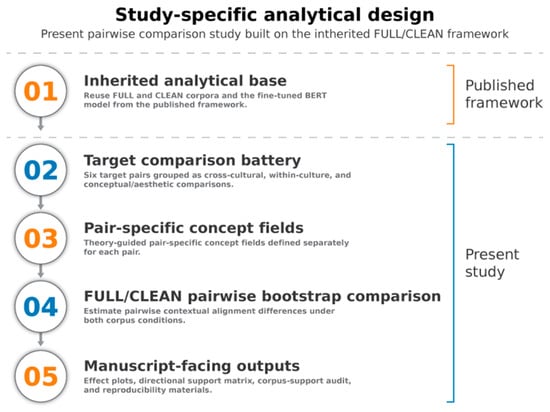
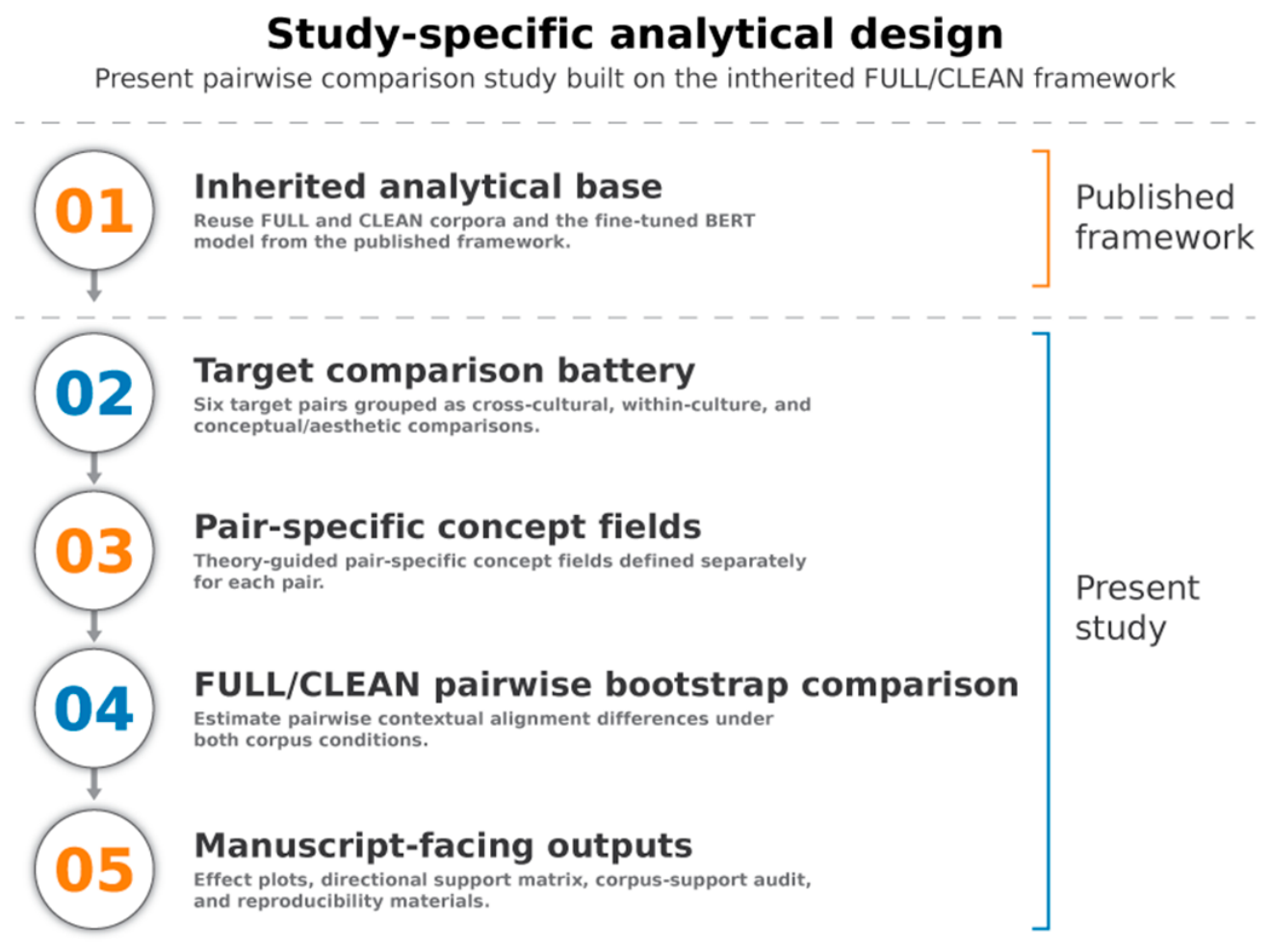
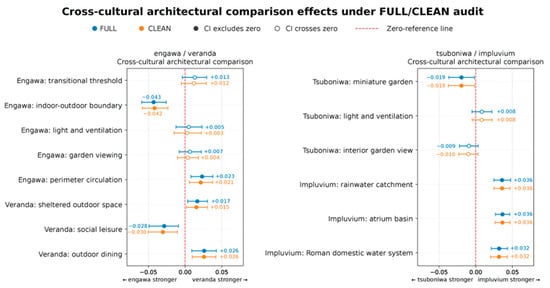
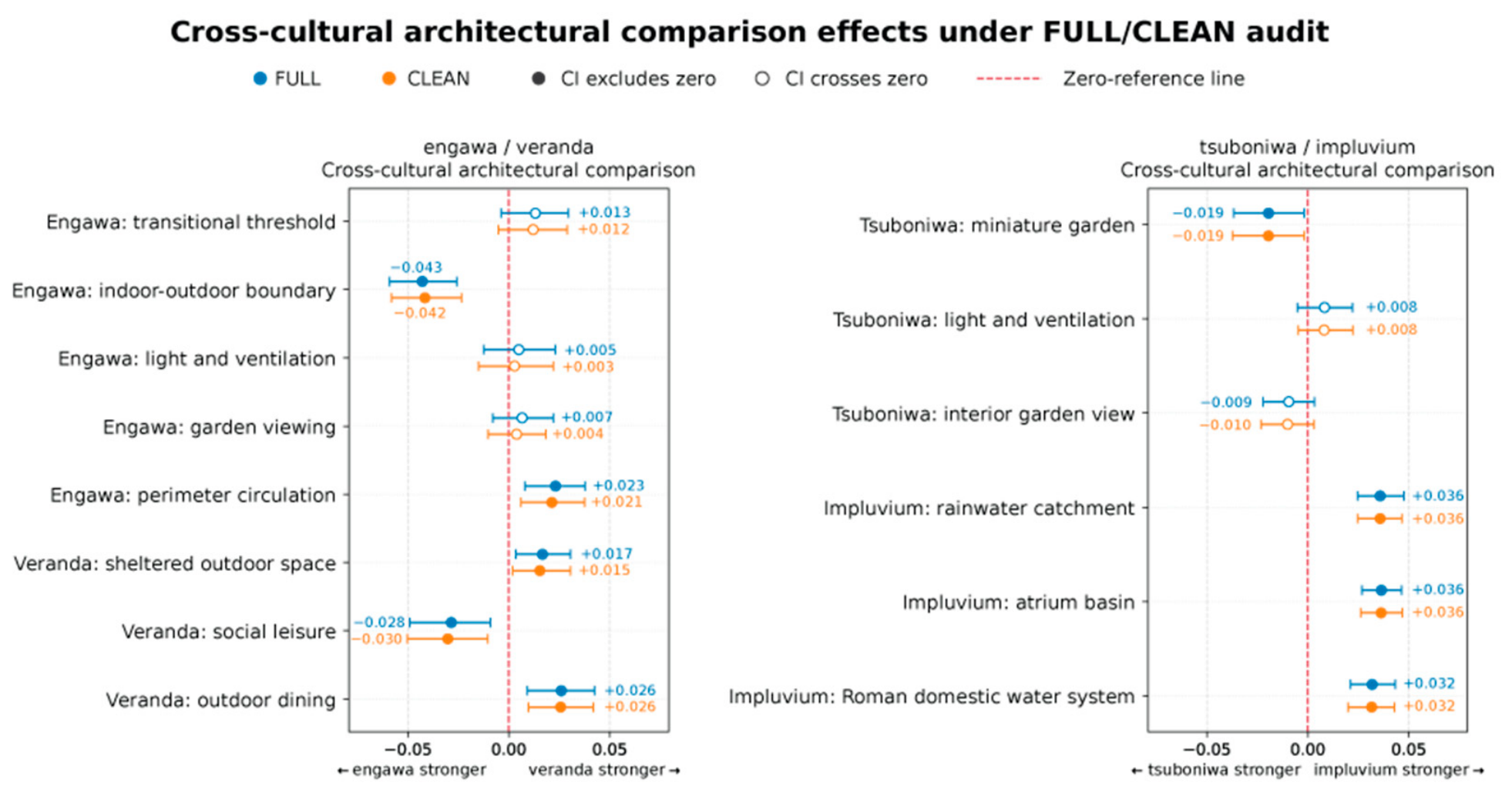
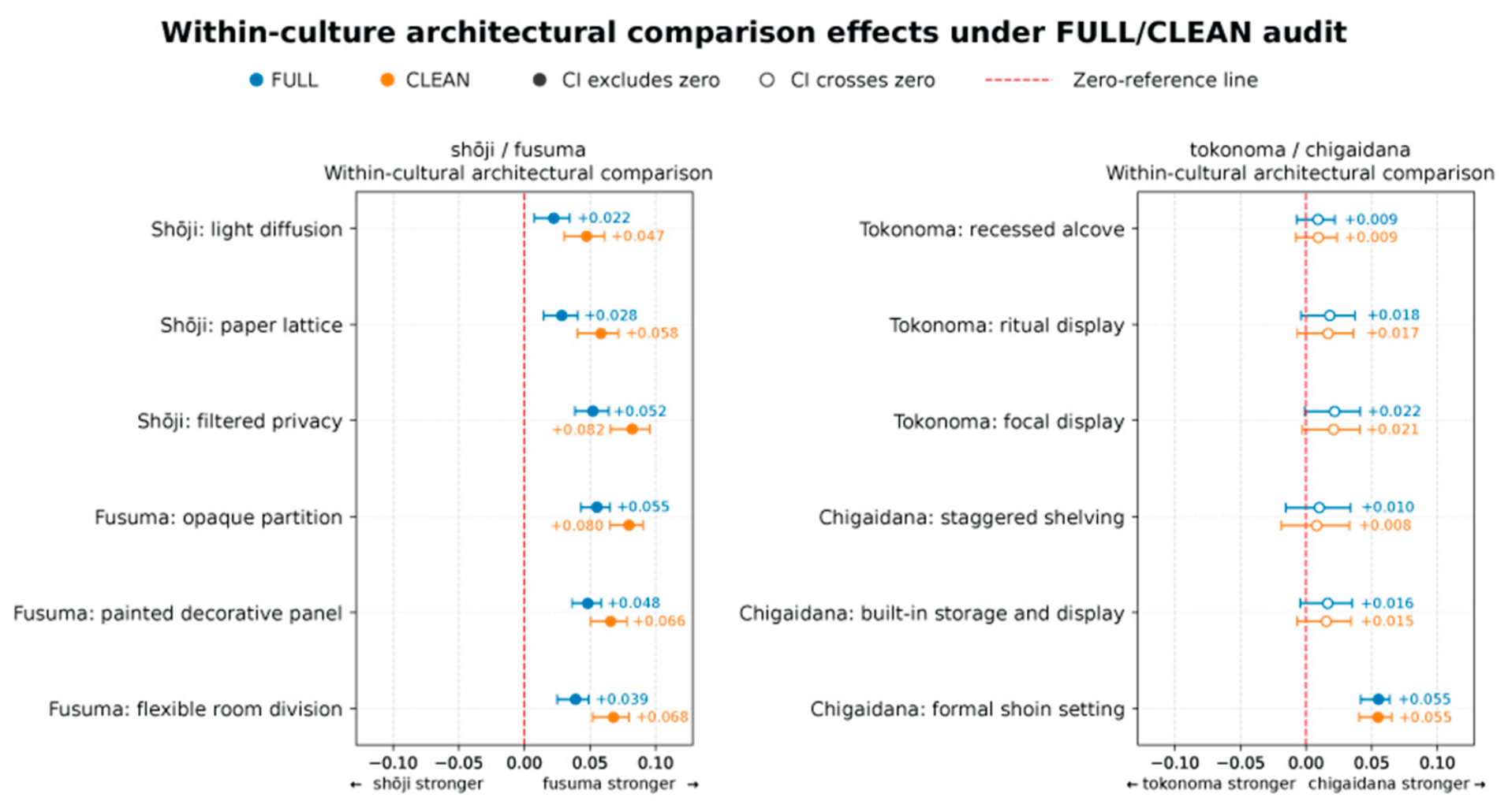
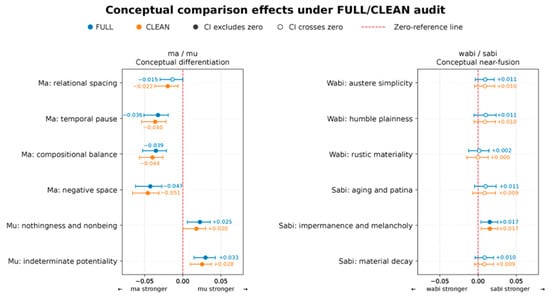
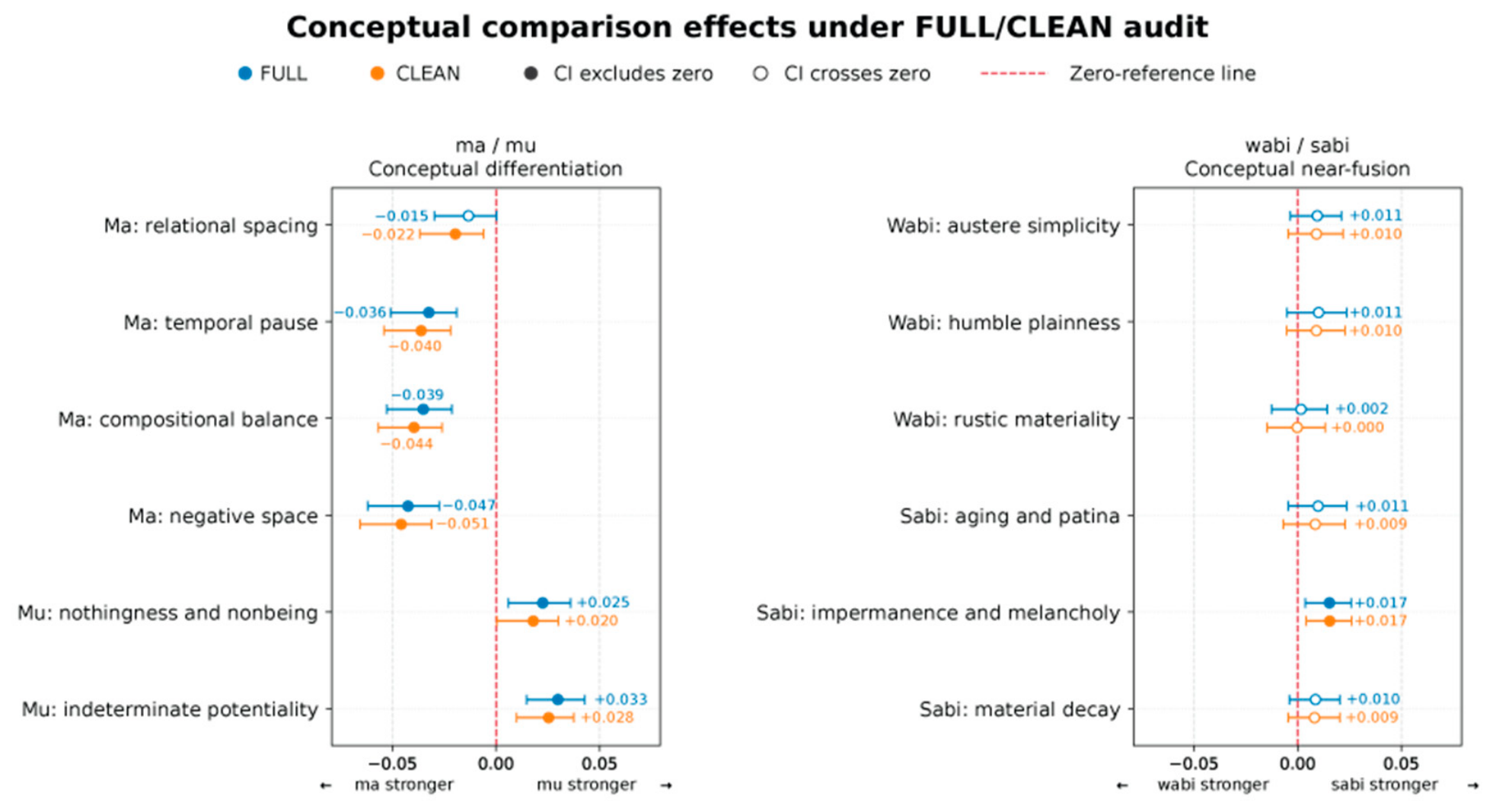
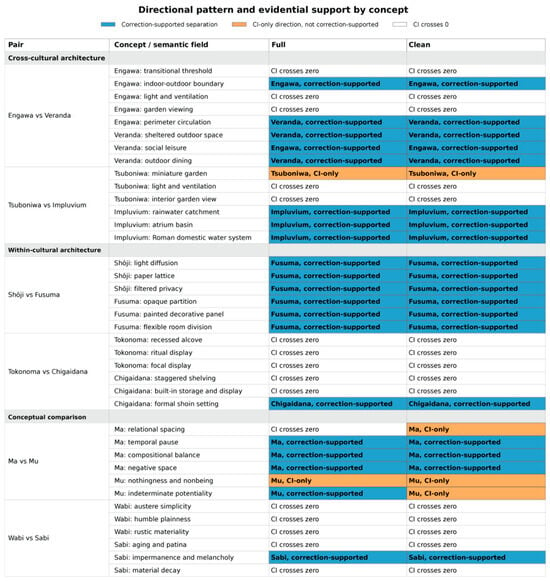
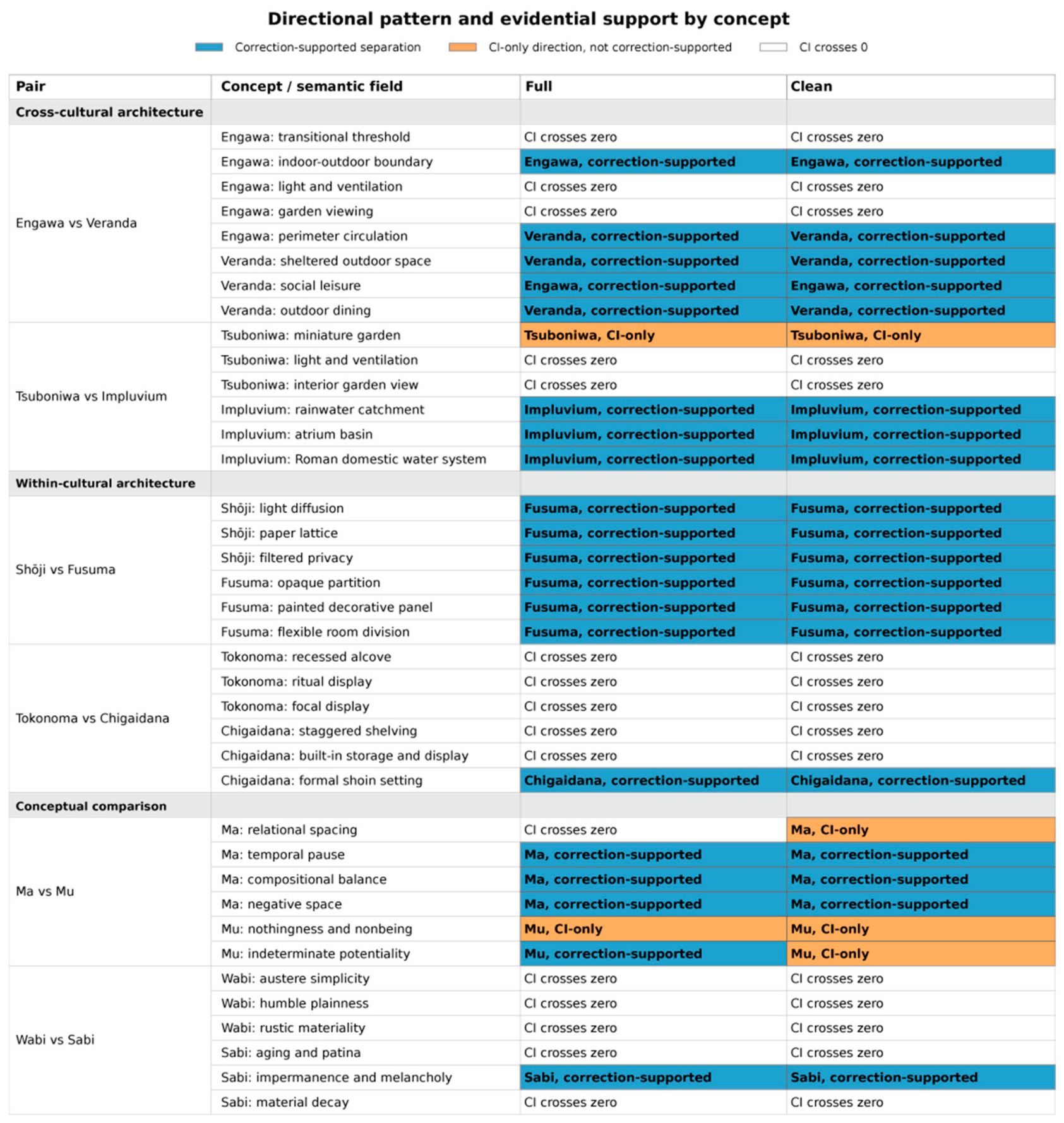
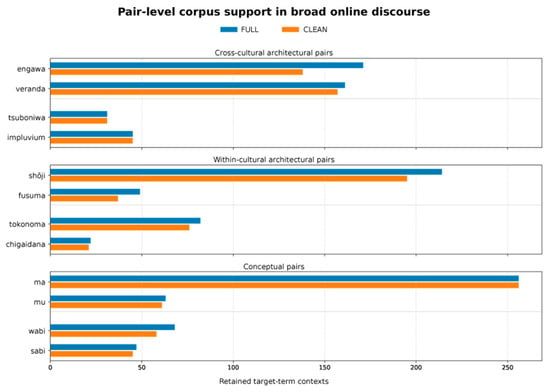
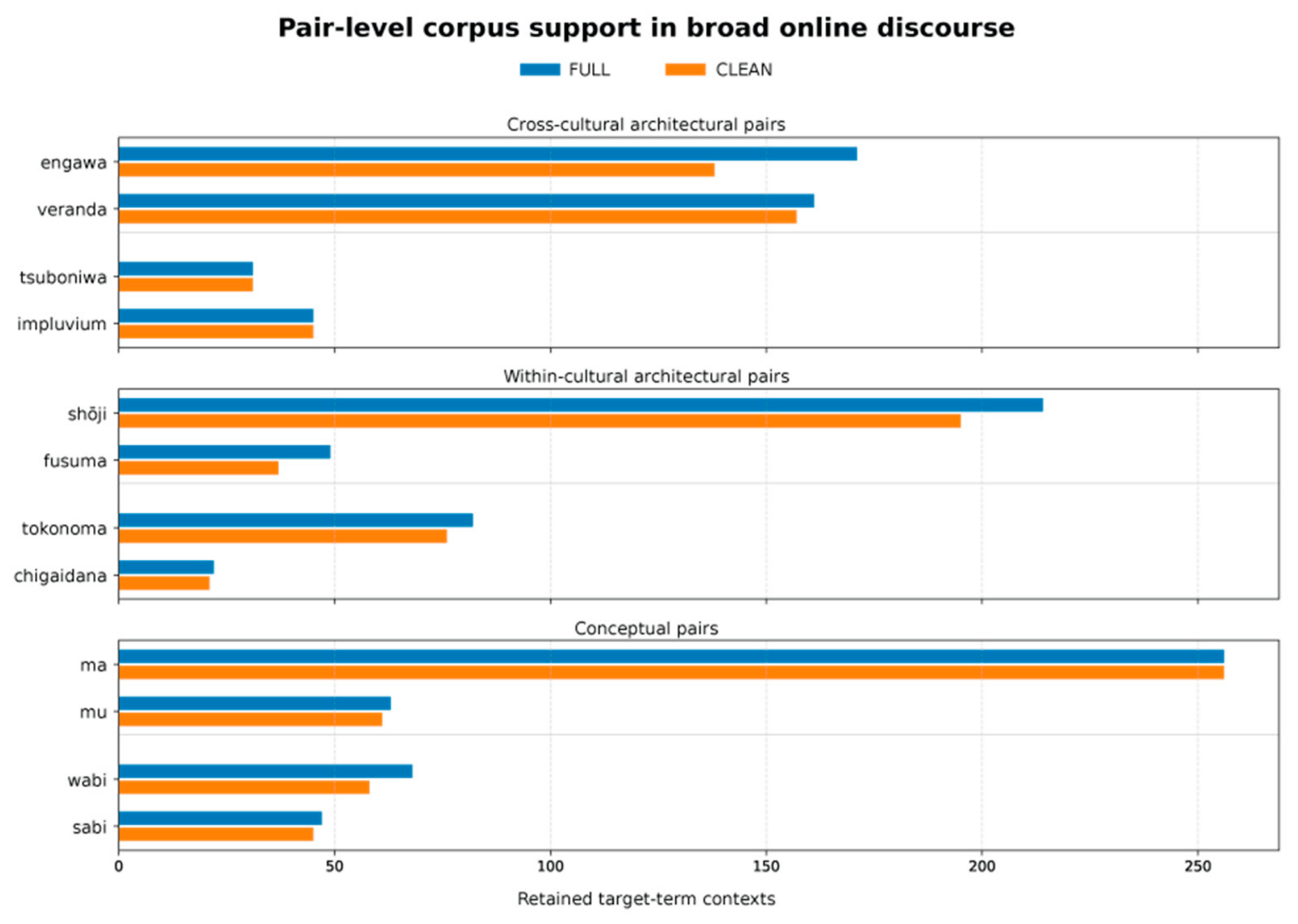
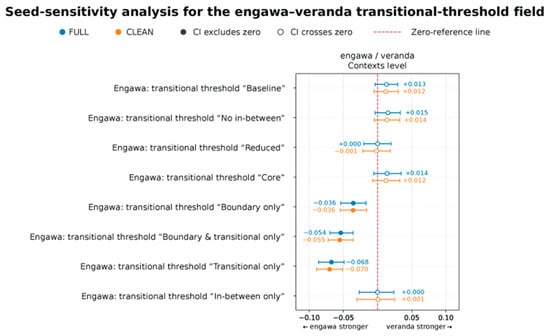
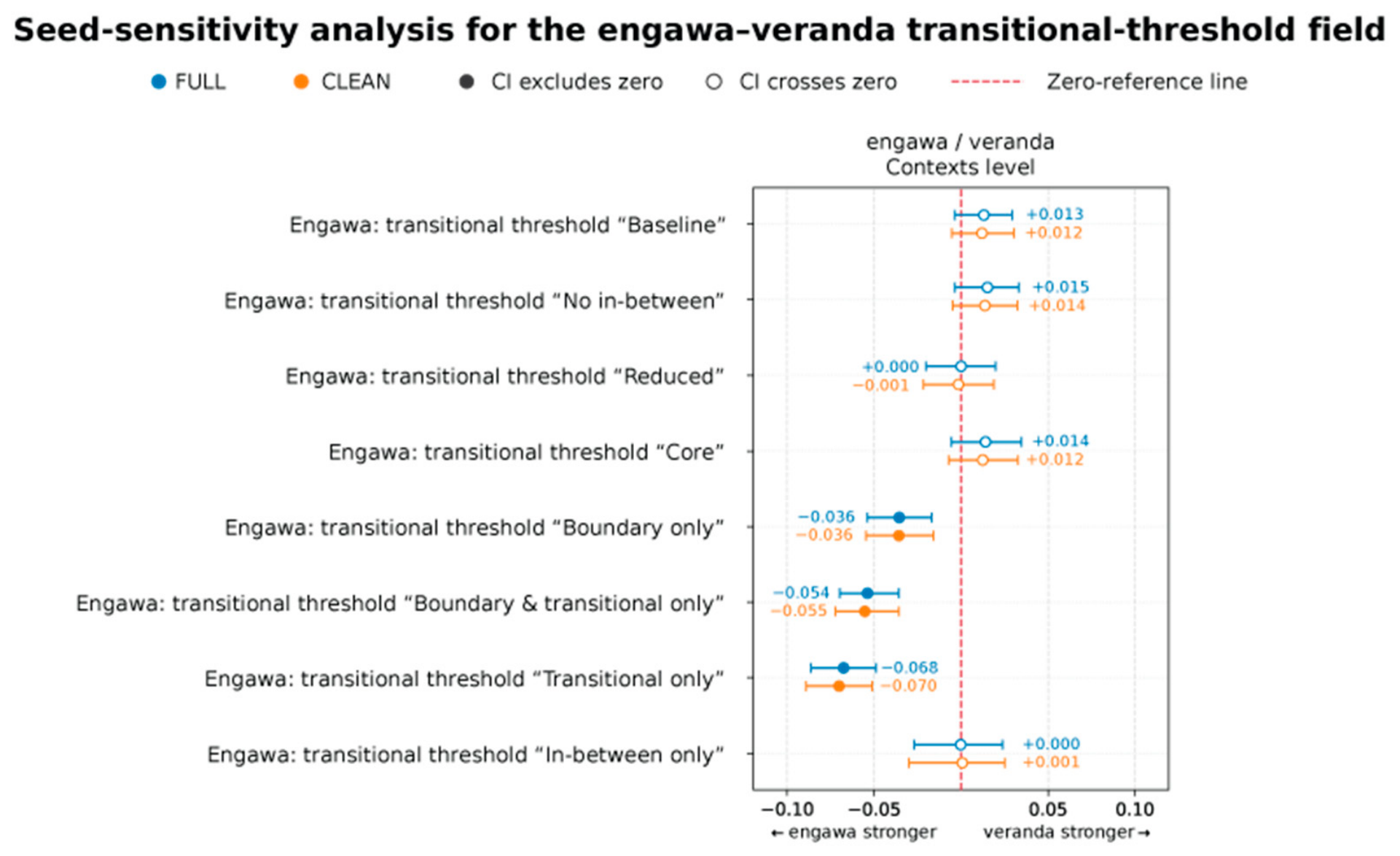

Disclaimer/Publisher’s Note: The statements, opinions and data contained in all publications are solely those of the individual author(s) and contributor(s) and not of MDPI and/or the editor(s). MDPI and/or the editor(s) disclaim responsibility for any injury to people or property resulting from any ideas, methods, instructions or products referred to in the content. |
© 2026 by the authors. Licensee MDPI, Basel, Switzerland. This article is an open access article distributed under the terms and conditions of the Creative Commons Attribution (CC BY) license.