


Abstract
Microplastics have become contaminants of increasing concern in coastal environments and aquaculture systems because of their persistence, diversity of sizes and polymers, and capacity to interact with organisms and other pollutants. This systematic review critically synthesizes evidence on microplastic contamination relevant to the genus Litopenaeus, with emphasis on occurrence and characteristics, environmental exposure pathways, biological effects, anthropogenic sources, and methodological heterogeneity. Database searches covering 2013–2025 identified 537 records; after removal of 143 duplicates, title/abstract screening, and full-text eligibility assessment, 66 primary studies were included in the qualitative synthesis. Direct evidence is concentrated on L. vannamei, in which particles have been documented in the gastrointestinal tract, gills, hepatopancreas, muscle, and exoskeleton. Fibres and fragments recur frequently, with PE, PP, PET/polyester, PA/nylon, and PS among the commonly identified polymers. Experimental assays report oxidative stress, histological damage, dysbiosis, immunometabolism alterations; changes in growth, swimming, feeding and olfaction, and modified responses to co-exposed contaminants. Environmental studies identify sediments, water, feed, and aquaculture infrastructure as exposure compartments or pathways, while wastewater, solid waste, fishing, aquaculture, agriculture, industry, ports, rivers, and drainage networks emerge as potential pressure factors. Methodological differences in sampling, digestion, density separation, size limits, quantitative units, and chemical confirmation restrict quantitative comparability and preclude a global meta-analysis. This review integrates sources, entry routes, environmental matrices, shrimp exposure, and biological responses and identifies priorities for methodological standardisation and direct research on L. setiferus.
1. Introduction
Microplastics (MPs), defined as plastic particles smaller than 5 mm [1], are emerging contaminants of growing concern in coastal environments and aquaculture systems owing to their persistence, the wide range of sizes and polymer types they encompass and their capacity to interact with organisms and other pollutants. They are classified as primary, when intentionally manufactured at these dimensions, or secondary, when derived from the fragmentation of larger items [1]. MPs have been documented in the water, sediments and biota of coastal lagoons worldwide [2]. Land-based inputs are a major source: in 2010 alone, an estimated 4.8–12.7 million tonnes of plastic waste generated in 192 coastal countries entered the ocean [3]. In aquaculture, the widespread use of nets, pipes, tanks, feeding systems and geomembrane liners constitutes an additional source [4,5], as the weathering of these materials by solar radiation, salinity and mechanical abrasion releases particles into the surrounding environment [6]. External inputs, such as urban runoff, domestic wastewater and contaminated intake water, further increase MP loads in these systems [7].
Once in the environment, MPs can be ingested by fish and crustaceans and accumulate in their tissues, where they have been associated with physical damage, oxidative stress, inflammatory responses, digestive and metabolic disturbances and impaired reproduction [8,9]. The severity of these effects varies with particle size and concentration [10,11]. MPs may also facilitate the transfer of chemical additives and hydrophobic pollutants to biota [12] and act as vectors for heavy metals, antibiotics and antibiotic-resistant bacteria [13]. Consequently, their occurrence in species intended for human consumption raises concerns regarding food safety; although evidence of adverse effects in humans remains limited and the current risks are generally considered low, environmental microplastic concentrations are projected to rise [14].
Among the commercially important organisms potentially exposed to these particles are shrimp of the genus Litopenaeus, which support both capture fisheries and aquaculture in tropical and subtropical regions. The genus Litopenaeus comprises the species L. vannamei, L. setiferus, L. stylirostris, L. schmitti and L. occidentalis. Its economic importance is most evident in L. vannamei: according to the Food and Agriculture Organization of the United Nations (FAO), global production of this species reached approximately 6.8 million tonnes in 2022, mainly through aquaculture [15]. This species accounted for nearly 83% of the global shrimp production analysed by Villarreal and Juarez [16], who also reported that Ecuadorian production exceeded one million tonnes in 2021, worth US$5.3 billion. The genus is also important for capture fisheries: the National Marine Fisheries Service of the US National Oceanic and Atmospheric Administration (NOAA Fisheries) recorded commercial landings of L. setiferus of approximately 48,500 tonnes in 2024, valued at US$159 million [17].
From an ecological perspective, shrimp of the genus Litopenaeus form part of the food webs in estuaries and coastal lagoons. Juveniles feed on small bottom-dwelling invertebrates and are in turn preyed upon by other aquatic animals, thereby contributing to the transfer of matter and energy; moreover, predation by juvenile L. setiferus can reduce the abundance of estuarine benthic macroinvertebrates [18]. The life cycle of this shrimp depends on a range of coastal habitats that provide feeding, refuge and nursery grounds [19]. The distribution of juvenile L. setiferus responds to habitat characteristics, with higher densities along flooded marsh edges [20]. In Louisiana salt marshes undergoing mangrove encroachment, the relative contribution of primary production sources to the diet of this species shifted with mangrove cover [21]. At earlier life stages, the recruitment of L. setiferus postlarvae into nursery areas is associated with selective tidal-stream transport: in Términos Lagoon (Mexico), tidal current velocity and water temperature jointly explained 86% of the variation in postlarval abundance [22]. These findings suggest that the development of this species depends on connectivity between marine and estuarine environments.
This close association with coastal environments, together with the widespread use of plastics in culture facilities, exposes Litopenaeus shrimp to MPs in both natural settings and aquaculture systems. As bottom foragers, they may ingest particles present in the sediment or in their prey, a pathway supported by field studies reporting MPs in the gastrointestinal tract of wild shrimp; the additional presence of MPs in the exoskeleton suggests that exposure is not restricted to ingestion [23]. MPs have also been detected in the muscle, the edible portion, of farmed shrimp [24], and in L. vannamei reared in a super-intensive system with geomembrane-lined ponds, MP abundance increased over the culture cycle and exceeded that reported for shrimp from semi-intensive systems and the wild [5]. Laboratory experiments have further described adverse responses to exposure, including oxidative stress, histological damage and altered gut microbiota [10,25,26]. From a food safety perspective, estimated human intakes under different consumption assumptions were 280 and 647 MPs per person per year for wild shrimp consumed in Mexico [23] and shrimp reared in super-intensive systems [5], respectively.
However, the evidence published between 2013 and 2025 has focused largely on L. vannamei in both natural environments and aquaculture systems [5,23,24], whereas other species of the genus Litopenaeus remain poorly characterised. Moreover, the detection of particles alone is insufficient to infer adverse biological effects, as the biological significance of such findings depends on dose, particle size and shape, polymer type, exposure route and experimental conditions [11,27]. In addition, the comparability of findings across studies is constrained by variations in sample preparation, minimum detectable particle size, quantitative units and the proportion of particles verified by Fourier-transform infrared (FTIR) spectroscopy, micro-FTIR (μFTIR), Raman spectroscopy or other analytical techniques, including the preliminary visual classification step [28,29]. Therefore, this systematic review aims to synthesise and critically evaluate the available evidence on MP contamination in the genus Litopenaeus, considering the occurrence and characteristics of MPs, environmental exposure pathways, biological effects, potential anthropogenic sources and the methodological approaches employed, in order to identify key knowledge gaps and establish priorities for future research.
2. Materials and Methods
2.1. Review Design and Search Strategy
A systematic literature review was conducted in accordance with the PRISMA 2020 (Preferred Reporting Items for Systematic Reviews and Meta-Analyses) statement [30]. The completed PRISMA 2020 checklist is provided as Supplementary Material. The protocol for this review was registered on the Open Science Framework (OSF; DOI: https://doi.org/10.17605/OSF.IO/MFSNC). The procedure comprised identification, duplicate removal, screening, eligibility assessment, and final inclusion. The search covered publications from 2013 to 2025 and was performed across Scopus, SpringerLink, Google Scholar, and ResearchGate owing to their extensive coverage of environmental sciences, ecotoxicology, marine pollution, coastal ecosystems, fisheries, and aquaculture. Both English and Spanish terms related to the pollutant, target organism, environmental matrices, and potential sources of exposure were employed. Keywords included “microplastics”, “microplastic pollution”, “plastic contamination”, “coastal lagoons”, “estuaries”, “mangroves”, “sediments”, “anthropogenic sources”, “wastewater”, “aquaculture”, “shrimp”, “penaeid shrimp”, “Litopenaeus”, “Litopenaeus vannamei”, and “Litopenaeus setiferus”, combined using the Boolean operators AND and OR. Search strings were appropriately adapted for each platform. In Scopus, queries included combinations such as (“microplastics” OR “microplastic pollution” OR “plastic contamination”) AND (“coastal lagoon” OR “estuary” OR “mangrove” OR “coastal sediment”) AND (“shrimp” OR “penaeid shrimp” OR “Litopenaeus” OR “Litopenaeus vannamei” OR “Litopenaeus setiferus”). To broaden the identification of research concerning sources and effects, supplementary combinations focusing on “anthropogenic sources”, “aquaculture”, “accumulation”, “toxicity”, “oxidative stress”, and “microbiota” were applied. Equivalent expressions tailored to the specific search options of SpringerLink, Google Scholar, and ResearchGate were also utilised.
2.2. Eligibility Criteria and Organisation of Evidence
Original or empirical research was included if it evaluated microplastics in species of the genus Litopenaeus, other penaeid shrimp used for comparative reference, and coastal lagoons, estuaries, mangroves, sediments, water, or aquaculture systems capable of providing information on environmental exposure pathways. Experimental trials analysing accumulation, tissue distribution, oxidative stress, histological alterations, immunity, microbiota, metabolism, behaviour, growth, or the effects of co-exposed contaminants in shrimp were also considered.
Excluded records comprised duplicate documents, literature reviews used as primary evidence units, methodological protocols, book chapters, popular-science articles, conference abstracts, research proposals, studies focused exclusively on macroplastics, and publications without sufficient scientific information for data extraction. Reviews and methodological papers were retained only for contextual or procedural support and were not counted among the 66 primary studies.
For the synthesis, the corpus was functionally organised into: (a) direct evidence of presence, accumulation, or effects in Litopenaeus; (b) environmental evidence regarding water, sediment, lagoons, estuaries, mangroves, and aquaculture systems relevant to exposure pathways; and (c) experimental studies on toxicity and co-exposure. A single article could contribute to more than one analytical dimension but was counted only once as a unit of evidence.
2.3. Study Selection
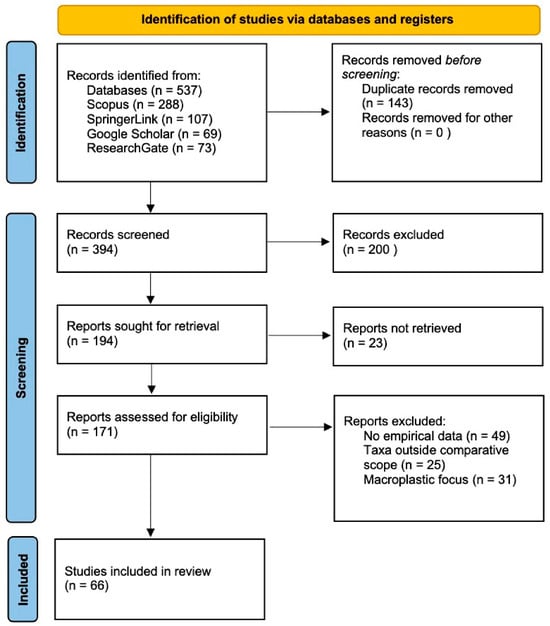
The initial search identified 537 records, of which 143 duplicates were removed, leaving 394 records that underwent title and abstract screening. Following full-text retrieval and eligibility assessment, 66 primary studies met the inclusion criteria for qualitative synthesis. A detailed breakdown by source and the specific reasons for exclusion are presented in Figure 1.
Figure 1.
PRISMA 2020 flow diagram for identification, screening, eligibility assessment, and inclusion of the 66 primary studies.
2.4. Data Extraction and Synthesis
For each primary study, the following data were extracted: author and year; country and matrix/system; matrix type; species and wild or cultivated origin; number of sites and individuals; abundance units; size, shape, colour, and polymer type; sampling method; digestion and density separation; identification technique; blanks and controls; proposed anthropogenic sources; biological effects; and limitations. The unit of evidence was the study rather than the individual file; in cases where translations, exported pages, or differently named copies of the same article existed, only a single bibliographic reference and the most complete version were retained.
Abundance data were maintained in their original units and were directly compared only when the matrix, normalisation basis (dry mass, wet mass, volume, or individual), size range, and analytical technique matched. When chemical composition was not confirmed, items were interpreted as suspected microplastic particles rather than confirmed polymers. Due to the heterogeneity of units and detection limits, a general meta-analysis of abundances was not performed; quantitative synthesis was restricted to comparisons within methodologically compatible groups. The systematic synthesis comprises 66 primary studies selected via the PRISMA procedure for the search period spanning 2013 to 2025.
2.5. Methodological Quality Assessment
A ten-criterion methodological quality appraisal framework was used to structure the evaluation of study design, analytical control, and reporting transparency (Table 1). Each applicable criterion was defined as 0 points when unreported or inadequate, 1 point when partially reported, and 2 points when complete; criteria genuinely not applicable were recorded as N/A rather than automatically scored as 0. The proposed total-score categories were low (0–7), moderate (8–14), and high (15–20) when all ten criteria were applicable. For controlled exposure studies, concentration relevance, particle characterisation, controls, and exposure duration were interpreted within the same framework. The matrix was used to support confidence judgments and identify recurrent limitations rather than as an automatic exclusion rule. Because the surviving audit record did not contain a complete per-study score sheet for all 66 studies, this review did not report an aggregate low/moderate/high distribution.
Table 1.
Methodological quality appraisal matrix for primary studies. Proposed classification: low (0–7), moderate (8–14), and high (15–20 points).
3. Results and Discussion
3.1. General Characteristics of the Evidence
The included evidence focuses on three main groups: environmental studies on microplastics in water, sediments, lagoons, estuaries, and mangroves; research on presence and accumulation in shrimp; and experimental toxicity assays. Geographic coverage is uneven, and studies specifically focusing on Litopenaeus centre primarily on L. vannamei, in both wild and farmed systems. In contrast, specific information on L. setiferus within the corpus was insufficient, preventing the direct extrapolation of exposure, retention, or sensitivity levels observed in other species.
A comprehensive review by Garcés-Ordóñez et al. [2] identified 57 publications containing data from 50 coastal lagoons and reported that 77% examined only a single environmental matrix. Although this review was not counted as a primary study within our set of 66 investigations, its findings align with a limitation observed here: few study designs simultaneously incorporate water, sediment, organisms, and potential sources, thereby hindering a complete reconstruction of transport and exposure pathways.
Across the included evidence, fibres and fragments are recurrent morphotypes, while PE, PP, and PET/polyester frequently occur among chemically identified polymers. Loads measured in shrimp vary with species, size, wild or farmed origin, organ analysed, and sample pretreatment. Experimental studies provide mechanistic evidence of oxidative stress, histological alterations, dysbiosis, immunometabolic changes, and behavioural effects, but environmental extrapolation requires consideration of concentration, particle size and ageing, exposure route, and co-occurring contaminants [25,31,32,33,34,35].
The analytical characterisation of the 66 included primary studies is presented in Supplementary Table S1, which compiles information regarding matrices, species or tissues, abundances or frequencies, morphotypes, polymers, sample preparation methods, identification techniques, potential sources, and main findings.
3.2. Presence and Characteristics of Microplastics in the Genus Litopenaeus
The developmental stage should not be considered a universal predictor of particle load. Valencia-Castañeda et al. [5] recorded an increase in particles per shrimp across culture stages in a super-intensive system, whereas Naidu et al. [31] documented a decrease during a different production cycle. These are not contradictory estimates derived from the same population; the systems, sampling times, size distributions, and exposure pathways differed. Variations apparently associated with age may also reflect body growth, continuous ingestion, depuration, or the specific anatomical compartment analysed; age-dependent patterns in Litopenaeus remain insufficiently elucidated.
Kim et al. [27] exposed Penaeus vannamei to polyethylene terephthalate (PET) microfibers in a benthic assay and observed alterations in molting patterns associated with molecular changes linked to molting hormones and chitin biosynthesis. An altered molting cycle does not, in itself, demonstrate that microplastics are eliminated via ecdysis. In another decapod, Nephrops norvegicus, Welden and Cowie [36] observed a lower microplastic load in recently molted individuals and found particles in the shed stomach lining; they proposed ecdysis as a potential elimination pathway for that species. This mechanism and its magnitude cannot be directly extrapolated to Litopenaeus. Evaluating this in the latter group requires studies that quantify particles in exuviae, digestive linings, faeces, and tissues before and after recorded molts, distinguishing elimination via molting from depuration [27,36,37].
Field studies on shrimp frequently analyse the gastrointestinal tract as an indicator of recent ingestion, whereas gills provide evidence of contact with suspended particles; hepatopancreas, muscle, and exoskeleton have also been examined to assess tissue distribution, retention, or externally adhered particles [5,24,31,32,38,39,40]. Comparisons among organs require attention to tissue mass, quantitative units, surface cleaning, digestion conditions, and analytical detection limits.
Páez-Osuna et al. [38] found 5.5 ± 0.5 particles per individual in wild L. vannamei across the analysed tissues, with a predominance of fibers and fragments. In Cau Hai Lagoon, My et al. [32] recorded 8.6 ± 3.5 particles per individual in L. vannamei, with a higher load in the gastrointestinal tract than in other tissues. Reunura and Prommi [39], as well as Vitheepradit and Prommi [24], also documented microplastics in farmed shrimp. During a culture cycle, Naidu et al. [31] detected microplastics in 93.7% of shrimp samples and simultaneously analysed feed, water, and sediment. Taken together, these studies demonstrate the recurrence of fibers and fragments and the frequent identification of PE, PP, PET/polyester, PA/nylon, and PS.
The observed loads do not depend solely on ambient concentration. The production system, duration of exposure, water exchange rate, feed, infrastructure wear, organism size, particle geometry, and the tissue analysed can all influence the quantified load. Studies covering different culture stages and production durations show distinct temporal trajectories [5,31], and depuration under controlled conditions has been documented [37]. Molting could alter externally adhered particles and shed digestive structures, yet its independent contribution to the elimination of internal particles in Litopenaeus has not yet been established. Consequently, comparisons between wild and farmed shrimp must take into account the developmental stage, exposure environment, analytical units, and tissue selection.
Findings regarding L. vannamei identify organs of interest and candidate variables but do not establish equivalent particle loads, retention, or sensitivity for L. setiferus, L. stylirostris, L. schmitti, or L. occidentalis (Table 2).
Table 2.
Representative studies on microplastics in penaeid shrimp, with emphasis on Litopenaeus vannamei. Differences in organ, minimum size, processing, and quantitative units preclude direct ranking by contamination level.
3.3. Environmental Exposure Pathways and Relationship with Environmental Matrices
Rainfall, run-off, and fluvial discharges can introduce particles from river basins, whereas wind, wave action, currents, and storms can redistribute or resuspend deposited particles. An increased input does not necessarily result in a higher local concentration when dilution, water exchange, or export rates are also high. İslek et al. [42] recorded greater abundance in sediments during the rainy winter season in Küçükçekmece Lagoon; however, this represents environmental evidence specific to that system rather than a measured seasonal shift in Litopenaeus tissues. Naidu et al. [31] sampled shrimp and culture matrices at different periods, although variations across a production cycle could not be automatically interpreted as climate-driven seasonality. Robust seasonal inference requires paired, repeated sampling of water, sediment, and specific shrimp tissues, alongside data concerning precipitation, flow rate, salinity, temperature, hydrodynamics, and developmental stage.
Exposure of Litopenaeus must be interpreted within the environmental context in which particles are transported and retained. Rivers, canals, drains, runoff, and discharges connect inland sources to lagoons, estuaries, and coastal zones, whereas hydrodynamics, residence time, suspended solids, salinity, and inlet morphology influence retention or export. Sediments can act as sinks for denser, biofouled, or aggregated particles, while waves, currents, storms, dredging, and bioturbation can promote resuspension [33,42,43,44].
Studies conducted in Venice, Küçükçekmece, Urías, Setiu, and the Pearl River Estuary demonstrate marked spatial variation and the recurrence of fibres and fragments; however, their abundance values are not directly comparable. İslek et al. [42] reported 2922.32 ± 517.35 particles/kg in sediments of Küçükçekmece Lagoon, whereas Zuo et al. [43] recorded 100–7900 particles/kg of dry sediment in mangroves of the Pearl River Estuary. These contrasts must be interpreted by taking into account sampling depth, analysed mass, density separation efficiency, minimum detectable size, and the proportion of chemically confirmed particles (Table 3).
Table 3.
Representative studies on microplastics in coastal lagoons, sediments, and biota. Abundance values are retained in their original units and should not be compared without considering method and matrix.
For benthic and detritivorous shrimp, sediment represents a plausible route of exposure through contact and ingestion. However, a correlation between sediment and intestinal loads does not by itself demonstrate direct transfer because both compartments may respond to the same source or retention regime. Stronger inference requires paired sampling by site and date, environmental covariates, and coherence in particle shape, colour, and polymer composition between sediment and shrimp [31,32,38,44].
Alonso et al. [48] examined the relationship between microplastics in sediment and in the tissues of Macrobrachium amazonicum within a tropical reservoir; their results are neither attributed to Litopenaeus nor utilised to establish a causal transfer between matrices.
3.4. Biological and Toxicological Effects
The presence of microplastics in an organism does not automatically equate to an adverse effect. Controlled assays are useful for identifying mechanisms and target organs, but environmental interpretation depends on whether the concentrations, particle sizes, shapes, polymers, ageing state, and exposure routes are environmentally plausible. In L. vannamei, experimental studies have described oxidative stress, intestinal and hepatopancreatic lesions, changes in microbiota, immunity and metabolism, reduced growth and swimming performance, altered feeding and olfaction, and modified exoskeletal properties [10,11,25,26,49,50].
At the molecular level, Han et al. [51] investigated the transcriptomic response of experimentally exposed P. vannamei and detected 1251 differentially expressed genes (685 upregulated and 566 downregulated), with functional changes related to stress, immune response, and muscle-associated processes. This study was already included in the submitted literature, although its findings have not been integrated into the main discussion. Duan et al. [25] reported complementary proteomic and metabolomic responses, whereas Kim et al. [27] included transcriptomic findings from a size-dependent PET exposure study. Differential gene expression documents a transcriptional response but does not, in itself, demonstrate DNA mutations, heritable damage, or adverse effects under field conditions.
Microplastics and nanoplastics must be interpreted separately because particle size alters the fractions recovered by analytical methods and can influence uptake, tissue distribution, and biological response. The experiment involving trophic exposure of shrimp to nanoplastics [34] provides complementary mechanistic context rather than an interchangeable estimate of environmental microplastic exposure. Cross-study interpretation must explicitly consider size definition, polymer type, shape, dose metric, exposure route, and the limit of detection [11,27,34].
Duan et al. [25] reported changes in microbiota, proteomic profiles, and haemolymph metabolism following microplastic exposure; Hsieh et al. [26] documented oxidative stress and histopathological damage; and Zhou et al. [11] demonstrated size-dependent responses. Trophic exposure to nano-polystyrene (nano-PS) via contaminated mussels altered gut microbiota and nutritional composition [34], whereas Shan et al. [50] recorded reduced food intake, delayed olfactory response, dysbiosis, and digestive disturbances.
Mixtures with other contaminants add further complexity. Co-exposure to PS and hexabromocyclododecane altered toxicity and HBCD accumulation in the hepatopancreas [52] while aged PE modified several responses associated with a glyphosate-based herbicide [53]. These findings indicate that microplastics can modify responses to co-occurring contaminants, but they do not support the assumption that all microplastics invariably act as vectors of increased toxicity (Table 4).
Table 4.
Physiological and toxicological effects of microplastics in Litopenaeus vannamei.
Consumer Exposure and Potential Health Implications
The presence of particles in shrimp does not equate to a quantified risk to human health. Yoon et al. [40] found distinct particle burdens when analysing seafood products with and without heads or intestines, which highlights the importance of the edible fraction and culinary preparation. Chen et al. [56] evaluated the polymer composition and potential health implications in estuarine P. vannamei, indicating the need for more direct evidence regarding human exposure. Gao et al. [57] modelled consumer exposure in other edible wild shrimp taxa; their estimates provide a comparative approach rather than a risk assessment specifically for Litopenaeus. A defensible evaluation requires chemically identifying the particles present in the portion actually consumed, quantifying the portion size and consumption frequency, and obtaining toxicological references relevant to human exposure; the effects documented in experimentally exposed shrimp cannot be directly extrapolated to human consumers [40,56,57].
3.5. Anthropogenic Activities as Potential Sources of Contamination
Potential sources of microplastics in environments where shrimp live or are farmed include wastewater, urbanisation, solid waste, fishing, aquaculture, agriculture, industry, ports, navigation, tourism, roads, and atmospheric deposition (Table 5). Domestic discharges can transport fibres and fragments; fishing and aquaculture materials can release particles through loss and wear; and larger plastic debris can fragment through weathering and abrasion. Spatial or temporal gradients associated with drains, rivers, land use, and productive activities provide stronger source evidence than polymer identity alone [31,33,35,44,45,47].
Table 5.
Anthropogenic activities as potential sources of microplastics and evidence required for cautious source attribution.
Aquaculture represents a particular case because it combines external inputs with potential internal sources. Feed, pipes, nets, hoses, containers, and other plasticised infrastructure can contribute particles. Naidu et al. [31] identified feed as a significant source signal during a production cycle, whereas other studies in ponds support water and infrastructure as potential exposure pathways [5,24,39]. Fishing activities can also contribute fibres or fragments composed of PA, PP, and PE resulting from the wear of nets, lines, and ropes, although these polymers are not exclusive to fisheries.
Attributing a specific particle to a particular activity requires caution. Polyester fibres near domestic discharges are compatible with textile-derived inputs but may also originate from ropes, nets, or atmospheric deposition; likewise, PE and PP are too widely used to identify a unique source on their own. Confidence increases when spatial or temporal gradients, locally used materials, hydrological connectivity, land use, and polymer profiles converge. GIS-based integration of drains, roads, land use, and environmental variables can strengthen this attribution framework [35,44,47].
3.6. Integrative Synthesis: From Sources to Biological Response
The primary contribution of this review is the integration of components that are frequently studied in isolation: anthropogenic sources, entry pathways, environmental matrices, Litopenaeus exposure, biological effects, and the methodological decisions that condition their interpretation. This integration allows for a clear distinction between the mere co-occurrence of microplastics and human activities, the evidence of exposure in shrimp, and the demonstration of a biological response (Table 6).
Table 6.
Integrative causal chain linking anthropogenic activities, environmental matrices, shrimp exposure, and biological response.
Primary evidence converges on a general sequence: human activities release particles or debris; hydrological and atmospheric pathways transport them; hydrodynamics and particle properties determine persistence in water or sediment; shrimp are exposed through ingestion, branchial contact, and surface contact; and, under some conditions, sublethal responses may occur. Causal inference is strengthened by spatial and temporal continuity, agreement in morphotypes and polymers, paired environmental and biological samples, and analyses that rule out plausible alternatives [25,31,32,33,43].
3.7. Methodological Comparability
The primary cross-cutting limitation across the evidence base was methodological heterogeneity (Table 7). In sediments, sampling involved either surface or core samples, variable sample masses, and different density separation solutions; in water, varying mesh sizes, filters, and volumes were employed; and in shrimp, analyses ranged from whole organisms to specific anatomical parts, such as the gastrointestinal tract, gills, hepatopancreas, muscle, or exoskeleton. These procedural choices directly influence the fraction of particles recovered and, consequently, the apparent magnitude of contamination.
Table 7.
Sources of methodological heterogeneity and recommendations for generating comparable data in coastal environment and shrimp studies.
Digestion treatments also vary. Reagents such as KOH and H2O2 differ in digestion efficiency and polymer compatibility, and reported lower size limits range from sub-micrometre fractions to millimetres. Visual identification can misclassify natural or regenerated fibres in the absence of chemical confirmation. FTIR, μFTIR, Raman, and thermal techniques increase confidence, but studies differ in the proportion of suspected particles that are chemically analysed [24,33,39,40,41].
Quantitative units hinder direct comparison between matrices and, frequently, even within the same matrix. Sediments may be expressed as particles/kg of dry mass; water as particles/L or particles/m3; whole shrimp as particles/individual only when the entire organism is examined; and isolated organs or tissues as particles/organ, particles/sample, or particles/g of tissue, specifying whether wet or dry weight is used. A figure obtained from an isolated intestine cannot be equated with the particle burden of a whole shrimp. Consequently, numerical contrasts must take into account the anatomical fraction analysed, the normalisation basis, the minimum detectable size, the proportion of chemical confirmation, and the analytical method. Future studies should report sample mass or volume, examined organs, recovery controls, blanks, and confirmation rates; when studying only a part of the shrimp, units normalised by tissue mass and the explicit identification of the organ are preferred.
3.8. Knowledge Gaps
Several critical knowledge gaps remain. Direct evidence for L. setiferus is scarce, and comparable exposure ranges for wild populations are lacking [5,23,24,31,32,38,39]. Few designs integrate water, sediment, shrimp, and anthropogenic sources at the same sites and times [31,32]. Methodological standardisation remains incomplete for lower size limits, quantitative units, digestion, density separation, contamination controls, and spectroscopic confirmation [24,33,39,40,41]. Source attribution is often inferred from proximity or land use rather than demonstrated through converging evidence [35,44,47]. Retention, clearance, translocation, and the role of molting in wild shrimp are also poorly resolved [5,10,24,37], as are complex mixtures under environmentally realistic conditions [38,52,53,54]. Finally, comprehensive seasonal and event-based sampling remains uncommon [31,42].
3.9. Perspectives and Development Opportunities
The next stage of research should move from studies focused solely on the question ‘Are there microplastics in shrimp?’ toward designs capable of answering where they come from, what environmental factors control exposure, what fraction is retained or cleared, what effects they produce, and to what extent these results can be compared across regions and species. This requires integrated designs that sample water, sediment, and shrimp at the same sites and dates, record environmental parameters, and explicitly characterise anthropogenic activities.
Standardisation is a priority opportunity. The use of harmonised protocols for minimum size, digestion, density separation, blanks, chemical confirmation, and quantitative units would allow for the transformation of a currently fragmented literature into a more comparable evidence base. Identification using FTIR, μFTIR, Raman, or equivalent techniques should be accompanied by information on the proportion of confirmed particles and, where possible, by analyses that distinguish synthetic polymers from natural or regenerated fibres.
Spatiotemporal studies and experiments with greater environmental realism are also needed. Including rainy seasons, droughts, and hydrometeorological events would allow for the assessment of changes in transport and retention, while tests should consider aged fibres and fragments, polymer mixtures, and environmentally plausible concentrations. In parallel, evaluating co-exposed contaminants, purification, and transfer between internal compartments could improve the understanding of the mechanisms of effect.
Given that shrimp are widely consumed, future research should also consider the implications of these findings for food safety. In particular, forthcoming studies should ideally distinguish between the edible fraction and the tissues that are normally discarded, quantifying microplastics separately in the muscle, hepatopancreas and gastrointestinal tract, and accounting for the way in which the species is customarily consumed (whole, headless, peeled or deveined). Such data could allow dietary exposure to be estimated from consumption rates and could provide a basis for future risk assessments, for which the available evidence on fishery products remains limited [14]. Depuration trials, together with evaluations of the effects of cooking and processing on particle retention, may further help to establish whether the exposure reaching the consumer differs from that measured in field-collected organisms.
Finally, source attribution can be strengthened by combining field observations, GIS, land use, hydrological connectivity, locally used materials, and polymer profiles. This approach can move interpretation from broad associations with ‘anthropogenic activity’ toward testable source hypotheses and can guide prevention measures targeting discharges, waste management, fishing gear, aquaculture infrastructure, and other dominant pathways [31,35,44,47]. Generating direct evidence for L. setiferus and other understudied species of the genus remains a priority for improving the ecological validity of the evidence base.
4. Conclusions
The available evidence confirms the presence of microplastics in different compartments of Litopenaeus, but it is markedly concentrated in L. vannamei. Fibres and fragments are the most recurrent morphotypes, and PE, PP, PET/polyester, PA/nylon, and PS appear among the most frequently identified polymers. Specific information for L. setiferus remains insufficient; therefore, the results obtained in other species should not be extrapolated without direct verification.
Experimental studies show plausible mechanisms of effect, including oxidative stress, histological damage, dysbiosis, immunometabolic alterations, changes in growth, swimming, feeding, olfaction, and exoskeleton properties. However, translating these results to the environment requires considering concentration, size, shape, ageing, exposure route, and coexisting contaminants, and explicitly distinguishing between presence, association, and causality.
The main limitation for a comprehensive quantitative synthesis is the methodological heterogeneity among studies. Differences in matrix, sampling, digestion, density separation, minimum size, chemical confirmation, and quantitative units can generate apparent contrasts that do not necessarily reflect real differences in contamination. Standardisation of these components is essential.
Supplementary Materials
The following supporting information can be downloaded at https://www.mdpi.com/article/10.3390/microplastics5040237/s1, Supplementary Material PRISMA 2020 checklist and Supplementary Table S1 provide the analytical characteristics of the 66 primary studies included in the qualitative synthesis [5,10,11,23,24,25,26,27,31,32,33,34,35,37,38,39,40,41,42,43,44,45,46,47,48,49,50,51,52,53,54,55,56,57,58,59,60,61,62,63,64,65,66,67,68,69,70,71,72,73,74,75,76,77,78,79,80,81,82,83,84,85,86,87,88,89].
Author Contributions
Conceptualization, B.O.-M. and M.d.R.C.-C.; methodology, S.S.-R. and F.L.-R.; formal analysis, S.S.-R. and B.O.-M.; investigation, S.S.-R., B.O.-M. and M.d.R.C.-C.; data curation, D.G.M.-L., J.M.-M. and A.H.-E.; writing—original draft preparation, S.S.-R. and B.O.-M.; writing—review and editing, S.S.-R., B.O.-M. and M.d.R.C.-C.; visualization, B.O.-M. and J.M.-M.; project administration, B.O.-M. and M.d.R.C.-C.; funding acquisition, B.O.-M. All authors have read and agreed to the published version of the manuscript.
Funding
S.S.-R. received scholarship support 634359 from SECIHTI. No additional external funding was reported in the source manuscript.
Institutional Review Board Statement
This study does not require ethical review and approval, as it is a systematic review based entirely on previously published data. No new data were collected directly from human participants or animal subjects. Therefore, ethical approval from the Institutional Committee for Graduate Studies and Research was not necessary. Moreover, to ensure transparency, reproducibility, and ethical compliance, we registered the review protocol on the Open Science Framework. OSF Registration DOI: https://doi.org/10.17605/OSF.IO/MFSNC.
Data Availability Statement
All data supporting the findings of this systematic review are included in the article and Supplementary Table S1.
Acknowledgments
The authors would like to thank the Comité de Sanidad Acuícola y Pesquero Veracruzano (COSAP) for facilitating this study. During the preparation of this manuscript/study, the authors used ChatGPT model 5.6 to design the graphical abstract. Additionally, the authors employed Gemini 3.5 Flash-Lite for English language stylistic refinements. The authors have reviewed and edited the output and assume full responsibility for the content of this publication.
Conflicts of Interest
The authors declare no conflicts of interest.
Abbreviations
The following abbreviations are used in this manuscript:
| Abbreviation | Definition |
| AChE | Acetylcholinesterase |
| BPA | Bisphenol A |
| FTIR | Fourier-transform infrared spectroscopy |
| GIS | Geographic information system |
| GIT | Gastrointestinal tract |
| GSH | Glutathione |
| GST | Glutathione S-transferase |
| HBCD | Hexabromocyclododecane |
| MPs | Microplastics |
| PA | Polyamide/nylon |
| PE | Polyethylene |
| PET | Polyethylene terephthalate |
| PP | Polypropylene |
| PRISMA | Preferred Reporting Items for Systematic Reviews and Meta-Analyses |
| PS | Polystyrene |
| PTFE | Polytetrafluoroethylene |
| PVC | Polyvinyl chloride |
| SOD | Superoxide dismutase |
| μFTIR | Micro-Fourier-transform infrared spectroscopy |
References
- GESAMP. Sources, Fate and Effects of Microplastics in the Marine Environment: A Global Assessment; Kershaw, P.J., Ed.; Reports and Studies GESAMP No. 90; International Maritime Organization: London, UK, 2015. [Google Scholar]
- Garcés-Ordóñez, O.; Saldarriaga-Vélez, J.F.; Espinosa-Díaz, L.F.; Canals, M.; Sánchez-Vidal, A.; Thiel, M. A systematic review on microplastic pollution in water, sediments, and organisms from 50 coastal lagoons across the globe. Environ. Pollut. 2022, 315, 120366. [Google Scholar] [CrossRef] [Scilit] [PubMed]
- Jambeck, J.R.; Geyer, R.; Wilcox, C.; Siegler, T.R.; Perryman, M.; Andrady, A.; Narayan, R.; Law, K.L. Plastic waste inputs from land into the ocean. Science 2015, 347, 768–771. [Google Scholar] [CrossRef] [Scilit] [PubMed]
- Lusher, A.L.; Hollman, P.C.H.; Mendoza-Hill, J.J. Microplastics in Fisheries and Aquaculture: Status of Knowledge on Their Occurrence and Implications for Aquatic Organisms and Food Safety; FAO Fisheries and Aquaculture Technical Paper No. 615; FAO: Rome, Italy, 2017. [Google Scholar]
- Valencia-Castañeda, G.; Medina-López, J.A.; Frías-Espericueta, M.G.; Páez-Osuna, F. Farmed stage (age)-dependent accumulation and size of microplastics in Litopenaeus vannamei shrimp reared in a super-intensive controlled system. Sci. Total Environ. 2024, 918, 170575. [Google Scholar] [CrossRef] [Scilit] [PubMed]
- Andrady, A.L.; Koongolla, B. Degradation and fragmentation of microplastics. In Plastics and the Ocean: Origin, Characterization, Fate, and Impacts; Andrady, A.L., Ed.; John Wiley & Sons: Hoboken, NJ, USA, 2022; pp. 227–268. [Google Scholar]
- Zhou, A.; Zhang, Y.; Xie, S.; Chen, Y.; Li, X.; Wang, J.; Zou, J. Microplastics and their potential effects on the aquaculture systems: A critical review. Rev. Aquac. 2021, 13, 719–733. [Google Scholar] [CrossRef] [Scilit]
- Wright, S.L.; Thompson, R.C.; Galloway, T.S. The physical impacts of microplastics on marine organisms: A review. Environ. Pollut. 2013, 178, 483–492. [Google Scholar] [CrossRef] [Scilit] [PubMed]
- Zhang, S.; Wu, H.; Hou, J. Progress on the effects of microplastics on aquatic crustaceans: A review. Int. J. Mol. Sci. 2023, 24, 5523. [Google Scholar] [CrossRef] [Scilit] [PubMed]
- Zeng, Y.; Deng, B.; Kang, Z.; Araujo, P.; Mjøs, S.A.; Liu, R.; Lin, J.; Yang, T.; Qu, Y. Tissue accumulation of polystyrene microplastics causes oxidative stress, hepatopancreatic injury and metabolome alterations in Litopenaeus vannamei. Ecotoxicol. Environ. Saf. 2023, 256, 114871. [Google Scholar] [CrossRef] [Scilit] [PubMed]
- Zhou, N.; Wang, Z.; Yang, L.; Zhou, W.; Qin, Z.; Zhang, H. Size-dependent toxicological effects of polystyrene microplastics in the shrimp Litopenaeus vannamei using a histomorphology, microbiome, and metabolic approach. Environ. Pollut. 2023, 316, 120635. [Google Scholar] [CrossRef] [Scilit] [PubMed]
- Rochman, C.M.; Hoh, E.; Kurobe, T.; Teh, S.J. Ingested plastic transfers hazardous chemicals to fish and induces hepatic stress. Sci. Rep. 2013, 3, 3263. [Google Scholar] [CrossRef] [Scilit] [PubMed]
- Li, Z.; Junaid, M.; Chen, G.; Wang, J. Interactions and associated resistance development mechanisms between microplastics, antibiotics and heavy metals in the aquaculture environment. Rev. Aquac. 2022, 14, 1028–1045. [Google Scholar] [CrossRef] [Scilit]
- Alberghini, L.; Truant, A.; Santonicola, S.; Colavita, G.; Giaccone, V. Microplastics in Fish and Fishery Products and Risks for Human Health: A Review. Int. J. Environ. Res. Public Health 2023, 20, 789. [Google Scholar] [CrossRef] [Scilit] [PubMed]
- FAO. The State of World Fisheries and Aquaculture 2024: Blue Transformation in Action; Food and Agriculture Organization of the United Nations: Rome, Italy, 2024; 264p. [Google Scholar] [CrossRef] [Scilit]
- Villarreal, H.; Juarez, L. Super-intensive shrimp culture: Analysis and future challenges. J. World Aquac. Soc. 2022, 53, 928–932. [Google Scholar] [CrossRef] [Scilit]
- NOAA Fisheries. White Shrimp (Litopenaeus setiferus). Available online: https://www.fisheries.noaa.gov/species/white-shrimp (accessed on 22 September 2026).
- Beseres, J.J.; Feller, R.J. Importance of predation by white shrimp Litopenaeus setiferus on estuarine subtidal macrobenthos. J. Exp. Mar. Biol. Ecol. 2007, 344, 193–205. [Google Scholar] [CrossRef] [Scilit]
- Day, J.W., Jr.; Yáñez-Arancibia, A.; Kemp, W.M.; Crump, B.C. (Eds.) Introduction to Estuarine Ecology. In Estuarine Ecology, 2nd ed.; Wiley-Blackwell: Hoboken, NJ, USA, 2012; pp. 1–18. [Google Scholar] [CrossRef] [Scilit]
- Minello, T.J.; Rozas, L.P. Nekton in Gulf Coast wetlands: Fine-scale distributions, landscape patterns, and restoration implications. Ecol. Appl. 2002, 12, 441–455. [Google Scholar] [CrossRef]
- Nelson, J.A.; Lesser, J.; James, W.R.; Behringer, D.P.; Furka, V.; Doerr, J.C. Food web response to foundation species change in a coastal ecosystem. Food Webs 2019, 21, e00125. [Google Scholar] [CrossRef] [Scilit]
- Gómez-Ponce, M.A.; Flores-Coto, C.; López-Martínez, J.; Cruz-Sánchez, J.L.; Sanvicente-Añorve, L. Evaluation of the entry of white shrimp postlarvae (Decapoda: Penaeidae) to a nursery area in the southern Gulf of Mexico. Lat. Am. J. Aquat. Res. 2018, 46, 166–175. [Google Scholar] [CrossRef] [Scilit]
- Valencia-Castañeda, G.; Ibáñez-Aguirre, K.; Rebolledo, U.A.; Capparelli, M.V.; Páez-Osuna, F. Microplastic contamination in wild shrimp Litopenaeus vannamei from the Huizache-Caimanero Coastal lagoon, SE Gulf of California. Bull. Environ. Contam. Toxicol. 2022, 109, 425–430. [Google Scholar] [CrossRef] [Scilit] [PubMed]
- Vitheepradit, A.; Prommi, T.O. Microplastics in surface water and tissue of white leg shrimp, Litopenaeus vannamei, in a cultured pond in Nakhon Pathom Province, Central Thailand. AIMS Environ. Sci. 2023, 10, 478–503. [Google Scholar] [CrossRef] [Scilit]
- Duan, Y.; Xiong, D.; Wang, Y.; Zhang, Z.; Li, H.; Dong, H.; Zhang, J. Toxicological effects of microplastics in Litopenaeus vannamei as indicated by an integrated microbiome, proteomic and metabolomic approach. Sci. Total Environ. 2021, 761, 143311. [Google Scholar] [CrossRef] [Scilit] [PubMed]
- Hsieh, S.L.; Wu, Y.C.; Xu, R.Q.; Chen, Y.T.; Chen, C.W.; Singhania, R.R.; Dong, C.-D. Effect of polyethylene microplastics on oxidative stress and histopathology damages in Litopenaeus vannamei. Environ. Pollut. 2021, 288, 117800. [Google Scholar] [CrossRef] [Scilit] [PubMed]
- Kim, L.; Kim, H.; Song, Y.; An, Y.J. Size-dependent toxicological effects and mechanisms of PET microplastics in Pacific white shrimp (Penaeus vannamei). Mar. Pollut. Bull. 2025, 219, 118357. [Google Scholar] [CrossRef] [Scilit] [PubMed]
- Lusher, A.L.; Bråte, I.L.N.; Munno, K.; Hurley, R.R.; Welden, N.A. Is it or isn’t it: The importance of visual classification in microplastic characterization. Appl. Spectrosc. 2020, 74, 1139–1153. [Google Scholar] [CrossRef] [Scilit] [PubMed]
- Caro-Martínez, D.M.; Niño-Torres, C.A.; Charruau, P.; Rendón-von Osten, J.; Castelblanco-Martínez, D.N.; Rios Mendoza, L.M.; Frausto-Martínez, O.; Blanco-Parra, M.D.P. The state of microplastic pollution in México: A review and evolving perspectives. Sci. Total Environ. 2025, 988, 179772. [Google Scholar] [CrossRef] [Scilit] [PubMed]
- Page, M.J.; Moher, D.; Bossuyt, P.M.; Boutron, I.; Hoffmann, T.C.; Mulrow, C.D.; Shamseer, L.; Tetzlaff, J.M.; Akl, E.A.; Brennan, S.E.; et al. PRISMA 2020 explanation and elaboration: Updated guidance and exemplars for reporting systematic reviews. BMJ 2021, 372, n160. [Google Scholar] [CrossRef] [PubMed]
- Naidu, B.C.; Xavier, K.A.M.; Sahana, M.D.; Landge, A.T.; Jaiswar, A.K.; Shukla, S.P.; Ranjeet, K.; Nayak, B.B. Temporal variability of microplastics in shrimp (Litopenaeus vannamei), feed, water and sediments of coastal and inland culture ponds. Sci. Total Environ. 2025, 959, 178173. [Google Scholar] [CrossRef] [Scilit] [PubMed]
- My, T.T.A.; Dat, N.D.; Hung, N.Q. Occurrence and Characteristics of Microplastics in Wild and Farmed Shrimps Collected from Cau Hai Lagoon, Central Vietnam. Molecules 2023, 28, 4634. [Google Scholar] [CrossRef] [Scilit] [PubMed]
- Vianello, A.; Boldrin, A.; Guerriero, P.; Moschino, V.; Rella, R.; Sturaro, A.; Da Ros, L. Microplastic particles in sediments of Lagoon of Venice, Italy: First observations on occurrence, spatial patterns and identification. Estuar. Coast. Shelf Sci. 2013, 130, 54–61. [Google Scholar] [CrossRef] [Scilit]
- Chae, Y.; Kim, D.; Choi, M.J. Impact of nano-sized plastic on the nutritional value and gut microbiota of whiteleg shrimp Litopenaeus vannamei via dietary exposure. Environ. Int. 2019, 130, 104848. [Google Scholar] [CrossRef] [Scilit] [PubMed]
- Alvarado-Zambrano, D.; Rivera-Hernández, J.R.; Green-Ruiz, C. Macroplastic and Microparticle Pollution in Beach Sediments from Urias Coastal Lagoon (Northwest Mexico). Toxics 2024, 12, 439. [Google Scholar] [CrossRef] [Scilit] [PubMed]
- Welden, N.A.C.; Cowie, P.R. Environment and gut morphology influence microplastic retention in langoustine, Nephrops norvegicus. Environ. Pollut. 2016, 214, 859–865. [Google Scholar] [CrossRef] [Scilit] [PubMed]
- Hariharan, G.; Purvaja, R.; Anandavelu, I.; Robin, R.S.; Ramesh, R. Ingestion and toxic impacts of weathered polyethylene (wPE) microplastics and stress defensive responses in whiteleg shrimp (Penaeus vannamei). Chemosphere 2022, 300, 134487. [Google Scholar] [CrossRef] [Scilit] [PubMed]
- Páez-Osuna, F.; Valencia-Castañeda, G.; Rodríguez Valenzuela, O.; Frías-Espericueta, M.G. Microplastics and heavy metals in shrimp Litopenaeus vannamei from the SAMARE lagoon, Gulf of California: Is it a case of combined MPs-Zn pollution in gills? Environ. Pollut. 2023, 336, 122479. [Google Scholar] [CrossRef] [Scilit] [PubMed]
- Reunura, T.; Prommi, T.O. Detection of microplastics in Litopenaeus vannamei (Penaeidae) and Macrobrachium rosenbergii (Palaemonidae) in cultured pond. PeerJ 2022, 10, e12916. [Google Scholar] [CrossRef] [Scilit] [PubMed]
- Yoon, H.; Park, B.; Rim, J.; Park, H. Detection of Microplastics by Various Types of Whiteleg Shrimp (Litopenaeus vannamei) in the Korean Sea. Separations 2022, 9, 332. [Google Scholar] [CrossRef] [Scilit]
- Morris, S.; Sarlin, P.J.; Morris, S.; Joseph, P. Microplastic ingestion and retention in penaeid shrimp from the Arabian Sea. Discov. Environ. 2025, 3, 28. [Google Scholar] [CrossRef] [Scilit]
- İslek, S.; Bostan, Z.; Güney, E.; Sönmez, V.Z. Occurrence and Spatial Distribution of Microplastics in Coastal Lagoon Sediments: The Case from Küçükçekmece Lagoon. Comm. J. Biol. 2023, 7, 1–11. [Google Scholar] [CrossRef] [Scilit]
- Zuo, L.; Sun, Y.; Li, H.; Hu, Y.; Lin, L.; Peng, J.; Xu, X. Microplastics in mangrove sediments of the Pearl River Estuary, South China: Correlation with halogenated flame retardants’ levels. Sci. Total Environ. 2020, 725, 138344. [Google Scholar] [CrossRef] [Scilit] [PubMed]
- El-Alfy, M.A.; El-Hamid, H.T.A.; Keshta, A.E.; Elnaggar, A.A.; Darwish, D.H.; Basiony, A.I.; Alzeny, A.M.; Abou-Hadied, M.M.; Toubar, M.M.; Shalaby, A.; et al. Assessing microplastic pollution vulnerability in a protected coastal lagoon in the Mediterranean Coast of Egypt using GIS modeling. Sci. Rep. 2025, 15, 11557, Correction in Sci. Rep. 2025, 15, 16568. https://doi.org/10.1038/s41598-025-00674-3. [Google Scholar] [CrossRef] [Scilit] [PubMed]
- Botello, A.V.; Villanueva, S.F.; Leon, D.; García-Borquez, A.; De La Lanza, G.; Ponce, G. Microplastics and Bisphenol A (BPA) in Sediments of Coastal Lagoons of Veracruz, Mexico. J. Toxicol. Curr. Res. 2020, 4, 1–7. [Google Scholar] [CrossRef] [Scilit] [PubMed]
- Ángel-Guzmán, D.J.D.; Lango-Reynoso, F.; Dávila-Camacho, C.A.; Castañeda-Chávez, M.D.R.; Bernal-Ramírez, R.D.G.; Montoya-Mendoza, J.; Martínez-Cárdenas, L. Microplastics in the fish Dormitator maculatus from the Alvarado Lagoon, Veracruz, Mexico. Lat. Am. J. Aquat. Res. 2025, 53, 582–593. [Google Scholar] [CrossRef] [Scilit]
- Maulana, N.S.M.; Zulkifli, M.S.; Khalid, A.A.; Shahrudin, R.; Anuar, S.T.; Jaafar, M.; Ariffin, E.H. Revealing Microplastic Contamination in Mangrove Sediments from Setiu Wetlands, Malaysia. Indones. J. Chem. 2025, 25, 520–533. [Google Scholar] [CrossRef] [Scilit]
- Alonso, M.B.; Binler, N.F.V.; Nunes, M.A.; de Pádua Bueno, A.A. Microplastics in a tropical lentic environment: Dynamics between sediments and the shrimp Macrobrachium amazonicum. Hydrobiologia 2026, 853, 5005–5017. [Google Scholar] [CrossRef] [Scilit]
- Tong, D.; Yu, Y.; Lu, L. Microplastics weaken the exoskeletal mechanical properties of Pacific whiteleg shrimp Litopenaeus vannamei. J. Hazard. Mater. 2024, 468, 133771. [Google Scholar] [CrossRef] [Scilit] [PubMed]
- Shan, C.; Zhang, X.; Lu, L.; Tong, D.; Zhang, W.; Gao, Y.; Yu, Y.; Shu, Y.; Li, W.; Zhao, X.; et al. Microplastics exposure affects the feeding behavior of the whiteleg shrimp Litopenaeus vannamei by impairing the appetite, olfaction and digestion. Mar. Pollut. Bull. 2025, 220, 118455. [Google Scholar] [CrossRef] [Scilit] [PubMed]
- Han, J.E.; Choi, S.-K.; Jeon, H.J.; Park, J.-K.; Han, S.-H.; Jeong, J.; Kim, J.H.; Lee, J.M. Transcriptional response in the whiteleg shrimp (Penaeus vannamei) to short-term microplastic exposure. Aquac. Rep. 2021, 20, 100713. [Google Scholar] [CrossRef] [Scilit]
- Yu, Y.; Hu, L.; Tian, D.; Yu, Y.; Lu, L.; Zhang, J.; Huang, X.; Yan, M.; Chen, L.; Wu, Z.; et al. Toxicities of polystyrene microplastics (MPs) and hexabromocyclododecane (HBCD), alone or in combination, to the hepatopancreas of the whiteleg shrimp, Litopenaeus vannamei. Environ. Pollut. 2023, 329, 121646. [Google Scholar] [CrossRef] [Scilit] [PubMed]
- Thammatorn, W.; Cholewińska, P.; Kruangkum, T.; Palić, D. Aged polyethylene microplastics and glyphosate-based herbicide co-exposure toxicity in Pacific white shrimp (Litopenaeus vannamei). Front. Mar. Sci. 2024, 11, 1384487. [Google Scholar] [CrossRef] [Scilit]
- Xing, Y.F.; Zhu, X.Y.; Huang, J.H.; Nan, Y.X.; Duan, Y.F.; Zhang, J.S. Toxic effects of microplastics and nitrite exposure on intestinal histology, digestion, immunity, and microbial community of shrimp Litopenaeus vannamei. Mar. Pollut. Bull. 2024, 200, 116077. [Google Scholar] [CrossRef] [Scilit] [PubMed]
- Wang, Z.; Fan, L.; Wang, J.; Xie, S.; Zhang, C.; Zhou, J.; Zhang, L.; Xu, G.; Zou, J. Insight into the immune and microbial response of the white-leg shrimp Litopenaeus vannamei to microplastics. Mar. Environ. Res. 2021, 169, 105377. [Google Scholar] [CrossRef] [Scilit] [PubMed]
- Chen, B.; Hossain, K.B.; Kang, R.; Zhou, Y.; Wang, J.; Cai, M. Assessment of microplastic hazards in Penaeus vannamei shrimp in a typical estuary of China: Polymer composition, risk assessment, and health implications. J. Oceanol. Limnol. 2025, 43, 572–588. [Google Scholar] [CrossRef] [Scilit]
- Gao, C.; Chen, M.; Liang, B.; Cai, E.; Zhang, S.; Gao, S. Distribution Patterns and Human Exposure Risks of Microplastics in Dominant Wild Edible Shrimp: A Case Study of Haizhou Bay Marine Ranch. Water 2025, 17, 1495. [Google Scholar] [CrossRef] [Scilit]
- Devriese, L.I.; van der Meulen, M.D.; Maes, T.; Bekaert, K.; Paul-Pont, I.; Frère, L.; Robbens, J.; Vethaak, A.D. Microplastic contamination in brown shrimp (Crangon crangon, Linnaeus 1758) from coastal waters of the Southern North Sea and Channel area. Mar. Pollut. Bull. 2015, 98, 179–187. [Google Scholar] [CrossRef] [Scilit] [PubMed]
- Rochman, C.M.; Tahir, A.; Williams, S.L.; Baxa, D.V.; Lam, R.; Miller, J.T.; Teh, F.-C.; Werorilangi, S.; Teh, S.J. Anthropogenic debris in seafood: Plastic debris and fibers from textiles in fish and bivalves sold for human consumption. Sci. Rep. 2015, 5, 14340. [Google Scholar] [CrossRef] [Scilit] [PubMed]
- Dris, R.; Gasperi, J.; Rocher, V.; Renault, N.; Tassin, B. Microplastic contamination in an urban area: A case study in Greater Paris. Environ. Chem. 2015, 12, 592–599. [Google Scholar] [CrossRef] [Scilit]
- Brennecke, D.; Duarte, B.; Paiva, F.; Caçador, I.; Canning-Clode, J. Microplastics as vector for heavy metal contamination from the marine environment. Estuar. Coast. Shelf Sci. 2016, 178, 189–195. [Google Scholar] [CrossRef] [Scilit]
- Alomar, C.; Estarellas, F.; Deudero, S. Microplastics in the Mediterranean Sea: Deposition in coastal shallow sediments, spatial variation and preferential grain size. Mar. Environ. Res. 2016, 115, 1–10. [Google Scholar] [CrossRef] [Scilit] [PubMed]
- Murphy, F.; Ewins, C.; Carbonnier, F.; Quinn, B. Wastewater Treatment Works (WwTW) as a Source of Microplastics in the Aquatic Environment. Environ. Sci. Technol. 2016, 50, 5800–5808. [Google Scholar] [CrossRef] [Scilit] [PubMed]
- Lo, H.S.; Xu, X.; Wong, C.Y.; Cheung, S.G. Comparisons of microplastic pollution between mudflats and sandy beaches in Hong Kong. Environ. Pollut. 2018, 236, 208–217. [Google Scholar] [CrossRef] [Scilit] [PubMed]
- Barrows, A.P.W.; Cathey, S.E.; Petersen, C.W. Marine environment microfiber contamination: Global patterns and the diversity of microparticle origins. Environ. Pollut. 2018, 237, 275–284. [Google Scholar] [CrossRef] [Scilit] [PubMed]
- Bayo, J.; Rojo, D.; Olmos, S. Abundance, morphology and chemical composition of microplastics in sand and sediments from a protected coastal area: The Mar Menor lagoon (SE Spain). Environ. Pollut. 2019, 252, 1357–1366. [Google Scholar] [CrossRef] [Scilit] [PubMed]
- Zhou, Q.; Tu, C.; Fu, C.; Li, Y.; Zhang, H.; Xiong, K.; Zhao, X.; Li, L.; Waniek, J.J.; Luo, Y. Characteristics and distribution of microplastics in the coastal mangrove sediments of China. Sci. Total Environ. 2020, 703, 134807. [Google Scholar] [CrossRef] [Scilit] [PubMed]
- Zhang, L.; Zhang, S.; Guo, J.; Yu, K.; Wang, Y.; Li, R. Dynamic distribution of microplastics in mangrove sediments in Beibu Gulf, South China: Implications of tidal current velocity and tidal range. J. Hazard. Mater. 2020, 399, 122849. [Google Scholar] [CrossRef] [Scilit] [PubMed]
- Zheng, Y.; Li, J.; Cao, W.; Jiang, F.; Zhao, C.; Ding, H.; Wang, M.; Gao, F.; Sun, C. Vertical distribution of microplastics in bay sediment reflecting effects of sedimentation dynamics and anthropogenic activities. Mar. Pollut. Bull. 2020, 152, 110885. [Google Scholar] [CrossRef] [Scilit] [PubMed]
- Bagheri, T.; Gholizadeh, M.; Abarghouei, S.; Zakeri, M.; Hedayati, A.; Rabaniha, M.; Aghaeimoghadam, A.; Hafezieh, M. Microplastics distribution, abundance and composition in sediment, fishes and benthic organisms of the Gorgan Bay, Caspian Sea. Chemosphere 2020, 257, 127201. [Google Scholar] [CrossRef] [Scilit] [PubMed]
- Mehdinia, A.; Dehbandi, R.; Hamzehpour, A.; Rahnama, R. Identification of microplastics in the sediments of southern coasts of the Caspian Sea, north of Iran. Environ. Pollut. 2020, 258, 113738. [Google Scholar] [CrossRef] [Scilit] [PubMed]
- Chico-Ortiz, N.; Mahu, E.; Crane, R.; Gordon, C.; Marchant, R. Microplastics in Ghanaian coastal lagoon sediments: Their occurrence and spatial distribution. Reg. Stud. Mar. Sci. 2020, 40, 101509. [Google Scholar] [CrossRef] [Scilit]
- Edo, C.; González-Pleiter, M.; Tamayo-Belda, M.; Ortega-Ojeda, F.E.; Leganés, F.; Fernández-Piñas, F.; Rosal, R. Microplastics in sediments of artificially recharged lagoons: Case study in a Biosphere Reserve. Sci. Total Environ. 2020, 729, 138824. [Google Scholar] [CrossRef] [Scilit] [PubMed]
- Marques Mendes, A.; Golden, N.; Bermejo, R.; Morrison, L. Distribution and abundance of microplastics in coastal sediments depends on grain size and distance from sources. Mar. Pollut. Bull. 2021, 172, 112802. [Google Scholar] [CrossRef] [Scilit] [PubMed]
- Gholizadeh, M.; Cera, A. Microplastic contamination in the sediments of Qarasu estuary in Gorgan Bay, south-east of Caspian Sea, Iran. Sci. Total Environ. 2022, 838, 155913. [Google Scholar] [CrossRef] [Scilit] [PubMed]
- Fan, W.; Yang, P.; Qiao, Y.; Su, M.; Zhang, G. Polystyrene nanoplastics decrease molting and induce oxidative stress in adult Macrobrachium nipponense. Fish Shellfish Immunol. 2022, 122, 419–425. [Google Scholar] [CrossRef] [Scilit] [PubMed]
- Vermeiren, P.; Ikejima, K.; Uchida, Y.; Muñoz, C.C. Microplastic distribution among estuarine sedimentary habitats utilized by intertidal crabs. Sci. Total Environ. 2023, 866, 161400. [Google Scholar] [CrossRef] [Scilit] [PubMed]
- Cardoso-Mohedano, J.G.; Ruiz-Fernández, A.C.; Sanchez-Cabeza, J.A.; Camacho-Torres, S.M.; Ontiveros-Cuadras, J.F. Microplastics transport in a low-inflow estuary at the entrance of the Gulf of California. Sci. Total Environ. 2023, 870, 161825. [Google Scholar] [CrossRef] [Scilit] [PubMed]
- Cordova, M.R.; Ulumuddin, Y.I.; Lubis, A.A.; Kaisupy, M.T.; Wibowo, S.P.A.; Subandi, R.; Yogaswara, D.; Purbonegoro, T.; Renyaan, J.; Nurdiansah, D.; et al. Microplastics leaving a trace in mangrove sediments ever since they were first manufactured: A study from Indonesia mangroves. Mar. Pollut. Bull. 2023, 195, 115517. [Google Scholar] [CrossRef] [Scilit] [PubMed]
- Ragoobur, D.; Amode, N.S.; Somaroo, G.D.; Nazurally, N. Microplastics in estuarine water and sediment in Mauritius. Reg. Stud. Mar. Sci. 2023, 57, 102766. [Google Scholar] [CrossRef] [Scilit]
- Celis-Hernandez, O.; Ávila, E.; Rendón-von Osten, J.; Briceño-Vera, E.A.; Borges-Ramírez, M.M.; Gómez-Ponce, A.M.; Capparelli, V.M. Environmental risk of microplastics in a Mexican coastal lagoon ecosystem: Anthropogenic inputs and its possible human food risk. Sci. Total Environ. 2023, 879, 163095. [Google Scholar] [CrossRef] [Scilit] [PubMed]
- Ruiz-Fernández, A.C.; Pérez-Bernal, L.H.; Sanchez-Cabeza, J.A.; Valencia-Castañeda, G.; Ontiveros-Cuadras, J.F.; Alonso-Hernández, C.M. Accelerating microplastic contamination in 210Pb dated sediment cores from an urbanized coastal lagoon (NW Mexico) since the 1990s. Sci. Total Environ. 2024, 951, 175613. [Google Scholar] [CrossRef] [Scilit] [PubMed]
- Lawan, P.L.M.J.H.; De Silva, D.S.M.; Amarathunga, A.A.D.; McGoran, A.; Bakir, A.; Sivyer, D.B.; Reeve, C. Microplastic Contamination in Shrimps from the Negombo Lagoon—Sri Lanka. Water 2024, 16, 447. [Google Scholar] [CrossRef] [Scilit]
- Sánchez-Campos, M.; Ponce-Vélez, G.; Sanvicente-Añorve, L.; Alatorre-Mendieta, M. Microplastic contamination in three environmental compartments of a coastal lagoon in the southern Gulf of Mexico. Environ. Monit. Assess. 2024, 196, 1012. [Google Scholar] [CrossRef] [Scilit] [PubMed]
- Song, K.; Xie, S.; Li, C.; He, J.; Jin, W.; Wang, R.; Huang, W.; Li, P.; Feng, Z. The occurrence of pollutants in organisms and water of inland mariculture systems: Shrimp aquaculture is a procession of Microplastics accumulation. Environ. Pollut. 2024, 342, 123072. [Google Scholar] [CrossRef] [Scilit] [PubMed]
- Rathnayake, R.M.L.I.; Amarathunga, A.A.D.; De Silva, D.S.M.; McGoran, A.R.; Bakir, A.; Sivyer, D.B.; Reeve, C.; Narangoda, S.R.C.N.K. Comprehensive Analysis of Microplastic Abundance in Macrophytes, Macrophyte-Associated Sediments, and Water in Tropical Coastal Lagoons in Sri Lanka. Water 2025, 17, 157. [Google Scholar] [CrossRef] [Scilit]
- Leela, M.; Pushpalatha, V.; Swetha, S.; Anusuya, S.; Madhavan, S.; Eswari, S.; Thilagam, H.; Thiagarajan, R.; Krishnamurthy, R. Ingestion of weathered high density polyethylene microplastics-induced oxidative stress and modulation of antioxidant responses in post larval stages of Litopenaeus vannamei. Front. Mar. Sci. 2025, 12, 1617070. [Google Scholar] [CrossRef] [Scilit]
- Marcial, R.; Morante, Y. Microplastics in the gut of Litopenaeus vannamei. Rev. Estud. Cienc. Biol. 2025, 1, 30–38. [Google Scholar]
- Yu, L.; Li, R.; Chai, M.; Li, B. Vertical distribution, accumulation, and characteristics of microplastics in mangrove sediment in China. Sci. Total Environ. 2023, 856, 159256. [Google Scholar] [CrossRef] [Scilit] [PubMed]

Disclaimer/Publisher’s Note: The statements, opinions and data contained in all publications are solely those of the individual author(s) and contributor(s) and not of MDPI and/or the editor(s). MDPI and/or the editor(s) disclaim responsibility for any injury to people or property resulting from any ideas, methods, instructions or products referred to in the content. |
© 2026 by the authors. Licensee MDPI, Basel, Switzerland. This article is an open access article distributed under the terms and conditions of the Creative Commons Attribution (CC BY) license.