


Abstract
Microplastics are increasingly recognized as contaminants that may affect seed germination and early seedling establishment, yet the ecological significance of these responses under natural soil conditions remains uncertain. Evidence from controlled studies includes reduced germination, altered germination timing and synchrony, and impaired early root development, but responses vary with particle properties, exposure intensity, growth medium, plant species, and exposure duration. Here, we examine how experimental simplification can influence the detection and interpretation of microplastic effects during the earliest stages of plant establishment. We propose “experimental inflation” as a hypothesis-generating framework referring specifically to increased response detectability and apparent consistency that may arise when exposure probability is increased and environmental variability is reduced; it does not imply larger biological effects or greater ecological risk. We distinguish this concept from ecological realism, exposure realism, external validity, signal-to-noise ratio, and statistical power, and we discuss how concentration, substrate heterogeneity, exposure duration, and biological complexity operate through different pathways. We further synthesize representative quantitative evidence and outline a tiered experimental framework in which polymer characteristics, exposure metrics, soil properties, plant species, germination endpoints, and statistical approaches are harmonized across laboratory, realistic soil, mesocosm, and field studies. This framework is intended to generate testable hypotheses rather than establish a universal direction or magnitude of microplastic effects.
1. Introduction
Microplastics are recognized as contaminants in terrestrial ecosystems that affect soil processes, microbial communities, and plant development [1,2,3,4]. A major limitation is the mismatch between environmental exposure and experimental conditions. Reported microplastic concentrations in urban, agricultural, and forest soils span broad ranges, with many studies reporting values on the order of hundreds to thousands of particles per kilogram [5,6], whereas many experiments apply substantially higher concentrations, often between 0.01 and 1% (w/w), which may increase response detectability [7]. However, concentration is only one component of experimental simplification. Substrate homogeneity can reduce environmental variance, short exposure periods constrain the response window, and low biological complexity can remove interactions that otherwise modify exposure and toxicity. We therefore use experimental inflation narrowly to describe a potential increase in the detectability and apparent consistency of a response under a particular experimental configuration, not an inflation of effect size or ecological risk. The framework is explicitly intended as a hypothesis about how experimental design may shape inference and must be evaluated against alternative explanations such as sample size, statistical power, publication bias, selective reporting, and differences in exposure intensity.
Seed germination and early seedling establishment are the primary scope of this article because these stages provide measurable endpoints that can respond rapidly to micro-plastic exposure. Reported responses include reduced germination, delayed emergence, altered germination velocity or synchrony, and impaired early root growth [8,9,10,11]. Responses nevertheless vary among studies depending on polymer type, particle size and shape, exposure concentration, plant species, growth medium, and experimental duration. A recent meta-analysis reported that microplastics were associated with an approximately 14% reduction in germination, whereas other studies have found no change in final germination despite changes in the timing or synchrony of emergence [10]. This distinction matters because final germination percentage, germination timing, and early seedling growth do not represent the same biological process. Accordingly, evidence concerning later biomass accumulation, plant community composition, or long-term soil processes is used here only to explain mechanisms or environmental context, rather than as direct evidence for effects on germination.
Experimental simplification may contribute to differences among studies, but the relevant components should not be treated as a single mechanism. Elevated concentrations primarily alter exposure intensity and may change the magnitude or shape of concentration–response relationships; homogeneous substrates reduce environmental heterogeneity and can increase the signal-to-noise ratio; short exposure periods constrain which transient, delayed, or compensatory responses can be observed; and reduced microbial complexity may remove biological interactions that can buffer, amplify, or redirect responses. Under realistic soil conditions, microplastics interact with heterogeneous particle distributions, microbial communities, soil aggregation, organic matter, and fluctuating abiotic conditions that influence mobility, bioavailability, and exposure pathways [12,13,14,15,16].
The evidence therefore does not justify assuming that simplified systems always generate larger effects or greater cross-study consistency. Rather, controlled systems may make some responses easier to detect because they reduce uncontrolled variation or increase exposure probability, while realistic systems may produce negative, neutral, positive, or directionally different responses depending on environmental context. The experimental-inflation hypothesis is consequently framed as a testable difference in response detectability and variance across experimental configurations, not as a general claim that laboratory studies overestimate ecological risk.
Accordingly, this opinion article examines how experimental simplification influences the detection and interpretation of microplastic effects during seed germination and early seedling establishment, with particular emphasis on the concept of experimental inflation. We discuss environmentally relevant concentrations, heterogeneous and biologically active soils, particle weathering, leachate-mediated exposure, and interacting environmental stressors. We also identify common variables that should be harmonized across experimental tiers and propose statistical comparisons based on effect sizes, within-treatment variance, response detection, and publication-bias diagnostics.
2. Microplastic Effects on Seed Germination and Early Plant Development
Microplastics can affect seed germination and early seedling establishment in con-trolled experiments, but the response depends strongly on exposure conditions. In Lepidium sativum, Bosker et al. [8] exposed seeds to 50, 500, and 4800 nm plastic particles at 103–107 particles mL−1; at 8 h, germination under the highest 4800 nm exposure declined from 78% in the control to 17%, while the difference was no longer evident after 24 h. In a glasshouse study, Lozano et al. [10] mixed 12 microplastic types into soil at 0.4% (w/w) and monitored Daucus carota for 49 days. Final germination was approximately 39–44% across microplastic shapes versus approximately 42% in the control, but germination velocity declined by about 20% with fibers and 15% with films, while synchrony increased by approximately 20–25%. These examples show why a single final germination percentage can miss biologically relevant changes in the timing and trajectory of establishment.
Several mechanisms can operate during germination. First, particles may accumulate on seed surfaces and partially obstruct pores, reducing water and oxygen exchange and slowing imbibition. Second, microplastics can alter the physical properties of the surrounding medium, including water retention, pore structure, bulk density, and aeration. Third, particles may interact with the emerging radicle and root surface, producing mechanical interference or modifying the local rhizosphere environment. These mechanisms are consistent with evidence that particle shape and size influence germination dynamics and early root responses [8,10].
These mechanisms are not mutually exclusive. These pathways may interact rather than operate independently. Physical obstruction can alter water availability; altered water status can change oxidative balance; oxidative stress can modify hormone signaling; and changes in soil microbial activity can feed back to nutrient availability and root development. Consequently, the same nominal microplastic concentration can generate different responses when particle size, shape, polymer chemistry, weathering state, soil structure, or microbial activity changes.
A lack of change in final germination percentage should therefore not necessarily be interpreted as a lack of biological response. Microplastics may produce transient effects during imbibition or emergence, or indirect effects that become evident during early seedling development, including changes in root traits, biomass allocation, nutrient dynamics, and plant–microbe interactions [17,18,19,20,21,22]. Responses attributed to particles may also be partly mediated by additives or leachates. This distinction is particularly relevant for weathered materials because aging can modify surface chemistry, morphology, reactivity, and the release of associated chemicals [23].
Microplastics may have indirect effects that manifest during later seedling development, such as changes in root traits, biomass allocation, nutrient dynamics, or plant–microbe interactions [18,19,20,21,22]. In some instances, responses ascribed to microplastic particles may be partly mediated by plastic-derived leachates, as polymer composition, degradability, additives, and environmental aging can influence the release and toxicity of plastic-derived chemicals [20,23]. Consequently, it is critical to differentiate direct particle effects from indirect and leachate-mediated responses when interpreting the ecological significance of seemingly neutral germination outcomes.
3. Experimental Inflation: A Conceptual Framework
Mechanistic clarity in laboratory systems often depends on experimental simplification. Many studies use single polymer types, uniform particle sizes, artificial substrates, short exposure periods, and elevated concentrations that maximize exposure while reducing environmental variability [7,24,25]. Such conditions facilitate response detection and mechanistic interpretation but differ substantially from heterogeneous soils. Consequently, effects observed under controlled systems may differ in magnitude or consistency under field conditions. Controlled experiments remain valuable for identifying biological responses under simplified exposure scenarios, although clear laboratory responses may not establish ecological relevance under natural conditions. These components of experimental simplification do not operate through a single mechanism. Elevated concentrations primarily alter exposure intensity, homogeneous substrates can reduce environmental variance, short exposure periods constrain the temporal window in which responses can be detected, and reduced biological complexity can modify interactions that may buffer, amplify, or redirect microplastic effects. Distinguishing these components is therefore necessary before attributing differences among experimental systems to experimental inflation.
Experimental inflation describes the potential for simplified experimental systems to increase the detectability and apparent consistency of microplastic responses by reducing environmental variability and, in some configurations, increasing the probability of direct exposure. Here, apparent consistency refers to a greater similarity in the direction or presence of responses among comparable experimental replicates or studies, which may be reflected in lower within-treatment variability or a more uniform pattern of responses across comparable experimental conditions. Reduced environmental variability may also improve the signal-to-noise ratio and statistical power of controlled experiments, facilitating the detection of treatment effects even when their biological magnitude is comparable across experimental systems. Thus, experimental inflation refers primarily to a potential increase in the probability of detecting or reproducing a response, rather than necessarily to an increase in effect magnitude. This concept does not imply that laboratory conditions necessarily increase effect magnitude or systematically overestimate ecological risk. Experimental inflation should not be considered synonymous with ecological realism, exposure realism, or limited external validity. These concepts address related but distinct dimensions of experimental inference. Ecological realism refers to the extent to which an experimental system represents relevant characteristics of natural ecosystems, whereas exposure realism concerns the extent to which exposure concentration, particle properties, environmental matrix, and exposure pathways approximate environmentally relevant conditions. External validity concerns the extent to which experimental findings can be generalized beyond the study system. Signal-to-noise ratio and statistical power, in contrast, describe statistical properties that influence the probability of detecting a response.
Rather, it describes a specific inferential consequence that may emerge when experimental simplification simultaneously increases exposure probability and reduces environmental variance, thereby increasing the detectability and apparent reproducibility of biological responses. Experimental inflation differs from these concepts because it is proposed here as a comparative, design-level hypothesis: experimental configuration may systematically influence response detectability or apparent consistency after differences in exposure intensity, sample size, endpoint, and other relevant moderators are considered. It therefore does not replace these established concepts but provides a framework for examining how their combination within different experimental configurations may affect the detection and interpretation of microplastic responses.
Exposure intensity represents an important alternative explanation for differences in response magnitude and detectability. Experiments using concentrations substantially above environmentally relevant levels may produce stronger responses simply because plants experience a greater particle burden. Such differences should therefore be interpreted primarily as concentration-dependent effects rather than as evidence of experimental inflation. The experimental inflation hypothesis becomes more informative when differences in detectability or consistency remain after exposure intensity and other major experimental moderators are accounted for.
In practice, laboratory experiments often maintain elevated exposure levels and reduce sources of biological and physicochemical variability, whereas natural soils contain heterogeneous processes that can modify the expression and consistency of plant responses (Table 1 and Table 2). However, environmental heterogeneity should not be assumed to simply weaken microplastic effects. Soil aggregation, microbial activity, organic matter, weathering, drought, salinity, nutrient limitation, and co-occurring contaminants may buffer, amplify, or modify the direction of plant responses depending on the specific exposure context.
Table 1.
Conceptual contrasts between simplified experimental systems and environmentally realistic conditions in microplastic seed germination research.
Table 2.
Conceptual categories of context-dependent microplastic effects on seed germination across experimental conditions.
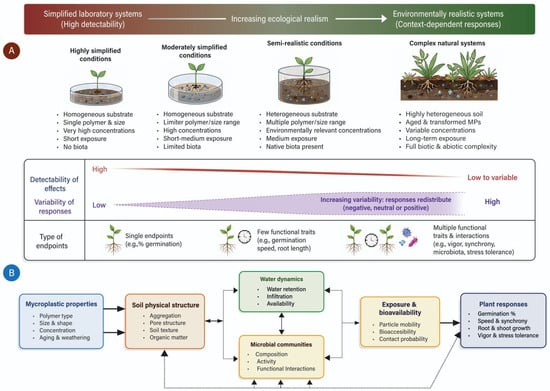
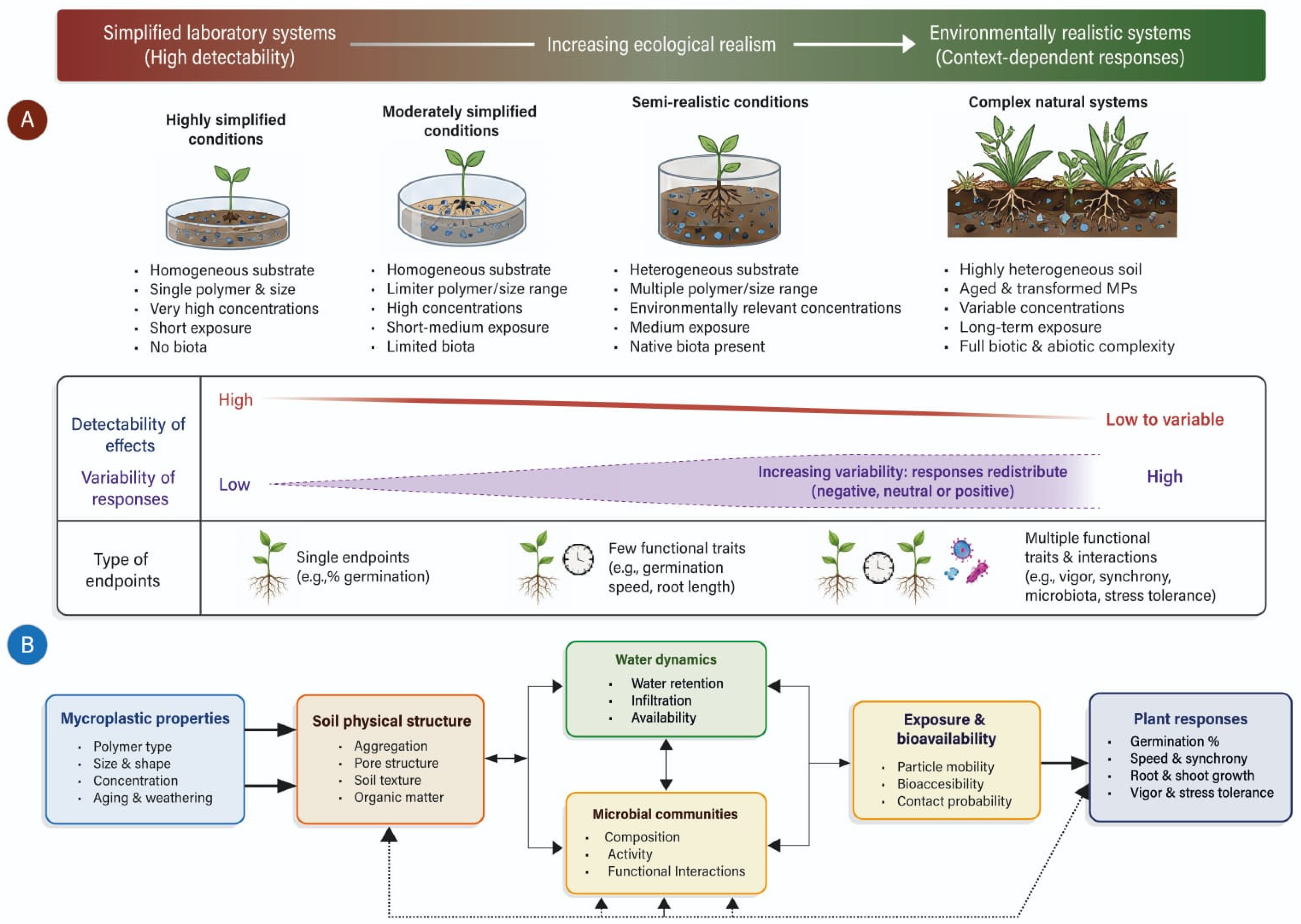
Table 1 and Table 2 summarize experimental contrasts and response patterns that provide the empirical context for, rather than direct evidence of, the experimental inflation framework. Because these tables were intended as a conceptual synthesis rather than a formal meta-analysis, the ranges and response categories should not be interpreted as quantitative estimates of experimental inflation. A quantitative comparison would require a systematic literature search, predefined inclusion criteria, standardized effect-size extraction, and explicit treatment of study-level dependence and potential publication bias. Variation in germination responses across studies may partly reflect differences in experimental complexity across systems, together with variation in exposure conditions, plant traits, statistical power, and other study-specific factors. Under controlled conditions, effects may be easier to detect and may appear more reproducible, while realistic soil systems can generate negative, neutral, or positive responses depending on soil properties, plant traits, microbial communities, and environmental stressors [10,24,25,33]. Accordingly, increasing environmental complexity should not be interpreted as producing a predictable decrease in effect magnitude. Instead, complexity may increase response variability, reveal buffering or amplifying mechanisms, or change the direction or endpoint of the observed response. As environmental complexity increases, plant responses can therefore become more variable and context dependent (Figure 1).
Figure 1.
The trajectories shown are hypothetical and are intended to illustrate testable expectations rather than established monotonic relationships between ecological realism, effect detectability, and response variability. (A) In panel A, the horizontal arrow represents a conceptual gradient from simplified laboratory systems to environmentally realistic systems, whereas the arrows and trend lines indicate hypothesized changes in effect detectability and response variability. Simple laboratory systems use homogeneous substrates, high microplastic concentrations, short exposure times, and low biological complexity; realistic conditions involve heterogeneous soils, aged particles, microbial communities, and environmental variability. (B) In panel B, arrows represent conceptual interactions and potential influences among microplastic properties, soil characteristics, water dynamics, microbial communities, particle bioavailability, and plant responses, rather than direct or unidirectional causal pathways. Plant responses under field conditions are the result of the interaction between microplastic properties, soil characteristics, water dynamics, microbial communities, and particle bioavailability, affecting germination, root development, and plant performance. The framework therefore allows ecological complexity to produce buffering, amplification, or changes in response direction rather than assuming a monotonic reduction in microplastic effects.
At present, experimental inflation should be regarded as a hypothesis-generating framework rather than a quantitative model. Available evidence is insufficient to demonstrate that increasing ecological realism systematically reduces effect magnitude or that laboratory studies consistently overestimate ecological risk. Instead, the framework proposes that experimental simplification can influence the detectability, consistency, and interpretation of biological responses by reducing environmental variability and, under some conditions, increasing the probability of direct exposure. The framework therefore makes no a priori assumption that laboratory studies produce larger biological effects than realistic systems. Its testable prediction concerns whether experimental configuration is associated with systematic differences in response detectability, within-treatment variance, or apparent consistency after relevant exposure and design variables are controlled. In this sense, experimental inflation provides a conceptual basis for examining why responses detected under highly controlled conditions may become more variable or context dependent as ecological complexity increases.
Apparent consistency across laboratory studies may also be influenced by publication bias, selective reporting, small-study effects, and differences in statistical power. These processes should be distinguished from experimental inflation because they operate at different stages of the evidence-generation process. Experimental inflation concerns how the experimental configuration may influence response detectability or consistency within and across experiments, whereas publication bias and selective reporting influence which results become available for synthesis. Consequently, the relative contribution of experimental inflation cannot currently be isolated from these methodological and publication-related processes and should therefore be treated as an empirical question rather than an established property of laboratory microplastic studies. Future meta-analytical assessments will be needed to disentangle these effects.
Several testable expectations emerge from this framework. First, increasing environmental complexity may increase variability and context dependency in plant responses rather than simply produce a progressive reduction in effect magnitude. Second, simplified systems combining elevated microplastic concentrations with homogeneous substrates are hypothesized to have a greater probability of detecting measurable responses, but this prediction should be evaluated after accounting for exposure intensity, sample size, endpoint, and other study-level moderators. Third, additional environmental stressors, including drought, nutrient limitation, temperature extremes, salinity, or co-contaminants, may amplify or reveal microplastic effects even at comparatively low concentrations [34,35,36]. Testing these expectations across progressively more realistic experimental systems would provide an empirical basis for evaluating the framework by comparing standardized effect sizes, within-treatment variance, between-study heterogeneity, response-detection probability, and the proportion of statistically detectable effects across experimental tiers.
4. Ecological Realism and Context-Dependent Plant Responses
Plant responses to microplastics depend heavily on environmental conditions. Drought, nutrient limitation, heat stress, salinity, and co-contaminant exposure may enhance or mitigate microplastic effects, even at low concentrations [10,24,33,37]. Study differences likely reflect differences in soil properties, microbial activity, abiotic stress, and plant functional traits across experimental systems. These factors may act independently or interactively, and their effects are not necessarily unidirectional. For example, environmental stress may increase plant susceptibility to microplastics in some contexts, whereas soil buffering, microbial activity, or reduced particle bioavailability may attenuate responses in others.
Microplastics occur in heterogeneous soil mixtures, varying in size, shape, polymer composition, and weathering state [13,29]. For experimental purposes, weathering state should be defined operationally rather than treated as a binary descriptor. Studies should distinguish pristine particles from artificially aged and environmentally aged or recovered particles, because these materials may differ in surface chemistry, morphology, and associated chemical release [38,39]. Artificial aging can be used to simulate selected weathering processes, including thermal aging, photoaging under ultraviolet (UV) radiation, and oxidative treatments such as Fenton-based oxidation. However, these approaches represent experimental proxies for specific weathering pathways and should not be considered direct equivalents of environmental weathering. Soil aggregation, organic matter interactions, and microbial activity further modify particle mobility, distribution, and bioavailability [14,15,31]. Such processes can reduce direct contact between particles and seeds and alter the exposure routes in realistic situations. However, these processes may also increase or modify exposure under environmental conditions. Weathering can alter particle surfaces and facilitate the release of associated chemicals, while microbial colonization and biofilm formation may modify particle transport, aggregation, and interactions with soil and plant surfaces. When artificial weathering is used, the treatment conditions should be reported explicitly, including temperature and exposure duration for thermal treatments, UV wavelength, intensity and exposure duration for photoaging, and oxidant concentrations and reaction conditions for oxidative treatments such as Fenton-based processes. Where possible, changes induced by aging should be verified by comparing particles before and after treatment using appropriate measurements of morphology, particle-size distribution, surface chemistry, oxidation state, or additive and leachate release. Consequently, ecological complexity can change not only the magnitude of exposure but also the pathway through which microplastics affect plants.
Interactions between microplastics, soil properties, and environmental stressors determine plant responses in the field. Since such factors seldom occur in isolation, responses observed in relatively simple laboratory settings may poorly reflect plant–soil interactions in natural systems [12]. Field-based evidence remains sparse, and most studies are still based on controlled systems designed to maximize response detectability and minimize variability [11,12,38]. Therefore, it remains unclear how reproducible the reported microplastic effects are under realistic environmental conditions. This limitation hinders comparisons across experimental systems and ecological contexts. In addition, differences between controlled and realistic systems cannot be attributed solely to ecological complexity because concentration, particle characteristics, exposure duration, sample size, plant species, and measured endpoints may also differ among studies. Comparisons across experimental tiers should therefore account for these potential confounding factors before differences in response detectability or variability are attributed to ecological realism.
These ecological processes can moderate, amplify, or redirect responses, rather than simply reducing their magnitude. Thus, increasing ecological realism may increase the range of possible outcomes and context dependency, providing a mechanistic basis for understanding why responses observed under control conditions may not be reproducible in natural soils. Importantly, a more variable response under realistic conditions should not be interpreted as evidence that the underlying biological effect is necessarily weaker. Increased variability may arise because additional mechanisms operate simultaneously, because exposure becomes spatially heterogeneous, or because plant responses depend on interactions among microplastics, soil properties, microorganisms, and environmental stressors. Conversely, ecological complexity may also amplify effects when co-occurring stressors increase plant susceptibility or enhance particle or chemical bioavailability.
This context dependence also has implications for the interpretation of apparently neutral responses. The absence of a significant effect under a particular soil or environmental condition may reflect buffering of exposure or biological responses rather than the absence of an intrinsic capacity of microplastics to affect plants. Conversely, an effect detected under a highly simplified system should not automatically be considered ecologically irrelevant if similar mechanisms operate under environmentally realistic conditions. The relevant question is therefore whether the direction, magnitude, and detectability of the response remain consistent across conditions that differ in ecological complexity.
These observations shift the central question from whether microplastics can influence germination under controlled conditions to whether those responses are sustained, reduced, enhanced, or reversed as ecological realism increases. Closing this gap will require experimental frameworks that maintain mechanistic control while progressively adding the complexity that characterizes natural soils. Such frameworks should retain core variables across experimental tiers, including polymer type, particle size and shape, weathering state, exposure concentration expressed in comparable units, soil properties, plant species, exposure duration, and standardized germination or early-development endpoints. For weathered particles, the aging procedure and, where available, the physicochemical changes resulting from aging should also be reported to improve comparability among studies. This would allow differences in response to be attributed more reliably to changes in ecological context rather than to simultaneous changes in experimental design.
Conversely, if increasing ecological realism does not alter response variability, detection frequency, or context dependency across experimental tiers, the explanatory value of the experimental inflation framework would be weakened. Similarly, if differences among experimental tiers are fully explained by exposure concentration, sample size, particle characteristics, or other measured moderators, the specific contribution of ecological realism would remain limited. These outcomes would provide useful tests of the framework because they would distinguish an effect of experimental configuration from differences arising from other characteristics of the exposure or study design.
5. Bridging Laboratory Experiments and Environmentally Realistic Conditions
Testing the experimental inflation framework requires experimental designs that progressively increase ecological realism while retaining sufficient mechanistic control. Integrating laboratory, mesocosm, and field studies will improve identification of responses that remain consistent across systems and those that depend on local context. However, comparisons across experimental tiers will be informative only if key exposure and biological variables are standardized or explicitly accounted for. Core variables should include polymer type, particle size and shape, weathering status, exposure concentration and units, soil properties, plant species, exposure duration, and germination or early-development endpoints. Maintaining these variables as consistently as possible, or incorporating them as moderators in the statistical analysis, would allow differences among tiers to be more directly attributed to ecological complexity rather than to simultaneous changes in experimental conditions.
Differences in experimental design also complicate reproducibility and comparisons among studies [40,41]. Contrasting results may partly reflect variation in ecological complexity across experimental systems. They may also reflect differences in exposure intensity, particle characteristics, sample size, statistical power, endpoint definition, or other study-specific factors. Accounting for these differences can improve comparisons across studies and reduce overgeneralization of effect sizes derived from simplified systems. Similar patterns may occur with other emerging contaminants when simplified experimental systems increase response detectability while only partially representing natural conditions. Greater attention to how experimental design shapes observed responses could improve ecological interpretation across environmental research. Importantly, the purpose of the tiered framework is not to assume that higher ecological realism produces smaller effects, but to determine whether ecological context changes the magnitude, variability, detectability, or direction of observed responses.
A tiered experimental framework, from highly controlled laboratory assays to realistic soil systems, mesocosms, and ultimately field validation, could provide a more robust basis for distinguishing mechanistically detectable effects from responses that remain ecologically relevant under realistic exposure scenarios. Controlled assays can isolate mechanisms and concentration-response relationships; realistic soil experiments can incorporate environmentally relevant concentrations, weathered particles, and biologically active substrates; mesocosms can introduce interacting environmental stressors and greater spatial and temporal complexity; and field studies can test whether observed responses persist under natural exposure conditions. Such a progressive gradient would allow ecological complexity to be evaluated systematically while retaining sufficient mechanistic control across experimental tiers. At each tier, the framework should evaluate not only whether a statistically detectable response occurs, but also the standardized effect size, within-treatment variance, between-study heterogeneity, and proportion of detectable responses. Within this framework, apparent consistency could be assessed through lower within-treatment variability, lower heterogeneity among comparable experiments, or a more uniform direction of responses across studies after accounting for relevant moderators. These metrics would provide complementary information about whether responses become weaker, more variable, more context dependent, or unchanged as ecological complexity increases.
A key prediction of the framework is therefore not that laboratory studies will necessarily produce larger effects, but that simplified experimental configurations may show higher response detectability or apparent consistency under otherwise comparable exposure conditions. This prediction can be evaluated by comparing experimental tiers while controlling for concentration, sample size, plant species, particle properties, exposure duration, and other relevant moderators. If differences in detectability or variance persist after these factors are accounted for, this would provide evidence consistent with an effect of experimental configuration. Conversely, if tier differences disappear after controlling these variables, the explanatory contribution of experimental inflation would be limited.
The framework also provides a basis for distinguishing experimental effects from publication and reporting processes. A higher proportion of significant findings in laboratory studies could result from lower within-treatment variance or greater statistical power, but it could also reflect selective reporting or publication bias. Consequently, future quantitative syntheses should model experimental tier separately from study size, statistical precision, and publication-related moderators. Multilevel meta-analysis could be used to account for dependence among multiple outcomes reported within the same study while testing whether experimental tier explains additional variation in effect size or response detectability.
6. Conclusions
The question is not simply whether microplastics affect seed germination, but under which environmental conditions and through which mechanisms such effects become ecologically relevant. Differences among studies may reflect variation in experimental design, exposure intensity, soil properties, particle characteristics, plant traits, and response variables across experimental systems. As environmental complexity increases, microplastic effects may become more variable, context-dependent, or even change in direction, because they are mediated by interacting soil, microbial, and abiotic processes that can buffer or amplify exposure and biological responses. Combining laboratory experiments, realistic soil systems, mesocosm experiments, and field observations should allow identification of responses that remain consistent across systems and those that depend strongly on ecological context. Within this framework, experimental inflation refers primarily to increased response detectability and apparent consistency under simplified experimental conditions, rather than necessarily to larger effect sizes or greater ecological risk. The framework therefore does not assume that increasing ecological realism will systematically reduce microplastic effects. Instead, it proposes that ecological complexity may alter the probability of detecting a response, its variability, its magnitude, or its direction. Testing whether increasing ecological realism changes response detectability, effect-size distributions, within-treatment variability, and context dependency will be critical for evaluating this conceptual framework and avoiding overgeneralization from simplified laboratory systems. Future comparative and quantitative studies should also distinguish these experimental effects from publication bias, selective reporting, and differences in statistical power, which may independently influence the apparent consistency of the evidence base.
Author Contributions
Conceptualization, J.Á.-L., A.S. and H.C.-M.; formal analysis, J.Á.-L., A.S., A.P.-C., M.J.R.-C. and H.C.-M.; data curation, J.Á.-L., A.P.-C. and M.J.R.-C.; writing—original draft preparation, J.Á.-L., A.S. and H.C.-M.; writing—review and editing, J.Á.-L., A.S. and H.C.-M. All authors have read and agreed to the published version of the manuscript.
Funding
This research received no external funding.
Institutional Review Board Statement
Not applicable.
Informed Consent Statement
Not applicable.
Data Availability Statement
No new data were created or analyzed in this study. Data sharing is not applicable to this article.
Conflicts of Interest
The authors declare no conflicts of interest.
References
- Rillig, M.C.; Ziersch, L.; Hempel, S. Microplastic transport in soil by earthworms. Sci. Rep. 2017, 7, 1362. [Google Scholar] [CrossRef] [Scilit] [PubMed]
- de Souza Machado, A.A.; Lau, C.W.; Till, J.; Kloas, W.; Lehmann, A.; Becker, R.; Rillig, M.C. Impacts of microplastics on the soil biophysical environment. Environ. Sci. Technol. 2018, 52, 9656–9665. [Google Scholar] [CrossRef] [Scilit] [PubMed]
- Álvarez-Lopeztello, J.; Cruz-Martínez, H.; González-Méndez, B.; Chávez-García, E.; Sunny, A. Deciphering the effects of micro-plastics on arbuscular mycorrhizal fungi: Current knowledge and future research perspectives. Appl. Soil Ecol. 2025, 215, 106477. [Google Scholar] [CrossRef] [Scilit]
- Hernández-Sánchez, L.; Cruz-López, V.; Herrera-Rivera, R.; Solis-Pomar, F.; Navarro-Antonio, J.; Cruz-Martínez, H. Impacts of microplastics and nanoplastics on tomato crops: A critical review. Environments 2025, 12, 328. [Google Scholar] [CrossRef] [Scilit]
- Zhang, G.S.; Liu, Y.F. The distribution of microplastics in soil aggregate fractions in southwestern China. Sci. Total Environ. 2018, 642, 12–20. [Google Scholar] [CrossRef] [Scilit] [PubMed]
- Álvarez-Lopeztello, J.; Robles, C.; del Castillo, R.F. Microplastic pollution in neotropical rainforest, savanna, pine plantations, and pasture soils in lowland areas of Oaxaca, Mexico: Preliminary results. Ecol. Indic. 2021, 121, 107084. [Google Scholar] [CrossRef] [Scilit]
- de Souza Machado, A.A.; Lau, C.W.; Kloas, W.; Bergmann, J.; Bachelier, J.B.; Faltin, E.; Becker, R.; Görlich, A.S.; Rillig, M.C. Micro-plastics can change soil properties and affect plant performance. Environ. Sci. Technol. 2019, 53, 6044–6052. [Google Scholar] [CrossRef] [Scilit] [PubMed]
- Bosker, T.; Bouwman, L.J.; Brun, N.R.; Behrens, P.; Vijver, M.G. Microplastics accumulate on pores in seed capsule and delay germination and root growth of the terrestrial vascular plant Lepidium sativum. Chemosphere 2019, 226, 774–781. [Google Scholar] [CrossRef] [Scilit] [PubMed]
- Jiang, X.; Chen, H.; Liao, Y.; Ye, Z.; Li, M.; Klobučar, G. Ecotoxicity and genotoxicity of polystyrene microplastics on higher plant Vicia faba. Environ. Pollut. 2019, 250, 831–838. [Google Scholar] [CrossRef] [Scilit] [PubMed]
- Lozano, Y.M.; Caesaria, P.U.; Rillig, M.C. Microplastics of different shapes increase seed germination synchrony while only films and fibers affect seed germination velocity. Front. Environ. Sci. 2022, 10, 1017349. [Google Scholar] [CrossRef] [Scilit]
- Wong, A.E.; Taylor, G. Plants and microplastics: Growing impacts in the terrestrial environment. Front. Plant Sci. 2025, 16, 1666047. [Google Scholar] [CrossRef] [Scilit] [PubMed]
- Chen, Z.; Carter, L.J.; Banwart, S.A.; Kay, P. Microplastics in soil–plant systems: Current knowledge, research gaps, and future directions for agricultural sustainability. Agronomy 2025, 15, 1519. [Google Scholar] [CrossRef] [Scilit]
- Pu, X.; Zhao, N.; Dong, X.; Ye, S.; Zhang, W.; Lv, L.; Wang, X.; Sun, L.; He, M.; Liu, J. Plant community responses to polypropylene microplastic and cadmium co-exposure: Implications for mycorrhizal strategies in a coastal wetland. J. Hazard. Mater. 2026, 505, 141411. [Google Scholar] [CrossRef] [Scilit] [PubMed]
- Rillig, M.C.; Lehmann, A. Microplastic in terrestrial ecosystems. Science 2020, 368, 1430–1431. [Google Scholar] [CrossRef] [Scilit] [PubMed]
- Lehmann, A.; Leifheit, E.F.; Feng, L.; Bergmann, J.; Wulf, A.; Rillig, M.C. Microplastic fiber and drought effects on plants and soil are only slightly modified by arbuscular mycorrhizal fungi. Soil Ecol. Lett. 2022, 4, 32–44. [Google Scholar] [CrossRef] [Scilit]
- Luan, Z.X.; Ran, J.; Xiong, H.Q.; Xiang, H.; Sun, X.L. Polypropylene and polylactic acid microplastics alter plateau wetland seed bank emergence and community assembly: A greenhouse stress test experiment. Plants 2026, 15, 910. [Google Scholar] [CrossRef] [Scilit] [PubMed]
- Boots, B.; Russell, C.W.; Green, D.S. Effects of microplastics in soil ecosystems: Above and below ground. Environ. Sci. Technol. 2019, 53, 11496–11506. [Google Scholar] [CrossRef] [Scilit] [PubMed]
- Jia, L.; Liu, L.; Zhang, Y.; Fu, W.; Liu, X.; Wang, Q.; Tanveer, M.; Huang, L. Microplastic stress in plants: Effects on plant growth and their remediations. Front. Plant Sci. 2023, 14, 1226484. [Google Scholar] [CrossRef] [Scilit] [PubMed]
- Li, X.; Wang, R.; Dai, W.; Luan, Y.; Li, J. Impacts of micro(nano)plastics on terrestrial plants: Germination, growth, and litter. Plants 2023, 12, 3554. [Google Scholar] [CrossRef] [Scilit] [PubMed]
- Saeed, T.; Khan, T.A.; Yusuf, M.; Bajguz, A. Microplastics in the rhizosphere: Unraveling plant–microbe–soil interactions and consequences for crop resilience. Plant Signal. Behav. 2026, 21, 2678701. [Google Scholar] [CrossRef] [Scilit] [PubMed]
- Chen, G.; Li, Y.; Liu, S.; Junaid, M.; Wang, J. Effects of micro(nano)plastics on higher plants and the rhizosphere environment. Sci. Total Environ. 2022, 807, 150841. [Google Scholar] [CrossRef] [Scilit] [PubMed]
- Saeed, Q.; Lu, X.; Farooqi, Z.U.R.; Ghafoor, A.; Naveed, M.; Maqsood, N.; Kareem, H.A.; Mustafa, A. Root traits and rhizosphere responses as emerging bioindicators of microplastic pollution in agricultural soils: A review. Environ. Res. 2026, 294, 123866. [Google Scholar] [CrossRef] [Scilit] [PubMed]
- He, M.; Feng, Z.; Xu, Y.; Ding, H.; Ying, C.; Cai, Y.; Zhang, H. Macro- and microplastic leachates show a slightly toxic effect on seed germination of cotton. Chemosphere 2023, 335, 139081. [Google Scholar] [CrossRef] [Scilit] [PubMed]
- Macan, G.P.F.; Munhoz, D.R.; Willems, L.A.J.; Monkley, C.; Lloyd, C.E.M.; Hageman, J.; Geissen, V.; Landa, B.B.; Harkes, P. Macro- and microplastics leachates: Characterization and impact on seed germination. J. Hazard. Mater. 2024, 480, 136013. [Google Scholar] [CrossRef] [Scilit] [PubMed]
- Tatum, A.; Martin, V.; Kankarla, V. Impact of microplastic-amended soil on seed germination of alfalfa (Medicago sativa) in a controlled environment. Agronomy 2025, 15, 237. [Google Scholar] [CrossRef] [Scilit]
- Yuan, W.; Zhou, Y.; Liu, X.; Wang, J. New perspective on the nanoplastics disrupting the reproduction of an endangered fern in artificial freshwater. Environ. Sci. Technol. 2019, 53, 12715–12724. [Google Scholar] [CrossRef] [Scilit] [PubMed]
- Meng, F.; Yang, X.; Riksen, M.; Xu, M.; Geissen, V. Response of common bean (Phaseolus vulgaris L.) growth to soil contaminated with microplastics. Sci. Total Environ. 2021, 755, 142516. [Google Scholar] [CrossRef] [Scilit] [PubMed]
- de Silva, Y.S.K.; Rajagopalan, U.M.; Kadono, H.; Li, D. Effects of microplastics on lentil (Lens culinaris) seed germination and seedling growth. Chemosphere 2022, 303, 135162. [Google Scholar] [CrossRef] [Scilit] [PubMed]
- Hartmann, N.B.; Hüffer, T.; Thompson, R.C.; Hassellöv, M.; Verschoor, A.; Daugaard, A.E.; Rist, S.; Karlsson, T.; Brennholt, N.; Cole, M.; et al. Are we speaking the same language? Recommendations for a definition and categorization framework for plastic debris. Environ. Sci. Technol. 2019, 53, 1039–1047. [Google Scholar] [CrossRef] [Scilit] [PubMed]
- Lozano, Y.M.; Lehnert, T.; Linck, L.T.; Lehmann, A.; Rillig, M.C. Microplastic shape, polymer type, and concentration affect soil properties and plant biomass. Front. Plant Sci. 2021, 12, 616645. [Google Scholar] [CrossRef] [Scilit] [PubMed]
- Zhang, Y.; Wang, X.; Li, J.; Yang, Y.; Gao, Y.; Wang, P. Polyethylene microplastic: Impacts on ryegrass seed germination and seedling development. BMC Plant Biol. 2025, 25, 876. [Google Scholar] [CrossRef] [Scilit] [PubMed]
- Bitton, N.K.; Zucker, I.; Gruntman, M. Microplastic exposure reduces seed germination in a coastal plant. Sci. Total Environ. 2025, 972, 179098. [Google Scholar] [CrossRef] [Scilit] [PubMed]
- van Kleunen, M.; Brumer, A.; Gutbrod, L.; Zhang, Z. A microplastic used as infill material in artificial sport turfs reduces plant growth. Plants People Planet 2020, 2, 157–166. [Google Scholar] [CrossRef] [Scilit]
- Sajjad, M.; Bahadur, S.; Masood, A.; Acioly, T.M.d.S.; Ilyas, M.; Din, I.; Al Asmari, A.F.; Islam, S.; Rahman, K.U. Synergistic effects of thermal stress and microplastic pollution on seed germination under agricultural soil conditions. Clean Soil Air Water 2026, 54, e70156. [Google Scholar] [CrossRef] [Scilit]
- Lozano, Y.M.; Rillig, M.C. Effects of microplastic fibers and drought on plant communities. Environ. Sci. Technol. 2020, 54, 6166–6173. [Google Scholar] [CrossRef] [Scilit] [PubMed]
- Zhen, Y.-Q.; Che, T.-H.; Song, Y.-X.; Wan, Y.-M.; Jiang, H.-H.; Yu, Z.-Z.; Yu, M.; Xu, S.-Q.; Li, C.-Y.; Zhou, J.-Y. Combined toxicity of microplastics and heavy metals to terrestrial plants: A global meta-analysis integrating machine learning predictions. J. Environ. Chem. Eng. 2025, 13, 120174. [Google Scholar] [CrossRef] [Scilit]
- Li, B.; Huang, S.; Wang, H.; Liu, M.; Xue, S.; Tang, D.; Cheng, W.; Fan, T.; Yang, X. Effects of plastic particles on germination and growth of soybean (Glycine max): A pot experiment under field condition. Environ. Pollut. 2021, 272, 116418. [Google Scholar] [CrossRef] [Scilit] [PubMed]
- En-Nejmy, K.; Hayany, B.E.; Al-Alawi, M.; Jemo, M.; Hafidi, M.; El Fels, L. Microplastics in soil: A comprehensive review of occurrence, sources, fate, analytical techniques and potential impacts. Ecotoxicol. Environ. Saf. 2024, 288, 117332. [Google Scholar] [CrossRef] [Scilit] [PubMed]
- Li, D.; Li, P.; Shi, Y.; Sheerin, E.D.; Zhang, Z.; Yang, L.; Xiao, L.; Hill, C.; Gordon, C.; Ruether, M.; et al. Stress-Induced Phase Separation in Plastics Drives the Release of Amorphous Polymer Micropollutants into Water. Nat. Commun. 2025, 16, 3814. [Google Scholar] [CrossRef] [Scilit] [PubMed]
- Cowger, W.; Gray, A.; Christiansen, S.H.; DeFrond, H.; Deshpande, A.D.; Hemabessiere, L.; Lee, E.; Mill, L.; Munno, K.; Ossmann, B.E.; et al. Critical review of processing and classification techniques for images and spectra in microplastic research. Appl. Spectrosc. 2020, 74, 989–1010. [Google Scholar] [CrossRef] [Scilit] [PubMed]
- Koelmans, A.A.; Redondo-Hasselerharm, P.E.; Mohamed Nor, N.H.; de Ruijter, V.N.; Mintenig, S.M.; Kooi, M. Risk assessment of microplastic particles. Nat. Rev. Mater. 2022, 7, 138–152. [Google Scholar] [CrossRef] [Scilit]

Disclaimer/Publisher’s Note: The statements, opinions and data contained in all publications are solely those of the individual author(s) and contributor(s) and not of MDPI and/or the editor(s). MDPI and/or the editor(s) disclaim responsibility for any injury to people or property resulting from any ideas, methods, instructions or products referred to in the content. |
© 2026 by the authors. Licensee MDPI, Basel, Switzerland. This article is an open access article distributed under the terms and conditions of the Creative Commons Attribution (CC BY) license.