


Abstract
Microplastic contamination is an increasing concern in terrestrial ecosystems, yet behavioral responses of soil-dwelling organisms remain less studied than conventional toxicity endpoints. This laboratory study assessed avoidance and mortality in three earthworm species, Eisenia fetida, Lumbricus terrestris, and Allolobophora chlorotica, and one soil-dwelling insect, Amara sp. (Carabidae), exposed to polyethylene microplastics at 0.10–0.30% (w/w). After 72 h, avoidance generally increased with polyethylene concentration, reaching 57.33% in E. fetida, 44.24% in L. terrestris, 51.90% in A. chlorotica, and 68.00% in Amara sp. at 0.30% polyethylene. Significant positive concentration effects were detected for E. fetida (odds ratio (OR) = 1.40, 95% CI: 1.10–1.79, p = 0.007) and Amara sp. (OR = 1.71, 95% CI: 1.33–2.19, p < 0.001), whereas trends in L. terrestris and A. chlorotica were not significant. Among the three taxa tested in the same soil matrix, polyethylene concentration significantly affected avoidance, while taxon and the taxon × concentration interaction were not significant. Mortality at 0.30% polyethylene was 12% in E. fetida, 26% in L. terrestris, and 36% in A. chlorotica, with none recorded in Amara sp. These findings support combining behavioral and mortality endpoints when assessing microplastic effects on soil fauna.
1. Introduction
Microplastic (MP) contamination has emerged as an increasing ecological concern in terrestrial environments, particularly in agricultural soils, where plastics are introduced through practices such as mulching, compost and sewage sludge application, irrigation, and atmospheric deposition [1]. Once incorporated into soil, MPs can interact with the soil matrix and alter physicochemical properties, including aggregate stability, porosity, bulk density, and water-holding capacity [2]. Their surface properties may also facilitate interactions with other contaminants, such as pesticides and heavy metals, potentially modifying their transport, persistence, and bioavailability in soil [3]. Consequently, MPs may affect soil organisms through both direct and indirect pathways [2,3,4]. Direct exposure through ingestion or contact with contaminated substrates may result in physiological, cellular, and behavioral responses, whereas indirect effects may arise from MP-induced changes in soil properties and interactions with other environmental contaminants [3,4,5]. At broader ecological scales, such effects may influence species interactions and ecosystem functioning, emphasizing the need to consider organism-level responses within the wider context of terrestrial ecosystems [5].
Soil organisms are fundamental components of terrestrial ecosystems, contributing to organic matter transformation, nutrient cycling, soil aggregation, and the formation and maintenance of soil pore networks. Earthworms are particularly important ecosystem engineers because their burrowing and casting activities modify soil structure and influence organic matter transformation and microbial processes [6]. Their interactions with soil microorganisms can further affect nutrient turnover and the functioning of the soil microbial food web [7]. Soil-dwelling insects such as carabid beetles (Coleoptera: Carabidae) also represent functionally important components of agroecosystems, encompassing taxa with diverse feeding strategies and ecological roles within terrestrial food webs [8,9]. Because soil organisms differ substantially in their feeding strategies, ecological niches, mobility, life cycles, and physiological characteristics, their responses to environmental stressors cannot necessarily be expected to be uniform. Consequently, the effects of MP contamination may vary among soil taxa depending on their ecological and physiological characteristics, as well as on MP properties and exposure conditions, highlighting the need to consider taxon-specific responses when assessing the ecological effects of MPs in soil [3,10].
Ecotoxicological assessments of soil organisms commonly rely on endpoints such as survival, growth, and reproduction [11,12]. Although these endpoints are essential for evaluating adverse effects, behavioral responses can provide complementary information on sublethal effects of environmental stressors [13,14,15]. Avoidance responses, in particular, can be detected over relatively short exposure periods and, in some cases, may show greater sensitivity than conventional toxicity endpoints [13,16,17]. Behavioral responses may include changes in movement, burrowing activity, feeding or foraging activity, and habitat selection or avoidance, reflecting different ways in which soil organisms respond to unfavorable environmental conditions [12,13,14]. In the context of MP contamination, such responses are particularly relevant because changes in movement or habitat selection may alter the spatial distribution of soil organisms even under exposure conditions associated with low or absent mortality. Recent studies have therefore highlighted the value of integrating behavioral responses with conventional toxicity endpoints when assessing the effects of MPs on soil fauna [16,18,19,20].
Among behavioral endpoints, avoidance is particularly informative because it reflects an organism’s ability to discriminate between favorable and unfavorable substrates and to alter its spatial distribution accordingly [14,21]. In soil ecotoxicology, avoidance tests have been standardized as rapid, sublethal screening tools, particularly for earthworms, which can discriminate between contaminated and uncontaminated soils and move away from unfavorable substrates [14,21]. Avoidance may therefore complement conventional toxicity endpoints by providing information on habitat selection that is not captured by mortality, biomass, or reproduction alone [14,15]. According to Bodor et al. [3], behavioral responses to MPs can vary with organism and MP characteristics, while Letwin et al. [20] reported variable avoidance responses across different polymer types and exposure concentrations.
Although available studies indicate that soil invertebrates may differ in their responses to MP contamination [10,16,22], comparative evidence among soil taxa remains limited. A global meta-analysis by Wei et al. [22] showed that MP effects on soil biota were influenced by MP type, particle size, concentration, and exposure duration. Weltmeyer and Roß-Nickoll [10] likewise reported variable effects among invertebrate groups exposed to mulch-film-derived MPs, emphasizing the role of biological and exposure-related factors in shaping MP effects. In a direct comparison, van Loon et al. [16] evaluated four soil invertebrate species; notably, earthworms exhibited avoidance behavior whereas isopods did not. These contrasts are particularly relevant for avoidance because ecological characteristics such as feeding strategy, burrowing activity, mobility, and habitat use may influence exposure to MPs and behavioral responses to contaminated soil [3,12,16]. Comparative evaluation among soil taxa may therefore help determine the extent to which avoidance responses are consistent among taxa or vary in relation to their ecological traits.
Despite the increasing number of studies addressing the effects of MPs on soil fauna, behavioral endpoints have been investigated less extensively than conventional fitness-related endpoints such as survival, growth, and reproduction [11,12]. The systematic review and meta-analysis by Ji et al. [11] showed that MP exposure can affect a wide range of biological endpoints in soil invertebrates, with responses varying according to MP characteristics, concentration, and exposure duration. Möhrke et al. [12] and Hanif et al. [23] similarly documented effects across multiple biological endpoints, including behavioral, physiological, developmental, reproductive, and survival-related responses. Importantly, sublethal responses may occur under exposure conditions associated with low or absent mortality [12,23]. However, comparative studies evaluating avoidance and mortality within the same experimental framework across multiple soil taxa remain limited. Joint assessment of these endpoints may therefore provide a more comprehensive characterization of organism responses to MP exposure than either endpoint considered alone.
Available evidence indicates that MP concentration can influence biological responses of soil invertebrates, although concentration-dependent patterns are not consistent across taxa or endpoints [3,11]. Ji et al. [11] reported clear concentration-related effects in nematodes, whereas comparable trends were not consistently observed in earthworms. Bodor et al. [3] emphasized that the effects of MPs depend not only on concentration but also on polymer type, particle size, and shape. Studies specifically addressing avoidance have produced contrasting concentration–response patterns, with concentration-dependent avoidance reported in E. fetida [19,24], whereas other studies found weak, variable, or no clear avoidance responses across different exposure ranges [20,25]. Collectively, these findings indicate that avoidance responses cannot be predicted from MP concentration alone and may also depend on organism characteristics, MP properties, and experimental conditions. Assessment across a defined concentration gradient may therefore help characterize the strength and consistency of concentration-related avoidance responses.
The interpretation of MP effects on soil fauna is further complicated by substantial variation in experimental exposure conditions. Differences in soil physicochemical properties, exposure matrices, and other experimental conditions can influence organism responses and hinder direct comparisons among studies [3,12,26]. En-Nejmy et al. [26] further highlighted the transport and redistribution of MPs within soil and the importance of soil and environmental conditions in determining their fate and effects. In addition, laboratory exposure concentrations do not always reflect environmentally realistic scenarios, emphasizing the need to consider environmental relevance when interpreting ecotoxicological findings [12,27]. Consequently, differences among experimental systems need to be carefully considered when comparing biological responses across studies or taxa, particularly when exposure matrices are not equivalent.
Taken together, these gaps highlight an additional limitation of the current evidence base: its strong taxonomic bias toward a limited number of model organisms, particularly earthworms and nematodes [3,11,12]. Other components of the soil fauna remain considerably less investigated, limiting the extent to which current findings can be generalized across soil invertebrates. In this context, inclusion of Amara sp. (Carabidae) provides information for a soil-associated insect taxon for which experimental evidence on behavioral responses to MPs remains particularly limited.
To address these knowledge gaps, the present study assessed avoidance behavior and mortality in three earthworm species, Eisenia fetida, Lumbricus terrestris, and Allolobophora chlorotica, and one soil-dwelling insect, Amara sp. Specifically, we tested whether (1) increasing polyethylene concentration affected the probability of occurrence in the uncontaminated compartment and (2) concentration-related avoidance responses differed among taxa tested in the same soil matrix.
2. Materials and Methods
2.1. Test Organisms, Test Substrates and Microplastic
The colonies of Eisenia fetida (Savigny, 1826) and compost used in the bioassays were purchased from the local earthworm farm (Apatin, Serbia). Only adult earthworms with fully developed clitellum and individual mass above 300 mg were used in the tests. Specimens of Lumbricus terrestris Linnaeus, 1758 and Allolobophora chlorotica (Savigny, 1826), as well as ground beetles (Carabidae), were collected from the agricultural fields of the Institute of Field and Vegetable Crops, Novi Sad (Vojvodina, Northern Province of the Republic of Serbia), using a shovel, digging up to 50 cm in depth. The collected organisms were carefully placed by hand in plastic containers containing a sufficient amount of soil and transported to the laboratory. Only adult earthworms of these two species with fully developed clitellum and individual mass above 500 mg were used in tests. The earthworm masses were measured using the analytical scale Kern 440-47N (KERN & SOHN GmbH, Lörrach, Germany). Additionally, collected carabid beetles were identified to the genus level, and only adults belonging to the genus Amara were used in the experiments.
To minimize the potential influence of differences in soil physicochemical properties, the same soil matrix was used in all bioassays with L. terrestris, A. chlorotica, and Amara sp. Soil was collected from the same agricultural fields and at the same time as these test organisms, transported to the laboratory in bags, and subsequently used for the preparation of both control and MP-amended compartments. The sampling site, previously designated as “Banat 1”, was physicochemically characterized in our earlier study [19]. Previously reported characteristics of soil from this site included a loamy clay texture, a pH of 7.32 in KCl and 8.33 in H2O, and an organic matter content of 3.11% [19]. Detailed physicochemical characteristics and the corresponding analytical procedures are reported in Baloš et al. [19]. Initial water content, water-holding capacity and bulk density were not determined for the soil batch used in the present bioassays and were therefore not available for inclusion in the soil characterization. The fields had not been treated with agrochemicals during the year preceding sampling. The soil was not sterilized in order to preserve its natural characteristics and avoid introducing an additional experimental stressor. In contrast, the bioassays with E. fetida were conducted using the purchased compost in which this species was maintained.
The microplastic used in all bioassays originated from field-collected agricultural mulch film and was obtained from the same sample used in our previously published study [19], in which Fourier-transform infrared spectroscopy (FTIR) using a Nicolet iS20 FTIR spectrometer (Thermo Fisher Scientific, Waltham, MA, USA) confirmed the polymer identity as polyethylene (PE). Therefore, FTIR characterization was not repeated as part of the present study. For the current experiments, the field-collected mulch film was manually cut into irregularly shaped particles with a maximum dimension of <5 mm. The resulting particles were heterogeneous in size and shape. A quantitative particle-size distribution and film thickness were not determined, and the weathering/aging state of the field-collected material, as well as the presence and composition of potential additives or surface residues, were not characterized. Thus, although the polymer identity was confirmed as PE by FTIR, these additional physicochemical characteristics of the test material remained undetermined.
2.2. Experimental Design and Exposure Conditions
The experiments were conducted as laboratory bioassays under controlled environmental conditions using two-section custom-made stainless-steel chambers with a capacity of 2 L. The containers allowed sufficient light access and gaseous exchange between the soil and the air, as they were covered with fine mesh, secured to the sides with tape in order to prevent the earthworms and Amara sp. from escaping.
The effects of MP-amended test substrate on organism distribution between the control and MP-amended compartments were assessed using a modified avoidance-test protocol based on EN ISO 17512-1:2020 [21]. Each taxon was tested separately. For the purpose of these tests, 500 g of the respective test substrate was spiked with 0.5, 0.75, 1.0, 1.25, or 1.5 g of MP particles in glass beakers, thoroughly mixed to ensure an even distribution of the particles, and poured into the right compartment of each container. Consequently, the PE concentrations were 0.10%, 0.15%, 0.20%, 0.25%, and 0.30% (w/w), corresponding to 1.0–3.0 g PE kg−1 of test substrate. The selected PE concentration range was based on our previous study [19] and on concentrations applied in controlled soil ecotoxicological studies with PE microplastics [28,29]. Each PE concentration was tested using five independent replicates per taxon. The left compartment of each treatment replicate contained the corresponding test substrate of the same origin but without added MP particles. In addition, five control replicates were established per taxon, with both compartments containing 500 g of the corresponding unamended test substrate. The MP particles and test substrate were weighed using an analytical balance (Kern 440-47N, KERN & SOHN GmbH, Lörrach, Germany).
At the beginning of the bioassay, the containers were split into two equal sections using a custom-made vertically introduced plastic divider. Both compartments were filled with the respective test substrate to a depth of approximately 70 mm. Thereafter, the plastic divider was removed, and the test organisms were placed along the separating line. Because of differences in body size and biomass, ten E. fetida or Amara sp. individuals and five L. terrestris or A. chlorotica individuals were introduced into each replicate. The organisms were placed individually at the center of the separating line and allowed to burrow freely.
All containers were maintained in the same environmental chamber at 22 ± 2 °C and 38–42% relative humidity, under a 16:8 h light:dark cycle. Temperature and relative humidity were monitored using a Profi-Thermo-/Hygrometer HygroLogg Pro (TFA Dostmann GmbH & Co. KG, Wertheim, Germany). The bioassays lasted 72 h, representing an extension of the 48-h exposure period specified in EN ISO 17512-1:2020 [21]. The 72-h exposure period was applied uniformly to all tested taxa as part of the comparative multi-taxon design, allowing avoidance and mortality to be assessed at the same experimental endpoint. During the exposure period, no additional food was provided to the earthworms or Amara sp., and no additional water was added to the test substrate. For Amara sp., these conditions were applied as part of the same comparative experimental design; however, EN ISO 17512-1:2020 [21] is an earthworm avoidance protocol and does not represent a taxon-specific standardized procedure for this beetle.
At the end of the bioassay, the two compartments were separated again using the same plastic divider. The dividers were inserted while the containers remained in the environmental chamber to minimize potential organism movement associated with changes in temperature or humidity. Earthworms and Amara sp. were then counted separately in each compartment. For earthworms intersected by the divider during its insertion, individuals were assigned a value of 0.5 to each compartment when approximately equal portions of the body occurred on both sides of the divider. When a larger portion of the body was located in one compartment, or when the compartment containing the prostomium could be identified, the individual was assigned entirely to that compartment [19].
2.3. Avoidance and Mortality Assessment
Avoidance (A), expressed as a percentage, was calculated according to the following equation:
where A is avoidance (in %), nc is the number of surviving individuals in the unamended test substrate, nt is the number of surviving individuals in the MP-amended test substrate, and N is the total number of surviving individuals recovered from both compartments [21]. Because avoidance was calculated exclusively from surviving individuals, mortality within a replicate reduced the number of organisms contributing to the behavioral endpoint. Consequently, avoidance percentages describe the distribution of the surviving subset rather than that of all individuals initially introduced into the replicate.
A (%) = ((nc − nt)/N) × 100,
Mortality was calculated as the percentage of dead individuals relative to the initial number of individuals introduced into each replicate (5 or 10). Specimens were considered dead when they showed no movement following gentle tactile stimulation or when visible signs of desiccation were observed.
2.4. Statistical Analyses
Descriptive statistics, including arithmetic means, standard deviations, and mortality percentages, were calculated using Microsoft Excel 2019 (Microsoft Corporation, Redmond, WA, USA). Statistical analyses were performed using Statistica 14.0.0.15 (TIBCO Software Inc., Palo Alto, CA, USA).
Each chamber containing a defined number of organisms was considered one experimental replicate and the experimental unit. Avoidance responses were analyzed using generalized linear models (GLMs) with a logit link, based on the proportion of surviving individuals recorded in the control compartment relative to the total number of surviving individuals recovered from both compartments in each replicate. Microplastic concentration was included as a continuous predictor and scaled so that model estimates corresponded to an increase of 0.10 percentage points (w/w) in PE concentration. For earthworms, fractional counts resulting from individuals intersected by the divider were retained according to the predefined scoring procedure described above, without rounding. A quasibinomial formulation was therefore used to accommodate proportional responses containing fractional assignments. Model dispersion was evaluated using the Pearson dispersion statistic. No evidence of overdispersion was detected; consequently, no additional correction for overdispersion or beta-binomial modelling was required.
The effect of PE concentration on avoidance was first evaluated separately for each taxon. Effect estimates were expressed as odds ratios (ORs) for a 0.10 percentage-point increase in PE concentration, together with 95% confidence intervals (CIs) and p-values. The adequacy of treating PE concentration as a continuous predictor was assessed by comparing these models with models in which concentration was treated as a categorical factor. An additional GLM including taxon, PE concentration, and their interaction was used to evaluate whether concentration-dependent responses differed among taxa. This analysis was restricted to L. terrestris, A. chlorotica, and Amara sp., which were tested in the same soil matrix. E. fetida was excluded from this formal cross-taxon comparison because it was tested in a different substrate. The taxon × concentration interaction was used to test whether the concentration–response relationship differed among the three taxa under the same soil conditions. In the absence of a significant interaction, the reduced additive model was used to evaluate the overall effects of PE concentration and taxon.
Mortality was expressed as the percentage of dead individuals in each replicate. Because mortality data were discrete and characterized by a high proportion of zero values, differences among PE concentrations were assessed using the Kruskal–Wallis test. When a significant overall difference was detected, pairwise comparisons were performed using Dunn’s post hoc test with Holm adjustment for multiple comparisons. Amara sp. was not subjected to inferential analysis of mortality because no mortality was recorded in any treatment or control replicate.
For all statistical analyses, statistical significance was assessed at α = 0.05.
3. Results
3.1. Avoidance Behavior
Avoidance responses of the four tested taxa were assessed after 72 h of exposure to different PE concentrations. The distribution of organisms between the control and PE-amended compartments and the corresponding mean avoidance values are summarized in Table 1.
Table 1.
Distribution of surviving specimens between compartments containing unamended (nc) and polyethylene (PE)-amended (nt) test substrate and corresponding avoidance responses (A%) at different PE concentrations after 72 h of exposure.
Numerically, avoidance generally increased with increasing PE concentration in all four tested taxa (Table 1). At the highest PE concentration (0.30%), mean avoidance ranged from 44.24% in L. terrestris to 68.00% in Amara sp., while intermediate values were recorded for A. chlorotica (51.90%) and E. fetida (57.33%).
Avoidance responses were further evaluated using GLMs based on the proportion of surviving individuals recorded in the control compartment. Taxon-specific analyses showed a significant positive effect of increasing PE concentration on avoidance in E. fetida and Amara sp., whereas the positive concentration–response trends observed for L. terrestris and A. chlorotica were not statistically significant (Table 2). The magnitude of the concentration effect was greatest in Amara sp., with an odds ratio of 1.71 per 0.10 percentage-point increase in PE concentration.
Table 2.
Taxon-specific generalized linear model (GLM) results for avoidance responses to increasing PE concentration.
The cross-taxon analysis of L. terrestris, A. chlorotica, and Amara sp. showed no significant taxon x PE concentration interaction, indicating no evidence that the concentration–response relationships differed among the three taxa tested in the same soil matrix (Table 3). Following removal of the non-significant interaction, the reduced additive model showed a significant overall effect of PE concentration, whereas the overall effect of taxon was not significant. Across the three taxa, the odds of occurrence in the control compartment increased by a factor of 1.53 for each 0.10 percentage-point increase in PE concentration.
Table 3.
Cross-taxon generalized linear model analysis of avoidance responses to increasing PE concentration.
Model diagnostics indicated no evidence of overdispersion, and comparison with models treating PE concentration as a categorical factor provided no evidence that the continuous concentration specification was inadequate.
3.2. Mortality
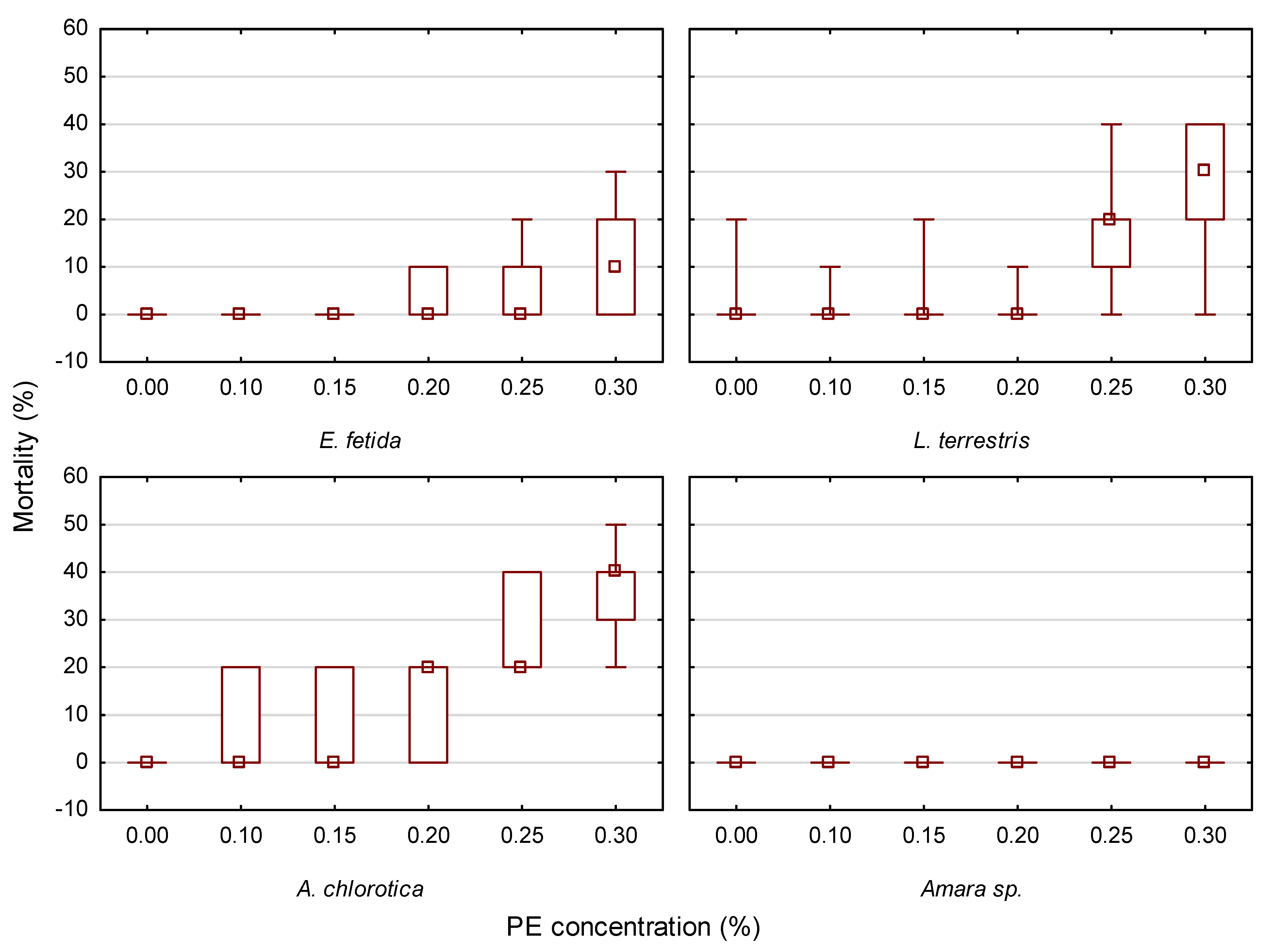
Mortality of the tested soil organisms was assessed after 72 h of exposure to different PE concentrations (Figure 1). No mortality was recorded in Amara sp. in either the control or PE treatments. At the highest PE concentration (0.30%), mean mortality reached 36% in A. chlorotica, 26% in L. terrestris, and 12% in E. fetida. Mortality was recorded at all tested PE concentrations in L. terrestris and A. chlorotica, whereas in E. fetida it was first observed at 0.20% PE. A low level of mortality (4%) was also recorded in the L. terrestris control group, corresponding to one individual among the 25 organisms used across the five control replicates.
Figure 1.
Mortality of the tested soil organisms after 72 h of exposure to different polyethylene (PE) concentrations. Boxes represent the 25th–75th percentiles, central markers indicate medians, and whiskers represent the minimum–maximum range (n = 5 replicates per concentration). No mortality was recorded in Amara sp.
Mortality in E. fetida did not differ significantly among PE concentrations and the control (Kruskal–Wallis: H = 9.881, df = 5, p = 0.079). For L. terrestris, the overall Kruskal–Wallis test indicated a significant difference among groups (H = 12.479, df = 5, p = 0.029); however, none of the pairwise comparisons remained significant following Dunn’s post hoc test with Holm adjustment. Mortality in A. chlorotica also differed significantly among groups (H = 18.958, df = 5, p = 0.002). Dunn’s post hoc test with Holm adjustment showed significantly higher mortality at 0.25% (adjusted p = 0.042) and 0.30% PE (adjusted p = 0.004) compared with the control. Because no mortality occurred in Amara sp., inferential analysis was not performed for this taxon.
4. Discussion
The present study showed that avoidance responses generally increased with increasing PE concentration, although the strength and statistical support for this relationship varied among the tested taxa. Taxon-specific analyses confirmed a significant positive concentration effect for E. fetida and Amara sp., whereas the positive trends observed for L. terrestris and A. chlorotica were not statistically significant. Among the three taxa tested in the same soil matrix, the overall effect of PE concentration was significant, while neither the taxon × concentration interaction nor the overall effect of taxon was significant. Thus, the results provide evidence that PE concentration influenced avoidance behavior but do not support statistically confirmed differences in concentration–response relationships among these three taxa. Across these three taxa, the odds of occurrence in the control compartment increased by a factor of 1.53 (95% CI: 1.28–1.83) for each 0.10 percentage-point increase in PE concentration. Nevertheless, the descriptive responses showed substantial avoidance at the highest PE concentration, reaching 68.00% in Amara sp., 57.33% in E. fetida, 51.90% in A. chlorotica, and 44.24% in L. terrestris.
The PE concentrations used in the present study were higher than microplastic mass concentrations reported in some agricultural field soils. For example, Qi et al. [30] reported estimated microplastic mass concentrations of 3.12, 5.63, and 7.99 mg kg−1 dry soil in agricultural soils from three regions of China, with PE representing the dominant polymer type. These field concentrations were substantially lower than the experimental range applied in the present study (1.0–3.0 g kg−1). Accordingly, the concentrations used here should be regarded as controlled experimental exposure levels rather than direct representations of typical field concentrations. An additional limitation concerns the characterization of the field-collected mulch film used as the PE source. Because particle-size distribution, film thickness, weathering/aging state, and potential additives or residues were not characterized, any contribution of these material-specific properties to the observed biological responses cannot be distinguished from effects associated with the PE matrix itself.
4.1. Concentration-Dependent Avoidance Responses
The positive relationship between PE concentration and avoidance observed in the present study is consistent with our previous findings for E. fetida. Baloš et al. [19] reported avoidance responses of E. fetida exposed for 48 h to 0.10, 0.20, and 0.30% PE in three agricultural soils. Avoidance ranged from 18.67% to 27.40% among soil types, and PE concentration had a significant effect, with stronger responses at 0.20 and 0.30% than at 0.10%. In the present study, E. fetida likewise showed a significant positive concentration effect, with avoidance reaching 57.33% at 0.30% PE. However, concentration-dependent avoidance has not been consistently demonstrated across studies. Trakić et al. [25] found no clear avoidance response in E. fetida exposed to considerably higher MP concentrations (2.5–7%), while Letwin et al. [20] reported generally weak and variable responses to several MP polymers, without significant differences among concentrations. These findings contrast with the significant positive concentration effect observed for E. fetida in the present study and indicate that MP concentration alone may not determine avoidance behavior; polymer characteristics, soil properties, and experimental conditions may also contribute to variation among studies. In this context, the absence of measurements of initial water content, water-holding capacity and bulk density for the test soil represents a methodological limitation, because these properties can influence soil structure and moisture conditions and may consequently affect organism behavior.
For L. terrestris, avoidance increased numerically from 10.22% at 0.10% PE to 44.24% at 0.30% PE, but the concentration effect was not statistically significant (OR = 1.30, 95% CI: 0.91–1.87, p = 0.147). Baeza et al. [31] similarly reported no clear preference or dose–response relationship in L. terrestris exposed to different plastic materials. Although that study also documented physical and biochemical effects following MP exposure, these observations do not establish the mechanism underlying avoidance behavior. Therefore, the numerical shift toward the uncontaminated compartment observed in the present study should be interpreted as a positive concentration-related trend rather than evidence of a statistically confirmed concentration–response relationship for L. terrestris.
The potential importance of exposure concentration is further supported by Ding et al. [24], who compared biodegradable MPs and PE in E. fetida and identified concentration as an important determinant of biological responses, reporting an estimated 10% effect concentration (EC10) for avoidance of 40 g kg−1. This value was substantially higher than the PE concentrations used in the present study (1.0–3.0 g kg−1), and direct comparison is limited by differences in exposure conditions and MP characteristics. Nevertheless, together with the present findings, these studies indicate that behavioral responses to MPs may vary quantitatively with exposure level while remaining strongly dependent on the experimental context.
A. chlorotica and Amara sp. also showed increasing avoidance with increasing PE concentration. The concentration effect was not statistically significant in A. chlorotica (OR = 1.40, 95% CI: 0.96–2.04, p = 0.084), whereas Amara sp. showed a significant concentration-related response and the largest estimated concentration effect in the taxon-specific analyses (OR = 1.71, 95% CI: 1.33–2.19, p < 0.001). Thus, the taxon-specific analyses provided different levels of statistical support for positive concentration-related responses, although this should not be interpreted as evidence of statistically different concentration–response relationships among taxa.
Overall, the results support a graded rather than binary interpretation of avoidance responses to PE contamination. Increasing PE concentration was associated with a general numerical shift toward the uncontaminated compartment across the tested taxa, although statistically significant concentration effects were demonstrated only for E. fetida and Amara sp. Physical effects on earthworms have been reported following MP exposure [31], while MP-induced changes in soil properties have been proposed as a possible driver of avoidance behavior in terrestrial oligochaetes [32]. Moreover, according to Syed et al. [33], earthworm avoidance can be influenced by chemosensory cues. However, these potential mechanisms were not directly investigated in the present study and therefore remain hypothetical in relation to the observed avoidance responses.
4.2. Variation in Avoidance Responses Among Tested Taxa
At the descriptive level, avoidance responses varied among the tested organisms, particularly at the highest PE concentration. At 0.30% PE, avoidance reached 44.24% in L. terrestris, 51.90% in A. chlorotica, and 68.00% in Amara sp. Among these three taxa, which were tested in the same soil matrix, however, neither the taxon × concentration interaction nor the overall effect of taxon was statistically significant. Thus, the observed numerical differences should not be interpreted as evidence of statistically confirmed taxon-specific differences in avoidance. E. fetida showed 57.33% avoidance at the same PE concentration, but because this species was tested in compost rather than in the soil matrix used for the other taxa, it was excluded from the formal cross-taxon comparison.
Ecological characteristics nevertheless remain relevant when considering why responses to MPs may vary among soil organisms and experimental contexts. Saartama et al. [34], in a two-year field study conducted in Finland, Germany, and Spain using conventional low-density PE and biodegradable poly(butylene adipate-co-terephthalate) (PBAT)–starch-blend MPs, reported that responses of soil invertebrates varied among organism groups, MP types, geographical regions, and sampling years. The authors also observed treatment-related increases in earthworm abundance and biomass in deeper soil layers and proposed downward movement from MP-treated topsoil as one possible explanation. They further noted that A. chlorotica and L. terrestris differ in ecological strategy and vertical distribution within the soil profile. Although the present study did not examine vertical movement, these findings indicate that ecological characteristics may contribute to variation in how earthworms respond to MP-contaminated soil.
The ecological strategies of L. terrestris and A. chlorotica provide additional context for interpreting their descriptive response patterns. A. chlorotica is an endogeic, geophagous species that occupies a range of depths in the soil profile and can adjust its burrowing depth in response to unfavorable conditions [35], whereas L. terrestris is an anecic species characterized by a distinct vertical burrowing strategy [36]. Capowiez et al. [36] demonstrated substantial differences in burrow-system architecture between anecic and endogeic earthworms, with endogeic species producing more highly branched and less continuous burrow systems. However, because the present study did not directly examine burrowing activity or vertical movement, these ecological differences should be regarded as possible contextual factors rather than demonstrated mechanisms underlying the observed avoidance responses.
This interpretation is also consistent with Papazlatani et al. [37], who compared anecic L. terrestris and endogeic Aporrectodea caliginosa exposed to 0.2% low-density polyethylene MPs and found that earthworm life form was a stronger determinant of gut bacterial community composition than MP treatment. Although gut microbiome responses cannot be directly equated with avoidance behavior, their findings illustrate that ecological strategy can influence biological responses to MP exposure and may contribute to variability among studies.
Among the taxa tested in the same soil matrix, Amara sp. showed the highest descriptive avoidance at 0.30% PE (68.00%) and a significant positive concentration effect. However, the behavioral response of Amara sp. should be interpreted in the context of the experimental conditions. Unlike the earthworm tests, the 72-h exposure of Amara sp. without supplemental food or water was not based on a taxon-specific standardized avoidance protocol and may have influenced beetle activity and distribution independently of, or in interaction with, PE exposure. Although these conditions were identical across all Amara sp. treatments and therefore do not provide a treatment-specific explanation for the observed concentration effect, the avoidance response cannot be attributed exclusively to PE exposure. Field evidence indicates that carabid beetles can be exposed to MPs in terrestrial environments. Meacci et al. [38] detected ingested MPs in 32% of examined carabids, with ingestion frequency differing significantly among sampling sites (p = 0.028) and reaching 75% and 87.5% during July and August, respectively, at the site subjected to intense summer tourism. These findings provide relevant field evidence of MP exposure in carabid beetles and ecological context for considering Amara sp. in MP research, although the behavioral response observed in the present study should not be generalized to Carabidae as a whole.
More broadly, interactions between terrestrial invertebrates and MPs may extend beyond effects on individual organisms. Al Malki et al. [39] detected MPs in several terrestrial taxa, including L. terrestris, and proposed terrestrial biota as potential indicators of MP contamination. Gallitelli et al. [40] further demonstrated that saproxylic beetle larvae can mechanically fragment plastic and highlighted their potential contribution to MP redistribution and transfer through terrestrial food webs. These studies do not demonstrate comparable processes in Amara sp., but they emphasize the wider ecological relevance of interactions between soil-associated invertebrates and plastic contamination.
4.3. Mortality Effects
Mortality provided additional information on the effects of PE exposure across the tested taxa. Avoidance and mortality represent distinct but complementary endpoints for characterizing organism responses to contaminant exposure [14,15]. The relationship between avoidance and mortality requires particular caution because the avoidance endpoint was calculated only from surviving individuals. Thus, in treatments with mortality, especially for L. terrestris and A. chlorotica, the number of organisms contributing to the behavioral endpoint was reduced. Moreover, if mortality was not random with respect to individual sensitivity or behavior, the surviving subset may not fully represent the behavioral response of the group initially exposed. Avoidance percentages in these treatments should therefore be interpreted as the distribution of surviving individuals and considered together with the corresponding mortality response. Because the present protocol extended the standard 48-h exposure period specified in EN ISO 17512-1:2020 to 72 h [21], the longer exposure duration may have contributed to the mortality observed in some treatments, particularly in L. terrestris and A. chlorotica. This possible contribution of exposure duration should also be considered when evaluating the observed mortality patterns.
In E. fetida, mortality increased at the higher PE concentrations, but the overall treatment effect was not statistically significant. This distinction between observed patterns and statistically supported effects is also evident in previous studies. Ding et al. [24] observed higher mortality at the highest PE exposure levels, but neither MP type nor concentration had a statistically significant effect on mortality. Trakić et al. [25] reported no mortality in E. fetida after 7 or 14 days of exposure to commercial glitter MPs, whereas mortality became evident after 28 days at the higher concentrations. Together, these findings suggest that mortality responses in E. fetida may vary with exposure conditions and duration, although increases in mortality are not consistently supported by statistically significant treatment effects.
A low control mortality of 4% was recorded in L. terrestris and was considered the baseline level when interpreting treatment-related mortality. For L. terrestris, the omnibus test indicated differences in mortality among treatments, although no individual pairwise comparison remained significant after correction for multiple comparisons. Previous studies further illustrate the importance of experimental context when interpreting survival responses in this species. Huerta Lwanga et al. [41] reported no mortality after 14 days of exposure to PE MPs incorporated into surface litter, whereas mortality occurred after 60 days at higher exposure levels and reached 25% at the highest concentration tested. Prendergast-Miller et al. [42] observed neither mortality nor avoidance in L. terrestris exposed to polyester microfibres at 0.1% and 1.0% (w/w) for 35 days. Nevertheless, exposure to 1.0% microfibres induced marked molecular responses, including a 24.3-fold increase in metallothionein-2 expression and a 9.9-fold decrease in heat shock protein 70 expression. These studies demonstrate that survival responses can differ substantially among exposure scenarios and that the absence of mortality does not necessarily preclude other biological effects.
In contrast, A. chlorotica showed the clearest treatment-related mortality response in the present study, with significantly higher mortality at the two highest PE concentrations than in the control. Experimental data on MP-related mortality in A. chlorotica remain scarce, limiting direct species-specific comparison with previous studies. Given the scarcity of comparable data, the present result adds species-specific information on the mortality response of A. chlorotica to PE exposure, while broader conclusions will require further studies.
No mortality was recorded in Amara sp. at any PE concentration. However, the absence of mortality should not be interpreted as evidence of an absence of biological effects, as sublethal responses to MP exposure have been reported in terrestrial beetles without detectable effects on survival [43,44]. Experimental studies specifically addressing the effects of MPs on carabid beetles remain scarce, and evidence from coleopteran taxa can therefore provide useful, although indirect, context. El Kholy et al. [43] exposed the tenebrionid beetle Blaps polychresta to 2% (w/w) irregularly shaped polystyrene, polyethylene terephthalate, and polyamide MPs for 30 days. Although survival was unaffected, MP exposure reduced defecation rate, altered digestive enzyme activities, and caused histological and ultrastructural changes in the midgut. Similarly, Kokalj et al. [44] exposed Tenebrio molitor to conventional PE and biodegradable PBAT–starch-blend MPs at concentrations of 0.005–5% (w/w) over two generations. No significant effects on survival were detected, whereas exposure to 5% PE MPs reduced larval growth and moulting in the first generation. Although these studies involved different beetle taxa and exposure conditions, they demonstrate that biologically relevant effects of MPs may occur in the absence of detectable effects on survival.
Overall, the mortality results complement the avoidance data by providing an additional endpoint for characterizing responses to PE exposure. Direct comparisons among studies are nevertheless influenced by differences in exposure duration, MP concentration, particle characteristics, and exposure matrix. Taken together, the results support the joint interpretation of behavioral and mortality endpoints when evaluating the effects of PE contamination, particularly when mortality reduces the number of individuals contributing to the avoidance response.
5. Conclusions
The present study demonstrates that PE concentration can influence avoidance behavior in soil-dwelling organisms under laboratory conditions, although the strength and statistical support of the response varied among the tested taxa. Significant positive concentration effects were observed in E. fetida and Amara sp., while the corresponding responses in L. terrestris and A. chlorotica were not statistically significant. Among the three taxa tested in the same soil matrix, PE concentration had a significant overall effect on avoidance, whereas neither the taxon × concentration interaction nor the overall effect of taxon was significant. Amara sp. showed the largest estimated taxon-specific concentration effect, with avoidance reaching 68% at 0.30% PE in the absence of mortality. Together, these findings highlight the value of assessing behavioral and mortality endpoints in parallel and expand the available information on responses of soil-dwelling taxa to PE exposure. The conclusions are restricted to the tested taxa, PE concentrations, substrates, and 72-h laboratory exposure conditions and should not be generalized to other microplastic types or exposure scenarios.
Author Contributions
Conceptualization, A.P. (Aleksandra Petrović) and A.P. (Aleksandra Popović); methodology, I.I. and A.P. (Aleksandra Popović); software, A.Ž. and N.L.; validation, D.M., A.P. (Aleksandra Popović) and I.I.; formal analysis, A.P. (Aleksandra Popović), N.L. and A.L.; investigation, A.P. (Aleksandra Petrović) and D.M.; resources, D.M. and V.B.; data curation, V.B.; writing—original draft preparation, A.P. (Aleksandra Petrović); writing—review and editing, A.P. (Aleksandra Popović); visualization, A.P. (Aleksandra Petrović), A.P. (Aleksandra Popović) and I.I.; supervision, D.M. and V.B.; project administration, I.I.; funding acquisition, I.I. All authors have read and agreed to the published version of the manuscript.
Funding
This research was funded by the Provincial Secretariat for Higher Education and Scientific Research of AP Vojvodina (Project No. 003877101 2025 09418 003 000 000 001 04 004, “Microplastics in Agroecosystems: Understanding Effects on Plants and Rhizosphere Organisms to Preserve the Functions of High-Quality Agricultural Soil—SafeNet”).
Institutional Review Board Statement
Not applicable.
Informed Consent Statement
Not applicable.
Data Availability Statement
The raw data supporting the conclusions of this article will be made available by the authors on request.
Acknowledgments
The authors would like to acknowledge the support of the Ministry of Science, Technological Development and Innovation of the Republic of Serbia under Contract No. 451-03-34/2026-03/200117 and Contract No. 451-03-33/2026-03/200117, both dated 5 February 2026.
Conflicts of Interest
The authors declare no conflicts of interest. The funders had no role in the design of the study; in the collection, analyses, or interpretation of data; in the writing of the manuscript; or in the decision to publish the results.
Abbreviations
The following abbreviations are used in this manuscript:
| MP(s) | Microplastic(s) |
| FTIR | Fourier-Transform Infrared Spectroscopy |
| PE | Polyethylene |
| GLMs | Generalized Linear Models |
| ORs | Odds Ratios |
| CIs | Confidence Intervals |
| PBAT | poly(butylene adipate-co-terephthalate) |
References
- Baloš, M.; Petrović, A.; Tubić, A.; Gvozdenac, S.; Prvulović, D.; Bursić, V. Significance of microplastics in agricultural soil. J. Agron. Technol. Eng. Manag. 2023, 6, 910–918. [Google Scholar] [CrossRef] [Scilit]
- Zhou, Y.; Dou, M.; Zhang, Y.; Ning, K.; Li, Y. Distribution characteristics of soil microplastics and their impact on soil physicochemical properties in agricultural areas of the North China plain. Environ. Sci. Process. Impacts 2024, 26, 1556–1570. [Google Scholar] [CrossRef] [Scilit] [PubMed]
- Bodor, A.; Feigl, G.; Kolossa, B.; Mészáros, E.; Laczi, K.; Kovács, E.; Perei, K.; Rákhely, G. Soils in distress: The impacts and ecological risks of (micro)plastic pollution in the terrestrial environment. Ecotoxicol. Environ. Saf. 2024, 269, 115807. [Google Scholar] [CrossRef] [Scilit] [PubMed]
- Hoang, V.H.; Nguyen, M.K.; Hoang, T.D.; Ha, M.C.; Huyen, N.T.T.; Bui, V.K.H.; Pham, M.T.; Nguyen, C.M.; Chang, S.W.; Nguyen, D.D. Sources, environmental fate, and impacts of microplastic contamination in agricultural soils: A comprehensive review. Sci. Total Environ. 2024, 950, 175276. [Google Scholar] [CrossRef] [Scilit] [PubMed]
- Sheng, D.; Jing, S.; He, X.; Klein, A.-M.; Köhler, H.-R.; Wanger, T.C. Plastic pollution in agricultural landscapes: An overlooked threat to pollination, biocontrol and food security. Nat. Commun. 2024, 15, 8413. [Google Scholar] [CrossRef] [Scilit] [PubMed]
- Bonfanti, J.; Potapov, A.M.; Angst, G.; Ganault, P.; Briones, M.J.I.; Calderón-Sanou, I.; Chen, T.-W.; Conti, E.; Degrune, F.; Eisenhauer, N.; et al. Linking effect traits of soil fauna to processes of organic matter transformation. Funct. Ecol. 2025, 39, 446–461. [Google Scholar] [CrossRef] [Scilit]
- Lu, S.; Wei, S.; Li, M.; Chadwick, D.R.; Xie, M.; Wu, D.; Jones, D.L. Earthworms alleviate microplastics stress on soil microbial and protist communities. Sci. Total Environ. 2024, 948, 174945. [Google Scholar] [CrossRef] [Scilit] [PubMed]
- Müller, P.; Neuhoff, D.; Nabel, M.; Schiffers, K.; Döring, T.F. Tillage effects on ground beetles in temperate climates: A review. Agron. Sustain. Dev. 2022, 42, 65. [Google Scholar] [CrossRef] [Scilit]
- Makwela, M.M.; Slotow, R.; Munyai, T.C. Carabid Beetles (Coleoptera) as Indicators of Sustainability in Agroecosystems: A Systematic Review. Sustainability 2023, 15, 3936. [Google Scholar] [CrossRef] [Scilit] [PubMed]
- Weltmeyer, A.; Roß-Nickoll, M. Different mulch films, consistent results: Soil fauna responses to microplastic. Environ. Monit. Assess. 2024, 196, 943. [Google Scholar] [CrossRef] [Scilit] [PubMed]
- Ji, Z.; Huang, Y.; Feng, Y.; Johansen, A.; Xue, J.; Tremblay, L.A.; Li, Z. Effects of pristine microplastics and nanoplastics on soil invertebrates: A systematic review and meta-analysis of available data. Sci. Total Environ. 2021, 788, 147784. [Google Scholar] [CrossRef] [Scilit] [PubMed]
- Möhrke, A.C.F.; Haegerbaeumer, A.; Traunspurger, W.; Höss, S. Underestimated and ignored? The impacts of microplastic on soil invertebrates—Current scientific knowledge and research needs. Front. Environ. Sci. 2022, 10, 975904. [Google Scholar] [CrossRef] [Scilit]
- Natal-da-Luz, T.; Amorim, M.J.; Römbke, J.; Sousa, J.P. Avoidance tests with earthworms and springtails: Defining the minimum exposure time to observe a significant response. Ecotoxicol. Environ. Saf. 2008, 71, 545–551. [Google Scholar] [CrossRef] [Scilit] [PubMed]
- Loureiro, S.; Soares, A.M.; Nogueira, A.J. Terrestrial avoidance behaviour tests as screening tool to assess soil contamination. Environ. Pollut. 2005, 138, 121–131. [Google Scholar] [CrossRef] [Scilit] [PubMed]
- Brami, C.; Glover, A.R.; Butt, K.R.; Lowe, C.N. Avoidance, biomass and survival response of soil dwelling (endogeic) earthworms to OECD artificial soil: Potential implications for earthworm ecotoxicology. Ecotoxicology 2017, 26, 576–579. [Google Scholar] [CrossRef] [Scilit] [PubMed]
- van Loon, S.; Saartama, V.; Šmídová, K.; Kokalj, A.J.; Zidar, P.; Salanitri, G.P.; Riccobene, P.; Gargiulo, L.; Hofman, J.; Hurley, R.; et al. Sublethal effects of microplastics sourced from polypropylene agricultural plastics on four soil invertebrate species. J. Hazard. Mater. 2025, 499, 140247. [Google Scholar] [CrossRef] [Scilit] [PubMed]
- Wang, S.J.; Yan, Z.G.; Guo, G.L.; Lu, G.L.; Wang, Q.H.; Li, F.S. Ecotoxicity assessment of aged petroleum sludge using a suite of effects-based end points in earthworm Eisenia fetida. Environ. Monit. Assess. 2010, 169, 417–428. [Google Scholar] [CrossRef] [Scilit] [PubMed]
- Akinwole, P.O.; Shaffer, N.G.; Zabot Pasini, C.; Carr, K.M.; Brown, K.L.; Owojori, O.J. Ecotoxicity evaluation using the avoidance response of the oribatid mite Oppia nitens (Acari: Oribatida) in bioplastics, microplastics, and contaminated Superfund field sites. Chemosphere 2024, 359, 142301. [Google Scholar] [CrossRef] [Scilit] [PubMed]
- Baloš, M.; Petrović, A.; Tubić, A.; Zeremski, T.; Gvozdenac, S.; Supić, D.; Bursić, V. Effects of Polyethylene Microplastics in Agricultural Soil on Eisenia fetida (Annelida: Oligochaeta) Behavior, Biomass, and Mortality. Agriculture 2024, 14, 578. [Google Scholar] [CrossRef] [Scilit]
- Letwin, N.V.; Varnovitski, N.S.; Princz, J.; Stephenson, G.L.; Prosser, R.S. Toxicity and behavioral responses of environmentally relevant microplastics in earthworms (Eisenia fetida): Ingestion, survival, reproduction, and avoidance across common polymer types. Environ. Toxicol. Chem. 2026, 45, 2690–2703. [Google Scholar] [CrossRef] [Scilit] [PubMed]
- EN ISO 17512-1: 2020; Soil Quality—Avoidance Test for Determining the Quality of Soils and Effects of Chemicals on Behaviour-Part 1: Test with Earthworms (Eisenia fetida and Eisenia andrei). International Organization for Standardization: Geneva, Switzerland, 2020.
- Wei, H.; Wu, L.; Liu, Z.; Saleem, M.; Chen, X.; Xie, J.; Zhang, J. Meta-analysis reveals differential impacts of microplastics on soil biota. Ecotoxicol. Environ. Saf. 2022, 230, 113150. [Google Scholar] [CrossRef] [Scilit] [PubMed]
- Hanif, M.N.; Aijaz, N.; Azam, K.; Akhtar, M.; Laftah, W.A.; Babur, M.; Abbood, N.K.; Benitez, I.B. Impact of microplastics on soil (physical and chemical) properties, soil biological properties/soil biota, and response of plants to it: A review. Int. J. Environ. Sci. Technol. 2024, 21, 10277–10318. [Google Scholar] [CrossRef] [Scilit]
- Ding, W.; Li, Z.; Qi, R.; Jones, D.L.; Liu, Q.; Liu, Q.; Yan, C. Effect thresholds for the earthworm Eisenia fetida: Toxicity comparison between conventional and biodegradable microplastics. Sci. Total Environ. 2021, 781, 146884. [Google Scholar] [CrossRef] [Scilit]
- Trakić, T.; Popović, F.; Sekulić, J.; Hackenberger, D.K. Ecotoxicological Effects of Commercial Microplastics on Earthworm Eisenia fetida (Savigny, 1826) (Clitellata; Lumbricidae). Agriculture 2024, 14, 267. [Google Scholar] [CrossRef] [Scilit]
- En-Nejmy, K.; EL Hayany, B.; Al-Alawi, M.; Jemo, M.; Hafidi, M.; El Fels, L. Microplastics in soil: A comprehensive review of occurrence, sources, fate, analytical techniques and potential impacts. Ecotoxicol. Environ. Saf. 2024, 288, 117332. [Google Scholar] [CrossRef] [Scilit] [PubMed]
- Renault, D.; Wiegand, C.; Balzani, P.; Richard, C.M.C.; Haubrock, P.J.; Colinet, H.; Davranche, M.; Pierson-Wickmann, A.C.; Derocles, S.A.P. The Plasticene era: Current uncertainties in estimates of the hazards posed by tiny plastic particles on soils and terrestrial invertebrates. Sci. Total Environ. 2024, 927, 172252. [Google Scholar] [CrossRef] [Scilit] [PubMed]
- Sobhani, Z.; Panneerselvan, L.; Fang, C.; Naidu, R.; Megharaj, M. Chronic and transgenerational effects of polyethylene microplastics at environmentally relevant concentrations in earthworms. Environ. Toxicol. Innov. 2022, 25, 102226. [Google Scholar] [CrossRef] [Scilit]
- Mondal, T.; Jho, E.H.; Hwang, S.K.; Hyeon, Y.; Park, C. Responses of earthworms exposed to low-density polyethylene microplastic fragments. Chemosphere 2023, 333, 138945. [Google Scholar] [CrossRef] [Scilit] [PubMed]
- Qi, R.; Tang, Y.; Jones, D.L.; He, W.; Yan, C. Occurrence and characteristics of microplastics in soils from greenhouse and open-field cultivation using plastic mulch film. Sci. Total Environ. 2023, 905, 166935. [Google Scholar] [CrossRef] [Scilit] [PubMed]
- Baeza, C.; Cifuentes, C.; González, P.; Araneda, A.; Barra, R. Experimental Exposure of Lumbricus terrestris to Microplastics. Water Air Soil Pollut. 2020, 231, 308. [Google Scholar] [CrossRef] [Scilit]
- Pflugmacher, S.; Huttunen, J.H.; von Wolff, M.-A.; Penttinen, O.-P.; Kim, Y.J.; Kim, S.; Mitrovic, S.M.; Esterhuizen-Londt, M. Enchytraeus crypticus Avoid Soil Spiked with Microplastic. Toxics 2020, 8, 10. [Google Scholar] [CrossRef] [Scilit] [PubMed]
- Syed, Z.; Alexander, D.; Ali, J.; Unrine, J.; Shoults-Wilson, W.A. Chemosensory cues alter earthworm (Eisenia fetida) avoidance of lead-contaminated soil. Environ. Toxicol. Chem. 2017, 36, 999–1004. [Google Scholar] [CrossRef] [Scilit] [PubMed]
- Saartama, V.; van Gestel, C.A.; Haimi, J.; Velmala, S.; de Jeu, L.; Braun, M.; Kaseva, J.; Pitkänen, J.-M.; Post, D.-J.; Hasselerh, P.R.; et al. Conventional and biodegradable agricultural microplastics: Effects on soil decomposer animals and protists in three climate zones. Appl. Soil Ecol. 2026, 220, 106885. [Google Scholar] [CrossRef] [Scilit]
- Ellis, S.R.; Hodson, M.E.; Wege, P. The soil-dwelling earthworm Allolobophora chlorotica modifies its burrowing behaviour in response to carbendazim applications. Ecotoxicol. Environ. Saf. 2010, 73, 1424–1428. [Google Scholar] [CrossRef] [Scilit] [PubMed]
- Capowiez, Y.; Bottinelli, N.; Sammartino, S.; Michel, E.; Jouquet, P. Morphological and functional characterisation of the burrow systems of six earthworm species (Lumbricidae). Biol. Fertil. Soils 2015, 51, 869–877. [Google Scholar] [CrossRef] [Scilit]
- Papazlatani, C.; Garbeva, P.; Huerta Lwanga, E. Effect of microplastic pollution on the gut microbiome of anecic and endogeic earthworms. FEMS Microbiol. Lett. 2024, 371, fnae040. [Google Scholar] [CrossRef] [Scilit] [PubMed]
- Meacci, S.; Orsini, M.; Pittura, L.; Nardi, A.; Gorbi, S.; Regoli, F.; Abulebda, A.M.A.; Riolo, P.; Ruschioni, S. A pilot study to assess carabids (Coleoptera: Carabidae) as potential bioindicators of microplastics contamination in soils. Environ. Sustain. Indic. 2025, 27, 100729. [Google Scholar] [CrossRef] [Scilit]
- Al Malki, J.S.; Hussien, N.A.; Tantawy, E.M.; Khattab, Y.; Mohammadein, A. Terrestrial Biota as Bioindicators for Microplastics and Potentially Toxic Elements. Coatings 2021, 11, 1152. [Google Scholar] [CrossRef] [Scilit]
- Gallitelli, L.; Zauli, A.; Scalici, M. Another one bites the plastics. Ecol. Evol. 2022, 12, e9332. [Google Scholar] [CrossRef] [Scilit] [PubMed]
- Huerta Lwanga, E.; Gertsen, H.; Gooren, H.; Peters, P.; Salánki, T.; Van Der Ploeg, M.; Besseling, E.; Koelmans, A.A.; Geissen, V. Microplastics in the terrestrial ecosystem: Implications for Lumbricus terrestris (Oligochaeta, Lumbricidae). Environ. Sci. Technol. 2016, 50, 2685–2691. [Google Scholar] [CrossRef] [Scilit] [PubMed]
- Prendergast-Miller, M.T.; Katsiamides, A.; Abbass, M.; Sturzenbaum, S.R.; Thorpe, K.L.; Hodson, M.E. Polyester-derived microfibre impacts on the soil-dwelling earthworm Lumbricus terrestris. Environ. Pollut. 2019, 251, 453–459. [Google Scholar] [CrossRef] [Scilit] [PubMed]
- El Kholy, S.; Ayorinde, T.; Sayes, C.M.; Al Naggar, Y. Microplastic exposure reduced the defecation rate, altered digestive enzyme activities, and caused histological and ultracellular changes in the midgut tissues of the ground beetle (Blaps polychresta). J. Insect Physiol. 2024, 158, 104697. [Google Scholar] [CrossRef] [Scilit] [PubMed]
- Kokalj, A.J.; Nagode, A.; Drobne, D.; Dolar, A. Effects of agricultural microplastics in multigenerational tests with insects; mealworms Tenebrio molitor. Sci. Total Environ. 2024, 946, 174490. [Google Scholar] [CrossRef] [Scilit] [PubMed]

Disclaimer/Publisher’s Note: The statements, opinions and data contained in all publications are solely those of the individual author(s) and contributor(s) and not of MDPI and/or the editor(s). MDPI and/or the editor(s) disclaim responsibility for any injury to people or property resulting from any ideas, methods, instructions or products referred to in the content. |
© 2026 by the authors. Licensee MDPI, Basel, Switzerland. This article is an open access article distributed under the terms and conditions of the Creative Commons Attribution (CC BY) license.