


Abstract
The examination presented herein aimed at developing a benign alkali-catalyzed organosolv treatment for efficacious recovery of antioxidant hydroxycinnamates from wheat straw (WS), which is a widespread agricultural residue, rich in lignocellulosic material. After an initial screening of aqueous mixtures of various common alcohols, 20% (v/v) 1-propanol was selected as the most efficient solvent, while a following trial indicated 1.5% sodium hydroxide as the most appropriate catalyst concentration. Using this system (20% 1propanol/1.5% sodium hydroxide), WS treatment was investigated by carrying out polyphenol recovery kinetics, estimating the effect of severity and performing treatment optimization with response surface methodology. It was shown that the yield in total polyphenols and the ferric-reducing power of the extracts produced were highly correlated with treatment severity, but the antiradical activity was less so. Under optimized conditions, the treatment afforded a total polyphenol yield of 30.0 ± 1.7 mg ferulic acid equivalents g−1 dry WS mass, at 300 min and 80 °C. Analysis of the extracts obtained under optimized conditions with liquid chromatography–tandem mass spectrometry revealed the instrumental role of the alkali catalyst in liberating major bound hydroxycinnamates, namely p-coumaric acid and ferulic acid. The corresponding yields of these two compounds were 4.01 and 2.55 mg g−1 dry WS mass, suggesting WS as a promising source of high value-added phytochemicals, with a significant prospect in food, pharmaceutical and cosmetics industry.
1. Introduction
Agricultural waste valorization is a well-established strategy that transforms by-products such as crop residues and food processing waste into valuable resources, reducing landfill use and environmental harm. This approach supports waste management and circular economy goals, while creating extra income for farmers, improving resource efficiency, and reducing reliance on non-renewable materials [1,2,3,4].
Wheat straw (WS), a major agricultural by-product generated after grain harvesting, represents a valuable resource for agricultural waste valorization, and it has been estimated that, in Greece, the annual WS production reaches around 1,200,000 tons [4]. WS valorization includes processes of converting this abundant agricultural residue into valuable products, thereby reducing waste and creating economic and environmental benefits. Instead of being burned or left to decompose in the field, WS can be utilized as a renewable feedstock for biofuels, bioenergy, biochemicals, and biomaterials. Through processes such as pretreatment, enzymatic hydrolysis, fermentation, and thermochemical conversion, its main components—cellulose, hemicellulose, and lignin—can be transformed into products like bioethanol, biogas, biochar, and biodegradable composites. Such approaches add value to the agricultural supply chain but also support circular economy principles by promoting sustainable resource management [5,6,7].
Hydroxycinnamates are important phenolic compounds in WS that play a key role in the structure and recalcitrance of the plant cell wall. The most abundant hydroxycinnamates in WS are ferulic acid (FA) and p-coumaric acid (CouA), which are mainly ester-linked to hemicelluloses such as arabinoxylans and, in some cases, ether-linked to lignin. These compounds act as cross-linking agents between polysaccharides and lignin, increasing cell wall rigidity and resistance to enzymatic degradation. During pretreatment and valorization processes—such as alkaline treatments—hydroxycinnamates can be released or transformed into value-added phenolic products with antioxidant properties, making them attractive targets in WS biorefinery strategies [8,9,10,11].
CouA is a naturally occurring hydroxycinnamic acid with various biological properties. It has strong antioxidant activity, scavenging free radicals and inhibiting lipid peroxidation. It also shows anti-inflammatory effects by regulating inflammatory mediators and reducing oxidative stress [12,13]. Studies have reported antimicrobial activity against bacteria and fungi, as well as potential anticancer effects through inhibition of tumor growth and induction of apoptosis [14,15]. These properties make CouA valuable for food preservation, nutraceutical, and pharmaceutical applications [16]. Similarly, FA is a naturally occurring hydroxycinnamic acid found in plant cell walls, mainly linked to polysaccharides such as arabinoxylans [17]. It is known for strong antioxidant activity and protection against oxidative damage. FA also has anti-inflammatory, antimicrobial, and photoprotective properties, with potential anticancer and cardioprotective effects. Because of its broad biological activity and ability to stabilize other antioxidants, FA is widely used in food, cosmetic, and pharmaceutical applications [18,19].
Organosolv treatments are a promising approach for the valorization of WS, particularly for the efficient fractionation of its lignocellulosic structure. In this process, organic solvents such as ethanol, methanol, etc.—often combined with water and an acid catalyst—are used to selectively solubilize lignin and hemicellulose while preserving a cellulose-rich solid fraction [20,21]. Overall, organosolv treatments may enhance the value of WS, as in cases of other lignocellulosic materials, by enabling the production of multiple high-quality products within an integrated biorefinery framework. Alkali-catalyzed treatments are widely used in the valorization of lignocellulosic materials due to their effectiveness in disrupting lignocellulosic structure. In these processes, alkaline agents such as sodium hydroxide, potassium hydroxide, or calcium hydroxide selectively cleave ester linkages, particularly those involving lignin–carbohydrate complexes and hydroxycinnamates like FA and CouA. This leads to partial delignification, and effective liberation of bound hydroxycinnamates [22,23].
Alkali-catalyzed treatments are especially attractive because they operate under relatively mild conditions and enable the recovery of phenolic compounds, although challenges remain in chemical recovery for large-scale applications. Furthermore, WS has never been explicitly considered as a rich and abundant pool of hydroxycinnamate antioxidants, and this may be regarded as a significant gap in the relevant field. This being the case, the aim of the study was to investigate and propose a targeted methodology for maximizing hydroxycinnamate (CouA and FA) recovery from WS, by establishing a benign and eco-compatible protocol, based on green solvents and mild alkaline catalysis. To this end, a few widely used, food-grade solvents were tested and, upon selection of the most efficient one, the overall treatment was optimized by integrating sodium hydroxide as catalyst. As far as it could be known, such a philosophy and approach regarding WS harnessing are reported for the first time.
2. Materials and Methods
2.1. Reagents and Chemicals
Sodium hydroxide, iron(III) chloride hexahydrate, and 2,4,6-tripyridyl-s-triazine (TPTZ) were purchased from Honeywell/Fluka (Steinheim, Germany). Ascorbic acid, 2,2-diphenylpicrylhydrazyl (DPPH), trans-p-coumaric acid (≥98%) and trans-ferulic acid (99%) were obtained from Sigma-Aldrich (Darmstadt, Germany). Folin–Ciocalteu reagent was supplied by Merck (Darmstadt, Germany). HPLC-grade solvents were used for all chromatographic analyses.
2.2. Wheat Straw Procurement and Handling
Roughly 3 kg of wheat straw (WS), remained after cropping hard wheat (Triticum aestivum), was collected in October 2025 from an agricultural field near Karditsa, Central Greece. The biomass was transported to the laboratory, dried for 24 h at 70 °C to moisture level below 8%, ground using a laboratory mill, and sieved to obtain particles with an average size below 500 μm. The processed material was stored in airtight containers at 4 °C and used within one week.
2.3. Organosolv Treatments
Common alcohol solvents, including methanol, ethanol, 1-propanol and 2-propanol were initially screened as aqueous mixtures (20–80%) for polyphenol recovery efficiency, under standard residence time of 180 min and temperature of 60 °C. The WS mass used was 2.5 g, combined with 50 mL of solvent in a screw-capped glass vial, under continuous stirring at 400 rpm. Both agitation and stirring were accomplished with a hotplate/magnetic stirrer (AREC.X, Velp Scientifica, Usmate, Italy), with the aid of a paraffin bath. Catalyst (sodium hydroxide) concentration was assayed between 0.5 and 2% (w/v), under the same time regime and temperature. All conditions employed (alcohol proportion range, residence time, temperature, catalyst concentration) were based on previously reported studies [22], but also preliminary trials. For treatment severity determination and response surface methodology, both residence time and temperature were adapted according to the experimental design. However, the maximum temperature tested was 80 °C, to avoid excessive vapor pressure, since the solvent systems tested were water/alcohol mixtures. Finally, extracts were centrifuged at 11,500× g for 10 min to separate the clear extract from debris and stored at −17 °C for no longer than a week.
2.4. Treatment Severity Determination
The treatment intensity was assessed using a previously reported approach [24]. Treatment severity (Ro) is defined as:
From Equation (1), the severity factor (SF) is calculated as:
where t is the treatment time, T is the temperature (°C), 100 °C is the reference temperature, and 14.75 is an empirical constant associated with process temperature and activation energy. The combined severity factor (CSF) is determined according to:
SF = logRo
CSF = logRo − pH
In addition, an alternative combined severity factor (CSF′) was calculated as:
CSF′ = logRo + |pH − 7|
2.5. Polyphenol Release Kinetics
Based on preliminary screening, the kinetic model that best described the experimental data was a single rectangular two-parameter hyperbolic function, in agreement with models reported in previous studies [25].
In this model, YTP(t) denotes the total polyphenol yield at a given residence time , while YTP(s) represents the equilibrium (saturation) yield. The parameter corresponds to the time required for YTP(t) to reach half of YTP(s). Accordingly, when t = t0.5, the yield equals YTP(s)/2, and t0.5 may therefore be interpreted as the half-saturation time. As a result, a residence time of approximately 2t0.5 is required for the yield to approach YTP(s). The initial extraction rate, , and the second-order extraction rate constant, , are subsequently determined as follows:
2.6. Experimental Design and Treatment Optimization
Treatment evaluation was conducted using a design of experiments approach that considered two primary processing variables, temperature (T) and residence time (t). The yield in total polyphenols (YTP) was the response, and the experimental design was set to maximizing YTP. The upper temperature limit was fixed at 80 °C to prevent excessive vapor pressure in the treatment vial arising from the presence of alcohols in the solvent systems. Informed by the kinetic analysis, a central composite design was employed, comprising eight factorial points and three center points, resulting in a total of eleven experimental runs. Both variables were coded at three levels (−1, 0, and 1) according to a previously described methodology [26]. The full set of experimental conditions is summarized in Table 1.
Table 1.
The two treatment (independent) variables selected to construct the experimental design and their corresponding values, given in both actual and coded form.
Model adequacy (R2 and p-value) and the significance of individual model coefficients were assessed using appropriate statistical analyses, including analysis of variance (ANOVA) and lack-of-fit tests, with statistical significance determined at a 95% confidence level.
2.7. Determination of Total Polyphenol Yield
Total polyphenol content in the produced WS extracts was determined using the Folin–Ciocalteu method, following a previously reported procedure [27]. Prior to analysis, all samples were suitably diluted with 1 M formic acid in methanol. Briefly, 0.78 mL of distilled water was placed in a 1.5 mL centrifuge tube and mixed with 0.02 mL of diluted extract or standard solution, followed by the addition of 0.05 mL of Folin–Ciocalteu reagent. After a reaction period of 1 min, 0.15 mL of a 20% (w/v) sodium carbonate solution was added, and the mixture was incubated at room temperature for 60 min. Absorbance was measured at 740 nm using a blank prepared with water in place of the extract or standard solution. Total polyphenol yield (YTP) was quantified using a calibration curve constructed with caffeic acid standard solutions (60–300 mg L−1, R2 = 0.997) and expressed as caffeic acid equivalents (FAE), according to Equation (9):
where C is the total polyphenol concentration of the extract (mg L−1), V is the volume of the extraction medium (L), and m is the dry mass (g) of WS.
2.8. Ferric-Reducing Power (PR) Determination
This assay evaluates the capacity of antioxidants to reduce the ferric TPTZ complex to the intensely blue ferrous form under acidic conditions. Reducing power (PR) values are determined by measuring absorbance at 620 nm and comparing the results to those obtained from a standard solution of ascorbic acid, a well-known strong reducing agent. Because the method is based on the reduction of ferric ions, it is particularly selective for polyphenolic antioxidants. The assay was performed following a previously established protocol [27]. Appropriately diluted samples (0.05 mL in methanol) were mixed with 0.05 mL of FeCl3 solution (4.03 mM in 0.05 M HCl) and incubated in a water bath at 37 °C for 30 min. Subsequently, 0.9 mL of TPTZ solution (1 mM in 0.05 M HCl) was added, and absorbance was measured at 620 nm exactly 5 min after addition. Reducing power was expressed as micromoles of ascorbic acid equivalents (µmol AAE) per gram of dry WS mass.
2.9. Antiradical Activity (AAR) Determination
Antioxidant activity was assessed using a previously reported stoichiometric method based on the DPPH radical [28]. The extract was diluted 1:50 (v/v) with 1 M formic acid in methanol, and 0.025 mL of the diluted sample was combined with 0.975 mL of a DPPH solution (100 µM in methanol) and incubated at room temperature. Absorbance at 515 nm was recorded at t = 0 min (A515(i)) and after 30 min (A515(f)). The antiradical activity (AAR) of the extract was calculated according to Equation (13):
where ΔA = A515(i) − A515(f), ε (DPPH) = 11,126 × 106 μM−1 cm−1, C = CTP × 0.025 × dilution (1/10), YTP the extraction yield (mg g−1) in TP of the extract, and l the path length (1 cm). AAR was expressed as μmol DPPH g−1 dm.
2.10. Liquid Chromatography–Diode Array–Tandem Mass Spectrometry
A recently reported method was employed for liquid chromatography–tandem mass spectrometry (LC–MS/MS) analyses [29]. Chromatographic and mass spectrometric measurements were performed using a TSQ Quantum Access LC–MS/MS system equipped with a Surveyor pump (Thermo Scientific, Waltham, MA, USA) and an Acquity PDA detector (Waters, Milford, MA, USA), controlled via XCalibur 2.1 and TSQ 2.1 software. Separation was achieved on a Fortis RP-18 column (150 mm × 2.1 mm, 3 μm) maintained at 40 °C, with a 10 μL injection volume and a flow rate of 0.3 mL min−1. The mobile phases consisted of 1% aqueous acetic acid (eluent A) and 99% acetonitrile/1% acetic acid (eluent B), using the following gradient: 0–2 min, 5% B; 2–27 min, 50% B; 27–29 min, 100% B. Mass spectrometry parameters were set as follows: spray voltage 3000 V, sheath gas 30 (arbitrary units), auxiliary gas 10 (arbitrary units), and capillary temperature 350 °C. Quantification was performed via external calibration using CouA (R2 = 0.9990) and FA (R2 = 0.9987) over a concentration range of 0–50 μg mL−1. All standards were freshly prepared in HPLC-grade methanol prior to analysis.
2.11. Statistics and Data Processing
Experimental design, response-surface methodology, and related statistical analyses—including ANOVA and lack-of-fit tests—along with multiple regressions, were performed using JMP™ Pro 16 (SAS, Cary, NC, USA). Non-linear curve fitting for kinetic analyses, with a significance threshold of 95%, was carried out using SigmaPlot™ 15.0 (Systat Software Inc., San Jose, CA, USA). To detect statistical significance (where this was required), normality of the data was first assessed using the Shapiro–Wilk test. As the results indicated non-normal distributions, statistically significant differences among extract determinations were evaluated using the Kruskal–Wallis test in IBM SPSS Statistics™ 29 (SPSS Inc., Chicago, IL, USA). All extractions were performed at least twice, and each spectrophotometric or chromatographic measurement was conducted in triplicate. Data are reported as mean ± standard deviation (SD).
3. Results and Discussion
3.1. Solvent Survey
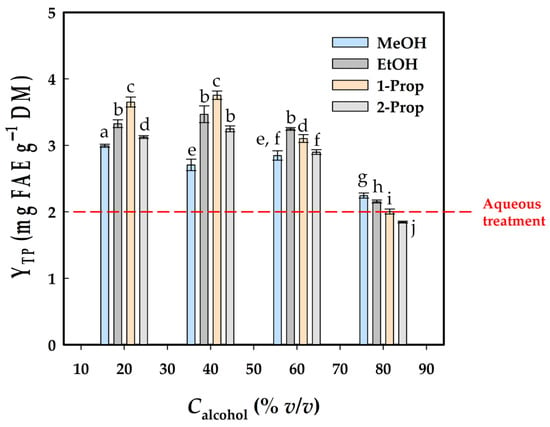
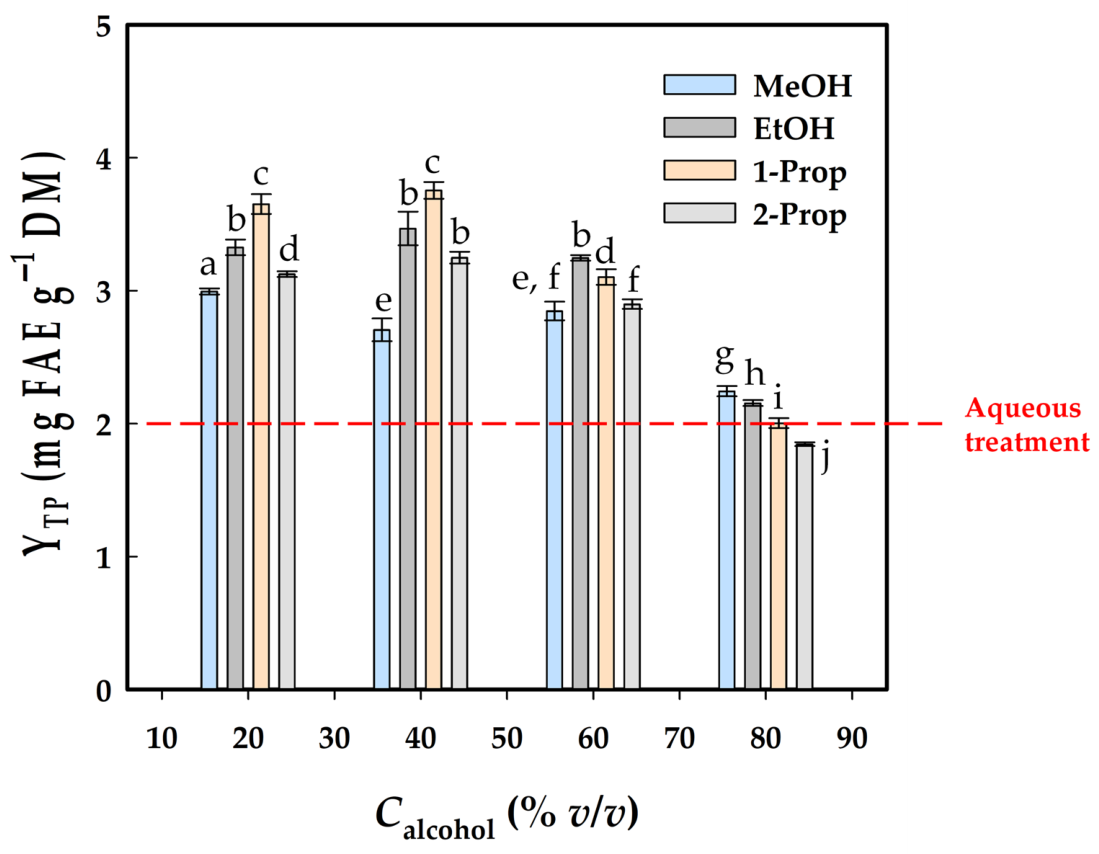
Three common green solvents, including ethanol, 1-propanol, and 2-propanol, along with methanol which served as control, were first screened for their efficacy in extracting WS polyphenols. All alcohols tested were used as mixtures with water, with alcohol proportions varying from 0 (pure water) to 80% (v/v). Compared to aqueous extraction, mixtures of all alcohols were far more efficient when used up to 60%, but at 80% only methanol and ethanol were marginally more efficient (Figure 1). Of all combinations assayed, 20 and 40% 1-propanol were the highest-performing mixtures (p < 0.05), providing virtually equal total polyphenol yields; thus, the lower proportion (20%) was chosen for further investigation.
Figure 1.
Survey of aqueous mixtures of various alcohols with regard to total polyphenol recovery yield (YTP) from wheat straw. Bars designated with different letters (a–j) are statistically different values (p < 0.05).
3.2. Effect of Alkali Catalyst Concentration
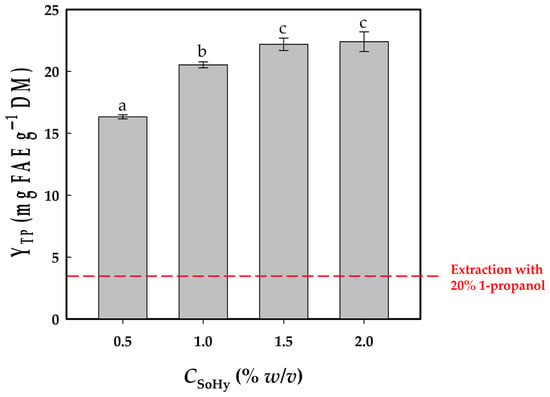
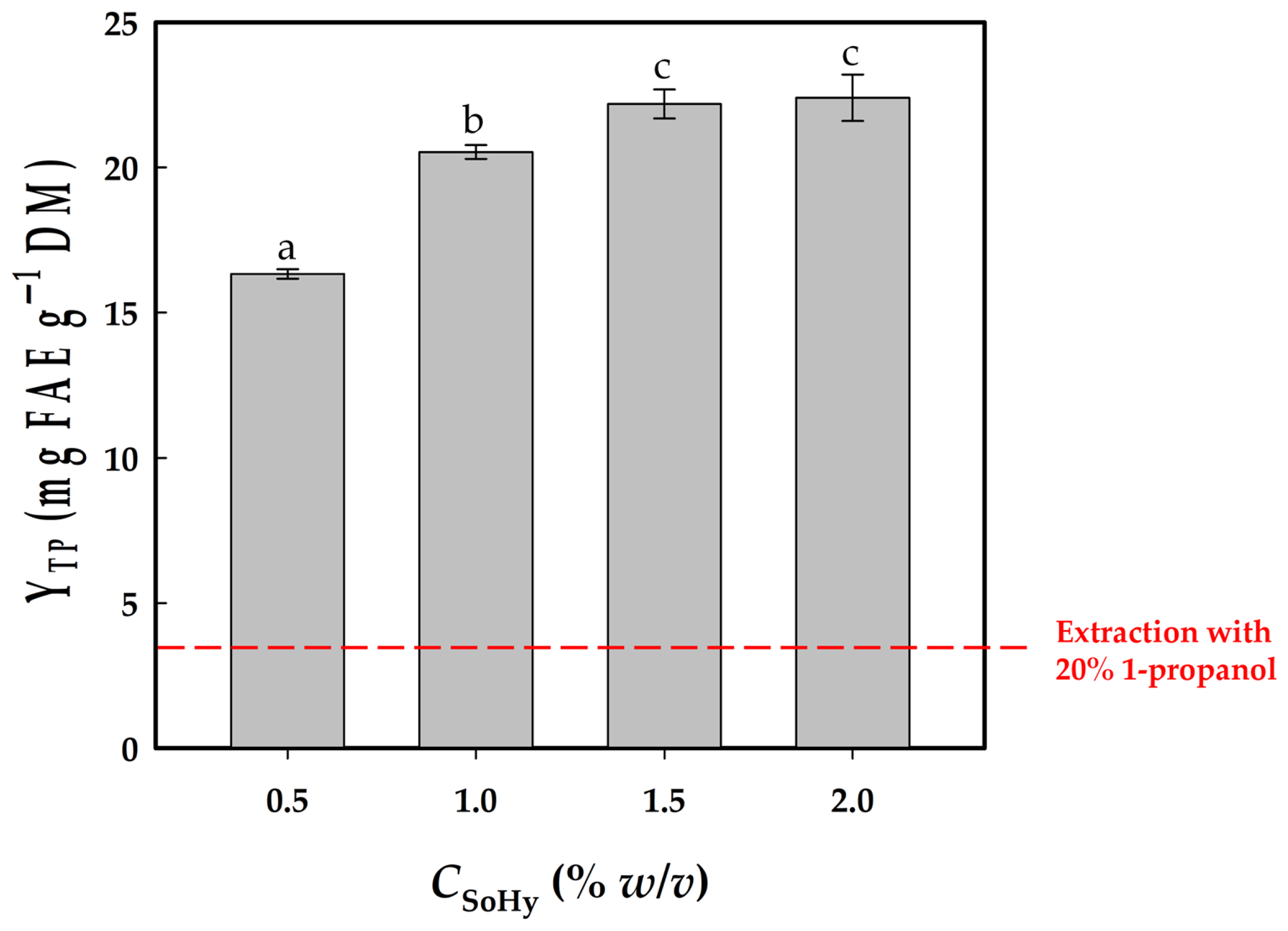
To examine the effect of alkali catalyst concentration, a range from 0 (no catalyst added) to 2% (w/v) sodium hydroxide (assigned as SoHy) was appraised. This range was selected based on previous trials [30,31]. Even with as low as 0.5% concentration, the incorporation of SoHy to 20% 1-propanol provided an outstanding boost to polyphenol recovery yield, which increased by 87% compared to treatment without catalyst. Further rise in SoHy concentration to 1% gave an even higher yield (p < 0.05), and the same trend was observed when SoHy concentration switched from 1 to 1.5% (Figure 2). However, additional increase in SoHy concentration to 2% did not offer significantly higher polyphenol recovery yield (p > 0.05). On this ground, 1.5% was deemed as the optimum alkali catalyst concentration.
Figure 2.
Survey of alkali (sodium hydroxide—SoHy) catalyst concentration with regard to total polyphenol recovery yield (YTP) from WS, using 20% 1-propanol. Bars designated with different letters (a–c) are statistically different values (p < 0.05).
3.3. Polyphenol Release Kinetics
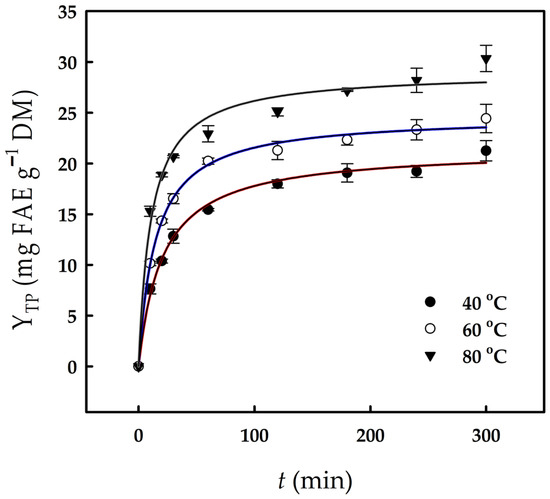
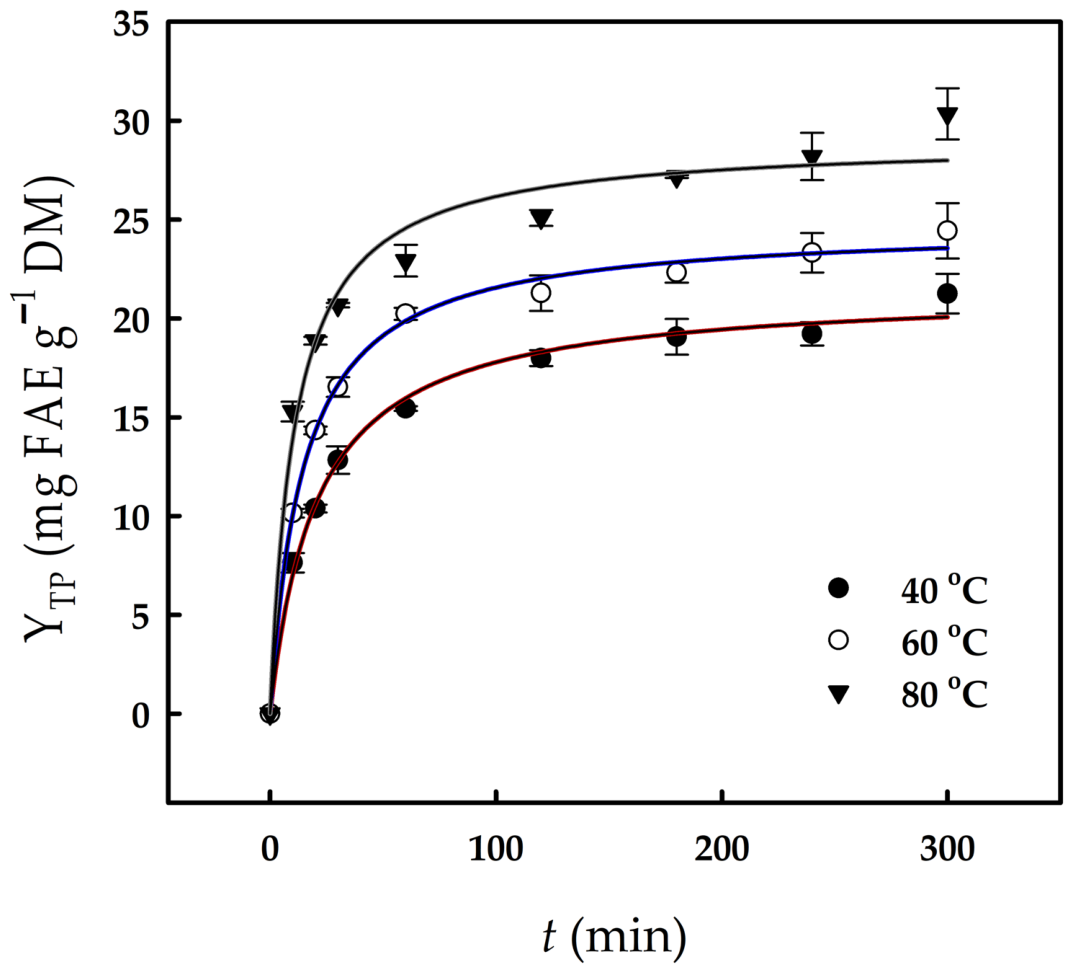
To assess the influence of two pivotal treatment factors, residence time and temperature, on the polyphenol release yield, kinetics was undertaken within ranges chosen based on previous studies [25], where polyphenol release kinetics was found to obey a two-parameter hyperbolic function model (Figure 3). For all three temperatures examined, curve fitting to the experimental values was very satisfactory (R2 ≥ 0.98), which evidenced a high model credibility. The two-parameter hyperbolic function might represent a two-phase release of WS polyphenols under the conditions employed. First, the easily extractable free (non-bound) polyphenols, which constitute only a small portion of the total content, were quickly transferred into the solvent at all tested temperatures. Therefore, this stage could not be the rate-limiting step, as it corresponded to the initial washing phase of extraction. At 40 °C, the release of bound polyphenols was likely slow, a fact that could explain the lower k and h (Table 2).
Figure 3.
Kinetics of polyphenol recovery from WS using 20% 1-propanol/1.5% SoHy as the treatment medium, at different temperatures.
Table 2.
Data obtained from the kinetic assay on polyphenol recovery from WS using 20% 1-propanol/1.5% SoHy as the treatment medium.
As temperature increased, bound polyphenols might have been progressively released upon the action of the alkali catalyst, through chemical reactions that freed them from the lignocellulosic matrix and through degradation of the cell wall structure, which allowed trapped polyphenols to diffuse into the solvent. Consequently, both the liberation of bound compounds and their diffusion into the liquid phase may have controlled the extraction rate. Since polyphenol liberation from a lignocellulosic network might involve multiple reaction mechanisms (e.g., ester hydrolysis, ether hydrolysis), the observed two-parameter kinetics may indicate that polyphenol release occurred through more than one pathway. However, this hypothesis remains to be elucidated. Ultimately, extraction at 80 °C resulted in substantially higher YTP(s) (p < 0.05) compared to either 40 or 60 °C, a confirmation of the critical role of temperature.
3.4. Severity Effects
Various sets of residence time and temperature were used to determine treatment severity and to acquire a deeper understanding of the impact of treatment harshness on total polyphenol yield. Furthermore, the antiradical activity (AAR) and the ferric-reducing power of the extracts generated were also determined (Table 3), to obtain an insight into the effect of severity on antioxidant activity. The overall assessment was based on a multiple correlation, to ascertain whether severity was associated with increased polyphenol yield and enhanced antioxidant potency.
Table 3.
Treatment severity as determined by using various combinations of temperature and residence time. The corresponding values of yield in total polyphenols (YTP), antiradical activity (AAR) and reducing power (PR) are given along with the standard deviation (n = 3).
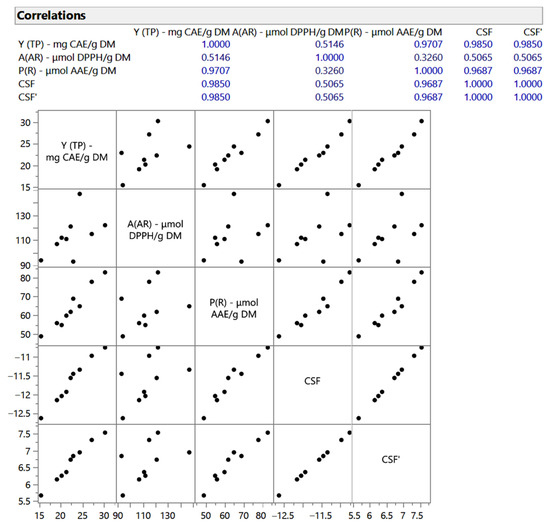
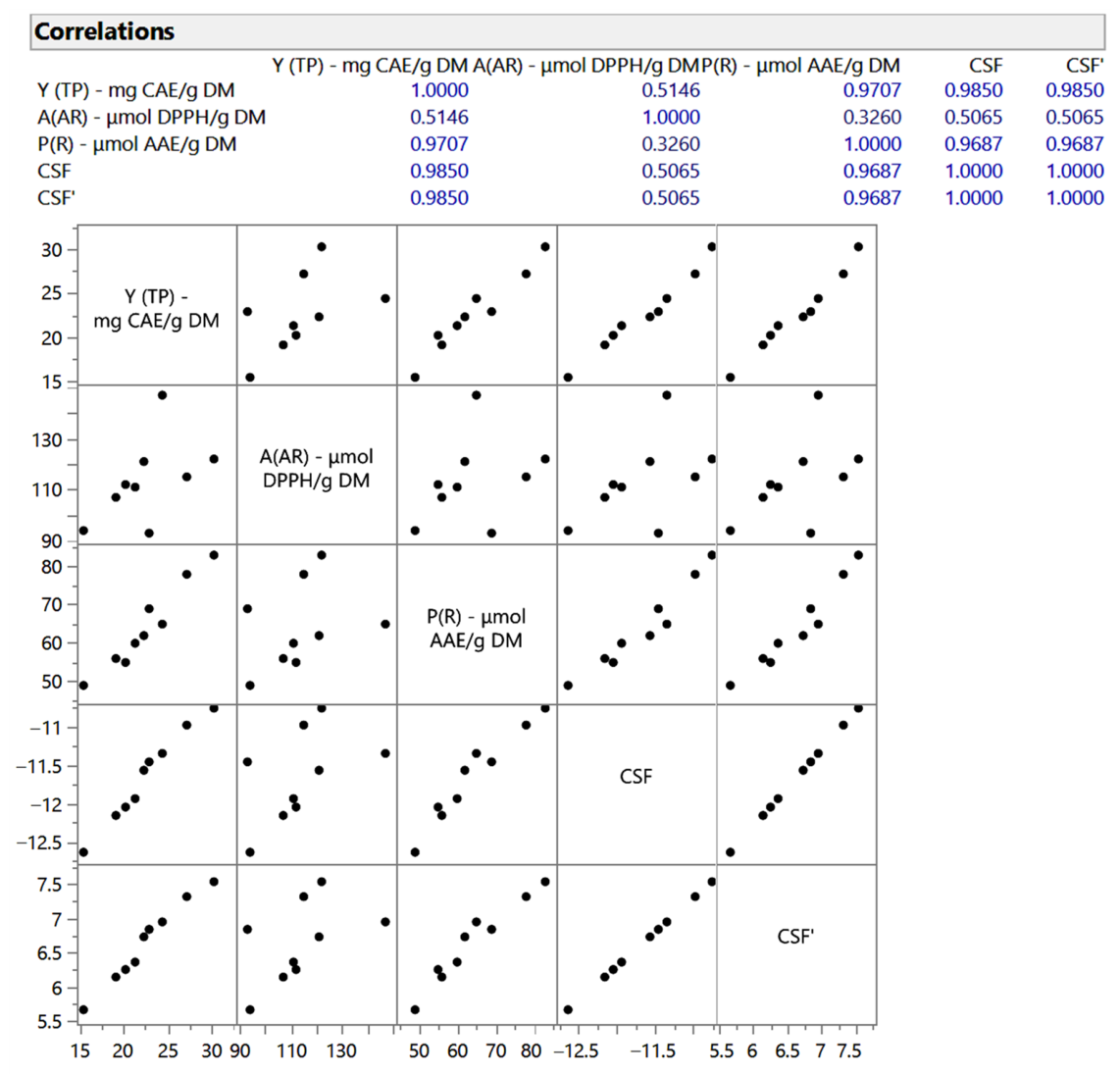
As can be seen in Figure 4 (and the inset table “Correlations”), the total polyphenol yield was directly proportional to treatment severity (expressed either as CSF or CSF’), as manifested by the strong linear relationship (r = 0.98, p < 0.0001) between YTP and CSF (or CSF’). Such a phenomenon was also seen for the relationship between PR and CSF, but correlation between CSF and AAR was much weaker, as judged by the significantly lower r. These results revealed that (i) increased treatment severity entailed increased polyphenol yield, within the selected ranges of residence time and temperature, and (ii) increased polyphenol levels were highly correlated with the reducing power of the extracts obtained, but not with the radical-scavenging ability. Such an outcome is in accordance with an earlier study on acid-catalyzed treatment of WS, which afforded almost 23 mg gallic acid equivalents g−1 DM at a CSF of 1.99 [32]. In that study, it was shown a simultaneous increase in YTP and reducing power of the extracts as a function of severity, but also a gradual decline of the radical-scavenging ability.
Figure 4.
Multiple regression analysis illustrating the relationships between yield and total polyphenols (YTP), antiradical activity (AAR) and reducing power (PR) in relation to treatment severity, expressed either as the combined severity factor (CSF) or the modified combined severity factor (CSF′). The blue numbers shown in the inset “Correlations” table represent the corresponding R2 values for each linear regression.
The poor correlation between AAR and PR (r = 0.33) might suggest that the compounds expressing reducing effects might not behave as effective radical scavengers, and vice versa. On the other hand, the strong link between PR and YTP was indication that the richer the extracts in polyphenolic compounds, the higher their reducing power. Such a discrepancy regarding the antioxidant properties has been previously observed in wheat bran extracts [30] and it has been supported that the differences seen cannot be solely attributed to the total polyphenol concentration of the extracts, since variations in the relative composition of individual constituents may determine the overall antioxidant performance. Therefore, the antioxidant capacity of extracts containing polyphenols cannot be reliably predicted, since it depends not only on the specific polyphenolic compounds present but also on their relative proportions. Interactions among these constituents may lead to synergistic or antagonistic effects, meaning that the overall ferric-reducing or antiradical activity reflects the combined outcome of such interactions [33,34]. Despite this complexity, previous work has shown that the release of bound polyphenols can substantially increase antioxidant activity [30,31,35]. Thus, it could be argued that alkali hydrolysis–induced enrichment of WS extracts with polyphenols enhanced reducing power, yet the expression of antiradical activity warrants further investigation.
Treatment severity has been widely applied as a benchmark for evaluating the efficiency of polyphenol recovery from WB and it is regarded as a useful parameter for the critical comparison of organosolv processes employing either acidic or alkaline catalysts. Incorporating pH into the severity factor yields a more comprehensive representation of treatment effects across a broad pH range. However, the calculated CSF (or CSF′) should be viewed as an indicative measure only, since additional parameters—such as the chemical nature of the extracted polyphenols, and their thermal stability—may also markedly influence treatment performance. While correlations between YTP and CSF do not account for potential synergistic interactions between residence time and temperature, severity remains a valuable guide for defining appropriate operational windows when designing organosolv treatments. This view has been well exemplified by earlier investigations, which clearly demonstrated a linear correlation between YTP and CSF or CSF’ [30,36].
3.5. Optimization of Organosolv Treatment
As mentioned above, simple correlation between YTP and severity cannot reveal the detailed effect of residence time and temperature on treatment performance, because interactions between these two variables are not captured. Thus, an optimization study was structured to evaluate the influence of the two principal processing variables (t and T) and to identify potential synergistic interactions between them. Model adequacy and the appropriateness of the applied response surface methodology were assessed using ANOVA and lack-of-fit tests (Figures S1–S3), together with comparisons between experimental and predicted values (Table 4). Only statistically significant terms were retained in the models, while non-significant factors were excluded. The coefficients of determination (R2) for each model accounted for the proportion of variance explained by the fitted equations. As shown below (Equations (11)–(13)), all models exhibited R2 values of at least 0.92, and the lack-of-fit p-values at the 95% confidence level were highly significant. These results indicated an excellent fit of the models to the experimental data.
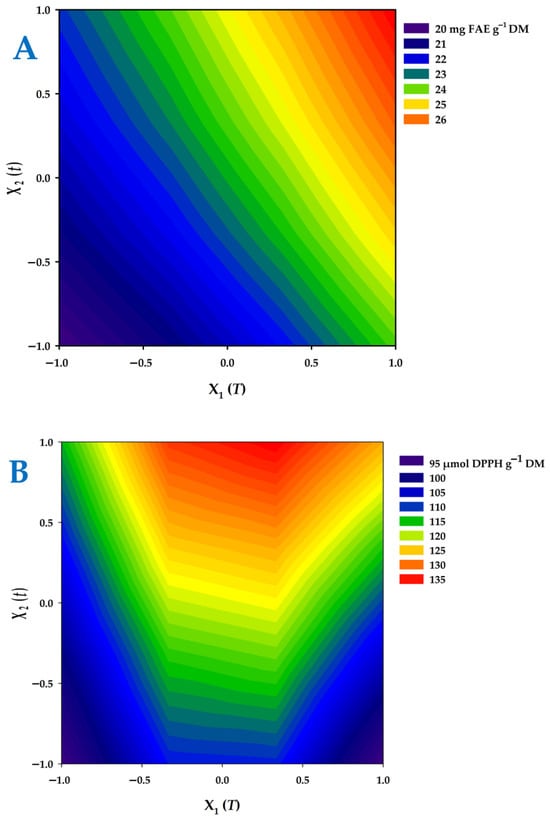
YTP = 22.5 + 4.1X1 + 2.9X2 (R2 = 0.98, p = 0.0002)
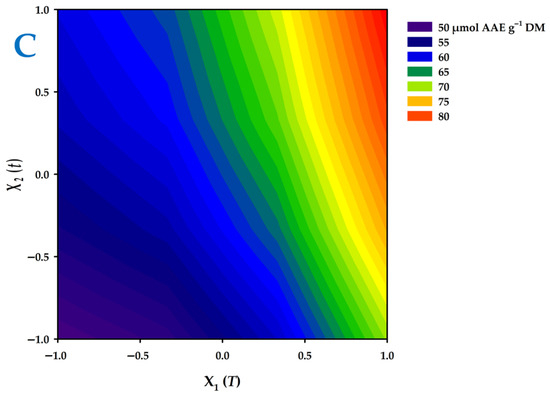
AAR = 123 + 12.9X2 − 16.8X12 (R2 = 0.92, p = 0.0080)
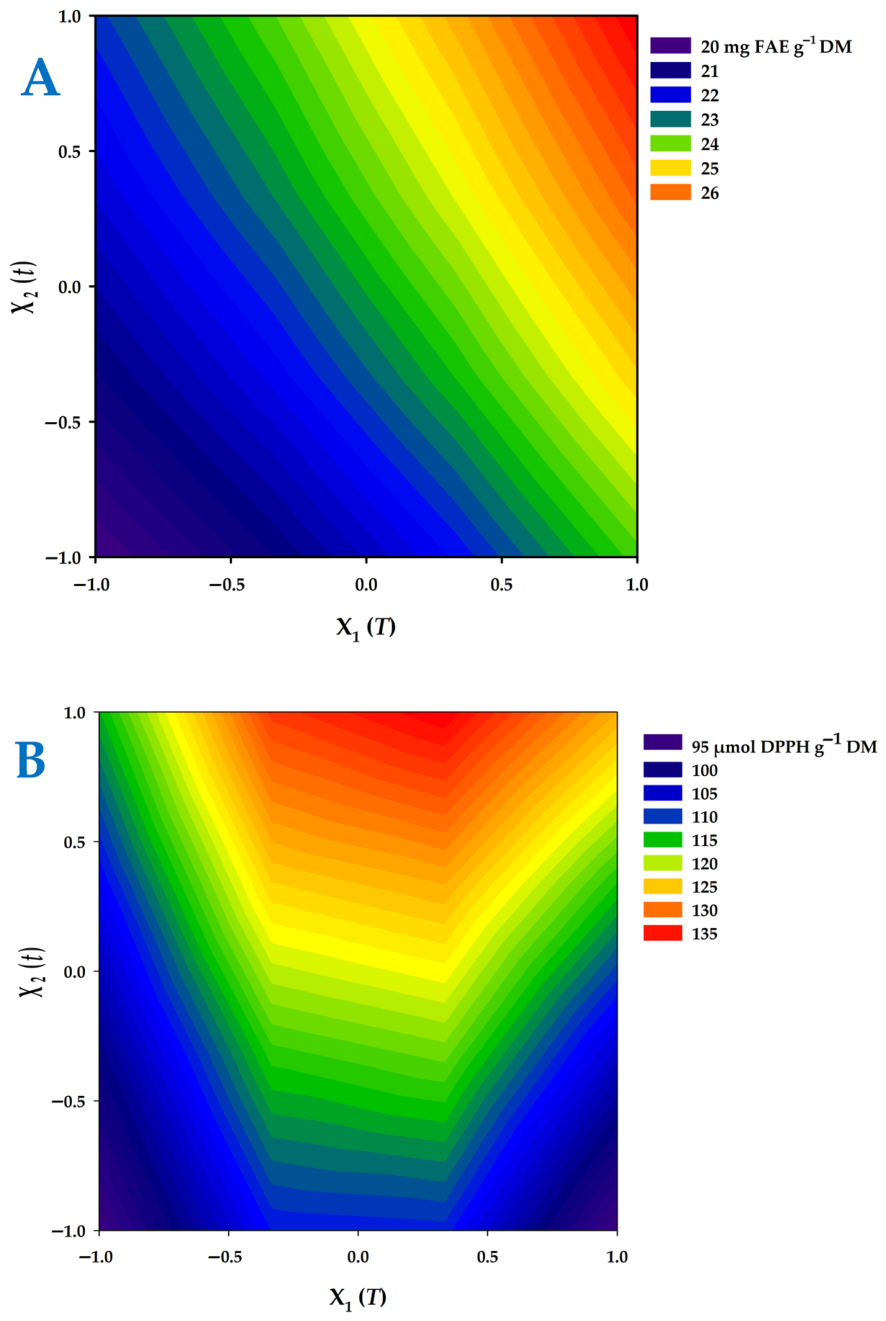
PR = 61.5 + 10.9X1 + 5.9X2 + 5.2X12 − 1.7X22 (R2 = 1.00, p < 0.0001)
Table 4.
The experimental design points employed to construct the response surface methodology, along with their corresponding measured and predicted response values.
A visualization of the influence of the independent variables on the responses is provided in the form of Contour plots, in Figure 5. With respect to polyphenol yield optimization, both independent variables were significant, evidencing a dependence of YTP on both the residence time and temperature of the treatment.
Figure 5.
Contour plots illustrating the combined influence of variables X1 (T) and X2 (t) on the responses: (A) total polyphenol yield (YTP), (B) antiradical activity (AAR), and (C) reducing power (PR).
Similarly, the production of extracts with maximized PR was shown to depend directly on time and temperature, but in this case quadratic terms of both variables were also significant. However, the negative effect of the quadratic X2 term (residence time) in Equation (3) suggested that prolonging time beyond a certain limit was not favorable for further enhancement of the reducing power of the extracts. Contrary to these findings, the model describing AAR optimization (Equation (2)) revealed a direct and positive influence of time, but the negative quadratic term of temperature (X12) indicated that increasing temperature over a certain level might attenuate radical scavenging potency.
The maximum predicted YTP, determined using the desirability function (Figure S1) was 30.0 ± 1.7 mg FAE g−1 DM, attained at 300 min and 80 °C. This level is higher than 23 mg GAE g−1 DM reported for acid-catalyzed treatment of WS [33], but lower than 39.1 mg GAE g−1 DM achieved with harsh alkaline catalysis (3 M SoHy), at 120 °C [37]. In another examination on both acid- and alkaline-catalyzed treatment, the latter was more efficient yielding 10.0 mg GAE g−1 DM, as opposed to the former which afforded 4.7 mg GAE g−1 DM, under much more intense conditions (4 N NaOH, 24 h) [38]. Based on this information, it could be argued that the optimized treatment presented herein provided very satisfactory yield in total polyphenols, under relatively benign conditions.
3.6. Hydroxycinnamate Composition and Yield
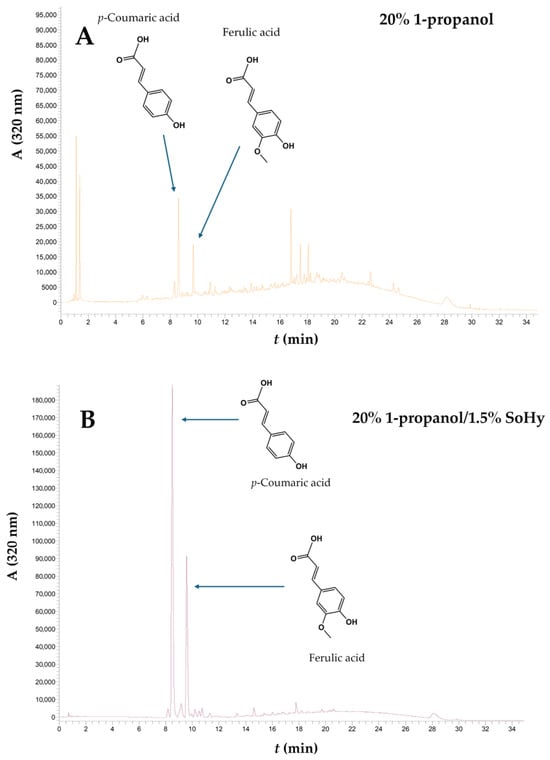
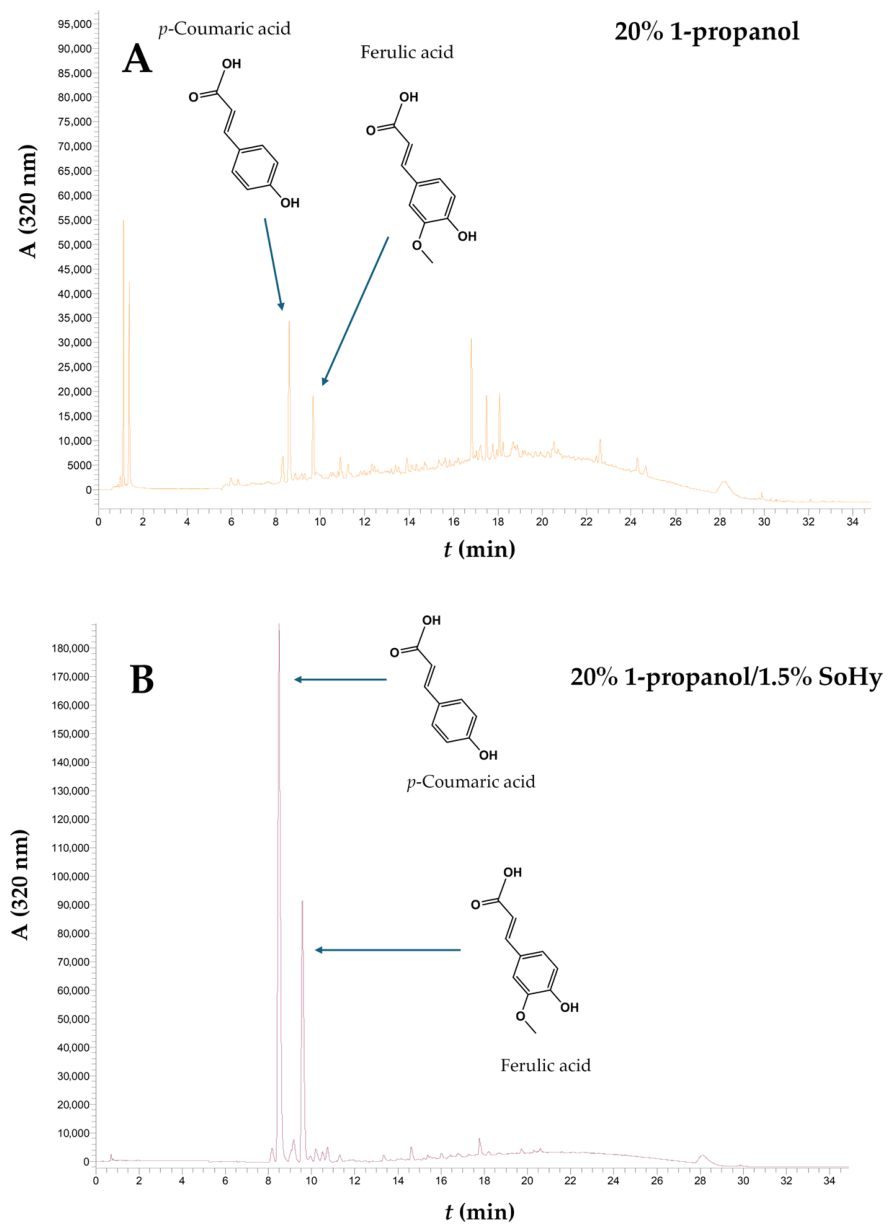
The extract produced with 20% 1-propanol/1.5% SoHy was subjected to analysis using liquid chromatography–diode array–mass spectroscopy to shed more light into its polyphenolic composition. Furthermore, to bring out the role of alkaline catalysis, an extract prepared with only 1-propanol (no SoHy added) was also analyzed. The polyphenolic profiles of these two extracts are depicted in Figure 6, and it can be viewed (Figure 6A) that the principal hydroxycinnamates detected in the extract obtained with the treatment performed with 20% 1-propanol were p-coumaric acid (CouA) and ferulic acid (FA). Their identity was confirmed by comparison with commercial standards, but also their corresponding molecular ions at m/z = 163 and m/z = 193 (negative ionization mode).
Figure 6.
Chromatogram of WS extracts produced under optimized conditions (80 °C for 180 min). The eluent was monitored at 320 nm. (A): extract prepared with 20% 1-propanol; (B): extract prepared with 20% 1-propanol and 1.5% sodium hydroxide (SoHy).
The extract produced through treatment with 20% 1-propanol/1.5% SoHy was shown to be dominated by only these two compounds (Figure 6B), whereas no other major peak was detected. The quantitative assay highlighted the paramount importance of the alkali catalysts, since the extract generated with 20% 1-propanol/1.5% SoHy had 10.6- and 9.1-fold higher CouA and FA concentrations, respectively, compared to the extract obtained without alkaline catalysis (Table 5). Overall, treatment with 20% 1-propanol/1.5% SoHy afforded a yield of 6.56 mg total hydroxycinnamates per g WS.
Table 5.
Treatment yields of the two principal polyphenols in WS obtained under optimized conditions.
The hydroxycinnamate yields achieved in this work were comparable to 4.8 and 2.5 mg g−1 DM obtained for CouA and FA, respectively, after alkaline nitrobenzene oxidation of WS lignin [39], but also 3.71 and 2.98 mg g−1 DM, found for CouA and FA, respectively, upon alkaline hydrolysis [40,41]. Levels of 2.39 and 1.15 mg g−1 DM for CouA and FA, respectively, were achieved at much higher severity (2 M SoHy, 120 °C), and it was also stressed that liberation of individual hydroxycinnamates required different optimal conditions, since FA could be more effectively liberated at higher temperatures compared to CouA [37]. However, under much harsher conditions, the CouA and FA yields attained were 6.6 and 12.4 mg g−1 DM, respectively [42]. On the other hand, significantly lower CouA and FA yields of 0.16 and 1.93 mg g−1 DM, respectively, have also been reported [43].
Early examinations showed that the major hydroxycinnamates in lignin isolated from WS were CouA and FA, at a mass ratio of 0.95 [44], indicating occurrence of these two phenolics at almost equal levels. A close ratio of 0.88 was also found by another work [45], where it was revealed that over 80% of CouA was ester-linked, as opposed to FA which was found to be 56% under esterified form and 44% etherified, in accordance with previous results [46]. Other studies evidenced that these hydroxycinnamates were attached to hemicellulose only by ester bonds, but significant amounts of non-saponifiable linkages (such as ethers) between CouA and FA and lignin were also presumed [47]. CouA was claimed to be linked onto the lignin matrix mainly through alkali-labile ester bonds, yet the role of FA was also bridging WS hemicellulose and lignin. Such an assumption was further corroborated by following investigations, which clearly showed that mild alkaline treatment could liberate both CouA and FA, but almost 90% of CouA in WS was ester-linked to lignin, whereas more than 60% of FA was ether-linked [48,49,50,51]. In that case, FA was found to occur at much higher levels than CouA, a finding advocated by more recent investigations [52]. However, other works provided contrasted information, since a predominance of CouA was demonstrated [53,54,55]. The extended esterification of CouA to WS lignin was reassured by other studies [56], while the bridging function of both phenolics in the lignocellulosic WS network has been confirmed [55].
On the ground of the information given above, there may be some additional considerations regarding the results presented in this study. First, it could be argued that the CouA/FA mass ratio of approximately 1.6 suggested a higher abundance of CouA, in line with several earlier works. However, taking into consideration that CouA is principally ester-bound, as opposed to FA, which is attached onto the lignocellulosic matrix mainly via ether bonds, then the actual FA content may be higher. Ester bonds are susceptible to alkaline hydrolysis, and this might explain the increased release of CouA observed. In contrast, FA linked through ether bonds can be effectively cleaved under acid-catalyzed conditions, which require temperatures higher than the 90 °C applied in this study [57]. Such a phenomenon could also account for the biphasic kinetics observed. Both ether and ester linkages are susceptible to alkaline hydrolysis, allowing the release of CouA and FA from the lignocellulosic matrix, with the alcohol (1-propanol) promoting their dissolution and transfer into the liquid phase. However, ester bond hydrolysis would be faster, allowing for a rapid CouA release. On the other hand, the hydrolysis of ether-bound FA would lag behind CouA hydrolysis, and thus the overall release would exhibit a biphasic behavior, hence the high statistical significance of the kinetic model selected.
Finaly, the overall yield found was comparable to those attained under much harsher conditions, as described above. This might be attributed to the presence of 1-propanol. Previous studies have shown that ethanol organosolv processing promotes the cleavage of α-aryl and β-aryl ether bonds, which plays a major role in lignin depolymerization [22,58]. This breakdown of large lignin polymers into smaller fragments can further enhance hydroxycinnamate release by increasing lignin solubility [59]. Although both acidic and alkaline catalysts can accelerate these reactions, alkaline conditions are particularly effective in promoting lignin solubilization, an effect that is further strengthened by the presence of ethanol [60]. Since the release of hydroxycinnamates has been closely associated with alkali-solubilized lignin [57], this mechanism likely contributed to the relatively increased CouA and FA yields observed in this study, performed under relatively mild alkaline conditions.
4. Conclusions
The alkali-catalyzed 1-propanol organosolv treatment developed showed that under relatively mild conditions of residence time, temperature and alkali concentration, a significant yield in both CouA and FA could be attained, reaching corresponding levels of 4.01 and 2.55 mg g−1 DM. Such a finding highlighted for the first time the efficiency of 1-propanol over other commonly used alcohol in WS treatment for hydroxycinnamate recovery. More extended release of FA requires a more thorough investigation. This could boost hydroxycinnamate recovery to higher levels, thus improving the efficiency of the methodology proposed. Ongoing efforts to optimize the treatment conditions are expected to improve overall process performance and enable the development of a highly efficient and fully sustainable approach. Furthermore, future studies should also include scaling-up trials to fully examine the industrial potential of the process. Such advancements would further highlight the potential of WS as an exceptionally rich lignocellulosic bioresource for valuable bioactive compounds. Similar technologies could serve as key elements of integrated biomass utilization strategies for bio-product development within a broader biorefinery framework.
Supplementary Materials
The following supporting information can be downloaded at https://www.mdpi.com/article/10.3390/biomass6030035/s1: Figure S1: Optimization of the organosolv process using SoHy as a catalyst. Panel (A) illustrates the relationship between the predicted and experimental response (YTP) values obtained through response surface methodology. The coefficient of determination (R2) and the model’s p-value are also presented. Panel (B) displays the desirability function, the highest predicted YTP, and the theoretical optimal time (t) and temperature (T). The inset tables summarize the statistical parameters related to the response surface methodology. Values highlighted in color indicate statistical significance (p < 0.05); Figure S2: Optimization of the organosolv process using SoHy as a catalyst. Panel (A) illustrates the relationship between the predicted and experimental response (AAR) values obtained through response surface methodology. The coefficient of determination (R2) and the model’s p-value are also presented. Panel (B) displays the desirability function, the highest predicted YTP, and the theoretical optimal time (t) and temperature (T). The inset tables summarize the statistical parameters related to the response surface methodology. Values highlighted in color indicate statistical significance (p < 0.05); Figure S3: Optimization of the organosolv process using SoHy as a catalyst. Panel (A) illustrates the relationship between the predicted and experimental response (PR) values obtained through response surface methodology. The coefficient of determination (R2) and the model’s p-value are also presented. Panel (B) displays the desirability function, the highest predicted YTP, and the theoretical optimal time (t) and temperature (T). The inset tables summarize the statistical parameters related to the response surface methodology. Values highlighted in color indicate statistical significance (p < 0.05).
Author Contributions
Conceptualization, D.P.M. and S.G.; methodology, D.P.M., S.G., E.N.D., and M.M.Y.; validation, D.P.M., S.G., E.N.D., and M.M.Y.; formal analysis, E.N.D., M.M.Y.; investigation, E.N.D., M.M.Y.; resources, D.P.M. and S.G.; data curation, E.N.D., M.M.Y.; writing—original draft preparation, D.P.M. and S.G.; writing—review and editing, D.P.M. and S.G.; visualization, D.P.M. and S.G.; supervision, D.P.M. and S.G.; project administration, S.G.; All authors have read and agreed to the published version of the manuscript.
Funding
This study received no external funding.
Institutional Review Board Statement
Not applicable.
Informed Consent Statement
Not applicable.
Data Availability Statement
The original contributions presented in this study are included in the article/Supplementary Material. Further inquiries can be directed to the corresponding author.
Conflicts of Interest
The authors declare no conflicts of interest.
References
- Dos Santos, F.K.F.; Barcellos-Silva, I.G.C.; Leite-Barbosa, O.; Ribeiro, R.; Cunha-Silva, Y.; Veiga-Junior, V.F. High added-value by-products from biomass: A case study unveiling opportunities for strengthening the agroindustry value chain. Biomass 2024, 4, 217–242. [Google Scholar] [CrossRef] [Scilit]
- Gavrilaș, S.; Raț, M.; Munteanu, F.-D. Biowaste valorisation and its possible perspectives within sustainable food chain development. Processes 2025, 13, 2085. [Google Scholar] [CrossRef] [Scilit]
- Coronado-Contreras, S.A.; Ibarra-Manzanares, Z.G.; Casas-Rodríguez, A.D.; Pastrana-Pastrana, Á.J.; Sepúlveda, L.; Rodríguez-Herrera, R. Bio-circular economy and digitalization: Pathways for biomass valorization and sustainable biorefineries. Biomass 2025, 6, 1. [Google Scholar] [CrossRef] [Scilit]
- Alatzas, S.; Moustakas, K.; Malamis, D.; Vakalis, S. Biomass potential from agricultural waste for energetic utilization in Greece. Energies 2019, 12, 1095. [Google Scholar] [CrossRef] [Scilit]
- Tufail, T.; Saeed, F.; Afzaal, M.; Ain, H.B.U.; Gilani, S.A.; Hussain, M.; Anjum, F.M. Wheat straw: A natural remedy against different maladies. Food Sci. Nutr. 2021, 9, 2335–2344. [Google Scholar] [CrossRef] [Scilit]
- Zhang, B.; Li, H.; Chen, L.; Fu, T.; Tang, B.; Hao, Y.; Li, J.; Li, Z.; Zhang, B.; Chen, Q. Recent advances in the bioconversion of waste straw biomass with steam explosion technique: A comprehensive review. Processes 2022, 10, 1959. [Google Scholar] [CrossRef] [Scilit]
- Bangar, S.P.; Kajla, P.; Ghosh, T. Valorization of wheat straw in food packaging: A source of cellulose. Int. J. Biol. Macromol. 2023, 227, 762–776. [Google Scholar] [CrossRef] [Scilit] [PubMed]
- Zikeli, F.; Ters, T.; Fackler, K.; Srebotnik, E.; Li, J. Wheat straw lignin fractionation and characterization as lignin-carbohydrate complexes. Ind. Crops Prod. 2016, 85, 309–317. [Google Scholar] [CrossRef] [Scilit]
- Martínková, L.; Grulich, M.; Pátek, M.; Křístková, B.; Winkler, M. Bio-based valorization of lignin-derived phenolic compounds: A review. Biomolecules 2023, 13, 717. [Google Scholar] [CrossRef] [Scilit]
- Zhang, T.; Zhang, S.; Lan, W.; Yue, F. Quantitative extraction of p-coumaric acid and ferulic acid in different gramineous materials and structural changes of residual alkali lignin. J. Renew. Mater. 2023, 11, 12. [Google Scholar] [CrossRef] [Scilit]
- Kaur, H.; Goyal, D. Maximizing wheat straw utilization: An integrated, near-zero-waste sequential biorefining approach. Biomass Bioenergy 2026, 205, 108486. [Google Scholar] [CrossRef] [Scilit]
- Pei, K.; Ou, J.; Huang, J.; Ou, S. p-Coumaric acid and its conjugates: Dietary sources, pharmacokinetic properties and biological activities. J. Sci. Food Agric. 2016, 96, 2952–2962. [Google Scholar] [CrossRef] [Scilit]
- Chen, F.; Zhang, X.; Wang, J.; Wang, F.; Mao, J. p-Coumaric acid: Advances in pharmacological research based on oxidative stress. Curr. Top. Med. Chem. 2024, 24, 416–436. [Google Scholar] [CrossRef] [Scilit]
- Abazari, M.F.; Nasiri, N.; Karizi, S.Z.; Nejati, F.; Haghi-Aminjan, H.; Norouzi, S.; Piri, P.; Estakhr, L.; Faradonbeh, D.R.; Kohandani, M. An updated review of various medicinal applications of p-co umaric acid: From antioxidative and anti-inflammatory properties to effects on cell cycle and proliferation. Mini Rev. Med. Chem. 2021, 21, 2187–2201. [Google Scholar] [CrossRef] [Scilit]
- Tehami, W.; Nani, A.; Khan, N.A.; Hichami, A. New insights into the anticancer effects of p-coumaric acid: Focus on colorectal cancer. Dose-Response 2023, 21, 15593258221150704. [Google Scholar] [CrossRef] [Scilit] [PubMed]
- Kaur, J.; Kaur, R. p-Coumaric acid: A naturally occurring chemical with potential therapeutic applications. Cur. Org. Chem. 2022, 26, 1333–1349. [Google Scholar] [CrossRef] [Scilit]
- Khosravi, A.; Razavi, S.H. The role of bioconversion processes to enhance bioaccessibility of polyphenols in rice. Food Biosci. 2020, 35, 100605. [Google Scholar] [CrossRef] [Scilit]
- Fărcaș, A.; Drețcanu, G.; Pop, T.D.; Enaru, B.; Socaci, S.; Diaconeasa, Z. Cereal processing by-products as rich sources of phenolic compounds and their potential bioactivities. Nutrients 2021, 13, 3934. [Google Scholar] [CrossRef] [Scilit] [PubMed]
- Li, D.; Rui, Y.-X.; Guo, S.-D.; Luan, F.; Liu, R.; Zeng, N. Ferulic acid: A review of its pharmacology, pharmacokinetics and derivatives. Life Sci. 2021, 284, 119921. [Google Scholar] [CrossRef] [Scilit] [PubMed]
- Wei Kit Chin, D.; Lim, S.; Pang, Y.L.; Lam, M.K. Fundamental review of organosolv pretreatment and its challenges in emerging consolidated bioprocessing. Biofuels Bioprod. Biorefin. 2020, 14, 808–829. [Google Scholar] [CrossRef] [Scilit]
- Sun, C.; Song, G.; Pan, Z.; Tu, M.; Kharaziha, M.; Zhang, X.; Show, P.-L.; Sun, F. Advances in organosolv modified components occurring during the organosolv pretreatment of lignocellulosic biomass. Bioresour. Technol. 2022, 368, 128356. [Google Scholar] [CrossRef] [Scilit]
- Zhou, Z.; Lei, F.; Li, P.; Jiang, J. Lignocellulosic biomass to biofuels and biochemicals: A comprehensive review with a focus on ethanol organosolv pretreatment technology. Biotechnol. Bioeng. 2018, 115, 2683–2702. [Google Scholar] [CrossRef] [Scilit] [PubMed]
- Pazo-Cepeda, V.; Benito-Roman, Ó.; Navarrete, A.; Alonso, E. Valorization of wheat bran: Ferulic acid recovery using pressurized aqueous ethanol solutions. Waste Biomass Valor. 2020, 11, 4701–4710. [Google Scholar] [CrossRef] [Scilit]
- Pedersen, M.; Meyer, A.S. Lignocellulose pretreatment severity–relating pH to biomatrix opening. New Biotechnol. 2010, 27, 739–750. [Google Scholar] [CrossRef] [Scilit] [PubMed]
- Karageorgou, I.; Grigorakis, S.; Lalas, S.; Makris, D.P. Enhanced extraction of antioxidant polyphenols from Moringa oleifera Lam. leaves using a biomolecule-based low-transition temperature mixture. Eur. Food Res. Technol. 2017, 243, 1839–1848. [Google Scholar] [CrossRef] [Scilit]
- Bezerra, M.A.; Ferreira, S.L.C.; Novaes, C.G.; Dos Santos, A.M.P.; Valasques, G.S.; da Mata Cerqueira, U.M.F.; dos Santos Alves, J.P. Simultaneous optimization of multiple responses and its application in Analytical Chemistry—A review. Talanta 2019, 194, 941–959. [Google Scholar] [CrossRef] [Scilit]
- Karakashov, B.; Grigorakis, S.; Loupassaki, S.; Mourtzinos, I.; Makris, D.P. Optimisation of organic solvent-free polyphenol extraction from Hypericum triquetrifolium Turra using Box–Behnken experimental design and kinetics. Int. J. Ind. Chem. 2015, 6, 85–92. [Google Scholar] [CrossRef] [Scilit]
- Lakka, A.; Karageorgou, I.; Kaltsa, O.; Batra, G.; Bozinou, E.; Lalas, S.; Makris, D. Polyphenol extraction from Humulus lupulus (hop) using a neoteric glycerol/L-alanine deep eutectic solvent: Optimisation, kinetics and the effect of ultrasound-assisted pretreatment. AgriEngineering 2019, 1, 403–417. [Google Scholar] [CrossRef] [Scilit]
- Refai, H.; Derwiche, F.; Grigorakis, S.; Makris, D.P. Simultaneous high-performance recovery and extended acid-catalyzed hydrolysis of oleuropein and flavonoid glycosides of olive (Olea europaea) leaves: Hydrothermal versus ethanol organosolv treatment. Int. J. Mol. Sci. 2024, 25, 7820. [Google Scholar] [CrossRef] [Scilit]
- Papadaki, E.S.; Palaiogiannis, D.; Lalas, S.I.; Mitlianga, P.; Makris, D.P. Polyphenol release from wheat bran using ethanol-based organosolv treatment and acid/alkaline catalysis: Process modeling based on severity and response surface optimization. Antioxidants 2022, 11, 2457. [Google Scholar] [CrossRef] [Scilit]
- Papadimitriou, G.; Zarnavalou, V.; Chatzimitakos, T.; Palaiogiannis, D.; Athanasiadis, V.; Lalas, S.I.; Makris, D.P. Comparison of sodium hydroxide and sodium carbonate as alkali catalysts in ethanol organosolv treatment of cotton stalks for the release of hydroxycinnamates. Recycling 2024, 9, 21. [Google Scholar] [CrossRef] [Scilit]
- Akpinar, O.; Sabanci, S.; Levent, O.; Sayaslan, A. Evaluation of antioxidant activity of dilute acid hydrolysate of wheat straw during xylose production. Ind. Crops Prod. 2012, 40, 39–44. [Google Scholar] [CrossRef] [Scilit]
- Abou Samra, M.; Chedea, V.S.; Economou, A.; Calokerinos, A.; Kefalas, P. Antioxidant/prooxidant properties of model phenolic compounds: Part I. Studies on equimolar mixtures by chemiluminescence and cyclic voltammetry. Food Chem. 2011, 125, 622–629. [Google Scholar] [CrossRef] [Scilit]
- Choueiri, L.; Chedea, V.S.; Calokerinos, A.; Kefalas, P. Antioxidant/pro-oxidant properties of model phenolic compounds. Part II: Studies on mixtures of polyphenols at different molar ratios by chemiluminescence and LC–MS. Food Chem. 2012, 133, 1039–1044. [Google Scholar] [CrossRef] [Scilit]
- Papadaki, E.S.; Pappas, V.; Lalas, S.I.; Mitlianga, P. Pressurized hot water treatment of wheat bran under mild acidic/alkaline conditions to boost polyphenol release and recovery. Waste Biomass Valoriz. 2025, 16, 6221–6230. [Google Scholar] [CrossRef] [Scilit]
- Guenaoui, A.; Casasni, S.; Grigorakis, S.; Makris, D.P. Alkali-catalyzed organosolv treatment of oat bran for enhanced release of hydroxycinnamate antioxidants: Comparison of 1-and 2-propanol. Environments 2023, 10, 118. [Google Scholar] [CrossRef] [Scilit]
- Akpinar, Ö.; Usal, G. Investigation of the effect of temperature and alkaline concentration on the solubilization of phenolic acids from dilute acid-pretreated wheat straw. Food Bioprod. Proc. 2015, 95, 272–280. [Google Scholar] [CrossRef] [Scilit]
- Vadivel, V.; Moncalvo, A.; Dordoni, R.; Spigno, G. Effects of an acid/alkaline treatment on the release of antioxidants and cellulose from different agro-food wastes. Waste Manag. 2017, 64, 305–314. [Google Scholar] [CrossRef] [Scilit] [PubMed]
- Sun, R.; Fang, J.; Rowlands, P.; Bolton, J. Physicochemical and thermal characterization of wheat straw hemicelluloses and cellulose. J. Agric. Food Chem. 1998, 46, 2804–2809. [Google Scholar] [CrossRef] [Scilit]
- Merali, Z.; Ho, J.D.; Collins, S.R.; Le Gall, G.; Elliston, A.; Käsper, A.; Waldron, K.W. Characterization of cell wall components of wheat straw following hydrothermal pretreatment and fractionation. Bioresour. Technol. 2013, 131, 226–234. [Google Scholar] [CrossRef] [Scilit]
- Merali, Z.; Marjamaa, K.; Käsper, A.; Kruus, K.; Gunning, A.P.; Morris, V.J.; Waldron, K.W. Chemical characterization of hydrothermally pretreated and enzyme-digested wheat straw: An evaluation of recalcitrance. Food Chem. 2016, 198, 132–140. [Google Scholar] [CrossRef] [Scilit]
- Sun, R.-C.; Sun, X.-F.; Zhang, S.-H. Quantitative determination of hydroxycinnamic acids in wheat, rice, rye, and barley straws, maize stems, oil palm frond fiber, and fast-growing poplar wood. J. Agric. Food Chem. 2001, 49, 5122–5129. [Google Scholar] [CrossRef] [Scilit]
- Hosseinian, F.; Mazza, G. Triticale bran and straw: Potential new sources of phenolic acids, proanthocyanidins, and lignans. J. Funct. Foods 2009, 1, 57–64. [Google Scholar] [CrossRef] [Scilit]
- Jung, H.J.G.; Himmelsbach, D.S. Isolation and characterization of wheat straw lignin. J. Agric. Food Chem. 1989, 37, 81–87. [Google Scholar] [CrossRef] [Scilit]
- Pan, G.X.; Bolton, J.L.; Leary, G.J. Determination of ferulic and p-coumaric acids in wheat straw and the amounts released by mild acid and alkaline peroxide treatment. J. Agric. Food Chem. 1998, 46, 5283–5288. [Google Scholar] [CrossRef] [Scilit]
- Scalbert, A.; Monties, B.; Lallemand, J.-Y.; Guittet, E.; Rolando, C. Ether linkage between phenolic acids and lignin fractions from wheat straw. Phytochemistry 1985, 24, 1359–1362. [Google Scholar] [CrossRef] [Scilit]
- Fidalgo, M.L.; Terron, M.C.; Martinez, A.T.; Gonzalez, A.E.; Gonzalez-Vila, F.J.; Galletti, G.C. Comparative study of fractions from alkaline extraction of wheat straw through chemical degradation, analytical pyrolysis, and spectroscopic techniques. J. Agric. Food Chem. 1993, 41, 1621–1626. [Google Scholar] [CrossRef] [Scilit]
- Lawther, J.M.; Sun, R.; Banks, W. Fractional characterization of alkali-labile lignin and alkali-insoluble lignin from wheat straw. Ind. Crops Prod. 1996, 5, 291–300. [Google Scholar] [CrossRef] [Scilit]
- Lawther, J.M.; Sun, R.; Banks, W. Fractional characterization of wheat straw lignin components by alkaline nitrobenzene oxidation and FT-IR spectroscopy. J. Agric. Food Chem. 1996, 44, 1241–1247. [Google Scholar] [CrossRef] [Scilit]
- Lawther, J.M.; Sun, R.-C.; Banks, W. Rapid isolation and structural characterization of alkali-soluble lignins during alkaline treatment and atmospheric refining of wheat straw. Ind. Crops Prod. 1996, 5, 97–105. [Google Scholar] [CrossRef] [Scilit]
- Sun, X.-F.; Sun, R.C.; Fowler, P.; Baird, M.S. Extraction and characterization of original lignin and hemicelluloses from wheat straw. J. Agric. Food Chem. 2005, 53, 860–870. [Google Scholar] [CrossRef] [Scilit]
- Tramontina, R.; Scopel, E.; Cardoso, V.G.K.; Martins, M.; da Silva, M.F.; Flaibam, B.; Salvador, M.J.; Goldbeck, R.; Damasio, A.; Squina, F.M. Hydroxycinnamic acid extraction from multiple lignocellulosic sources: Correlations with substrate composition and taxonomy for flavoring and antioxidant applications. J. Agric. Food Chem. 2024, 72, 28048–28059. [Google Scholar] [CrossRef] [Scilit]
- Sun, R.; Sun, X.; Wang, S.; Zhu, W.; Wang, X. Ester and ether linkages between hydroxycinnamic acids and lignins from wheat, rice, rye, and barley straws, maize stems, and fast-growing poplar wood. Ind. Crops Prod. 2002, 15, 179–188. [Google Scholar] [CrossRef] [Scilit]
- Sun, R.; Tomkinson, J. Comparative study of lignins isolated by alkali and ultrasound-assisted alkali extractions from wheat straw. Ultrason. Sonochem. 2002, 9, 85–93. [Google Scholar] [CrossRef] [Scilit]
- Xie, D.; Gan, T.; Su, C.; Han, Y.; Liu, Z.; Cao, Y. Structural characterization and antioxidant activity of water-soluble lignin-carbohydrate complexes (LCCs) isolated from wheat straw. Inter. J. Biol. Macromol. 2020, 161, 315–324. [Google Scholar] [CrossRef] [Scilit] [PubMed]
- Crestini, C.; Argyropoulos, D.S. Structural analysis of wheat straw lignin by quantitative 31P and 2D NMR spectroscopy. The occurrence of ester bonds and α-O-4 substructures. J. Agric. Food Chem. 1997, 45, 1212–1219. [Google Scholar] [CrossRef] [Scilit]
- Linh, T.N.; Fujita, H.; Sakoda, A. Release kinetics of esterified p-coumaric acid and ferulic acid from rice straw in mild alkaline solution. Bioresour. Technol. 2017, 232, 192–203. [Google Scholar] [CrossRef] [Scilit]
- Buranov, A.U.; Mazza, G. Lignin in straw of herbaceous crops. Ind. Crops Prod. 2008, 28, 237–259. [Google Scholar] [CrossRef] [Scilit]
- Woiciechowski, A.L.; Neto, C.J.D.; de Souza Vandenberghe, L.P.; de Carvalho Neto, D.P.; Sydney, A.C.N.; Letti, L.A.J.; Karp, S.G.; Torres, L.A.Z.; Soccol, C.R. Lignocellulosic biomass: Acid and alkaline pretreatments and their effects on biomass recalcitrance—Conventional processing and recent advances. Bioresour. Technol. 2020, 304, 122848. [Google Scholar] [CrossRef] [Scilit]
- Borand, M.N.; Karaosmanoğlu, F. Effects of organosolv pretreatment conditions for lignocellulosic biomass in biorefinery applications: A review. J. Renew. Sustain. Energy 2018, 10, 033104. [Google Scholar] [CrossRef] [Scilit]

Disclaimer/Publisher’s Note: The statements, opinions and data contained in all publications are solely those of the individual author(s) and contributor(s) and not of MDPI and/or the editor(s). MDPI and/or the editor(s) disclaim responsibility for any injury to people or property resulting from any ideas, methods, instructions or products referred to in the content. |
© 2026 by the authors. Licensee MDPI, Basel, Switzerland. This article is an open access article distributed under the terms and conditions of the Creative Commons Attribution (CC BY) license.