


Abstract
Fish-processing residues represent a significant environmental challenge due to their high moisture and nitrogen contents, which favor greenhouse gas (GHG) emissions during degradation. This study evaluated how different waste management strategies affect GHG emissions from fish waste, including conventional composting (Bulk), composting amended with biochar (BulkBioch), burial with soil (S), and burial with soil plus sawdust (BulkS). Daily emissions of CH4, N2O, and CO2 were monitored, and cumulative emissions were modeled using generalized additive models. Composting treatments (Bulk and BulkBioch) released higher CO2, suggesting greater microbial degradation, while burial treatments developed earlier anaerobic conditions with reduced decomposition efficiency. Bulk showed the highest cumulative CH4 and CO2 emissions, whereas N2O fluxes were greater in burial methods, reaching 2.18 g N2O kg−1 TS in S. Biochar addition was associated with 15% and 10% lower CH4 and N2O emissions, respectively, and earlier stabilization of CH4 emissions. In global warming potential, BulkBioch presented the lowest climate impact (305 g CO2-eq kg−1 fish), followed by Bulk (338 g CO2-eq kg−1), whereas BulkS reached up to 599 g CO2-eq kg−1. The use of bulking agents in burial resulted in lower CH4 buildup and greater nutrient retention. Overall, combining bulking agents and biochar may represent a promising strategy to mitigate GHG emissions while supporting nutrient conservation.
1. Introduction
The fish industry is projected to reach 194 million tons of production by 2026 [1], which will generate vast amounts of waste, particularly during filleting, a stage that accounts for an average of 70% of the carcass [2]. Fishmeal production is one of the most profitable and common valorization strategies for these by-products; however, constraints such as the need to discard lots condemned for sanitary reasons and the limited storage capacity within processing facilities often undermine this option [3]. Therefore, alternative technologies are required to ensure proper disposal, aiming to minimize pathogen dissemination and mitigate air, soil, and water contamination.
Composting is an efficient, low-cost, and simple management strategy that eliminates pathogens due to the high temperatures reached [4,5], in addition to generating a nutrient-rich organic fertilizer [6]. In contrast, burial is still used as a disposal option in aquaculture units due to its operational simplicity and low cost, but it poses environmental risks such as pathogen dissemination and potential groundwater contamination [7]. Both disposal methods contribute to greenhouse gas (GHG) emissions, resulting in significant carbon losses as CO2 and CH4 [8], as well as nitrogen losses as N2O [9].
The use of additives has shown potential to mitigate GHG emissions and improve degradation conditions. Bulking agents such as sawdust enhance aeration, adjust the C:N ratio, and supply lignin for humic compound formation [10]. Biochar, in turn, is recognized for its ability to adsorb gases such as CO2 and NH3 and to reduce the formation of anaerobic pockets [11]. Experimental evidence supports these benefits: [12] reported that granular biochar increased porosity by 4.02% and decreased CH4 emissions by 22.15% in pig manure composting with wheat straw, while [13] found that the addition of 10% rice straw biochar reduced cumulative N2O emissions by 55% during the initial stage of agricultural waste composting.
Excessive gaseous losses may also impair the agronomic quality of the final compost. High nitrogen losses reduce the availability of this key macronutrient [14], while reduced phosphatase activity can diminish phosphorus concentrations [15]. Furthermore, recent studies indicate that potassium and other nutrients may also be affected under poorly managed composting conditions, reducing the fertilizing potential of the final product [16,17].
Evaluating how different fish waste disposal strategies influence GHG emissions during organic matter degradation is essential for improving the environmental sustainability of aquaculture waste management. Despite growing interest in alternative treatments such as composting with additives, limited information is available regarding the temporal patterns of GHG emissions from fish waste under different management approaches. Therefore, the present study aimed to investigate the dynamics of GHG emissions during the degradation of fish waste managed through composting systems (with and without biochar) and burial systems (with and without bulking agents). In addition, the study examined how these management strategies influence key process parameters, including temperature and pH throughout the decomposition process, as well as the nutrient composition of the final compost.
This study provides a novel and integrated evaluation of GHG emissions and nutrient recovery from fish waste under the main disposal strategies currently adopted in aquaculture systems, particularly in high fish-producing countries such as Brazil. These management practices were selected to represent realistic scenarios observed in productive settings. Thus, beyond comparing treatments, this study sought to understand how each management strategy influences gas emissions, process dynamics, and nutrient recovery under practical conditions. This approach advances the literature and supports circular economy principles by promoting the sustainable valorization of fish-processing residues.
2. Materials and Methods
2.1. Experimental Site and Waste Characterization
The experiment was conducted in a greenhouse at the experimental area of Embrapa Western Agriculture, located in Dourados, Brazil (22°16′30″ S, 54°49′00″ W, at an altitude of 408 m). The region’s climate, as classified by the Köppen system, is Cwa—a Humid mesothermal climate, characterized by hot summers and dry winters, with an annual precipitation of 1500 mm and an average annual air temperature of 22 °C.
Fish waste was collected fresh at the time of filleting from a commercial processing unit in Itaporã, MS, and consisted of heads, scales, carcasses, and whole fish. The bulking agent (sawdust) was obtained from a local sawmill located near Dourados, and soil was collected at the experimental site. Biochar was produced from bamboo biomass. The composition of the raw materials is presented in Table 1. The surface area and pore size data were obtained from [18].
Table 1.
Chemical composition of raw materials used in the composting and burial of fish waste.
The experiment was designed as a pilot-scale study to represent realistic operational scenarios of fish waste management. Due to logistical, economic, and biosafety constraints inherent to large-scale composting and burial systems, each treatment was conducted in a single experimental unit. Nevertheless, the system was intensively monitored over time, and repeated measurements were used to characterize the temporal dynamics of greenhouse gas emissions and process parameters.
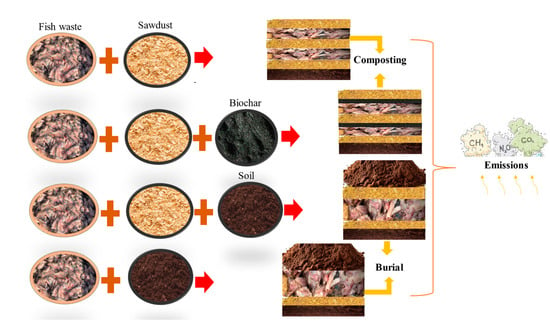
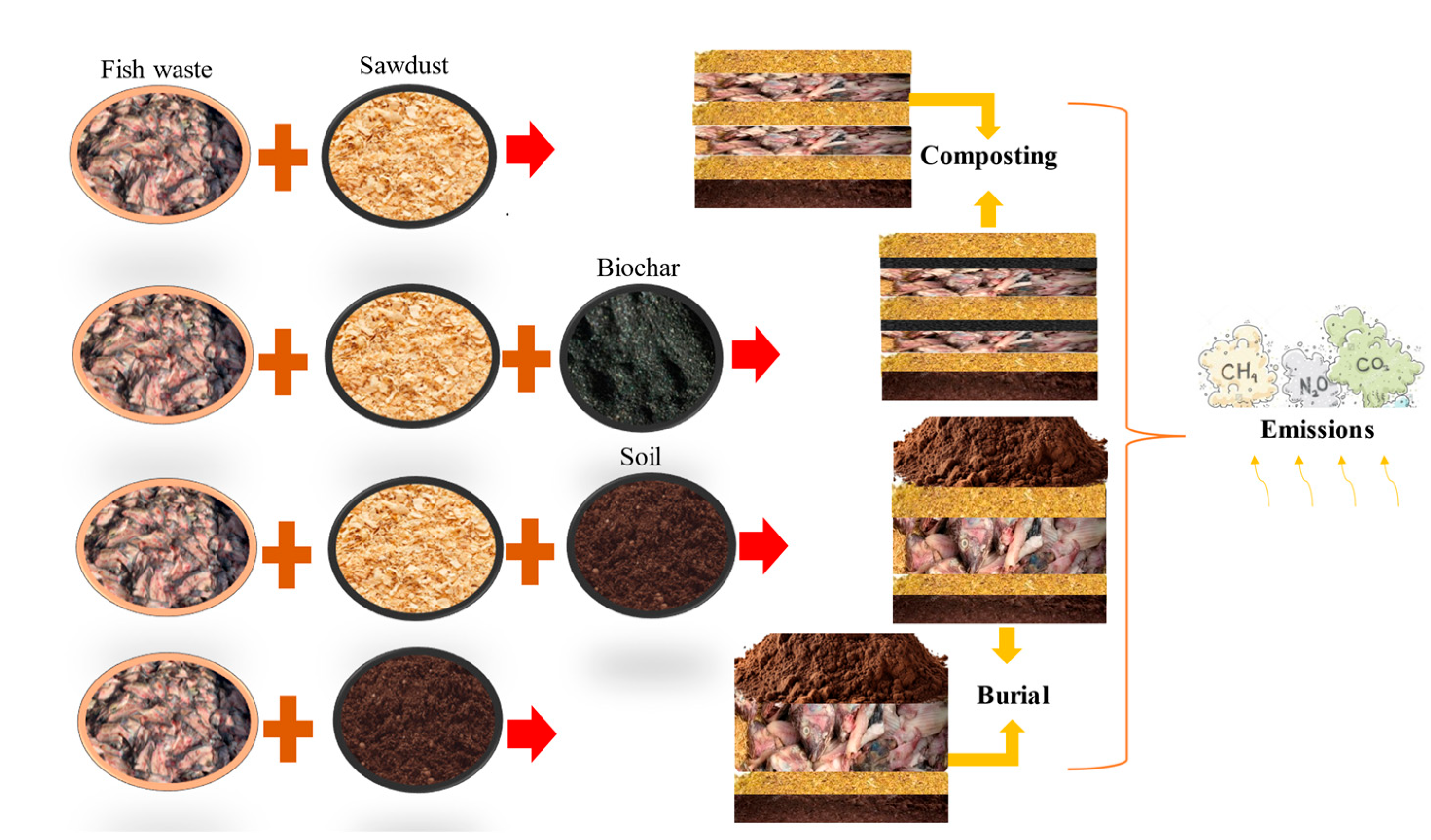
Fish waste was placed in four masonry cells, each with an area of approximately 1 m2 and an estimated capacity of 300 kg of fresh material. The fish waste was added to the cell in alternating layers, as follows: (i) bulking agent and fish waste (Bulk); (ii) bulking agent and fish waste with 10% biochar on a fish waste mass basis (BulkBioch); (iii) bulking agent and fish waste buried (BulkS), and (iv) fish waste buried (S) (Figure 1).
Figure 1.
Schematic representation of fish waste management by composting with and without biochar and by burial with and without sawdust cover.
For composting piles, materials were layered alternately within the cells, starting with sawdust at the base and finishing with sawdust at the top (Figure 1). The bulking agent: fish waste ratio was 1:2.5 (mass:mass), and the biochar was placed over the fish waste layer and distributed uniformly. Under the burial condition, the base soil was lined with a layer of bulking agent, followed by an additional soil layer, and approximately 150 kg of fish waste was added. For covering, one cell received a bulking agent followed by soil (BulkS), whereas the other was covered with soil only (S) (Figure 1).
In composting, forced aeration was applied during the first six weeks using an air blower at a continuous flow of 0.6 L kg−1 VS min−1, as recommended by [19]. Furthermore, three turnings were conducted at 50, 70, and 90 days of composting. The material was removed from the composting cell and placed on a plastic canvas for homogenization, sample collection, and moisture content adjustment. No management was applied to burial treatments to avoid process interference. During the burial period, simulated rainfall totaled 301.3 mm, based on the cumulative precipitation recorded at the experimental site throughout the trial. Water was evenly applied to all treatments according to the rainfall schedule to mimic natural precipitation conditions. The maintenance of soil moisture through rainfall simulation likely affected microbial activity, organic matter degradation, nutrient transformations, and gas fluxes.
Both the composting and burial processes took 135 days, during which temperature was monitored continuously using dataloggers. Temperature readings were taken from the base, center, and top of the cells to calculate the average temperature. The levels of total solids (TS), volatile solids (VS), and pH were determined in the samples collected from the initial material and at 135 days of composting. The TS and VS content was measured using the methodology outlined in [20], while the pH was determined using the method described in [21]. To assess the quality of the compost, the levels of macrominerals (N, P, and K) were determined using an Inductively Coupled Plasma Atomic Emission Spectrometer (ICP-OES), PerkinElmer, Optima 8300 model (Dual View). C and N concentrations were determined using a VARIO MACRO model Elemental Analyzer [22]. The ether extract contents were determined using the Randall method (INCT-CA G-005/1) as outlined in [23]. NDF, ADF, cellulose, hemicellulose, and lignin analyses were performed as previously described [24].
2.2. Quantification of CH4, N2O, and CO2
Fluxes of CH4, N2O, and CO2 were quantified using the closed static-chamber technique. The chamber was an opaque rectangular enclosure (73.2 L). Emissions were monitored during 135 days at variable intervals of 2–7 days, totaling 45 deployments per windrows and 37 deployments for the burial treatments. For each deployment, the chamber was seated on the cell’s sampling interface, the headspace air was mixed with an internal fan for 30 s, and the headspace temperature was recorded with a digital thermometer attached to each chamber. Gas samples were withdrawn with 20 mL syringes at 3, 6, 9, and 12 min after closure (four samples per deployment). Sampling started at 8:00 local time to approximate daily average soil N2O and CH4 emissions [25].
Samples were analyzed by gas chromatography using a Thermo Scientific Trace 1310 gas chromatograph equipped with Porapak Q/N columns, dual detectors (electron-capture detector, ECD; and flame-ionization detector, FID), and a TriPlus RSH autosampler for automatic injection. Before each run, certified standards with known concentrations were injected to construct calibration curves used to convert peak areas to gas concentrations in samples.
Gas concentrations were temperature-corrected to the headspace temperature measured at the time of sampling. Chamber fluxes were computed from the linear rate of change in headspace concentration over time following [26]:
where F represents the gas flux (mg m−2 h−1); δC/δt is the temporal change in gas concentration within the chamber during the closure interval (ppm min−1), V is chamber volume (m3), A is the covered surface area, M is the molecular weight of the CH4 (16 g mol−1), CO2 (44 g mol−1), N2O (44 g mol−1); Vm is the molar volume corrected to sampling conditions:
with Vm in m3 mol−1 (0.02241 m3 mol−1 = 22.41 L mol−1), T the chamber headspace temperature (°C), p0 standard atmospheric pressure at sea level, and p1 the site atmospheric pressure, estimated from the barometric equation, site altitude.
F = δC/δt × 60 × (V/A) × M/Vm,
Vm = 0.02241 × ((273,15 + T)/273.15) × p0/p1,
Cumulative emissions were estimated using the trapezoidal integration method, which assumes a linear variation between two consecutive sampling points. For each gas (CH4, N2O, and CO2), the daily flux values (expressed per unit area or per unit mass of dry waste) were interpolated using the average of two successive measurements multiplied by the time interval between them [27].
2.3. Global Warming Potential (GWP)
The global warming potential (GWP) of each treatment was estimated from the cumulative emissions of methane (CH4) and nitrous oxide (N2O). Only CH4 and N2O were considered in this calculation because carbon dioxide (CO2) emissions were of biogenic origin and therefore were not included in the GWP assessment. Emissions were converted to carbon dioxide equivalents (CO2-eq) using global warming potential factors of 27 for CH4 and 273 for N2O over a 100-year time horizon, according to the Intergovernmental Panel on Climate Change [28].
Total GWP was calculated as the sum of the CO2-equivalent contributions of both gases and expressed per kilogram of initial fish dry matter to enable comparison among treatments. The calculation was performed as follows:
where CH4 and N2O represent the cumulative emissions of methane and nitrous oxide, respectively, expressed per kilogram of initial fish dry matter.
GWP = (CH4 × 27) + (N2O × 273),
2.4. Thermal (TGA–DSC) Analysis
Samples for thermal analysis were collected on day 135 during the composting and burial process. Thermal analyses (TGA-DSC) were performed on a Netzsch STA449 F3 Jupiter® thermogravimetric analyzer using approximately 5.0 mg subsamples and α-alumina crucibles. The purge gas flow rate (air) was set to 50 mL min−1, and the heating rate was conducted at 20 °C min−1 over a temperature range of 30 to 1000 °C [29].
2.5. Plant Growth Assay
A germination test was conducted using lettuce seedlings grown with the organic fertilizers produced in the experiment. Among the products resulting from the evaluated fish waste disposal methods, only those derived from composting were selected for this assessment. This selection was based on their exposure to an intense, sustained thermophilic phase, which led to greater reductions in solid constituents and ensured adequate stabilization and sanitization of the material. Additionally, these composted fertilizers exhibited higher concentrations of plant-essential nutrients, particularly nitrogen (N), phosphorus (P), and potassium (K), compared to the materials obtained from the burial treatments.
The bio-compound assay was performed in a completely randomized design with a 2 × 4 factorial arrangement, comprising two organic fertilizers (with and without biochar) and four application rates (0, 25, 50, and 100 g), with four replicates per treatment. Each experimental unit consisted of a 3 L pot containing 2 kg of unfertilized soil and one lettuce seedling (approximately 8 g fresh mass and 9 cm in height). Application rates were defined based on typical field recommendations for organic fertilizers in vegetable production systems (up to 60 t ha−1; [30]) and proportionally adjusted to the pot scale. The soil was collected from an area with no history of fertilization. Pots were irrigated daily for 30 days, after which plants were harvested to determine shoot fresh weight, shoot length, root fresh weight, and root length.
2.6. Statistical Analysis
The experimental design consisted of one composting cell per treatment; therefore, no spatial replication was performed. Consequently, the variability presented in the emission curves reflects temporal variation in gas fluxes throughout the monitoring period rather than experimental replication. Time was treated as a repeated-measures dimension within each treatment, and statistical modeling focused on characterizing temporal emission dynamics independently for each management strategy. Accordingly, analyses of the composting experiment were descriptive and exploratory, whereas inferential statistics were reserved for the replicated germination assay.
Statistical modeling of daily and cumulative gas emission trends for each gas and fish waste treatment was done following three steps: (i) calculation of daily gas emissions on a per dry manure basis (g d−1 kg−1 dry fish waste) from emission 12 min dataset; (ii) estimation of mean daily fluxes using generalized additive models [31] fitted to the daily time series data, with thin plate regression splines as the default smoothing function in the “gam” function of the “mgcv” package in R version 4.5.3 [32]; and (iii) to propagate uncertainties in daily emissions, Monte Carlo methods were used to sample 10,000 vectors of parameter values from the variance–covariance matrix of parameter estimates [32], simulating 10,000 daily emission curves consistent with our data. From these curves, we computed the mean and 95% confidence intervals of daily gas emissions. This approach follows the methodology applied by [33], allowing for a flexible representation of the non-linear variation in emissions over time within each treatment.
An exploratory correlation analysis was conducted to investigate potential associations between the final nutrient concentrations in the compost (N, P, and K) and the thermal behavior of the piles during composting. For each treatment, the final values of N, P, and K were extracted from the last sampling point. Correlation coefficients were estimated using both Pearson’s (linear correlation) and Spearman’s (rank-based correlation) methods provided in Appendix A (Table A1 and Table A2). Given the experimental design, which comprised four treatments without replication, the analysis was restricted to descriptive and exploratory purposes. Accordingly, no statistical inference was applied, and the results are presented as trends that may indicate possible relationships between nutrient retention, organic matter degradation, and process temperature dynamics.
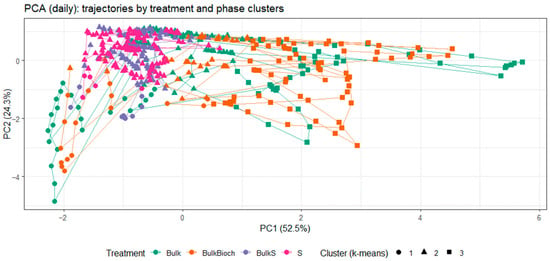
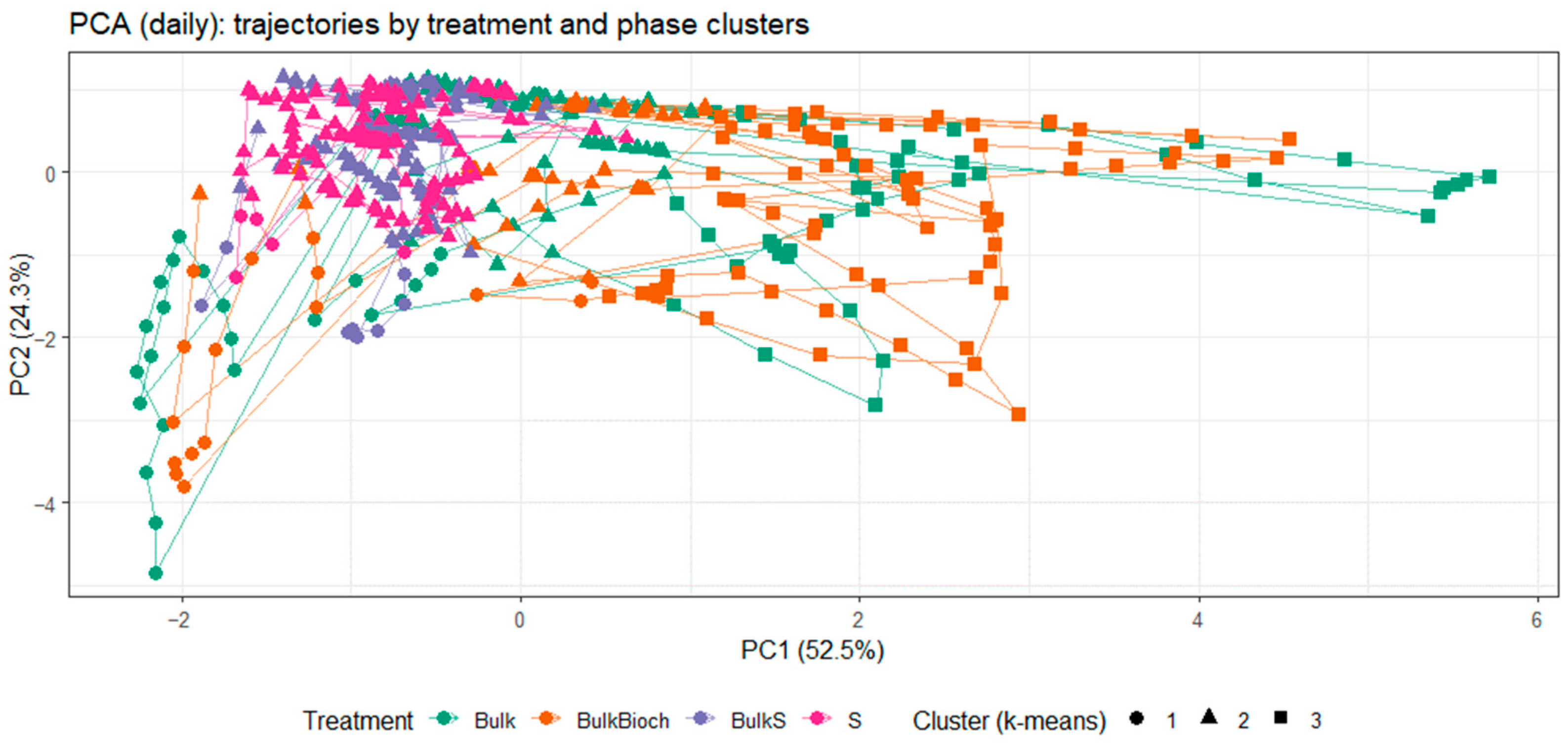
To further integrate daily gas emissions and temperature dynamics, a Principal Component Analysis (PCA) was performed on the daily dataset (CH4, N2O, CO2, and temperature), enabling the visualization of multivariate trajectories for each treatment. Temperature evolution during composting is shown in Figure A1 (Appendix B). Treatments were projected as temporal trajectories, and k-means clustering was applied to daily points, identifying three clusters corresponding to early, thermophilic, and late composting phases. This multivariate analysis was exploratory in nature and intended to describe temporal progression and emission–temperature coupling rather than to test statistical differences among treatments. The resulting multivariate patterns are illustrated in Figure A1, while detailed loading values and correlation matrices used for the PCA are provided in Appendix A (Table A3).
Germination test data were subjected to analysis of variance (ANOVA), and when the F-test indicated significant treatment effects, means were compared using Tukey’s test at the 5% significance level (p < 0.05).
A generative artificial intelligence tool (ChatGPT-5, OpenAI, San Francisco, CA, USA) was used as technical support for troubleshooting and refining R scripts related to data processing and graphical visualization. Its use was limited to identifying coding issues, suggesting syntactic corrections, and improving the formatting of figures and plot elements. No AI tools were used for statistical decision-making, hypothesis testing, or interpretation of results.
2.7. Limitations of the Study
The composting and burial experiment was conducted under pilot-scale conditions with a lack of replication, since each waste-management treatment consisted of a single experimental unit. Therefore, the observed differences in gas emissions, process dynamics, and compost characteristics should be interpreted as exploratory trends rather than statistically confirmed treatment effects, with limited generalizability to commercial-scale systems. Further replicated studies under full-scale operational conditions are needed to validate the trends observed here.
3. Results and Discussion
3.1. Temperature and pH Dynamics
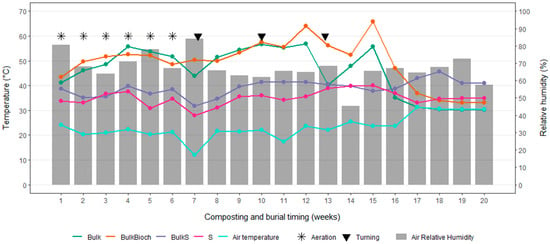
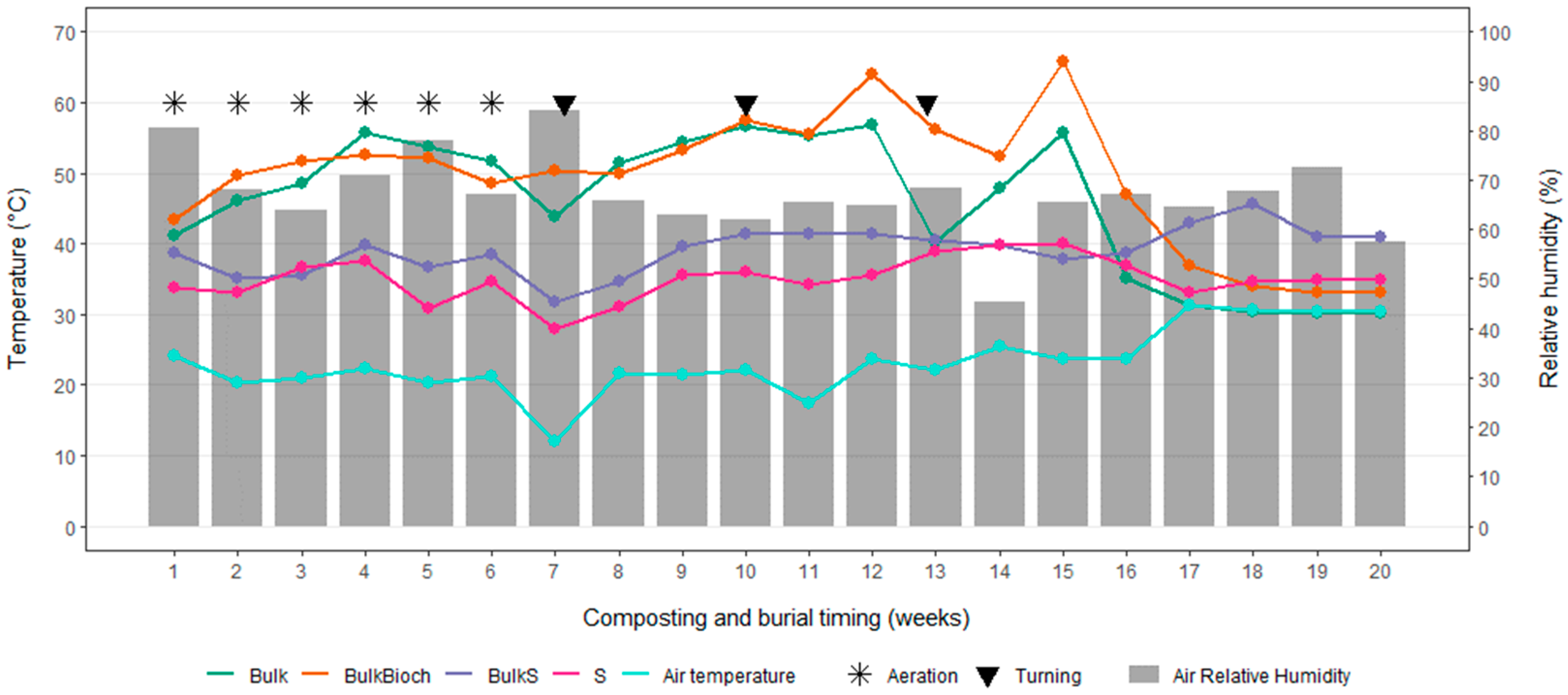
Composting cell temperatures (Figure 2 and Figure A1) remained within the thermophilic range (above 45 °C) under both conditions (with and without biochar) for most of the process. The cell without biochar addition stayed in this phase for 87 days, with an average thermophilic temperature of 53 °C. In contrast, the cell amended with 10% biochar remained above 45 °C for 105 days, with a mean temperature of 54.1 °C. The peak temperature of both cells was reached at day 100, corresponding to 64.3 °C in the control and 69.6 °C in the treatment with 10% biochar. In the buried waste, temperatures remained below 45 °C throughout the process in both cover conditions. The maximum temperatures in the buried residues occurred at days 102 and 121, reaching 40.8 °C in the residues covered only with soil and 48.0 °C in those covered with sawdust plus soil, respectively.
Figure 2.
Average weekly temperature in each treatment, average ambient air temperature, and relative air humidity, during fish waste treatments. Star-like marker (✳; Aeration) denotes forced aeration events; downward-triangle marker (▼; Turning) denotes windrow turnings.
The persistence of thermophilic temperatures during composting was likely associated with management practices such as forced aeration, pile turning, and moisture adjustment. These practices are essential to establish favorable conditions for microbial activity, ensuring sufficient oxygen supply, reduced compaction, and availability of organic substrates [4]. In addition to management strategies, environmental conditions such as high ambient temperature and relative humidity also contributed to maintaining elevated composting temperatures. The inclusion of 10% biochar likely enhanced metabolic heat generation within the composting mass, as biochar can store heat within its porous structure, thereby intensifying organic matter decomposition [8].
Temperature peaks reflected the oxidation of organic matter by aerobic microorganisms. During this process, heat is released as a natural by-product of exothermic reactions, while organic compounds are converted into simpler end-products such as CO2 and H2O [34,35].
In contrast, the burial method, where residues were arranged in a single layer, likely caused significant compaction that slowed degradation. Soil coverage further reinforced this compaction, particularly during water addition events [36]. Moreover, the absence of management interventions under this method contributed to the observed temperature profile. Similar results were reported by [37] when whole swine carcasses were buried in soil. The use of sawdust as an additional cover material for fish residues increased the temperature, likely by enhancing oxygen penetration and circulation within the buried mass, thereby favoring microbial development.
All pH values recorded throughout the experiment remained within the range considered optimal for microbial degradation processes. The pH exhibited a similar overall trend in both composting and burial treatments, with an initial decrease followed by a gradual increase toward neutrality or slight alkalinity. In composting, initial values ranged from 5.33 to 6.30 and increased to 7.23 and 8.35 in the treatments without and with biochar, respectively. In burial, values varied within a narrower range, from 6.15–7.0 initially to 6.35–6.82 at the end of the process, remaining close to neutrality. This trend reflects the typical dynamics of organic matter decomposition. The initial acidification is mainly associated with the accumulation of CO2 and volatile fatty acids during the rapid decomposition of easily degradable substrates [13]. As degradation progresses, these acids are consumed, and ammonium is formed, leading to a gradual increase in pH.
Although biochar addition resulted in a slightly higher final pH compared to the control (8.35 vs. 7.23), the magnitude of this increase was less pronounced than reported in previous studies. For instance, Ref. [38] observed a final pH of 9.12 when 20% wood biochar was added to food waste composting. Ref. [39] emphasized the alkalinizing effect of biochar due to its high content of basic cations (K+, Na+, Mg2+, Ca2+) and carbonate species. The smaller increase observed here may be attributed to the specific experimental conditions, including the type of waste, biochar proportion, and moisture management, which likely moderated the buffering capacity of biochar.
3.2. Daily CH4, N2O, and CO2 Emissions
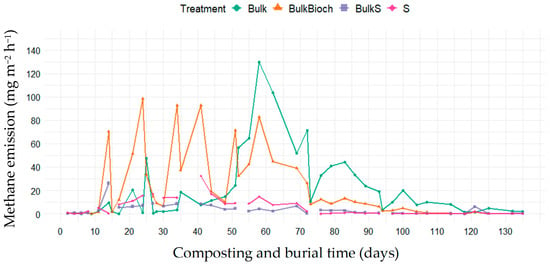
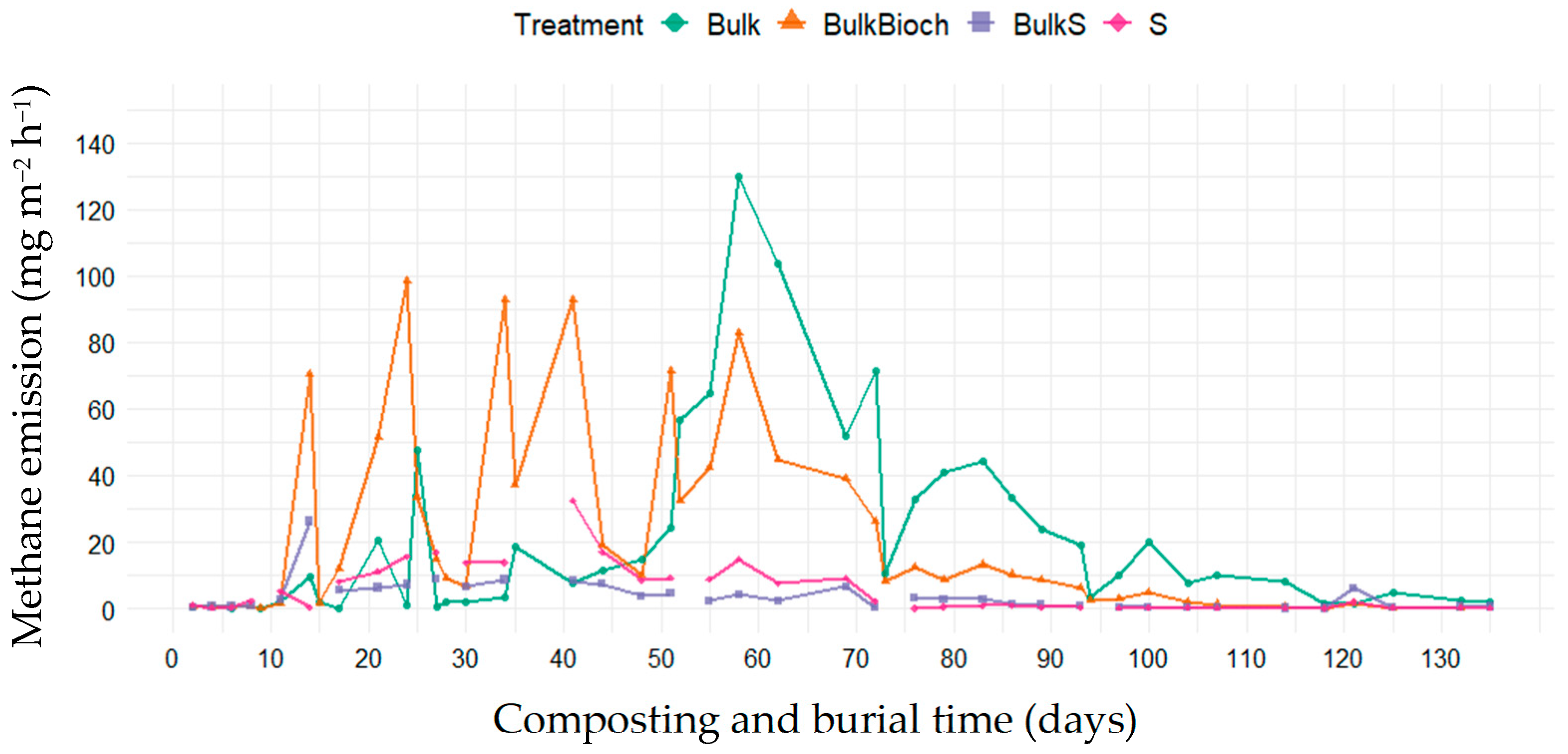
In the static windrows, the highest CH4 emission was recorded on day 24 in the treatment with biochar (BulkBioch; 98.38 mg m−2 h−1) and on day 58 in the treatment without biochar (Bulk; 129.98 mg m−2 h−1) (Figure 3). In the burial treatments, the greatest CH4 emissions occurred during the first weeks, with a peak of 32.5 mg CH4 m−2 h−1 when residues were covered exclusively with soil (S), and values below 27 mg CH4 m−2 h−1 in the treatment covered with sawdust (BulkS), stabilizing at around 5 mg CH4 m−2 h−1 after 72 days (Figure 3).
Figure 3.
Daily methane emission during composting (Bulk and BulkBioch) and burial (BulkS and S) treatments of fish waste.
Overall, CH4 emissions in all treatments decreased over the course of the study, a typical pattern associated with the intensity of aerobic decomposition (Figure 3). The period of more intense methane release usually coincides with the anaerobic phase of the process. In static windrows, residues tend to compact, hindering oxygen penetration, favoring the development of methanogenic microbial communities, and consequently leading to higher CH4 emissions [33]. Some factors, such as the inclusion of biochar, aeration, and pile turning, help maintain aerobic conditions and mitigate GHG emissions, including CH4 [17,40,41]. The addition of biochar to composting can increase oxygen concentration and control methanogenic activity, reducing GHG emissions by 27–32% [42,43,44].
In this study, biochar increased CH4 emissions during the first 50 days of composting (Figure 3). This effect likely resulted from the layered application of the additive over fish residues, which likely promoted anaerobic microsites, especially after moisture adjustment. Water may have occupied biochar pores, reducing its aeration capacity and limiting oxygen transfer. Similar results were reported by [45], who observed a higher initial CH4 emissions with 5% biochar, attributed to greater organic matter availability. Likewise, the high organic matter content of fish residues in this study (Table 1) may have contributed to the elevated CH4 emissions in the initial phase. This interpretation is supported by [46], who reported that high availability of readily degradable organic matter, combined with rapid microbial oxygen consumption, promotes the formation of anaerobic zones and increases CH4 emissions. After pile turning, biochar was homogenized with the other components, eliminating the layered arrangement and allowing its beneficial effects to prevail.
Covering residues exclusively with soil resulted in lower CH4 emissions (Figure 3). This lower emission may be related to the lower moisture observed in this treatment, which likely limited the formation of anaerobic microsites and, consequently, constrained the conditions required for methanogenesis. In addition, restricted gas diffusion through the soil layer, together with CH4 oxidation in partially oxygenated microsites, may have further decreased net emissions [47].
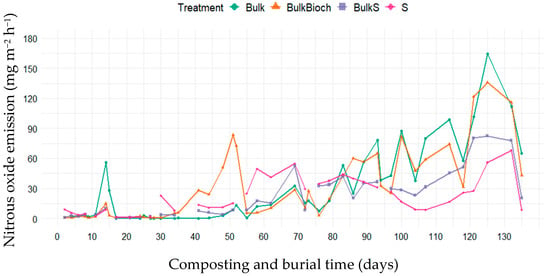
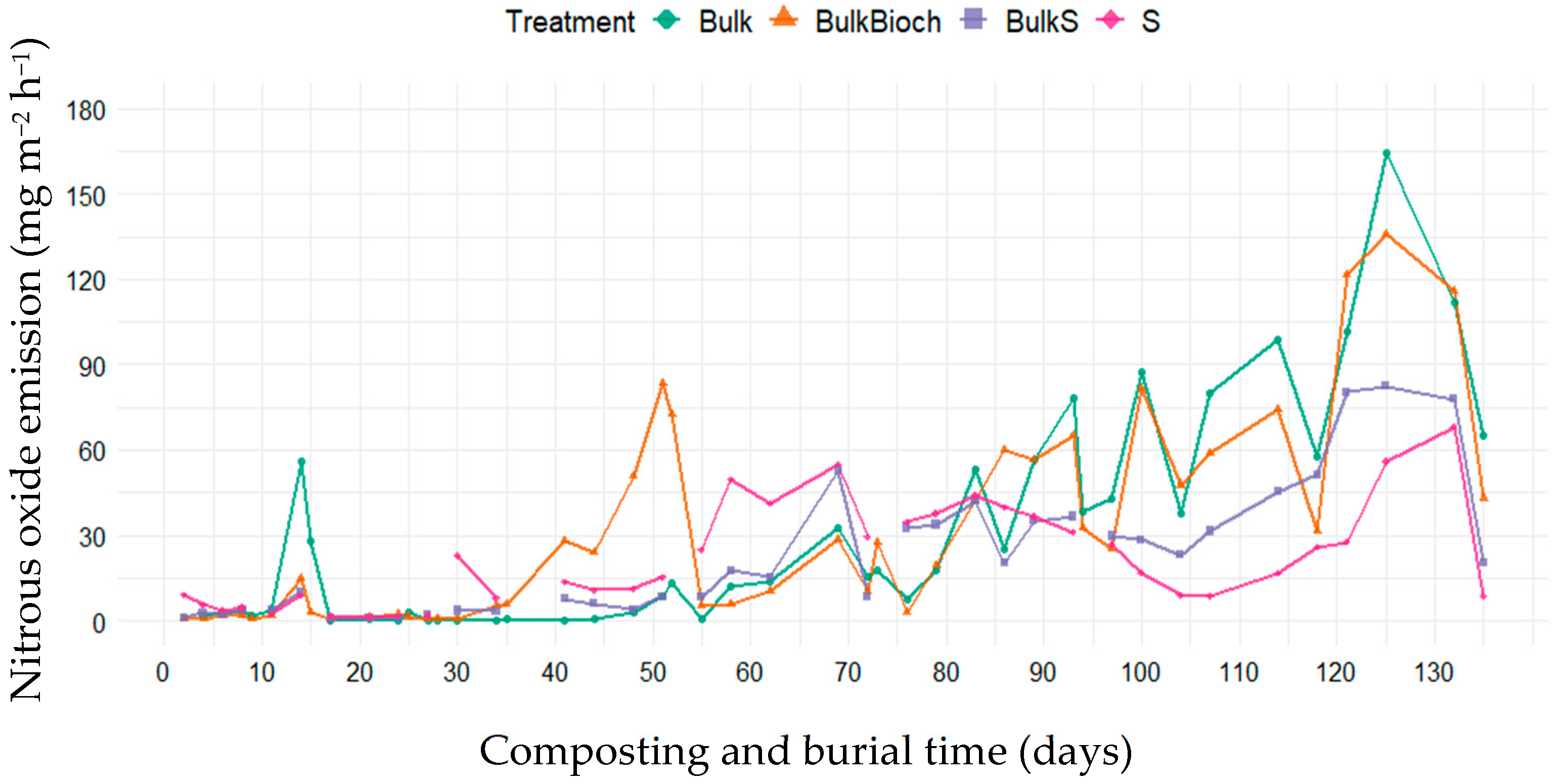
Regarding N2O, composting (Bulk and BulkBioch) showed more irregular emissions and sharper peaks compared to the burial treatments (Figure 4). In the static windrows, the initial peaks occurred at day 14, with values of 55.80 mg m−2 h−1 for Bulk and 15.12 mg m−2 h−1 for BulkBioch, while during the same period emissions were 9.02 mg m−2 h−1 for S and 10.13 mg m−2 h−1 for BulkS (Figure 5). All residue management strategies exhibited a similar pattern of delayed N2O emission. The highest N2O peaks occurred near the end of the process, reaching 82.32 and 68.06 mg m−2 h−1 at days 125 and 132 for the sawdust-plus-soil and soil-only covers, respectively, and corresponding to 135.68 and 165.65 mg m−2 h−1 at day 125 in the Bulk and BulkBioch treatments, respectively (Figure 4).
Figure 4.
Daily nitrous oxide emission during composting (Bulk and BulkBioch) and burial (BulkS and S) treatments of fish waste.
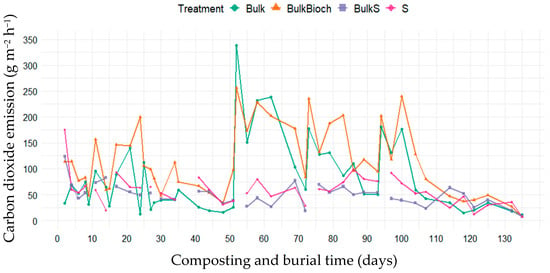
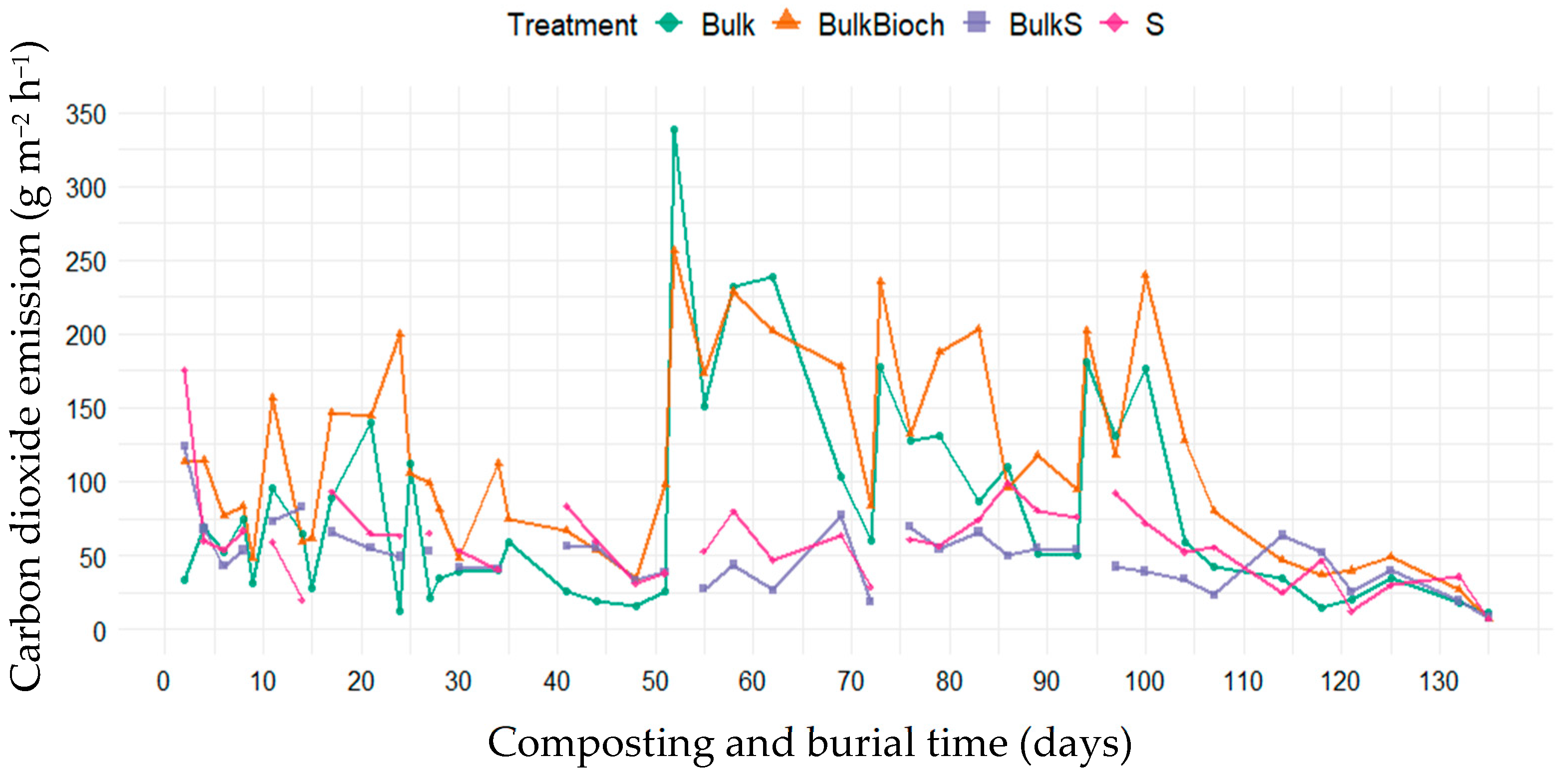
Figure 5.
Daily carbon dioxide emission during composting (Bulk and BulkBioch) and burial (BulkS and S) treatments of fish waste.
The delayed N2O emission observed in this study agrees with [48], who reported higher emissions at the final stage of rice straw composting. This pattern likely reflects the combined influence of temperature and oxygen limitation on N2O emissions. In the present study, although thermophilic conditions persisted, the temperature decline after day 100 (Figure 2) coincided with increased N2O emissions, suggesting the reactivation of microbial processes associated with nitrification and denitrification. High temperatures can inhibit nitrification, limiting N2O production during the thermophilic phase [49,50]. In contrast, other studies report early N2O peaks. Peng et al. [5] observed initial emissions linked to high microbial activity, readily degradable substrates, moderate temperatures, and heterogeneous oxygen distribution. These conditions favor nitrification and denitrification, increasing N2O emissions. Similarly, early N2O release has been attributed to NH4+ oxidation to NO2− [51,52,53].
The daily CO2 emissions exhibited contrasting behaviors between composting (Bulk and BulkBioch) and burial (BulkS and S) of fish residues. In the composting treatments, multiple peaks were observed throughout the process, with the most pronounced increases occurring after pile turnings (Figure 5). Both treatments reached their maximum at day 52, with values of 338,911.0 and 256,337.7 mg m−2 h−1 for BulkBioch and Bulk, respectively (Figure 5). In the burial treatments, the highest emissions occurred on day 2 (175,613.7 mg m−2 h−1 in S and 123,844.0 mg m−2 h−1 in BulkS), followed by a sharp decline and lower-amplitude fluctuations (Figure 5).
CO2 emission is widely recognized as an indicator of the intensity of aerobic microbial respiration during the decomposition of organic matter [17]. More pronounced peaks reflect higher degradation rates, associated with an efficient biological process [45]. In the present study, the highest CO2 fluxes observed in the composting treatments coincided with the periods of turning and with forced aeration during the first 50 days of the process. As discussed previously, turning and aeration likely sustained aerobic conditions, contributing to higher CO2 fluxes.
The presence of biochar and sawdust in the composting of fish waste may have enhanced this effect. As noted earlier, sawdust may improve physical structure and aeration of the matrix while also supplying additional carbon, which may contribute to CO2 emissions. The results are consistent with [11], who reported a 7.4% increase in CO2 emission when poultry manure compost received the highest dose of bamboo biochar (10%). Other studies have reported that higher CO2 emissions in composting with biochar addition may result from the abiotic oxidation of biochar or from the labile carbon fraction of biochar, which serves as an energy source for microorganisms [35,54].
In the burial treatments, the absence of turning and forced aeration rapidly limited oxygen diffusion, promoting the early establishment of anaerobic conditions. This limitation reduced the activity of aerobic microorganisms, resulting in lower emissions and a slower decomposition process. The more intense CO2 release observed at the beginning of the burial treatments, under both conditions, may represent a response to the consumption of residual oxygen. Subsequently, due to compaction, the environment shifted toward anaerobiosis, thereby reducing emissions.
To complement the univariate assessment of daily gas fluxes, a multivariate analysis was performed to integrate emission dynamics with temperature over time. In addition to the temporal dynamics of individual gases, multivariate analysis of daily emissions and temperature revealed clear treatment-dependent trajectories (Figure 6 and Figure A1, Appendix B). The PCA separated the composting treatments (Bulk and BulkBioch) from the burial treatments (S and BulkS), with clusters corresponding to distinct composting phases. Bulk and BulkBioch exhibited longer trajectories, reflecting the transition across multiple stages, including a sustained thermophilic phase characterized by high CO2 fluxes and active microbial degradation. In contrast, the burial treatments showed shorter trajectories and clustered in early-phase regions, consistent with lower temperatures and more limited aerobic activity.
Figure 6.
Principal Component Analysis (PCA) of daily greenhouse gas (GHG) emissions (CH4, N2O, CO2) and temperature across treatments. The trajectories represent the temporal evolution of each treatment, while the symbols indicate phase clusters identified by k-means clustering (● = Cluster 1; ▲ = Cluster 2; ■ = Cluster 3). Treatments: Bulk = static windrow; BulkBioch = static windrow with biochar addition; BulkS = burial with sawdust cover; S = burial with soil cover.
3.3. Generalized Additive Model and Cumulative Emissions
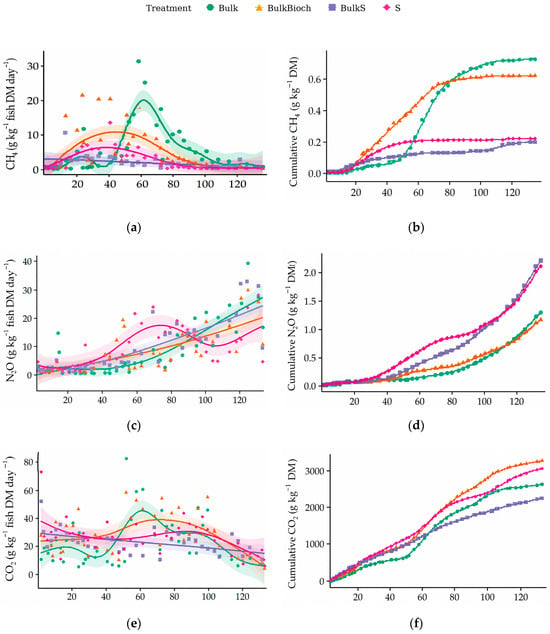
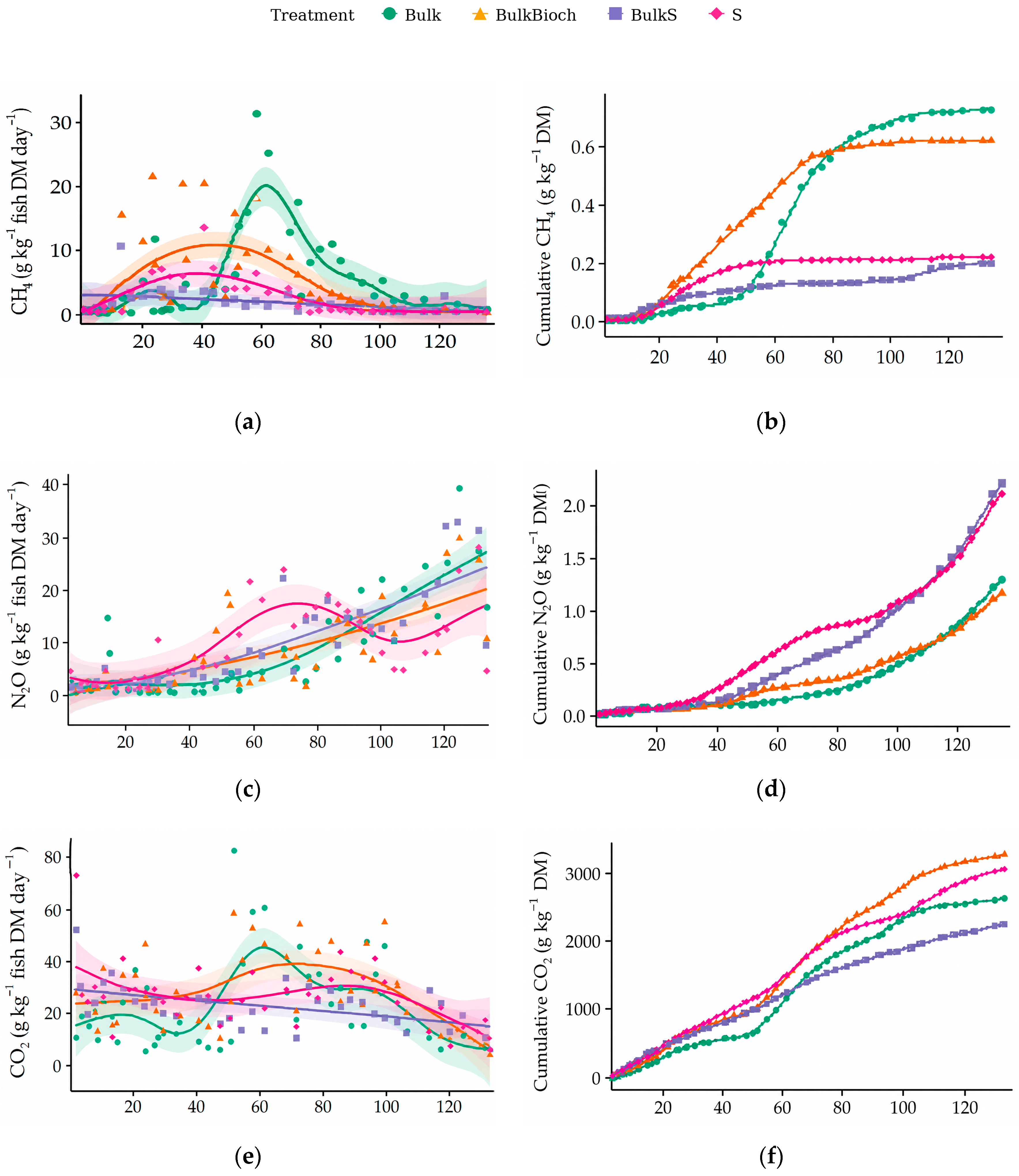
Considering the results fitted by the generalized additive model (GAM), daily GHG emissions, expressed per kilogram of TS fish waste, showed distinct temporal patterns across treatments, reflecting the influence of waste management strategy, as well as the use of biochar and bulking agent, on the dynamics of organic matter degradation (Figure 7). In general, CH4 emissions were more pronounced during the early to intermediate stages of the process, with peaks observed between 30 and 50 days of composting or burial (Figure 7). N2O emissions, in turn, varied depending on the treatment, with peaks occurring later in the process, whereas CO2 exhibited a more constant behavior over time, though with differing intensities among treatments.
Figure 7.
Daily mean fluxes of CH4 (a), N2O (c), and CO2 (e) measured from the waste windrows over the 135 d measurement period and the fitted statistic trends (lines). The shaded area represents 95% confidence intervals. The cumulative emission of CH4 (b), N2O (d), and CO2 (f) are also plotted. Black arrows indicate windrow turning events in the static piles.
The cumulative emissions of GHG per kilogram of TS fish waste varied substantially among treatments (Figure 7). The Bulk treatment tended to show higher accumulated values of methane (0.72 g CH4 kg−1 dry waste) and carbon dioxide (2.57 kg CO2 kg−1 dry waste), whereas the highest accumulations of nitrous oxide were observed in the burial treatments S (2.18 g N2O kg−1 dry waste) and BulkS (2.08 g N2O kg−1 dry waste). The treatment with biochar (BulkBioch) presented comparatively lower cumulative emissions of CH4 (0.61 g kg−1 dry waste) and N2O (1.06 g kg−1 dry waste) compared with the Bulk treatment, representing mitigation of 15% and 10%, respectively. The incorporation of sawdust in the burial treatment positively influenced the N2O emission profile, resulting in a value 4% lower than that recorded in the soil-only treatment (S).
Cumulative data indicate that biochar promoted earlier stabilization of CH4 emissions (Figure 7). By day 73, 70% and 91% of total methane had been released in the Bulk and BulkBioch treatments, respectively. The faster accumulation in the BulkBioch may be associated with its higher moisture content (30.5% vs. 24.9%), which likely favored anaerobic microsites and accelerated methanogenesis in the initial phase. Later, this moisture pattern was reversed, with higher moisture content in Bulk (38.8%) than in Bulkbioch (32.5%). If confirmed as an indicator of compost maturity, this stabilization could offer operational advantages, such as faster pile turnover and reduced land use for waste treatment. It may also provide environmental benefits by reducing reliance on synthetic fertilizers.
The mitigation of N2O emissions observed with biochar addition in the present study is consistent with [55,56,57,58], who reported a reduction of approximately 17.5% to up to 70% in cumulative emissions during composting. In contrast, Ref. [59] reported a significant increase in cumulative N2O emissions following the addition of 10% tobacco-derived biochar during food waste composting. This discrepancy likely reflects differences in substrate characteristics, biochar properties, and process conditions [17,57,58]. The biochar used in the present study exhibited a surface area of 7.45 m2 g−1 and a pore size of 7.55 nm, indicating a mesoporous structure that may facilitate gas diffusion and contribute to aeration within the compost matrix. These characteristics align with reports that biochar porosity and surface area influence water retention, aeration, and microbial activity, affecting nitrogen transformation [60]. Furthermore, previous studies have shown that biochar can mitigate N2O emissions by altering nitrogen transformation pathways and microbial activity [58].
In the present study, cumulative N2O emissions per unit of TS residue were higher than those of CH4, which can be explained by the high nitrogen concentrations in fish waste and the nitrogen transformation pathways discussed above. According to [17], this prominent contribution of N2O is linked to the high availability of nitrogen, particularly in the ammoniacal form (NH4+), which serves as a substrate for nitrification and denitrification. Moreover, the physical environment of composting under intermittent aeration fosters the development of microaerobic zones, which are conducive to partial nitrogen conversion into N2O.
The more intense cumulative N2O emissions observed in the burial treatments (S and BulkS) can be explained by a combination of physical, chemical, and microbiological factors that favor incomplete nitrification and partial denitrification, the main pathways of N2O production [42]. This finding is particularly relevant since nitrous oxide has a global warming potential per molecule approximately 296 times greater than that of carbon dioxide (CO2), making it one of the most impactful greenhouse gases [48]. In addition, N2O can be transported to the stratosphere, where it contributes to ozone layer depletion, posing substantial risks to ecosystems and human health [61]. Thus, the choice of waste treatment method becomes a strategic factor in mitigating these emissions, especially given the evidence that burial favors the release of this pollutant.
Fish residues are characterized by high moisture and nitrogen contents, conditions that may favor CH4 and N2O formation during degradation. Within the conditions of this pilot-scale study, biochar amendment was associated with lower cumulative emissions of both gases. Further studies under replicated and commercial-scale conditions are needed to confirm these trends and to evaluate alternative methods for homogeneous biochar incorporation.
3.4. Global Warming Potential
Table 2 summarizes cumulative emissions and global warming potential (GWP) values across treatments, allowing direct comparison of their environmental performance. The GWP differed among treatments (Table 2), based on cumulative CH4 and N2O emissions expressed as CO2-equivalent. Composting amended with biochar (BulkBioch) showed the lowest GWP (305 g CO2-eq kg−1 fish), followed by conventional composting (Bulk) (338 g CO2-eq kg−1 fish). In contrast, burial treatments were associated with higher climate impacts, reaching 599 and 575 g CO2-eq kg−1 fish for the sawdust + soil (BulkS) and soil-only (S) treatments, respectively.
Table 2.
Cumulative CH4 and N2O emissions, emission intensity, and global warming potential (GWP) per kilogram of initial fish dry matter under different fish waste management treatments.
The addition of biochar resulted in a 33 g CO2-eq kg−1 fish total GWP, corresponding to a 10% reduction relative to conventional composting. When burial treatments were compared, the soil-only system presented slightly lower GWP than the sawdust + soil treatment, avoiding 24 g CO2-eq kg−1 fish, which corresponds to a 4% reduction. The contrast between management strategies was more pronounced when composting and burial pathways were compared. Conventional composting avoided 261 g CO2-eq kg−1 fish, corresponding to a 44% reduction relative to the sawdust + soil burial treatment. These results indicate that aerobic waste management strategies substantially reduce the climate impact associated with fish waste disposal compared with burial systems.
3.5. Compost Characteristics: Thermal Behavior, Nutrient Composition, and Reductions in TS and VS
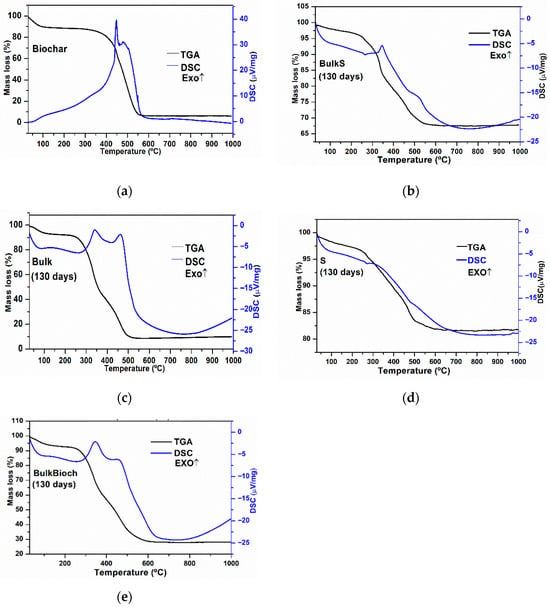
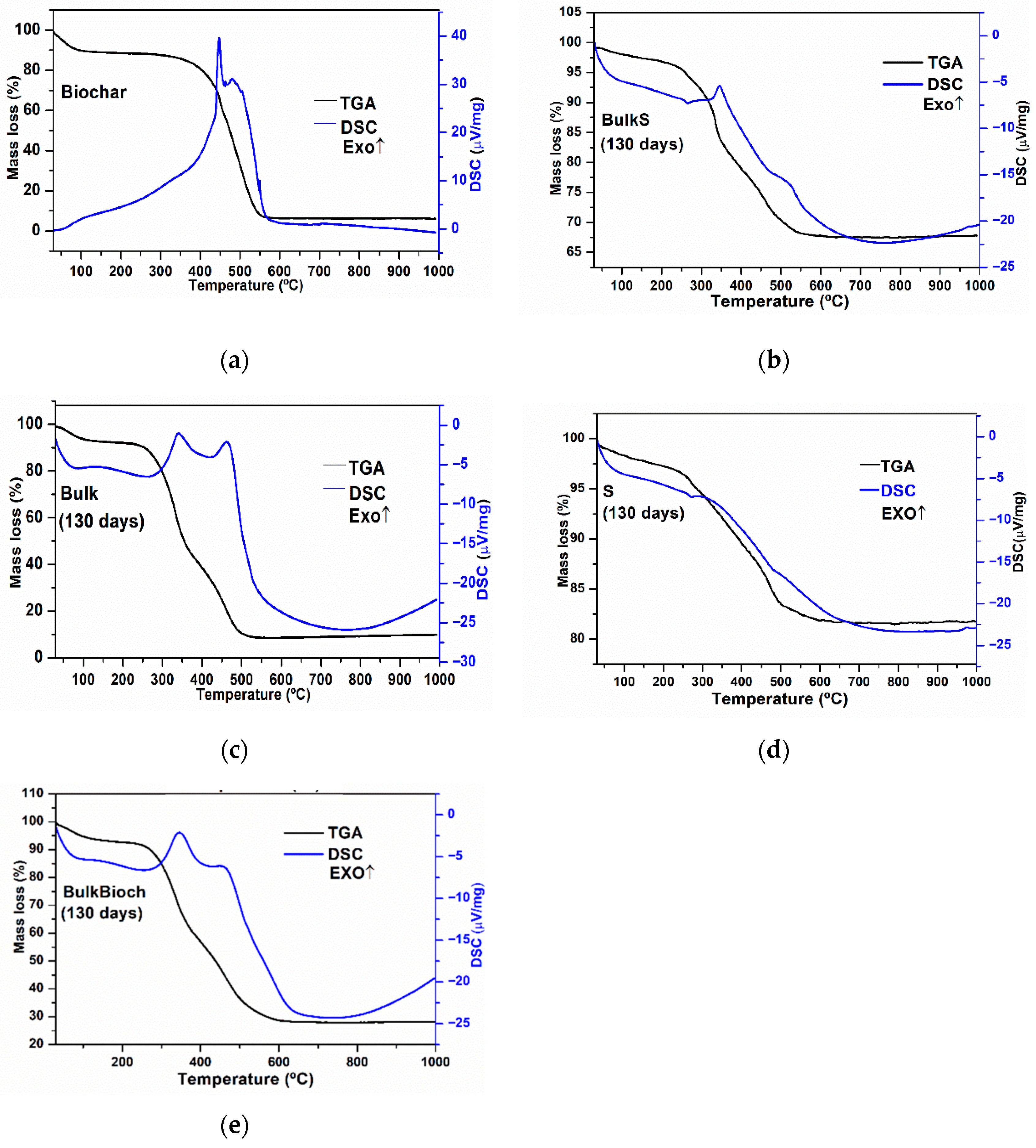
The thermal stability of biochar is an essential parameter for understanding its resistance to aging. The TGA–DSC curves of isolated biochar (Figure 8a) showed intensified mass loss around 500 °C, stabilizing near 600 °C, which indicates a higher concentration of aromatic carbon. This pattern was also described by [62], who identified the 500–600 °C range as indicative of the stability of biochars from different sources. When evaluated together with composting residues (Figure 8c,e), mass loss occurred at lower temperatures, around 300 °C. This suggests that, despite the intrinsic stability of biochar, more labile constituents of the system influence the thermal profile, making the residual material gradually more stable throughout the process.
Figure 8.
TG–DSC curves of rice husk biochar (a), buried fish waste with sawdust as cover ((b), BulkS), fish waste compost with 10% biochar ((c), BulkBioch), buried fish waste without sawdust as cover ((d), S), fish waste compost without biochar ((e), Bulk).
At 130 days, two peaks were observed in both composting treatments, but in the material with biochar (Figure 8c) the second peak was less intense, suggesting adsorption or stabilization of recalcitrant compounds. This effect is relevant, since even after 100 days, composting with biochar maintained higher temperatures (Figure 8e), indicating ongoing microbial activity. Under these conditions, the additive limited the emission of volatiles, reinforcing its stabilizing role. The remaining mass was also greater in composting with biochar, likely due to the increased recalcitrant fraction resulting from its combination with sawdust. This outcome is consistent with [63], who reported higher residual mass in TGA following lignin addition.
In the burial experiment (Figure 8b,d), TG curves indicated initial water loss up to 240 °C, followed by organic matter decomposition. In the residues buried with sawdust and soil (Figure 8b), exothermic peaks were detected at 355 °C (135 days), associated with the release of volatile compounds. Conversely, in the burial with soil only (Figure 8d), no apparent peaks were observed, suggesting the absence of retained gases. This result aligns with the temperature monitoring, which did not exceed 45 °C, indicating minimal microbial activity.
As expected, the residual mass was higher in the burial with sawdust and soil (approximately 31%) compared with soil alone (18%). This effect is related to the greater recalcitrance of sawdust, which is rich in lignin [64], favoring the accumulation of material at the end of the process.
The final compost exhibited higher concentrations of N, P, and K in the Bulk and BulkBioch treatments (Table 3). The findings of nutrient concentration in this study are partially aligned with previous research on composting fish waste in aerated static windrows [65], which observed a variation of 2.7 to 3.0% in N, 21.3 to 25.4 g P kg−1 compost, and 7.8 to 11.8 g K kg−1 compost. The lower N level in our study can be attributed to the initial composition of substrates and organic waste used, and experimental conditions. However, biochar demonstrated effectiveness in retaining N in composting, similarly with results observed in composting of cattle slaughterhouse waste [66] and in sewage sludge [67].
Table 3.
Characterization of the compost: nutrients (N, P, and K), total solids (TS) and volatile solids (VS).
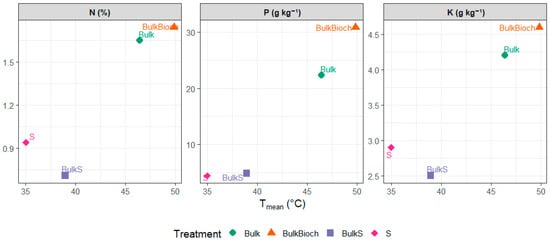
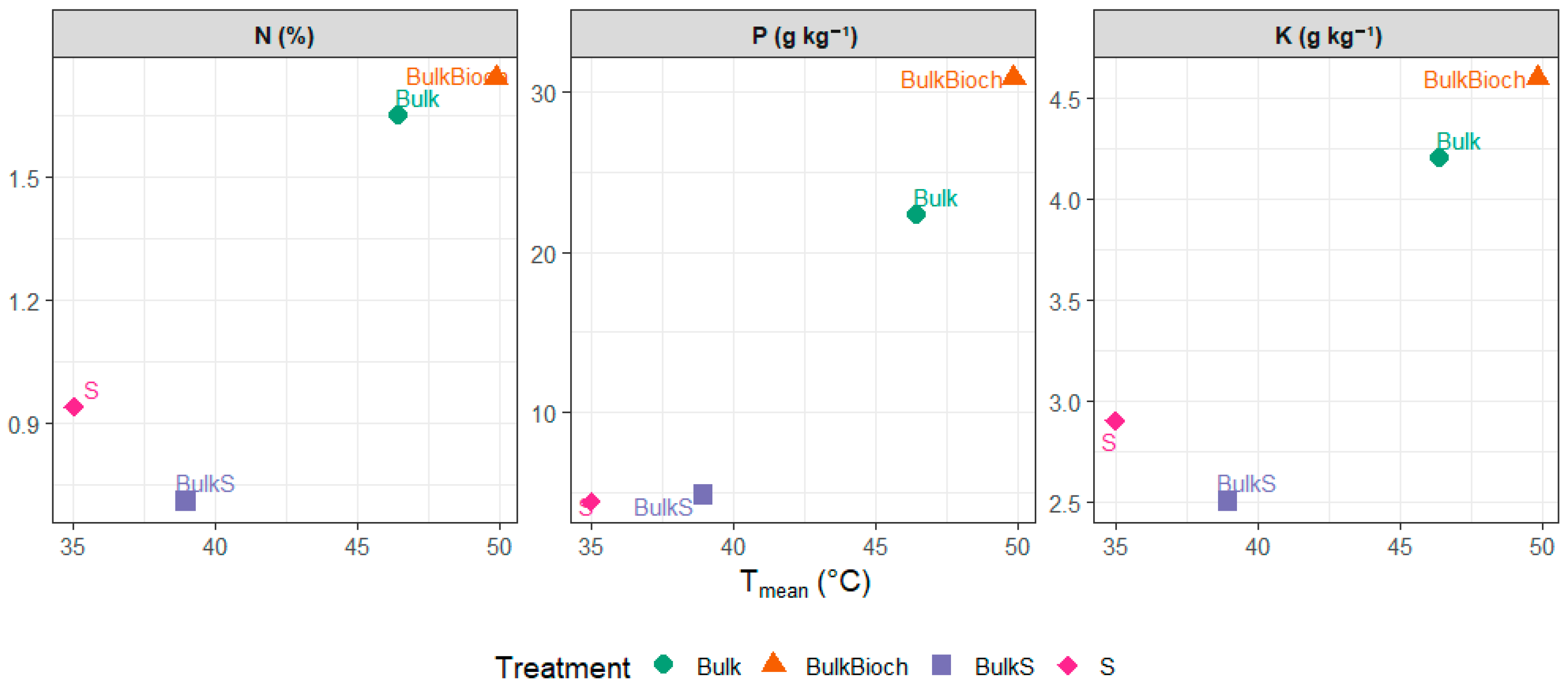
The burial treatments (S and BulkS) resulted in composts with markedly lower nutrient concentrations, higher TS values, and very low VS contents (Table 3). These results may reflect the suppressive effect of soil addition on microbial activity, as indirectly evidenced by the lower average temperatures recorded in these treatments (Figure 9). Exploratory analysis suggested a strong correlation between nutrient concentrations and composting temperature (Appendix A, Table A1 and Table A2), although this result should be interpreted with caution, as the correlation analysis was based on treatment-level summary values from only four non-replicated experimental units. Soil incorporation dilutes the organic matter fraction, thereby limiting the energy available for microbial metabolism and preventing the development of sustained thermophilic phases [68].
Figure 9.
Associations between nutrient contents (N, P, K) and solids reductions (TS: total solids, VS: volatile solids) with average composting temperature across treatments.
3.6. Plant Growth Response to Compost Application
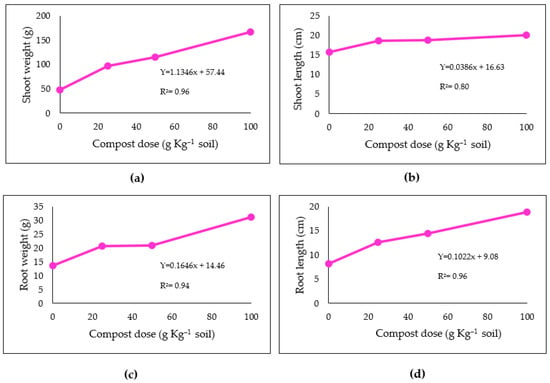
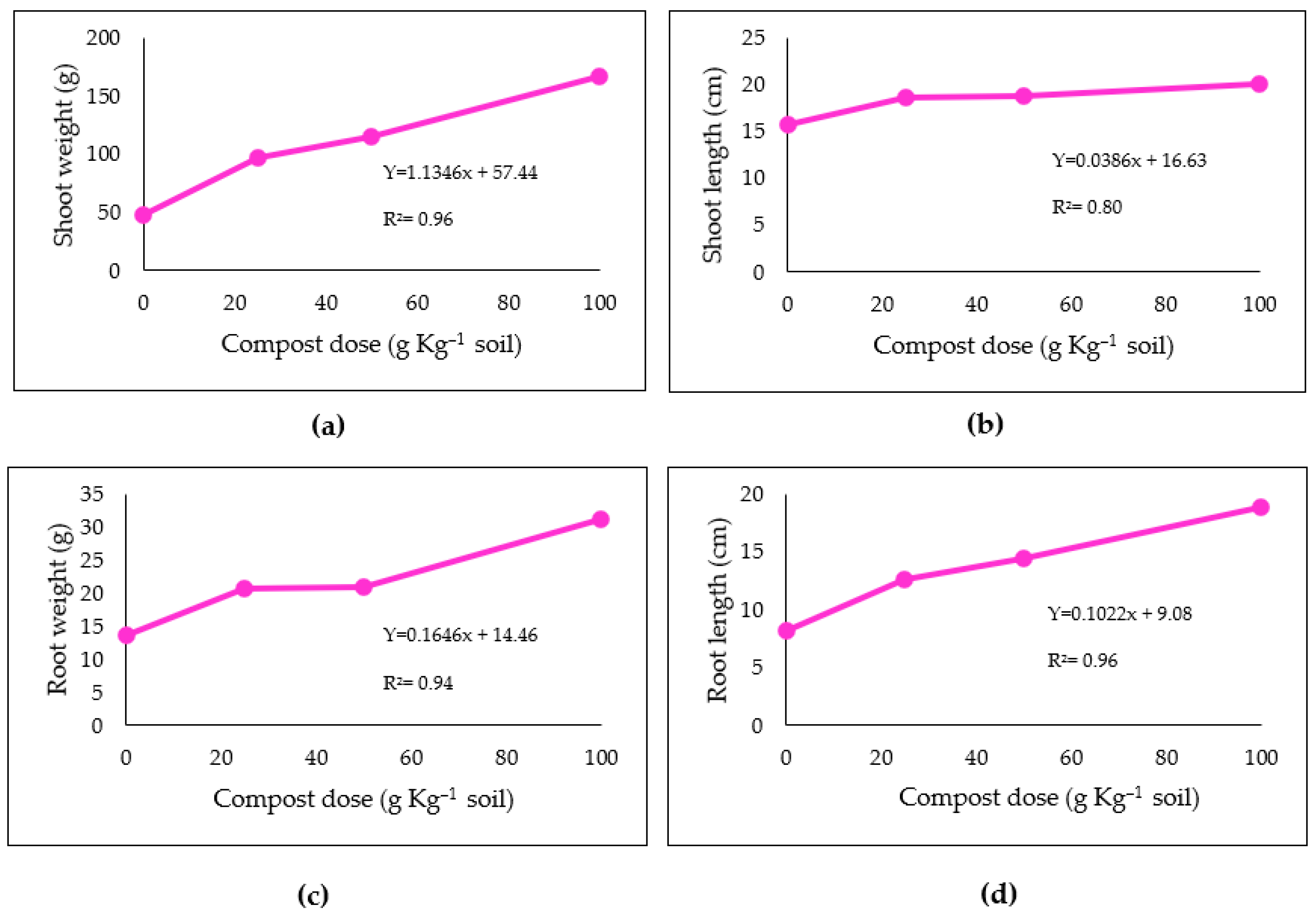
Compost application rate significantly affected all evaluated parameters (p < 0.05), with the greatest responses observed at the highest doses. As no significant effect of compost type was detected, data from both composts were pooled, and a single regression curve was used to illustrate the dose–response relationship.
The highest compost application rate resulted in lettuce plants with approximately twice the total length of those grown in soil without compost. It also promoted substantial increases in shoot biomass and root development, as evidenced by the linear relationships observed for shoot weight, shoot length, root weight, and root length (Figure 10a–d). These findings highlight the importance of organic fertilization in enhancing crop growth and quality. The gradual mineralization of organic matter in compost ensures a sustained release of nutrients, thereby improving nutrient availability and uptake efficiency by plants.
Figure 10.
Shoot weight (a), shoot length (b), root weight (c), and root length (d) of lettuce seedlings fertilized with compost produced from the composting of fish waste.
Similar results were reported by [68], who evaluated poultry manure-based compost amended with biochar during lettuce cultivation. The authors observed increases of 71% in plant biomass, 77% in soil organic carbon, and approximately 90% in the availability of macronutrients (N, P, and K), along with improvements in plant morphology and canopy diameter.
4. Conclusions
This study shows that fish waste management strategies may influence greenhouse gas emissions, process dynamics, and nutrient recovery during degradation. In this pilot-scale trial, composting amended with 10% biochar resulted in lower CH4 and N2O emissions, earlier CH4 stabilization, and greater nutrient retention in the final compost. Methane emissions were more pronounced during the early stages of degradation, whereas N2O emissions tended to increase toward the later stages of the process. Burial treatments, in contrast, were associated with lower decomposition efficiency and higher N2O-related climate impact. In addition, composts derived from fish waste proved to be effective organic fertilizers for lettuce cultivation, with plant growth responding positively to increasing application rates. Overall, these findings indicate that composting with biochar and structural bulking agents represents a more sustainable alternative for fish waste management, with potential applications in circular-economy strategies aimed at waste valorization and greenhouse gas mitigation.
Author Contributions
Conceptualization, J.D.d.O., A.C.A.O., M.T., C.T.d.C. and M.A.P.O.J.; methodology, J.D.d.O., A.C.A.O., T.S.d.C.S., C.T.d.C. and M.A.P.O.J.; formal analysis, J.D.d.O. and R.N.d.S.V.; investigation, J.D.d.O., L.A.K.A.I., M.T. and T.S.d.C.S.; resources, A.C.A.O.; data curation, É.d.C.O.; writing—original draft preparation, J.D.d.O.; É.d.C.O. and R.N.d.S.V.; writing—review and editing, A.C.A.O. and É.d.C.O.; visualization, L.A.K.A.I.; supervision, A.C.A.O.; project administration, A.C.A.O.; funding acquisition, A.C.A.O. and M.A.P.O.J. All authors have read and agreed to the published version of the manuscript.
Funding
This research was funded by CAPES, Process numbers: 88887.994531/2024-00 and 88887.679719/2022-00, and FUNDECT, project 1: Process number: 71/044.567/2022, Fundect number: 882/2022; project 2: Process number: 83/026.783/2024, Fundect number: 112/2024.
Institutional Review Board Statement
Not applicable.
Informed Consent Statement
Not applicable.
Data Availability Statement
The original contributions presented in this study are included in the article and its appendices. Further inquiries can be directed to the corresponding author.
Acknowledgments
During the preparation of this study, the authors used ChatGPT (OpenAI, San Francisco, CA, USA) to assist in solving R scripts issues during data processing and visualization. The authors reviewed and edited all outputs generated by the tool and take full responsibility for the content of this publication. The authors also acknowledge the Graduate Program in Animal Science (PPGZ) at the Federal University of Grande Dourados (UFGD) for institutional support. In addition, the authors thank CAPES (Coordenação de Aperfeiçoamento de Pessoal de Nível Superior) for fellowships and research support.
Conflicts of Interest
The authors declare no conflicts of interest.
Abbreviations
The following abbreviations are used in this manuscript:
| AD | Anaerobic digestion |
| ADF | Acid detergent fiber |
| C | Carbon |
| CH4 | Methane |
| CO2 | Carbon dioxide |
| CO2-eq | Carbon dioxide equivalent |
| DSC | Differential scanning calorimetry |
| EE | Ether extract |
| NDF | Neutral detergent fiber |
| GHG | Greenhouse gases |
| K | Potassium |
| N | Nitrogen |
| NH3 | Ammonia |
| NH4+ | Ammonium |
| NO | Nitric oxide |
| NO2− | Nitrite |
| NO3− | Nitrate |
| N2O | Nitrous oxide |
| P | Phosphorus |
| pH | Potential of hydrogen |
| TGA | Thermogravimetric analysis |
| TS | Total solids |
| VS | Volatile solids |
Appendix A
Table A1.
Exploratory Pearson’s correlation coefficients between final nutrient concentrations (N, P, K; n = 4, one value per treatment) and thermal descriptors of the composting process (T_mean, T_max, T_sd, T_AUC; calculated from daily records).
Table A2.
Exploratory Spearman’s correlation coefficients between final nutrient concentrations (N, P, K; n = 4, one value per treatment) and thermal descriptors of the composting process (T_mean, T_max, T_sd, T_AUC; calculated from daily records).
Table A3.
Summary of the PCA approach applied to daily gas emissions and temperature dynamics.
Appendix B
Figure A1.
Temperature profiles of composting treatments Bulk (fish waste + bulking agent), BulkBioch (fish waste + bulking agent + 10% biochar), BulkS (fish waste + bulking agent, covered with soil), and S (fish waste covered with soil). Data were obtained from daily monitoring of pile temperature (T, °C) and analyzed to identify sustained thermophilic windows. Shaded orange and red bands highlight periods with temperatures ≥45 °C and ≥55 °C, respectively, sustained for at least three consecutive days, representing phases of intense microbial activity and pathogen inactivation.
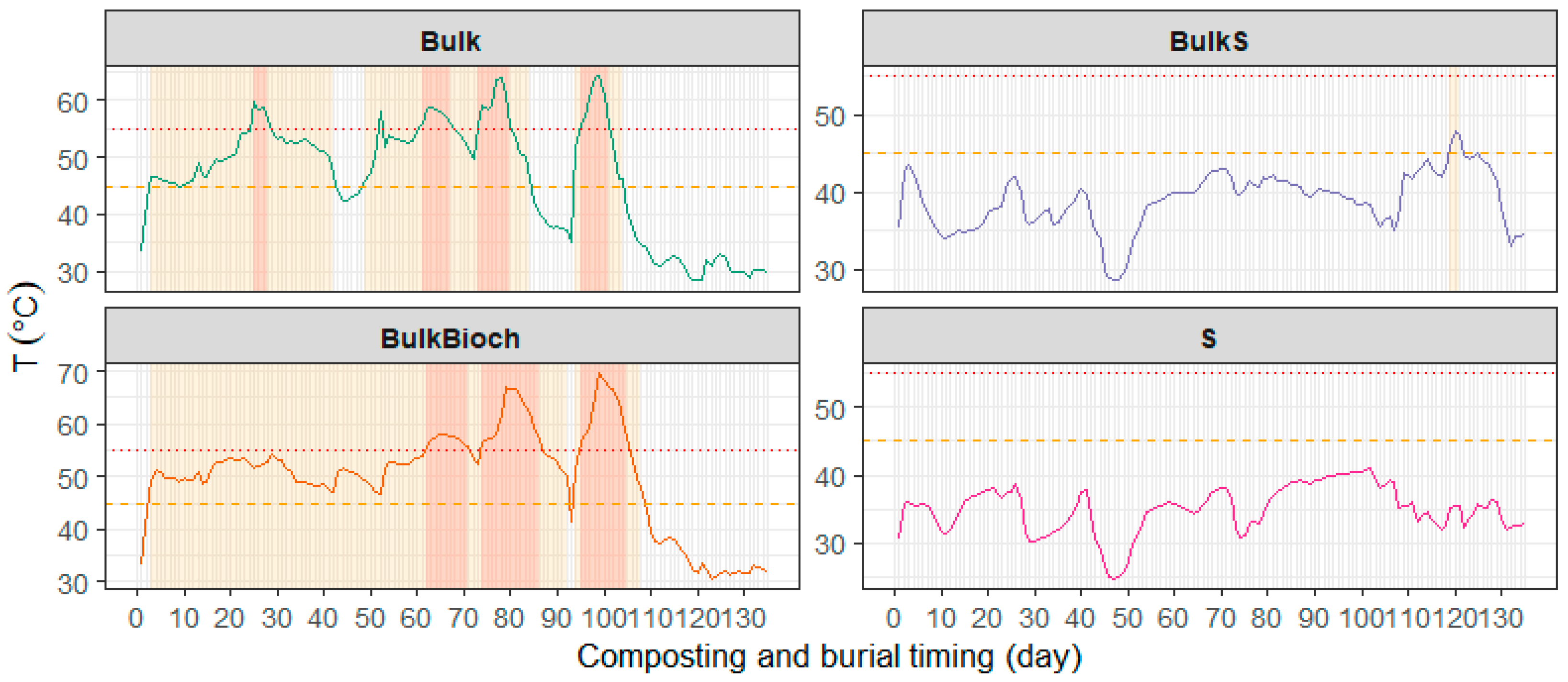
Figure A2.
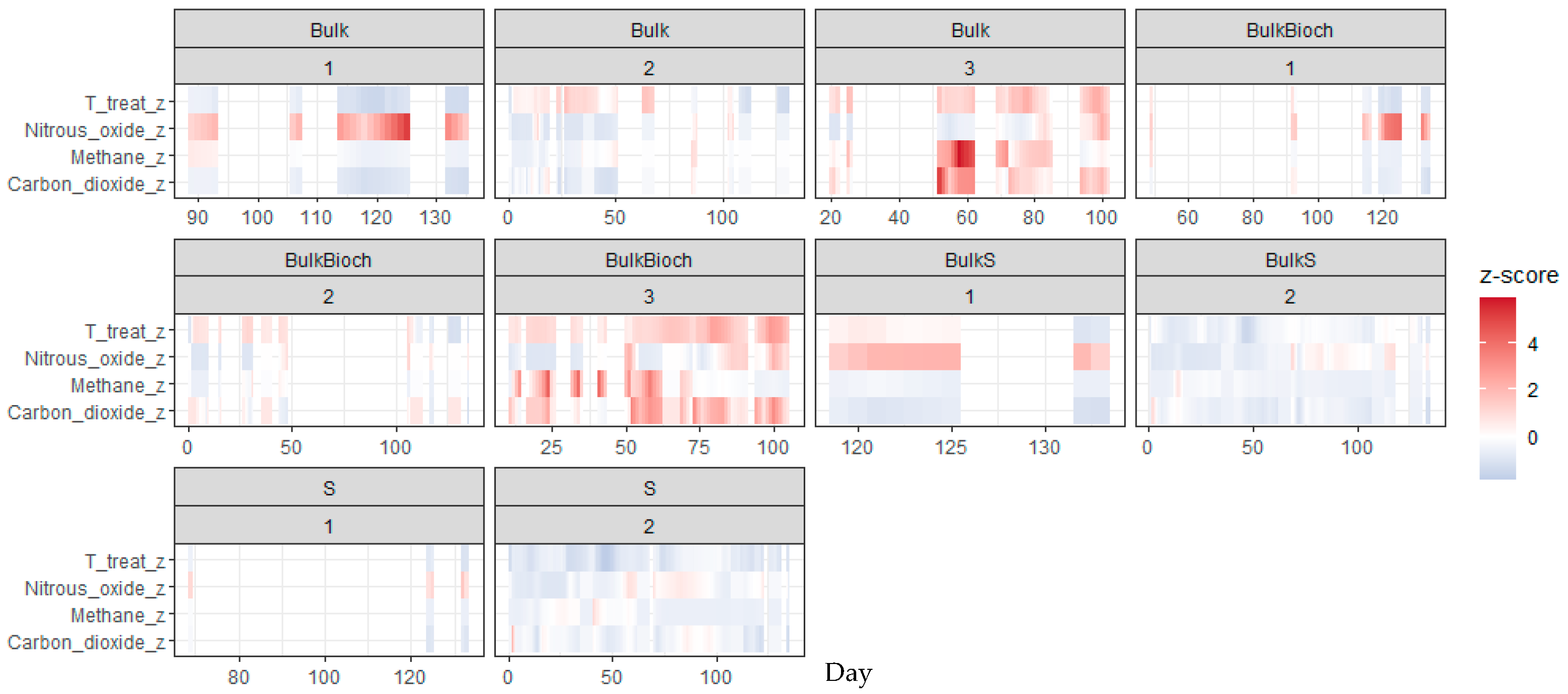
Heatmap of standardized values (z-scores) of pile temperature (T), nitrous oxide (N2O), methane (CH4), and carbon dioxide (CO2) emissions across composting days and treatments (Bulk, BulkBioch, BulkS, and S). Z-scores represent the deviation of each observation from the variable mean, expressed in standard deviation units, allowing comparison across variables with different scales. Clusters (1, 2, and 3) indicate groups of consecutive days with similar multivariate profiles, identified using the k-means algorithm, which reflect distinct composting phases.
Appendix C
Appendix C.1. Data Analysis and Graphical Representation of Thermophilic Windrows
Time-series data of mean pile temperature (Figure A1) were used to identify thermophilic windows during composting. Sustained intervals of temperatures equal to or above 45 °C and 55 °C, lasting at least three consecutive days, were highlighted. These thresholds are commonly applied to characterize the active thermophilic phase and hygienization conditions in composting studies. Graphical representations included shaded bands over temperature curves, documenting the duration and intensity of thermophilic phases for each treatment. The analyses were performed in R software version 4.5.3.
Appendix C.2. Exploratory Correlation Analysis
An exploratory correlation analysis was performed to investigate potential associations between the nutrient concentrations in the final compost (N, P, and K) and thermal descriptors derived from the composting process (T_mean, T_max, T_sd, and T_AUC). Both Pearson’s and Spearman’s correlation coefficients were calculated to account for linear and rank-based associations, respectively (Table A1 and Table A2).
Temperature data were summarized into representative indicators, including mean temperature (T_mean), maximum temperature (T_max), standard deviation (T_sd), and the area under the temperature curve (T_AUC) calculated using the trapezoidal method as a proxy of cumulative thermal load. The mean temperature (T_mean) was computed as the arithmetic average of all measurements obtained during the composting period, representing the overall heating intensity. The standard deviation of temperature (T_sd) was calculated to assess the variability around the mean, providing an indicator of process stability. The maximum temperature (T_max) was recorded as the highest value observed in each treatment, corresponding to the thermophilic peak. Finally, the cumulative thermal load (T_AUC) was estimated as the area under the temperature–time curve, using the trapezoidal integration method, which accounts for both the magnitude and the duration of heating. Together, these descriptors allowed a quantitative comparison of thermal profiles across treatments.
Appendix C.3. Heatmap Analysis and PCA Approach Applied to Daily Gas Emissions and Temperature Dynamics
To explore temporal dynamics and multivariate associations among composting variables, a heatmap analysis was performed. Daily data on pile temperature and gas fluxes (CO2, CH4, and N2O) were standardized using z-scores to allow comparison across variables with different scales. The standardized values were then arranged by day and treatment, and grouped into clusters identified by the k-means algorithm. This procedure enabled the visualization of periods with similar emission and temperature profiles, as well as co-occurrence patterns among variables.
The heatmap analysis provided a detailed visualization of daily dynamics in temperature and GHG emissions, highlighting periods of similarity between consecutive days and co-occurrence among variables (Figure A2). The clustering approach allowed the identification of phases within each treatment, with intense red colors indicating higher-than-average values and blue colors representing lower-than-average values. These patterns suggested a close association between thermophilic activity and CO2 release, as well as distinct profiles for CH4 and N2O under soil-covered treatments.
To summarize these multivariate patterns and evaluate how treatments evolved as a whole, a Principal Component Analysis (PCA) was subsequently performed. While the heatmap explores local temporal fluctuations and variable-specific peaks, the PCA provides a global statistical synthesis, projecting treatments and variables in a reduced-dimensional space. Together, these complementary approaches enhance the interpretation of treatment-specific behaviors and the identification of critical phases during fish-waste composting.
In the PCA of daily data, four variables were considered: daily methane (CH4), nitrous oxide (N2O), and carbon dioxide (CO2) fluxes, expressed in mg m−2 h−1, together with the mean pile temperature per treatment (T_treat, °C). Before analysis, all variables were standardized using z-scores to remove scale effects and allow direct comparison of their relative contributions. The PCA was conducted using the prcomp function in R, based on the correlation matrix, which is appropriate when variables are expressed in different units. The scores obtained for the first two components were used to generate biplots, in which the daily trajectories of each treatment were plotted to capture temporal dynamics in the multivariate space. In addition, k-means clustering (k = 3) was applied to the PCA scores to identify groups of days with similar emission and temperature profiles. These clusters were interpreted as corresponding to distinct composting phases (initial, thermophilic, and maturation), providing an exploratory framework to evaluate whether treatments followed similar or divergent temporal patterns. This analysis is descriptive and aimed at exploring potential groupings, rather than formal statistical inference. Full details of the PCA procedure and clustering approach are presented in Appendix A (Table A3).
References
- Ganjeh, A.M.; Saraiva, J.A.; Pinto, C.A.; Casal, S.; Silva, A.M.S. Emergent Technologies to Improve Protein Extraction from Fish and Seafood By-Products: An Overview. Appl. Food Res. 2023, 3, 100339. [Google Scholar] [CrossRef] [Scilit]
- Limeneh, D.Y.; Tesfaye, T.; Ayele, M.; Husien, N.M.; Ferede, E.; Haile, A.; Mengie, W.; Abuhay, A.; Gelebo, G.G.; Gibril, M.; et al. A Comprehensive Review on Utilization of Slaughterhouse By-Product: Current Status and Prospect. Sustainability 2022, 14, 6469. [Google Scholar] [CrossRef] [Scilit]
- Sarkar, M.S.I.; Hasan, M.M.; Hossain, M.S.; Khan, M.; Al Islam, A.; Paul, S.K.; Rasul, M.G.; Kamal, M. Exploring Fish in a New Way: A Review on Non-Food Industrial Applications of Fish. Heliyon 2023, 9, e22673. [Google Scholar] [CrossRef] [Scilit]
- Vilela, R.N.d.S.; Orrico, A.C.A.; Orrico Junior, M.A.P.; Aspilcueta Borquis, R.R.; Tomazi, M.; de Oliveira, J.D.; de Ávila, M.R.; Santos, F.T.d.; Leite, B.K.V. Effects of Aeration and Season on the Composting of Slaughterhouse Waste. Environ. Technol. Innov. 2022, 27, 102505. [Google Scholar] [CrossRef] [Scilit]
- Peng, L.; Tang, R.; Wang, G.; Ma, R.; Li, Y.; Li, G.; Yuan, J. Effect of Aeration Rate, Aeration Pattern, and Turning Frequency on Maturity and Gaseous Emissions during Kitchen Waste Composting. Environ. Technol. Innov. 2023, 29, 102997. [Google Scholar] [CrossRef] [Scilit]
- Mahapatra, S.; Ali, M.H.; Samal, K. Assessment of Compost Maturity-Stability Indices and Recent Development of Composting Bin. Energy Nexus 2022, 6, 100062. [Google Scholar] [CrossRef] [Scilit]
- Chowdhury, S.; Kim, G.H.; Bolan, N.; Longhurst, P. A Critical Review on Risk Evaluation and Hazardous Management in Carcass Burial. Process Saf. Environ. Prot. 2019, 123, 272–288. [Google Scholar] [CrossRef] [Scilit]
- Ansari, S.A.; Shakeel, A.; Sawarkar, R.; Maddalwar, S.; Khan, D.; Singh, L. Additive Facilitated Co-Composting of Lignocellulosic Biomass Waste, Approach towards Minimizing Greenhouse Gas Emissions: An up to Date Review. Environ. Res. 2023, 224, 115529. [Google Scholar] [CrossRef] [Scilit]
- Xie, T.; Zhang, Z.; Zhang, D.; Wei, C.; Lin, Y.; Feng, R.; Nan, J.; Feng, Y. Effect of Hydrothermal Pretreatment and Compound Microbial Agents on Compost Maturity and Gaseous Emissions During Aerobic Composting of Kitchen Waste. Sci. Total Environ. 2023, 854, 158712. [Google Scholar] [CrossRef] [Scilit]
- Kulikowska, D.; Bernat, K.; Zaborowska, M.; Zielińska, M. Municipal Sewage Sludge Composting in the Two-Stage System: The Role of Different Bulking Agents and Amendments. Energies 2022, 15, 5014. [Google Scholar] [CrossRef] [Scilit]
- Awasthi, M.K.; Duan, Y.; Awasthi, S.K.; Liu, T.; Zhang, Z. Influence of Bamboo Biochar on Mitigating Greenhouse Gas Emissions and Nitrogen Loss during Poultry Manure Composting. Bioresour. Technol. 2020, 303, 122952. [Google Scholar] [CrossRef] [Scilit]
- He, X.; Yin, H.; Han, L.; Cui, R.; Fang, C.; Huang, G. Effects of Biochar Size and Type on Gaseous Emissions During Pig Manure/Wheat Straw Aerobic Composting: Insights into Multivariate-Microscale Characterization and Microbial Mechanism. Bioresour. Technol. 2019, 271, 375–382. [Google Scholar] [CrossRef] [Scilit]
- Liu, W.; Huo, R.; Xu, J.; Liang, S.; Li, J.; Zhao, T.; Wang, S. Effects of Biochar on Nitrogen Transformation and Heavy Metals in Sludge Composting. Bioresour. Technol. 2017, 235, 43–49. [Google Scholar] [CrossRef] [Scilit]
- Leite, B.K.V.; Orrico, A.C.A.; Orrico Junior, M.A.P.; Aspilcueta Borquis, R.R.; Oliveira, J.D.; Macena, I.A.; Ota, E.C.; Vilela, R.N.S.; Silva, T.S.C.; Inoue, L.A.K.A. Valorization of Fish Waste Using Biochar and Crude Glycerin as Additives in Composting. ACS Omega 2025, 10, 18501–18509. [Google Scholar] [CrossRef] [Scilit]
- Duan, Y.; Yang, J.; Awasthi, M.K.; Pandey, A.; Li, H. Innovations in Design and Operation of Aeration Devices for Composting and Vermicomposting. In Current Developments in Biotechnology and Bioengineering: Advances in Composting and Vermicomposting Technology; Elsevier: Amsterdam, The Netherlands, 2022; pp. 57–81. ISBN 9780323918749. [Google Scholar]
- Aranganathan, L.; Radhika Rajasree, S.R.; Govindaraju, K.; Sivarathna Kumar, S.; Gayathri, S.; Remya, R.R.; Suman, T.Y. Spectral and Microscopic Analysis of Fulvic Acids Isolated from Marine Fish Waste and Sugarcane Bagasse Co-Compost. Biocatal. Agric. Biotechnol. 2020, 29, 101762. [Google Scholar] [CrossRef] [Scilit]
- Wang, N.; He, Y.; Zhao, K.; Lin, X.; He, X.; Chen, A.; Wu, G.; Zhang, J.; Yan, B.; Luo, L.; et al. Greenhouse Gas Emission Characteristics and Influencing Factors of Agricultural Waste Composting Process: A Review. J. Environ. Manag. 2024, 354, 120337. [Google Scholar] [CrossRef] [Scilit] [PubMed]
- Li, D.; Manu, M.K.; Varjani, S.; Wong, J.W.C. Role of Tobacco and Bamboo Biochar on Food Waste Digestate Co-Composting: Nitrogen Conservation, Greenhouse Gas Emissions, and Compost Quality. Waste Manag. 2023, 156, 44–54. [Google Scholar] [CrossRef] [Scilit] [PubMed]
- Rasapoor, M.; Nasrabadi, T.; Kamali, M.; Hoveidi, H. The Effects of Aeration Rate on Generated Compost Quality, Using Aerated Static Pile Method. Waste Manag. 2009, 29, 570–573. [Google Scholar] [CrossRef] [Scilit]
- APHA. Standard Methods for the Examination of Water and Wastewater, 22nd ed.; APHA: Washington, DC, USA, 2012. [Google Scholar]
- MAPA. Manual de Métodos Analíticos Oficiais Para Fertilizantes e Corretivos; Ministério da Agricultura, Pecuária e Abastecimento Secretaria de Defesa Agropecuária: Brasília, Brazil, 2017; ISBN 9788579911095. [Google Scholar]
- Orrico, A.C.A.; Schwingel, A.W.; Costa, M.S.S.d.M.; Orrico Junior, M.A.P.; Borquis, R.R.A.; Alves, G.P.; de Oliveira, J.D.; Leite, B.K.V.; Garcia, R.G.; Vilela, R.N.d.S. Characterization and Valuing of Hatchery Waste from the Broiler Chicken Productive Chain. Waste Manag. 2020, 105, 520–530. [Google Scholar] [CrossRef] [Scilit]
- Detmann, E.; Souza, M.A.; Valadares Filho, S.C.; Queiroz, A.C.; Berchielli, T.T.; Saliba, E.O.S.; Cabral, L.S.; Pina, D.S.; Ladeira, M.M.; Azevedo, J.A.G. Métodos Para Análise de Alimentos; Universidade Federal de Lavras: Lavras, Brazil, 2012. [Google Scholar]
- Van Soest, P.J.; Robertson, J.B.; Lewis, B.A. Methods for Dietary Fiber, Neutral Detergent Fiber, and Nonstarch Polysaccharides in Relation to Animal Nutrition. J. Dairy Sci. 1991, 74, 3583–3597. [Google Scholar] [CrossRef] [Scilit]
- Alves, B.J.R.; Smith, K.A.; Flores, R.A.; Cardoso, A.S.; Oliveira, W.R.D.; Jantalia, C.P.; Urquiaga, S.; Boddey, R.M. Selection of the Most Suitable Sampling Time for Static Chambers for the Estimation of Daily Mean N2O Flux from Soils. Soil Biol. Biochem. 2012, 46, 129–135. [Google Scholar] [CrossRef] [Scilit]
- Barton, L.; Murphy, D.V.; Butterbach-Bahl, K. Influence of Crop Rotation and Liming on Greenhouse Gas Emissions from a Semi-Arid Soil. Agric. Ecosyst. Environ. 2013, 167, 23–32. [Google Scholar] [CrossRef] [Scilit]
- IPCC. 2006 IPCC Guidelines for National Greenhouse Gas Inventories; Eggleston, S., Buendia, L., Miwa, K., Ngara, T., Tanabe, K., Eds.; Institute for Global Environmental Strategies (IGES) for the IPCC: Hayama, Japan, 2006. [Google Scholar]
- Intergovernmental Panel on Climate Change (IPCC). Climate Change 2021—The Physical Science Basis; Cambridge University Press: Cambridge, UK, 2023. [Google Scholar] [CrossRef] [Scilit]
- Moreira, J.M.; Rodrigues, R.; Trindade, M.A.G.; dos Santos, K.C.; da Silva, M.M.; Tirloni, B.; Brandl, C.A.; Paveglio, G.C.; Roman, D.; de Carvalho, C.T. Characterization (XRD/TGA-DSC) and Assessment of Calf Thymus DNA Interaction with Single-Crystalline Novel Complexes from Schiff Base Ligands. Inorg. Chim. Acta 2025, 575, 122443. [Google Scholar] [CrossRef] [Scilit]
- Watanabe, A.T.; Trani, A.L.; Hirata, A.C.S.; de Melo, A.M.T.; Filho, A.B.C.; van Raij, B.; Amano, C.Y.; Kano, C.; Leite, D.; Kariya, E.A.; et al. Embrapa Manual de Hortaliças: Recomendações de Calagem e Adubação Para o Estado de São Paulo; Embrapa/CNPH/IAC: Brasília, Brazil, 2008. [Google Scholar]
- Hastie, T.; Tibshirani, R. Generalized Additive Models; Chapman & Hall/CRC: Boca Raton, FL, USA, 1999; ISBN 0412343908. [Google Scholar]
- Wood, S.N. Generalized Additive Models; Chapman and Hall/CRC: Boca Raton, FL, USA, 2006; ISBN 9780429093159. [Google Scholar]
- Bai, M.; Flesch, T.; Trouvé, R.; Coates, T.; Butterly, C.; Bhatta, B.; Hill, J.; Chen, D. Gas Emissions During Cattle Manure Composting and Stockpiling. J. Environ. Qual. 2020, 49, 228–235. [Google Scholar] [CrossRef] [Scilit] [PubMed]
- Silva Minini Baiense, K.M.; Linhares, F.G.; Teves Inácio, C.; Sthel, M.S.; Vargas, H.; da Silva, M.G. Photoacoustic-Based Sensor for Real-Time Monitoring of Methane and Nitrous Oxide in Composting. Sens. Actuators B Chem. 2021, 341, 129974. [Google Scholar] [CrossRef] [Scilit]
- Czekała, W.; Malińska, K.; Cáceres, R.; Janczak, D.; Dach, J.; Lewicki, A. Co-Composting of Poultry Manure Mixtures Amended with Biochar—The Effect of Biochar on Temperature and C-CO2 Emission. Bioresour. Technol. 2016, 200, 921–927. [Google Scholar] [CrossRef] [Scilit]
- Nelson, B.; Zytner, R.G.; Dulac, Y.; Cabral, A.R. Mitigating Fugitive Methane Emissions from Closed Landfills: A Pilot-Scale Field Study. Sci. Total Environ. 2022, 851, 158351. [Google Scholar] [CrossRef] [Scilit] [PubMed]
- Ki, B.M.; Kim, Y.M.; Jeon, J.M.; Ryu, H.W.; Cho, K.S. Characterization of Odor Emissions and Microbial Community Structure During Degradation of Pig Carcasses Using the Soil Burial-Composting Method. Waste Manag. 2018, 77, 30–42. [Google Scholar] [CrossRef] [Scilit]
- Chaher, N.E.H.; Chakchouk, M.; Engler, N.; Nassour, A.; Nelles, M.; Hamdi, M. Optimization of Food Waste and Biochar In-Vessel Co-Composting. Sustainability 2020, 12, 1356. [Google Scholar] [CrossRef] [Scilit]
- Ebrahimi, M.; Gholipour, S.; Mostafaii, G.; Yousefian, F. Biochar-Amended Food Waste Compost: A Review of Properties. Results Eng. 2024, 24, 103118. [Google Scholar] [CrossRef] [Scilit]
- Zhu-Barker, X.; Bailey, S.K.; Paw U, K.T.; Burger, M.; Horwath, W.R. Greenhouse Gas Emissions from Green Waste Composting Windrow. Waste Manag. 2017, 59, 70–79. [Google Scholar] [CrossRef] [Scilit]
- Pérez, T.; Vergara, S.E.; Silver, W.L. Assessing the Climate Change Mitigation Potential from Food Waste Composting. Sci. Rep. 2023, 13, 7608. [Google Scholar] [CrossRef] [Scilit]
- Chowdhury, M.A.; de Neergaard, A.; Jensen, L.S. Potential of Aeration Flow Rate and Bio-Char Addition to Reduce Greenhouse Gas and Ammonia Emissions During Manure Composting. Chemosphere 2014, 97, 16–25. [Google Scholar] [CrossRef] [Scilit] [PubMed]
- Liu, H.; Zheng, X.; Li, Y.; Yu, J.; Ding, H.; Sveen, T.R.; Zhang, Y. Soil Moisture Determines Nitrous Oxide Emission and Uptake. Sci. Total Environ. 2022, 822, 153566. [Google Scholar] [CrossRef] [Scilit] [PubMed]
- Peng, S.; Li, H.; Xu, Q.; Lin, X.; Wang, Y. Addition of Zeolite and Superphosphate to Windrow Composting of Chicken Manure Improves Fertilizer Efficiency and Reduces Greenhouse Gas Emission. Environ. Sci. Pollut. Res. 2019, 26, 36845–36856. [Google Scholar] [CrossRef] [Scilit]
- Lin, X.; Wang, N.; Li, F.; Yan, B.; Pan, J.; Jiang, S.; Peng, H.; Chen, A.; Wu, G.; Zhang, J.; et al. Evaluation of the Synergistic Effects of Biochar and Biogas Residue on CO2 and CH4 Emission, Functional Genes, and Enzyme Activity During Straw Composting. Bioresour. Technol. 2022, 360, 127608. [Google Scholar] [CrossRef] [Scilit] [PubMed]
- Gu, S.; Ji, Z.; Li, X.; Qin, H.; Li, M.; Zhang, L.; Zhang, J.; Huang, H.; Luo, L. Organic Matter Components Rather than Microbial Enzymes and Genes Predominate CO2/CH4 Emissions during Composting Amended with Biochar at Different Stages. Environ. Pollut. 2025, 373, 126129. [Google Scholar] [CrossRef] [Scilit]
- Dos Santos Moreira, F.G.; Guedes, M.J.F.; Monteiro, V.E.D.; De Melo, M.C. Fugitive Emissions of Biogas in Coverage Liner of Compacted Soil in a Landfill. Eng. Sanit. Ambient. 2020, 25, 247–258. [Google Scholar] [CrossRef] [Scilit]
- Wang, N.; Awasthi, M.K.; Pan, J.; Jiang, S.; Wan, F.; Lin, X.; Yan, B.; Zhang, J.; Zhang, L.; Huang, H.; et al. Effects of Biochar and Biogas Residue Amendments on N2O Emission, Enzyme Activities and Functional Genes Related with Nitrification and Denitrification during Rice Straw Composting. Bioresour. Technol. 2022, 357, 127359. [Google Scholar] [CrossRef] [Scilit]
- Sánchez-García, M.; Roig, A.; Sánchez-Monedero, M.A.; Cayuela, M.L. Biochar Increases Soil N2O Emissions Produced by Nitrification-Mediated Pathways. Front. Environ. Sci. 2014, 2, 25. [Google Scholar] [CrossRef] [Scilit]
- Van Zwieten, L.; Kammann, C.; Cayuela, M.; Singh, B.P.; Joseph, S.; Kimber, S.; Donne, S.; Clough, T.; Spokas, K. Biochar Effects on Nitrous Oxide and Methane Emissions from Soil. In Biochar for Environmental Management; Routledge: Oxfordshire, UK, 2019; pp. 521–552. [Google Scholar] [CrossRef] [Scilit]
- Sun, X.P.; Lu, P.; Jiang, T.; Schuchardt, F.; Li, G.X. Influence of Bulking Agents on CH4, N2O, and NH3 Emissions during Rapid Composting of Pig Manure from the Chinese Ganqinfen System. J. Zhejiang Univ. Sci. B 2014, 15, 353–364. [Google Scholar] [CrossRef] [Scilit]
- Agyarko-Mintah, E.; Cowie, A.; Van Zwieten, L.; Singh, B.P.; Smillie, R.; Harden, S.; Fornasier, F. Biochar Lowers Ammonia Emission and Improves Nitrogen Retention in Poultry Litter Composting. Waste Manag. 2017, 61, 129–137. [Google Scholar] [CrossRef] [Scilit] [PubMed]
- Cao, Y.; Wang, X.; Bai, Z.; Chadwick, D.; Misselbrook, T.; Sommer, S.G.; Qin, W.; Ma, L. Mitigation of Ammonia, Nitrous Oxide and Methane Emissions During Solid Waste Composting with Different Additives: A Meta-Analysis. J. Clean. Prod. 2019, 235, 626–635. [Google Scholar] [CrossRef] [Scilit]
- Dias, B.O.; Silva, C.A.; Higashikawa, F.S.; Roig, A.; Sánchez-Monedero, M.A. Use of Biochar as Bulking Agent for the Composting of Poultry Manure: Effect on Organic Matter Degradation and Humification. Bioresour. Technol. 2010, 101, 1239–1246. [Google Scholar] [CrossRef] [Scilit] [PubMed]
- Abdelfadeel, I.A.; Alotaibi, K.D.; Alkoiak, F.N.; Aloud, S.S.; Fulleros, R.B. Effects of Biochar Addition on Gaseous Emissions During the Thermophilic Composting Phase and Subsequent Changes in Compost Characteristics. Processes 2025, 13, 3210. [Google Scholar] [CrossRef] [Scilit]
- Zhang, Z.; Wu, H.; Zhao, Y.; Wu, Y.; Ming, R.; Liu, D.; Qiao, Y.; Xiao, Z.; Ren, J.; Chen, Y.; et al. Biochar Effectively Reduced N2O Emissions During Heap Composting and NH3 Emissions During Aerobic Composting. Agriculture 2025, 15, 1907. [Google Scholar] [CrossRef] [Scilit]
- Zhang, L.; Li, X.; Ji, Z.; Qin, H.; Li, M.; Zhang, J.; Huang, H. Different Types of Biochar Reduce N2O Emissions by Mediating the Interplay of Multiple Factors during Composting. J. Environ. Chem. Eng. 2025, 13, 119381. [Google Scholar] [CrossRef] [Scilit]
- Wang, Y.; Fan, X.; Liang, W.; Ma, X.; Zhang, W.; Yu, C. Biochar Mitigates N2O and NH3 Emissions in Sheep Manure Composting by Regulating Microbial Genes Associated with Nitrogen Cycle. Environ. Technol. Innov. 2026, 41, 104828. [Google Scholar] [CrossRef] [Scilit]
- Li, X.; Zhao, Y.; Xu, A.; Chang, H.; Lin, G.; Li, R. Conductive Biochar Promotes Oxygen Utilization to Inhibit Greenhouse Gas Emissions during Electric Field-Assisted Aerobic Composting. Sci. Total Environ. 2022, 842, 156929. [Google Scholar] [CrossRef] [Scilit]
- Muema, F.M.; Richardson, Y.; Keita, A.; Sawadogo, M. An Interdisciplinary Overview on Biochar Production Engineering and Its Agronomic Applications. Biomass Bioenergy 2024, 190, 107416. [Google Scholar] [CrossRef] [Scilit]
- Hu, M.; Chen, D.; Dahlgren, R.A. Modeling Nitrous Oxide Emission from Rivers: A Global Assessment. Glob. Chang. Biol. 2016, 22, 3566–3582. [Google Scholar] [CrossRef] [Scilit]
- Verdolotti, L.; Oliviero, M.; Lavorgna, M.; Iannace, S.; Camino, G.; Vollaro, P.; Frache, A. On Revealing the Effect of Alkaline Lignin and Ammonium Polyphosphate Additives on Fire Retardant Properties of Sustainable Zein-Based Composites. Polym. Degrad. Stab. 2016, 134, 115–125. [Google Scholar] [CrossRef] [Scilit]
- Bjurström, A.; Hedenqvist, M.S.; Prade, T.; Mensah, R.A.; Das, O.; Åhrlin, A.; Matsson, A.; Helgesson, D.; Carrick, C.; Roulin, T.; et al. Synergistic Enhancement of Fire Performance and Carbon Footprint Reduction in Polymer Biocomposites Through Combined Use of Lignin and Biochar. Ind. Crops Prod. 2025, 233, 121402. [Google Scholar] [CrossRef] [Scilit]
- Orrico, A.C.A.; de Oliveira, J.D.; Leite, B.K.V.; Vilela, R.N.d.S.; Orrico Junior, M.A.P.; Aspilcueta Borquis, R.R.; Tomazi, M.; Macena, I.A. Effects of Aeration and Season of the Year on Fish Waste Composting and Compost Quality. Environ. Technol. 2023, 45, 3765–3777. [Google Scholar] [CrossRef] [Scilit] [PubMed]
- Leite, B.K.V.; Orrico, A.C.A.; Orrico Junior, M.A.P.; Aspilcueta Borquis, R.R.; Tomazi, M.; de Oliveira, J.D.; Vilela, R.N.d.S.; Schwingel, A.W. Use of Biochar and Crude Glycerin as Additives in the Composting of Slaughterhouse Waste in Static Piles. Renew. Agric. Food Syst. 2022, 37, 268–277. [Google Scholar] [CrossRef] [Scilit]
- Zhou, S.; Li, Y.; Jia, P.; Wang, X.; Kong, F.; Jiang, Z. The Co-Addition of Biochar and Manganese Ore Promotes Nitrous Oxide Reduction but Favors Methane Emission in Sewage Sludge Composting. J. Clean. Prod. 2022, 339, 130759. [Google Scholar] [CrossRef] [Scilit]
- Boldrin, A.; Andersen, J.K.; Møller, J.; Christensen, T.H.; Favoino, E. Composting and Compost Utilization: Accounting of Greenhouse Gases and Global Warming Contributions. Waste Manag. Res. 2009, 27, 800–812. [Google Scholar] [CrossRef] [Scilit] [PubMed]
- Eamrat, R.; Pussayanavin, T.; Taweesan, A.; Witthayaphirom, C.; Tanatvanit, S.; Panswad, D.; Sastaravet, P.; Fakkaew, K. Valorization of Chicken Manure into Biochar and Compost for Acidic Soil Amendment and Lettuce Productivity. Environ. Technol. Innov. 2026, 42, 104900. [Google Scholar] [CrossRef] [Scilit]

Disclaimer/Publisher’s Note: The statements, opinions and data contained in all publications are solely those of the individual author(s) and contributor(s) and not of MDPI and/or the editor(s). MDPI and/or the editor(s) disclaim responsibility for any injury to people or property resulting from any ideas, methods, instructions or products referred to in the content. |
© 2026 by the authors. Licensee MDPI, Basel, Switzerland. This article is an open access article distributed under the terms and conditions of the Creative Commons Attribution (CC BY) license.