


Definition
Practical argumentation refers to a form of argumentation oriented towards action. Unlike theoretical argumentation, which primarily concerns the truth or acceptability of propositions, or mathematical argumentation, which is mainly concerned with the production, justification, and validation of mathematical claims, practical argumentation includes an action, decision, or course of conduct as a central component of the argument. Practical argumentation has attracted growing interest in fields such as political science, critical discourse analysis, argumentation theory, and education. In educational contexts, it is especially relevant for analysing how teachers justify pedagogical decisions in relation to learning objectives, classroom circumstances, available means, professional values, and anticipated consequences. Within mathematics education, analytical tools have been developed to structure and represent practical arguments made by prospective and practising teachers during episodes of teaching reflection on practice, for instance through schemes that connect argumentation models with didactical criteria for analysing mathematics teaching and learning. Practical argumentation thus provides a conceptual and analytical tool for making visible the reasons underlying teachers’ decision-making, particularly in situations characterised by tensions between mathematical, didactical, and classroom-management considerations.
1. Introduction
The notion of practical argumentation is rooted in the broader tradition of practical reasoning, which dates back to Aristotle’s Nicomachean Ethics, specifically Books VI and VII [1]. Unlike theoretical reasoning, which is primarily oriented towards establishing what is true or acceptable as knowledge, practical reasoning is directed towards action, choice, and conduct. For Audi, Aristotle’s notion of practical reasoning is not easy to express in clear and precise language. More specifically, this type of reasoning “provides a way to understand and explain actions [and] makes actions that are based on practical reasoning intelligible as conduct in accordance with one’s practical judgment” [2] (p. 28). For Aristotle, the notion of practical reasoning is expressed in the form of a syllogism, also known as a practical syllogism, which serves to illustrate both the process of practical reasoning and the formalisation of that process [1]. In contemporary argumentation theory, this tradition has been developed as the study of arguments whose conclusions recommend, justify, or evaluate action. Thus, the historical development of practical argumentation can be understood as a shift from the practical syllogism, as a formalisation of practical reasoning, to the practical argument, as an analytical structure for examining the justification of actions.
This understanding of the practical argument is consistent with the work of Green [3], Fenstermacher [4], and Walton [5], among others, who have approached practical argumentation from different perspectives. Green [3] related practical arguments to teaching competence, arguing that instruction involves acting upon the premises that guide students’ practical reasoning. Fenstermacher [4] extended this idea to the relationship between research and teaching practice, suggesting that research contributes to practice when it improves the practical arguments that inform teachers’ decisions. Walton [5] characterised practical reasoning as goal-driven, knowledge-based, and action-guiding argumentation, thereby connecting agents’ goals, available means, circumstances, and possible consequences.
The educational relevance of practical argumentation can be better understood in relation to the development of reflective approaches to professional practice. Schön’s work [6] on the reflective practitioner highlighted that professionals often act in situations that are uncertain, unique, and marked by conflicting demands, and that their knowledge-in-action is not always fully explicit. Teaching can be understood as one such professional practice, since teachers constantly interpret classroom events, select possible courses of action, and justify their decisions in relation to learning objectives, students’ responses, curricular demands, available resources, and professional values.
More recently, research on teacher professional reasoning has developed through several related trajectories, including professional noticing, video-supported reflection, lesson study, instructional coaching, and digitally mediated professional learning. In mathematics education, professional noticing has been conceptualised as teachers’ capacity to attend to students’ mathematical thinking, interpret students’ understandings, and decide how to respond instructionally [7]. Research on mathematics teacher noticing has also highlighted the importance of analysing how teachers make sense of classroom events and how this sense-making informs instructional decisions [8]. Similarly, lesson study has become a prominent collaborative professional development approach in mathematics education, generally organised around cycles of study, planning, teaching, and reflection, with a strong focus on students’ thinking and learning [9]. Recent work on AI-supported and video-based reflection further indicates that digital tools can make classroom activity more visible and support teachers’ noticing, interpretation, and reflection [10]. However, these approaches do not always provide a detailed account of the argumentative structure through which teachers justify their pedagogical decisions, where practical argumentation contributes to this landscape.
Given the focus of this entry, it is important to distinguish practical argumentation from two other types of argumentation. On the one hand, between mathematical argumentation and practical argumentation: the former arises within mathematical practices and is concerned with the production, justification, and validation of mathematical claims through inductive, abductive, analogical, and deductive forms of reasoning; the latter, when examined in teaching contexts, is concerned with the justification, assessment, or reconsideration of pedagogical actions planned or carried out in the classroom [11]. On the other hand, between theoretical argumentation and practical argumentation: the former enables answering questions such as ‘is p true?’ (where p is a description of the world); the latter enables answering questions such as ‘what should A do in situation x?’ (where A is the name or description of an agent, and x is the description of a problem situation) [12].
In the context of mathematics education, argumentation has traditionally been studied in relation to mathematical reasoning, proof, justification, and the validation of mathematical claims. Research on proof and argumentation has shown the centrality of these processes in students’ mathematical activity and in mathematics education research more broadly [13,14]. In fact, in the specialised literature, the development of mathematical argumentation is regarded as a fundamental aspect of learning this discipline [15,16,17], that is, as a competence to be developed in the classroom [18]. Recent work in the philosophy of mathematical practice has also shown that mathematical proof activity is not reducible to a mere sequence of deductive steps. Hamami and Morris [19,20] argue that proofs are connected to the plans and intentions of the agents who produce them, and that proof activities may be analysed in terms of planning agency and practical reasoning. This perspective is relevant because it shows that action-oriented reasoning may also play a role within mathematical practice itself. However, practical argumentation introduces a different but complementary focus: instead of analysing how mathematical claims are justified, it examines how pedagogical actions in the mathematics classroom are justified. This shift is particularly relevant for studying episodes of teaching reflection on practice, where prospective and practising mathematics teachers justify, assess, weigh up, or reconsider their pedagogical decisions [11,21,22].
This entry presents practical argumentation as a conceptual and analytical tool for studying teachers’ pedagogical decision-making when reflecting on their practice. The first section traces the general development of practical argumentation and situates it in relation to mathematics education. The second section presents applications of practical argumentation in different fields of knowledge and outlines proposed models for its analysis. The third section explains a scheme for structuring and representing practical arguments in connection with didactical criteria for analysing mathematics teaching and learning. Finally, the entry discusses the current status, limitations, and future prospects of practical argumentation in research on teaching reflection on practice, emphasising its value for making visible the reasons underlying mathematics teachers’ decisions in situations characterised by mathematical, didactical, and classroom-management tensions.
2. Applications and Analytical Models of Practical Argumentation
Practical argumentation has been applied in several domains in which agents must justify, assess, weigh up, or reconsider possible courses of action. Its relevance lies in the fact that many social, institutional, professional, and educational problems are not limited to determining whether a proposition is true but involve deciding what should be done under particular circumstances. In these contexts, practical argumentation provides conceptual and analytical tools for reconstructing the relations between circumstances, goals, values, available means, possible consequences, and proposed actions. It is therefore especially useful for analysing forms of reasoning that emerge in contexts of uncertainty, disagreement, conflicting values, or competing alternatives.
Given the nature of this entry, it does not aim to provide a systematic or scoping review of the literature. Instead, this section offers a conceptual synthesis of the applications, and analytical models of practical argumentation, with particular attention to its relevance for mathematics teacher education and teaching reflection on practice. The literature presented below was selected for its historical, theoretical, and empirical relevance to these aims.
2.1. Applications of Practical Argumentation
One of the areas in which practical argumentation has been most systematically developed is political discourse analysis. In this field, practical argumentation has been used to examine how proposals for public action are justified in situations marked by disagreement, power relations, institutional constraints, and conflicts of interests or values. Fairclough and Fairclough’s [23] approach to political discourse analysis is particularly significant because it integrates argumentation analysis into critical discourse analysis and political discourse analysis. Their work is grounded in a conception of politics in which deliberation, decision, and action are central concepts, and where political discourse is concerned with arriving at decisions about what should be done in contexts of uncertainty and risk. From this perspective, practical argumentation makes it possible to analyse not only the content of political proposals, but also the structure of the reasons through which such proposals are presented as necessary, desirable, or preferable.
Another important area of application is artificial intelligence and law, where practical argumentation has been used to model decision-making processes and action-oriented reasoning. Atkinson and Bench-Capon [24], for example, describe practical reasoning as that focused on what it is best for an agent to do in a certain situation. Their approach is based on presumptive justifications of action through argument schemes and associated critical questions. In this line of research, practical argumentation is not only a descriptive tool for analysing human reasoning, but also a formal resource for representing actions, goals, values, preferences, possible outcomes, and counterarguments. Related work on computational representations of practical argument has proposed dialogue protocols and formal models to support deliberation over proposed actions [25]. These developments show that practical argumentation can be used to address problems of decision support, multi-agent coordination, and the formal representation of action-based reasoning.
Practical argumentation has also played an important role in educational research, especially in studies concerned with teacher reasoning, professional judgement, and reflective practice. Fenstermacher and Richardson [1] argued that practical arguments can be elicited and reconstructed in teaching in order to explain why an individual took action based on practical reasoning. Their proposal is especially relevant because it links practical arguments to the use of research in educational practice: research does not directly prescribe what teachers should do, but it can contribute to the improvement of the practical arguments that inform teachers’ decisions. From this point of view, educational research may enrich, modify, or add premises to teachers’ practical arguments, thereby influencing how they interpret classroom situations and justify pedagogical actions.
Within mathematics education, practical argumentation introduces a perspective that is complementary to the more established study of mathematical argumentation, as explained in the introductory section. In relation to contemporary approaches to teacher professional reasoning, practical argumentation can be understood as complementary to professional noticing, video-supported reflection, lesson study, instructional coaching, and digitally mediated professional learning. These approaches often examine what teachers notice, how they interpret classroom events, and how they discuss possible responses. Practical argumentation adds a more specific analytical focus: it reconstructs the reasons that connect those interpretations with proposed, enacted, or reconsidered pedagogical actions.
Recent studies in this field have begun to examine practical argumentation in episodes of teaching reflection on practice. One line of work has analysed the practical argumentation of practising mathematics teachers during the design, implementation, and redesign of a lesson on the Pythagorean theorem [11]. In that study, teachers participated in a training course aimed at fostering reflection on practice, and their practical argumentation was analysed through an adaptation of Toulmin’s model [26] incorporating a proposal of didactical principles of mathematics teaching and learning (this model is explained in Section 3). This suggests that practical argumentation can help researchers examine not only the structure of teachers’ arguments, but also the didactical criteria that support their pedagogical choices. Another recent application concerns prospective primary education teachers’ practical arguments in the context of mathematical modelling [22]. In this case, practical argumentation was analysed in relation to the design of application problems and their transformation into modelling problems. This application illustrates how practical argumentation can be used to study the reasons prospective teachers invoke when designing mathematical tasks under conditions of openness, uncertainty, and multiple plausible solutions.
A related line of work in the philosophy of mathematical practice has analysed the role of plans, intentions, and rational agency in mathematical proof. Hamami and Morris [19,20] examine mathematical proofs as reports of proof activities and argue that proof activities are structured by plans produced by agents through practical reasoning. Their work is relevant for practical argumentation because it highlights the role of agency and planning in mathematical practice, although the object of analysis differs from the one addressed in this entry: whereas these authors focus on proof activities and the rational structure of mathematical proofs, this entry focuses on how pedagogical actions in the mathematics classroom are justified.
2.2. Analytical Models of Practical Argumentation
A key breakthrough in the development of analytical approaches to argumentation was the move from purely formal accounts of validity towards models capable of representing arguments as they appear in ordinary, professional, and institutional discourse. Models for analysing practical argumentation have frequently been connected with the broader study of argumentation schemes, which represent stereotypical patterns of reasoning that can be used to identify, analyse, and evaluate arguments in natural language. Nevertheless, these models vary according to the field of application.
Toulmin’s model [26], introduced in 1958, was central to this shift because it proposed a functional layout of arguments and emphasised that the evaluation of arguments depends partly on field-dependent criteria. Walton, Reed, and Macagno [27] provide a systematic account of argumentation schemes, including practical reasoning schemes, and emphasise the role of critical questions in assessing the strength and defeasibility of arguments. In the case of practical argumentation, such questions may concern whether the proposed action is actually feasible, whether it will achieve the intended goal, whether it has undesirable consequences, whether alternative actions are available, or whether the values invoked are acceptable in the given context. In this sense, practical arguments are generally defeasible: their acceptability depends on the circumstances, the goals pursued, the available means, the consequences anticipated, and the possible objections raised.
In its most basic form, a practical argument can be structured as an abstract set of premises leading to a conclusion (the action) [28] (p. 520):
- Premise 1: Agent A has a goal G.
- Premise 2: Carrying out action B is a means to realise G.
- Conclusion: Therefore, A should bring about action B.
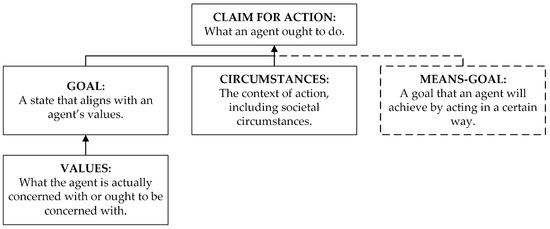
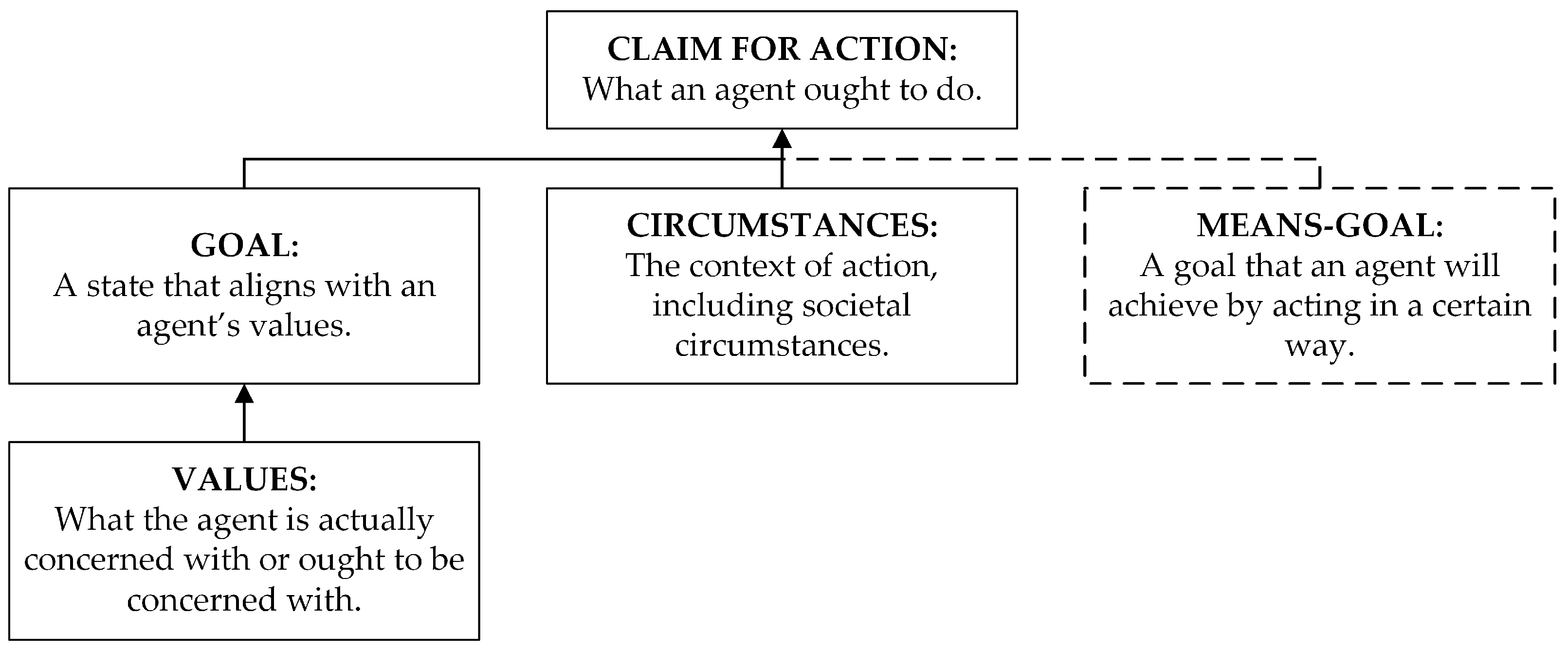
This basic structure, used by various authors [27,29,30], captures the means-end core of practical reasoning, although it does not yet include values, alternatives, side effects, or contextual constraints. Therefore, this structure has been developed into schemes to represent practical reasoning in greater detail. One example is the scheme proposed by Fairclough and Fairclough [23] for representing the structure of a practical argument. This scheme is based on the notions of practical reasoning proposed by Audi [31] and Walton [32]. Its aim is to capture how agents (individuals), particularly in political discourse, justify actions in real-world contexts, where decisions are made under uncertainty, with incomplete information, and in the presence of conflicting values. These authors argue that practical reasoning is based on two types of essential premises:
- Circumstantial premise: The set of relevant facts (natural, social, or institutional) that shape the context of action. In this scheme, institutional facts are included as obligations, promises, or legal norms.
- Normative or goal premise: A possible future state of affairs that the agent envisions as desirable or normatively appropriate. The authors emphasise that goals should not simply be equated with desires, as they may stem from moral, legal, or institutional obligations.
It should be noted that these goals are supported by values, understood as concerns, commitments, or principles that determine which future states are legitimate or acceptable. The connection between circumstances and goals is established through a means-goal relation, that is, action A is a reasonable conjecture that could transform current circumstances into the envisioned future state. This hypothetical nature makes the conclusion (the agent ought to do A) presumptive and defeasible, that is, open to revision if new information, better alternatives, or negative consequences arise. The structure described above is summarised in Figure 1.
Figure 1.
Fairclough and Fairclough’s scheme for the structure of practical arguments. Source: Authors’ adaptation from [33] (p. 4).
Another example is the scheme proposed by Walton [30] (pp. 205, 208), in which the author takes the basic structure of the practical argument and represents it using a decision diagram. This diagram depicts a process which the author terms minimal rational deliberation, in which the agent: first determines whether it has a goal, then checks whether a means is available and, if so, proceeds to carry out the action. Nevertheless, Walton stresses that this form is too simplistic to represent real cases. In other words, the basic structure does not handle multiple goals, does not represent chains of actions, does not incorporate cost–benefit evaluation, and cannot explain complex behaviour. Even so, the author presents it as an analytical starting point, valuable for its clarity and explanatory power, but insufficient for modelling practical reasoning in richer contexts, such as, for example, educational contexts, where pedagogical actions are rarely justified only through a simple means-end relation. For this reason, the following section presents a scheme that adapts general models of argumentation incorporating specific elements of mathematics education.
3. Scheme for Structuring and Representing Practical Arguments in Teaching Reflection on Practice
For the analysis of practical argumentation in teaching reflection on practice, a scheme has been proposed in the literature on mathematics education to structure and represent practical arguments generated in this context. This proposal brings together three theoretical references: the structure of a practical argument (as defined by Fenstermacher and Richardson [1]), Toulmin’s model [26], and the Didactic Suitability Criteria construct [34]. In conceptual terms, this scheme assumes Lewiński’s [35] definition of practical argumentation as that which is “aimed at deciding on a course of action” (p. 219), supplemented by Gómez’s [12] view, who characterises it as argumentation that takes place in social contexts and is geared towards choosing an action to resolve a practical problem. The link between these two definitions is the presence of an action within the arguments generated.
3.1. Structure of a Practical Argument
As mentioned above, the work by Fenstermacher and Richardson [1] focuses on the influence of educational research on educational practice and, more specifically, on how a teacher can use this research to reflect on their practice. To address this issue, the authors specify that practical reasoning—or rationality—is “the process of thought that ends in an action or an intention to act” (p. 102), where the practical argument is the formalisation of that process. Thus, Fenstermacher and Richardson consider that a practical argument can be described by the following four premises and an action or intention to act (pp. 106–107):
- Value premise: States the human good or benefit expected from the action. This premise can be expressed in the declarative form (e.g., My goal is for students to be competent in mathematics) or the imperative form (e.g., Students must be competent in mathematics). This premise supplies the normative grounding for the action.
- Stipulative premise: Defines or interprets key concepts and is often derived from educational theories or operational definitions (e.g., Being competent in mathematics requires the development of a set of sub-competencies).
- Empirical premise: Testable empirical claims linking action to observable outcomes (e.g., The use of concrete materials aids the learning of geometry).
- Situational premises: Describe the contextual facts in which the action occurs (e.g., resources, student profiles, institutional constraints). Pendlebury [36] discusses this sort of premise at length.
- An action or intention to act: Corresponds to the conclusion of a practical argument. Whilst there are authors in the literature who question whether this is in fact the conclusion of a practical argument (e.g., [37]), Fenstermacher and Richardson point out that, for their purposes, the distinction between action and the intention to act is secondary, as the reconstruction focuses on the rationality that justified the behaviour.
Finally, Fenstermacher and Richardson point out that practical arguments can be descriptive in nature (e.g., when a teacher explains their actions) or normative (e.g., when a teacher assesses or refines the explanation of their actions).
3.2. Toulmin’s Model
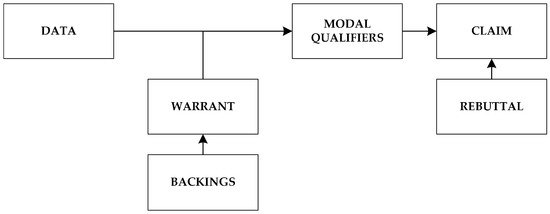
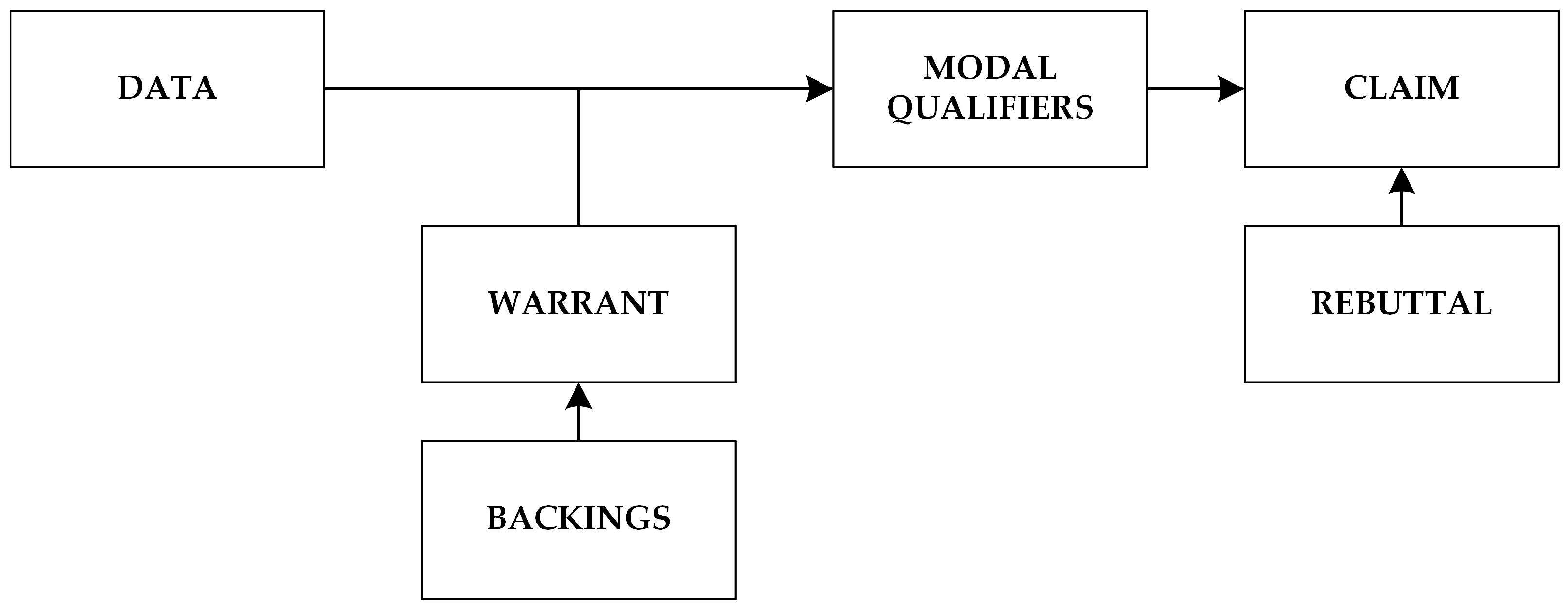
As mentioned above, Toulmin’s model was central to the move from purely formal accounts of validity towards models capable of representing arguments. In his description, this author suggests that a typical argument consists of the following elements [26]:
- Claim: Conclusion or proposition to be established, that is, the thesis of the argument. It is the point that the arguer seeks to have the listener accept.
- Data: Evidence, facts, or specific reasons on which the claim is based and which render it plausible. The data do not logically prove the conclusion in a deductive sense but rather support it in a practical way.
- Warrant: A rule, principle, or inference that links the data to the claim and explains why the data supports the conclusion, acting as a logical-pragmatic bridge.
- Backings: Additional justifications that underpin the warrant when it is not obvious or is contested. They provide theoretical, empirical, or normative authority for accepting the warrant.
- Modal qualifiers: Statements indicating the degree of strength of the warrant or the modalisation of the claim in relation to the data. They enable us to recognise the non-absolute nature of many arguments, as well as to qualify the conclusion to reflect uncertainty or conditions.
- Rebuttal: Conditions or counterexamples that would limit the validity of the claim, that is, they indicate when the conclusion does not hold. They allow objections to be anticipated and show that the arguer recognises limits or circumstances that would invalidate the conclusion.
The elements described above are summarised in Figure 2.
Figure 2.
Toulmin’s model. Source: Authors’ reinterpretation based on [26].
In the context of mathematics education, Toulmin’s model has been used by various researchers, mainly from the perspective of mathematical argumentation (e.g., [38,39]) or of argumentative structure without reference to its representation (e.g., [40]).
3.3. Didactic Suitability Criteria
In mathematics education, as a scientific and technological discipline, researchers have developed various theoretical frameworks to address the specific problems inherent to this field of knowledge. One of these is the Onto-Semiotic Approach, which identifies the following types of problems [41]:
- Epistemological problem.
- Ontological problem.
- Semiotic-cognitive problem.
- Educational-instructional problem.
- Ecological problem.
- Problem of teacher education.
- Problem of instruction optimisation.
To address these problems, the Onto-Semiotic Approach proposes a set of theoretical and methodological tools, one of which is the notion of didactic suitability [34]. This notion is proposed as a response to the problem of instructional optimisation and has been presented in the literature as a consensus-based perspective on principles of mathematics education. In the Onto-Semiotic Approach, the didactic suitability of a mathematical teaching and learning process is defined as follows:
the degree to which the process (or a part of the same) has certain characteristics considered as optimal or adequate for succeeding in the adaptation between the students’ personal meanings (learning) and the institutional meanings (teaching), taking into account the circumstances and available resources (environment). [42] (p. 4)
Thus, the notion of didactic suitability is presented as a systemic criterion for optimising a mathematical teaching and learning process, which involves the coordination of six facets (or aspects) associated with such processes. To put this notion into practice, the Onto-Semiotic Approach has developed the Didactic Suitability Criteria (DSC) construct, which is multidimensional in nature, as each of the six facets corresponds to a specific criterion that addresses an aspect of the mathematical teaching and learning process. Table 1 presents the DSC guidelines with the respective components of each criterion.
Table 1.
Didactic suitability criteria and their components.
Just as each criterion in the DSC guidelines has its respective components, each component has its own set of observable indicators for assessing the degree of didactic suitability in each of the facets associated with a mathematical teaching and learning process. As an example, Table 2 sets out the indicators for the components of the epistemic criterion.
Table 2.
Components and indicators of the epistemic criterion.
The discourse underpinning the development of the DSC occupies a middle ground between two opposing positions [41]. On the one hand, there is an objectivist/positivist position that holds that research in mathematics education is capable of providing teachers with a set of practices that work in the classroom. Researchers associated with this position point out that, given that these classroom-practices have been empirically (i.e., objectively) validated, there is sufficient evidence to support them. On the other hand, there is a consensus-based position that holds that, whilst the results of research in mathematics education are important, improvements to the mathematical teaching and learning processes should also stem from the argumentative discourse of the educational community as a whole (researchers, teachers, school administrators, parents, etc.). Individuals associated with this position point out that principles must be agreed upon by consensus so that they can provide guidance on what are considered to be the best practices to implement in the classroom.
Given the consensual nature of this construct, DSC have been widely used by both researchers and prospective and practising mathematics teachers. Their main use is as a tool for structuring teaching reflection on practice (see [43,44]), but also to analyse the didactic suitability of classroom episodes (e.g., [45,46]), teaching resources (e.g., [47,48]), and mathematical tasks (e.g., [49,50]), amongst others. It should be noted that DSC do not serve as teaching guides designed to dictate how teachers should act but rather constitute a set of norms that function as principles and not as rules.
3.4. Adaptation of Toulmin’s Model Incorporating DSC
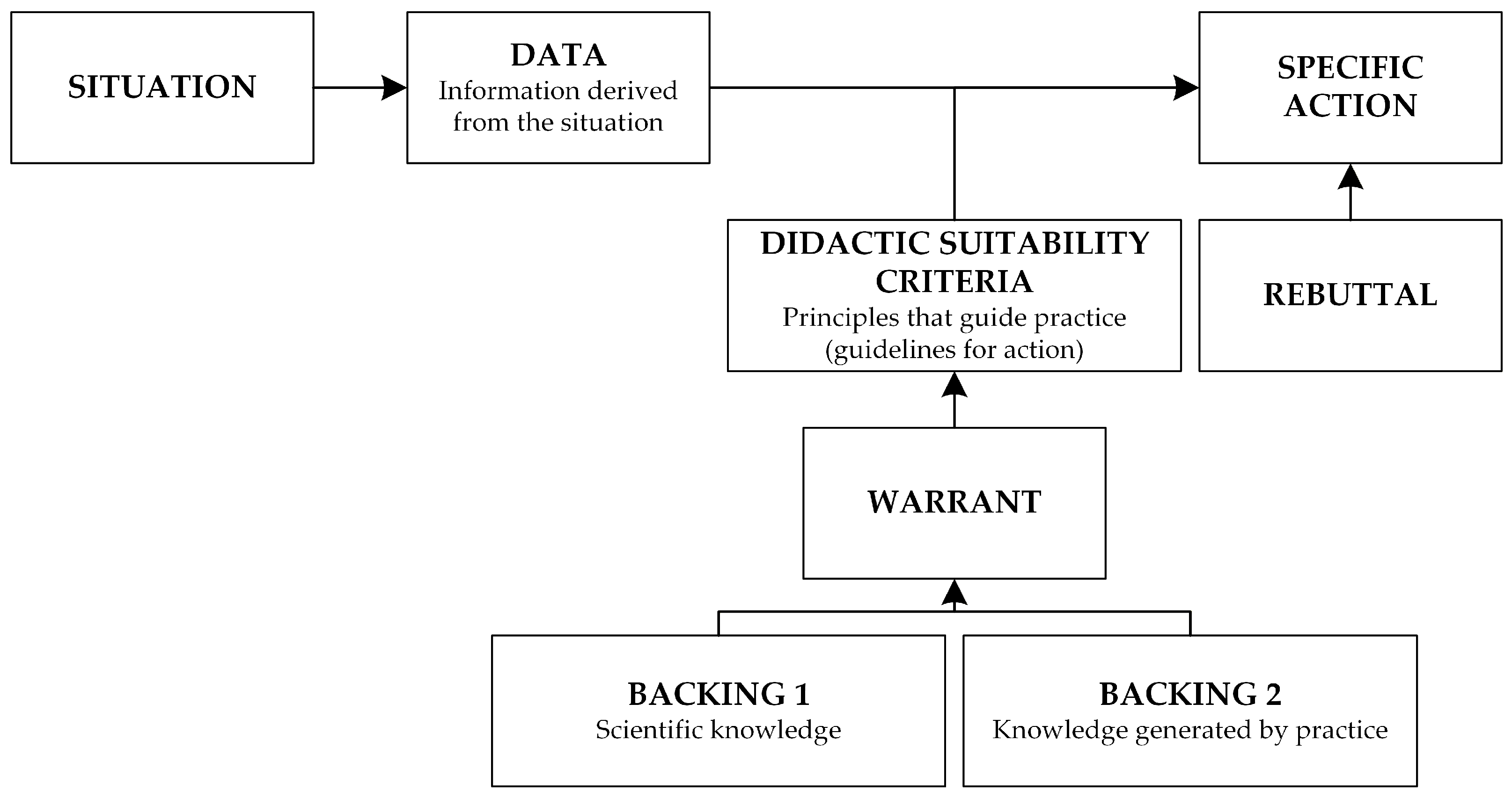
In the work of Sol et al. [11], an adaptation of Toulmin’s model has been proposed to analyse practical argumentation in teaching reflection on practice—specifically in the field of mathematics education—by means of a scheme for structuring and representing practical arguments generated in this context. Firstly, this scheme modifies the structure of a typical argument proposed by Toulmin [26] to bring it into line with the structure of a practical argument, incorporating three of the four premises proposed by Fenstermacher and Richardson [1] as follows:
- The situational premise is added as an element to the scheme, as the teacher draws on empirical and contextual information from the classroom (students’ characteristics, difficulties identified, available resources); in other words, this is their source for generating data.
- The backings that underpin the warrant are divided into two types of premises: scientific knowledge (stipulative premises) and knowledge generated through teaching practice (empirical premises).
- The claim (as the conclusion of a typical argument) becomes a specific action (as the conclusion of a practical argument).
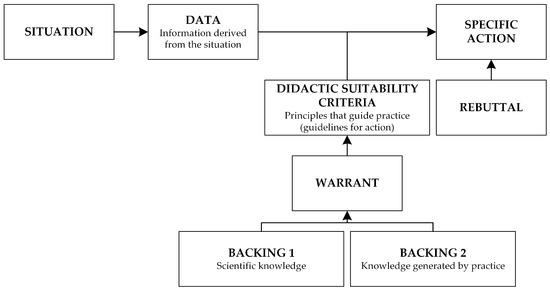
Secondly, this scheme incorporates DSC as an independent element that nuances the relationship between the warrant and the specific action. In this scheme, DSC are not regarded as a typical warrant, as this construct acts as a set of principles—guidelines for action—in mathematics education, which a teacher takes into consideration when carrying out an action. The justification for incorporating them as an independent element is also to be found in the discourse underpinning the development of DSC described above, which takes into account both scientific knowledge and empirical experience. In other words, behind every action taken by a teacher there is a principle that relativises and guides the warrants depending on the situation, and which can be interpreted (or inferred) in terms of DSC.
It must be stressed that, in this new scheme, rebuttal functions in the same way as in Toulmin’s original model. The elements described above are summarised in Figure 3.
Figure 3.
Adaptation of Toulmin’s model incorporating DSC. Source: Adapted from [11] (p. 3719).
In mathematics education, Inglis et al. [51] have argued that modal qualifiers play an important role in mathematical argumentation and that the use of Toulmin’s full model allows for a more refined categorisation of mathematical arguments. Their contribution is relevant because it shows that qualifiers help to analyse the degree of certainty or force with which a claim is advanced. However, it should be noted that the scheme shown in Figure 3 does not represent modal qualifiers as an independent structural element. This decision responds to the focus of the scheme for structuring and representing practical arguments, where the central conclusion is a pedagogical action or intention to act. Nevertheless, modal qualifiers can be used during analysis to interpret the degree of commitment, caution, or provisional nature associated with the proposed or enacted action, which is clustered within DSC.
The scheme shown in Figure 3 should not be interpreted as a direct representation of teachers’ cognitive processes but as a tool to reconstruct their practical argumentation. In many cases, teachers’ practical arguments are implicit, incomplete, fragmented, or distributed across their dialogues. Consequently, the reconstruction of practical arguments always involves an interpretative effort on the part of the researcher. From this perspective, DSC are not assumed to represent principles that teachers explicitly invoke when reasoning about pedagogical actions. Rather, they function as an analytical construct that enables researchers to interpret and characterise the normative and didactical principles that appear to underlie teachers’ practical arguments.
Studies conducted using the scheme shown in Figure 3 (e.g., [11,21,52]) have provided preliminary evidence supporting three potential contributions of its use to the analysis of practical argumentation: (a) the capability to reconstruct the practical argumentation of mathematics teachers during episodes of reflection on their practice, in which the arguments put forward to justify, assess, weigh up, or reconsider pedagogical actions carried out in certain classroom contexts can be structured and represented; (b) the capability to reinterpret these episodes of reflection in terms of the DSC, as behind every proposed or enacted action there is a principle of mathematics education that guides, regulates, or gives normative orientation to that action; and (c) the possibility of better explaining why, given the multitude of trends in mathematics education that are, in theory, considered interesting and innovative, only some of them are applied in teaching practice whilst others are not.
4. Conclusions and Prospects
Practical argumentation provides a conceptual and analytical tool for studying teachers’ pedagogical decisions, in this case, when reflecting on their practice. Unlike mathematical argumentation—which is concerned with the production, justification, and validation of mathematical claims—and theoretical argumentation—which focuses on the truth or acceptability of propositions—practical argumentation examines how pedagogical actions in the classroom are justified. In mathematics education, which is the context mainly addressed in this entry, this distinction is especially relevant because teaching involves continuous pedagogical decision-making in situations characterised by mathematical, didactical, and classroom-management tensions.
Practical argumentation remains an emerging area of research in mathematics education, although current findings suggest considerable potential. The empirical literature remains relatively limited, and many of the claims discussed in this entry should be understood as theoretical propositions or emerging analytical findings rather than as fully established conclusions. While argumentation has traditionally been studied in relation to mathematical reasoning, proof, justification, and the validation of mathematical claims [13,14], practical argumentation introduces a complementary focus: examining the justification of pedagogical action in the mathematics classroom. This focus is particularly relevant in reflective contexts, where prospective and practising mathematics teachers must justify, assess, weigh up, or reconsider possible courses of action in relation to classroom situations, learning objectives, students’ responses, curricular demands, available resources, and didactical principles.
The scheme shown in Figure 3 contributes to this line of work by articulating three theoretical references: the structure of a practical argument (as defined by Fenstermacher and Richardson [1]), Toulmin’s model [26], and the DSC construct [34]. Compared with other approaches to practical argumentation, this scheme offers a domain-specific advantage for mathematics education. The general models of practical argumentation shown in this entry can represent relations among goals, means, circumstances, and actions, but they do not provide analytical tools for interpreting the didactical principles involved in mathematical teaching and learning processes. More specifically, previous studies using Toulmin’s model have been able to describe the argumentative structure of pedagogical reasoning (e.g., [40]), but without an explicit framework for interpreting the didactical principles underlying such arguments. Also, Walton’s model provides a general account of practical reasoning but does not offer mathematics-education-specific categories for analysing pedagogical justification. Therefore, the scheme shown in Figure 3 not only enables practical arguments to be structured but also allows the relationship between their constituent elements (premises, data, warrants, etc.) to be represented, with pedagogical actions forming the conclusions of these arguments. Furthermore, the incorporation of DSC is especially relevant because these criteria help interpret the principles that guide teachers’ decisions without functioning as rigid rules for action [11,21].
Nevertheless, some limitations should be acknowledged. Practical argumentation does not prescribe what teachers should do, nor does it determine the suitable pedagogical decision in advance. Its value lies in reconstructing and analysing in greater detail the reasons that support action. Moreover, teachers’ practical arguments may be implicit, incomplete, fragmented, or distributed across their dialogues, which requires careful interpretation by researchers devoted to this topic. At the same time, an important limitation of the scheme shown in Figure 3 is that it does not fully capture the dynamic evolution of practical argumentation over time, the interaction among multiple competing goals and values, or all affective and institutional influences on decision-making. These aspects remain important topics for future research.
Future research could examine practical argumentation across different mathematical contents, educational levels, and teacher education contexts. It could also study the evolution of teachers’ practical arguments over time and explore their relationship with professional noticing, video-supported reflection, lesson study, instructional coaching, and digitally mediated professional learning. In these contexts, practical argumentation could help analyse not only what teachers notice or discuss, but also how they justify the pedagogical actions they propose, enact, or reconsider. Overall, practical argumentation offers a promising framework for connecting argumentation theory, teacher professional reasoning, and mathematics education.
Author Contributions
Conceptualisation, C.L. and V.F.; methodology, C.L., V.F., A.S. and A.C.; software, C.L., V.F., A.S. and A.C.; validation, C.L., V.F., A.S. and A.C.; formal analysis, C.L., V.F., A.S. and A.C.; investigation, C.L., V.F., A.S. and A.C.; resources, C.L. and V.F.; data curation, C.L., V.F., A.S. and A.C.; writing—original draft preparation, C.L. and A.S.; writing—review and editing, C.L., V.F., A.S. and A.C.; visualisation, C.L., V.F., A.S. and A.C.; supervision, C.L. and V.F.; project administration, V.F.; funding acquisition, C.L. and V.F. All authors have read and agreed to the published version of the manuscript.
Funding
This research received no external funding.
Institutional Review Board Statement
Not applicable.
Informed Consent Statement
Not applicable.
Data Availability Statement
No new data were created or analysed in this study. Data sharing is not applicable to this article.
Acknowledgments
This research was partially conducted within Grant PID2021-127104NB-I00 funded by MICIU/AEI/10.13039/501100011033 and by “ERDF A way of making Europe”; and Predoctoral Contract PRE2019-090177. We also want to thank Telesforo Sol for his previous work on practical argumentation in mathematics teacher education.
Conflicts of Interest
The authors declare no conflicts of interest. The funders had no role in the design of the study; in the collection, analyses, or interpretation of data; in the writing of the manuscript; or in the decision to publish the results.
References
- Fenstermacher, G.D.; Richardson, V. The elicitation and reconstruction of practical arguments in teaching. J. Curric. Stud. 1993, 25, 101–114. [Google Scholar] [CrossRef] [Scilit]
- Audi, R. Practical Reasoning; Routledge: London, UK, 1989. [Google Scholar]
- Green, T.F. Teacher competence as practical rationality. Educ. Theory 1976, 26, 249–258. [Google Scholar] [CrossRef] [Scilit]
- Fenstermacher, G.D. A philosophy of research on teaching: Three aspects. In Handbook of Research on Teaching, 3rd ed.; Wittrock, M.C., Ed.; MacMillan: New York, NY, USA, 1986; pp. 37–49. [Google Scholar]
- Walton, D.N. Practical Reasoning: Goal-Driven, Knowledge-Based, Action-Guiding Argumentation; Rowman & Littlefield Publishers: Savage, MD, USA, 1990. [Google Scholar]
- Schön, D.A. The Reflective Practitioner: How Professionals Think in Action; Routledge: Abingdon, UK, 2016; Original work published in 1983. [Google Scholar] [CrossRef] [Scilit]
- Jacobs, V.R.; Lamb, L.L.C.; Philipp, R.A. Professional noticing of children’s mathematical thinking. J. Res. Math. Educ. 2010, 41, 169–202. [Google Scholar] [CrossRef] [Scilit]
- König, J.; Santagata, R.; Scheiner, T.; Adleff, A.-K.; Yang, X.; Kaiser, G. Teacher noticing: A systematic literature review of conceptualizations, research designs, and findings on learning to notice. Educ. Res. Rev. 2022, 36, 100453. [Google Scholar] [CrossRef] [Scilit]
- Ding, M.; Huang, R.; Beckowski, C.P.; Li, X.; Li, Y. A review of lesson study in mathematics education from 2015 to 2022: Implementation and impact. ZDM 2024, 56, 87–99. [Google Scholar] [CrossRef] [Scilit]
- Cai, H.; Lu, L.; Han, B.; Wong, L.-H.; Gu, X. Exploring pre-service teachers’ reflection mediated by an AI-powered teacher dashboard in video-based professional learning: A pilot study. Educ. Technol. Res. Dev. 2025, 73, 1129–1154. [Google Scholar] [CrossRef] [Scilit]
- Sol, T.; Ledezma, C.; Sánchez, A.; Font, V. Teachers’ practical argumentation on the teaching of the Pythagorean theorem. Int. J. Sci. Math. Educ. 2025, 23, 3707–3731. [Google Scholar] [CrossRef] [Scilit]
- Gómez, J. ¿Qué es la argumentación práctica? [What is practical argumentation?]. Co-Herencia 2017, 14, 215–243. [Google Scholar] [CrossRef] [Scilit]
- Mariotti, M.A. Proof and proving in mathematics education. In Handbook of Research on the Psychology of Mathematics Education: Past, Present and Future; Gutiérrez, Á., Boero, P., Eds.; Sense Publishers: Rotterdam, The Netherlands, 2006; pp. 173–204. [Google Scholar]
- Stylianides, A.J.; Bieda, K.N.; Morselli, F. Proof and argumentation in mathematics education research. In The Second Handbook of Research on the Psychology of Mathematics Education: The Journey Continues; Gutiérrez, Á., Leder, G.C., Boero, P., Eds.; Sense Publishers: Rotterdam, The Netherlands, 2016; pp. 315–351. [Google Scholar] [CrossRef] [Scilit]
- Nussbaum, E.M. Collaborative discourse, argumentation, and learning: Preface and literature review. Contemp. Educ. Psychol. 2008, 33, 345–359. [Google Scholar] [CrossRef] [Scilit]
- Singletary, L.; Conner, A. Connecting research to teaching: Focusing on mathematical arguments. Math. Teach. 2015, 109, 143–147. [Google Scholar] [CrossRef] [Scilit]
- Yackel, E. What we can learn from analyzing the teacher’s role in collective argumentation. J. Math. Behav. 2002, 21, 423–440. [Google Scholar] [CrossRef] [Scilit]
- Rapanta, C.; Garcia-Mila, M.; Gilabert, S. What is meant by argumentative competence? An integrative review of methods of analysis and assessment in education. Rev. Educ. Res. 2013, 83, 483–520. [Google Scholar] [CrossRef] [Scilit]
- Hamami, Y.; Morris, R.L.E.A. Plans and planning in mathematical proofs. Rev. Symb. Log. 2021, 14, 1030–1065. [Google Scholar] [CrossRef] [Scilit]
- Hamami, Y.; Morris, R.L.E.A. Rationality in mathematical proofs. Australas. J. Philos. 2023, 101, 793–808. [Google Scholar] [CrossRef] [Scilit]
- Sol, T.; Ledezma, C.; Breda, A.; Font, V. Criterios de idoneidad didáctica en la argumentación práctica de futuros profesores de matemática [Didactic suitability criteria in the practical argumentation of mathematics teacher educators]. Uniciencia 2025, 39, 89–111. [Google Scholar] [CrossRef] [Scilit]
- Ledezma, C.; Sol, T.; Sánchez, A.; Font, V. Practical arguments of prospective primary education teachers in mathematical modelling problems. Educ. Sci. 2026, 16, 118. [Google Scholar] [CrossRef] [Scilit]
- Fairclough, I.; Fairclough, N. Political Discourse Analysis: A Method for Advanced Students; Routledge: London, UK, 2012. [Google Scholar] [CrossRef] [Scilit]
- Atkinson, K.; Bench-Capon, T.J.M. Practical reasoning as presumptive argumentation using action-based alternating transition systems. Artif. Intell. 2007, 171, 855–874. [Google Scholar] [CrossRef] [Scilit]
- Atkinson, K.; Bench-Capon, T.J.M.; McBurney, P. Computational representation of practical argument. Synthese 2006, 152, 157–206. [Google Scholar] [CrossRef] [Scilit]
- Toulmin, S. The Uses of Argument, 2nd ed.; Cambridge University Press: Cambridge, UK, 2003; Original work published in 1958. [Google Scholar]
- Walton, D.; Reed, C.; Macagno, F. Argumentation Schemes; Cambridge University Press: Cambridge, UK, 2008. [Google Scholar] [CrossRef] [Scilit]
- Macagno, F.; Walton, D. Practical reasoning arguments: A modular approach. Argumentation 2018, 32, 519–547. [Google Scholar] [CrossRef] [Scilit]
- Clarke, D.S. Varieties of practical inference. South. J. Philos. 1979, 17, 273–286. [Google Scholar] [CrossRef] [Scilit]
- Walton, D. Evaluating practical reasoning. Synthese 2007, 157, 197–240. [Google Scholar] [CrossRef] [Scilit]
- Audi, R. Practical Reasoning and Ethical Decision; Routledge: London, UK, 2006. [Google Scholar]
- Walton, D. Fundamentals of Critical Argumentation; Cambridge University Press: New York, NY, USA, 2006. [Google Scholar]
- Westerstrand, S. Fairness in AI systems development: EU AI Act compliance and beyond. Inf. Softw. Technol. 2025, 187, 107864. [Google Scholar] [CrossRef] [Scilit]
- Godino, J.D. Indicadores de la idoneidad didáctica de procesos de enseñanza y aprendizaje de las matemáticas [Indicators of the didactic suitability of mathematics teaching and learning processes]. Cuad. Investig. Y Form. Educ. Matemática 2013, 8, 111–132. [Google Scholar]
- Lewiński, M. Practical argumentation in the making: Discursive construction of reasons for action. In Argumentation and Lan-guage—Linguistic, Cognitive and Discursive Explorations; Oswald, S., Herman, T., Jacquin, J., Eds.; Springer: Cham, Switzerland, 2018; pp. 219–241. [Google Scholar] [CrossRef] [Scilit]
- Pendlebury, S. Practical arguments and situational appreciation in teaching. Educ. Theory 1990, 40, 171–179. [Google Scholar] [CrossRef] [Scilit]
- Dahl, N.O. Practical Reason, Aristotle and Weakness of the Will; University of Minnesota Press: Minneapolis, MN, USA, 1990. [Google Scholar]
- Tekin, A. Arguments constructed within the mathematical modelling cycle. Int. J. Math. Educ. Sci. Technol. 2019, 50, 292–314. [Google Scholar] [CrossRef] [Scilit]
- Solar, H.; Ortiz, A.; Arriagada, V.; Deulofeu, J. Argumentative orchestration in the mathematical modelling cycle in the classroom. EURASIA J. Math. Sci. Technol. Educ. 2022, 18, em2141. [Google Scholar] [CrossRef] [Scilit] [PubMed]
- Metaxas, N.; Potari, D.; Zachariades, T. Analysis of a teacher’s pedagogical arguments using Toulmin’s model and argumentation schemes. Educ. Stud. Math. 2016, 93, 383–397. [Google Scholar] [CrossRef] [Scilit]
- Godino, J.D. Ontosemiotic Approach in Mathematics Education: Foundations, Tools, and Application; DIGIBUG: Granada, Spain, 2024; Available online: https://hdl.handle.net/10481/93738 (accessed on 30 July 2026).
- Godino, J.D.; Batanero, C.; Burgos, M. Theory of didactical suitability: An enlarged view of the quality of mathematics instruction. EURASIA J. Math. Sci. Technol. Educ. 2023, 19, em2270. [Google Scholar] [CrossRef] [Scilit] [PubMed]
- Sánchez, A.; Ledezma, C.; Font, V. A proposal of integration of Universal Design for Learning and Didactic Suitability Criteria. Educ. Sci. 2025, 15, 909. [Google Scholar] [CrossRef] [Scilit]
- Breda, A. Características del análisis didáctico realizado por profesores para justificar la mejora en la enseñanza de las matemáticas [Characteristics of the didactic analysis carried out by teachers to justify the improvement of mathematics teaching]. BOLEMA Bull. Math. Educ. 2020, 34, 69–88. [Google Scholar] [CrossRef] [Scilit]
- Garcés, W. Análisis de las pautas que rigen la práctica del profesor en la enseñanza de derivadas en ciencias básicas en carreras de ingeniería [Analysis of the guidelines governing the teacher’s practice in the teaching of derivatives in basic sciences in engineering careers]. REDIMAT J. Res. Math. Educ. 2021, 10, 239–268. [Google Scholar] [CrossRef] [Scilit]
- García-Marimón, O.; Diez-Palomar, J.; Morales-Maure, L.; Durán-González, R.E. Evaluación de secuencias de aprendizaje de matemáticas usando la herramienta criterios de idoneidad didáctica [Using the didactic suitability criteria tool when assessing mathematics learning sequences]. BOLEMA Bull. Math. Educ. 2021, 35, 1047–1072. [Google Scholar] [CrossRef] [Scilit]
- Burgos, M.; Castillo, M.J. Criterios de idoneidad emitidos por futuros maestros de primaria en la valoración de vídeos educativos de matemáticas [Suitability criteria used by future primary school teachers in the assessment of math educational videos]. Uniciencia 2021, 35, 291–307. [Google Scholar] [CrossRef] [Scilit]
- Burgos, M.; Beltrán-Pellicer, P.; Contrado, B. A guide to the analysis of didactic suitability of probability textbook lessons. Int. Elect. J. Math. Educ. 2025, 20, em0858. [Google Scholar] [CrossRef] [Scilit] [PubMed]
- Gómez-Muñoz, M.P.; Rodríguez-Nieto, C.A.; Pimienta, A.; Breda, A. Colombian pre-service mathematics teachers’ knowledge and didactic suitability in the context of the measurement. EURASIA J. Math. Sci. Technol. Educ. 2025, 21, em2573. [Google Scholar] [CrossRef] [Scilit] [PubMed]
- Manolino, C.; Giacomone, B.; Beltrán-Pellicer, P. Semiotic bundle approach and Onto-Semiotic Approach: A dialogue between two theories on an arithmetic-algebraic problem. Educ. Pesqui. 2023, 49, e256699. [Google Scholar] [CrossRef] [Scilit]
- Inglis, M.; Mejia-Ramos, J.P.; Simpson, A. Modelling mathematical argumentation: The importance of qualification. Educ. Stud. Math. 2007, 66, 3–21. [Google Scholar] [CrossRef] [Scilit]
- Sol, T.; Breda, A.; Richit, A.; Sala-Sebastià, G. Didactic suitability criteria that emerge in the future teachers’ practical argumentation. Zetetiké 2024, 32, e0240004. [Google Scholar] [CrossRef] [Scilit]

Disclaimer/Publisher’s Note: The statements, opinions and data contained in all publications are solely those of the individual author(s) and contributor(s) and not of MDPI and/or the editor(s). MDPI and/or the editor(s) disclaim responsibility for any injury to people or property resulting from any ideas, methods, instructions or products referred to in the content. |
© 2026 by the authors. Licensee MDPI, Basel, Switzerland. This article is an open access article distributed under the terms and conditions of the Creative Commons Attribution (CC BY) license.