


Definition
Machine learning (ML) in materials science refers to computational methods that learn statistical, structural, or physics-informed relationships from experimental, computational, and literature-derived materials data. These methods are used to predict materials properties, identify structure–property and process–structure–property–performance relationships, discover candidate materials, optimize synthesis and processing routes, and guide functional applications. ML is narrower than artificial intelligence (AI), which also includes broader reasoning, planning, search, and automation capabilities. It is also distinct from materials informatics, which is the wider data-centered framework that includes databases, descriptors, metadata, workflows, visualization, and knowledge management. ML can complement high-throughput computation by building surrogate models from density functional theory, finite-element simulation, molecular dynamics, or experimental data, but it is not identical to high-throughput screening itself. Unlike conventional physics-based modeling, which begins with explicit governing equations or mechanistic assumptions, ML usually infers predictive relationships from data; modern approaches increasingly combine both perspectives through physics-informed features, uncertainty quantification, and human expertise.
1. Introduction and Historical Development
1.1. From Empirical Materials Development to Data-Driven Materials Science
Materials development has historically combined empirical observation, thermodynamics, processing experience, and mechanistic modeling. Data-driven materials science extends this tradition by using curated experimental and computational data to infer patterns that are difficult to capture by trial-and-error experimentation alone. Materials informatics and big-data approaches have been described as part of a broader fourth-paradigm mode of scientific inquiry, in which data, models, and domain knowledge are used together to accelerate materials discovery [1,2].
1.2. Emergence of Materials Informatics
Materials informatics emerged from the need to organize, connect, and reuse increasingly heterogeneous materials datasets generated by computation, experimentation, characterization, and literature-derived sources. Its development was stimulated by high-throughput computation, combinatorial experimentation, and the need to connect composition, process, structure, property, and performance information in reusable ways [3,4].
1.3. Growth of Machine Learning in Materials Research
ML became prominent in materials science as public databases, automated calculations, imaging pipelines, and laboratory records increased the availability of machine-readable data. Solid-state materials studies have used ML for property prediction, descriptor construction, stability screening, and ranking of candidate compounds [5,6]. In continuum materials mechanics, ML and data mining have also been adopted for constitutive behavior, damage, fatigue, and microstructure–property modeling [7].
1.4. Scope of the Entry
This entry defines core concepts, summarizes data infrastructure and algorithm families, and describes representative applications in functional and structural materials. It is not a systematic literature review and does not rank publications bibliometrically. Its emphasis is on established terminology, technical principles, common workflows, validation practices, limitations, and future directions relevant to ML-enabled materials discovery and functional applications.
The purpose of this entry is to provide a concise but analytical overview of how ML is used in materials science, with attention to both its opportunities and its methodological constraints. The intended audience includes materials scientists, engineers, graduate students, computational researchers, and interdisciplinary readers who need a structured introduction to data-driven materials research. Relative to specialized reviews focused on a single algorithm family, database, or materials class, the distinctive contribution of this entry is its integrated treatment of definitions, materials data infrastructure, ML method families, validation and reproducibility issues, representative functional applications, industrial deployment considerations, and future perspectives within one encyclopedic framework.
2. Core Concepts and Materials Data Infrastructure
2.1. Artificial Intelligence, Machine Learning, and Deep Learning
Because AI-related terminology is often used inconsistently in materials research, a clear hierarchy is useful before discussing data infrastructure and algorithm families. In this hierarchy, artificial intelligence denotes broad computational decision-support capabilities, ML refers to models that learn relationships from materials data, and deep learning (DL) denotes neural-network-based representation learning. The distinction is practical rather than only terminological: automated calculation pipelines, database searches, and high-throughput screening are not necessarily ML workflows, while many ML models used for tabular materials data are not deep neural networks [8,9]. Table 1 summarizes key terms used throughout this entry and gives representative citations.
Table 1.
Key terms and concepts in machine learning for materials science.
2.2. Data-Driven Materials Science
Data-driven materials science is an ecosystem rather than an algorithm: it includes high-throughput computations, high-throughput characterization, automated processing of microscopy and spectroscopy, literature mining, and decision-making workflows [25,26].
2.3. Materials Descriptors and Representations
A descriptor is an encoded description of a material, processing condition, microstructure, spectrum, or service environment. Common descriptors include elemental properties, stoichiometric features, crystal symmetry, local atomic environments, radial distribution functions, microstructure statistics, image-derived features, and physics-guided variables. Modern representation studies emphasize that the choice of representation strongly affects transferability, interpretability, and data efficiency [12,13].
2.4. Structure–Property and Process–Structure–Property Relationships
The core materials science problem is often expressed as a structure–property relationship; manufacturing-oriented studies extend this to process–structure–property (PSP) and process–structure–property–performance (PSPP) relationships. Data science provides tools to model these linkages when mechanistic models are incomplete or when processing histories and microstructural descriptors are high-dimensional [27].
2.5. Sources of Materials Data
Materials data may originate from experimental measurements, density functional theory (DFT), finite-element method (FEM) simulations, molecular dynamics (MD), high-throughput calculations, combinatorial synthesis, microscopy, diffraction, spectroscopy, synthesis records, processing histories, service records, and literature-derived data. The most useful datasets usually combine target values with provenance, uncertainty, metadata, units, and clear definitions of the measured or computed quantity.
2.6. Databases, Repositories, Metadata, and FAIR Principles
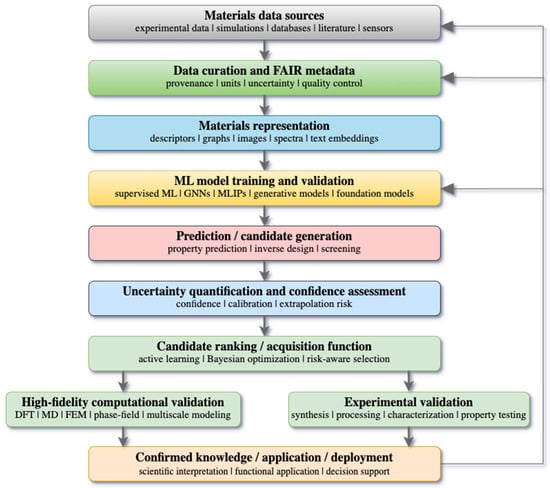
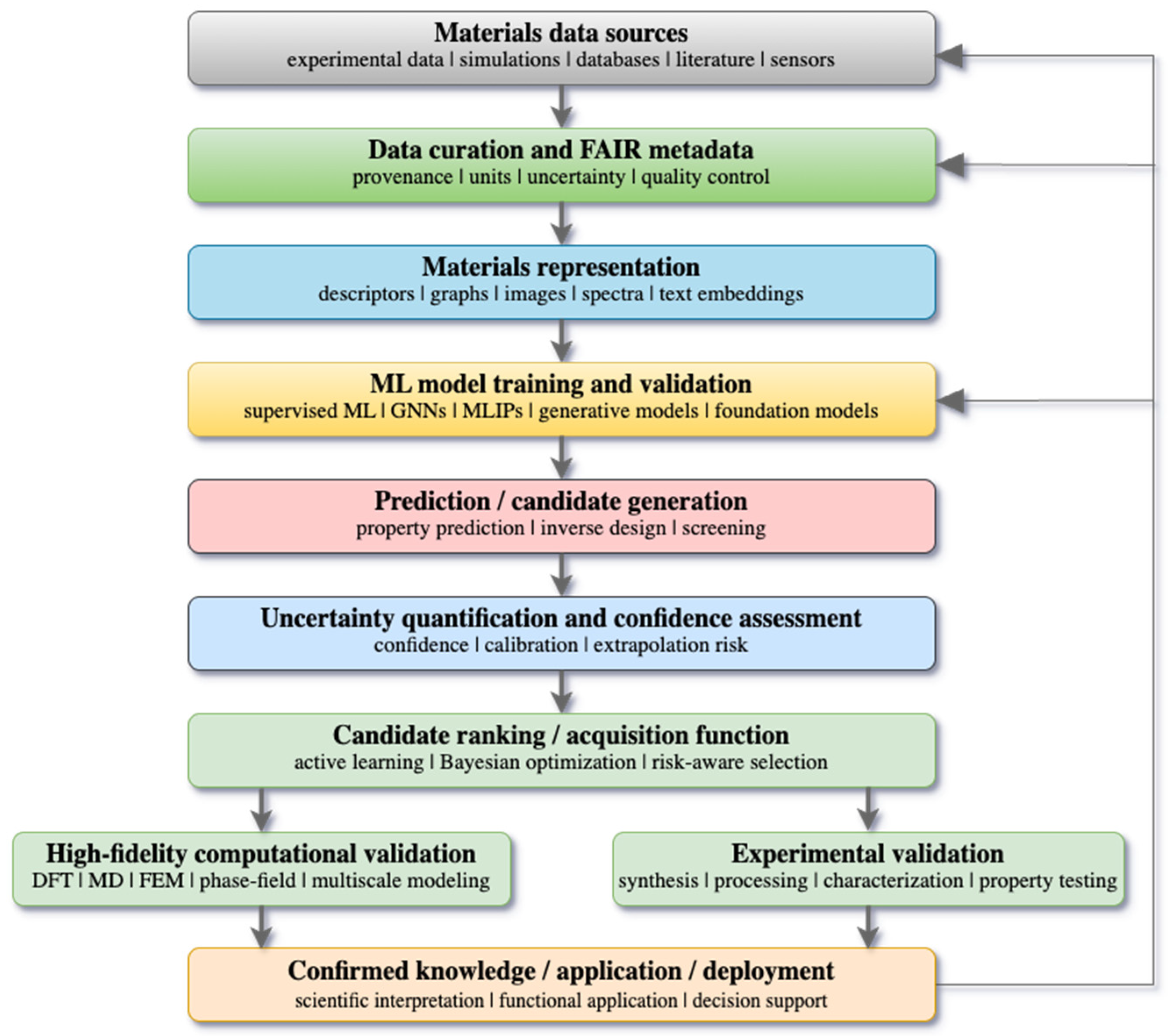
Databases and repositories enable ML by ensuring that data remain findable, accessible, interoperable, and reusable (FAIR). Examples include automated repositories and quantum materials databases used for structure, property, and benchmark data [28,29]. The Graph Networks for Materials Exploration (GNoME) study illustrates the transition from data repositories to AI-driven discovery pipelines by using graph networks trained at scale to identify 2.2 million candidate structures predicted to lie below the current convex hull, including experimentally realized structures and candidates relevant to layered materials, solid electrolytes, learned interatomic potentials, and ionic conductivity screening [30]. Semantic data federation and benchmark platforms further address persistent barriers, including inconsistent metadata, incompatible schemas, limited provenance, and uneven reproducibility across materials data resources [31,32]. The overall role of ML in materials science can be summarized as a data-to-decision workflow in which curated materials data are transformed into descriptors, modeled using appropriate algorithmic families, applied to structure–property or process–structure–property–performance problems, and then subjected to validation before scientific or engineering deployment (Figure 1). The workflow is iterative rather than strictly linear: validation results can lead to improved data curation, experimental results can support model retraining, and uncertainty estimates can guide active learning and additional experiments. Domain expertise remains essential throughout the workflow because it defines meaningful targets, constrains the design space, evaluates physical plausibility, and supports interpretation of model outputs.
Figure 1.
Workflow of ML in materials science, showing the progression from heterogeneous materials data sources through curation, representation, model selection, materials science tasks, functional applications, validation, and iterative model refinement.
3. Machine Learning Methods and Algorithms
ML methods in materials science can be understood according to the type of data they use and the decision they support. Classical supervised models are often effective for tabular composition, processing, and property datasets. Deep learning methods are useful when the relevant information is contained in images, spectra, text, graphs, or other high-dimensional representations. Graph neural networks describe atomistic and crystal structures through nodes and edges, while machine-learned interatomic potentials accelerate atomistic simulations. Active learning and Bayesian optimization help select the next experiment or calculation, and generative or inverse-design models propose candidate materials that may satisfy target properties. Table 2 summarizes these method families, their typical inputs, representative tasks, application areas, and citations.
Table 2.
Machine learning method families, typical input data, representative tasks, and application domains in materials science.
3.1. Classical Supervised Learning
Supervised learning relies on labeled examples in which materials descriptors, such as composition, processing conditions, structural descriptors, or measured features, are paired with known properties or classes. In materials science, these models remain widely used because many available datasets are small to medium in size, tabular in format, and derived from experimental or computational studies with limited numbers of observations. Classical supervised approaches are therefore useful as transparent baselines for property prediction, classification, candidate ranking, and structure–property or process–property analysis. Their reliability depends strongly on descriptor quality; training domain coverage; and validation strategies that separate chemically, structurally, or processing-related records when extrapolation is expected [33,34].
3.2. Unsupervised and Semi-Supervised Learning
Unsupervised learning supports the exploration of materials datasets when target labels are unavailable, incomplete, or not yet clearly defined. It can reveal clusters, latent variables, low-dimensional trends, microstructure classes, phase-field patterns, or outliers that may not be obvious from direct inspection. Semi-supervised learning occupies an intermediate position by combining a limited number of labeled measurements with larger collections of unlabeled formulas, structures, spectra, images, or text-derived records. These approaches are especially useful for organizing complex materials spaces before supervised prediction, active learning, or experimental prioritization is applied [4,12].
3.3. Deep Learning and Representation Learning
DL methods learn nonlinear representations directly from data rather than relying entirely on manually designed descriptors. This is valuable when important information is contained in high-dimensional or weakly structured inputs, such as microstructure images, spectra, sequential records, text, or multidimensional simulation outputs. Representation learning can reduce the need for handcrafted features and may improve transfer across related materials tasks. However, these methods require careful validation because learned representations can capture imaging artifacts, dataset bias, processing history, or publication-specific patterns, as well as physically meaningful materials features [10,12].
3.4. Graph Neural Networks and Crystal Graph Models
Materials property prediction increasingly uses crystal graph architectures to learn relationships between atomic environments, crystal periodicity, composition, and target properties. Recent graph–attention and hybrid Transformer–graph frameworks extend earlier crystal graph approaches by weighting atomic contributions, incorporating local and global structural features, and representing higher-body interactions. These developments improve predictions of energy-related quantities, band gaps, energy above the convex hull, and data-scarce mechanical properties, especially when transfer learning is used [48,49]. In this role, graph models produce target–property predictions or learned structural embeddings for screening and interpretation rather than reusable potential-energy surfaces for molecular dynamics. Their validation should therefore focus on property prediction accuracy, generalization to new chemistries or structures, transfer to scarce targets, and interpretability of atomic or structural contributions [15,16].
3.5. Machine-Learned Interatomic Potentials
For atomistic simulation, MLIPs reduce the cost of repeated first-principles calculations by learning the energy–force–stress relationships required for molecular dynamics and related simulations. Universal MLIPs extend this role by providing pretrained potentials intended to transfer across broader chemical and structural spaces instead of being trained only for a single material system. CHGNet illustrates a graph-based universal neural-network potential that incorporates charge-informed information and is pretrained on large Materials Project trajectory data, while systematic uMLIP assessments show that transferability remains model- and task-dependent [50,51]. Consequently, validation must include energies; forces; stresses; stability; dynamics; and out-of-domain configurations such as surfaces, defects, diffusion pathways, phase transformations, and mechanically deformed states [39,40,41].
3.6. Active Learning and Bayesian Optimization
Active learning and Bayesian optimization (BO) choose the next experiment, calculation, or simulation by balancing exploitation of promising candidates with exploration of uncertain regions. Bayesian methods are well suited to materials discovery because many experiments are expensive and many targets are multi-objective [17]. Crystal graph descriptors and active learning have been combined to search two-dimensional magnetic materials, while batch BO has been used to solve inverse microstructure-to-process problems [11,18].
3.7. Generative Models and Inverse Design
Generative models search for materials that satisfy desired targets by learning a distribution over structures, compositions, molecules, or processing conditions. Variational autoencoders (VAEs), generative adversarial networks, diffusion models, reinforcement learning, and genetic algorithms have been applied to molecules, two-dimensional materials, and polymers [20,42]. Inverse design remains limited by synthesizability, thermodynamic stability, processing constraints, and the need for experimental or high-fidelity computational verification [19,52].
3.8. Foundation Models and Large Language Models
The broader foundation-model landscape in materials science includes several technically distinct directions. LLMs primarily support text analysis, synthesis description processing, literature mining, retrieval, and tool-mediated workflows; structure-aware models operate on crystals, molecules, or atomistic graphs; universal or foundational interatomic potentials support atomistic simulation; and multimodal models combine several data streams, such as composition, structure, spectra, images, text, and metadata. Recent foundational interatomic-potential frameworks show that large-scale pretraining can support transfer, fine-tuning, and knowledge distillation, but benchmark studies also show that out-of-domain tasks still require dedicated validation [53,54]. LLM-based workflows currently include materials language processing, literature mining, ontology-conformal named entity recognition, LLM-assisted property prediction, synthesis planning, database-assisted retrieval, code generation, multi-agent simulation workflows, and generative design [43,55]. Materials language processing can support text classification, named entity recognition, extractive question answering, and annotation support with limited labeled datasets [56]. However, ontology-conformal recognition of materials entities remains challenging because materials terminology is domain-specific, fine-grained, and semantically ambiguous. Comparative studies in materials mechanics and fatigue show that task-specific language models can outperform general foundation LLMs regarding ontology-constrained named entity recognition, and that in-context learning with foundation models depends strongly on the quality of few-shot demonstrations when handling a domain shift [57].
Recent benchmark and application studies show both the promise and the limitations of LLMs for materials prediction and discovery. LLM4Mat-Bench provides a large benchmark for crystalline materials property prediction using composition, crystallographic information files, and crystal text descriptions as input modalities, and shows that general-purpose LLMs remain limited for property prediction unless supported by task-specific predictive models or task-specific instruction tuning [58]. In synthesis planning, LLMs have been used to recall inorganic synthesis conditions, predict precursors, estimate calcination and sintering temperatures, and generate reaction recipes for training downstream models, with off-the-shelf models reaching Top-1 precursor prediction accuracy of up to 53.8% and temperature errors below 126 °C for held-out reactions [59]. Related frameworks such as MSP-LLM formulate synthesis planning as a structured problem involving precursor prediction and synthesis operation prediction, but this direction also requires careful validation against experimentally realizable synthesis pathways [60].
LLMs are also being integrated with materials databases, toolkits, and simulation software. ChatMOF combines LLM-based natural language interaction with database access, property prediction, and structure generation for metal-organic frameworks, with examples tested using v0.2.0 and accuracy measurements using v0.0.0 [61]. MatSciAgent illustrates the use of modular LLM agents for data retrieval, continuum simulation, crystal structure generation, and molecular dynamics workflows [62]. Molecular dynamics agents have also been proposed to generate, execute, and refine simulation code for thermodynamic property calculations, reducing the average task time by about 42% in code-generation workflows [63]. In soft materials, LLMs have been explored as evolutionary optimizers for sequence-defined macromolecule design [64]. These developments suggest that LLMs may become useful interfaces between materials knowledge, computational tools, and experimental decision-making.
Despite this progress, validation remains a central concern. LLM outputs may contain hallucinated claims, incomplete provenance, incorrect units, unsupported synthesis routes, invalid structures, or plausible but physically inconsistent predictions. Knowledge reconstruction studies show that LLMs can extract synthesis routes, processing conditions, and performance relationships from inorganic materials literature with high precision, recall, and F1 scores, but also emphasize the need for structured outputs, logical consistency, and domain transfer testing [65]. Broader perspectives on materials LLMs emphasize that current models are not yet general-purpose materials discovery engines and require grounding in domain knowledge, high-quality multimodal datasets, tool augmentation, and hypothesis testing [44,66]. Therefore, LLM-based outputs in materials science should be validated using task-specific benchmarks, ontology consistency checks, provenance tracking, uncertainty or confidence assessment, expert review, high-fidelity computation, and experimental confirmation where discovery claims are made.
3.9. Explainable and Interpretable Machine Learning
Interpretability helps users understand whether a model has learned meaningful materials relationships or merely dataset correlations. Feature importance, Shapley additive explanations (SHAP), surrogate models, symbolic regression, partial-dependence analyses, and attention inspection can reveal candidate mechanisms or guide feature engineering. Interpretable ML has been used for structure–property analysis in crystals, XANES spectrum–property relationships, and compositional controls in inorganic glasses [13,35]. Interpretability should be treated as evidence for model behavior, not as proof of physical causality [36].
4. Structure–Property and Process–Structure–Property Modeling
4.1. Composition–Property Prediction
Composition–property models predict target properties from elemental fractions, elemental attributes, stoichiometry, or learned compositional representations. They are common in alloy design, glasses, ceramics, polymers, catalysts, and energy materials because composition is often easier to record than full microstructure. However, composition-only models may overlook processing history, defects, phase fractions, and metastable structures [67].
4.2. Crystal-Structure and Phase-Stability Predictions
Crystal-structure and phase-stability models use atomic positions, lattice parameters, symmetry, graph connectivity, and electronic descriptors to predict formation energy, stability, density of states, band gap, and related properties. High-throughput repositories make such modeling possible, but polymorphism, finite-temperature effects, disorder, and synthesis constraints remain important sources of uncertainty [28,29].
4.3. Microstructure–Property Modeling
Microstructure–property modeling links grain morphology, phase distributions, precipitates, pores, interfaces, texture, and other microstructural descriptors to properties such as strength, fatigue resistance, creep life, conductivity, and toughness. Deep learning has been applied to high-contrast composite simulation datasets and image-derived microstructure–property prediction [38,68]. Microstructure-aware BO and interpretable models increasingly support inverse design of microstructures under process constraints [37].
4.4. Process–Structure–Property–Performance Modeling
PSPP modeling connects synthesis and processing variables to microstructure, properties, and functional or service performance. Examples include additive manufacturing process optimization, fatigue prediction, and surface roughness or fracture performance modeling [69,70]. Literature-mining systems are beginning to extract composition–processing–structure–performance linkages from fragmented multimodal sources, but automated extraction still depends on careful curation and validation [27].
4.5. Multiscale and Multi-Fidelity Modeling
Multiscale modeling integrates atomistic, mesoscale, continuum, and experimental data. Multi-fidelity ML combines inexpensive approximate calculations with smaller numbers of high-fidelity results to improve accuracy while controlling cost. This approach is used for band gap prediction and is relevant wherever DFT, empirical simulations, laboratory measurements, and engineering-scale models have different accuracy and cost profiles [45,71]. AI acceleration is also important for time-dependent physics-based simulations, where repeated high-fidelity calculations may be computationally expensive. A recent finite-element and machine-learning framework for early-age concrete stress evolution illustrates this role by combining thermo-chemo-mechanical modeling, deep sequential learning, and active learning. In that study, an active-learning strategy allowed a recurrent model to reach the accuracy associated with approximately 900 Latin hypercube samples using about 200 actively selected samples, demonstrating how ML can reduce the number of repeated simulations needed for time-dependent materials behavior prediction [72].
5. Data-Driven Materials Discovery and Functional Applications
5.1. High-Throughput Virtual Screening and Candidate Ranking
High-throughput virtual screening (HTS) uses automated calculations or model predictions to rank large candidate sets before experimental work. ML can function as a surrogate model that reduces the number of DFT calculations or experiments needed for screening. Its value depends on the training domain, descriptor quality, uncertainty estimates, and final verification with higher-fidelity computation or experiments [6,28].
5.2. Inverse Materials Design and Multi-Objective Optimization
Inverse design begins with desired targets, such as high strength and ductility, low thermal conductivity, high ionic conductivity, catalytic activity, or phase stability, and searches for compositions, structures, or processes that may meet them. Multi-objective optimization is essential because materials often require trade-offs between performance, stability, cost, toxicity, and manufacturability [11,19].
5.3. Closed-Loop and Autonomous Materials Discovery
Closed-loop workflows combine ML, automated experimentation, high-throughput characterization, and decision algorithms. In such workflows, the model proposes candidates, the laboratory or simulation platform evaluates them, and the new results update the model. Autonomous high-throughput hydrogel characterization illustrates the combination of automated sensing and physics-guided ML, while combinatorial thin-film libraries illustrate high-throughput experimental discovery [46,47]. A recent A-Lab study further demonstrates the use of autonomous solid-state synthesis for inorganic powders, combining computations, historical literature data, natural-language models, active learning, thermodynamic constraints, and robotic experimentation. During continuous operation, the platform realized 36 compounds from 57 targets, illustrating how autonomous laboratories can help close the gap between computational screening and experimental realization [73].
5.4. Integration with Physics-Based Methods
ML is most reliable when integrated with thermodynamics, kinetics, electronic structure theory, mechanics, transport theory, and experimental constraints. Physics-guided descriptors, mechanistic regularization, residual learning, and uncertainty-aware workflows can reduce spurious correlations and improve extrapolation, although they do not eliminate the need for validation [24,45].
5.5. Energy Storage Materials
Energy storage studies use ML to predict electrode, electrolyte, interphase, diffusion, voltage, degradation, and state-of-health behavior. Battery applications include materials design, state prediction, multiscale energy-materials modeling, and accelerated screening of rechargeable battery components [74,75]. Recent multiscale work connects materials descriptors with performance targets across energy applications, but electrochemical testing and stability analysis remain decisive [70].
5.6. Catalysts and Electrocatalysts
Catalyst discovery uses descriptors such as adsorption energies, electronic structure, surface composition, coordination environment, and activity-stability metrics. ML-assisted catalyst design can rationalize alloy catalyst descriptors and guide oxygen electrocatalyst screening, but model outputs must be checked against surface reconstruction, electrolyte effects, durability, and measurement protocols [67,76].
5.7. Photovoltaic, Optoelectronic, and Semiconductor Materials
ML is used to predict band gaps, stability, defect tolerance, optical response, carrier transport, and photovoltaic suitability. Studies include computational design of optoelectronic semiconductors and ML identification of lead-free perovskites for solar cells [77,78]. These applications require attention to toxicity, synthesis routes, phase stability, and device-level performance beyond single-property screening.
5.8. Structural Alloys and Composites
In structural alloys, ML supports high-entropy alloy design, titanium alloy discovery, creep-life prediction, and steel property-to-microstructure analysis [79,80]. High-throughput and ML studies for high-entropy materials illustrate the expansion of data-driven methods into compositionally complex spaces, while superalloy and steel studies demonstrate their use in performance-critical structural systems [81,82]. Composite material studies use image data, multiscale simulations, and AI-based property prediction to link architecture, reinforcement, and performance [83].
5.9. Polymers, Ceramics, Glasses, and Soft Materials
Polymer informatics uses molecular fingerprints, repeat-unit descriptors, sequence representations, and physics-informed features to predict dielectric, mechanical, thermal, transport, and processing properties [84,85]. Genetic algorithms and ML have been used for polymer design, and recent surveys emphasize the need for reliable data, uncertainty estimation, and synthesis-aware workflows [86]. In ceramics and glasses, ML is used for high-entropy oxide structure prediction, ultra-low-loss dielectric ceramic discovery, and glass-forming-region prediction [87,88].
5.10. Additive Manufacturing, Coatings, Corrosion, Tribology, and Reliability
Additive manufacturing (AM) generates complex PSPP relationships involving powder properties, heat input, scan strategy, microstructure, porosity, residual stress, and performance. ML-assisted laser powder bed fusion optimization and probabilistic fatigue prediction demonstrate the role of data-driven models in AM process qualification [24,69]. Coatings, corrosion, tribology, and reliability studies use ML for nanoscale friction prediction, triboinformatics, coating compatibility, corrosion-inhibitor discovery, and mechanistic discovery in corrosion-resistant multi-principal-element alloys [89,90]. These domains require careful attention to environment, wear history, surface chemistry, and accelerated test validity [91,92].
5.11. Cross-Domain Trends and Common Lessons
Across these application areas, ML improves materials research primarily by reducing the cost of screening large composition and processing spaces, prioritizing experiments or simulations, extracting hidden structure–property and process–structure–property–performance relationships, and supporting multi-objective optimization under practical constraints. Common trends are visible across energy materials, catalysts, semiconductors, alloys, polymers, ceramics, additive manufacturing, coatings, corrosion, tribology, and reliability: ML is most effective when it is combined with physically meaningful descriptors, curated metadata, uncertainty-aware validation, and domain expertise. Therefore, the main contribution of ML is not simply faster prediction, but better decision support for selecting candidates, designing experiments, identifying mechanisms, and determining which results justify high-fidelity computation or experimental validation.
6. Evaluation, Validation, and Reproducibility
Discovery-oriented materials ML requires validation beyond conventional random train–test splits. Prospective and time-aware testing, leakage control, uncertainty-aware extrapolation, false-positive analysis near stability thresholds, and task-specific discovery metrics are needed to evaluate whether a model can support reliable candidate selection rather than only retrospective prediction.
6.1. Model-Training Strategies
Common training strategies include random train–test splitting, k-fold cross-validation, nested cross-validation, leave-one-composition-out testing, time-aware splitting, forward cross-validation, and external validation on independently generated data. In materials discovery, random splitting can overestimate performance when related compositions, structures, or processing conditions appear in both training and test sets [93]. The validation protocol should therefore be selected according to the intended use of the model. Random train–test splitting is useful for estimating interpolation within a known data distribution, but it is often insufficient for discovery-oriented tasks. When the goal is extrapolation to new materials spaces, more demanding protocols are needed, including leave-one-composition-family-out, leave-one-chemistry-out, leave-one-processing-route-out, leave-one-publication-out, time-aware splitting, forward cross-validation, and external validation on independently generated data. These protocols are particularly important when datasets contain closely related alloys, polymorphs, crystal structures, microstructures, processing histories, or records extracted from the same literature sources [94,95,96].
6.2. Evaluation Metrics
Regression metrics include mean absolute error (MAE), root mean square error (RMSE), coefficient of determination (R2), calibration error, and uncertainty quality metrics. Classification metrics include accuracy, precision, recall, F1 score, area under the receiver operating characteristic curve (ROC AUC), and precision–recall behavior. Metrics should be interpreted with the property scale, measurement uncertainty, training domain size, and intended decision threshold in mind. Recent benchmark studies show that conventional regression metrics are not always aligned with discovery performance. For example, Matbench Discovery evaluates machine learning energy models as pre-filters for high-throughput crystal stability screening and emphasizes that models with low formation-energy errors can still produce high false-positive rates when predictions lie close to the convex-hull stability threshold [97]. Similarly, the Discovery Precision metric was proposed to evaluate how efficiently ML models identify novel high-FOM materials, showing that discovery-oriented metrics may be more informative than MAE, RMSE, or R2 for explorative materials discovery [98]. Task-specific studies further illustrate the diversity of reported metrics: comparative MOF property-prediction studies commonly report RMSE, R2, MAE, and cross-validation scores [99]; microstructure classification studies may report classification accuracy and correlation between learned microstructural features and macroscopic properties [100]; and composite–property prediction studies often use target-specific R2 values for tensile, flexural, impact, and hardness properties [101]. Therefore, scalar regression metrics should be complemented by task-relevant indicators such as top-k hit rate, enrichment factor, discovery precision, false-positive rate near decision thresholds, validity, novelty, synthesizability, prospective confirmation rate, sample efficiency, and experimental hit rate, depending on whether the task is property regression, candidate screening, inverse design, microstructure classification, MLIP validation, or closed-loop discovery.
6.3. Data Leakage and Benchmark Limitations
Data leakage occurs when information from the test set is directly or indirectly available during model training, feature construction, model selection, or preprocessing. In materials ML, leakage can occur when normalization, imputation, feature selection, dimensionality reduction, descriptor screening, or data augmentation are performed before the train–test split. It can also occur when duplicate or near-duplicate compositions, crystal structures, spectra, microscopy images, simulated microstructures, or literature-derived records appear in both training and test sets. Additional leakage risks arise when records from the same publication, experimental batch, computational campaign, or high-throughput database pipeline are split across training and testing because such records may share hidden assumptions, measurement protocols, simulation settings, or preprocessing steps.
Benchmark limitations also require careful interpretation. Materials benchmarks may contain hidden duplicates, inconsistent target definitions, uneven representation of chemical families, biased candidate spaces, missing negative results, and differences between computed and experimentally measured properties. A model that performs well under a random split may therefore perform substantially worse under leave-one-chemistry-out, leave-one-composition-family-out, time-aware, or prospective validation. Benchmark platforms are valuable because they standardize tasks and baselines, but they cannot replace task-specific validation, external testing, uncertainty analysis, and domain-aware interpretation of errors [32,93].
6.4. Uncertainty Quantification and Extrapolation
UQ estimates whether predictions are well supported by training data. It can be based on Gaussian processes, ensembles, dropout, Bayesian neural networks, conformal methods, calibration models, or empirical error analysis. UQ is especially important for active learning, experimental prioritization, safety-critical structural materials, and extrapolation to new chemistry or processing domains [17,24].
6.5. Experimental Validation
Experimental validation is the decisive step for discovery claims. A useful ML prediction should be accompanied by realistic synthesis or processing routes, independent measurements, uncertainty estimates, and comparison with relevant baselines. Inverse-design, catalyst, battery, corrosion, and AM applications all require verification under conditions that approximate intended use rather than only idealized screening environments [92]. For discovery claims, retrospective benchmark performance should be distinguished from prospective validation. A model may achieve strong cross-validation performance but still generate false positives when applied near practical decision thresholds, such as phase stability, fatigue resistance, catalytic activity, corrosion resistance, manufacturability, or safe operating limits. Therefore, promising candidates should be verified using independent high-fidelity calculations, new experiments, or service-relevant tests. For deployment-oriented studies, validation should also assess robustness to new material batches, instruments, laboratories, processing windows, environmental conditions, and measurement protocols.
6.6. Reporting Standards, Code Availability, and Reproducible Workflows
Reproducible materials ML studies should report data sources, target definitions, units, train–test splits, featurization, hyperparameters, validation procedures, code availability, random seeds, and uncertainty methods. FAIR data practices, semantic federation, and open infrastructure improve reusability and reduce duplication, especially when experimental and computational datasets are combined [102].
7. Advantages, Challenges, and Limitations
7.1. Advantages of Machine Learning in Materials Science
ML can accelerate hypothesis generation, property prediction, candidate ranking, image and spectrum analysis, process optimization, and inverse design. It is particularly useful when design spaces are large, experiments are costly, simulations are expensive, or relationships are nonlinear. The strongest workflows use ML to prioritize scientific decisions rather than replace materials expertise [103].
7.2. Data Scarcity, Bias, and Missing Negative Results
Materials datasets are often small; biased toward successful or publishable outcomes; and inconsistent in units, metadata, and measurement protocols. Negative results, failed syntheses, and unstable candidates are underreported, which biases models toward known materials and apparently successful regions of chemical space. Such bias affects both supervised prediction and generative design [19,93].
7.3. Interpretability and Physical Consistency
Interpretability is necessary for scientific trust, but interpretability tools can be misleading when input features are correlated or when the model extrapolates. Physical consistency requires that predictions respect chemistry, crystallography, thermodynamics, kinetics, conservation laws, and measurement limits. Interpretable deep learning and feature-attribution approaches can help, but they must be evaluated with domain knowledge [13,36].
7.4. Domain Shift and Extrapolation to New Materials Spaces
Domain shift occurs when training data differ from deployment data in composition, structure, process route, measurement protocol, or environment. It is a common problem in discovery because the goal is often to predict beyond known materials. Forward cross-validation, external testing, uncertainty estimates, and active learning reduce but do not remove this risk [17,23].
7.5. Synthesizability, Manufacturability, Scale-Up, and Deployment
A predicted material may be thermodynamically plausible yet difficult to synthesize, unstable during processing, or impractical at scale. Scale-up introduces constraints from cost, availability, environmental impact, safety, process windows, defects, reproducibility, and certification. ML workflows for AM, alloys, polymers, and catalysts therefore need manufacturability and lifecycle constraints, not only target property optimization [67,69].
Translation of ML models toward industrial use requires reliability under realistic manufacturing and service-relevant conditions, not only high retrospective accuracy. ML-assisted rolling-bearing diagnosis illustrates deployment-relevant requirements such as high diagnostic accuracy, identification of unknown fault states, and robust decision logic for predictive maintenance [104]. Cyber–physical manufacturing cloud architectures further indicate that practical implementation depends on integration with machine tools, remote monitoring, virtualization, and service-oriented communication [105]. Materials-specific studies also demonstrate industrially relevant optimization pathways, including MD-ML analysis of MoS2 tribological coatings [106], prospectively validated ML-guided optimization of plasma electrolytic oxidation parameters for corrosion-resistant AZ31 magnesium alloy coatings [107], and ML-enabled electrolyte-interface co-design for Li-based anode-free batteries under practical cell constraints [108].
7.6. Ethical, Economic, and Sustainability Considerations
Materials AI affects resource use, intellectual property strategy, labor organization, environmental burden, and the distribution of benefits from accelerated discovery. Sustainable deployment requires attention to data provenance, reproducibility, energy cost of computation, toxicity, scarcity of elements, circularity, and equitable access to open infrastructure [102].
8. Current Status and Future Perspectives
8.1. From Task-Specific Models to Foundation Models
The field is moving from task-specific predictors toward materials foundation models that combine large-scale pretraining, multimodal representations, domain-specific instruction tuning, database grounding, and tool-augmented reasoning. This transition is visible in recent work on materials language processing, ontology-conformal information extraction, crystalline property benchmarks, synthesis planning, agentic simulation workflows, reticular chemistry, knowledge reconstruction, and LLM-assisted materials design [44,56,57,60]. The long-term value of these systems will not be determined by model size alone. More important criteria include transferability across materials classes, robustness under domain shift, semantic consistency with domain ontologies, traceable provenance, calibrated confidence, and prospective validation on newly generated calculations or experiments.
Future materials foundation models are likely to operate across text, composition, crystal structure, spectra, microscopy images, processing histories, simulation outputs, and experimental metadata. Such multimodal models could support literature-derived knowledge graphs, synthesis route reconstruction, property prediction, candidate generation, and autonomous laboratory decision-making. However, reliable use requires careful separation between information extraction, prediction, reasoning, and decision-making. For example, an LLM that retrieves or summarizes synthesis knowledge should be evaluated differently from a model that predicts crystal properties, generates structures, plans synthesis operations, or writes simulation code. Each task requires its own validation protocol, including benchmark testing; comparison with domain-specific baselines; provenance checks; tool output verification; and, where relevant, experimental validation.
A practical future direction is the development of grounded MatSci-LLMs that combine domain-specific corpora, structured materials databases, ontologies, physics-aware constraints, uncertainty-aware ranking, and modular computational tools. Such systems may reduce the burden of literature mining, annotation, synthesis planning, simulation setup, and candidate prioritization. Nevertheless, they should be used as decision-support systems rather than autonomous sources of scientific truth. Human expert oversight remains essential for evaluating physical plausibility; identifying missing variables; checking synthesis feasibility; interpreting failure cases; and deciding whether predicted candidates justify further computation, experimentation, or deployment [44,62,66].
8.2. Multimodal Materials Intelligence
Multimodal materials intelligence combines composition, structure, processing histories, spectra, images, text, simulation results, and measurements. Literature-mining and LLM-powered extraction systems show how unstructured sources can be transformed into structured PSPP knowledge, although extraction accuracy and provenance remain central concerns.
8.3. Autonomous Laboratories and Closed-Loop Experimentation
Autonomous laboratories combine robotics, sensors, ML, and optimization to plan, execute, and interpret experiments while retaining limited human oversight. They are most useful when objectives are well defined, measurements are reliable, and the design space is constrained enough for sequential learning. Human oversight remains necessary for problem formulation, safety, anomaly detection, and interpretation.
8.4. Physics-Informed and Causally Informed Machine Learning
Physics-informed ML incorporates known laws, constraints, symmetries, mechanisms, or physically meaningful descriptors into the learning process. Causally informed modeling is emerging as a complementary direction for distinguishing correlation from intervention-relevant relationships, especially in processing and manufacturing. These methods are promising but require careful experimental design and validation.
8.5. FAIR and Community-Curated Data Ecosystems
FAIR and community-curated data ecosystems are central to future progress. Shared schemas, ontologies, metadata standards, provenance tracking, persistent identifiers, and benchmark datasets can make materials ML more reproducible and reusable. Semantic federation and open-source infrastructure are important steps toward such ecosystems.
8.6. Human Expertise in AI-Assisted Materials Science
Human expertise remains essential for choosing meaningful targets, designing experiments, identifying confounding variables, interpreting mechanisms, and recognizing when a model is outside its validity domain. The most productive role of AI is therefore collaborative: it augments expert judgment, increases search efficiency, and makes complex data more actionable without removing the need for scientific accountability.
9. Conclusions and Prospects
ML is now a major enabling methodology in modern materials science. It supports data-driven discovery, structure–property modeling, PSPP analysis, high-throughput screening, inverse design, autonomous experimentation, and functional applications across energy, catalysis, electronics, structural materials, polymers, ceramics, coatings, corrosion, tribology, and reliability. Its long-term value depends on reliable data, physically meaningful representations, rigorous validation, interpretable predictions, uncertainty awareness, reproducible workflows, and integration with experiments and physics-based models. ML should therefore be viewed not as a replacement for materials science, but as a disciplined computational partner that can increase the speed, transparency, and scope of materials discovery when used within well-defined scientific and engineering constraints.
Funding
This research was funded by the Bulgarian National Science Fund, Project KΠ-06-H77/5 “Self-lubricating hybrid aluminum metal matrix composites: synthesis, experimental and computer modeling of mechanical and tribological properties”.
Institutional Review Board Statement
Not applicable.
Informed Consent Statement
Not applicable.
Data Availability Statement
No new data were created or analyzed in this study. Data sharing is not applicable to this article.
Acknowledgments
The work in this publication was performed using equipment funded by project BG16RFPR002-1.014-0006 “National Center of Excellence Mechatronics and Clean Technologies”.
Conflicts of Interest
The author declares no conflicts of interest.
Abbreviations
| AI | artificial intelligence |
| AM | additive manufacturing |
| BO | Bayesian optimization |
| CNN | convolutional neural network |
| DFT | density functional theory |
| DL | deep learning |
| DOS | density of states |
| FAIR | findable, accessible, interoperable, and reusable |
| FEM | finite-element method |
| GNoME | Graph Networks for Materials Exploration |
| GNN | graph neural network |
| HTC | high-throughput characterization |
| HTS | high-throughput screening |
| LLM | large language model |
| MAE | mean absolute error |
| MD | molecular dynamics |
| ML | machine learning |
| MLIP | machine-learned interatomic potential |
| NLP | natural language processing |
| PSP | process–structure–property |
| PSPP | process–structure–property–performance |
| RMSE | root mean square error |
| SHAP | Shapley additive explanations |
| UQ | uncertainty quantification |
| VAE | variational autoencoder |
| XANES | X-ray absorption near-edge structure |
References
- Agrawal, A.; Choudhary, A. Perspective: Materials Informatics and Big Data: Realization of the “Fourth Paradigm” of Science in Materials Science. APL Mater. 2016, 4, 053208. [Google Scholar] [CrossRef] [Scilit]
- Rajan, K. Materials Informatics: The Materials “Gene” and Big Data. Annu. Rev. Mater. Res. 2015, 45, 153–169. [Google Scholar] [CrossRef] [Scilit]
- Kalidindi, S.R.; De Graef, M. Materials Data Science: Current Status and Future Outlook. Annu. Rev. Mater. Res. 2015, 45, 171–193. [Google Scholar] [CrossRef] [Scilit]
- Rickman, J.M.; Lookman, T.; Kalinin, S.V. Materials Informatics: From the Atomic-Level to the Continuum. Acta Mater. 2019, 168, 473–510. [Google Scholar] [CrossRef] [Scilit]
- Liu, Y.; Zhao, T.; Ju, W.; Shi, S. Materials Discovery and Design Using Machine Learning. J. Mater. 2017, 3, 159–177. [Google Scholar] [CrossRef] [Scilit]
- Schmidt, J.; Marques, M.R.G.; Botti, S.; Marques, M.A.L. Recent Advances and Applications of Machine Learning in Solid-State Materials Science. npj Comput. Mater. 2019, 5, 83. [Google Scholar] [CrossRef] [Scilit]
- Bock, F.E.; Aydin, R.C.; Cyron, C.J.; Huber, N.; Kalidindi, S.R.; Klusemann, B. A Review of the Application of Machine Learning and Data Mining Approaches in Continuum Materials Mechanics. Front. Mater. 2019, 6, 110. [Google Scholar] [CrossRef] [Scilit]
- Madika, B.; Saha, A.; Kang, C.; Buyantogtokh, B.; Agar, J.; Wolverton, C.M.; Voorhees, P.; Littlewood, P.; Kalinin, S.; Hong, S. Artificial Intelligence for Materials Discovery, Development, and Optimization. ACS Nano 2025, 19, 27116–27158. [Google Scholar] [CrossRef] [Scilit] [PubMed]
- Lookman, T.; Liu, Y.; Gao, Z. Materials Informatics: Emergence to Autonomous Discovery in the Age of AI. Adv. Mater. 2026, 38, e15941. [Google Scholar] [CrossRef] [Scilit] [PubMed]
- Ge, M.; Su, F.; Zhao, Z.; Su, D. Deep Learning Analysis on Microscopic Imaging in Materials Science. Mater. Today Nano 2020, 11, 100087. [Google Scholar] [CrossRef] [Scilit]
- Honarmandi, P.; Attari, V.; Arroyave, R. Accelerated Materials Design Using Batch Bayesian Optimization: A Case Study for Solving the Inverse Problem from Materials Microstructure to Process Specification. Comput. Mater. Sci. 2022, 210, 111417. [Google Scholar] [CrossRef] [Scilit]
- Damewood, J.; Karaguesian, J.; Lunger, J.R.; Tan, A.R.; Xie, M.; Peng, J.; Gómez-Bombarelli, R. Representations of Materials for Machine Learning. Annu. Rev. Mater. Res. 2023, 53, 399–426. [Google Scholar] [CrossRef] [Scilit]
- Vu, T.-S.; Ha, M.-Q.; Nguyen, D.-N.; Nguyen, V.-C.; Abe, Y.; Tran, T.; Tran, H.; Kino, H.; Miyake, T.; Tsuda, K.; et al. Towards Understanding Structure–Property Relations in Materials with Interpretable Deep Learning. npj Comput. Mater. 2023, 9, 215. [Google Scholar] [CrossRef] [Scilit]
- Chen, C.; Ye, W.; Zuo, Y.; Zheng, C.; Ong, S.P. Graph Networks as a Universal Machine Learning Framework for Molecules and Crystals. Chem. Mater. 2019, 31, 3564–3572. [Google Scholar] [CrossRef] [Scilit]
- Ko, T.W.; Deng, B.; Nassar, M.; Barroso-Luque, L.; Liu, R.; Qi, J.; Thakur, A.C.; Mishra, A.R.; Liu, E.; Ceder, G.; et al. Materials Graph Library (MatGL), an Open-Source Graph Deep Learning Library for Materials Science and Chemistry. npj Comput. Mater. 2025, 11, 253. [Google Scholar] [CrossRef] [Scilit]
- Du, H.; Wang, J.; Hui, J.; Zhang, L.; Wang, H. DenseGNN: Universal and Scalable Deeper Graph Neural Networks for High-Performance Property Prediction in Crystals and Molecules. npj Comput. Mater. 2024, 10, 292. [Google Scholar] [CrossRef] [Scilit]
- Arróyave, R.; Khatamsaz, D.; Vela, B.; Couperthwaite, R.; Molkeri, A.; Singh, P.; Johnson, D.D.; Qian, X.; Srivastava, A.; Allaire, D. A Perspective on Bayesian Methods Applied to Materials Discovery and Design. MRS Commun. 2022, 12, 1037–1049. [Google Scholar] [CrossRef] [Scilit]
- Lu, S.; Zhou, Q.; Guo, Y.; Zhang, Y.; Wu, Y.; Wang, J. Coupling a Crystal Graph Multilayer Descriptor to Active Learning for Rapid Discovery of 2D Ferromagnetic Semiconductors/Half-Metals/Metals. Adv. Mater. 2020, 32, e2002658. [Google Scholar] [CrossRef] [Scilit] [PubMed]
- Park, H.; Li, Z.; Walsh, A. Has Generative Artificial Intelligence Solved Inverse Materials Design? Matter 2024, 7, 2355–2367. [Google Scholar] [CrossRef] [Scilit]
- Lyngby, P.; Thygesen, K.S. Data-Driven Discovery of 2D Materials by Deep Generative Models. npj Comput. Mater. 2022, 8, 232. [Google Scholar] [CrossRef] [Scilit]
- Pyzer-Knapp, E.O.; Manica, M.; Staar, P.; Morin, L.; Ruch, P.; Laino, T.; Smith, J.R.; Curioni, A. Foundation Models for Materials Discovery—Current State and Future Directions. npj Comput. Mater. 2025, 11, 61. [Google Scholar] [CrossRef] [Scilit]
- Qu, J.; Xie, Y.R.; Ciesielski, K.M.; Porter, C.E.; Toberer, E.S.; Ertekin, E. Leveraging Language Representation for Materials Exploration and Discovery. npj Comput. Mater. 2024, 10, 58. [Google Scholar] [CrossRef] [Scilit]
- Xiong, Z.; Cui, Y.; Liu, Z.; Zhao, Y.; Hu, M.; Hu, J. Evaluating Explorative Prediction Power of Machine Learning Algorithms for Materials Discovery Usingk-Fold Forward Cross-Validation. Comput. Mater. Sci. 2020, 171, 109203. [Google Scholar] [CrossRef] [Scilit]
- Chen, J.; Liu, Y. Fatigue Property Prediction of Additively Manufactured Ti-6Al-4V Using Probabilistic Physics-Guided Learning. Addit. Manuf. 2021, 39, 101876. [Google Scholar] [CrossRef] [Scilit]
- Li, J.; Lim, K.; Yang, H.; Ren, Z.; Raghavan, S.; Chen, P.-Y.; Buonassisi, T.; Wang, X. AI Applications through the Whole Life Cycle of Material Discovery. Matter 2020, 3, 393–432. [Google Scholar] [CrossRef] [Scilit]
- Hong, S.; Liow, C.H.; Yuk, J.M.; Byon, H.R.; Yang, Y.; Cho, E.; Yeom, J.; Park, G.; Kang, H.; Kim, S.; et al. Reducing Time to Discovery: Materials and Molecular Modeling, Imaging, Informatics, and Integration. ACS Nano 2021, 15, 3971–3995. [Google Scholar] [CrossRef] [Scilit] [PubMed]
- Zhao, Z.; Tan, F.; Xie, T.; Chen, W.; Yu, J.; Ye, Y.; Liao, Z.; Xu, G.; Lee, B.; Jiang, Y.; et al. Automated Distillation of Composition–Processing–Structure–Performance Linkages from Fragmented and Multi-Modal Materials Literature. Mater. Des. 2026, 267, 116250. [Google Scholar] [CrossRef] [Scilit]
- Choudhary, K.; Garrity, K.F.; Reid, A.C.E.; DeCost, B.; Biacchi, A.J.; Hight Walker, A.R.; Trautt, Z.; Hattrick-Simpers, J.; Kusne, A.G.; Centrone, A.; et al. The Joint Automated Repository for Various Integrated Simulations (JARVIS) for Data-Driven Materials Design. npj Comput. Mater. 2020, 6, 173. [Google Scholar] [CrossRef] [Scilit]
- Shen, J.; Griesemer, S.D.; Gopakumar, A.; Baldassarri, B.; Saal, J.E.; Aykol, M.; Hegde, V.I.; Wolverton, C. Reflections on One Million Compounds in the Open Quantum Materials Database (OQMD). J. Phys. Mater. 2022, 5, 031001. [Google Scholar] [CrossRef] [Scilit]
- Merchant, A.; Batzner, S.; Schoenholz, S.S.; Aykol, M.; Cheon, G.; Cubuk, E.D. Scaling Deep Learning for Materials Discovery. Nature 2023, 624, 80–85. [Google Scholar] [CrossRef] [Scilit] [PubMed]
- Aggour, K.S.; Kumar, V.S.; Gupta, V.K.; Gabaldon, A.; Cuddihy, P.; Mulwad, V. Semantics-Enabled Data Federation: Bringing Materials Scientists Closer to FAIR Data. Integr. Mater. Manuf. Innov. 2024, 13, 420–434. [Google Scholar] [CrossRef] [Scilit]
- Choudhary, K.; Wines, D.; Li, K.; Garrity, K.F.; Gupta, V.; Romero, A.H.; Krogel, J.T.; Saritas, K.; Fuhr, A.; Ganesh, P.; et al. JARVIS-Leaderboard: A Large Scale Benchmark of Materials Design Methods. npj Comput. Mater. 2024, 10, 93. [Google Scholar] [CrossRef] [Scilit]
- Roy, A.; Babuska, T.; Krick, B.; Balasubramanian, G. Machine Learned Feature Identification for Predicting Phase and Young’s Modulus of Low-, Medium- and High-Entropy Alloys. Scr. Mater. 2020, 185, 152–158. [Google Scholar] [CrossRef] [Scilit]
- Wang, Z.-L.; Adachi, Y. Property Prediction and Properties-to-Microstructure Inverse Analysis of Steels by a Machine-Learning Approach. Mater. Sci. Eng. A Struct. Mater. 2019, 744, 661–670. [Google Scholar] [CrossRef] [Scilit]
- Torrisi, S.B.; Carbone, M.R.; Rohr, B.A.; Montoya, J.H.; Ha, Y.; Yano, J.; Suram, S.K.; Hung, L. Random Forest Machine Learning Models for Interpretable X-Ray Absorption near-Edge Structure Spectrum-Property Relationships. npj Comput. Mater. 2020, 6, 109. [Google Scholar] [CrossRef] [Scilit]
- Bhattoo, R.; Bishnoi, S.; Zaki, M.; Krishnan, N.M.A. Understanding the Compositional Control on Electrical, Mechanical, Optical, and Physical Properties of Inorganic Glasses with Interpretable Machine Learning. Acta Mater. 2023, 242, 118439. [Google Scholar] [CrossRef] [Scilit]
- Khatamsaz, D.; Attari, V.; Arróyave, R. Microstructure-Aware Bayesian Materials Design. Acta Mater. 2026, 303, 121587. [Google Scholar] [CrossRef] [Scilit]
- Yang, Z.; Yabansu, Y.C.; Al-Bahrani, R.; Liao, W.-K.; Choudhary, A.N.; Kalidindi, S.R.; Agrawal, A. Deep Learning Approaches for Mining Structure-Property Linkages in High Contrast Composites from Simulation Datasets. Comput. Mater. Sci. 2018, 151, 278–287. [Google Scholar] [CrossRef] [Scilit]
- Kaundinya, P.R.; Choudhary, K.; Kalidindi, S.R. Prediction of the Electron Density of States for Crystalline Compounds with Atomistic Line Graph Neural Networks (ALIGNN). Jom 2022, 74, 1395–1405. [Google Scholar] [CrossRef] [Scilit]
- Zhang, L.; Wan, Y.; Shibuta, Y.; Huang, X. Progress in Machine Learning Interatomic Potential and Its Applications in Materials Science. Prog. Nat. Sci. 2025, 35, 1079–1104. [Google Scholar] [CrossRef] [Scilit]
- Chandran, A.; Santhosh, A.; Pistidda, C.; Jerabek, P.; Aydin, R.C.; Cyron, C.J. TiAlNb Alloy Interatomic Potentials: Comparing Passive and Active Machine Learning Techniques with MTP and DeePMD. Front. Mater. 2025, 12, 1591955. [Google Scholar] [CrossRef] [Scilit]
- Kim, K.; Kang, S.; Yoo, J.; Kwon, Y.; Nam, Y.; Lee, D.; Kim, I.; Choi, Y.-S.; Jung, Y.; Kim, S.; et al. Deep-Learning-Based Inverse Design Model for Intelligent Discovery of Organic Molecules. npj Comput. Mater. 2018, 4, 67. [Google Scholar] [CrossRef] [Scilit]
- Niyongabo Rubungo, A.; Arnold, C.; Rand, B.P.; Dieng, A.B. LLM-Prop: Predicting the Properties of Crystalline Materials Using Large Language Models. npj Comput. Mater. 2025, 11, 186. [Google Scholar] [CrossRef] [Scilit]
- Zheng, Z.; Rampal, N.; Inizan, T.J.; Borgs, C.; Chayes, J.T.; Yaghi, O.M. Large Language Models for Reticular Chemistry. Nat. Rev. Mater. 2025, 10, 369–381. [Google Scholar] [CrossRef] [Scilit]
- Qian, X.; Yang, R. Machine Learning for Predicting Thermal Transport Properties of Solids. Mater. Sci. Eng. R Rep. 2021, 146, 100642. [Google Scholar] [CrossRef] [Scilit]
- Ludwig, A. Discovery of New Materials Using Combinatorial Synthesis and High-Throughput Characterization of Thin-Film Materials Libraries Combined with Computational Methods. npj Comput. Mater. 2019, 5, 70. [Google Scholar] [CrossRef] [Scilit]
- Zhang, J.; Liu, Y.; Singh, M.; Tong, Y.; Kucukdeger, E.; Yoon, H.Y.; Haring, A.P.; Roman, M.; Kong, Z.J.; Johnson, B.N. Rapid, Autonomous High-Throughput Characterization of Hydrogel Rheological Properties via Automated Sensing and Physics-Guided Machine Learning. Appl. Mater. Today 2023, 30, 101720. [Google Scholar] [CrossRef] [Scilit]
- Madani, M.; Lacivita, V.; Shin, Y.; Tarakanova, A. Accelerating Materials Property Prediction via a Hybrid Transformer Graph Framework That Leverages Four Body Interactions. npj Comput. Mater. 2025, 11, 15. [Google Scholar] [CrossRef] [Scilit] [PubMed]
- Louis, S.-Y.; Zhao, Y.; Nasiri, A.; Wang, X.; Song, Y.; Liu, F.; Hu, J. Graph Convolutional Neural Networks with Global Attention for Improved Materials Property Prediction. Phys. Chem. Chem. Phys. 2020, 22, 18141–18148. [Google Scholar] [CrossRef] [Scilit] [PubMed]
- Yu, H.; Giantomassi, M.; Materzanini, G.; Wang, J.; Rignanese, G.-M. Systematic Assessment of Various Universal Machine-learning Interatomic Potentials. Mater. Genome Eng. Adv. 2024, 2, e58. [Google Scholar] [CrossRef] [Scilit]
- Deng, B.; Zhong, P.; Jun, K.; Riebesell, J.; Han, K.; Bartel, C.J.; Ceder, G. CHGNet as a Pretrained Universal Neural Network Potential for Charge-Informed Atomistic Modelling. Nat. Mach. Intell. 2023, 5, 1031–1041. [Google Scholar] [CrossRef] [Scilit]
- Kim, C.; Batra, R.; Chen, L.; Tran, H.; Ramprasad, R. Polymer Design Using Genetic Algorithm and Machine Learning. Comput. Mater. Sci. 2021, 186, 110067. [Google Scholar] [CrossRef] [Scilit]
- Lysogorskiy, Y.; Bochkarev, A.; Drautz, R. Graph Atomic Cluster Expansion for Foundational Machine Learning Interatomic Potentials. npj Comput. Mater. 2026, 12, 114. [Google Scholar] [CrossRef] [Scilit]
- Focassio, B.; M. Freitas, L.P.; Schleder, G.R. Performance Assessment of Universal Machine Learning Interatomic Potentials: Challenges and Directions for Materials’ Surfaces. ACS Appl. Mater. Interfaces 2025, 17, 13111–13121. [Google Scholar] [CrossRef] [Scilit] [PubMed]
- Yuan, H.; Zeng, J.; Zuo, J.; Wang, X.; Xu, D. A General LLM-Powered Text Mining Framework: Applied to Extract High Entropy Alloys. Comput. Mater. Sci. 2026, 264, 114476. [Google Scholar] [CrossRef] [Scilit]
- Choi, J.; Lee, B. Accelerating Materials Language Processing with Large Language Models. Commun. Mater. 2024, 5, 13. [Google Scholar] [CrossRef] [Scilit]
- Potu, S.T.; Niranjan Murthy, R.; Thomas, A.; Mishra, L.; Prange, N.; Durmaz, A.R. Ontology-Conformal Recognition of Materials Entities Using Language Models. Sci. Rep. 2025, 15, 18597. [Google Scholar] [CrossRef] [Scilit] [PubMed]
- Niyongabo Rubungo, A.; Li, K.; Hattrick-Simpers, J.; Bousso Dieng, A. LLM4Mat-Bench: Benchmarking Large Language Models for Materials Property Prediction. Mach. Learn. Sci. Technol. 2025, 6, 020501. [Google Scholar] [CrossRef] [Scilit]
- Prein, T.; Pan, E.; Jehkul, J.; Weinmann, S.; Olivetti, E.; Rupp, J.L.M. Language Models Enable Data-Augmented Synthesis Planning for Inorganic Materials. ACS Appl. Mater. Interfaces 2025, 17, 69221–69233. [Google Scholar] [CrossRef] [Scilit] [PubMed]
- Noh, H.; Na, G.S.; Lee, N.; Park, C. MSP-LLM: A Unified Large Language Model Framework for Complete Material Synthesis Planning. arXiv 2026, arXiv:2602.07543. [Google Scholar]
- Kang, Y.; Kim, J. ChatMOF: An Artificial Intelligence System for Predicting and Generating Metal-Organic Frameworks Using Large Language Models. Nat. Commun. 2024, 15, 4705. [Google Scholar] [CrossRef] [Scilit] [PubMed]
- Chaudhari, A.; Ock, J.; Barati Farimani, A. Modular Large Language Model Agents for Multi-Task Computational Materials Science. Commun. Mater. 2026, 7, 131. [Google Scholar] [CrossRef] [Scilit]
- Shi, Z.; Xin, C.; Huo, T.; Jiang, Y.; Wu, B.; Chen, X.; Qin, W.; Ma, X.; Huang, G.; Wang, Z.; et al. A Fine-Tuned Large Language Model Based Molecular Dynamics Agent for Code Generation to Obtain Material Thermodynamic Parameters. Sci. Rep. 2025, 15, 10295. [Google Scholar] [CrossRef] [Scilit] [PubMed]
- Reinhart, W.F.; Statt, A. Large Language Models Design Sequence-Defined Macromolecules via Evolutionary Optimization. npj Comput. Mater. 2024, 10, 262. [Google Scholar] [CrossRef] [Scilit]
- Li, S.; Wei, S.; Huang, C.; Zhang, Y.; Zhang, G.; Sun, S. Extracting and Reconstructing Knowledge in Materials Science Literature Using Large Language Models. Commun. Mater. 2026, 7, 31. [Google Scholar] [CrossRef] [Scilit]
- Miret, S.; Krishnan, N.M.A. Enabling Large Language Models for Real-World Materials Discovery. Nat. Mach. Intell. 2025, 7, 991–998. [Google Scholar] [CrossRef] [Scilit]
- Yang, Z.; Gao, W. Applications of Machine Learning in Alloy Catalysts: Rational Selection and Future Development of Descriptors. Adv. Sci. 2022, 9, e2106043. [Google Scholar] [CrossRef] [Scilit] [PubMed]
- Cang, R.; Li, H.; Yao, H.; Jiao, Y.; Ren, Y. Improving Direct Physical Properties Prediction of Heterogeneous Materials from Imaging Data via Convolutional Neural Network and a Morphology-Aware Generative Model. Comput. Mater. Sci. 2018, 150, 212–221. [Google Scholar] [CrossRef] [Scilit]
- Liu, Q.; Wu, H.; Paul, M.J.; He, P.; Peng, Z.; Gludovatz, B.; Kruzic, J.J.; Wang, C.H.; Li, X. Machine-Learning Assisted Laser Powder Bed Fusion Process Optimization for AlSi10Mg: New Microstructure Description Indices and Fracture Mechanisms. Acta Mater. 2020, 201, 316–328. [Google Scholar] [CrossRef] [Scilit]
- Mortazavi, B. Recent Advances in Machine Learning-assisted Multiscale Design of Energy Materials. Adv. Energy Mater. 2025, 15, 2403876. [Google Scholar] [CrossRef] [Scilit]
- Pilania, G.; Gubernatis, J.E.; Lookman, T. Multi-Fidelity Machine Learning Models for Accurate Bandgap Predictions of Solids. Comput. Mater. Sci. 2017, 129, 156–163. [Google Scholar] [CrossRef] [Scilit]
- Liang, M.; Fang, Y.; Guo, W.; He, C.; Schlangen, E.; Šavija, B.; Contera, S. Deep Active Sequential Learning of Stress Evolution in Early-Age Concrete Informed by Thermo-Chemo-Mechanical Modelling. Eng. Appl. Artif. Intell. 2026, 177, 114985. [Google Scholar] [CrossRef] [Scilit]
- Szymanski, N.J.; Rendy, B.; Fei, Y.; Kumar, R.E.; He, T.; Milsted, D.; McDermott, M.J.; Gallant, M.; Cubuk, E.D.; Merchant, A.; et al. An Autonomous Laboratory for the Accelerated Synthesis of Novel Materials. Nature 2023, 624, 86–91. [Google Scholar] [CrossRef] [Scilit] [PubMed]
- Liu, Y.; Guo, B.; Zou, X.; Li, Y.; Shi, S. Machine Learning Assisted Materials Design and Discovery for Rechargeable Batteries. Energy Storage Mater. 2020, 31, 434–450. [Google Scholar] [CrossRef] [Scilit]
- Lv, C.; Zhou, X.; Zhong, L.; Yan, C.; Srinivasan, M.; Seh, Z.W.; Liu, C.; Pan, H.; Li, S.; Wen, Y.; et al. Machine Learning: An Advanced Platform for Materials Development and State Prediction in Lithium-Ion Batteries. Adv. Mater. 2022, 34, e2101474. [Google Scholar] [CrossRef] [Scilit] [PubMed]
- Liu, J.; Liu, H.; Chen, H.; Du, X.; Zhang, B.; Hong, Z.; Sun, S.; Wang, W. Progress and Challenges toward the Rational Design of Oxygen Electrocatalysts Based on a Descriptor Approach. Adv. Sci. 2020, 7, 1901614. [Google Scholar] [CrossRef] [Scilit] [PubMed]
- Yang, X.; Zhou, K.; He, X.; Zhang, L. Methods and Applications of Machine Learning in Computational Design of Optoelectronic Semiconductors. Sci. China Mater. 2024, 67, 1042–1081. [Google Scholar] [CrossRef] [Scilit]
- Im, J.; Lee, S.; Ko, T.-W.; Kim, H.W.; Hyon, Y.; Chang, H. Identifying Pb-Free Perovskites for Solar Cells by Machine Learning. npj Comput. Mater. 2019, 5, 37. [Google Scholar] [CrossRef] [Scilit]
- Liu, X.; Zhang, J.; Pei, Z. Machine Learning for High-Entropy Alloys: Progress, Challenges and Opportunities. Prog. Mater. Sci. 2023, 131, 101018. [Google Scholar] [CrossRef] [Scilit]
- Zou, C.; Li, J.; Wang, W.Y.; Zhang, Y.; Lin, D.; Yuan, R.; Wang, X.; Tang, B.; Wang, J.; Gao, X.; et al. Integrating Data Mining and Machine Learning to Discover High-Strength Ductile Titanium Alloys. Acta Mater. 2021, 202, 211–221. [Google Scholar] [CrossRef] [Scilit]
- Huang, E.-W.; Lee, W.-J.; Singh, S.S.; Kumar, P.; Lee, C.-Y.; Lam, T.-N.; Chin, H.-H.; Lin, B.-H.; Liaw, P.K. Machine-Learning and High-Throughput Studies for High-Entropy Materials. Mater. Sci. Eng. R Rep. 2022, 147, 100645. [Google Scholar] [CrossRef] [Scilit]
- Liu, Y.; Wu, J.; Wang, Z.; Lu, X.-G.; Avdeev, M.; Shi, S.; Wang, C.; Yu, T. Predicting Creep Rupture Life of Ni-Based Single Crystal Superalloys Using Divide-and-Conquer Approach Based Machine Learning. Acta Mater. 2020, 195, 454–467. [Google Scholar] [CrossRef] [Scilit]
- Kibrete, F.; Trzepieciński, T.; Gebremedhen, H.S.; Woldemichael, D.E. Artificial Intelligence in Predicting Mechanical Properties of Composite Materials. J. Compos. Sci. 2023, 7, 364. [Google Scholar] [CrossRef] [Scilit]
- Chen, L.; Pilania, G.; Batra, R.; Huan, T.D.; Kim, C.; Kuenneth, C.; Ramprasad, R. Polymer Informatics: Current Status and Critical next Steps. Mater. Sci. Eng. R Rep. 2021, 144, 100595. [Google Scholar] [CrossRef] [Scilit]
- Kim, C.; Chandrasekaran, A.; Huan, T.D.; Das, D.; Ramprasad, R. Polymer Genome: A Data-Powered Polymer Informatics Platform for Property Predictions. J. Phys. Chem. C Nanomater. Interfaces 2018, 122, 17575–17585. [Google Scholar] [CrossRef] [Scilit]
- Gao, L.; Lin, J.; Wang, L.; Du, L. Machine Learning-Assisted Design of Advanced Polymeric Materials. Acc. Mater. Res. 2024, 5, 571–584. [Google Scholar] [CrossRef] [Scilit]
- Liu, J.; Wang, A.; Gao, P.; Bai, R.; Liu, J.; Du, B.; Fang, C. Machine Learning-based Crystal Structure Prediction for High-entropy Oxide Ceramics. J. Am. Ceram. Soc. 2024, 107, 1361–1371. [Google Scholar] [CrossRef] [Scilit]
- Zhang, X.; Zhou, L.; Yang, J.; Li, J.; Lan, M.; Li, Y.; Shi, Z.; Wu, W.; Tang, B.; Yang, H.; et al. Revealing Loss Mechanisms through Interpretable Machine Learning and Accelerated Discovery of Ultra-Low-Loss Dielectric Ceramics in the Li2TiO3-Li3NbO4-MgO System. J. Mater. Sci. Technol. 2026, 267, 268–283. [Google Scholar] [CrossRef] [Scilit]
- Sattari Baboukani, B.; Ye, Z.; G. Reyes, K.; Nalam, P.C. Prediction of Nanoscale Friction for Two-Dimensional Materials Using a Machine Learning Approach. Tribol. Lett. 2020, 68, 57. [Google Scholar] [CrossRef] [Scilit]
- Hasan, M.S.; Nosonovsky, M. Triboinformatics: Machine Learning Algorithms and Data Topology Methods for Tribology. Surf. Innov. 2022, 10, 229–242. [Google Scholar] [CrossRef] [Scilit]
- Karuth, A.; Szwiec, S.; Casanola-Martin, G.M.; Khanam, A.; Safaripour, M.; Boucher, D.; Xia, W.; Webster, D.C.; Rasulev, B. Integrated Machine Learning, Computational, and Experimental Investigation of Compatibility in Oil-Modified Silicone Elastomer Coatings. Prog. Org. Coat. 2024, 193, 108526. [Google Scholar] [CrossRef] [Scilit]
- Özkan, C.; Sahlmann, L.; Feiler, C.; Zheludkevich, M.; Lamaka, S.; Sewlikar, P.; Kooijman, A.; Taheri, P.; Mol, A. Laying the Experimental Foundation for Corrosion Inhibitor Discovery through Machine Learning. npj Mater. Degrad. 2024, 8, 21. [Google Scholar] [CrossRef] [Scilit]
- De Breuck, P.-P.; Evans, M.L.; Rignanese, G.-M. Robust Model Benchmarking and Bias-Imbalance in Data-Driven Materials Science: A Case Study on MODNet. J. Phys. Condens. Matter 2021, 33, 404002. [Google Scholar] [CrossRef] [Scilit] [PubMed]
- Burns, J.W.; Spiekermann, K.A.; Bhattacharjee, H.; Vlachos, D.G.; Green, W.H. Machine Learning Validation via Rational Dataset Sampling with Astartes. J. Open Source Softw. 2023, 8, 5996. [Google Scholar] [CrossRef] [Scilit]
- Witman, M.D.; Schindler, P. MatFold: Systematic Insights into Materials Discovery Models’ Performance through Standardized Cross-Validation Protocols. Digit. Discov. 2025, 4, 625–635. [Google Scholar] [CrossRef] [Scilit]
- Adin, A.; Krainski, E.T.; Lenzi, A.; Liu, Z.; Martínez-Minaya, J.; Rue, H. Automatic Cross-Validation in Structured Models: Is It Time to Leave out Leave-One-Out? Spat. Stat. 2024, 62, 100843. [Google Scholar] [CrossRef] [Scilit]
- Riebesell, J.; Goodall, R.E.A.; Benner, P.; Chiang, Y.; Deng, B.; Ceder, G.; Asta, M.; Lee, A.A.; Jain, A.; Persson, K.A. A Framework to Evaluate Machine Learning Crystal Stability Predictions. Nat. Mach. Intell. 2025, 7, 836–847. [Google Scholar] [CrossRef] [Scilit]
- Lian, Z.; Ma, Y.; Li, M.; Lu, W.; Zhou, W. Discovery Precision: An Effective Metric for Evaluating Performance of Machine Learning Model for Explorative Materials Discovery. Comput. Mater. Sci. 2024, 233, 112738. [Google Scholar] [CrossRef] [Scilit]
- Zheng, Z.; Liu, K.; Zhu, X. Machine Learning-Based Prediction of Metal-Organic Framework Materials: A Comparative Analysis of Multiple Models. arXiv 2025. [Google Scholar] [CrossRef] [Scilit]
- Yu, Z.; Jing, H.; Gao, Y.; Fang, Z.; Wu, J. Quantitative Microstructure Analysis of Nano-Modified Cement Composites under Freeze-Thaw Deterioration: A Fractal and Deep Learning Approach. Colloids Surf. A Physicochem. Eng. Asp. 2026, 742, 140466. [Google Scholar] [CrossRef] [Scilit]
- Sundaravadivel, P.; Satheeskumar, S. Advanced Machine Learning Assisted Prediction of Multi-Fiber Hybrid Natural Fiber/Epoxy Composites Based on Jute, Coconut Coir, Banana, and Pineapple Leaf Fibers. J. Mater. Res. Technol. 2026, 43, 2956–2973. [Google Scholar] [CrossRef] [Scilit]
- Salas, M.; Singh, A.; Pignataro, C.; Pal, L. AI-Powered Open-Source Infrastructure for Accelerating Materials Discovery and Advanced Manufacturing. Commun. Mater. 2026, 7, 65. [Google Scholar] [CrossRef] [Scilit]
- Wang, C.; Fu, H.; Jiang, L.; Xue, D.; Xie, J. A Property-Oriented Design Strategy for High Performance Copper Alloys via Machine Learning. npj Comput. Mater. 2019, 5, 87. [Google Scholar] [CrossRef] [Scilit]
- Xiang, C.; Zhou, J.; Han, B.; Li, W.; Zhao, H. Fault Diagnosis of Rolling Bearing Based on a Priority Elimination Method. Sensors 2023, 23, 2320. [Google Scholar] [CrossRef] [Scilit] [PubMed]
- Liu, X.F.; Shahriar, M.R.; Al Sunny, S.M.N.; Leu, M.C.; Hu, L. Cyber-Physical Manufacturing Cloud: Architecture, Virtualization, Communication, and Testbed. J. Manuf. Syst. 2017, 43, 352–364. [Google Scholar] [CrossRef] [Scilit]
- Guo, K.; Li, H.; Shao, X.; Shi, J.; Zhang, L.; Wang, X.; Liu, J.; Du, C.; Wang, J.; Feng, S.; et al. Unveiling Tribological Mechanisms of MoS2 Coatings on FeNiCr Alloys via Molecular Dynamics and Machine Learning. Chin. J. Mech. Eng. 2026, 100323. [Google Scholar] [CrossRef] [Scilit]
- Mohammadipour, E.; Adib, F.; Ghorbani, M. Machine Learning–Guided Optimization of PEO Coating Parameters Using Support Vector Regression for Enhanced Corrosion Resistance of AZ31 Magnesium Alloy. Results Eng. 2026, 29, 109408. [Google Scholar] [CrossRef] [Scilit]
- Namazi, H.; Pradhan, A.K.; Frischer, R.; Socha, L. Machine Learning-Guided Electrolyte–Interface Co-Design for Li-Based Anode-Free Batteries: Toward a Predictive Framework for Stable Metal Deposition. J. Power Sources 2026, 690, 240826. [Google Scholar] [CrossRef] [Scilit]

Disclaimer/Publisher’s Note: The statements, opinions and data contained in all publications are solely those of the individual author(s) and contributor(s) and not of MDPI and/or the editor(s). MDPI and/or the editor(s) disclaim responsibility for any injury to people or property resulting from any ideas, methods, instructions or products referred to in the content. |
© 2026 by the author. Licensee MDPI, Basel, Switzerland. This article is an open access article distributed under the terms and conditions of the Creative Commons Attribution (CC BY) license.