


Machine Learning in Materials Science: Data-Driven Discovery and Functional Applications


Definition
1. Introduction and Historical Development
1.1. From Empirical Materials Development to Data-Driven Materials Science
1.2. Emergence of Materials Informatics
1.3. Growth of Machine Learning in Materials Research
1.4. Scope of the Entry
2. Core Concepts and Materials Data Infrastructure
2.1. Artificial Intelligence, Machine Learning, and Deep Learning
2.2. Data-Driven Materials Science
2.3. Materials Descriptors and Representations
2.4. Structure–Property and Process–Structure–Property Relationships
2.5. Sources of Materials Data
2.6. Databases, Repositories, Metadata, and FAIR Principles
3. Machine Learning Methods and Algorithms
3.1. Classical Supervised Learning
3.2. Unsupervised and Semi-Supervised Learning
3.3. Deep Learning and Representation Learning
3.4. Graph Neural Networks and Crystal Graph Models
3.5. Machine-Learned Interatomic Potentials
3.6. Active Learning and Bayesian Optimization
3.7. Generative Models and Inverse Design
3.8. Foundation Models and Large Language Models
3.9. Explainable and Interpretable Machine Learning
4. Structure–Property and Process–Structure–Property Modeling
4.1. Composition–Property Prediction
4.2. Crystal-Structure and Phase-Stability Predictions
4.3. Microstructure–Property Modeling
4.4. Process–Structure–Property–Performance Modeling
4.5. Multiscale and Multi-Fidelity Modeling
5. Data-Driven Materials Discovery and Functional Applications
5.1. High-Throughput Virtual Screening and Candidate Ranking
5.2. Inverse Materials Design and Multi-Objective Optimization
5.3. Closed-Loop and Autonomous Materials Discovery
5.4. Integration with Physics-Based Methods
5.5. Energy Storage Materials
5.6. Catalysts and Electrocatalysts
5.7. Photovoltaic, Optoelectronic, and Semiconductor Materials
5.8. Structural Alloys and Composites
5.9. Polymers, Ceramics, Glasses, and Soft Materials
5.10. Additive Manufacturing, Coatings, Corrosion, Tribology, and Reliability
5.11. Cross-Domain Trends and Common Lessons
6. Evaluation, Validation, and Reproducibility
6.1. Model-Training Strategies
6.2. Evaluation Metrics
6.3. Data Leakage and Benchmark Limitations
6.4. Uncertainty Quantification and Extrapolation
6.5. Experimental Validation
6.6. Reporting Standards, Code Availability, and Reproducible Workflows
7. Advantages, Challenges, and Limitations
7.1. Advantages of Machine Learning in Materials Science
7.2. Data Scarcity, Bias, and Missing Negative Results
7.3. Interpretability and Physical Consistency
7.4. Domain Shift and Extrapolation to New Materials Spaces
7.5. Synthesizability, Manufacturability, Scale-Up, and Deployment
7.6. Ethical, Economic, and Sustainability Considerations
8. Current Status and Future Perspectives
8.1. From Task-Specific Models to Foundation Models
8.2. Multimodal Materials Intelligence
8.3. Autonomous Laboratories and Closed-Loop Experimentation
8.4. Physics-Informed and Causally Informed Machine Learning
8.5. FAIR and Community-Curated Data Ecosystems
8.6. Human Expertise in AI-Assisted Materials Science
9. Conclusions and Prospects
Funding
Institutional Review Board Statement
Informed Consent Statement
Data Availability Statement
Acknowledgments
Conflicts of Interest
Abbreviations
| AI | artificial intelligence |
| AM | additive manufacturing |
| BO | Bayesian optimization |
| CNN | convolutional neural network |
| DFT | density functional theory |
| DL | deep learning |
| DOS | density of states |
| FAIR | findable, accessible, interoperable, and reusable |
| FEM | finite-element method |
| GNoME | Graph Networks for Materials Exploration |
| GNN | graph neural network |
| HTC | high-throughput characterization |
| HTS | high-throughput screening |
| LLM | large language model |
| MAE | mean absolute error |
| MD | molecular dynamics |
| ML | machine learning |
| MLIP | machine-learned interatomic potential |
| NLP | natural language processing |
| PSP | process–structure–property |
| PSPP | process–structure–property–performance |
| RMSE | root mean square error |
| SHAP | Shapley additive explanations |
| UQ | uncertainty quantification |
| VAE | variational autoencoder |
| XANES | X-ray absorption near-edge structure |
References
- Agrawal, A.; Choudhary, A. Perspective: Materials Informatics and Big Data: Realization of the “Fourth Paradigm” of Science in Materials Science. APL Mater. 2016, 4, 053208. [Google Scholar] [CrossRef] [Scilit]
- Rajan, K. Materials Informatics: The Materials “Gene” and Big Data. Annu. Rev. Mater. Res. 2015, 45, 153–169. [Google Scholar] [CrossRef] [Scilit]
- Kalidindi, S.R.; De Graef, M. Materials Data Science: Current Status and Future Outlook. Annu. Rev. Mater. Res. 2015, 45, 171–193. [Google Scholar] [CrossRef] [Scilit]
- Rickman, J.M.; Lookman, T.; Kalinin, S.V. Materials Informatics: From the Atomic-Level to the Continuum. Acta Mater. 2019, 168, 473–510. [Google Scholar] [CrossRef] [Scilit]
- Liu, Y.; Zhao, T.; Ju, W.; Shi, S. Materials Discovery and Design Using Machine Learning. J. Mater. 2017, 3, 159–177. [Google Scholar] [CrossRef] [Scilit]
- Schmidt, J.; Marques, M.R.G.; Botti, S.; Marques, M.A.L. Recent Advances and Applications of Machine Learning in Solid-State Materials Science. npj Comput. Mater. 2019, 5, 83. [Google Scholar] [CrossRef] [Scilit]
- Bock, F.E.; Aydin, R.C.; Cyron, C.J.; Huber, N.; Kalidindi, S.R.; Klusemann, B. A Review of the Application of Machine Learning and Data Mining Approaches in Continuum Materials Mechanics. Front. Mater. 2019, 6, 110. [Google Scholar] [CrossRef] [Scilit]
- Madika, B.; Saha, A.; Kang, C.; Buyantogtokh, B.; Agar, J.; Wolverton, C.M.; Voorhees, P.; Littlewood, P.; Kalinin, S.; Hong, S. Artificial Intelligence for Materials Discovery, Development, and Optimization. ACS Nano 2025, 19, 27116–27158. [Google Scholar] [CrossRef] [Scilit] [PubMed]
- Lookman, T.; Liu, Y.; Gao, Z. Materials Informatics: Emergence to Autonomous Discovery in the Age of AI. Adv. Mater. 2026, 38, e15941. [Google Scholar] [CrossRef] [Scilit] [PubMed]
- Ge, M.; Su, F.; Zhao, Z.; Su, D. Deep Learning Analysis on Microscopic Imaging in Materials Science. Mater. Today Nano 2020, 11, 100087. [Google Scholar] [CrossRef] [Scilit]
- Honarmandi, P.; Attari, V.; Arroyave, R. Accelerated Materials Design Using Batch Bayesian Optimization: A Case Study for Solving the Inverse Problem from Materials Microstructure to Process Specification. Comput. Mater. Sci. 2022, 210, 111417. [Google Scholar] [CrossRef] [Scilit]
- Damewood, J.; Karaguesian, J.; Lunger, J.R.; Tan, A.R.; Xie, M.; Peng, J.; Gómez-Bombarelli, R. Representations of Materials for Machine Learning. Annu. Rev. Mater. Res. 2023, 53, 399–426. [Google Scholar] [CrossRef] [Scilit]
- Vu, T.-S.; Ha, M.-Q.; Nguyen, D.-N.; Nguyen, V.-C.; Abe, Y.; Tran, T.; Tran, H.; Kino, H.; Miyake, T.; Tsuda, K.; et al. Towards Understanding Structure–Property Relations in Materials with Interpretable Deep Learning. npj Comput. Mater. 2023, 9, 215. [Google Scholar] [CrossRef] [Scilit]
- Chen, C.; Ye, W.; Zuo, Y.; Zheng, C.; Ong, S.P. Graph Networks as a Universal Machine Learning Framework for Molecules and Crystals. Chem. Mater. 2019, 31, 3564–3572. [Google Scholar] [CrossRef] [Scilit]
- Ko, T.W.; Deng, B.; Nassar, M.; Barroso-Luque, L.; Liu, R.; Qi, J.; Thakur, A.C.; Mishra, A.R.; Liu, E.; Ceder, G.; et al. Materials Graph Library (MatGL), an Open-Source Graph Deep Learning Library for Materials Science and Chemistry. npj Comput. Mater. 2025, 11, 253. [Google Scholar] [CrossRef] [Scilit]
- Du, H.; Wang, J.; Hui, J.; Zhang, L.; Wang, H. DenseGNN: Universal and Scalable Deeper Graph Neural Networks for High-Performance Property Prediction in Crystals and Molecules. npj Comput. Mater. 2024, 10, 292. [Google Scholar] [CrossRef] [Scilit]
- Arróyave, R.; Khatamsaz, D.; Vela, B.; Couperthwaite, R.; Molkeri, A.; Singh, P.; Johnson, D.D.; Qian, X.; Srivastava, A.; Allaire, D. A Perspective on Bayesian Methods Applied to Materials Discovery and Design. MRS Commun. 2022, 12, 1037–1049. [Google Scholar] [CrossRef] [Scilit]
- Lu, S.; Zhou, Q.; Guo, Y.; Zhang, Y.; Wu, Y.; Wang, J. Coupling a Crystal Graph Multilayer Descriptor to Active Learning for Rapid Discovery of 2D Ferromagnetic Semiconductors/Half-Metals/Metals. Adv. Mater. 2020, 32, e2002658. [Google Scholar] [CrossRef] [Scilit] [PubMed]
- Park, H.; Li, Z.; Walsh, A. Has Generative Artificial Intelligence Solved Inverse Materials Design? Matter 2024, 7, 2355–2367. [Google Scholar] [CrossRef] [Scilit]
- Lyngby, P.; Thygesen, K.S. Data-Driven Discovery of 2D Materials by Deep Generative Models. npj Comput. Mater. 2022, 8, 232. [Google Scholar] [CrossRef] [Scilit]
- Pyzer-Knapp, E.O.; Manica, M.; Staar, P.; Morin, L.; Ruch, P.; Laino, T.; Smith, J.R.; Curioni, A. Foundation Models for Materials Discovery—Current State and Future Directions. npj Comput. Mater. 2025, 11, 61. [Google Scholar] [CrossRef] [Scilit]
- Qu, J.; Xie, Y.R.; Ciesielski, K.M.; Porter, C.E.; Toberer, E.S.; Ertekin, E. Leveraging Language Representation for Materials Exploration and Discovery. npj Comput. Mater. 2024, 10, 58. [Google Scholar] [CrossRef] [Scilit]
- Xiong, Z.; Cui, Y.; Liu, Z.; Zhao, Y.; Hu, M.; Hu, J. Evaluating Explorative Prediction Power of Machine Learning Algorithms for Materials Discovery Usingk-Fold Forward Cross-Validation. Comput. Mater. Sci. 2020, 171, 109203. [Google Scholar] [CrossRef] [Scilit]
- Chen, J.; Liu, Y. Fatigue Property Prediction of Additively Manufactured Ti-6Al-4V Using Probabilistic Physics-Guided Learning. Addit. Manuf. 2021, 39, 101876. [Google Scholar] [CrossRef] [Scilit]
- Li, J.; Lim, K.; Yang, H.; Ren, Z.; Raghavan, S.; Chen, P.-Y.; Buonassisi, T.; Wang, X. AI Applications through the Whole Life Cycle of Material Discovery. Matter 2020, 3, 393–432. [Google Scholar] [CrossRef] [Scilit]
- Hong, S.; Liow, C.H.; Yuk, J.M.; Byon, H.R.; Yang, Y.; Cho, E.; Yeom, J.; Park, G.; Kang, H.; Kim, S.; et al. Reducing Time to Discovery: Materials and Molecular Modeling, Imaging, Informatics, and Integration. ACS Nano 2021, 15, 3971–3995. [Google Scholar] [CrossRef] [Scilit] [PubMed]
- Zhao, Z.; Tan, F.; Xie, T.; Chen, W.; Yu, J.; Ye, Y.; Liao, Z.; Xu, G.; Lee, B.; Jiang, Y.; et al. Automated Distillation of Composition–Processing–Structure–Performance Linkages from Fragmented and Multi-Modal Materials Literature. Mater. Des. 2026, 267, 116250. [Google Scholar] [CrossRef] [Scilit]
- Choudhary, K.; Garrity, K.F.; Reid, A.C.E.; DeCost, B.; Biacchi, A.J.; Hight Walker, A.R.; Trautt, Z.; Hattrick-Simpers, J.; Kusne, A.G.; Centrone, A.; et al. The Joint Automated Repository for Various Integrated Simulations (JARVIS) for Data-Driven Materials Design. npj Comput. Mater. 2020, 6, 173. [Google Scholar] [CrossRef] [Scilit]
- Shen, J.; Griesemer, S.D.; Gopakumar, A.; Baldassarri, B.; Saal, J.E.; Aykol, M.; Hegde, V.I.; Wolverton, C. Reflections on One Million Compounds in the Open Quantum Materials Database (OQMD). J. Phys. Mater. 2022, 5, 031001. [Google Scholar] [CrossRef] [Scilit]
- Merchant, A.; Batzner, S.; Schoenholz, S.S.; Aykol, M.; Cheon, G.; Cubuk, E.D. Scaling Deep Learning for Materials Discovery. Nature 2023, 624, 80–85. [Google Scholar] [CrossRef] [Scilit] [PubMed]
- Aggour, K.S.; Kumar, V.S.; Gupta, V.K.; Gabaldon, A.; Cuddihy, P.; Mulwad, V. Semantics-Enabled Data Federation: Bringing Materials Scientists Closer to FAIR Data. Integr. Mater. Manuf. Innov. 2024, 13, 420–434. [Google Scholar] [CrossRef] [Scilit]
- Choudhary, K.; Wines, D.; Li, K.; Garrity, K.F.; Gupta, V.; Romero, A.H.; Krogel, J.T.; Saritas, K.; Fuhr, A.; Ganesh, P.; et al. JARVIS-Leaderboard: A Large Scale Benchmark of Materials Design Methods. npj Comput. Mater. 2024, 10, 93. [Google Scholar] [CrossRef] [Scilit]
- Roy, A.; Babuska, T.; Krick, B.; Balasubramanian, G. Machine Learned Feature Identification for Predicting Phase and Young’s Modulus of Low-, Medium- and High-Entropy Alloys. Scr. Mater. 2020, 185, 152–158. [Google Scholar] [CrossRef] [Scilit]
- Wang, Z.-L.; Adachi, Y. Property Prediction and Properties-to-Microstructure Inverse Analysis of Steels by a Machine-Learning Approach. Mater. Sci. Eng. A Struct. Mater. 2019, 744, 661–670. [Google Scholar] [CrossRef] [Scilit]
- Torrisi, S.B.; Carbone, M.R.; Rohr, B.A.; Montoya, J.H.; Ha, Y.; Yano, J.; Suram, S.K.; Hung, L. Random Forest Machine Learning Models for Interpretable X-Ray Absorption near-Edge Structure Spectrum-Property Relationships. npj Comput. Mater. 2020, 6, 109. [Google Scholar] [CrossRef] [Scilit]
- Bhattoo, R.; Bishnoi, S.; Zaki, M.; Krishnan, N.M.A. Understanding the Compositional Control on Electrical, Mechanical, Optical, and Physical Properties of Inorganic Glasses with Interpretable Machine Learning. Acta Mater. 2023, 242, 118439. [Google Scholar] [CrossRef] [Scilit]
- Khatamsaz, D.; Attari, V.; Arróyave, R. Microstructure-Aware Bayesian Materials Design. Acta Mater. 2026, 303, 121587. [Google Scholar] [CrossRef] [Scilit]
- Yang, Z.; Yabansu, Y.C.; Al-Bahrani, R.; Liao, W.-K.; Choudhary, A.N.; Kalidindi, S.R.; Agrawal, A. Deep Learning Approaches for Mining Structure-Property Linkages in High Contrast Composites from Simulation Datasets. Comput. Mater. Sci. 2018, 151, 278–287. [Google Scholar] [CrossRef] [Scilit]
- Kaundinya, P.R.; Choudhary, K.; Kalidindi, S.R. Prediction of the Electron Density of States for Crystalline Compounds with Atomistic Line Graph Neural Networks (ALIGNN). Jom 2022, 74, 1395–1405. [Google Scholar] [CrossRef] [Scilit]
- Zhang, L.; Wan, Y.; Shibuta, Y.; Huang, X. Progress in Machine Learning Interatomic Potential and Its Applications in Materials Science. Prog. Nat. Sci. 2025, 35, 1079–1104. [Google Scholar] [CrossRef] [Scilit]
- Chandran, A.; Santhosh, A.; Pistidda, C.; Jerabek, P.; Aydin, R.C.; Cyron, C.J. TiAlNb Alloy Interatomic Potentials: Comparing Passive and Active Machine Learning Techniques with MTP and DeePMD. Front. Mater. 2025, 12, 1591955. [Google Scholar] [CrossRef] [Scilit]
- Kim, K.; Kang, S.; Yoo, J.; Kwon, Y.; Nam, Y.; Lee, D.; Kim, I.; Choi, Y.-S.; Jung, Y.; Kim, S.; et al. Deep-Learning-Based Inverse Design Model for Intelligent Discovery of Organic Molecules. npj Comput. Mater. 2018, 4, 67. [Google Scholar] [CrossRef] [Scilit]
- Niyongabo Rubungo, A.; Arnold, C.; Rand, B.P.; Dieng, A.B. LLM-Prop: Predicting the Properties of Crystalline Materials Using Large Language Models. npj Comput. Mater. 2025, 11, 186. [Google Scholar] [CrossRef] [Scilit]
- Zheng, Z.; Rampal, N.; Inizan, T.J.; Borgs, C.; Chayes, J.T.; Yaghi, O.M. Large Language Models for Reticular Chemistry. Nat. Rev. Mater. 2025, 10, 369–381. [Google Scholar] [CrossRef] [Scilit]
- Qian, X.; Yang, R. Machine Learning for Predicting Thermal Transport Properties of Solids. Mater. Sci. Eng. R Rep. 2021, 146, 100642. [Google Scholar] [CrossRef] [Scilit]
- Ludwig, A. Discovery of New Materials Using Combinatorial Synthesis and High-Throughput Characterization of Thin-Film Materials Libraries Combined with Computational Methods. npj Comput. Mater. 2019, 5, 70. [Google Scholar] [CrossRef] [Scilit]
- Zhang, J.; Liu, Y.; Singh, M.; Tong, Y.; Kucukdeger, E.; Yoon, H.Y.; Haring, A.P.; Roman, M.; Kong, Z.J.; Johnson, B.N. Rapid, Autonomous High-Throughput Characterization of Hydrogel Rheological Properties via Automated Sensing and Physics-Guided Machine Learning. Appl. Mater. Today 2023, 30, 101720. [Google Scholar] [CrossRef] [Scilit]
- Madani, M.; Lacivita, V.; Shin, Y.; Tarakanova, A. Accelerating Materials Property Prediction via a Hybrid Transformer Graph Framework That Leverages Four Body Interactions. npj Comput. Mater. 2025, 11, 15. [Google Scholar] [CrossRef] [Scilit] [PubMed]
- Louis, S.-Y.; Zhao, Y.; Nasiri, A.; Wang, X.; Song, Y.; Liu, F.; Hu, J. Graph Convolutional Neural Networks with Global Attention for Improved Materials Property Prediction. Phys. Chem. Chem. Phys. 2020, 22, 18141–18148. [Google Scholar] [CrossRef] [Scilit] [PubMed]
- Yu, H.; Giantomassi, M.; Materzanini, G.; Wang, J.; Rignanese, G.-M. Systematic Assessment of Various Universal Machine-learning Interatomic Potentials. Mater. Genome Eng. Adv. 2024, 2, e58. [Google Scholar] [CrossRef] [Scilit]
- Deng, B.; Zhong, P.; Jun, K.; Riebesell, J.; Han, K.; Bartel, C.J.; Ceder, G. CHGNet as a Pretrained Universal Neural Network Potential for Charge-Informed Atomistic Modelling. Nat. Mach. Intell. 2023, 5, 1031–1041. [Google Scholar] [CrossRef] [Scilit]
- Kim, C.; Batra, R.; Chen, L.; Tran, H.; Ramprasad, R. Polymer Design Using Genetic Algorithm and Machine Learning. Comput. Mater. Sci. 2021, 186, 110067. [Google Scholar] [CrossRef] [Scilit]
- Lysogorskiy, Y.; Bochkarev, A.; Drautz, R. Graph Atomic Cluster Expansion for Foundational Machine Learning Interatomic Potentials. npj Comput. Mater. 2026, 12, 114. [Google Scholar] [CrossRef] [Scilit]
- Focassio, B.; M. Freitas, L.P.; Schleder, G.R. Performance Assessment of Universal Machine Learning Interatomic Potentials: Challenges and Directions for Materials’ Surfaces. ACS Appl. Mater. Interfaces 2025, 17, 13111–13121. [Google Scholar] [CrossRef] [Scilit] [PubMed]
- Yuan, H.; Zeng, J.; Zuo, J.; Wang, X.; Xu, D. A General LLM-Powered Text Mining Framework: Applied to Extract High Entropy Alloys. Comput. Mater. Sci. 2026, 264, 114476. [Google Scholar] [CrossRef] [Scilit]
- Choi, J.; Lee, B. Accelerating Materials Language Processing with Large Language Models. Commun. Mater. 2024, 5, 13. [Google Scholar] [CrossRef] [Scilit]
- Potu, S.T.; Niranjan Murthy, R.; Thomas, A.; Mishra, L.; Prange, N.; Durmaz, A.R. Ontology-Conformal Recognition of Materials Entities Using Language Models. Sci. Rep. 2025, 15, 18597. [Google Scholar] [CrossRef] [Scilit] [PubMed]
- Niyongabo Rubungo, A.; Li, K.; Hattrick-Simpers, J.; Bousso Dieng, A. LLM4Mat-Bench: Benchmarking Large Language Models for Materials Property Prediction. Mach. Learn. Sci. Technol. 2025, 6, 020501. [Google Scholar] [CrossRef] [Scilit]
- Prein, T.; Pan, E.; Jehkul, J.; Weinmann, S.; Olivetti, E.; Rupp, J.L.M. Language Models Enable Data-Augmented Synthesis Planning for Inorganic Materials. ACS Appl. Mater. Interfaces 2025, 17, 69221–69233. [Google Scholar] [CrossRef] [Scilit] [PubMed]
- Noh, H.; Na, G.S.; Lee, N.; Park, C. MSP-LLM: A Unified Large Language Model Framework for Complete Material Synthesis Planning. arXiv 2026, arXiv:2602.07543. [Google Scholar]
- Kang, Y.; Kim, J. ChatMOF: An Artificial Intelligence System for Predicting and Generating Metal-Organic Frameworks Using Large Language Models. Nat. Commun. 2024, 15, 4705. [Google Scholar] [CrossRef] [Scilit] [PubMed]
- Chaudhari, A.; Ock, J.; Barati Farimani, A. Modular Large Language Model Agents for Multi-Task Computational Materials Science. Commun. Mater. 2026, 7, 131. [Google Scholar] [CrossRef] [Scilit]
- Shi, Z.; Xin, C.; Huo, T.; Jiang, Y.; Wu, B.; Chen, X.; Qin, W.; Ma, X.; Huang, G.; Wang, Z.; et al. A Fine-Tuned Large Language Model Based Molecular Dynamics Agent for Code Generation to Obtain Material Thermodynamic Parameters. Sci. Rep. 2025, 15, 10295. [Google Scholar] [CrossRef] [Scilit] [PubMed]
- Reinhart, W.F.; Statt, A. Large Language Models Design Sequence-Defined Macromolecules via Evolutionary Optimization. npj Comput. Mater. 2024, 10, 262. [Google Scholar] [CrossRef] [Scilit]
- Li, S.; Wei, S.; Huang, C.; Zhang, Y.; Zhang, G.; Sun, S. Extracting and Reconstructing Knowledge in Materials Science Literature Using Large Language Models. Commun. Mater. 2026, 7, 31. [Google Scholar] [CrossRef] [Scilit]
- Miret, S.; Krishnan, N.M.A. Enabling Large Language Models for Real-World Materials Discovery. Nat. Mach. Intell. 2025, 7, 991–998. [Google Scholar] [CrossRef] [Scilit]
- Yang, Z.; Gao, W. Applications of Machine Learning in Alloy Catalysts: Rational Selection and Future Development of Descriptors. Adv. Sci. 2022, 9, e2106043. [Google Scholar] [CrossRef] [Scilit] [PubMed]
- Cang, R.; Li, H.; Yao, H.; Jiao, Y.; Ren, Y. Improving Direct Physical Properties Prediction of Heterogeneous Materials from Imaging Data via Convolutional Neural Network and a Morphology-Aware Generative Model. Comput. Mater. Sci. 2018, 150, 212–221. [Google Scholar] [CrossRef] [Scilit]
- Liu, Q.; Wu, H.; Paul, M.J.; He, P.; Peng, Z.; Gludovatz, B.; Kruzic, J.J.; Wang, C.H.; Li, X. Machine-Learning Assisted Laser Powder Bed Fusion Process Optimization for AlSi10Mg: New Microstructure Description Indices and Fracture Mechanisms. Acta Mater. 2020, 201, 316–328. [Google Scholar] [CrossRef] [Scilit]
- Mortazavi, B. Recent Advances in Machine Learning-assisted Multiscale Design of Energy Materials. Adv. Energy Mater. 2025, 15, 2403876. [Google Scholar] [CrossRef] [Scilit]
- Pilania, G.; Gubernatis, J.E.; Lookman, T. Multi-Fidelity Machine Learning Models for Accurate Bandgap Predictions of Solids. Comput. Mater. Sci. 2017, 129, 156–163. [Google Scholar] [CrossRef] [Scilit]
- Liang, M.; Fang, Y.; Guo, W.; He, C.; Schlangen, E.; Šavija, B.; Contera, S. Deep Active Sequential Learning of Stress Evolution in Early-Age Concrete Informed by Thermo-Chemo-Mechanical Modelling. Eng. Appl. Artif. Intell. 2026, 177, 114985. [Google Scholar] [CrossRef] [Scilit]
- Szymanski, N.J.; Rendy, B.; Fei, Y.; Kumar, R.E.; He, T.; Milsted, D.; McDermott, M.J.; Gallant, M.; Cubuk, E.D.; Merchant, A.; et al. An Autonomous Laboratory for the Accelerated Synthesis of Novel Materials. Nature 2023, 624, 86–91. [Google Scholar] [CrossRef] [Scilit] [PubMed]
- Liu, Y.; Guo, B.; Zou, X.; Li, Y.; Shi, S. Machine Learning Assisted Materials Design and Discovery for Rechargeable Batteries. Energy Storage Mater. 2020, 31, 434–450. [Google Scholar] [CrossRef] [Scilit]
- Lv, C.; Zhou, X.; Zhong, L.; Yan, C.; Srinivasan, M.; Seh, Z.W.; Liu, C.; Pan, H.; Li, S.; Wen, Y.; et al. Machine Learning: An Advanced Platform for Materials Development and State Prediction in Lithium-Ion Batteries. Adv. Mater. 2022, 34, e2101474. [Google Scholar] [CrossRef] [Scilit] [PubMed]
- Liu, J.; Liu, H.; Chen, H.; Du, X.; Zhang, B.; Hong, Z.; Sun, S.; Wang, W. Progress and Challenges toward the Rational Design of Oxygen Electrocatalysts Based on a Descriptor Approach. Adv. Sci. 2020, 7, 1901614. [Google Scholar] [CrossRef] [Scilit] [PubMed]
- Yang, X.; Zhou, K.; He, X.; Zhang, L. Methods and Applications of Machine Learning in Computational Design of Optoelectronic Semiconductors. Sci. China Mater. 2024, 67, 1042–1081. [Google Scholar] [CrossRef] [Scilit]
- Im, J.; Lee, S.; Ko, T.-W.; Kim, H.W.; Hyon, Y.; Chang, H. Identifying Pb-Free Perovskites for Solar Cells by Machine Learning. npj Comput. Mater. 2019, 5, 37. [Google Scholar] [CrossRef] [Scilit]
- Liu, X.; Zhang, J.; Pei, Z. Machine Learning for High-Entropy Alloys: Progress, Challenges and Opportunities. Prog. Mater. Sci. 2023, 131, 101018. [Google Scholar] [CrossRef] [Scilit]
- Zou, C.; Li, J.; Wang, W.Y.; Zhang, Y.; Lin, D.; Yuan, R.; Wang, X.; Tang, B.; Wang, J.; Gao, X.; et al. Integrating Data Mining and Machine Learning to Discover High-Strength Ductile Titanium Alloys. Acta Mater. 2021, 202, 211–221. [Google Scholar] [CrossRef] [Scilit]
- Huang, E.-W.; Lee, W.-J.; Singh, S.S.; Kumar, P.; Lee, C.-Y.; Lam, T.-N.; Chin, H.-H.; Lin, B.-H.; Liaw, P.K. Machine-Learning and High-Throughput Studies for High-Entropy Materials. Mater. Sci. Eng. R Rep. 2022, 147, 100645. [Google Scholar] [CrossRef] [Scilit]
- Liu, Y.; Wu, J.; Wang, Z.; Lu, X.-G.; Avdeev, M.; Shi, S.; Wang, C.; Yu, T. Predicting Creep Rupture Life of Ni-Based Single Crystal Superalloys Using Divide-and-Conquer Approach Based Machine Learning. Acta Mater. 2020, 195, 454–467. [Google Scholar] [CrossRef] [Scilit]
- Kibrete, F.; Trzepieciński, T.; Gebremedhen, H.S.; Woldemichael, D.E. Artificial Intelligence in Predicting Mechanical Properties of Composite Materials. J. Compos. Sci. 2023, 7, 364. [Google Scholar] [CrossRef] [Scilit]
- Chen, L.; Pilania, G.; Batra, R.; Huan, T.D.; Kim, C.; Kuenneth, C.; Ramprasad, R. Polymer Informatics: Current Status and Critical next Steps. Mater. Sci. Eng. R Rep. 2021, 144, 100595. [Google Scholar] [CrossRef] [Scilit]
- Kim, C.; Chandrasekaran, A.; Huan, T.D.; Das, D.; Ramprasad, R. Polymer Genome: A Data-Powered Polymer Informatics Platform for Property Predictions. J. Phys. Chem. C Nanomater. Interfaces 2018, 122, 17575–17585. [Google Scholar] [CrossRef] [Scilit]
- Gao, L.; Lin, J.; Wang, L.; Du, L. Machine Learning-Assisted Design of Advanced Polymeric Materials. Acc. Mater. Res. 2024, 5, 571–584. [Google Scholar] [CrossRef] [Scilit]
- Liu, J.; Wang, A.; Gao, P.; Bai, R.; Liu, J.; Du, B.; Fang, C. Machine Learning-based Crystal Structure Prediction for High-entropy Oxide Ceramics. J. Am. Ceram. Soc. 2024, 107, 1361–1371. [Google Scholar] [CrossRef] [Scilit]
- Zhang, X.; Zhou, L.; Yang, J.; Li, J.; Lan, M.; Li, Y.; Shi, Z.; Wu, W.; Tang, B.; Yang, H.; et al. Revealing Loss Mechanisms through Interpretable Machine Learning and Accelerated Discovery of Ultra-Low-Loss Dielectric Ceramics in the Li2TiO3-Li3NbO4-MgO System. J. Mater. Sci. Technol. 2026, 267, 268–283. [Google Scholar] [CrossRef] [Scilit]
- Sattari Baboukani, B.; Ye, Z.; G. Reyes, K.; Nalam, P.C. Prediction of Nanoscale Friction for Two-Dimensional Materials Using a Machine Learning Approach. Tribol. Lett. 2020, 68, 57. [Google Scholar] [CrossRef] [Scilit]
- Hasan, M.S.; Nosonovsky, M. Triboinformatics: Machine Learning Algorithms and Data Topology Methods for Tribology. Surf. Innov. 2022, 10, 229–242. [Google Scholar] [CrossRef] [Scilit]
- Karuth, A.; Szwiec, S.; Casanola-Martin, G.M.; Khanam, A.; Safaripour, M.; Boucher, D.; Xia, W.; Webster, D.C.; Rasulev, B. Integrated Machine Learning, Computational, and Experimental Investigation of Compatibility in Oil-Modified Silicone Elastomer Coatings. Prog. Org. Coat. 2024, 193, 108526. [Google Scholar] [CrossRef] [Scilit]
- Özkan, C.; Sahlmann, L.; Feiler, C.; Zheludkevich, M.; Lamaka, S.; Sewlikar, P.; Kooijman, A.; Taheri, P.; Mol, A. Laying the Experimental Foundation for Corrosion Inhibitor Discovery through Machine Learning. npj Mater. Degrad. 2024, 8, 21. [Google Scholar] [CrossRef] [Scilit]
- De Breuck, P.-P.; Evans, M.L.; Rignanese, G.-M. Robust Model Benchmarking and Bias-Imbalance in Data-Driven Materials Science: A Case Study on MODNet. J. Phys. Condens. Matter 2021, 33, 404002. [Google Scholar] [CrossRef] [Scilit] [PubMed]
- Burns, J.W.; Spiekermann, K.A.; Bhattacharjee, H.; Vlachos, D.G.; Green, W.H. Machine Learning Validation via Rational Dataset Sampling with Astartes. J. Open Source Softw. 2023, 8, 5996. [Google Scholar] [CrossRef] [Scilit]
- Witman, M.D.; Schindler, P. MatFold: Systematic Insights into Materials Discovery Models’ Performance through Standardized Cross-Validation Protocols. Digit. Discov. 2025, 4, 625–635. [Google Scholar] [CrossRef] [Scilit]
- Adin, A.; Krainski, E.T.; Lenzi, A.; Liu, Z.; Martínez-Minaya, J.; Rue, H. Automatic Cross-Validation in Structured Models: Is It Time to Leave out Leave-One-Out? Spat. Stat. 2024, 62, 100843. [Google Scholar] [CrossRef] [Scilit]
- Riebesell, J.; Goodall, R.E.A.; Benner, P.; Chiang, Y.; Deng, B.; Ceder, G.; Asta, M.; Lee, A.A.; Jain, A.; Persson, K.A. A Framework to Evaluate Machine Learning Crystal Stability Predictions. Nat. Mach. Intell. 2025, 7, 836–847. [Google Scholar] [CrossRef] [Scilit]
- Lian, Z.; Ma, Y.; Li, M.; Lu, W.; Zhou, W. Discovery Precision: An Effective Metric for Evaluating Performance of Machine Learning Model for Explorative Materials Discovery. Comput. Mater. Sci. 2024, 233, 112738. [Google Scholar] [CrossRef] [Scilit]
- Zheng, Z.; Liu, K.; Zhu, X. Machine Learning-Based Prediction of Metal-Organic Framework Materials: A Comparative Analysis of Multiple Models. arXiv 2025. [Google Scholar] [CrossRef] [Scilit]
- Yu, Z.; Jing, H.; Gao, Y.; Fang, Z.; Wu, J. Quantitative Microstructure Analysis of Nano-Modified Cement Composites under Freeze-Thaw Deterioration: A Fractal and Deep Learning Approach. Colloids Surf. A Physicochem. Eng. Asp. 2026, 742, 140466. [Google Scholar] [CrossRef] [Scilit]
- Sundaravadivel, P.; Satheeskumar, S. Advanced Machine Learning Assisted Prediction of Multi-Fiber Hybrid Natural Fiber/Epoxy Composites Based on Jute, Coconut Coir, Banana, and Pineapple Leaf Fibers. J. Mater. Res. Technol. 2026, 43, 2956–2973. [Google Scholar] [CrossRef] [Scilit]
- Salas, M.; Singh, A.; Pignataro, C.; Pal, L. AI-Powered Open-Source Infrastructure for Accelerating Materials Discovery and Advanced Manufacturing. Commun. Mater. 2026, 7, 65. [Google Scholar] [CrossRef] [Scilit]
- Wang, C.; Fu, H.; Jiang, L.; Xue, D.; Xie, J. A Property-Oriented Design Strategy for High Performance Copper Alloys via Machine Learning. npj Comput. Mater. 2019, 5, 87. [Google Scholar] [CrossRef] [Scilit]
- Xiang, C.; Zhou, J.; Han, B.; Li, W.; Zhao, H. Fault Diagnosis of Rolling Bearing Based on a Priority Elimination Method. Sensors 2023, 23, 2320. [Google Scholar] [CrossRef] [Scilit] [PubMed]
- Liu, X.F.; Shahriar, M.R.; Al Sunny, S.M.N.; Leu, M.C.; Hu, L. Cyber-Physical Manufacturing Cloud: Architecture, Virtualization, Communication, and Testbed. J. Manuf. Syst. 2017, 43, 352–364. [Google Scholar] [CrossRef] [Scilit]
- Guo, K.; Li, H.; Shao, X.; Shi, J.; Zhang, L.; Wang, X.; Liu, J.; Du, C.; Wang, J.; Feng, S.; et al. Unveiling Tribological Mechanisms of MoS2 Coatings on FeNiCr Alloys via Molecular Dynamics and Machine Learning. Chin. J. Mech. Eng. 2026, 100323. [Google Scholar] [CrossRef] [Scilit]
- Mohammadipour, E.; Adib, F.; Ghorbani, M. Machine Learning–Guided Optimization of PEO Coating Parameters Using Support Vector Regression for Enhanced Corrosion Resistance of AZ31 Magnesium Alloy. Results Eng. 2026, 29, 109408. [Google Scholar] [CrossRef] [Scilit]
- Namazi, H.; Pradhan, A.K.; Frischer, R.; Socha, L. Machine Learning-Guided Electrolyte–Interface Co-Design for Li-Based Anode-Free Batteries: Toward a Predictive Framework for Stable Metal Deposition. J. Power Sources 2026, 690, 240826. [Google Scholar] [CrossRef] [Scilit]
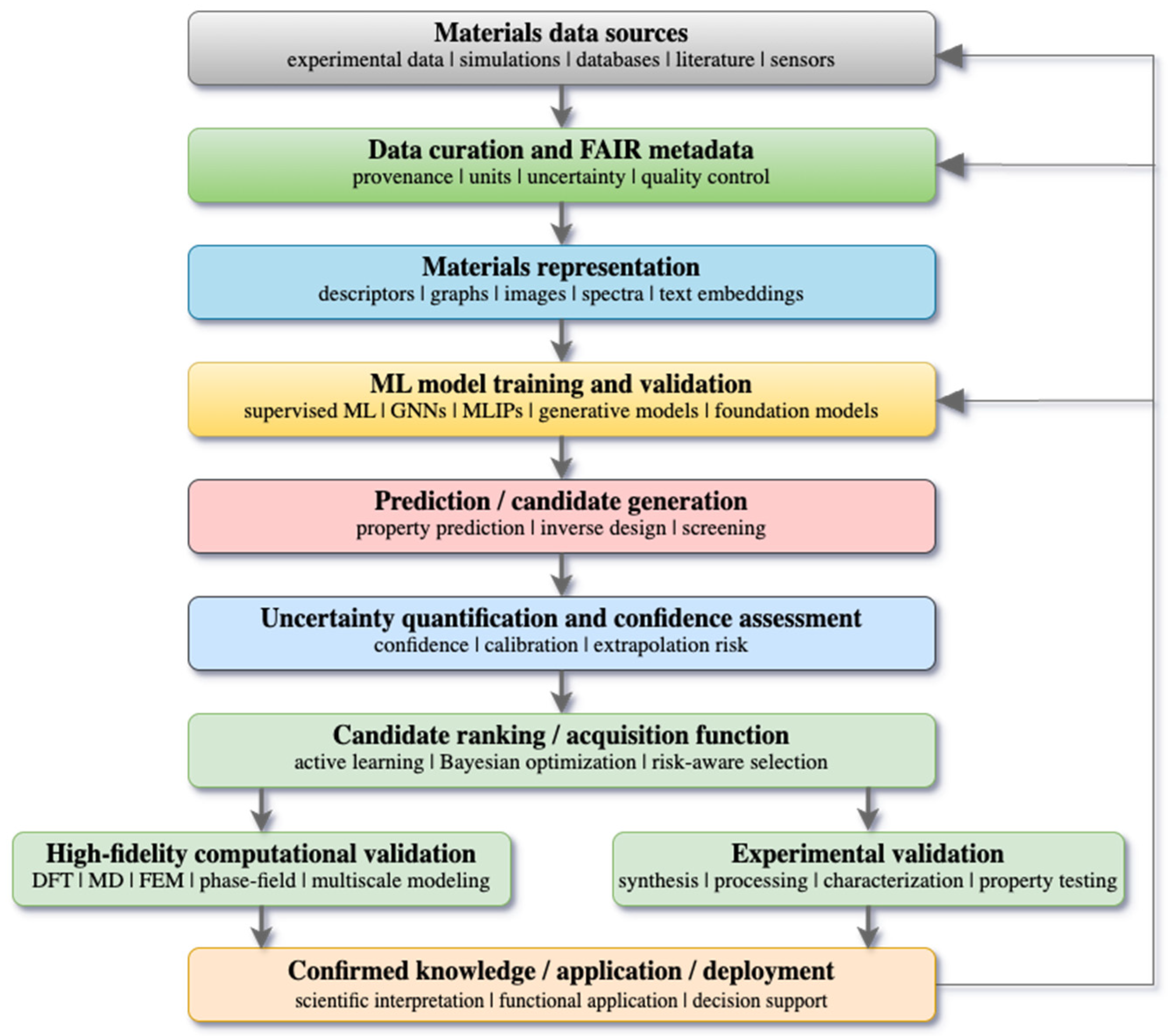

| Term | Definition and Role in Materials Science | Representative Citations |
|---|---|---|
| Artificial intelligence | Computational methods for reasoning, searching, optimization, automation, and decision support in materials workflows. | [8,9] |
| Machine learning | Data-driven algorithms for property prediction, candidate screening, structure–property analysis, and process optimization. | [5,6] |
| Deep learning | Neural-network-based ML for learning complex features from images, spectra, text, graphs, and nonlinear materials data. | [10,11] |
| Materials informatics | Data-centered framework connecting materials databases, descriptors, metadata, workflows, visualization, and domain knowledge. | [1,4] |
| Descriptors and representations | Numerical, symbolic, image, graph, spectral, or text encodings of composition, structure, microstructure, or processing history. | [12,13] |
| Representation learning | Model-based feature learning that reduces manual descriptor design and supports transfer across related materials tasks. | [14,15] |
| Graph neural networks | Neural models for graph-structured materials data, including crystals, molecules, bonds, and local atomic environments. | [14,16] |
| Active learning and Bayesian optimization | Sequential strategies that use prediction and uncertainty to select informative experiments or calculations. | [17,18] |
| Inverse design and generative modeling | Target-driven approaches for proposing compositions, structures, molecules, or processing routes with desired properties. | [19,20] |
| Foundation models and large language models | Large pretrained models adapted for text, formulas, structures, multimodal data, literature mining, and synthesis support. | [21,22] |
| Uncertainty quantification | Estimation of predictive confidence or error to guide extrapolation control, active learning, and risk-aware decisions. | [23,24] |
| Method Family | Typical Input Data | Representative Tasks | Application Domains | Representative Citations |
|---|---|---|---|---|
| Classical supervised learning | Composition, processing variables, scalar descriptors, and tabular property data. | Regression, classification, candidate ranking, and composition–property prediction. | Alloys, steels, glasses, ceramics, and battery materials. | [33,34] |
| Tree ensembles and gradient boosting | Engineered tabular features, experimental descriptors, and spectral descriptors. | Feature importance, nonlinear property prediction, and explainable screening. | Glasses, X-ray absorption near-edge structure (XANES), and additive manufacturing (AM). | [35,36] |
| Gaussian processes and BO | Small experimental or computational datasets with uncertainty estimates. | Sequential experiment selection, inverse process design, and multi-objective optimization. | Microstructure design, alloys, energy materials, and autonomous workflows. | [17,37] |
| Deep neural networks and CNNs | Images, microstructure fields, spectra, and multidimensional simulation outputs. | Microstructure–property prediction, segmentation, feature extraction, and image-based screening. | Composites, microscopy, additively manufactured metals, and heterogeneous media. | [10,38] |
| GNNs and crystal graph models | Crystal and molecular graphs with atoms, bonds, coordination, and periodic neighborhoods. | Formation energy, band gap, density of states (DOS), and structure–property prediction. | Inorganic crystals, molecules, optoelectronic materials, and catalysts. | [14,39] |
| Machine-learned interatomic potentials (MLIPs) | Atomic configurations, energies, forces, and stresses from DFT or higher-level calculations. | Accelerated MD, defect energetics, diffusion, phase behavior, and mechanical response. | Alloys, ceramics, surfaces, interfaces, and functional materials. | [40,41] |
| Generative and inverse-design models | Latent spaces, molecular strings, crystal graphs, formula vectors, and target property vectors. | Candidate generation, constrained optimization, and property-to-structure search. | Two-dimensional materials, organic molecules, polymers, and porous frameworks. | [20,42] |
| Foundation models, LLMs, and NLP | Text corpora, formulas, synthesis descriptions, structures, spectra, and multimodal records. | Property prediction, literature mining, synthesis-route extraction, and knowledge retrieval. | Reticular chemistry, high-entropy alloys, and literature-derived PSPP linkages. | [43,44] |
| Physics-informed and probabilistic learning | Physics-guided descriptors, mechanistic constraints, and uncertainty-aware outputs. | Fatigue prediction, process optimization, reliability assessment, and extrapolation control. | AM metals, structural alloys, thermal transport, and process control. | [24,45] |
| Autonomous and high-throughput workflows | Robotic experiments, combinatorial libraries, high-throughput characterization, and feedback loops. | Closed-loop optimization, rapid characterization, and adaptive experimental design. | Hydrogels, thin films, energy materials, and coatings. | [46,47] |
Disclaimer/Publisher’s Note: The statements, opinions and data contained in all publications are solely those of the individual author(s) and contributor(s) and not of MDPI and/or the editor(s). MDPI and/or the editor(s) disclaim responsibility for any injury to people or property resulting from any ideas, methods, instructions or products referred to in the content. |
© 2026 by the author. Licensee MDPI, Basel, Switzerland. This article is an open access article distributed under the terms and conditions of the Creative Commons Attribution (CC BY) license.
Share and Cite
Kolev, M. Machine Learning in Materials Science: Data-Driven Discovery and Functional Applications. Encyclopedia 2026, 6, 150. https://doi.org/10.3390/encyclopedia6070150
Kolev M. Machine Learning in Materials Science: Data-Driven Discovery and Functional Applications. Encyclopedia. 2026; 6(7):150. https://doi.org/10.3390/encyclopedia6070150
Chicago/Turabian StyleKolev, Mihail. 2026. "Machine Learning in Materials Science: Data-Driven Discovery and Functional Applications" Encyclopedia 6, no. 7: 150. https://doi.org/10.3390/encyclopedia6070150
APA StyleKolev, M. (2026). Machine Learning in Materials Science: Data-Driven Discovery and Functional Applications. Encyclopedia, 6(7), 150. https://doi.org/10.3390/encyclopedia6070150

