


Definition
Individual ambidexterity is the capacity of an individual to engage in both exploration of new knowledge, roles, and opportunities and exploitation of existing skills, experience, and routines in ways that support adaptation and sustained work contribution over time. Amidst the challenges of ageing demographics, digital transformation, and longer working lives, maintaining careers over the long term is becoming increasingly important to people and businesses alike. Individual ambidexterity, as the capacity to combine exploration of new knowledge and opportunities and the use of existing skills and experiences, provides a meaningful framework for thinking about adaptive behavior across career stages. In this article, we integrate insights from the literature on individual ambidexterity with career sustainability, particularly for senior professionals and late-career trajectories. Drawing on research from organizational behavior, leadership, career development, and sustainable careers, the article synthesizes key theoretical foundations, identifies relevant contextual enablers, and highlights emerging research trends. It further examines how leadership, job design, and knowledge management practices shape ambidextrous behavior across extended careers. The framework advanced here is integrative and heuristic rather than predictive. This contribution clarifies how individual ambidexterity may provide the micro-level capability for sustainable careers in ageing and dynamic labor markets by synthesizing fragmented literatures.
1. Introduction
Individual ambidexterity is an individual’s capacity to engage in both exploration and exploitation activities within their work. Exploration involves behaviors oriented toward experimentation, learning, and the pursuit of new ideas, whereas exploitation focuses on efficiency, refinement, and the application of existing knowledge and skills. This fundamental distinction originates in the seminal work of [1], who conceptualized exploration and exploitation as competing yet interdependent modes of learning.
Building on this foundation, research over the past two decades has increasingly conceptualized ambidexterity at the individual level. In this stream, individual ambidexterity is commonly defined as the extent to which employees engage in exploratory and exploitative activities within the same role or across time. Influential contributions by [2,3] emphasize that ambidexterity is enacted through everyday work practices and reflects individuals’ ability to balance continuity and change in response to task and contextual demands.
Contemporary labor markets are characterized by profound demographic, technological, and organizational transformations. Population ageing, extended working lives, and accelerated digitalization have fundamentally altered traditional career patterns, giving rise to more fragmented, non-linear, and prolonged professional trajectories. As a result, organizations increasingly depend on the continued participation of experienced workers, while individuals face growing pressure to remain adaptable, employable, and productive across longer career spans. These dynamics have increased the relevance of career sustainability in organizational research and practice.
Within this context, sustaining a career is no longer understood solely as maintaining employment continuity, but rather as the capacity to remain relevant, engaged, and resilient over time while navigating changing work demands. Recent research emphasizes that sustainable careers depend on the interaction between individual resources, organizational conditions, and broader labor market structures [4,5,6,7]. For senior professionals and late-career workers, this challenge is particularly salient, as accumulated experience must be continuously reconciled with evolving technologies, work practices, and expectations regarding flexibility and innovation.
Against this backdrop, individual ambidexterity has emerged as a promising conceptual lens for understanding adaptive behavior across career stages. While ambidexterity was initially examined at the organizational level, recent scholarship increasingly highlights the role of employees in simultaneously or sequentially engaging in exploration and exploitation as part of their everyday work [3,8]. More recent studies further suggest that individual ambidexterity supports adaptability, learning, and sustained performance in dynamic environments, particularly under conditions of uncertainty and change [8,9,10].
Importantly, emerging research points to the relevance of individual ambidexterity for ageing workforces and late-career contexts, although this connection remains underdeveloped in the literature. Scholars have begun to examine how personal resources such as self-efficacy, proactive personality, and lifelong learning orientation interact with contextual enablers, including leadership styles, innovation climates, and knowledge-sharing practices, to support ambidextrous behavior over time [11,12,13]. However, empirical and conceptual integration between ambidexterity research and the sustainable careers literature remains limited, particularly regarding professional reintegration, post-retirement work, and late-career transitions.
This article addresses this gap by synthesizing and integrating research on individual ambidexterity and career sustainability, with a specific focus on senior professionals and later career stages. By consolidating fragmented theoretical insights, mapping dominant research trends, and presenting an integrative conceptual framework, the entry aims to clarify how individual ambidexterity functions as an adaptive capability that supports sustained organizational participation and professional renewal across extended working lives. The sections that follow examine the conceptual foundations of individual ambidexterity, its relevance for career sustainability, and the contextual conditions under which ambidextrous behavior can be fostered throughout the career life course.
This entry considers the encyclopedia not just as a dissemination medium but as a knowledge-management artefact that informs individuals’ ways of accessing, validating, and integrating knowledge over more extended career paths.
Scope and Review Approach
The article adopts an integrative and narrative review approach appropriate for encyclopedia submissions and synthesis of theoretical content. This is not an exhaustive systematic review, but a consolidation and interpretation of key strands of literature on individual ambidexterity and career sustainability, with an emphasis on late-career stages and senior professionals.
Three inclusion principles guided the selection of the literature: (1) conceptual and empirical works in the areas of exploration, exploitation, ambidexterity or contextual ambidexterity at the individual or leadership levels; (2) studies in the field of sustainable careers, career development, ageing at work, and late-career transitions; (3) recent works, especially those published from 2020 onwards, which captured contemporary developments while preserving earlier foundational works that were, theoretically, essential, such as March’s distinction between exploration and exploitation.
Studies were excluded if they were not directly relevant to the article’s underlying argument, if the citations did not explicitly support the discussion of individual ambidexterity or career sustainability, or if they were redundant with respect to more relevant sources. The synthesis was based on an interpretive logic; convergence in organizational behavior, leadership, career studies, and knowledge management is identified, as is the development of the integrative conceptual framework presented later in the article.
2. Conceptual Foundations of Individual Ambidexterity
The theoretical foundations of individual ambidexterity are rooted in organizational learning and strategic management research, particularly in the longstanding distinction between exploration and exploitation. This distinction was originally articulated by [1], who described exploration as activities associated with variation, experimentation, and innovation, and exploitation as activities focused on refinement, efficiency, and implementation. Ref. [1] framework established the central paradox that continues to shape ambidexterity research: while both modes of action are essential for adaptation and performance, they compete for limited cognitive, temporal, and organizational resources.
Early ambidexterity research conceptualized this tension primarily at the organizational level, focusing on how firms and business units could structure themselves to pursue exploration and exploitation simultaneously. Foundational contributions by [14,15] proposed structural and temporal solutions, such as separating exploratory and exploitative activities across units or over time. While these approaches advanced understanding of organizational adaptability, they treated individuals largely as executors of predefined structures rather than as active agents in managing ambidextrous demands.
A significant conceptual shift occurred with the introduction of contextual ambidexterity by [8]. This perspective emphasized organizational contexts, such as supportive leadership, performance management systems, and social norms, that enable individuals to make discretionary choices about how to divide their time and effort between alignment-oriented (exploitative) and adaptability-oriented (exploratory) activities. Contextual ambidexterity thus positioned employees as central actors in the ambidexterity process, opening the way for a micro-level conceptualization.
Building on this foundation, research on individual ambidexterity emerged to explicitly examine how employees enact exploration and exploitation within their daily work practices. Contributions by [2,3] conceptualized individual ambidexterity as the extent to which employees engage in both exploratory and exploitative activities within the same role or across time. This work demonstrated that ambidexterity is not solely a structural property, but a behavioral capability manifested through task switching, problem-solving approaches, and learning behaviors.
Subsequent research has further refined the construct by emphasizing its cognitive and self-regulatory dimensions. Individual ambidexterity has been described as a dynamic capability that depends on individuals’ ability to manage paradoxical demands, allocate attention flexibly, and regulate competing goals. Rather than being a fixed personality trait, ambidextrous behavior is understood as context-dependent and malleable, shaped by both personal resources and situational cues. Empirical studies highlight the role of psychological resources such as self-efficacy, proactive personality, and learning orientation in facilitating ambidextrous engagement, particularly in complex and uncertain work environments [16,17,18].
The role of leadership and organizational context has also been central to contemporary conceptualizations of individual ambidexterity. Research on ambidextrous leadership, notably by [19], as well as later extensions by [20], emphasizes leaders’ capacity to encourage both exploration and exploitation by flexibly switching between opening and closing leadership behaviors. This line of research underscores that individual ambidexterity is fostered not only by autonomy but also by guidance, feedback, and temporal structuring of work.
More recent scholarship has increasingly linked individual ambidexterity to broader career-related outcomes, including adaptability, employability, and long-term performance. Studies published in the last few years suggest that ambidextrous behavior enables individuals to cope more effectively with digital transformation, role changes, and evolving skill requirements, thereby supporting sustained professional relevance over time [9,10,11,21,22]. These insights reinforce the view of individual ambidexterity as a critical microfoundation connecting organizational contexts with dynamic career trajectories.
Taken together, these developments reflect a shift from structural explanations toward a more integrative, multi-level perspective centered on individual agency. By situating exploration and exploitation within everyday work practices and across the career life course, contemporary ambidexterity theory provides a robust framework for understanding how individuals adapt, learn, and sustain their professional contributions in increasingly complex and ageing labor markets.
3. Individual Ambidexterity and Career Sustainability
The notion of career sustainability has gained prominence in response to profound changes in work trajectories, employment relations, and life-course patterns. Contemporary careers are increasingly characterized by longer duration, greater uncertainty, and recurring transitions, which challenge traditional assumptions of linear progression and stable employment. Within this context, career sustainability refers to an individual’s ability to maintain meaningful, productive, and healthy participation in work over time while continuously adapting to changing personal, organizational, and labor market conditions.
The sustainable careers framework, developed by scholars such as [4] (e.g., [6,7]), conceptualizes career sustainability as a dynamic process shaped by the interaction of three interdependent dimensions: health, happiness, and productivity. These dimensions are embedded within broader temporal, social, and institutional contexts, emphasizing that sustainable careers emerge through ongoing adaptation rather than through static career choices.
Within this framework, adaptability and continuous learning are central individual resources. Individuals are required not only to exploit existing competencies but also to explore new skills, roles, and professional identities as work demands evolve. Individual ambidexterity directly addresses this requirement by explaining how individuals manage the tension between continuity and change across their careers. By balancing exploration and exploitation, ambidextrous individuals are better positioned to sustain performance while avoiding obsolescence in dynamic work environments.
From an Encyclopedia Studies viewpoint, it benefits us to identify how people gain, arrange and stabilize some knowledge inputs which contribute to continual learning. Encyclopedias are a traditional infrastructure for structured knowledge acquisition: they lower search costs, organize entry points, provide curated syntheses through which learners can update mental models without extensive primary-source screening. In this way, we can think of an encyclopedia as a practice of micro-management of knowledge of the individual that nurtures ambidexterity: It permits exploration through an efficient exposure to new domains and new concepts, and it enables exploitation through consolidation of fundamental knowledge and an orderly standardizing of knowledge to be put to good use in practice. This dual role is particularly relevant later in careers, when selective renewal of competencies can be achieved under the limitations of time, cognitive load, and role-based performance expectations.
Recent research increasingly links individual ambidexterity to core outcomes associated with career sustainability, including employability, work engagement, and long-term performance. Studies suggest that individuals who engage in ambidextrous behaviors are more capable of updating their skill sets while leveraging accumulated experience, thereby enhancing their perceived and actual employability [9,23]. This dual capacity is particularly relevant in contexts of digital transformation, where continuous technological change places renewed emphasis on learning agility alongside domain-specific expertise [10].
Importantly, the relevance of individual ambidexterity becomes more pronounced across later career stages. Senior professionals often possess substantial stocks of tacit knowledge and experiential capital, which constitute a strong basis for exploitation. At the same time, extended working lives and delayed retirement increase the need for ongoing exploration, whether through skill renewal, role adaptation, or engagement in new forms of work. Research on ageing and work highlights that the ability to flexibly integrate learning and experience is a key determinant of sustained motivation, well-being, and productivity in later career phases [13,24].
From this perspective, individual ambidexterity can be understood as a mechanism that supports late-career sustainability by enabling professionals to reconcile stability with change. Rather than framing exploration as a threat to established expertise, ambidextrous behavior allows senior workers to use accumulated knowledge as a platform for adaptation and innovation. This logic aligns with emerging evidence that late-career development is less about radical reinvention and more about recombination, transfer, and selective renewal of competencies [11,12].
At the same time, sustainable careers research emphasizes that individual resources alone are insufficient. Organizational contexts play a decisive role in shaping whether ambidextrous behaviors are supported or constrained over time. Leadership styles, job design, learning opportunities, and knowledge-sharing practices influence the extent to which individuals can engage in exploration without jeopardizing performance expectations tied to exploitation. Recent studies suggest that supportive and ambidextrous leadership, combined with inclusive age management practices, enhances the sustainability of ambidextrous behavior across career stages [9,18].
In sum, individual ambidexterity provides a valuable conceptual bridge between ambidexterity theory and the sustainable careers literature. By framing exploration and exploitation as complementary processes enacted across the career life course, this perspective helps to explain how individuals sustain employability, well-being, and productive contribution over extended working lives [25,26,27]. This integration is particularly relevant for understanding late-career transitions and the continued organizational participation of senior professionals, a topic that remains underexplored in existing research and is addressed in the subsequent sections of this entry [28,29,30].
This reading is also consistent with the dominant perspectives in career development theory, especially life-span and life-course perspectives that regard careers as changing processes in relation to adaptation, role transitions, and changing person–environment relations over time. In that light, career sustainability does not merely refer to employment retention, but also the ability to regenerate competences and reposition roles within a series of professional contexts. Individual ambidexterity contributes to these perspectives by indicating that continuity and change is behaviorally to be managed through the joint enactment of exploration and exploitation.
4. Individual Ambidexterity in Late Careers and Senior Professionals
Late-career stages are increasingly characterized by prolonged participation in the labor market, diversified work arrangements, and recurrent transitions, including career reorientation, post-retirement employment, and professional reintegration. This characterization is consistent with life-course and sustainable career perspectives, which emphasize that careers unfold through temporally embedded transitions shaped by individual agency, organizational opportunities, and institutional conditions. These developments challenge deficit-based views of ageing at work and call for conceptual frameworks that recognize the adaptive potential of senior professionals. Within this context, individual ambidexterity offers a valuable lens for understanding how experienced workers sustain their contribution while responding to evolving organizational and technological demands.
Research on ageing and work highlights that senior professionals possess substantial stocks of human, social, and experiential capital accumulated over long careers. This accumulated capital provides a strong foundation for exploitative activities, such as the application of tacit knowledge, mentoring, and the stabilization of organizational routines. At the same time, extended working lives and accelerated digital transformation require ongoing engagement in exploratory behaviors, including skill renewal, learning new technologies, and adapting to changing roles. Studies on late-career development increasingly emphasize that successful ageing at work depends on the capacity to integrate these two demands rather than privileging one at the expense of the other [13,24,31].
From an ambidexterity perspective, senior professionals are not inherently disadvantaged in exploratory activities, as is often implied by age-related stereotypes. Rather, recent evidence suggests that experience can enhance exploratory depth by enabling individuals to recombine existing knowledge in novel ways. In later career stages, exploration frequently takes the form of incremental innovation, problem reframing, and knowledge integration rather than radical experimentation, aligning closely with ambidextrous modes of learning [11,31,32]. Such forms of exploration complement exploitation and support sustained effectiveness in complex work environments.
Individual ambidexterity is particularly relevant in contexts of career transition and professional reintegration. Late-career transitions, whether voluntary or involuntary, require individuals to simultaneously draw on past experience and acquire new competencies to meet changing labor market expectations. Research on post-retirement work and bridge employment indicates that individuals who can flexibly combine exploration and exploitation are better positioned to maintain work engagement, identity continuity, and perceived employability during these transitions [16,23,33]. Ambidextrous behavior thus facilitates continuity amid change, supporting smoother reintegration into organizational roles.
Psychological resources play a critical role in enabling ambidextrous behavior among senior professionals. Self-efficacy, proactive personality, and a growth-oriented regulatory focus have been identified as key enablers of learning and adaptation in later career stages. Empirical studies suggest that these resources buffer the potential negative effects of age-related stereotypes and support engagement in exploratory activities without undermining confidence in established expertise [12,13]. In this sense, individual ambidexterity is closely linked to motivational processes that sustain engagement and well-being over extended working lives.
Organizational contexts further shape the extent to which senior professionals can enact ambidextrous behavior. Inclusive age management practices, flexible job design, and opportunities for knowledge sharing create conditions under which exploration and exploitation can be balanced effectively. Leadership approaches that value experience while encouraging learning are particularly important in mitigating tensions between stability and change. Recent research highlights that ambidextrous and transformational leadership styles support older workers’ willingness to engage in new activities while continuing to leverage their accumulated expertise [18,19,34].
Despite growing recognition of these dynamics, the integration of individual ambidexterity into research on late careers remains limited. Much of the ambidexterity literature continues to focus on early- and mid-career employees, while studies on ageing and work have only recently begun to incorporate ambidexterity-related constructs. This fragmentation has constrained the development of comprehensive models explaining how senior professionals sustain performance, employability, and well-being over time. Addressing this gap requires a more explicit linkage between ambidexterity theory and life-course perspectives on work and careers.
In summary, individual ambidexterity provides a powerful conceptual framework for understanding adaptive behavior in late careers and among senior professionals. By enabling the integration of accumulated experience with continuous learning, ambidextrous behavior supports sustained organizational participation, effective career transitions, and professional reintegration in ageing workforces [35,36,37]. This perspective challenges deficit-oriented views of ageing at work and underscores the importance of organizational and leadership practices that foster ambidexterity across the entire career life course.
5. Contextual Enablers of Individual Ambidexterity
Although individual ambidexterity is enacted at the level of the employee, a substantial body of research emphasizes that its emergence and sustainability are strongly shaped by organizational context. Ambidextrous behavior does not occur in isolation; rather, it is enabled or constrained by leadership approaches, job design, knowledge management practices, and the broader innovation climate. Understanding these contextual enablers is essential for explaining how individual ambidexterity can be fostered across career stages, particularly among senior professionals.
5.1. Leadership as an Enabler of Individual Ambidexterity
Leadership plays a central role in shaping the conditions under which individuals balance exploration and exploitation [38,39]. Research on ambidextrous leadership highlights leaders’ capacity to flexibly alternate between behaviors that encourage experimentation, autonomy, and learning, and behaviors that emphasize discipline, goal clarity, and efficiency. Seminal work by [19] conceptualizes this leadership style as a dynamic process of “opening” and “closing” behaviors aligned with situational demands.
Subsequent research extended this perspective by demonstrating that ambidextrous and transformational leadership styles support employees’ willingness and ability to engage in both exploratory and exploitative activities. Studies by [13,34] suggest that leadership sensitivity to temporal dynamics, individual needs, and career stages is particularly important in ageing workforces. For senior professionals, leadership that values experience while legitimizing learning and experimentation reduces the perceived risks associated with exploration and supports sustained ambidextrous engagement.
5.2. Job Design, Autonomy, and Performance Expectations
Job design and autonomy are key structural conditions influencing individual ambidexterity [40]. Roles that provide discretion over task execution, time allocation, and problem-solving approaches enable individuals to shift flexibly between exploration and exploitation. Research on contextual ambidexterity emphasizes that autonomy must be accompanied by clear performance expectations and accountability mechanisms to prevent role overload or role ambiguity [8].
For senior professionals, job designs that allow for role adaptation—such as mentoring responsibilities, project-based work, or hybrid roles combining operational and developmental tasks—are particularly conducive to ambidextrous behavior. Such designs enable the exploitation of accumulated expertise while creating space for exploratory activities that support skill renewal and continued engagement. Recent studies indicate that flexible and inclusive job design is positively associated with sustained motivation and performance in later career stages [9,18].
5.3. Knowledge Sharing and Knowledge Management Practices
Knowledge management constitutes a critical contextual enabler of individual ambidexterity [41]. Exploration and exploitation are inherently knowledge-based processes, relying on the creation, transfer, and application of both explicit and tacit knowledge. Organizational practices that promote knowledge sharing, such as communities of practice, cross-generational collaboration, and learning-oriented HR systems, facilitate ambidextrous behavior by lowering barriers to learning and innovation.
For senior professionals, knowledge-sharing practices serve a dual function. On the one hand, they support exploitation by allowing experienced workers to transfer and apply accumulated knowledge. On the other hand, they foster exploration by exposing individuals to new perspectives, technologies, and practices. Recent research underscores that inclusive knowledge management systems mitigate age-related segmentation and enhance ambidextrous engagement across career stages [11,12].
This knowledge-management layer can identify encyclopedias as an organizing device of codified knowledge. As far as being codified, they represent a codification strategy, translating widely dispersed knowledge into structured, widely accessible entries. At an individual level, encyclopedia consultation may serve as a boundary-spanning learning routine: practitioners can quickly collect common vocabularies, clarify conceptual distinctions, and benchmark understanding against curated definitions. This structured codified input for senior professionals in particular can supplement tacit expertise as it facilitates just-in-time updating and recombination of accumulated knowledge, thereby supporting ambidextrous engagement without compromising identity continuity or role credibility.
5.4. Innovation Climate and Psychological Safety
An organization’s innovation climate and level of psychological safety significantly influence individual ambidexterity. Innovation climates characterized by openness to change, tolerance for error, and support for learning encourage individuals to experiment without fear of negative consequences. Psychological safety, in particular, has been identified as a key mechanism through which individuals feel permitted to engage in exploratory activities while maintaining exploitative performance standards.
Recent studies suggest that psychological safety is especially important for senior professionals, who may face heightened concerns about competence judgments and age-related stereotypes [42]. Supportive climates that normalize learning across all career stages reduce these concerns and promote sustained ambidextrous behavior [13,18]. In such environments, exploration is reframed as a legitimate component of professional contribution rather than as a signal of declining expertise.
5.5. Integrating Contextual Enablers Across Career Stages
Taken together, leadership, job design, knowledge management, and innovation climate form an interconnected system of contextual enablers that shape individual ambidexterity. This integrative view is consistent with the contextual ambidexterity perspective advanced by [8], which emphasizes that organizational contexts can empower employees to flexibly allocate effort between alignment-oriented and adaptability-oriented activities. It is also aligned with the broader ambidexterity literature arguing that ambidextrous outcomes depend on the interplay between multiple organizational mechanisms rather than on isolated factors [15,43].
At the micro–macro interface, research on ambidextrous leadership provides a complementary lens for understanding how contextual elements are activated and coordinated. The opening–closing leadership framework proposed by [19], and later extensions emphasizing the importance of situational and temporal fit [34], supports the view that leadership behaviors can orchestrate employees’ shifts between exploratory and exploitative activity patterns. In parallel, studies on individual ambidexterity highlight that personal resources such as self-efficacy and proactive personality interact with contextual signals, such as autonomy, performance expectations, and knowledge-sharing norms, to enable or constrain ambidextrous behavior [3,17,18].
From a career-stage perspective, integrating contextual enablers becomes particularly important in ageing workforces, where sustained ambidexterity must be balanced with considerations of well-being, motivation, and identity continuity. Research on work and ageing emphasizes that supportive environments can mitigate age-related stereotypes and facilitate continued learning and adaptability in later career stages [13,31]. Recent contributions further suggest that age-inclusive practices, such as flexible role design, intergenerational knowledge exchange, and learning-oriented climates, strengthen the conditions under which senior professionals can combine the exploitation of accumulated experience with exploratory skill renewal [9,11,12,44].
Overall, the integration of contextual enablers across career stages reinforces a central implication of contemporary ambidexterity theory: individual ambidexterity is best understood as a dynamic capability emerging from the interaction between individual agency and an enabling organizational context. This integrated view provides a foundation for the conceptual framework presented in the next section, which synthesizes how leadership, knowledge processes, and innovation-supporting conditions jointly foster ambidexterity and contribute to sustainable careers in later professional phases.
6. An Integrative Conceptual Framework
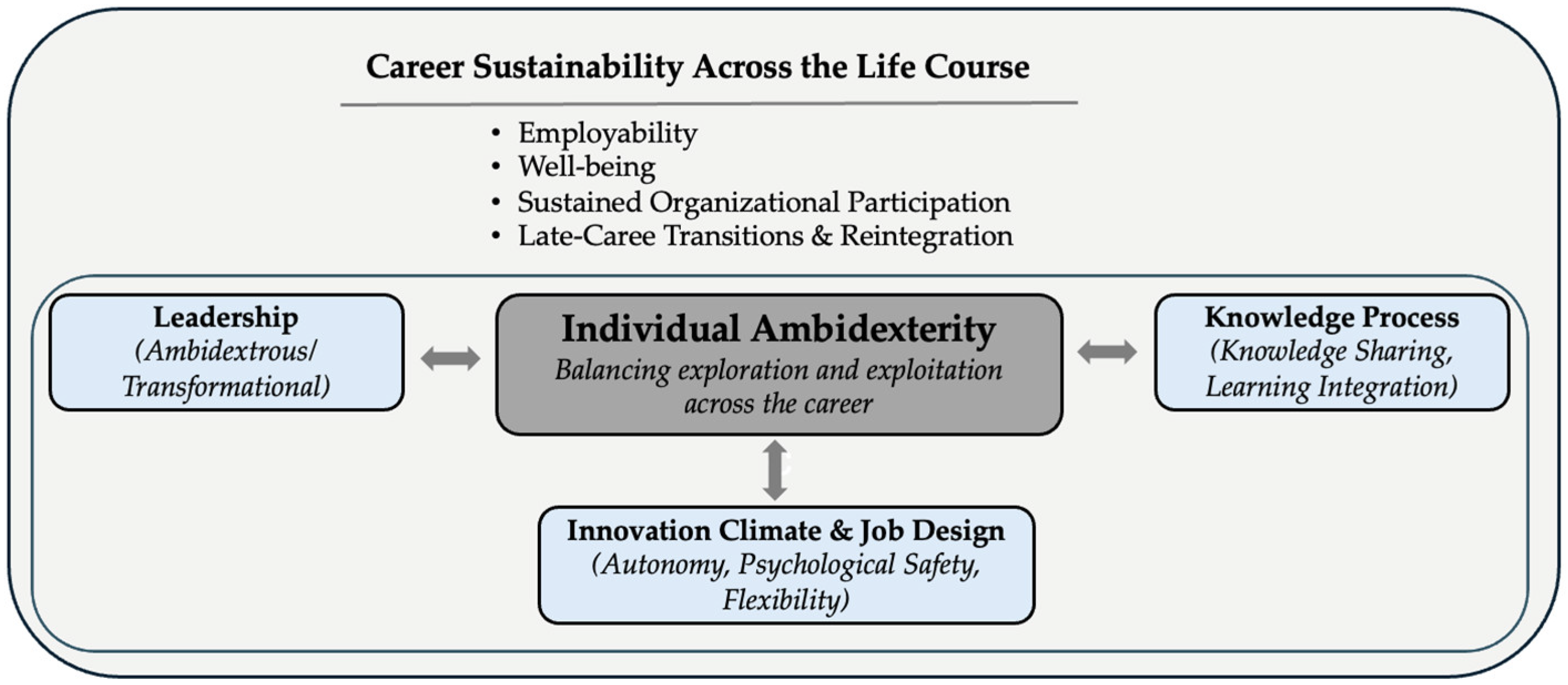
The integrative conceptual framework presented in Figure 1 synthesizes the main theoretical insights discussed in this entry and positions individual ambidexterity as a central mechanism linking individual resources, organizational contexts, and career sustainability across the life course. Rather than specifying causal relationships, the framework provides a structured representation of how exploration and exploitation are enacted by individuals within enabling organizational environments and how these dynamics unfold over extended career trajectories.
Figure 1.
Integrative conceptual framework of individual ambidexterity and career sustainability.
At the core of the framework lies individual ambidexterity, conceptualized as the capacity to balance and integrate exploration and exploitation in everyday work practices. Consistent with micro-level ambidexterity research, the framework emphasizes that this balance is not static but dynamically adjusted in response to task demands, career stage, and contextual cues [3,8]. Individual ambidexterity is therefore represented as an integrative capability that allows continuity and change to coexist throughout the career life course.
Surrounding the individual level, the framework highlights the role of organizational contextual enablers, including leadership, knowledge processes, and innovation-supportive job design. Leadership is depicted as a key coordinating mechanism that legitimizes both exploratory and exploitative behaviors and signals when each mode is appropriate [19,34]. Knowledge processes, such as knowledge sharing, learning, and integration, support the effective mobilization of both accumulated experience and new insights, while innovation climates and flexible job design create the psychological and structural conditions necessary for ambidextrous engagement.
Importantly, the framework is explicitly embedded within a career sustainability perspective, represented as an overarching life-course context rather than as a set of immediate outcomes. Career sustainability is conceptualized in terms of employability, well-being, sustained organizational participation, and late-career transitions and reintegration. This positioning reflects the sustainable careers literature, which emphasizes that career outcomes emerge cumulatively over time through the interaction of individual and contextual factors [4,7].
A key contribution of the framework is its explicit consideration of late-career stages and senior professionals. In contrast to deficit-oriented views of ageing at work, the model highlights how individual ambidexterity enables experienced workers to leverage accumulated expertise while selectively engaging in exploration to remain adaptive and relevant. By situating ambidexterity within a life-course and sustainability logic, the framework illustrates how stability and renewal can be jointly sustained across extended working lives.
Overall, the integrative framework serves as a conceptual anchor for entry, bringing together previously fragmented strands of research into a coherent structure. It reinforces the view that individual ambidexterity is best understood as a dynamic capability emerging from the interaction between personal agency and enabling organizational contexts, with implications that extend beyond short-term performance to long-term career sustainability. This framework thus provides a foundation for the implications and future research directions discussed in the subsequent section.
7. Implications for Organizations, Policy, and Future Research
The integrative framework presented in this entry has important implications for organizations, policymakers, and the future development of research on individual ambidexterity and career sustainability. By positioning individual ambidexterity as a dynamic capability enacted across the career life course, the framework challenges static and age-neutral approaches to talent management and highlights the need for more inclusive and adaptive strategies.
7.1. Implications for Organizations
For organizations, the framework underscores that sustaining performance and innovation in ageing workforces depends not only on retaining experienced employees, but also on creating conditions that enable them to remain adaptive over time. Individual ambidexterity provides a conceptual basis for rethinking human resource practices aimed at senior professionals, shifting the focus from deficit-oriented assumptions to the active integration of experience and learning.
Leadership development emerges as a central lever. Research on ambidextrous and transformational leadership suggests that leaders who flexibly balance support for exploration with guidance for exploitation are better positioned to foster sustained ambidextrous behavior across career stages [18,19,34]. For senior professionals, such leadership reduces the perceived risks associated with learning and experimentation, while legitimizing the continued exploitation of accumulated expertise.
Job design and work organization also play a critical role. Flexible roles that combine operational responsibilities with mentoring, project-based work, or knowledge integration activities enable senior employees to enact ambidexterity in ways that align with their experience and career stage. Inclusive knowledge management practices, particularly those that promote intergenerational exchange, further support the dual processes of exploration and exploitation, contributing to knowledge continuity and organizational learning [11,12].
7.2. Implications for Policy and Sustainable Work Systems
At the policy level, the framework aligns with broader debates on active ageing, extended working lives, and sustainable employment systems. Policies aimed at prolonging labor market participation often emphasize employability and skill renewal but may overlook the value of experience-based exploitation. Individual ambidexterity offers a lens for integrating these priorities by highlighting how learning and experience can be jointly mobilized across the life course.
Age-inclusive labor market policies that support lifelong learning, flexible retirement pathways, and post-retirement employment can create institutional conditions conducive to ambidextrous behavior. Such policies are consistent with research emphasizing that sustainable careers depend on coordinated action across organizational, institutional, and individual levels [4,7]. By recognizing senior professionals as adaptive contributors rather than as declining resources, policy frameworks can better support productive and meaningful extended working lives.
7.3. Directions for Future Research
Despite growing interest in individual ambidexterity, several avenues for future research remain underexplored. First, stronger conceptual and empirical integration between ambidexterity research and the sustainable careers literature is needed. While both streams emphasize adaptation over time, they have largely evolved in parallel. Future studies could explicitly examine how ambidextrous behavior contributes to the health, happiness, and productivity dimensions of career sustainability across different career stages.
Second, research on individual ambidexterity would benefit from greater attention to temporal dynamics. Longitudinal and life-course approaches are particularly well suited to capturing how exploration and exploitation are rebalanced over extended careers, including during transitions such as professional reintegration, career reorientation, and post-retirement work [23,31]. Such approaches would help to clarify whether and how ambidextrous behavior changes in response to ageing, experience accumulation, and shifting motivational priorities.
Third, future research should further explore contextual variation. Comparative studies across sectors, institutional settings, and cultural contexts could illuminate how organizational and societal conditions shape opportunities for ambidextrous engagement among senior professionals. Public-sector organizations, small and medium-sized enterprises, and non-traditional employment arrangements remain underrepresented in current ambidexterity research.
Finally, there is scope for refining the conceptualization of individual ambidexterity itself. Recent work has called for greater clarity regarding its boundaries, potential costs, and unintended consequences, such as overload or role conflict [17,18]. Addressing these issues is essential for developing more balanced and realistic models of ambidexterity that account for well-being and sustainability alongside performance.
8. Conclusions
This entry has examined individual ambidexterity as a central adaptive capability for sustaining careers in contemporary and ageing labor markets. By integrating insights from ambidexterity theory, organizational behavior, leadership research, and the sustainable careers literature, the entry has positioned individual ambidexterity as a key micro-level mechanism through which individuals navigate the enduring tension between exploration and exploitation across extended career trajectories.
The analysis highlights that individual ambidexterity is not a static trait, but a dynamic and context-dependent capability shaped by the interaction between personal resources and organizational conditions. Leadership, job design, knowledge management practices, and innovation-supportive climates jointly influence whether individuals can flexibly combine learning and experience in their daily work. This interaction becomes particularly salient in later career stages, where professionals must reconcile accumulated expertise with ongoing adaptation to technological, organizational, and labor market change.
By explicitly focusing on senior professionals and late-career contexts, this entry contributes to a more inclusive understanding of ambidexterity that challenges deficit-oriented views of ageing at work. Individual ambidexterity is shown to support sustained employability, meaningful organizational participation, and professional reintegration by enabling experienced workers to leverage prior knowledge while selectively engaging in exploration. In this sense, ambidexterity functions as a mechanism of continuity through change, aligning stability with renewal over the career life course.
Overall, the integrative perspective advanced in this entry underscores the relevance of individual ambidexterity for both theory and practice. Conceptually, it bridges previously fragmented research streams and situates ambidexterity within a life-course and sustainability framework. Practically, it highlights the importance of age-inclusive organizational and policy contexts that recognize and foster the adaptive potential of experienced workers. As workforces continue to age and careers become increasingly prolonged and non-linear, individual ambidexterity offers a valuable lens for understanding how careers can be sustained, renewed, and extended in dynamic work environments.
In addition to its contribution to career sustainability research, this entry draws Encyclopedia Studies attention by conceptualizing the encyclopedia as an active knowledge-management instrument, rather than a passive reference source. By illustrating the role such learning spaces play in facilitating structured learning, knowledge integration, and ambidextrous competence development, this entry demonstrates how encyclopedic knowledge infrastructures can contribute to the individual’s ability to adapt when working long-term.
Funding
This research received no external funding.
Institutional Review Board Statement
Not applicable.
Informed Consent Statement
Not applicable.
Data Availability Statement
No new data were created or analyzed in this study. Data sharing is not applicable to this article.
Acknowledgments
During the preparation of this study, DeepL Translator (DeepL SE, 2017) was used for some purposes in selected sections of the manuscript (e.g., initial drafts of Section 1). The author has reviewed and edited the output and takes full responsibility for the content of this publication.
Conflicts of Interest
The author declares no conflicts of interest.
References
- March, J.G. Exploration and exploitation in organizational learning. Organ. Sci. 1991, 2, 71–87. [Google Scholar] [CrossRef] [Scilit]
- Mom, T.J.; Van Den Bosch, F.A.; Volberda, H.W. Investigating managers’ exploration and exploitation activities: The influence of top-down, bottom-up, and horizontal knowledge inflows. J. Manag. Stud. 2007, 44, 910–931. [Google Scholar] [CrossRef] [Scilit]
- Mom, T.J.; Fourné, S.P.; Jansen, J.J. Managers’ work experience, ambidexterity, and performance: The contingency role of the work context. Hum. Resour. Manag. 2015, 54, s133–s153. [Google Scholar] [CrossRef] [Scilit]
- De Vos, A.; Van der Heijden, B.I.J.M.; Akkermans, J. Sustainable careers: Towards a conceptual model. Sustainable Careers across the Lifespan: A Contemporary Perspective. J. Vocat. Behav. 2020, 117, 103196. [Google Scholar] [CrossRef] [Scilit]
- Jacobs, S.; Akkermans, J.; Van der Heijden, B.; De Vos, A. Career sustainability in the gig economy: A delicate balancing act. In Research Handbook of Careers in the Gig Economy; Edward Elgar Publishing: Cheltenham, UK, 2025; pp. 51–66. [Google Scholar]
- Akkermans, J.; Kubasch, S. Trending topics in careers: A review and future research agenda. Career Dev. Int. 2017, 22, 586–627. [Google Scholar] [CrossRef] [Scilit]
- Donald, W.E.; Van der Heijden, B.I.; Baruch, Y. Introducing a sustainable career ecosystem: Theoretical perspectives, conceptualization, and future research agenda. J. Vocat. Behav. 2024, 151, 103989. [Google Scholar] [CrossRef] [Scilit]
- Birkinshaw, J.; Gupta, K. Clarifying the distinctive contribution of ambidexterity to the field of organization studies. Acad. Manag. Perspect. 2013, 27, 287–298. [Google Scholar] [CrossRef] [Scilit]
- Varandas, C.; Fernandes, C.I.; Veiga, P.M. Human resource management in ambidextrous organisations―A systematic literature review. Technol. Soc. 2024, 77, 102504. [Google Scholar] [CrossRef] [Scilit]
- Zhou, Q.; Wang, S.; Wang, L.; Xu, W. Knowledge governance and innovation ambidexterity in the platform context: Exploring the role of knowledge transformation. J. Knowl. Manag. 2025, 29, 1301–1329. [Google Scholar] [CrossRef] [Scilit]
- Ceptureanu, S.I.; Ferraro, G.; Ceptureanu, E.G.; Georgescu, B. Individual learning ambidexterity behavior and individual job performance in services: The role of organizational structure. Rev. Manag. Sci. 2024, 19, 1–36. [Google Scholar]
- Khairi, S.M.M.; Rozali, N.; Sobry, S.C.; Nor, N.M. Fostering Resilience in Cooperative Employees: Evaluating the role of Ability, Motivation, and Opportunity (AMO). Environ. Behav. Proc. J. 2025, 10, 179–186. [Google Scholar] [CrossRef] [Scilit]
- Zacher, H.; Rudolph, C.W. Environmental knowledge is inversely associated with climate change anxiety. Clim. Change 2023, 176, 32. [Google Scholar] [CrossRef] [Scilit]
- O’Reilly, C.A., III; Tushman, M.L. Organizational ambidexterity in action: How managers explore and exploit. Calif. Manag. Rev. 2011, 53, 5–22. [Google Scholar] [CrossRef] [Scilit]
- O’Reilly, C.A., III; Tushman, M.L. Organizational ambidexterity: Past, present, and future. Acad. Manag. Perspect. 2013, 27, 324–338. [Google Scholar] [CrossRef] [Scilit]
- Caniëls, M.C.; Semeijn, J.H.; Renders, I. Mind the mindset! The role of transformational leadership in the relation between proactivity and engagement at work. J. Leadersh. Organ. Stud. 2017, 24, 115. [Google Scholar]
- Kostopoulos, K.; Mammassis, C.; Papalexandris, A. A systematic literature review of organizational innovation: Exploration, exploitation, and ambidexterity through a multilevel lens. Exploitation, and Ambidexterity through a Multilevel Lens. J. Manag. Stud. 2020, 57, 1–28. [Google Scholar]
- Lindsey-Hall, K.K.; Marti, C.L.; Boylan, N.M.; Baker, T.L.; Ogilvie, J.L. Frontline ambidexterity: A systematic review and future research agenda. J. Pers. Sell. Sales Manag. 2024, 44, 50–73. [Google Scholar] [CrossRef] [Scilit]
- Rosing, K.; Frese, M.; Bausch, A. Explaining the heterogeneity of the leadership-innovation relationship: Ambidextrous leadership. Leadersh. Q. 2011, 22, 956–974. [Google Scholar] [CrossRef] [Scilit]
- Zacher, H. Successful aging at work. Work Aging Retire 2015, 1, 4–25. [Google Scholar] [CrossRef] [Scilit]
- Trieu, H.D.; Nguyen, P.V.; Tran, K.T.; Vrontis, D.; Ahmed, Z. Organisational resilience, ambidexterity and performance: The roles of information technology competencies, digital transformation policies and paradoxical leadership. Int. J. Organ. Anal. 2024, 32, 1302–1321. [Google Scholar] [CrossRef] [Scilit]
- Goraya, M.A.S.; Yaqub, M.Z.; Khan, M.A.; Akram, M.S.; Alofaysan, H. Transforming performance: How agility, response, resilience and support shape success in digital strategies. Inf. Technol. People 2026, 39, 325–353. [Google Scholar] [CrossRef] [Scilit]
- Yawson, M.T.; Ngidi, L.Z.; Hanu, C.; Zar, D.M. Balancing contracts expectations and professional identity: Conscientiousness and organisational support as enablers for career resilience. Int. J. Res. Bus. Soc. Sci. 2024, 13, 248–261. [Google Scholar] [CrossRef] [Scilit]
- Beier, M.E.; Kanfer, R.; Kooij, D.T.; Truxillo, D.M. What’s age got to do with it? A primer and review of the workplace aging literature. Pers. Psychol. 2022, 75, 779–804. [Google Scholar] [CrossRef] [Scilit]
- Nicholls, H.; Nicholls, M.; Tekin, S.; Lamb, D.; Billings, J. The impact of working in academia on researchers’ mental health and well-being: A systematic review and qualitative meta-synthesis. PLoS ONE 2022, 17, e0268890. [Google Scholar] [CrossRef] [Scilit]
- Blustein, D.L.; Lysova, E.I.; Duffy, R.D. Understanding decent work and meaningful work. Annu. Rev. Organ. Psychol. Organ. Behav. 2023, 10, 289–314. [Google Scholar] [CrossRef] [Scilit]
- Cohen-Scali, V.; Drabik-Podgórna, V.; Podgórny, M.; Duarte, M.E.; Guichard, J.; Aisenson, G.; Antonio, D.S. New perspectives for life-design interventions in the anthropocene context. Aust. J. Career Dev. 2025, 34, 5–17. [Google Scholar] [CrossRef] [Scilit]
- Fasbender, U.; Vignoli, M.; Topa, G. Understanding how aging experiences shape late career development. Career Dev. Q. 2022, 70, 174–189. [Google Scholar] [CrossRef] [Scilit]
- Amarnani, R.K.; Bordia, P.; Garcia, P.R.; Sykes-Bridge, I. You can leave the younger workers out of it! Toward a centered paradigm for studying older workers’ employment relationships and late-career dynamics. Group Organ. Manag. 2023, 48, 436–467. [Google Scholar] [CrossRef] [Scilit]
- Jokisaari, M.; Ruokolainen, M.; Vuori, J. The moderating role of social capital for late-career management intervention effects on older employees’ work engagement. Hum. Resour. Manag. 2024, 63, 463–476. [Google Scholar] [CrossRef] [Scilit]
- Kanfer, R.; Ackerman, P.L. Aging, adult development, and work motivation. Acad. Manag. Rev. 2004, 29, 440–458. [Google Scholar] [CrossRef] [Scilit]
- Ackerman, P.L.; Kanfer, R. Cognitive, affective, and conative aspects of adult intellect within a typical and maximal performance framework. In Motivation, Emotion, and Cognition; Routledge: New York, NY, USA, 2004; pp. 133–156. [Google Scholar]
- Stamov-Roßnagel, C.; Hertel, G. Older workers’ motivation: Against the myth of general decline. Manag. Decis. 2010, 48, 894–906. [Google Scholar] [CrossRef] [Scilit]
- Beehr, T.A.; Bennett, M.M. Working after retirement: Features of bridge employment and research directions. Work Aging Retire 2015, 1, 112–128. [Google Scholar] [CrossRef] [Scilit]
- Zacher, H.; Rosing, K. Ambidextrous leadership and team innovation. Leadersh. Organ. Dev. J. 2015, 36, 54–68. [Google Scholar] [CrossRef] [Scilit]
- Joseph, J.; Firmin, S.; Oseni, T.; Stranieri, A. Decoding Employee ambidexterity: Understanding drivers, constraints, and performance implications for thriving in the evolving work landscapes―A scoping review. Heliyon 2023, 9, e22493. [Google Scholar] [CrossRef] [Scilit]
- Lee, A.N.; Nie, Y. Future-Oriented Learning and Continuous Skills Development: Developing a Resilient Workforce in Changing Times. In Future-Oriented Learning and Skills Development for Employability; Springer Nature Singapore: Singapore, 2024; pp. 3–15. [Google Scholar]
- Andriopoulos, C.; Lewis, M.W. Managing innovation paradoxes: Ambidexterity lessons from leading product design companies. Long Range Plan. 2010, 43, 104–122. [Google Scholar] [CrossRef] [Scilit]
- Liu, Y.; Zhao, X. Successful implementation of value-based selling: A value co-creation and dynamic capabilities perspective. J. Bus. Ind. Mark. 2021, 36, 372–389. [Google Scholar] [CrossRef] [Scilit]
- Paiuc, D.; Săniuță, A.; Teacu Parincu, A.M. Strategic intelligence: A semantic leadership perspective. Encyclopedia 2024, 4, 785–798. [Google Scholar] [CrossRef] [Scilit]
- Cioffi, G.; Balducci, C.; Toderi, S. Stress-Preventive Management Competencies. Encyclopedia 2025, 5, 46. [Google Scholar] [CrossRef] [Scilit]
- Abboodi, B.; Pileggi, S.F.; Bharathy, G. Social networks in crisis management: A literature review to address the criticality of the challenge. Encyclopedia 2023, 3, 1157–1177. [Google Scholar] [CrossRef] [Scilit]
- Li, Y.; Shao, Y.; Wang, M.; Fang, Y.; Gong, Y.; Li, C. From inclusive climate to organizational innovation: Examining internal and external enablers for knowledge management capacity. J. Appl. Psychol. 2022, 107, 2285. [Google Scholar] [CrossRef] [Scilit]
- Devis-Rozental, C. Developing the socio-emotional intelligence of doctoral students. Encyclopedia 2023, 3, 1178–1186. [Google Scholar] [CrossRef] [Scilit]
Disclaimer/Publisher’s Note: The statements, opinions and data contained in all publications are solely those of the individual author(s) and contributor(s) and not of MDPI and/or the editor(s). MDPI and/or the editor(s) disclaim responsibility for any injury to people or property resulting from any ideas, methods, instructions or products referred to in the content. |
© 2026 by the author. Licensee MDPI, Basel, Switzerland. This article is an open access article distributed under the terms and conditions of the Creative Commons Attribution (CC BY) license.