


Definition
Deepfakes have emerged as one of the most significant developments in contemporary computational media, representing a sophisticated convergence of machine learning, computer vision, and audiovisual synthesis. Enabled primarily by deep neural networks such as generative adversarial networks (GANs) and transformer-based architectures, Deepfakes are realistic video fabrications through sound and image alteration and substitution that synthesises human likeness, speech, and behaviours. Deepfakes function simultaneously as creative tools, political instruments, security risks, and epistemic disruptors. They have generated widespread scholarly, regulatory, and public concern by contributing to the reshaping of visual communication and posing significant challenges to established norms of authenticity. This entry defines Deepfakes, outlines their technological foundations, synthesises insights from current research and assesses implications for media industries, journalism, documentary, disinformation, governance, and digital culture.
1. Introduction
Deepfakes refer to algorithmically generated or manipulated audiovisual artefacts produced through deep learning systems initially involving encoder–decoder models and more recently generative adversarial networks (GANs). Deepfakes are synthetic representations of people, voices, or events with high degrees of realism making them increasingly difficult to distinguish from authentic representations. Prominent U.S. politicians Nancy Pelosi, Barack Obama and Joe Biden have been the subject of Deepfakes alongside countless numbers of female celebrities and anonymous women who have been subjected to Deepfakes for the purposes of revenge-porn. While traditional audiovisual manipulation has long existed, deepfakes represent a paradigmatic shift due to their automation, scalability, believability, and accessibility, allowing non-experts to create and distribute photorealistic fabrications with consumer-level tools.
Within media and communication studies, Deepfakes are understood as a form of synthetic media capable of eroding visual evidence standards, destabilising epistemic trust, and reshaping public communication practices [1,2,3,4,5]. Deepfakes is a compound noun derived from Deep and Fake: deep refers to deep learning methods, and fake, referring to inauthentic. Deepfakes refers to the products generated by machine learning computational models that enable face replacement, voice cloning, mouth reanimation, full-body puppetry, and multimodal synthetic content generation.
The following entry is arranged accordingly: Technological foundations presented in Section 2. Expanding into media, communication, and the epistemic challenges of deepfakes in Section 3. The social, political and cultural implications of Deepfakes are examined in Section 4. Issues stemming from Detection, Forensics, and Synthetic Media Literacy and explored in Section 5. Key measures of control are the focus of Section 6 with governance, regulation, and ethical frameworks. Section 7 addresses contemporary developments and future trajectories and conclusions are in Section 8.
2. Technological Foundations of Deepfakes
Deepfakes are enabled by computational processes of deep learning, a subcategory of machine learning that sees algorithms learn and acquire experience without human involvement. Artificial neural networks see algorithms process large amounts of data for decision-making that can be trained to recognize the underlying relationships existing in data. Information is structured in the deep learning systems operating through multiple layers enabling machines to solve complex problems using diverse and unstructured datasets.
Deepfakes have an inauspicious origin dating back to 2017 when a Reddit user using the handle Deepfake created face swap videos of Gal Gadot and Scarlett Johansson amongst others and swapped them onto porn performers. The technology beneath Deepfakes is enabled by rapidly expanding Artificial Intelligence capabilities built upon advances in neural network architectures designed for data-driven generation of images, audio, and video.
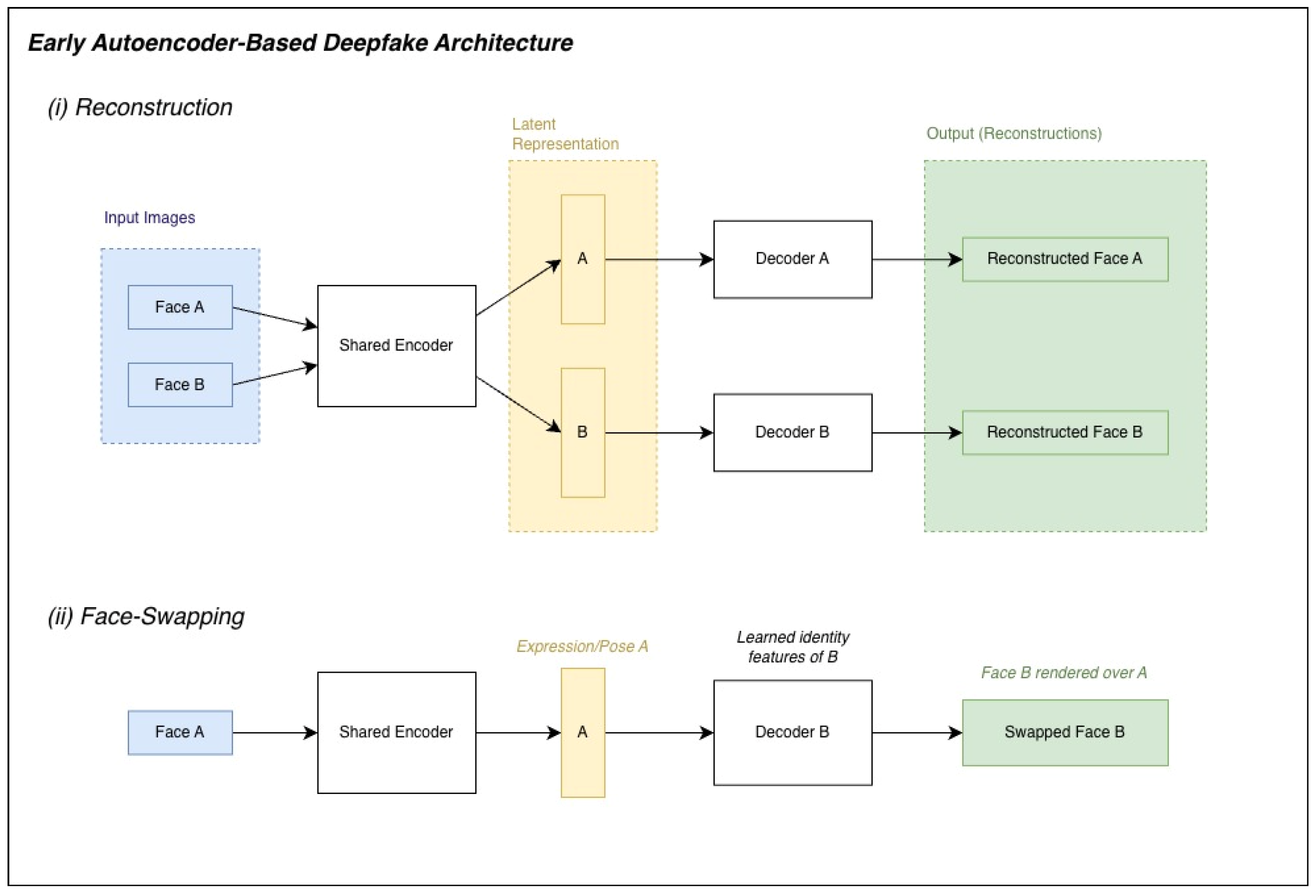
Early Deepfake videos were produced in a multi-stage process using an autoencoder-based model. This is a special type of neural network architecture that learns to ‘encode’ or transform input data into a compressed representation, then ‘decode’ or reconstruct it back into its original form. In the context of Deepfakes, given two individuals the goal is to swap the face of person A onto the body of person B. The first step involves training a shared encoder network on thousands of face images of both individuals. The encoder learns the similarities between the two faces and compresses the images into a simplified representation that captures their shared common features. In the second phase a decoder network learns to recover the faces from the compressed representations. Since the faces are different, one decoder is trained to recover the first face and another decoder is trained to recover the second face. Face swapping is achieved when every frame of a video has been converted into an encoded representation and effectively inputted into the wrong decoder. When a compressed representation of face A is inputted into the decoder trained on face B, the decoder reconstructs face B while preserving elements like expressions captured from face A [6].
More recently, Deepfakes have been created using GANs (Generative Adversarial Networks), a versatile and novel architecture for adversarial training frameworks introduced in 2014 by Ian Goodfellow and his collaborators. A GAN is comprised of two neural networks; a generator that creates synthetic samples; and a discriminator that evaluates them. Publicly available video footage and audio files sourced from large datasets are used to train the discriminator, while the generator learns to produce increasingly realistic synthetic outputs based on feedback it receives from the discriminator.
To create a Deepfake involving a particular individual, the training data typically consists of a large swathe of images drawn from publicly available sites, providing reference material that captures a person’s facial expressions and voice. The harvested images centre on a target subject that includes as many face and body angles with features and expressions under multiple lighting conditions. These serve as examples for the discriminator when assessing whether the generator’s outputs resemble authentic footage. Video forgeries created by the generator render the target subjects face onto another person’s body. Once a video forgery has been made, its creators manually fine tune some of the results to avoid obvious image problems like glitches. Throughout this process, the discriminator continues to evaluate the synthetic outputs and a deepfake is considered complete when the discriminator can no longer reliably distinguish between forged videos and the source footage.
It is through the adversarial training underpinning GAN that the generator learns to produce increasingly realistic outputs, enabling face swapping, reenactment, and fabrication. Complementary artificial neural network architectures include deep learning models composed of autoencoders (AE), variational autoencoders (VAE), and transformer-based diffusion models, that denoise data and allow for fine-grained control of human likeness and temporal coherence (see Figure 1).
Figure 1.
Early autoencoder and decoder process for Deepfakes and Face swapping.
Face manipulation typically involves aligning facial landmarks, encoding source and target images, and rendering blended outputs through neural inference pipelines [1]. Audio deepfakes, also known as shallow fakes employ spectrogram-based synthesis or large-scale neural text-to-speech (TTS) systems. Trained on voice datasets TTS can clone speech patterns with high fidelity by learning the nuanced audio patterns of human speech based on timbre, pitch and timing. Full-body deepfake puppetry extends these techniques to bodily gestures and gait modelling. The ongoing diffusion of open-source frameworks and cloud-based processing has accelerated both innovation and misuse of the deep learning technologies beneath Deepfakes raising issues of technological responsibility and social, political and corporate governance [7,8].
3. Media, Communication, and the Epistemic Challenges of Deepfakes
Deepfakes challenge core media studies concepts of representation, indexicality, and authenticity. Communications and media scholars argue that the ability to manipulate faces and voices at scale undermines long-standing assumptions about the evidentiary status of audiovisual media, contributing to what Fallis describes as an epistemic threat to society’s capacity to reliably evaluate truth claims and visual evidence [9]. Deepfakes thus destabilise the semiotic link between visual signifier and physical referent, intensifying concerns about a “post-truth” media environment.
Communications research highlights two major epistemic dynamics that contribute to what a Council of Europe study describes as the current age of dis-information, mis-information and mal-information. Threatening the fundamentals of truth and authorised knowledge systems that support factual claims and dependable evidence are core tenets of polity, democratic institutions and an informed citizenry [10]. A clear threat derives from widespread belief in fake and synthetic videos designed to go viral and circulate with the intent to deceive audiences. Such malicious online content poses special harm in political contexts susceptible to emotive and heuristic social reactions [11,12]. In a converse manner, a growing symptom of information disorder is referred to as the ‘liar’s dividend’ wherein, amidst the proliferation of synthetic media, authentic and genuine media content gets dismissed as fake and unreliable providing rhetorical diversions that avoids accountability or convinces people factual videos like the killing of George Floyd was a deep fake [3,13].
In the new global ecology of media, communications and information, separations between professional and amateur content and creators has undergone irrevocable shifts. Deepfakes are symptomatic of a disrupted communications mediascape where information disorder is contributing to a climate of interpretive uncertainty and complicating journalistic verification. Engendering public trust when it comes to political information and discourse has been historically challenging. Compounding contemporary distrust of official modes of communications is the way web-based communications has seen power and information ceded from legacy media institutions and the diminution of verification systems aimed at transparency and accountability. The distributive basis of web-basis media combined with the disintermediation of news has seen traditional gatekeepers of information and their processes removed along with systems and regulations that previously ensured ethical and quality oversight. In its place is the platformization [14] of media has seen traditional and legacy media style publishers replaced by Alphabet, Amazon, Apple, Meta/Facebook and Microsoft, giving rise to the era of social media and user generated content under which, verification processes have largely ceased.
4. Social, Cultural, and Political Implications
4.1. Disinformation and Political Manipulation
Deepfakes present a high-impact vector for computational misinformation. While large-scale Deepfake influence remains limited, research demonstrates their potential effectiveness in shaping perceptions of political actors, affecting trust in news and heightening uncertainty. Deepfake-driven deception does not necessarily require widespread circulation because the mere possibility has the effect of destabilising public confidence in media evidence.
The political centre that builds consensus required for western liberal democracy to function effectively has been challenged by the emergence of ‘networked feudalism’ [11,12,15]. Algorithmic curation combines with self-selection behaviours to create online filter bubbles producing echo chambers that encourage group think and isolating viewpoints from their alternatives. Digital behaviours have a tendency to be closed off to opposing perspectives and can be attributed to skewered perceptions of reality. Joining bot driven algorithmic feeds and proliferating fake news, Deepfakes contribute to polarised political viewpoints and the hyper-partisanship of contemporary politics effecting countries from the United States to the Philippines.
The web-based digital domains of online lived reality continues to recalibrate the everyday of social and political life. Irrespective of these twenty-first century transformations from life lived online, an informed citizenry relies upon trustworthy information that underpins the conditions necessary for active participation in the digital age. Fundamentals of public trust rely on truth and accuracy to be delivered through global and local governance frameworks capable of being enforced through regulatory and legal means but that are consistently resisted by an ascendant tech sector exercised through oligopolistic practices securing their dominance. Rises in online fraud, electoral interference and geopolitical manipulations has seen calls for redressing issues surrounding platform sovereignty afforded to the technology sector under the aegis of free speech and freedom of expression. Self-regulation resulting from the operations of platform sovereignty has led to an absence of accountability, responsibility and liability, key factors that have been attributed to deficiencies surrounding synthetic content governance [16,17].
The slow moving pace of regulatory efforts that attempt to contain online behaviours and implement corporate accountabilities is in stark contrast to the rapid flows of communication and information that fuels the effectiveness of Deepfakes. The ability of misleading media content to influence attitudes and cause confusion reflects the incessant 24/7 hyper flows of information across an online, web-based mediascape. Amidst the volume of data flows and platformization of virtual cyberspace, the ever-increasing speed that churns communications also hinders efforts to retract and repair false and misleading impressions left in the wake of Deepfakes. The multivalent distortions perpetuated by Deepfakes result from both human and non-human spreaders. The former can intentionally spread Deepfakes as intentional propagators to damage reputations or manipulate social and political opinions by employing personal networks across social media and messaging platforms. Similarly, unintentional human spreaders who share content become unwitting amplifiers contributing to false information that has been shown to spread more rapidly than truthful information through human social networks [18]. Non-human spreaders includes algorithmic and autonomous distribution infrastructures operating through synthetic accounts, social bots and recommendation systems.
4.2. Gendered Abuse, Non-Consensual Synthetic Sexual Media
Beginning in 2017 with Reddit user and handle, ‘r/deep fakes’, face-swapping has become a ubiquitous online activity supplying the means for all kinds of video content ranging from the satirical to the politically disingenuous to the unambiguously harmful. Face-swapping videos and their persistence is categorised as Non-Consensual Intimate Imagery (NCII) and translates into a substantial proportion of Deepfake content [19]. Similar to revenge porn, these videos circulate as non-consensual sexual imagery targeting women that highlights gaps in legal frameworks surrounding digital and online systems that fail to protect women [20]. Comprising a mode of technologically mediated gendered violence, Deepfakes extends harm that goes beyond reputational damage and has been demonstrated to encompass psychological distress that constitutes new forms of misogyny and digital harassment of women. In 2023, sexually explicit Deepfake videos accounted for 98% of the 95,820 Deepfake videos online and mostly depicting female victims, a 550% increase since 2019 [21].
Deepfakes speak to ongoing structural inequalities amplified by the affordances of algorithmic tools and technologies increasingly available through open source Artificial Intelligence (A.I.). technology. Early Deepfake videos previously required weeks or months to produce but by 2023 it took less than 25 min and could be based on one clear face image [4,21,22]. While women continue to bear the burden of the malicious intent behind face swapping techniques targets also include politicians, celebrities and influencers, attesting to how anyone with a high public profile and standing has an increased risk of becoming the subject of a Deepfake video.
4.3. Weapons of Mass Distraction and an Epistemological Crisis
The technology beneath Deepfakes has been weaponised by malicious actors and rogue states in the service of geopolitical struggles. Employed as weapons of ‘mass distraction’ Deepfake techniques have advanced the tactics of propaganda and techniques of persuasion in wars of disinformation that span armed conflicts to public referendums like Brexit in February 2020.
Platform content and its amplification recognizes how online media is neither created nor distributed equally. Metadata manipulations and the scaling of content extend beyond investing in search engine optimization and can also be achieved through malicious and organised acts involving data breaches and calculated manipulations employing engineered fraudulent accounts. In 2018, evidence of highly organized data and content manipulations supplied by a whistleblower revealed that data analytics firm, Cambridge Analytica, had accessed 50 million Facebook users without their knowledge. The intended outcome was the circulation and distribution of false and misleading videos designed to sway and divide public opinion on Brexit across the United Kingdom [23].
While harmful Deepfakes warrant the focus and attention being given to synthetic media, the technology enabling them represents significant cost-saving and other efficiency dividends for legitimate content creation. From visual effects and archival restoration to experimental documentary, filmmakers and studios are exploring the potential of synthetic re-enactment and machine learning based image manipulation techniques for narrative and aesthetic purposes of innovation.
Documentary filmmakers have responded to the potential posed by Deepfake technologies with widespread reactions. Spanning outright rejection to eagerly embracing newfound possibilities, documentarians are negotiating the impact machine learning techniques enabling deep fakes has on the genre’s basis in verifiable truth claims and the ethical boundaries of representing people and subjects drawn from contemporary and historical reality. The representation of participants has long been a contentious factor for documentary filmmaking practices. With the addition of generative A.I. and expanded capabilities drawn from the machine learning that creates Deepfakes, the epistemological foundation beneath documentary’s social contract is called into question [23]. The 2002 Netflix docuseries, The Andy Warhol Diaries’ and the 2021 biopic of celebrity chef, ‘Roadrunner: A Film About Anthony Bourdain’ were some of the earliest documentary forays employing Generative A.I with results provoking mixed responses amongst each film’s audiences, critics and participants. The two high profile productions highlighted how technologies that enable Deepfakes will continue to overlap and find application in non-fiction narrative and documentary filmmaking. At the very least, the reactions from both films point to the need for new and expanded norms of disclosure and editorial transparency in documentary [9].
5. Detection, Forensics, and Synthetic Media Literacy
Negative impacts from Deepfakes will continue unmitigated until technological interventions are combined with educational strategies aimed at containing their pernicious effects. A multi-pronged response is seen as the means for addressing the paradigm altering effects from machine learning, generative A.I. and the deep learning neural networks and which Deepfakes have become symptomatic [24]. The prolific rise of Deepfake has driven technological rejoinders in the detection tools and applications that are essential to the infrastructure and workflows of media companies and newsrooms, similar to the role played by encryption software in cybersecurity systems. Employing machine learning, computer vision and biometric analysis, detection software is designed to identify synthetic videos, images and audio generated by artificial intelligence [25]. Computational detection methods are deployed in a fight fire-with-fire approach through sophisticated counter measures including: biometric inconsistency analysis to detect blinking patterns and other facial microtextures that can reveal the tell-tale signs of a Deepfake; frequency-domain analysis and compression artefact detection aimed at detecting compression algorithms required to convert image data from the spatial domain to the frequency domain that results in a loss of detail and the introduction of unique artifacts that leave specific forensic cues; temporal coherence analysis for examining frame-to-frame consistency in video that can be compromised in deepfake imagery; adversarial robustness training (ART) that fortifies deep learning models against adversarial manipulations leading to the detection and removal of deepfake content [1,7,23,26,27].
Given that detection tools face an escalating adversarial cycle as generation models improve, detection applications offer limited accuracy at scale and vulnerable to adversarial perturbations leading to unintended misclassifications [26]. Consequently, the argument for technology solutions to be accompanied by broader sociotechnical responses like increased media literacy surrounding synthetic content, improved media industry transparency standards and provenance authentication infrastructures [28,29]. Media literacies and robust industry standards can foster understandings of the power of audiovisual based communication. Considerations that address the limits of photographic verisimilitude through to raising awareness of the distortions intrinsic to all modes and forms of communication and mediated representation, can function to inoculate and safeguard users from the malignancies of Deepfakes and growing falsehoods permeating online communications.
6. Governance, Regulation, and Ethical Frameworks
Deepfakes circulate in a largely unregulated media domains with its basis in the United States, 1998 Digital Millennium Copyright Act (DMCA) that constructed digital platform providers on a substantively different legal framework from what had previously governed publishers and broadcasters.
Regulatory efforts and legislative frameworks responding to Deepfakes differ widely across international jurisdictions. Common features of responses to the harmful impacts and deceptive qualities of Deepfakes include; provisions in the service of labelling and provenance requirements; platform moderation obligations and stricter enforcement of notice-and-takedown procedures; penalties for malicious use in election interference and causes of sexual harm [21], and the development of broad ranging, compliance standards and agreements for the use of synthetic media in creative industries and screen productions [16].
Governance approaches based on hard laws aimed at making Deepfakes illegal appears to be beyond the remit of many jurisdictions with opinions varying on whether legal efforts would be rendered ineffective from problems of enforcement. Ethical debates centre on issues of consent, identity ownership, autonomy and the moral wrongs of creating or circulating synthetic representations. With their capacity to undermine personhood and manipulate social meaning, effective controls imposed on Deepfakes necessitate the robust leveraging of existing regulatory frameworks [4,5] and amending current legal protections already aimed at safeguarding populations from non-consensual incursions and societal harms [23]. The European Union’s Artificial Intelligence Act that came into effect in August 2024 evidence efforts at regulatory balance. Striving to establish a regulatory framework for the responsible use of A.I. the Act classifies Deepfakes under the ‘limited risk’ category that acknowledges their harmful potential while aiming to preserve their positive applications by insisting on principles of transparency in the use and application of Deepfakes [30].
7. Contemporary Developments and Future Trajectories
Access to diffusion models like Stable Diffusion and DALL.E3 that enable high fidelity, high resolution photorealistic outputs from generative machine learning architectures only continues to widen. In addition, the applications of multimodal foundation models of large-scale neural architectures enables cross-modal reasoning that sees language linked to imagery and allows video to be generated from dialogue. Combined with growing real-time inference capacities of machine learning systems that generate outputs like face swapping and voice cloning instantaneously without the need for post-production process, the creation of deepfakes is transitioning from a specialised practice requiring a modicum of software skills and knowledge into a user-friendly, everyday media content creation activity.
As Deepfakes become an increasingly normative element of online behaviours and practices synthetic media is forecast to expand into the hitherto unchartered territories. Concepts like real-time synthetic telepresence may realise notions of what have previously been conceived as holographic avatars. The licensing of synthetic performers and voice doubles could augment intellectual property rights of established performers and artists. In terms of controlling Deepfakes interventions through industry standards are more likely to have an impact than regulatory efforts. Innovations like forensic watermarking operating in tandem with authenticated capture pipelines will feature in production workflows along with systems providing integrated provenance layers through cryptographic verification [8,29]. While future media communication settings may normalise synthetic media in the service of entertainment products and consumption, rigorous evidentiary protocols in journalism, law, and public institutions will require framing and enforcement through traditional legislative practices [31].
8. Conclusions
Deepfakes constitute a transformative media technology that intersects with communication processes, political discourse, creative practice, and digital ethics. Their rapid proliferation and the ever-increasing uptake of the technologies that enable them challenges epistemic stability and media authenticity with implications for governance measures across digital domains. Deepfakes may operate in terms of harmful and malicious intent comprising a vector that spans sexual harassment to sophisticated fraud but the technologies enabling them continue to expand the means of creative experimentation and facilitate new and increasingly accessible affordances amongst amateur content creators. While necessary interventions into Deepfakes must include technical detection and other counter measures that can ameliorate, if not entirely eliminate, the harmful effects of pernicious synthetic media. Future interventions have to take into account ways in which frameworks involving regulation and legislation as well as industry self-compliance measures, can co-exist with the innovative potential represented by the underlying inventiveness of the machine learning technologies utilised in Deepfakes. Striking this balance means delivering effective verification processes and methods and at the same time fostering cultural and media literacies that advance understandings of evidence in the context of mediated representations capable of restoring shared notions of trust.
Supplementary Materials
The following supporting information can be downloaded at: https://www.mdpi.com/article/10.3390/encyclopedia6040080/s1. Author acknowledgement on use Gen A.I.
Funding
This research received no external funding.
Institutional Review Board Statement
Not applicable.
Informed Consent Statement
Not applicable.
Data Availability Statement
No new data were created or analyzed in this study. Data sharing is not applicable to this article.
Acknowledgments
During the preparation of this manuscript/study, the author used Chat GPT-4 for the purposes of sourcing articles as part of a preliminary literature review. Detailed information can be found at Supplementary Materials. The author has reviewed and edited the output and takes full responsibility for the content of this publication—Sean Maher, Queensland University of Technology, Brisbane, Australia.
Conflicts of Interest
The author declares no conflicts of interest.
References
- Tolosana, R.; Vera-Rodríguez, R.; Fierrez, J.; Morales, A.; Ortega-García, J. DeepFakes and Beyond: A Survey of Face Manipulation and Fake Detection. arXiv 2020, arXiv:2001.00179. [Google Scholar] [CrossRef] [Scilit]
- Nguyen, T.T.; Nguyen, Q.V.H.; Nguyen, D.T.; Nguyen, T.A.; Nahavandi, S.; Bhatti, A.; Nguyen, T.N. Deep Learning for Deepfakes Creation and Detection: A Survey. arXiv 2019, arXiv:1909.11573. [Google Scholar]
- Fallis, D. The Epistemic Threat of Deepfakes. Philos. Technol. 2020, 34, 565–578. [Google Scholar] [CrossRef] [Scilit] [PubMed]
- de Ruiter, A. The Distinct Wrong of Deepfakes. Philos. Technol. 2021, 34, 887–903. [Google Scholar] [CrossRef] [Scilit]
- Flattery, T.; Miler, C. Deepfakes and Dishonesty. Philos. Technol. 2024, 37, 120. [Google Scholar] [CrossRef] [Scilit]
- Mirsky, Y.; Wenke, L. The Creation and Detection of Deepfakes: A Survey. ACM Comput. Surv. 2022, 54, 7. [Google Scholar] [CrossRef] [Scilit]
- Neekhara, P.; Dolhansky, B.; Bitton, J.; Ferrer, C.C. Adversarial Threats to Deepfake Detection: A Practical Perspective. arXiv 2020, arXiv:2011.09957. [Google Scholar] [CrossRef] [Scilit]
- Guar, L. (Ed.) Deepfakes: Creation, Detection, and Impact; CRC Press: Boca Raton, FL, USA, 2023. [Google Scholar]
- Lees, D. Deepfakes in documentary film production: Images of deception in the representation of the real. Stud. Doc. Film 2023, 18, 108–129. [Google Scholar] [CrossRef] [Scilit]
- Wardle, C.; Derakhshan, H. Information Disorder: Toward an Interdisciplinary Framework for Research and Policy Making (No. 9); Council of Europe: Strasbourg, France, 2017. [Google Scholar]
- Appel, M.; Verdoodt, V.; Röttger, P.; Hermanns, J. The Detection of Political Deepfakes. J. Comput. Mediat. Commun. 2022, 27, zmac008. [Google Scholar] [CrossRef] [Scilit]
- Vaccari, C.; Chadwick, A. Deepfakes and Disinformation: Exploring the Impact of Synthetic Political Video on Deception, Uncertainty, and Trust in News. Soc. Media Soc. 2020, 6, 2056305120903408. [Google Scholar] [CrossRef] [Scilit]
- Farid, H. Detecting and Combating Deep Fakes. J. Intell. Confl. Warf. 2021, 3, 83–87. [Google Scholar] [CrossRef] [Scilit]
- Maher, S.; Monaci, S. Media Technologies and Epistemologies: The Platforming of Everything. Int. J. Commun. 2024, 18, 4249–4261. [Google Scholar]
- Cadwalladr, C.; Graham-Harrison, E. Revealed: 50 Million Facebook Profiles Harvested for Cambridge Analytica in Major Data Breach. Guardian 2018, 17, 22. [Google Scholar]
- Romero-Moreno, F. Generative AI and deepfakes: A human rights approach to tackling harmful content. Int. Rev. Law Comput. Technol. 2024, 38, 297–326. [Google Scholar] [CrossRef] [Scilit]
- Monaci, S. The Governance of Disinformation Everyday Practices of Platform Sovereignty. Int. J. Commun. 2024, 18, 4298–4313. [Google Scholar]
- Vosoughi, S.; Roy, D.; Aral, S. The spread of true and false news online. Science 2018, 359, 1146–1151. [Google Scholar] [CrossRef] [Scilit]
- Rathgeb, C.; Tolosana, R.; Vera-Rodríguez, R.; Busch, C. (Eds.) Handbook of Digital Face Manipulation and Detection: From Deepfakes to Morphing Attacks; Springer: Cham, Switzerland, 2022. [Google Scholar]
- Mania, K. Legal Protection of Revenge and Deepfake Porn Victims in the European Union: Findings from a Comparative Legal Study. Trauma Violence Abus. 2024, 25, 117–129. [Google Scholar] [CrossRef] [Scilit]
- Gotsis, T.S. Sexually Explicit Deepfakes and the Criminal Law in NSW. Parliament of NSW Research Paper 2. April 2025. Available online: https://www.parliament.nsw.gov.au/researchpapers/Pages/deepfakes.aspx#:~:text=This%20paper%20presents%20data%20on,and%20discusses%20their%20harmful%20impacts (accessed on 21 March 2026).
- Paris, B.; Donovan, J. Deepfakes and Cheap Fakes: The Manipulation of Audio and Visual Evidence; Data & Society Research Institute: New York, NY, USA, 2019. [Google Scholar]
- Hight, C. Deepfakes and Documentary Practice in an Age of Misinformation. Continuum 2022, 36, 393–410. [Google Scholar] [CrossRef] [Scilit]
- O’Reilly, T. WTF? What’s the Future and Why It’s Up to Us; Penguin and Random House: New York, NY, USA, 2022. [Google Scholar]
- Al-Khazraji, S. Impact of Deepfake Technology on Social Media: Detection, Misinformation and Societal Implications. Eurasia Proc. Sci. Technol. Eng. Math. 2023, 23, 429–441. [Google Scholar] [CrossRef] [Scilit]
- Raina, A.; Mann, G. Exploring the Ethics of Deepfake Technology in Media: Implications for Trust and Information Integrity. J. Inform. Educ. Res. 2024, 4, 1530–1541. [Google Scholar]
- Maheshwari, R.U.; Paulchamy, B. Securing online integrity: A hybrid approach to deepfake detection and removal using Explainable AI and Adversarial Robustness Training. Automatika 2024, 65, 1517–1532. [Google Scholar] [CrossRef] [Scilit]
- Lu, H. Fighting Fake News with Fake Faces: The Effects of Deepfake Self-Debunking on Misinformation Correction. Inf. Commun. Soc. 2025, 1–18. [Google Scholar] [CrossRef] [Scilit]
- Romanishyn, A.; Malytska, O.; Gonscharuk, V. AI-driven disinformation: Policy recommendations for democratic resilience. Front. Artif. Intell. 2025, 8, 1569115. [Google Scholar] [CrossRef] [Scilit]
- Łabuz, M. Deep fakes and the Artificial Intelligence Act—An important signal or a missed opportunity? Policy Internet 2024, 16, 783–800. [Google Scholar] [CrossRef] [Scilit]
- Matthews, T.; Kidd, I.J. The Ethics and Epistemology of Deepfakes. In The Routledge Handbook of Philosophy and Media Ethics; Fox, C., Sanders, J., Eds.; Routledge: London, UK, 2023; pp. 101–118. [Google Scholar]
Disclaimer/Publisher’s Note: The statements, opinions and data contained in all publications are solely those of the individual author(s) and contributor(s) and not of MDPI and/or the editor(s). MDPI and/or the editor(s) disclaim responsibility for any injury to people or property resulting from any ideas, methods, instructions or products referred to in the content. |
© 2026 by the author. Licensee MDPI, Basel, Switzerland. This article is an open access article distributed under the terms and conditions of the Creative Commons Attribution (CC BY) license.