


Abstract
Migration is often viewed through an economic lens, but it also drives a profound transfer of intangible resources, including ideas, attitudes, beliefs, practices, values, and norms. This review examines the emerging literature on social remittances across post-transition economies. These countries are characterized by their shift from socialist planning to market-oriented systems. Based on an analysis of twenty-six publications, this literature review examines the mechanisms through which intangible resources are acquired, transferred, and implemented among migrants, their communities of origin, and even their destination societies. The evidence reveals that migrants often act as agents of change, transferring knowledge and practices that influence areas from entrepreneurship and politics to science, gender norms, and everyday life. Future research should analyze the social networks, structural constraints, and digital tools that facilitate these knowledge transfers across the skill spectrum. Such work is important for developing holistic policies that can leverage the social remittances of diverse migrant groups as a sustained resource for social innovation and development in evolving economies.
1. Introduction
Migration is a form of social mobility where people move from one country (or part of a country) to another and tend to live there for at least a while [1]. Migration processes include diverse decision-making sequences, which must acknowledge various factors in family life and biographical planning within a social context of the neighborhood, friendships and other social relationships and material living conditions. Furthermore, migration decisions are considered to last for different time episodes or irreversibly for the rest of a lifetime.
Acknowledging such forms of embeddedness implies acknowledging that people behave as members of households, families, neighborhoods, clans, or other collectivities. In doing so, the analysis will often merge the competencies of economics, sociology, psychology, history, and other social sciences to identify the “neglected links” [2] that keep the economy and society together. Financial and social remittances reflect the profound extent of migrants’ integration within their original social networks and the socio-cultural background of their country of origin, as well as their adaptation and engagement within the destination country’s environment.
This study evaluates and synthesizes the literature on social remittances by structuring their phases, mechanisms, and channels of transmission, with a particular focus on post-transition economies. Existing research has made important strides in systematizing social remittance literature. Tuccio and Wahba [3] systematically organized the literature on social remittances into three primary categories: economic, social, and political norms, with each category analyzed at both the macro and micro levels. More recently, Diniega and Sakdapolrak [4] extended the scope of review by focusing on environmental social remittances, identifying practices transferred across borders that foster sustainable agriculture, household behavior, and renewable energy use, as well as barriers to their adoption. White and Grabowska [5] provided a concise synthesis of social remittances research in Central and Eastern Europe, alongside their own analysis of how migration has shaped broader patterns of social change in Poland since 1989. Fihel and Kaczmarczyk [6] also provided a brief synthesis of the literature on migrant networks in eleven post-transition countries that have joined the EU, demonstrating that these networks function as transnational social spheres that facilitate the transfer of knowledge, practices, and norms between migrants and their countries of origin. Building on these contributions, the present study continues the review of contemporary literature on social remittances, focusing on post-transition economies in Central, Eastern, and Southeastern Europe (CESEE) and Central Asia.
The post-transition countries forming the focus of this review are defined by their shared historical experience of a fundamental systemic transformation from socialist, centrally planned economies to market-oriented systems, primarily during the 1990s. The notion of post-transition signifies that the period of intense, large-scale institutional and economic reforms had largely concluded, with reform processes reaching a certain limit by the onset of the Global Financial Crisis (Stojkov & Zalduendo, [7]). This common point of departure creates a valuable analytical lens for studying social remittances for several reasons. First, these societies underwent rapid, simultaneous changes in economic, political, and social institutions, creating a context in which imported ideas and practices could have a pronounced impact. Second, the opening of borders triggered significant and varied waves of migration, creating extensive transnational networks. Third, the diaspora from these regions is multi-generational, comprising those who left during the socialist era, immediately after its collapse, and following EU accession, allowing for analysis of how different migration cohorts transfer distinct social resources. Focusing on this group allows us to examine how social remittances operate within a set of countries grappling with similar legacies and challenges of systemic change, thereby offering more comparable and generalizable insights than a geographically dispersed sample might provide.
This study begins with a brief overview of migration theories that leads to the theoretical concept of social remittances, before proceeding to a literature review focused specifically on post-transition countries. It then advances targeted directions for future research of this evolving field.
2. Theoretical Concept of Social Remittances
Over the course of the development of migration theory, it became evident that migration is inherently linked to cross-border social interactions and encompasses not only the movement of people and financial transfers but also the exchange of intangible resources. As the theoretical framework evolved, this understanding ultimately led to the formalization of the concept of social remittances.
Early approaches to migration included the Neoclassical Economic Theory, which emphasized individual rational decision-making by Homo economicus seeking to maximize benefits from migration [8,9]. In the 1970s, the World Systems Theory viewed migration as a consequence of global capitalist expansion and structural inequalities between central and peripheral countries [10].
The Dual Labor Market Theory [11,12] defined two sectors within destination country labor markets: the primary sector, characterized by higher-paying jobs typically occupied by migrants with high skills and regular legal status, and the secondary sector, comprising lower-paying “3D” jobs (dirty, difficult, and dangerous) often filled by migrants with uncertain or irregular legal status. The Migration Transition Theory [13,14] focused on the long-term links between development and migration, connecting specific stages of a country’s development with internal and external population movements.
Although these theories contributed to understanding migration, they suffered from a top-down perspective, representing migrants as passive subjects influenced by broader macroeconomic forces. As a consequence, a new set of theories emerged. In the late 1980s, the New Economics of Labor Migration (NELM) Theory [15,16] emphasized the role of households and social networks in making migration decisions. Migrants often rely on social connections with friends, family, and community members who have already migrated to gather information about opportunities in the destination country and receive financial, emotional, and practical support.
The Aspirations-Capabilities theoretical approach [17,18] suggested that individuals may migrate when their aspirations exceed their current capabilities in their countries of origin, while acknowledging that migration decisions are also shaped by familial, social, legal, and other background factors. Migration Network Theory [19] explored how interpersonal ties facilitate and perpetuate migration, while Migration Systems Theory [20,21] adopted a broader lens, analyzing the structural, historical, and institutional linkages between origin and destination countries that sustain migration flows.
Migration induces a multidirectional flow of not only money but also ideas, practices, beliefs, attitudes, and norms across geographical boundaries. While economic effects of migration are mostly tangible, such as the volume of financial remittances and their impact on increasing income and spending power, the transmission of ideas, practices, behaviors, norms, and values is less tangible, making them more challenging to demonstrate and quantify. These are the social transfers or social remittances, as Peggy Levitt coined it ([22], p. 927).
Migrants are not numbers, isolated cases moving from place A to place B, but they carry complex social connections, emotions, and personal aspirations. In this understanding, people have social networks and empathy [23,24]. Patterns of social relevance govern people’s lives and determine their life goals, preferences, and norms [25,26]. Humans are embedded in life narratives that form their capabilities [27,28] and orientation principles. Granovetter [29] argued that human behavior is more complex than can be captured by a rational man’s monocausal assumption. Therefore, people must be understood in their social context and related institutions, norms, constraints, and opportunities [30,31,32].
Furthermore, Life Course Migration Theory [33,34] emphasizes how migration decisions and outcomes are embedded within individual biographical trajectories, intersecting with family transitions, educational paths, and career stages, thereby shaping the timing, content, and reception of potential social remittances.
3. A Review of Social Remittances Literature in Post-Transition Countries
3.1. Method
The aim of this literature review is to map the existing literature on social remittances in relation to post-transition economies, encompassing all relevant themes. The review encompasses selected contemporary English-language publications, including peer-reviewed journal articles, book sections, open-access resources, and working papers. The literature search was conducted in the academic database Google Scholar using a combination of keywords. The core term “social remittances” was paired with geographical identifiers such as “post-transition countries”, “CESEE”, “Central Asia”, as well as the names of individual countries. Boolean operators were applied (such as “social remittances” AND “Central Asia”) to refine results.
To ensure a comprehensive and transparent overview, a structured selection protocol was followed. The Google Scholar search was conducted in July–August 2025 using the keyword combinations listed above. The initial search yielded over 37 results. To be included, publications had to: (1) be primarily focused on the concept or empirical analysis of social remittances (or direct equivalents); (2) explicitly center on one or more post-transition economies as defined in this study; and (3) be published in English. The search was not restricted by publication date to capture the evolution of the concept, but the final selection prioritizes contemporary work from the last two decades. Titles and abstracts were screened against these criteria. The full texts of potentially relevant publications were then assessed, yielding a final corpus of 26 works that form the basis of this thematic synthesis. It is important to note that this is a qualitative, narrative review aimed at thematic mapping and synthesis, not a quantitative systematic review with meta-analysis.
The review encompassed 26 publications addressing social remittances in post-transition economies. Interviews were the predominant research method used by authors. This review explicitly notes instances where alternative methods, other than interviews, were employed. To provide a clear overview of the literature, the key mechanisms, findings, and representative studies are summarized thematically in Table 1.
Table 1.
Summary of key literature on social remittances in post-transition economies, organized by thematic focus.
3.2. Themes and Trends
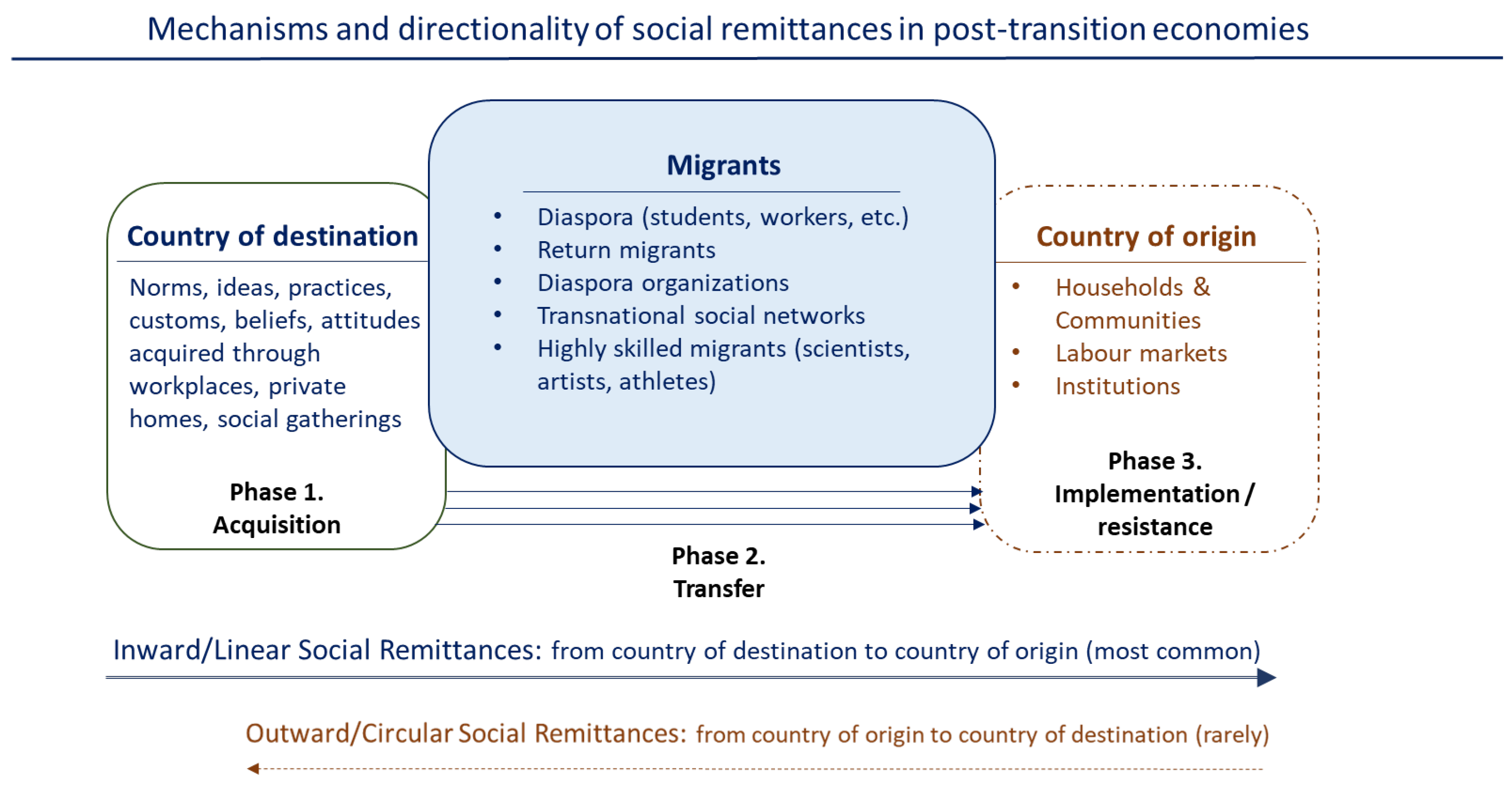
The phases and mechanisms of the social remitting process have been revisited by many scholars. By analyzing the behavior of Polish migrants in the UK [5], three stages of social remitting are sorted out:
- ▪ Acquisition refers to adopting ideas and practices in the destination country through communicating, working with others, learning and observing at workplaces, restaurants, migrant clubs, barbershops, private homes and similar social environments and gatherings.
- ▪ Transfer of remittances occurs when these adopted ideas, practices, norms or customs move from one place to another.
- ▪ The final stage, the outcome of transfers, involves implementing an idea through imitation, acceptance and/or adaptation.
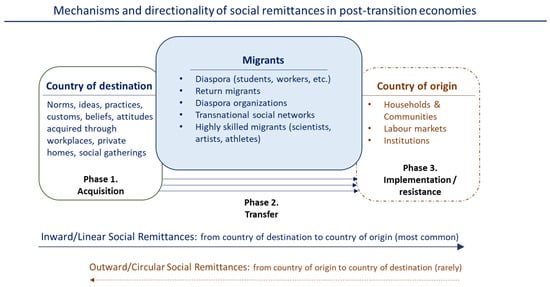
Figure 1 illustrates the multidirectional flow of social remittances between migrants, destination societies, and countries of origin, highlighting key mechanisms of acquisition, transmission, and acceptance or resistance.
Figure 1.
Flow of social remittances. Note: The figure is the authors’ original design. The inward and outward dimensions are defined with respect to the country of origin.
Social remittances are transferred daily, gradually, and invisibly, mainly by comparing conditions in the destination country with those in the country of origin. However, social remitting may encounter resistance at each stage. White and Grabowska [5] argued that migrants, as potential transmitters of social remittances, may deliberately choose not to transfer specific ideas back to their country of origin, believing they may be inappropriate or incompatible with local norms. In addition, receivers of social remittances can exercise agency in deciding which ideas to adopt or reject. For example, Polish families are more likely to imitate simple, practical activities that make everyday life easier than new values and norms.
There are cases where social remittances alter traditional social relations. Based on the case study of Tajikistan, it is demonstrated that social remittances reshape the organization of work, shifting from the traditional practice of khashar (In Central Asia, khashar has historically carried cultural significance as a form of voluntary communal labor that reinforced solidarity, mutual assistance, and social cohesion within local communities), which refers to collective neighborly and kin-based gatherings to assist with construction, toward the monetized engagement of specialized construction labor [37].
Combining quantitative analysis of large-scale survey data with qualitative interviews and ethnographic research to examine how Polish migrants acquire and transfer social remittances, Grabowska [36] found that migrants develop transferable social skills abroad, which they diffuse upon return through workplaces and local communities, acting as “agents of change” who introduce new practices related to work, entrepreneurship, and social norms. In that respect, White and Grabowska [5] differentiated between wide-ranging (transformative ideas that reshape institutions or norms) and selective social remittances (targeted adoptions often hybridized with local practices).
Baru [38] also demonstrated that Romanian returnees from Norway first internalize newly acquired values, behaviors, and practices, and only after some time begin to disseminate them. However, this process may encounter barriers when the ideas are perceived as too innovative.
Social remittances depend on the macrostructural conditions in the country of origin and tend to be limited if the environment is burdened by various cleavages and structural conflicts. The study by Drbohlav et al. [39] examined how Moldovan migrants in Czechia transfer social remittances and found that their diffusion is limited by these structural factors. For example, returning migrants are often reluctant to start new businesses due to low purchasing power and pronounced disparities between urban and rural areas, as well as between central and peripheral regions. Equally, based on an online survey of 307 respondents and 30 narrative interviews, King et al. [40] showed that highly educated Latvian youth abroad see themselves as potential agents of change through knowledge transfer. However, although certain skills and practices can be fully transferred, structural constraints in the country, such as limited opportunities and discriminatory labor-market practices, may limit their actual application.
Drbohlav and Dzurova [41] analyzed social remittances among Moldovan migrants in Prague and Turin using survey data and decision tree analysis. They distinguished between communication-based (transferred informally through conversations, digital media, or visits), project-oriented (implemented through formal community initiatives), and return-tied social remittances (which occur when migrants return permanently to invest in ventures that incorporate ideas and practices acquired abroad). They found that migrants in Italy, usually more established and higher-skilled, exhibit stronger project-oriented remittances (59% intensity), while those in Czechia engage more in interpersonal exchanges. In this regard, authors argued that migrants who speak the destination country’s language, have higher education and apply a transnational way of behavior adopt and transfer new ideas and practices more easily.
The receptivity of the origin country to social remittances also depends on the favorable context for knowledge and skills transfer [42]. By analyzing a case study of mobile Slovak doctors who returned to their home country after short-term stays abroad, Williams and Baláž [42] adapted four main types of tacit knowledge:
- ▪ Embrained (the term was popularized by Frank Blackler [61] in his typology of organizational knowledge and later adopted by other scholars) knowledge, which doctors acquire in libraries and classrooms.
- ▪ Embodied knowledge, which is acquired by observing and/or participating in events such as operations or consultations.
- ▪ Encultured knowledge, which refers to learning different values and approaches to healthcare.
- ▪ Embedded knowledge, which refers to learning the differences between healthcare systems.
The first two types of knowledge are easy to transfer, as they are part of an individual; however, the other two types depend on relationships and socialization processes. This may apply to other professions as well, such as international engineers and educators.
In a conceptual study, migrants who successfully transmit social remittances are considered overachievers [43]. Migrants who are particularly prominent in society, such as scientists, artists or athletes, have a greater chance of effectively transmitting social remittances. Social remittances can influence livelihoods, education, health, the environment, or governance in the country of origin [43]. Hofreiter and Koštialová [44] determined that young Slovak return migrants, beyond their economic impact, act as agents of social change by introducing new ideas, practices, and civic engagement to their home communities. Similarly, Radjabov [45] found that upon their return, Uzbek students introduced organic farming practices learned in Germany; by contrasting these with traditional methods, they acted as agents of change.
A good example of social remittances from high-skilled migrants that successfully impacted their home economy is provided by the case of returning Yugoslavian migrants. As a result of exposure to knowledge, technologies, and best practices in Germany, Bahar et al. [47] used difference-in-difference estimations to show that industries with a 10% higher share of returning refugees experienced 1–1.6% higher export growth, primarily driven by productivity gains in knowledge-intensive sectors.
Using original field survey data from a rural village in Uzbekistan, Hiwatari [46] applied extended spatial autoregressive models estimated with generalized spatial two-stage least squares (GS2SLS) and found that peer influence within migrant networks considerably shapes household relocation decisions. In this rural area, household choices are affected by the migration behavior of neighbors, which suggests that dense social networks can amplify migration flows.
Some national authorities try to maintain contact with the diaspora, using its professional and transnational knowledge for development. Based on 30 semi-structured interviews with skilled diaspora members, eight interviews with institutional representatives, and supplementary survey data, Nevinskaitė [59] examined Lithuania’s efforts to engage its professional diaspora through initiatives such as the Global Lithuania Programme. However, although authorities aim to support knowledge transfer, the study showed that mistrust of government, bureaucratic rigidity, and lack of openness within institutions and society undermine the use of diaspora knowledge.
The exchange of social remittances is also carried out by collectives through their networks. Religious beliefs and practices, for example, are associated with a network of churches, synagogues or mosques, which migrants use in their specific religious collectives to maintain and transmit their cultural and religious values. Using interviews, participant observation, ethnographic field work and survey data to research Muslim migrants from Central Asia in Russia, Yusupova and Ponarin [49] found that social remittances occur among different Muslim ethnic groups (Tatars, Tajiks, Uzbeks, etc.), as well as among indigenous and migrant Muslims, because they all belong to the same religious community. Using interviews and participant observation in Romania and Germany, Coșciug [50] explored how Romanian return migrants leverage religious social capital to reintegrate and transform local religious practices, particularly to innovate and legitimize their work in the second-hand car trade.
Scientists are also interested in the role of gender and generations in social remittances. Vlase [54] found that Romanian women from rural areas working in Italy transformed the traditional patriarchal organization of households. While they are working abroad, their husbands take care of the children, or upon returning from abroad, they want to live separately from their husbands’ parents. Similarly, among Belarusian returnees, women transmit more egalitarian gender values and more relaxed views on marriage, while men tend to reinforce traditional patriarchal norms [55]. In contrast, studying Albanian migrants in the UK, transformations occur only at the generational level (the passing of power from father to son), but not at the household level [58]. In addition, in rural Kyrgyzstan, entrenched social norms regarding the role of women remain largely unchanged, even when women attain greater independence through employment and income earned abroad [57].
Focusing on the former Yugoslavia and applying a quasi-experimental design, Ivlevs [56] found that emigration can undermine pro-environmental behavior through increased consumerism but can promote it when women are well-represented in migrant flows: each 1 percentage point increase in the female share among migrants is associated with 0.019 additional pro-environmental actions.
Political remittances, which can be considered either a subset of social remittances or a separate category of remittances, involve migrants acting as transnational political agents [43]. Based on primary survey data from 1839 Romanian migrants and secondary sources, including electoral results, media reports, and prior studies, it was found that the Romanian diaspora influenced presidential election outcomes in 2009 and 2014 [48].
3.3. Terminology, Directionality, and Distinctions from Financial Remittances
In the conceptual study by Pinkow-Läpple and Möllers [35], doubts have been raised regarding the adequacy of the term “social remittances”. The term “remittance”, derived from the Latin “remittere” (“to send back”), is argued to be inadequate, as the transfer of ideas, practices, norms, and values occurs in both directions, rather than solely from the country of origin to the country of destination.
The outward and inward expressions are defined with respect to the country of origin. Some scholars use the term “reverse remittances” for outward remittances [35]. In addition, the alternative terms “linear and cyclical social remittances” are used to denote unidirectional and bi-directional flows [45]. Social remittances (transferred from migrants’ origin countries to their destination countries) in post-transition countries, although less prevalent than inward social remittances, have been documented in the domains of religion, science, and health. In the religious sphere, Polish Catholic migrants in the UK transferred the Easter food-blessing tradition to their English parish, institutionalizing a Central European practice in the host country’s religious norms [5]. Similarly, Central Asian Muslim migrants transferred Islamic religious practices from their origin countries to Russia, where these were adopted by indigenous Muslim communities [49]. In the scientific domain, using quantitative data analyses, it has been documented that after the Soviet Union collapsed in 1992, many elite Soviet mathematicians migrated to the U.S. and other countries and transferred specific knowledge [51,52]. In the field of health, research has shown that Armenian mothers provided informal medical advice to their children studying abroad during the COVID-19 pandemic [53].
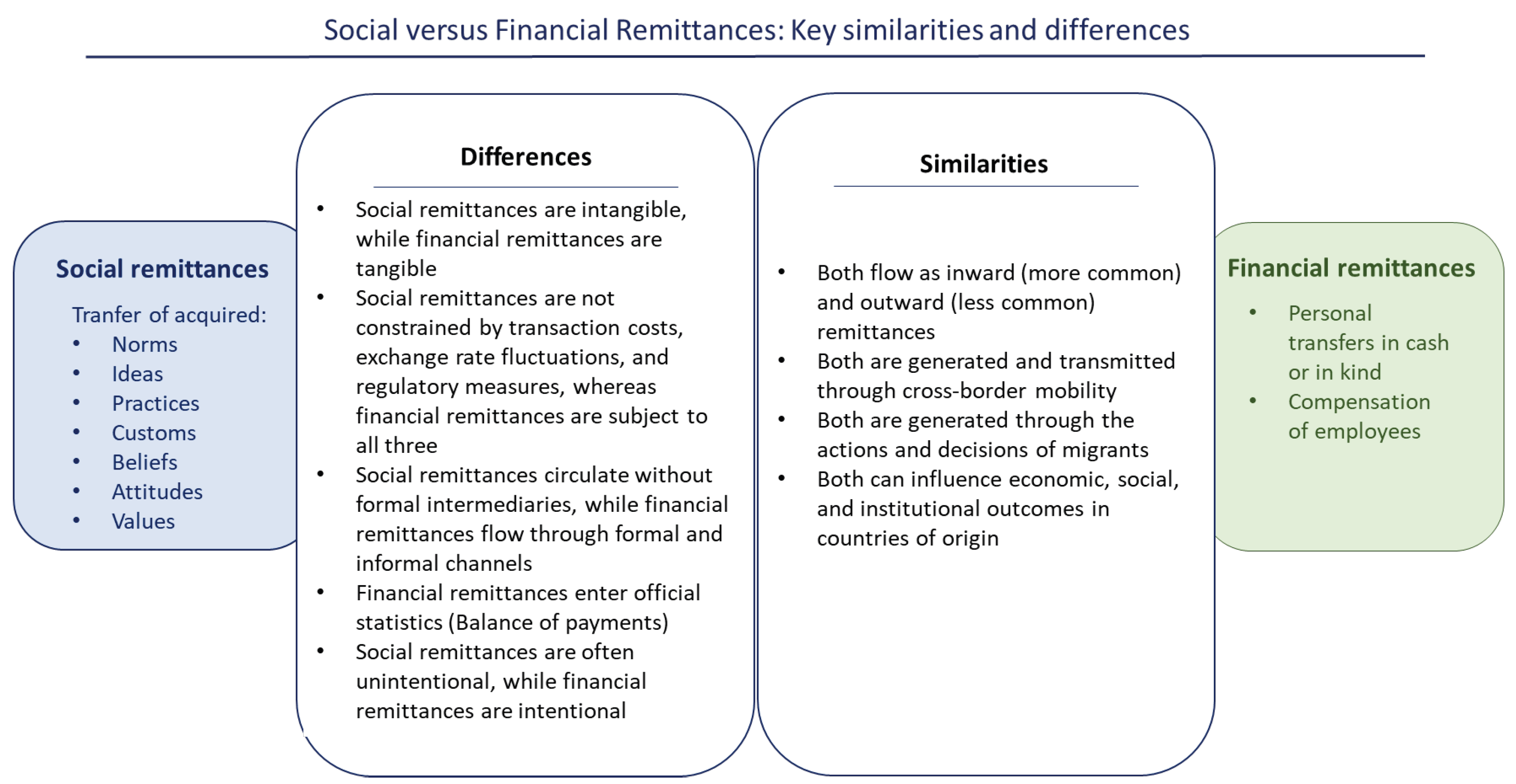
Beyond the debate on the appropriateness of the term “social remittances”, scholars also emphasize a conceptual distinction between social and financial remittances, arguing that the former are multidirectional, whereas the latter are typically unidirectional [43]. According to such opinion, financial remittances generally flow from the country of destination to the country of origin. However, in practice, both inward and outward remittances occur regularly. Inward remittances refer to financial transfers from the country of destination to the country of origin, while outward remittances denote the opposite direction. Although outward remittances are less common and involve smaller aggregate quantities, they nevertheless occur. Examples include payments for children’s education abroad or the transfer of funds derived from the sale of real estate in the country of origin.
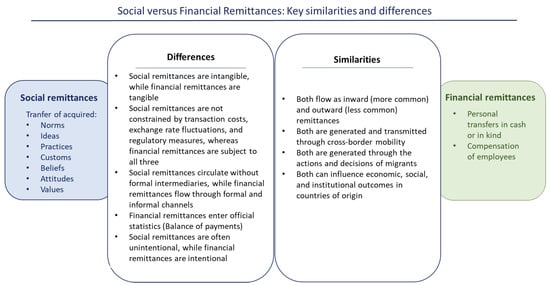
A distinction between social and financial remittances stems from the fact that the transfer of social remittances is not constrained by transaction costs, exchange rate fluctuations, or regulatory measures such as taxation on remittances or oversight intended to prevent illicit activities (betting, gambling, speculative transactions, or other illegal purposes). Social remittances, by contrast, circulate mostly without formal intermediaries, financial charges, or institutional verification, allowing for generally unrestricted and cost-free exchange. The comparison presented in Figure 2 helps clarify the conceptual distinctions between social and financial remittances within the context of migration studies.
Figure 2.
Comparing social and financial remittances. Note: The figure is the authors’ original design.
However, the financial and social remittances are often deeply intertwined. As demonstrated by Bajić-Hajduković and Bernard [60], who combined long-term historical analysis with anthropological fieldwork, the act of sending financial remittances is itself a practice laden with social meaning. Their study of Serbia revealed that within the same ethnic group, different social norms governed the use of money: rural families leveraged financial remittances for social mobility and status, while the urban middle class rejected them to preserve a class identity built on non-material values. This case illustrates that the flow of money cannot be understood in purely economic terms; it is shaped by, and in turn shapes, the transfer of intangible resources: social values, practices, and identities.
4. Discussion and Conclusions
This review undertakes a structured synthesis of the literature on social remittances, with a specific focus on post-transition economies in CESEE and Central Asia. By mapping the phases, mechanisms, and thematic domains explored across 26 studies, it provides a consolidated framework for understanding how intangible resources circulate through migration in conditions marked by profound systemic change.
Several significant intuitions emerge. First, the social remitting process is best understood as a multi-stage sequence of acquisition, transfer, and implementation, migrants, in which migrants’ agency as “agents of change” interacts with structural constraints in the origin country. Second, the impact of these transfers is remarkably broad, permeating economic life, political participation, gender relations, religious practices, and scientific development. Third, the receptivity to social remittances is heavily conditioned by local institutions and social networks.
The primary contribution of this study is the structural synthesis of social remittances within a coherent regional environment that shares a common historical trajectory. For policymakers in post-transition economies, the takeaway is clear—diaspora engagement strategies must look beyond financial capital and high-skilled returnees. Holistic policies should aim to create receptive ecosystems (through transparent institutions, support for community initiatives, and digital infrastructure) that can capture and amplify the social knowledge flowing through diverse migrant networks. For researchers, the agenda must involve methodological innovation to trace these often-invisible flows over time and theoretical refinement to better link micro-level transfers with macro-level social change.
This review provides a structured synthesis of social remittances literature in post-transition economies, but certain limitations should be acknowledged. First, the search was confined to English-language publications, which may exclude relevant research published in the local languages of the regions studied. Second, as a narrative review, it does not employ the formal meta-analytic techniques of a full systematic review.
Third, a methodological reflection emerging from this review concerns the predominant reliance on qualitative interviews and case studies within the existing literature. Although these methods are exceptionally well-suited to capturing the nuanced, subjective, and context-dependent processes of acquiring and transferring intangible resources, this focus also presents limitations. The heavy reliance on self-reported data and relatively small samples can constrain the generalizability of findings and make it difficult to measure the scale, causal impact, or long-term evolution of social remittance flows. Future research would benefit significantly from embracing methodological pluralism and innovation. For example, mixed-methods approaches that combine in-depth qualitative work with larger-scale surveys could help validate patterns and quantify prevalence. Longitudinal designs are important to trace the lifecycle of a social remittance from acquisition to institutionalization. Experimental or quasi-experimental techniques, as seen in some economic studies [47,56], could more rigorously isolate the causal effect of migration exposure on specific outcomes. Furthermore, digital ethnography and the analysis of trace data from social media and communication platforms offer promising possibilities to observe the real-time, informal exchange of ideas within transnational networks. Encouraging such methodological diversity will be key to building a more robust, empirically grounded understanding of social remittances.
An important implication of this study is that social remittance flows from migrants represent a continuous, yet often underutilized, intangible resource. Although high-skilled migrants may transfer specialized knowledge conducive to technological innovation, as evidenced by contributions to sectors like fintech [62] or science [51], the review demonstrates that migrants of various skill levels instigate profound social change. This includes the diffusion of new gender norms [54], work ethics [37], civic engagement [44], and environmental practices [56]. Therefore, future research and policy should recognize the broad-based developmental potential embedded within diverse diasporas. A promising direction involves developing strategies to facilitate beneficial knowledge diffusion from all migrant cohorts. Kerr’s [63] observation of innovative transfers through ethnic networks, for example, is not exclusive to high-skilled groups. Comparable potential exists across diasporas from post-transition economies. To harness this, further research is needed into the institutional conditions that enable inclusive social knowledge transfers and the policy instruments that could systematically support these exchanges.
Author Contributions
Conceptualization, D.B. and K.P.; Methodology, K.P.; Software, K.P.; Investigation, D.B. and K.P.; Writing—Original draft preparation, D.B. and K.P.; Writing—review and editing, K.P.; Visualization, K.P.; Supervision, D.B. and K.P. All authors have read and agreed to the published version of the manuscript.
Funding
This research received no external funding.
Institutional Review Board Statement
Not applicable.
Informed Consent Statement
Not applicable.
Data Availability Statement
No new data were created or analyzed in this study. Data sharing is not applicable to this article.
Acknowledgments
Open Access Funding by the University of Klagenfurt.
Conflicts of Interest
The authors declare no conflicts of interest.
References
- Bögenhold, D. Migration. In Cultural Sociology of Mental Illness: An A-to-Z Guide; Scull, A., Ed.; SAGE Publications, Inc.: Thousand Oaks, CA, USA, 2014; Volumes 1–2, pp. 535–537. [Google Scholar]
- Bögenhold, D. Neglected Links in Economics and Society. Inequality, Organization, Work and Economic Methodology; Palgrave Publishers: London, UK, 2021. [Google Scholar]
- Tuccio, M.; Wahba, J. Social Remittances. In Handbook of Labor, Human Resources and Population Economics; Zimmermann, K., Ed.; Springer: Cham, Switzerland, 2020; pp. 1–13. [Google Scholar]
- Diniega, R.; Sakdapolrak, P. Social Remittances and the Environment in the Context of Climate Change: What Do We Know? Where Do We Go? Clim. Dev. 2025, 17, 709–729. [Google Scholar] [CrossRef] [Scilit]
- White, A.; Grabowska, I. Social Remittances and Social Change in Central and Eastern Europe: Embedding Migration in the Study of Society. Cent. East. Eur. Migr. Rev. 2019, 8, 33–50. [Google Scholar]
- Fihel, A.; Kaczmarczyk, P. Emigration From Post-Communist Central Europe After 1989 Interpreted Within the Aspirations/Capabilities Framework. Comp. Popul. Stud. 2023, 48, 629–656. [Google Scholar] [CrossRef] [Scilit]
- Stojkov, A.; Zalduendo, J. Europe as a Convergence Engine. Heterogeneity and Investment Opportunities in Emerging Europe; The World Bank, Europe and Central Asia Region: Washington, DC, USA, 2011; Policy Research Working Paper 5837. [Google Scholar]
- Harris, J.; Todaro, M. Migration, Unemployment and Development: A Two-Sector Analysis. Am. Econ. Rev. 1970, 60, 126–142. [Google Scholar]
- Sjaastad, A. The Costs and Returns of Human Migration. J. Political Econ. 1962, 70, 80–93. [Google Scholar] [CrossRef] [Scilit]
- Wallerstein, I. The Modern World-System I: Capitalist Agriculture and the Origins of the European World-Economy in the Sixteenth Century; University of California Press: Oakland, CA, USA, 2011. [Google Scholar]
- Piore, M. Birds of Passage: Migrant Labor and Industrial Societies; Cambridge University Press: New York, NY, USA, 1979. [Google Scholar]
- Sassen, S. The Global City: New York, London, Tokyo; Princeton University Press: Princeton, NJ, USA, 2001. [Google Scholar]
- Skeldon, R. Migration and Development: A Global Perspective; Longman: Harlow, UK, 1997. [Google Scholar]
- Zelinsky, W. The Hypothesis of the Mobility Transition. Geogr. Rev. 1971, 61, 219–249. [Google Scholar] [CrossRef] [Scilit]
- Lucas, R.; Stark, O. Motivations to Remit: Evidence from Botswana. J. Political Econ. 1985, 93, 901–918. [Google Scholar]
- Stark, O.; Levhari, D. On Migration and Risk in LDCs. Econ. Dev. Cult. Change 1982, 31, 191–196. [Google Scholar] [CrossRef] [Scilit]
- De Haas, H. Migration Theory: Quo Vadis? International Migration Institute: Amsterdam, The Netherlands; University of Oxford: Oxford, UK, 2014; Working Paper 100. [Google Scholar]
- Sen, A. Development as Freedom; Alfred Knopf: New York, NY, USA, 1999. [Google Scholar]
- Massey, D.; Arango, J.; Hugo, G.; Kouaouci, A.; Pellegrino, A.; Taylor, J. Worlds in Motion: Understanding International Migration at the End of the Millennium; Oxford University Press: Oxford, UK, 2005. [Google Scholar]
- Kritz, M.; Lim, L.; Zlotnik, H. International Migration Systems: A Global Approach; Clarendon Press: Oxford, UK; Oxford University Press: Oxford, UK, 1992. [Google Scholar]
- Mabogunje, A. Systems Approach to a Theory of Rural-Urban Migration. Geogr. Anal. 1970, 2, 1–18. [Google Scholar] [CrossRef] [Scilit]
- Levitt, P. Social Remittances: Migration Driven Local-Level Forms of Cultural Diffusion. Int. Migr. Rev. 1998, 32, 926–948. [Google Scholar] [CrossRef] [Scilit]
- Turner, J. Network Theory. In The Structure of Sociological Theory; Wadsworth Publishing: Belmont, CA, USA, 1998; pp. 503–512. [Google Scholar]
- Turner, J.; Stets, J. The Sociology of Emotions; Cambridge University Press: Cambridge, UK, 2005. [Google Scholar]
- Collins, R. Interaction Ritual Chains; Princeton University Press: Princeton, NJ, USA, 2014. [Google Scholar]
- Elster, J. Emotions and Economic Theory. J. Econ. Lit. 1998, 36, 47–74. [Google Scholar]
- Sen, A. Inequality Reexamined; Oxford University Press: Oxford, UK, 1992. [Google Scholar]
- Sen, A. Capability and well-being. In The Quality of Life; Nussbaum, M., Sen, A., Eds.; Oxford University Press: Oxford, UK, 1993; pp. 30–53. [Google Scholar]
- Granovetter, M. Society and Economy: Framework and Principles; Harvard Belknap Press: Cambridge, MA, USA, 2017. [Google Scholar]
- Coleman, J. Social Capital in the Creation of Human Capital. Am. J. Sociol. 1988, 94, 95–120. [Google Scholar] [CrossRef] [Scilit]
- Cook, K. Advanced Introduction to Social Capital; Edward Elgar Publishing: Northampton, MA, USA, 2022. [Google Scholar]
- Foundations of Social Capital; Ostrom, E., Ahn, T., Eds.; Edward Elgar: Cheltenham, UK, 2003. [Google Scholar]
- Bailey, A.J. Population geography: Life-course matters. Prog. Hum. Geogr. 2009, 33, 407–418. [Google Scholar] [CrossRef] [Scilit]
- Wingens, M.; Windzio, M.; De Valk, H.; Aybek, C. (Eds.) A Life-Course Perspective on Migration and Integration; Springer: Dordrecht, The Netherlands, 2011; Available online: https://hdl.handle.net/1814/19054 (accessed on 11 August 2025).
- Pinkow-Läpple, J.; Möllers, J. From Social to Intangible Remittances: A Conceptual Recalibration; University of Sussex: Brighton, UK; Sussex Centre for Migration Research: Brighton, UK, 2022; Working Paper No. 100. [Google Scholar]
- Grabowska, I. Social Remittances, Channels of Diffusion. In The Impact of Migration on Poland; White, A., Grabowska, I., Eds.; UCL Press: London, UK, 2018; pp. 68–89. [Google Scholar]
- Zotova, N.; Cohen, J. Remittances and Their Social Meaning in Tajikistan. Remit. Rev. 2016, 1, 5–16. [Google Scholar] [CrossRef] [Scilit]
- Baru, F. Change Starts from Within: Migration and Processes of Social and Cultural Change. A Romanian Case. Soc. Change Rev. 2022, 20, 127–161. [Google Scholar] [CrossRef] [Scilit]
- Drbohlav, D.; Bailey, A.; Lupták, M.; Čermáková, D. Migrant values and social remittances across the contemporary migration-development nexus: The case of Moldovans in Czechia. Geografie 2017, 122, 526–553. [Google Scholar] [CrossRef] [Scilit]
- King, R.; Lulle, A.; Buzinska, L. Beyond Remittances: Knowledge Transfer among Highly Educated Latvian Youth Abroad. Sociol. Dev. 2016, 2, 183–203. [Google Scholar] [CrossRef] [Scilit]
- Drbohlav, D.; Dzurova, D. Social Remittances Upon Closer Examination: Moldovan Migrants in Prague, Czechia and Turin, Italy. Probl. Post-Communism 2021, 68, 247–260. [Google Scholar] [CrossRef] [Scilit]
- Williams, A.; Baláž, V. International Return Mobility, Learning and Knowledge Transfer: Slovak Doctors. Soc. Sci. Med. 2008, 67, 1924–1933. [Google Scholar] [CrossRef] [Scilit]
- Grečić, V. The importance of social remittances for the economy and society of a less developed country. Rev. Int. Aff. 2019, 1173, 5–23. [Google Scholar]
- Hofreiter, R.; Koštialová, K. Young Returning Migrants as Actors of Social Changes in Slovakia. Sociologija 2019, 61, 227–240. [Google Scholar] [CrossRef] [Scilit]
- Radjabov, B. Social Remittances Created by Uzbek Students Studying in Kassel, Germany and Tsukuba, Japan. Eurasia Cult. 2017, 3, 57–88. [Google Scholar]
- Hiwatari, M. Social networks and migration decisions: The influence of peer effects in rural households in Central Asia. J. Comp. Econ. 2016, 44, 1115–1131. [Google Scholar] [CrossRef] [Scilit]
- Bahar, D.; Hauptmann, A.; Özgüzel, C.; Rapoport, H. Migration and Knowledge Diffusion: The Effect of Returning Refugees on Export Performance in the Former Yugoslavia. Rev. Econ. Stat. 2024, 106, 287–304. [Google Scholar] [CrossRef] [Scilit]
- Gherghina, S.; Farcas, R. Not Out of Mind. The Romanian Diaspora and Politics at Home. In Everyday Postsocialismin Eastern Europe. History Doesn’t Travel in One Direction; Massino, J., Wien, M., Eds.; Purdue University Press: West Lafayette, IN, USA, 2024; pp. 251–271. [Google Scholar]
- Yusupova, G.; Ponarin, E. Social Remittances in Religion: Muslim Migrants in Russia and Transformation of Islamic Practices. Probl. Post-Communism 2016, 65, 188–200. [Google Scholar] [CrossRef] [Scilit]
- Coșciug, A. Religion, Return Migration and Change in an Emigration Country. In Transnational Return and Social Change: Hierarchies, Identities and Ideas; Anghel, R., Fauser, M., Boccagni, P., Eds.; Anthem Press: London, UK, 2019; pp. 85–102. [Google Scholar]
- Ganguli, I. Immigration and Ideas: What Did Russian Scientists “Bring” to the United States? J. Labor Econ. 2015, 33, 257–288. [Google Scholar] [CrossRef] [Scilit]
- Borjas, G.; Doran, K. The Collapse of the Soviet Union and the Productivity of American Mathematicians. Q. J. Econ. 2012, 3, 1143–1203. [Google Scholar] [CrossRef] [Scilit]
- Galstyan, N.; Galstyan, M. Social remittances during COVID-19: On the “new normality” negotiated by transnational families. Comp. Migr. Stud. 2021, 9, 51. [Google Scholar] [CrossRef] [Scilit]
- Vlase, I. Women’s social remittances and their implications at household level: A case study of Romanian migration to Italy. Migr. Lett. 2013, 10, 81–90. [Google Scholar] [CrossRef] [Scilit]
- Bobova, N. The Complexity of Return: Socio-Cultural Remittances of Highly Skilled Belarusians. Cent. East. Eur. Migr. Rev. 2016, 5, 119–134. [Google Scholar]
- Ivlevs, A. Does Emigration Affect Pro-environmental Behaviour Back Home? A Long-Term, Local-Level Perspective. Kyklos 2021, 74, 48–76. [Google Scholar] [CrossRef] [Scilit]
- Scott, C.; Sexsmith, K.; Chi, G. Gendered Migration Patterns and Social Change in Rural Kyrgyzstan. Migr. Dev. 2024, 13, 176–198. [Google Scholar] [CrossRef] [Scilit]
- King, R.; Dalipaj, M.; Mai, N. Gendering migration and remittances: Evidence from London and northern Albania. Popul. Space Place 2006, 12, 409–434. [Google Scholar] [CrossRef] [Scilit]
- Nevinskaite, L. Social Remittances from the Professional Diaspora: The Issue of Home-Country Receptivity. Cent. East. Eur. Migr. Rev. 2016, 5, 135–153. [Google Scholar]
- Bajić-Hajduković, I.; Bernard, S. “Money can’t buy me love”: Remittances, return migration, and family relations in Serbia (1960s–2000s). In Remittances as Social Practices and Agents of Change; Meyer, S., Ströhle, C., Eds.; Palgrave Macmillan: London, UK, 2023; pp. 77–97. [Google Scholar]
- Blackler, F. Knowledge, Knowledge Work and Organizations: An Overview and Interpretation. Organ. Stud. 1995, 16, 1021–1046. [Google Scholar] [CrossRef] [Scilit]
- Merli, A. Europe’s Innovators are Waking Up. Financ. Dev. 2025, 62, 40–43. [Google Scholar]
- Kerr, W. The Gift of Global Talent: How Migration Shapes Business, Economy & Society; Stanford University Press: Stanford, CA, USA, 2021. [Google Scholar]

Disclaimer/Publisher’s Note: The statements, opinions and data contained in all publications are solely those of the individual author(s) and contributor(s) and not of MDPI and/or the editor(s). MDPI and/or the editor(s) disclaim responsibility for any injury to people or property resulting from any ideas, methods, instructions or products referred to in the content. |
© 2026 by the authors. Licensee MDPI, Basel, Switzerland. This article is an open access article distributed under the terms and conditions of the Creative Commons Attribution (CC BY) license.