1. Introduction
In the digital era, claims about ‘democratising finance’ increasingly depend on expanded technological access and increased user participation. However, access does not equate to agency. While access refers to the ability to use financial services such as investing, borrowing and transacting, agency denotes the capacity to influence the rules, governance and accountability structures that shape these services. This entry therefore argues that much fintech-driven participation operates as a ‘simulation of democracy’: users experience visibility, immediacy and symbolic inclusion through platform interfaces, but decision-making authority and structural control remain concentrated in institutional, technological and proprietary infrastructures.
The notion of financial democracy has long been aspirational. It evokes the idea of an open, participatory financial system that is accessible to all citizens, rather than one controlled by a small elite of financial intermediaries and institutional investors. Historically, the concept emerged in the post-war era as part of the ideal of shareholder democracy—a movement that aimed to empower ordinary investors to influence corporate governance through ownership and voting rights [
1]. By the early twenty-first century, the term had expanded beyond corporate boards to encompass public debates about inclusion and access. This links financial democracy to the broader concept of financial citizenship and the social legitimacy of capitalism [
2].
However, the concept of financial democracy has acquired a new meaning in the digital age. The rise of fintech—ranging from mobile banking and robo-advisory services to decentralised finance (DeFi) and tokenised assets—has been widely celebrated as a democratising force [
3,
4,
5]. Fintech platforms claim to remove traditional barriers to financial participation by reducing costs, personalising the user experience, and widening access to credit and investment opportunities [
6,
7]. The logic of participation, central to democratic theory for a long time [
8], appears to have become embedded in financial technology, enabling users to invest, vote and transact with unprecedented ease.
However, expanded access and intensified participation can also lead to distortion. The proliferation of digital platforms has created new dependencies, information asymmetries and behavioural biases that restrict the autonomy that these systems claim to promote [
9,
10]. Platform-based finance operates through algorithms that influence user behaviour through gamification, subtle prompts and speculative engagement. Retail trading platforms, for instance, commonly use real-time price animations, performance rankings and frequent trade notifications to intensify engagement, while offering little influence over platform rules or risk exposure. The populist language of empowerment—‘finance for everyone’—can obscure the fact that data extraction, algorithmic opacity and concentrated platform ownership reinforce structural inequalities [
11,
12]. Although retail investors may have broader market access, they typically have limited power to contest governance, redesign incentives or hold platforms accountable.
The coexistence of expanded technological access to financial services and limited involvement in institutional financial governance has been described in the literature as
fintech populism. In this analytical sense, the term denotes a pattern of digitally mediated financial participation characterised by rapid interaction, high user engagement, and reduced reliance on traditional financial intermediaries [
13,
14]. Empirical developments such as the GameStop short squeeze and increased activity in the cryptocurrency market illustrate how digital financial tools can enable retail users to participate on a large scale and in a synchronised manner, without the need for formal coordination or deliberative processes.
The contribution of this entry is not the introduction of a new term, but the analytical refinement and extension of an existing one. While the notion of fintech populism has appeared in the literature as a descriptive label for digitally mediated mass participation in finance, this paper develops it as a structured analytical lens embedded within a broader framework of financial democracy. Unlike adjacent concepts such as platform capitalism (which focuses on value extraction and market structures), financialisation (which emphasises the expanding role of finance in everyday life), surveillance capitalism (which centres on data extraction and behavioural control), and narratives of retail investor empowerment (which stress individual access and participation), fintech populism captures the disjunction between expanded digital participation and limited influence over financial governance. The originality of this contribution lies in situating fintech populism within the four dimensions of financial democracy—access, participation, transparency, and accountability—thereby demonstrating how digitally enabled inclusion can coexist with structural constraints on agency and control.
These developments resemble participation dynamics commonly discussed in studies of political populism, where mobilisation and visibility increase independently of formal representation or accountability structures. In the financial context, participation becomes more immediate and widespread, while decision-making authority remains embedded in existing institutional and technological frameworks. As a result, users may gain greater presence within financial systems without a corresponding role in shaping their underlying rules or outcomes. This configuration has been described by Zuboff [
10] as a “participation paradox”, referring to situations in which visibility and engagement expand alongside limited influence over system design.
Within this context, the concept of financial democracy warrants analytical reconsideration. Classical political economy associates democratic systems with participation, transparency, and accountability [
15]. In contemporary financial systems, these principles are increasingly mediated through digital infrastructures operated by private, globally integrated platforms. Therefore, the expansion of access to financial services is accompanied by a greater reliance on algorithmic processes, data-driven decision-making and platform-based coordination mechanisms. These mechanisms structure participation while operating within governance arrangements that differ from those of traditional public institutions [
9,
10].
This paper argues that, in the digital era, financial democracy must be conceptualised as a contested and evolving process rather than an achieved state. By tracing the shift from shareholder democracy to fintech populism, it explores how digital finance both transforms and distorts citizens’ participation in financial systems. Financial democracy today operates within the tension between technological empowerment and structural concentration, access and agency, and participation and power. The paper develops a conceptual framework to examine these tensions along four analytical dimensions: access, participation, transparency, and accountability. It also considers the implications of these dimensions for the legitimacy and inclusiveness of digital financial governance. The research question of this inquiry is therefore:
In what ways does digital finance transform, distort or democratise citizens’ participation in financial systems?
In answering this question, the paper makes a theoretical contribution to the redefinition of financial democracy, offering a new way of understanding the emancipatory and exclusionary dynamics of digital finance. It extends the notion of financial democracy by integrating insights from financialisaton and digital governance. It posits that fintech populism signifies a new phase of participatory illusion, wherein citizens interact with finance more directly yet possess limited structural influence.
The paper is organised as follows.
Section 2 sets out the methodological approach and the logic of synthesis underlying the analysis.
Section 3 examines the historical trajectories of shareholder democracy and fintech populism.
Section 4 develops the analytical framework of financial democracy across the dimensions of access, participation, transparency, and accountability.
Section 5 analyses the transformation of financial democracy in the digital era, with particular attention to fintech-driven inclusion and participation.
Section 6 examines the distortions of financial democracy associated with fintech populism and digitally mediated participation.
Section 7 rethinks financial democracy through the lens of democratisation and simulation.
Section 8 concludes by summarising the main analytical insights and outlining implications for future research.
2. The Methodological Approach and the Logic of Synthesis
This article employs a conceptual, theory-building approach grounded in the analytical synthesis of established scholarly literatures. The methodological objective is to develop an integrated framework for analysing financial democracy in the digital era by systematically connecting bodies of research that are commonly addressed in isolation.
The analysis encompasses several fintech subdomains that differ in their institutional design and governance arrangements. For analytical clarity, the discussion distinguishes between payment and financial inclusion technologies, retail investing platforms, and decentralised finance and token-based governance systems. These domains are not treated as governed by identical mechanisms. Instead, they are examined together because each exhibits a similar participatory configuration in which digitally mediated access and engagement expand more rapidly than users’ capacity to influence the governance of financial infrastructures. The concept of fintech populism is therefore applied as a unifying analytical lens to capture this shared participatory logic across heterogeneous fintech settings, while remaining attentive to variation in accountability structures, forms of agency, and modes of governance.
The selection of sources adheres to a problem-oriented and framework-driven logic. The selection of literature was informed by the four analytical dimensions of financial democracy developed in this paper: access, participation, transparency, and accountability. The analysis is structured by four core strands of scholarship: shareholder democracy and corporate governance; financialization and financial citizenship; platform capitalism and digital governance; and fintech and decentralized finance. Within each strand, emphasis is placed on peer-reviewed theoretical contributions, foundational conceptual works, and widely cited studies that explicitly engage with questions of power, participation, and governance in financial systems.
The integration of divergent perspectives within these literatures is achieved through analytical juxtaposition. Contributions that frame digital finance primarily in terms of inclusion, efficiency, and expanded participation are examined alongside critical political economy approaches that emphasize data asymmetries, algorithmic governance, and platform-based power. These perspectives are not regarded as mutually exclusive; rather, their tensions are utilized as an analytical resource for identifying structural contradictions between expanded participation and constrained agency. The concept of fintech populism is developed at this intersection, serving as a lens through which these contradictions can be interpreted across different technological configurations.
References to empirical developments, including retail trading platforms, cryptocurrency markets and decentralised finance governance arrangements, serve an illustrative function within this analytical framework. These examples are employed to elucidate the theoretical mechanisms and participation dynamics identified in the extant literature, without constituting empirical case analysis. The entry’s contribution is notable for its emphasis on conceptual integration. The analysis elucidates how digitally mediated participation can simultaneously broaden access and reproduce limitations on democratic control embedded in contemporary financial infrastructures. This is achieved by embedding fintech populism within a multidimensional framework of financial democracy.
3. From Shareholder Democracy to Fintech Populism: Historical Trajectories
To understand the contemporary debate about financial democracy, it is necessary to revisit its intellectual and institutional roots in the ideal of shareholder democracy. First emerging in the mid-twentieth century, this concept was based on the idea that dispersed ownership and active voting could align corporate power with the interests of ordinary investors and, by extension, the interests of the general public more broadly [
16,
17]. It brought the democratic ethos into the corporate sphere, where the ‘one share, one vote’ principle mirrored the political norm of equal representation. However, this early notion of democratisation was confined to listed companies and presumed that access to equity markets equated to participation in decision-making processes.
However, as financial markets deepened and globalised, the link between ownership and influence weakened. Institutional investors, such as pension funds, mutual funds and insurance companies, aggregated capital on behalf of individuals, creating a professionalised layer between citizens and corporations. This transformation redefined the democratic promise of finance: small shareholders no longer exercised meaningful control, while intermediaries prioritised fiduciary responsibility over participatory governance This transformation reflects the broader evolution of capitalist governance, in which the language of democracy persists, but its participatory nature is eroding. In the early post-war era, the concept of shareholder democracy implied dispersed ownership and the expectation of collective oversight—namely, that citizens could influence managerial decisions and corporate behaviour in their capacity as shareholders. As capital markets expanded and became more complex during this period, however, participation became increasingly mediated through institutional layers, with pension funds, mutual funds and investment managers exercising voting power on behalf of millions of individuals [
1]. Financial democracy thus became procedural rather than substantive, consisting of formal rights without active deliberation.
By the late twentieth century, the rise of financialisaton had further altered this landscape. Rather than engaging with financial markets as owners or voters, citizens increasingly became involved as borrowers, savers, and participants in investment portfolios. This meant that their livelihoods became tied to the volatility of capital markets [
2,
18]. Consequently, the discourse of financial citizenship emerged, emphasising financial literacy and self-responsibility as prerequisites for participation [
19,
20]. The moral narrative shifted from collective control over finance to individual adaptation within it, mirroring the neoliberal shift in responsibility across economic and political domains [
21].
The global financial crisis of 2008 marked a turning point in prevailing models of shareholder governance and financially mediated participation, highlighting structural vulnerabilities within existing financial systems. In the subsequent period, financial technologies gained prominence as mechanisms aimed at expanding access to financial services. Digital platforms, mobile applications, and algorithmic interfaces were increasingly presented as enabling more direct interaction with credit, investment, and payment systems by reducing reliance on traditional financial intermediaries [
3,
5,
7]. Within this context, references to inclusivity and broad participation became more prominent, framing technological innovation as a means of widening access to financial activity.
This expansion of digitally mediated participation has been described, in analytical terms, as fintech populism. Used metaphorically, the concept refers to a mode of participation that emphasises accessibility, immediacy, and collective engagement enabled by financial technologies, often articulated in contrast to established financial institutions [
13]. Participation under this model is structured through platform-based interactions, such as commission-free trading interfaces, token-based governance mechanisms in decentralised finance (DeFi) systems, and coordination within online communities. Developments such as the GameStop short squeeze of 2021 illustrate how digital infrastructures can facilitate large-scale participation characterised by heightened visibility and collective action [
9].
In this setting, financial participation increasingly takes place through algorithmic and data-driven systems that organise access and interaction. The expansion of access is accompanied by a growing role of platform governance, data processing, and automated decision-making in shaping user engagement. As a result, participation is reconfigured from institutionally mediated arrangements toward digitally structured forms of involvement, in which engagement and coordination occur within technological frameworks that define the conditions of access and interaction [
10].
In the transition from shareholder democracy to fintech populism, the concept of financial democracy has undergone repeated reframing: from equality of votes to equality of opportunity to equality of access. Each stage broadens the scope of participation but reduces its depth. What appears as democratisation often represents a redistribution of responsibility rather than power. Understanding this historical evolution is essential for reassessing financial democracy as a dynamic process shaped by technological innovation, political ideology and institutional design, rather than a static condition.
4. Theoretical Framework: Dimensions of Financial Democracy
The concept of financial democracy has always encompassed more than just market access. It means citizens being able to participate meaningfully in financial systems, understand how capital is created and distributed, and hold financial and technological organisations to account. These ideals have never been static but have evolved alongside the institutional architecture of capitalism. In the digital era, fintech, platform capitalism, and algorithmic governance are shaping these ideals. To analyse this transformation, the concept of financial democracy must be broken down into its constituent parts.
Democracy, whether political, economic or digital, does not rest on a single inclusion criterion, but on a constellation of interdependent conditions that determine how power is distributed and exercised [
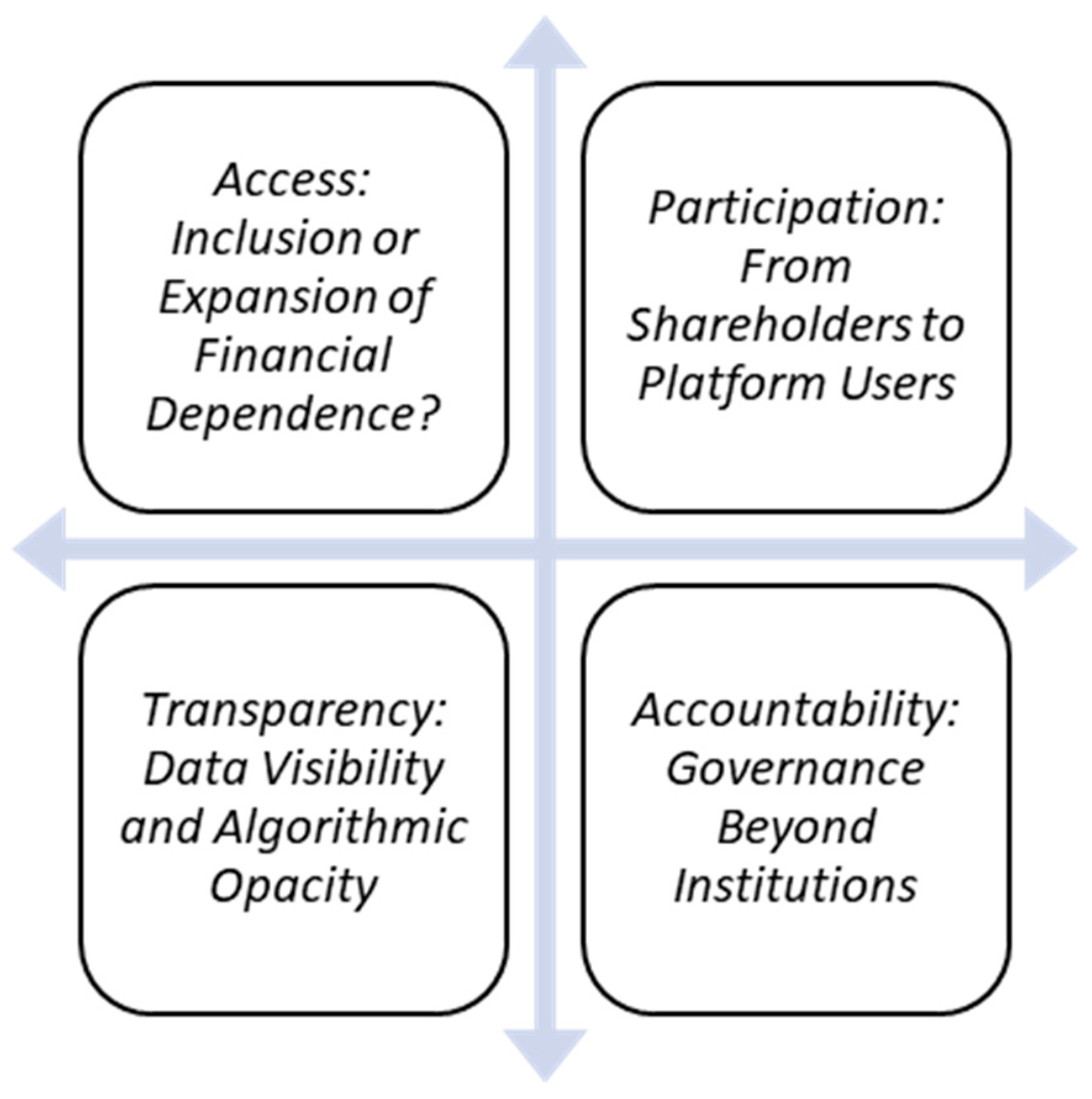
22]. In the context of financial systems, these conditions manifest as four interrelated dimensions: access, participation, transparency, and accountability (see
Figure 1). Each dimension captures a distinct facet of the democratic ideal as it becomes embedded within market and technological infrastructures.
Access reflects the distributive dimension of democracy, determining who is permitted to enter financial systems and on what terms. It represents the foundational promise of digital finance. Mobile banking, peer-to-peer lending and robo-advisory services have dramatically lowered entry barriers, extending financial participation to historically excluded populations [
6,
7]. From a developmental perspective, this aligns with the United Nations’ Sustainable Development Goals and global strategies for financial inclusion.
However, inclusion does not necessarily lead to empowerment. Critical political economy scholars argue that digital inclusion often expands the reach of finance rather than redistributing power [
2,
23]. Citizens are primarily integrated into financial systems as consumers, debtors and data producers, with their participation being mediated by algorithmic credit scoring and behavioural profiling [
10]. Access becomes conditional, granted through opaque metrics of risk and reputation, creating what Mader [
20] terms “governed inclusion”. Consequently, the rhetoric of democratisation can mask the deepening of dependency: individuals may gain market access, but they remain subject to structural hierarchies of data, literacy and infrastructure. The logic of access-as-democracy thus risks substituting availability for agency.
Participation expresses the procedural dimension, reflecting the degree to which actors can influence financial decision-making rather than merely operating within its constraints. Participation concerns the ability to influence financial decision-making and governance. In classical shareholder democracy, participation was based on ownership and voting rights [
1,
16]. In the digital economy, however, participation is redefined: citizens engage as users of platforms rather than owners of capital [
9].
Although digital tools such as social trading apps, decentralised finance (DeFi) communities and crowdfunding systems appear participatory, they often operate through algorithmic curation and unequal knowledge structures. Platform interfaces translate deliberation into clicks and metrics, producing affective engagement rather than substantive control [
10,
19]. As Fox [
11] observes, participation in innovation ecosystems is often appropriated by the designers and owners of the platforms rather than the communities that sustain them. The result is a form of affective participation that is visible, emotional and fast-moving, but detached from deliberation. Digital finance therefore extends the breadth of participation while hollowing out its depth, transforming democratic involvement into a populist spectacle.
Transparency concerns the epistemic dimension, namely how knowledge about financial processes, algorithms and outcomes circulates and whether this visibility empowers or pacifies citizens. Transparency is a classic democratic virtue, intended to make power visible and accountable. In theory, digital finance should amplify transparency through open-data infrastructures, real-time ledgers and blockchain traceability [
24,
25]. These innovations promise a world in which transactions can be verified instantly and corruption reduced.
In practice, however, the new visibility conceals new opacity. Algorithms that rate, price and target users are proprietary and non-auditable, and although data is abundant, it is uninterpretable to most citizens [
26]. This produces the “transparency paradox”: open systems that are legible only to those with computational power. Rather than demystifying finance, digital platforms may entrench asymmetries of information, creating a landscape of ‘transparent opacity’ in which users are observed but cannot observe. Therefore, the critical question for financial democracy is not whether data are available, but whether they are comprehensible, contestable and actionable by the public.
Finally, accountability embodies the normative dimension, representing the capacity to hold financial and technological actors accountable for the consequences of their actions. Accountability remains the most demanding democratic principle. Traditional finance achieves this through regulation, auditing and shareholder oversight. In digital ecosystems, however, these mechanisms are displaced by private governance, with code, algorithms and platform policies taking the place of law [
27]. Platform operators and data intermediaries exercise quasi-public authority despite lacking democratic mandates [
9,
10]. Within the framework of financial democracy, accountability refers to the concrete institutional mechanisms through which power exercised in digital financial systems can be questioned, constrained, and, where necessary, corrected. In the context of digital finance, accountability operates through several interrelated routes:
Complaint and redress mechanisms that allow users to challenge platform decisions.
The auditability and contestability of algorithmic decision-making, including access to explanations and independent review.
Clear allocation of liability among platforms, third-party service providers, and users when automated or data-driven processes shape financial outcomes.
And governance transparency concerning who sets, modifies, and enforces platform rules, under what procedures, and subject to which constraints.
Conceptualising accountability through these routes specifies how democratic control can be exercised in practice, rather than treating accountability solely as a normative endpoint.
Emerging research on algorithmic accountability proposes participatory auditing, explainability standards and co-governance models that incorporate ethics into fintech design [
26,
28]. However, such frameworks remain peripheral compared with the pace of innovation. To achieve accountability, adaptive regulation is required, as well as new civic infrastructures capable of treating fintech as a public utility. Without these, the risk is that financial democracy will degenerate into technocracy by code, where the authority to make decisions lies with engineers and investors rather than citizens.
These four dimensions—access, participation, transparency and accountability—exist in tension with each other rather than forming a linear progression. Each dimension embodies both democratising and depoliticising tendencies. Digital finance, for instance, increases accessibility but fosters dependency; broadens participation but replaces deliberation with emotion; multiplies data but obscures power; and offers accountability while dispersing responsibility. By distinguishing between these four areas, the framework moves beyond the rhetorical assertion that digitalisation “democratises” finance. It enables a critical evaluation of how digital infrastructures extend, transform or undermine citizens’ agency within financial systems. This approach is conceptually informed by theories of polycentric democracy [
29] and digital citizenship. In these theories, democracy is not viewed as a fixed institutional arrangement, but rather as a dynamic process of negotiation between various centres of authority, including states, markets, and platforms. Financial democracy requires more than just technological inclusion or market participation. Rather, it is an evolving equilibrium between openness and control, visibility and opacity, and empowerment and dependence. Financial democracy should therefore be understood as an ongoing negotiation between technology, social inclusion and institutional design. Its future depends on citizens’ ability to convert digital connectivity into political agency, thereby transforming the infrastructures of finance from instruments of market expansion into arenas of democratic contestation.
5. Transformation: The Promise of Digital Inclusion
Digitalization has transformed financial intermediation and redefined the grammar of participation in modern economies. Fintech—broadly defined as the use of digital technologies to provide financial services—is often described as a revolutionary force for democratisation, capable of breaking down structural barriers, improving efficiency and enabling individuals to engage directly with financial systems [
3,
30]. Proponents of this idea claim that technology fosters inclusion and empowerment by reducing transaction costs and eliminating physical and bureaucratic constraints. However, critical scholarship reminds us that each wave of innovation reconfigures, rather than eliminates, asymmetry [
10,
18]. Digital finance extends access, but it also embeds new logics of surveillance, dependence and behavioural control.
In this context, the transformation of financial democracy can be seen as a dual process: digital infrastructures create opportunities for participation while simultaneously undermining the institutional safeguards that once regulated it. The following subsections examine three core mechanisms through which digital finance reshapes this terrain: technological inclusion; the decentralisation of intermediation; and personalised empowerment. Together, these mechanisms redefine the meaning of democratic participation in finance.
Financial inclusion is often presented as the most tangible success of fintech innovation. Mobile banking, digital wallets and online credit platforms have made formal financial services accessible to millions who were previously excluded from traditional banking systems [
22]. For instance, M-Pesa has made it possible for people in Sub-Saharan Africa to send and receive money safely without having to open a bank account. In Southeast Asia, GCash and PayMaya have become integral to everyday transactions, and in Europe, neo-banks such as Revolut, N26, and Wise have blurred national and institutional boundaries.
These examples are often cited as emblematic of “technological leapfrogging”, whereby mobile networks compensate for the absence of physical banking infrastructure. From a developmental perspective, greater access supports the United Nations’ Sustainable Development Goals by linking inclusion to poverty reduction, gender equality and entrepreneurship. Digital ecosystems allow citizens to save small amounts of money, access micro-insurance and transfer remittances at a lower cost. This integrates them into broader economic circuits [
22].
However, connectivity does not necessarily imply empowerment. Empirical research reveals that many newly banked users remain marginalised in decision-making processes and are vulnerable to digital exclusion due to literacy gaps, algorithmic bias and affordability constraints [
20]. Fintech platforms classify users according to behavioural data, creating new hierarchies of creditworthiness and trustworthiness [
10]. While technically “included”, women, migrants, and rural populations often face predatory interest rates or limited recourse mechanisms.
Consequently, inclusion in digital finance can resemble market enrolment rather than civic participation. Langley [
24] argues that financial technologies convert citizens into datafile consumers, whose everyday actions feed predictive models. The notion of access thus risks collapsing into a purely transactional relationship—visibility without agency. A truly democratic form of inclusion would require universal access, transparent governance of digital infrastructures, equitable data rights and mechanisms for collective voice.
The second transformation concerns the structural decentralisation of financial authority. Technologies such as blockchain, distributed ledgers and smart contracts challenge the dominance of banks and payment processors by enabling peer-to-peer exchange that is validated through code [
24,
25]. In principle, DeFi replaces institutional trust with algorithmic verification; consensus protocols and open-source contracts serve as substitutes for legal and bureaucratic oversight. This model embodies what Campbell-Verduyn [
31] describes as “algorithmic governance”—a regime in which power operates through technical design rather than institutional negotiation. The ethos of decentralisation aims to flatten hierarchies and enable community-based control. Token-based voting, for example, permits users a proportional say in protocol decisions, indicating a transition towards participatory governance. Projects such as MakerDAO and Aave promote the idea that financial systems can be collectively governed through open code.
However, empirical analyses of DeFi reveal persistent contradictions. The concentration of capital and technical knowledge creates new oligarchies: Whales’ and core developers often dominate decision outcomes [
27,
32]. The algorithmic design itself can also encode biases that privilege early adopters and technologically literate individuals. Rather than eliminating intermediaries, decentralisation reconfigures intermediation—from bankers to coders, and from regulators to protocol architects.
Despite these tensions, DeFi represents a significant epistemic shift, whereby trust becomes a computational property rather than a moral or legal one. This shift has profound implications for financial democracy. If governance is embedded in code, democratic oversight requires auditability—the ability to inspect, understand and contest algorithmic rules—rather than voting. Without this literacy and access, decentralisation risks replacing one opaque authority with another.
A third, more subjective transformation lies in the narrative of empowerment. Fintech platforms often portray themselves as instruments of autonomy, “democratising investment”, “putting you in control”, or “making finance human”. Through personalised dashboards, gamified investment interfaces, and AI-driven robo-advisers, users receive real-time data visualisations that translate the abstract nature of markets into actionable insights.
Recent research shows that such tools can enhance confidence and participation when accompanied by adequate financial literacy. Lusardi and Mitchell [
33] demonstrate that digital financial literacy (DFL) significantly improves individuals’ ability to evaluate financial products and manage risk. Similarly, Choung et al. [
34] identify a positive correlation between DFL and financial well-being, and Kamble et al. [
35] emphasise its role in promoting inclusive outcomes in developing economies. Together, these findings suggest that digital skills constitute a new dimension of citizenship, which could be termed financial data competence.
Nevertheless, the concept of empowerment remains ambivalent. The same algorithms that educate and guide can also nudge and manipulate. Behavioural personalisation tailors financial choices to individual preferences. However, it also uses predictive analytics to influence those preferences [
10]. Investment apps exploit cognitive biases by using reward mechanisms and push notifications, thereby reinforcing short-term trading and speculative behaviour. The result is a new form of affective participation: users feel engaged and empowered, yet their agency is constrained by the design of the platform.
Furthermore, the rhetoric of empowerment aligns with neoliberal governance logics that shift responsibility from institutions to individuals. Citizens are encouraged to optimise their financial lives themselves, thereby transforming systemic inequalities into matters of personal competence. True empowerment would instead require collective infrastructures for learning, rights to algorithmic explanation and participatory regulation of digital financial services.
Taken together, the three processes of expanded inclusion, decentralised architectures and personalised empowerment constitute the transformative frontier of financial democracy. They signal a transition from institutional representation (e.g., shareholder voting and regulatory oversight) to infrastructural participation, where democratic ideals are embedded not in constitutions, but in code, data flows and interface design. This transformation challenges the traditional boundaries between public and private authority. As Filippi and Hassan [
27] observe, “code is law” in digital ecosystems, where governance occurs through protocols that determine what constitutes acceptable behaviour. However, when these protocols are privately owned or commercially motivated, democratic participation can be reduced to mere usage. The rhetoric of “finance for everyone” can obscure new dependencies on digital intermediaries whose power lies in algorithmic control rather than capital ownership.
To preserve the democratic potential of digital finance, scholars advocate the development of algorithmic accountability frameworks and civic oversight mechanisms that treat fintech platforms as public infrastructures [
36,
37,
38]. These would include transparent auditing standards, open-source compliance, and participatory regulation involving consumer groups and civil society actors. Only by aligning technological innovation with institutional accountability can inclusion evolve into empowerment rather than exploitation. Ultimately, digital finance transforms democracy not by reproducing its political institutions, but by embedding its principles—participation, transparency and accountability—within computational systems. The challenge lies in ensuring that these systems remain contestable and intelligible to the citizens they claim to serve. Financial democracy in the digital age is thus a negotiation between innovation and equity, access and agency, and decentralisation and oversight.
6. Distortion: The Populist Turn and the Limits of Digital Participation
Contemporary research into digital finance highlights the dual nature of technological innovation. While it increases access and participation, it also creates new power imbalances and exacerbates existing inequalities. The discourse of financial democracy, which frames finance as universally accessible, inclusive and empowering, often conceals underlying structural imbalances between end users and technology platforms, and between citizens and the algorithmic systems that increasingly shape financial engagement. A salient phenomenon, termed ‘fintech populism’, exemplifies this dynamic: popular sentiment is mobilised against traditional financial elites via digital platforms, yet these same technologies may consolidate centralised control and oversight [
9,
19]. From a critical research perspective, four interconnected distortions emerge as central challenges to the democratic aspirations of digital finance. These are summarised in
Table 1.
Together, these distortions complicate the promised emancipatory potential of digital financial technologies. Ongoing scholarly inquiry is required to dissect these complexities and to develop frameworks for algorithmic accountability, civic oversight, and equitable participation in digital financial ecosystems.
Fintech populism draws heavily on the language of empowerment, portraying users as rebels reclaiming autonomy from traditional institutions. Commission-free trading platforms and online investment communities present market participation as a moral and political act—“finance by the people, for the people”. The GameStop short squeeze of 2021 symbolised this populist reimagining of finance: thousands of retail investors coordinated via social media to challenge the dominance of hedge funds. However, as Mounk [
13] and Zuboff [
10] point out, populist participation rarely results in structural change. Populism transforms democratic participation into an emotional spectacle. In digital finance, affective engagement—excitement, outrage or resentment—replaces deliberative reasoning [
19]. Retail investors are united not by shared long-term goals, but by momentary enthusiasm, which is often amplified by social media algorithms designed to maximise engagement rather than understanding. The result is a form of participation without deliberation: intense, fleeting and highly mediated. Rather than deepening financial democracy, fintech populism commodifies it, turning political discontent into digital activity and data flows.
The second distortion concerns the nature of speculative participation. While fintech has dramatically lowered barriers to entry in financial markets, this inclusion is often achieved through mechanisms that encourage risk-taking and short-termism. Commission-free trading and fractional-share investing, while expanding access, also promote gamified behaviour. Empirical evidence shows that retail traders using mobile apps such as Robinhood engage in more speculative trading and exhibit stronger behavioural biases, including overconfidence and herd mentality. Real-time feedback loops amplify these tendencies. Vives [
5] notes that, post-crisis, innovation has transformed financial intermediation into a form of consumer technology that is fast and personalised but also volatility-inducing. This speculative participation is an example of what van der Zwan [
2] termed the financialization of everyday life: citizens are empowered to invest, but within structures that externalise risk and privatise responsibility. The rhetoric of democratisation obscures the fact that, while platforms monetise engagement through order flow and data analytics, participation transfers financial and psychological risk to users. In this sense, empowerment often becomes dependence.
The rise of algorithmic governance may be the most significant distortion of financial democracy to date. Algorithms now determine creditworthiness, portfolio recommendations and emotional engagement with financial content. Rather than deriving their legitimacy from collective deliberation, they derive it from technical authority and predictive accuracy [
27,
28]. This regime replaces institutional trust with computational trust—a form of authority that is quantitative rather than participatory. Scholars of digital capitalism warn that such systems produce governance without government [
9]: decision-making is automated and privatised, while accountability is diffused across code, datasets and machine learning models. The asymmetry between users and platforms is stark: citizens engage with financial technologies daily, yet remain unable to comprehend how algorithms classify, price or influence them. Algorithmic governance thus inverts democracy itself, producing participation without power and transparency without understanding.
Financial democracy presupposes not only access, but also symmetry of informational power. However, the data-driven logic of digital finance has created enormous disparities in who controls and benefits from financial data. Fintech platforms collect vast behavioural datasets that enable predictive profiling and monetisation across sectors [
10,
37]. Users’ transactions, savings and investment patterns become proprietary data assets. This process is an example of surveillance capitalism [
10]—a mode of accumulation in which human experience is translated into behavioural data for profit. Meanwhile, data ownership has become a new axis of inequality: individuals who generate data have little visibility of, or control over, how it is used. As Mazzucato and Semieniuk [
38] notes, the digital economy is becoming increasingly dependent on public knowledge and user-generated data, while privatising the resulting value. The promise of democratisation through data conceals its opposite: the centralisation of informational and economic power within a few global technology-finance conglomerates.
These distortions should not be considered an inevitable consequence of digital finance. Whether the use of fintech has a real impact on people’s lives depends on the management and rules of financial institutions. There should be rules requiring transparency and fairness in algorithms, and users should have the right to be informed and to appeal decisions. Users should also participate in governance beyond just interacting with the interface. These conditions can transform people’s engagement with the digital world, shifting from a sense of inclusion without meaningful involvement to active participation. This demonstrates that fintech encompasses both technology and the rules that determine its impact on democracy.
7. Democratization or Simulation: Rethinking Financial Democracy in the Digital Era
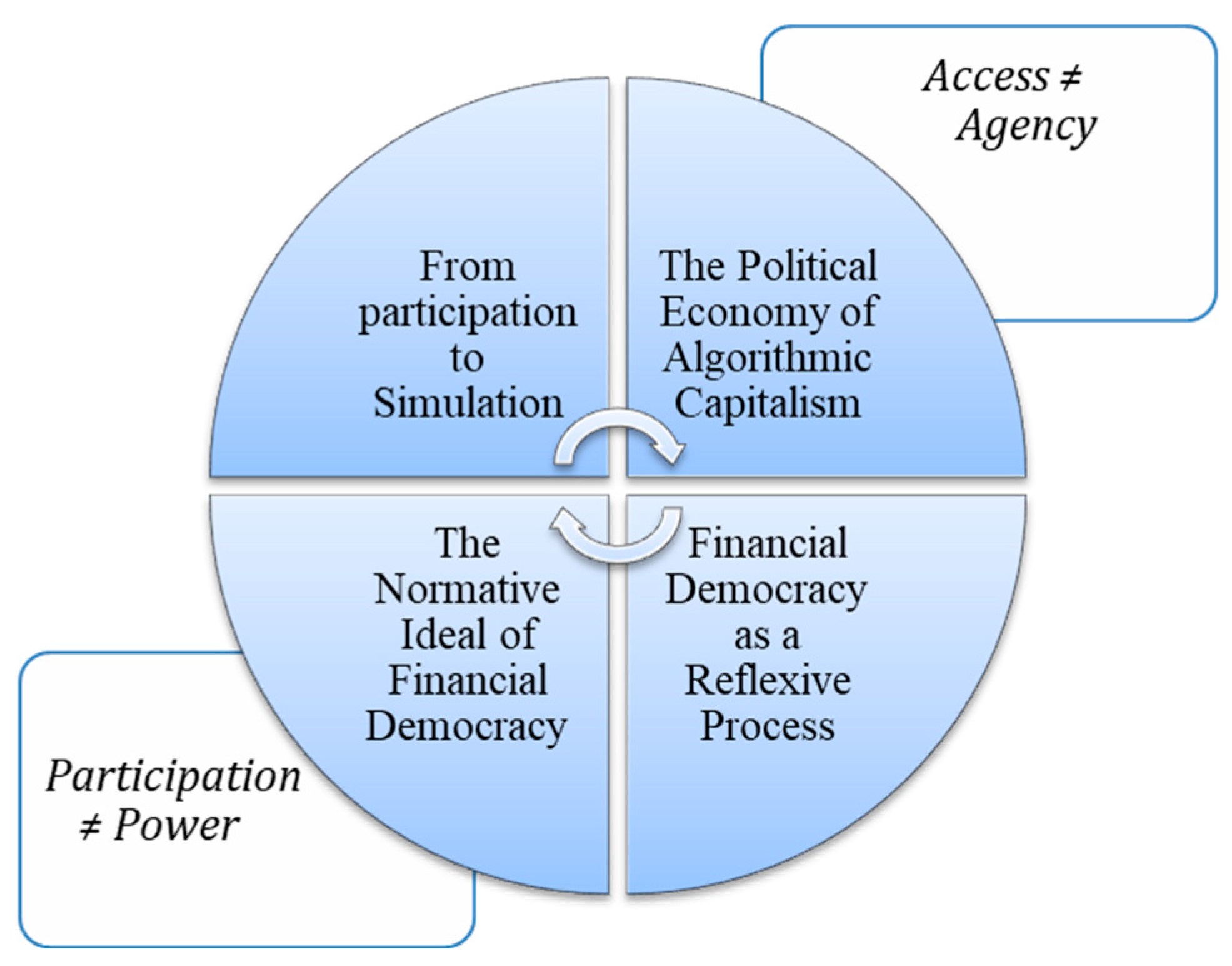
The digital transformation of finance has produced a paradoxical situation in which financial systems appear to be more open and participatory than ever before. However, they are still governed by largely invisible, unaccountable mechanisms that perpetuate inequality. This raises a central question for contemporary political economy: does digital finance truly democratise financial participation, or does it simulate democracy while increasing financial dependence? This question can be answered through the following framework (
Figure 2).
7.1. From Participation to Simulation
Digital participation is often mistaken for democratic participation. Fintech applications, retail trading platforms and blockchain communities encourage users to “take control” of their financial lives. However, the act of engagement is often merely a gesture within pre-programmed environments [
9,
10]. Participation is simulated through interfaces that convert decisions into data points and empowerment into measurable engagement. This dynamic echoes Baudrillard’s [
39] concept of simulation, whereby symbols of democracy replace democracy itself. Citizens perform participation through clicks, votes or token holdings, yet the architecture of control remains external to their agency. The gamification of trading and the illusion of decentralised control in DeFi communities embody this tension; they permit interaction without genuine influence. Financial democracy thus risks becoming a spectacle of inclusion—a symbolic reaffirmation of participation without redistributing power. Empirical studies confirm this paradox. For example, Barber et al. [
40] demonstrate that mobile trading platforms create the illusion of agency while reinforcing addictive, gamified behaviour. Similarly, Bomnüter [
41] demonstrate that gamified fintech interfaces generate emotional engagement rather than encouraging informed decision-making. In this sense, digital participation becomes a simulation of democracy, designed to capture attention rather than enable deliberation.
7.2. The Political Economy of Algorithmic Capitalism
To understand why financial democracy tends towards simulation, it is necessary to examine the political economy of algorithmic capitalism. As Srnicek [
9] and Zuboff [
10] argue, the platform economy derives value not primarily from production or exchange, but from behavioural prediction and control. Financial platforms—brokerage apps, digital banks and crypto exchanges—operate on the same logic: participation generates data, and data generates profit. In this framework, users’ engagement becomes the raw material for accumulation. Participation itself produces the data necessary for platforms to refine credit models, personalise offers and optimise engagement metrics. Thus, the architecture that purports to democratise finance relies on maintaining asymmetries of knowledge and control.
As Mazzucato and Semieniuk [
38] and Pasquale [
37] emphasise, digital capitalism transforms public knowledge and user behaviour into privately appropriated assets, enabling profit extraction under the guise of personalisation. Birch and Cochrane [
42] also point out that the algorithmic infrastructures of fintech reproduce financial dependency by monetising citizens’ digital footprints. What appears as collective democratisation is therefore also a systemic deepening of capitalist surveillance and extraction. Unlike in the earlier phase of financialization, when citizens’ savings and pensions linked them indirectly to capital markets [
2], digital finance ties participation itself—data, attention and interaction—to the accumulation process. In doing so, it undermines the normative foundations of financial democracy: transparency, accountability, and deliberation.
7.3. The Normative Ideal of Financial Democracy
Despite these distortions, the democratic aspiration within finance retains normative value. Historically, the ideal of financial democracy has rested on three principles: equal access to capital, collective oversight of financial institutions, and the equitable distribution of knowledge and returns [
8,
18,
43]. These principles continue to serve as benchmarks for assessing the legitimacy of digital finance. Reasserting democracy in this context necessitates distinguishing between formal participation—the ability to transact, invest, or hold tokens—and substantive participation—the capacity to influence the rules and objectives of financial systems. Substantive democracy demands inclusion in governance: the capacity to influence how algorithms allocate resources, how data are monetised and the ethical frameworks that underpin technological design [
26,
28].
This shift from access to agency implies a move towards deliberative financial democracy, in which citizens act not merely as users, but as co-governors of digital infrastructures. Such a framework would emphasise public transparency of algorithmic models, participatory regulation of fintech and enforceable data rights, which are grounded in democratic accountability [
44].
7.4. Financial Democracy as a Reflexive Process
In the digital age, financial democracy must be viewed as an ongoing process of negotiation between inclusion and exclusion, automation and agency, and innovation and legitimacy. Reflexivity acknowledges that democratisation can coexist with domination, and that expanding access can mask a contraction in accountability. From this perspective, the challenge lies not only in exposing simulations of participation, but also in transforming them into deliberative infrastructures. Emerging governance experiments, such as blockchain cooperatives, civic data trusts and participatory regulatory sandboxes, illustrate attempts to institutionalise democratic oversight within digital finance [
25,
45]. Whether these experiments can be scaled up remains uncertain, but they represent a conceptual shift: from digital finance for citizens to digital finance by citizens. An analysis of transformation and distortion shows that, rather than abolishing financial democracy, digital finance fundamentally redefines its architecture. The infrastructures of fintech, blockchain and algorithmic decision-making have shifted the democratic issue from an institutional to an infrastructural level. The key question is: who designs, controls and audits the code that governs financial participation? In this context, the normative vocabulary of democracy—access, participation, transparency and accountability—requires conceptual revision.
7.5. Access ≠ Agency and Participation ≠ Power
Digital finance has undoubtedly expanded access, but access alone cannot be equated with agency. Access refers to the ability to enter and use financial systems, whereas agency involves the ability to influence their operations and outcomes. While many fintech applications provide users with unprecedented connectivity, they often have limited control over how their data is used, how risk is priced by algorithms, and how governance protocols evolve [
9,
10]. A citizen may have access to a trading app yet remain disempowered within the surrounding data economy. Genuine financial democracy therefore demands inclusion based on agency—an inclusion that grants users not only access, but also a voice, the ability to understand, and the capacity to contest automated decisions.
Similarly, increased participation does not necessarily translate into power. The rise of retail investing, crowdfunding and token-based governance has multiplied opportunities for citizens to interact with financial systems. However, these forms of participation often remain symbolic or reactive [
19,
38]. The populist appeal of mass participation masks the enduring asymmetry between those who participate and those who design the systems of participation. Power in digital finance lies not in the frequency of user interaction, but in control over infrastructure, data and algorithms. Reclaiming financial democracy therefore requires reconnecting participation with institutional mechanisms of accountability and oversight.
To move beyond simulated inclusion, financial democracy in the digital era should be evaluated according to the following four interdependent criteria (
Table 2).
The evaluation criteria outlined in
Table 2 do not aim to replicate the four analytical dimensions of financial democracy that were previously introduced. Instead, they are designed to provide a complementary framework from normative and operational perspectives. The dimensions of access, participation, transparency and accountability offer an analytical approach to understanding the structure and transformation of financial democracy in the digital era. The criteria in
Table 2 translate these dimensions into conditions against which the quality of democracy can be assessed. Financial literacy and inclusivity are primarily associated with the access dimension because they address the social and cognitive conditions that make access meaningful. Transparency is directly associated with the epistemic dimension of financial democracy, emphasising the intelligibility and contestability of digital systems. Participatory governance operationalises the concept of accountability by shifting the focus from formal oversight mechanisms to citizens’ capacity to influence, contest and co-govern financial infrastructures. Together, these two frameworks differentiate between the analytical dimensions of financial democracy and the evaluative criteria for its democratic legitimacy. Consequently, they serve different yet complementary purposes within the broader argument.
These approaches redefine financial democracy as an institutional practice of shared stewardship rather than symbolic participation. In summary, financial democracy in the digital age is both a promise and a paradox. It extends participation while concentrating power, inviting citizens into financial systems while governing them through code and data. Therefore, the democratisation of finance is inseparable from the democratisation of technology itself. Participation can only escape its simulation by embedding principles of transparency, accountability, and deliberation into the infrastructures of digital finance.
8. Conclusions and Prospects
The evolution of financial democracy from shareholder-based governance toward digitally mediated forms of participation reflects broader transformations in capitalism associated with digitalisation. In earlier configurations, democracy in finance was primarily understood through mechanisms of collective oversight within corporate structures. In contemporary financial systems, participation increasingly takes place through individualised, algorithmically organised, and performative interactions. Processes commonly described as the democratisation of finance now unfold through mobile applications, blockchain-based protocols, and decentralised networks, which reorganise access, participation, and visibility within financial systems. In this analytical context, the relationship between finance and democracy can be described as increasingly infrastructural rather than institutional, as it is shaped by the technological systems that mediate participation, structure visibility, and define the conditions under which agency is exercised.
From this conceptual perspective, three interrelated analytical observations can be identified. First, digital finance transforms participation by lowering entry barriers and expanding access to financial tools that were previously limited to specific groups. Fintech platforms, mobile banking services, and decentralised finance arrangements have contributed to a redefinition of inclusion that is primarily technological in nature, based on access to digital infrastructures rather than formal political or organisational membership. Second, digitally mediated participation is structured through mechanisms such as platform design, gamification features, algorithmic coordination, and data processing. These mechanisms influence how users engage with financial activities and shape patterns of interaction, information distribution, and visibility within financial systems. As a result, participation may appear more open and immediate, while underlying control over technological architectures and data remains concentrated within platform-based governance arrangements. Third, financial democracy in the digital context can be understood as a contested and reflexive process whose meaning and scope are closely linked to the governance and design of the technologies through which financial participation occurs.
The theoretical contribution of this analysis lies in conceptualising financial democracy as a system characterised by ongoing tension rather than as a stable or fully realised condition. The discussion proposes a multidimensional analytical framework based on access, participation, transparency, and accountability, highlighting that changes in any one dimension affect the overall configuration of financial democracy. Digital transformation does not remove these dimensions; instead, it relocates them into technological infrastructures where rules and relationships are embedded in code, data architectures, and algorithmic processes. In this setting, the organisation of financial participation depends on how these infrastructures are designed, implemented, and governed, rather than solely on formal institutional arrangements.
This study adopts a conceptual approach and therefore entails limitations inherent to theoretical analysis. The argument does not aim to provide empirical evaluation but rather synthesises established strands of literature to interpret how financial democracy is reconfigured under conditions of digitalisation. Future research may build on this framework by examining how specific fintech platforms and decentralised finance ecosystems operationalise access, transparency, and accountability in practice, as well as how regulatory environments influence these processes. Comparative and interdisciplinary approaches may further contribute to understanding how technological mediation shapes participation and governance in contemporary financial systems.
In this context, discussions of financial democracy in the digital era increasingly centre on the interaction between technological infrastructures and participatory arrangements. As financial systems become more reliant on digital platforms and algorithmic coordination, the organisation of participation is increasingly influenced by the governance of these technologies. The scope and character of financial democracy are therefore closely connected to the institutional and technical frameworks within which digital financial systems operate.