


Abstract
Ammonia (NH3) is emerging as a key energy carrier in the context of the European Union’s drive towards decarbonisation, serving as a hydrogen carrier and direct fuel in maritime and power generation sectors. Accurate and traceable measurement of NH3 purity is essential across the entire ammonia value chain. This article describes the work carried out by the Reference Gas Laboratory (LGR) of the Instituto Português da Qualidade (IPQ) within the framework of the European Partnership on Metrology project MetNH3Energy. This work presents the calibration of NH3 reference gas mixtures according to ISO 6143 using a first-order linear fit with three certified reference gas standards in nitrogen matrix at nominal mole fractions from 25 µmol/mol to 1001 µmol/mol. While the ISO 6143 comparative approach is well established, its systematic application to NH3 across this concentration range, together with an assessment of the nitrogen-to-air matrix effect relevant to IPQ’s air-matrix reference mixtures, has not previously been reported and extends the NH3 measurement capabilities currently available through the BIPM Key Comparison Database. The validation of the NH3 calibration method was carried out on three consecutive days using the normalised error (En) statistical tool and repeatability and intermediate precision studies. All En values obtained were within the acceptance criterion |En| ≤ 1, confirming the validity of the calibration method. Repeatability and intermediate precision components were found to be well below the calibration uncertainty, demonstrating the robustness of the measurement procedure. These results support the establishment of new Calibration and Measurement Capabilities (CMCs) for NH3 at IPQ, contributing to the metrological infrastructure for ammonia in emerging energy applications. This work therefore represents the first rigorous validation of the NH3 calibration method at IPQ, providing the metrological foundation needed to support the emerging ammonia energy sector.
1. Introduction
Ammonia (NH3) is emerging as a pivotal molecule in the global energy transition. Its potential as a carbon-free hydrogen carrier positions ammonia as a strategically important energy vector for the European Union’s decarbonisation ambitions [1]. This potential is reinforced by its established use in the fertiliser, refrigeration, and chemical industries, which already provide infrastructure and handling expertise relevant to its expanded role as an energy carrier. EU policy frameworks, including REPowerEU [2], REFuelEU [3], and FuelEUMaritime [4], underscore the urgency of developing robust metrological infrastructure to support the safe and reliable deployment of ammonia across maritime, power generation, and industrial sectors.
As ammonia transitions from an industrial chemical to an energy carrier, the requirements for measurement quality and traceability become significantly more stringent. Impurities such as H2O, CO2, CH4, SO2 and H2S can compromise performance in downstream applications, for example, by poisoning catalysts in ammonia crackers, degrading proton exchange membranes in hydrogen fuel cells, or causing corrosion in storage and distribution infrastructure. Furthermore, pollutant emissions including NH3, SO2, NO, NO2, and N2O arising from the thermochemical conversion of ammonia must be reliably monitored under increasingly stringent regulatory frameworks such as the EU Industrial Emissions Directive (IED) [5] and National Emissions Ceilings (NEC) Directive [6].
In this context, the European Partnership on Metrology (EPM) project MetNH3Energy—“Metrology to Support Ammonia Use in Emerging Applications”—was launched in September 2025 with a duration of 36 months. The project is coordinated by the Physikalisch-Technische Bundesanstalt (PTB, Germany) and involves 26 partner institutions, including National Metrology Institutes (NMIs), Designated Institutes (DIs), Universities, and Industrial partners across Europe [7].
The Instituto Português da Qualidade, I.P. (IPQ) is an Internal Beneficiary of the MetNH3Energy project, contributing through its Reference Gas Laboratory (Laboratório de Gases de Referência, LGR). LGR is the Portuguese national laboratory responsible for the preparation and certification of primary reference gas standards, with long-standing experience in gravimetric preparation according to ISO 6142-1 [8] and gas analysis according to ISO 6143 [9,10,11]. IPQ participates in Work Package 1 (WP1—Reference Materials and Measurement Methods), as well as in the dissemination and management work packages (WP5 and WP6).
Within WP1, IPQ is responsible for the preparation of NH3 reference gas mixtures in an air matrix, targeting mole fractions between 25 µmol/mol and 50 µmol/mol, using the static gravimetric method with specially treated high-pressure cylinders. Before these air-matrix NH3 mixtures can be produced with confidence, the underlying calibration method itself must be validated. This validation, presented in this article, was performed using certified NH3 standards in a nitrogen matrix, and the implications of this nitrogen-to-air matrix difference for the non-dispersive infrared (NDIR) analyser response are addressed in Section 3.1.
Reference gas mixtures for NH3 have previously been developed mainly for ambient air-quality applications, at concentration levels well below those relevant to the ammonia energy sector. Within the EMRP-funded MetNH3 project, gravimetric primary standard mixtures in passivated cylinders and permeation-based dynamic generators were developed and characterised as optical transfer standards for cavity ring-down spectrometry, together with dedicated studies of NH3 surface adsorption on treated cylinder materials [12,13]. More recently, Macé et al. [14] developed dynamic NH3 reference gas mixtures at 1 nmol/mol–400 nmol/mol in synthetic air, generated by permeation with two-stage dilution and verified by cavity ring-down spectroscopy (CRDS) against the Swiss national metrology institute (METAS), achieving expanded uncertainties below 2% (k = 2) for ambient air-quality monitoring. These approaches target the nmol/mol range relevant to atmospheric NH3 monitoring, using dynamic generation in an air matrix and CRDS verification. The present work instead addresses the µmol/mol range relevant to fuel-grade ammonia purity and emission monitoring in energy applications, using static gravimetric preparation of certified reference mixtures in a nitrogen matrix, verified through ISO 6143 comparative calibration with NDIR analysis; to our knowledge, no previous validation of an ISO 6143-based NH3 calibration method has been reported at these concentration levels.
This article focuses on the calibration of NH3 reference gas mixtures performed at LGR/IPQ using the comparative method described in ISO 6143, with subsequent validation of the calibration procedure using the normalised error (En) statistical criterion and repeatability and intermediate precision (R&R) studies. The work directly supports the MetNH3Energy project objectives by establishing traceable measurement capabilities for NH3 across the range of 25 µmol/mol to 1001 µmol/mol and contributes to the preparation of new Calibration and Measurement Capabilities (CMCs) for submission to the BIPM Key Comparison Database (KCDB) [15]. The novelty of this work lies not in the ISO 6143 methodology itself, which is well established, but in its first systematic application to NH3 across the (25–1001) µmol/mol range, together with an explicit assessment of the nitrogen-to-air matrix effect relevant to the air-matrix reference mixtures produced under WP1, extending NH3 measurement capabilities beyond those currently listed in the KCDB. Rather than proposing a new analytical technique, the contribution of this work is to provide, for the first time, a rigorous, ISO 6143-compliant validation of the NH3 calibration capability at IPQ, establishing the metrological foundation needed to support the emerging ammonia energy sector.
2. The MetNH3Energy Project and IPQ’s Role
2.1. Project Overview
MetNH3Energy is funded under the European Partnership on Metrology, with a total budget of approximately € 3.65 million and a consortium of 26 beneficiaries from 15 countries. The project addresses critical gaps in ammonia metrology across four technical work packages: WP1 (Reference materials and measurement methods), WP2 (Flow metering), WP3 (Metrological support for ammonia leakage and material compatibility), and WP4 (Real-time emission measurement techniques and ammonia life-cycle analysis).
The project’s overarching objective is to develop a metrological framework that supports the deployment of ammonia as an energy carrier in emerging applications such as ammonia cracking for hydrogen production, maritime fuel, and power generation. A particular challenge addressed in WP1 is the development of reference materials in ammonia matrices, which is technically demanding due to ammonia’s low vapour pressure at room temperature (~8 bar) and its strong adsorption behaviour on surfaces [12,14].
2.2. IPQ Contributions Within MetNH3Energy
The LGR/IPQ has solid experience and competence in the preparation of gaseous reference materials using gravimetry and Certified Reference Material (CRM) production according to ISO 17034. LGR contributes to WP1 of the MetNH3Energy project in:
- (1)
- Preparation of NH3 reference gas mixtures in air matrix using the static gravimetric method with specially treated high-pressure cylinders, targeting mole fractions between 25 µmol/mol and 50 µmol/mol, using non-dispersive infrared spectroscopy (NDIR) analytical technique.
- (2)
- Preparation of NO2 reference materials in an air matrix at mole fractions between 50 µmol/mol and 1000 µmol/mol, covering this full sub-range, using the non-dispersive ultraviolet absorption (NDUV) analytical technique.
- (3)
- Preparation of SO2 reference materials in a nitrogen matrix at mole fractions between 20 µmol/mol and 150 µmol/mol, using NDIR analytical technique.
All these mixtures are subsequently validated through interlaboratory circulation studies, with the participants’ laboratories, supporting the development of analytical methods based on TDLAS (Tunable Diode Laser Absorption Spectroscopy), CRDS (Cavity Ring-Down Spectroscopy), NDUV and NDIR techniques.
Beyond reference material preparation, IPQ participates in the dissemination activities of WP5, contributing to stakeholder workshops, publications, and standardisation outreach, including engagement with the BIPM CCQM Gas Analysis Working Group (GAWG) [16].
Before producing the NH3 reference gas mixtures, IPQ first had to validate its calibration method. This step was essential to confirm the reliability and traceability of the results generated, in accordance with ISO 17034 [17] and ISO 17025 [18] requirements. The work presented in this article focuses specifically on this validation process, describing the methodology applied and the outcomes achieved. Successful validation of the calibration method is a prerequisite for establishing CMC entries in KCDB. These entries will formally recognise IPQ’s measurement capability for ammonia reference gas mixtures.
3. Materials and Methods
3.1. Calibration Method According to ISO 6143
The approach applied in this work is referred to as a comparative calibration method: the response of the analytical system to a sample of unknown composition is compared against its response to a set of certified reference gas mixtures analysed under the same instrumental conditions, rather than being derived from an absolute physical measurement. This comparative principle underlies the ISO 6143 [9] methodology described below. The purpose of calibration according to this standard is to establish a dependable correlation between the instrument’s signal and the concentration of the target gas in the sample, ensuring accurate, consistent, and traceable measurements during gas analysis. This standard specifies methods for determining the response function (calibration function) of gas analysers using a set of reference gas mixtures with certified mole fractions spanning the measurement range of interest. The instrument response to each reference mixture is recorded, typically as peak areas or voltages, depending on the type of analyser used.
A mathematical model, such as a linear or polynomial regression, is then applied to describe the relationship between the instrument response and the concentration of the analyte. This standard emphasises the evaluation of uncertainties for both the reference mixtures and the instrument response, ensuring the calibration curve is accurate and reliable. The established calibration curve is subsequently used to determine the composition of unknown gas mixtures by measuring their instrument response and interpolating within the range of the calibration standards.
The certification process is carried out using an automated multichannel sampling system, to which all cylinders scheduled for analysis are connected. During analysis, the system automatically selects each cylinder, allowing the individual flow of gas through the analyser. The entire sampling and measurement process is managed by the custom-developed IPQAnaliseQui software, which controls system operation and records all measurement data obtained by the analyser. All collected data, including standard and sample analysis records, are subsequently compiled into a spreadsheet, and the final results are corrected using zero readings and pressure data. Specifically, before each series of standard and sample analyses, the analyser baseline was established by measuring a zero gas of high-purity nitrogen (N2 ≥ 99.999%), matching the matrix of the reference standards used in this validation, and this zero reading was subtracted from each subsequent instrument response to correct for baseline drift. In addition, the cylinder outlet pressure was logged for each measurement and used to correct the instrument response for small variations in sample flow associated with pressure fluctuations during the sampling sequence.
The calibration function is determined using XGENLINE, a software tool developed by the National Physical Laboratory (NPL). This software identifies the most appropriate low-degree polynomial calibration function (first-, second-, third-, or fourth-order) for a given set of measurement data (X, Y), taking into account the associated uncertainties. XGENLINE identified a first-order polynomial as the most suitable calibration function for each calibration performed. Consistent with ISO 6143, XGENLINE performs a generalised least-squares regression that incorporates the standard uncertainties of both the certified reference mole fractions (x-values) and the recorded instrument responses (y-values), rather than treating the x-values as exact; this ensures that the fitted calibration function and its uncertainty correctly propagate contributions from both axes, as required by the standard.
For the specific case of NH3, calibration of the measurement system was carried out following the comparative method described in Section 3.1 above. Consistent with the first-order result identified by XGENLINE, a linear fit was applied, expressed as y = a + b·x, where y is the instrument signal, x is the certified NH3 mole fraction, and the coefficients a (intercept) and b (slope) are determined by least-squares regression. This linear model was selected as the most appropriate for the (25–1001) µmol/mol range, consistent with the ISO 6143 recommendations for analysers exhibiting a linear response function. The specific analytical method used was NDIR.
The validated calibration procedure and results reported in this work apply specifically to NH3 in a nitrogen matrix, corresponding to the matrix of the certified reference standards used (Section 3.2). The NH3 reference gas mixtures subsequently produced by IPQ under WP1 are prepared in an air matrix, so the implications of this difference were considered. Because NDIR targets a specific NH3 absorption band in the mid-infrared region, and neither N2 nor the major constituents of dry air (N2, O2) absorb significantly in that band, no substantial matrix-induced shift in the NH3 response is expected between nitrogen and air matrices. Trace species that do absorb in overlapping spectral regions, notably H2O and CO2, can nonetheless interfere with the NH3 signal if present in the sample or carrier gas; the analyser’s optical filter and the use of dry, high-purity carrier and zero gases minimise this risk, but a dedicated matrix-effect and interference study for air-matrix NH3 mixtures is planned as future work (Section 5).
On each measurement day, three consecutive readings (runs) were taken for each calibration standard, and the mean value and associated repeatability were computed. XGENLINE, which complies with ISO 6143, handles the propagation of uncertainty and provides a standard uncertainty value for each analytical result. For the NH3 calibration, the combined uncertainty included contributions from the certified uncertainty of the reference standards, the repeatability of the measurements, and the uncertainty of the regression, propagated according to the Guide to the Expression of Uncertainty in Measurement (GUM) [19]. The final results are presented together with their respective expanded uncertainties.
3.2. Reference Gas Standards
The calibration was performed using three NH3 reference gas standards in a nitrogen matrix, supplied with certificates traceable to SI units. The standards cover a wide range of NH3 mole fractions relevant to both quality assessment and emission monitoring applications within the MetNH3Energy project. The characteristics of the certified reference standards used are presented in Table 1.
Table 1.
NH3 reference gas standards used for calibration.
All expanded uncertainties are reported at a coverage factor k = 2 (approximately 95% confidence level). The standards were stored and handled in accordance with their certification conditions prior to use. Three reference standards were used because XGENLINE requires a minimum of three calibration points to fit a first-order polynomial with an associated goodness-of-fit assessment; the concentration levels selected ((25, 503 and 1001) µmol/mol) were chosen to span the range of interest for the MetNH3Energy project within the availability of certified NH3 standards in a nitrogen matrix at the time of this study. This minimum configuration confirms a linear response but provides limited power to detect subtle deviations from linearity; additional intermediate-level standards are planned in future work to strengthen this assessment (Section 5). While three points are the minimum required to define a first-order calibration function, the consistency of the results across the full range of 25 µmol/mol–1001 µmol/mol, together with the absence of systematic residual trends identified by XGENLINE, supports the adequacy of a linear model over this range; nonetheless, additional intermediate standards remain desirable to more rigorously test linearity, as noted above.
3.3. Method Validation
3.3.1. Normalised Error (En)
The normalised error (En) [20] is a widely used metrological criterion for verifying the compatibility between a measured result and a reference value, taking into account their respective uncertainties. It is defined as:
where xLab is the laboratory measurement result, xRef is the certified reference value, ULab is the expanded uncertainty of the measurement result, and URef is the expanded uncertainty of the reference standard (both at k = 2). The acceptance criterion is |En| ≤ 1, indicating statistical compatibility between the two values at the 95% confidence level.
3.3.2. Repeatability and Intermediate Precision Studies
Repeatability and intermediate precision were assessed in accordance with the methodology described in ISO 5725-2 [21] and applied within the spreadsheet tool developed at LGR/IPQ. For each calibration standard and each measurement day, three replicate readings were performed, from which the within-day repeatability standard deviation (sr) was computed.
The repeatability standard uncertainty of mean estimates was calculated as sr/√3 (standard deviation of the mean of three replicates). The intermediate precision of the mean of triplicates was assessed by computing the standard deviation of the daily mean results across the three days of measurement, divided by √3. The calibration uncertainty component was derived from the combined uncertainty of the three individual run uncertainties. These three components—repeatability, calibration uncertainty, and intermediate precision—were combined using the root-sum-of-squares method to obtain the total combined measurement uncertainty, from which the expanded uncertainty at k = 2 was derived.
Traceability, applicability, and limitations. Traceability to the SI is established through the gravimetric preparation of the primary NH3 reference standards according to ISO 6142-1, with the certified values of the standards used in this study traceable to the SI mole fraction and disseminated to the analytical result via the ISO 6143 comparative calibration procedure described above. All measurements were performed under the controlled temperature and pressure conditions of the LGR/IPQ gas metrology laboratory, with standards and samples allowed to equilibrate to ambient laboratory conditions before analysis, in accordance with the requirements of ISO 6143. The validated applicability range of the present method is limited to NH3 in a nitrogen matrix over the (25–1001) µmol/mol range, using NDIR analysis and a first-order calibration function; it has not yet been demonstrated for NH3 in an air matrix, for other analytical techniques, outside this concentration range, or through interlaboratory comparison, and these limitations are addressed as future work in Section 5.
4. Results and Discussion
4.1. Validation Results—Normalised Error and Uncertainty Components
The complete validation results, including the measurement results (x), expanded uncertainties (U), normalised error (En), repeatability, calibration uncertainty, and intermediate precision for each cylinder and each measurement day, are presented in Table 2.
Table 2.
Validation results for NH3 calibration method: measurement results, expanded uncertainty, normalised error, and standard uncertainty components for three reference gas standards over three measurement days.
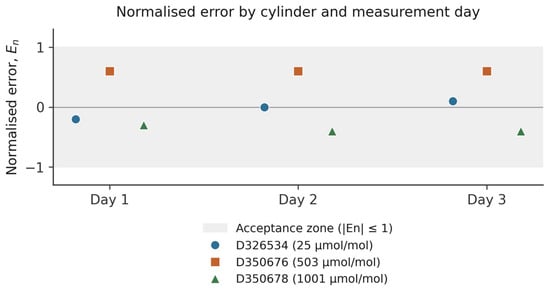
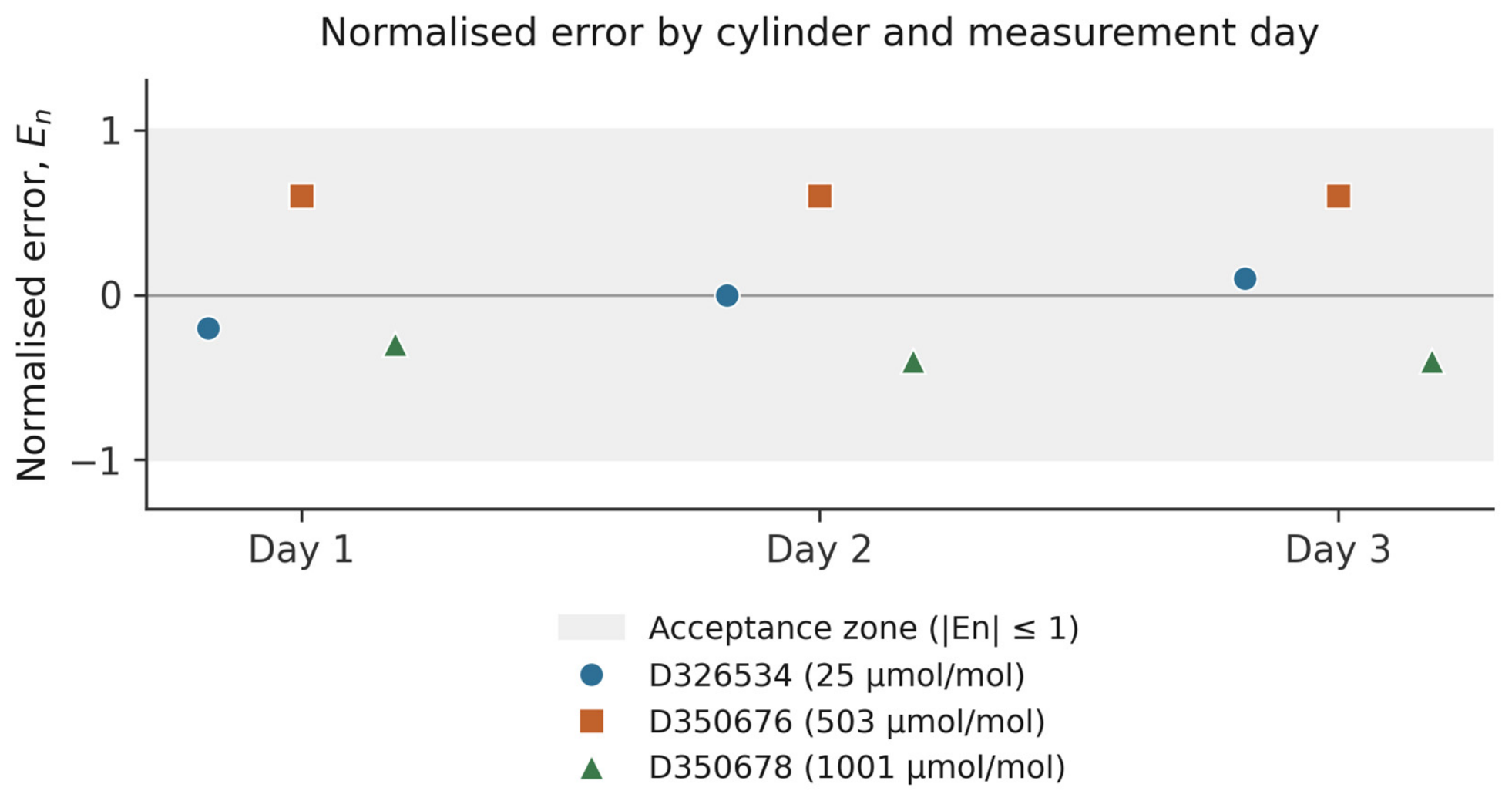
All normalised error values satisfy the criterion |En| ≤ 1 for all three reference standards and all three measurement days, Figure 1. For cylinder D326534 (nominal 25 µmol/mol), En ranged from −0.2 to 0.1, indicating excellent agreement with the certified reference value. For cylinder D350676 (nominal 503 µmol/mol), all three days yielded En = 0.6, reflecting a small but statistically acceptable positive bias. For cylinder D350678 (nominal 1001 µmol/mol), En values ranged from −0.3 to −0.4, indicating a slight negative bias within the combined uncertainty envelope. The consistent En = 0.6 observed for cylinder D350676 across all three measurement days indicates a small but systematic positive bias rather than random scatter, since a purely random effect would be expected to vary in sign and magnitude between days. Because this bias is stable in both direction and magnitude, plausible origins include a marginal deviation of this cylinder’s certified value from its true composition, a small non-linearity in the NDIR response at intermediate concentrations not fully captured by the first-order fit, or a systematic contribution from the multichannel sampling system specific to this cylinder position. As |En| remained below the acceptance threshold of 1 on all three days, this bias does not compromise the validity of the calibration, but it is noted here as a candidate for further investigation, for example through the inclusion of additional intermediate-level reference standards in future validation campaigns (Section 3.2). Among these, NDIR cross-sensitivity to trace species, small differences in cylinder matrix composition, and residual pressure effects during sampling are considered the most likely systematic contributors, rather than random measurement variation; distinguishing between them would require dedicated interference and matrix-matched comparison experiments, which are proposed as future work.
Figure 1.
Normalised error (En) for each of the three NH3 reference standards on each of the three measurement days. The shaded band marks the acceptance zone (|En| ≤ 1).
The calibration uncertainty component is the dominant contributor to the total measurement uncertainty across all concentration levels, as expected for a comparative method where the reference standard’s certified uncertainty is the primary source of uncertainty. The repeatability contribution is substantially smaller than the calibration uncertainty at all three concentration levels, confirming that the measurement system is stable and well-controlled within each measurement session.
4.2. Repeatability and Intermediate Precision Summary
Table 3 summarises the repeatability and intermediate precision components derived from the three-day validation study, together with the mean estimated results and associated expanded uncertainties.
Table 3.
Summary of mean calibration results and uncertainty components (repeatability and intermediate precision) for the three NH3 reference standards.
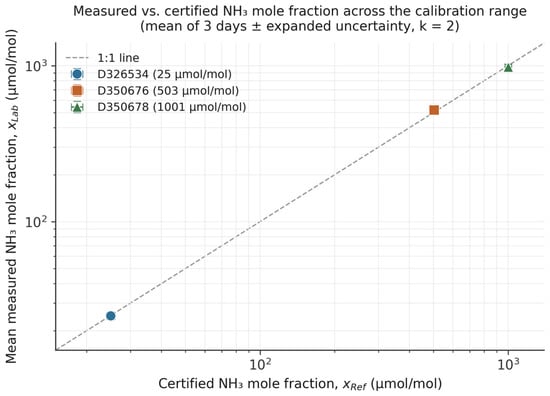
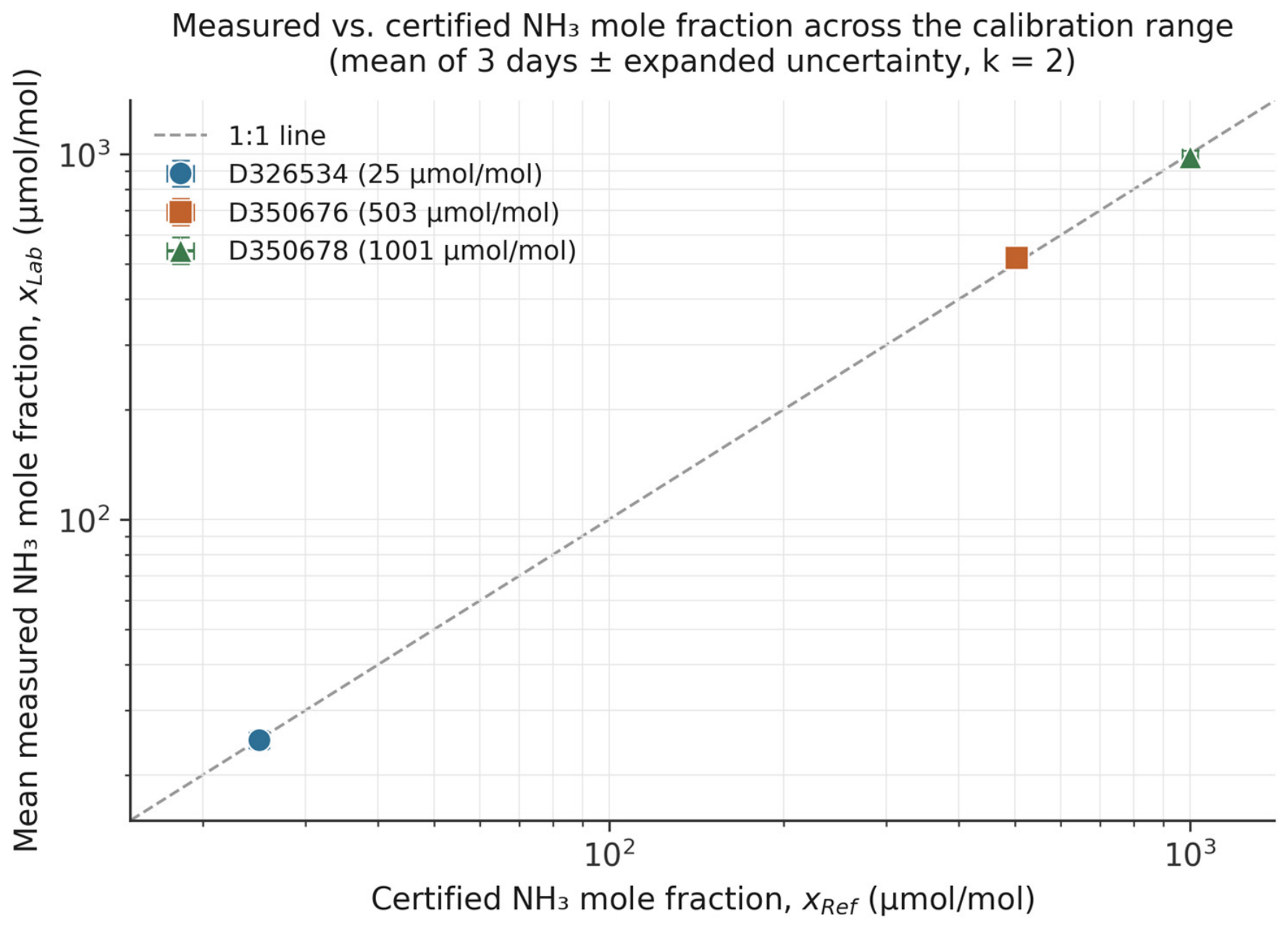
The results confirm a consistent pattern across all three concentration levels, Figure 2. The intermediate precision standard deviation (sR) is of the same order of magnitude as the repeatability (sr), with sR typically being approximately twice sr, as is characteristic of well-controlled laboratory measurement systems where between-day variation is only slightly larger than within-day variation.
Figure 2.
Mean measured NH3 mole fraction versus certified value across the three reference standards ((25, 503 and 1001) µmol/mol), plotted on logarithmic axes to show agreement across the full calibration range. Error bars show expanded uncertainty (k = 2); the dashed line is the 1:1 reference.
For the 25 µmol/mol level, repeatability (0.059 µmol/mol) and intermediate precision (0.116 µmol/mol) are very small relative to the expanded calibration uncertainty (~0.4 µmol/mol), representing less than 15% and 30% of the calibration uncertainty, respectively. Similar ratios are observed at the 503 µmol/mol and 1001 µmol/mol levels, confirming that the random components of uncertainty are not a limiting factor in the overall measurement uncertainty budget.
The slightly elevated values observed at 503 µmol/mol relative to the certified reference value (mean measured: 520 µmol/mol vs. certified: 503 µmol/mol) are within the combined expanded uncertainty and reflect measurement compatibility as confirmed by the En criterion. This level of agreement is consistent with what is achievable using first-order ISO 6143 calibration at these concentration levels.
5. Conclusions
This work presents the calibration and validation of NH3 reference gas mixtures at LGR/IPQ in the context of the EPM MetNH3Energy project. The calibration was performed according to ISO 6143 using a first-order linear fit with three certified reference standards covering the mole fraction range (25–1001) µmol/mol. The validation was carried out over three consecutive measurement days using the normalised error (En) statistical criterion and repeatability and intermediate precision assessments.
All |En| values were ≤ 1, confirming full statistical compatibility between the measurement results obtained at LGR/IPQ and the certified reference values. Repeatability and intermediate precision components were found to be significantly smaller than the calibration uncertainty across all three concentration levels, demonstrating the robustness and intermediate precision of the ISO 6143 comparative calibration procedure at LGR/IPQ.
These results provide the technical basis for establishing new Calibration and Measurement Capabilities (CMCs) for NH3 reference gas mixtures at IPQ. Translating this validation into a formal CMC entry will require submission of the corresponding CMC claim, supported by this validation dataset, for review by the EURAMET Technical Committee for Metrology in Chemistry (TC-MC), followed by inter-regional review under the CIPM MRA and publication in the BIPM Key Comparison Database (KCDB). They further contribute to the metrological infrastructure being developed within MetNH3Energy for ammonia quality assessment and emission monitoring in emerging energy applications, directly supporting the project’s deliverables of Work Package 1.
Future work will extend this validation to lower NH3 mole fraction levels ((5–30) µmol/mol) using dynamically generated reference materials and will include intercomparison exercises with WP1 partners to demonstrate cross-laboratory measurement compatibility. It will also incorporate additional intermediate-level reference standards to more rigorously test linearity across the calibration range and will include a dedicated matrix-effect and spectral-interference study to confirm the applicability of the present nitrogen-matrix validation to the air-matrix NH3 reference mixtures produced under WP1.
Author Contributions
Conceptualisation, F.A.D.; methodology, F.A.D., J.C. and C.P.; formal analysis, F.A.D., J.C., C.J.C. and C.P.; investigation, F.A.D., J.C. and C.P.; writing—original draft preparation, F.A.D.; review and editing, C.J.C., J.C., C.P. and R.B.d.S.; project administration, F.A.D. All authors have read and agreed to the published version of the manuscript.
Funding
This research was carried out within the framework of the European Partnership on Metrology (EPM) project 24GRD01 MetNH3Energy—“Metrology to Support Ammonia Use in Emerging Applications” (project reference: v16_Protocol_P1.2), which received funding from the European Union through EURAMET. The views expressed are those of the authors and do not necessarily reflect those of EURAMET or the European Commission.
Data Availability Statement
Data is contained within the article. The original contributions presented in this study are included in the article. Further inquiries can be directed to the corresponding author.
Conflicts of Interest
The authors declare no conflicts of interest.
References
- IEA. Ammonia Technology Roadmap (ATRIP); International Energy Agency: Paris, France, 2021. [Google Scholar]
- European Commission. REPowerEU. Available online: https://commission.europa.eu/topics/energy/repowereu_en (accessed on 24 July 2026).
- European Commission, Directorate-General for Mobility and Transport. ReFuelEU Aviation-Mobility and Transport-European Commission. Available online: https://transport.ec.europa.eu/transport-modes/air/environment/refueleu-aviation_en (accessed on 24 July 2026).
- European Commission, Directorate-General for Mobility and Transport. Decarbonising Maritime Transport-FuelEU Maritime-Mobility and Transport. Available online: https://transport.ec.europa.eu/transport-modes/maritime/decarbonising-maritime-transport-fueleu-maritime_en (accessed on 24 July 2026).
- Directive 2010/75/EU of the European Parliament and of the Council on Industrial Emissions (IED Directive) of 24 November 2010. Available online: https://eur-lex.europa.eu/eli/dir/2010/75/oj/eng (accessed on 24 July 2026).
- Directive 2016/2284/EU on National Emission Ceilings (NEC Directive) of 31 December 2016. Available online: https://eur-lex.europa.eu/eli/dir/2016/2284/oj/eng (accessed on 24 July 2026).
- Qu, Z. MetNH3Energy—Metrology to Support Ammonia Use in Emerging Applications. JRP Protocol v16_Protocol_P1.2, European Partnership on Metrology, EURAMET. 2024. Available online: https://www.euramet.org/research-innovation/search-research-projects/details?tx_eurametctcp_project%5Bproject%5D=2008&cHash=ea6362bde3f8eb0496963dc102c743f1 (accessed on 24 July 2026).
- ISO 6142-1:2015; Gas Analysis—Preparation of Calibration Gas Mixtures—Part 1: Gravimetric Method for Class I Mixtures. International Organisation for Standardisation: Geneva, Switzerland, 2015.
- ISO 6143:2025; Gas Analysis—Comparison Methods for Determining and Checking the Composition of Calibration Gas Mixtures. International Organisation for Standardisation: Geneva, Switzerland, 2025.
- Dias, F.A.; Palma, C.; Costa, C.J. Preparation of Multicomponent Mixtures to Support Carbon Metrology. Measurement 2025, 239, 115453. [Google Scholar] [CrossRef] [Scilit]
- Dias, F.A.; Palma, C.; Costa, C.J. Multicomponent Mixtures—Stability Study to Support Carbon Metrology. J. Electr. Electron. Eng. 2025, 4, 1–9. [Google Scholar] [CrossRef] [Scilit]
- Vaittinen, O.; Metsälä, M.; Persijn, S.; Vainio, M.; Halonen, L. Adsorption of ammonia on treated stainless steel and polymer surfaces. Appl. Phys. B 2014, 115, 185–196. [Google Scholar] [CrossRef] [Scilit]
- Pogány, A.; Balslev-Harder, D.; Braban, C.F.; Cassidy, N.; Ebert, V.; Ferracci, V.; Hieta, T.; Leuenberger, D.; Martin, N.A.; Pascale, C.; et al. A metrological approach to improve accuracy and reliability of ammonia measurements in ambient air. Meas. Sci. Technol. 2016, 27, 115012. [Google Scholar] [CrossRef] [Scilit]
- Macé, T.; Iturrate-Garcia, M.; Pascale, C.; Niederhauser, B.; Vaslin-Reimann, S.; Sutour, C. Air pollution monitoring: Development of ammonia (NH3) dynamic reference gas mixtures at nanomoles per mole levels. Atmos. Meas. Tech. 2022, 15, 2703–2718. [Google Scholar] [CrossRef] [Scilit]
- BIPM. Search. KCDB Quick Search. Available online: https://www.bipm.org/kcdb/cmc/quick-search (accessed on 24 July 2026).
- BIPM. Welcome—BIPM. Available online: https://www.bipm.org/en/ (accessed on 24 July 2026).
- ISO 17034:2016; General Requirements for the Competence of Reference Material Producers. International Organisation for Standardisation: Geneva, Switzerland, 2016.
- ISO/IEC 17025:2017; General Requirements for the Competence of Testing and Calibration Laboratories. International Organisation for Standardisation: Geneva, Switzerland, 2017.
- JCGM 100:2008; Evaluation of Measurement Data—Guide to the Expression of Uncertainty in Measurement (GUM). Joint Committee for Guides in Metrology: Sèvres, France, 2008.
- ISO 13528:2022; Statistical Methods for Use in Proficiency Testing by Interlaboratory Comparison. International Organization for Standardization: Geneva, Switzerland, 2022.
- ISO 5725-2:2019; Accuracy (Trueness and Precision) of Measurement Methods and Results—Part 2: Basic Method for the Determination of Repeatability and Reproducibility of a Standard Measurement Method. International Organisation for Standardisation: Geneva, Switzerland, 2019.

Disclaimer/Publisher’s Note: The statements, opinions and data contained in all publications are solely those of the individual author(s) and contributor(s) and not of MDPI and/or the editor(s). MDPI and/or the editor(s) disclaim responsibility for any injury to people or property resulting from any ideas, methods, instructions or products referred to in the content. |
© 2026 by the authors. Licensee MDPI, Basel, Switzerland. This article is an open access article distributed under the terms and conditions of the Creative Commons Attribution (CC BY) license.