


Abstract
In the context of the increasing demands of precision manufacturing and nanotechnology, especially for emerging fields such as Oxide oxide films in Nuclear nuclear fuel assemblies, the measurement of multi-layer inhomogeneous thin films faces significant challenges. Traditional spectroscopic interference thickness measurement techniques have limitations in handling dispersion interference, parameter coupling, and the efficient solution of nonlinear inverse problems. This study proposes a new model that integrates deep learning and physical model fitting. It constructs a theoretical model of multi-layer thin-film interference spectroscopy based on the Lorentz–Drude formula, uses a generative adversarial network (GAN) for initial structure analysis, and builds a two-layer optimization framework of “deep learning rough positioning—physical model fine fitting”. The research aims to break through the limitations of traditional methods, improve measurement accuracy and anti-noise ability, and provide a key technical support for emerging fields.
1. Introduction
Precision manufacturing and nanotechnology are developing rapidly, and emerging applications—such as oxide films in nuclear fuel assemblies, extreme ultraviolet (EUV) lithography mask stacks, and gradient films for flexible electronics—are placing increasing demands on the characterization of multi-layer inhomogeneous thin films. These films often exhibit broadband dispersion and non-uniform structures, which require accurate estimation of both optical constants and layer thicknesses over a wide spectral range [1,2,3,4].
Spectroscopic interference/reflectometry methods based on thin-film interference theory have been widely adopted in thin-film metrology [2,3,4]. However, their performance can degrade significantly when dispersion and multilayer coupling become prominent. First, the wavelength-dependent complex refractive index of inhomogeneous materials must be modeled in a physically consistent manner; otherwise, the forward spectral response cannot be accurately reproduced over a broad band (e.g., dispersion described by Lorentz–Drude type formulations) [5]. Second, strong parameter coupling arises because the optical constants (refractive index and extinction coefficient) and thicknesses of multiple layers jointly determine the measured spectrum, making the inverse problem more ill-posed. Third, conventional iterative fitting is sensitive to initialization and measurement noise: selecting suitable initial parameters for complex stacks is time-consuming and typically relies on substantial prior knowledge, and under low signal-to-noise ratio (SNR) conditions, the optimization can be trapped in local minima, leading to unstable or biased results [4,6,7,8]. These issues collectively limit achievable accuracy and constrain the minimum measurable thickness, which is critical for advanced nanotechnology applications.
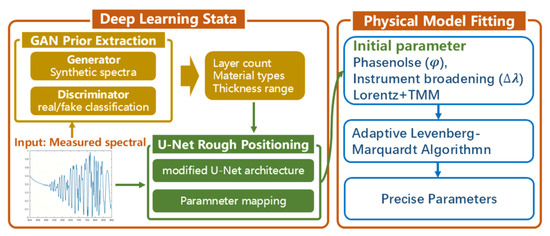
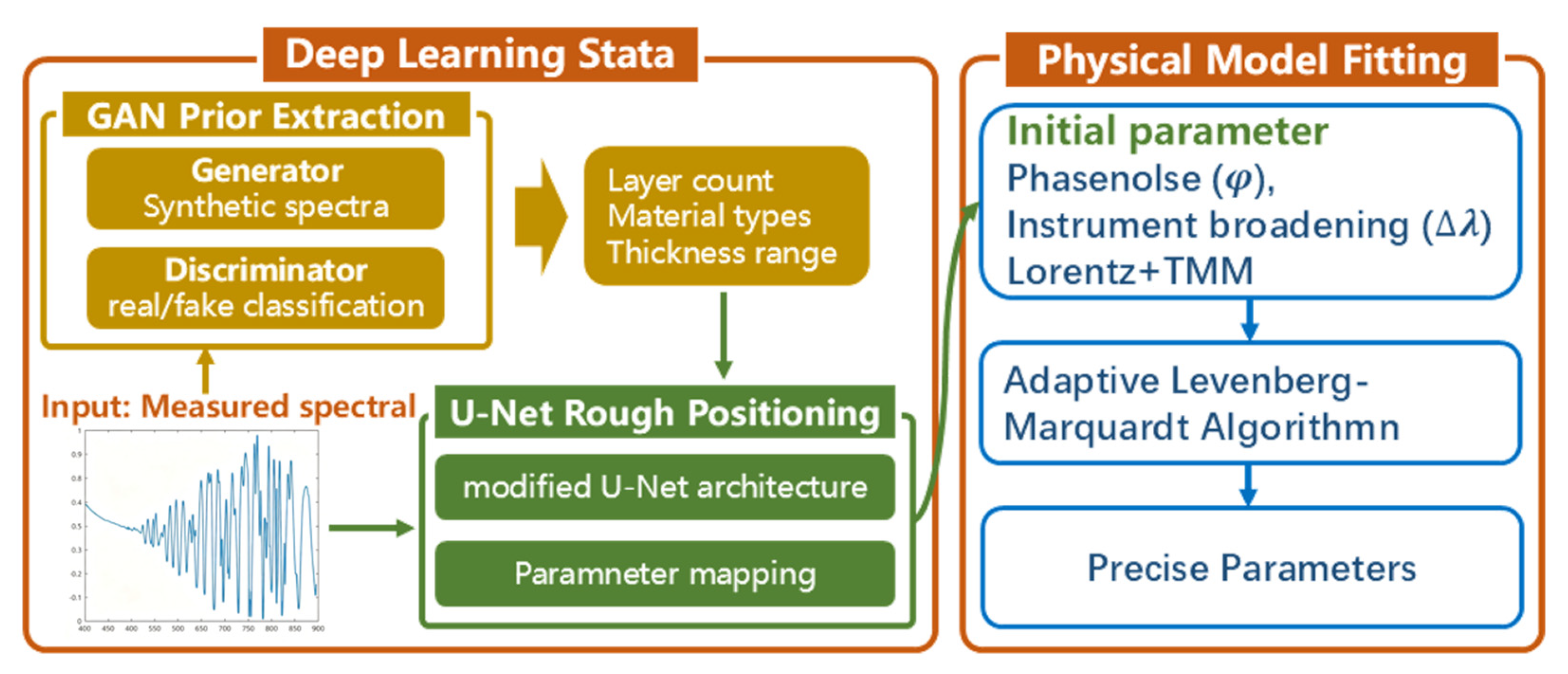
To address the above challenges, integrating data-driven inference with physics-based modeling has become a promising direction for dispersion-aware thin-film metrology [7,9,10]. Recent studies have demonstrated the effectiveness of physics-informed or physics-guided deep learning in various engineering problems, including structural response prediction, milling dynamics prediction, and transportation demand forecasting. These works indicate that embedding physical knowledge or domain constraints into learning models can improve prediction accuracy, interpretability, and generalization capability [11,12,13]. In this work, we propose a hybrid framework that combines deep learning with physical model fitting, as shown in Figure 1. Specifically, a dispersion-consistent multi-layer interference model is constructed as the forward model, while deep learning is used to extract structural priors and provide a reliable parameter initialization, followed by physics-based fine fitting to obtain high-precision estimates. This strategy aims to improve robustness against noise, reduce dependence on manual initialization, and enable accurate characterization for complex multilayer systems.
Figure 1.
The schematic diagram.
2. Research Content and Methods
As discussed in Section 1, dispersion interference, strong parameter coupling in multilayer stacks, and sensitivity to initialization and measurement noise jointly make the inverse problem ill-posed. To reduce redundancy and improve readability, the research content and the corresponding methods are described together in the following three coupled tasks: (i) a dispersion-consistent forward model, (ii) deep-learning-assisted prior learning and coarse initialization, and (iii) physics-based refinement with practical measurement factors.
2.1. Dispersion-Consistent Forward Model for Multilayer Interference Spectroscopy
A physically consistent forward model is the foundation of the proposed framework. It provides a one-to-one procedure to compute the spectral response from a given multilayer structure, and therefore supports both synthetic data generation (for learning) and high-precision refinement (for inversion).
For each layer material, the wavelength-dependent complex refractive index is described through a Lorentz-type dielectric response. The Lorentz formulation captures broadband dispersion and absorption with a small number of physically meaningful parameters, which helps avoid unphysical solutions during fitting. The complex refractive index is obtained from the complex dielectric constant ε(λ) via . The Lorentz formula is written as:
In the above expression, ε is the complex dielectric constant, ε∞ is the high-frequency dielectric constant, εs is the static dielectric constant, ω0 is the resonant frequency, is the damping factor, and is the angular frequency of the incident light. These parameters jointly determine the dispersion shape over the wavelength band of interest.
Given the optical constants, the spectral reflectance of an m-layer stack is computed using the transfer-matrix method (TMM). Each layer j is represented by a characteristic matrix, and the total response is obtained by cascading the matrices and enforcing boundary conditions at the air–film and film–substrate interfaces. The characteristic matrix of layer j is:
Here θj is the propagation angle in layer j (from Snell’s law), and dj is the thickness of the layer j. In addition, for TE-polarization, and for TM-polarization. Once the global transfer matrix is obtained, the modeled reflectance spectrum can be expressed as:
where Ei and Er are the incident and reflected electric fields, respectively. By explicitly embedding dispersion and multilayer interference physics, the forward model reduces ambiguity in the inversion and provides a reliable physical constraint for later stages, which directly targets the dispersion mismatch and coupling issues highlighted in Section 1.
2.2. Deep-Learning Assisted Prior Learning and Coarse Initialization (GAN + U-Net)
Because large-scale, high-precision multilayer measurement datasets are difficult to acquire in real experiments, the forward model in Section 2.1 is first used to generate a synthetic dataset for learning. Film structures with varying layer numbers (e.g., 1–20 layers) are sampled, together with physically reasonable thickness ranges and dispersion parameters. To improve the realism and generalization of the synthetic dataset, representative non-ideal measurement effects commonly encountered in practical spectroscopic systems were incorporated during the simulation process. Specifically, additive noise was introduced to mimic detector noise, background fluctuation, and external environmental disturbance, while spectral broadening was applied to account for the finite spectral resolution of the optical instrument. Through these treatments, the generated spectra deviate from ideal theoretical responses and more closely resemble experimentally acquired signals, enabling the deep learning model to learn more robust spectral features and reducing performance degradation when the method is transferred from simulated data to practical measurements. In this study, 10,000 samples are generated and randomly split into training and test sets with an 8:2 ratio.
Based on this dataset, a generative adversarial network (GAN) is employed to learn structural priors from spectral patterns. Instead of relying on manual experience to guess the layer number, material candidates, and thickness range, the GAN extracts these priors automatically, narrowing the feasible solution space before fine fitting. The GAN training objective is:
In the objective, pdata denotes the distribution of real spectra and pz denotes the distribution of latent noise. After adversarial training, the learned priors are used to define a candidate set (or a bounded feasible region) for key variables, which mitigates the coupling-induced ambiguity described in Section 1.
On top of the prior constraint, an improved U-Net regression network is used for rapid coarse localization. The encoder–decoder structure captures global spectral trends, while skip connections preserve local interference features that are highly sensitive to thickness. The network maps an input spectrum to an initial estimate of the parameter vector (or a feasible range), which is then used as the initialization and/or bounds for the physics-based refinement stage. This design reduces the dependence on manual initialization and lowers the risk of being trapped in local minimum under noisy conditions.
2.3. Two-Stage Hybrid Inversion and Physics-Based Refinement (Adaptive LMA)
Building on the priors and coarse estimates obtained in Section 2.2, the multilayer parameters are further refined through a physics-based inversion that is consistent with the dispersion-aware forward model established in Section 2.1. In other words, the learning-based stage is used to provide a physically plausible initialization and a constrained search region, and the final retrieval is completed by directly fitting the measured spectrum with the forward model so that the solution remains interpretable and traceable to the underlying optical physics. To clarify the interaction between the learning-based and physics-based stages, the proposed inversion process can be understood as a sequential parameter-transfer workflow rather than two independent modules. Therefore, the output of the learning stage is not directly regarded as the final measurement result, but is used to construct the initial point and bounded feasible region for the subsequent physical refinement.
To better reflect actual, non-ideal measurement conditions, the model spectrum is further proposed based on the dispersion-consistent forward model established in Section 2.1 and incorporating representative measurement-related factors. Here, denotes the wavelength of the incident light and is used to characterize the response of the model spectrum at different wavelength positions; encompasses the multi-layer parameters to be inverted, including the thickness of each layer and the dispersion parameters that determine the complex refractive index within the wavelength range; phase noise and spectral broadening are instrumental parameters introduced on top of the forward model, enabling the model spectrum to account for deviations caused by other non-ideal factors and thereby bringing it closer to the experimentally measured response. Subsequently, this optimization problem is formulated as a nonlinear least-squares problem, in which the residual between the measured spectrum and must be minimized.
An adaptive Levenberg–Marquardt algorithm (LMA) is adopted to solve this nonlinear optimization efficiently and robustly. LMA can be understood as a compromise between gradient descent and the Gauss–Newton method: it improves stability when the current solution is still far from the optimum, while enabling fast local convergence once the fitting enters the neighborhood of a good solution. In the implementation, the damping factor is adjusted adaptively according to whether the objective function decreases after an update, which significantly improves convergence stability under strong noise and reduces sensitivity to the initial guess. In addition, spectrum-region weighting and constraint handling can be introduced to further enhance the fitting quality, for example by emphasizing wavelength bands with higher information content and by enforcing physically meaningful bounds on thickness and dispersion parameters.
3. Results
The proposed inversion strategy is validated on representative systems such as multi-layer stacks and metal/dielectric composite films. Performance is evaluated in terms of thickness accuracy, robustness to noise, and the achievable minimum measurable thickness, and is compared against conventional fitting approaches and commercial instruments.
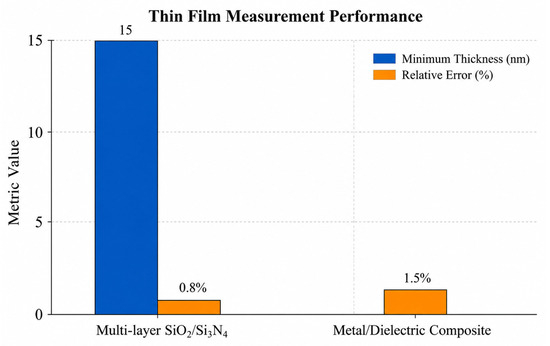
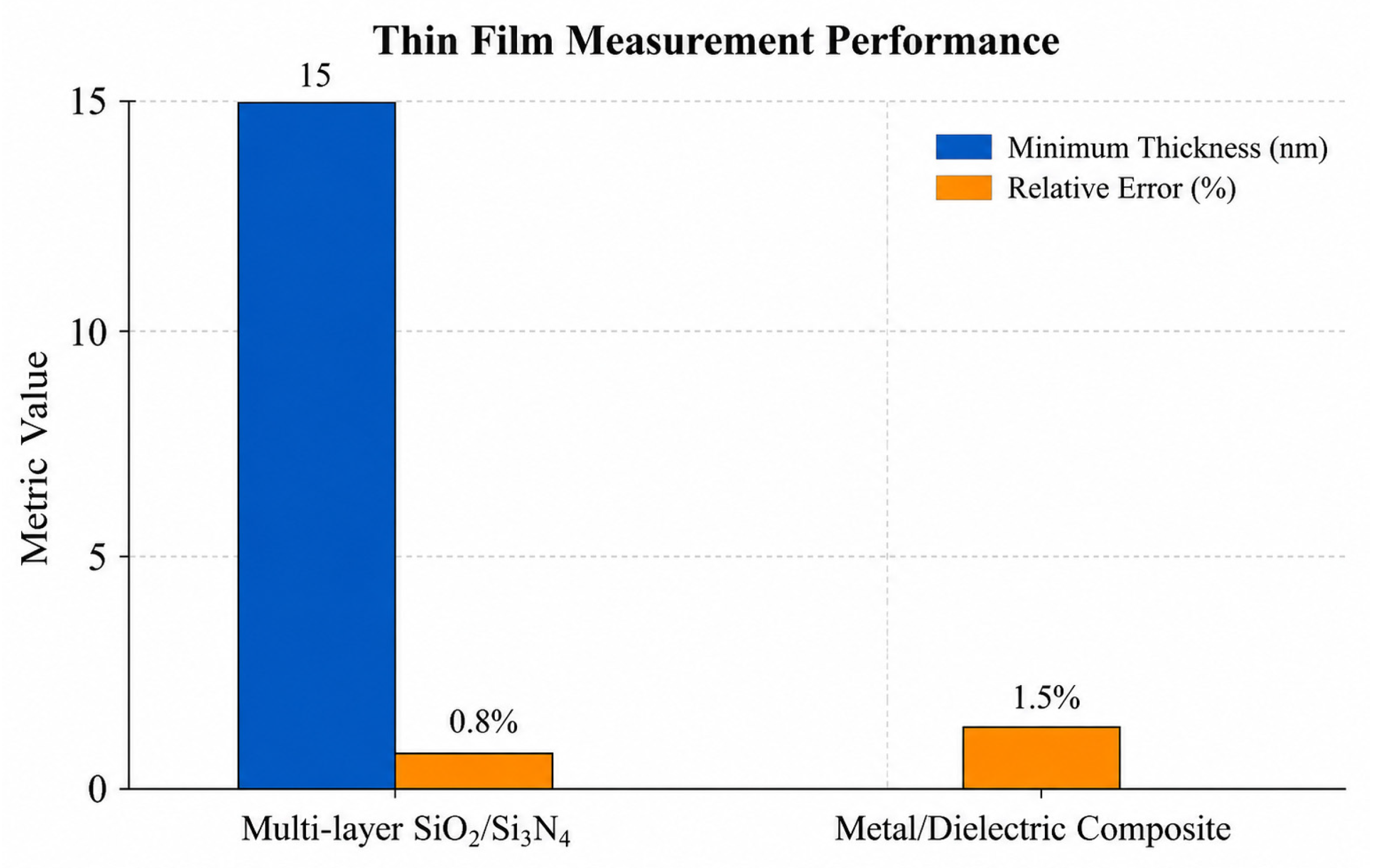
In the multi-layer silicon oxide/silicon nitride film system, the performance of the proposed method is evaluated mainly from three aspects, namely the minimum measurable thickness, the relative error of thickness estimation, and the robustness against measurement noise, and the results are compared with those of conventional fitting approaches and commercial instruments, as shown in Figure 2. Specifically, the minimum measurable thickness refers to the thinnest layer thickness that can still be retrieved with stable inversion performance, while the relative error is used to characterize the deviation between the estimated thickness and the reference value. The anti-noise ability reflects the stability of the inversion under non-ideal measurement conditions. For this representative multilayer system, the minimum measurable thickness is expected to be ≤15 nm, with a relative error ≤ 0.8%, and the anti-noise ability for ultra-thin layers is expected to be improved by more than 4 times compared to traditional methods. In the measurement of metal/dielectric composite films, the measurement accuracy is expected to be better than 1.5%. These technical indicators demonstrate that the proposed method can simultaneously improve ultrathin-film sensitivity, inversion robustness, and overall measurement accuracy for complex thin-film systems.
Figure 2.
Comparison of measurement performance.
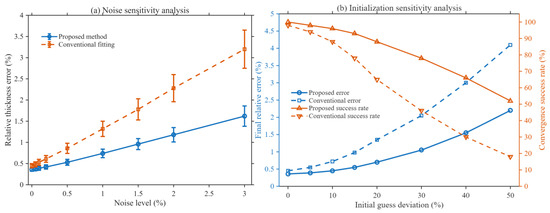
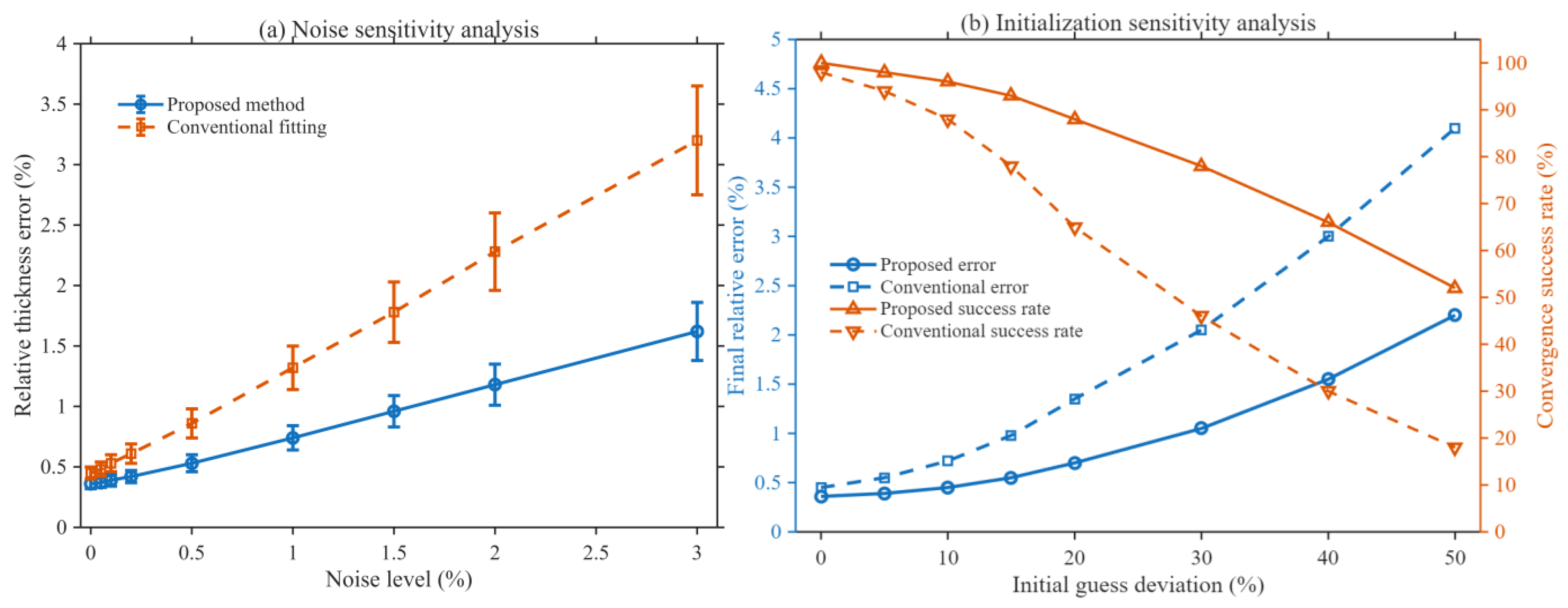
To further evaluate the robustness and stability of the proposed inversion framework, sensitivity analyses were conducted with respect to measurement noise and initialization deviation. In the noise sensitivity test, different levels of relative spectral noise were added to the simulated measurement spectra, and the corresponding thickness inversion errors were compared between the proposed method and the conventional fitting method. As shown in Figure 3a, the proposed method exhibits a slower error growth and maintains lower inversion error over the investigated noise range, indicating improved robustness under non-ideal measurement conditions.
Figure 3.
Sensitivity and robustness analysis of the proposed inversion method.
In addition, the influence of initial guess deviation was investigated to evaluate the convergence stability of the inversion process. As shown in Figure 3b, when the initial guess deviates increasingly from the reference thickness, the conventional fitting method shows a more pronounced increase in final relative error and a faster decrease in convergence success rate. By contrast, the proposed hybrid strategy maintains relatively lower error and higher convergence probability under moderate initialization deviation.
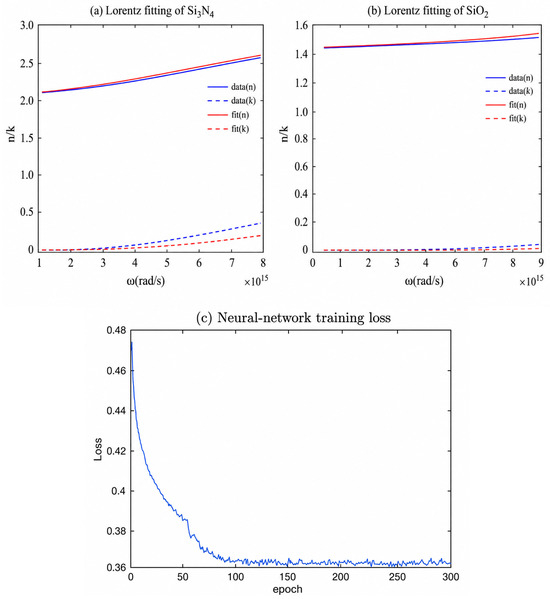
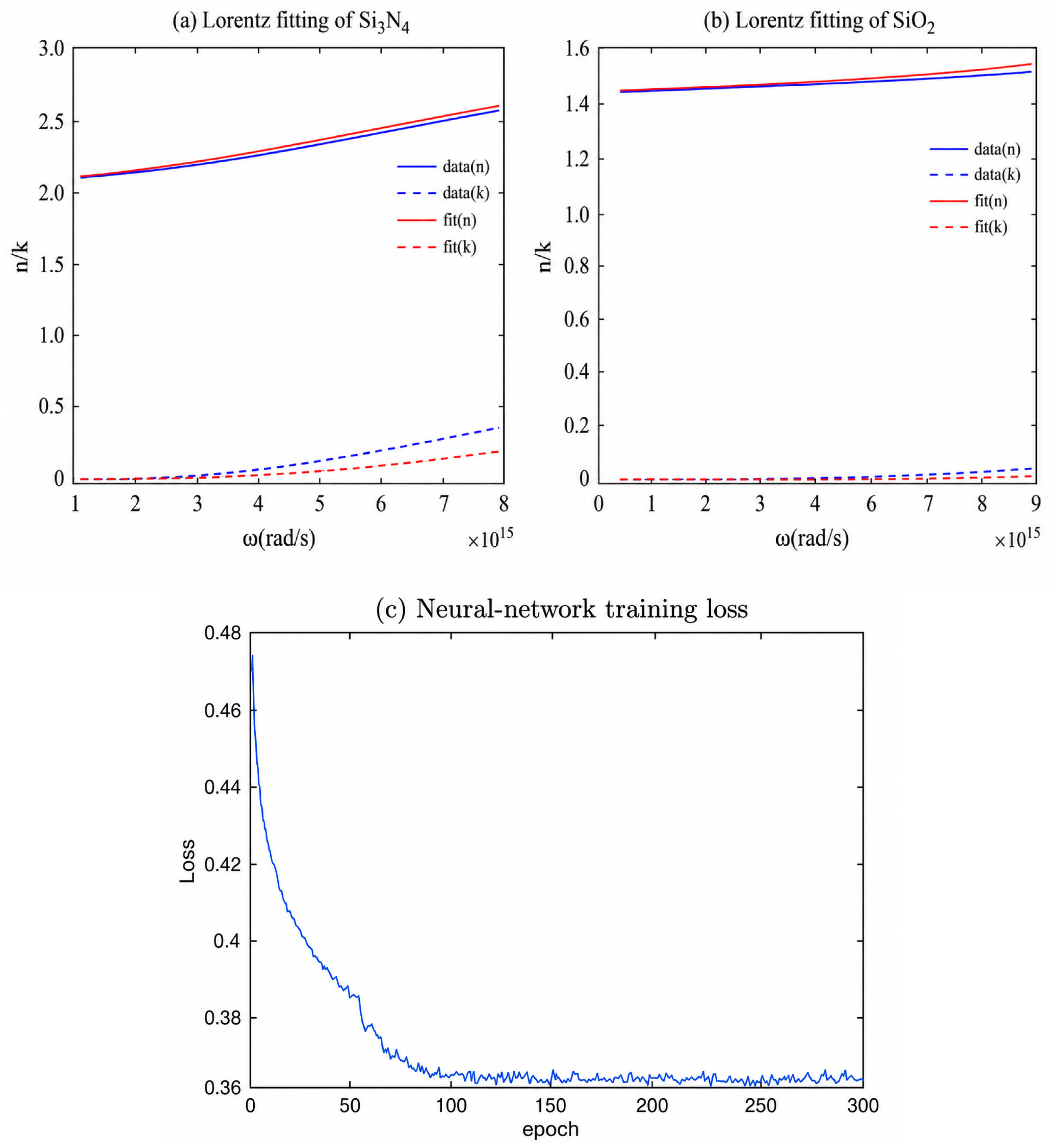
As shown in Figure 4a,b, the Lorentz dispersion model is used to fit the optical constants of Si3N4 and SiO2 over the wavelength range of 200–1700 nm. In these two subfigures, the blue curves represent the reference data of the refractive index n and extinction coefficient k, while the red curves represent the corresponding fitted results obtained from the Lorentz model. For both Si3N4 and SiO2, the fitted curves are in good agreement with the reference data, indicating that the Lorentz model can effectively describe the wavelength-dependent optical dispersion of these representative dielectric materials. Through the fitting process, the key dispersion parameters, including and , are obtained and subsequently used in the forward spectral model for thin-film inversion. Figure 4c shows the training loss of the neural network over 300 epochs. The loss decreases rapidly during the early training stage and gradually reaches a stable value after approximately 100 epochs, indicating that the network has achieved stable convergence. This result suggests that the learning-based module can effectively extract spectral features and provide reliable coarse initialization for the subsequent physics-based refinement.
Figure 4.
The fitting results and loss function.
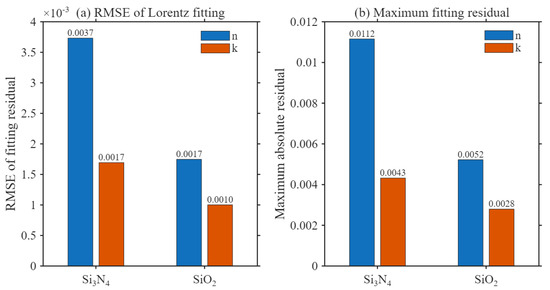
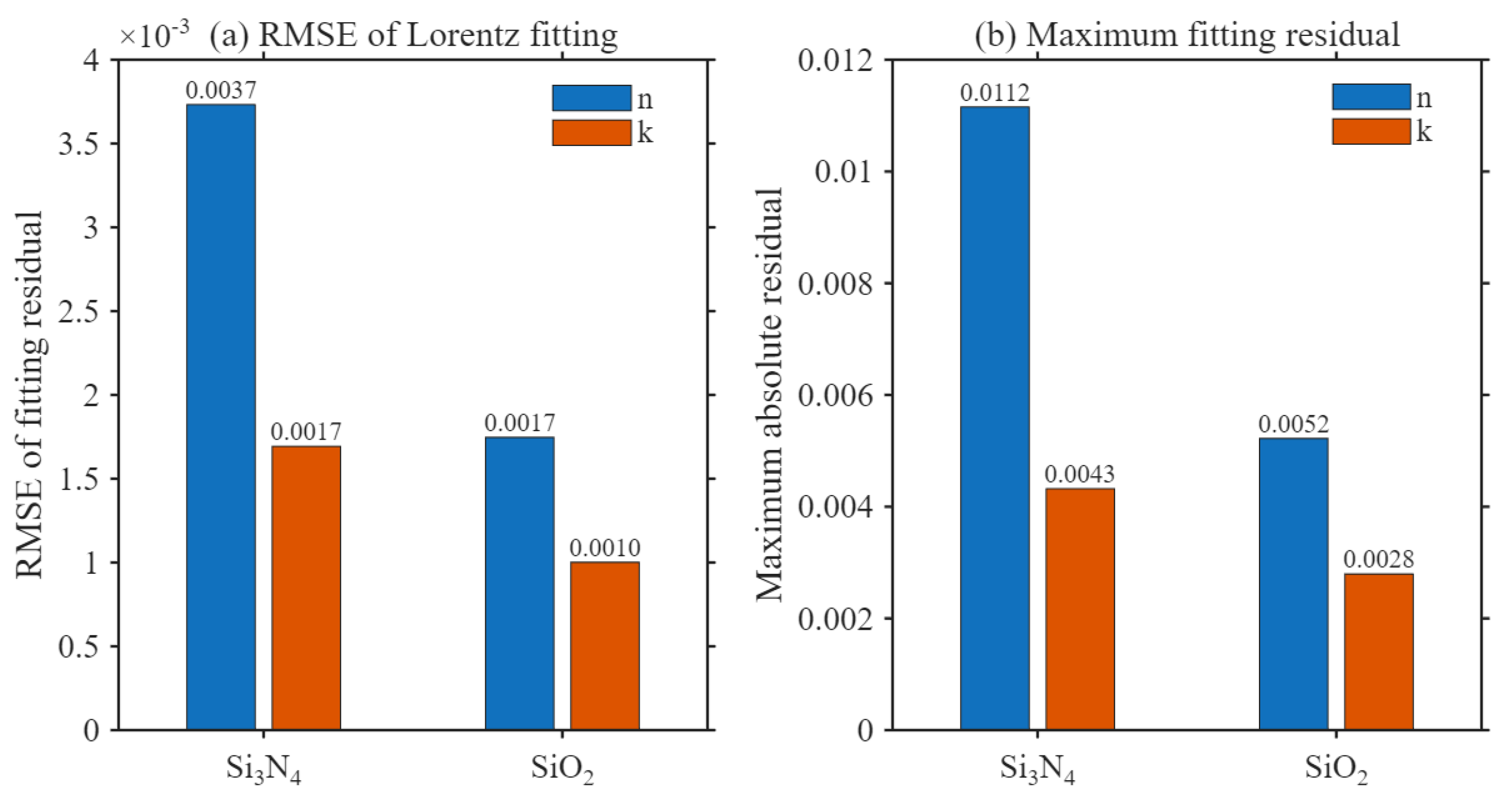
As shown in Figure 5, the RMSE values of the fitting residuals for both Si3N4 and SiO2 remain on the order of 10−3, indicating that the fitted optical constants are in good agreement with the reference data over the wavelength range of 200–1700 nm. In addition, the maximum absolute residuals remain within approximately 10−2, suggesting that no large local fitting deviation occurs within the investigated spectral range. These results provide a more quantitative evaluation of the fitting accuracy and further support the reliability of the Lorentz dispersion model.
Figure 5.
Quantitative fitting error analysis of the Lorentz dispersion model.
The results demonstrate that the proposed hybrid inversion pipeline improves the practicality of spectroscopic interference metrology for complex multilayer thin films. Leveraging data-assisted prior learning and coarse initialization, followed by dispersion-consistent, physics-based refinement, the method reduces reliance on manual parameter initialization and enhances robustness under measurement noise, directly addressing the ill-posedness and convergence instability highlighted earlier.
4. Conclusions
This work addresses the ill-posed inverse problem in thin-film dispersion interference spectroscopy, where broadband dispersion, strong parameter coupling in multilayer stacks, and measurement noise jointly lead to ambiguity and poor convergence in conventional fitting. To address these issues, a dispersion-consistent forward modeling and hybrid inversion framework is proposed by combining data-assisted prior learning, coarse initialization, and physics-based refinement. Its main contributions can be summarized in the following aspects.
First, an integrated physics-guided learning and hybrid inversion paradigm is established. Instead of treating deep learning and physical fitting as separate solutions, this work combines them into a single inversion workflow: the learning modules are used to extract structural priors and provide a reliable initial estimate (or feasible region) from spectral patterns, while the final parameter retrieval is completed by fitting the measured spectrum with a dispersion-aware physical forward model. Compared with purely physics-based fitting, this integration is expected to reduce dependence on manual initialization and may mitigate the risk of being trapped in local minima within the investigated representative cases, especially when the multilayer structure is complex. Compared with purely data-driven regression, the refinement step helps preserve physical traceability by explicitly estimating thickness and dispersion-related parameters through a forward model, thereby improving accuracy without losing the connection to material optics.
Second, the framework shows the potential to improve robustness and thin-film measurement capability under non-ideal measurements. In Section 2.3, practical measurement factors such as phase noise and instrument spectral broadening are explicitly incorporated into the forward model, and an adaptive Levenberg–Marquardt algorithm is adopted to perform stable nonlinear least-squares refinement. With physically plausible initialization from Section 2.2 and adaptive damping in the optimizer, the method becomes less sensitive to noise and initial guesses, which is particularly important for ultrathin layers where spectra are easily distorted and convergence becomes unstable in traditional approaches. These results indicate the potential of the method to improve robustness and ultrathin-film measurability, but the conclusions should be understood within the scope of the simulated and representative systems studied in this work.
Third, the proposed framework provides a possible route for extending dispersion-aware thin-film inversion to more complex metrology scenarios. Because the forward model remains physics-consistent and the learning modules are trained on physically meaningful synthetic spectra generated from that model, the framework may be adapted to new film structures by updating material dispersion representations, parameter ranges, and training distributions, rather than redesigning the entire algorithm. This extensibility makes the approach promising for advanced applications featuring complex stacks and heterogeneous materials. However, further validation is still required before making general conclusions about its applicability to a wide range of film systems, instrument configurations, and experimental conditions.
In summary, this study proposes a dispersion-consistent forward modeling and inversion framework for thin-film spectral interference measurement, combining data-assisted prior learning with physics-based refinement to improve both reliability and accuracy under practical noise conditions. The current results, based on representative multilayer systems and controlled perturbation analyses, suggest that the method has the potential to improve initialization stability, fitting robustness, and ultrathin-film measurement capability. Future work will focus on further improving generalization with more diverse material models and experimental datasets, refining the treatment of non-ideal factors under different instrument settings, and exploring real-time implementation of the inversion pipeline for online thin-film metrology.
Author Contributions
Conceptualization, T.W. and J.L.; Methodology, T.W., C.Z., J.Y. and J.L.; Software, H.L.; Validation, C.L., J.W. and J.Y.; Formal analysis, J.W. and Z.Z.; Investigation, C.Z.; Resources, B.J.; Data curation, C.Z.; Writing—original draft, Z.Z.; Writing—review & editing, H.L., C.L., J.Y. and Z.Z.; Visualization, B.D., A.S. and B.J.; Supervision, B.D., A.S. and B.J.; Project administration, A.S. and B.J.; Funding acquisition, B.D. and B.J. All authors have read and agreed to the published version of the manuscript.
Funding
This work is supported by the High-quality Special Project (No. 2024ZY01049), National Natural Science Foundation of China (No. 52405037, No. 52175521), National Key R&D Program of China (No. 2024YFF0727800), and Zhejiang Provincial Natural Science Foundation of China (No. LMS26E050007).
Data Availability Statement
The original contributions presented in this study are included in the article. Further inquiries can be directed to the corresponding author.
Conflicts of Interest
Author Tong Wu, Chuan Zhang, Jiahao Wu employed by Computer Application Institute of Nuclear Industry, China National Nuclear Corporation. The remaining authors declare that the research was conducted in the absence of any commercial or financial relationships that could be construed as potential conflicts of interest.
References
- Piegari, A.; Masetti, E. Thin film thickness measurement: A comparison of various techniques. Thin Solid Film. 1985, 124, 848–852. [Google Scholar] [CrossRef] [Scilit]
- Jo, T.; Kim, K.R.; Kim, S.R.; Pahk, H.J. Thickness and surface measurement of transparent thin-film layers using white light scanning interferometry combined with reflectometry. J. Opt. Soc. Korea 2014, 18, 236–243. [Google Scholar] [CrossRef] [Scilit]
- Kim, K.R.; Kim, S.R.; Kwon, S.Y.; Pahk, H.J. Volumetric thin film thickness measurement using spectroscopic imaging reflectometer and compensation of reflectance modeling error. Int. J. Precis. Eng. Manuf. 2014, 15, 1817–1822. [Google Scholar] [CrossRef] [Scilit]
- Kim, S.W.; Kim, G.H. Thickness-profile measurement of transparent thin-film layers by white-light scanning interferometry. Appl. Opt. 1999, 38, 5968–5973. [Google Scholar] [CrossRef] [Scilit] [PubMed]
- Ohlídal, M.; Ohlídal, I.; Klapetek, P.; Nečas, D.; Majumdar, A. Measurement of the thickness distribution and optical constants of non-uniform thin films. Meas. Sci. Technol. 2011, 22, 085104. [Google Scholar] [CrossRef] [Scilit]
- Kim, Y. Convolutional neural networks for sentence classification. In Proceedings of the 2014 Conference on Empirical Methods in Natural Language Processing (EMNLP), Doha, Qatar, 2014; pp. 1746–1751. [Google Scholar]
- Rivenson, Y.; Wu, Y.; Ozcan, A. Deep learning in holography and coherent imaging. Light Sci. Appl. 2019, 8, 85. [Google Scholar] [CrossRef] [Scilit] [PubMed]
- Kim, M.G. Improved measurement of thin film thickness in spectroscopic reflectometer using convolutional neural networks. Int. J. Precis. Eng. Manuf. 2020, 21, 219–225. [Google Scholar] [CrossRef] [Scilit]
- Sinha, A.; Lee, J.; Li, S.; Barbastathis, G. Lensless computational imaging through deep learning. Optica 2017, 4, 1117–1125. [Google Scholar] [CrossRef] [Scilit]
- Wu, Y.; Rivenson, Y.; Zhang, Y.; Wei, Z.; Günaydin, H.; Lin, X.; Ozcan, A. Extended depth-of-field in holographic imaging using deep-learning-based autofocusing and phase recovery. Optica 2018, 5, 704–710. [Google Scholar] [CrossRef] [Scilit]
- Zhou, Y.; Meng, S.; Lou, Y.; Kong, Q. Physics-Informed Deep Learning-Based Real-Time Structural Response Prediction Method. Engineering 2024, 35, 147–164. [Google Scholar] [CrossRef] [Scilit]
- Zhu, K.; Li, J. Physics-Guided Deep Network for Milling Dynamics Prediction. Engineering 2025, 55, 71–85. [Google Scholar] [CrossRef] [Scilit]
- Zhang, S.; Zhang, J.; Yang, L.; Chen, F.; Li, S.; Gao, Z. Physics Guided Deep Learning-Based Model for Short-Term Origin-Destination Demand Prediction in Urban Rail Transit Systems Under Pandemic. Engineering 2024, 41, 291–312. [Google Scholar] [CrossRef] [Scilit]
Disclaimer/Publisher’s Note: The statements, opinions and data contained in all publications are solely those of the individual author(s) and contributor(s) and not of MDPI and/or the editor(s). MDPI and/or the editor(s) disclaim responsibility for any injury to people or property resulting from any ideas, methods, instructions or products referred to in the content. |
© 2026 by the authors. Licensee MDPI, Basel, Switzerland. This article is an open access article distributed under the terms and conditions of the Creative Commons Attribution (CC BY) license.