


Abstract
To identify whether a relationship exists between COVID-19 and appendicitis and compare the incidence of appendicitis during three pandemic years to the year prior to the pandemic, we conducted two observational retrospective studies: a propensity score-matched (PSM) cohort and a repeated monthly cross-sectional study. We used data from the Military Health System (MHS) Data Repository, which contains data about healthcare provided to active-duty service members, retirees, and their dependents. For the PSM cohort of 753,138 individuals, patients with COVID-19 between July 2020 and June 2021 from the MHS were matched to two similar people without COVID-19. Survival analysis using a conditional Cox proportional hazards model explored these relationships. For the cross-sectional study we used a separate, unmatched MHS cohort of 10,402,021 individuals. Poisson regression generated incident rate ratios (IRRs) of any appendicitis or complicated appendicitis by year, comparing three pandemic years to one pre-pandemic year. COVID-19 was associated with appendicitis or appendectomy within the first year of infection (hazard ratio: 1.13, 95% confidence interval: 1.02–1.26). The IRRs for both any appendicitis and complicated appendicitis were significantly less than one when comparing individual pandemic years to the pre-pandemic year. COVID-19 is associated with appendicitis. Rates of any appendicitis and complicated appendicitis were lower in each individual pandemic year.
1. Introduction
Acute appendicitis is a very common surgical emergency, with an annual incidence rate of approximately 100 cases per 100,000 people and an estimated lifetime risk of nearly nine percent in developed countries [1]. Although predominantly uncomplicated, the recent surgical literature suggests that 16–30% of acute appendicitis cases are complicated by perforation, abscess formation, gangrene, and generalized peritonitis, with higher rates in elderly patients, young children, patients with significant co-morbidities, and those with delayed presentations [2].
In 2020, the emergence of SARS-CoV-2 changed the modern medical landscape. In the first year of the pandemic, emergency room visits for non-respiratory issues like abdominal pain may have declined significantly due to implementation of lockdowns, social distancing, fear of contracting COVID-19, reduced transportation, and public messaging to avoid hospitals unless necessary. Many hospitals observed a significant decrease in patients seeking care or receiving appendectomies for acute appendicitis in the lockdown phases of the pandemic, while others noted an increase in numbers of complicated or perforated appendicitis due to delays in care [3,4,5].
From a pathophysiology standpoint, infection with SARS-CoV-2 has been shown to cause inflammation within the gastrointestinal tract. The receptor for the virus, angiotensin-converting enzyme 2 (ACE-2), is highly expressed on the luminal surface of the epithelial cells of the intestine, including the appendix [6]. The active replication of SARS-CoV-2 in the gastrointestinal tract triggers mucosal injury and localized gut inflammation. COVID-19-associated gut inflammation is evidenced by the observation of significantly elevated levels of fecal calprotectin in those infected with COVID-19. Furthermore, patients experiencing gastrointestinal symptoms of COVID-19 infection exhibit elevated inflammatory cytokines such as IL-8, IL-18, and IL-23 [7,8,9]. One case–control study, which examined the appendixes of 42 children with recent COVID-19 who received appendectomy for acute appendicitis, found lymphoid hyperplasia, congested blood vessels with microthrombi, and fibrinoid necrosis of the vascular wall on microscopy, and detected SARS-CoV-2 RNA within the appendix epithelium [10].
Thus, a combination of viral, host, and social factors likely influenced the clinical epidemiology of appendicitis throughout the pandemic. This study sought to determine the impact of SARS-CoV-2 infection on inflammation within the gastrointestinal system and identify whether a relationship exists between a diagnosis of COVID-19 and the subsequent development of appendicitis, compare the incidence of appendicitis during three pandemic years to the year prior to the pandemic, and investigate complicated appendicitis diagnoses by age group.
2. Methods
2.1. Propensity Score-Matched Cohort
2.1.1. Study Design
In this observational study, we used a propensity-matched cohort to explore the relationship between COVID-19 and appendectomy or appendicitis outcomes in a military-connected population. We used data from TRICARE Management Activity’s Military Health System (MHS) Data Repository (MDR), which contains data about healthcare provided to MHS beneficiaries. In order to investigate the relationship between COVID-19 and appendectomy and appendicitis outcomes, we selected individuals who had COVID-19 between July 2020 and June 2021 from the MHS and matched each of these individuals to two similar people with the same age in years, sex, and MHS beneficiary status (active duty, dependent child, dependent spouse, retiree, or other) who did not have COVID-19 using propensity score matching, as described in Sexton et al. [11]. We used propensity score matching to control for baseline conditions which could influence a person’s likelihood of acquiring or receiving a diagnosis of COVID-19. To determine whether propensity score matching effectively balanced these baseline characteristics between the groups with and without COVID-19, we calculated standardized mean differences (SMDs) for all variables included when calculating propensity scores. An SMD compares the value of a variable between two groups. Small SMD values indicate balance, and we considered values below 0.1 small enough to indicate a variable was well-balanced between our COVID-19 and non-COVID-19 groups [12]. Because matching was conducted on a month-by-month basis, we defined the day on which all three people in a matched trio joined the study as the day on which the COVID-19-positive member received a COVID-19 diagnosis or positive laboratory test.
2.1.2. Study Population
MHS beneficiaries aged 1–64 years who had been enrolled in the MHS for at least one year were included in this study. We excluded anyone without sex, age, or beneficiary data; members of the National Guard or Reserves and their dependents; anyone without a recorded visit in the year before they joined the study; anyone who had COVID-19 prior to joining the study; anyone who was assigned an extreme propensity score (0 or 1); and anyone for whom a match was not found during the propensity score matching process. Individuals were also excluded if their medical record in the MDR showed a prior appendectomy at any time after January 2018 and before they joined the study or if they had an appendicitis diagnosis from 365 days before to four days after joining the study. Because matching occurred on a month-by-month basis, individuals who were matched in an earlier month were ineligible to be matched later, unless they were included first in the non-COVID-19 group and later received a COVID-19 diagnosis or positive laboratory test, in which case they were eligible for matching in a later month within the COVID-19 group.
2.1.3. Variables
Our outcome conditions of interest, appendicitis and appendectomy, were identified using International Classification of Diseases, 10th Revision (ICD-10) diagnosis and procedure codes and Current Procedural Terminology (CPT) codes included in Supplementary Table S1 [13]. Appendicitis was considered “complicated” if its ICD-10 description included perforation, abscess, generalized peritonitis, or gangrene and “uncomplicated” otherwise. Our exposure of interest, COVID-19, was identified using either ICD-10 diagnosis codes or positive antigen or polymerase chain reaction (PCR) laboratory test results. Additionally, demographic data gathered included sex, sponsor’s rank, and beneficiary status, as recorded in the MHS Defense Enrollment Eligibility Reporting System (DEERS).
2.1.4. Data Analysis
We explored the relationship between COVID-19 and subsequent appendicitis or appendectomy within our population through survival analysis using a conditional Cox proportional hazards model. After joining the study, individuals were followed for one year, until they were diagnosed with appendicitis or underwent an appendectomy, or until they were censored. Individuals were censored if they became ineligible for the MHS for two consecutive months or, if they were in the non-COVID-19 group, they received a COVID-19 diagnosis or positive laboratory test. We considered hazard ratios significant if they resulted in p-values less than 0.05. We tested the proportional hazards assumption by evaluating the correlation between Schoenfeld residuals and time [14]. If this correlation was not significant (p < 0.05), we considered the proportional hazards assumption not violated. Additionally, Cox regression models typically assume that observations are independent, an assumption that is violated by the process of propensity score matching. To adjust for this, we stratified our Cox model on propensity-matched groups [12]. Additionally, the number and percent of individuals from the groups with and without COVID-19 with an incident appendicitis diagnosis or appendectomy who also had a complicated appendicitis diagnosis during the follow-up period were calculated and stratified by age.
2.2. Monthly Repeated Cross-Sectional Study
To examine the impact of the pandemic time period on rates of appendicitis and complicated appendicitis, we looked at the number of people with an incident appendicitis or complicated appendicitis diagnosis code each month, relative to the number of TRICARE enrollees each month, from March 2019 to February 2023. We included individuals aged 1–64 years and excluded Guard and Reserve members and their dependents; individuals with missing or unknown sex, beneficiary status, sponsor’s military rank, or geographic region; and individuals with any appendicitis diagnosis during the fourteen months before the study period (from December 2017 to February 2019). Demographic data were taken from DEERS for each month from March 2019 to February 2023 (Supplemental Table S2). The ICD-10 codes used to identify any appendicitis (either “complicated” or “uncomplicated”) and complicated appendicitis are shown in Supplemental Table S1.
Incident rate ratios (IRRs) were calculated separately for any appendicitis and complicated appendicitis using adjusted Poisson regression models with independent variables: sex, sponsor rank (junior enlisted, senior enlisted, or officer), geographic region of residence (north, south, west, or OCONUS, which were the regions used by TRICARE prior to 2025), active-duty status, age in years, and time period (Supplemental Table S3). The time period was divided into one-year periods around the time of the beginning of the COVID-19 pandemic, with a pre-pandemic period (March 2019–February 2020) used as a reference group against which to compare each of the following three years (March 2020–February 2021, March 2021–February 2022, and March 2022–February 2023).
2.3. Software Used
Propensity score matching and calculation of standardized mean differences were performed in R using the MatchIt and smd packages [15,16,17]. All other statistical analyses were performed using SAS software v9.4 (Cary, NC, USA) [18]. Figures were created using GraphPad Prism (version 11.0.2 for Windows, GraphPad Software, Boston, MA, USA, www.graphpad.com).
3. Results
3.1. Propensity Score-Matched Cohort
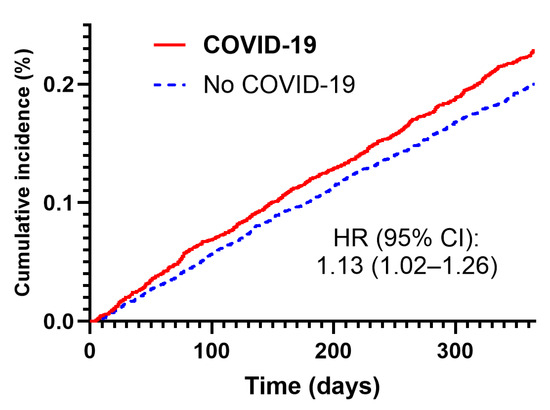
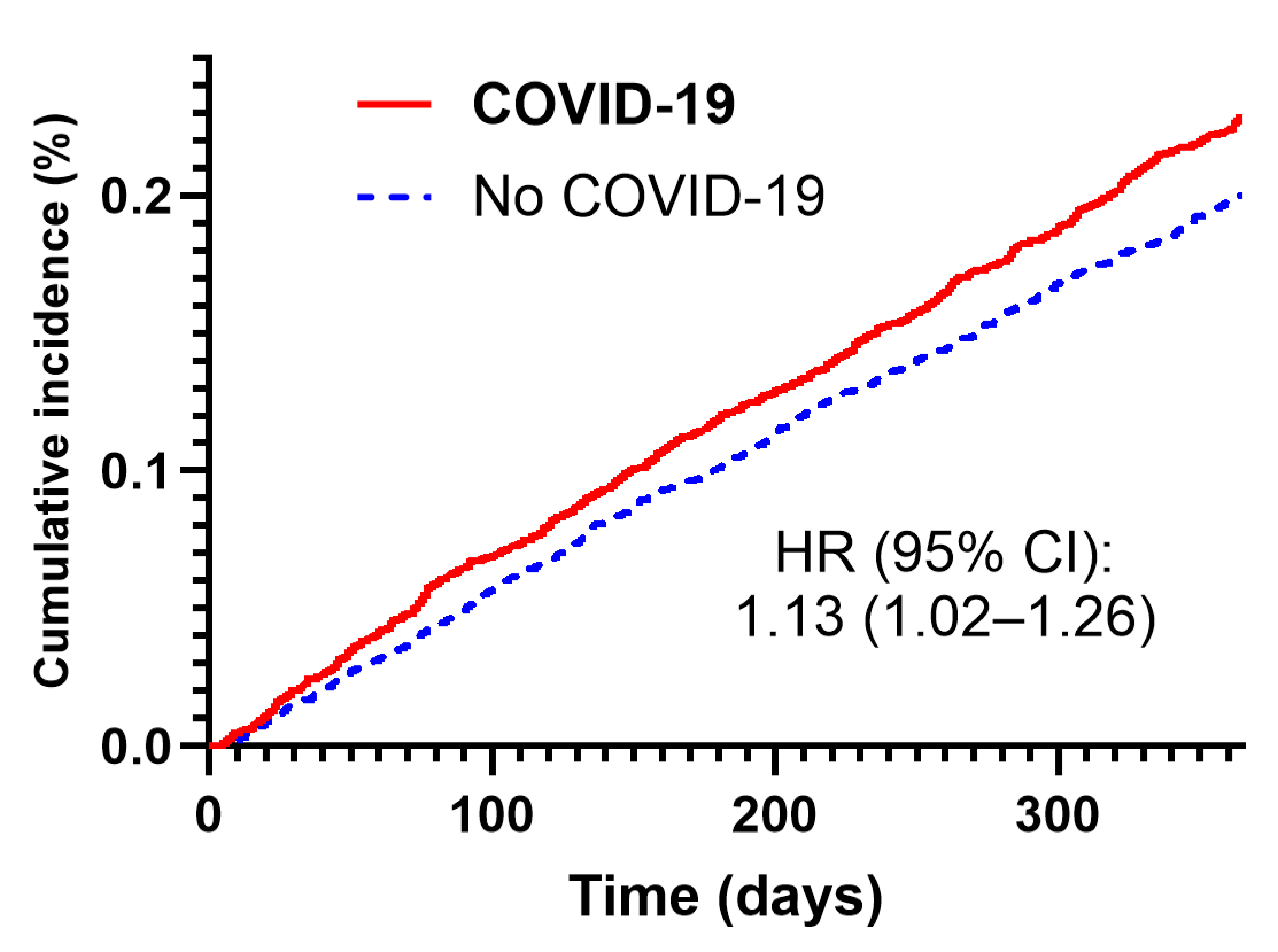
There were 753,138 individuals (256,287 with COVID-19 and 512,574 without) in the cohort (Table 1). The median age in both groups was 31 years (IQR 22–47), with 55.2% male, and 17.3% dependent children. After matching, the SMDs for all variables included in the propensity score were less than 0.1, indicating balance on baseline covariates between the groups with and without COVID-19. A total of 15,723 people were first included in the group without COVID-19, but were later diagnosed with COVID-19 and included in the COVID-19 group. In total, 570 (0.22%) people with COVID-19 had appendicitis or an appendectomy during the follow-up period, compared to 954 (0.19%) of those without COVID-19 (Figure 1).
Table 1.
Demographics of study population.
Figure 1.
Cumulative incident of appendicitis in COVID-19 and non-COVID-19 group. Kaplan-Meier cumulative incidence plot showing the cumulative incidence of experiencing an incident appendectomy or case of appendicitis during follow-up among those with and without an identified COVID-19 infection.
The median (IQR) time after joining the study to an incident appendicitis diagnosis or an appendectomy (among those to whom one occurred) was 169 (77, 265) days for those with COVID-19 and 169 (86, 265) days for those without. During the follow-up period, the hazard of having appendicitis or an appendectomy for those with COVID-19 was 13% higher than for those without COVID-19 (HR: 1.13, 95% confidence interval [CI]: 1.02–1.26). Using Schoenfeld residuals, we determined that the proportional hazards assumption was not violated for our Cox regression model. Of the 954 individuals in the non-COVID-19 group who had a new appendicitis diagnosis or appendectomy during the follow-up period, 174 (18.2%) had a complicated appendicitis diagnosis during that time, compared to 88 (15.4%) of 570 individuals in the COVID-19 group. There were no differences in proportion of appendicitis cases that were complicated by COVID-19 status for 0–4, 18–49, and 50–64-year-olds (p > 0.05 for all). Among 5–17-year-olds, a greater proportion of those without COVID-19 experienced complicated appendicitis (26.9%) when compared to those with COVID-19 (13.5%; p = 0.0374) (Table 2).
Table 2.
Percent of people with incident appendicitis outcomes who had complicated vs. uncomplicated appendicitis during the follow-up period, by COVID-19 group and age group.
3.2. Monthly Repeated Cross-Sectional Study
A total of 10,402,021 unique individuals were included in the monthly repeated cross-sectional study, although not all individuals were present in all months of data. The rate of incident appendicitis was lower for all three pandemic years when compared to the pre-pandemic reference period of March 2019–February 2020 (March 2020–February 2021: IRR: 0.91, 95% CI: 0.88–0.93; March 2021–February 2022: IRR: 0.92, 95% CI: 0.90–0.95; and March 2022–February 2023: IRR: 0.91, 95% CI: 0.89–0.94) (Table 3). The incident rate ratios for complicated appendicitis were also significantly less than one when comparing all three pandemic years to the pre-pandemic reference year (March 2020–February 2021: IRR: 0.92, 95% CI: 0.88–0.95; March 2021–February 2022: IRR: 0.93, 95% CI: 0.89–0.96; and March 2022–February 2023: IRR: 0.85, 95% CI: 0.81–0.88).
Table 3.
Incidence rate ratios for incident appendicitis (any appendicitis) and complicated appendicitis.
4. Discussion
The COVID-19 pandemic was a transformative time for medicine and patients seeking care. From July 2020 to June 2022, our population of MHS beneficiaries in our propensity score-matched cohort demonstrated a slight, but statistically significant increase in the hazard of having appendicitis or an appendectomy within the first year following a COVID-19 diagnosis. Other studies have observed an association between COVID-19 and acute appendicitis. One case series from a single hospital identified through pre-procedure SARS-CoV-2 testing from May to July 2020 that a diagnosis of acute appendicitis is much more likely to be positive for SARS-CoV-2 (10.8%), when compared to all other patients presenting for interventional procedures (1.3%), suggesting an association [19]. A temporal pattern was observed at a tertiary care children’s hospital in early 2020 where cases of acute appendicitis in SARS-CoV-2 infected children increased approximately 2 weeks after the peak of COVID-19 pneumonia cases, leading the authors to speculate that appendicitis may represent a postinfectious hyperinflammatory condition of SARS-CoV-2 [20]. Furthermore, a review by Kariyawasam et al. noted that a minority of patients infected with COVID-19 presenting with an acute abdomen have acute pancreatitis, acute appendicitis, or bowel ischemia with the finding of coronavirus RNA in biopsies of the gastrointestinal tract, suggesting that SARS-CoV-2 involvement may be due to direct viral injury and/or an inflammatory immune response [21].
We attempted to analyze whether patients infected with SARS-CoV-2 in this cohort were more likely to have complications of appendicitis during the pandemic, such as perforation, abscess formation, gangrene, and generalized peritonitis. The incidence of developing complicated appendicitis in the first year of the pandemic was lower in the COVID-19 group (88/570, or 15.4%) compared to those in the non-COVID group (174/954, or 18.2%). As this finding was unexpected, further investigation into the overall incidence rates of appendicitis in the pre-pandemic and pandemic years were analyzed in our monthly repeated cross-sectional study involving over 10 million individuals using adjusted Poisson regression models. Interestingly, the incidence rate of appendicitis, either uncomplicated or complicated, was higher during the pre-pandemic reference year than during the pandemic itself in our population. One retrospective study of 1665 patients from a single center from 2018 to 2022 had similar findings, with higher rates of perforated and gangrenous appendicitis on pathology reports in the pre-pandemic era compared to the COVID-19 era [22]. However, multiple other studies observed the opposite, demonstrating that rates of complicated appendicitis were higher during the first waves of the pandemic. In one surgical center involving 279 patients during the first year of the pandemic and 262 patients in the preceding year, researchers noted a marked rise in perforated appendicitis rates, which increased from 10.2% pre-pandemic to 27.4% during the pandemic [23]. Other single-center studies cited higher rates of complicated appendicitis of 33% and 39%, and even 47% in patients under 20 years of age [24,25]. Additional studies claimed these higher rates of complicated appendicitis during the pandemic were due to delays in presentation [26,27]. A meta-analysis of 3559 patients by Kariya et al. found an overall significantly higher rate of complicated appendicitis during the pandemic (relative risk 1.55, 95% CI 1.26–1.89) compared to before the pandemic [28]. Similarly, a systematic review of 54 studies involving 8313 individuals from the first year of the pandemic demonstrated an overall risk ratio of 1.65 (95% CI 1.32–2.07) for complicated acute appendicitis [29]. In another systematic review comparing 18,107 pre-pandemic individuals to 7474 first-year pandemic individuals, complicated appendicitis rates were higher during the pandemic (26.6% vs. 22.2%; odds ratio 2.00, 95% CI 1.60–2.50) [30]. However, higher rates of complicated appendicitis during the pandemic can likely be explained by the findings from the largest meta-analysis on this subject, involving over 100,000 patients from 25 countries. The increased proportion of complicated appendicitis during the COVID-19 pandemic was explained by a decrease in the incidence of uncomplicated appendicitis (incidence ratio 0.66, 95% CI 0.59–0.73), while the incidence of complicated appendicitis remained stable, suggesting that many cases of uncomplicated appendicitis spontaneously resolved prior to seeking medical care [31], or patients were successfully treated as outpatients with oral antibiotics [32]. Several systematic reviews note the significant rise in non-operative management (NOM) of appendicitis during the pandemic and demonstrate it as a safe, short-term alternative to surgery with acceptably low failure and complication rates [30,33]. Additionally, only a few studies looked at the complication rates of appendicitis beyond the first year of the pandemic. Hoffman et al. conducted a retrospective single-center cohort study and reported that, similar to our findings in our cross-sectional study, rates of perforation and peritonitis in the later waves of the pandemic (March to November 2021) were comparable to the pre-pandemic reference period [34].
Finally, we investigated the rate of complicated appendicitis in the COVID-19 and non-COVID-19 groups based on age stratification. The surgical literature demonstrates that the rates of perforation and abscess formation can reach 30% in certain populations, such as older adults, children under 5 years, those with significant co-morbid conditions, and delayed presentation [2,35]. The groups in our study with the highest rate of complicated appendicitis were 5–17-year-olds in the non-COVID-19 group at 26.9% and the 50–64-year-olds in the COVID-19-infected group at 31.0%. Although not statistically significant, we did observe a higher rate of complicated appendicitis in the 50–64-year-old age group in those with COVID-19 (31.0%) compared to those who did not have COVID-19 (24.8%). This may be due to persistent immune dysregulation and microvascular injury following COVID-19 infection in an older age group that has higher rates of pre-existing vascular disease and immune system dysfunction from diabetes, obesity, and hypertension. Interestingly, we observed a statistically significant two-times higher rate of complicated appendicitis in the 5–17-year-old group in the patients who did not have COVID-19 (26.9%) compared to those who did have COVID-19 (13.5%). We speculate that some children and adolescents with a prior history of COVID-19 infection later presented with symptoms that mimicked an acute abdomen due to a post-inflammatory state analogous to Multisystem Inflammatory Syndrome in Children (MIS-C). As several studies have demonstrated, post-COVID appendicitis in this age group involves a different mechanism than traditional obstructive appendicitis. Pediatric patients with conditions resembling MIS-C lacked neutrophilic infiltrate and edema of the appendiceal muscularis without intraluminal obstruction, and they are less likely to perforate and form an abscess [36,37].
Our study’s primary strength is the size of our MHS population. We were able to evaluate diagnostic codes for over 750,000 beneficiaries in the propensity-matched cohort and over 10 million beneficiaries in the cross-sectional study who received care either through military treatment facilities or civilian medical institutions. This population represents a diverse cross-section who have universal access to healthcare. The propensity score match minimized the effect of confounding variables at baseline. Another strength was the multiple approaches to study design, allowing us to look at both the direct effects of COVID-19 infection within an individual as well as the pandemic level effects of COVID-19. A limitation of this study includes its reliance on ICD-10 codes. Improper coding could lead to misclassification of appendicitis and its associated complications. Relying on coding also prevents the ability to assess for potential reasons for the development of complicated appendicitis such as delays in seeking care, poor access to healthcare, and delays in diagnosis due to mimicking or masking of symptoms secondary to COVID-19 co-infection. One potential confounder with our study was the emergence of the use of non-operative management (NOM) of acute appendicitis. This modality utilizes antibiotic therapy for the initial management of acute appendicitis which may alleviate or delay the necessity for surgical intervention. There is no specific diagnostic code which exists for NOM of acute appendicitis. With our current data set, NOM cannot easily be assessed for its role in the management of acute appendicitis. The literature suggests that NOM is a safe and effective way to initially manage acute appendicitis. Two meta-analyses studied whether the application of NOM during the pandemic was associated with an increase or decrease in complications. Emile et al. noted a decrease in complications comparing NOM to immediate appendectomy when utilized as initial management [32]. Decker and colleagues concluded that NOM is a safe initial management, but that failure rates increase with time [38]. They do not report on the number of NOM patients who ultimately had an appendectomy and experienced a complication. It is possible that providers transitioning to the NOM approach during the pandemic may support our findings of a decrease in complicated appendicitis.
5. Conclusions
COVID-19 is associated with a slight increased hazard of having appendicitis or appendectomy within the first year following infection, although overall incidence of appendicitis, both overall appendicitis and complicated diagnoses, was higher in the pre-pandemic reference year when compared to each individual pandemic year. In addition, within the first year of COVID-19 infection, children and younger adults appear to have less complicated appendicitis when compared to those without COVID-19.
Supplementary Materials
The following supporting information can be downloaded at: https://www.mdpi.com/article/10.3390/covid6090166/s1, Supplemental Table S1: ICD-10 codes and designation; Supplemental Table S2: Demographics for Poisson analysis; Supplemental Table S3: Incidence rate ratios for incident appendicitis (any appendicitis) and complicated appendicitis.
Author Contributions
Conceptualization, A.S. and C.M.N.; methodology, A.S., Z.B. and C.M.N.; formal analysis, A.S., Z.B. and C.M.N.; investigation, V.L.M., C.M.N., M.R. and M.D.E.; resources, V.L.M., C.M.N., M.R. and M.D.E.; data curation, A.S. and Z.B.; writing—original draft preparation, V.L.M., C.M.N., M.R. and M.D.E.; writing—review and editing, V.L.M., Z.B., A.S., C.M.N., M.R. and M.D.E.; supervision, A.S., C.M.N., M.R. and M.D.E.; project administration, M.D.E. and C.M.N.; funding acquisition, C.M.N. All authors have read and agreed to the published version of the manuscript.
Funding
This study was supported by an intramural Uniformed Services University Award (award number 66667; grant number HU00012120014). The funder had no influence over the design, conduct, analysis, and write up of the study.
Institutional Review Board Statement
The study protocol (2020-065) was reviewed and deemed no more than minimal risk human subjects research by the institutional review board of the Uniformed Services University of the Health Sciences, Bethesda, MD, USA. Approval Date: 2 October 2021.
Informed Consent Statement
Informed consent and HIPAA consents are not available as the Institutional Review Board granted waivers due to the nature of the data being accessed.
Data Availability Statement
All data were accessed from the Military Health System database, which requires a valid data sharing agreement due to the nature of personal health information and cannot be shared without prior approval from the US Department of Defense, Defense Health Agency.
Conflicts of Interest
The authors declare no conflicts of interest. The funders had no role in the design of the study; in the collection, analyses, or interpretation of data; in the writing of the manuscript, or in the decision to publish the results. The authors have no financial relationships relevant to this article to disclose. Disclaimer: The views expressed in this article are those of the authors and do not necessarily reflect the official policy or position of the Department of the Army, Department of the Air Force, Department of the Navy, Department of Defense, or the United States Government. Copyright Statement: As military service members or employees of the United States Government, this work was prepared as part of our official duties. Title 17 U.S.C. 105 provides that “copyright protection under this title is not available for any work of the United States Government.” Title 17 U.S.C. 101 defines a United States government work as “a work prepared by a military service member or employee of the United States government as part of that person’s official duties.” Victoria McPherson, DO is a Captain in the US Army Medical Corps; Matthew Eberly, MD is a Colonel in the US Air Force Medical Corps.
Abbreviations
| MHS | Military Health System |
| MDR | Military Data Repository |
| SMDs | Standardized Mean Differences |
| ICD-10 | International Classification of Diseases, 10th Revision |
| CPT | Current Procedural Terminology |
| PCR | Polymerase Chain Reaction |
| DEERS | Defense Enrollment Eligibility Reporting System |
| HR | Hazard Ratio |
| IRR | Incident Rate Ratio |
| CI | Confidence Interval |
| NOM | Non-operative Management |
References
- Moris, D.; Paulson, E.K.; Pappas, T.N. Diagnosis and management of acute appendicitis in adults: A review. JAMA 2021, 326, 2299–2311. [Google Scholar] [CrossRef] [Scilit] [PubMed]
- Di Saverio, S.; Podda, M.; De Simone, B.; Ceresoli, M.; Augustin, G.; Gori, A.; Boermeester, M.; Sartelli, M.; Coccolini, F.; Tarasconi, A.; et al. Diagnosis and treatment of acute appendicitis: 2020 update of the WSES Jerusalem guidelines. World J. Emerg. Surg. 2020, 15, 27. [Google Scholar] [CrossRef] [Scilit] [PubMed]
- Willms, A.G.; Oldhafer, K.J.; Conze, S.; Thasler, W.E.; von Schassen, C.; Hauer, T.; Huber, T.; Germer, C.-T.; Günster, S.; Bulian, D.R. Appendicitis during the COVID-19 lockdown: Results of a multicenter analysis in Germany. Langenbeck’s Arch. Surg. 2021, 406, 367–375. [Google Scholar] [CrossRef] [Scilit] [PubMed]
- Obeidat, K.A.; Saadeh, R.A.; Msameh, R.Y. Impact of the COVID-19 pandemic on the pattern of acute appendicitis, a single-center study. Front. Surg. 2026, 13, 1778112. [Google Scholar] [CrossRef] [Scilit] [PubMed]
- Wichmann, D.; Schweizer, U.; Wulff, D.; Thiel, K.; Beltzer, C.; Königsrainer, A.; Archid, R. Incidence of perforated appendicitis during the COVID-19 pandemic: Lessons to be considered in the second wave. J. Gastrointest. Surg. 2021, 25, 2404–2406. [Google Scholar] [CrossRef] [Scilit] [PubMed]
- Penninger, J.M.; Grant, M.B.; Sung, J.J.Y. The role of angiotensin converting enzyme 2 in modulating gut microbiota, intestinal inflammation, and coronavirus infection. Gastroenterology 2021, 160, 39–46. [Google Scholar] [CrossRef] [Scilit] [PubMed]
- Effenberger, M.; Grabherr, F.; Mayr, L.; Schwaerzler, J.; Nairz, M.; Seifert, M.; Hilbe, R.; Seiwald, S.; Scholl-Buergi, S.; Fritsche, G.; et al. Faecal calprotectin indicates intestinal inflammation in COVID-19. Gut 2020, 69, 1543–1544. [Google Scholar] [CrossRef] [Scilit] [PubMed]
- Britton, G.; Chen-Liaw, A.; Cossarini, F.; Livanos, A.; Spindler, M.; Plitt, T.; Eggers, J.; Mogno, I.; Gonzalez-Reiche, A.S.; Siu, S.; et al. Limited intestinal inflammation despite diarrhea, fecal viral RNA and SARS-CoV-2-specific IgA in patients with acute COVID-19. Sci. Rep. 2021, 11, 13308. [Google Scholar] [CrossRef] [Scilit] [PubMed]
- Tao, W.; Zhang, G.; Wang, X.; Guo, M.; Zeng, W.; Xu, Z.; Cao, D.; Pan, A.; Wang, Y.; Zhang, K.; et al. Analysis of the intestinal microbiota in COVID-19 patients and its correlation with the inflammatory factor IL-18. Med. Microecol. 2020, 5, 100023. [Google Scholar] [CrossRef] [Scilit] [PubMed]
- Demyashkin, G.; Gorokhov, K.; Shchekin, V.; Vadyukhin, M.; Matevosyan, A.; Rudavina, A.; Pilipchuk, A.; Pilipchuk, A.; Kochetkova, S.; Atiakshin, D.; et al. Features of appendix and the characteristics of appendicitis development in children with COVID-19. Biomedicines 2024, 12, 312. [Google Scholar] [CrossRef] [Scilit] [PubMed]
- Sexton, K.W.; Berill, Z.; Susi, A.; Coene, J.; Madison, K.E.; Nylund, C.M. The Metabolic aftershock: COVID-19 and metabolic disease risk among U.S. active-duty military personnel. Metabolites 2025, 15, 795. [Google Scholar] [CrossRef] [Scilit] [PubMed]
- Faries, D.E.; Leon, A.C.; Haro, J.M.; Obenchain, R.L. Analysis of Observational Health Care Data Using SAS; SAS Institute: Cary, NC, USA, 2010. [Google Scholar]
- National Center for Health Statistics (NCHS). ICD-10-CM: International Classification of Diseases, Tenth Revision, Clinical Modification. Available online: https://www.cdc.gov/nchs/icd/icd-10-cm (accessed on 1 August 2025).
- Allison, P.D. Survival Analysis Using SAS, 2nd ed.; SAS Institute: Cary, NC, USA, 2010. [Google Scholar]
- R Core Team. R: A Language and Environment for Statistical Computing, Version 4.4.1; R Foundation for Statistical Computing: Vienna, Austria, 2024; Available online: https://www.R-project.org/ (accessed on 3 March 2025).
- Ho, D.; Imai, K.; King, G.; Stuart, E.A. MatchIt: Nonparametric Preprocessing for Parametric Causal Inference. J. Stat. Softw. 2011, 42, 1–28. [Google Scholar] [CrossRef] [Scilit]
- Saul, B. smd: Compute Standardized Mean Differences, Version 0.7.0; Comprehensive R Archive Network: Vienna, Austria, 2024; Available online: https://CRAN.R-project.org/package=smd (accessed on 9 December 2025).
- SAS Institute Inc. SAS Software, Version 9.4; SAS Institute Inc.: Cary, NC, USA, 2013. [Google Scholar]
- Prichard, C.; Canning, M.; McWilliam-Ross, K.; Birbari, J.; Parker, W.; Wasson, L.; Hollingsworth, J.W. Case series of acute appendicitis association with SARS-CoV-2 infection. BMC Infect. Dis. 2021, 21, 217. [Google Scholar] [CrossRef] [Scilit] [PubMed]
- Malhotra, A.; Sturgill, M.; Whitley-Williams, P.; Lee, Y.-H.; Esochaghi, C.; Rajasekhar, H.; Olson, B.B.; Gaur, S. Pediatric COVID-19 and appendicitis: A gut reaction to SARS-CoV-2? Pediatr. Infect. Dis. J. 2021, 40, e49–e55. [Google Scholar] [CrossRef] [Scilit] [PubMed]
- Kariyawasam, J.C.; Jayarajah, U.; Riza, R.; Abeysuriya, V.; Senevirante, S.L. Gastrointestinal manifestations in COVID-19. Trans. R. Soc. Trop. Med. Hyg. 2021, 115, 1362–1388. [Google Scholar] [CrossRef] [Scilit] [PubMed]
- Harshaw, N.; Durante, K.; Moore, K.; Bresz, K.; Campbell, A.; Perea, L.L. The severity of appendicitis during the COVID-19 pandemic: A single institution experience. Am. Surg. 2025, 91, 1010–1018. [Google Scholar] [CrossRef] [Scilit] [PubMed]
- Kupietzky, A.; Finkin, M.; Dover, R.; Eliezer Lourie, N.E.; Mordechai-Heyn, T.; Juster, E.Y.; Mazeh, H.; Mizrahi, I. Higher rates of complicated appendicitis during the COVID-19 pandemic: A year-to-year analysis. J. Surg. Res. 2023, 290, 304–309. [Google Scholar] [CrossRef] [Scilit] [PubMed]
- Bouziane, E.; Perez, M.; Brunaud, L.; Luc, A.; Baumann, C.; Nomine-Criqui, C. Perioperative severity of acute appendicitis during the confinement related to SARS COVID-19: A retrospective comparative cohort. Surg. Endosc. 2025, 39, 820–829. [Google Scholar] [CrossRef] [Scilit] [PubMed]
- Bauci, G.; Arigoni, M.; Passoni, S.; Ukegjini, K.; Marti, L.; Steffen, T. The rate of complicated appendicitis during a nonpharmaceutical intervention in two territories with different COVID-19 incidence. BMC Gastroenterol. 2025, 25, 863. [Google Scholar] [CrossRef] [Scilit] [PubMed]
- Burgard, M.; Cherbanyk, F.; Nassiopoulus, K.; Malekzadeh, S.; Pugin, F.; Egger, B. An effect of the COVID-19 pandemic: Significantly more complicated appendicitis due to delayed presentation of patients. PLoS ONE 2021, 16, e0249171. [Google Scholar] [CrossRef] [Scilit] [PubMed]
- Pellicciaro, M.; Vanni, G.; Grande, S.; Materazzo, M.; Santori, F.; Cesare, T.D.I.; Manuelli, M.C.; Sforza, D.; Villa, M.; Venditti, D. Acute Appendicitis During Coronavirus Disease 2019 (COVID-19): Increasing Incidence of Complicate Appendicitis, Severity and Length of Hospitalization. In Vivo 2022, 36, 1325–1332. [Google Scholar] [CrossRef] [Scilit] [PubMed]
- Kariya, A.; Krutsri, C.; Singhatas, P.; Sumritpradit, P.; Thampongsa, T.; Lertsitthichai, P.; Phoprom, N. Incidence of complicated appendicitis during the COVID-19 pandemic: A systematic review and meta-analysis. Int. J. Surg. Open 2022, 45, 100512. [Google Scholar] [CrossRef] [Scilit] [PubMed]
- Grossi, U.; Gallo, G.; Ortenzi, M.; Piccino, M.; Salimian, N. Changes in hospital admissions and complications of acute appendicitis during the COVID-19 pandemic: A systematic review and meta-analysis. Health Sci. Rev. 2022, 3, 100021. [Google Scholar] [CrossRef] [Scilit] [PubMed]
- Köhler, F.; Müller, S.; Hendricks, A.; Kastner, C.; Reese, L.; Boerner, K.; Flemming, S.; Lock, J.F.; Germer, C.-T.; Wiegering, A. Changes in appendicitis treatment during the COVID-19 pandemic: A systematic review and meta-analysis. Int. J. Surg. 2021, 95, 106148. [Google Scholar] [CrossRef] [Scilit] [PubMed]
- Andersson, R.E.; Agiorgiti, M.; Bendtsen, M. Spontaneous resolution of uncomplicated appendicitis may explain increase in proportion of complicated appendicitis during COVID-19 pandemic: A systematic review and meta-analysis. World J. Surg. 2023, 47, 1901–1916. [Google Scholar] [CrossRef] [Scilit] [PubMed]
- Emile, S.H.; Hamid, H.K.S.; Khan, S.M.; Davis, G.N. Rate of application and outcome of non-operative management of acute appendicitis in the setting of COVID-19: Systematic review and meta-analysis. J. Gastrointest. Surg. 2021, 25, 1905–1915. [Google Scholar] [CrossRef] [Scilit] [PubMed]
- Pogorelić, Z.; Anand, S.; Žuvela, T.; Singh, A.; Križanac, Z.; Krishnan, N. Incidence of complicated appendicitis during the COVID-19 pandemic versus the pre-pandemic period: A systematic review and meta-analysis of 2782 pediatric appendectomies. Diagnostics 2022, 12, 127. [Google Scholar] [CrossRef] [Scilit] [PubMed]
- Hoffmann, M.; Schrempf, M.; de Gracia, L.A.; Muzalyova, A.; Freitag, M.; Römmele, C.; Sommer, F.; Anthuber, M.; Wolf, S. Adaptation of emergency surgical care during successive COVID-19 waves: A single-center analysis of surgically treated acute appendicitis. BMC Surg. 2026, 26, 390. [Google Scholar] [CrossRef] [Scilit] [PubMed]
- Bratton, S.L.; Haberkern, C.M.; Waldhausen, J.H. Acute appendicitis risks of complications: Age and Medicaid insurance. Pediatrics 2000, 106, 75–78. [Google Scholar] [CrossRef] [Scilit] [PubMed]
- Rouva, G.; Vergadi, E.; Galanakis, E. Acute abdomen in multisystem inflammatory syndrome in children: A systematic review. Acta Paediatr. 2022, 111, 467–472. [Google Scholar] [CrossRef] [Scilit] [PubMed]
- Okarska-Napierala, M.; Wozniak, W.; Mandziuk, J.; Ludwikowska, K.M.; Feleszko, W.; Grzybowski, J.; Panczyk, M.; Berdej-Szczot, E.; Zaryczański, J.; Górnicka, B.; et al. Pathologic analysis of twenty-one appendices from children with multisystem inflammatory syndrome compared to specimens of acute appendicitis: A cross sectional study. Pediatr. Infect. Dis. J. 2024, 43, 525–531. [Google Scholar] [CrossRef] [Scilit] [PubMed]
- Decker, E.; Ndzi, A.; Kenny, S.; Harwood, R. Systematic review and meta-analysis to compare the short- and long-term outcomes of non-operative management with early operative management of simple appendicitis in children after the COVID-19 pandemic. J. Pediatr. Surg. 2024, 59, 1050–1057. [Google Scholar] [CrossRef] [Scilit] [PubMed]

Disclaimer/Publisher’s Note: The statements, opinions and data contained in all publications are solely those of the individual author(s) and contributor(s) and not of MDPI and/or the editor(s). MDPI and/or the editor(s) disclaim responsibility for any injury to people or property resulting from any ideas, methods, instructions or products referred to in the content. |
© 2026 by the authors. Licensee MDPI, Basel, Switzerland. This article is an open access article distributed under the terms and conditions of the Creative Commons Attribution (CC BY) license.