


Abstract
Background and Objective: After SARS-CoV-2 infection, Long COVID (LC) syndrome has occurred in a high proportion of patients, affecting their health. The aim of this study was to estimate the incidence of LC, as well as its risk and protective factors. Materials and Methods: We conducted a prospective population-based cohort study of the Borriana COVID-19 cohort (Castellon Province, Valencia Community, Spain) from May 2020 to August 2023, with a follow-up of 40 months, using the LC definition given by the World Health Organization. Inverse probability-weighted regression adjustment was applied in the statistical analysis. Results: With a participation rate of 63.8% and a total of 722 participants, the mean age was 37.7 ± 17.4 years, and 460 (62.3%) were female. Among them, 644 had experienced a SARS-CoV-2 infection, and 184 developed LC, corresponding to a cumulative incidence of 28.6%. At the time of follow-up, 135 patients remained affected by LC, and one LC-related death was recorded. Significant risk factors for LC included older age, female sex, being part of a small family, having a chronic disease, SARS-CoV-2 exposure, and disease severity. Asymptomatic COVID-19 infection and SARS-CoV-2 vaccination were significantly protective factors. Conclusions: A substantial incidence of LC was observed, along with a low recovery rate. Several risk and protective factors were identified. Continued follow-up of this cohort, improved medical care for patients with non-recovered LC, ongoing surveillance of SARS-CoV-2 infections, and vaccination of the at-risk populations against SARS-CoV-2 are recommended.
1. Introduction
Following the COVID-19 pandemic, a high incidence of sequelae has been observed among patients who had the disease. This condition has been termed post-COVID-19 syndrome, or long COVID (LC) syndrome. This syndrome presents a wide range of clinical manifestations and varying degrees of severity. The causes of the syndrome are not well known [1,2,3].
In the study of LC, an operational definition of the syndrome has been proposed by the World Health Organization [4], although alternative definitions have been suggested [5,6]. In cohort studies, the reported incidence of LC varies widely, from around 2% to 69%, among COVID-19 patients, considering the methodological approach used [7,8]. Determination of risk and protective factors for LC is an essential step in its prevention. In addition, longitudinal follow-up of affected patients is necessary to establish effective strategies for recovery and prevention [9,10].
Prospective cohort studies initiated at the beginning of the pandemic can be a useful design for investigating LC, as they allow measurement of risk and protective factors prior to the onset of the syndrome [11,12]. In contrast, prevalence studies may be less suitable, as they measure exposure and outcome simultaneously and have other methodological limitations [13]. When combined with a population-based approach, cohort studies could be more representative of the general population [14,15]. The study of LC in hospitalized patients has been carried out more frequently, but it may introduce selection bias and limit the generalization of its results [16]. Similarly, studies based on medical records may be constrained by the limited number of variables available [17].
In March 2020, a significant outbreak of the COVID-19 pandemic occurred during the Fallas festival in Borriana, a city of 35,052 inhabitants in Castellon province (Valencia Community, Spain), which allowed us to initiate the study of the Borriana COVID-19 cohort [18]. In October 2020, six months after the onset of COVID-19, complications among individuals of this cohort were assessed, taking into account symptoms and risk factors [19]. Two surveys in 2022 and a follow-up through 2023 have continued the study [20].
The objectives of this study were to estimate the incidence of LC in the Borriana COVID-19 cohort and to identify its related risk and protective factors during the period 2020 to 2023.
2. Materials and Methods
2.1. Presentation
The design of the study was a prospective population-based cohort of the Borriana COVID-19 cohort, conducted from May 2020 to August 2023 with a follow-up period of approximately 40 months. All COVID-19 cases were confirmed by laboratory testing for SARS-CoV-2 infection, including detection of antibodies against the SARS-CoV-2 nucleocapsid (N) protein by electrochemiluminescence immunoassay (ECLIA Roche Diagnostics, Mannheim, Germany) [21]; detection of anti-SARS-CoV-2 spike IgG antibodies and IgG and IgM anti-nucleocapsid antibodies using chemiluminescence microparticle immunoassay (CLIA Alinity i systems, Abbott, Chicago, IL, USA) [22]; and detection of SARS-CoV-2 RNA by reverse transcription–polymerase chain reaction (RT-PCR) as well as rapid antigen tests (RATs). In addition, we determined blood groups of participants. All tests were performed by the Microbiology Laboratory Service of the University Hospital de la Plana (Vila-real, Spain), and RATs were performed by the participants at home. Further details on laboratory testing are provided by Domènech and coauthors [20].
For the LC syndrome, we used the definition provided by the World Health Organization: “Post-COVID-19 condition occurs in individuals with a history of probable or confirmed SARS-CoV-2 infection, usually 3 months from the onset of COVID-19 with symptoms that last for at least 2 months and cannot be explained by an alternative diagnosis” [4]. Information on symptoms was obtained from participants’ self-reports through a questionnaire administered either face-to-face or by telephone interview, and it was completed through consultation of their medical records. Recovery from LC syndrome was defined as a participant’s self-reported complete recuperation of health or absence of sequelae, with sequelae defined as any abnormality resulting from SARS-CoV-2 infection that alters health status. No medical confirmation was required.
2.2. Surveys
Three surveys were conducted sequentially in May 2020, in October 2020, and in June 2022. In addition, follow-up was performed using digital primary healthcare records through the outpatient care application of the Valencia Health Agency (ABUCASIS) from May 2020 to August 2023 to identify new COVID-19 cases, reinfections, medical consultations, clinical evolution, and LC syndromes. The questionnaire collected information on demographics, social class, lifestyles, having chronic disease, SARS-CoV-2 exposure, history of SARS-CoV-2 infection, health status, symptoms, sequelae, recovery, medical care, and hospitalizations. Questions on LC incidence are presented in Table 1. In addition, the surveys gathered information on the presence of 30 symptoms of illness.
Table 1.
Questions on the incidence of LC.
The study was conducted by primary care staff from the Health Center of Vila-real, the Emergency Service of University Hospital de la Plana, and the Public Health Center of Castellon. Information on the participants’ SARS-CoV-2 vaccination status was obtained by consulting the population-based Valencia Region Vaccine Information System (VIS).
2.3. Statistical Analysis
Cumulative incidence of COVID-19 was calculated by dividing the number of COVID-19 patients by the number of total participants. The cumulative incidence of LC was calculated by dividing the number of LC patients by the total number of participants who had COVID-19, counting each new LC patient that occurred during the study period. The prevalence of LC was calculated by dividing the number of patients who still experienced LC in August 2023 by the total number of patients who had LC. A binomial distribution was assumed for the estimation of 95% confidence intervals (CI). The chi-squared and Fisher’s exact tests were used for the comparison of qualitative variables, and the Kruskal–Wallis test for the comparison of quantitative variables.
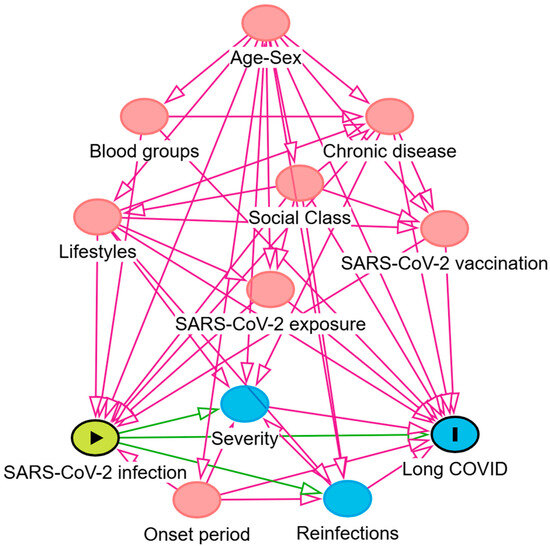
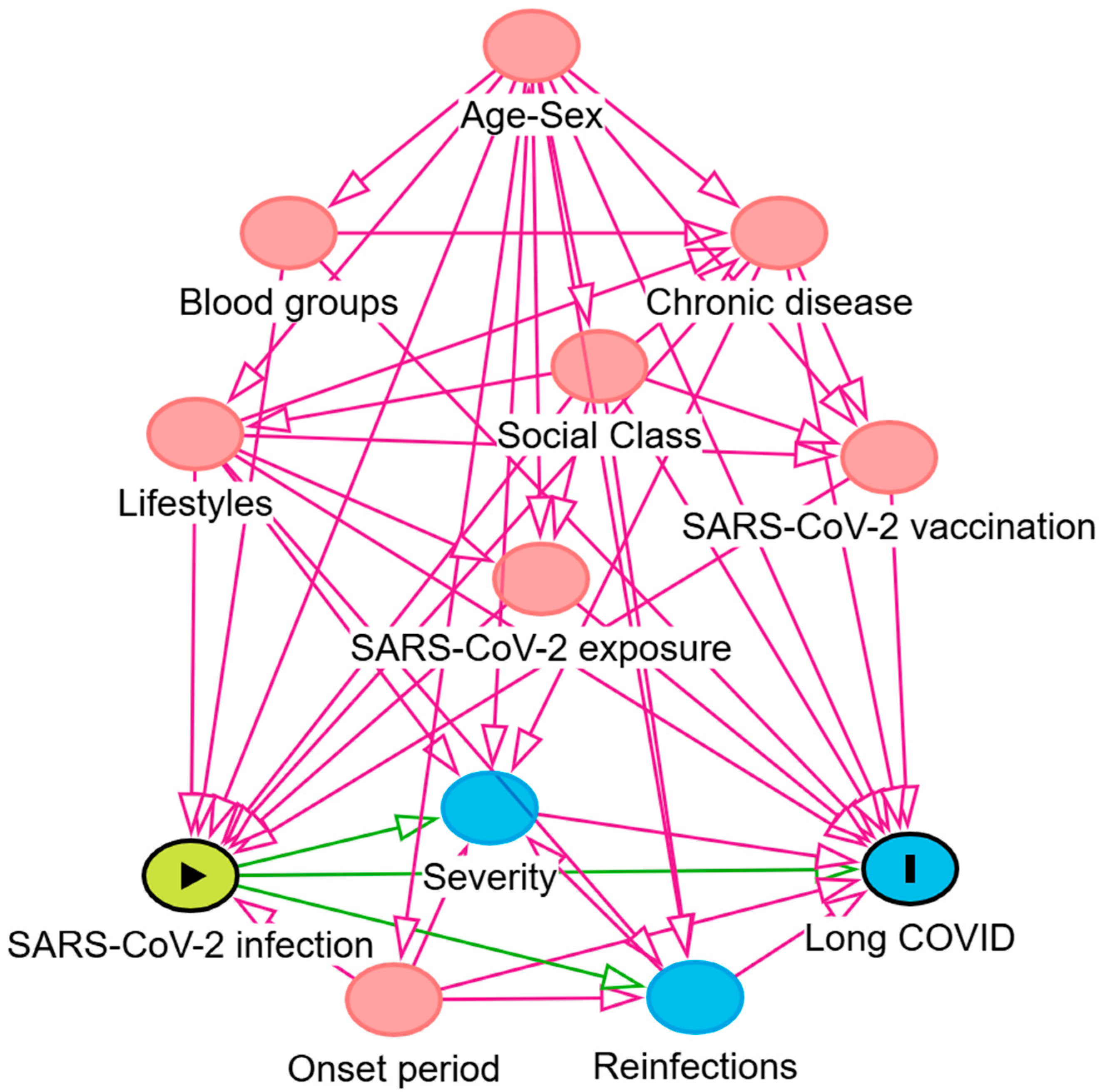
Relationships between risk and protective factors (as predictor variables) and LC were estimated using crude and adjusted relative risks (RR and aRR) through multivariable inverse probability-weighted regression adjustment (IPWRA) models [23] with a 95% CI. In addition, robust Poisson regression models were applied when predictor variables were quantitative. To adjust for potential confounders, the Directed Acyclic Graphs (DAGs) method was used to explore causal relationships among variables, with SARS-CoV-2 infection as the exposure and LC syndrome as the outcome [24,25]. The DAGitty program version 3.1 [26] was used to create the DAGs diagram (Figure 1). This diagram permits the identification of potential confounding factors of each predictor variable and the adjustment for these confounders using the specified multivariable models. The variables analyzed in the models include age and sex; blood groups; social class (education level, family size, and family with 1–2 members); lifestyles (alcohol consumption, body mass index, smoking habits, and physical exercise); having a chronic disease; SARS-CoV-2 exposures (attendance at mass gathering events (MGE), observed coughing by a person at an MGE, and a COVID-19 case in the family); SARS-CoV-2 vaccines administered; the period of the onset of SARS-CoV-2 infection (March–October 2020 for the first period and November 2020–August 2023 for the second); SARS-CoV-2 reinfections; and severity of COVID-19 disease (duration of illness, need for medical care during COVID-19 disease, hospitalization, and asymptomatic infection). For each predictor variable, a specific adjustment was applied.
Figure 1.
Directed Acyclic Graphs (DAGs) showing the effect of SARS-CoV-2 infection (exposure) on LC syndrome (outcome). Ancestors of both exposure and outcome are shown in red, and ancestors of the outcome in blue. Generated using the DAGitty program, version 3.1.
To avoid overfitting in the multivariable models, the number of events per variable (EPV) was calculated as the number of events divided per number of predictor variables included in the models, with a reduction in adjustment variables for chronic disease, SARS-CoV-2 vaccination, SARS-CoV-2 reinfections, and COVID-19 severity. Table 2 shows the adjustment of each variable and the number of predictive variables in each model.
Table 2.
Distribution of predictor variables, adjustments in multivariable models, and the number of predictor variables (NPV) in each model.
Analysis of the SARS-CoV-2 vaccination variable was performed only in those participants that had received the vaccine prior to SARS-CoV-2 infection. Vaccination campaigns began in January 2021, which corresponded with the second period of the study.
A sensitivity analysis was performed by adjusting for the period of SARS-CoV-2 infection onset, March–October 2020 and November 2020–August 2023, for variables that were not adjusted for this factor in the initial DAGs analysis. These variables were social class, chronic disease, lifestyles, and SARS-CoV-2 exposures. In Spain, during the first period, the circulating variant was wild type, following by the Alpha and Delta variants from November 2020 to October 2021 and the Omicron variant from November 2021 to 2023 [27].
The models implemented by IPEWA and robust Poisson regression fit well through checking the plots’ overlap assumption, the test for covariate balance, and the estimated predictor variable probabilities for the first method and the Pearson and chi-squared tests for the second. The Stata® program version 14 (StataCorp., College Station, TX, USA) was used in statistical analysis.
2.4. Ethical Issue
The study was approved by the Ethics Committee of the University Hospital de la Plana (12 October 2021; registry number: 2961). All participants, or their parents in the case of minors, provided written informed consent to participate in the study.
3. Results
In the survey of June 2022, 722 individuals from the initial cohort of May 2020 with confirmatory laboratory tests of SARS-CoV-2 infection participated with a participation rate of 63.7% (722/1134). Table 3 presents a comparison between participants and non-participants. No significant difference was observed by sex, but participants were significantly older than non-participants. However, when examining age groups, a significant difference was found only in the 15–24 and 65-year-old and above groups. Participation was higher among individuals from upper and middle classes; obesity and having a chronic disease were more frequent among participants. Participants engaged in less physical exercise, while smoking habits and alcohol consumption did not differ between groups. Finally, the proportion of COVID-19 cases and the use of medical care for the disease were significantly higher among participants, but perceived health status did not differ between the two groups.
Table 3.
Distribution and characteristics of participants and non-participants in the Borriana COVID-19 cohort study, 2020–2023.
The mean age of participants was 39.7 ± 17.4 years (range: 3–82); 450 were female (62.3%) and 272 male (37.7%). Among the total number of participants, 644 had experienced COVID-19 disease, three lacked laboratory confirmation, and 75 had no known infection. The cohort was followed for 1210 days, from May 2020 to August 2023, with a cumulative COVID-19 incidence of 89.6% (95% CI 87.1–91.7) (644/719).
Of 644 COVID-19 cases, 184 participants developed LC during the study period, with a cumulative incidence of 28.6% (CI 95% 25.1–32.2) (184/644). Among LC patients, 135 remained affected by the syndrome (73.4%), while 49 recovered (26.6%). At the end of this study in August 2023, the prevalence of LC was 21.0% (CI 95% 17.9–24.3) (135/644) among all COVID-19 cases and 73.4% (95% CI 66.4–79.6) (135/184) among LC patients.
When analyzed for periods, in the first period (March–October 2020), 387 participants had COVID-19 at the time, of whom 147 developed LC, resulting in a cumulative incidence of 38.0% (95% CI 33.1–43.0) (147/387). In the second period (November 2020–August 2023), 257 participants had COVID-19, and 37 developed LC, with a cumulative incidence of 14.4% (95% CI 10.3–19.2) (37/257). Excluding the first three months after SARS-CoV-2 infection onset, the average duration of LC was 433.8 ± 289.0 days, with a median of 365 days (range: 60–950 days).
Among the 184 patients with LC, the more frequently reported sequelae were fatigue (25.6%); alterations in taste and smell (18.0%), hair loss (12.5%), dyspnea (9.8%), cough (7.7%), headache (7.7%), weakness (7.1%), memory lost (7.1%), anxiety (6.5%), joint pain (4.9%), nose and throat disorders (4.9%), eye disorders (4.4%), muscle pain (3.8%), digestive disorders (3.3%), skin disorders (2.8%), sleep disorders (2.2%), menstrual disorders (2.2%), palpitations (1.6%), thrombosis (1.6%), and other conditions with a frequency below 1.5%. Of these patients, 84 (45.7%) consulted a doctor for their sequelae, and 4 (2.2%) were hospitalized.
A participant with LC, a 73-year-old woman, died from myelodysplastic syndrome and chronic kidney insufficiency three years after experiencing severe COVID-19 that required hospitalization. Taking all LC patients in the study, the mortality rate was 0.5% (1/184).
To complete the overview of LC in the cohort, the prevalence of symptoms of illness reported in the June 2022 survey is presented in Table 4, comparing LC cases, recovered LC cases, non-LC cases, and non-COVID-19 cases. LC patients showed a higher prevalence of symptoms compared with both non-LC cases and non-COVID-19 cases. Recovered LC cases occupied an intermediate position. The most frequent symptoms among LC patients were fatigue (44.4%), hair loss (37.9%), insomnia (29.0%), restlessness (28.6%), and headaches (25.0%), with a progressive decline of frequency across the other groups. Overall, the recovered LC group showed an intermediate pattern. Non-LC and non-COVID-19 cases had a similar prevalence of symptoms.
Table 4.
Prevalence of symptoms among participants in the June 2022 survey: LC cases (n = 135), recovered LC cases (n = 49), non-LC cases (n = 460), and non-COVID-19 cases (n = 75).
Table 5 presents the distribution and characteristics of LC patients, non-LC cases, and non-COVID-19 cases. LC incidence was higher during the first period (March–October 2020), accounting for 79.9% of cases in contrast with 20.1% in the second period. LC patients were older than non-LC patients. Children and adolescents had the lowest cumulative incidence of LC (8.8%, 6/68), with a progressive increase across older age groups: 34.7% (87/251) in the 45–64-year group and 32.3% (10/31) in those aged 65 years and above.
Table 5.
Distribution and characteristics of LC incidence among LC cases, non-LC cases, and non-COVID-19 cases.
LC was more frequent in females than males (31.5% vs. 23.4%). Being part of a smaller family size and smoking habits were higher among LC patients. BMI, obesity, having chronic disease, and blood group B were also more frequent in LC patients. Exposure to SARS-CoV-2 infections, including attendance at mass gathering events, observing coughing by a person, and having family with COVID-19 cases, was more frequent in LC patients.
Receiving three doses of SARS-CoV-2 vaccine before the onset of the infection was protective against LC. Regarding COVID-19 disease characteristics, duration of the illness, need for medical care, hospitalization, and SARS-CoV-2 reinfections were all higher in LC patients. Asymptomatic infections were more common among non-LC patients.
Table 6 presents the crude RR and aRR for several factors of the incidence of LC between patients with the syndrome and non-LC patients. The risk of LC was significantly higher when the infection onset occurred in the period March–October 2020 (aRR = 2.57; 95% CI 1.85–3.55) and increased with age. Patients aged 50 years and above had a higher risk than those under 50 years (aRR = 1.41; 95% CI 1.11–1.81).
Table 6.
Demographics, education levels, lifestyles, family size, chronic disease, and blood group as risk and protective factors for the incidence of LC (n = 184) compared with COVID-19 cases without LC (n = 460). Inverse probability-weighted regression adjustment models. Crude and adjusted relative risks (RRs) 95% confidence intervals (CIs), and the number of events per variable (EPVs).
Females had a higher risk than males (aRR = 1.48; 95% CI 1.11–1.94). Education levels, smoking habits, physical exercise, alcohol consumption, and obesity were not significant risk factors for LC. Being part of a smaller family size, having a chronic disease, and blood group B increased the incidence of LC (aRR = 1.38; 95% CI 1.05–1.81), (aRR = 1.32; 95% CI 1.01–1.73), and (aRR = 1.77; 95% CI 1.24–2.53), respectively. Having chronic disease was a significant risk factor for LC (aRR = 1.32; 95% CI 1.01–1.73). With respect to EPV, values were generally 10 or higher, except for current smoking, obesity, and blood groups B and AB.
Table 7 presents the crude RR and aRR of SARS-CoV-2 exposures and COVID-19 disease characteristics as risk and protective factors for LC. Attendance at mass gathering events (aRR = 1.68; 95% CI 1.30–2.19) and observed coughing by a person (aRR = 1.71; 95% CI 1.24–2.49) increased the risk for LC. Having a family with a COVID-19 case did not significantly increase the risk for LC. Regarding SARS-CoV-2 vaccination ≥14 days before the onset of a SARS-CoV-2 infection, receiving three doses (aRR = 0.16; 95% CI 0.04–0.54) and receiving three or four doses compared with being unvaccinated or having been vaccinated with only one or two doses (aRR = 0.15; 95% CI 0.05–0.44) were protective factors against LC.
Table 7.
SARS-CoV-2 exposures, vaccination, and COVID-19 disease characteristic as risk and protective factors for the incidence of LC (n = 184), compared with COVID-19 cases without LC (n = 460). Inverse probability-weighted regression adjustment models. Crude and adjusted relative risks (RRs) 95% confidence intervals (CIs) and the number of events per variable (EPVs).
Considering the COVID-19 disease characteristics, duration of illness (aRR = 1.01; 95% CI 1.01–1.02), duration of illness above the median (aRR = 1.55; 95% CI 1.19–2.03), need for medical care (aRR = 3.12: 95% CI 2.05–4.73), and hospitalization (aRR = 1.83; 95% CI 1.35–2.48) were significant risk factors for LC. SARS-CoV-2 reinfections (aRR = 1.13; 95% CI 0.87–1.48) increased the risk for LC without reaching significance. Asymptomatic infections were protective (aRR = 0.22; 95% CI 0.06–0.47). With respect to EPV, values were generally 10 or higher, except for hospitalized, asymptomatic infections and SARS-CoV-2 reinfections.
A sensitivity analysis, adjusting for the period of SARS-CoV-2 infection onset, yielded similar results to the initial analysis (Table 8). The primary education level increased LC risk compared with the middle level, and ex-smokers had a higher risk than non-smokers, although in both cases the risks were of marginal significance (aRR = 1.39; 95% CI 0.99–1.95, and aRR = 1.41; 95% CI 0.97–2.04), respectively. Being part of a smaller family, having a chronic disease, attending mass gathering events, and observing a person with a cough remained significant risk factors for LC, but there was a decreased risk in the last two factors.
Table 8.
Sensitivity analysis adjusting for the period of SARS-CoV-2 infection onset using inverse probability-weighted regression adjustment models. Social class, lifestyles, chronic disease, and SARS-CoV-2 exposures as risk factors of the incidence of LC. Adjusted relative risks (aRRs) 95% confidence intervals (CIs).
4. Discussion
With a considerable follow-up period of up to 40 months, the cumulative incidence of LC in our cohort was 28.6%. The evolution of the COVID-19 pandemic was clearly reflected in the difference between the cumulative incidences of LC: 38.0% in the first period and 14.4% in the second period, during which the Omicron variant predominated. Only one-third of patients who experienced LC after COVID-19 fully recovered, with a low rate of medical consultation [28]. The main persistent symptoms, such as fatigue, alterations in taste and smell, hair loss, dyspnea, and neurological symptoms, as well as other prevalent symptoms, including insomnia, restlessness, and headaches, are consistent with those reported in other studies [8,14,15]. The mortality rate among participants with LC was lower compared with the mortality rate of the COVID-19 pandemic [29,30].
The estimated cumulative incidence of LC in our cohort was consistent with other cohort studies and reflects the decrease observed during the Omicron period [31,32]. However, large variations in LC incidence have been reported, considering differences in methods, follow-up periods, and populations [7,8,33,34,35,36,37,38,39]. The incidence in children and adolescents was low, in line with previous research [40,41]. Similarly, the low recovery rate observed in our cohort was consistent with findings from other studies [42,43,44,45,46].
Several significant risk factors for LC incidence were found, including female sex, older age, chronic disease, infection onset during the March–October 2020 period, and severity of COVID-19 disease (measured by duration of illness, need for medical care, and hospitalization). These risks have been reported in other studies [47,48,49].
However, our study also identified some less-studied risk factors. Firstly, exposure to SARS-CoV-2, such as attendance at mass gathering events and observation of a person with a cough, increased the risk of LC. Additionally, professions with high exposure to SARS-CoV-2 infection showed a higher risk of developing LC [50,51]. Secondly, participants with blood group B had a higher risk for LC compared with those with blood group O. Several studies have found relationships between COVID-19 disease and blood groups, with non-O groups generally showing higher disease severity [52]. This effect may be associated with different cellular immune responses between O and non-O groups [53]. However, in a cohort study, the B group appeared to be protective, even after adjusting for COVID-19 symptoms [54], and in another cross-sectional study of hospitalized patients with a low participation rate, it was found that there was no increased risk for the B group [55]. Thirdly, participants from smaller families had a higher risk of developing LC compared with those from families with three or more members, contrasting with what was found in a cross-sectional study in France [47]. However, the mental health effects of LC are common, and anxiety and depression may be more prevalent in individuals from smaller households [56,57].
In contrast to some studies, smoking habits, primary education level, obesity, and SARS-CoV-2 reinfections were not risk factors in our cohort [58,59,60,61]. While current smoking was a risk factor in our cohort in the October 2020 survey, it was not significant in the present study [19]. The high prevalence of obesity in our cohort may have limited its detectability as a risk factor. Regarding SARS-CoV-2 reinfections, the crude RR was significant; however, when adjusted for the period of infection onset, the aRR lost significance, as many participants had already developed LC during the first period, prior to reinfections.
In line with our previous study on the prevalence of LC [62], vaccination against SARS-CoV-2 was a protective factor for LC in patients vaccinated prior to infection, particularly during the Omicron variant period, which is consistent with findings from several studies [63,64,65]. The exact mechanism of this effect is not well understood, but it might be associated with a lower incidence of severe SARS-CoV-2 infection among the vaccinated population and enhanced immune responses [66,67]. Asymptomatic cases presented a lesser risk for LC in agreement with other research [68].
The pathophysiologic mechanisms of LC are not yet fully understood. Invasion of tissues by SARS-CoV-2 and the subsequent systemic immune response, followed by tissue inflammation, dysfunction, and immune dysregulation, summarize the proposed pathophysiology of LC [9]. SARS-CoV-2 persistence in the body, immune dysfunction, autoimmunity, endocrine insufficiency, and metabolic alterations may all contribute to its development [69,70]. Some neurological symptoms and myalgias have been associated with immune-mediated virus clearance [71]. Risk and protective factors for LC continue to be investigated across different methods and populations [72,73].
Our study presents some strong points. First, its prospective population-based cohort design. Second, it started with the onset of the pandemic. Third, it includes long-term follow-up from the cohort. Fourth, we measured the incidence of new LC cases, preventing the bias from disease duration. Fifth, risk and preventive factors were assessed prior to the syndrome occurring. Sixth, the control of potential confounding factors was performed by IPWRA and robust Poisson regression. Seventh, participants were non-hospitalized, making the cohort more representative of the general population.
On the other hand, our study has several limitations. First, self-reporting of LC and recovery may have introduced information bias. Second, there was some loss of participants from the initial cohort. Third, participants were older, of higher social class, more often obese, and had a high incidence of SARS-CoV-2 infection compared with non-participants, suggesting potential selection bias. Fourth, residual confounding may be present, as no information on SARS-CoV-2 variants was available. Fifth, to prevent overfitting, the number of predictor variables was reduced in the multivariable models, resulting in more limited adjustments. Sixth, models with the EPV below 10 could be unstable, although it may be debated [74]. And, finally, LC is a newly recognized syndrome; some aspects may not have been considered in our study.
The results of our study highlight that the harmful effects of the pandemic are still present in a substantial proportion of our cohort. The low recovery rate requires an increase in consultation and medical care to improve outcomes. Identifying risk and protective factors in our cohort can help promote preventive measures, including health education and vaccination. Continuing the follow-up of this cohort would provide useful information on the evolution of LC, as well as crucial information for primary health care and public health strategies [75,76,77].
Continuing research on LC to better understand its underlying biologic mechanisms is essential, given its high prevalence and low recovery rate [78,79]. Further investigation into new SARS-CoV-2 vaccines with fewer side effects is also warranted. In addition, epidemiological surveillance of SARS-CoV-2 infections, detection and control of outbreaks, infection prevention, and SARS-CoV-2 vaccination of the at-risk population are recommended to enhance preparedness for future epidemics.
5. Conclusions
A substantial incidence of LC was observed in the Borriana COVID-19 cohort after 40 months of follow-up, with a low recovery rate, and significant risk and protective factors were detected. We strongly recommend continuing the follow-up of this cohort, improving medical care for patients with non-recovered LC, ongoing surveillance of SARS-CoV-2 infections, and vaccination of the at-risk populations against SARS-CoV-2.
Author Contributions
Conceptualization, S.D.-M., Ó.P.-O., A.A.-P., M.R.P.-S., L.L.-D. and M.A.R.-G.; methodology, S.D.-M., Ó.P.-O., A.A.-P. and M.R.P.-S.; software, M.R.P.-S. and A.A.-P.; validation, M.S.-U., P.S.-M. and R.R.-P.; formal analysis, Ó.P.-O. and A.A.-P.; investigation, S.D.-M., I.A.-G., D.S.-T., M.S.-U., P.S.-M., M.A.R.-G., J.C.-S., C.N.-R., G.B.-M., L.A.-E.; C.D.-L., R.R.-P. and M.R.P.-S.; resources, S.D.-M., Ó.P.-O., L.L.-D. and J.C.-S.; data curation, D.S.-T.,R.R.-P. and M.S.-U.; writing—original draft preparation, A.A.-P., Ó.P.-O., D.S.-T. and P.S.-M.; writing—review and editing, A.A.-P., S.D.-M., D.S.-T., Ó.P.-O. and P.S.-M.; visualization, G.B.-M., L.A.-E., J.C.-S. and C.D.-L.; supervision, J.C.-S., L.L.-D. and C.N.-R.; project administration, S.D.-M., Ó.P.-O. and L.L.-D.; funding acquisition, S.D.-M., Ó.P.-O. and L.L.-D. All authors have read and agreed to the published version of the manuscript.
Funding
This research received no external funding.
Institutional Review Board Statement
This study (BO-CO-COVID-2 FALLAS DE BORRIANA) has been approved by the Ethics Committee of the University Hospital de la Plana, Vila-real. Date: 14 October 2021 (IRB number 2961).
Informed Consent Statement
All participants or the parents of minors provided informed written consent to be included in the study.
Data Availability Statement
The data presented in this study are available on request from the correspondence author due to official authorizations.
Acknowledgments
We thank the participants of the Borriana COVID-19 cohort, and we appreciate the Borriana’s Falles organization for the support and help to implement this study.
Conflicts of Interest
The authors declare no conflicts of interest.
References
- Cogliandro, V.; Bonfanti, P. Long COVID: Lights and shadows on the clinical characterization of this emerging pathology. New Microbiol. 2024, 47, 15–27. [Google Scholar]
- Pazukhina, E.; Garcia-Gallo, E.; Reyes, L.F.; Kildal, A.B.; Jassat, W.; Dryden, M.; Holter, J.C.; Chatterjee, A.; Gomez, K.; Søraas, A.; et al. Long Covid: A global health issue—A prospective, cohort study set in four continents. BMJ Glob. Health 2024, 9, e015245. [Google Scholar] [CrossRef] [Scilit]
- Sharma, S.K.; Mohan, A.; Upadhyay, V. Long COVID syndrome: An unfolding enigma. Indian J. Med. Res. 2024, 159, 585–600. [Google Scholar]
- Soriano, J.B.; Murthy, S.; Marshall, J.C.; Relan, P.; Diaz, J.V. A clinical case definition of post-COVID-19 condition by a Delphi consensus. Lancet Infect. Dis. 2022, 22, e102–e107. [Google Scholar] [PubMed]
- Thaweethai, T.; Jolley, S.E.; Karlson, E.W.; Levitan, E.B.; Levy, B.; McComsey, G.A.; McCorkell, L.; Nadkarni, G.N.; Parthasarathy, S.; Singh, U.; et al. Development of a definition of postacute sequelae of SARS-CoV-2 infection. JAMA 2023, 329, 1934–1946. [Google Scholar] [PubMed]
- Geng, L.N.; Erlandson, K.M.; Hornig, M.; Letts, R.; Selvaggi, C.; Ashktorab, H.; Atieh, O.; Bartram, L.; Brim, H.; Brosnahan, S.B.; et al. 2024 Update of the RECOVER-Adult Long COVID Research Index. JAMA 2025, 333, 694–700. [Google Scholar] [CrossRef] [Scilit] [PubMed]
- Sharif-Askari, F.S.; Alsayed, H.A.H.; Sharif-Askari, N.S.; Saddik, B.; Hussain, A.A.S.; Halwani, R. Risk factors and early preventive measures for long COVID in non-hospitalized patients: Analysis of a large cohort in the United Arab Emirates. Public Health 2024, 230, 198–206. [Google Scholar] [CrossRef] [Scilit]
- Bai, F.; Tomasoni, D.; Falcinella, C.; Barbanotti, D.; Castoldi, R.; Mulè, G.; Augello, M.; Mondatore, D.; Allegrini, M.; Cona, A.; et al. Female gender is associated with long COVID syndrome: A prospective cohort study. Clin. Microbiol. Infect. 2022, 28, 611.e9–611.e16. [Google Scholar] [CrossRef] [Scilit]
- Peluso, M.J.; Deeks, S.G. Mechanisms of long COVID and the path toward therapeutics. Cell 2024, 187, 5500–5529. [Google Scholar] [CrossRef] [Scilit]
- Gheorghita, R.; Soldanescu, I.; Lobiuc, A.; Caliman Sturdza, O.A.; Filip, R.; Constantinescu-Bercu, A.; Dimian, M.; Mangul, S.; Covasa, M. The knowns and unknowns of long COVID-19: From mechanisms to therapeutical approaches. Front. Immunol. 2024, 15, 1344086. [Google Scholar] [CrossRef] [Scilit]
- Shabnam, S.; Razieh, C.; Dambha-Miller, H.; Yates, T.; Gillies, C.; Chudasama, Y.V.; Pareek, M.; Banerjee, A.; Kawachi, I.; Lacey, B.; et al. Socioeconomic inequalities of Long COVID: A retrospective population-based cohort study in the United Kingdom. J. R. Soc. Med. 2023, 116, 263–273. [Google Scholar] [CrossRef] [Scilit] [PubMed]
- Salci, M.A.; Carreira, L.; Oliveira, N.N.; Pereira, N.D.; Covre, E.R.; Pesce, G.B.; Oliveira, R.R.; Höring, C.F.; Baccon, W.C.; Puente Alcaraz, J.; et al. Long COVID among Brazilian adults and elders 12 months after hospital discharge: A population-based cohort study. Healthcare 2024, 12, 1443. [Google Scholar] [CrossRef] [Scilit]
- Hua, M.J.; Butera, G.; Akinyemi, O.; Porterfield, D. Biases and limitations in observational studies of Long COVID prevalence and risk factors: A rapid systematic umbrella review. PLoS ONE 2024, 19, e0302408. [Google Scholar] [CrossRef] [Scilit]
- Bahmer, T.; Borzikowsky, C.; Lieb, W.; Horn, A.; Krist, L.; Fricke, J.; Scheibenbogen, C.; Rabe, K.F.; Maetzler, W.; Maetzler, C.; et al. Severity, predictors and clinical correlates of Post-COVID syndrome (PCS) in Germany: A prospective, multi-centre, population-based cohort study. eClinicalMedicine 2022, 51, 101549. [Google Scholar] [CrossRef] [Scilit]
- Ellingjord-Dale, M.; Nygaard, A.B.; Støer, N.C.; Bø, R.; Landrø, N.I.; Brunvoll, S.H.; Istre, M.; Kalleberg, K.T.; Dahl, J.A.; Geng, L.; et al. Temporal trajectories of long-COVID symptoms in adults with 22 months follow-up in a prospective cohort study in Norway. Int. J. Infect. Dis. 2024, 149, 107263. [Google Scholar] [CrossRef] [Scilit]
- Sigfrid, L.; Drake, T.M.; Pauley, E.; Jesudason, E.C.; Olliaro, P.; Lim, W.S.; Gillesen, A.; Berry, C.; Lowe, D.J.; McPeake, J.; et al. Long Covid in adults discharged from UK hospitals after Covid-19: A prospective, multicentre cohort study using the ISARIC WHO Clinical Characterisation Protocol. Lancet Reg. Health Eur. 2021, 8, 100186. [Google Scholar]
- Boglione, L.; Meli, G.; Poletti, F.; Rostagno, R.; Moglia, R.; Cantone, M.; Esposito, M.; Scianguetta, C.; Domenicale, B.; Di Pasquale, F.; et al. Risk factors and incidence of long-COVID syndrome in hospitalized patients: Does remdesivir have a protective effect? QJM 2022, 114, 865–871. [Google Scholar] [CrossRef] [Scilit] [PubMed]
- Domènech-Montoliu, S.; Pac-Sa, M.R.; Vidal-Utrillas, P.; Latorre-Poveda, M.; Del Rio-González, A.; Ferrando-Rubert, S.; Ferrer-Abad, G.; Sánchez-Urbano, M.; Aparisi-Esteve, L.; Badenes-Marques, G.; et al. Mass gathering events and COVID-19 transmission in Borriana (Spain): A retrospective cohort study. PLoS ONE 2021, 16, e0256747. [Google Scholar] [CrossRef] [Scilit]
- Domènech-Montoliu, S.; Puig-Barberà, J.; Pac-Sa, M.R.; Vidal-Utrillas, P.; Latorre-Poveda, M.; Del Rio-González, A.; Ferrando-Rubert, S.; Ferrer-Abad, G.; Sánchez-Urbano, M.; Aparisi-Esteve, L.; et al. Complications post-COVID-19 and risk factors among patients after six months of a SARS-CoV-2 infection: A population-based prospective cohort study. Epidemiologia 2022, 3, 49–67. [Google Scholar]
- Domènech-Montoliu, S.; Pérez-Olaso, Ó.; Sala-Trull, D.; Del Rio-Gonzalez, A.; López-Diago, L.; Aleixandre-Gorriz, I.; Pac-Sa, M.R.; Sánchez-Urbano, M.; Satorres-Martinez, P.; Notari-Rodriguez, C.; et al. SARS-CoV-2 mRNA vaccine effectiveness in the Borriana COVID-19 cohort: A prospective population-based cohort study. Epidemiologia 2025, 7, 1. [Google Scholar] [PubMed]
- Egger, M.; Bundschuh, C.; Wiesinger, K.; Gabriel, C.; Clodi, M.; Mueller, T.; Dieplinger, B. Comparison of the Elecsys® Anti-SARS-CoV-2 immunoassay with the EDI™ enzyme linked immunosorbent assays for the detection of SARS-CoV-2 antibodies in human plasma. Clin. Chim. Acta 2020, 509, 18–21. [Google Scholar] [CrossRef] [Scilit]
- Narasimhan, M.; Mahimainathan, L.; Araj, E.; Clark, A.E.; Markantonis, J.; Green, A.; Xu, J.; SoRelle, J.A.; Alexis, C.; Fankhauser, K.; et al. Clinical evaluation of the Abbott Alinity SARS-CoV-2 spike-specific quantitative IgG and IgM assays among infected, recovered, and vaccinated groups. J. Clin. Microbiol. 2021, 59, e0038821. [Google Scholar] [CrossRef] [Scilit] [PubMed]
- Robins, J.M.; Hernán, M.A.; Brumback, B. Marginal structural models and causal inference in epidemiology. Epidemiology 2000, 11, 550–560. [Google Scholar] [CrossRef] [Scilit] [PubMed]
- Greenland, S.; Pearl, J.; Robins, J.M. Causal diagrams for epidemiologic research. Epidemiology 1999, 10, 37–48. [Google Scholar] [CrossRef] [Scilit]
- Lederer, D.J.; Bell, S.C.; Branson, R.D.; Chalmers, J.D.; Marshall, R.; Maslove, D.M.; Ost, D.E.; Punjabi, N.M.; Schatz, M.; Smyth, A.R.; et al. Control of confounding and reporting of results in causal inference studies. Guidance for Authors from Editors of Respiratory, Sleep, and Critical Care Journals. Ann. Am. Thorac. Soc. 2019, 16, 22–28. [Google Scholar] [CrossRef] [Scilit]
- Textor, J.; van der Zander, B.; Gilthorpe, M.S.; Liskiewicz, M.; Ellison, G.T. Robust causal inference using directed acyclic graphs: The R package ‘dagitty’. Int. J. Epidemiol. 2016, 45, 1887–1894. [Google Scholar] [CrossRef] [Scilit]
- Hodcroift, E. CoVariants Overview of Variants in Countries. Available online: https://covariants.org/per-country?region=World (accessed on 1 March 2026).
- Kirchberger, I.; Meisinger, C.; Warm, T.D.; Hyhlik-Dürr, A.; Linseisen, J.; Goßlau, Y. Post-COVID-19 Syndrome in Non-Hospitalized Individuals: Healthcare Situation 2 Years after SARS-CoV-2 Infection. Viruses 2023, 15, 1326. [Google Scholar] [PubMed]
- Lippi, G.; Sanchis-Gomar, F. Mortality of post-COVID-19 condition: 2025 update. COVID 2025, 5, 11. [Google Scholar] [CrossRef] [Scilit]
- Sivasubramanian, B.P.; Joshi, S.; Ravikumar, D.B.; Jagannathan, M.; Babu, S.; Sripathi, S.R.; Javvaji, A.; Jain, P.; Shanmugam, D.K.; Kannan, B.D.S.; et al. COVID-19 in acute myeloid leukemia (AML) and myelodysplastic syndrome (MDS): A propensity matched analysis (2020–2021). Front. Oncol. 2024, 14, 1446482. [Google Scholar] [CrossRef] [Scilit]
- Antonelli, M.; Pujol, J.C.; Spector, T.D.; Ourselin, S.; Steves, C.J. Risk of long COVID associated with delta versus omicron variants of SARS-CoV-2. Lancet 2022, 399, 2263–2264. [Google Scholar] [CrossRef] [Scilit]
- Du, M.; Ma, Y.; Deng, J.; Liu, M.; Liu, J. Comparison of long COVID-19 caused by different SARS-CoV-2 strains: A systematic review and meta-analysis. Int. J. Environ. Res. Public Health 2022, 19, 16010. [Google Scholar] [PubMed]
- Pérez-González, A.; Araújo-Ameijeiras, A.; Fernández-Villar, A.; Crespo, M.; Poveda, E.; Cohort COVID-19 of the Galicia Sur Health Research Institute. Long COVID in hospitalized and non-hospitalized patients in a large cohort in Northwest Spain, a prospective cohort study. Sci. Rep. 2022, 12, 3369. [Google Scholar] [CrossRef] [Scilit]
- Di Gennaro, F.; Belati, A.; Tulone, O.; Diella, L.; Fiore Bavaro, D.; Bonica, R.; Genna, V.; Smith, L.; Trott, M.; Bruyere, O.; et al. Incidence of long COVID-19 in people with previous SARS-Cov2 infection: A systematic review and meta-analysis of 120,970 patients. Intern. Emerg. Med. 2023, 18, 1573–1581. [Google Scholar] [CrossRef] [Scilit]
- Jeffrey, K.; Hammersley, V.; Maini, R.; Crawford, A.; Woolford, L.; Batchelor, A.; Weatherill, D.; White, C.; Millington, T.; Kerr, R.; et al. Deriving and validating a risk prediction model for long COVID: A population-based, retrospective cohort study in Scotland. J. R. Soc. Med. 2024, 117, 402–414. [Google Scholar] [CrossRef] [Scilit]
- Ruiyin, W.; Qi, J.; Tingting, W.; Yuqin, Y.; Yan, J.; Kun, P. Long COVID outcomes following omicron wave in non-hospital population. Front. Public Health 2024, 12, 1377866. [Google Scholar] [CrossRef] [Scilit]
- Kogevinas, M.; Karachaliou, M.; Espinosa, A.; Iraola-Guzmán, S.; Castaño-Vinyals, G.; Delgado-Ortiz, L.; Farré, X.; Blay, N.; Pearce, N.; Bosch de Basea, M.; et al. Risk, determinants, and persistence of long-COVID in a population-based cohort study in Catalonia. BMC Med. 2025, 23, 140. [Google Scholar] [CrossRef] [Scilit]
- Dosbayeva, A.; Serikbayev, A.; Sharapiyeva, A.; Amrenova, K.; Krykpayeva, A.; Kairkhanova, Y.; Dyussupov, A.; Seitkabylov, A.; Zhumanbayeva, Z. Post-COVID-19 syndrome: Incidence, biomarkers, and clinical pattersns in Kazakhstan. Georgian Med. News 2025, 363, 184–192. [Google Scholar]
- Gottlieb, M.; Yu, H.; Chen, J.; Spatz, E.S.; Gentile, N.L.; Geyer, R.E.; Santangelo, M.; Malicki, C.; Gatling, K.; Saydah, S.; et al. Differences in Long COVID severity by duration of illness, symptom evolution, and vaccination: A longitudinal cohort study from the INSPIRE group. Lancet Reg. Health Am. 2025, 44, 101026. [Google Scholar] [CrossRef] [Scilit] [PubMed]
- Asghar, A.F.; Enderle, J.; Salazar, J.H.; Esani, M. Predictors of post-acute sequelae of coronavirus disease 2019 and long COVID in adults and children: A retrospective cohort study using us electronic health record data. J. Public Health 2026, 48, 185–194. [Google Scholar] [CrossRef] [Scilit] [PubMed]
- Mandel, H.; Yoo, Y.J.; Allen, A.J.; Abedian, S.; Verzani, Z.; Karlson, E.W.; Kleinman, L.C.; Mudumbi, P.C.; Oliveira, C.R.; Muszynski, J.A.; et al. Long COVID incidence proportion in adults and children between 2020 and 2024: An electronic health record-based study from the RECOVER initiative. Clin. Infect. Dis. 2025, 80, 1247–1261. [Google Scholar] [CrossRef] [Scilit] [PubMed]
- Pazukhina, E.; Andreeva, M.; Spiridonova, E.; Bobkova, P.; Shikhaleva, A.; El-Taravi, Y.; Rumyantsev, M.; Gamirova, A.; Bairashevskaia, A.; Petrova, P.; et al. Prevalence and risk factors of post-COVID-19 condition in adults and children at 6 and 12 months after hospital discharge: A prospective, cohort study in Moscow (StopCOVID). BMC Med. 2022, 20, 244. [Google Scholar] [CrossRef] [Scilit]
- Rahmati, M.; Udeh, R.; Yon, D.K.; Lee, S.W.; Dolja-Gore, X.; McEVoy, M.; Kenna, T.; Jacob, L.; López Sánchez, G.F.; Koyanagi, A.; et al. A systematic review and meta-analysis of long-term sequelae of COVID-19 2-year after SARS-CoV-2 infection: A call to action for neurological, physical, and psychological sciences. J. Med. Virol. 2023, 95, e28852. [Google Scholar] [CrossRef] [Scilit] [PubMed]
- Lee, C.; Williams, P.; Abrahams, A.; Darbyshire, J.; Davies, H.E.; De Kock, J.; Esmer, U.; Jones, S.A.; Newey, V.; Scott, J.; et al. What Can We Learn Four Years On? A multi-centre service evaluation exploring symptoms, functional impact, recovery and care pathways in Long Covid. Health Expect. 2025, 28, e70435. [Google Scholar] [CrossRef] [Scilit]
- Ávila Nieto, A.; Infante, P.; Barca Durán, F.J. Prevalence and persistence of post-COVID-19 condition after critical care: 32-month follow-up. J. Clin. Med. 2026, 15, 711. [Google Scholar] [CrossRef] [Scilit]
- Shi, Y.; Strobl, R.; Apfelbacher, C.; Bahmer, T.; Geisler, R.; Heuschmann, P.; Horn, A.; Hoven, H.; Keil, T.; Krawczak, M.; et al. Persistent symptoms and risk factors predicting prolonged time to symptom-free after SARS-CoV-2 infection: An analysis of the baseline examination of the German COVIDOM/NAPKON-POP cohort. Infection 2023, 51, 1679–1694. [Google Scholar] [CrossRef] [Scilit]
- Coste, J.; Delpierre, C.; Robineau, O.; Rushyizekera, M.; Richard, J.B.; Alleaume, C.; Gallay, A.; Tebeka, S.; Steichen, O.; Lemogne, C.; et al. A multidimensional network of factors associated with long COVID in the French population. Commun. Med. 2025, 5, 114. [Google Scholar] [CrossRef] [Scilit]
- Zemni, I.; Gara, A.; Bennasrallah, C.; Ezzar, S.; Kacem, M.; Chokri, R.; Maatouk, A.; Abroug, H.; Dhouib, W.; Fredj, M.B.; et al. Incidence and risk factors of post COVID-19 syndrome: A Tunisian cohort study. BMC Infect. Dis. 2024, 24, 461. [Google Scholar] [CrossRef] [Scilit] [PubMed]
- Shah, D.P.; Thaweethai, T.; Karlson, E.W.; Bonilla, H.; Horne, B.D.; Mullington, J.M.; Wisnivesky, J.P.; Hornig, M.; Shinnick, D.J.; Klein, J.D.; et al. Sex Differences in Long COVID. JAMA Netw. Open 2025, 8, e2455430. [Google Scholar] [CrossRef] [Scilit]
- De Matteis, S.; Consonni, D.; Espinosa, A.; de Cid, R.; Magriña, N.B.; Castaño-Vinyals, G.; Karachaliou, M.; Alba Hidalgo, M.A.; Papantoniou, K.; Garcia, J.; et al. Occupational determinants of Long COVID in the population-based COVICAT cohort. Occup. Environ. Med. 2026, 82, 579–588. [Google Scholar] [CrossRef] [Scilit]
- Rushyizekera, M.; Delpierre, C.; Makovski, T.T.; Coste, J. Occupational and non-occupational factors of post-COVID-19 condition: A cross-sectional survey in the French general working population. BMJ Public Health 2025, 3, e001613. [Google Scholar] [CrossRef] [Scilit] [PubMed]
- Franchini, M.; Maggi, F.; Focosi, D. ABO blood group-related mechanism of infection of SARS-CoV-2: An overview of systematic reviews. Clin. Chem. Lab. Med. 2023, 62, 396–401. [Google Scholar] [CrossRef] [Scilit]
- Gil-Manso, S.; Miguens Blanco, I.; Motykam, B.; Halpin, A.; López-Esteban, R.; Pérez-Fernández, V.A.; Carbonell, D.; López-Fernández, L.A.; West, L.; Correa-Rocha, R.; et al. ABO blood group is involved in the quality of the specific immune response anti-SARS-CoV-2. Virulence 2022, 13, 30–45. [Google Scholar] [CrossRef] [Scilit] [PubMed]
- Guzman-Esquivel, J.; Mendoza-Hernandez, M.A.; Guzman-Solorzano, H.P.; Sarmiento-Hernandez, K.A.; Rodriguez-Sanchez, I.P.; Martinez-Fierro, M.L.; Paz-Michel, B.A.; Murillo-Zamora, E.; Rojas-Larios, F.; Lugo-Trampe, A.; et al. Clinical characteristics in the acute phase of COVID-19 that predict long COVID: Tachycardia, myalgias, severity, and use of antibiotics as main risk factors, while education and blood group B are protective. Healthcare 2023, 11, 197. [Google Scholar] [CrossRef] [Scilit]
- Soriano, J.B.; Peláez, A.; Busquets, X.; Rodrigo-García, M.; Pérez-Urría, E.Á.; Alonso, T.; Girón, R.; Valenzuela, C.; Marcos, C.; García-Castillo, E.; et al. ABO blood group as a determinant of COVID-19 and Long COVID: An observational, longitudinal, large study. PLoS ONE 2023, 18, e0286769. [Google Scholar] [CrossRef] [Scilit]
- Radin, A.K.; Zheng, Z.; Shaw, J.; Brown, S.P.; McCue, E.; Fouts, T.; Skeie, A.; Peña, C.; Youell, J.; Flint, H.; et al. Sociodemographic factors and mental health in health care professionals and patients during COVID-19. Rural. Ment. Health 2025, 49, 288–303. [Google Scholar] [CrossRef] [Scilit]
- Wu, B. Social isolation and loneliness among older adults in the context of COVID-19: A global challenge. Glob. Health Res. Policy 2020, 5, 27. [Google Scholar] [CrossRef] [Scilit]
- Subramanian, A.; Nirantharakumar, K.; Hughes, S.; Myles, P.; Williams, T.; Gokhale, K.M.; Taverner, T.; Chandan, J.S.; Brown, K.; Simms-Williams, N.; et al. Symptoms and risk factors for long COVID in non-hospitalized adults. Nat. Med. 2022, 28, 1706–1714. [Google Scholar] [CrossRef] [Scilit]
- Adebisi, Y.A.; Ogunkola, I.O.; Jimoh, N.D.; Alshahrani, N.Z.; Shomuyiwa, D.O.; Alaran, A.J.; Lucero-Prisno, D.E., 3rd. Tobacco smoking and the risk of Long COVID: A prospective cohort study with mediation analysis. J. Epidemiol. Popul. Health 2025, 73, 203142. [Google Scholar] [CrossRef] [Scilit] [PubMed]
- Feldman, C.H.; Santacroce, L.; Bassett, I.V.; Thaweethai, T.; Alicic, R.; Atchley-Challenner, R.; Chung, A.; Goldberg, M.P.; Horowitz, C.R.; Jacobson, K.B.; et al. Social determinants of health and risk for Long COVID in the U.S. RECOVER-Adult Cohort. Ann. Intern. Med. 2025, 178, 1287–1297. [Google Scholar] [CrossRef] [Scilit]
- Khurana, M.P.; Brünnich Sloth, M.M.; Scheidwasser, N.; Curran-Sebastian, J.; Morgenstern, C.; Banholzer, N.; Thein, D.; Mortensen, L.H.; Rasmussen, M.; Jokelainen, P.; et al. SARS-CoV-2 reinfections and subsequent risk of hospital-diagnosed post-acute sequelae in Denmark (2020–2022): A nationwide cohort study. Lancet Reg. Health Eur. 2026, 63, 101601. [Google Scholar] [CrossRef] [Scilit] [PubMed]
- Domènech-Montoliu, S.; Puig-Barberà, J.; Badenes-Marques, G.; Gil-Fortuño, M.; Orrico-Sánchez, A.; Pac-Sa, M.R.; Perez-Olaso, O.; Sala-Trull, D.; Sánchez-Urbano, M.; Arnedo-Pena, A. Long COVID Prevalence and the Impact of the Third SARS-CoV-2 Vaccine Dose: A Cross-Sectional Analysis from the Third Follow-Up of the Borriana Cohort, Valencia, Spain (2020–2022). Vaccines 2023, 11, 1590. [Google Scholar] [CrossRef] [Scilit] [PubMed]
- Abul, Y.; Harris, D.A.; Chachlani, P.; Hayes, K.N.; Zullo, A.R.; Mor, V.; Gravenstein, S. Incidence of long COVID diagnoses in 3.6 million U.S. Medicare beneficiaries with COVID-19. J. Gerontol. A Biol. Sci. Med. Sci. 2025, 80, glaf108. [Google Scholar] [CrossRef] [Scilit]
- Byambasuren, O.; Stehlik, P.; Clark, J.; Alcorn, K.; Glasziou, P. Effect of covid-19 vaccination on long covid: Systematic review. BMJ Med. 2023, 2, e000385. [Google Scholar] [CrossRef] [Scilit]
- Català, M.; Mercadé-Besora, N.; Kolde, R.; Trinh, N.T.H.; Roel, E.; Burn, E.; Rathod-Mistry, T.; Kostka, K.; Man, W.Y.; Delmestri, A.; et al. The effectiveness of COVID-19 vaccines to prevent long COVID symptoms: Staggered cohort study of data from the UK, Spain, and Estonia. Lancet Respir. Med. 2024, 12, 225–236. [Google Scholar] [CrossRef] [Scilit] [PubMed]
- Hedberg, P.; van der Werff, S.D.; Nauclér, P. The effect of COVID-19 vaccination on the risk of persistent post-COVID-19 condition: Cohort study. J. Infect. Dis. 2025, 231, e941–e944. [Google Scholar] [CrossRef] [Scilit] [PubMed]
- Guimarães, G.N.; Brunetti, N.S.; De Lima, D.G.; Proenca-Modena, J.L.; Farias, A.S. Vaccination and COVID-19: Impact on long-COVID. Front. Immunol. 2025, 16, 1686572. [Google Scholar] [CrossRef] [Scilit]
- Ma, Y.; Deng, J.; Liu, Q.; Du, M.; Liu, M.; Liu, J. Long-Term consequences of asymptomatic SARS-CoV-2 infection: A systematic review and meta-analysis. Int. J. Environ. Res. Public Health 2023, 20, 1613. [Google Scholar] [CrossRef] [Scilit]
- Aid, M.; Boero-Teyssier, V.; McMahan, K.; Dang, R.; Doyle, M.; Belabbaci, N.; Borducchi, E.; Collier, A.Y.; Mullington, J.; Barouch, D.H. Long COVID involves activation of proinflammatory and immune exhaustion pathways. Nat. Immunol. 2026, 27, 61–71. [Google Scholar] [CrossRef] [Scilit]
- da Silva, M.D.; da Silva, T.S.; Mendes, C.G.; Valbão, M.C.M.; Badu-Tawiah, A.K.; Laurindo, L.F.; Barbalho, S.M.; Direito, R.; Miglino, M.A. Advances in understanding long COVID: Pathophysiological mechanisms and the role of omics technologies in biomarker identification. Mol. Diagn. Ther. 2025, 29, 617–636. [Google Scholar] [CrossRef] [Scilit]
- Antar, A.A.R.; Yu, T.; Demko, Z.O.; Hu, C.; Tornheim, J.A.; Blair, P.W.; Thomas, D.L.; Manabe, Y.C. Long COVID brain fog and muscle pain are associated with longer time to clearance of SARS-CoV-2 RNA from the upper respiratory tract during acute infection. Front Immunol. 2023, 14, 1147549. [Google Scholar] [CrossRef] [Scilit] [PubMed]
- Hermans, L.E.; Wasserman, S.; Xu, L.; Eikelboom, J. Long COVID prevalence and risk factors in adults residing in middle- and high-income countries: Secondary analysis of the multinational Anti-Coronavirus Therapies (ACT) trials. BMJ Glob. Health 2025, 10, e017126. [Google Scholar] [CrossRef] [Scilit]
- Wehrmeister, F.C.; Menezes, A.M.B.; Dalcolmo, M.; Prendergast, E.C.C.; Batista, T.G.S.; Leão, O.A.A.; Blumenberg, C.; Vinholes Siqueira, F.; Struchiner, C.J.; Victora, C.G.; et al. A countrywide study on post-COVID-19 condition in Brazil: The Epicovid 2.0. Int. J. Epidemiol. 2026, 55, i31–i40. [Google Scholar] [CrossRef] [Scilit]
- Riley, R.D.; Ensor, J.; Snell, K.I.E.; Harrell, F.E., Jr.; Martin, G.P.; Reitsma, J.B.; Moons, K.G.M.; Collins, G.; van Smeden, M. Calculating the sample size required for developing a clinical prediction model. BMJ 2020, 368, m441. [Google Scholar] [CrossRef] [Scilit]
- Thaweethai, T.; Donohue, S.E.; Martin, J.N.; Hornig, M.; Mosier, J.M.; Shinnick, D.J.; Ashktorab, H.; Atieh, O.; Blomkalns, A.; Brim, H.; et al. Long COVID trajectories in the prospectively followed RECOVER-Adult US cohort. Nat. Commun. 2025, 16, 9557. [Google Scholar] [CrossRef] [Scilit]
- Ayoubkhani, D.; Atchison, C.J.; Banerjee, A.; Brightling, C.; Calvert, M.; Diamond, I.; Eggo, R.M.; Elliott, P.; Evans, R.A.; Haroon, S.; et al. Considerations for epidemiological studies investigating emerging post-acute infection syndromes: Long Covid as a case study. eClinicalMedicine 2026, 94, 103833. [Google Scholar] [CrossRef] [Scilit]
- Calcaterra, V.; Zanelli, S.; Foppiani, A.; Verduci, E.; Benatti, B.; Bollina, R.; Bombaci, F.; Brucato, A.; Cammarata, S.; Calabrò, E.; et al. Long COVID in children, adults, and vulnerable populations: A comprehensive overview for an integrated approach. Diseases 2024, 12, 95. [Google Scholar] [CrossRef] [Scilit] [PubMed]
- Latifi, A.; Flegr, J. Persistent health and cognitive impairments up to four years post-COVID-19 in young students: The impact of virus variants and vaccination timing. Biomedicines 2024, 13, 69. [Google Scholar] [CrossRef] [Scilit] [PubMed]
- Sardell, J.; Pearson, M.; Chocian, K.; Das, S.; Taylor, K.; Strivens, M.; Gupta, R.; Rochlin, A.; Gardner, S. Reproducibility of genetic risk factors identified for long COVID using combinatorial analysis across US and UK patient cohorts with diverse ancestries. J. Transl. Med. 2025, 23, 516. [Google Scholar] [CrossRef] [Scilit] [PubMed]

Disclaimer/Publisher’s Note: The statements, opinions and data contained in all publications are solely those of the individual author(s) and contributor(s) and not of MDPI and/or the editor(s). MDPI and/or the editor(s) disclaim responsibility for any injury to people or property resulting from any ideas, methods, instructions or products referred to in the content. |
© 2026 by the authors. Licensee MDPI, Basel, Switzerland. This article is an open access article distributed under the terms and conditions of the Creative Commons Attribution (CC BY) license.