


Abstract
Introduction: COVID-19 and influenza are viruses that have been major causes of morbidity and mortality worldwide. While a combination vaccine for these two viruses is currently in development, little is known about public perceptions and attitudes towards such a vaccine. Therefore, we have aimed to conduct a scoping review to evaluate the attitudes and reasons for the acceptance/rejection of a combination COVID-19 and influenza vaccination. Material and Methods: Our review has followed the Preferred Reporting Items for Systematic Reviews and Meta-Analyses for Scoping Reviews (PRISMA-ScR) guidelines. Search terms included those on COVID-19, influenza, and combination vaccines. Searches were conducted in a total of 10 different databases, as follows: Embase, Global Health, Google Scholar, CINAHL, Medline, Scopus, ScienceDirect, PubMed, PsycINFO, and Web of Science. Results: Searches across all databases produced a total of 1763 results, of which five studies were deemed to be eligible for this review. Data from included studies encompassed a total of 20,581 participants across 14 countries. Generally, participants had favorable views towards a combination vaccine. However, attitudes varied by region, demographics, and prior vaccine exposure. Reasons provided for accepting a combination vaccine include low cost, reasonable effectiveness, fewer injections, and higher safety. However, reasons for rejection of a potential combination vaccine include a potential lack of evidence and studies regarding its effectiveness and a fear of possible side effects. Conclusions: There are generally positive attitudes and perceptions towards a combination vaccination for COVID-19 and influenza, and there are also specific segments of populations that may show hesitancy towards such a vaccine. Vaccination delivery programs should clearly demonstrate that these vaccines are safe and must concurrently address false rumors and misinformation. Ensuring that as many people as possible can receive the vaccination without barriers via equity in access should be a public health priority. It is also important to recognize the limitations of this work, especially that the review was limited to five studies, the majority of which were cross-sectional and relied on self-reporting.
1. Introduction
Coronavirus disease (COVID-19) and influenza virus are both major causes of morbidity and have been a major cause of death worldwide [1,2,3]. It has been estimated that global excess mortality attributed to COVID-19 between 2020 and 2021 was 5.94 million deaths [2]. Past estimates for total annual deaths due to influenza have been as high as 650,000 worldwide, as per the World Health Organization [3]. Furthermore, the risk of severe respiratory illness and deaths in populations was found to be very high where co-infection occurs [4,5,6,7]. A prior systematic review demonstrated that mortality rates of patients co-infected with influenza and COVID-19 was 15–25% in some settings [7].
Vaccination for COVID-19 and influenza viruses has been integral to reducing the morbidity and mortality from infection. It has been estimated that as many as 14.4 million lives were saved in a single year due to COVID-19 vaccination [8]. Likewise, numerous studies have demonstrated the importance and success of influenza vaccination in reducing morbidity and mortality for this virus [9,10,11]. However, to ensure optimal protection from these vaccinations, there is a need to regularly receive multiple doses [12,13]. To address the need for routine vaccination for both viruses, calls have been made for the development of a combination vaccination containing COVID-19 and influenza.
Combination vaccines protect against two or more diseases, or against two or more strains of the same disease. A combined vaccine includes two or more antigens either combined by the manufacturer or mixed immediately before administration as a single product, in comparison to two or more vaccines being administered through multiple injections on the same day [14]. Combination vaccines came into use in the mid-1950s with the administration of individual diphtheria, tetanus, and pertussis (DTP) vaccines as a single, combined product. Further combining inactivated polio, hemophilus influenzae, and hepatitis B vaccines into the product has helped reduce the number of injections received by infants. Combination vaccines have become the mainstay of childhood immunization schedules [15]. In addition, combined vaccines for adults are in common use, such as the quadrivalent influenza vaccine, which protects against multiple strains, including two influenza A and two influenza B viruses [16].
A combination vaccine has the potential to address some key concerns identified through global studies on barriers to uptake of vaccination, which included access barriers, inconvenience, fear of needles, lack of vaccine offers, and lack of communication [17]. Historically, immunization uptake has been higher for combined vaccines [15,18]. Combination vaccines for COVID-19 and influenza are at present in advanced stages of clinical trials and are expected to be available on the market soon [19,20,21,22,23]. These combination vaccines may have the potential to be more effective than mono-vaccines and, consequently, may result in improved health outcomes for those infected with the pathogens [22,23].
While there is increasing optimism regarding the potential of combination vaccinations for COVID-19 and influenza, there is also a clear need for the development of appropriate vaccine communication and health promotion efforts, to ensure increased rates of uptake in the general population once they are developed. This is especially pertinent, as studies have determined that vaccine hesitancy rates for the COVID-19 and influenza vaccines have been found to be as high as 29.7% and 37.7%, respectively [24,25]. To provide better insights into attitudes toward a combined vaccination, we conducted a scoping review on attitudes, perceptions, and hesitancy towards a combined vaccination for both COVID-19 and influenza.
2. Methods
For this scoping review, we followed the Preferred Reporting Items for Systematic Review and Meta-Analyses Extension for Scoping Reviews (PRISMA-ScR) [26,27]. There were numerous steps conducted, which were conducted in the following order:
- Creating the research question;
- Developing search terms across the respective databases;
- Developing the inclusion and exclusion criteria;
- Screening for studies to include and exclude;
- Extracting of data from included studies;
- Synthesizing findings;
- Reporting of findings and implications.
On 6 June 2023, searches were conducted across in ten different databases: PubMed, Scopus, Google Scholar, Embase, OVID Medline, CINAHL, PsycINFO, ScienceDirect, Global Health, and Web of Science. Searches were repeated on 31 August 2024, to ensure that as many relevant articles as possible were included. Search terms pertained to those regarding COVID-19, influenza, and combined vaccination, respectively. A full list of search terms, by database, is shown in Supplementary Table S1.
Inclusion criteria was intended to be as broad as possible to maximize the number of potential articles to be included. Studies were eligible for inclusion if they provided any perceptions/attitudes towards combination COVID-19-influenza vaccination. Original qualitative, quantitative, and mixed-methods studies were all eligible for inclusion. No restrictions were placed based on the number of participants and the date of publication. Conference abstracts, dissertations, and pre-prints were all eligible for inclusion. Studies were not eligible for inclusion if they were any of the following:
- Not in English;
- Not original research (review, commentary, etc.);
- Only examines perceptions of a single vaccine (i.e., only COVID-19 vaccine or only influenza vaccine).
After conducting the searches, two researchers (KV and IS) screened articles independently. Duplicates were first removed, then articles were thereafter screened by title and abstract. Next, articles were analyzed by reading the full text to determine if they met the inclusion criteria. Discrepancies regarding articles to be included were resolved by consensus among the authors, which resulted in complete agreement regarding the study selection.
The data extracted included those on study characteristics, as well as those on participant characteristics/perceptions. Data extracted under study characteristics included study design, objectives, sources of data, sampling method, analyses conducted, and study limitations reported by authors. Participant data that were extracted included total number of participants, gender, age, and attitudes/perceptions/hesitancy towards vaccination. To allow for comparisons, data for attitudes/perceptions/hesitancy were extracted for receiving the influenza vaccination, the COVID-19 vaccination, and the combined vaccination. Data were extracted, and discrepancies were again resolved by consensus. Once the data were fully extracted, they were analyzed, with trends across data and relevant findings being reported in the text and in tabular format.
Study quality was assessed using the Joanna Briggs Institute’s critical appraisal tools [28]. These specific tools were used to be able to provide a quantifiable metric for quality across study methodologies. Following approaches previously taken [29,30,31], we modified the tools to provide scores for each study based on the number of yes/no responses on the quality assessment to allow for a comparison across study methodologies. Percentage scores were based on the number of “yes” responses as per the metric, with a higher response indicating higher study quality overall.
3. Results
3.1. Study Screening
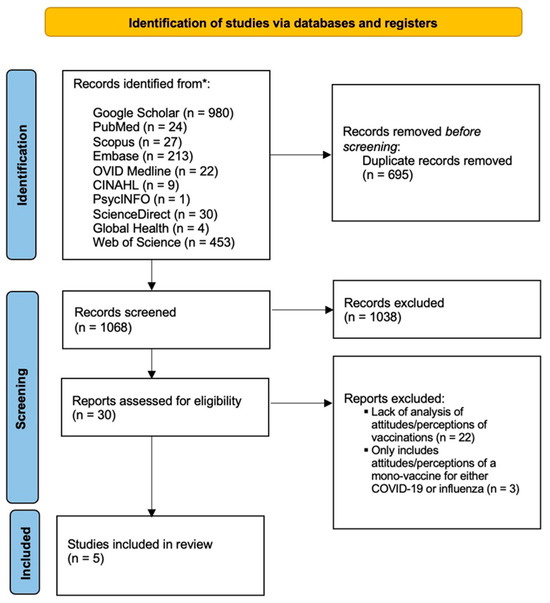
Searches across all databases produced a total of 1763 results. Following the removal of duplicates, 1068 articles were screened by title/abstract; of these articles, 30 were analyzed by reading the full text. Ultimately, five articles were deemed to be eligible for inclusion in the review [32,33,34,35,36]. Reasons for the exclusion of studies were a lack of analysis of attitudes/perceptions regarding vaccinations and studies only including attitudes/perceptions of a mono-vaccine for either COVID-19 or influenza. A full depiction of the screening workflow is shown in Figure 1.
Figure 1.
Workflow for screening of studies for this review [27]. * Combined total of 1763 articles from the initial searches.
3.2. Study Characteristics
A full list of study characteristics is shown in Table 1. The studies, from 14 countries, encompassed a total of 20,581 participants. Of the five studies included in this review, all five utilized an online survey format; four had a cross-sectional design [33,34,35,36], and one was a longitudinal cohort study [32]. One study was conducted in 2020 and 2021 [32], one was only in 2021 [35], and two were conducted in 2022 [33,34]. A single study did not specify the period for data collection [36]. Sample sizes across studies ranged from 600 [36] to 12,287 [35]. Logistic regression was used in four studies to assess for relevant factors associated with vaccination acceptance [32,33,35,36], and one study utilized independent t-testing and chi-square testing to evaluate trends in data [34]. Common reported limitations across studies included recall bias, sampling bias, a lack of representativeness, and social desirability bias.
Table 1.
Characteristics of studies included in this review.
3.3. Study Quality
Overall, the studies included in this review had a percentage study quality score ranging from 75% to 100% (mean = 85.7%). The single cohort study [32] had a quality score of 90.9% (10 out of 11 possible points), and the four cross-sectional studies [33,34,35,36] had an average score of 84.4%, with 8 possible points as per the metric for cross-sectional studies. There were not found to be consistencies in terms of areas of included studies that resulted in lower quality points; all included studies adequately addressed potential confounding variables. Scores for individual studies are shown in Supplementary Tables S2 and S3.
3.4. Participant Characteristics
Characteristics of participants, including attitudes/perceptions of a combination vaccine, are shown in Table 2. Participants from 14 countries were represented (with one study including data from 11 countries [33]), which were Italy (2543 participants) [32], Egypt (330 participants) [33], Iraq (330 participants) [33], Kuwait (330 participants) [33], Lebanon (330 participants) [33], Morocco (330 participants) [33], Pakistan (330 participants) [33], Afghanistan (330 participants) [33], Sudan (330 participants) [33], Saudi Arabia (330 participants) [33], Yemen (330 participants) [33], Libya (2745 participants) [33,34], the United States (12,287 participants) [35], and the United Kingdom (600 participants) [36]. All studies included participants across age groups, with most common groupings being 18–24, 25–34, 35–50, 50–64, and 65+. Of the studies that specified, 9151 participants (45.8%) were male, and 10,830 (54.2%) were female.
Table 2.
Key findings and characteristics of participants from studies included in this review.
3.5. Rates of Acceptance
Overall, the rates of acceptance for a combination COVID-19 and influenza vaccine ranged from 50.0% [34] to 74.7% [36]. One study evaluating the acceptance of a combination vaccination, with potential of flu-like symptoms as a side effect, demonstrated that 24.1% of participants were willing to accept such a risk (95% CI: 23.0–25.2) [36]. The same study also showed that 7.5% would not accept any risk of flu-like symptoms as a side effect [36]. Another study focused solely on the acceptance of a combination vaccination among participants who have refused the COVID-19 vaccination. Amongst these 1819 individuals, 512 (28.2%) were willing to accept a combination vaccination instead [34]. Likewise, a study collecting data in 2020 and 2021, demonstrated that 73.7% favored a combination vaccine [35]. In this study, among the 88.2% of individuals who had previously received a COVID-19 vaccine dose/intended to have the COVID-19 vaccine, 42.2% had received the influenza vaccine in the same year [32].
3.6. Factors Associated with Acceptance
Differences in rates of acceptance of a combination vaccinated were noted across age groups, with those above 60 years of age found to be associated with acceptance in two studies [33,34]. Males were also shown to be 21% more likely to accept combination vaccination than females in one study [33]. Compared to those who have never had the flu vaccination, those who always receive the flu shot annually had a 1770% higher odds of accepting a combination vaccine; those who had the flu shot in some years were also more likely to accept the combination vaccine (OR = 7.03, p < 0.001), as well as those who usually do not have the flu shot (OR = 2.58, p < 0.001) [35]. Other factors demonstrated to be associated with acceptance were political identification as a Democrat (in the United States), earning above the median income, having had a family member who died from COVID-19, and having had higher educational attainment [33,34]. A study on the acceptability of risk for side effects from a combination vaccine demonstrated that higher education and having previously been vaccinated for COVID-19 and influenza were associated with increased tolerance to risks for side effects [36].
3.7. Factors Associated with Rejection
Being in an at-risk population appeared to be associated with the rejection of a combination vaccination; in one study, it was shown that those with chronic disease and/or past COVID-19 infection were more likely to reject the combination vaccine (p < 0.001) [33]. The study demonstrated that having had COVID-19 infection in the past was associated with 21.0% decreased odds of acceptance (OR = 0.79, 95 CI: 0.65–0.95) [33]. Similarly, another study demonstrated that those with comorbidities/risks for flu complications were the least tolerant to any risks of a combination vaccination’s side effects [36].
Another study determined demographic factors associated with hesitation toward the combination vaccine, including being Black/African American (compared to being White) (OR = 0.60, p < 0.001), being female compared to being male (OR = 0.65, p < 0.001) living in a small town/city (compared to being in a city) (OR = 0.78, p < 0.05), and living in a rural area (compared to being in a city (OR = 0.63, p < 0.05) [34]. Among the 11 countries in the Middle East region surveyed in one study, the lowest rates of acceptance were shown in Kuwait (30%) and Lebanon (22%) [33].
3.8. Reasons for Acceptance and Refusal
Four main reasons for the acceptance of combination vaccines were described across included studies. Combinations were considered safer among 51% of those who would accept a combination vaccine in one study [34] and 18% in another study [33]. Lower costs were a reason specified by 3.3% [34] and 9.0% of participants [33]. Increased effectiveness was also specified among 19.1% [34] and 17% [33]. Lastly, requiring fewer overall doses was also described among 24.0% [34] and 19.0% of those who would be willing to accept a combination vaccine [33].
Reasons for the refusal of a combination vaccine were also described. One study indicated that the three main reasons, among those who self-reported rejecting a combination vaccine, were fear of side-effects (48.7%), lack of studies demonstrating effectiveness (29.8%), and perceptions that a combination vaccine may be useless (11.2%) [34]. A further study had comparable findings, with 31% of those who rejected a combination vaccine specifying that this was due to fear of side effects, with a further 31% describing concerns over a lack of data published on the effectiveness of a combined vaccine [33]. Notably, another study highlighted specific additional reasons for participant rejection of the influenza vaccination (though these factors were not solely linked to a combination vaccine); 12.9% felt that flu shots are to profit pharmaceuticals, 5.5% have fear of needles, 7.0% said doctors recommended not to receive the influenza vaccine, 13.9% believed that the flu has diminished since COVID-19, so a vaccine is not necessary, 12.0% believe flu shots do not work, and 5.5% had the shot but were sick anyway [32].
4. Discussion
In this review, it has been shown that there are favorably high rates of acceptance towards a combination vaccination for COVID-19 and influenza (though, notably, there was also variation across an array of populations and demographic groups). Convenience, affordability, effectiveness, and safety were described as important contributing factors towards the acceptance of a combined COVID-19 and influenza vaccine. These findings have important implications in providing guidance for healthcare providers and public health programs that are focusing on creating initiatives for combination vaccination.
With the development of new combination vaccines, it is imperative that equity is prioritized to ensure that the vaccine is accessible to those who desire to have it but face socioeconomic burdens. Though not limited to combination vaccines, developing programs where vaccines can be administered free of charge have been shown to greatly increase vaccination uptake [37,38]. Conversely, high expenses have been a notable barrier to combination vaccine uptake in the past [39], as well as for regular vaccines [40,41]. Considering that new combination vaccines for COVID-19 and influenza will likely involve the utilization of cutting edge technologies, it is likely that the costs will be high; based on the findings of this review, it is important that public health departments are adequately funded by governments to ensure that funding is allocated for these vaccines so that members of the general population are not overburdened by the financial costs associated with vaccination.
Of note, those who have had the influenza vaccination in the past had a markedly higher likelihood of accepting a combination vaccination for COVID-19 and influenza. Therefore, while public health efforts should focus on promoting the combination vaccine, there is also a critical need to reinforce the importance of the annual flu vaccination more generally. A wide range of interventions have been implemented to successfully increase the uptake of the influenza vaccination, and these include school-level training, educating implementers in schools, educating individuals specifically, reminding students and parents [42], nurses/pharmacists educating patients, postcards, personalized phone calls, home visits [43], providing financial incentives to health care workers and practices, using staff to identify eligible patients for outreach, and assisting practices with leadership efforts to provide performance reports for vaccination rates [44]. To improve the rates of influenza vaccination, and subsequently combination vaccination, these efforts need to be scaled up for influenza vaccination campaigns; furthermore, these initiatives and efforts should increasingly aim to also integrate and promote the combination vaccine to see further rises in the rates of uptake. Importantly, these health promotion campaigns should occur alongside COVID-19 vaccine health promotion efforts, as well as newly developed combination vaccine health promotion campaigns. While it is not known when the combination vaccination will be available, these findings do indicate that scaling up of influenza vaccinations in current times (prior to the development of a combination vaccine) can potentially increase the likelihood that people will accept the combination vaccine when it becomes available.
Vaccine safety was discussed as an important factor related to willingness to accept combination vaccines. There may be an underlying perception that having a combination vaccine can be inherently safer relative to the administration of two individualized vaccinations. When combination vaccines have been implemented in the past, a critical finding has been that such vaccinations are as safe as other vaccinations and have not been associated with increased risk for side effects or adverse events [45,46]. Therefore, it is imperative that this new combination vaccination, when it is developed, is rigorously tested and is demonstrated to be safe for all who receive it; while it may not be necessarily possible to be safer than individual vaccines, the combination should nonetheless be demonstrated to at least be as safe as these individual alternatives. Of note, in the past, it has been expressed that one of the concerns of the COVID-19 vaccine was that it was developed too rapidly to be tested adequately and to be able to provide convincing evidence that the risks were minimal [47,48]. Hence, it is critical that the process of developing the combination vaccine is not rushed, and that its effectiveness and safety is tested comprehensively before it becomes used and recommended on a large scale. The high safety of these vaccinations should be included in public health messaging when the combination vaccinations become available.
Our review has shown that several demographic groups appear to be especially reluctant towards a combination vaccine. These include residing in a rural area, being a racial minority, having comorbidities, being female, and having previously had a COVID-19 infection. This has important implications and suggests that vaccine delivery programs should relate to health promotion campaigns and communication efforts that attempt to reach out to these groups, who may be reluctant. Increased public health messaging, along with provision of support to groups who may have had lower vaccination rates overall, may have a valuable role in increasing uptake for a combination vaccine. The support may be in the form of additional resources to help to ensure they receive the vaccination, but also increasing access to care, especially primary care, more generally. Healthcare practitioners, nursing, and allied health staff are better positioned at identifying patients belonging to these demographic groups. Doctors, especially rural generalists or general practitioners, could spend additional time during patient consultations addressing misconceptions towards combination vaccines and providing evidence-based recommendations to increase vaccine uptake [49]. For example, rural clinics can advertise and run community awareness campaigns informing their patient populations about benefits and the risks of combination vaccines. Importantly, these forms of support should be supplemented by longer-term forms of other social support for groups that continually face disadvantage, both before and after the COVID-19 pandemic; these groups include ethnic minorities [50,51], those who experience hate crimes [52,53], and those experiencing unstable housing/living in overcrowded housing [54,55]. By providing such support, increased trust in the health system can be developed, and this can lead to increasing rates of vaccination uptake in the long term.
The reasons for refusal of a combination vaccine also need to be recognized in public health efforts. As a fear of side-effects and low overall effectiveness were described in studies, it is clear that—along with ensuring that these vaccines (once developed) will be safe and provide optimal protection in comparison to mono-vaccines—there needs to be effective health communication to all populations addressing misconceptions about the vaccines. This will entail distributing messages across populations of their safety but also addressing potential misinformation regarding perceptions of dangers of such a vaccination. Additionally, there is also a need to consider factors such as a fear of profiteering, which was discussed in one study [32]. Addressing misinformation will be of pertinence considering that, since the emergence of COVID-19 vaccines, there have been significant misperceptions regarding the vaccination that have become widespread in numerous segments of populations [56]. Concerns such as these can be addressed by creating freely available educational webinars and sessions and emphasizing that the purposes of these vaccinations is to ensure public health safety and not financial advantage. Considering that all the included studies in this review were observational, it would be of high utility for future research to also be conducted to evaluate interventions that attempt to address reluctance for a future combination vaccine. Such interventions may have a powerful role in shaping health policy at the government levels.
To interpret, coalesce, and implement actions based on the relevant data, it is recommended that practitioners adopt theoretical frameworks on vaccine hesitancy. For example, the 5C model [57] on vaccine hesitancy, which emphasizes confidence, constraints, complacency, calculation, and collective responsibility, can provide useful insights as to the motivations of individuals to have a combination COVID-19 and influenza vaccination. Relating to our findings, from the model, confidence would likely be driven by the perceived safety of the vaccination, constraints may relate to affordability, complacency may be linked to having had previously received an influenza vaccination (or not having had this vaccination), calculation could be based on fears stemming from misinformation/general fears of the lack of science of vaccines (or medical science more generally), and collective responsibility in this case was heavily lacking. This may serve as a reason for people to implicitly reject the vaccinations (that is, they did not feel this collective responsibility but were not asked about it), or that those accepting it felt this but did not state it. Regardless, the utilization of this framework opens numerous avenues of potential research and can offer guidance as to how these findings can be implemented in real-world settings.
Table 3 summarizes key findings associated with acceptance and refusal of a combination vaccine and recommended courses of action based on these findings.
Table 3.
Summary of factors associated with acceptance/rejection, with recommended courses of action.
Alongside the overall findings and implications of this review, it is also important to consider limitations. Our review was limited to five studies, four of which had a cross-sectional study design. Therefore, many of the findings may not be able to accurately elucidate how attitudes towards vaccination change and develop over time. Furthermore, the small number of studies means there is a need for further evaluation of the factors associated with the acceptance and refusal of a combination vaccination. These studies should ideally be longitudinal in nature but should also involve a qualitative design so that perceptions can be more thoroughly understood overall. Interventional studies assessing changes in attitudes or perceptions influencing vaccine uptake pre- and post-messaging should also be undertaken to further inform public health and marketing campaigns promoting combination vaccines. Similarly, studies should be performed evaluating the effectiveness of specific delivery models for combination vaccines especially within at-risk demographics. Adding on to this point, a meta-analysis was not conducted (and not possible due to heterogeneity in the data) in this scoping review. Therefore, there are inherent limits to the extent to which the findings can be pooled and compared across studies.
An additional limitation of this review was that all the included studies utilized an online survey methodology for data collection, which has the potential to impact results due to social desirability bias and recall bias. It is difficult to verify if individuals may be falsifying responses deliberately, especially if they feel that there is some financial incentive for giving what they deem as a desirable response. As these studies relied heavily on self-reporting, this creates a notable limitation to the data. More generally, online survey research has other limitations. For example, the digital divide means that the studies may have been specific only to certain segments of the population who have access to online means of completing the articles; hence, there may be a sizeable segment of the populations whose voices are not represented in this research.
Connected to the previously described limitations, there is currently no combination COVID-19 and influenza vaccination available, and so the data regarding perceptions is only for a theoretical, future vaccination. Hence, it is important that future studies continue to evaluate perceptions of a combination vaccine after it has become available for the general population. Furthermore, it is important that studies evaluate the differences between perceptions/attitudes and the actual uptake of the vaccination.
Regardless of the limitations of the review and the studies included within it, it is nonetheless worthwhile to also recognize the strengths. The studies included were found to be high quality overall and came from diverse settings that evaluated a wide variety of populations. Adequate statistical analyses were conducted, and large sample sizes were included across studies. Therefore, important public health recommendations can be made in this review based on the findings.
This work can potentially valuable insights and starting points in research to scientists and those in public health regarding how success can be optimized for a combination COVID-19 and influenza vaccination. These insights can also offer utility for other future combination vaccinations and their respective delivery programs. Overall, this can help to contribute to improved health outcomes across populations.
5. Conclusions
In this review, it has been shown that there are relatively high rates of acceptance of a combination vaccination for COVID-19 and influenza across some geographical areas. However, there is also a wide array of variability within and across populations—especially across certain demographic groups. With rates being considerably lower among specific demographics, important reasons for refusal include concerns about effectiveness, safety, and cost. Once a combination vaccination becomes available, it may be highly relevant that public health messaging works to clear misconceptions regarding the vaccination, while also ensuring that communication is specifically provided to groups that may have initial reluctance towards the vaccine. These efforts may potentially have a valuable role in improving vaccination rates and, therefore, contributing to decreases in morbidity and mortality due to both COVID-19 and influenza. However, more high-quality research is needed to further understand these attitudes, and how they can be amenable to change. Further studies should aim to move beyond cross-sectional research that is reliant on self-reporting of data from online surveys.
Supplementary Materials
The following supporting information can be downloaded at: https://www.mdpi.com/article/10.3390/covid5070103/s1, Table S1: Search terms used across different databases (searches conducted on 31 August 2024); Table S2: Joanna Briggs Quality Assessment for cohort studies included in the review; Table S3: Joanna Briggs Quality Assessment for analytical cross-sectional studies included in the review. References [29,30,31,32] are cited in the Supplementary Materials.
Author Contributions
Conceptualization, K.V.; methodology, K.V.; validation, K.V., and I.S.; formal analysis, K.V. and P.G.; data curation, K.V., I.S., P.G., and D.S.; writing—original draft preparation, K.V., P.G., M.V.R., and D.S.; writing—review and editing, K.V., I.S., P.G., M.V.R., and D.S.; All authors have read and agreed to the published version of the manuscript.
Funding
This research received no external funding.
Institutional Review Board Statement
Ethics approval was not required for this review article.
Informed Consent Statement
Not applicable.
Data Availability Statement
All data is included in the review article.
Conflicts of Interest
The authors have no conflicts of interest to disclose.
References
- World Health Organisation. Media Briefing 5 May 2023. Available online: https://www.who.int/director-general/speeches/detail/who-director-general-s-opening-remarks-at-the-media-briefing---5-may-2023 (accessed on 26 April 2023).
- COVID-19 Excess Mortality Collaborators. Estimating excess mortality due to the COVID-19 pandemic: A systematic analysis of COVID-19-related mortality, 2020–2021. Lancet 2022, 399, 1513–1536, Erratum in Lancet 2022, 399, 1468. [Google Scholar] [CrossRef] [Scilit] [PubMed] [PubMed Central]
- Paget, J.; Spreeuwenberg, P.; Charu, V.; Taylor, R.J.; Iuliano, A.D.; Bresee, J.; Simonsen, L.; Viboud, C.; Global Seasonal Influenza-Associated Mortality Collaborator Network and GLaMOR Collaborating Teams*. Global mortality associated with seasonal influenza epidemics: New burden estimates and predictors from the GLaMOR Project. J. Glob. Health 2019, 9, 020421. [Google Scholar] [CrossRef] [Scilit] [PubMed] [PubMed Central]
- Townsend, J.P.; Hassler, H.B.; Lamb, A.D.; Sah, P.; Nishio, A.A.; Nguyen, C.; Tew, A.D.; Galvani, A.P.; Dornburg, A.; Mahalingam, S. Seasonality of endemic COVID-19. mBio 2023, 14, e0142623. [Google Scholar] [CrossRef] [Scilit] [PubMed] [PubMed Central]
- World Health Organization. Influenza (Seasonal). 2025. Available online: https://www.who.int/news-room/fact-sheets/detail/influenza-(seasonal) (accessed on 25 June 2025).
- Domnich, A.; Orsi, A.; Trombetta, C.-S.; Guarona, G.; Panatto, D.; Icardi, G. COVID-19 and Seasonal Influenza Vaccination: Cross-Protection, Co-Administration, Combination Vaccines, and Hesitancy. Pharmaceuticals 2022, 15, 322. [Google Scholar] [CrossRef] [Scilit] [PubMed]
- Varshney, K.; Pillay, P.; Mustafa, A.D.; Shen, D.; Adalbert, J.R.; Mahmood, M.Q. A systematic review of the clinical characteristics of influenza-COVID-19 co-infection. Clin. Exp. Med. 2023, 23, 3265–3275. [Google Scholar] [CrossRef] [Scilit] [PubMed] [PubMed Central]
- Watson, O.J.; Barnsley, G.; Toor, J.; Hogan, A.B.; Winskill, P.; Ghani, A.C. Global impact of the first year of COVID-19 vaccination: A mathematical modelling study. Lancet Infect. Dis. 2022, 22, 1293–1302, Erratum in Lancet Infect Dis. 2023, 23, e400. [Google Scholar] [CrossRef] [Scilit] [PubMed] [PubMed Central]
- Comber, L.O.; Murchu, E.; Jordan, K.; Hawkshaw, S.; Marshall, L.; O’NEill, M.; Teljeur, C.; Ryan, M.; Carnahan, A.; Martín, J.J.P.; et al. Systematic review of the efficacy, effectiveness and safety of high-dose seasonal influenza vaccines for the prevention of laboratory-confirmed influenza in individuals ≥ 18 years of age. Rev. Med. Virol. 2023, 33, e2330. [Google Scholar] [CrossRef] [Scilit] [PubMed]
- Minozzi, S.; Lytras, T.; Gianola, S.; Gonzalez-Lorenzo, M.; Castellini, G.; Galli, C.; Cereda, D.; Bonovas, S.; Pariani, E.; Moja, L. Comparative efficacy and safety of vaccines to prevent seasonal influenza: A systematic review and network meta-analysis. eClinicalMedicine 2022, 46, 101331. [Google Scholar] [CrossRef] [Scilit] [PubMed] [PubMed Central]
- Guo, J.; Chen, X.; Guo, Y.; Liu, M.; Li, P.; Tao, Y.; Liu, Z.; Yang, Z.; Zhan, S.; Sun, F. Real-world effectiveness of seasonal influenza vaccination and age as effect modifier: A systematic review, meta-analysis and meta-regression of test-negative design studies. Vaccine 2024, 42, 1883–1891. [Google Scholar] [CrossRef] [Scilit] [PubMed]
- Chemaitelly, H.; Ayoub, H.H.; Tang, P.; Coyle, P.; Yassine, H.M.; Al Thani, A.A.; Al-Khatib, H.A.; Hasan, M.R.; Al-Kanaani, Z.; Al-Kuwari, E.; et al. Long-term COVID-19 booster effectiveness by infection history and clinical vulnerability and immune imprinting: A retrospective population-based cohort study. Lancet Infect. Dis. 2023, 23, 816–827. [Google Scholar] [CrossRef] [Scilit] [PubMed] [PubMed Central]
- Park, H.J.; Gonsalves, G.S.; Tan, S.T.; Kelly, J.D.; Rutherford, G.W.; Wachter, R.M.; Schechter, R.; Paltiel, A.D.; Lo, N.C. Comparing frequency of booster vaccination to prevent severe COVID-19 by risk group in the United States. Nat. Commun. 2024, 15, 1883. [Google Scholar] [CrossRef] [Scilit] [PubMed] [PubMed Central]
- World Health Organisation. DT-Based Combined Vaccines. Available online: https://www.who.int/teams/health-product-policy-and-standards/standards-and-specifications/norms-and-standards/vaccines-quality/diptheria-tetanus-pertussis-and-combined-vaccines (accessed on 26 April 2024).
- Skibinski, D.A.; Baudner, B.C.; Singh, M.; O’Hagan, D.T. Combination vaccines. J. Glob. Infect. Dis. 2011, 3, 63–72. [Google Scholar] [CrossRef] [Scilit] [PubMed]
- Centers for Disease Control and Prevention. Quadrivalent Influenza Vaccine 25 August 2023. Available online: https://archive.cdc.gov/www_cdc_gov/flu/prevent/quadrivalent.htm (accessed on 25 June 2025).
- National Health System. Vaccination Race and Religion/Belief 8 Feb 2021. Available online: https://www.england.nhs.uk/south-east/wp-content/uploads/sites/45/2021/05/Vaccination-and-race-religion-and-belief-A4.pdf (accessed on 25 June 2025).
- Marshall, G.S.; Happe, L.E.; Lunacsek, O.E.; Szymanski, M.D.; Woods, C.R.; Zahn, M.; Russell, A. Use of combination vaccines is associated with improved coverage rates. Pediatr. Infect. Dis. J. 2007, 26(6), 496–500. [Google Scholar] [CrossRef] [Scilit]
- Akingbola, A.; Adegbesan, A.; Adegoke, K.; Idahor, C.; Mariaria, P.; Peters, F.; Salami, R.A.; Ojo, O.; Nwaeze, E.; Abdullahi, O.; et al. Comparing Moderna’s mRNA-1083 and Pfizer’s dual-target mRNA vaccines for influenza and COVID-19. Npj Vaccines 2025, 10, 105. [Google Scholar] [CrossRef] [Scilit]
- Vijayanand, S.; Patil, S.; Bagwe, P.; Singh, R.; Adediran, E.; D′Souza, M.J. Evaluating the Immunogenicity of an Intranasal Microparticle Combination Vaccine for COVID-19 and Influenza. Vaccines 2025, 13, 282. [Google Scholar] [CrossRef] [Scilit] [PubMed] [PubMed Central]
- Spergel, A.K.R.; Wu, I.; Deng, W.; Cardona, J.; Johnson, K.; Espinosa-Fernandez, I.; Sinkiewicz, M.; Urdaneta, V.; Carmona, L.; Schaefers, K.; et al. Immunogenicity and Safety of Influenza and COVID-19 Multicomponent Vaccine in Adults ≥ 50 Years: A Randomized Clinical Trial. JAMA 2025, 333, 1977–1987. [Google Scholar] [CrossRef] [Scilit] [PubMed]
- Kreier, F. Combined COVID-flu vaccines are coming: Moderna jab clears major test. Nature 2024. [Google Scholar] [CrossRef] [Scilit] [PubMed]
- Rubin, R. Combined Vaccines Against COVID-19, Flu, and Other Respiratory Illnesses Could Soon Be Available. JAMA 2024, 331, 1880–1882. [Google Scholar] [CrossRef] [Scilit] [PubMed]
- Pourrazavi, S.; Fathifar, Z.; Sharma, M.; Allahverdipour, H. COVID-19 vaccine hesitancy: A Systematic review of cognitive determinants. Health Promot. Perspect. 2023, 13, 21–35. [Google Scholar] [CrossRef] [Scilit] [PubMed] [PubMed Central]
- Alghalyini, B.; Garatli, T.; Hamoor, R.; Ibrahim, L.; Elmehallawy, Y.; Hamze, D.; Abbara, Z.; Zaidi, A.R.Z. Hesitance and Misconceptions about the Annual Influenza Vaccine among the Saudi Population Post-COVID-19. Vaccines 2023, 11, 1595. [Google Scholar] [CrossRef] [Scilit] [PubMed] [PubMed Central]
- Tricco, A.C.; Lillie, E.; Zarin, W.; O’Brien, K.K.; Colquhoun, H.; Levac, D.; Moher, D.; Peters, M.D.J.; Horsley, T.; Weeks, L.; et al. PRISMA Extension for Scoping Reviews (PRISMA-ScR): Checklist and Explanation. Ann. Intern. Med. 2018, 169, 467–473. [Google Scholar] [CrossRef] [Scilit] [PubMed]
- Page, M.J.; McKenzie, J.E.; Bossuyt, P.M.; Boutron, I.; Hoffmann, T.C.; Mulrow, C.D.; Shamseer, L.; Tetzlaff, J.M.; Akl, E.A.; Brennan, S.E.; et al. The PRISMA 2020 statement: An updated guideline for reporting systematic reviews. BMJ 2021, 372, 71. [Google Scholar] [CrossRef] [Scilit] [PubMed] [PubMed Central]
- Joanna Briggs Institute. Critical Appraisal Tools. 2020. Available online: https://jbi.global/critical-appraisal-tools (accessed on 25 June 2025).
- Bowring, A.L.; Veronese, V.; Doyle, J.S.; Stoove, M.; Hellard, M. HIV and sexual risk among men who have sex with men and women in Asia: A systematic review and meta-analysis. AIDS Behav. 2016, 20, 2243–2265. [Google Scholar] [CrossRef] [Scilit] [PubMed]
- Xu, Y.; Chen, X.; Wang, K. Global prevalence of hypertension among people living with HIV: A systematic review and meta-analysis. J. Am. Soc. Hypertens. 2017, 11, 530–540. [Google Scholar] [CrossRef] [Scilit]
- Adalbert, J.R.; Varshney, K.; Tobin, R.; Pajaro, R. Clinical outcomes in patients co-infected with COVID-19 and Staphylococcus aureus: A scoping review. BMC Infect. Dis. 2021, 21, 985. [Google Scholar] [CrossRef] [Scilit] [PubMed]
- Domnich, A.; Grassi, R.; Fallani, E.; Spurio, A.; Bruzzone, B.; Panatto, D.; Marozzi, B.; Cambiaggi, M.; Vasco, A.; Orsi, A.; et al. Changes in Attitudes and Beliefs Concerning Vaccination and Influenza Vaccines between the First and Second COVID-19 Pandemic Waves: A Longitudinal Study. Vaccines 2021, 9, 1016. [Google Scholar] [CrossRef] [Scilit] [PubMed] [PubMed Central]
- Hussein, M.F.; Elshabrawy, A.; Ibrahim, S.A.; Abdel-Rahman, S.; Shiba, H.A.A.; Elrewany, E.; Haroon Hairan, M.; Ghazy, R.M. Combining COVID-19 and seasonal influenza vaccines together to increase the acceptance of newly developed vaccines in the Eastern Mediterranean Region: A cross-sectional study. Ann. Med. 2023, 55, 2286339. [Google Scholar] [CrossRef] [Scilit] [PubMed]
- Ghazy, R.M.; Sallam, M.; Abdullah, F.S.A.; Hussein, M.; Hussein, M.F. The Effect of Combining the COVID-19 Vaccine with the Seasonal Influenza Vaccine on Reducing COVID-19 Vaccine Rejection Among Libyans. J. Epidemiology Glob. Health 2023, 13, 292–302. [Google Scholar] [CrossRef] [Scilit] [PubMed] [PubMed Central]
- Lennon, R.P.; Block, R.; Schneider, E.C.; Zephrin, L.; Shah, A. African American Research Collaborative 2021 COVID Group. Underserved population acceptance of combination influenza-COVID-19 booster vaccines. Vaccine 2022, 40, 562–567. [Google Scholar] [CrossRef] [Scilit] [PubMed]
- Poulos, C.; McMichael, A.; Kent, C.; Rudin, D.; Buck, P.; Ghaswalla, P.; Mehta, D. PCR176 Preferences for a Combination Influenza and COVID-19 Vaccine: Results from a Threshold Technique Study with Consumers in the United Kingdom. Value Health 2024, 27, S329. [Google Scholar] [CrossRef] [Scilit]
- Bernardo, C.D.O.; González-Chica, D.A.; Stocks, N. Impact of funding influenza vaccination on coverage among Australian children: A national study using MedicineInsight, a large general practice database. Hum. Vaccines Immunother. 2020, 16, 630–635. [Google Scholar] [CrossRef] [Scilit] [PubMed] [PubMed Central]
- Oyo-Ita, A.; Oduwole, O.; Arikpo, D.; E Effa, E.; Esu, E.B.; Balakrishna, Y.; Chibuzor, M.T.; Oringanje, C.M.; E Nwachukwu, C.; Wiysonge, C.S.; et al. Interventions for improving coverage of childhood immunisation in low- and middle-income countries. Cochrane Database Syst. Rev. 2023, 2023, CD008145. [Google Scholar] [CrossRef] [Scilit]
- Gidengil, C.A.; Dutta-Linn, M.M.; Messonnier, M.L.; Rusinak, D.; Lieu, T.A. Financial Barriers to the Adoption of Combination Vaccines by Pediatricians. Arch. Pediatr. Adolesc. Med. 2010, 164, 1138–1143. [Google Scholar] [CrossRef] [Scilit] [PubMed]
- Lanza, T.E.; Lombardi, G.S.; Tumelero, S.; Paladini, A.; Castagna, C.; Cadeddu, C. Barriers and strength factors of adult immunization plans in seven countries of the European region. J. Public Health 2024, 32, 2307–2314. [Google Scholar] [CrossRef] [Scilit]
- Obohwemu, K.; Jong, F.C.-D.; Ling, J. Parental childhood vaccine hesitancy and predicting uptake of vaccinations: A systematic review. Prim. Health Care Res. Dev. 2022, 23, e68. [Google Scholar] [CrossRef] [Scilit]
- Hu, Y.; Yan, R.; Yin, X.; Gong, E.; Xin, X.; Gao, A.; Shi, X.; Wang, J.; Xue, H.; Feng, L.; et al. Effectiveness of Multifaceted Strategies to Increase Influenza Vaccination Uptake: A Cluster Randomized Trial. JAMA Netw. Open 2024, 7, e243098. [Google Scholar] [CrossRef] [Scilit]
- Thomas, R.E.; Lorenzetti, D.L. Interventions to increase influenza vaccination rates of those 60 years and older in the community. Cochrane Database Syst. Rev. 2018, 5, CD005188. [Google Scholar] [CrossRef] [Scilit] [PubMed]
- Dexter, L.J.; Teare, M.D.; Dexter, M.; Siriwardena, A.N.; Read, R.C. Strategies to increase influenza vaccination rates: Outcomes of a nationwide cross-sectional survey of UK general practice. BMJ Open 2012, 2, e000851. [Google Scholar] [CrossRef] [Scilit]
- Liu, B.; Cao, B.; Wang, C.; Han, B.; Sun, T.; Miao, Y.; Lu, Q.; Cui, F. Immunogenicity and Safety of Childhood Combination Vaccines: A Systematic Review and Meta-Analysis. Vaccines 2022, 10, 472. [Google Scholar] [CrossRef] [Scilit]
- Bauwens, J.; de Lusignan, S.; Weldesselassie, Y.G.; Sherlock, J.; Künzli, N.; Bonhoeffer, J. Safety of routine childhood vaccine coadministration versus separate vaccination. BMJ Glob. Health 2022, 7, e008215. [Google Scholar] [CrossRef] [Scilit]
- Xie, J.; Wang, L.; Zhang, Y.; Wang, Z. Influence of rapid COVID-19 vaccine development on vaccine hesitancy. Vaccine 2021, 39, 6486–6494. [Google Scholar] [CrossRef] [Scilit]
- Adu, P.; Popoola, T.; Medvedev, O.N.; Collings, S.; Mbinta, J.; Aspin, C.; Simpson, C.R. Implications for COVID-19 vaccine uptake: A systematic review. Prev. Med. Rep. 2023, 35, 102319. [Google Scholar] [CrossRef] [Scilit] [PubMed]
- Zheng, H.; Jiang, S.; Wu, Q. Factors influencing COVID-19 vaccination intention: The roles of vaccine knowledge, vaccine risk perception, and doctor-patient communication. Patient Educ. Couns. 2022, 105, 277–283. [Google Scholar] [CrossRef] [Scilit] [PubMed]
- Williams, A.M.; Clayton, H.B.; Singleton, J.A. Racial and Ethnic Disparities in COVID-19 Vaccination Coverage: The Contribution of Socioeconomic and Demographic Factors. Am. J. Prev. Med. 2021, 62, 473–482. [Google Scholar] [CrossRef] [Scilit] [PubMed] [PubMed Central]
- LaRosa, J.; Doran, C.; Guth, A.; Varshney, K.; Anaele, B.; Davis, K.; DiDonato, S.; Romney, M.; Keddem, S.; Frasso, R. Life during COVID-19: The student experience. Health Promot. Pract. 2022, 23, 48–56. [Google Scholar] [CrossRef] [Scilit]
- Carr, S.; Holley, J.; Hafford-Letchfield, T.; Faulkner, A.; Gould, D.; Khisa, C.; Megele, C. Mental health service user experiences of targeted violence and hostility and help-seeking in the UK: A scoping review. Glob. Ment. Health 2017, 4, e25. [Google Scholar] [CrossRef] [Scilit] [PubMed] [PubMed Central]
- Flores, A.R.; Stotzer, R.L.; Meyer, I.H.; Langton, L.L.; Shah, S.G.S. Hate crimes against LGBT people: National Crime Victimization Survey, 2017–2019. PLoS ONE 2022, 17, e0279363. [Google Scholar] [CrossRef] [Scilit] [PubMed] [PubMed Central]
- Varshney, K.; Adalbert, J. Overcrowded housing increases risk for COVID-19 mortality: An ecological study. Health Serv. Res. 2011, 56, 103–114. [Google Scholar] [CrossRef] [Scilit]
- Corburn, J.; Vlahov, D.; Mberu, B.; Riley, L.; Caiaffa, W.T.; Rashid, S.F.; Ko, A.; Patel, S.; Jukur, S.; Martínez-Herrera, E.; et al. Slum Health: Arresting COVID-19 and Improving Well-Being in Urban Informal Settlements. J. Urban Health 2020, 97, 348–357, Erratum in J. Urban Health 2021, 98, 309–310. [Google Scholar] [CrossRef] [Scilit] [PubMed] [PubMed Central]
- Skafle, I.; Nordahl-Hansen, A.; Quintana, D.S.; Wynn, R.; Gabarron, E. Misinformation About COVID-19 Vaccines on Social Media: Rapid Review. J. Med. Internet Res. 2022, 24, e37367. [Google Scholar] [CrossRef] [Scilit] [PubMed] [PubMed Central]
- Betsch, C.; Schmid, P.; Heinemeier, D.; Korn, L.; Holtmann, C.; Böhm, R.; Angelillo, I.F. Beyond confidence: Development of a measure assessing the 5C psychological antecedents of vaccination. PLoS ONE 2018, 13, e0208601. [Google Scholar] [CrossRef] [Scilit] [PubMed] [PubMed Central]

Disclaimer/Publisher’s Note: The statements, opinions and data contained in all publications are solely those of the individual author(s) and contributor(s) and not of MDPI and/or the editor(s). MDPI and/or the editor(s) disclaim responsibility for any injury to people or property resulting from any ideas, methods, instructions or products referred to in the content. |
© 2025 by the authors. Licensee MDPI, Basel, Switzerland. This article is an open access article distributed under the terms and conditions of the Creative Commons Attribution (CC BY) license (https://creativecommons.org/licenses/by/4.0/).