


Abstract
The rapid expansion of distance and hybrid education has significantly increased the strategic role of Learning Management Systems (LMS) in supporting teaching, learning, and institutional digital transformation. This study presents a systematic literature review that examines recent technological innovations in LMS and their impact on learning outcomes, user adoption, and organizational readiness. The research addresses a timely question: how do emerging technologies and organizational factors impact LMS adoption and educational effectiveness? The review followed a structured literature review methodology based on predefined search criteria, inclusion and exclusion criteria, and thematic synthesis of studies published between 2020 and 2025. Publications were identified through major academic databases and analyzed to identify technological trends, organizational factors, and their influence on LMS adoption and educational effectiveness. Additionally, factors like institutional support, perceived usefulness, and user training were examined through the lens of the Extended Technology Acceptance Model (ETAM). The findings show that while new technologies enhance personalization and student engagement, their success depends heavily on organizational readiness and user perception. Perceived usefulness, quality of training, and strategic implementation emerged as critical drivers of LMS adoption. The study also identifies current gaps in empirical research and offers recommendations for future investigation. These insights can benefit educational researchers, policymakers, and technology developers alike. By aligning technological innovation with pedagogical and organizational strategies, LMS platforms can become more effective tools for supporting quality distance education.
1. Introduction
The landscape of education has undergone significant transformation in recent years, with Learning Management Systems (LMS) emerging as pivotal tools in facilitating distance education. The global shift towards online learning, accelerated by the COVID-19 pandemic, has underscored the necessity for robust digital platforms that can support diverse learning needs [1,2]. LMS and related digital learning environments have evolved beyond basic content delivery to incorporate increasingly sophisticated capabilities, including Artificial Intelligence (AI), learning analytics, and data-informed learner support [3,4]. Beyond supporting online course delivery, contemporary LMS have become strategic digital infrastructures that enable institutions to strengthen digital competences, promote continuous professional development, and enhance organizational adaptability. Consequently, LMS are increasingly viewed not only as educational technologies but also as organizational assets that support resilience during periods of rapid technological change.
The integration of AI into LMS has enabled personalized learning experiences, allowing systems to adapt to individual learner behaviors and preferences. Adaptive learner support, data-informed feedback, and learning analytics are increasingly used in digital learning environments to support personalization, learner monitoring, and educational intervention [3,5]. Recent research indicates that Learning Management Systems are evolving beyond conventional content delivery toward more adaptive and data-informed digital learning environments that support personalization, learner monitoring, and flexible learning experiences [3,5,6].
Studies have shown that AI-enabled learning environments can support personalized and adaptive learning experiences, including self-regulated learning and intelligent learner support [3,7]. Recent evidence indicates that learning analytics can support learner monitoring, personalized feedback, self-regulated learning, and data-informed educational decision-making in digital learning environments [4,5,8,9,10,11].
Despite these promising developments, challenges remain in the widespread adoption and effective implementation of advanced LMS technologies. These include infrastructural and institutional barriers, user-related challenges, and the need for appropriate organizational policies and support mechanisms to ensure sustainable and effective LMS implementation [1,12].
Understanding the current trends and innovations in LMS is crucial for stakeholders aiming to leverage these technologies to improve distance education.
This study aims to systematically examine recent technological innovations in Learning Management Systems (LMS) and evaluate their contribution to distance education by synthesizing evidence from recent scholarly literature. In particular, the review investigates how emerging technologies—including artificial intelligence, learning analytics, gamification, and mobile learning—affect learner engagement, educational effectiveness, institutional readiness, and organizational resilience.
The study also explores the organizational conditions that facilitate successful LMS adoption, emphasizing the role of institutional support, leadership, digital skills development, and user acceptance. By integrating technological and organizational perspectives, this review seeks to provide a comprehensive conceptual understanding of LMS innovation in contemporary distance education.
The study addresses the following research questions:
RQ1. What are the major technological innovations currently shaping Learning Management Systems for distance education?
RQ2. How do these technological innovations influence learner engagement, educational effectiveness, and LMS adoption?
RQ3. Which organizational and institutional factors facilitate the successful implementation of innovative LMS environments?
RQ4. How can LMS innovations contribute to digital skills development and organizational resilience within educational institutions?
The remainder of this paper is organized as follows. Section 2 reviews the recent literature on LMS innovations and emerging educational technologies. Section 3 describes the systematic literature review methodology adopted in this study. Section 4 presents the synthesized findings of the reviewed studies. Section 5 discusses the implications of the findings and proposes a conceptual framework linking technological innovation with organizational resilience and digital skills development. Finally, Section 6 presents the conclusions, limitations, and directions for future research.
2. Literature Review
The integration of Artificial Intelligence (AI) into digital learning environments has expanded the possibilities for personalized and adaptive learning. Jin et al. [3] demonstrate how AI applications can support students’ self-regulated learning in online education, while Ilić et al. [7] identify intelligent techniques as an important component of contemporary e-learning systems, particularly in relation to personalization and adaptive learner support. Together, these findings suggest that AI can enhance the responsiveness of digital learning environments when technological capabilities are appropriately aligned with pedagogical objectives.
Recent developments in digital learning environments instead emphasize AI-supported personalization, intelligent learner support, and data-informed approaches as important directions for technology-enhanced learning [3,4,7].
Taken together, these developments illustrate a broader shift from predominantly content-delivery functions toward more interactive, adaptive, and data-informed digital learning environments [3,5].
Data-driven decision-making has become an important dimension of contemporary digital learning environments. The reviewed evidence shows that learning analytics can support learner monitoring, feedback, prediction, and data-informed educational interventions. Across different higher-education contexts, analytics-based approaches have been used to identify patterns in learner activity, provide actionable information to educators and students, and support timely interventions aimed at improving the learning process [4,5,8,9,10,11,13].
While technological innovation can enhance digital education, effective LMS implementation remains dependent on the conditions under which learners and institutions access and use these technologies. The reviewed evidence identifies infrastructural constraints, institutional readiness, facilitating conditions, and organizational support as important factors affecting the successful and sustainable use of digital learning environments [1,12,14,15]. These findings suggest that technological innovation should be accompanied by appropriate institutional support and implementation strategies to ensure that its educational benefits can be effectively realized.
Recent peer-reviewed research identifies several technological developments shaping contemporary LMS and digital learning environments, including artificial intelligence, personalization, gamification, mobile learning, and data-informed learner support [3,6,7,16].
Beyond specific technological innovations, the evidence indicates that the evolution of LMS is increasingly shaped by the interaction between technological capabilities and organizational conditions. Effective and sustainable implementation depends not only on system functionality but also on institutional readiness, governance, facilitating conditions, and stakeholder support [12,14,15,17,18].
First, while many studies examine individual technological innovations independently, few investigate the long-term, systemic impact of integrating multiple technologies within unified digital learning environments.
Moreover, the reviewed literature indicates that important gaps remain in understanding how technological innovation can be effectively aligned with institutional readiness, facilitating conditions, governance, and sustainable implementation across diverse educational contexts [1,12,14,17]. Building upon these identified research gaps, the present study systematically synthesizes recent evidence to explain not only which technological innovations characterize modern LMS platforms, but also how these technologies interact with organizational factors to influence learner engagement, institutional effectiveness, digital competence development, and organizational resilience.
Toward an Integrated Conceptual Perspective
Although previous studies have extensively examined individual technological innovations in Learning Management Systems, the existing literature rarely considers how these innovations interact within a unified educational ecosystem. Most studies investigate artificial intelligence, learning analytics, gamification, or mobile learning independently, without explaining their combined influence on educational and organizational outcomes.
Based on the reviewed literature, this study adopts an integrated perspective in which technological innovation operates together with organizational and human factors. Emerging LMS technologies improve learning outcomes primarily by increasing learner engagement, personalization, adaptive learning opportunities, and timely educational interventions. However, the effectiveness of these technological capabilities depends on institutional readiness, leadership support, digital competence development, user acceptance, and organizational commitment to continuous improvement.
Accordingly, the present review synthesizes previous findings into a broader conceptual perspective that links technological innovation, organizational support, LMS adoption, digital skills development, and organizational resilience. This integrated perspective serves as the theoretical foundation for the discussion presented later in this paper.
3. Methodology
This study employed a Systematic Literature Review (SLR) methodology to investigate recent technological innovations in Learning Management Systems (LMS) for distance education and to synthesize current evidence regarding their educational and organizational impact. The review followed the principles of the Preferred Reporting Items for Systematic Reviews and Meta-Analyses (PRISMA 2020), ensuring methodological transparency, reproducibility, and systematic study selection.
3.1. Search Strategy
The literature search was conducted between April and May 2026 using four major academic databases:
- Scopus
- ScienceDirect
- SpringerLink
- Google Scholar
The search focused on studies published between January 2020 and December 2025. The following search string (and equivalent combinations) was applied:
(“Learning Management System” OR LMS)
AND
(“Artificial Intelligence” OR AI OR “Learning Analytics” OR Gamification OR “Adaptive Learning” OR “Mobile Learning”)
AND
(“Distance Education” OR Online Learning OR E-learning)
Additional manual searches of reference lists were performed to identify potentially relevant studies not retrieved through database searching.
3.2. Eligibility Criteria
Studies were included when they satisfied the following criteria:
- published in peer-reviewed journals, conference proceedings, or authoritative policy and professional sources relevant to emerging LMS technologies.
- published between 2020 and 2025;
- written in English;
- focused on Learning Management Systems within distance or online education;
- examined technological innovation, educational outcomes, user adoption, or organizational implementation.
Studies were excluded if they:
- focused exclusively on technical software development without educational application;
- were editorials, opinion papers or commercial reports;
- provided insufficient methodological information;
- were duplicate publications.
3.3. Study Selection
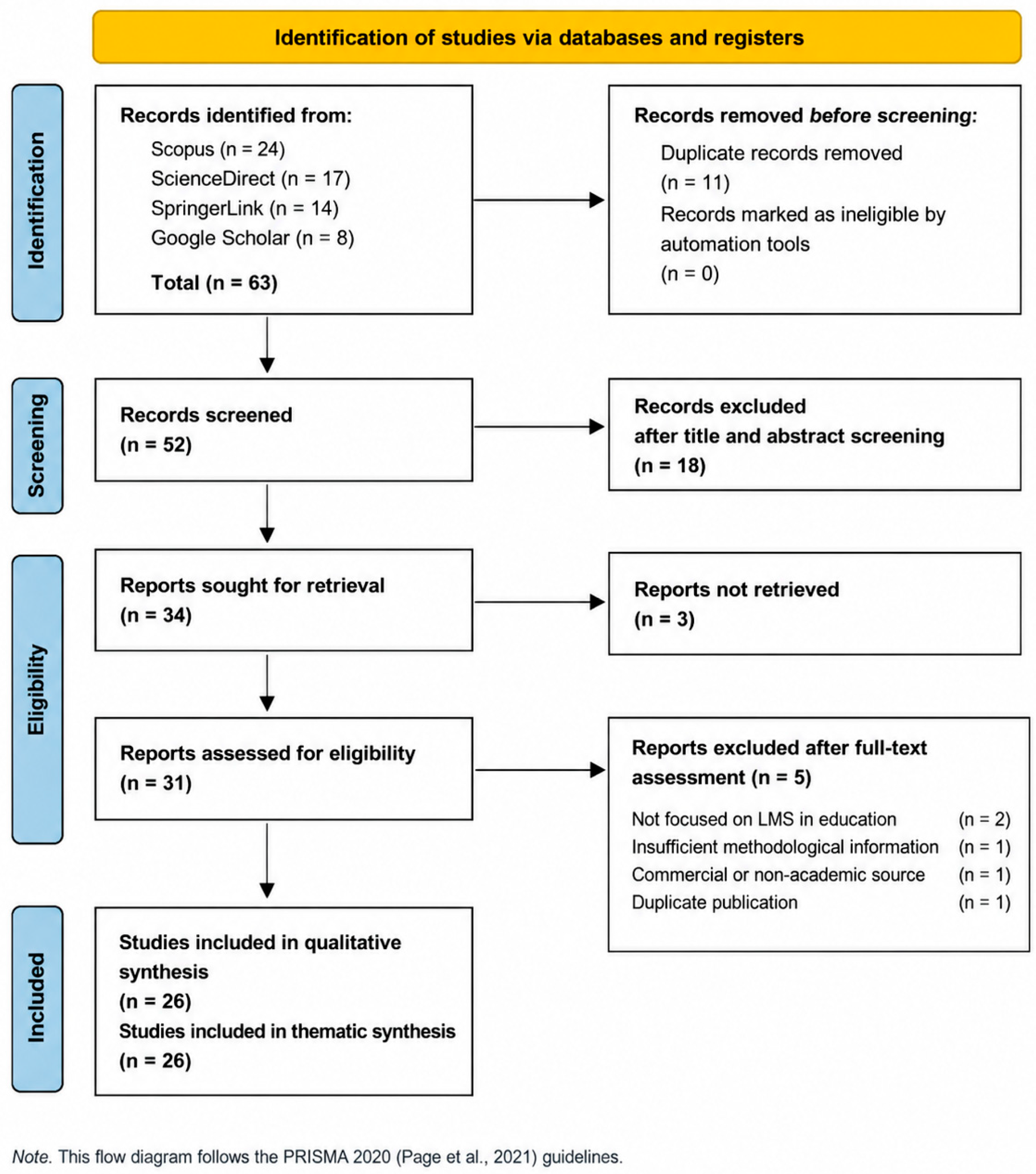
The initial database search identified 63 potentially relevant publications. After duplicate removal and title/abstract screening, studies not directly related to the research objectives were excluded. The remaining articles underwent full-text assessment according to the predefined eligibility criteria. Finally, 26 studies were included in the qualitative synthesis. The study selection process is summarized according to the PRISMA framework (Figure 1).
Figure 1.
PRISMA 2020 Flow Diagram of the Study Selection Process.
3.4. Data Extraction and Synthesis
Data extraction was performed using a structured review protocol. For each study, the following information was recorded:
- publication year;
- research design;
- educational context;
- technological innovation investigated;
- major findings;
- reported educational or organizational outcomes.
Following data extraction, a thematic synthesis was conducted. The studies were grouped into major thematic categories including:
- Artificial Intelligence;
- Learning Analytics;
- Gamification;
- Mobile Learning;
- Institutional Support;
- Technology Acceptance;
- Digital Skills and Organizational Readiness.
Rather than performing a meta-analysis, the study adopted a qualitative evidence synthesis approach to identify recurring patterns, common findings, and research gaps across the reviewed literature. To ensure consistency during the thematic synthesis, a structured coding scheme was developed. The unit of analysis was the individual study. Each article was coded according to predefined categories, including the type of technological innovation investigated, educational context, research methodology, reported educational outcomes, organizational factors, and key conclusions. During the coding process, recurring concepts and relationships were identified and grouped into broader analytical themes. This iterative coding approach facilitated the systematic comparison of findings across heterogeneous studies while preserving the contextual characteristics of each individual investigation.
3.5. Quality Assessment
To enhance methodological rigor, each study was assessed according to four quality indicators:
- clarity of research objectives;
- appropriateness of research methodology;
- transparency of data collection and analysis;
- relevance to the objectives of the present review.
Only studies meeting acceptable methodological standards were retained in the final synthesis (Table 1).
Table 1.
Major Technological Themes Identified through the Systematic Literature Review.
4. Results
The systematic literature review identified 26 eligible studies for inclusion in the final qualitative synthesis. To ensure complete transparency and traceability of the evidence base, Table 2 reports all 26 studies included in the synthesis rather than a representative subset. The included studies address a range of themes related to LMS innovation and implementation, including artificial intelligence, learning analytics, adaptive learning, gamification, mobile learning, technology acceptance, institutional readiness, and organizational support. Each of the 26 included studies is also included in the reference list, while Supplementary Table S1 provides an extended study-level description of the evidence base.
4.1. Overall Synthesis of the Reviewed Studies
The thematic synthesis demonstrated that recent LMS research has gradually shifted from technology-centered approaches toward integrated socio-technical perspectives. Earlier studies primarily examined individual technological features, whereas more recent research increasingly investigates the interaction between technological innovation, organizational readiness, digital competence, and user acceptance.
Across the reviewed studies, artificial intelligence and learning analytics emerged as the most frequently investigated technological innovations. Gamification, adaptive learning, and mobile learning were also identified as important dimensions of contemporary digital learning environments. At the organizational level, institutional support, leadership commitment, staff training, and perceived usefulness consistently appeared as key determinants of successful LMS implementation.
Consideration of the complete evidence base reveals several interconnected thematic patterns. Studies addressing learning analytics emphasize prediction, feedback, learner monitoring, self-regulated learning, and data-informed educational intervention [4,5,8,9,10,11,13,26]. Research focusing on artificial intelligence and intelligent or adaptive learning environments highlights opportunities for personalization and learner support [3,7], while gamification research identifies engagement and motivation as important but design-dependent outcomes [16]. A further cluster of studies demonstrates that LMS adoption and sustained use are associated with facilitating conditions, perceived usefulness, satisfaction, behavioral intention, and user preferences [14,19,20,21,22,23,24]. Finally, evidence concerning LMS implementation and institutional conditions indicates that infrastructure, organizational readiness, policy, diffusion processes, training, and stakeholder perspectives remain important for sustainable LMS use [1,12,15,17,18]. Studies of blended learning, mobile learning, and LMS functionality further demonstrate the importance of integrating technological capabilities with educational design and institutional context [2,6,25]. Taken together, the complete set of 26 studies indicates that LMS effectiveness emerges from the interaction between technological capabilities, pedagogical design, user acceptance, and institutional capacity rather than from technological innovation alone.
Table 2.
Characteristics of the 26 Studies Included in the Qualitative Synthesis.
Table 2 reveals several interconnected patterns across the reviewed evidence. Artificial intelligence and adaptive learning primarily emphasize personalization, automated feedback, and learner support, whereas learning analytics studies focus on prediction, early identification of at-risk students, and data-informed intervention. Gamification is more strongly associated with engagement and motivation, while mobile learning emphasizes flexibility and accessibility. A second group of studies highlights organizational and human factors, including institutional support, training, digital competence, and technology acceptance. Taken together, these categories indicate that LMS effectiveness does not depend on technological functionality alone; rather, educational outcomes emerge from the interaction between technological capabilities, pedagogical practices, user readiness, and institutional conditions. This pattern provides the basis for the integrated interpretation developed in Section 5.
4.2. Perceived Usefulness and User Attitudes
Among the reviewed studies, perceived usefulness and user attitudes emerged as important determinants of LMS adoption and continued use. The evidence indicates that LMS acceptance is shaped not only by technological functionality but also by users’ perceptions of usefulness, satisfaction, facilitating conditions, and behavioral intention. Studies examining LMS adoption across different educational contexts consistently emphasize the importance of these user-centered factors in explaining both initial acceptance and continued system use [14,20,21,22,23,24].
4.3. Institutional Support and Organizational Readiness
Institutional and organizational factors were repeatedly identified as important conditions for successful and sustainable LMS implementation. Across the reviewed studies, organizational readiness, facilitating conditions, institutional policies, diffusion processes, and stakeholder support emerged as factors influencing LMS adoption and continued use. The evidence suggests that technological capabilities alone are insufficient; effective implementation also depends on the institutional environment in which LMS technologies are introduced and sustained [1,12,14,15,17,18].
4.4. Emerging Technologies Supporting LMS Innovation
The reviewed literature consistently highlighted the contribution of emerging digital technologies to improving educational effectiveness. Artificial intelligence, adaptive learning systems, learning analytics, and gamification collectively support personalization, learner engagement, timely feedback, and data-informed educational decision-making. The integration of emerging technologies, including AI-supported personalization, learning analytics, and gamification, also emerged as an important dimension of contemporary digital learning environments. AI-supported approaches can facilitate personalized and self-regulated learning [3,7], while gamification provides design mechanisms aimed at strengthening learner engagement and motivation [16]. Learning analytics further contributes to this transformation by enabling learner monitoring, feedback, and data-informed educational interventions [4,5]. Together, these developments illustrate how technological innovation can extend LMS functionality beyond conventional content delivery toward more adaptive and learner-centered digital learning environments.
Collectively, the reviewed studies indicate that successful LMS implementation depends on the interaction between technological innovation and organizational readiness. Although the individual studies employed different research designs and statistical approaches, their findings consistently support the importance of perceived usefulness, institutional support, user training, and emerging digital technologies in promoting effective distance education.
Taken together, the evidence suggests that emerging LMS technologies should not be interpreted as isolated innovations but as complementary components of increasingly integrated digital learning environments. Artificial intelligence and adaptive systems primarily support personalization and automated feedback, whereas learning analytics provide the data infrastructure required for prediction, monitoring, and timely intervention. Gamification contributes more directly to motivation and engagement, while mobile technologies extend flexibility and continuity of access. Importantly, the reviewed studies indicate that these technological benefits are conditional rather than automatic. Their educational value depends on appropriate pedagogical integration, users’ digital competences, institutional support, and the capacity of organizations to translate technological functionality into sustainable learning practices. The emerging pattern therefore shifts attention from the question of which technology is most effective to how combinations of technologies can be implemented within organizational environments capable of supporting their effective use. This finding also reinforces the conceptual relationship between LMS innovation, digital skills development, and organizational resilience examined in the following Section 5.
5. Discussion
The findings of this systematic literature review demonstrate that technological innovation alone does not guarantee successful Learning Management System (LMS) implementation. Rather, the reviewed evidence indicates that educational effectiveness emerges from the interaction between technological capabilities and organizational conditions. Across the analyzed studies, artificial intelligence, learning analytics, gamification, and mobile learning were associated with enhanced learner engagement, personalization, and flexibility.
However, these technological innovations achieved their greatest impact when supported by institutional readiness, leadership commitment, user training, and positive technology acceptance.
The synthesized evidence suggests that LMS implementation should be understood as a socio-technical process in which technology, human factors, and organizational support operate simultaneously. This integrated perspective extends previous research by highlighting that digital transformation in education depends not only on technological innovation but also on the organizational capacity to successfully adopt and sustain these innovations.
The findings reinforce the importance of user perceptions and organizational conditions in explaining LMS adoption and continued use. Across the reviewed studies, perceived usefulness, satisfaction, facilitating conditions, and behavioral intention emerge as important user-level determinants of technology acceptance [14,20,21,22,23,24]. At the organizational level, institutional readiness, governance, facilitating conditions, and stakeholder support further shape the capacity of institutions to implement and sustain LMS technologies effectively [1,12,15,17,18]. These findings indicate that successful LMS implementation depends on the interaction between technological functionality, user acceptance, and organizational readiness.
These findings indicate that organizational readiness is a critical condition alongside technological infrastructure for effective LMS implementation. This realization shifts the focus back to the human and organizational side of digital transformation. User readiness, digital skills development, and the overall psychological acceptance of AI-supported learning platforms play a decisive role in actual system performance. Therefore, institutional support must go beyond deploying software; it requires a systematic approach to professional development, continuous user training, and fostering an organizational culture that embraces digital adaptability.
The reviewed evidence indicates that emerging technologies such as artificial intelligence, learning analytics, and gamification are increasingly associated with more personalized, adaptive, and data-informed learning environments. AI-supported approaches can facilitate personalized and self-regulated learning [3,7], while learning analytics can support learner monitoring, feedback, and evidence-informed intervention [4,5]. Gamification also emerges as a relevant design approach for supporting learner engagement and motivation in e-learning environments [16].
From a broader organizational perspective, these findings also support the objectives of the present Special Issue by demonstrating that innovative LMS platforms contribute to the development of digital skills, continuous professional learning, and institutional adaptability. Adaptive learning environments encourage learners and educators to continuously develop digital competences, while learning analytics provide evidence-based decision support that strengthens institutional responsiveness during periods of educational and technological change.
These findings are consistent with the evidence synthesized in the present review, which indicates that the educational value of LMS innovation is shaped by both learner-level and institutional conditions. Learning analytics can support learner monitoring, personalized feedback, and data-informed educational decision-making [4,5,8,9,10,11]. At the same time, LMS adoption and sustained use depend on facilitating conditions, institutional readiness, governance, and stakeholder support [12,14,15,17,18]. Taken together, these findings demonstrate that technological innovation generates educational value most effectively when it is accompanied by appropriate organizational and institutional conditions.
The synthesis also indicates that the contribution of LMS innovation to organizational resilience is indirect rather than automatic. Technologies such as AI, adaptive learning, and learning analytics can strengthen responsiveness by enabling personalized support, continuous monitoring, and data-informed intervention, but these capabilities generate educational value only when institutions possess the digital competences, organizational support, and implementation capacity required to use them effectively. Evidence from the reviewed studies further indicates that infrastructural constraints, facilitating conditions, and institutional readiness can influence the effective and sustainable use of digital learning environments [1,12,14,15]. These findings support an integrated interpretation in which technological innovation, user acceptance, digital competence, and organizational readiness operate as mutually reinforcing dimensions of sustainable LMS implementation.
The present review contributes to the existing literature in three important ways:
- It systematically synthesizes recent evidence regarding technological innovations in Learning Management Systems.
- It demonstrates that technological innovation and organizational readiness should be considered complementary dimensions of successful LMS implementation.
- It proposes an integrated conceptual perspective linking technological innovation, institutional support, technology acceptance, digital skills development, and organizational resilience.
Overall, the synthesized findings suggest that future LMS development should move beyond isolated technological improvements toward integrated educational ecosystems that combine advanced digital technologies with effective organizational strategies, leadership support, and continuous digital competence development.
Viewed across the complete set of 26 included studies, the evidence does not support a technology-deterministic interpretation of LMS innovation. Learning analytics can facilitate prediction, feedback, learner monitoring, and data-informed support, but their educational value depends on pedagogical integration and actionable design [4,5,8,9,10,11,13,26]. AI-supported and intelligent learning environments similarly offer opportunities for personalization and self-regulated learning [3,7], while gamification and mobile learning extend the possibilities for engagement and flexible participation [6,16]. At the same time, studies of LMS adoption and implementation consistently demonstrate that facilitating conditions, perceived usefulness, user preferences, satisfaction, training, institutional policies, organizational readiness, and stakeholder involvement influence whether technological opportunities translate into sustained educational practice [1,12,14,15,17,18,19,20,21,22,23,24]. Evidence concerning blended-learning adoption and LMS functionality further reinforces the importance of aligning technological capabilities with educational design and institutional context [2,25]. Taken together, the complete evidence base supports the central interpretation of this review: effective LMS innovation results from the interaction of technological capability, pedagogical design, user acceptance, and organizational capacity.
6. Conclusions
This study systematically reviewed recent research on technological innovations in Learning Management Systems (LMS) and examined how these innovations influence distance education from both technological and organizational perspectives. The synthesized evidence demonstrates that successful LMS implementation depends not only on advanced digital technologies but also on institutional readiness, leadership support, user acceptance, and continuous digital skills development.
The findings of the reviewed studies consistently indicate that perceived usefulness, organizational support, staff training, and emerging digital technologies constitute the principal factors influencing successful LMS adoption.
The findings extend the current understanding of LMS development by highlighting how emerging technological trends, including AI-supported personalization, adaptive learning, and gamification, are reshaping digital learning experiences. The integration of such innovations can support more adaptive and learner-centered digital learning environments, particularly through AI-enabled personalization, intelligent learner support, gamification, and data-informed feedback [3,4,7,16].
The practical implications of this review extend to multiple stakeholder groups. Educational institutions may use these findings to support strategic digital transformation initiatives, while policymakers can better understand the organizational conditions required for effective LMS implementation. Likewise, LMS developers may benefit from integrating user-centered design, adaptive technologies, and learning analytics into future platform development.
Nevertheless, the study is not without its limitations. The research was based on a synthesis of existing literature and did not include primary data collection, such as surveys or interviews, which could have added empirical depth. In addition, the rapidly evolving nature of educational technologies means that trends identified today may shift quickly, especially as artificial intelligence and machine learning models continue to develop.
Future research could build on this work by conducting empirical studies with end-users, such as instructors and students, to validate the identified factors in real-world educational settings. Additionally, longitudinal research could help evaluate the sustained impact of innovations like gamification and AI-driven recommendations on learner success and retention. Comparative studies across different educational systems or cultural contexts may also yield insights into how institutional and societal factors influence LMS adoption globally. Future systematic reviews may also examine how specific combinations of LMS technologies interact with organizational culture, digital leadership, and institutional resilience across different educational contexts. Comparative international studies would further strengthen the evidence base for strategic LMS implementation.
In conclusion, this systematic literature review demonstrates that technological innovation alone is insufficient to ensure successful LMS implementation. Sustainable educational transformation requires the integration of advanced digital technologies with organizational readiness, leadership support, user acceptance, and continuous digital competence development. By synthesizing recent evidence, this study provides a conceptual perspective that may assist researchers, educational leaders, and policymakers in designing more effective and resilient digital learning environments.
Supplementary Materials
The following supporting information can be downloaded at: https://www.mdpi.com/article/10.3390/merits6030024/s1, Table S1: Complete Characteristics of the 26 Studies Included in the Systematic Synthesis.
Funding
This research received no external funding.
Institutional Review Board Statement
Not applicable.
Informed Consent Statement
Not applicable.
Data Availability Statement
No new data were created or analyzed in this study. Data sharing is not applicable to this article.
Conflicts of Interest
The author declares no conflicts of interest.
References
- Mohammadi, M.K.; Mohibbi, A.A.; Hedayati, M.H. Investigating the challenges and factors influencing the use of the learning management system during the COVID-19 pandemic in Afghanistan. Educ. Inf. Technol. 2021, 26, 5165–5198. [Google Scholar] [CrossRef] [Scilit] [PubMed]
- Anthony, B., Jr.; Kamaludin, A.; Romli, A.; Raffei, A.F.M.; Phon, D.N.A.E.; Abdullah, A.; Ming, G.L. Blended Learning Adoption and Implementation in Higher Education: A Theoretical and Systematic Review. Technol. Knowl. Learn. 2022, 27, 531–578. [Google Scholar] [CrossRef] [Scilit]
- Jin, S.H.; Im, K.; Yoo, M.; Roll, I.; Seo, K. Supporting students’ self-regulated learning in online learning using artificial intelligence applications. Int. J. Educ. Technol. High. Educ. 2023, 20, 37. [Google Scholar] [CrossRef] [Scilit]
- Paulsen, L.; Lindsay, E. Learning analytics dashboards are increasingly becoming about learning and not just analytics—A systematic review. Educ. Inf. Technol. 2024, 29, 14279–14308. [Google Scholar] [CrossRef] [Scilit]
- Susnjak, T.; Ramaswami, G.S.; Mathrani, A. Learning analytics dashboard: A tool for providing actionable insights to learners. Int. J. Educ. Technol. High. Educ. 2022, 19, 12. [Google Scholar] [CrossRef] [Scilit] [PubMed]
- Rangel-de Lazaro, G.; Duart, J.M. Moving Learning: A Systematic Review of Mobile Learning Applications for Online Higher Education. J. New Approaches Educ. Res. 2023, 12, 198–224. [Google Scholar] [CrossRef] [Scilit]
- Ilić, M.; Mikić, V.; Kopanja, L.; Vesin, B. Intelligent techniques in e-learning: A literature review. Artif. Intell. Rev. 2023, 56, 14907–14953. [Google Scholar] [CrossRef] [Scilit]
- Ifenthaler, D.; Yau, J.Y.-K. Utilising learning analytics to support study success in higher education: A systematic review. Educ. Technol. Res. Dev. 2020, 68, 1961–1990. [Google Scholar] [CrossRef] [Scilit]
- Guzmán-Valenzuela, C.; Gómez-González, C.; Tagle, A.R.-M.; Lorca-Vyhmeister, A. Learning analytics in higher education: A preponderance of analytics but very little learning? Int. J. Educ. Technol. High. Educ. 2021, 18, 23. [Google Scholar] [CrossRef] [Scilit] [PubMed]
- Rets, I.; Herodotou, C.; Bayer, V.; Hlosta, M.; Rienties, B. Exploring critical factors of the perceived usefulness of a learning analytics dashboard for distance university students. Int. J. Educ. Technol. High. Educ. 2021, 18, 46. [Google Scholar] [CrossRef] [Scilit]
- Kaliisa, R.; Dolonen, J.A. CADA: A teacher-facing learning analytics dashboard to foster teachers’ awareness of students’ participation and discourse patterns in online discussions. Technol. Knowl. Learn. 2023, 28, 937–958. [Google Scholar] [CrossRef] [Scilit]
- Turnbull, D.; Chugh, R.; Luck, J. An Overview of the Common Elements of Learning Management System Policies in Higher Education Institutions. TechTrends 2022, 66, 855–867. [Google Scholar] [CrossRef] [Scilit] [PubMed]
- Hellings, J.; Haelermans, C. The effect of providing learning analytics on student behaviour and performance in programming: A randomised controlled experiment. High. Educ. 2022, 83, 1–18. [Google Scholar] [CrossRef] [Scilit]
- Bervell, B.; Arkorful, V. LMS-enabled blended learning utilization in distance tertiary education: Establishing the relationships among facilitating conditions, voluntariness of use and use behaviour. Int. J. Educ. Technol. High. Educ. 2020, 17, 6. [Google Scholar] [CrossRef] [Scilit]
- Alduraywish, Y.; Patsavellas, J.; Salonitis, K. Critical success factors for improving learning management systems diffusion in KSA HEIs: An ISM approach. Educ. Inf. Technol. 2022, 27, 1105–1131. [Google Scholar] [CrossRef] [Scilit]
- Khaldi, A.; Bouzidi, R.; Nader, F. Gamification of e-learning in higher education: A systematic literature review. Smart Learn. Environ. 2023, 10, 10. [Google Scholar] [CrossRef] [Scilit] [PubMed]
- Boland, B. Social capital and the diffusion of learning management systems: A case study. J. Innov. Entrep. 2020, 9, 27. [Google Scholar] [CrossRef] [Scilit] [PubMed]
- Simon, P.D.; Jiang, J.; Fryer, L.K.; King, R.B.; Frondozo, C.E. An Assessment of Learning Management System Use in Higher Education: Perspectives from a Comprehensive Sample of Teachers and Students. Technol. Knowl. Learn. 2025, 30, 741–767. [Google Scholar] [CrossRef] [Scilit]
- Buabeng-Andoh, C. Investigating student–teachers’ continuous intention to use mobile learning management system: The technology acceptance model and expectation confirmatory model. Discov. Educ. 2025, 4, 76. [Google Scholar] [CrossRef] [Scilit]
- Tinmaz, H.; Lee, J.H. An analysis of users’ preferences on learning management systems: A case on German versus Spanish students. Smart Learn. Environ. 2020, 7, 30. [Google Scholar] [CrossRef] [Scilit]
- Alzahrani, L.; Seth, K.P. Factors influencing students’ satisfaction with continuous use of learning management systems during the COVID-19 pandemic: An empirical study. Educ. Inf. Technol. 2021, 26, 6787–6805. [Google Scholar] [CrossRef] [Scilit] [PubMed]
- Lavidas, K.; Komis, V.; Achriani, A. Explaining faculty members’ behavioral intention to use learning management systems. J. Comput. Educ. 2022, 9, 707–725. [Google Scholar] [CrossRef] [Scilit]
- Lehmann, T.; Blumschein, P.; Seel, N.M. Accept it or forget it: Mandatory digital learning and technology acceptance in higher education. J. Comput. Educ. 2023, 10, 797–817. [Google Scholar] [CrossRef] [Scilit]
- Mella-Norambuena, J.; Chiappe, A.; Badilla-Quintana, M.G. Theoretical and empirical models underlying the teaching use of LMS platforms in higher education: A systematic review. J. Comput. Educ. 2025, 12, 997–1023. [Google Scholar] [CrossRef] [Scilit]
- Sanchez, L.; Penarreta, J.; Poma, X.S. Learning management systems for higher education: A brief comparison. Discov. Educ. 2024, 3, 58. [Google Scholar] [CrossRef] [Scilit]
- Vaarma, M.; Li, H. Predicting student dropouts with machine learning: An empirical study in Finnish higher education. Technol. Soc. 2024, 76, 102474. [Google Scholar] [CrossRef] [Scilit]

Disclaimer/Publisher’s Note: The statements, opinions and data contained in all publications are solely those of the individual author(s) and contributor(s) and not of MDPI and/or the editor(s). MDPI and/or the editor(s) disclaim responsibility for any injury to people or property resulting from any ideas, methods, instructions or products referred to in the content. |
© 2026 by the author. Licensee MDPI, Basel, Switzerland. This article is an open access article distributed under the terms and conditions of the Creative Commons Attribution (CC BY) license.