


Abstract
Carbon nanofillers have become a research hotspot in high-performance polymer composites, yet the correlation between filler dimensionality and macroscopic properties remains to be systematically elucidated. This review classifies carbon nanofillers into zero-dimensional (fullerenes, nanodiamonds), one-dimensional (carbon nanotubes, nanofibers), two-dimensional (graphene, nanoplatelets), and three-dimensional (assembled carbon black aggregates, graphene foams, and CNT sponges, whose 0D/1D/2D building blocks are specified where relevant) categories and compares their effects on electrical, mechanical, and thermal properties. The findings reveal that dimensionality significantly influences performance through three important pathways, namely percolation network efficiency, interfacial stress transfer, and thermal transport mechanisms including interfacial thermal resistance and phonon scattering. Zero-dimensional fillers excel in wear resistance, one-dimensional fillers impart optimal impact toughness with high aspect ratio, two-dimensional fillers provide the best tensile strength and modulus enhancement with ultra-high specific surface area, and three-dimensional fillers establish long-range continuous reinforcing networks with interconnected porous structures at low loadings. This review also elucidates the synergistic effects of carbon nanofillers with different dimensionalities, demonstrating that judicious filler combinations can break through the performance ceiling of single-filler systems, and three fundamental synergistic mechanisms (network bridging, network filling, and interlayer intercalation/exfoliation) are identified. This review provides a systematic theoretical framework and experimental basis for filler selection and structural design of high-performance polymer composites.
1. Introduction
Carbon nanofillers, including fullerenes, carbon nanotubes, graphene, and their derivatives, have fundamentally reshaped the research landscape and industrial practice of polymer composites over the past three decades [1]. With exceptional mechanical properties (Young’s modulus of monolayer graphene ~1 TPa, intrinsic tensile strength ~130 GPa) [2], high electrical conductivity (carbon nanotubes ~104 S/cm), and outstanding thermal conductivity (graphene ~5000 W/m·K) [3], these materials are now widely recognized as ideal fillers for polymer reinforcement, delivering substantial performance gains at remarkably low loadings (typically below 5 wt.%).
The so-called “nano-effect” originates from two key features: extremely high specific surface area (theoretical value of monolayer graphene ~2600 m2/g) and unique geometric dimensionality [4,5]. These characteristics endow carbon nanofillers with efficient stress transfer, superior conductive network formation, and effective thermal pathways, which are far beyond those of conventional micro-scale fillers. Yet the structural diversity of carbon nanomaterials, such as zero-dimensional (0D) spherical fullerenes, one-dimensional (1D) tubular carbon nanotubes, two-dimensional (2D) planar graphene, and three-dimensional (3D) interconnected networks, presents both abundant choices and serious challenges for rational composite design [4,5].
Considerable research efforts have been devoted to carbon nanofiller/polymer composite systems, covering a wide range of polymer matrices (thermoplastic resins, thermosetting resins, and elastomers) [6,7,8,9] and application scenarios (structural reinforcement, electromagnetic interference shielding, sensing, and thermal management) [10,11,12,13]. However, a unified understanding of how filler dimensionality systematically governs composite performance is still lacking. Several key questions persist: Why do one-dimensional carbon nanotubes typically exhibit lower percolation thresholds than two-dimensional graphene, despite graphene’s higher intrinsic conductivity? Under what conditions do two-dimensional fillers outperform one-dimensional counterparts in mechanical reinforcement? How do three-dimensional fillers achieve such dramatic property improvements at low loadings? And how can the rational combination of different dimensional fillers produce synergistic enhancements?
This review aims to establish a dimensionality–property framework through systematic comparison of 0D, 1D, 2D, and 3D carbon nanofillers in polymer composites, clarifying the distinct roles each dimensionality plays in determining electrical, mechanical, and thermal performance. Particular emphasis is placed on synergistic reinforcement effects arising from multi-dimensional filler combinations, where judiciously blending different dimensional fillers yields performance gains beyond what any single filler system can achieve. This framework is expected to provide systematic guidance for the rational selection of carbon nanofillers and the structural design of high-performance polymer composites.
2. Classification and Structural Characteristics of Carbon Nanofillers
2.1. Classification System Based on Geometric Dimensionality
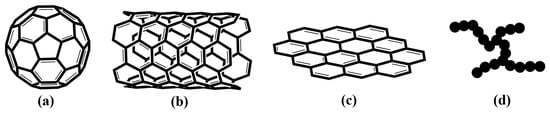
Carbon nanofillers can be divided into four categories according to their geometric dimensionality (Figure 1) [14]:
Figure 1.
Structure of fullerene (a), carbon nanotube (b), graphene (c), and aggregate carbon black (d).
Zero-dimensional (0D) fillers mainly include fullerenes (C60), primary carbon black (PCB), and nanodiamonds (NDs) [15]. These fillers exhibit spherical or spheroidal particle morphology with an aspect ratio close to unity and isotropic properties. Fullerenes are closed-cage molecules composed of 12 pentagonal and 20 hexagonal rings; nanodiamonds possess a tetrahedral lattice structure of diamond-phase sp3-hybridized carbon, with particle sizes typically ranging from 2 to 10 nm.
One-dimensional (1D) fillers mainly include carbon nanotubes (CNTs) and carbon nanofibers (CNFs) [16]. Carbon nanotubes can be viewed as tubular structures formed by rolling graphene sheets along specific directions, with diameters ranging from 1 to 50 nm and lengths reaching millimeters or even centimeters, typically exhibiting aspect ratios exceeding 1000. Carbon nanofibers have larger diameters (50–200 nm), with internal graphene basal planes stacked in a herringbone or parallel fashion.
Two-dimensional (2D) fillers mainly include monolayer graphene and graphene nanoplatelets (GNPs) [17]. Graphene is a single-atom-thick honeycomb lattice of sp2-hybridized carbon atoms, with a theoretical thickness of only 0.335 nm and lateral dimensions reaching tens of micrometers. Graphene nanoplatelets consist of 1–10 stacked graphene layers, with surface-to-thickness ratios (lateral dimension to thickness) typically exceeding 1000.
Three-dimensional (3D) fillers mainly aggregate carbon black (ACB) [18], graphene foams [19], and carbon nanotube sponges [20]. These fillers are assembled from low-dimensional building blocks (0D, 1D, or 2D) into interconnected networks featuring hierarchical pore structures. Their structural characteristics include high porosity, large specific surface area, continuous electrically and thermally conductive skeletons, and excellent mechanical resilience.
It should be emphasized that a clear distinction must be made between intrinsic filler dimensionality and assembled network dimensionality. Intrinsic dimensionality refers to the geometry of an individual building block: 0D for spherical fullerenes, nanodiamonds, and primary carbon black particles; 1D for individual carbon nanotubes and nanofibers; and 2D for individual graphene sheets and nanoplatelets. Assembled network dimensionality, by contrast, refers to the effective dimensionality of the interconnected structure formed by these building blocks in the composite. Graphene foams and CNT sponges are assembled from 2D graphene sheets and 1D CNTs, respectively, yet they form 3D interconnected networks whose performance depends not only on the nominal “3D” structure but also on the topology, porosity, and connectivity of the pre-constructed network. Similarly, carbon black exhibits a hierarchical structure: primary particles (PCB) are 0D, whereas their fused aggregates (ACB) constitute 3D networks. Throughout this review, the dimensionality assignment is stated explicitly for each filler and property section, and the dimensionality–structure–property relationships are discussed with reference to both the intrinsic building block and the assembled network level.
2.2. Structural Parameters and Properties
The key structural parameters of carbon nanofillers with different dimensionalities and their influence pathways on composite performance are summarized in Table 1.
Table 1.
Comparison of structural parameters of carbon nanofillers with different dimensionalities.
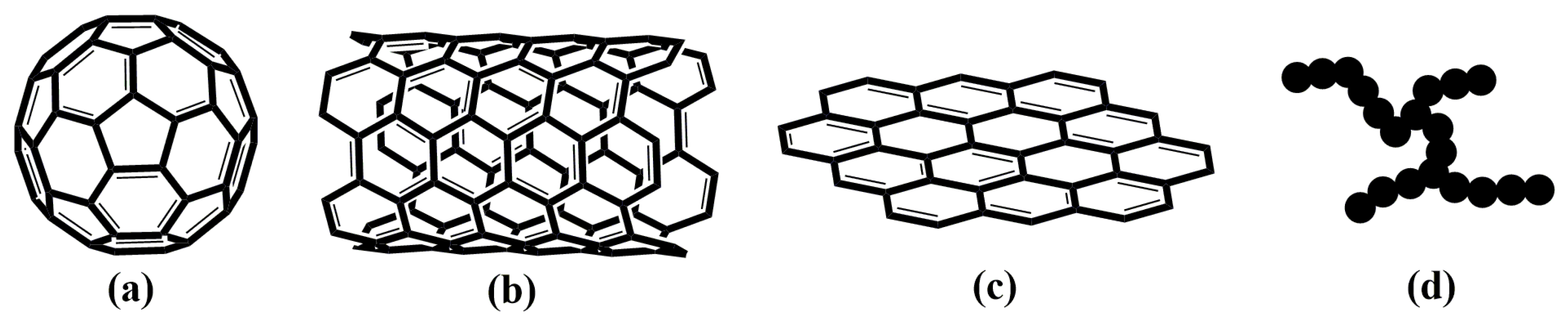
As shown in Table 1, the contact mode and network connectivity determined by dimensionality plays a key role in determining the efficiency of filler network formation and load transfer capability. Zero-dimensional fillers can only form point–point contacts, which exhibit the highest contact resistance and the lowest network construction efficiency. One-dimensional fillers form line–line contacts, with each intersection offering multi-directional connection orientations that facilitate the construction of three-dimensional interconnected networks. Two-dimensional fillers, though capable of forming face–face contacts, are prone to stacking and aggregation due to strong van der Waals forces between layers. Three-dimensional fillers, by virtue of their integrated interconnected network structure, already possess complete electrically and thermally conductive skeletons in the preform state, effectively circumventing the dispersion challenges and achieving continuous pathways with bulk penetration. Representative TEM images of carbon nanofillers with different dimensions are shown in Figure 2 [14].
Figure 2.
TEM images of fullerene (a), CNTs (b), graphene (c), and ACB aggregates (d) [14].
It should be emphasized that dimensionality is closely coupled with other structural parameters, including aspect ratio, lateral size, orientation, dispersion state, surface functionalization, interfacial interactions, and network topology. Dimensionality alone cannot fully determine composite performance. For example, graphene’s effective aspect ratio can be dramatically reduced by stacking, wrinkling, and agglomeration during processing, causing its behavior to deviate from ideal 2D predictions. Conversely, surface functionalization can improve dispersion and interfacial bonding while simultaneously introducing defects that reduce intrinsic conductivity. Therefore, dimensionality should be regarded as one important structural descriptor among several, and its effects must be interpreted in conjunction with the specific structural and processing parameters of each system.
3. Carbon Nanofiller Dimensional Effects on Electrical Properties
3.1. Percolation Theory and Its Dimension Dependence
The electrical conductivity of carbon nanofiller/polymer composites typically follows the classical percolation theory (Equation (1)) [29,30]:
where σ is the electrical conductivity of the composite, σ0 is a proportionality constant related to the intrinsic conductivity of the filler, ϕ is the filler volume fraction, ϕc is the percolation threshold, and t is the critical exponent that reflects the dimensionality characteristics of the system [31,32]. The geometric structure of the filler determines ϕc through the excluded volume effect; fillers with higher aspect ratios occupy larger effective volumes at the same volume fraction, thus requiring lower critical concentrations to form connected networks. For three-dimensional fillers, their pre-constructed interconnected network structure is equivalent to having already completed the percolation network construction prior to filler addition, enabling the percolation threshold to be reduced to extremely low levels.
σ = σ0(ϕ − ϕc)t
3.2. Comparison of Electrical Properties of Single-Carbon Nanofiller Systems
The percolation threshold is a core parameter for evaluating the efficiency of conductive filler network construction, and its value directly reflects the regulatory effect of filler geometry dimensionality on electrical conductivity. Table 2 summarizes the percolation thresholds of single-carbon nanofillers with different dimensionalities in typical polymer matrices, along with their key influencing factors.
Table 2.
Electrical conductivity of single-carbon nanofiller/polymer composites.
Zero-dimensional fullerenes in the poly [2-methoxy-5-(2-ethyl)hexoxy-1,4-phenylenevinylene] (MEH-PPV)-conjugated polymer matrix, limited by the point–point contact nature of spherical molecules, require a filler loading as high as 40 vol.% to establish a physically connected conductive network. Their percolation threshold is far higher than that of one-dimensional carbon nanotubes and two-dimensional graphene. The combination of low intrinsic conductivity and inefficient point-contact network construction results in extremely limited conductivity enhancement effectiveness [33].
One-dimensional carbon nanotubes exhibit the lowest percolation thresholds among all categories of carbon nanofillers. In high-density polyethylene (HDPE) matrices with a segregated network structure, the percolation threshold of multi-walled carbon nanotubes (MWCNTs) can be as low as 0.15 vol.% [34]. In thermoplastic polyurethane (TPU), the percolation threshold of one-dimensional carbon nanotubes is approximately 0.088 wt.% [35]. This advantage can be attributed to the high aspect ratio of one-dimensional fillers and the efficient network connectivity conferred by their line–line contacts.
Two-dimensional graphene, despite having intrinsic conductivity comparable to or even better than that of carbon nanotubes, generally exhibits relatively high experimental percolation thresholds. In HDPE-based composites with a segregated network structure, the percolation threshold of graphene nanosheets (GNSs) is approximately 1 vol.%, nearly an order of magnitude higher than that of MWCNT composites [34]. In TPU matrices, the percolation threshold of graphene nanosheets is approximately 0.1 wt.% [35]. This result is not counterintuitive but is quantitatively consistent with classical excluded-volume theory. Balberg et al. [31] demonstrated that the excluded volume of a 1D cylinder scales as L2W, whereas that of a 2D disk scales as D3. Consequently, 1D cylinders mathematically percolate at lower volume fractions than 2D disks, and the lower experimental percolation threshold of CNTs is a direct validation of classical percolation theory.
Three-dimensional carbon nanofillers exhibit unique advantages in percolation behavior. Branched carbon nanotubes (CNTs) in TPU matrices achieve a percolation threshold as low as 0.01 wt.% [35]; three-dimensional graphene foam in epoxy requires only approximately 0.05 wt.% to achieve significant conductivity enhancement [36]. This extremely low percolation threshold originates from the pre-constructed interconnected network structure of three-dimensional fillers; the fillers exist in the matrix as complete skeletons, eliminating the need for filler–filler contact to form networks, thus enabling bulk-penetrating conductive pathways at extremely low loadings.
The systematic comparison between CNT/HDPE and GNS/HDPE composites reveals [34] that the theoretical predictions of graphene’s superior network-forming capability are not fully achieved experimentally. The main limiting factors include: (1) the strong face-to-face van der Waals interactions between graphene sheets inevitably lead to agglomeration [37]; (2) graphene undergoes irreversible wrinkling and curling deformation during mechanical processing, reducing its effective aspect ratio [38]; (3) the two-dimensional sheet geometry limits topological contact opportunities compared to one-dimensional flexible fibers [39]. In contrast, three-dimensional fillers fundamentally circumvent the above dispersion challenges through pre-constructed interconnected network architectures, representing another important direction in carbon nanofiller design [40].
These dimensional trends are further modulated by processing conditions. Solution mixing generally favors 1D and 2D fillers because the low viscosity of the solvent allows ultrasonic energy to overcome van der Waals attraction, whereas melt mixing imposes high shear that can exfoliate 2D platelets but simultaneously fragment 1D nanotubes, reducing their effective aspect ratio and raising the percolation threshold [4,34,35]. Surface functionalization offers an additional route: covalent modification improves dispersion in polar matrices but introduces defects that lower intrinsic conductivity, while non-covalent modification provides a compromise between dispersion quality and property retention [39]. For 3D fillers such as graphene foams and CNT sponges, preform impregnation avoids dispersion difficulties altogether, but the infiltration pressure and temperature must be optimized to ensure complete polymer penetration [36].
It should be noted that the studies summarized in Table 2 employ different polymer matrices, filler loadings, processing methods, and testing conditions. The percolation thresholds and conductivity values reported in this paper are therefore not directly comparable in a strict quantitative sense. The observed dimensional trends reflect the combined influence of filler dimensionality, matrix polarity and crystallinity, dispersion state, and processing-induced network morphology and should be interpreted as general tendencies rather than universal relationships.
3.3. Synergistic Conductivity Enhancement in Multi-Carbon Nanofiller Systems
The judicious combination of fillers with different dimensionalities can achieve significant synergistic enhancement in electrical conductivity through complementary network structures [41].
In a nitrile butadiene rubber (NBR) matrix, the incorporation of 15 phr GNP combined with 10 phr PCB (total filler loading of 25 phr) reduces the DC resistivity from approximately 108 Ω·cm for the single GNP system to approximately 106 Ω·cm, a reduction of two orders of magnitude [42]. The underlying microscopic mechanism is that PCB particles act as interlayer intercalating agents, penetrating between GNP layers to promote their exfoliation and dispersion, thereby forming a GNP-PCB-GNP bridging network. Field emission scanning electron microscopy (FESEM) and transmission electron microscopy (TEM) analyses have confirmed the morphological feature of PCB particles located between GNP sheets [42].
In thermoplastic natural rubber (TPNR), the combination of 0.25 wt.% graphene oxide (GNO) with 0.25 wt.% MWCNT achieves an electrical conductivity of 8.66 × 10⁻¹² S/m, significantly outperforming the 4.48 × 10⁻¹³ S/m of 0.5 wt.% GNO alone [43]. Scanning electron microscopy observations confirm that CNTs, as flexible conductive pathways, span across the gaps between GNO sheets, forming a hybrid percolation network [43].
In poly(butylene terephthalate) (PBT) nanocomposites, with a total filler loading of 6 wt.% and a CNT/ACB mass ratio of 2:1, the volume resistivity reaches as low as approximately 102 Ω·cm, a value unattainable with either single filler at the same total loading [44]. The synergistic mechanism lies in the one-dimensional CNT fibers bridging the gaps between ACB aggregates, forming a more continuous percolation conductive pathway. Thermographic imaging experiments demonstrate that this hybrid composite reaches a surface temperature of 64 °C within 120 s under a DC voltage of 12 V, exhibiting excellent Joule heating effect [44].
The fundamental mechanisms of multi-dimensional synergistic conductivity enhancement can be summarized as follows [45,46]: (1) Zero-dimensional fillers fill the microscopic voids of the network and can serve as interlayer intercalating/exfoliating agents to improve the dispersion state of two-dimensional fillers. (2) One-dimensional fillers primarily function to bridge isolated conductive regions and provide long-range connectivity. (3) Two-dimensional fillers provide large-area in-plane conductive channels for efficient electron transport. (4) Three-dimensional fillers, with their pre-constructed interconnected skeletons, provide bulk-penetrating conductive networks, achieving high conductivity at extremely low loadings [47].
4. Carbon Nanofiller Dimensional Effects on Mechanical Properties
4.1. Mechanical Enhancement Mechanisms Associated with Filler Dimensionality
The mechanical reinforcement mechanisms of carbon nanofillers are strongly influenced by filler dimensionality, although aspect ratio, interfacial bonding, dispersion state, and network structure act concurrently and can significantly modulate the resulting reinforcement efficiency [48,49]:
Zero-dimensional fullerenes, nanodiamonds, and carbon nano-onions primarily reinforce polymers by physically restricting the mobility of polymer molecular chains to increase modulus, but their enhancement in tensile strength is relatively limited [50].
One-dimensional carbon nanotubes, leveraging their exceptionally high aspect ratio and outstanding intrinsic mechanical properties (tensile strength ~150 GPa, Young’s modulus ~1 TPa), effectively dissipate fracture energy through crack bridging and pull-out effects, enabling simultaneous synergistic enhancement in both strength and toughness of the composites [51].
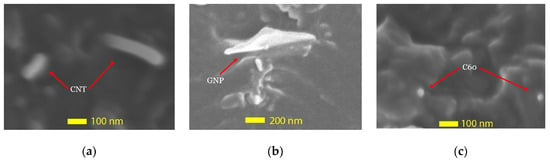
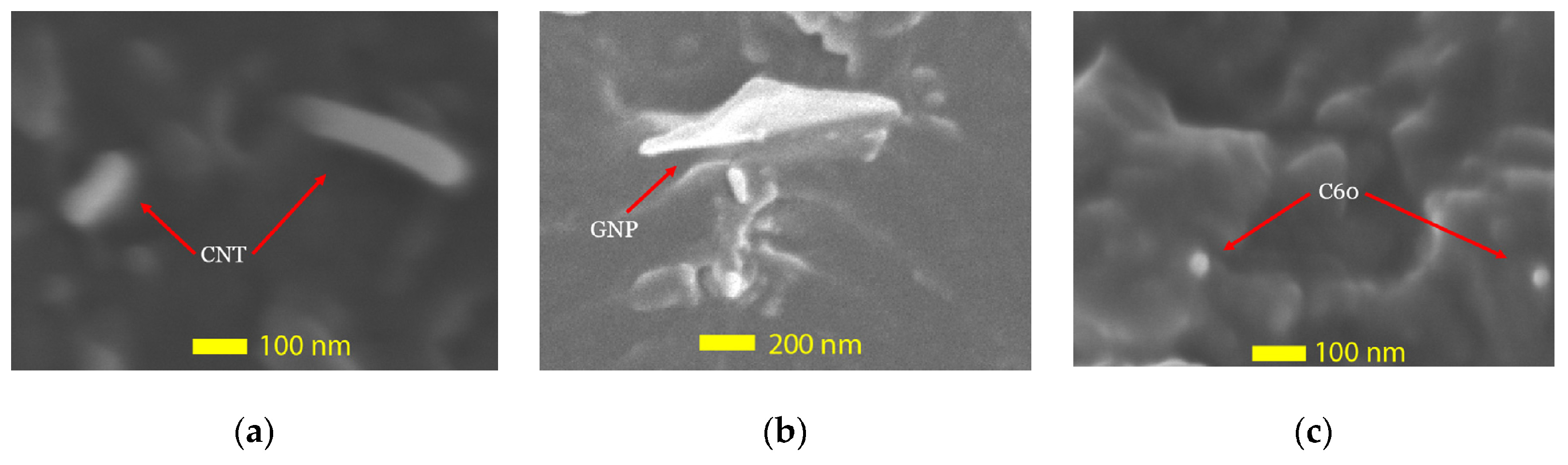
Two-dimensional graphene, with its ultra-high specific surface area, greatly increases the filler–matrix interfacial area, facilitating uniform load transfer at the interface. Its intrinsically wrinkled surface structure further enhances the mechanical interlocking effect with the polymer matrix. The wrinkled texture formed by defects on the graphene surface is beneficial for increasing contact sites with polymer molecules (Figure 3) [52].
Figure 3.
SEM images showing the interfacial bonding between nanoparticles and epoxy resin. (a) Carbon nanotubes, (b) graphene nanoplatelets, and (c) fullerene–C60 particles [52].
Three-dimensional carbon nanofillers, owing to their pre-constructed interconnected network structure, form bulk-penetrating reinforcing skeletons within the composites. Their mechanical reinforcement mechanisms include [53,54]: (1) skeletal load-bearing, the three-dimensional network skeleton itself bears part of the external load; (2) network confinement, the interconnected network imposes three-dimensional physical constraints on the polymer matrix, restricting molecular chain motion; (3) crack suppression, the porous network structure can blunt crack tips through pores, delaying crack propagation. In addition, the porous structure of three-dimensional fillers allows full infiltration of the polymer matrix, forming an interpenetrating network structure that significantly enhances interfacial load transfer efficiency. It should be emphasized that dimensionality provides the geometric basis for these mechanisms, but the actual reinforcement efficiency is jointly governed by aspect ratio, interfacial adhesion, dispersion quality, and the topology of the filler network.
4.2. Comparison of Mechanical Properties of Single-Carbon Nanofiller Systems
The effects of carbon nanofillers with different dimensionalities on the mechanical properties of polymer composites are summarized in Table 3.
Table 3.
Mechanical properties of single-carbon nanofiller/polymer composites.
4.2.1. Thermoplastic Polymer Composites
In thermoplastic resin matrices, the reinforcement effects of carbon nanofillers with different dimensionalities exhibit significant differences. Zero-dimensional fullerenes demonstrate moderate reinforcement in PEEK matrices. The addition of 0.5 wt.% fullerene enhances the tensile strength of PEEK by 12.8%, but further increasing the loading to 1 wt.% leads to property deterioration due to agglomeration [55]. Zero-dimensional carbon nano-onions exhibit excellent reinforcement efficiency in PCL matrices; 0.5 wt% functionalized carbon nano-onions enhance the tensile strength of PCL by 106% and Young‘s modulus by 75%, which is attributed to the improved filler–matrix interfacial bonding through functionalization [57]. Two-dimensional GNP exhibited dramatical reinforcement in NBR matrix; the tensile strength was improved more than 190% when 5 phr GNP was added. It is particularly noteworthy that the flexibility and interlayer sliding capability of GNP sheets enable simultaneous stress transfer and strain coordination during tensile deformation [58].
4.2.2. Thermoset Polymer Composites
In thermoset resin matrices, the mechanical reinforcement effects of fillers with different dimensionalities also exhibit significant differences. Zero-dimensional nanodiamonds in epoxy/natural fiber composites achieve tensile strength enhancements of 19–28% at 0.3 wt.% loading, excessive loading (0.5 wt.%) leads to property deterioration due to agglomeration [56]. One-dimensional carbon nanotubes in epoxy matrices achieve tensile strength enhancements of 18–35% and elastic modulus enhancements of 20–200% [51]. Three-dimensional graphene foam exhibits outstanding mechanical properties in epoxy matrices; the addition of only 0.13 wt.% enhances the flexural strength by approximately 10% and the flexural modulus by about 38% [36]. This significant reinforcement effect is attributed to the interpenetrating network structure formed by the 3D filler skeleton and the polymer matrix, which enables efficient interfacial load transfer [53].
4.2.3. Mechanical Reinforcement Mechanisms
Dimensionality, together with aspect ratio, interfacial bonding, and network structure, governs the diversity of mechanical reinforcement mechanisms. Zero-dimensional fillers (fullerenes, nanodiamonds, carbon nano-onions) enhance modulus by physically restricting molecular chain motion, but their tensile strength enhancement is highly dependent on dispersion state: fullerenes achieve 12.8% enhancement in PEEK [55], nanodiamonds achieve 19–28% in epoxy/natural fiber composites [56], and carbon nano-onions achieve 106% (tensile strength) and 75% (Young’s modulus) enhancement in PCL [57]. One-dimensional fillers achieve synergistic enhancement in both strength and toughness through crack bridging and pull-out effects, with tensile strength enhancements of 18–35% and elastic modulus enhancements of 20–200% [51]. Two-dimensional fillers provide optimal tensile strength enhancement by virtue of their ultra-large interfacial area [58]. Three-dimensional fillers achieve bulk-penetrating reinforcement networks through pre-constructed interconnected skeletons, with flexural strength and modulus enhancements of 38% and 53%, respectively [36]. Fillers of different dimensionalities have their own advantages and disadvantages in terms of tensile strength, elastic modulus, impact toughness, and elongation at break. In practical applications, the appropriate filler dimensionality should be selected according to the target performance requirements.
The mechanical property comparisons in this section are drawn from studies using different polymer matrices, filler loadings, dispersion strategies, and testing standards. These differences can substantially affect the measured reinforcement efficiency. Accordingly, the dimensional trends discussed above should be understood as reflecting the combined effects of filler dimensionality, aspect ratio, interfacial bonding, dispersion quality, and matrix characteristics, rather than as a direct and exclusive consequence of dimensionality.
4.3. Synergistic Mechanical Enhancement in Multi-Carbon Nanofiller Systems
Single-dimensional fillers often fail to simultaneously optimize multiple mechanical properties such as strength, toughness, and modulus. The judicious combination of fillers with different dimensionalities generates synergistic reinforcement through structural complementarity.
In thermoplastic natural rubber (TPNR), the combination of 0.25 wt.% graphene oxide (GNO) with 0.25 wt.% MWCNT increases the Young’s modulus by 28%, outperforming the 24% enhancement in GNO alone, demonstrating a clear synergistic stiffening effect [43]. Scanning electron microscopy observations confirm the interconnection between CNTs and GNO sheets, forming a hybrid percolation network structure.
In ethylene-propylene-diene monomer rubber (EPDM), the combination of 2 wt.% GNP with 24 wt.% PCB achieves a maximum tensile strength of approximately 20 MPa, exceeding the predictions of the simple mixture model, while maintaining excellent elongation at break [59]. The microscopic mechanisms of synergistic reinforcement include: (1) PCB particles act as interlayer intercalating agents, penetrating between GNP layers; (2) this promotes the exfoliation and dispersion of GNP, enhancing polymer–filler interfacial interactions; (3) a GNP-PCB-GNP three-dimensional network structure is formed, enabling efficient stress transfer.
5. Carbon Nanofiller Dimensional Effects on Thermal Properties
5.1. Dimensional Dependence of Thermal Conductivity
The enhancement efficiency of thermal conductivity is also profoundly influenced by filler dimensionality, yet the dimensionality ranking for thermal enhancement is distinctly different from that for electrical conductivity. The effects of carbon nanofillers with different dimensionalities on the thermal conductivity of polymer composites are summarized in Table 4.
Table 4.
Thermal conductivity of single-carbon nanofiller/polymer composites.
Zero-dimensional fillers, limited by point–point contacts and extremely high interfacial thermal resistance, exhibit the most limited thermal conductivity enhancement. In PVDF matrices, the addition of 20 wt.% fullerene shows almost no thermal conductivity improvement [60].
One-dimensional fillers exhibit moderate thermal conductivity enhancement. In PVDF matrices, 20 wt.% carbon nanotubes achieve approximately a 2-fold enhancement in thermal conductivity [60]. In TPNR, 0.5 wt.% MWCNTs achieves a thermal conductivity of 0.78 W/(m·K) at 30 °C, outperforming 0.25 W/(m·K) for GNO, demonstrating the effectiveness of carbon nanotubes’ superior network-forming capability in constructing thermal pathways [43]. Recent molecular dynamics studies have revealed the interfacial thermal transport mechanisms of 1D CNTs. Zou et al. showed that encapsulating linear carbon chains (LCCs) inside CNTs enhances CNT-CNT interfacial thermal conductance by up to 81.88% via low-frequency phonon resonance and additional heat transfer pathways, while weakening its temperature dependence [61]. Bridging two uniaxially aligned CNTs with an LCC extends the effective axial heat transfer distance from 2.4 Å to 28.2 Å, with LCC acting as a phonon redistribution modulator at short spacings and as a heat transfer path at long spacings [62]. These findings highlight that interfacial phonon coupling and axial heat transfer path extension are critical for constructing efficient thermal transport networks in CNT-based composites.
Two-dimensional fillers exhibit the highest enhancement efficiency in improving polymer thermal conductivity. In PVDF matrices, the addition of 20 wt.% graphene achieves a 10-fold enhancement in thermal conductivity from 0.189 W/(m·K) to 2.06 W/(m·K), while the same loading of carbon nanotubes achieves only approximately a 2-fold enhancement, and fullerene shows almost no enhancement [60]. The high efficiency of two-dimensional fillers in thermal enhancement is mainly attributed to [63,64]: (1) the face–face contact mode provides large-area interfacial thermal transport channels, effectively reducing Kapitza thermal resistance [65]; (2) in-plane phonon transport pathways are continuous, with intrinsic thermal conductivity as high as approximately 5000 W/m·K [66].
Three-dimensional fillers, owing to their pre-constructed interconnected network structures, exhibit unique advantages in thermal enhancement. Three-dimensional carbon nanotube sponge/polymer composites can construct continuous thermal networks at extremely low loadings. Studies show that 3D graphene foam/epoxy composites achieve significant thermal enhancement at only 0.13 wt% loading [36].
The ranking of thermal conductivity enhancement efficiency (2D > 3D ≥ 1D >> 0D) differs significantly from that of electrical conductivity (3D ≈ 1D > 2D >> 0D). The physical origins of this difference lie in [67,68]: (1) thermal transport is more sensitive to the contact area between fillers (face–face > body–body > line–line > point–point); (2) interfacial phonon scattering is the dominant factor governing thermal resistance; (3) the high in-plane thermal conductivity of graphene can only be effectively utilized when it is fully exfoliated and oriented [69]; (4) the bulk continuous network of three-dimensional fillers can effectively reduce interfacial thermal resistance at low loadings [70].
It should be emphasized that interfacial thermal resistance in polymer/carbon systems is governed by multiple factors beyond contact area. While face-to-face contact between 2D fillers increases the effective heat-transfer area, the actual interfacial thermal conductance also depends on: (1) phonon spectral matching: efficient heat transfer requires overlap between the vibrational density of states of the filler and the polymer, and poor spectral matching leads to strong phonon scattering even at large contact areas; (2) interfacial bonding: strong covalent or hydrogen-bonding interactions can enhance phonon transmission across the interface, whereas weak van der Waals interactions result in high interfacial thermal resistance; (3) polymer-chain ordering: ordered polymer chains near the filler surface can facilitate phonon transport, while disordered chains increase scattering; (4) surface functionalization: functional groups can improve interfacial bonding but may also introduce defects that scatter phonons; and (5) local interfacial structure: roughness, wrinkles, and voids at the interface can either enhance or impede heat transfer depending on their scale relative to the phonon mean free path. Therefore, the relationship between contact area and interfacial thermal resistance is more complex than a simple area argument, and dimensionality effects on thermal conductivity must be interpreted in conjunction with these interfacial factors.
From a mechanistic perspective, dimensionality governs thermal conductivity through three coupled pathways that are distinct from those governing electrical conductivity. First, interfacial thermal resistance is highly sensitive to the contact geometry: point–point contacts in 0D systems produce the highest interfacial thermal resistance, whereas face–face contacts in 2D systems and body–body contacts in 3D systems provide larger effective heat-transfer areas and lower interfacial resistance. Second, phonon spectral matching between the filler and the polymer matrix determines the efficiency of phonon transmission across the interface; poor spectral overlap leads to strong interfacial phonon scattering even when the contact area is large. Third, phonon scattering at filler–filler junctions and at the filler–matrix interface governs the mean free path of heat carriers, and dimensionality strongly affects the density and nature of these scattering sites. These three mechanisms, together with the intrinsic thermal conductivity of the filler, collectively determine the dimensionality-dependent thermal enhancement efficiency.
As with the electrical and mechanical comparisons, the thermal conductivity data summarized in Table 4 originate from different polymer matrices, filler loadings, processing routes, and measurement techniques. The ranking of dimensionalities in terms of thermal enhancement efficiency should therefore be regarded as a general trend rather than a universally valid ordering, since matrix thermal conductivity, filler orientation, interfacial thermal resistance, and dispersion state all act in conjunction with filler dimensionality.
5.2. Synergistic Thermal Conductivity Enhancement in Multi-Carbon Nanofiller Systems
Although single-dimensional fillers can enhance the thermal conductivity of polymers to a certain extent, they are often limited by their own geometric structures and struggle to construct efficient bulk thermal networks at low loadings. The judicious combination of fillers with different dimensionalities can achieve synergistic thermal conductivity enhancement through structural complementarity.
In ethylene-propylene-diene monomer rubber (EPDM), the hybrid system of 2 wt.% GNP combined with 24 wt.% PCB exhibits superior thermal conductivity compared to the control system with 48 wt.% PCB alone [59]. µ-CT three-dimensional reconstruction analysis reveals that PCB aggregates are preferentially distributed on the surface of GNP sheets, effectively shortening the thermal conduction distance between GNP layers and constructing more efficient thermal pathways [59]. The underlying physical mechanism is that PCB acts as a thermal bridge between GNP sheets, enhancing phonon transport efficiency within the filler network. This hybrid strategy achieves superior thermal conductivity to the single high-loading filler system (48 wt.% PCB) at a lower total filler loading (26 wt.%).
In high-density polyethylene (HDPE), the combination of expanded graphite (EG) and carbon nanotubes (CNTs) produces a significant synergistic thermal conductivity enhancement [71]. Studies show that EG sheets provide large-area in-plane thermal conduction channels, while CNT bridges the gaps between EG sheets, forming a continuous three-dimensional thermal network. At the same total filler loading, the EG/CNT hybrid system achieves much higher thermal conductivity than single-filler systems, demonstrating the complementary advantages of “face–face contact” and “line–face contact.”
The core mechanism of synergistic thermal conductivity enhancement in multi-dimensional filler systems lies in the functional complementarity of different dimensional fillers in constructing thermal pathways: zero-dimensional fillers fill microscopic network voids and shorten thermal conduction distances, one-dimensional fillers bridge the gaps between two-dimensional sheets, two-dimensional fillers provide large-area in-plane thermal channels, and three-dimensional fillers provide bulk-penetrating thermal networks through pre-constructed skeletons. Through judicious combination, superior thermal conductivity to single high-loading filler systems can be achieved at lower total filler loadings.
5.3. Thermal Stability
The effect of filler dimensionality on the thermal stability of polymer composites, commonly characterized by the onset decomposition temperature (T1, temperature at 5% weight loss) and the 50% decomposition temperature (T50), depends primarily on the specific surface area, aspect ratio, and network tortuosity of the filler. Zero-dimensional fillers, such as fullerenes and nanodiamonds, generally provide only modest improvements because their point–point contacts create limited diffusion barriers. In PEEK, 0.5 wt.% fullerene raised T1 by approximately 18 °C [55], while in epoxy/natural fiber composites, 0.3 wt.% nanodiamonds raised T1 by approximately 14 °C [56]. One-dimensional carbon nanotubes offer greater enhancement owing to their high aspect ratio and network-forming ability: in epoxy, 1 wt.% MWCNT increased T1 by about 35 °C, although the effect saturated above approximately 3 wt.% because of agglomeration [43]. Two-dimensional graphene exhibits the highest enhancement per unit loading, since its ultra-high specific surface area and large lateral dimensions maximize the diffusion path length; in NBR, 5 wt.% GNP increased T1 by 47 °C and T50 by 31 °C [58]. Three-dimensional network fillers, including graphene foams and ACB aggregates, combine high porosity with continuous skeletons and thus provide an effective physical barrier at relatively low loadings, though their performance depends strongly on the degree of polymer infiltration [53,54].
Carbon nanofillers synergistically enhance the thermal stability of polymers through the following three mechanisms [72,73]: (1) the tortuous path effect: two-dimensional sheets and three-dimensional network fillers retard the diffusion of heat and volatile decomposition products; (2) radical scavenging: defect sites and oxygen-containing groups on the carbon material surfaces capture and stabilize free radicals during thermal decomposition [74]; (3) physical crosslinking barrier: the filler network restricts the movement and disentanglement of polymer molecular chains at elevated temperatures [75].
In EPDM, the GNP-PCB hybrid system significantly elevates the initial decomposition temperature from 359 °C for neat EPDM to 389 °C (15 phr GNP + 10 phr PCB), while the T50 and the final decomposition temperature (Tf) are also simultaneously improved [42]. This synergistic enhancement effect reflects the more fully exfoliated structure of GNP after PCB intercalation in the hybrid system, forming a more effective physical barrier network than that of single-filler systems [76].
6. Synergistic Effect of Carbon Nanofiller Hybrid Systems
6.1. Three Basic Types of Synergistic Mechanisms
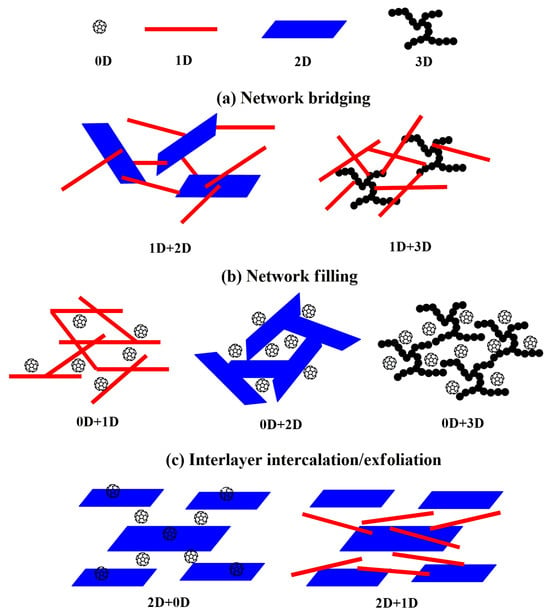
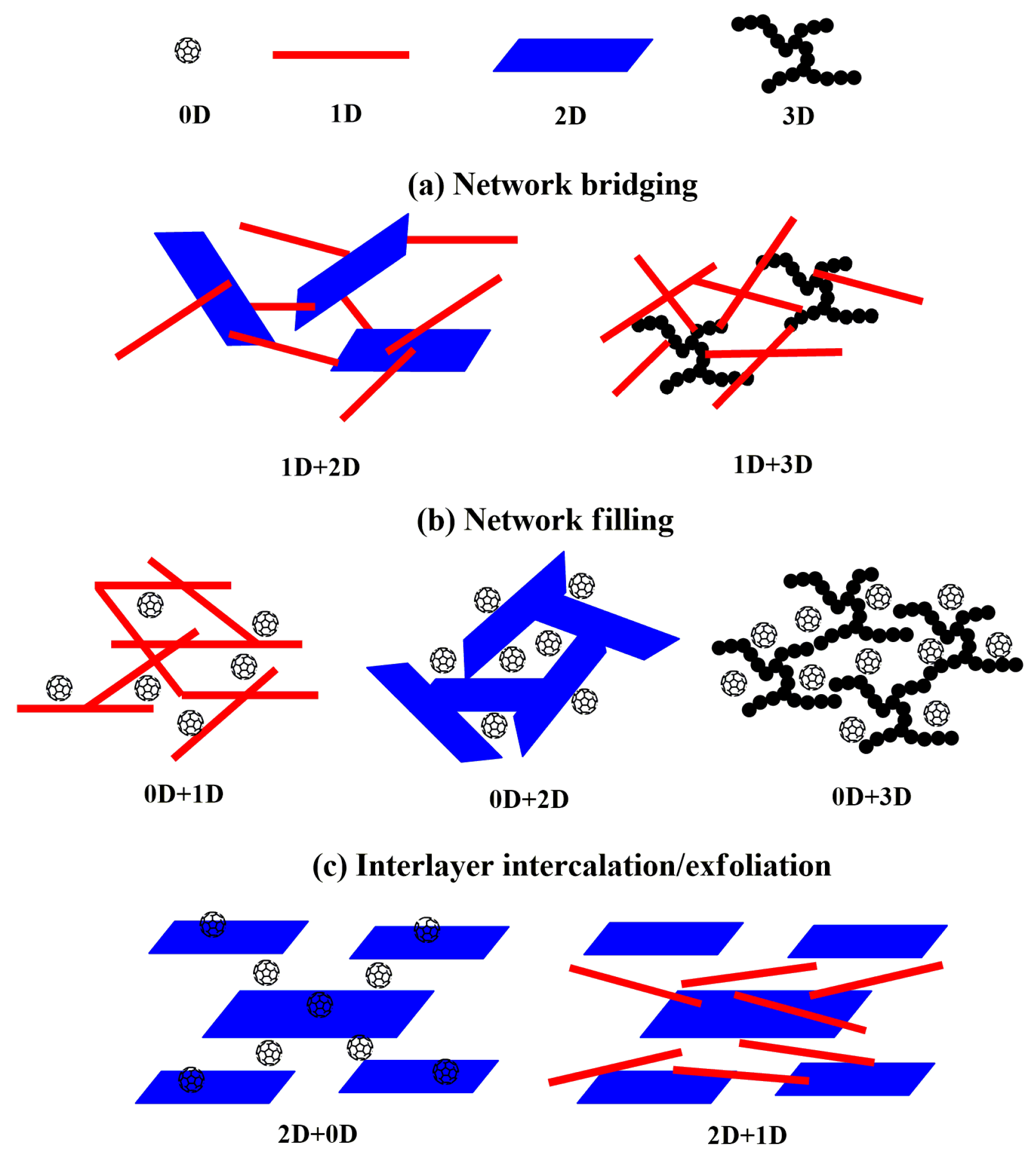
Based on systematic synthesis of experimental evidence from multiple systems, the synergistic reinforcement of hybrid-dimensional carbon nanofiller systems can be attributed to three fundamental physical mechanisms (Figure 4) [77,78]:
Figure 4.
Illustration of three synergistic reinforcement mechanisms: (a) network bridging, (b) network filling, and (c) interlayer intercalation/exfoliation.
(1) Network bridging (1D + 2D/3D): One-dimensional carbon nanotubes span across and bridge the microscopic gaps between two-dimensional GNP/GNO sheets or three-dimensional skeletons, forming continuous three-dimensional interconnected network structures [43]. Recent molecular dynamics studies provide nanoscale evidence for this bridging effect. Zou et al. showed that LCCs bridging two uniaxially aligned CNTs extend the effective axial heat transfer distance from 2.4 Å to 28.2 Å, acting as a heat transfer path at long spacings [62]. In addition, LCCs encapsulated inside CNTs optimize interfacial phonon matching and enhance CNT–CNT interfacial thermal conductance by up to 81.88% [61]. These findings confirm that 1D fillers can effectively bridge adjacent conductive fillers and regulate interfacial thermal transport, providing molecular-level support for the network bridging mechanism.
(2) Network filling (0D + 1D/2D/3D): Zero-dimensional carbon nanofillers (including PCB particles) fill the microscopic voids within one-dimensional CNT networks, two-dimensional GNP networks, or three-dimensional skeletons, increasing the effective contact density between fillers and reducing contact resistance and interfacial thermal resistance [42].
(3) Interlayer intercalation/exfoliation (2D + 0D/1D): Zero-dimensional carbon nanofillers or one-dimensional CNTs penetrate into the interlayer spaces of two-dimensional GNP under mechanical force, promoting the exfoliation of GNP layers through physical wedging effects, thereby increasing their effective specific surface area and aspect ratio [59].
6.2. Synergistic Effect of Typical Hybrid Systems
The synergistic enhancement effects of typical multi-dimensional hybrid systems are summarized in Table 5.
Table 5.
Synergistic enhancement effects of hybrid-dimensional carbon nanofillers.
6.3. Design Principles of Synergistic Hybrid Systems
Based on the above comparative analysis, several guiding principles for the design of synergistic hybrid filler systems can be summarized [80,81]:
(1) Dimensional complementarity: Combining fillers with different dimensionalities to maximize network connectivity and minimize microscopic network voids. Studies show that 1D + 2D combinations are most effective in constructing three-dimensional interconnected networks [46], while 3D + 0D combinations can achieve microscopic filling while maintaining network continuity [35].
(2) Ratio optimization: The optimal filler ratio depends on the geometric parameters and electrical properties of the specific fillers and needs to be determined through systematic experiments. Taking the PBT/CNT/CB system as an example, the optimal CNT/CB mass ratio is 2:1 [44].
(3) Processing–structure–performance correlation: Effective synergistic reinforcement requires adequate dispersion of the secondary filler rather than simple mixing. The synergistic effect of the NBR-GNP-PCB system is highly dependent on the intercalation process of PCB particles into GNP interlayers, which requires solution mixing [42]. Three-dimensional fillers typically employ preform impregnation, which can effectively avoid dispersion difficulties [36].
(4) Performance trade-off management: Different hybrid systems have different emphases across performance dimensions, GNP-PCB hybrids excel in mechanical and thermal properties, while CNT-based hybrids generally offer superior electrical conductivity. The optimal hybrid system should achieve a balance among specific application requirements [82].
7. Conclusions and Future Prospects
7.1. Main Conclusions
Through systematic comparative analysis, this review identifies the geometric dimensionality of carbon nanofillers as an important structural descriptor that significantly influences the performance spectrum of polymer composites, while acting in conjunction with other structural and processing factors. CB is classified according to its effective network dimensionality in the composite: as 3D when present as ACB aggregates and as 0D only when referring to PCB primary particles. The main conclusions can be summarized as follows:
(1) The dimensionality dependence of electrical conductivity follows the order 3D ≈ 1D > 2D >> 0D, with the physical origin lying in the superior percolation network construction efficiency conferred by the high aspect ratio of one-dimensional fillers and the pre-constructed interconnected networks of three-dimensional fillers.
(2) The dimensionality response of mechanical properties exhibits differentiated characteristics: two-dimensional fillers perform the best in tensile strength (benefiting from ultra-large interfacial area), one-dimensional fillers excel in impact toughness (benefiting from crack bridging and pull-out effects), and three-dimensional fillers provide the highest elastic modulus enhancement (benefiting from three-dimensional skeletal load-bearing effects). Zero-dimensional fillers offer limited tensile strength enhancement but contribute to wear resistance.
(3) The dimensionality dependence of thermal properties follows the order 2D > 3D ≥ 1D >> 0D, with the physical origin lying in the face–face contact mode of two-dimensional fillers, the bulk continuous network of three-dimensional fillers, and their low interfacial thermal resistance characteristics. The underlying mechanisms include interfacial thermal resistance, phonon spectral matching, and phonon scattering at filler–filler and filler–matrix interfaces, which act in conjunction with the intrinsic thermal conductivity of the filler.
(4) Multi-dimensional synergistic reinforcement: The judicious combination of fillers with different dimensionalities can break through the performance limits of single-filler systems, achieving synergistic optimization of electrical, mechanical, and thermal properties. The three fundamental synergistic mechanisms—network bridging, network filling, and interlayer intercalation/exfoliation—provide theoretical guidance for the design of hybrid systems.
The dimensionality rankings presented in this review should be understood as general trends reported in the literature, not as universal relationships. The data underlying these rankings are obtained from different polymer matrices, filler loadings, processing methods, and testing conditions, all of which can shift the observed behavior. Rigorous normalization across systems is not feasible at present because of insufficient reporting of matrix and processing parameters. The rankings therefore provide qualitative guidance for filler selection while acknowledging that matrix, loading, and processing factors act in conjunction with dimensionality.
7.2. Key Design Principles
Based on the systematic analysis of this review, the following application-oriented composite design principles are proposed:
Single filler selection: Select filler dimensionality according to target performance priorities, prioritize three-dimensional or one-dimensional fillers (CNTs) for electrical conductivity, two-dimensional fillers (GNP) for thermal conductivity/strength, and zero-dimensional fillers (PCB) for wear resistance/cost sensitivity.
Hybrid system design: Combine fillers with different dimensionalities to meet multiple performance requirements, for example, GNP + PCB combinations can simultaneously satisfy mechanical reinforcement and thermal conductivity enhancement, CNT + ACB combinations can balance electrical conductivity and processability, and three-dimensional skeletons + zero-dimensional filling can achieve ultra-low percolation thresholds combined with excellent mechanical properties.
Processing optimization: Solution mixing facilitates uniform dispersion of fillers, preform impregnation is suitable for three-dimensional filler systems, and melt mixing is appropriate for industrial large-scale production.
7.3. Future Research Directions
Based on current research progress and existing scientific questions, future research can be pursued in the following directions:
(1) Multi-scale predictive models: Establish quantitative, multi-scale predictive theoretical models from filler geometric parameters (aspect ratio, orientation distribution, dispersion degree, network topology) to macroscopic composite properties.
(2) High-throughput optimization of hybrid systems: Systematically investigate the mapping relationships between different filler ratios, processing conditions, and composite properties and accelerate the screening of optimal formulations through high-throughput experiments and machine learning methods.
(3) Exploration of novel carbon nanofillers: In-depth study of emerging carbon nanofillers such as graphene nanoribbons, carbon quantum dots, and covalent organic framework-derived carbon materials, as well as the enhancement potential of their hybrid combinations. The structural design and controllable preparation of three-dimensional fillers remain important directions.
(4) Application-oriented customized design: Tailor optimal hybrid filler systems for specific application scenarios such as electromagnetic interference shielding, thermal management, flexible sensing, and structural composites.
(5) Sustainable manufacturing technologies: Develop low-energy, scalable, and environmentally friendly production processes for hybrid nanocomposites, promoting the transition of carbon nanofiller/polymer composites from laboratory research to industrial applications.
Author Contributions
Conceptualization, J.G. and X.H.; formal analysis, Z.Z. and X.H.; writing—original draft preparation, Z.Z. and J.G.; writing—review and editing, J.G. and X.H. All authors have read and agreed to the published version of the manuscript.
Funding
This research was funded by the Natural Science Foundation of Hubei Province (2020CFB169), the Foundation of Hubei Provincial Department of Education (Q20222802), and the Scientific Research Foundation of Hubei University of Science and Technology (BK202003).
Institutional Review Board Statement
Not applicable.
Informed Consent Statement
Not applicable.
Data Availability Statement
No new data were created or analyzed in this study. Data sharing is not applicable to this review.
Conflicts of Interest
The authors declare no conflicts of interest.
References
- Lee, C.G.; Wei, X.D.; Kysar, J.W.; Hone, J. Measurement of the elastic properties and intrinsic strength of monolayer graphene. Science 2008, 321, 385–388. [Google Scholar] [CrossRef] [Scilit] [PubMed]
- Sun, X.X.; Huang, C.J.; Wang, L.D.; Liang, L.; Cheng, Y.J.; Fei, W.D.; Li, Y.B. Recent progress in graphene/polymer nanocomposites. Adv. Mater. 2021, 33, 2001105. [Google Scholar] [CrossRef] [Scilit] [PubMed]
- Zhu, Y.W.; Murali, S.; Cai, W.W.; Li, X.S.; Suk, J.W.; Potts, J.R.; Ruoff, R.S. Graphene and graphene oxide: Synthesis, properties, and applications. Adv. Mater. 2010, 22, 3906–3924. [Google Scholar] [CrossRef] [Scilit] [PubMed]
- Kinloch, I.A.; Suhr, J.; Lou, J.; Young, R.J.; Ajayan, P.M. Composites with carbon nanotubes and graphene: An outlook. Science 2018, 362, 547–553. [Google Scholar] [CrossRef] [Scilit] [PubMed]
- Moriya, S.M. Polymer/nanocarbon nanocomposites with enhanced properties. Polym. J. 2022, 54, 977–984. [Google Scholar] [CrossRef] [Scilit]
- Vilatela, J.J.; Eder, D. Nanocarbon composites and hybrids in sustainability: A review. ChemSusChem 2012, 5, 456–478. [Google Scholar] [CrossRef] [Scilit] [PubMed]
- Han, X.B.; Gao, J.; Chen, T.; Qian, L.B.; Xiong, H.H.; Chen, Z.Y. Application progress of PALS in the correlation of structure and properties for graphene/polymer nanocomposites. Nanomaterials 2022, 12, 4161. [Google Scholar] [CrossRef] [Scilit] [PubMed]
- Han, X.B.; Chen, T.; Zhao, Y.; Gao, J.; Sang, Y.N.; Xiong, H.H.; Chen, Z.Y. Relationship between the microstructure and performance of graphene/polyethylene composites investigated by positron annihilation lifetime spectroscopy. Nanomaterials 2021, 11, 2990. [Google Scholar] [CrossRef] [Scilit] [PubMed]
- Han, X.B.; Kong, H.; Chen, T.; Gao, J.; Zhao, Y.; Sang, Y.N.; Hu, G.W. Effect of π–π stacking interfacial interaction on the properties of graphene/poly(styrene-b-isoprene-b-styrene) composites. Nanomaterials 2021, 11, 2158. [Google Scholar] [CrossRef] [Scilit] [PubMed]
- Li, Y.C.; Huang, X.R.; Zeng, L.J.; Li, R.F.; Tian, H.F.; Fu, X.W.; Wang, Y.; Zhong, W.H. A review of the electrical and mechanical properties of carbon nanofiller-reinforced polymer composites. J. Mater. Sci. 2019, 54, 1036–1076. [Google Scholar] [CrossRef] [Scilit]
- Ehsani, M.; Rahimi, P.; Joseph, Y. Structure–function relationships of nanocarbon/polymer composites for chemiresistive sensing: A review. Sensors 2021, 21, 3291. [Google Scholar] [CrossRef] [Scilit] [PubMed]
- Latif, Z.; Ali, M.; Lee, E.J.; Zubair, Z.; Lee, K.H. Thermal and Mechanical Properties of Nano-Carbon-Reinforced Polymeric Nanocomposites: A Review. J. Compos. Sci. 2023, 7, 441. [Google Scholar] [CrossRef] [Scilit]
- Gayathri, M.K.V.; Jelby, G.; Manoj, B. Polymer-nanocarbon composites: A promising strategy for enhanced performance of organic solar cells. Emergent Mater. 2024, 7, 17–33. [Google Scholar] [CrossRef] [Scilit]
- Han, X.B.; Zhou, Z.Z.; Gao, J.; Zhao, Y.; Chen, T. Effect of carbon nanoparticles morphology on the properties of poly(styrene-b-isoprene-b-styrene) elastomer composites. Polymers 2023, 15, 4415. [Google Scholar] [CrossRef] [Scilit] [PubMed]
- Daniel, G.B.; Nachimuthu, K.; Nallasivam, J.L. Functionalization of [C60]-ullerene: A recent update. Chem. Asian J. 2025, 20, e202401800. [Google Scholar] [CrossRef] [Scilit] [PubMed]
- Liu, L.; Wang, X.N.; Jin, H.H.; Wang, J.; Li, Q.W. Carbon nanotube-derived materials for smart thermal management. Adv. Sustain. Syst. 2025, 9, 2400757. [Google Scholar] [CrossRef] [Scilit]
- Yu, Y.Y.; Liu, X.B.; Lu, D.Q.; Liu, T.; Li, Y.S.; Wu, Z.P. Recent progress in graphene based materials for high-performance electromagnetic shielding. Carbon 2025, 236, 120093. [Google Scholar] [CrossRef] [Scilit]
- Silva, C.M.C.; Maganinho, C.; Mendes, A.; Rocha, J.; Portugal, I.; Silva, C.M. Recovered carbon black: A comprehensive review of activation, demineralization, and incorporation in rubber matrices. Carbon. Resour. Convers. 2026, 9, 100334. [Google Scholar] [CrossRef] [Scilit]
- Chen, Z.P.; Xu, C.; Ma, C.Q.; Ren, W.C.; Cheng, H.M. Lightweight and flexible graphene foam composites for high-performance electromagnetic interference shielding. Adv. Mater. 2013, 25, 1296–1300. [Google Scholar] [CrossRef] [Scilit] [PubMed]
- Gui, X.C.; Wei, J.Q.; Wang, K.L.; Cao, A.Y.; Zhu, H.W.; Jia, Y.; Shu, Q.K.; Wu, D.H. Carbon nanotube sponges. Adv. Mater. 2010, 22, 617–621. [Google Scholar] [CrossRef] [Scilit] [PubMed]
- Schubert, S.; Kim, Y.H.; Menke, T.; Fischer, A.; Timmreck, R.; Meskamp, L.M.; Leo, K. Highly doped fullerene C60 thin films as transparent stand alone top electrode for organic solar cells. Sol. Energy Mater. Sol. Cells 2013, 118, 165–170. [Google Scholar] [CrossRef] [Scilit]
- Ebbesen, T.W.; Lezec, H.J.; Hiura, H.; Bennett, J.W.; Ghaemi, H.F.; Thio, T. Electrical conductivity of individual carbon nanotubes. Nature 1996, 382, 54–56. [Google Scholar] [CrossRef] [Scilit]
- Novoselov, K.S.; Geim, A.K.; Morozov, S.V.; Jiang, D.; Zhang, Y.; Dubonos, S.V.; Grigorieva, I.V.; Firsov, A.A. Electric field effect in atomically thin carbon films. Science 2004, 306, 666–669. [Google Scholar] [CrossRef] [Scilit] [PubMed]
- Chen, G.Q.; Liu, Y.X.; Liu, F.; Zhang, X. Fabrication of three-dimensional graphene foam with high electrical conductivity and large adsorption capability. Appl. Surf. Sci. 2014, 311, 808–815. [Google Scholar] [CrossRef] [Scilit]
- Chen, L.; Wang, X.J.; Kumar, S. Thermal transport in fullerene derivatives using molecular dynamics simulations. Sci. Rep. 2015, 5, 12763. [Google Scholar] [CrossRef] [Scilit] [PubMed]
- AI Keyyam, I.; Li, B.; Wang, T.; Deng, C.; Wang, X. Simultaneous measurement of thermal conductivity and interfacial thermal resistance of sub-10 nm SWCNT bundle via Raman-probing of distinct energy transport states. Carbon 2025, 233, 119906. [Google Scholar] [CrossRef] [Scilit]
- Balandin, A.A.; Ghosh, S.; Bao, W.Z.; Calizo, I.; Teweldebrhan, D.; Miao, F.; Lau, C.N. Superior thermal conductivity of single-layer graphene. Nano Lett. 2008, 8, 902–907. [Google Scholar] [CrossRef] [Scilit] [PubMed]
- Lin, H.; Xu, S.; Wang, X.W.; Mei, N. Significantly reduced thermal diffusivity of free-standing two-layer graphene in graphene foam. Nanotechnology 2013, 24, 415706. [Google Scholar] [CrossRef] [Scilit] [PubMed]
- Kirkpatrick, S. Percolation and conduction. Rev. Mod. Phys. 1973, 45, 574–588. [Google Scholar] [CrossRef] [Scilit]
- Bauhofer, W.; Kovacs, J.Z. A review and analysis of electrical percolation in carbon nanotube polymer composites. Compos. Sci. Technol. 2009, 69, 1486–1498. [Google Scholar] [CrossRef] [Scilit]
- Balberg, I.; Anderson, C.H.; Alexander, S.; Wagner, N. Excluded volume and its relation to the onset of percolation. Phys. Rev. B 1984, 30, 3933–3943. [Google Scholar] [CrossRef] [Scilit]
- Liu, H.; Li, Y.; Dai, K.; Zheng, G.Q.; Liu, C.T.; Shen, C.Y.; Yan, X.R.; Guo, J.; Guo, Z.H. Electrically conductive thermoplastic elastomer nanocomposites at ultralow graphene loading levels for strain sensor applications. J. Mater. Chem. C 2016, 4, 157–166. [Google Scholar] [CrossRef] [Scilit]
- Ltaief, A.; Bouazizi, A.; Davenas, J.; Alcouffe, P.; Chaabane, R.B. Dielectric behaviour of polymer-fullerene composites for organic solar cells. Thin Solid Films 2006, 511–512, 498–505. [Google Scholar] [CrossRef] [Scilit]
- Du, J.H.; Zhao, L.; Zeng, Y.; Zhang, L.L.; Li, F.; Liu, P.F.; Liu, C. Comparison of electrical properties between multi-walled carbon nanotube and graphene nanosheet/high density polyethylene composites with a segregated network structure. Carbon 2011, 49, 1094–1100. [Google Scholar] [CrossRef] [Scilit]
- Ke, K.; Sang, Z.; Zloczower, I.M. Stretchable elastomer composites with segregated filler networks: Effect of carbon nanofiller dimensionality. Nanoscale Adv. 2019, 1, 2337–2347. [Google Scholar] [CrossRef] [Scilit] [PubMed]
- Jia, J.J.; Sun, X.Y.; Lin, X.Y.; Shen, X.; Mai, Y.W.; Kim, J.K. Exceptional electrical conductivity and fracture resistance of 3D interconnected graphene foam/epoxy composites. ACS Nano 2014, 8, 5774–5783. [Google Scholar] [CrossRef] [Scilit] [PubMed]
- Stankovich, S.; Dikin, D.A.; Piner, R.D.; Kohlhaas, K.A.; Kleinhammes, A.; Jia, Y.Y.; Wu, Y.; Nguyen, S.T.; Ruoff, R.S. Synthesis of graphene-based nanosheets via chemical reduction of exfoliated graphite oxide. Carbon 2007, 45, 1558–1565. [Google Scholar] [CrossRef] [Scilit]
- Rafiee, M.A.; Rafiee, J.; Wang, Z.; Song, H.H.; Yu, Z.Z.; Koratkar, N. Enhanced mechanical properties of nanocomposites a low graphene content. ACS Nano 2009, 3, 3884–3890. [Google Scholar] [CrossRef] [Scilit] [PubMed]
- Li, J.; Kim, J.K. Percolation threshold of conducting polymer composites containing 3D randomly distributed graphite nanoplatelets. Compos. Sci. Technol. 2007, 67, 2114–2120. [Google Scholar] [CrossRef] [Scilit]
- Kuang, T.R.; Chang, L.Q.; Chen, F.; Sheng, Y.; Fu, D.J.; Peng, X.F. Facile preparation of lightweight high-strength biodegradable polymer/multi-walled carbon nanotubes nanocomposite foams for electromagnetic interference shielding. Carbon 2016, 105, 305–313. [Google Scholar] [CrossRef] [Scilit]
- Ma, P.C.; Liu, M.Y.; Zhang, H.; Wang, S.Q.; Wang, R.; Wang, K.; Wong, Y.K.; Tang, B.Z.; Hong, S.H.; Paik, K.W.; et al. Enhanced electrical conductivity of nanocomposites containing hybrid fillers of carbon nanotubes and carbon black. ACS Appl. Mater. Interfaces 2009, 1, 1090–1096. [Google Scholar] [CrossRef] [Scilit] [PubMed]
- Mondal, S.; Khastgir, D. Elastomer reinforcement by graphene nanoplatelets and synergistic improvements of electrical and mechanical properties of composites by hybrid nano fillers of graphene-carbon black & graphene-MWCNT. Compos. Part A 2017, 102, 154–165. [Google Scholar] [CrossRef] [Scilit]
- Tarawneh, M.A.; Ahmad, S.; Chen, R.S. Mechanical, thermal, and electrical properties of graphene oxide-multiwalled carbon nanotubes-filled thermoplastic elastomer nanocomposite. J. Elastomers Plast. 2017, 49, 345–355. [Google Scholar] [CrossRef] [Scilit]
- Dorigato, A.; Brugnara, M.; Pegoretti, A. Synergistic effects of carbon black and carbon nanotubes on the electrical resistivity of poly(butylene-terephthalate) nanocomposites. Adv. Polym. Technol. 2017, 37, 1744–1754. [Google Scholar] [CrossRef] [Scilit]
- Wei, T.; Song, L.P.; Zheng, C.; Wang, K.; Yan, J.; Shao, B.; Fan, Z.J. The synergy of a three filler combination in the conductivity of epoxy composites. Mater. Lett. 2010, 64, 2376–2379. [Google Scholar] [CrossRef] [Scilit]
- Yue, L.; Pircheraghi, G.; Monemian, S.A.; Zloczower, I.M. Epoxy composites with carbon nanotubes and graphene nanoplatelets—Dispersion and synergy effects. Carbon 2014, 78, 268–278. [Google Scholar] [CrossRef] [Scilit]
- Tang, G.Q.; Jiang, Z.G.; Li, X.F.; Zhang, H.B.; Dasari, A.; Yu, Z.Z. Three dimensional graphene aerogels and their electrically conductive composites. Carbon 2014, 77, 592–599. [Google Scholar] [CrossRef] [Scilit]
- Coleman, J.N.; Khan, U.; Blau, W.J.; Gunko, Y.K. Small but strong: A review of the mechanical properties of carbon nanotube-polymer composites. Carbon 2006, 44, 1624–1652. [Google Scholar] [CrossRef] [Scilit]
- Papageorgiou, D.G.; Kinloch, I.A.; Young, R.J. Mechanical properties of graphene and graphene-based nanocomposites. Prog. Mater. Sci. 2017, 90, 75–127. [Google Scholar] [CrossRef] [Scilit]
- Tayfun, U.; Kanbur, Y.; Abaci, U.; Guney, H.Y.; Bayramli, E. Mechanical, flow and electrical properties of thermoplastic polyurethane/fullerene composites: Effect of surface modification of fullerene. Compos. Part B 2015, 80, 101–107. [Google Scholar] [CrossRef] [Scilit]
- Gojny, F.H.; Wichmann, M.H.G.; Fiedler, B.; Schulte, K. Influence of different carbon nanotubes on the mechanical properties of epoxy matrix composites—A comparative study. Compos. Sci. Technol. 2005, 65, 2300–2313. [Google Scholar] [CrossRef] [Scilit]
- Wang, X.Y.; Tang, F.J.; Cao, Q.; Qi, X.N.; Pearson, M.; Li, M.L.; Pan, H.; Zhang, Z.; Lin, Z.B. Comparative study of three carbon additives: Carbon nanotubes, graphene, and fullerene-C60, for synthesizing enhanced polymer nanocomposites. Nanomaterials 2020, 10, 838. [Google Scholar] [CrossRef] [Scilit] [PubMed]
- Embrey, L.; Nautiyal, P.; Loganathan, A.; Idoewu, A.; Boesl, B.; Agarwal, A. Three-dimensional graphene foam induces multifunctionality in epoxy nanocomposites by simultaneous improvement in mechanical, thermal, and electrical properties. ACS Appl. Mater. Interfaces 2017, 9, 39717–39727. [Google Scholar] [CrossRef] [Scilit] [PubMed]
- Chen, Y.; Zhang, H.B.; Yang, Y.Y.; Wang, M.; Cao, A.Y.; Yu, Z.Z. High-performance epoxy nanocomposites reinforced with three-dimensional carbon nanotube sponge for electromagnetic interference shielding. Adv. Funct. Mater. 2016, 26, 447–455. [Google Scholar] [CrossRef] [Scilit]
- Öz, Y.; Bilgic, B.; Özturk, F.; Yavuz, Z.; Toros, S. Effect of fullerene (C60) nanoparticles on the thermomechanical behavior of polyether ether ketone matrix composites. J. Appl. Polym. Sci. 2026, 143, e71077. [Google Scholar] [CrossRef] [Scilit]
- Arun, K.M.; Selvaraj, S.K.; Kanniyappan, S.; Karthikeyan, B.; Chadha, U. Effects of adding nanodiamonds in mechanical properties of jute and ramie fiber reinforced epoxy composites. Polym. Compos. 2024, 45, 11872–11882. [Google Scholar] [CrossRef] [Scilit]
- Mamidi, N.; Gamero, M.R.M.; Delgadillo, V.R.M.; Castrejon, J.V.; Zuniga, A.E. Engineering of functionalized carbon nano-onions reinforced nanocomposites: Fabrication, biocompatibility, and mechanical properties. J. Mater. Res. 2020, 35, 922–930. [Google Scholar] [CrossRef] [Scilit]
- Varghese, T.V.; Kumar, H.A.; Anitha, S.; Ratheesh, S.; Rajeev, R.S.; Rao, V.L. Reinforcement of acrylonitrile butadiene rubber using pristine few layer graphene and its hybrid fillers. Carbon 2013, 61, 476–486. [Google Scholar] [CrossRef] [Scilit]
- Valentini, L.; Bon, S.B.; Manchado, M.A.L.; Verdejo, R.; Pappalardo, L.; Bolognini, A.; Alvino, A.; Borsino, S.; Berardo, A.; Pugno, N.M. Synergistic effect of graphene nanoplatelets and carbon black in multifunctional EPDM nanocomposites. Compos. Sci. Technol. 2016, 128, 123–130. [Google Scholar] [CrossRef] [Scilit]
- Cao, Y.; Liang, M.J.; Liu, Z.D.; Wu, Y.M.; Xiong, X.L.; Li, C.Y.; Wang, X.M.; Jiang, N.; Yu, J.H.; Lin, C.T. Enhanced thermal conductivity for poly(vinylidene fluoride) composites with nano-carbon fillers. RSC Adv. 2016, 6, 68357–68362. [Google Scholar] [CrossRef] [Scilit]
- Zou, H.Y.; Feng, Y.H.; Qiu, L. Interfacial heat conduction enhancement mechanism between CNTs encapsulated with LCC. Chem. Eng. J. 2025, 523, 168842. [Google Scholar] [CrossRef] [Scilit]
- Zou, H.Y.; Shi, Q.L.; Feng, Y.H.; Liang, J.F.; Qiu, L. Bridging uniaxially-aligned carbon nanotubes with linear carbon chain for heat transfer enhancement. Int. J. Heat Mass Transf. 2026, 262, 128613. [Google Scholar] [CrossRef] [Scilit]
- Chen, H.Y.; Ginzburg, V.V.; Yang, J.; Yang, Y.F.; Liu, W.; Huang, Y.; Du, L.B.; Chen, B. Thermal conductivity of polymer-based composites: Fundamentals and applications. Prog. Polym. Sci. 2016, 59, 41–85. [Google Scholar] [CrossRef] [Scilit]
- Han, Z.D.; Fina, A. Thermal conductivity of carbon nanotubes and their polymer nanocomposites: A review. Prog. Polym. Sci. 2011, 36, 914–944. [Google Scholar] [CrossRef] [Scilit]
- Nan, C.W.; Shi, Z.; Lin, Y. A simple model for thermal conductivity of carbon nanotube-based composites. Chem. Phys. Lett. 2003, 375, 666–669. [Google Scholar] [CrossRef] [Scilit]
- Shahil, K.M.F.; Balandin, A.A. Graphene-multilayer graphene nanocomposites as highly efficient thermal interface materials. Nano Lett. 2012, 12, 861–867. [Google Scholar] [CrossRef] [Scilit] [PubMed]
- Gojny, F.H.; Wichmann, M.H.G.; Fiedler, B.; Kinloch, I.A.; Bauhofer, W.; Winkdle, A.H.; Schulte, K. Evaluation and identification of electrical and thermal conduction mechanisms in carbon nanotube/epoxy composites. Polymer 2006, 47, 2036–2045. [Google Scholar] [CrossRef] [Scilit]
- Huxtable, S.T.; Cahill, D.G.; Shenogin, S.; Xue, L.P.; Ozisik, R.; Barone, P.; Usrey, M.; Strano, M.S.; Siddons, G.; Shim, M.; et al. Interfacial heat flow in carbon nanotube suspensions. Nat. Mater. 2003, 2, 731–734. [Google Scholar] [CrossRef] [Scilit] [PubMed]
- Fang, H.M.; Bai, S.L.; Wong, C.P. Microstructure engineering of graphene towards highly thermal conductive composites. Compos. Part A 2018, 112, 216–238. [Google Scholar] [CrossRef] [Scilit]
- Lian, G.; Tuan, C.C.; Li, L.Y.; Jiao, S.L.; Wang, Q.L.; Moon, K.S.; Cui, D.L.; Wong, C.P. Vertically aligned and interconnected graphene networks for high thermal conductivity of epoxy composites with ultralow loading. Chem. Mater. 2016, 28, 6096–6104. [Google Scholar] [CrossRef] [Scilit]
- Che, J.J.; Wu, K.; Lin, Y.J.; Wang, K.; Fu, Q. Largely improved thermal conductivity of HDPE/expanded graphite/carbon nanotubes ternary composites via filler network-network synergy. Compos. Part A 2017, 99, 32–40. [Google Scholar] [CrossRef] [Scilit]
- Chrissafis, K.; Bikiaris, D. Can nanoparticles really enhance thermal stability of polymers? Part I: An overview on thermal decomposition of addition polymers. Thermochim. Acta 2011, 523, 1–24. [Google Scholar] [CrossRef] [Scilit]
- Bikiaris, D. Can nanoparticles really enhance thermal stability of polymers? Part II: An overview on thermal decomposition of polycondensation polymers. Thermochim. Acta 2011, 523, 25–45. [Google Scholar] [CrossRef] [Scilit]
- Kuan, C.F.; Chen, W.J.; Li, Y.L.; Chen, C.H.; Kuang, H.C.; Chiang, C.L. Flame retardance and thermal stability of carbon nanotube epoxy composite prepared from sol-gel method. J. Phys. Chem. Solids 2010, 71, 539–543. [Google Scholar] [CrossRef] [Scilit]
- Yang, H.F.; Gong, J.; Wen, X.; Xue, J.; Chen, Q.; Jiang, Z.W.; Tian, N.N.; Tang, T. Effect of carbon black on improving thermal stability, flame retardancy and electrical conductivity of polypropylene/carbon fiber composites. Compos. Sci. Technol. 2015, 113, 31–37. [Google Scholar] [CrossRef] [Scilit]
- Ray, S.S.; Okamoto, M. Polymer/layered silicate nanocomposites: A review from preparation to processing. Prog. Polym. Sci. 2003, 28, 1539–1641. [Google Scholar] [CrossRef] [Scilit]
- Hu, H.Q.; Zhao, L.; Liu, J.Q.; Liu, Y.; Cheng, J.M.; Luo, J.; Liang, Y.R.; Tao, Y.; Wang, X.; Zhao, J. Enhanced dispersion of carbon nanotube in silicone rubber assisted by graphene. Polymer 2012, 53, 3378–3385. [Google Scholar] [CrossRef] [Scilit]
- Li, H.y.; Yang, L.; Weng, G.S.; Xing, W.; Wu, J.R.; Huang, G.S. Toughening rubbers with a hybrid filler network of graphene and carbon nanotubes. J. Mater. Chem. A 2015, 3, 22385–22392. [Google Scholar] [CrossRef] [Scilit]
- Das, A.; Kasaliwal, G.R.; Jurk, R.; Boldt, R.; Fischer, D.; Stockelhuber, K.W.; Heinrich, G. Rubber composites based on graphene nanoplatelets, expanded graphite, carbon nanotubes and their combination: A comparative study. Compos. Sci. Technol. 2012, 72, 1961–1967. [Google Scholar] [CrossRef] [Scilit]
- Kim, H.; Macosko, C.W. Processing-property relationships of polycarbonate/graphene composites. Polymer 2009, 50, 3797–3809. [Google Scholar] [CrossRef] [Scilit]
- Kuilla, T.; Bhadra, S.; Yao, D.H.; Kim, N.H.; Bose, S.; Lee, J.H. Recent advances in graphene based polymer composites. Prog. Polym. Sci. 2010, 35, 1350–1375. [Google Scholar] [CrossRef] [Scilit]
- Zhang, H.M.; Wang, C.; Zhang, Y. Preparation and properties of styrene-butadiene rubber nanocomposites blended with carbon black-graphene hybrid filler. J. Appl. Polym. Sci. 2015, 132, 41309. [Google Scholar] [CrossRef] [Scilit]

Disclaimer/Publisher’s Note: The statements, opinions and data contained in all publications are solely those of the individual author(s) and contributor(s) and not of MDPI and/or the editor(s). MDPI and/or the editor(s) disclaim responsibility for any injury to people or property resulting from any ideas, methods, instructions or products referred to in the content. |
© 2026 by the authors. Licensee MDPI, Basel, Switzerland. This article is an open access article distributed under the terms and conditions of the Creative Commons Attribution (CC BY) license.