


Abstract
SrMoO4 nanoparticles were effectively prepared through direct mechanochemical activation carried out under ambient conditions. In order to improve their catalytic properties, the obtained SrMoO4 was modified with palladium and comprehensively characterized by X-ray diffraction analysis (XRD), N2-physisorption, transmission electron microscopy (TEM), and X-ray photoelectron spectroscopy (XPS). Catalytic tests for VOCs were carried out. The XRD patterns showed that the as-synthesized SrMoO4 and Pd/SrMoO4 samples are crystallized in a scheelite-type structure. It was found that the use of SrMoO4 as a catalytic support enables the preparation of a catalytic system with highly dispersed Pd species and strong metal–support interactions. The presence of reduced Mo species on the Pd-modified SrMoO4 catalyst, together with oxygen-deficient surface regions, suggests that the Mo species actively participate in the catalytic process through their redox cycle. The possible coexistence of both Pd2+ and Pd0 species and partially reduced Mo environments further indicates the active involvement of the Pd/SrMoO4 surface in oxygen activation and VOC oxidation, supporting the Mars–van Krevelen mechanism as the most probable reaction route. In addition, the high stability of the material demonstrates the reliability of the Pd-modified SrMoO4 catalyst. Therefore, this material can be considered a promising catalyst in environmental catalysis.
1. Introduction
Volatile organic compounds (VOCs) are a broad group of carbon-containing substances that readily evaporate under ambient conditions. They are commonly produced from transportation, petrochemical industries, industrial operations, and the use of paints, coatings, and solvents [1,2,3]. Due to their high reactivity and persistence in the atmosphere, VOCs play a major role in the formation of secondary air pollution, such as photochemical smog and tropospheric ozone, which adversely affect both human health and environmental quality [4,5,6]. Prolonged exposure to VOCs has been associated with respiratory diseases, neurological disorders, and carcinogenic risks, making their removal a priority in air pollution control strategies [7,8]. Various technologies have been developed for VOC abatement, including adsorption, biofiltration, thermal incineration, and catalytic oxidation [9,10,11]. Among these methods, catalytic oxidation is widely regarded as one of the most efficient and environmentally friendly approaches, as it enables the complete mineralization of VOCs into carbon dioxide and water at relatively low temperatures [12,13,14]. Compared with conventional thermal oxidation, catalytic processes offer significant advantages, including lower energy consumption, higher selectivity, and reduced formation of secondary pollutants [15,16]. Consequently, the design and development of highly active, stable, and cost-effective catalysts have become key research directions. Noble metal-based catalysts, particularly those containing palladium (Pd), platinum, and gold, have demonstrated superior catalytic activity for VOC oxidation reactions [17,18,19]. Among them, palladium-based catalysts are especially attractive due to their excellent ability to activate molecular oxygen and facilitate the cleavage of C-H and C-C bonds in organic molecules [20,21,22,23,24]. The catalytic performance of Pd is strongly influenced by its oxidation state, dispersion, and interaction with the support material [25,26,27]. In addition, several studies have reported that highly dispersed palladium nanoparticles provide a large number of accessible active sites, which significantly improves catalytic efficiency, particularly in oxidation reactions [28,29]. The nature of the support material also plays a crucial role, as it can affect metal–support interactions and the stabilization of specific palladium species.
Transition metal oxides and mixed oxides are widely used as catalyst supports due to their ability to influence the dispersion, oxidation state, and stability of active metal species [30,31]. Among them, molybdate-based materials, such as SrMoO4, have emerged as promising candidates due to their high chemical and thermal stability, non-toxicity, low price, and abundant resources [32,33,34]. It crystallizes in a scheelite-type structure belonging to the tetragonal space group I41/a, where Mo6+ ions are tetrahedrally coordinated by oxygen atoms to form isolated MoO4, while Sr2+ ions occupy eightfold-coordinated sites as formed SrO8 units [35]. SrMoO4 possesses several interesting properties, including blue and green emission at room temperature [36,37,38], applicability as a laser host material [39,40], electrode material for supercapacitors [41], sensor material [42], and photocatalyst [36,43,44,45,46]. It is well known that scheelite crystal phases belonging to the d0 system exhibit notable oxidative catalytic properties [47,48]. The catalytic performance of SrMoO4 in VOC oxidation reactions has not yet been extensively investigated. Therefore, evaluating the catalytic activity of this compound for the removal of VOCs is of considerable interest. In our previous studies, mechanochemically synthesized AWO4 (A = Mg, Ca, and Cu) materials modified with Pd demonstrated promising catalytic performance in VOC oxidation reactions [49,50,51]. The VOC reaction mechanism of the above-mentioned transition metal oxides is distinct and strongly depends on the formation of active centers (Pd, PdO, and PdO2) and on the types of bivalent cations and metal ions. We have not investigated the catalytic properties of the crystal phases containing Mo ions, and this motivated us to further extend our research in this direction.
Mechanochemical synthesis represents a rapid and efficient method for the development of catalysts and catalyst supports. Literature data indicate that catalyst preparation can be achieved through a one-step process involving only mechanical treatment, without the use of solvents, washing procedures, or additional heat treatment [52,53]. Mechanochemical reactions are driven by the energy transferred from the milling bodies to the powdered material during the milling process.
Although SrMoO4 has been largely investigated as a photocatalyst [54,55,56], its potential as a catalyst support for VOC oxidation remains mostly undiscovered.
The aim of this study is to synthesize SrMoO4-based catalysts for VOC oxidation via a mechanochemical method and to investigate the effect of Pd modification on their structural, surface, and catalytic properties. Particular attention is focused on the role of Pd dispersion and metal–support interactions in enhanced catalytic performance, as well as on establishing the relationship between catalyst composition, structure, and activity in VOC oxidation reactions. The present work focuses on elucidating the role of SrMoO4 in promoting the performance of supported Pd catalysts through support-induced effects.
2. Materials and Methods
2.1. Synthesis of SrMoO4 and Pd/SrMoO4
The detailed procedure for the preparation of the pure SrMoO4 catalyst by a mechanochemical approach was described in our previous article [40]. The initial components of SrO (Thermo Scientific, Waltham, MA, USA, 99.99%) and MoO3 (Merck, Darmstadt, Germany, 99.99%)) in a stoichiometric ratio of 1:1, which corresponds to the SrMoO4 crystal phase, were activated in a high-energy ball mill (Fritsch–Premium line–Pulversette No. 7, Idar-Oberstein, Germany). The initial mixture was milled at a milling speed of 850 rpm for a duration of 1 h. The ball-to-powder weight ratio was 10:1, with jars and balls made of ZrO2; the activation was carried out in an air atmosphere. The mechanochemically prepared SrMoO4 was modified with 0.5 wt.% Pd via incipient wetness impregnation. The impregnation was carried out at room temperature for 6 h using Pd(CH3COO)2 (Sigma–Aldrich, St. Louis, MO, USA, 47%) dissolved in acetone. The obtained material was dried overnight under ambient conditions and calcined at 450 °C for 2 h in air. For comparison, a sample of Pd/γ-Al2O3 (Rhône-Poulenc, Paris, France) was prepared in the same procedure. Its specific surface area was determined to be 207 m2/g.
2.2. Characterization Techniques
The X-ray powder diffractometer Bruker D8 Advance (Bruker AXS, Karlsruhe, Germany) with a LynxEye PSD detector (Bruker AXS, Karlsruhe, Germany) and a CuKa radiation source (1.542 Å) was used to obtain the X-ray diffraction (XRD) patterns. The measurement range was 10 to 80.0° 2θ, with a step of 0.02°, and a counting time of 1.0 s/strip (the PSD detector indicates a total of 175.0 s/step). The average crystallite size (D, nm) was determined based on the experimental diffractograms with the HighScore Plus 4.5 program using Profile fitting. The textural properties of pure SrMoO4 and Pd-modified SrMoO4 samples, before and after catalytic testing, were investigated by low-temperature nitrogen adsorption using a Quantachrome NOVA 1200e analyzer (Anton Paar, Boynton Beach, FL, USA). Prior to the analyses, the samples were degassed under vacuum at 110 °C for 16 h. The specific surface areas were calculated according to the Brunauer–Emmett–Teller (BET) method, while the total pore volume and average pore diameter were determined at relative pressures (p/p0) approaching unity. Pore size distribution curves were obtained using the Barrett–Joyner–Halenda (BJH) model. Transmission electron microscopy (TEM) investigations were carried out using a high-resolution scanning transmission electron microscope HR-STEM, JEOL JEM-2100 (JEOL Ltd., Tokyo, Japan) operated at an acceleration voltage of 80–200 kV. The instrument provides a maximum point-to-point resolution of 0.23 nm and maximum magnifications of 1,500,000× in conventional mode and 2,000,000× in scanning mode. The system was equipped with a GATAN Orius 832 SC1000 CCD camera (Gatan, Inc., Pleasanton, CA, USA) and GATAN Microscopy Suite software (version 2.31.734.00). A suspension of the powdered sample was prepared in ethanol and subjected to ultrasonic treatment for 6 min. The resulting suspension was then deposited onto a standard carbon-coated copper grid. Particle size distribution was obtained by measuring 100 particles using ImageJ software. Interplanar spacings were determined from HRTEM images using Gatan Digital Micrograph version 2.31.734.00. Ex situ X-ray photoelectron spectroscopy (XPS) was performed on an ESCALAB MkII (VG Scientific, now Thermo Fisher Scientific, Waltham, MA, USA) electron spectrometer. The starting base pressure in the analysis chamber was 5 × 10⁻¹⁰ mbar, increasing to 5 × 10⁻⁹ mbar during the measurement. The X-ray source was AlKα (excitation energy hν = 1486.6 eV). The instrumental resolution was 1 eV, measured as the full width at half maximum (FWHM) of the Ag3d5/2 photoelectron peak. The energy scale was calibrated for electrostatic sample charging by the C1s line of adventitious hydrocarbons, normalized to 285.0 eV. The data were analyzed by SpecsLab2 CasaXPS software (Casa Software Ltd., Teignmouth, Devon, UK, version 2.3.26PR1). The processing of the measured spectra includes a subtraction of X-ray satellites and a Shirley-type background [57]. The peak positions and areas are evaluated by a symmetrical Gaussian-Lorentzian curve fitting. The relative concentrations of the different chemical species are determined based on normalization of the peak areas to their photoionization cross-sections, calculated by Scofield [58]. The uncertainty in the surface atomic concentrations determined by XPS is approximately 10% (relative), increasing to approximately 15% for noisy spectra with a low signal-to-noise ratio.
2.3. Catalytic Activity Tests
The catalytic activity of pure and Pd-modified SrMoO4 catalysts was evaluated in the complete oxidation of methane, ethane, propane, butane, and ethylene in a continuous- flow type of reactor with a gaseous hourly space velocity (GHSV) of 100 000 h−1. The reference sample Pd/γ-Al2O3 was tested in methane, ethane, propane, and butane oxidation. The inlet concentrations of the hydrocarbons used were 0.10 vol%, while the oxygen concentration was 10.0 vol%. All gaseous mixtures were balanced to 100 vol% with nitrogen (4.0). The catalyst bed volume was 0.5 cm3 (0.3 cm3 catalyst and 0.2 cm3 quartz-glass particles of the same size) and the reactor diameter was 6.0 mm (Dreactor/Dparticles ≥ 10). The reaction temperature was maintained below 450 °C, corresponding to the practical upper limit commonly applied in VOC abatement processes. VOC inlet and outlet concentrations were measured by an on-line gas analyzer equipped with a flame ionization detector (Thermo FID, SK Elektronik, Leverkusen, Germany) with a resolution of 0.3 ppm VOCs (0.1 ppm as propane). The CO2, as a product of the reaction, was measured by an NDIR on-line gas analyzer SICK (Mod. 710S, Maihak-Sick, Reute, Germany) with a resolution of 0.1 ppm. The water vapor was measured by an FTIR on-line multi-gas analyzer (MKS Instruments Inc., Model 2030G, Andover, MA, USA) with a resolution of 0.01 vol.%. The possible formation of by-products of the incomplete oxidation was controlled as follows: CO was measured by an NDIR on-line gas analyzer with a resolution of 0.1 ppm; formaldehyde was measured by an FTIR on-line multi-gas analyzer (MKS Instruments Inc., Model 2030G, Andover, MA, USA) with a resolution of 0.1 ppm. All signals from the gas analyzers were collected by a fully automated supervisory control and data acquisition (SCADA) system (Isomatic Complect, Plovdiv, Bulgaria). Reactor set-up: fully automated six-reactor system, operated by a microprocessor integrated to the SCADA system (Isomatic Complect, Plovdiv, Bulgaria). Gas flow control by Bronkhorst (Bronkhorst High Tech B.V., Ruurlo, The Netherlands) mass-flow controllers. For kinetic studies, ethane and ethylene inlets were varied within the limits of 2.0 × 10⁻²–8.6 × 10⁻² vol.%, while the oxygen concentrations were selected from 0.9 vol.% up to 20.0 vol.%.
3. Results and Discussion
In order to evaluate any structural and/or physicochemical changes induced during the catalytic process, the samples were characterized both before and after the ethylene oxidation reaction.
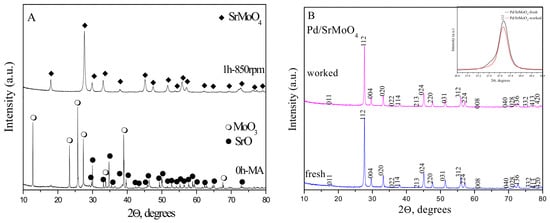
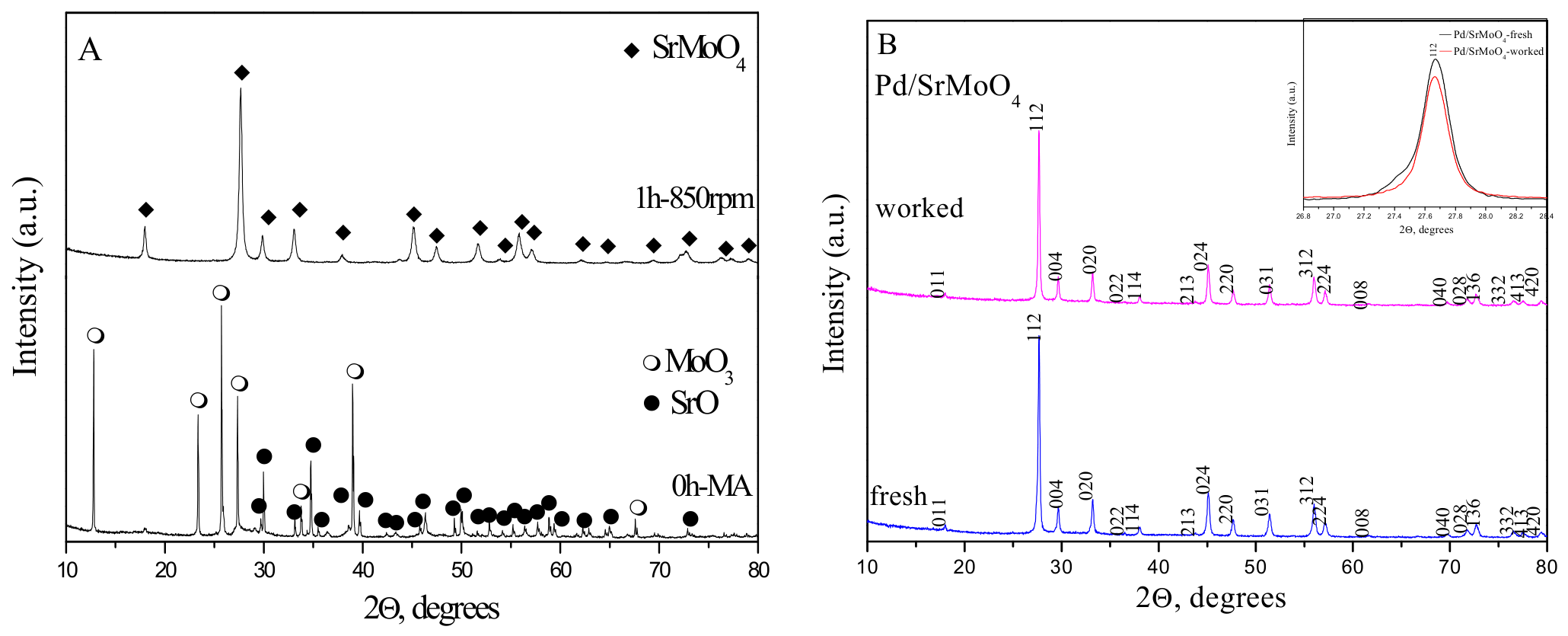
The phase composition of pure SrMoO4 and the Pd/SrMoO4 catalysts was investigated by powder X-ray diffraction analysis (XRD), and the results are presented in Figure 1. The diffraction pattern of the initial mixture before ball milling exhibits intense and narrow reflections corresponding to orthorhombic MoO3 (ICSD 98-003-025) and cubic SrO (ICSD 98-002-8904) (Figure 1A). After mechanochemical activation for 1 h using a milling speed of 850 rpm, new diffraction peaks characteristic of tetragonal SrMoO4 (ICSD 98-017-3120) appeared, confirming the successful formation of the target phase. No additional crystalline phases or impurities were detected in the XRD pattern. The average crystallite size of the as-prepared SrMoO4 sample was estimated to be 24 nm from the HighScore Plus 4.5 program using Profile fitting. Subsequent impregnation with a Pd-containing precursor followed by thermal treatment at 450 °C resulted in an increase in the intensity of all diffraction peaks associated with the catalyst support (Figure 1B), indicating improved crystallinity. No diffraction peaks corresponding to Pd species were observed, which was attributed to the low Pd loading and high dispersion of palladium on the support surface. The average crystallite size of Pd/SrMoO4 increased to 44 nm due to the enhanced crystallinity after thermal treatment. XRD pattern of the Pd/SrMoO4 catalyst after the catalytic test showed that no diffraction peaks corresponding to PdOx phases were detected (Figure 1B). Since the catalytic experiments were performed up to 450 °C, the diffraction lines became noticeably sharper after the reaction, indicating crystal growth and particle sintering during the catalytic process. The narrowing of the diffraction peak suggests an increase in the average crystallite size together with a reduction in the structural defects introduced during the mechanochemical treatment. The average crystallite size of the worked Pd/SrMoO4 was determined to be 58 nm.
Figure 1.
XRD patterns of the initial mixture and after mechanochemical treatment (A) and of fresh and worked Pd/SrMoO4 catalyst (B).
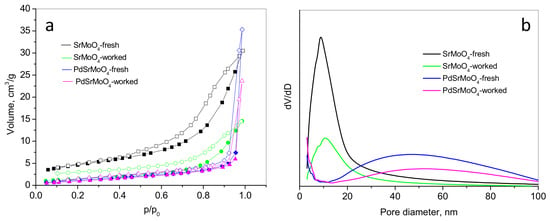
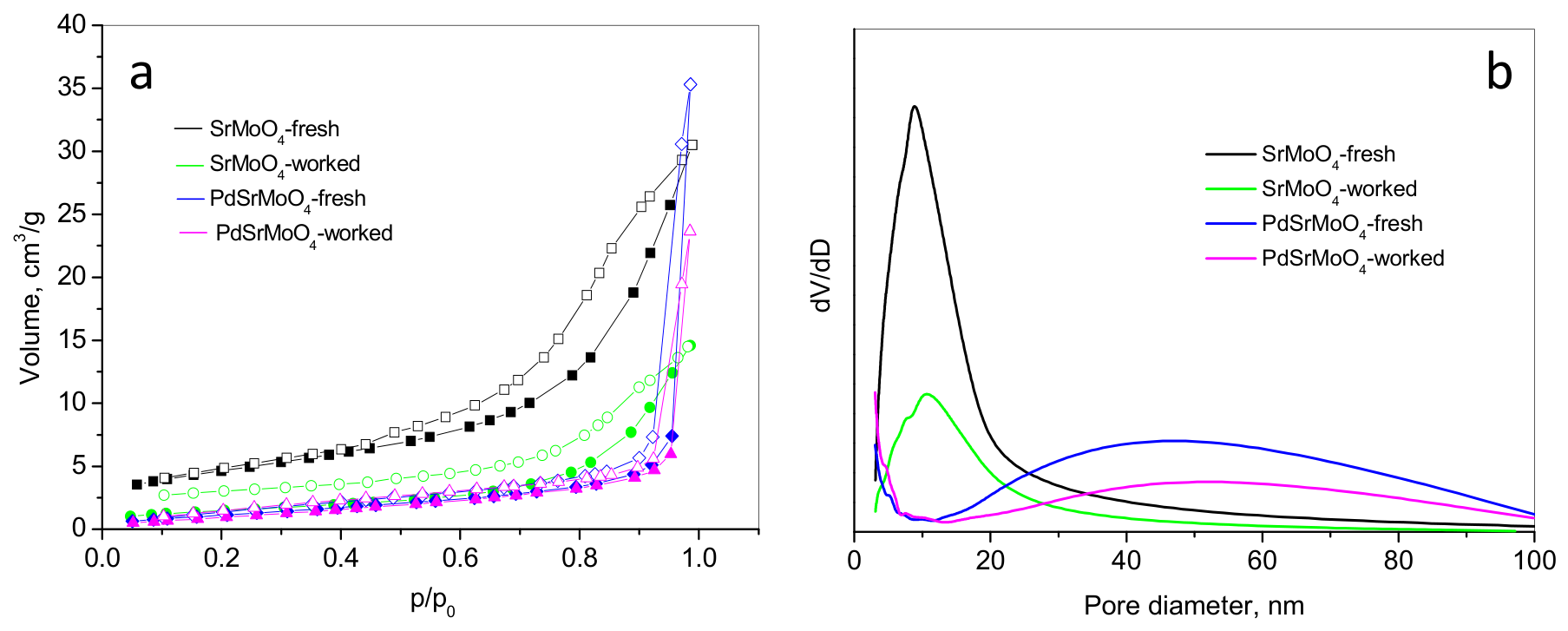
The nitrogen adsorption–desorption isotherms and pore size distribution curves confirm the mesoporous character of all investigated SrMoO4-based materials (Figure 2). The isotherms exhibit type IV behavior according to the IUPAC classification, with a sharp increase in nitrogen uptake at high relative pressures (p/p0 > 0.8), characteristic of capillary condensation in mesopores. The textural parameters reveal substantial differences between the pure and Pd-modified samples. The pure SrMoO4 sample exhibits the highest specific surface area (16.7 m2/g), together with a pore volume of 0.05 cm3/g and an average pore diameter of 11 nm. Its pore size distribution curve shows a narrow and intense peak centered in the lower mesopore region (below 10 nm), indicating a relatively uniform porous structure dominated by smaller mesopores. After the catalytic reaction, the surface area decreases substantially to 5.5 m2/g, while the average pore diameter increases to 17 nm. The pore distribution becomes broader and less intense, suggesting partial collapse of small pores, pore merging, or sintering effects during the catalytic process. The Pd/SrMoO4 samples display lower specific surface areas (4.6 and 4.0 m2/g for fresh and worked samples, respectively), which indicates partial surface coverage or pore blocking by Pd species (Table 1). However, the pore size distributions demonstrate that Pd incorporation significantly modifies the pore structure. In particular, the fresh Pd/SrMoO4 sample exhibits a broad pore size distribution extending from approximately 20 to 100 nm, with a maximum around 45–50 nm, in agreement with the calculated average pore diameter of 47 nm. This explains the relatively high nitrogen uptake at high relative pressures despite the lower specific surface area, as larger mesopores and interparticle voids contribute substantially to capillary condensation. Following catalytic use, the Pd/SrMoO4-worked sample shows only a slight decrease in the pore volume and average pore diameter. The pore size distribution remains relatively broad, although shifted toward somewhat higher diameters, indicating that the Pd-modified material preserves its porous framework more effectively during operation. Overall, Pd incorporation decreases the specific surface area but generates significantly larger mesopores/interparticle voids and contributes to improved structural stability and better preservation of the porous texture after use. Mainly, Pd incorporation decreases the specific surface area due to partial pore coverage with Pd species. However, it simultaneously generates a broader mesoporous network with larger pore diameters and improves the structural stability of the support during catalytic operation. The absence of a direct correlation between the surface area and catalytic performance indicates that the textural properties are not the limiting factor for the reaction. Instead, the superior activity of Pd/SrMoO4 could be due to the formation of highly active Pd sites and strong metal–support interactions, while the mesoporous structure mainly facilitates efficient diffusion of the reagents and the products.
Figure 2.
Adsorption–desorption isotherms (a) and pore size distribution (b) of fresh and worked SrMoO4 and Pd/SrMoO4. Empty symbols in (a) represent desorption points.
Table 1.
Textural characteristics of fresh and worked SrMoO4 and Pd-modified SrMoO4.
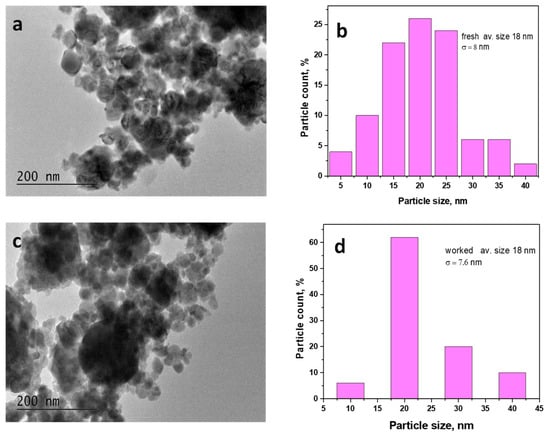
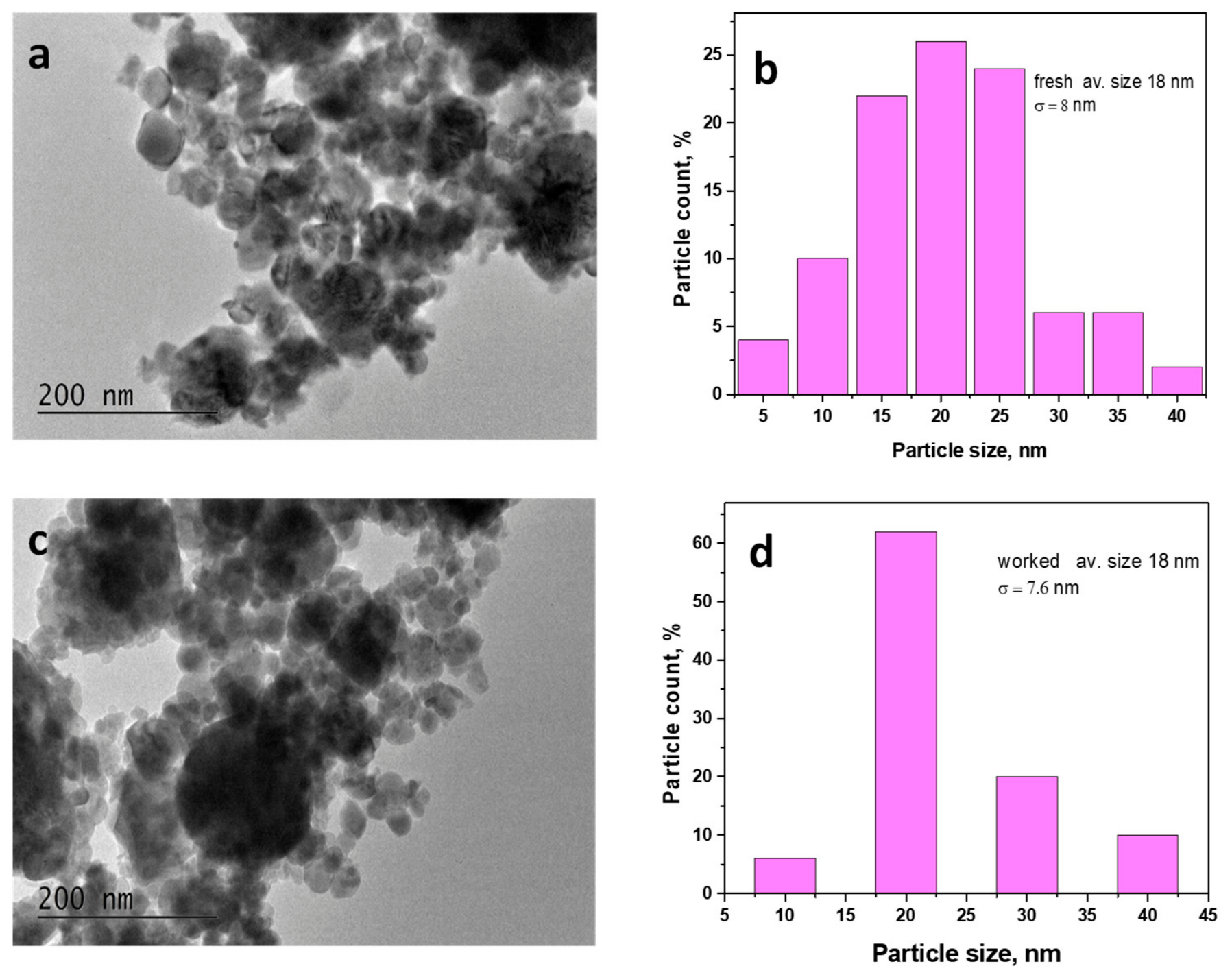
TEM investigations were performed to evaluate the particle morphology of the catalysts before and after the catalytic tests (Figure 3). TEM analysis of the fresh Pd/SrMoO4 catalyst revealed the formation of agglomerated nanoparticles with irregular form and relatively broad particle size distribution. The particles are closely packed, forming interconnected aggregates typical of mechanochemically synthesized materials. Most of the particles are in the nanometer range, with an average particle size of approx. 18 nm. No distinct separated Pd-containing phases were observed, suggesting a high dispersion of Pd species on the SrMoO4 surface. The TEM analysis showed no significant changes in the nanoparticle size or morphology after the reaction, indicating good structural stability of the catalyst during the catalytic process.
Figure 3.
Bright-field micrographs (a,c) and corresponding particle size distribution histograms (b,d) of fresh (a,b) and worked (c,d) Pd/SrMoO4 catalysts.
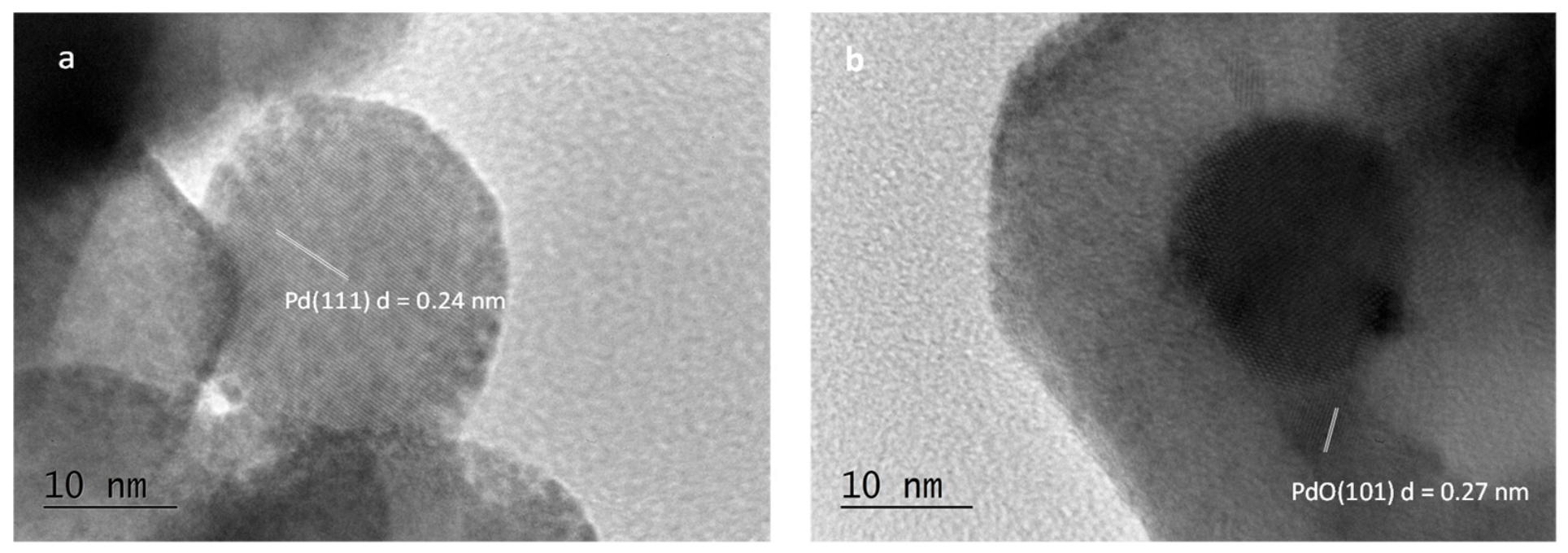
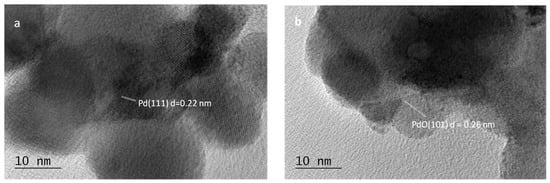
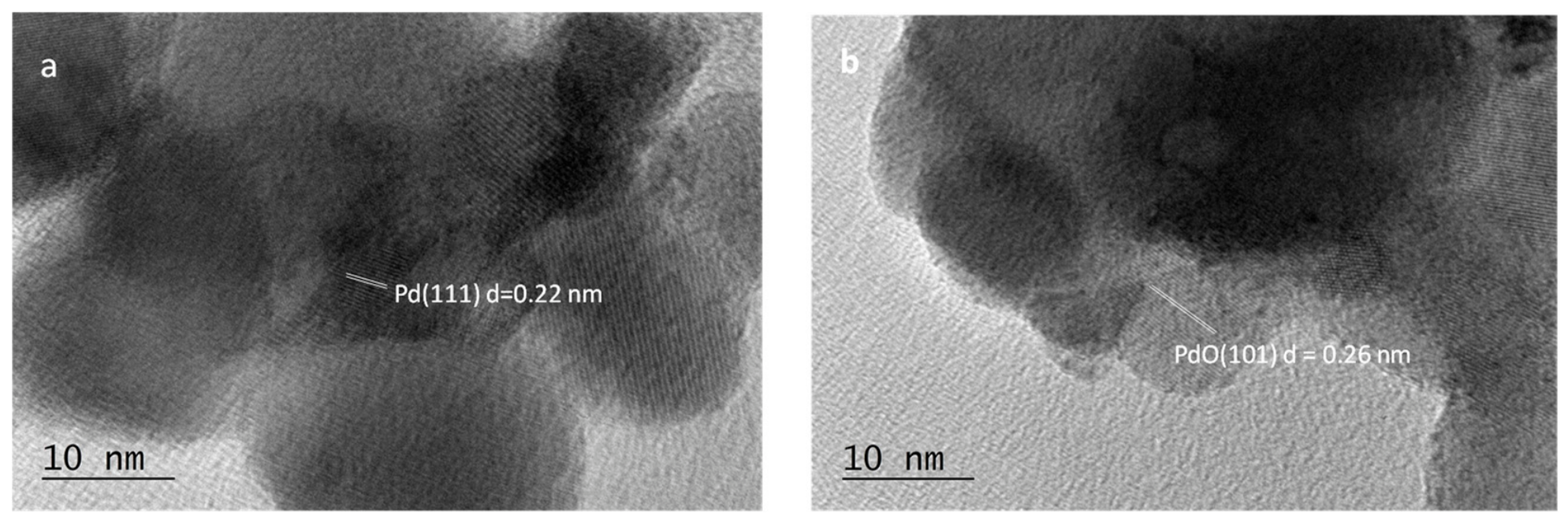
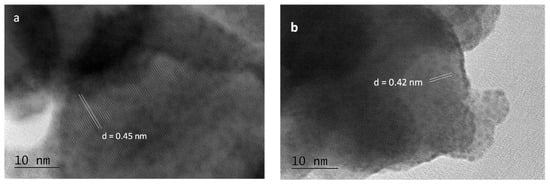
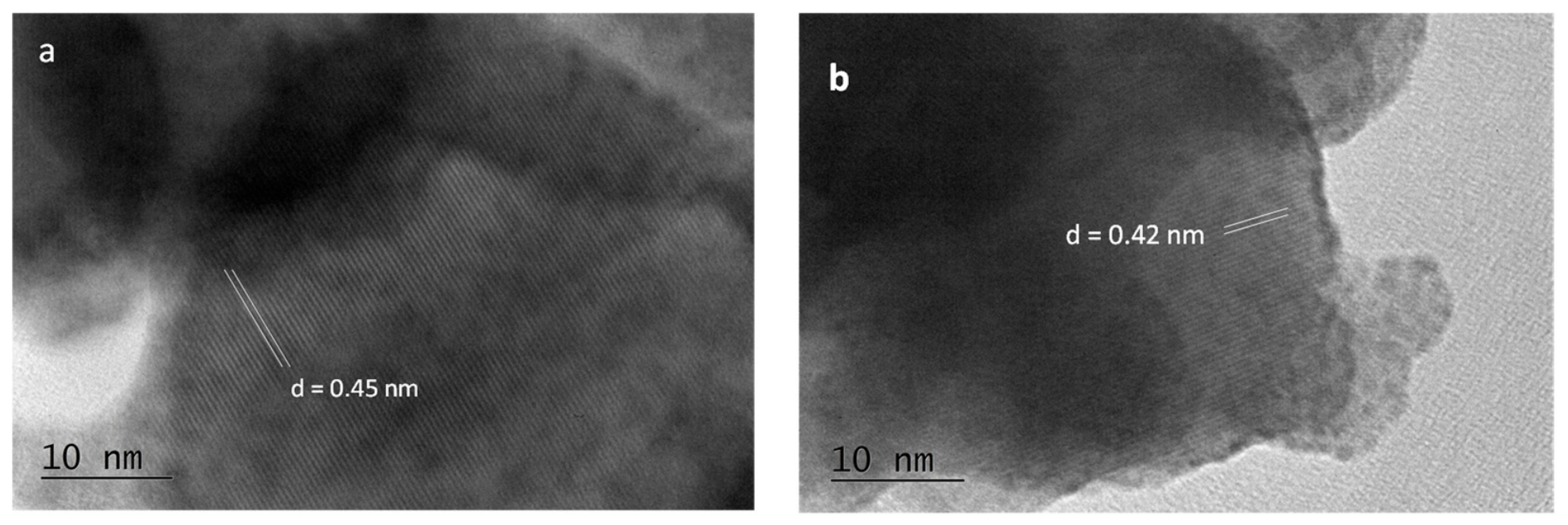
HRTEM images of the fresh and worked Pd/SrMoO4 catalysts (Figure 4 and Figure 5) showed well-defined lattice fringes, confirming the high crystallinity of the formed nanostructures. An interplanar spacing of approximately 0.24 nm was observed and indexed to the (111) crystallographic planes of face-centered cubic metallic Pd, indicating the presence of finely dispersed Pd nanoparticles on the SrMoO4 surface. In addition, lattice fringes with d-spacings in the range of 0.26–0.27 nm were detected, which can be attributed to oxidized palladium species, most likely PdO. Larger interplanar spacings of approx. 0.40–0.45 nm were also identified and are consistent with the Sr-Mo oxide support structure or mixed oxide domains formed between the Pd species and the SrMoO4 matrix (Figure 6).
Figure 4.
HRTEM image of Pd (111) plane, d = 0.24 nm (a), and PdO (101) plane, d = 0.27 nm (b), of Pd/SrMoO4 fresh catalyst.
Figure 5.
HRTEM image of the Pd (111) plane, d = 0.22 nm (a), and PdO (101) plane, d = 0.26 nm (b), of the Pd/SrMoO4 worked catalyst.
Figure 6.
HRTEM image of the Sr–Mo oxide support recorded at a magnification of 400,000×, showing well-resolved lattice fringes of fresh (a) and worked (b) Pd/SrMoO4 catalyst.
The coexistence of metallic and oxidized Pd species suggests the formation of heterogeneous active sites within the catalyst. The results from HRTEM indicate that the Pd nanoparticles are stable during VOC oxidation.
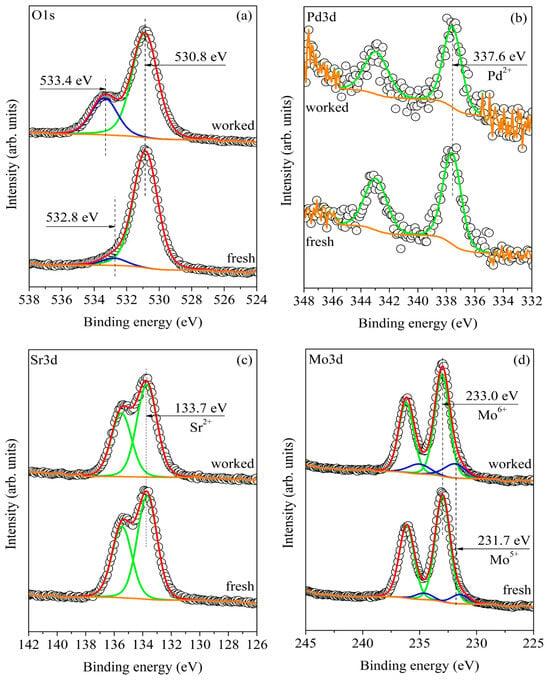
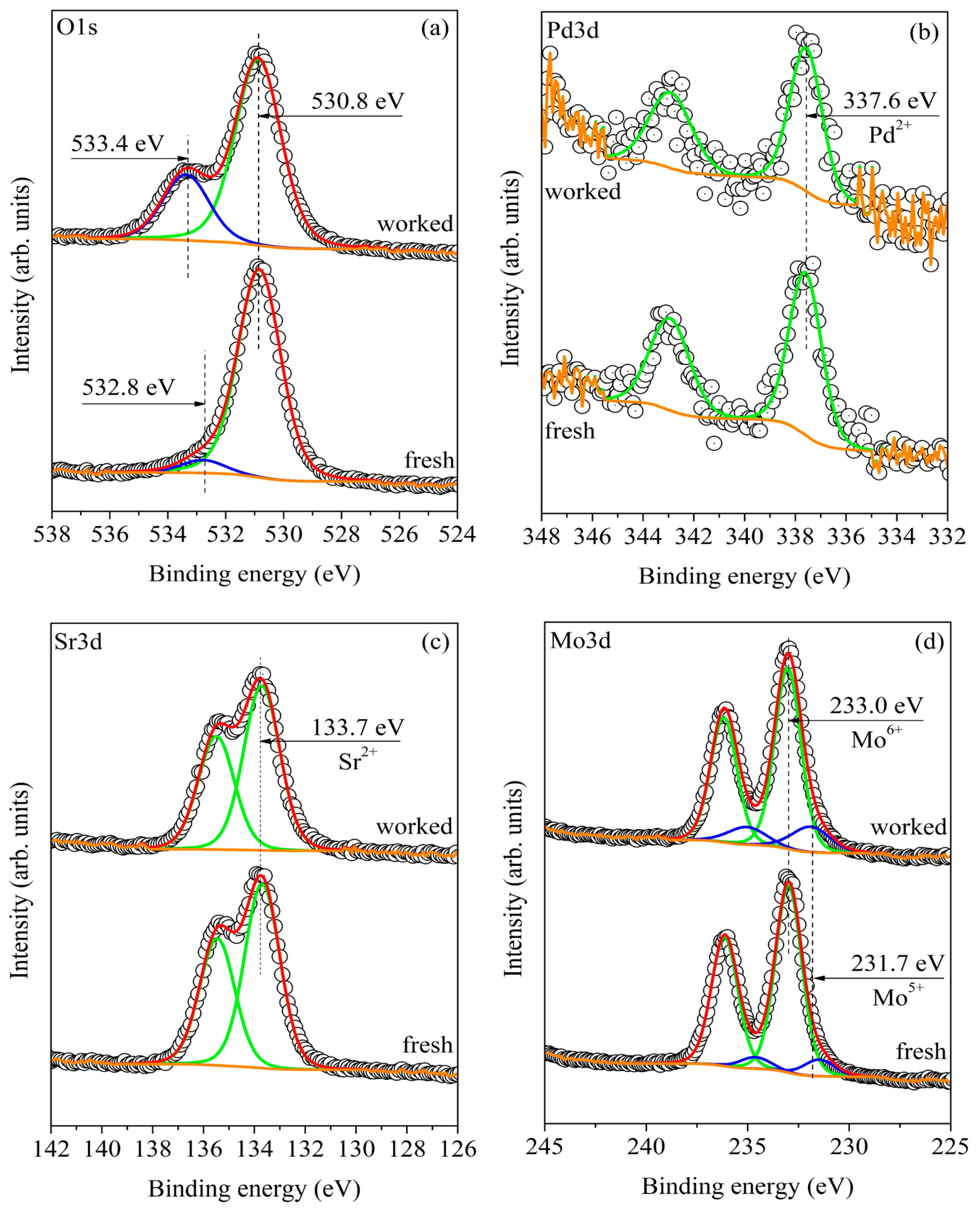
For the catalytic processes, the oxidation states of the elements present on the surface and their concentrations are important; therefore, XPS analysis was used to answer these questions for the Pd/SrMoO4 samples before and after VOC oxidation processes. The results are presented in Figure 7 and Table 2. All relevant fitting parameters are included in the Supplementary Files (Table S1). The O1s spectrum (Figure 7a) of fresh Pd/SrMoO4 is dominated by the lattice oxygen component (green) at ca. 530.8 eV, assigned to O2- species (Sr-O-Mo bonds) in the SrMoO4 structure. A minor high-binding-energy contribution (blue) at 532.8 eV, accounting for about 3.63 at.%, can be attributed to weakly bound surface oxygen-containing species, such as hydroxyl groups, adsorbed water, and/or carbonate-like species. After catalytic oxidation of VOCs, this contribution increases markedly to about 16.96 at.% and shifts to 533.4 eV. This change is not indicative of a modification of the bulk SrMoO4 lattice but rather reflects the accumulation of surface adsorbates/reaction-derived oxygenated species, including hydroxylated, hydrated, carbonate/formate-like, or organic C–O-containing residues. The shift toward higher binding energy suggests a larger contribution from weakly bound molecular water and/or organic oxygen species and may also be affected by differential charging of the adsorbate-rich surface layer.
Figure 7.
High-resolution XPS spectra of (a) O 1s, (b) Pd 3d, (c) Sr 3d, and (d) Mo 3d regions for fresh and worked Pd/SrMoO4 samples. The contributions of the different chemical states are represented by individually colored components. Open circles correspond to the experimental data points, while the red line represents the overall fit envelope.
Table 2.
Surface atomic concentrations (at.%) of fresh and worked Pd-modified SrMoO4 samples determined by XPS analysis.
The Pd 3d spectrum shows a doublet structure that has been assigned to Pd2+, with the main peak centered at 337.6 eV [59]. The spin–orbit splitting is 5.34 eV for both samples (Table S1). A weak contribution on the lower-binding-energy side of the main peak is also observed (Figure 7b). The maximum intensity of this feature is located around 335.2 eV, which is consistent with literature values reported for metallic palladium [55]. Although the metallic contribution is relatively weak and cannot be fitted reliably as a separate component, the presence of Pd0 species at the surface cannot be excluded. The results of the TEM analysis confirm its presence within the material.
In the Sr 3d spectrum (Figure 7c), the main peak is centered at 133.7 eV, consistent with Sr2+ reference values [55]. The spin–orbit splitting between Sr 3d5/2 and 3d3/2 is 1.79 eV for the pristine and the used samples (Table S1). No significant chemical shifts are observed following the catalytic test. The atomic concentrations suggest some surface depletion, likely due to attenuation by active or adsorbed species. Strontium primarily serves a structural role within the SrMoO4 lattice and is not expected to participate directly in the catalytic mechanism. In molybdates, catalytic behavior is more commonly associated with surface molybdenum environments and oxygen mobility [60].
In Figure 7d, the Mo 3d core-level spectra are shown and were fitted with two doubles with binding energies at 231.7 eV and 233.0 eV, corresponding to Mo5+ and Mo6+, respectively. The Sr:Mo ratio is very close to 1:1, suggesting successful SrMoO4 synthesis. The atomic concentrations indicate that the surface oxygen content is lower than the nominal value, possibly due to the presence of oxygen-deficient regions. The presence of oxygen-deficient surface regions may contribute to partial reduction in Mo species. Additional reduction effects arising from X-ray irradiation during the measurements in the vacuum chamber, as well as defects introduced during synthesis, cannot be excluded. After the catalytic tests, an increased amount of the reduced species is observed. Molybdenum could potentially exhibit behavior similar to that of other transition metals and participate actively in the catalytic process through its redox pair, with a Mars–van Krevelen mechanism being considered the most probable reaction pathway [61]. Overall, XPS does not provide direct evidence for abundant surface hydroxyl groups; nevertheless, the possible coexistence of Pd2+/Pd0 species, partially reduced Mo environments, and the increased amount of high-binding-energy oxygen species after reaction are consistent with the active involvement of the Pd/SrMoO4 surface in oxygen activation and VOC oxidation in the case of ethylene oxidation.
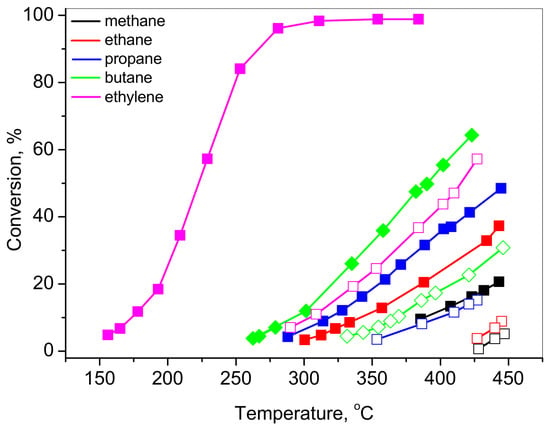
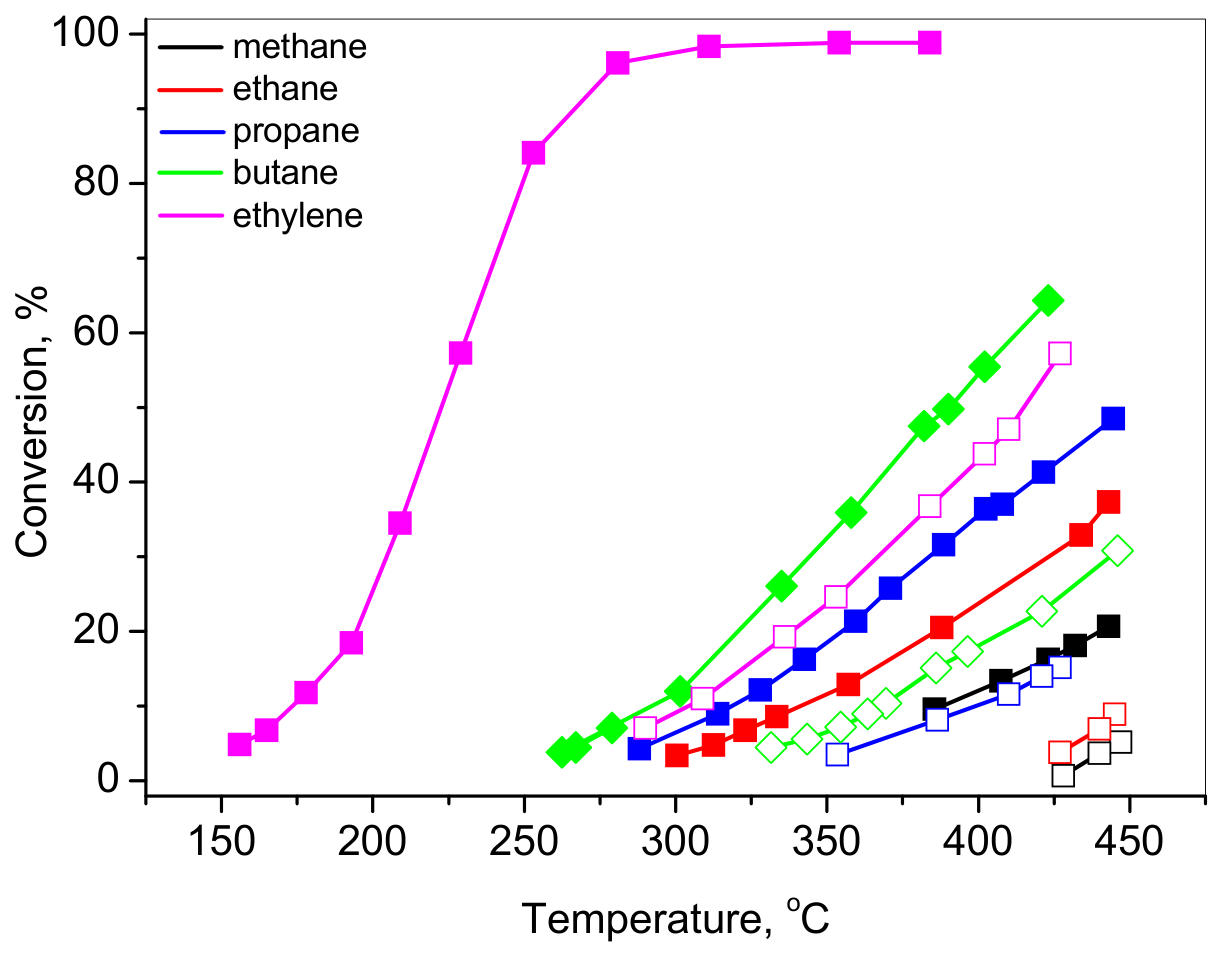
The catalytic oxidation performance of pure SrMoO4 and Pd/SrMoO4 catalysts toward methane, ethane, propane, butane, and ethylene oxidation is presented in Figure 8. CO2 and H2O were the main products of the reactions; CO was the only by-product registered, and its concentration was below 10 ppm. A direct comparison between the two catalysts clearly demonstrates that the incorporation of palladium significantly enhances the catalytic activity of SrMoO4 in the investigated temperature range. The pure SrMoO4 catalyst exhibited relatively low activity and limited conversion efficiency, particularly at lower temperatures, indicating that the support itself cannot be considered active for efficient VOC oxidation. In contrast, the Pd/SrMoO4 catalyst showed substantially improved catalytic behavior, confirming the strong promoting effect of Pd species on the oxidation reactions.
Figure 8.
Temperature dependencies of the conversion degrees during the complete oxidation of different VOCs on pure SrMoO4 (empty symbols) and Pd-modified SrMoO4 (full symbols).
Among the investigated VOCs, methane oxidation was the most difficult reaction and required the highest temperatures to achieve substantial conversion. This behavior is shown in the highest light-off temperature (T50), defined as the temperature corresponding to 50% conversion. The lower reactivity of methane can be attributed to the high stability and strong C-H bond energy of the methane molecule, which makes its activation more difficult compared to other gases. The catalytic results show that the ethylene oxidation exhibited the highest catalytic activity among all tested VOCs. The Pd/SrMoO4 catalyst demonstrated more efficient performance toward ethylene combustion, reaching the lowest T50 value of 210 °C at a gas hourly space velocity (GHSV) of 100 000 h−1. The enhanced reactivity of ethylene is associated with the presence of the C=C double bond, which facilitates its adsorption and activation on the catalyst surface. Furthermore, the Pd/SrMoO4 catalyst ensures nearly complete oxidation of ethylene, achieving conversion levels up to 99% at 385 °C. The catalyst also showed significantly improved activity toward the oxidation of ethane, propane, and butane compared to pure SrMoO4, demonstrating the favorable effect of palladium in promoting hydrocarbon activation and oxygen transfer processes.
A comparison of the catalytic activity of Pd/SrMoO4 with representative Pd- and Mo-containing catalysts reported in the literature is provided in Table S2. According to the available data, Pd/SrMoO4 demonstrates higher activity than other Pd-containing catalysts with a scheelite-type structure [50,51]. In comparison with other Pd- and Mo-containing catalysts, its performance is within a similar range, with activity values close to those reported for these systems [62,63,64]. Additional experiments on VOC oxidation over synthesized Pd/γ-Al2O3 (Rhône-Poulenc), which is mostly used for practical applications, were conducted, and the results for comparison are also placed in Table S2 and Figure S1. Although the activity of Pd/γ-Al2O3 is better than the studied catalyst, the normalization of the reaction rates to the specific surface area reveals considerably higher values for Pd/SrMoO4. This suggests that the SrMoO4-supported Pd catalyst possesses highly active surface sites, while its overall conversion is strongly limited by its relatively low specific surface area. However, these should be regarded as comparative rather than as intrinsic turnover rates, since the specific surface area does not always correspond directly to the number of catalytically accessible Pd sites.
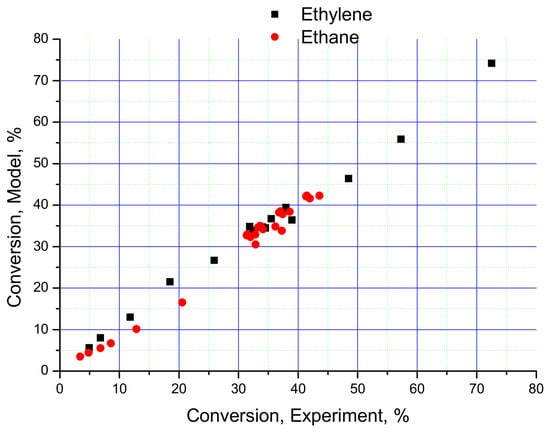
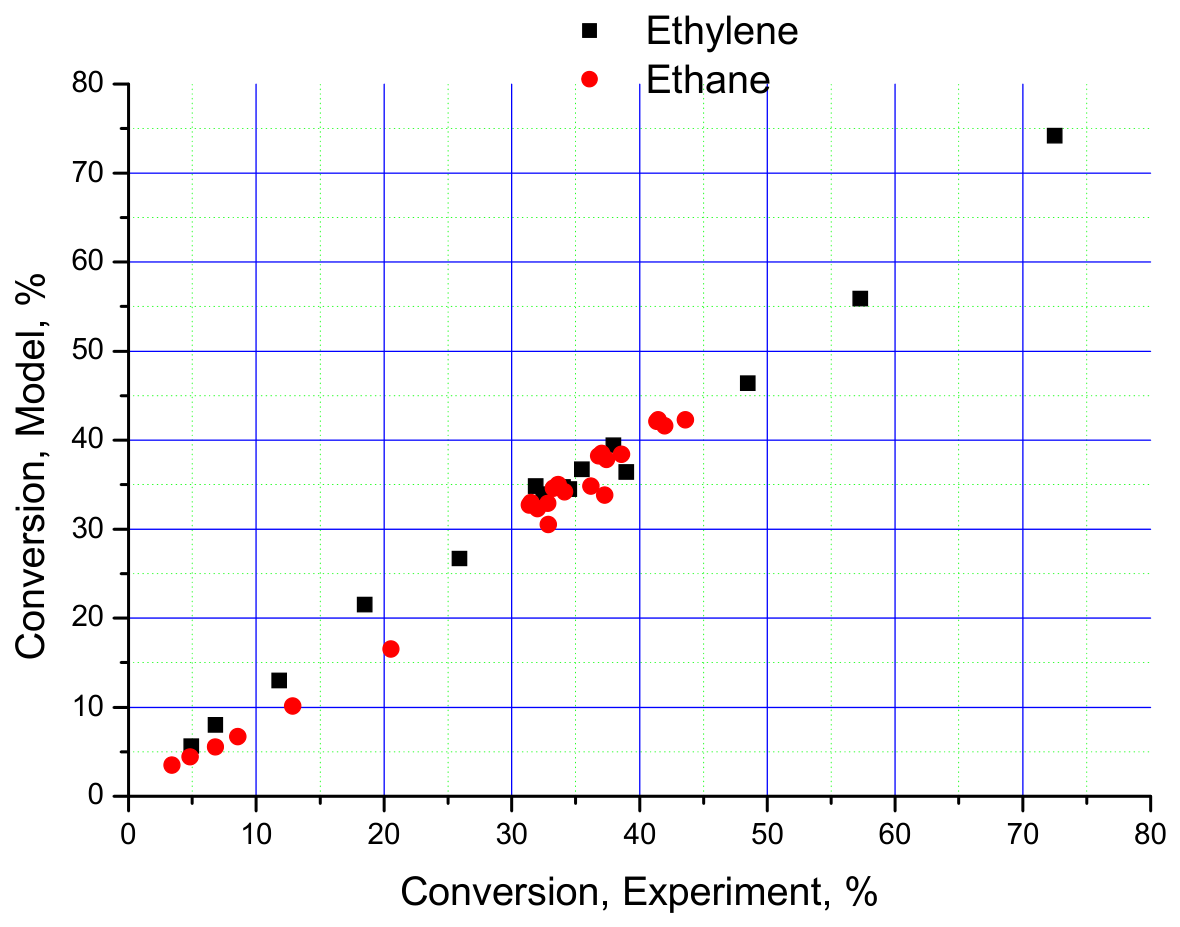
The additional information about the reaction mechanism was obtained by calculation of the kinetic parameters (Table 3). The reported values for Ea in Table 3 refer to the apparent activation energies calculated by using the power-law kinetics model for the entire set of experimental points when varying the inlet concentrations. In the case of first-order kinetics (i.e., without accounting for the effect of the concentrations of the reagents and the products), the observed values of Eapp are 64.7 kJ/mol for ethane and 73.5 kJ/mol for ethylene. Arrhenius plots for ethane and ethylene combustion, with simplified calculations based on first-order reaction kinetics, are presented in Figure S2. The inlet concentrations of reagents were varied, and the corresponding kinetic parameters were determined applying Duprat’s method [65]. Details on the calculation procedure were published previously [65,66,67,68]. The comparison between the experimentally measured conversions and those predicted by the reaction kinetics models is presented in Figure 9.
Table 3.
Kinetic parameters based on power-law model.
Figure 9.
Comparison between the experimentally measured conversions and those predicted by the reaction kinetics models.
A power law kinetic model (PWL) has been fitted to the experimental data. The dependence of the reaction rate of ethylene and ethane is around 0.85, which shows relatively weak adsorption of the organic molecules on the catalytic surface. It should be pointed out that the high value of the reaction order shows that the reaction rate depends little on the reagents in their adsorbed form. At the limiting case of unity, the compound reacts directly from the gas phase. In contrast, the values of the reaction order close to zero reveal almost complete coverage of the catalytic surface by the corresponding reagent, and the reaction rate almost does not depend on the gas-phase concentration. Remarkable is the difference regarding the reaction order towards oxygen. While in the ethane case, the reaction rate is not dependent on the oxygen gas-phase concentration (zero order), during ethylene combustion the oxygen reaction order shows a negative value (−0.45), thus revealing a strong self-inhibition effect. The higher the oxygen concentration, the lower the reaction rate. The observed behavior shows strong oxygen adsorption on the catalytic surface. Based on the results from the instrumental methods and reaction kinetics tests, one may conclude that the SrMoO4 phase plays the role of an oxygen supplier to the Pd atoms to form PdO during the surface oxy-redox process.
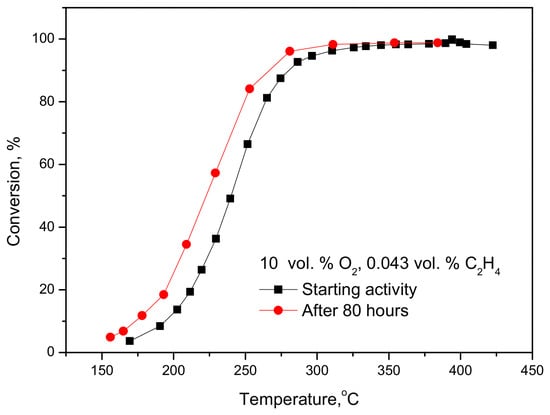
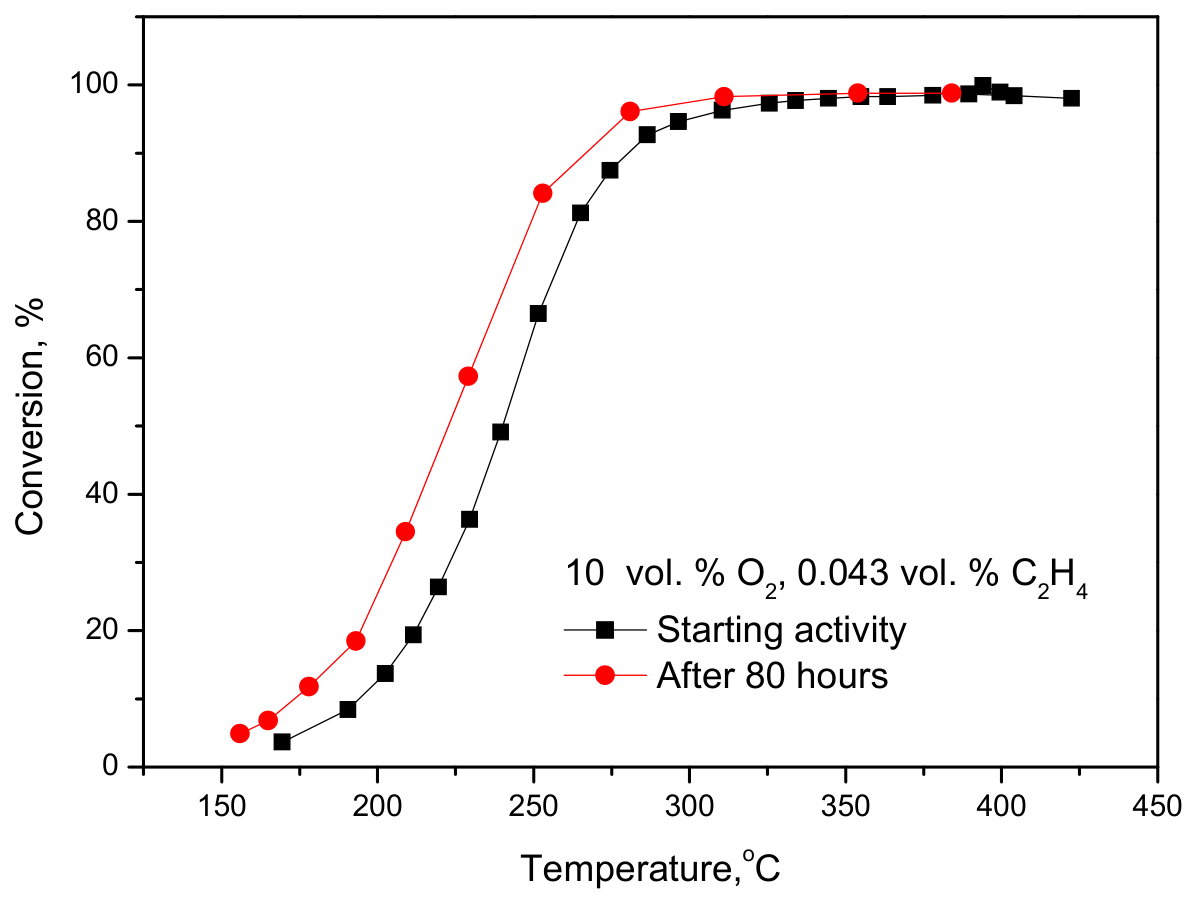
The stability of the catalytic material was evaluated by an 80 h test with 10 cycles from room temperature to 450 °C. The activity measurements before and after the stability test were carried out at averaged concentrations of the reagents when compared to the reaction kinetics tests. The activity was measured by ethylene combustion tests at the beginning and the end of the tests. The results are presented in Figure 10. Despite the pronounced decrease in specific surface area, no loss of catalytic activity was observed after the 80 h stability test, indicating that the catalytic performance is not governed solely by the total surface area. A slight increase in activity was even observed after the stability test, which is most probably associated with stabilization of the active phase under reaction conditions and the establishment of a more favorable Pd/PdO ratio. It is worth noting that Pd/SrMoO4 possesses high durability and performance stability throughout the entire experiment without poisoning or deactivation by the reaction product, water vapor.
Figure 10.
Stability tests of ethylene combustion on Pd-modified SrMoO4 catalyst.
The improved catalytic performance of the Pd/SrMoO4 catalyst can be explained by several synergistic structural and physicochemical factors. First, the high dispersion of Pd species on the SrMoO4 surface increases the number of accessible active sites available for gas adsorption and oxidation. Finely dispersed Pd nanoparticles provide a larger active surface area and may promote more efficient interaction between the VOC molecules and the catalyst surface. In addition, the possible coexistence of metallic Pd0 and oxidized PdO species plays an important role in the catalytic process. Metallic palladium facilitates the adsorption and activation of hydrocarbon molecules, while PdO species are highly active in oxygen activation and supply reactive oxygen species necessary for complete oxidation. The simultaneous presence of both oxidation states creates dynamic redox cycles between Pd0/PdO during the reaction, which enhances oxygen mobility and facilitates the oxidation process. The strong metal–support interactions contribute to improved catalyst stability and catalytic activity. These interactions may stabilize highly dispersed Pd nanoparticles, prevent excessive particle agglomeration, and modify the electronic properties of the active Pd species. As a result, the transfer of oxygen species between the SrMoO4 support and the palladium active sites becomes more efficient. The role of Mo in Pd-based catalysts has also been reported for ethane oxidation, where the introduction of Mo was shown to regulate the Pd0/Pd2+ ratio and improve the catalytic performance of Pd–Mo/Al2O3 catalysts [62]. The combination of these effects facilitates the activation of molecular oxygen and improves the redox behavior of the catalyst surface, leading to enhanced catalytic efficiency during VOC oxidation reactions.
4. Conclusions
The modification of SrMoO4 with palladium significantly enhances its catalytic properties, which can be attributed to the well-dispersed Pd species and their strong interaction with the SrMoO4 support. The results suggest that the use of SrMoO4 as a catalytic support enables the preparation of an advanced catalytic system with highly dispersed Pd species and strong metal–support interactions, with the possible coexistence of metallic and oxidized Pd species. The observed reduced species over the Pd-modified SrMoO4 catalyst and the presence of oxygen-deficient surface regions lead to the conclusion that the Mo species take part in the catalytic process through their redox pair. The proposed corresponding reaction pathway to this behavior is most probably the Mars–van Krevelen mechanism. The possible coexistence of both Pd2+ and Pd0 species and partially reduced Mo environments reveals an active involvement of the Pd/SrMoO4 surface in oxygen activation and VOC oxidation, with the Mars–van Krevelen mechanism being suggested as the most probable. Due to the high reliability of the material, confirmed by the stability of the size of the catalyst’s nanoparticles and the preserved porous structure during the reaction, the Pd-modified SrMoO4 catalyst can be considered a promising material for further application in environmental catalysis, supported both on pellets and monolithic elements.
Supplementary Materials
The following supporting information can be downloaded at https://www.mdpi.com/article/10.3390/micro6040092/s1, Table S1: Binding energy, FWHM, and spin–orbit splitting derived from XPS data for fresh and worked Pd-modified SrMoO4 samples; Table S2: Comparison of the catalytic performance of Pd/SrMoO4 with representative Pd- and Mo-containing catalysts reported in the literature for VOC oxidation; Figure S1: Temperature dependencies of the conversion degrees during the complete oxidation of different VOCs on Pd/γ-Al2O3 (Rhône-Poulenc); Figure S2: Arrhenius plots for ethane and ethylene combustion, simplified calculations based on the first order reaction kinetics.
Author Contributions
Conceptualization, M.G., R.V., R.I., I.S., and A.N.; methodology, M.G., R.V., R.I., I.S., and A.N.; formal analysis, I.S., S.D., H.K., P.M., and K.T.; investigation, I.S., S.D., H.K., and P.M.; data curation, I.S., S.D., H.K., P.M., and R.V.; writing—original draft preparation, M.G., R.V., R.I., I.S., and A.N.; writing—review and editing, M.G., R.V., R.I., A.N., I.S., H.K., and R.V.; visualization, M.G. and R.V. All authors have read and agreed to the published version of the manuscript.
Funding
This research received no external funding.
Institutional Review Board Statement
Not applicable.
Informed Consent Statement
Not applicable.
Data Availability Statement
The data presented in this study are available upon request from the corresponding author.
Acknowledgments
The MultiGas FTIR Gas Analyzer 2030G, under the project No. BG16RFPR002-1.014-0006 “National Center of Excellence Mechatronics and Clean Technologies” and supported by the European Regional Development Fund under the “Research Innovation and Digitization for Smart Transformation” program 2021–2027, was used for the experimental work. Research equipment from the distributed research infrastructure INFRAMAT, part of the Bulgarian National Roadmap for Research Infrastructures, supported by the Bulgarian Ministry of Education and Science, was also used in the investigation.
Conflicts of Interest
The authors declare no conflicts of interest.
References
- Finlayson-Pitts, B.J.; Pitts, J.N. Chemistry of the Upper and Lower Atmosphere; Academic Press: San Diego, CA, USA, 2000. [Google Scholar]
- Atkinson, R. Atmospheric chemistry of VOCs and NOx. Atmos. Environ. 2000, 34, 2063–2101. [Google Scholar] [CrossRef] [Scilit]
- Monks, P.S.; Granier, C.; Fuzzi, S.; Stohl, A.; Williams, M.; Akimoto, H.; Amann, M.; Baklanov, A.; Baltensperger, U.; Bey, I.; et al. Atmospheric composition change—Global and regional air quality. Atmos. Environ. 2009, 43, 5268–5300. [Google Scholar] [CrossRef] [Scilit]
- Seinfeld, J.H.; Pandis, S.N. Atmospheric Chemistry and Physics; Wiley: Hoboken, NJ, USA, 2016. [Google Scholar]
- Monks, P.S.; Archibald, A.T.; Colette, A.; Cooper, O.; Coyle, M.; Derwent, R.; Fowler, D.; Granier, C.; Law, K.S.; Mills, G.E.; et al. Tropospheric ozone and its precursors from the urban to the global scale from air quality to short-lived climate forcer. Atmos. Chem. Phys. 2015, 15, 8889–8973. [Google Scholar] [CrossRef] [Scilit]
- Jenkin, M.E.; Clemitshaw, K.C. Ozone and other secondary photochemical pollutants: Chemical processes governing their formation in the planetary boundary layer. Atmos. Environ. 2000, 34, 2499–2527. [Google Scholar] [CrossRef] [Scilit]
- Jones, A.P. Indoor air quality and health. Atmos. Environ. 1999, 33, 4535–4564. [Google Scholar] [CrossRef] [Scilit]
- Guo, H.; Lee, S.C.; Chan, L.Y.; Li, W.M. Risk assessment of exposure to volatile organic compounds in different indoor environments. Environ. Res. 2004, 94, 57–66. [Google Scholar] [CrossRef] [Scilit] [PubMed]
- Kamal, M.S.; Razzak, S.A.; Hossain, M.M. Catalytic oxidation of volatile organic compounds (VOCs)—A review. Atmosph. Environ. 2016, 140, 117–134. [Google Scholar] [CrossRef] [Scilit]
- He, C.; Cheng, J.; Zhang, X.; Diao, X. Recent Advances in the Catalytic Oxidation of Volatile Organic Compounds: A Review Based on Pollutant Sorts and Sources. J. Environ. Sci. 2019, 82, 201–215. [Google Scholar] [CrossRef] [Scilit] [PubMed]
- Khan, F.I.; Ghoshal, A.K. Removal of volatile organic compounds from polluted air. J. Loss Prev. Process Ind. 2000, 13, 527–545. [Google Scholar] [CrossRef] [Scilit]
- Kim, S.C.; Shim, W.G. Properties and performance of Pd based catalysts for catalytic oxidation of volatile organic compounds. App. Catal. B Environ. 2009, 92, 429–436. [Google Scholar] [CrossRef] [Scilit]
- Gómez, J.L.; Ordóñez, S.; Sastre, H. Catalytic combustion of volatile organic compounds over metal oxide catalysts. Catal. Today 2005, 107–108, 273–279. [Google Scholar] [CrossRef] [Scilit]
- Huang, H.; Xu, Y.; Feng, Q.; Leung, D.Y.C. Low temperature catalytic oxidation of volatile organic compounds: A review. Catal. Sci. Technol. 2015, 5, 2649–2669. [Google Scholar] [CrossRef] [Scilit]
- Liu, R.; Wu, H.; Shi, J.; Xu, X.; Zhao, D.; Ng, Y.H.; Zhang, M.; Liu, S.; Ding, H. Recent progress on catalysts for catalytic oxidation of volatile organic compounds: A review. Catal. Sci. Technol. 2022, 12, 6945–6991. [Google Scholar] [CrossRef] [Scilit]
- Djeghaba, Z.; Ibn Ferjani, A. Total oxidation of volatile organic compounds over Mn-based catalysts. Catalysts 2020, 10, 1025. [Google Scholar] [CrossRef] [Scilit]
- Zhang, H.; Wang, Z.; Lin, H.; Liu, Y.; Dai, H.; Deng, J. Catalytic oxidation of volatile organic compounds over supported noble metal and single atom catalysts: A review. J. Environ. Sci. 2025, 155, 858–888. [Google Scholar] [CrossRef] [Scilit] [PubMed]
- Liotta, L.F. Catalytic oxidation of volatile organic compounds on supported noble metals. Appl. Catal. B Environ. 2010, 100, 403–412. [Google Scholar] [CrossRef] [Scilit]
- Haruta, M. Catalysis of gold nanoparticles deposited on metal oxides. CATTECH 2002, 6, 102–115. [Google Scholar] [CrossRef] [Scilit]
- Joy, J.; Demina, T.D.; Durgi, A.K.; Vijayan, A. A brief review on palladium-catalyzed C–H activation reactions of 2-phenylpyridines. RSC Adv. 2025, 15, 11065–11084. [Google Scholar] [CrossRef] [Scilit] [PubMed]
- Xu, H.-J.; Fan, Z.; Nian, B.-B.; Wang, Y.-F.; Hou, X.; Zhou, Z.; Yu, S.-Y.; Shi, B.-F. Achieving mono-selective palladium (II)-catalysed C–H activation of arenes with protein ligands. Nat. Catal. 2025, 8, 948–956. [Google Scholar] [CrossRef] [Scilit]
- Zhao, Q.; Chen, L.; Liu, Y. Palladium-catalyzed enantioselective C–H functionalization via C–H palladation. Trends Chem. 2022, 4, 220–235. [Google Scholar] [CrossRef] [Scilit]
- Wang, X.; Xiao, F.; Patureau, F.W. CO2 and palladium enabled highly chemoselective hydroxylation of gem-difluorocyclopropanes. Org. Chem. Front. 2024, 11, 2494–2501. [Google Scholar] [CrossRef] [Scilit]
- Mao, Z.; Gu, H.; Lin, X. Recent advances of Pd/C-catalyzed reactions. Catalysts 2021, 11, 1078–1105. [Google Scholar] [CrossRef] [Scilit]
- Cao, Y.; Ran, R.; Wu, X.; Si, Z.; Kang, F.; Weng, D. Progress on metal-support interactions in Pd-based catalysts for automobile emission control. J. Environ. Sci. 2023, 125, 401–426. [Google Scholar] [CrossRef] [Scilit] [PubMed]
- Haneda, M.; Todo, M.; Nakamura, Y.; Hattori, M. Effect of Pd dispersion on the catalytic activity of Pd/Al2O3 for C3H6 and CO oxidation. Catal. Today 2017, 281, 447–453. [Google Scholar] [CrossRef] [Scilit]
- Van Vaerenbergh, B.; Lauwaert, J.; Vermeir, P.; De Clercq, J.; Thybaut, J.W. Synthesis and support interaction effects on the palladium nanoparticle catalyst characteristics. Adv. Catal. 2019, 65, 1–120. [Google Scholar] [CrossRef] [Scilit]
- Liu, L.; Corma, A. Metal catalysts for heterogeneous catalysis: From single atoms to nanoclusters and nanoparticles. Chem. Rev. 2018, 118, 4981–5079. [Google Scholar] [CrossRef] [Scilit] [PubMed]
- Zhang, C.; Chen, X.; Zhang, X.; Chen, S.; Gao, S.; Yu, D.; Wang, L.; Fan, X.; Yu, X.; Zhao, Z. Advances in the influencing factors and reaction mechanisms of Pd-based supported catalysts for catalytic methane combustion. J. Mater. Chem. A 2025, 13, 16382–16413. [Google Scholar] [CrossRef] [Scilit]
- Tauster, S.J.; Fung, S.C.; Baker, R.T.K.; Horsley, J.A. Strong interactions in supported-metal catalysts. Science 1981, 211, 1121–1125. [Google Scholar] [CrossRef] [Scilit] [PubMed]
- Campbell, C.T. The energetics of supported metal nanoparticles: Relationships to sintering rates and catalytic activity. Acc. Chem. Res. 2013, 46, 1712–1719. [Google Scholar] [CrossRef] [Scilit] [PubMed]
- Swathi, S.; Yuvakkumar, R.; Senthil Kumar, P.; Ravi, G.; Nanthini, D.; Velauthapillai, D. Flower like strontium molybdate for efficient energy conversion applications. Fuel 2022, 308, 122051. [Google Scholar] [CrossRef] [Scilit]
- Manikanta, P.; Mounesh; Nikam, R.R.; Sandeep, S.; Santhosh, A.S.; Pramoda, K.; Nagaraja, B.M. Hydrothermal synthesis of 3D broccoli-like strontium molybdate electrocatalyst for sensitive evaluation of the anticancer drug flutamide in real samples. Surf. Interfaces 2025, 62, 106249. [Google Scholar] [CrossRef] [Scilit]
- Silva, M.M.S.; Sena, M.S.; Lopes-Moriyama, A.L.; Souza, C.P.; Santos, A.G. Experimental planning of the synthesis of strontium molybdate by EDTA-citrate and its structural influence, morphology and optical bandgap. Ceram. Int. 2018, 44, 16606–16614. [Google Scholar] [CrossRef] [Scilit]
- Gurmen, E.; Daniels, E.; King, J.S. Crystal structure refinement of SrMoO4, SrWO4, CaMoO4, and BaWO4 by neutron diffraction. J. Chem. Phys. 1971, 55, 1093–1097. [Google Scholar] [CrossRef] [Scilit]
- Kowalkińska, M.; Głuchowski, P.; Swebocki, T.; Ossowski, T.; Ostrowski, A.; Bednarski, W.; Karczewski, J.; Zielińska-Jurek, A. Scheelite-type wide-bandgap ABO4 compounds (A = Ca, Sr, and Ba; B = Mo and W) as potential photocatalysts for water treatment. J. Phys. Chem. C 2021, 125, 25497–25513. [Google Scholar] [CrossRef] [Scilit]
- Thongtem, T.; Phuruangrat, A.; Thongtem, S. Microwave-assisted synthesis and characterization of SrMoO4 and SrWO4 nanocrystals. J. Nanopart. Res. 2010, 12, 2287–2294. [Google Scholar] [CrossRef] [Scilit]
- Künzel, R.; Feldhaus, C.M.S.; Suzuki, Y.O.F.; Ferreira, F.F.; de Paula, V.G.; Courrol, L.C.; Umisedo, N.K.; Yoshimura, E.M.; Okuno, E.; de Azevedo Marques, A.P. Photoluminescence and magnetic properties of SrMoO4 phosphors submitted to thermal treatment and electron irradiation. J. Magn. Magn. Mater. 2022, 562, 169761–169774. [Google Scholar] [CrossRef] [Scilit]
- Jung, J.-Y. Luminescent color-adjustable europium and terbium co-doped strontium molybdate phosphors synthesized at room temperature applied to flexible composite for LED filter. Crystals 2022, 12, 552–563. [Google Scholar] [CrossRef] [Scilit]
- Gancheva, M.; Iordanova, R.; Koseva, I.; Avdeev, G.; Ivanov, P. Mechanochemical synthesis and luminescent properties of pure and Dy-doped SrMoO4 crystalline phases. Inorganics 2026, 14, 133–147. [Google Scholar] [CrossRef] [Scilit]
- Sathiyan, A.; Rajkumar, S.; Dhineshkumar, S.; Princy Merlin, J. Electrochemical performance of SrMoO4 as electrode material for supercapacitor applications. J. Ind. Eng. Chem. 2024, 129, 521–530. [Google Scholar] [CrossRef] [Scilit]
- Islam, M.S.; Jeon, S.-Y.; Namgung, Y.; Park, J.; Shin, D.; Park, J.-Y.; Song, S.-J. SrMoO4-based mixed-potential gas sensor for NH3 sensing in direct ammonia-fed fuel cells. Sens. Actuators B Chem. 2024, 413, 135870. [Google Scholar] [CrossRef] [Scilit]
- Bi, J.; Wu, L.; Zhang, Y.; Li, Z.; Wang, J.; Fu, X. Solvothermal preparation, electronic structure and photocatalytic properties of PbMoO4 and SrMoO4. Appl. Catal. B Environ. 2009, 91, 135–143. [Google Scholar] [CrossRef] [Scilit]
- Gulzar, A.; Hassan, S.; Imran, Z.; Riaz, S.; Naseem, S.; Mustafa, G.; Atiq, S. Exploring the photocatalytic activity of doped novel SrMoO4 nanoparticles in dye degradation: Catalyzing change. Ceram. Int. 2024, 50, 54630–54642. [Google Scholar] [CrossRef] [Scilit]
- Mahmoud, N.; Boudina, A.; Nait Abderrahmane, O.; Trari, M. Characterization of SrMoO4 synthesized at different temperatures and its photocatalytic performance toward carbendazim fungicide degradation under UV light. Sep. Purif. Technol. 2025, 357, 130225–130236. [Google Scholar] [CrossRef] [Scilit]
- Arab, M.; Lopes-Moriyama, A.L.; Renovato dos Santos, T.; Pereira de Souza, C.; Gavarri, J.R.; Leroux, C. Strontium and cerium tungstate materials SrWO4 and Ce2(WO4)3: Methane oxidation and mixed conduction. Catal. Today 2013, 208, 35–45. [Google Scholar] [CrossRef] [Scilit]
- Alencar, L.D.S.; Mesquita, A.; Feitosa, C.A.C.; Balzer, R.; Probst, L.F.D.; Batalha, D.C.; Rosmaninho, M.G.; Fajardo, H.V.; Bernardi, M.I.B. Preparation, characterization and catalytic application of barium molybdate (BaMoO4) and barium tungstate (BaWO4) in the gas-phase oxidation of toluene. Ceram. Int. 2017, 43, 4462–4469. [Google Scholar] [CrossRef] [Scilit]
- Jafar, M.; Kumar, A.; Gupta, V.G.; Tyagi, A.K.; Bhattacharyya, K. Scheelite catalysts for thermal mineralization of toluene: A mechanistic overview. ACS Omega 2025, 10, 13080–13104. [Google Scholar] [CrossRef] [Scilit] [PubMed]
- Gancheva, M.; Naydenov, A.; Iordanova, R.; Nihtianova, D.; Stefanov, P. Mechanochemically assisted solid state synthesis, characterization, and catalytic properties of MgWO4. J. Mater. Sci. 2015, 50, 3447–3456. [Google Scholar] [CrossRef] [Scilit]
- Gancheva, M.; Velinova, R.; Konova, P.; Stefanov, P.; Iordanova, R.; Naydenov, A. On the stabilization of the oxidized state of palladium by CuWO4 for application as catalyst in abatement of C1–C4 hydrocarbons emissions. Mater. Res. Express 2019, 6, 085554. [Google Scholar] [CrossRef] [Scilit]
- Georgieva, R.; Gancheva, M.; Ivanov, G.; Shipochka, M.; Markov, P.; Nihtianova, D.; Iordanova, R.; Naydenov, A. Synthesis, characterization and activity of Pd/CaWO4 catalyst in the complete oxidation of C1–C6 alkanes and toluene. React. Kinet. Mech. Catal. 2021, 132, 811–827. [Google Scholar] [CrossRef] [Scilit]
- Ralphs, K.; Hardacre, C.; James, S.L. Application of heterogeneous catalysts prepared by mechanochemical synthesis. Chem. Soc. Rev. 2013, 42, 7701–7718. [Google Scholar] [CrossRef] [Scilit] [PubMed]
- Shah, P.M.; Day, A.N.; Davies, T.E.; Morgan, D.J.; Taylor, S.H. Mechanochemical preparation of ceria-zirconia catalysts for the total oxidation of propane and naphthalene volatile organic compounds. Appl. Catal. B Environ. 2019, 253, 331–340. [Google Scholar] [CrossRef] [Scilit]
- Basumatary, P.; Saha, S.; Ramchiary, A.; Konwar, D. Development of bifunctional SrTiO3/SrMoO4 heterojunction catalyst for efficient adsorption and photocatalytic performance evaluation. J. Phys. Chem. Solids 2024, 188, 111939. [Google Scholar] [CrossRef] [Scilit]
- Shi, D.; Zhang, L.; Cao, Y. Band structure engineering of Pd-, Rh-, and Cu-modified SrMoO4 for enhanced activity and selectivity in photocatalytic CO2 reduction to CH4. Appl. Surf. Sci. 2024, 648, 158979–158994. [Google Scholar] [CrossRef] [Scilit]
- Yao, Z.-F.; Zheng, G.-H.; Dai, Z.-X.; Zhang, L.-Y. Synthesis of the Dy: SrMoO4 with High Photocatalytic Activity under Visible Light Irradiation. Appl. Organomet. Chem. 2018, 32, e4412. [Google Scholar] [CrossRef] [Scilit]
- Shirley, D.A. High-resolution X-ray photoemission spectrum of the valence bands of gold. Phys. Rev. B 1972, 5, 4709–4714. [Google Scholar] [CrossRef] [Scilit]
- Scofield, J.H. Hartree-Slater subshell photoionization cross-sections at 1254 and 1487 eV. J. Electron Spectrosc. Relat. Phenom. 1976, 8, 129–137. [Google Scholar] [CrossRef] [Scilit]
- Todorova, S.; Naydenov, A.; Velinova, R.; Kolev, H.; Larin, A.V.; Stoyanova, D.; Shopska, M.; Tenchev, K.; Stefanov, P. Pd–MeOx/Al2O3 (Me = Co, La, Ce) catalysts for methane combustion. React. Kinet. Mech. Catal. 2019, 126, 663–678. [Google Scholar] [CrossRef] [Scilit]
- Han, Y.-H.; Ueda, W.; Moro-Oka, Y. Activity control by structural design of multicomponent scheelite-type molybdate catalysts for the selective oxidation of propene. J. Catal. 1999, 186, 75–80. [Google Scholar] [CrossRef] [Scilit]
- Fang, Y.; Wang, B.; Liu, Z.; Chen, Z.; Li, M.; Xu, X. Beyond equilibrated structures: Sequential lattice oxygen evolution shapes Mars–van Krevelen catalytic oxidation on β-MnO2 (110). ACS Catal. 2025, 15, 9940–9948. [Google Scholar] [CrossRef] [Scilit]
- Sun, X.; Li, J.; Fan, J.; Fan, J.; Deng, Q.; Xu, M.; Huang, H.; Wu, J.; Ye, D. Study on Sulfur-Resistant Pd-Based Catalysts for High-Efficiency Oxidation of VOCs. J. Hazard. Mater. 2025, 491, 137958. [Google Scholar] [CrossRef] [Scilit] [PubMed]
- Liang, P.; Wang, L.; Wang, Q.; Zhao, B.; Li, Y.; Ma, Y.; Wei, Y.; Sun, T. Improved catalytic oxidation of propane over phos-phate-modified Pd/Al2O3-TiO2 catalyst. J. Environ. Chem. Eng. 2023, 11, 109569. [Google Scholar] [CrossRef] [Scilit]
- Demoulin, O.; Le Clef, B.; Navez, M.; Ruiz, P. Combustion of methane, ethane and propane and of mixtures of methane with ethane or propane on Pd/γ-Al2O3 catalysts. Appl. Catal. A Gen. 2008, 344, 1–9. [Google Scholar] [CrossRef] [Scilit]
- Duprat, F. Light-off curve of catalytic reaction and kinetics. Chem. Eng. Sci. 2002, 57, 901–911. [Google Scholar] [CrossRef] [Scilit]
- Todorova, S.; Naydenov, A.; Kolev, H.; Holgado, J.P.; Ivanov, G.; Kadinov, G.; Caballero, A. Mechanism of complete n-hexane oxidation on silica supported cobalt and manganese catalysts. Appl. Catal. A Gen. 2012, 413–414, 43–51. [Google Scholar] [CrossRef] [Scilit]
- Markova-Velichkova, M.; Lazarova, T.; Tumbalev, V.; Ivanov, G.; Kovacheva, D.; Stefanov, P.; Naydenov, A. Complete oxidation of hydrocarbons on YFeO3 and LaFeO3 catalysts. Chem. Eng. J. 2013, 231, 236–244. [Google Scholar] [CrossRef] [Scilit]
- Stefanov, P.; Todorova, S.; Naydenov, A.; Tzaneva, B.; Kolev, H.; Atanasova, G.; Stoyanova, D.; Karakirova, Y.; Aleksieva, K. On the development of active and stable Pd–Co/γ-Al2O3 catalyst for complete oxidation of methane. Chem. Eng. J. 2015, 266, 329–338. [Google Scholar] [CrossRef] [Scilit]

Disclaimer/Publisher’s Note: The statements, opinions and data contained in all publications are solely those of the individual author(s) and contributor(s) and not of MDPI and/or the editor(s). MDPI and/or the editor(s) disclaim responsibility for any injury to people or property resulting from any ideas, methods, instructions or products referred to in the content. |
© 2026 by the authors. Licensee MDPI, Basel, Switzerland. This article is an open access article distributed under the terms and conditions of the Creative Commons Attribution (CC BY) license.