


Abstract
Lactic acid bacteria (LAB) from traditional foods are a useful source of natural biopreservatives. This study isolated and characterized indigenous LAB from goat meat produced in the argan grove ecosystem of the Souss-Massa region, Morocco, to identify strains that could improve food safety and shelf life. LAB were isolated under anaerobic conditions and screened by Gram staining, catalase test, growth profiling, and biochemical assays. Proteolytic, gelatinase, and hemolytic activity were assessed, together with antimicrobial activity against foodborne pathogens by agar well diffusion. The most promising strains were identified by 16S rRNA gene sequencing. The selected isolates belonged to Latilactobacillus and Enterococcus. Several isolates strongly inhibited Salmonella enterica, Listeria monocytogenes and Staphylococcus aureus, and none were hemolytic or gelatinase-positive. The sustained inhibition even after neutralization of pH suggested that the antimicrobial effects might be mediated by bacteriocin-like compounds or other non-acidic metabolites. In the strains tested, L. sakei MG4013 gave the best results because of its wide range of antimicrobial activity and absence of hemolytic, gelatinase, proteolytic and lipolytic activities. Goat meat from the Souss-Massa region therefore harbours LAB with biopreservative potential, with potential for use as natural preservatives in traditional meat products or as starter cultures in fermented foods. However, before being used as natural preservatives or starter cultures, they need to be further validated in food matrices.
1. Introduction
Goat farming is an important source of livelihood for rural people supplying meat, milk and revenue [1]. In Morocco, it is especially important in hilly and desert zones where goat meat is appreciated for its low fat level, nutritional value and cultural importance. This tradition is especially distinctive in the Souss-Massa region of southwestern Morocco, a dry-climate area with a long pastoralist culture. Herds there graze mainly on local vegetation, above all the argan trees (Argania spinosa) typical of the landscape. UNESCO has designated these argan grove ecosystems a Biosphere Reserve for their ecological and socio-economic value [2,3]. They form a complex agro-sylvo-pastoral system in which goats forage among the woody argan canopy, and this particular combination of climate, plant species, and grazing behaviour may shape the microbial communities the animals carry [2].
Lactic acid bacteria (LAB) are Gram-positive, catalase-negative microorganisms, which are commonly used in food fermentation and preservation. They produce organic acids, hydrogen peroxide and bacteriocins which allow them to prevent spoilage organisms and foodborne pathogens, supporting their applicability as natural bioprotective cultures [4,5]. Their extensive use in foods makes certain LAB strains intriguing alternatives to synthetic preservatives, particularly when considering the growing demand for clean-label and minimally processed foods [6,7].
LAB of indigenous origin isolated from traditionally produced meats may have the further advantage of being adapted to the local processing settings. These strains are able to prevent pathogens such as Listeria monocytogenes, Salmonella spp. and Staphylococcus aureus, increase the shelf-life of the product and contribute to the performance of fermentation and sensory quality [8,9].
This potential depends on careful characterization. Identifying useful native LAB usually means assessing their technological and adaptive traits, such as proteolytic activity, tolerance to acid and bile salts, and growth and acidification capacity [10], together with their antimicrobial activity against foodborne pathogens [11] and safety checks such as the absence of hemolytic activity and gelatinase production [12,13]. Because animal-associated microbiota is shaped by geographical origin and rearing practices, an underexplored ecosystem like the argan groves may hold strains with functional properties that differ from those in conventional livestock systems, which is relevant to food biotechnology, sustainability, and public health [14,15].
The aim of this work was to characterize indigenous LAB isolates in terms of their technological, safety and antimicrobial properties and to select promising candidate strains for further evaluation as protective or starter cultures in traditional goat meat products.
2. Materials and Methods
2.1. Sampling
Fifty-four samples of goat meat were taken from different sites on goats reared in the Souss-Massa area (Morocco), belonging to three categories of products (fresh, fermented and dried, fermented meat) of 18 each. Samples of meat were categorized as fresh, fermented or dried-fermented. Fresh meat was untreated muscle obtained soon after slaughter and was not subjected to seasoning, fermentation or drying. The fermented meat was sliced into slices and mixed with a customary mix of spices and olive oil and fermented spontaneously in covered food-grade containers at ambient temperature (20–25 °C) for around 24–48 h. Dried fermented meat was produced by utilizing the same formulation and fermentation technique followed by traditional sun drying for about 5–7 days at daytime temperatures of 25–35 °C, with the meat shielded from dust, insects and other sources of contamination. Samples were collected from male goats aged approximately between 6 and 12 months. Meat samples were taken from the muscle and carcass region within 1–2 h after slaughter and delivered to the laboratory under refrigerated conditions. All animals were conventionally reared in a traditional extensive system in the pseudo-arid agro-sylvo-pastoral zone characterized by Argania spinosa [2,16], where diet and environment may influence the composition of the animals’ gastrointestinal microbiota [17]. All carcass parts (shoulder, leg, and loin) were sampled to minimize the potential impact of the skeletal part [18].
Each sample (~200 g) was excised aseptically from the meat cuts, placed in sterile stomacher bags, labelled, and transported at 4 °C to the laboratory [19].
The samples were prepared for analysis within 4–6 h or preserved at 4 °C for no more than 12 h to limit changes post mortem by microorganisms and help properly preserve the natural microbiota [20].
2.2. Microbiological Isolation
Mesophilic LAB were isolated by culture-dependent techniques. Twenty-five grams of ground meat product of each sample were homogenized in 225 mL buffered peptone water. The medium was made in dehydrated form at 25.5 g/L and contains peptone (10.0 g/L), sodium chloride (5.0 g/L), disodium hydrogen phosphate dodecahydrate (9.0 g/L) and potassium dihydrogen phosphate (1.5 g/L). The medium was dissolved in distilled water, poured into appropriate containers and sterilized by autoclaving at 121 °C for 15 min. The final pH was 7.0 ± 0.2 at 25 °C. The phosphate-buffering technique provided near-neutral conditions during sample preparation and thereby facilitated recovery of stressed or sub-lethally wounded bacteria. The homogenates were then serially diluted and plated on de Man, Rogosa and Sharpe (MRS) or GM17 agar (Biokar Diagnostics, Beauvais, France)—acetate- and citrate-based composition acts to inhibit the growth of competing microbiota to enhance LAB [9]. Plates were incubated anaerobically at 30 °C for 48–72 h [13]. Putative isolates were purified on fresh MRS agar and identified presumptively by microscopy and standard biochemical tests [21].
2.3. Preliminary Antimicrobial Screening
The antagonistic activity of each isolate was originally screened qualitatively by double-layer agar overlay [22]. An overnight culture of the producer was standardized to ~108 CFU/mL and 3–10 μL were spotted onto MRS agar and grown at 30 °C for 24–48 h. The producer cells were killed by exposure to chloroform, and the plates were overlaid with soft agar (0.7–0.75%), containing indicator bacteria (Listeria monocytogenes and Staphylococcus aureus) in exponential phase (~106 CFU/mL).
The plates were incubated for 24 h and the presence of the clear inhibition halos surrounding the producer cells noted as a measure of antagonistic activity. Cross-antagonism between the selected LAB isolates was determined using the same overlay technique.
2.4. Antimicrobial Activity by Agar Well Diffusion
Agar well diffusion assays were used to determine the antibacterial activity of the LAB isolates’ extracellular metabolites. Cell-free supernatants (CFS) were prepared from 24–48 h MRS broth (Biokar Diagnostics, Beauvais, France) cultures of each isolate by centrifugation (13,000× g, 15 min, 4 °C) followed by filtration of a 200 µL aliquot of the supernatant through a 0.22 µm membrane filter [23]. The indicator strains comprised Listeria monocytogenes CECT 935 and Salmonella enterica serovar Enteritidis CECT 4396, obtained from the Spanish Type Culture Collection (CECT, Valencia, Spain), and Staphylococcus aureus ArFMSA019, from our laboratory collection. The strains were cultured in Tryptic Soy Broth at 37 °C for 18 h, and the cell suspensions were adjusted to approximately 1.5 × 10⁸ CFU/mL (0.5 McFarland, OD600) [24]. Known volumes (100 µL) of each indicator suspension were applied evenly to Mueller–Hinton agar (BD, Becton Dickinson, Franklin Lakes, NJ, USA) plates using sterile glass beads, punched with a sterile cork borer (8 mm diameter) and loaded with 100 µL of each CFS. The plates were incubated at 37 °C for 24 h.
The diameters (mm) of the inhibition zones were used as a measurement of antibacterial activity. To differentiate acid inhibition from activity owing to antibacterial peptides (bacteriocin-like), certain aliquots of CFS were titrated to pH 7.0 prior to use [8]. All assays were performed in duplicate.
2.5. Phenotypic and Biochemical Characterization
The presumptive LAB were phenotypically characterized. Colony and cell morphology was described based on growth on MRS agar following Gram stain, and catalase, oxidase and CO2 production were determined by standard methods; Gram-positive, oxidase- and catalase-negative isolates were considered as presumptive LAB [4]. Growth was assessed in MRS broth at 5–45 °C, pH 3.5–10.0 and 2.0, 4.0 and 6.5% (w/v) NaCl, in test tubes, by means of turbidity and OD600 following anaerobic incubation [25]. Biochemical identification was carried with the API 20 Strep system, and carbohydrate fermentation profiles with the API 50 CHL system (bioMérieux, Marcy-l’Étoile, France), following the instructions of manufacturers [26]. All assays were performed in triplicate.
2.6. Technological Properties
Proteolytic activity was assessed on skim milk agar (MRS agar supplemented with 10% w/v skim milk powder) by spot inoculation and incubation at 30 °C for 48–72 h; a clear halo around the colony was scored as positive for casein hydrolysis [10]. Lipolytic activity was evaluated on Tween 80 agar after incubation at 30 °C for 48–72 h, with a clear zone around the colony recorded as positive. All assays were performed in duplicate.
2.7. Safety-Related Traits
Gelatinase activity was assessed in nutrient gelatin stabs (12% gelatin) incubated at 30 °C; persistent liquefaction after chilling at 4 °C was scored as positive, and only non-gelatinolytic isolates were considered suitable [11]. Hemolytic activity was determined on 5% sheep blood agar after 24–48 h at 37 °C and classified as β-, α-, or γ-hemolysis; only γ-hemolytic isolates were retained [27]. Antibiotic susceptibility was tested by the disc diffusion method following CLSI guidelines [12]. The isolates were spread evenly on agar, antibiotic discs were applied, and inhibition-zone diameters were measured after overnight incubation at 30 °C. Commercial antibiotic impregnated paper discs were used according to the manufacturer’s instructions. Antibiotic discs were obtained commercially from Mast Group Ltd., Bootle, Merseyside, United Kingdom. European distributor listed on the product box is likewise Mast Diagnostica GmbH, Reinfeld, Germany. The discs tested were ampicillin (15 µg), penicillin G (10 U), kanamycin (30 µg), spectinomycin (100 µg), flumequine (30 µg), methicillin (15 µg), amoxicillin (25 µg), vancomycin (30 µg), ciprofloxacin (5 µg), chloramphenicol (30 µg), netilmicin (30 µg), fusidic acid (10 µg), and gentamicin (10 µg). Results were interpreted as resistant (≤12.4 mm), intermediate (12.5–17.4 mm), or susceptible (≥17.5 mm). All assays were performed in triplicate.
2.8. Molecular Identification by 16S rRNA Gene Sequencing
Isolates were grown on YPG medium at 30 °C for 72 h, and genomic DNA was extracted from cell pellets following ISO 22174:2024 [28]. DNA concentration and purity were measured by NanoDrop spectrophotometry (Berthold Technologies GmbH & Co. KG, Bad Wildbad, Germany). The near full-length 16S rRNA gene (~1500 bp) was amplified with the universal primers pA (5′-AGAGTTTGATCCTGGCTCAG-3′) and pH (5′-AAGGAGGTGATCCAGCCGCA-3′) using Green-Taq DNA polymerase (Canvax, Boecillo, Spain). The cycling conditions were 94 °C for 5 min; 35 cycles of 94 °C for 30 s, 56 °C for 30 s, and 72 °C for 30 s; and a final extension at 72 °C for 5 min. Products were purified (ExoSAP-IT), (Affymetrix Inc., Santa Clara, CA, USA; supplied by Thermo Fisher Scientific),and Sanger-sequenced (BigDye Terminator v3.1) on an Applied Biosystems SeqStudio analyzer (Applied Biosys-tems, Thermo Fisher Scientific, Waltham, MA, USA). Sequences were compared with the NCBI GenBank database using BLASTn, BLASTn (Basic Local Alignment Search Tool for nucleotides) on the NCBI web server (National Center for Biotechnology Information, Bethesda, MD, USA) version 2.17.0+ and species were assigned on the basis of highest identity, query coverage, and E-value. Sequences generated in this study were deposited in the NCBI GenBank database; the corresponding accession numbers are designed as follow MG1117 (PZ298424), MG1612 (PZ068411), MG1706 (PZ068436), MG1714 (PZ069392), MG1924 (PZ069393), and MG4013 (PZ069394).
3. Results
3.1. Isolation and Selection of Antagonistic LAB
A total of 2304 presumptive LAB isolates were obtained from the goat meat samples and initially screened based on their growth on MRS or GM17 media, Gram-positive reaction and catalase- and oxidase-negative features. Among these isolates, 108 showed antimicrobial activity, eight were from fresh meat, 21 from fermented meat and 79 from dried-fermented meat. After removal of duplicate isolates and estimation of the intensity and range of their antimicrobial activity a shortlist of 27 isolates was prepared for further screening (two from fresh meat, nine from fermented meat and 16 from dried-fermented meat). After secondary screening, selection based on the greatest and broadest antagonistic activity, phenotypic traits and potential for later safety and technological assessment, finally six isolates were retained for comprehensive characterization. These isolates produced the largest inhibition zones among the active cultures and exhibited broad-spectrum antagonistic activity against the investigated indicator pathogens, namely Salmonella enterica, Listeria monocytogenes, and Staphylococcus aureus. Isolates showing weak or narrow-spectrum inhibition were excluded. The larger number of active isolates recovered from dried-fermented meat implies that traditional fermentation and drying conditions may be conducive to the selection of LAB with antibacterial potential (Table 1).
Table 1.
Distribution of antimicrobial LAB isolates from goat meat.
3.2. Phenotypic and Physiological Characteristics
All six selected isolates were Gram-positive and catalase- and oxidase-negative. Three are cocci capable of growth at 10–45 °C, in 6.5% NaCl and in a range of 4.5 < pH < 10. Three are bacilli able to grow at 5–35 °C in 6.5% NaCl and in a pH range of 4.5 < pH < 8 (Table 2). These features indicate salt tolerance and adaptability to varying storage conditions.
Table 2.
Phenotypic and physiological characteristics of selected LAB isolates.
3.3. Growth Characteristics and Fermentative Diversity of Selected Lactic Acid Bacterial Isolates
All six isolates grew consistently in MRS, GM17, M17 and BHI media, which demonstrates the wide culturability and metabolic adaptability of the isolates in both selective and nutrient-rich environments. The isolates included E. thailandicus, E. faecium and L. sakei. The Enterococcus isolates were homofermentative, in agreement with carbohydrate fermentation dominated by lactic acid. By contrast, all the L. sakei isolates were heterofermentative, suggesting production of CO2 and a more diverse fermentation profile. These results show differences in fermentative metabolism related to species but also confirm good growth performance in the test media (Table 3).
Table 3.
Comparative growth capacity and fermentative phenotypes of selected LAB isolates in differential culture media.
3.4. Antimicrobial Activity
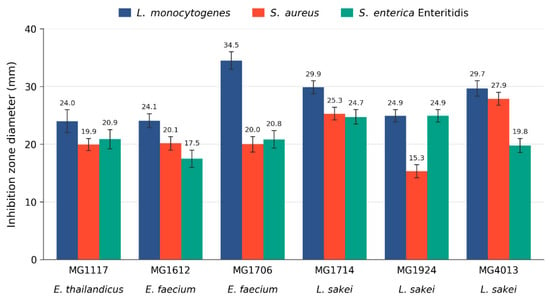
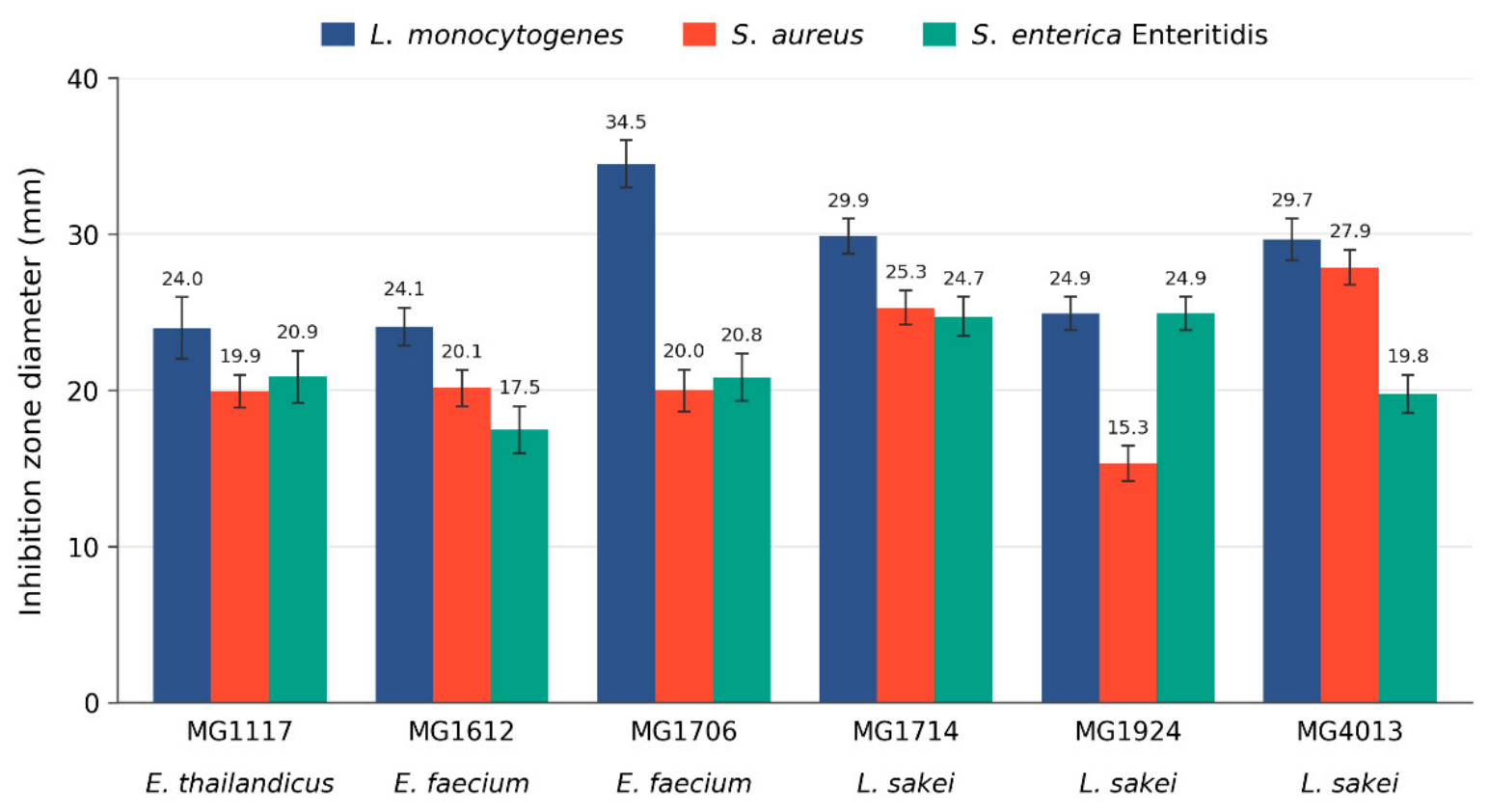
The results demonstrate that all LAB isolates exhibited measurable antibacterial activity against the three indicator pathogens, although the magnitude of inhibition was clearly strain- and pathogen-dependent. Overall, L. monocytogenes was the most susceptible target, with inhibition zones ranging from 24.0 to 34.5 mm, and the strongest activity being recorded for MG1706 (E. faecium; 34.5 mm), followed by MG1714 and MG4013 (L. sakei; 29.9 and 29.7 mm, respectively). In contrast, inhibition of Salmonella was comparatively moderate and less variable (17.5–24.9 mm), with the highest activity observed for MG1714 and MG1924 (24.7 and 24.9 mm). The response of S. aureus was more heterogeneous (15.3–27.9 mm), with MG4013 showing the greatest inhibitory effect (27.9 mm), whereas MG1924 exhibited the weakest anti-staphylococcal activity (15.3 mm). Collectively, these findings indicate substantial functional heterogeneity among the LAB isolates and identify MG1706, MG1714, and MG4013 as the most promising candidates, owing to their strong and/or broad-spectrum antibacterial performance (Figure 1). Neutralized CFS retained antimicrobial activity, suggesting that the inhibitory effect may not be solely due to organic acids and could involve bacteriocin-like substances (Figure S1).
Figure 1.
Antibacterial activity of the six selected LAB isolates against L. monocytogenes, S. aureus, and S. enterica ser. Enteritidis (inhibition zone diameter, mm; agar well diffusion). Values are means of two determinations; bars indicate the range.
3.5. Proteolytic, Gelatinase, Hemolytic and Lipolytic Activity
None of the isolates showed proteolytic, lipolytic, hemolytic or gelatinase activity. This confirms their potential suitability for food preservation without causing undesirable degradation of meat proteins or fats.
3.6. Antibiotic Resistance
Table 4 shows the antibiotic susceptibility profiles of the three Enterococcus isolates. Across the thirteen agents tested, every response fell into the susceptible (S) or intermediate (I) category and none of these isolates reached the resistance breakpoint. Antibiotic susceptibility data are not reported here for the three L. sakei isolates.
Table 4.
Antibiotic susceptibility profiles of the Enterococcus isolates.
The two E. faecium isolates did not share a common profile, indicating that susceptibility in this collection is strain-dependent rather than species-dependent. Intermediate responses were distributed across unrelated antibiotic classes rather than clustering within a single class, a pattern more consistent with strain-level phenotypic variation than with a shared resistance mechanism. Because an intermediate phenotype does not in itself indicate an acquired or transferable determinant, these responses are interpreted here as an indication for genotypic follow-up rather than as evidence of resistance.
Overall, these profiles are favourable for food application, although the intermediate responses indicate that further phenotypic and genotypic characterization is required before the strains can be exploited for technological or probiotic purposes [29] (Table 4).
3.7. Cross-Antagonism Activity Between Selected Strains
The cross-antagonism assay indicated that the LAB isolates’ inhibitory network was rather strain-dependent, with most pairwise interactions showing no detectable antagonism. Thus, the inhibition effect was not general but limited to some combinations of producer indicators. It is important to note that isolates from the same species did not share the same activity profiles, indicating a large intraspecific variability. Among the isolates tested, one isolate of L. sakei exhibited the broadest inhibitory spectrum with strong activity against MG 1924 and additional inhibition against MG 1117 and MG 4013. The other strains of L. sakei showed a different and narrower pattern of antagonism. The two E. faecium isolates also exhibited a significant difference: one isolate exhibited significant inhibition, especially against MG 4013, while the other isolate exhibited no detectable action. Overall, the results show a significant inter- and intraspecific variability in antagonistic potential, indicating the isolate-specific character of inhibitory activity in this collection of LAB (Table 5).
Table 5.
Cross-antagonistic activity among LAB isolates assessed by inhibition zone assay.
3.8. Biochemical and Molecular Identification of Selected Isolates
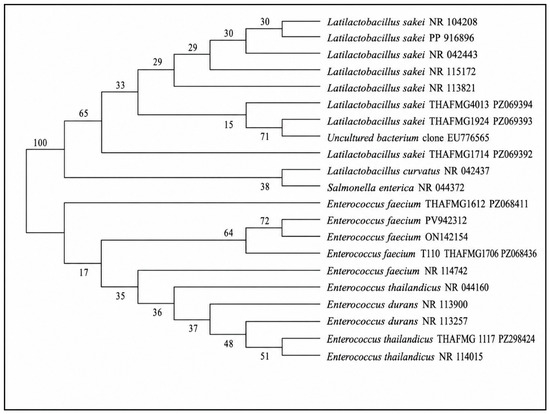
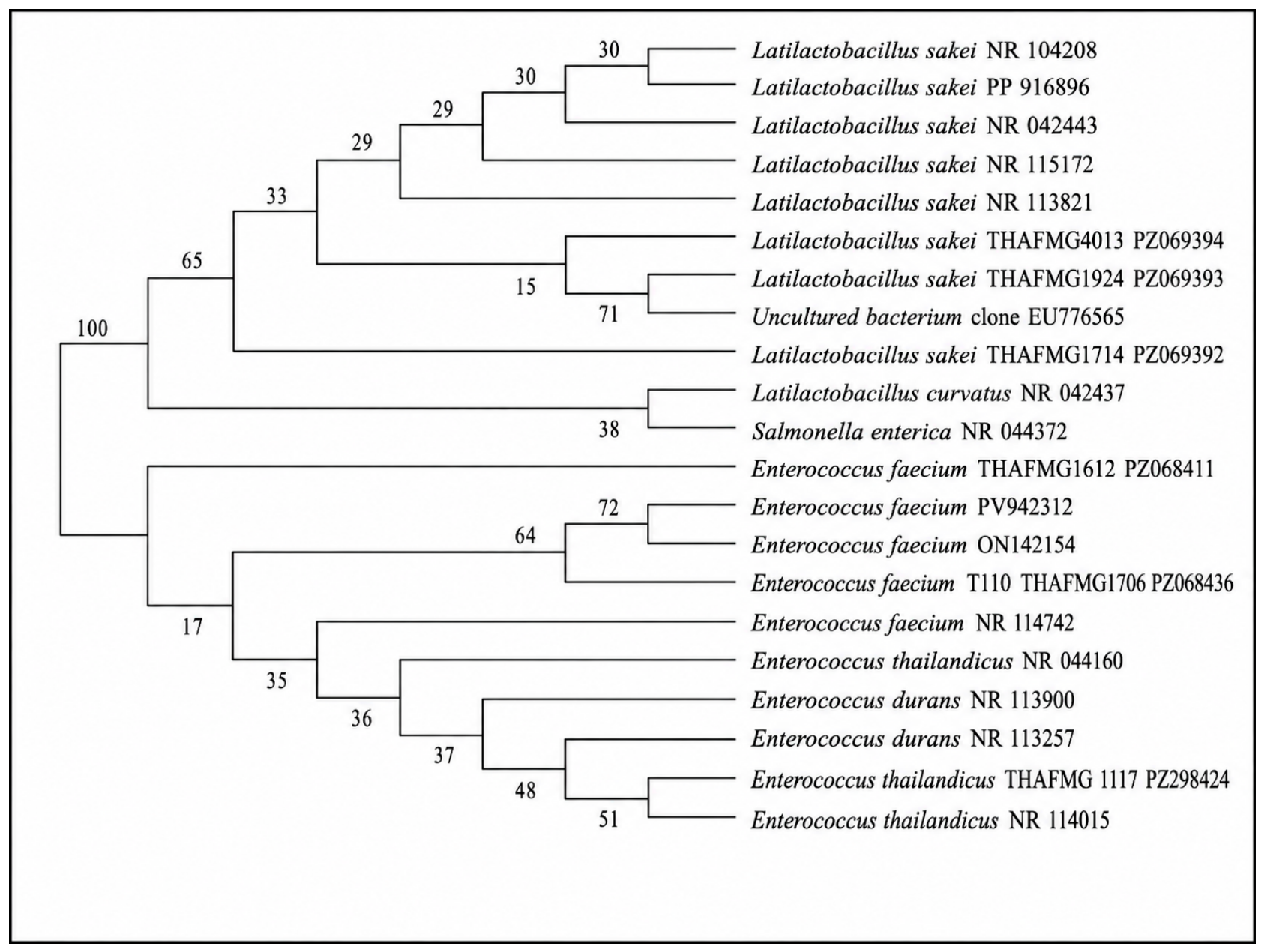
API 20 Strep profiling preliminarily identified most isolates as E. faecium. API 50 CHL profiling preliminarily identified three of the isolates as Latilactobacillus. Molecular analysis using molecular-biology reagents and sequencing instruments supplied by Thermo Fisher Scientific (Waltham, MA, USA), confirmed two isolates as E. faecium and one as E. thailandicus, and revealed that a distinct group belonged to L. sakei (three isolates), with similarity values ranging from 86.82% to 99.44% and high query coverage. Phylogenetic analysis further supported these assignments, clustering the isolates into two well-defined clades corresponding to the genera Enterococcus and Latilactobacillus. An external sequence (S. enterica subsp. salamae) was used as an outgroup, allowing clear rooting of the tree and confirming the phylogenetic separation between enterococci and lactobacilli (Figure 2).
Figure 2.
Phylogenetic tree of selected LAB using 16S ribosomal RNA partial sequence.
4. Discussion
The present study showed that goat meat produced in the argan grove production system of Souss-Massa is a prospective source of naturally occurring lactic acid bacteria (LAB) with antagonistic properties. Active isolates were recovered from fresh, fermented and dried-fermented goat meat indicating the presence of functionally important LAB in these traditional meat products. The number of isolates of antimicrobial activity was higher in fermented and dried-fermented samples than in fresh meat. This can be related to the selection pressure applied in processing such as decrease in water activity, salt exposure, acidification and competition between micro-organisms.
Traditional fermented meat products were previously identified as valuable sources of autochthonous LAB with antibacterial, technological and bioprotective potential [29,30]. However, the traits identified in this study cannot be directly linked to the argan grove environment as no LAB isolated from non-argan production systems and commercial reference cultures were included for comparison. Consequently, these isolates should be considered potential candidates associated with the argan-based goat production system rather than unique strains specifically linked to Argania spinosa. Although post-slaughter hygiene, processing, and storage conditions directly shape the microbial communities developing on meat, the argan-based diet may indirectly influence the microbiota by modifying the animals’ gastrointestinal and associated microbial populations, some of which may be transferred to the carcass during slaughter and subsequent handling. Additional comparative studies with isolates from different geographical locations and production systems are needed to determine whether the environment of the argan grove influences specific microbiological or functional properties [13,31].
The discovered isolates were E. thailandicus, E. faecium and L. sakei and they all demonstrated growth in MRS, GM17, M17 and BHI media. The wide culturability suggests metabolic flexibility and justifies their technological importance for meat-based fermentation or biopreservation systems. The recovery of L. sakei is of special relevance given the significant association of this species with meat and fermented meat habitats and its widespread recognition as adapted to protein-rich environments [32,33]. Enterococcus spp. are also expected in traditional fermented foods, but their application as protective cultures requires more rigorous safety assessment because members of this genus may possess strain-dependent virulence features or antibiotic resistance determinants.
The antimicrobial assay showed specific inhibition which is strain and pathogen dependent. Among the investigated indicator pathogens, L. monocytogenes exhibited the highest susceptibility with inhibition zones of 34.5 mm for E. faecium MG1706, and 29.9 and 29.7 mm for L. sakei MG1714 and MG4013. This significant anti-Listeria activity is of great relevance since L. monocytogenes is still one of the most major safety concerns in ready-to-eat and fermented meat products. Recent reviews highlight that LAB inhibits L. monocytogenes by several methods including organic acids generation, bacteriocins synthesis, competition for nutrients and ecological dominance in the food matrix [34].
The continued antibacterial activity after neutralization of the cell-free supernatants implies that suppression was not solely due to acidification. This result supports the likely participation of bacteriocin-like inhibitory compounds or other pH-independent antimicrobial metabolites. Similar interpretations have been reported for LAB isolated from traditional meat products, where neutralized supernatants retained activity against Listeria and other Gram-positive pathogens, indicating probable bacteriocin mediated effects [13,34]. However, the bacteriocin-like nature of the inhibitory compounds should be proved by proteolytic enzyme sensitivity, molecular screening of bacteriocin genes, purification and mass spectrometric characterization.
The higher inhibition of L. monocytogenes than of S. enterica seems biologically plausible since the outer membrane of Gram-negative bacteria is a permeability barrier that may restrict the access of LAB-derived bacteriocins and antimicrobial peptides to their cellular targets [35]. Nevertheless, the moderate inhibition of Salmonella observed in this study is still of technological relevance, particularly because LAB metabolites may contribute to the control of pathogens when combined with complementary preservation hurdles such as refrigeration, salt, vacuum packaging, modified-atmosphere packaging or plant-derived antimicrobials [36,37]. Thus, the present results suggest that LAB-based bioprotection should be considered as a part of an integrated hurdle strategy and not as a single antimicrobial measure.
The lack of hemolytic, gelatinase, proteolytic and lipolytic activities of the selected LAB isolates was considered as a safety advantage [38,39]. The lack of hemolytic activity reduces concerns about cytotoxicity and possible pathogenicity, and the lack of gelatinase is especially relevant as gelatinase production is considered an undesirable virulence-associated trait, particularly in food-associated Enterococcus strains [38]. Absence of significant proteolytic and lipolytic activities also indicates that the isolates are unlikely to cause over-degradation of meat proteins and lipids, which could affect texture, flavour development and product stability in fermented meat systems. In conclusion, the safety-related traits shown by the selected isolates qualify them as candidates for further technological testing as potential bioprotective cultures.
Antibiotic susceptibility profiles are presented here only for Enterococcus isolates (Table 4). Susceptibility is strain-specific not species-specific and cannot be predicted on the basis of species identity. For instance, L. sakei subsp. sakei 2a [40] was found to be multidrug resistant and positive for vanA, underscoring the importance of safety screening at the strain level.
The varied patterns identified for the E. faecium isolates are in keeping with the variability observed in enterococci associated with diet. Food-derived E. faecium strains were reported to be resistant to aminoglycosides and phenotypically susceptible based on genetic resistance factors [40,41,42]. The absence of transmissible or acquired resistance genes is not implied by intermediate inhibition.
The phenotypic characterization of Enterococcus thailandicus MG1117 can likewise be considered preliminary. Some isolates are phenotypically susceptible, although clinically relevant resistance genes such as optrA and poxtA have been discovered in public E. thailandicus genomes [43]. Thus, MG1117 is a potential candidate, but a quantitative MIC determination and whole-genome screening for acquired resistance genes and mobile genetic elements according to EFSA safety-assessment guidelines are required before introduction into food cultures [44] (Table 4 and Table 5). This is important because the E. faecium from food, livestock and environmental sources can carry resistance determinants, virulence-associated markers, plasmids and mobile genetic elements [41,45]. However, the presence of phenotypic resistance does not exclude a strain to be used in food application, since some resistance traits in enterococci might be intrinsic rather than acquired [46]. The main safety concern is related to the presence of transferable antimicrobial resistance genes, especially when in association with plasmids or other mobile genetic elements [47]. Any additional use of the E. faecium isolates should therefore be subject to whole-genome sequencing including specific screening for acquired antimicrobial resistance genes, virulence determinants, plasmids, insertion sequences and other mobile genetic elements [48]. This recommendation is in accordance with the EFSA QPS framework, which evaluates taxonomic identity, body of knowledge and safety concerns, including strain-level qualifications where relevant, for microorganisms intentionally introduced into the food or feed chain [44].
The cross-antagonism test also validates the need for strain level selection to produce multi-strain starter or protection cultures. Most pairwise interactions did not show noticeable inhibition indicating that numerous isolates may be compatible for combination use. However, the presence of strong or moderate antagonistic interactions in several selected pairs, suggests that inhibitory activity across LAB is not homogeneous but extremely strain specific [48,49]. This is particularly important in the design of starter cultures, as incompatible strains may inhibit each other during fermentation, leading to a reduction in population stability, metabolic performance and antibacterial activity [48,49,50,51]. By contrast, suitable strains with overlapping technical and antibacterial spectra may be useful for enhanced pathogen control, consistency in fermentation and ecological stability within complicated food matrices [30].
Thus, regarding the dataset combination, MG4013 appears to be the most promising candidate due to its strong antibacterial activity, lack of negative enzymatic activities and good compatibility profile, although its antibiotic susceptibility remains to be determined. Such a multi-criterion prioritization approach is in line with recent LAB selection frameworks proposing the evaluation of antimicrobial efficacy in combination with technical applicability and safety-related properties rather than in isolation [48]. Also, MG1714 showed a promising profile due to its significant anti-Listeria activity, but its antibiotic susceptibility remains to be established by standardized MIC based susceptibility testing before any application-oriented claim can be made [51,52]. The antibiotic resistance profile should be considered cautiously, even though the highest anti-Listeria activity was observed in MG1706. MG1706 should be considered a potential source of antimicrobial metabolites or bacteriocin-associated genes and not a ready-to-use live protective culture until whole-genome sequencing has been conducted to rule out the presence of acquired antimicrobial-resistance genes, virulence determinants, plasmids and other mobile genetic elements [44,53].
This study has the advantage of focusing on an under-researched ecological and cultural niche, i.e., goat meat from animals bred in the ecology of the argan grove in Souss-Massa. Unique microbial communities can be found in such traditional agro-sylvo-pastoral systems, which are moulded by the local vegetation, animal husbandry, climate and processing processes. This makes the study of microbiological and biotechnological relevance. However, there are some limits that need to be acknowledged. First, the study is based on culture-dependent isolation, which could lead to an underestimation of the total variety of LAB. Second, antimicrobial activity was evaluated in vitro and real meat systems may show different performances due to matrix effects, salt concentration, lipid content, pH, temperature and microbial competition. Third, 16S rRNA sequencing allows meaningful taxonomic assignment but is not discriminative enough for comprehensive safety assessment. Thus, future work should comprise whole-genome sequencing, metabolomic analysis of cell-free supernatants, bacteriocin purification, challenge tests in goat meat and sensory evaluation under realistic storage circumstances.
5. Conclusions
The present study indicates that Moroccan goat meat from the Souss-Massa argan grove ecosystem is a promising source of native LAB with bioprotective potential. The selected isolates exhibited a wide growth capacity, relevant physiological adaptability and measurable antimicrobial activity against main foodborne pathogens, especially L. monocytogenes. The inhibition after neutralization of pH indicates that antimicrobial effects may involve bacteriocin-like or other non-acidic metabolites. Among the tested strains, L. sakei MG4013 showed the most promising results, due to its wide spectrum of antimicrobial activity, and the absence of hemolytic, gelatinase, proteolytic and lipolytic activities. These results favour the use of some selected indigenous LAB as natural protective cultures for traditional meat products and as a clean-label preservation strategy. However, genomic safety evaluation, bacteriocin characterization and in situ validation in goat meat products are required before industrial application.
Supplementary Materials
The following supporting information can be downloaded at: https://www.mdpi.com/article/10.3390/applmicrobiol6080095/s1, Figure S1: Antibacterial activity of the selected lactic acid bacteria isolates against the indicator pathogens by agar well diffusion. Wells (8 mm diameter) were loaded with 100 µL of cell-free supernatant from each isolate and plates were incubated at 37 °C for 24 h. (a) Isolates MG1117, MG1612, MG1706 and MG1714; (b) isolates MG1924 and MG4013. CN, negative control.
Author Contributions
Conceptualization, H.T. and F.A.; methodology, H.T. and Y.E.; validation, Y.E. and M.Z.; formal analysis, M.Z. and A.E.; investigation, H.T. and M.A.; resources, F.A.; data curation, M.A. and A.E.; writing—original draft, H.T.; writing—review and editing, Y.E., M.Z. and F.A.; supervision, F.A.; funding acquisition, F.A. All authors have read and agreed to the published version of the manuscript.
Funding
The authors would like to express their gratitude to the EU PRIMA programme and the Moroccan Ministry of Higher Education, Scientific Research and Innovation (MESRSI) for their support of the Pas-Agro-Pas project [Grant number PRIMA/0016/2022].
Institutional Review Board Statement
Not applicable.
Informed Consent Statement
Not applicable.
Data Availability Statement
The 16S rRNA gene sequences generated in this study have been deposited in NCBI GenBank under accession numbers PZ298424, PZ068411, PZ068436, PZ069392, PZ069393 and PZ069394. All other data are contained within the article.
Acknowledgments
Generative AI tools were used to assist in the preparation of the graphical abstract and to improve the English language, grammar, and clarity of the manuscript. The scientific content, data interpretation, conclusions, and final version of the manuscript were carefully reviewed and validated by the authors.
Conflicts of Interest
The authors declare no conflicts of interest.
References
- Hussein, A.; Aseffa, S.; Kuraz, B.; Bedaso, B. Breeding and Milking Managements and Goat Production Constraints in Siltie Zone SNNPR, Ethiopia. Heliyon 2023, 9, e22573. [Google Scholar] [CrossRef] [Scilit] [PubMed]
- Meskour, B.; Labbaci, A.; Ait El Kadi, M.; Hakam, O.; Ongoma, V.; Hssaisoune, M.; Tairi, A.; El Hafyani, M.; Bouchaou, L. Drought and Vegetation Dynamics in Dryland of Arganeraie Biosphere Reserve in Morocco: Toward an Understanding of the Impact of Environmental Shocks on the Agro-Sylvo-Pastoral System. Silva Fenn. 2025, 59, 24056. [Google Scholar] [CrossRef] [Scilit]
- Fassih, B.; Ait-El-Mokhtar, M.; Douch, A.N.; Boutasknit, A.; Ben-Laouane, R.; Aganchich, B.; Wahbi, S. The Impact of Browsing Intensity on Argan Trees in the Essaouira Region of Morocco. J. Arid. Environ. 2025, 231, 105472. [Google Scholar] [CrossRef] [Scilit]
- Zapaśnik, A.; Sokołowska, B.; Bryła, M. Role of Lactic Acid Bacteria in Food Preservation and Safety. Foods 2022, 11, 1283. [Google Scholar] [CrossRef] [Scilit] [PubMed]
- Anumudu, C.K.; Miri, T.; Onyeaka, H. Multifunctional Applications of Lactic Acid Bacteria: Enhancing Safety, Quality, and Nutritional Value in Foods and Fermented Beverages. Foods 2024, 13, 3714. [Google Scholar] [CrossRef] [Scilit] [PubMed]
- Chauhan, K.; Rao, A. Clean-Label Alternatives for Food Preservation: An Emerging Trend. Heliyon 2024, 10, e35815. [Google Scholar] [CrossRef] [Scilit] [PubMed]
- Dong, H.; Xu, Y.; Zhang, Q.; Li, H.; Chen, L. Activity and Safety Evaluation of Natural Preservatives. Food Res. Int. 2024, 190, 114548. [Google Scholar] [CrossRef] [Scilit] [PubMed]
- Achemchem, F.; Cebrián, R.; Abrini, J.; Martínez-Bueno, M.; Valdivia, E.; Maqueda, M. Antimicrobial Characterization and Safety Aspects of the Bacteriocinogenic Enterococcus hirae F420 Isolated from Moroccan Raw Goat Milk. Can. J. Microbiol. 2012, 58, 596–604. [Google Scholar] [CrossRef] [Scilit] [PubMed]
- Elidrissi, A.; Ezzaky, Y.; Boussif, K.; Achemchem, F. Isolation and Characterization of Bioprotective Lactic Acid Bacteria from Moroccan Fish and Seafood. Braz. J. Microbiol. 2023, 54, 2117–2127. [Google Scholar] [CrossRef] [Scilit] [PubMed]
- Benguiar, R.; Benaraba, R.; Farhat, C.; Chouchane, H.; Boughaddou, D.; Belalem, F.; Cherif, A. Antioxidant, Anti-Inflammatory, Antagonistic, and Probiotic Properties of Lactic Acid Bacteria Isolated from Traditional Algerian Fermented Wheat. Microorganisms 2025, 13, 1852. [Google Scholar] [CrossRef] [Scilit] [PubMed]
- Piedra, V.; Usaga, J.; Redondo-Solano, M.; Uribe-Lorío, L.; Valenzuela-Martínez, C.; Barboza, N. Inhibiting Potential of Selected Lactic Acid Bacteria Isolated from Costa Rican Agro-Industrial Waste against Salmonella sp. in Yogurt. Ital. J. Food Saf. 2024, 14, 12494. [Google Scholar] [CrossRef] [Scilit] [PubMed]
- Albene, D.; Lema, N.K.; Tesfaye, G.; Andeta, A.F.; Ali, K.; Guadie, A. Probiotic Potential of Lactic Acid Bacteria Isolated from Ethiopian Traditional Fermented Cheka Beverage. Ann. Microbiol. 2024, 74, 25. [Google Scholar] [CrossRef] [Scilit]
- Azevedo, I.; Barbosa, J.; Albano, H.; Nogueira, T.; Teixeira, P. Lactic Acid Bacteria Isolated from Traditional and Innovative Alheiras as Potential Biocontrol Agents. Food Microbiol. 2024, 119, 104450. [Google Scholar] [CrossRef] [Scilit] [PubMed]
- Mouafik, M.; Chakhchar, A.; Fouad, M.; El Aboudi, A. Remote Sensing Technologies for Monitoring Argane Forest Stands: A Comprehensive Review. Geographies 2024, 4, 441–461. [Google Scholar] [CrossRef] [Scilit]
- Guo, W.; Zhou, M.; Li, F.; Neves, A.L.A.; Ma, T.; Bi, S.; Wang, W.; Long, R.; Guan, L.L. Seasonal Stability of the Rumen Microbiome Contributes to the Adaptation Patterns to Extreme Environmental Conditions in Grazing Yak and Cattle. BMC Biol. 2024, 22, 240. [Google Scholar] [CrossRef] [Scilit] [PubMed]
- Chebli, Y.; El Otmani, S.; Elame, F.; Moula, N.; Chentouf, M.; Hornick, J.-L.; Cabaraux, J.-F. Silvopastoral System in Morocco: Focus on Their Importance, Strategic Functions, and Recent Changes in the Mediterranean Side. Sustainability 2021, 13, 10744. [Google Scholar] [CrossRef] [Scilit]
- Wang, Y.; Wang, X.; Wang, Y.; Liao, S.; Pubu, Z.; Silang, J.; Chai, L.; Zhao, S. Dietary and Environmental Factors Affecting the Dynamics of the Gut Bacteria in Tibetan Awang Sheep (Ovis aries) across Divergent Breeding Models. Front. Microbiol. 2025, 16, 1502898. [Google Scholar] [CrossRef] [Scilit] [PubMed]
- Florek, M.; Domaradzki, P.; Skałecki, P.; Ryszkowska-Siwko, M.; Ziomek, M.; Tajchman, K.; Gondek, M.; Pyz-Łukasik, R. Content and Solubility of Collagen and Their Relation to Proximate Composition and Shear Force of Meat from Different Anatomical Location in Carcass of European Beaver (Castor fiber). Foods 2022, 11, 1288. [Google Scholar] [CrossRef] [Scilit] [PubMed]
- Barcenilla, C.; Cobo-Díaz, J.F.; Puente, A.; Valentino, V.; De Filippis, F.; Ercolini, D.; Carlino, N.; Pinto, F.; Segata, N.; Prieto, M.; et al. In-Depth Characterization of Food and Environmental Microbiomes across Different Meat Processing Plants. Microbiome 2024, 12, 199. [Google Scholar] [CrossRef] [Scilit] [PubMed]
- Dilio, G.; Blasi, F.; Tofani, S.; Albini, E.; Orsini, S.; Ciullo, M.; Massacci, F.R.; Pesciaroli, M.; Pezzotti, G.; Magistrali, C.F. Prevalence of ESBL-Producing Escherichia coli on Neck Skin in Slaughtered Broilers Raised on Conventional, Antibiotic-Free, and Organic Farms. Pathogens 2025, 14, 1265. [Google Scholar] [CrossRef] [Scilit] [PubMed]
- Bhattacharya, D.; Nanda, P.K.; Pateiro, M.; Lorenzo, J.M.; Dhar, P.; Das, A.K. Lactic Acid Bacteria and Bacteriocins: Novel Biotechnological Approach for Biopreservation of Meat and Meat Products. Microorganisms 2022, 10, 2058. [Google Scholar] [CrossRef] [Scilit] [PubMed]
- Roselli, M.; Colafranceschi, F.; Cipriani, V.; Valle, A.; Zinno, P.; Guantario, B.; Schifano, E.; Uccelletti, D.; Devirgiliis, C. Isolation and Characterization of Lactic Acid Bacteria from an Italian Traditional Raw Milk Cheese: Probiotic Properties and Technological Performance of Selected Strains. Microorganisms 2025, 13, 1368. [Google Scholar] [CrossRef] [Scilit] [PubMed]
- Kasimin, M.E.; Shamsuddin, S.; Molujin, A.M.; Sabullah, M.K.; Gansau, J.A.; Jawan, R. Enterocin: Promising Biopreservative Produced by Enterococcus sp. Microorganisms 2022, 10, 684. [Google Scholar] [CrossRef] [Scilit] [PubMed]
- Loforte, Y.; Fernandes, N.; De Almeida, A.M.; Cadavez, V.; Gonzales-Barron, U. A Meta-Analysis on the In Vitro Antagonistic Effects of Lactic Acid Bacteria from Dairy Products on Foodborne Pathogens. Foods 2025, 14, 907. [Google Scholar] [CrossRef] [Scilit] [PubMed]
- Li, W.; Wu, Q.; Kwok, L.; Zhang, H.; Gan, R.; Sun, Z. Population and Functional Genomics of Lactic Acid Bacteria, an Important Group of Food Microorganism: Current Knowledge, Challenges, and Perspectives. Food Front. 2024, 5, 3–23. [Google Scholar] [CrossRef] [Scilit]
- Denkova, Z.; Zapryanova, P.; Gaytanska, Y.; Goranov, B.; Shopska, V.; Denkova-Kostova, R.; Kostov, G. Isolation, Identification, and Characterization of Probiotic Properties of Lactic Acid Bacterial Strains Isolated from Rose Blossom of Rosa damascena Mill. Processes 2025, 13, 1644. [Google Scholar] [CrossRef] [Scilit]
- Mijid, N.; Namshir, B.; Kim, G.-H.; Lkhagvasuren, N.; Kim, W.S. Identification and Characterization of Lacticaseibacillus paracasei HKWS110 Isolated from Prunus yedoensis. Food Sci. Anim. Resour. 2025, 45, 1840–1855. [Google Scholar] [CrossRef] [Scilit] [PubMed]
- ISO 22174:2024; Microbiology of the Food Chain—Polymerase Chain Reaction (PCR) for the Detection and Quantification of Microorganisms—General Requirements and Definitions. International Organization for Standardization: Geneva, Switzerland, 2024.
- Nikodinoska, I.; Tabanelli, G.; Baffoni, L.; Gardini, F.; Gaggìa, F.; Barbieri, F.; Di Gioia, D. Characterization of Lactic Acid Bacteria Isolated from Spontaneously Fermented Sausages: Bioprotective, Technological and Functional Properties. Foods 2023, 12, 727. [Google Scholar] [CrossRef] [Scilit] [PubMed]
- Boubakri, K.; Idoui, T.; Aristimuño Ficoseco, M.C.; Segli, F.; Castellano, P.; Saavedra, L.; Vignolo, G. Autochthonous Lactic Acid Bacteria from Kaddid as Functional Starter Culture to Improve Quality and Safety. Discov. Food 2025, 5, 113. [Google Scholar] [CrossRef] [Scilit]
- Sato, Y.; Sato, R.; Fukui, E.; Yoshizawa, F. Impact of Rumen Microbiome on Cattle Carcass Traits. Sci. Rep. 2024, 14, 6064. [Google Scholar] [CrossRef] [Scilit] [PubMed]
- Yu, L.; Chen, Y.; Duan, H.; Qiao, N.; Wang, G.; Zhao, J.; Zhai, Q.; Tian, F.; Chen, W. Latilactobacillus sakei: A Candidate Probiotic with a Key Role in Food Fermentations and Health Promotion. Crit. Rev. Food Sci. Nutr. 2024, 64, 978–995. [Google Scholar] [CrossRef] [Scilit] [PubMed]
- Carneiro, K.O.; Campos, G.Z.; Scafuro Lima, J.M.; Rocha, R.D.S.; Vaz-Velho, M.; Todorov, S.D. The Role of Lactic Acid Bacteria in Meat Products, Not Just as Starter Cultures. Foods 2024, 13, 3170. [Google Scholar] [CrossRef] [Scilit] [PubMed]
- Ferrer-Bustins, N.; Costa, J.C.C.P.; Pérez-Rodríguez, F.; Martín, B.; Bover-Cid, S.; Jofré, A. The Antilisterial Effect of Latilactobacillus sakei CTC494 in Relation to Dry Fermented Sausage Ingredients and Temperature in Meat Simulation Media. Fermentation 2024, 10, 326. [Google Scholar] [CrossRef] [Scilit]
- Charest, A.M.; Reed, E.; Bozorgzadeh, S.; Hernandez, L.; Getsey, N.V.; Smith, L.; Galperina, A.; Beauregard, H.E.; Charest, H.A.; Mitchell, M.; et al. Nisin Inhibition of Gram-Negative Bacteria. Microorganisms 2024, 12, 1230. [Google Scholar] [CrossRef] [Scilit] [PubMed]
- Yan, Y.; Zhang, Y.; Fang, Z.; Wang, Z.-C.; Nan, Y.; Shi, H.; Zhang, H.; Song, W.; Gu, H. Modified Atmosphere Packaging and Plant Extracts Synergistically Enhance the Preservation of Meat: A Review. Food Control 2024, 164, 110622. [Google Scholar] [CrossRef] [Scilit]
- Karbowiak, M.; Szymański, P.; Zielińska, D. Synergistic Effect of Combination of Various Microbial Hurdles in the Biopreservation of Meat and Meat Products—Systematic Review. Foods 2023, 12, 1430. [Google Scholar] [CrossRef] [Scilit] [PubMed]
- Sakoui, S.; Derdak, R.; Pop, O.L.; Vodnar, D.C.; Jouga, F.; Teleky, B.-E.; Addoum, B.; Simon, E.; Suharoschi, R.; Soukri, A.; et al. Exploring Technological, Safety and Probiotic Properties of Enterococcus Strains: Impact on Rheological Parameters in Fermented Milk. Foods 2024, 13, 586. [Google Scholar] [CrossRef] [Scilit] [PubMed]
- Megur, A.; Daliri, E.B.-M.; Balnionytė, T.; Stankevičiūtė, J.; Lastauskienė, E.; Burokas, A. In Vitro Screening and Characterization of Lactic Acid Bacteria from Lithuanian Fermented Food with Potential Probiotic Properties. Front. Microbiol. 2023, 14, 1213370. [Google Scholar] [CrossRef] [Scilit] [PubMed]
- Lipilkina, T.A.; Xu, C.; Barbosa, M.D.S.; Khramova, V.N.; Shebeko, S.K.; Ermakov, A.M.; Ivanova, I.V.; Todorov, S.D. Beneficial and Safety Properties of a Bacteriocinogenic and Putative Probiotic Latilactobacillus sakei Subsp. Sakei 2a Strain. Foods 2024, 13, 3770. [Google Scholar] [CrossRef] [Scilit] [PubMed]
- Daza Prieto, B.; Raicevic, N.; Martinovic, A.; Ladstätter, J.; Zuber Bogdanovic, I.; Schorpp, A.; Stoeger, A.; Mach, R.L.; Ruppitsch, W.; Cabal, A. Genetic Diversity and Distinction of Enterococcus faecium and Enterococcus lactis in Traditional Montenegrin Brine Cheeses and Salamis. Front. Microbiol. 2024, 15, 1473938. [Google Scholar] [CrossRef] [Scilit] [PubMed]
- Xiao, J.; Chen, C.; Fu, Z.; Wang, S.; Luo, F. Assessment of the Safety and Probiotic Properties of Enterococcus faecium B13 Isolated from Fermented Chili. Microorganisms 2024, 12, 994. [Google Scholar] [CrossRef] [Scilit] [PubMed]
- Vázquez-Ucha, J.C.; Almeida-Santos, A.C.; Velasco, D.; Rodríguez-Pallares, S.; Outeda-García, M.; Rodríguez-Coello, A.; Fernández, A.; Aja-Macaya, P.; Novais, C.; Beceiro, A.; et al. Enterococcus thailandicus: Genomic Evidence of a Potential New Player in Enterococcal Virulence and Antimicrobial Resistance. New Microbes New Infect. 2026, 70, 101711. [Google Scholar] [CrossRef] [Scilit] [PubMed]
- EFSA Panel on Biological Hazards (BIOHAZ); Allende, A.; Alvarez-Ordóñez, A.; Bortolaia, V.; Bover-Cid, S.; De Cesare, A.; Dohmen, W.; Guillier, L.; Jacxsens, L.; Nauta, M.; et al. Update of the List of Qualified Presumption of Safety (QPS) Recommended Microbiological Agents Intentionally Added to Food or Feed as Notified to EFSA 21: Suitability of Taxonomic Units Notified to EFSA until September 2024. EFSA J. 2025, 23, e9169. [Google Scholar] [CrossRef] [Scilit] [PubMed]
- Lopes, J.; De Lencastre, H.; Conceição, T. Genomic Analysis of Enterococcus faecium from Non-Clinical Settings: Antimicrobial Resistance, Virulence, and Clonal Population in Livestock and the Urban Environment. Front. Microbiol. 2024, 15, 1466990. [Google Scholar] [CrossRef] [Scilit] [PubMed]
- Geniş, B.; Öztürk, H.; Özden Tuncer, B.; Tuncer, Y. Safety Assessment of Enterocin-Producing Enterococcus Strains Isolated from Sheep and Goat Colostrum. BMC Microbiol. 2024, 24, 391. [Google Scholar] [CrossRef] [Scilit] [PubMed]
- Kaszab, E.; Laczkó, L.; Kardos, G.; Bányai, K. Antimicrobial Resistance Genes and Associated Mobile Genetic Elements in Lactobacillales from Various Sources. Front. Microbiol. 2023, 14, 1281473. [Google Scholar] [CrossRef] [Scilit] [PubMed]
- Gephart, G.J.; Abdelhamid, A.G.; Yousef, A.E. Comparative Genomics and Phenotypic Assessment of Lactic Acid Bacteria Isolated from Artisanal Cheese as Potential Starter Cultures. LWT 2024, 210, 116849. [Google Scholar] [CrossRef] [Scilit]
- Azzouz, S. Evaluating Autochthonous Lactic Acid Bacteria for the Production of Moroccan Jben Cheese. Mljekarstvo 2025, 75, 78–90. [Google Scholar] [CrossRef] [Scilit]
- Girma, B.; Desalegn, A.; Birri, D.J.; Ashenafi, M.; Tigu, F. Development of a Defined Mixed Starter Culture for the Improvement of Tej, Ethiopian Honey Wine. Food Sci. Technol. Int. 2025, 31, 725–739. [Google Scholar] [CrossRef] [Scilit] [PubMed]
- Hernández Figueroa, R.H.; López-Malo, A.; Mani-López, E. Antimicrobial Activity and Applications of Fermentates from Lactic Acid Bacteria—A Review. Sustain. Food Technol. 2024, 2, 292–306. [Google Scholar] [CrossRef] [Scilit]
- Díaz-Formoso, L.; Contente, D.; Feito, J.; Orgaz, B.; Hernández, P.E.; Borrero, J.; Muñoz-Atienza, E.; Cintas, L.M. Antimicrobial Activity, Genetic Diversity and Safety Assessment of Lactic Acid Bacteria Isolated from European Hakes (Merluccius merluccius, L.) Caught in the Northeast Atlantic Ocean. Antibiotics 2025, 14, 469. [Google Scholar] [CrossRef] [Scilit] [PubMed]
- Chen, T.; Zhao, Y.; Fan, Y.; Dong, Y.; Gai, Z. Genome Sequence and Evaluation of Safety and Probiotic Potential of Lacticaseibacillus paracasei LC86 and Lacticaseibacillus casei LC89. Front. Microbiol. 2025, 15, 1501502. [Google Scholar] [CrossRef] [Scilit] [PubMed]

Disclaimer/Publisher’s Note: The statements, opinions and data contained in all publications are solely those of the individual author(s) and contributor(s) and not of MDPI and/or the editor(s). MDPI and/or the editor(s) disclaim responsibility for any injury to people or property resulting from any ideas, methods, instructions or products referred to in the content. |
© 2026 by the authors. Licensee MDPI, Basel, Switzerland. This article is an open access article distributed under the terms and conditions of the Creative Commons Attribution (CC BY) license.