


Abstract
Zinc deficiency in agricultural soils limits food security and the nutritional quality of crops. Purslane (Portulaca oleracea L.) is a leafy vegetable of growing interest as a functional food owing to its high content of omega-3 fatty acids, minerals, and antioxidant compounds. Zinc oxide nanoparticles (ZnO-NPs) are an innovative strategy for agronomic biofortification and for stimulating the synthesis of bioactive compounds. This study evaluated the effect of the foliar application of increasing concentrations of ZnO-NPs (0, 25, 50, 75, 100, and 125 mg L−1) under greenhouse conditions on yield, nutraceutical profile, and zinc accumulation in purslane. The 50 mg L−1 concentration increased fresh biomass (+61.6%) and the biosynthesis of bioactive compounds (+61.4%, +179.6%, +32.7%, and +58.6% for phenols, flavonoids, antioxidant capacity, and vitamin C, respectively), whereas 100 mg L−1 maximized zinc concentration (+162.4%) and soluble protein (+42.4%). The ZnO-NPs also reconfigured the antioxidant system: catalase activity increased (+53.2% at 75 mg L−1), while peroxidase decreased (−88.2%), indicating that the plant partially replaces enzymatic scavenging with the accumulation of non-enzymatic antioxidants, a metabolically less costly defense strategy that simultaneously improves nutraceutical value. ZnO-NPs therefore represent a promising strategy to improve both the productivity and the nutraceutical quality of purslane.
1. Introduction
Food security and the nutritional quality of crops represent critical challenges in the context of global population growth [1]. It is estimated that approximately two billion people worldwide suffer from micronutrient deficiencies, particularly of iron and zinc, a condition known as “hidden hunger” that compromises human health and socioeconomic development worldwide [2]. Zinc is an essential micronutrient for living organisms, acting as a cofactor in various enzymatic systems and playing critical roles in nitrogen metabolism, protein synthesis, and the immune system [3]. Despite its importance, its low availability in agricultural soils severely limits the productivity and nutritional quality of crops [4].
Given this situation, biofortification has emerged as a sustainable strategy to increase the micronutrient content in the edible portion of crops. Worldwide, three complementary approaches are used. Genetic biofortification relies on conventional breeding or genetic engineering to enhance the capacity of the plant to take up, translocate, and accumulate micronutrients in the edible tissue, and provides a durable solution, although it requires long development cycles. Microbial biofortification uses plant growth-promoting rhizobacteria and arbuscular mycorrhizal fungi to increase the solubilization and uptake of iron and zinc from the soil [5]. Agronomic biofortification, based on the soil or foliar application of mineral fertilizers, gives the fastest response and is the only approach that can be implemented immediately in already established production systems, which explains its wide adoption in horticultural crops [2]. However, conventional soil fertilization methods exhibit limited absorption and losses through leaching, increasing economic costs and adverse environmental effects [6].
In this context, agricultural nanotechnology offers an alternative through the use of zinc oxide nanoparticles (ZnO-NPs) as precision nanofertilizers [7], owing to their unique physicochemical properties, such as a high surface-to-volume ratio, controlled release, and greater foliar penetration efficiency compared with conventional fertilizers [2]. Because the response to ZnO-NPs depends on the sink strength and the developmental role of the receiving organ, the evidence most relevant to purslane comes from leafy vegetables, in which the edible tissue is the same organ that intercepts the foliar spray. In lettuce, foliar ZnO-NPs increased fresh and dry biomass, chlorophyll, phenols, flavonoids, antioxidant capacity, vitamin C, total protein, and the activity of phenylalanine ammonia-lyase, catalase, and ascorbate peroxidase, and allowed the total replacement of ionic Zn2+ without loss of yield [8]; in the ‘orejona’ cultivar, they improved commercial and phytochemical quality [9]; and in the ‘Parris Island’ cultivar, grown in 5 L pots with a sand–perlite substrate under greenhouse conditions comparable to those of the present study, foliar concentrations from 50 to 100 mg L−1 increased zinc accumulation and the synthesis of bioactive compounds [10]. In basil, foliar ZnO-NPs increased phenolic and flavonoid content [11]. Across these studies, a consistent dose-dependent pattern emerges: in lettuce sprayed with 0, 25, 50, and 100 ppm, low and intermediate concentrations promoted growth, anatomical development, and antioxidant traits, whereas the highest concentration inhibited the same traits [12]. Comparable biostimulant responses in non-leafy organs, such as green bean pods [13] and grapevine berries [14], indicate that the effect is general, but the magnitude and the optimal concentration are organ-dependent and cannot be transferred directly between crops.
Purslane (Portulaca oleracea L.) is a leafy vegetable with high nutraceutical potential, notable for its content of omega-3 fatty acids, vitamins, minerals, and antioxidant compounds [15]. Purslane is still grown on a small commercial scale and is only now being integrated into conventional and sustainable cropping systems, chiefly because of its tolerance to drought, salinity, and heat, which makes it a candidate crop for degraded and arid soils [16]. Purslane was selected for the present study for three reasons: the edible organ is the leaf; that is, the same tissue that directly intercepts and retains a foliar spray, which maximizes the efficiency of agronomic biofortification; it is a short-cycle species harvested approximately 45 days after sowing, so that a complete biofortification program can be carried out within a single production cycle; and it is consumed fresh and unprocessed, so that the zinc and the bioactive compounds accumulated in the tissue reach the consumer without thermal losses. Compared with other zinc-responsive leafy vegetables such as lettuce or spinach, purslane additionally combines one of the highest contents of omega-3 fatty acids among cultivated vegetables with tolerance to saline and drought conditions [15], which makes it a particularly suitable candidate for biofortification programs in arid regions where low soil zinc availability, alkaline pH, and water scarcity coincide, as is the case in northern Mexico. Despite its relevance as a functional food, there is limited information on how biofortification with ZnO-NPs modulates plant growth, zinc accumulation, and nutraceutical quality. The optimal concentration to balance productivity and nutraceutical quality in purslane has not yet been established. The range evaluated here (25–125 mg L−1) was defined from the responses previously documented in leafy vegetables: concentrations of up to 100 mg L−1 have been sufficient to cover both the stimulatory and the inhibitory phases of the response curve in lettuce [10,12], and the upper limit was therefore extended to 125 mg L−1 in order to delimit the point at which the benefit is lost. Concentrations below 25 mg L−1 were not included because the objective was to locate the optimum and the onset of inhibition within an agronomically practical range of application, rather than to characterize the lower threshold of the response. Therefore, it is hypothesized that foliar application of ZnO-NPs at moderate concentrations will induce a physiological improvement, increasing biomass and zinc accumulation in foliar tissue, along with a reconfiguration of the enzymatic and non-enzymatic antioxidant system. This hypothesis of a hormetic response rests on the dual role of zinc: at low and moderate concentrations, the Zn2+ released from the nanoparticles acts as a cofactor of more than 300 enzymes and as a structural component of Cu/Zn-superoxide dismutase, while generating a mild and transient increase in reactive oxygen species that operates as a signal activating secondary metabolism; at high concentrations, that same increase exceeds the buffering capacity of the antioxidant system and becomes a source of damage [12,17]. To test this hypothesis, the main objective of the present study was to evaluate the effect of foliar applications of zinc oxide (ZnO) nanoparticles at different concentrations on plant growth, zinc accumulation, and the bioactive compound profile of Portulaca oleracea L. Specific objectives were to determine biomass and morphological parameters, to carry out the spectrophotometric analysis of non-enzymatic antioxidants, and to quantify antioxidant enzyme activity and soluble protein content. The experiment was conducted under controlled greenhouse conditions, testing concentrations from 0 mg L−1 (control, deionized water with the adjuvant) to 125 mg L−1, applied as four weekly foliar sprays during the vegetative stage. This work contributes to the optimization of agronomic biofortification strategies for leafy vegetables with nutraceutical potential.
2. Materials and Methods
2.1. Plant Material and Growing Conditions
The study was conducted from May to June 2024 in a greenhouse at the Instituto Tecnológico de Torreón, Coahuila, Mexico (25°36′36.54″ N, 103°22′32.28″ W; 1123 m a.s.l.). Inside the greenhouse, the mean daytime temperature was 29.5 °C and the mean night-time temperature was 18.4 °C, under natural photoperiod. Seeds of a local landrace (criolla) of purslane (Portulaca oleracea L.) supplied by Huertas® (Coahuila, Mexico) were used. Sowing was carried out directly in black polyethylene pots with a 5 kg capacity, placing five seeds per pot on the surface of the substrate, which consisted of a mixture of river sand and perlite (v/v, 80:20) previously sterilized with 5% sodium hypochlorite. Germination occurred 15 days after sowing (DAS). The pots were distributed in double rows, obtaining a density of four plants per square meter. Crop nutrition was provided using Steiner nutrient solution [18], maintaining the pH at 5.5 and the electrical conductivity at 2.0 dS m−1 throughout the crop cycle, a value that balances yield and nutraceutical quality in horticultural crops under similar conditions [19]. The irrigation volume was adjusted according to the phenological stage, supplying 0.200 L in the initial stages and from 1 to 1.5 L in the stages of greater water demand. Harvest was carried out at 45 DAS. No transplanting was carried out: the plants remained in the same pot throughout the cycle, and all references to the crop cycle are therefore expressed as days after sowing (DAS).
2.2. Characterization of the ZnO-NPs
The ZnO-NPs were donated by Compañía Mexicana de Investigación y Desarrollo de Nanomateriales S.A. de C.V. (Monterrey, Mexico). According to the technical specifications provided by the supplier, the nanoparticles had an average size of less than 50 nm, a purity level of 99.7%, and a density of 5.61 g cm−3 [20]. Zinc oxide (CAS No. 1314-13-2) crystallizes under ambient conditions in the hexagonal wurtzite structure. The material was obtained by wet-chemistry synthesis in the form of wurtzite crystals free of contaminants and was characterized in a previous study [21]. The nanoparticles were supplied as a dry powder and were used as received, without any additional surface modification. Surface charge (zeta potential), specific surface area and coating were not reported by the supplier and were not determined in the present study; this is acknowledged as a limitation of the work. The same batch and supplier have been used and described in previous biofortification studies [10,14,20].
2.3. Experimental Design and Treatment Application
A completely randomized experimental design was used, with six treatments and four replicates; each experimental unit consisted of four plants. The treatments consisted of foliar application of ZnO-NPs at six concentrations: 0 (control, deionized water with the same adjuvant concentration), 25, 50, 75, 100, and 125 mg L−1. For the preparation of the treatments, a stock suspension of ZnO-NPs at 1000 mg L−1 was prepared, from which the five working concentrations were obtained by dilution with sterile deionized water. Each suspension was subsequently dispersed by ultrasonication for 30 min (AS2060, Tianjin Autoscience Instrumental Factory®, Tianjin, China) immediately before application, in order to prevent particle aggregation. Because zinc oxide is practically insoluble in water and sediments rapidly, dissolution was not assumed at any stage: the treatments were applied as suspensions, prepared fresh on each application date, re-dispersed by ultrasonication immediately before spraying, and kept agitated throughout the application. The commercial surfactant acted simultaneously as a dispersant, keeping the particles in suspension, and as an adhesive, improving retention of the droplet on the leaf surface. All formulations, including the control, contained 0.1% urea as a carrier ion and a non-toxic commercial surfactant (INEX-A®, Cosmocel S.A., San Nicolás de los Garza, Nuevo León, Mexico; 0.02% v/v)) as an adjuvant, and the pH of the solutions was adjusted to 6.5 in order to favor foliar uptake of the metallic nutrient [14]. Applications were carried out weekly (four applications in total) using a manual sprayer to the point of runoff. The first application was carried out at 14 DAS and the remaining three at seven-day intervals, so that the last spray took place 10 days before harvest.
2.4. Harvest and Sample Processing
Harvest was carried out at 45 DAS at 07:00 h. The whole aerial part of the plants of each experimental unit was cut at substrate level, immediately placed in an insulated cooler with ice packs, and transported to the laboratory. Fresh biomass and plant height were recorded on the same day, and the leaf tissue used for the determination of total chlorophyll, phenolic compounds, flavonoids, antioxidant capacity, vitamin C, enzyme activity, and soluble protein was processed on the day of harvest in order to avoid degradation of thermolabile compounds. For the determination of zinc, a separate leaf subsample from each experimental unit was oven-dried at 65 °C for 72 h, ground, and stored in sealed polyethylene bags until analysis.
2.5. Fresh Biomass and Plant Height
At harvest, total fresh biomass was determined by weighing the whole plant on an analytical balance (OHAUS, Parsippany, NJ, USA) and expressed as g plant−1. Plant height was measured on each plant of the experimental unit with a graduated ruler, from the base of the stem at substrate level to the apex of the main stem, and expressed in cm.
2.6. Total Chlorophyll Content
Total chlorophyll content was determined according to Fortis-Hernández et al. [11]. A sample of 0.5 g of fresh leaf tissue was homogenized in 10 mL of 95% ethanol and kept in darkness at 4 °C for 24 h. The homogenate was centrifuged at 3000 rpm for 5 min, and the absorbance of the supernatant was read at 649 and 665 nm in a UV-Vis spectrophotometer against a 95% ethanol blank. Chlorophyll a and chlorophyll b were calculated using the equations: chlorophyll (a) = 13.95 A665 − 6.88 A649; chlorophyll (b) = 24.96 A649 − 7.32 A665. Total chlorophyll was obtained as the sum of chlorophyll a and chlorophyll b. Results are expressed as mg total chlorophyll 100 g−1 fresh weight (FW).
2.7. Ethanolic Extract and Non-Enzymatic Antioxidants
To obtain the ethanolic extracts (EE), 2 g of fresh leaf tissue was homogenized and mixed in 10 mL of 80% ethanol. The mixture was kept under constant stirring for 24 h in darkness at room temperature (JB-MASTER, CIVEQ, Científica Vela Quin, Mexico City, Mexico). Subsequently, it was centrifuged (Thermo Electron LED GmbH, Osterode am Harz, Germany) at 3000 rpm for 5 min ), and the supernatant was recovered, filtered through Whatman No. 1 paper, and stored at 4 °C until analysis, which was performed on the same day. Total phenolic content was quantified using the Folin–Ciocalteu method [22]. Then, 300 µL of EE was mixed with 120 µL of Folin–Ciocalteu reagent and 7.5% of sodium carbonate solution, made up with distilled water, and allowed to react for 60 min in darkness at room temperature. Absorbance was read at 750 nm against a reagent blank and quantification was performed against a gallic acid calibration curve. Results were expressed as mg GAE 100 g−1 FW. Total flavonoids were quantified by the aluminum chloride colorimetric method: an aliquot of 250 µL EE was reacted with sodium nitrite (5%), aluminum chloride (10%) and sodium hydroxide (1 M), and the absorbance was read on a UV-Vis spectrophotometer (CGOLDENWALL, Seattle, WA, USA) at 510 nm against a quercetin calibration curve; results were expressed as mg QE 100 g−1 FW [23]. Total antioxidant capacity was measured by the DPPH (2,2-diphenyl-1-picrylhydrazyl) radical scavenging assay [24]: 50 µL of EE was mixed with 1950 µL of methanolic DPPH solution, incubated for 20 min in darkness, and the decrease in absorbance was measured at 515 nm. Quantification was performed against a Trolox calibration curve and results were expressed as µM Trolox equivalents 100 g−1 FW. The determinations described in Section 2.8, Section 2.9, Section 2.10 and Section 2.11 were carried out on separate extracts prepared in aqueous media.
2.8. Vitamin C
Vitamin C content was determined according to Hernández-Hernández et al. [23], following the procedure described by Guillén-Enríquez et al. [14]. A separate aqueous extract was prepared for this determination: 10 g of fresh leaf tissue was ground with 10 mL of 2% hydrochloric acid, filtered through filter paper, and the extract obtained was made up to 100 mL with deionized water. A 10 mL aliquot of this dilution was titrated with 2,6-dichlorophenolindophenol (DCPIP, 1 × 10⁻³ N) until a pink color persisted for a few seconds. Results are expressed as mg vitamin C 100 g−1 fresh weight. No additional stabilizing agent, such as metaphosphoric acid or EDTA, was added beyond the dilute hydrochloric acid used for extraction, which itself provides the acidic conditions that limit the oxidation of ascorbate; the extract was titrated on the same day. It should be noted that titration with DCPIP quantifies the total reducing capacity of the extract and is therefore not specific for ascorbic acid. Because the extraction was carried out in dilute acid, in which zinc oxide dissolves to Zn2+, a species that is not redox-active under the conditions of the assay, interference from residual nanoparticles is not expected; a contribution from other water-soluble reducing compounds, however, cannot be excluded. This is acknowledged as a limitation, and validation by HPLC or an enzymatic assay is recommended for future studies.
2.9. Enzymatic and Protein Extraction
A separate extract was prepared in aqueous buffer for the determination of antioxidant enzyme activity and soluble protein, following the procedure described by Guillén-Enríquez et al. [14]. Fresh leaf tissue (0.5 g) was homogenized in a mortar with 5 mL of a potassium–sodium phosphate buffer prepared from K2HPO4 and NaH2PO4 (10 mM, pH 7.0, at 4 °C) to which 50 mg of soluble polyvinylpyrrolidone (PVP) had been added, in order to prevent the oxidation of phenolic compounds during extraction. No chelating or reducing agents, such as EDTA or dithiothreitol, were included in the extraction buffer. The homogenate was centrifuged (Frontier™ FC5718R, OHAUS Corporation, Parsippany, NJ, USA) at 11,000× g for 11 min at 4 °Cand the supernatant was used as the enzyme and protein extract. The whole procedure was carried out at 4 °C, and the extract was assayed on the same day.
2.10. Antioxidant Enzyme Activity
Catalase activity (CAT, EC 1.11.1.6) was determined in the extract described in Section 2.9 according to Aebi [25]: 1 mL of the enzyme extract, diluted 1:20, was mixed with 3 mL of sodium phosphate buffer (300 mM, pH 6.8) and 1 mL of H2O2 (100 mM), and the decrease in absorbance was recorded at 240 nm over 1 min. One unit (U) of catalase activity was defined as the amount of enzyme that consumes 1 µmol of H2O2 per minute under the assay conditions, calculated with a molar extinction coefficient of 39.4 M−1 cm−1 for H2O2 at 240 nm. Peroxidase activity (POD, EC 1.11.1.7) was determined following a modification of the method of Nickel and Cunningham [26]: the reaction mixture contained 20 mL of distilled water, 2 mL of enzyme extract, 1 mL of guaiacol and 1 mL of H2O2, and the absorbance was recorded at 420 nm over 10 min. One unit (U) of peroxidase activity was defined on the same basis, as the amount of enzyme that consumes 1 µmol of H2O2 per minute under the assay conditions. The activity of both enzymes was normalized to the soluble protein content of the same extract and expressed as U mg−1 protein.
2.11. Soluble Protein
Soluble protein content was determined in the extract described in Section 2.9, by the Bradford method [27], in which the binding of Coomassie Brilliant Blue G-250 to protein shifts the absorbance maximum to 595 nm. An aliquot of this extract was mixed with the Bradford reagent, incubated for 5 min at room temperature, and read at 595 nm, using bovine serum albumin as a standard for the calibration curve. Results are expressed as mg g−1 FW.
2.12. Zinc Concentration in Purslane Leaves
Prior to drying, the leaves were washed with distilled water in order to remove nanoparticle residues adhering to the leaf surface, so that the zinc quantified corresponds to absorbed and translocated zinc rather than to surface deposits. Zinc concentration was determined in the leaf tissue previously oven-dried at 65 °C for 72 h and ground. The analysis was performed as an external service at Centro de Investigación en Alimentación y Desarrollo, following the procedure described by Preciado-Rangel et al. [10]. For each experimental unit, 25 mg of dry sample was digested with 2.5 mL of concentrated HNO3 and 1 mL of H2O2 in an analytical microwave oven (Multiwave GO, Anton Paar GmbH, Graz, Austria); the resulting digest was made up to 25 mL with deionized water. The zinc concentration was determined by inductively coupled plasma mass spectrometry (Thermo Fisher Scientific, Waltham, MA, USA) against a certified multi-element calibration standard, and a reagent blank was included in each digestion batch. The digestion and the instrumental determination were carried out as an external analytical service; the make and model of the microwave digestion system and of the ICP-MS instrument, the digestion program and the isotope monitored are held by that laboratory and were not made available to the authors, which is acknowledged as a limitation of the reporting. Results are expressed as mg kg−1 of dry weight (equivalent to µg g−1 DW).
2.13. Statistical Analysis
The experiment comprised six treatments with four plants per experimental unit. Independent subsamples were taken for each group of determinations, so that the number of experimental units analyzed was not identical for all variables: four for fresh biomass, plant height, and the assays performed on the ethanolic extract (total phenols, flavonoids. and antioxidant capacity), and five for total chlorophyll, vitamin C, antioxidant enzyme activity, soluble protein, and zinc concentration. The value of n is stated in the footnote of Table 1 and in each figure caption. For every variable, 10 technical replicates were measured per experimental unit, and their mean was used as the experimental value, so that each observation entered into the analysis of variance corresponds to one independent experimental unit. The data were subjected to a one-way analysis of variance (ANOVA), with ZnO-NP concentration as the only source of variation. The assumptions of normality of the residuals and homogeneity of variances were verified using the Shapiro–Wilk and Bartlett tests, respectively. Normality of the residuals was verified with the Shapiro–Wilk test, and no significant departure was detected for any of the variables. Homogeneity of variances was satisfied for nine of the eleven variables (p > 0.05); for flavonoids (p = 0.022) and peroxidase (p = 0.003) the variances were heterogeneous. Because the design was balanced, with the same number of observations in every treatment, the F-test and Tukey’s HSD are robust to this departure, and the results for these two variables are therefore interpreted with the corresponding caution; in both cases the treatment effect was large (F = 38.1 and F = 26.6, respectively), so the separation of the extreme treatments is not attributable to the heterogeneity of variances. When the F-test was significant, comparison of means was performed using Tukey’s honestly significant difference (HSD) test (p ≤ 0.05); this test was preferred over the least significant difference (LSD) test because it controls the family-wise error rate across the fifteen pairwise comparisons generated by the six treatments, over Dunnett’s test because the objective was not only to compare each concentration against the control but also to discriminate among concentrations, and over Scheffé’s test because the latter is unnecessarily conservative for pairwise comparisons in a balanced design. In addition to the p-values, the percentage change relative to the control and the minimum significant difference of Tukey’s HSD are reported for each variable, so that the magnitude of the effect can be assessed independently of statistical significance. The minimum significant difference obtained with Tukey’s HSD is reported in the footnote of Table 1. All analyses were carried out with R software, version 4.3.0 [28].
Table 1.
Fresh biomass, plant height and total chlorophyll content of purslane as affected by different concentrations of ZnO-NPs applied as a foliar spray.
3. Results and Discussion
3.1. Fresh Biomass, Plant Height, and Total Chlorophyll
Foliar application of ZnO-NPs influenced fresh biomass production (Table 1). All ZnO-NP concentrations increased fresh biomass significantly relative to the control (78.47 g plant−1), with increments ranging from 33.2% at 25 mg L−1 to 61.6% at 50 mg L−1. The highest biomass was obtained with 50 mg L−1 (126.80 g plant−1), which did not differ statistically from 100 mg L−1 (112.10 g plant−1, +42.9%) but was superior to 25, 75, and 125 mg L−1 (104.50–107.62 g plant−1, +33.2 to +37.2%). Plant height was greatest with 25 mg L−1 (37.75 cm; +11.9% relative to the control), followed by 50 mg L−1 (36.50 cm), which did not differ from either 25 mg L−1 or the control. In contrast, 75 mg L−1 reduced plant height by 17.0% and was the only concentration that differed significantly from the control, while 100 and 125 mg L−1 gave intermediate values (−5.9 and −10.4%, respectively) that were not statistically different from it. Total chlorophyll content was not significantly affected by the foliar application of ZnO-NPs (F = 0.90; p = 0.497); although the mean at 50 mg L−1 was 20.8% higher than the control. This response pattern, in which low to moderate concentrations stimulate plant growth and high concentrations induce inhibition, is characteristic of the hormesis phenomenon and has been documented in leafy vegetables treated with foliar ZnO-NPs: in lettuce, concentrations from 25 to 50 ppm maximized growth and antioxidant traits, whereas 100 ppm reduced them [10,12]. It should be noted that not all the available evidence on ZnO-NPs points in the same direction: Wang et al. [29] reported inhibition of root and shoot growth and a decrease in chlorophyll a and b in tomato, in a study designed to evaluate the toxicity of the nanoparticles rather than their use as a nanofertilizer. The discrepancy with the present results is attributable to the concentration range and to the route of exposure and reinforces the interpretation that the effect of ZnO-NPs is hormetic and strongly dependent on both the concentration and the receiving organ. The positive effect of ZnO-NPs on plant growth can be attributed to the fact that zinc is a cofactor of more than 300 enzymes, including those involved in auxin synthesis, which regulate cell elongation and plant development. In addition, nanoparticles can penetrate more easily through the stomata and leaf cuticles owing to their nanometric size, improving the absorption and translocation of zinc toward sites of greater metabolic activity [6]. On the other hand, the numerical increase in total chlorophyll, although it did not reach statistical significance, is consistent with the participation of zinc in the synthesis of δ-aminolevulinic acid and its role as a precursor of chlorophyll biosynthesis, as well as a structural component of carbonic anhydrase, an enzyme essential for photosynthesis [20].
3.2. Bioactive Compounds
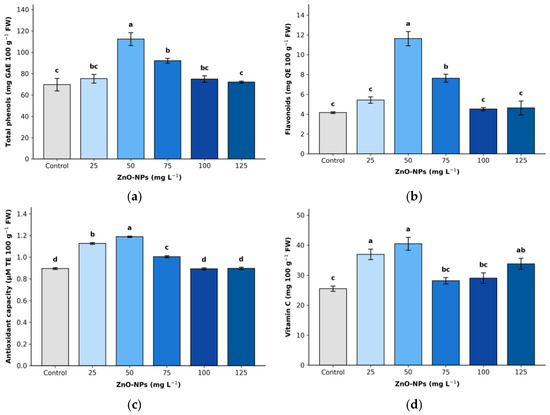
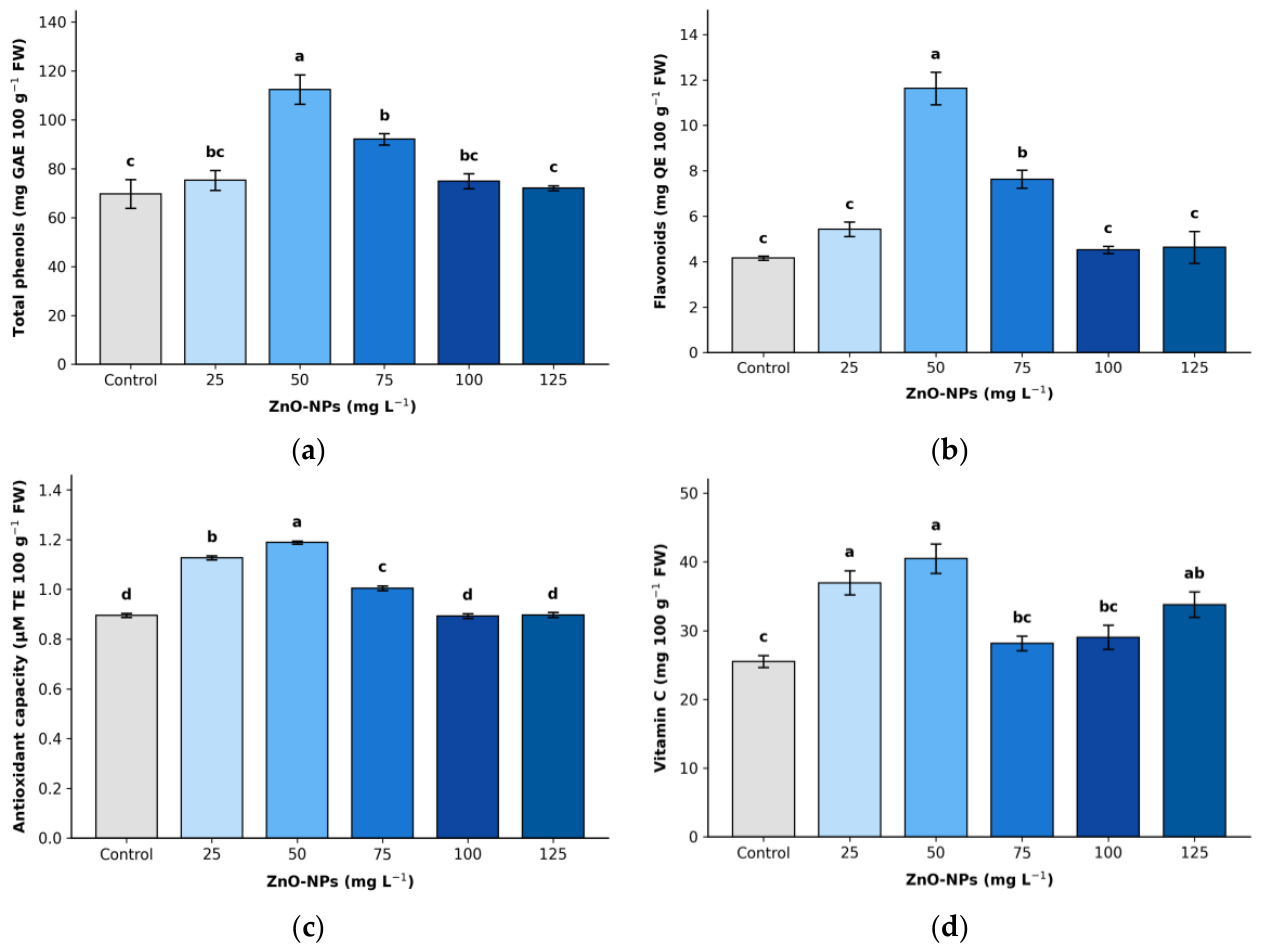
Bioactive compounds increased with the foliar application of ZnO-NPs (Figure 1). The 50 mg L−1 concentration increased the content of phenols (+61.4%), flavonoids (+179.6%), antioxidant capacity (+32.7%), and vitamin C (+58.6%) compared with the control, and was the only concentration that differed significantly from all the others for phenols, flavonoids and antioxidant capacity. The intermediate concentration of 75 mg L−1 also increased phenols (+32.1%), flavonoids (+83.5%), and antioxidant capacity (+12.2%) relative to the control, whereas 100 and 125 mg L−1 did not differ significantly from the control for any of these three variables. For vitamin C the pattern differed: the highest values were obtained with 25 (+44.8%) and 50 mg L−1 (+58.6%), which did not differ from one another, while 125 mg L−1 (+32.4%) was statistically indistinguishable from both the upper group and the intermediate concentrations. The vitamin C values should be read in the light of the methodological caveat stated in Section 2.8: the DCPIP titration quantifies the total reducing capacity of the extract and is not specific for ascorbic acid, so part of the increase reported here may correspond to other water-soluble reducing compounds rather than to ascorbate alone. The increase in phenolic compounds and flavonoids is consistent with a stimulation of the enzymes phenylalanine ammonia-lyase (PAL) and chalcone synthase (CHS) of the phenylpropanoid pathway [29,30], although neither enzyme activity nor the expression of the corresponding genes was measured in this study, so this interpretation is put forward as a hypothesis supported by the literature rather than as a demonstrated mechanism. These results are consistent with those reported for leafy vegetables treated with foliar ZnO-NPs: Garza-Alonso et al. [8] recorded increases in phenols, flavonoids, antioxidant capacity, and vitamin C in lettuce, and Hasan et al. [12] observed that the antioxidant activity of lettuce reached a maximum at 25 ppm and declined at 100 ppm, a dose-dependent pattern comparable to the one described here. Increases in phenolic compounds and flavonoids have also been reported in other species treated with metallic nanoparticles [31,32]. This is because zinc is a structural component of the enzyme Cu/Zn superoxide dismutase (Cu/Zn-SOD), one of the main antioxidant enzymes of the enzymatic defense system, which synergistically contributes to improving the total antioxidant capacity of the plant [33]. It is worth noting that the magnitude of the response was not identical for all the compounds evaluated: flavonoids responded almost three times more strongly than total phenols, which suggests that ZnO-NPs may not act uniformly on the whole phenylpropanoid pathway but preferentially on its flavonoid branch. One hypothesis consistent with the literature is that CHS, the first committed enzyme of flavonoid biosynthesis, could be more sensitive to the redox signals generated by the nanoparticles than the upstream steps catalyzed by PAL, so that a moderate and transient increase in reactive oxygen species would be sufficient to redirect the flux of p-coumaroyl-CoA towards flavonoid synthesis [5,32]. Testing this would require the determination of enzyme activities and of pathway fluxes, which was beyond the scope of the present work.
Figure 1.
Content of total phenols (a), flavonoids (b), antioxidant capacity (c), and vitamin C (d) as affected by different concentrations of ZnO-NPs applied to purslane. Data are shown as mean ± standard error (SE) (n = 4 for (a–c); n = 5 for (d)). Different letters indicate a significant difference (p ≤ 0.05) according to Tukey’s test. GAE = gallic acid equivalents; QE = quercetin equivalents; FW = fresh weight.
The accumulation of reducing compounds quantified as vitamin C may reflect a modulation by zinc of the expression of genes related to ascorbate-glutathione metabolism, which would enhance the synthesis of ascorbic acid as a mechanism of protection against the oxidative stress induced by nanoparticles at moderate concentrations [34,35]. A greater activity of the L-galactose pathway and of the ascorbate-glutathione cycle has also been proposed as a defense mechanism against the transient oxidative stress generated by ZnO-NPs [36]. Neither the activity of these pathways nor the concentration of ascorbate itself was determined here, and because total phenols and antioxidant capacity were quantified on the same tissue, part of the pool measured by the DCPIP titration may overlap with the reducing compounds captured by those assays; these mechanisms are therefore offered as interpretations consistent with the literature and not as findings of this study. Similar results of increased vitamin C content through zinc biofortification in horticultural crops have been reported by Poudel et al. [37].
3.3. Antioxidant Enzyme Activity
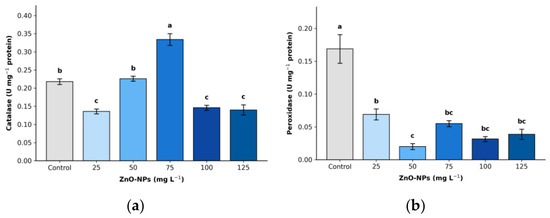
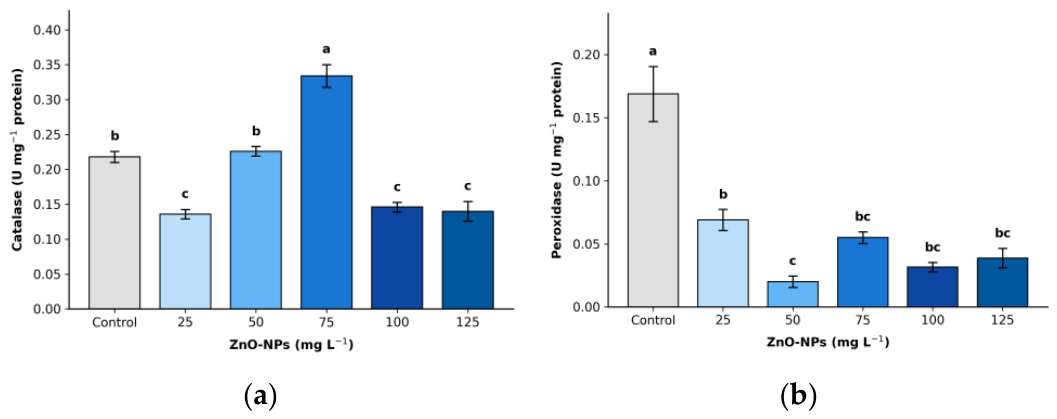
Catalase activity (Figure 2a) increased with the 75 mg L−1 concentration, representing an increase of 53.2% compared with the control. An increase in catalase activity in tomato treated with ZnO-NPs was also reported by Wang et al. [29]; in that study, however, the induction of the enzyme occurred together with inhibition of growth and loss of chlorophyll, that is, as a response to damage rather than as biostimulation. The fact that in purslane the same enzymatic induction coexists with an increase in fresh biomass indicates that both situations correspond to different points on the same dose-response curve, and that the induction of catalase on its own is not sufficient to distinguish an adaptive response from a toxic one. Catalase is a key antioxidant enzyme that catalyzes the decomposition of hydrogen peroxide (H2O2) into water and molecular oxygen, protecting cells from oxidative damage; its increase suggests that ZnO-NPs induce an adaptive response in the plant, activating the enzymatic antioxidant defense system to counteract the mild oxidative stress generated by the nanoparticles and strengthening the plant’s capacity to maintain cellular redox balance under stress conditions [32,33]. In contrast, POD showed the highest activity in the control treatment (Figure 2b), and all the ZnO-NP treatments reduced it significantly, by between 59.1% (25 mg L−1) and 88.2% (50 mg L−1). The 50 mg L−1 treatment gave the lowest mean value, although it did not differ statistically from 75, 100, or 125 mg L−1, so that the reduction can be described as a general effect of the nanoparticles rather than as an optimum located at one concentration. The drastic reduction in POD activity and the increase in CAT suggest an energetic optimization of the defense system. Given that flavonoid synthesis increased by 179.6%, it is likely that these secondary metabolites assumed the free-radical-scavenging function more efficiently; this substitution of enzymatic defense (POD) by a non-enzymatic defense, through the production of phenols and flavonoids, reduces the metabolic cost for the plant and allows resources to be redirected toward increased biomass and greater nutraceutical quality. This apparently contradictory pattern has been previously reported by Palmqvist et al. [17], attributing it to a reconfiguration of the antioxidant system, since the plant prioritizes the synthesis of phenolic secondary metabolites over enzymatic activity as a more efficient and energetically favorable antioxidant strategy [38]. The fact that CAT and POD responded in opposite directions is consistent with their different affinity for H2O2: catalase operates efficiently at the high H2O2 concentrations generated in peroxisomes and does not require a reducing substrate, whereas class III peroxidases act at low H2O2 concentrations in the apoplast and consume phenolic compounds as electron donors. An accumulation of phenols and flavonoids destined for storage in the vacuole therefore reduces the pool of substrate available for POD, which offers a biochemical explanation for the simultaneous decrease in its activity and increase in non-enzymatic antioxidants [38,39]. This metabolic shift not only confers protection against oxidative stress but simultaneously improves the nutraceutical quality of the crop by increasing high-value bioactive compounds [5]. It must be stated clearly that this substitution of enzymatic by non-enzymatic defense is consistent with the present data but is not demonstrated by them: the argument rests on the co-occurrence of a decrease in peroxidase activity and an increase in flavonoid content, and not on a direct measurement of substrate flux, which would require isotopic labelling or the quantification of the apoplastic phenolic pool.
Figure 2.
Catalase (a) and peroxidase (b) activity as affected by different concentrations of ZnO-NPs applied to purslane. Data are shown as mean ± standard error (SE) (n = 5). Different letters indicate a significant difference (p ≤ 0.05) according to Tukey’s test. Enzyme activity is expressed as units (U) per mg of total protein.
3.4. Soluble Protein
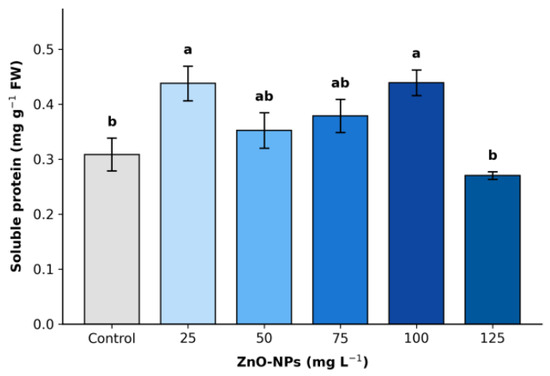
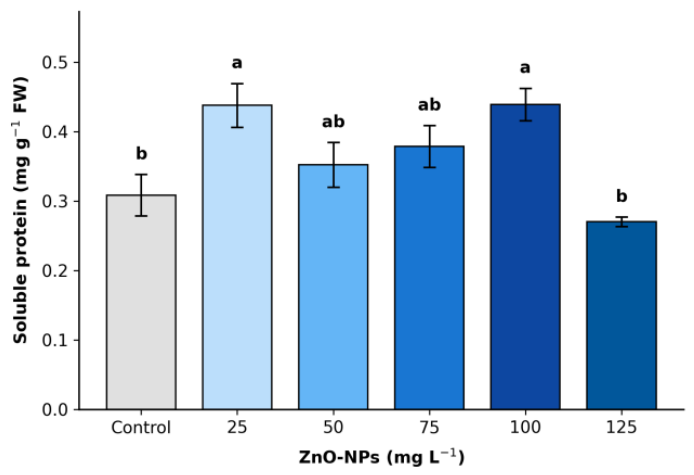
Soluble protein content increased significantly with the foliar application of ZnO-NPs (Figure 3). The highest value was recorded at 100 mg L−1, with an increase of 42.4% relative to the control; however, the concentrations of 25, 50, 75, and 100 mg L−1 did not differ statistically from one another, which indicates that the response reaches a plateau from 25 mg L−1 onwards and that increasing the concentration beyond that point does not translate into a further gain in protein. The 125 mg L−1 concentration gave the lowest mean value (−12.4% relative to the control), but did not differ statistically from the control, so that the loss of the stimulatory effect at the highest concentration is a numerical trend and not a significant reduction. The increase in protein is attributable to the fact that zinc is an essential component of “zinc finger” transcription factors, which regulate the expression of genes involved in protein synthesis [4]. In addition, it is a structural component of ribosomes and a cofactor of enzymes involved in nitrogen metabolism, amino acid synthesis, and the elongation of polypeptide chains during translation; the hormetic pattern observed suggests that moderate concentrations stimulate protein synthesis, whereas high concentrations generate excessive oxidative stress that interferes with the plant’s anabolic processes [3,4,39]. Comparable increases in total protein have been reported in lettuce treated with foliar ZnO-NPs [8], that is, in a leafy tissue whose nitrogen metabolism and sink strength are equivalent to those of purslane. Increases in protein have also been documented in seed crops such as common bean [6]; in that case, however, the response involves the seed as a storage sink and is therefore not directly comparable with the leaf.
Figure 3.
Soluble protein content as affected by different concentrations of ZnO-NPs applied to purslane. Data are shown as mean ± standard error (SE) (n = 5). Different letters indicate a significant difference (p ≤ 0.05) according to Tukey’s test. FW = fresh weight.
3.5. Zinc Concentration
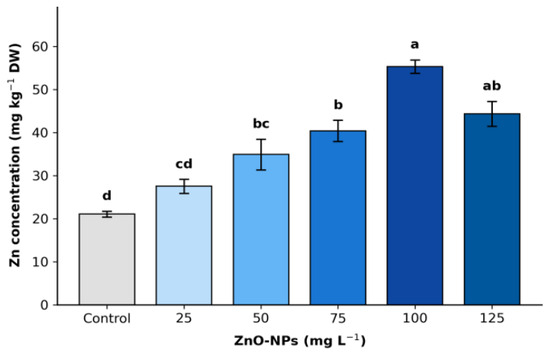
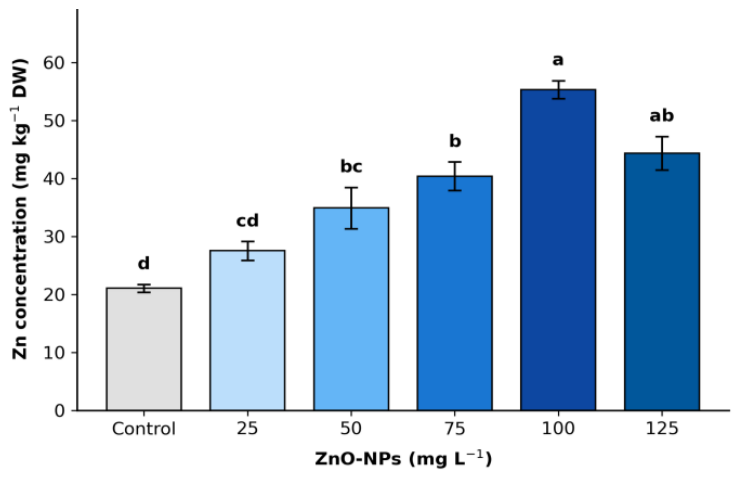
The treatment with the 100 mg L−1 concentration of ZnO-NPs presented the highest zinc concentration in foliar tissue, representing an increase of 162.4% compared with the control (Figure 4) and differing significantly from all the other treatments. Zinc accumulation rose progressively with concentration, although the increase produced by 25 mg L−1 (+30.6%) was not statistically different from the control; 50, 75, and 125 mg L−1 formed an intermediate group (+65.6, +91.6, and +110.3%, respectively) that did not differ among themselves. The fact that 125 mg L−1 did not exceed 100 mg L−1 indicates that leaf uptake reaches saturation within the range evaluated. This is due to the unique physicochemical properties of the nanoparticles, particularly their high surface-to-volume ratio that facilitates foliar absorption, and their ability to penetrate through stomata and cuticles more efficiently than conventional ionic forms of zinc. From a nutritional standpoint, the zinc concentrations attained remain within the range reported as adequate and non-phytotoxic for leafy vegetables, so that the biofortified tissue can contribute a relevant fraction of the recommended daily zinc intake without compromising crop performance [31,37]. The use of ZnO-NPs represents an effective agronomic biofortification strategy to improve the nutritional quality of purslane intended for human consumption [3].
Figure 4.
Zn concentration as affected by different concentrations of ZnO-NPs applied to purslane. Data are shown as mean ± standard error (SE) (n = 5). Different letters indicate a significant difference (p ≤ 0.05) according to Tukey’s test. DW = dry weight.
3.6. Integrated Response Across Variables
When all the variables are considered together, 50 mg L−1 was the concentration that gave the best response in the largest number of parameters, being superior in fresh biomass, total phenols, flavonoids, antioxidant capacity, and vitamin C, that is, in five of the eleven variables evaluated; total chlorophyll was the only variable that did not respond significantly to any concentration. The 100 mg L−1 concentration was superior only for zinc accumulation and soluble protein, while 25 and 75 mg L−1 were superior for plant height and catalase activity, respectively. From an agronomic perspective, this means that the concentration to be recommended depends on the objective pursued: 50 mg L−1 should be selected when the aim is to maximize yield and nutraceutical quality simultaneously, whereas 100 mg L−1 is preferable when the specific objective is to maximize the zinc content of the edible tissue for biofortification purposes. Concentrations above 100 mg L−1 did not provide additional benefits for any of the variables evaluated and reduced plant height, which delimits the useful range of application to between 50 and 100 mg L−1 under the conditions of this study.
Five limitations of this study should be stated explicitly. First, the determination of vitamin C was based on titration with DCPIP, a method that measures the total reducing capacity of the extract and is therefore not fully specific for ascorbic acid. Second, the nanoparticles were used as supplied and their surface charge and specific surface area were not determined, so the results cannot be extrapolated to formulations with different surface properties. Third, the experiment was conducted over a single cycle and under greenhouse conditions, so the concentrations identified here require validation under field conditions and over successive cycles before they can be recommended for commercial use. Fourth, the mechanisms invoked in the discussion to explain the accumulation of phenols, flavonoids, and ascorbate, and the reconfiguration of the antioxidant system, were inferred from the pattern of the metabolite and biomass data and from the published literature; no enzyme activities of the phenylpropanoid pathway, gene expression, or pathway fluxes were measured in this study, and these interpretations should therefore be read as hypotheses to be tested rather than as demonstrated mechanisms. Fifth, the zinc determination was carried out as an external analytical service and the instrumental operating conditions could not be reported in full, which limits the exact reproducibility of that particular measurement, although the sample preparation and the leaf-rinsing protocol are described completely.
4. Conclusions
Foliar application of zinc oxide nanoparticles improved plant growth as well as the nutraceutical and nutritional quality of purslane. The 50 mg L−1 concentration was superior in the largest number of variables, optimizing fresh biomass and the accumulation of bioactive compounds, whereas 100 mg L−1 favored zinc bioaccumulation in leaf tissue and soluble protein. The nanoparticles increased catalase activity and reduced peroxidase activity, suggesting an adjustment of antioxidant defense toward more efficient non-enzymatic mechanisms. Furthermore, treatments with moderate concentrations stimulated soluble protein synthesis, reflecting an activation of nitrogen metabolism. This hormetic behavior indicates that the nanoparticles act as plant growth biostimulants and modulators of secondary metabolism. Overall, the results indicate that zinc oxide nanoparticles represent a viable agronomic alternative for obtaining functional foods within a useful application range from 50 to 100 mg L−1; however, long-term field studies are required to ensure safe and sustainable application across different agricultural production systems.
Author Contributions
Conceptualization, P.P.-R. and R.R.G.-E.; methodology, P.P.-R., R.R.G.-E. and A.Y.E.-N.; data collection, A.Y.E.-N.; formal analysis and interpretation, P.P.-R., R.R.G.-E. and A.Y.E.-N.; writing—original draft preparation, P.P.-R. and R.R.G.-E.; writing—review and editing, M.F.-H., M.C.H.-A., R.G.-A. and B.P.P.-R.; supervision, P.P.-R. and R.R.G.-E. All authors have read and agreed to the published version of the manuscript.
Funding
Alondra Yazmin Estrada-Navarro gratefully acknowledges the financial support provided by the Secretaría de Ciencia, Humanidades, Tecnología e Innovación (SECIHTI) through a doctoral fellowship grant.
Institutional Review Board Statement
Not applicable.
Informed Consent Statement
Not applicable.
Data Availability Statement
The original contributions of this study are included in the article. Further information is available from the corresponding authors upon reasonable request.
Acknowledgments
During the preparation of this manuscript, the authors used AI-assisted language editing tools for language assistance during manuscript preparation, specifically for improving syntax, punctuation, and grammar. The authors have reviewed and edited the output and take full responsibility for the content of this publication.
Conflicts of Interest
The authors declare no conflicts of interest.
References
- Bhardwaj, R.L.; Parashar, A.; Parewa, H.P.; Vyas, L. An alarming decline in the nutritional quality of foods: The biggest challenge for future generations’ health. Foods 2024, 13, 877. [Google Scholar] [CrossRef] [Scilit] [PubMed]
- Kapoor, P.; Dhaka, R.K.; Sihag, P.; Mehla, S.; Sagwal, V.; Singh, Y.; Langaya, S.; Balyan, P.; Singh, K.P.; Xing, B.; et al. Nanotechnology-enabled biofortification strategies for micronutrients enrichment of food crops: Current understanding and future scope. NanoImpact 2022, 26, 100407. [Google Scholar] [CrossRef] [Scilit] [PubMed]
- Mirakhorli, T.; Ardebili, Z.O.; Ladan-Moghadam, A.; Danaee, E. Bulk and nanoparticles of zinc oxide exerted their beneficial effects by conferring modifications in transcription factors, histone deacetylase, carbon and nitrogen assimilation, antioxidant biomarkers, and secondary metabolism in soybean. PLoS ONE 2021, 16, e0256905. [Google Scholar] [CrossRef] [Scilit] [PubMed]
- Lin, J.; Bjørk, P.K.; Kolte, M.V.; Poulsen, E.; Dedic, E.; Drace, T.; Andersen, S.U.; Nadzieja, M.; Liu, H.; Castillo-Michel, H.; et al. Zinc mediates control of nitrogen fixation via transcription factor filamentation. Nature 2024, 631, 164–169. [Google Scholar] [CrossRef] [Scilit] [PubMed]
- Verma, S.; Chakdar, H.; Kumar, M.; Varma, A.; Saxena, A.K. Microorganisms as a sustainable alternative to traditional biofortification of iron and zinc: Status and prospect to combat hidden hunger. J. Soil Sci. Plant Nutr. 2021, 21, 1700–1717. [Google Scholar] [CrossRef] [Scilit]
- Salama, D.M.; Osman, S.A.; Abd El-Aziz, M.E.; Abd Elwahed, M.S.; Shaaban, E.A. Effect of zinc oxide nanoparticles on the growth, genomic DNA, production and the quality of common dry bean (Phaseolus vulgaris). Biocatal. Agric. Biotechnol. 2019, 18, 101083. [Google Scholar] [CrossRef] [Scilit]
- Gutiérrez, R.N.J.; Palacio, M.A.; Sánchez, C.E.; Muñoz, M.E.; Chávez, M.C.; Ojeda, B.D.L.; Flores, C.M.A. Impact of the foliar application of nanoparticles, sulfate and iron chelate on the growth, yield and nitrogen assimilation in green beans. Not. Bot. Horti Agrobot. 2021, 49, 12437. [Google Scholar] [CrossRef] [Scilit]
- Garza-Alonso, C.A.; Juárez-Maldonado, A.; González-Morales, S.; Cabrera-De la Fuente, M.; Cadenas-Pliego, G.; Morales-Díaz, A.B.; Trejo-Téllez, L.I.; Tortella, G.; Benavides-Mendoza, A. ZnO nanoparticles as potential fertilizer and biostimulant for lettuce. Heliyon 2023, 9, e12787. [Google Scholar] [CrossRef] [Scilit] [PubMed]
- Fortis-Hernández, M.; García-Delgado, J.D.; Preciado-Rangel, P.; Trejo-Valencia, R.; Sánchez-Estrada, A.; Fortis-Hernández, J. Commercial and phytochemical quality in biofortified ‘orejona’ lettuce with zinc oxide nanoparticles. Not. Bot. Horti Agrobot. 2022, 50, 12969. [Google Scholar] [CrossRef] [Scilit]
- Preciado-Rangel, P.; Sánchez-Chávez, E.; Fortis-Hernández, M.; Gaucin-Delgado, J.M.; González-Ávalos, R.; Hermosillo-Alba, M.C.; Peña-Revuelta, B.P.; Guillén-Enríquez, R.R. Enhanced enzymatic and bioactive compounds in lettuce via zinc oxide nanoparticles. Not. Sci. Biol. 2024, 16, 12088. [Google Scholar] [CrossRef] [Scilit]
- Fortis-Hernández, M.; Vázquez-Alvarado, C.; Galindo-Guzmán, M.; Preciado-Rangel, P.; Galindo-Guzmán, A.P.; Flores-Loyola, E. Biofortification with ZnO NPs as nanofertilizers to improve sustainable commercial and phytochemical quality in basil plants. Not. Bot. Horti Agrobot. 2023, 51, 13078. [Google Scholar] [CrossRef] [Scilit]
- Hasan, M.; Tariq, T.; Mustafa, G.; Ismail, E.A.A.; Awwad, F.A.; Hatami, M. Biogenic zinc oxide nanoregulator determines the quantitative analysis of morpho-anatomical and antioxidant capacity in Lactuca sativa L. Food Sci. Nutr. 2024, 12, 7954–7967. [Google Scholar] [CrossRef] [Scilit] [PubMed]
- Palacio-Márquez, A.; Ramírez-Estrada, C.A.; Gutiérrez-Ruelas, N.J.; Sánchez, E.; Ojeda-Barrios, D.L.; Chávez-Mendoza, C.; Sida-Arreola, J.P. Efficiency of foliar application of zinc oxide nanoparticles versus zinc nitrate complexed with chitosan on nitrogen assimilation, photosynthetic activity, and production of green beans (Phaseolus vulgaris L.). Sci. Hortic. 2021, 288, 110297. [Google Scholar] [CrossRef] [Scilit]
- Guillén-Enríquez, R.R.; Sánchez-Chávez, E.; Fortis-Hernández, M.; Márquez-Guerrero, S.Y.; Espinosa-Palomeque, B.; Preciado-Rangel, P. ZnO nanoparticles improve bioactive compounds, enzymatic activity and zinc concentration in grapevine. Not. Bot. Horti Agrobot. 2023, 51, 13377. [Google Scholar] [CrossRef] [Scilit]
- Li, Y.; Xiao, L.; Yan, H.; Wu, M.; Hao, X.; Liu, H. Nutritional values, bioactive compounds and health benefits of purslane (Portulaca oleracea L.): A comprehensive review. Food Sci. Hum. Wellness 2024, 13, 2480–2501. [Google Scholar] [CrossRef] [Scilit]
- Carrascosa, A.; Pascual, J.A.; Ros, M.; Petropoulos, S.A.; Alguacil, M.d.M. Agronomical practices and management for commercial cultivation of Portulaca oleracea as a crop: A review. Plants 2023, 12, 1246. [Google Scholar] [CrossRef] [Scilit] [PubMed]
- Farghaly, F.A.; Radi, A.A.; Al-Kahtany, F.A.; Hamada, A.M. Impacts of zinc oxide nano and bulk particles on redox-enzymes of the Punica granatum callus. Sci. Rep. 2020, 10, 19722. [Google Scholar] [CrossRef] [Scilit] [PubMed]
- Steiner, A.A. A universal method for preparing nutrient solutions of a certain desired composition. Plant Soil 1961, 15, 134–154. [Google Scholar] [CrossRef] [Scilit]
- Pérez-Vázquez, E.L.; Gaucín-Delgado, J.M.; Ramírez-Rodríguez, S.C.; Sariñana-Navarrete, M.A.; Zapata-Sifuentes, G.; Zúñiga-Valenzuela, E. Electrical conductivity of the nutrient solution and its effect on the yield and nutraceutical quality of bell pepper. Rev. Mex. Cienc. Agríc. 2020, 11, 1669–1676. [Google Scholar]
- Bautista-Díaz, J.; Cruz-Álvarez, O.; Hernández-Rodríguez, O.A.; Sánchez-Chávez, E.; Jacobo-Cuellar, J.L.; Preciado-Rangel, P.; Ojeda-Barrios, D.L. Zinc sulphate or zinc nanoparticle applications to leaves of green beans. Folia Hortic. 2021, 33, 365–375. [Google Scholar] [CrossRef] [Scilit]
- Ponce-García, C.O.; Soto-Parra, J.M.; Sánchez, E.; Muñoz-Márquez, E.; Piña-Ramírez, F.J.; Flores-Córdova, M.A.; Pérez-Leal, R.; Yáñez-Muñoz, R.M. Efficiency of nanoparticle, sulfate, and zinc-chelate use on biomass, yield, and nitrogen assimilation in green beans. Agronomy 2019, 9, 128. [Google Scholar] [CrossRef] [Scilit]
- Singleton, V.L.; Orthofer, R.; Lamuela-Raventós, R.M. Analysis of total phenols and other oxidation substrates and antioxidants by means of Folin-Ciocalteu reagent. Methods Enzymol. 1999, 299, 152–178. [Google Scholar] [CrossRef] [Scilit]
- Hernández-Hernández, H.; Quiterio-Gutiérrez, T.; Cadenas-Pliego, G.; Ortega-Ortiz, H.; Hernández-Fuentes, A.D.; Cabrera-De la Fuente, M.; Valdés-Reyna, J.; Juárez-Maldonado, A. Impact of selenium and copper nanoparticles on yield, antioxidant system, and fruit quality of tomato plants. Plants 2019, 8, 355. [Google Scholar] [CrossRef] [Scilit] [PubMed]
- Brand-Williams, W.; Cuvelier, M.E.; Berset, C. Use of a free radical method to evaluate antioxidant activity. LWT—Food Sci. Technol. 1995, 28, 25–30. [Google Scholar] [CrossRef] [Scilit]
- Aebi, H. Catalase in vitro. Methods Enzymol. 1984, 105, 121–126. [Google Scholar] [CrossRef] [Scilit] [PubMed]
- Nickel, K.; Cunningham, B. Improved peroxidase assay method using leuco 2,3′,6-trichloroindophenol and application to comparative measurements of peroxidase catalysis. Anal. Biochem. 1969, 27, 292–299. [Google Scholar] [CrossRef] [Scilit] [PubMed]
- Bradford, M.M. A rapid and sensitive method for the quantitation of microgram quantities of protein utilizing the principle of protein-dye binding. Anal. Biochem. 1976, 72, 248–254. [Google Scholar] [CrossRef] [PubMed]
- R Core Team. R: A Language and Environment for Statistical Computing version 4.3.0; R Foundation for Statistical Computing: Vienna, Austria, 2023; Available online: https://www.R-project.org/ (accessed on 20 September 2026).
- Wang, X.P.; Li, Q.Q.; Pei, Z.M.; Wang, S.C. Effects of zinc oxide nanoparticles on the growth, photosynthetic traits, and antioxidative enzymes in tomato plants. Biol. Plant. 2018, 62, 801–808. [Google Scholar] [CrossRef] [Scilit]
- Daccak, D.; Luís, I.C.; Marques, A.C.; Coelho, A.R.F.; Pessoa, C.C.; Silva, M.M.; Simões, M.; Reboredo, F.H.; Pessoa, M.F.; Legoinha, P.; et al. A case study about the use of precision agriculture technology applied to a Zn biofortification workflow for grapevine Vitis vinifera cv. Moscatel. Biol. Life Sci. Forum 2021, 3, 2. [Google Scholar] [CrossRef] [Scilit]
- López-Morales, D.; De La Cruz-Lázaro, E.; Sánchez-Chávez, E.; Preciado-Rangel, P.; Márquez-Quiroz, C.; Osorio-Osorio, R. Impact of agronomic biofortification with zinc on the nutrient content, bioactive compounds, and antioxidant capacity of cowpea bean (Vigna unguiculata L. Walpers). Agronomy 2020, 10, 1460. [Google Scholar] [CrossRef] [Scilit]
- Mosa, K.A.; El-Naggar, M.H.; Ramamoorthy, K.; Alawadhi, H.; Elnaggar, A.; Wartanian, S.; Ibrahim, E.; Hani, H. Copper nanoparticles induced genotoxicity, oxidative stress, and changes in superoxide dismutase (SOD) gene expression in cucumber (Cucumis sativus) plants. Front. Plant Sci. 2018, 9, 872. [Google Scholar] [CrossRef] [Scilit] [PubMed]
- Yusefi-Tanha, E.; Fallah, S.; Rostamnejadi, A.; Pokhrel, L.R. Zinc oxide nanoparticles (ZnONPs) as a novel nanofertilizer: Influence on seed yield and antioxidant defense system in soil grown soybean (Glycine max cv. Kowsar). Sci. Total Environ. 2020, 738, 140240. [Google Scholar] [CrossRef] [Scilit] [PubMed]
- Noreen, S.; Sultan, M.; Akhter, M.S.; Shah, K.H.; Ummara, U.; Manzoor, H.; Ulfat, M.; Alyemeni, M.N.; Ahmad, P. Foliar fertigation of ascorbic acid and zinc improves growth, antioxidant enzyme activity and harvest index in barley (Hordeum vulgare L.) grown under salt stress. Plant Physiol. Biochem. 2021, 158, 244–254. [Google Scholar] [CrossRef] [Scilit] [PubMed]
- Paciolla, C.; Fortunato, S.; Dipierro, N.; Paradiso, A.; De Leonardis, S.; Mastropasqua, L.; de Pinto, M.C. Vitamin C in plants: From functions to biofortification. Antioxidants 2019, 8, 519. [Google Scholar] [CrossRef] [Scilit] [PubMed]
- Smirnoff, N.; Wheeler, G.L. The ascorbate biosynthesis pathway in plants is known, but there is a way to go with understanding control and functions. J. Exp. Bot. 2024, 75, 2604–2630. [Google Scholar] [CrossRef] [Scilit] [PubMed]
- Poudel, P.; Connolly, E.L.; Kwasniewski, M.; Lambert, J.D.; Di Gioia, F. Zinc biofortification via fertigation using alternative zinc sources and concentration levels in pea, radish, and sunflower microgreens. Sci. Hortic. 2024, 331, 113098. [Google Scholar] [CrossRef] [Scilit]
- Khoshgoftarmanesh, A.H.; Markarian, S. Antioxidant response of wheat to tire rubber ash and ZnO nanoparticles and ionic zinc exposure in nutrient solution culture. Acta Physiol. Plant. 2022, 44, 38. [Google Scholar] [CrossRef] [Scilit]
- Ji, C.; Li, J.; Jiang, C.; Zhang, L.; Shi, L.; Xu, F.; Cai, H. Zinc and nitrogen synergistic act on root-to-shoot translocation and preferential distribution in rice. J. Adv. Res. 2022, 35, 187–198. [Google Scholar] [CrossRef] [Scilit] [PubMed]

Disclaimer/Publisher’s Note: The statements, opinions and data contained in all publications are solely those of the individual author(s) and contributor(s) and not of MDPI and/or the editor(s). MDPI and/or the editor(s) disclaim responsibility for any injury to people or property resulting from any ideas, methods, instructions or products referred to in the content. |
© 2026 by the authors. Licensee MDPI, Basel, Switzerland. This article is an open access article distributed under the terms and conditions of the Creative Commons Attribution (CC BY) license.