


Abstract
Pepper fruits contain diverse primary and secondary metabolites, including ascorbic acid, carotenoids, phenolics, and flavonoids, which contribute to nutritional quality, antioxidant capacity, coloration, and consumer acceptance. Chilaca chili pepper (Capsicum annuum L.) is a Mexican cultivar valued for its distinctive flavor and pungency, representing a valuable resource for studying fruit quality and sustainable crop improvement. This study evaluated the individual and combined effects of arbuscular mycorrhizal fungi (AMF) and plant growth-promoting rhizobacteria (PGPR) on growth, physiological responses, antioxidant activity, and fruit quality traits. Twelve treatments in a 3 × 2 × 2 factorial designs were evaluated for chlorophyll, soluble solids, biomass, APX and LOX activities, and vitamin C and capsaicin contents at three ripening stages (green, mid-red, and red). Enzyme activities were determined spectrophotometrically, and bioactive compounds were quantified from methanolic fruit extracts. Microbial inoculation primarily improved fruit physiological quality rather than vegetative growth. Biomass and growth traits showed no significant differences among treatments (p > 0.05), whereas biochemical responses exhibited distinct ripening-dependent patterns. APX activity, vitamin C, and capsaicin increased from green to mid-red stages and declined at full ripeness. Bacillus sp.-based treatments (T1 and T2) produced a significant transient increase in LOX activity during mid-ripening, while T7 showed a similar but weaker response. AMF progressively enhanced LOX activity and capsaicin accumulation in green fruits. PGPR effects were strain-dependent, with Bacillus sp. promoting early capsaicin accumulation and A. deleyi favoring higher levels during advanced ripening. Overall, AMF and PGPR differentially regulate antioxidant metabolism, vitamin C accumulation, and capsaicinoid biosynthesis while interacting with mineral fertilization to improve fruit quality. These findings support beneficial microorganisms as sustainable tools for enhancing nutrient-use efficiency and fruit nutritional and functional value without replacing mineral fertilization.
1. Introduction
Pepper (Capsicum annuum L.) is one of the most economically important vegetable crops worldwide, valued not only for its culinary applications but also for its high content of bioactive compounds associated with human health benefits [1]. Pepper fruits contain diverse primary and secondary metabolites, including ascorbic acid, carotenoids, phenolic compounds, and flavonoids, which contribute to nutritional quality, antioxidant capacity, color development, and consumer acceptance [2]. The accumulation of these compounds is strongly influenced by genotype, environmental conditions, and cultivation practices, resulting in considerable variation in fruit quality characteristics among pepper cultivars [3,4,5,6].
Fruit ripening processes involve complex transcriptional regulation that controls metabolite accumulation, color development, and quality traits in chili peppers [7]. Furthermore, genetic and molecular pathways regulate pigment biosynthesis and pungency-related compounds, providing opportunities for crop improvement and breeding strategies [8]. Recent metabolomic studies have further demonstrated that ripening-associated metabolic reprogramming regulates the accumulation of flavor-, pigment-, and health-related compounds in chili pepper fruits [9,10].
Lipoxygenase (LOX) is a key enzyme involved in fruit development, ripening, and nutritional quality through its role in the oxidation of polyunsaturated fatty acids and the production of oxylipins [11]. LOX-derived metabolites contribute to aroma and flavor formation, while also regulating antioxidant and defense pathways [12]. Increased LOX activity can stimulate the accumulation of nutritionally important compounds such as vitamin C, carotenoids, phenolics, and capsaicinoids, thereby enhancing fruit quality and antioxidant capacity [13]. Furthermore, LOX participates in jasmonic acid biosynthesis, which regulates secondary metabolism and stress responses. Balanced LOX activity is therefore essential for improving fruit nutritional value and quality [14].
Similarly, ascorbate peroxidase (APX) is a vital antioxidant enzyme that protects plant cells from oxidative damage by detoxifying hydrogen peroxide through the ascorbate–glutathione cycle [15]. APX plays an essential role in maintaining cellular redox balance during fruit development, ripening, and exposure to environmental stresses [13]. In fruits, higher APX activity is associated with increased antioxidant capacity, improved vitamin C retention, delayed senescence, and better postharvest quality [16]. Consequently, APX serves as an important biochemical indicator of fruit health, stress tolerance, and nutritional quality.
On the other hand, sustainable practices such as compost application, reduced tillage, and organic amendments further support beneficial microbial communities and improve crop resilience under climate stress conditions [17]. Therefore, integrating mycorrhizae and beneficial bacteria into chili pepper production represents an environmentally sustainable strategy for improving productivity, soil health, and agricultural resilience. Plant growth–promoting rhizobacteria (PGPR), including species of Pseudomonas and Bacillus, contribute to nitrogen fixation, phytohormone production, phosphate solubilization, and disease suppression in the rhizosphere [18,19]. In addition, the interaction between PGPR and fruit antioxidant metabolism represents an important area of research, as microbial stimulation can influence redox regulation during fruit development. Recent studies have shown that beneficial microorganisms, including Bacillus spp., arbuscular mycorrhizal fungi, and other rhizosphere-associated microbes, can enhance plant resilience against abiotic and biotic stresses by regulating physiological and biochemical responses [20,21,22]. In pepper, microbial inoculation with PGPR and beneficial fungi has been associated with improved growth, photosynthetic performance, disease resistance, and activation of defense-related pathways [19,23]. Cultivation of Capsicum annuum increasingly relies on sustainable soil fertility practices involving arbuscular mycorrhizal fungi (AMF) and beneficial bacterial microorganisms. Other studies have shown that AMF improves nutrient uptake, especially phosphorus, enhances water absorption, and increases tolerance to abiotic stresses such as drought and low temperature in chili pepper crops [24,25].
Chilaca chili pepper (Capsicum annuum L.) is a long, dark green Mexican chili valued for its distinctive earthy flavor and mild-to-medium pungency. Unlike many commercial chili varieties, fresh chilaca fruits are rarely marketed in their green form because they are commonly processed into pasilla chili through dehydration. While drying, the fruit develops a dark, wrinkled appearance resembling a small raisin, which gives the pasilla chili its name. Together with ancho and mulato chilies, pasilla forms part of the traditional dried chili foundation used in mole negro, one of the most emblematic sauces of Mexican cuisine [26]. Fresh chilaca peppers are widely used in sauces, stews, roasted preparations, and other regional dishes, where they contribute flavor complexity without excessive heat. The versatility, unique sensory characteristics, and cultural importance of chilaca pepper have contributed to its continued cultivation and appreciation. Beyond its culinary value, chilaca represents an important genetic resource within Capsicum annuum, with potential significance for studies focused on fruit quality, bioactive compound accumulation, and sustainable crop improvement.
This study aimed to evaluate the individual and combined effects of AMF and PGPR on growth performance, physiological responses, antioxidant enzyme activities (ascorbate peroxidase and lipoxygenase), and fruit quality attributes, including chlorophyll, vitamin C, and capsaicin content, in chilaca chili pepper.
2. Materials and Methods
2.1. Reagents
All the reagents, standards (capsaicin > 95% from Capsicum sp.; L-ascorbic acid > 99%), and solvents used were of high degree of purity or HPLC grade and were purchased from Sigma-Aldrich (Millipore) (St. Louis, MO, USA).
2.2. Experimental Site Description
The experiment was carried out in a passively ventilated greenhouse at the Faculty of Agriculture and Zootechnics (FAZ), Juárez University of the State of Durango, located at km 32 of the Gómez Palacio–Tlahualilo highway, ejido Venecia, municipality of Gómez Palacio, Durango, Mexico (25.7825° N, 103.3526° W; 1110 m a.s.l.). The crop cycle extended from transplanting in August 2025 to fruit harvest in December 2025, under natural photoperiod. Plants were grown under ambient greenhouse conditions without imposed abiotic stress treatments, with water and nutrients supplied according to the experimental design.
2.3. Plant Material and Growth Conditions
Chilaca chili seeds were sown in 200-cell polystyrene germination trays using a substrate composed of peat moss (PREMIER, Mississauga, ON, Canada) and perlite (Multiperl, Laguna Mills, Gómez Palacio, México) in a 3:1 (v/v) ratio. Prior to sowing, the substrate was autoclaved for 3 h at 18 psi. The trays were filled with sterilized substrate, and one seed was placed in each cell. Seedlings were watered regularly during the nursery stage to maintain adequate moisture for germination and growth, and were transplanted 45 days after sowing once they reached a height of 5 to 7 cm.
Seedlings were transplanted directly into the soil with a spacing of 35 cm between plants and 50 cm between rows. A T-tape drip irrigation system supplied water throughout the growing season. The experiment was established on a clay-loam soil with moderately alkaline pH (8.4), 2.2% organic matter, 61.5 mg kg−1 inorganic nitrogen (as nitrate) and 20.2 mg kg−1 available phosphorus.
Air temperature, relative humidity and photoperiod were not recorded inside the greenhouse. Because the structure was not fully enclosed—the upper section remained partially open throughout the cycle to allow passive ventilation—internal conditions were assumed to approximate ambient conditions at the site. Records from the nearest CONAGUA climatological station (No. 10169, C.B.T.A. 101 Gómez Palacio) indicate a mean air temperature of 22 °C and a mean monthly rainfall of 11 mm during the study period [27]. These values are reported as an approximation of the ambient conditions to which the crop was exposed and not as direct in-greenhouse measurements.
2.4. Microbial Strains and Inoculum Preparation
Two plant growth-promoting rhizobacteria (PGPR) strains isolated from the rhizosphere of Zea mays were used: Bacillus sp. (GenBank accession number PX631781) and Achromobacter deleyi (GenBank accession number PX631780). Both strains are capable of fixing atmospheric nitrogen and solubilizing phosphorus. Additionally, Bacillus sp. inhibited the growth of Fusarium chlamydosporum and Phytophthora capsici by 15% and 23%, respectively, whereas A. deleyi exhibited inhibition rates of 6% and 3%. Bacterial inocula were prepared in nutrient broth and adjusted to 5.4 × 10⁷ CFU mL−1 (OD600 = 0.3).
The arbuscular mycorrhizal fungus (AMF) Claroideoglomus claroideum was isolated from the rhizosphere of jalapeño pepper plants and propagated for one year in a trap culture using Medicago sativa grown in the same peat moss–perlite substrate (3:1, v/v) used for seedling production. The resulting inoculum contained 1234 spores per 100 g of substrate. No GenBank accession number is available for this isolate, since only the bacterial strains were sequenced and deposited.
2.5. Treatments and Experimental Design
The experiment was established under a completely randomized 3 × 2 × 2 factorial design with three factors. Factor A corresponded to PGPR with three levels: Bacillus sp. (B), A. deleyi (A) and a non-inoculated control without PGPR (WB). Factor B consisted of arbuscular mycorrhizal fungi with two levels: inoculation with C. claroideum (AM) and without inoculation (WAM). Factor C corresponded to chemical fertilization at two levels of the recommended 200–70–70 (N–P–K) dose: 100% (200–70–70 kg ha−1) and 50% (100–35–35 kg ha−1). The combination of these factors generated 12 treatments (B + AM + 50, B + AM + 100, B + WAM + 50, B + WAM + 100, A + AM + 50, A + AM + 100, A + WAM + 50, A + WAM + 100, WB + AM + 50, WB + AM + 100, WB + WAM + 50 and WB + WAM + 100), each replicated 14 times, for a total of 168 experimental units.
Bacterial inoculation was carried out five days after germination, when seedlings were approximately 1.5 cm tall, by applying 1 mL of the corresponding bacterial suspension to each seedling. Mycorrhizal inoculation was performed before transplanting by mixing the substrate with the AMF inoculum at a 1:1 (v/v) ratio; non-inoculated (WAM) treatments received the same substrate volume without inoculum. Mycorrhizal establishment was verified only through the initial spore count of the inoculum. Root colonization rates and rhizobacterial persistence in the rhizosphere were not quantified at the end of the experiment.
2.6. Collection of Fruits and Plant Materials
All fruits were harvested on the same date, 128 days after transplanting, since plants simultaneously carried fruits at the three maturity stages evaluated: mature green, mid-red and red. Representative fruits were selected on the basis of uniform colour corresponding to each ripening stage and optimal development. Each fruit was obtained from a different plant within the corresponding treatment (n = 3 fruits per treatment and ripening stage). The harvested fruits were subsequently dried in a cabinet-type convective dryer at 65 °C for 24 h and then ground into a fine powder prior to analysis.
Leaf and stem biomass were determined by separating plant tissues after harvest. Samples were dried in a forced-air oven at 65 °C until constant weight was achieved. Dry weights were recorded using a precision balance and expressed as g plant−1.
2.7. Fruit Weight
Fruit fresh weight was determined at the green ripening stage on individual fruits using an analytical balance OHAUS model PX84/E (OHAUS Latinoamerica, Ciudad de México, México) and expressed as g per fruit (n = 3 per treatment).
2.8. Leaf Sap Brix Measurement
Leaf sap soluble solids (°Brix) were determined using a handheld refractometer. Fully expanded mature leaves were collected from the middle canopy of chili pepper plants during the vegetative stage. Leaf sap was extracted using a manual tissue press, and one to two drops of sap were placed on the refractometer prism. Measurements were recorded as °Brix after calibration with distilled water. The prism was cleaned between samples, and results were expressed as the mean °Brix value for each treatment.
2.9. SPAD (Non-Destructive) Chlorophyll Measurement
Leaf chlorophyll content was estimated to be using a SPAD-502 chlorophyll meter (KONICA MINOLTA, Tokyo, Japan). Fully expanded leaves from the middle canopy of chili pepper plants were selected. SPAD readings were taken between the leaf midrib and margin, avoiding major veins. Three readings per leaf were recorded and averaged. Measurements were conducted between 09:00 and 10:00 h to minimize diurnal variation.
2.10. Preparation of Crude Enzymatic Extracts
Fruit samples from each ripening stage and treatment were washed with tap water and cut into approximately 1 × 1 cm pieces, using only the fruit pulp (seeds and pedicel excluded). Forty grams of pulp were weighed and pulverized under liquid nitrogen using a rubber mallet. The resulting powder was transferred to a Falcon tube and re-suspended in extraction buffer at a 1:1 (w/v) ratio. The buffer consisted of 0.1 M Tris-HCl, 1 mM EDTA, 0.1% (v/v) Triton X-100, and 10% (v/v) glycerol [13]. Five freeze–thaw cycles were then performed, alternating between liquid nitrogen (15 s) and room temperature water (45 s) per cycle. The homogenate was centrifuged at 27,000× g for 30 min at 4 °C, and the resulting supernatant was collected and used directly as the crude enzymatic extract. Protein concentration was determined in all extracts by the Bradford method.
2.11. Preparation of Methanolic Extracts for Vitamin C and Capsaicin Determination
For the determination of vitamin C and capsaicin contents, separate methanolic extracts were prepared from fruits at each ripening stage. Five grams of fruit pulp (excluding seeds and pedicel) were weighed and extracted with 70% HPLC-grade methanol to obtain a final concentration of 555.55 mg mL−1. The suspension was vortexed for 5 min and then sonicated in an ultrasonic bath for 30 min to enhance compound extraction. The extracts were analyzed using a UV–Vis spectrophotometer (HACH DR-5000; HACH Gore Road, London, UK) with 1 cm quartz cuvettes.
Vitamin C was quantified using a calibration curve prepared from a 2 mM L-ascorbic acid stock solution, applying the molar absorptivity coefficient at 265 nm (ε265 = 13,210 M−1 cm−1). Capsaicin was quantified using a calibration curve prepared from a 9.16 mM capsaicin stock solution and the molar absorptivity coefficient at 280 nm (ε280 = 3410 M−1 cm−1). Standard curves covering the appropriate concentration ranges were generated for each analyte and used to determine vitamin C and capsaicin concentrations in the fruit extracts according to the Beer–Lambert law.
2.12. Ascorbate Peroxidase (APX) Activity
APX activity was determined spectrophotometrically by monitoring the initial oxidation of ascorbate induced by H2O2 [28]. Absorbance readings were recorded at 5 min intervals over a 20 min period at 240 nm. Each reaction contained 50 mM phosphate buffer (pH 7.4), 200 μM ascorbate, 10 μL of crude enzymatic extract (1:100 dilution), and 10 mM H2O2. Enzymatic activity was calculated according to Equation (1):
where Vf is the final reaction volume (mL), FD is the dilution factor of the added sample, m is the slope of absorbance decrease (ΔAbs·min−1), ε is the molar extinction coefficient of ascorbate at 240 nm (43.6 mM−1·cm−1), Vm is the volume of sample added (mL), t is reaction time (min), and protein concentration is expressed in mg·mL−1.
Enzymatic activity (mM·min−1·mg−1) = (Vf × FD × m)/(ε × Vm × t) × protein−1
2.13. Lipoxygenase (LOX) Activity
LOX activity was determined spectrophotometrically using the ferrous oxidation–xylenol orange (FOX) assay, following the modifications described by Chrisnasari et al. [29]. The FOX reagent was prepared in methanol:HPLC-grade water (9:1, v/v) by sequentially dissolving and combining 440 mM perchloric acid, 2 mM ferrous sulfate (FeSO4), and 290 μM xylenol orange; the volume was adjusted to 5 mL. Before each series of measurements, a spectrophotometric scan was performed to confirm that the absorbance of the blank reagent at 570 nm did not exceed 0.050.
For each assay, the spectrophotometer was zeroed using a mixture containing 50 mM phosphate buffer (pH 7.4), 55% (v/v) FOX reagent, and 10 μL of crude enzymatic extract, read at 570 nm. For the reaction, 120 μL of 50 mM phosphate buffer (pH 7.4), 10 μL of crude enzymatic extract, and 50 μL of 12.5 mM linoleic acid were combined and incubated for 5 min to allow the enzymatic reaction to proceed. After incubation, 220 μL of 55% (v/v) FOX reagent was added and absorbance was read at 570 nm (t0). The reaction was allowed to continue for an additional 5 min, after which a second reading was taken (t5), capturing the combined enzymatic and chemical oxidation response. In the absence of a 13-hydroperoxy-9Z,11E-octadecadienoic acid (13-HPODE) standard, activity was expressed as H2O2 equivalents using an H2O2 calibration curve, an approach validated by Chrisnasari et al. [16]. Activity was calculated according to Equation (2)
where Δ[H2O2eq] is the change in hydroperoxide equivalents (mM), Vf is the final reaction volume (mL), FD is the dilution factor, Vm is the sample volume added (mL), t is the reaction time (min), and protein concentration is expressed in mg·mL−1.
Enzymatic activity (mM eq H2O2·min−1·mg−1) = (Δ[H2O2eq] × Vf × FD)/(Vm × t) × protein−1
2.14. Statistical Analysis
Experimental data are shown as the mean ± standard error of assay runs in triplicate for metabolite content and enzyme activities. The statistical test was a one-way ANOVA for each biochemical parameter: capsaicin, vitamin C, ascorbate peroxidase (APX), and lipoxygenase (LOX) of 12 treatments, which were performed in SigmaPlot version 14.5 for Windows. Subsequently, the means of treatments were compared with Tukey’s multiple range test (p ≤ 0.05). Finally, the authors used Claude (Cowork, version 1.15200.0; Anthropic) for the organization and tabular formatting in colors of one-way ANOVA results to facilitate the analysis of the information (Supplementary Materials).
3. Results
3.1. Effects of Treatments on Chlorophyll Content, Soluble Solids, and Biomass
The use of beneficial microorganisms has been proposed as a sustainable strategy to improve crop productivity and reduce dependence on chemical fertilizers. This study evaluated the effects of different fertilization rates, arbuscular mycorrhizal fungi, and bacterial inoculants on physiological and growth parameters of Capsicum annuum. A series of treatments combining fertilizer doses with microbial inoculation were assessed, and chlorophyll content, soluble solids, stem biomass, and leaf biomass were determined.
Table 1 presents the chlorophyll content, soluble solids, stem biomass, and leaf biomass of Capsicum annuum under the different treatments. Leaf dry biomass ranged from 13.44 to 20.79 g plant−1, while stem dry biomass ranged from 14.74 to 20.72 g plant−1. Chlorophyll readings varied from 55.11 to 69.56, indicating a relatively high photosynthetic capacity. Leaf sap soluble solids ranged from 3.57 to 5.10 °Brix. Although these values were relatively low, the substantial accumulation of leaf and stem biomass suggests that photosynthates were preferentially allocated to vegetative growth rather than accumulating as soluble sugars in leaf tissues.
Table 1.
Chlorophyll content, soluble solids, and stem and leaf biomass in fruits of Capsicum annuum by treatment (Mean ± SD).
Statistical analysis revealed no significant treatment effects for any of the measured variables (p > 0.05). Nevertheless, some numerical trends were observed. Chlorophyll content tended to be higher in T2 and T4 and lower in T8. Soluble solids were numerically greater in T2 and T7 and lower in T1 and T4. Stem biomass tended to be higher in T1 and T3 and lower in T7 and T11, whereas leaf biomass was numerically greater in T12, T6, and T1 and lower in T7, T9, and T11.
The comparison between T11 and T12 showed a slight numerical increase in leaf biomass and chlorophyll content at the higher fertilizer dose. Likewise, treatments involving arbuscular mycorrhizae and bacterial inoculation exhibited some numerical variation. However, because none of these differences were statistically significant, these observations should be interpreted as descriptive trends rather than treatment effects.
3.2. Effects of Treatments on Fruit Weight
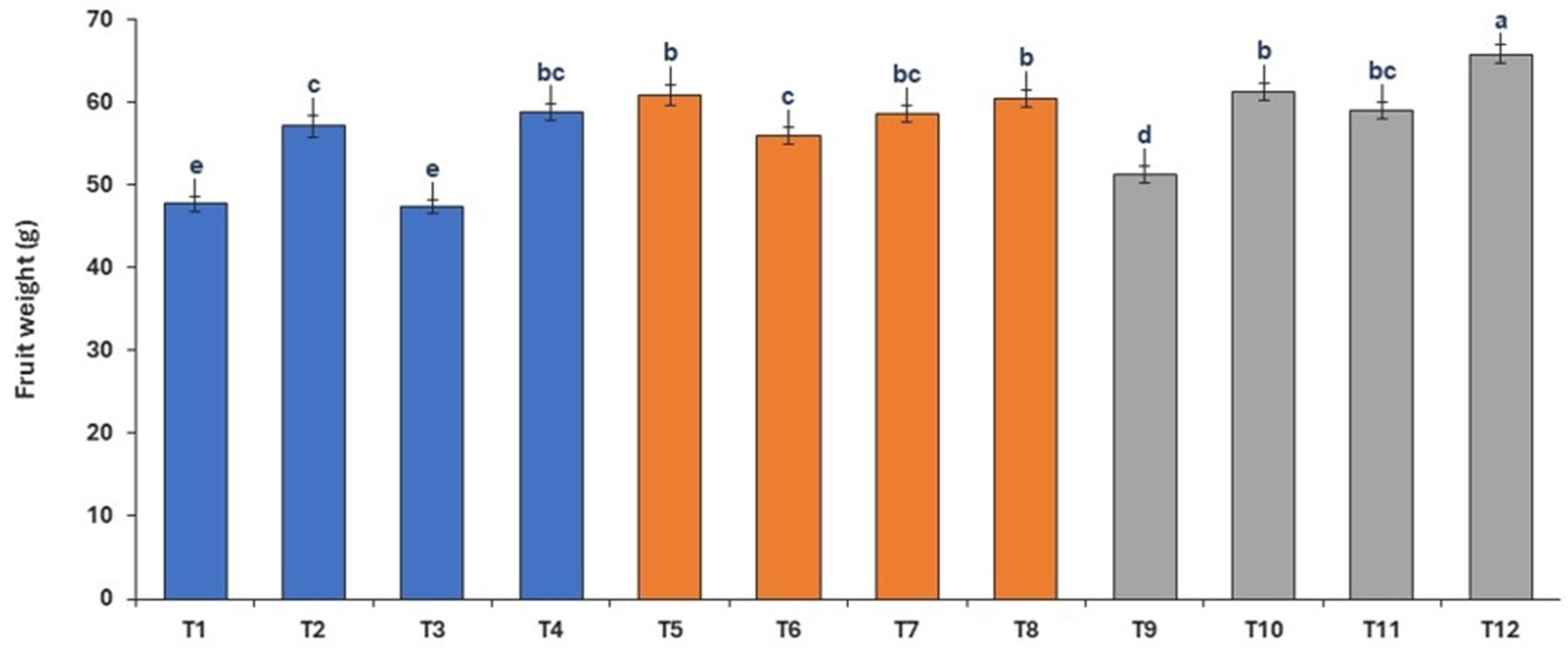
Compared with the other evaluated variables, fruit weight was the only agronomic trait that differed significantly among treatments (Figure 1). Mean fruit weight ranged from 47.30 ± 0.82 g to 65.80 ± 1.14 g, demonstrating a strong response to the combination of microbial inoculation and fertilization. The highest fruit weight was recorded in T12 (WB + WAM + 100, without PGPR), followed by T10 (WB + AM + 100, without PGPR), indicating that the combination of AM inoculation with the highest fertilization dose favored fruit development. Among the PGPR-inoculated treatments, Achromobacter deleyi combined with AM (T5) or WAM (T8) produced the greatest fruit weights, reaching 60.90 ± 1.23 g and 60.50 ± 1.04 g, respectively. In contrast, the lowest fruit weights were observed in T1 and T3, both corresponding to Bacillus sp. under the 50% fertilization level. These results suggest that fruit development was influenced by both microbial inoculation and nutrient availability, with the greatest response occurring under higher fertilization combined with AM, whereas the effectiveness of PGPR depended on the bacterial strain and treatment combination.
Figure 1.
Effect of biofertilizer treatments on fruit weight of Chilaca chili pepper at the green fruit stage. Blue bars represent treatments inoculated with Bacillus sp., orange bars represent treatments inoculated with A. deleyi, and gray bars represent treatments without PGPR inoculation. Values are presented as mean ± SD (n = 3). One-way ANOVA indicated significant differences among treatments (F = 86.461, p < 0.001, η2 = 0.975, observed power = 1.000). Bars sharing the same letter are not significantly different according to Tukey’s multiple comparison test (α = 0.05).
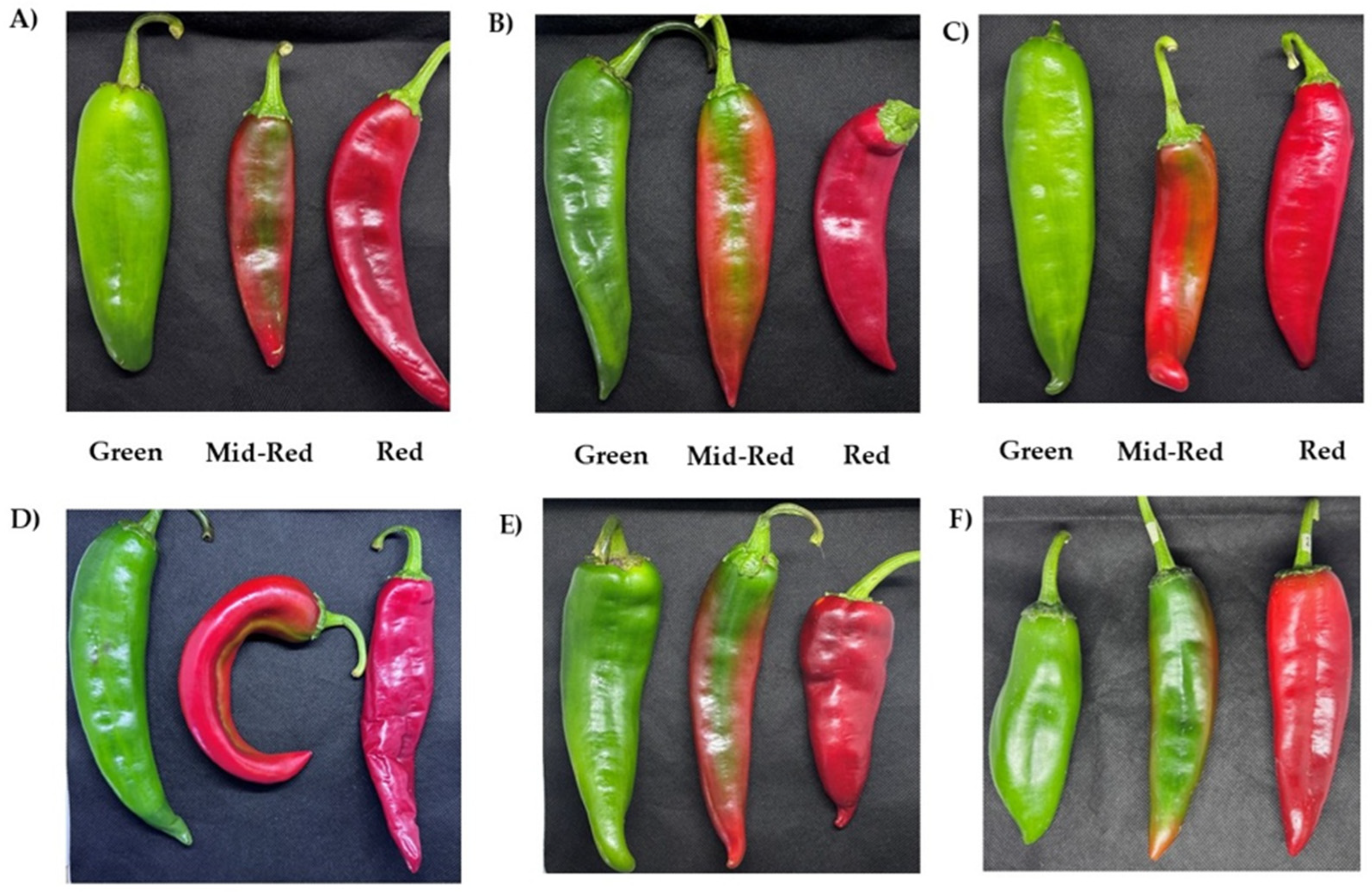
Although the treatments evaluated did not significantly affect various growth and quality traits, they induced marked changes in fruit size and weight and, consequently, in biochemical metabolism during ripening. Fruit ripening is a complex physiological process involving coordinated changes in growth, pigmentation, cellular metabolism, and defense responses. During ripening, enhanced metabolic activity and cellular remodeling often lead to increased production of reactive oxygen species (ROS), which function as signaling molecules but may cause oxidative damage when their levels exceed cellular antioxidant capacity. Plants therefore rely on a complex antioxidant network composed of enzymatic components, such as ascorbate peroxidase (APX), catalase, and superoxide dismutase, together with non-enzymatic antioxidants including vitamin C, glutathione, and phenolic compounds. The balance between ROS generation and antioxidant scavenging is essential for maintaining redox homeostasis and regulating fruit maturation processes. To further investigate these responses, vitamin C and capsaicin contents, together with lipoxygenase (LOX) and ascorbate peroxidase (APX) activities, were determined in chilaca pepper fruits. Figure 2 presents representative fruits at the three ripening stages evaluated (green, mid-red, and red) under the different microbial and fertilization treatments.
Figure 2.
Representative developmental stages of Capsicum annuum L. fruits at three maturity stages (green, mid-red, and red). (A) T1 (Bacillus sp. + arbuscular mycorrhizal fungi (AM) + 50% fertilizer application); (B) T2 (Bacillus sp. + AM + 100% fertilizer application); (C) T3 (Bacillus sp. + without AM + 50% fertilizer application); (D) T5; (A. deleyi +AM + 50% fertilizer application; (E) T7 (A. deleyi + WAM + 50 fertilizer application); and (F) T11 (without PGPR + WAM + 50% fertilizer application).
3.3. Capsaicin Accumulation During Fruit Ripening Under Different Treatments
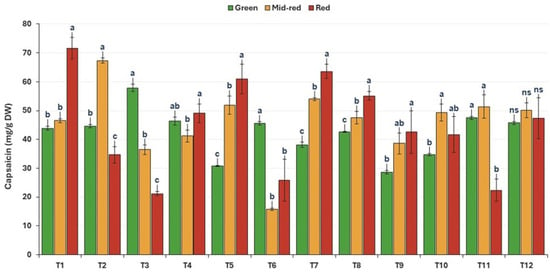
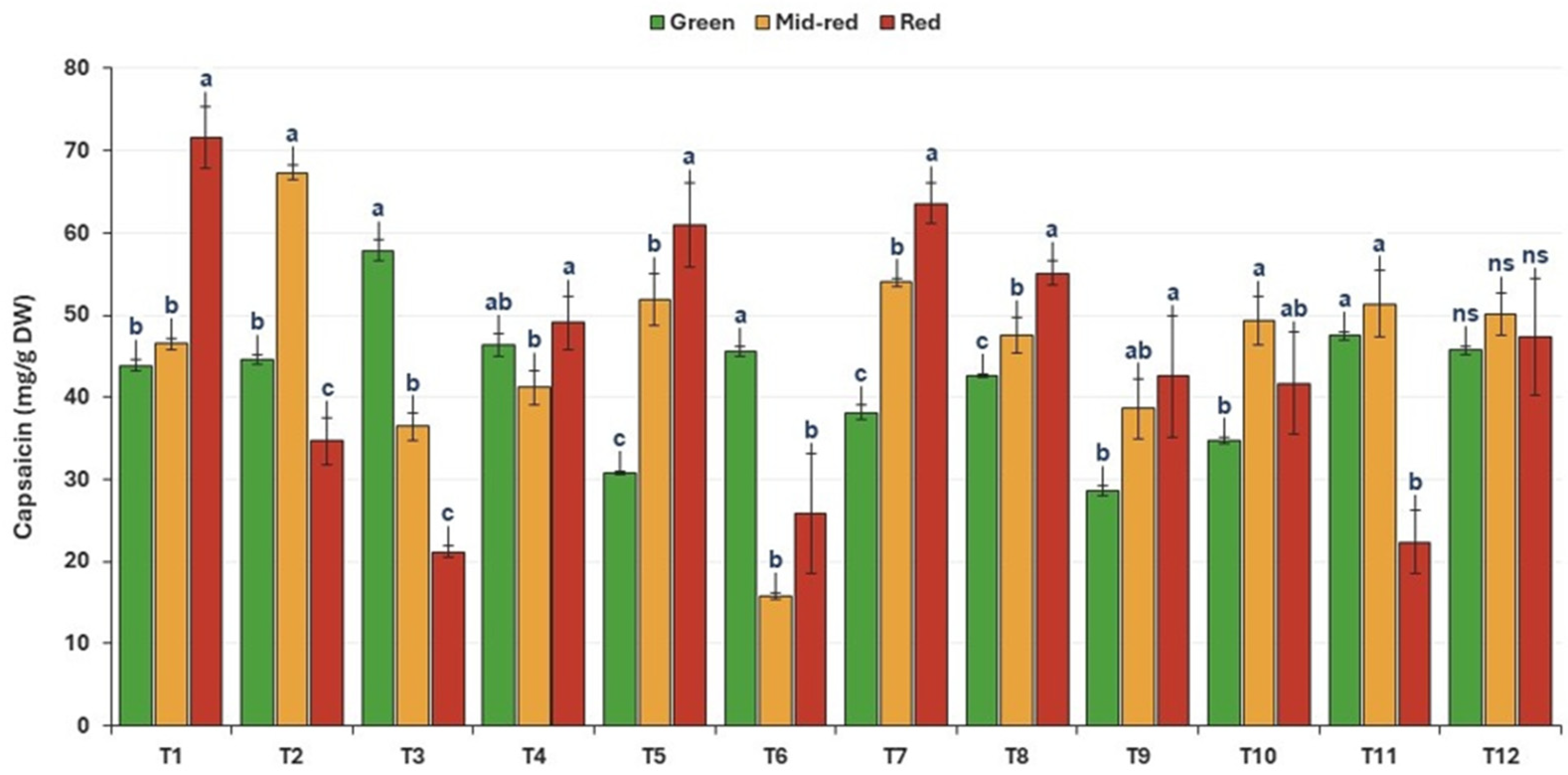
Capsaicin content was significantly affected by ripening stage in most treatment combinations, although the pattern of accumulation varied depending on PGPR inoculation, arbuscular mycorrhiza (AM), and fertilization level (Figure 3). Treatments T5 (A + AM + 50), T7 (A + WAM + 50), and T8 (A + WAM + 100) exhibited a progressive increase in capsaicin content throughout fruit ripening (G < MR < R), indicating continuous capsaicin biosynthesis from the green to the ripe stage (F = 59.693–221.125, p < 0.001). Similarly, T1 (B + AM + 50) showed a significant increase only at the ripe stage (G ≈ MR < R; F = 142.536, p < 0.001). Treatment T2 (B + AM + 100) reached its highest capsaicin content at the mid-ripening stage (MR; F = 265.207, p < 0.001), whereas T4 (B + WAM + 100) exhibited a modest increase only between the mid-ripening and ripe stages (MR < R; F = 8.426, p = 0.018). In contrast, T3 (B + WAM + 50) displayed a continuous decline in capsaicin content during ripening (G > MR > R; F = 681.102, p < 0.001), representing the strongest stage-dependent response among all treatments.
Figure 3.
Capsaicin accumulation during fruit ripening under different biofertilizer treatments. Capsaicin concentration (mg g−1 DW) was determined at three ripening stages (green, mid-red, and red) across the twelve treatments. Data are presented as mean ± SD (n = 3). A separate one-way ANOVA was performed within each treatment to evaluate the effect of ripening stage (df = 2, 6). Ripening stage significantly affected capsaicin accumulation in 11 of the 12 treatments. Within each treatment, bars sharing the same letter are not significantly different according to Tukey’s multiple comparison test (α = 0.05).
Treatment T6 (A + AM + 100) also showed a reduction in capsaicin content after the green stage (G > MR ≈ R; F = 38.346, p < 0.001). Among treatments without PGPR, T9 (WB + AM + 50) exhibited a significant increase only at the ripe stage (G < R; F = 6.770, p = 0.029), whereas T10 (WB + AM + 100) increased from the green to the mid-ripening stage but remained unchanged thereafter (G < MR ≈ R; F = 10.234, p = 0.012). Conversely, T11 (WB + WAM + 50) showed higher capsaicin content at the green and mid-ripening stages than at the ripe stage (G ≈ MR > R; F = 71.015, p < 0.001), while T12 (WB + WAM + 100) exhibited no significant differences across ripening stages (F = 0.795, p = 0.494).
3.4. Changes in Vitamin C Content During Fruit Ripening Under Different Treatments
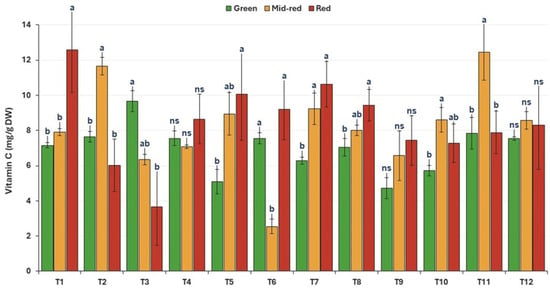
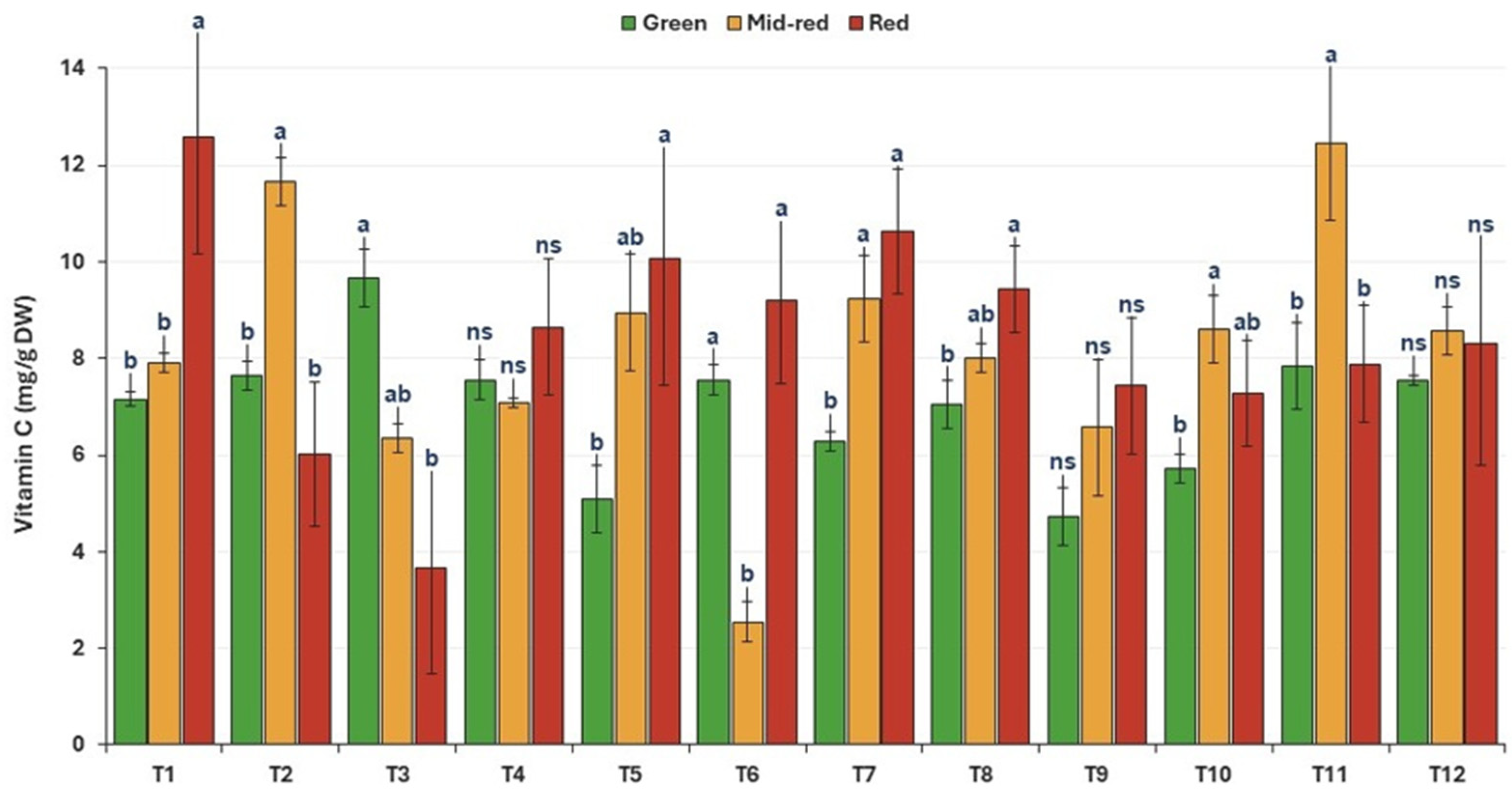
Vitamin C content was significantly affected by ripening stage in most treatment combinations, although the pattern of change depended on the interaction among plant growth-promoting rhizobacteria (PGPR), arbuscular mycorrhiza (AM), and fertilization level. Several treatments exhibited a net increase in vitamin C concentration as fruits reached full maturity. Treatments T1 (B + AM + 50), T5 (A + AM + 50), and T8 (A + WAM + 100) showed significantly higher vitamin C content at the ripe stage than at the green stage. In T1, vitamin C remained unchanged between the green (G) and mid-ripening (MR) stages before increasing at ripeness (G ≈ MR < R; F = 13.383, p = 0.006), whereas T5 and T8 exhibited significant differences only between the green and ripe stages (G < R; F = 7.079 and 11.332, respectively; p ≤ 0.026). Likewise, T7 (A + WAM + 50) showed a progressive increase from the green stage that was maintained through ripening (G < MR ≈ R; F = 17.404, p = 0.003). A second group of treatments displayed transient changes during fruit development. Treatments T2 (B + AM + 100) and T11 (WB + WAM + 50) reached their highest vitamin C concentrations at the mid-ripening stage (MR), indicating a temporary accumulation before full maturity (F = 29.358 and 13.141, respectively; p ≤ 0.006). Similarly, T10 (WB + AM + 100) showed an increase from the green to the mid-ripening stage without further changes thereafter (G < MR ≈ R; F = 10.446, p = 0.011). In contrast, T6 (A + AM + 100) exhibited a pronounced mid-ripening decline followed by recovery at the ripe stage (G ≈ R > MR; F = 34.322, p < 0.001). Only one treatment showed a consistent decline in vitamin C during ripening. T3 (B + WAM + 50) displayed significantly lower vitamin C content at the ripe stage than at the green stage (G > R; F = 15.366, p = 0.004). By contrast, T4 (B + WAM + 100), T9 (WB + AM + 50), and T12 (WB + WAM + 100) exhibited no significant differences among ripening stages (F = 0.386–4.001, p > 0.05), indicating relatively stable vitamin C concentrations throughout fruit development (Figure 4).
Figure 4.
Vitamin C accumulation during fruit ripening under different biofertilizer treatments. Vitamin C content (mg g−1 DW) was measured at three ripening stages (green, mid-red, and red) across the twelve treatments. Data are presented as mean ± SD (n = 3). A separate one-way ANOVA was performed within each treatment to evaluate the effect of ripening stage (df = 2, 6). Ripening stage significantly affected vitamin C accumulation in 9 of the 12 treatments. Within each treatment, bars sharing the same letter are not significantly different according to Tukey’s multiple comparison test (α = 0.05).
3.5. Lipoxygenase Activity During Fruit Ripening Under Different Treatments
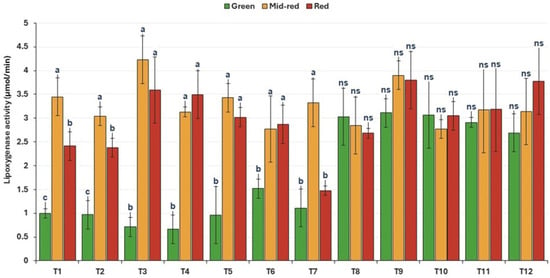
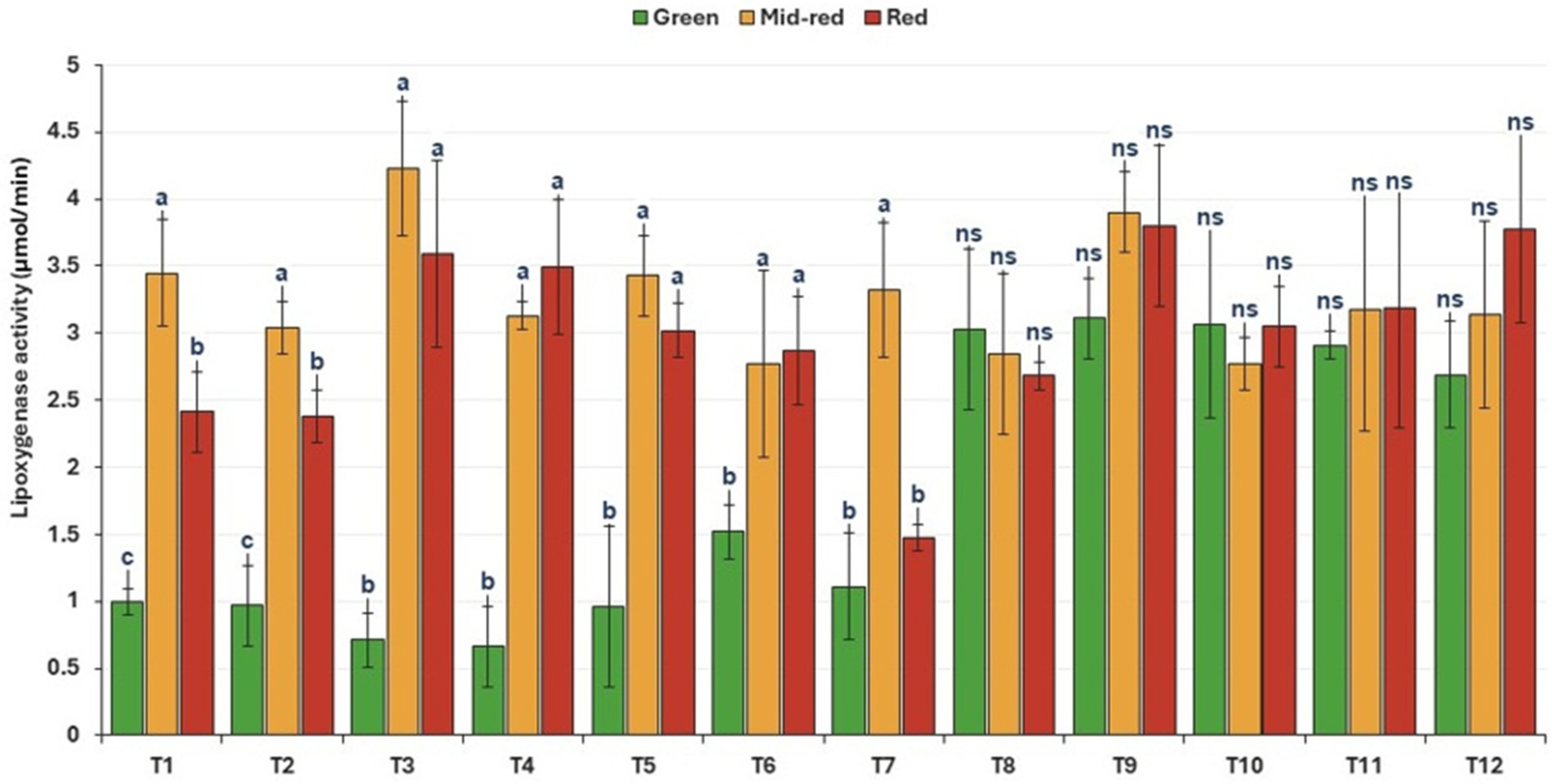
Lipoxygenase (LOX) activity was significantly affected by ripening stage in several treatment combinations, although the magnitude and pattern of the response depended on PGPR inoculation, arbuscular mycorrhiza (AMF), and fertilization level (Figure 5). Treatments T1 (B + AM + 50) and T2 (B + AM + 100) exhibited a pronounced transient increase in LOX activity at the mid-ripening (MR) stage, reaching significantly higher values than at both the green (G) and ripe (R) stages (G < MR > R; F = 52.340 and 59.194, respectively; p < 0.001). A similar but less pronounced pattern was observed in T7 (A + WAM + 50) (F = 30.129, p < 0.001). A second group of treatments showed a sustained increase in LOX activity during fruit development. Treatments T3 (B + WAM + 50), T4 (B + WAM + 100), T5 (A + AM + 50), and T6 (A + AM + 100) followed the pattern G < MR ≈ R, indicating that LOX activity increased significantly after the green stage and remained elevated through fruit maturity. Among these, T4 exhibited the strongest ripening-stage effect (F = 61.026, p < 0.001), followed by T3 (F = 40.566, p < 0.001), T5 (F = 32.181, p < 0.001), and T6 (F = 7.380, p = 0.024). In contrast, T8 (A + WAM + 100) and all treatments lacking PGPR (T9–T12) showed no significant differences in LOX activity among the green, mid-ripening, and ripe stages (F = 0.135–3.084, p > 0.05), indicating that enzyme activity remained relatively stable throughout fruit ripening.
Figure 5.
Lipoxygenase activity during fruit ripening under different biofertilizer treatments. Lipoxygenase activity (mmol/min) was evaluated at three ripening stages (green, mid-red, and red) across the twelve treatments. Data are presented as mean ± SD (n = 3). A separate one-way ANOVA was performed within each treatment to assess the effect of ripening stage (df = 2, 6). Ripening stage significantly affected lipoxygenase activity in 7 of the 12 treatments. Within each treatment, bars sharing the same letter are not significantly different according to Tukey’s multiple comparison test (α = 0.05). ns indicates no significant difference among ripening stages.
3.6. Ascorbate Peroxidase During Fruit Ripening Under Different Treatments
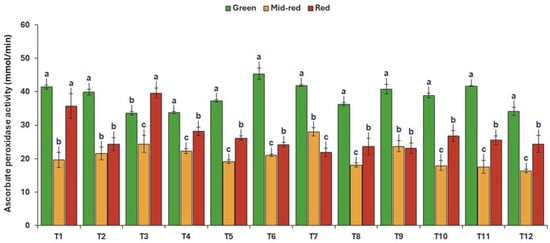
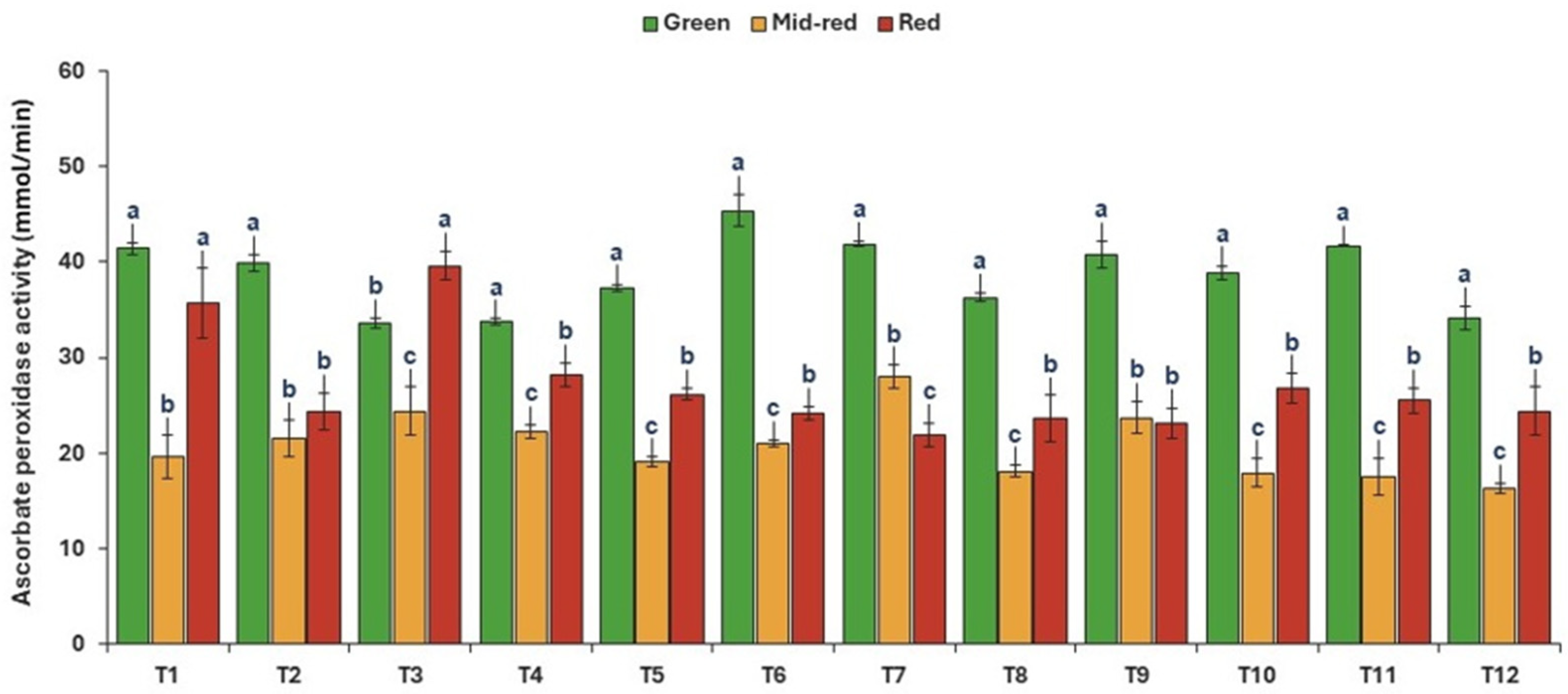
Ascorbate peroxidase (APX) activity was significantly influenced by ripening stage in all treatment combinations (p < 0.001), demonstrating that microbial inoculation, arbuscular mycorrhizal (AM) colonization, and fertilization level modulated antioxidant enzyme activity during fruit development (Figure 6). The predominant response pattern was a transient decline in APX activity at the mid-ripening (MR) stage, followed by recovery at fruit maturity (G ≈ R > MR). This pattern was observed in T1 (B + AM + 50), T3 (B + WAM + 50), T4 (B + WAM + 100), T5 (A + AM + 50), T6 (A + AM + 100), T8 (A + WAM + 100), T10 (WB + AM + 100), T11 (WB + WAM + 50), and T12 (WB + WAM + 100), suggesting a temporary reduction in APX activity during the transition from the mature green to the ripening stage. The strongest ripening-stage effects occurred in T5 (A + AM + 50) (F = 992.651, p < 0.001) and T6 (A + AM + 100) (F = 457.483, p < 0.001). A second response pattern was observed in T2 (B + AM + 100) and T9 (WB + AM + 50), where APX activity was highest at the green stage and declined during ripening without subsequent recovery (G > MR ≈ R). In contrast, T7 (A + WAM + 50) exhibited a continuous decrease in APX activity throughout fruit development (G > MR > R), indicating a progressive reduction in enzyme activity as ripening advanced.
Figure 6.
Ascorbate peroxidase activity during fruit ripening under different biofertilizer treatments. Ascorbate peroxidase activity (mmol min−1) was measured at three ripening stages (green, mid-red, and red) across the twelve treatments. Data are presented as mean ± SD (n = 3). A separate one-way ANOVA was performed within each treatment to evaluate the effect of ripening stage (df = 2, 6). Ripening stage significantly affected ascorbate peroxidase activity in all treatments (12 of 12). Within each treatment, bars sharing the same letter are not significantly different according to Tukey’s multiple comparison test (α = 0.05).
4. Discussion
This study demonstrates that PGPR, AMF, and fertilization exert distinct effects on growth and quality traits in Chilaca chili pepper. Although vegetative growth responses were modest, microbial inoculation, fertilization, and fruit developmental stage significantly affected fruit weight, antioxidant enzyme activity, and bioactive compound accumulation. These results indicate that, under the evaluated conditions, microbial inoculants primarily regulated plant physiology and fruit metabolism rather than broadly enhancing vegetative growth. Chlorophyll content, soluble solids, and biomass accumulation were not significantly altered by microbial inoculation or fertilization, contrasting with previous reports showing improved photosynthetic efficiency and plant performance following AMF and PGPR application in pepper [19]. Although AMF alone had a limited effect on fruit weight, its positive influence on chlorophyll suggests enhanced physiological efficiency and carbon assimilation during fruit development. AMF and beneficial bacteria have been reported to promote flowering, fruit development, yield, and the accumulation of capsaicin and vitamin C, improving pungency, nutritional quality, and antioxidant capacity [30]. Variation in microbial establishment, host–microbe compatibility, and interactions with native rhizosphere communities may have contributed to differences in inoculant effectiveness [31,32,33,34].
Our findings provide direct experimental evidence that mineral fertilization remains a major determinant of plant productivity. Increasing mineral fertilization from 50% to 100% significantly enhanced fruit weight and vegetative biomass, highlighting the importance of adequate nutrient availability for sustaining photosynthesis and biomass accumulation. Although microbial inoculation contributed to plant performance, the combined application of Bacillus sp., AMF, and 100% mineral fertilization (T2) resulted in significantly lower fruit weight than T12. These findings suggest that microbial inoculation can complement mineral fertilization by supporting plant growth but cannot fully replace adequate mineral nutrient inputs. They support the use of bioinoculants as components of integrated nutrient management strategies that improve nutrient-use efficiency and crop performance without substituting conventional fertilization. Similar results were reported by Wu et al. and Zhang et al. (2026) [21,35], who showed that beneficial microorganisms enhance plant productivity but cannot completely compensate for limited nutrient availability. Fruit weight exhibited the strongest response among agronomic traits, emphasizing the importance of interactions between microbial inoculants and mineral nutrition during fruit development. The higher fruit weight observed with A. deleyi compared with Bacillus sp. further supports strain-dependent PGPR effects. These microorganisms enhance plant performance through nitrogen fixation, phosphorus solubilization, siderophore production, phytohormone synthesis, and improved root development, collectively promoting nutrient acquisition and assimilate partitioning toward reproductive organs. Similar strain-specific effects have been reported for beneficial bacteria influencing disease resistance and plant performance, emphasizing the role of microbial identity in plant physiological responses [22,23].
In contrast to the responses observed for fruit weight and chlorophyll, several vegetative traits, including stem and leaf biomass, showed only limited variation among microbial treatments. The relatively small effect on vegetative growth suggests that microbial inoculation preferentially redirected plant resources toward physiological and metabolic processes associated with fruit development rather than increasing structural biomass. Similar observations have been reported in horticultural crops, where beneficial microorganisms improve plant function without necessarily producing significant increases in vegetative growth. Moreover, microbial performance depends on multiple interacting factors, including host genotype, environmental conditions, microbial compatibility, and nutrient availability. Raya-Hernández et al. [36] demonstrated that plant growth-promoting microorganisms do not invariably enhance plant growth and, under certain circumstances, may even negatively influence plant performance, highlighting the context-dependent nature of plant–microbe interactions.
Our results indicate that vitamin C accumulation closely followed APX activity, peaking at the mid-red ripening stage and declining at full maturity, likely due to oxidative degradation, reduced biosynthesis, or increased metabolic utilization. This pattern suggests coordinated regulation of enzymatic and non-enzymatic antioxidant systems during pepper fruit maturation. Microbial inoculation influenced vitamin C dynamics, with Bacillus sp. and A. deleyi promoting higher ascorbic acid concentrations at specific developmental stages or during intermediate ripening. These findings suggest that beneficial microorganisms regulate antioxidant metabolism by enhancing nutrient acquisition, hormonal signaling, and ascorbate biosynthesis and recycling, thereby increasing the antioxidant capacity of the fruit [37,38]. The observed changes in vitamin C during ripening may also reflect shifts in reactive oxygen species (ROS) metabolism, as oxidative processes associated with chlorophyll degradation, respiration, and cellular remodeling increase antioxidant demand and promote ascorbate utilization [39,40].
Among the antioxidant and defense-related enzymes evaluated, LOX activity showed the strongest response to microbial inoculation, particularly in Bacillus sp.-treated plants, whereas non-PGPR treatments remained relatively stable during fruit development. Because LOX initiates the oxylipin pathway involved in membrane remodeling, volatile biosynthesis, defense signaling, and ripening [41], increased activity is likely reflecting metabolic reprogramming during maturation rather than oxidative damage. The progressive increase in LOX activity in AMF-inoculated plants suggests enhanced oxylipin-mediated signaling and defense-related metabolism. LOX-derived compounds serve as precursors for jasmonic acid, which regulates plant defense and secondary metabolites, including capsaicinoids [42,43,44]. Therefore, increased LOX activity in AMF-treated plants may indicate a priming effect that enhances responsiveness to developmental or environmental signals. Although plants were grown under non-stress conditions, similar AMF-mediated improvements in antioxidant metabolism and secondary compound accumulation have been reported, particularly under abiotic stress [21,35]. Similar APX regulation patterns during pepper maturation reflect the balance between ROS production and antioxidant defense throughout development [45].
The increase in LOX activity observed in Bacillus sp.-inoculated fruits during intermediate ripening may be linked to physiological changes associated with the chloroplast-to-chromoplast transition, carotenoid accumulation, and volatile compound synthesis. Similar LOX increases have been reported during Capsicum fruit maturation and are considered part of normal ripening-related metabolic reorganization [13]. Because oxylipins regulate defense signaling and interact with jasmonate pathways, enhanced LOX activity may contribute to secondary metabolism and changes in capsaicinoid accumulation. Variations in LOX activity were accompanied by dynamic changes in APX, suggesting coordinated regulation between oxidative signaling and antioxidant defense [46]. Microbial associations can enhance plant defense and antioxidant systems by stimulating enzymes such as APX and LOX. While APX scavenges reactive oxygen species and protects cells from oxidative damage, LOX participates in lipid metabolism and the production of defense-related signaling molecules. Through improved nutrient acquisition, physiological performance, and stress tolerance, AMF–PGPR interactions provide a sustainable strategy for enhancing pepper productivity, fruit quality, and agricultural sustainability [47].
Consistent with recent studies, we observed that capsaicin accumulation was strongly influenced by microbial inoculation, AMF colonization, fertilization level, and fruit developmental stage, highlighting the complex regulation of secondary metabolism in Chilaca chili pepper. Responses varied among microbial treatments, indicating strain-specific effects rather than a generalized stimulation of capsaicinoid biosynthesis. Achromobacter deleyi-inoculated plants showed progressive increases in capsaicin concentration toward full maturity, whereas Bacillus sp.-inoculated plants exhibited greater accumulation during earlier stages, particularly in green fruits. Capsaicinoid biosynthesis involves coordinated regulation of the phenylpropanoid and branched-chain fatty acid pathways, influenced by developmental signals and environmental conditions [42,48,49]. Beneficial microorganisms may regulate these pathways by improving nutrient acquisition, nutrient-use efficiency, and phytohormonal signaling [37,43,44,50]. The early increase induced by Bacillus sp. suggests rapid activation of defense-related metabolism through bacterial signaling compounds, hormonal modulation, or enhanced nutrient availability during early fruit development. In contrast, the gradual response to A. deleyi indicates a delayed but sustained effect promoting capsaicin accumulation during later maturation. Similar developmental trends have been reported in Capsicum species, although response magnitude and timing depend on genotype, environment, and cultivation practices [51,52]. A recent study shows that synthetic microbial communities can reshape rhizosphere composition and plant metabolism, but their effectiveness depends on functional complementarity rather than microbial diversity alone [53]. Thus, the limited synergistic effects observed here likely reflect the complexity of plant–microbe interactions rather than reduced microbial activity.
5. Conclusions
In conclusion, this study demonstrated that microbial inoculation primarily enhanced fruit physiological quality rather than vegetative growth. AMF and PGPR differentially regulated vitamin C content, antioxidant metabolism, and capsaicinoid accumulation, while interacting with mineral fertilization to improve fruit development. These findings highlight the potential of beneficial microorganisms as sustainable components of pepper production systems, where their main contribution is improving nutrient-use efficiency and enhancing fruit nutritional and functional quality rather than replacing conventional fertilization. Future research should quantify microbial colonization, characterize rhizosphere microbial dynamics, and analyze genes involved in antioxidant metabolism, hormone signaling, and capsaicinoid biosynthesis to clarify the molecular mechanisms underlying these responses and confirm their effectiveness under different cultivation conditions, both in the greenhouse and in field conditions.
Supplementary Materials
The following supporting information can be downloaded at: https://www.mdpi.com/article/10.3390/crops6040079/s1. The structured tabular presentation of one-way ANOVA results, incorporating color coding, enhances the interpretation of biochemical parameter changes across different stages of fruit ripening across 12 experimental treatments.
Author Contributions
Conceptualization, J.G.F., A.A.B.L., A.G.M. and E.S.C.; methodology, J.G.F., A.A.B.L., P.V.L. and M.A.V.S.; software, A.A.B.L. and J.G.F.; validation, A.G.M. and E.S.C.; formal analysis, P.V.L., M.A.V.S., A.G.M. and E.S.C.; investigation, J.G.F. and A.A.B.L.; data curation, A.G.M. and E.S.C.; writing—original draft preparation, E.S.C.; writing—review and editing, A.G.M. and E.S.C.; visualization, A.G.M.; supervision, A.G.M.; project administration, A.G.M. and E.S.C. All authors have read and agreed to the published version of the manuscript.
Funding
Jael Gonzalez Flores is grateful to (Secihti, Mexico) for the financial support for her master’s studies, grant 2051725.
Data Availability Statement
The data are contained within the manuscript and the Supplementary Material.
Conflicts of Interest
The authors declare no conflicts of interest.
References
- Anaya-Esparza, L.M.; Mora, Z.V.-d.l.; Vázquez-Paulino, O.; Ascencio, F.; Villarruel-López, A. Bell Peppers (Capsicum annum L.) Losses and Wastes: Source for Food and Pharmaceutical Applications. Molecules 2021, 26, 5341. [Google Scholar] [CrossRef] [Scilit] [PubMed]
- Choi, M.H.; Kim, M.H.; Han, Y.S. Physicochemical properties and antioxidant activity of colored peppers (Capsicum annuum L.). Food Sci. Biotechnol. 2023, 32, 209–219. [Google Scholar] [CrossRef] [Scilit] [PubMed]
- Tripodi, P.; Ficcadenti, N.; Rotino, G.L.; Festa, G.; Bertone, A.; Pepe, A.; Caramanico, R.; Migliori, C.A.; Spadafora, D.; Schiavi, M.; et al. Genotypic and environmental effects on the agronomic, health-related compounds and antioxidant properties of chilli peppers for diverse market destinations. J. Sci. Food Agric. 2019, 99, 4550–4560. [Google Scholar] [CrossRef] [Scilit] [PubMed]
- Tripodi, P.; Lo Scalzo, R.; Ficcadenti, N. Dissection of heterotic, genotypic and environmental factors influencing the variation of yield components and health-related compounds in chilli pepper (Capsicum annuum). Euphytica 2020, 216, 112. [Google Scholar] [CrossRef] [Scilit]
- Ruiz-Hernández, S.C.; Carrillo-Rodríguez, J.C.; Vera-Guzmán, A.M.; Chávez-Servia, J.L.; Aquino-Bolaños, E.N.; Alba-Jiménez, J.E.; Davila, M.V. Agromorphological traits and bioactive compounds of four Mexican chili peppers (Capsicum annuum var. annuum L.). Afr. J. Food Agric. Nutr. Dev. 2023, 23, 24487–24506. [Google Scholar] [CrossRef] [Scilit]
- Salam, U.; Ullah, S.; Tang, Z.-H.; Elateeq, A.A.; Khan, Y.; Khan, J.; Khan, A.; Ali, S. Plant Metabolomics: An Overview of the Role of Primary and Secondary Metabolites against Different Environmental Stress Factors. Life 2023, 13, 706. [Google Scholar] [CrossRef] [Scilit] [PubMed]
- Villa-Rivera, M.G.; Ochoa-Alejo, N. Transcriptional Regulation of Ripening in Chili Pepper Fruits (Capsicum spp.). Int. J. Mol. Sci. 2021, 22, 12151. [Google Scholar] [CrossRef] [Scilit] [PubMed]
- Venkatesh, J.; Lee, S.Y.; Back, S.; Kim, T.G.; Kim, G.W.; Kim, J.M.; Kwon, J.K.; Kang, B.C. Update on the genetic and molecular regulation of the biosynthetic pathways underlying pepper fruit color and pungency. Curr. Plant Biol. 2023, 35, 100303. [Google Scholar] [CrossRef] [Scilit]
- Meitei, A.L.; Yogendra, K.; Sanivarapu, H.; Meetei, N.T.; Rai, M.; Tyagi, W. Metabolite profiling reveals differential accumulation of secondary metabolites related to flavour and colour across four heirloom chilli landraces. Physiol. Mol. Biol. Plants 2025, 31, 477–491. [Google Scholar] [CrossRef] [Scilit] [PubMed]
- Hake, A.A.; Saha, P.; Singh, B.K.; Kudupudi, P.R.; Kommana, M.; Kesamsetty, S.; Maganti, S.M. Integrated Transcriptome and Metabolome Identifies Novel Genes and Metabolites Associated with Ripening and Pigmentation in Chilli Pepper (Capsicum annuum L.). J. Plant Growth Regul. 2026, 45, 3081–3123. [Google Scholar] [CrossRef] [Scilit]
- Sarde, S.J.; Kumar, A.; Remme, R.N.; Dicke, M. Genome-wide identification, classification and expression of lipoxygenase gene family in pepper. Plant Mol. Biol. 2018, 98, 375–387. [Google Scholar] [CrossRef] [Scilit] [PubMed] [PubMed Central]
- Wu, K.; Yang, M.; Chen, L.; Ou, L.; Liu, Z.; Deng, Q.; Huang, R.; Altaf, M.A.; Wang, Z.; Xu, L.; et al. Genome-wide identification and effect on volatile aroma compounds of lipoxygenase in fruit fatty acid metabolism pathway in Capsicum chinense. Sci. Hortic. 2025, 345, 114157. [Google Scholar] [CrossRef] [Scilit]
- González-Gordo, S.; Cañas, A.; Muñoz-Vargas, M.A.; Palma, J.M.; Corpas, F.J. Lipoxygenase (LOX) in sweet and hot pepper (Capsicum annuum L.) fruits during ripening and under an enriched nitric oxide (NO) gas atmosphere. Int. J. Mol. Sci. 2022, 23, 15211. [Google Scholar] [CrossRef] [Scilit] [PubMed]
- Jarén-Galán, M.; Mínguez-Mosquera, M.I. Effect of pepper lipoxygenase activity and its linked reactions on pigments of the pepper fruit. J. Agric. Food Chem. 1999, 47, 4532–4536. [Google Scholar] [CrossRef] [Scilit] [PubMed]
- Pang, X.; Chen, J.; Xu, Y.; Liu, J.; Zhong, Y.; Wang, L.; Zheng, J.; Wan, H. Genome-wide characterization of ascorbate peroxidase gene family in pepper (Capsicum annuum L.) in response to multiple abiotic stresses. Front. Plant Sci. 2023, 14, 1189020. [Google Scholar] [CrossRef] [Scilit] [PubMed]
- Schantz, M.L.; Schreiber, H.; Guillemaut, P.; Schantz, R. Changes in ascorbate peroxidase activities during fruit ripening in Capsicum annum. FEBS Lett. 1995, 358, 149–152. [Google Scholar] [CrossRef] [Scilit] [PubMed]
- Singh, N.K.; Goyal, N.; Mishra, R.; Kumar, S.; Sharma, V.; Singh, P. Building Soil Health and Fertility through Organic Amendments and Practices: A Review. Asian J. Soil Sci. Plant Nutr. 2024, 10, 174–197. [Google Scholar] [CrossRef] [Scilit]
- Angulo-Castro, A.; Ferrera-Cerrato, R.; Alarcón, A.; Almaraz-Suárez, J.J.; Delgadillo-Martínez, J.; Jiménez-Fernández, M.; García-Barradas, O. Improved growth of bell pepper (Capsicum annuum) plants by inoculating arbuscular mycorrhizal fungi and beneficial rhizobacteria. Sci. Fungorum 2021, 51, e1299. [Google Scholar] [CrossRef] [Scilit]
- González-Mancilla, A.; Almaraz-Suárez, J.J.; Ferrera-Cerrato, R.; Rodríguez-Guzmán, M.P.; Taboada-Gaytán, O.R. Photosynthetic activity and growth of poblano pepper biofertilized with plant growth promoting rhizobacteria and arbuscular mycorrhizal fungi. Curr. Res. Microb. Sci. 2024, 7, 100269. [Google Scholar] [CrossRef] [Scilit] [PubMed]
- Zhang, W.; Wang, B.; Chen, Z.; Liu, B.; Liu, Y.; Qin, W.; Dai, X. Irrigation of previous crops alleviates the negative impact of replacing chemical fertilizers with organic fertilizers on foxtail millet yield. Agric. Water Manag. 2026, 324, 110156. [Google Scholar] [CrossRef] [Scilit]
- Wu, X.H.; Gu, Q.Y.; Ma, C.Y.; Zhang, W.; Dai, C.C. Research progress in plant beneficial fungi-mediated alleviation of drought stress in crops. J. Fungi 2026, 12, 188. [Google Scholar] [CrossRef] [Scilit] [PubMed]
- Cheng, Q.; Guo, S.; Du, Z.; Li, X.; Wang, Z.; Jiang, X.; Zhu, L.; Yang, B.; Feng, Y.; Wang, Y.; et al. Healthy wheat roots are enriched in Bacillus sp. XN303, conferring resistance to Fusarium crown rot, promoting seedling growth, and detoxifying deoxynivalenol. Pest. Manag. Sci. 2026. [Google Scholar] [CrossRef] [Scilit] [PubMed]
- Ávila-Oviedo, J.L.; Méndez-Inocencio, C.; Rodríguez-Torres, M.D.; Angoa-Pérez, M.V.; Martínez-Mendoza, E.K.; Villar-Luna, E. In Vivo Screening of Rhizobacteria Against Phytophthora capsici and Bacillus subtilis Induced Defense Gene Expression in Chili Pepper (Capsicum annuum L.). Horticulturae 2026, 12, 59. [Google Scholar] [CrossRef] [Scilit]
- Sayed, E.G.; Desoukey, S.F.; Desouky, A.F.; Farag, M.F.; El-Kholy, R.I.; Azoz, S.N. Synergistic influence of arbuscular mycorrhizal fungi inoculation with nanoparticle foliar application enhances chili (Capsicum annuum L.) antioxidant enzymes, anatomical characteristics, and productivity under cold-stress conditions. Plants 2024, 13, 517. [Google Scholar] [CrossRef] [Scilit] [PubMed]
- Akhoundnejad, Y.; Karakaş, Ö.; Daşgan, H.Y. Boosting Drought Resistance in Pepper (Capsicum annuum L.) with the Aid of Arbuscular Mycorrhizal Fungi and Key Phytohormones. HortScience 2023, 58, 1281–1290. [Google Scholar] [CrossRef] [Scilit]
- González-Pérez, E.; Villalobos-Reyes, S.; Núñez-Colin, C.A.; Canul-Ku, J. Caracterización morfológica de líneas avanzadas de chiles (Capsicum annuum L.) del. centro de. México. Agron. Mesoam. 2025, 36, 61651. [Google Scholar] [CrossRef] [Scilit]
- National Meteorological Service (SMN). Climatological Station 10169, C.B.T.A. 101 Gómez Palacio, Durango—Monthly Statistics. National Climatological Database, General Coordination of the National Meteorological Service, National Water Commission (CONAGUA), Government of Mexico. Available online: https://smn.conagua.gob.mx/es/climatologia/informacion-climatologica/informacion-estadistica-climatologica (accessed on 23 November 2025).
- Corpas, F.J.; González-Gordo, S.; Palma, J.M. Ascorbate peroxidase in fruits and modulation of its activity by reactive species. J. Exp. Bot. 2024, 75, 2716–2732. [Google Scholar] [CrossRef] [Scilit] [PubMed]
- Chrisnasari, R.; Ewing, T.A.; Hilgers, R.; van Berkel, W.J.H.; Vincken, J.-P.; Hennebelle, M. Versatile ferrous oxidation–xylenol orange assay for high-throughput screening of lipoxygenase activity. Appl. Microbiol. Biotechnol. 2024, 108, 266. [Google Scholar] [CrossRef] [Scilit] [PubMed]
- Villa-Rivera, M.G.; Ochoa-Alejo, N. Ascorbic acid in chili pepper fruits: Biosynthesis, accumulation, and factors affecting its content. J. Mex. Chem. Soc. 2023, 67, 187–199. [Google Scholar] [CrossRef] [Scilit]
- Santos, M.S.; Nogueira, M.A.; Hungria, M. Microbial inoculants: Reviewing the past, discussing the present and previewing an outstanding future for the use of beneficial bacteria in agriculture. Amb Express 2019, 9, 205. [Google Scholar] [CrossRef] [Scilit] [PubMed]
- Emmanuel, O.C.; Babalola, O.O. Productivity and quality of horticultural crops through co-inoculation of arbuscular mycorrhizal fungi and plant growth promoting bacteria. Microbiol. Res. 2020, 239, 126569. [Google Scholar] [CrossRef] [Scilit] [PubMed]
- Trabelsi, D.; Mhamdi, R. Microbial inoculants and their impact on soil microbial communities: A review. BioMed Res. Int. 2013, 2013, 863240. [Google Scholar] [CrossRef] [Scilit] [PubMed]
- Mawarda, P.C.; Le Roux, X.; Van Elsas, J.D.; Salles, J.F. Deliberate introduction of invisible invaders: A critical appraisal of the impact of microbial inoculants on soil microbial communities. Soil. Biol. Biochem. 2020, 148, 107874. [Google Scholar] [CrossRef] [Scilit]
- Zhang, Z.Z.; Feng, H.D.; Zhang, Z.Z.; Wen, Y.; Hashem, A.; Wu, Q.S. Arbuscular mycorrhizal fungi enhance drought resilience and bioactive compound accumulation in Polygonum cuspidatum. Plant Physiol. Biochem. 2026, 231, 110973. [Google Scholar] [CrossRef] [Scilit] [PubMed]
- Raya-Hernández, A.I.; López-Carmona, D.; Jaramillo-López, P.; Fernández-Pavía, S.P.; Carreón-Abud, Y.; Fraire-Velázquez, S.; Larsen, J. Well known microbial plant growth promoters provoke plant growth suppression and increase chili pepper wilt caused by the root pathogen Phytophthora capsici. Eur. J. Plant Pathol. 2023, 167, 787–799. [Google Scholar] [CrossRef] [Scilit]
- Backer, R.; Rokem, J.S.; Ilangumaran, G.; Lamont, J.; Praslickova, D.; Ricci, E.; Subramanian, S.; Smith, D.L. Plant Growth-Promoting Rhizobacteria: Context, Mechanisms of Action, and Roadmap to Commercialization of Biostimulants for Sustainable Agriculture. Front. Plant Sci. 2018, 9, 1473. [Google Scholar] [CrossRef] [Scilit] [PubMed]
- Rouphael, Y.; Colla, G. Editorial: Biostimulants in Agriculture. Front. Plant Sci. 2020, 11, 40. [Google Scholar] [CrossRef] [Scilit] [PubMed]
- Jimenez, A.; Creissen, G.; Kular, B.; Firmin, J.; Robinson, S.; Verhoeyen, M.; Mullineaux, P. Changes in oxidative processes and components of the antioxidant system during tomato fruit ripening. Planta 2002, 214, 751–758. [Google Scholar] [CrossRef] [Scilit] [PubMed]
- Howard, L.R.; Talcott, S.T.; Brenes, C.H.; Villalon, B. Changes in phytochemical and antioxidant activity of selected pepper cultivars (Capsicum species) as influenced by maturity. J. Agric. Food Chem. 2000, 48, 1713–1720. [Google Scholar] [CrossRef] [Scilit] [PubMed]
- Feussner, I.; Wasternack, C. The Lipoxygenase Pathway. Annu. Rev. Plant Biol. 2002, 53, 275–297. [Google Scholar] [CrossRef] [Scilit] [PubMed]
- Arce-Rodríguez, M.L.; Ochoa-Alejo, N. Biochemistry and molecular biology of capsaicinoid biosynthesis: Recent advances and perspectives. Plant Cell Rep. 2019, 38, 1017–1030. [Google Scholar] [CrossRef] [Scilit] [PubMed]
- Hause, B.; Maier, W.; Miersch, O.; Kramell, R.; Strack, D. Induction of jasmonate biosynthesis in arbuscular mycorrhizal barley roots. Plant Physiol. 2002, 130, 1213–1220. [Google Scholar] [CrossRef] [Scilit] [PubMed]
- Ambarwati, E.; Arwiyanto, T.; Widada, J.; Alam, T.; Andika, I.P. The genes associated with jasmonic acid and salicylic acid are induced in tropical chili pepper against Ralstonia solanacearum by applying arbuscular mycorrhizal fungi. Horticulturae 2022, 8, 876. [Google Scholar] [CrossRef] [Scilit]
- González-Gordo, S.; Rodríguez-Ruiz, M.; Palma, J.M.; Corpas, F.J. Superoxide Radical Metabolism in Sweet Pepper (Capsicum annuum L.) Fruits Is Regulated by Ripening and by a NO-Enriched Environment. Front. Plant Sci. 2020, 11, 485. [Google Scholar] [CrossRef] [Scilit] [PubMed]
- Asada, K. The Water-Water Cycle in Chloroplasts: Scavenging of Active Oxygens and Dissipation of Excess Photons. Annu. Rev. Plant Physiol. Plant Mol. Biol. 1999, 50, 601–639. [Google Scholar] [CrossRef] [Scilit] [PubMed]
- Islam, K.; Rawoof, A.; Kumar, A.; Momo, J.; Ahmed, I.; Dubey, M.; Ramchiary, N. Genetic regulation, environmental cues, and extraction methods for higher yield of secondary metabolites in capsicum. J. Agric. Food Chem. 2023, 71, 9213–9242. [Google Scholar] [CrossRef] [Scilit] [PubMed]
- Aza-González, C.; Núñez-Palenius, H.G.; Ochoa-Alejo, N. Molecular biology of capsaicinoid biosynthesis in chili pepper (Capsicum spp.). Plant Cell Rep. 2011, 30, 695–706. [Google Scholar] [CrossRef] [Scilit] [PubMed]
- Gómez-García, M.D.R.; Ochoa-Alejo, N. Biochemistry and Molecular Biology of Carotenoid Biosynthesis in Chili Peppers (Capsicum spp.). Int. J. Mol. Sci. 2013, 14, 19025–19053. [Google Scholar] [CrossRef] [Scilit] [PubMed]
- Pereira, J.A.P.; Vieira, I.J.C.; Freitas, M.S.M.; Capato Lima, T.; Paes Mendonça, L.V. Effects of phosphorus and arbuscular mycorrhizal fungi on the quality of chili pepper fruits. J. Plant Nutr. 2024, 47, 1319–1330. [Google Scholar] [CrossRef] [Scilit]
- Barbero, G.F.; Ruiz, A.G.; Liazid, A.; Palma, M.; Vera, J.C.; Barroso, C.G. Evolution of total and individual capsaicinoids in peppers during ripening of the Cayenne pepper plant (Capsicum annuum L.). Food Chem. 2014, 153, 200–206. [Google Scholar] [CrossRef] [Scilit] [PubMed]
- Vázquez-Espinosa, M.; Álvarez-Romero, M.; González-de-Peredo, A.V.; Ruíz-Rodríguez, A.; Ferreiro-González, M.; Barbero, G.F.; Palma, M. Capsaicinoid content in the pericarp and placenta of bolilla peppers (Capsicum annuum L.) throughout the ripening of the fruit at two different stages of plant maturation. Agronomy 2023, 13, 435. [Google Scholar] [CrossRef] [Scilit]
- Zhou, Q.; Gao, X.; Wu, Q.; Zeng, W.; Cao, W.; Zhou, T.; Cui, X.; Chen, J.; Gao, D.; Zhao, H. Cross-Kingdom Synthetic Microbiota Suppresses Wheat Fusarium Crown Rot by Remodeling the Rhizosphere Microbiome and Metabolome. J. Agric. Food Chem. 2026, 74, 2418. [Google Scholar] [CrossRef] [Scilit] [PubMed]

Disclaimer/Publisher’s Note: The statements, opinions and data contained in all publications are solely those of the individual author(s) and contributor(s) and not of MDPI and/or the editor(s). MDPI and/or the editor(s) disclaim responsibility for any injury to people or property resulting from any ideas, methods, instructions or products referred to in the content. |
© 2026 by the authors. Licensee MDPI, Basel, Switzerland. This article is an open access article distributed under the terms and conditions of the Creative Commons Attribution (CC BY) license.