Article

Long-Term Effects of Tillage Systems on Weeds and Maize Yield in the Transylvanian Plain


by
Felicia Chețan
1,
Roxana Elena Călugăr
1,*,
Alina Șimon
1,
Camelia Urdă
1,
Cornel Chețan
1,
Alin Popa
1 and
Adrian Ioan Pop
2
1
Agricultural Research and Development Station Turda, Agriculturii Street 27, 401100 Turda, Romania
2
Department of Technical and Soil Sciences, Faculty of Agriculture, University of Agricultural Sciences and Veterinary Medicine Cluj-Napoca, Mănăstur Street 3–5, 400372 Cluj-Napoca, Romania
*
Author to whom correspondence should be addressed.
Crops 2026, 6(4), 74; https://doi.org/10.3390/crops6040074
Submission received: 30 June 2026 / Revised: 23 July 2026 / Accepted: 28 July 2026 / Published: 3 August 2026

Abstract

This study evaluated the long-term effects of soil tillage systems on weed dynamics and maize (Zea mays L.) yield in the Transylvanian Plain, Romania, over an eight-year period (2018–2025). A long-term field experiment was established under a split-plot design with four tillage systems: conventional tillage (CS), minimum tillage with chisel (MTC), minimum tillage with disk (MTD) and no-tillage (NT). Results indicated that reduced soil disturbance significantly increased total weed density, with a clear shift in community structure toward perennial species under conservation tillage systems. Weed infestation ranged from 8 to 9 plants m−2 in CS to 18–25 plants m−2 in NT. Maize yield showed a progressive decline with decreasing tillage intensity, from 7283 kg ha−1 in CS to 4725 kg ha−1 in NT. ANOVA results confirmed highly significant effects of tillage system (F = 2451.15; p < 0.001) and year (F = 79.62; p < 0.001), as well as a significant tillage × year interaction (F = 2.15; p < 0.05), indicating temporal variability in treatment responses under changing climatic conditions. Under the specific pedoclimatic conditions of the Transylvanian Plain, reduced tillage systems showed lower maize productivity compared with conventional tillage, indicating that the balance between soil conservation and yield performance depends on local environmental and management conditions.

1. Introduction

Maize (Zea mays L.) is one of the most important cereal crops worldwide, serving as a key source of food, feed and industrial raw materials, including bioenergy production. Its global importance is closely linked to its high yield potential and wide adaptability to diverse agroecological conditions [1,2]. However, maize productivity is strongly influenced by environmental conditions and crop management practices. Among biotic constraints, weed competition during early growth stages represents one of the most critical limiting factors, as young maize plants are highly sensitive to competition for light, water and nutrients [3,4]. The concept of the critical period for weed control highlights that early-season weed interference can lead to irreversible yield losses if weeds are not effectively managed.
Weeds constitute a major biological constraint in maize production due to their high competitiveness and adaptability. Depending on infestation level and environmental conditions, yield losses may vary considerably [5]. In addition to direct competition, weeds can also negatively affect crop performance indirectly by modifying canopy microclimate and increasing production costs associated with additional control measures [6].
Weed competition affects maize differently depending on the crop developmental stage. During the early vegetative growth period, maize plants are particularly sensitive because their root system and canopy are still developing, allowing weeds to compete effectively for water, nutrients, light, and space. This interval corresponds to the critical period of weed interference, during which uncontrolled weed growth may cause irreversible reductions in biomass accumulation and grain yield, even when weeds are removed later in the season. Under drought conditions, competition for soil moisture becomes even more severe, as weeds further reduce the amount of water available for crop growth and negatively affect resource-use efficiency [7,8,9].
Soil tillage systems play a key role in regulating weed emergence patterns and community structure [10]. Conventional tillage generally reduces weed pressure by burying seeds and disrupting germination processes. In contrast, reduced tillage and no-tillage systems tend to alter weed community composition, often favoring perennial species due to reduced soil disturbance and increased seed retention in the upper soil layer [11,12,13,14]. In the context of conservation agriculture, understanding long-term interactions between tillage systems, weed dynamics and crop productivity is essential. These interactions are strongly influenced by local pedoclimatic conditions and management practices, which may progressively reshape weed community trajectories over time [15]. However, long-term studies from Central and Eastern Europe that simultaneously assess weed functional group dynamics and maize yield stability remain limited. Tillage practices influence weed community development by modifying soil disturbance intensity, seed distribution, residue cover, and soil microclimatic conditions. However, the long-term consequences of these changes for weed functional groups and maize productivity remain insufficiently documented under specific pedoclimatic conditions.
Therefore, the objective of this study was to evaluate the long-term effects of contrasting soil tillage systems on weed community dynamics and maize productivity during an eight-year field experiment (2018–2025) conducted under the pedoclimatic conditions of the Transylvanian Plain, Romania. The novelty of this research lies in the integrated assessment of weed density, functional group shifts, and maize yield response over an ex-tended period, allowing the cumulative effects of conventional and conservation tillage practices to be identified under variable climatic conditions. This long-term approach provides new insights into the relationship between soil disturbance intensity, weed community trajectories, and crop productivity in a region where such multi-year evaluations remain limited.

2. Materials and Methods

2.1. Experimental Site

The long-term field experiment was conducted at the Agricultural Research and Development Station (ARDS) Turda, Romania, over an eight-year period (2018–2025). The experimental site is located in the Transylvanian Plain, a region characterized by a temperate continental climate with high interannual variability in temperature and precipitation.
The area is representative for central-northwestern Romania, where agricultural production is strongly influenced by climatic variability and soil fertility constraints [16,17].

2.2. Experimental Design

The experiment was established as a long-term factorial field trial using a split-plot design (4 × 8 × 2), with two replications. The main factor (A) consisted of four tillage systems, he main factor (A) consisted of four tillage systems, while years (2018–2025) were considered repeated observations over time. Each experimental plot had a surface area of 144 m2 (12 m × 12 m), with 17 maize rows established at a row spacing of 0.70 m. The tillage treatments were randomly distributed within each replication and maintained constant throughout the experimental period to evaluate cumulative long-term effects on weed dynamics and maize productivity. The experiment comprised eight experimental plots in total (four tillage treatments × two replications), covering a total area of 1152 m2. The crop rotation system consisted of maize–soybean–winter wheat, ensuring a rotational structure while maintaining consistent tillage treatments. Sowing was performed annually during the first decade of April. The exact sowing dates were as follows: 9 April 2018, 6 April 2019, 8 April 2020, 5 April 2021, 8 April 2022, 7 April 2023, 6 April 2024, and 4 April 2025.
The studied tillage systems were: conventional tillage (CS); minimum tillage with chisel (MTC); minimum tillage with disk (MTD) and no-tillage (NT).

2.3. Crop Management Practices

Maize was sown using a precision seeder (Gaspardo MT-6, Maschio Gaspardo S.p.A., Campodarsego, Italy) [18] at a density of 65,000 plants ha−1. The hybrid used was ‘Turda 332’ (FAO 380), developed at the Agricultural Research and Development Station Turda, adapted to the pedoclimatic conditions of the Transylvanian Plain [19,20]. Seed treatment was applied before sowing using a fungicide formulation containing the active ingredients fludioxonil (25 g L−1) and metalaxyl-M (9.7 g L−1), applied at a rate of 1.0 L t−1 seed. The commercial product used was Maxim XL 035 FS (Syngenta Crop Protection, Basel, Switzerland) [21] at a rate of 1.0 L t−1 seed, containing fludioxonil (25 g L−1) and metalaxyl-M (9.7 g L−1).
Fertilization was applied at a moderate intensity level. At sowing, 300 kg ha−1 of NPK fertilizer 16:16:16 (Elixir Zorka, Novi Sad, Serbia) [22] was applied, providing 48 kg ha−1 N, P, and K each. Additionally, 100 kg ha−1 of urea (46% N; Yara International, ASA, Oslo, Norway) [23] was applied at the 6–7 leaf stage (V6–V7) to support vegetative growth. This fertilization strategy is consistent with integrated nutrient management recommendations for temperate maize production systems [24,25,26].
Weed management included a pre-emergence herbicide application based on isoxaflutole (240 g L−1) combined with the safener cyprosulfamide (240 g L−1), and dimethenamid-P (720 g L−1), applied at rates of 0.4 L ha−1 and 1.2 L ha−1, respectively. The commercial formulations used were Merlin Flex (Bayer Crop Science, Leverkusen, Germany) [27] and Spectrum 720 EC (BASF, Ludwigshafen am Rhein, Germany) [28]. using fluroxypyr (333 g L−1) and nicosulfuron (40 g L−1) as active ingredients, applied at rates of 0.54 L ha−1 and 1.0 L ha−1, respectively. The corresponding commercial products were Starane Super (Corteva Crop Solutions Rom SRL, Bucharest, Romania) and Nova Power 4 SC (Agricover Distribution SA, Ilfov, Romania) [29,30].

2.4. Weed Assessment

Weed infestation was assessed at the 4–6 leaf stage of maize (V4–V6), corresponding to the critical period for crop–weed competition. Weed density was determined using the quadrat sampling method, a commonly applied approach for field weed assessment [6,13]. All weed species identified during field observations were recorded and subsequently classified into four functional categories: annual dicotyledonous weeds (AD); annual monocotyledonous weeds (AM); perennial dicotyledonous weeds (PD) and perennial monocotyledonous weeds (PM). Total weed density (plants m−2) was calculated by summing the densities of all recorded weed species within each functional group. The classification into functional groups was used to facilitate statistical analysis and interpretation of treatment effects, while species-specific occurrence was considered when describing the weed flora of the experimental field. The identified weed species corresponded to the common weed spectrum associated with maize cultivation in the studied region. Dominant weed species and their ecological characteristics are presented in Table 1. The weed assessment was performed once, at the V4–V6 growth stage, because this period represents a critical phase when early weed competition can substantially influence maize growth and potential yield formation.

2.5. Statistical Analysis

Maize yield and weed density data were analyzed using POLY-FACT software 2020 (Cluj-Napoca, Romania) [31]. Analysis of variance (ANOVA) was performed according to Gomez and Gomez [32] for a factorial split-plot design. The tillage system was considered the main fixed factor, while year (2018–2025) was included as a fixed factor to evaluate the effect of specific climatic conditions and annual variability during the experimental period. Although the experiment was conducted as a long-term field trial, maize was included in a crop rotation system (maize–soybean–winter wheat); therefore, maize was not grown on the same experimental plots in consecutive years, and the data were not analyzed as repeated measurements. The interaction between tillage system and year was evaluated to determine whether the response of maize yield and weed density varied among experimental years. Mean comparisons were conducted using the Least Significant Difference (LSD) test at p < 0.05, p < 0.01 and p < 0.001 significance levels. Weed–yield relationships were evaluated using simple linear regression analysis following Khuri (2013) [33] with goodness of fit expressed as the coefficient of determination (R2).

2.6. Soil and Climatic Conditions

The field experiment was conducted on a Phaeozem soil [34]. The soil exhibited a neutral reaction, with a pH value of 7.2, determined potentiometrically in distilled water. The soil had a clay texture, with a clay content of approximately 50%. The humus content was 3.00%, determined using the Walkley–Black method, while the total nitrogen concentration was 0.122%, measured by the Kjeldahl method. The soil showed medium phosphorus availability (28 ppm) and a good potassium supply (132 ppm), with both elements determined using the Egner–Riehm–Domingo extraction method. Soil samples for chemical analyses were collected from the 0–30 cm arable layer.
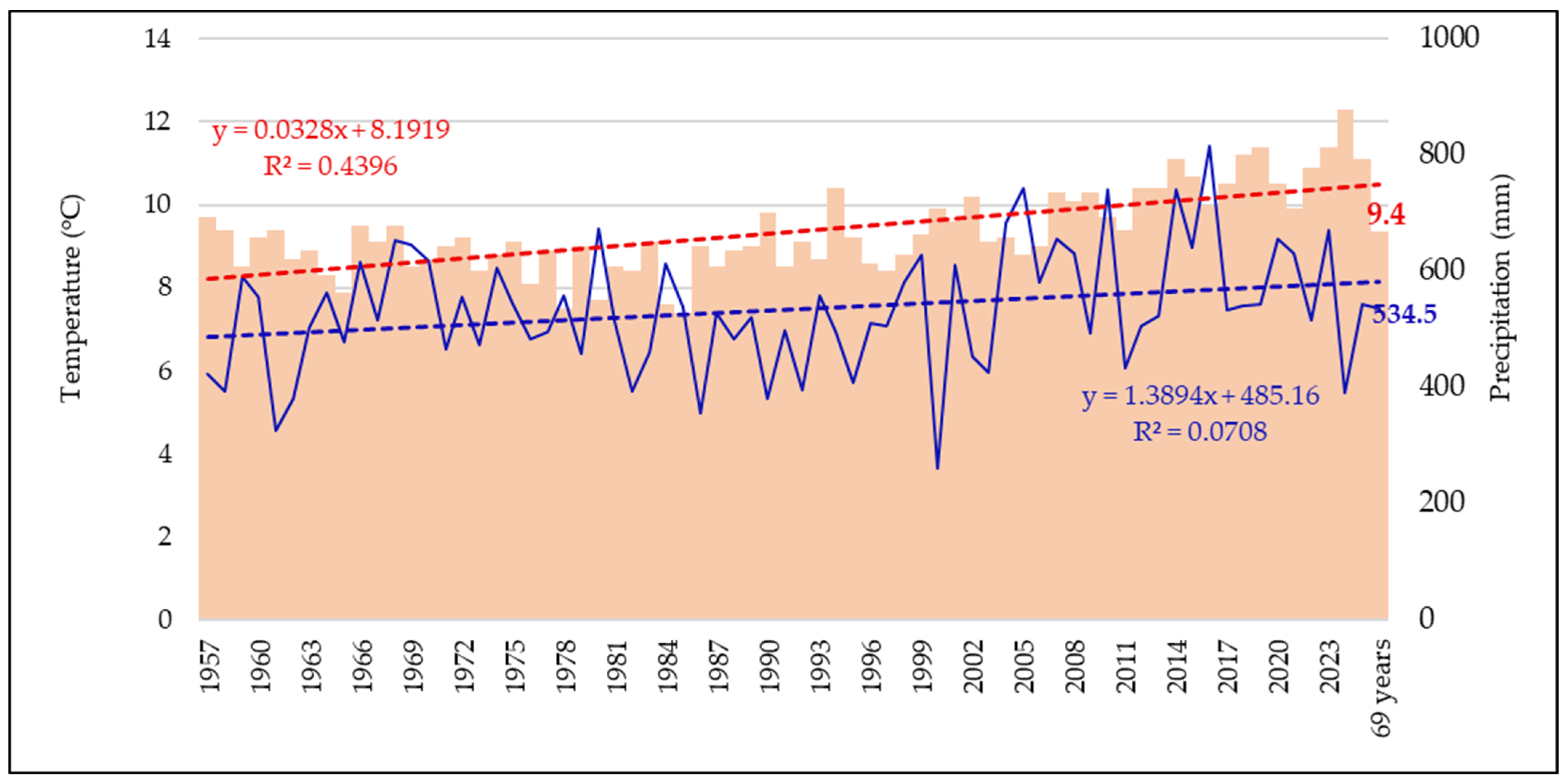
Over the 69-year reference period (1957–2025), the study area was characterized by a multiannual mean air temperature of 9.4 °C and a mean annual precipitation of 534.5 mm, corresponding to a temperate continental climate with moderate rainfall (Figure 1). Air temperature and precipitation data were obtained from measurements recorded at the Turda Weather Station, part of the Northern Transylvania Regional Meteorological Center of the Romanian National Meteorological Administration (ANM), located in the immediate vicinity of the experimental field [35]. The analysis of climate series highlights a clear trend of long-term air temperature rise, while the rainfall regime is characterized by high interannual variability and a much less pronounced trend. The relatively high value of the coefficient of determination for temperature (R2 = 0.4396) indicates the existence of a consistent warming climate signal, while the low value of the coefficient of determination for precipitation (R2 = 0.0708) suggests that their annual variations are controlled predominantly by natural climatic fluctuations and regional atmospheric circulation, rather than a long-term linear trend.
These results are consistent with the conclusions of the Sixth Assessment Report of the Intergovernmental Panel on Climate Change (IPCC), which highlights the significant increase in air temperature at the global and regional levels, concurrently with less uniform and more difficult to detect changes in the rainfall regime. In Central and Eastern Europe, including Romania, climate change is associated with an increase in the frequency and intensity of high-temperature episodes, as well as increased precipitation variability [36].
In an agricultural context, this climatic evolution can lead to the intensification of thermal and water stress on crops, affecting the physiological processes of plants, the efficiency of water use and the stability of agricultural productions. Although the annual amount of precipitation does not show a significant change, their uneven temporal distribution can favor the alternation of periods of water scarcity and excess, with direct effects on crop development and on the efficiency of applied agricultural technologies [36,37]. In the period 2018-2025, the climatic conditions in the Turda area reflected these general trends, being characterized by relatively high temperatures and an uneven distribution of precipitation. These climatic peculiarities influenced both the dynamics of weed communities and the productive response of maize cultivation, the effects being dependent on the tillage system and the availability of water resources in the different vegetation phases. Since rainfall after pre-emergence herbicide application may influence herbicide activation and efficacy, this factor was considered as an important environmental variable when interpreting the obtained results; however, the present study focused on the overall climatic conditions during the growing seasons rather than on short-term precipitation events following herbicide application.

3. Results

3.1. Weed Community Composition Under Different Tillage Systems

The analysis of weed flora structure (Table 1) showed differences in species composition among tillage systems. Annual dicotyledonous species (AD) represented the dominant weed group in the experimental field and were identified across all tillage systems. The main species included Chenopodium album, Amaranthus retroflexus, Xanthium strumarium, Hibiscus trionum, and Sinapis arvensis. Perennial dicotyledonous species (PD), including Cirsium arvense, Convolvulus arvensis, Sonchus arvensis, and Rubus caesius, were more frequently recorded in MTD and NT systems. Annual monocotyledonous species (AM), represented mainly by Echinochloa crus-galli, Setaria glauca, and Digitaria sanguinalis, occurred in all tillage systems, with higher representation in conservation treatments. The perennial monocotyledonous group (PM) was represented by Elymus repens, mainly occurring in MTD and NT systems.

3.2. Temporal Dynamics of Weed Density

The weed density analysis (Table 2) showed clear differences among tillage systems and temporal changes in the abundance of the main weed functional groups during the period 2018–2025 experimental period. Annual dicotyledonous (AD) weeds were the dominant functional group in all the systems analyzed, from 2018 to 2024, with the lowest densities under conventional tillage (CS, 5–6 plants m−2) and progressively higher values under conservation tillage, reaching 8–9 plants m−2 in the no-tillage (NT) system. In 2025, AD density declined across all tillage systems, ranging from 1 plants m−2 in CS to 4 plants m−2 in NT.
Perennial dicotyledonous (PD) weeds were consistently more abundant under conservation tillage than under conventional tillage. In CS, PD density remained low and relatively stable (2 plants m−2 during 2018–2024), whereas NT maintained the highest values (7–9 plants m−2) over the same period. Intermediate densities were recorded in the MTC and MTD systems (3–5 plants m−2). In 2025, PD density decreased in all tillage systems, with values ranging from 0 plants m−2 in CS to 4 plants m−2 in NT.
Annual monocotyledonous (AM) weeds occurred at low densities under CS (approximately 1 plant m−2) throughout 2018–2024, while conservation tillage systems supported slightly higher populations, reaching 4 plants m−2 in NT in 2024. In contrast, AM density increased markedly in 2025, attaining 5, 6, 7 and 8 plants m−2 in CS, MTC, MTD and NT, respectively.

Perennial Monocotyledonous (PM) Weeds Were Absent

CS from 2018 to 2024 but were present under all conservation tillage systems, with the highest density recorded in NT (4 plants m−2 in 2023–2024). In 2025, PM density increased in all tillage systems, reaching 2 plants m−2 in CS, 4 plants m−2 in MTC, 5 plants m−2 in MTD and 9 plants m−2 in NT.
Overall, conservation tillage systems, particularly NT, supported higher weed densities than conventional tillage throughout the experiment. Perennial weeds, especially Cirsium arvense, Convolvulus arvensis, and Elymus repens, were consistently more abundant under reduced soil disturbance than under conventional tillage. The marked changes observed in the distribution of weed functional groups in 2025 indicate a shift in weed community composition relative to the previous years.

3.3. Effects of Tillage System and Year on Weed Density

Analysis of variance (Table 3) revealed significant effects of the tillage system (A) and on weed density (F = 239.68 and F = 233.24, p < 0.001). In contrast, the annual variation (B) had no statistically significant effect (F = 2.61, p > 0.05), indicating relative stability of response over time.
The A × C interaction was significant (F = 14.99, p < 0.001), suggesting that the effect of the tillage system depends on the type of weeds analyzed, while the other interactions were not significant. The high significance of factor A confirms the dominant role of the tillage system in determining the structure of the weed community, while the significant effect of factor C reflects ecological differences between weed functional groups. The lack of significance of factor B indicates that annual variations had little impact on weed density, suggesting relative stability of response over time.
The significant interaction A × C highlights that the weed response to the tillage system is dependent on the functional type, which confirms the ecological differences between annual and perennial species in relation to soil disturbance.

3.4. Effects of Tillage System on Maize Yield

Table 4 (Analysis of variance) revealed a highly significant effect of the tillage system on maize yield (F = 2451.15; p < 0.001). Also, the agricultural year, which reflects the variability of the climatic conditions of the study period, had a highly significant effect on yield (F = 79.62; p < 0.001). The interaction between the tillage system and the agricultural year (A × B) was statistically significant (F = 2.15; p < 0.05), indicating that the response of yield to the different tillage systems varied according to the specific climatic conditions of each year.
The results presented in Table 5 show significant differences in maize yield among tillage systems during the 2018–2025 experimental period. The conventional tillage system (CS) recorded the highest average yield (7283 kg ha−1), considered as the control treatment (100%). Compared with CS, maize yield decreased by 298 kg ha−1 in MTC, 1568 kg ha−1 in MTD, and 2558 kg ha−1 in NT, corresponding to 95.9%, 78.5%, and 64.9% of the control yield, respectively. According to Duncan’s multiple range test, all tillage systems differed significantly from each other. The LSD value (5%) was 83 kg ha−1, indicating that yield differences exceeding this value were statistically significant.

3.5. Analysis of Yield Variability Across Years

Table 6 highlights that the tillage system had a highly significant effect on maize yield (F = 2451.15; p < 0.001), indicating major differences between the systems analyzed). Also, the agricultural year, which reflects the variability of climatic conditions throughout the study period, had a highly significant effect on yield (F = 79.62; p < 0.001), confirming the strong influence of climatic factors on yield. The interaction between the tillage system and the agricultural year (A × B) was statistically significant (F = 2.15; p < 0.05), indicating that the response of yield to the different tillage systems was not constant over time, but varied according to the specific climatic conditions of each year. This result suggests a differentiated response of tillage systems to climatic variations, especially in conservative systems.
Overall, the high F ratio values for factor A demonstrate that the tillage system represents the main determinant of yield variation in this experiment, followed by annual environmental conditions, while the A × B interaction, although significant, indicates moderate variability in response over time. The statistical significance of the A × B interaction observed in this study is also supported by the literature, where Rusinamhodzi et al. [38] demonstrated that the effects of conservative tillage systems are not constant over time, but depend on climatic conditions, especially rainfall regime and water availability in soil. This aspect explains the variation in the response of yield according to the agricultural year observed in the current experiment.

3.6. Long-Term Yield Trends Under Different Tillage Systems

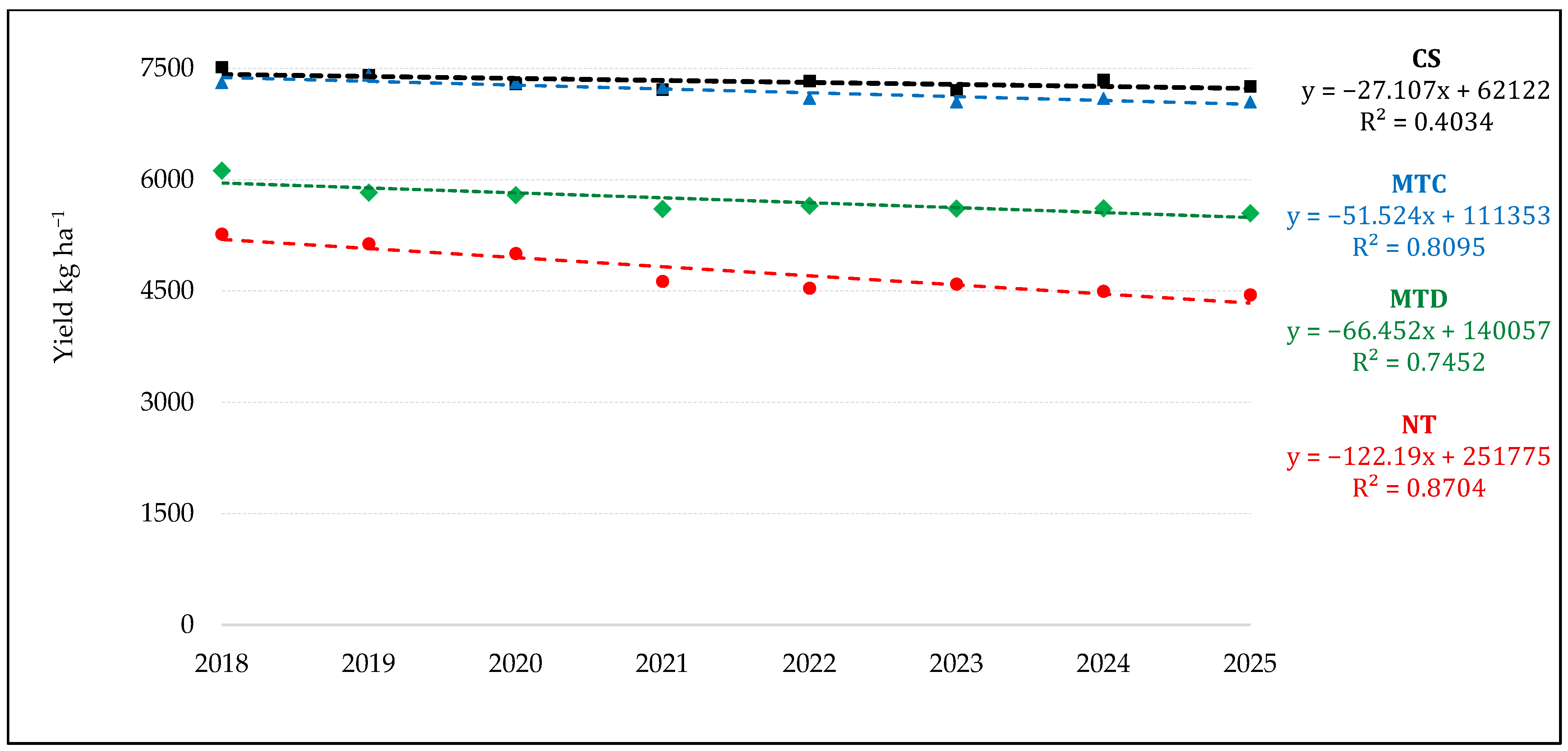
Figure 2 shows a decreasing tendency of maize yield across all tillage treatments during the experimental period (2018–2025), although the magnitude of the decline differed among systems. The conventional tillage system (CS) presented the smallest reduction rate over time (y = −27.107x + 62122; R2 = 0.4034), indicating a lower sensitivity of yield variation to the temporal trend compared with the reduced tillage treatments. Under the specific pedoclimatic conditions of the Transylvanian Plain, CS maintained higher yield values throughout the study period, whereas the decline was more pronounced in MTD and NT systems. Similar differences in yield response among tillage systems have been reported by Pittelkow et al. [39], who emphasized that the performance of conservation agriculture practices is strongly influenced by environmental conditions and site-specific management factors.
The MTC system showed a sharper decrease in yield (y = 51.524x + 111,353; R2 = 0.8095), indicating a greater sensitivity to climatic conditions and a clearly downward trend over time. High R2 values suggest that the reduction in output is well explained by temporal evolution.
In the case of MTD, the decline in yield was even more pronounced (y = −66.452x + 140,057; R2 = 0.7452), which confirms that reducing the intensity of tillage can lead to lower yield, especially under conditions of limiting resources of water and nutrients. The results are consistent with literature showing that reducing tillage can have negative effects on yield in the absence of compensating factors such as water stress [38].
The NT system recorded the sharpest decrease in yield over time (y = −122.19x + 251,775; R2 = 0.8704), highlighting a high sensitivity to climatic variations and a consistent reduction in long-term productive performance under the experimental conditions analyzed. This result is consistent with meta-analyses showing that no-tillage systems can reduce maize yield under non-water-limiting conditions, especially during the initial phases of transition [15], while positive effects can occur under conditions of water scarcity and moisture accumulation in the soil [38].
Overall, an inverse relationship between the degree of intensification of the reduction in tillage and the stability of yield over time is highlighted, with CS showing higher yield stability, while conservative systems, especially NT, recorded more pronounced declines in yield during the analyzed period. Similar trends have also been reported in previous studies by West & Post [40] and Pittelkow et al. [15], which highlighted comparable effects of tillage systems on maize yield, particularly in terms of differences between conventional and conservative systems.

4. Discussion

The results of the present study demonstrate that the tillage intensity played a key role in shaping both weed community dynamics and maize productivity under the pedoclimatic conditions of the Transylvanian Plain. Reducing soil disturbance led to higher weed densities and noticeable changes in weed community composition, mainly through the increased abundance of perennial functional groups in minimum tillage (MTD) and no-tillage (NT) systems. The greatest weed infestations were consistently recorded under NT, whereas conventional tillage maintained comparatively lower and more stable weed populations throughout the experimental period. Comparable responses have been reported by Nichols et al. [41], who showed that long-term conservation tillage promotes the persistence of perennial weed species. Likewise, Adeux et al. [42] demonstrated that reduced tillage alters weed community composition by increasing the dominance of species adapted to conditions of limited soil disturbance. The lower weed densities recorded under conventional tillage can be attributed to the repeated mechanical disruption of the soil, which affects weed emergence, seed redistribution, and the survival of vegetative propagules. Previous studies have identified tillage as one of the principal factors regulating weed recruitment and community composition) [12,13]. In the present study, the greater abundance of perennial weed groups in the MTD and NT treatments suggests that reduced soil disturbance created more favorable conditions for species capable of surviving and regenerating under relatively stable soil environments [43,44].
The observed distribution of weed functional groups among tillage systems further confirms the importance of soil disturbance intensity in determining weed community composition. The increased occurrence of perennial species in the MTD and NT treatments is likely associated with reduced mechanical damage to underground vegetative organs, allowing these species to survive and spread more effectively. At the same time, the persistence of annual grass weeds under conservation tillage may be related to reduced soil inversion, which favors the retention of seeds near the soil surface and enhances their opportunities for germination. These observations are consistent with previous findings indicating that conservation tillage systems promote gradual shifts in weed communities toward a greater representation of perennial species under reduced soil disturbance [6,12,13,39].
The weed flora identified during the study included several species commonly associated with maize production systems, including Echinochloa crus-galli, Setaria viridis, Chenopodium album, Amaranthus retroflexus, Sorghum halepense, and Cirsium arvense. The abundance and competitive importance of these species are known to vary according to climatic conditions, soil properties, and crop management practices [41,42,45]. The persistence of perennial species observed in the conservation tillage treatments further emphasizes the importance of long-term monitoring, as changes in weed community composition often become evident only after several years of continuous management.
The greater abundance of perennial weeds observed in conservation tillage treatments can largely be explained by their biological characteristics, particularly their ability to regenerate through underground vegetative organs such as rhizomes and stolons. In the experimental field, species including Cirsium arvense and Elymus repens made an important contribution to the higher proportions of perennial dicotyledonous and monocotyledonous weeds recorded in the MTD and NT systems. Their capacity for vegetative propagation enables these species to persist and gradually expand when soil disturbance is minimized. Comparable changes in weed community composition under conservation agriculture have been reported for species characterized by efficient vegetative reproduction and long-term persistence [43,44,46,47].
Despite the increasing importance of perennial weeds under reduced tillage, annual species remained significant components of the weed flora across all tillage treatments. Species such as Chenopodium album, Amaranthus retroflexus, and Xanthium strumarium are commonly associated with maize production systems, while Echinochloa crus-galli continues to be one of the dominant annual grass weeds in maize fields. Their occurrence in every tillage system demonstrates their broad ecological adaptability to cultivated environments, although their relative abundance was influenced by the intensity of soil disturbance and the associated crop management practices.
The differences identified among tillage systems illustrate the trade-off between the agronomic and environmental benefits of reduced soil disturbance and the increased challenges related to weed management. Conventional tillage may contribute to greater suppression of certain weed species by repeatedly disrupting weed establishment and vegetative regeneration, although this approach requires more intensive soil operations. In contrast, conservation tillage systems reduce mechanical soil disturbance and provide important benefits for soil protection, but they may also favor the persistence of weed species adapted to relatively undisturbed environments. Consequently, successful implementation of conservation tillage depends on the adoption of integrated weed management strategies, particularly those targeting perennial species that are less effectively controlled under minimum tillage and no-tillage conditions [46,47].
Beyond their effects on weed communities, tillage systems also influence the operational efficiency of crop production. Reduced tillage and no-tillage practices generally require fewer field operations than conventional tillage, contributing to lower fuel consumption and reduced labor requirements. Nevertheless, these operational advantages should be considered together with the increased need for weed monitoring and control, especially where perennial weed species become more competitive. Therefore, the overall performance of conservation tillage systems depends on achieving a balance between reduced production inputs, effective weed management, and the maintenance of stable crop productivity under local environmental conditions [38,44].
The analysis of variance identified tillage system as the principal factor influencing weed density (F = 239.68; p < 0.001), whereas the effect of year was not statistically significant (F = 2.61; p > 0.05). These results indicate that, under the conditions of this long-term experiment, tillage practices exerted a stronger influence on weed community development than annual climatic variability. Furthermore, the significant interaction between tillage system and weed functional groups (A × C; F = 14.99; p < 0.001) indicates that annual and perennial weeds responded differently to changes in soil disturbance intensity. Comparable patterns have also been described in previous studies evaluating weed responses to contrasting tillage systems [12,13,48].
The long-term nature of the present experiment provides valuable insight into the cumulative effects of tillage management on weed community dynamics. Short-term investigations may underestimate these responses because perennial weed species often require several growing seasons to establish and progressively increase their abundance. In the present study, the greater representation of perennial functional groups under MTD and NT suggests that reduced soil disturbance promoted gradual changes in weed community composition rather than only temporary fluctuations in weed density. Similar long-term trends have been reported by Dorado and López-Fando [49] and Nichols et al. [41], who observed that conservation tillage favors weed species adapted to low-disturbance environments. However, the magnitude of these responses remains dependent on several interacting factors, including crop rotation, climatic conditions, and weed management practices. Consequently, long-term field experiments are essential for understanding the cumulative ecological effects of conservation tillage and for developing management strategies adapted to specific agroecological conditions [13,50].
Regarding maize yield, the reduction in tillage intensity was associated with a decline in productivity. The conventional system recorded the highest average yield (7283 kg ha−1), whereas the no-tillage system recorded the lowest value (4725 kg ha−1) during the 2018–2025 experimental period. The lower productivity observed in MTD and NT occurred together with higher weed densities, particularly for perennial functional groups, suggesting that increased weed pressure could have contributed to stronger competition with maize during crop development. However, differences among tillage systems may also reflect the combined influence of soil conditions, crop establishment, and resource availability.
The reduction in maize yield under reduced tillage and no-tillage observed in the present study agrees with previous reports indicating that yield responses to conservation agriculture are strongly dependent on climatic conditions, soil characteristics, and management history. Pittelkow et al. [39] reported that no-tillage systems may result in yield penalties, particularly in environments without severe water limitations. Conversely, under drought-prone conditions, conservation systems may improve soil water availability and contribute to yield stabilization through increased residue retention and reduced evaporation losses [38,39,51]. Under the conditions of the Transylvanian Plain, the lower yield observed in NT may reflect the combined influence of weed pressure, soil-related constraints, and the specific adaptation requirements of conservation tillage system.
The response of maize to reduced tillage intensity is likely determined by several interacting processes within the soil–plant system. Lower soil disturbance may modify seedbed conditions and influence early root development and crop establishment. In addition, surface residues maintained in conservation systems may contribute to soil protection and water conservation; however, under the climatic conditions of the Transylvanian Plain, they may also affect spring soil warming and early maize development. Potential changes in soil structure and nutrient dynamics under long-term reduced disturbance may further contribute to differences in crop performance. Previous research has demonstrated that maize yield responses to conservation tillage are strongly influenced by climatic conditions and soil properties [15,20]. In addition, weed management practices represent a critical factor determining crop performance under reduced tillage systems [39]. The duration of adaptation to conservation practices may also affect yield responses, particularly during the transition period from conventional to conservation-based management [38,51].
Therefore, the yield differences observed in this long-term study should be interpreted as a site-specific response resulting from the interaction between tillage intensity, weed community development, and environmental conditions during the study period. Although conservation tillage systems may provide important benefits related to soil protection and operational efficiency, their effects on crop productivity can vary considerably depending on local conditions and management strategies. Under the agroecological conditions of the Transylvanian Plain, increased weed pressure and associated management constraints contributed to lower maize productivity in reduced tillage and no-tillage systems during the experimental period.
The eight-year evaluation provided important insights into the long-term response of maize yield to conservation tillage under the specific agroecological conditions of the Transylvanian Plain. Although no-tillage systems may provide benefits related to soil protection and water conservation, these advantages may not immediately compensate for limitations associated with increased weed pressure, slower soil warming, and crop establishment challenges in temperate environments. The lower maize productivity observed under NT in the present study suggests that conservation practices should be evaluated in relation to local environmental conditions, crop management strategies, and integrated weed control approaches rather than being considered universally beneficial. Therefore, the effectiveness of conservation tillage depends on achieving an appropriate balance between environmental benefits and the ability to maintain stable crop productivity under specific agroecological conditions.

5. Conclusions

Tillage management exerted a significant influence on weed community development and maize yield throughout the 2018–2025 experimental period. The progressive reduction in tillage intensity resulted in greater weed abundance, particularly among perennial species, with the highest weed densities observed in the no-tillage (NT) treatment. In contrast, conventional tillage maintained comparatively lower and more consistent weed populations. The changes observed in weed community composition under reduced tillage were mainly associated with the increased persistence of species capable of vegetative regeneration, which were favored by lower soil disturbance.
Maize productivity declined as tillage intensity decreased, with the conventional system producing the highest yields and the NT treatment showing the lowest performance. This yield reduction was related mainly to increased weed competition in conservation systems, although differences in soil conditions and crop establishment may also have contributed to the observed response. These results should be considered in relation to the specific environmental conditions of the Transylvanian Plain and the management practices applied throughout the study.
The findings demonstrate that reduced tillage systems can alter weed community composition and require specifically adapted weed management strategies to sustain maize production. Under the conditions of this long-term study, the environmental advantages associated with reduced soil disturbance need to be integrated with effective weed control measures, particularly for perennial weed species that may increase in importance under minimum tillage and no-tillage systems.
The eight-year assessment represents an important contribution to understanding the cumulative effects of tillage practices on weed dynamics and maize productivity. Unlike short-term evaluations, long-term experiments allow a more reliable assessment of management effects by reducing the influence of temporary annual fluctuations. The results obtained under the conditions of the Transylvanian Plain indicate that tillage impacts on weed communities and maize yield are strongly dependent on local agroecological factors and management approaches. Therefore, conservation tillage strategies should be evaluated according to specific agroecosystem conditions rather than being assumed to produce similar outcomes across different regions.

Author Contributions

Conceptualization, F.C. and C.C.; methodology, F.C.; software, R.E.C.; validation, A.I.P. and C.C.; formal analysis, A.Ș. and C.U.; investigation, C.C. and A.P.; resources, F.C.; data curation, C.U.; writing—original draft preparation, F.C.; writing—review and editing, R.E.C.; visualization, A.P. and A.Ș.; supervision, C.C. and A.P.; project administration, F.C.; funding acquisition, A.P. All authors have read and agreed to the published version of the manuscript.

Funding

This research received no external funding.

Data Availability Statement

The original contributions presented in this study are included in the article. Further inquiries can be directed to the corresponding author.

Conflicts of Interest

The authors declare no conflicts of interest.

References

  1. Ranum, P.; Peña-Rosas, J.P.; Garcia-Casal, M.N. Global Maize Production, Utilization, and Consumption. Ann. N. Y. Acad. Sci. 2014, 1312, 105–112. [Google Scholar] [CrossRef] [Scilit] [PubMed]
  2. Shiferaw, B.; Prasanna, B.M.; Hellin, J.; Bänziger, M. Crops That Feed the World 6. Past Successes and Future Challenges to the Role Played by Maize in Global Food Security. Food Secur. 2011, 3, 307–327. [Google Scholar] [CrossRef] [Scilit]
  3. Knezevic, S.Z.; Evans, S.P.; Blankenship, E.E.; Van Acker, R.C.; Lindquist, J.L. Critical Period for Weed Control: The Concept and Data Analysis. Weed Sci. 2002, 50, 773–786. [Google Scholar] [CrossRef] [Scilit]
  4. Tollenaar, M.; Lee, E.A. Dissection of Physiological Processes Underlying Grain Yield in Maize by Examining Genetic Improvement and Heterosis. Maydica 2006, 51, 399–408. [Google Scholar]
  5. Oerke, E.-C. Crop Losses to Pests. J. Agric. Sci. 2006, 144, 31–43. [Google Scholar] [CrossRef] [Scilit]
  6. Zimdahl, R.L. Fundamentals of Weed Science; Academic Press: Amsterdam, The Netherlands, 2018. [Google Scholar]
  7. Swanton, C.J.; Nkoa, R.; Blackshaw, R.E. Experimental Methods for Crop–Weed Competition Studies. Weed Sci. 2015, 63, 2–11. [Google Scholar] [CrossRef] [Scilit]
  8. Shrestha, P.; Gautam, R.; Ashwath, N. Effects of Agronomic Treatments on Functional Diversity of Soil Microbial Community and Microbial Activity in a Revegetated Coal Mine Spoil. Geoderma 2019, 338, 40–47. [Google Scholar] [CrossRef] [Scilit]
  9. Hall, M.R.; Swanton, C.J.; Anderson, G.W. The Critical Period of Weed Control in Grain Corn (Zea mays). Weed Sci. 1992, 40, 441–447. [Google Scholar] [CrossRef] [Scilit]
  10. Cheţan, F.; Rusu, T.; Cheţan, C.; Urdă, C.; Rezi, R.; Şimon, A.; Bogdan, I. Influence of Soil Tillage Systems on the Yield and Weeds Infestation in the Soybean Crop. Land 2022, 11, 1708. [Google Scholar] [CrossRef] [Scilit]
  11. Peigné, J.; Ball, B.C.; Roger-Estrade, J.; David, C. Is Conservation Tillage Suitable for Organic Farming? A Review. Soil Use Manag. 2007, 23, 129–144. [Google Scholar] [CrossRef] [Scilit]
  12. Derksen, D.A.; Lafond, G.P.; Thomas, A.G.; Loeppky, H.A.; Swanton, C.J. Impact of Agronomic Practices on Weed Communities: Tillage Systems. Weed Sci. 1993, 41, 409–417. [Google Scholar] [CrossRef] [Scilit]
  13. Buhler, D.D. Influence of Tillage Systems on Weed Population Dynamics and Management in Corn and Soybean in the Central USA. Crop Sci. 1995, 35, 1247–1258. [Google Scholar] [CrossRef] [Scilit]
  14. Singh, M.; Bhullar, M.S.; Chauhan, B.S. Seed Bank Dynamics and Emergence Pattern of Weeds as Affected by Tillage Systems in Dry Direct-Seeded Rice. Crop Prot. 2015, 67, 168–177. [Google Scholar] [CrossRef] [Scilit]
  15. Pittelkow, C.M.; Linquist, B.A.; Lundy, M.E.; Liang, X.; Van Groenigen, K.J.; Lee, J.; Van Gestel, N.; Six, J.; Venterea, R.T.; Van Kessel, C. When Does No-till Yield More? A Global Meta-Analysis. Field Crop. Res. 2015, 183, 156–168. [Google Scholar] [CrossRef] [Scilit]
  16. Sandu, I.; Mateescu, E.; Vătămanu, V.V. Schimbări Climatice în România și Impactul Asupra Agriculturii; Sitech: Craiova, Romania, 2010. [Google Scholar]
  17. Busuioc, A.; Birsan, M.; Carbunaru, D.; Baciu, M.; Orzan, A. Changes in the Large-scale Thermodynamic Instability and Connection with Rain Shower Frequency over Romania: Verification of the Clausius–Clapeyron Scaling. Int. J. Climatol. 2016, 36, 2015–2034. [Google Scholar] [CrossRef] [Scilit]
  18. Gaspardo MT-6, Maschio Gaspardo S.p.A., Campodarsego, Via Marcello, 73, 35011, Padova, Italy. Available online: https://www.maschiogaspardo.com/en_row/ (accessed on 27 July 2026).
  19. Vana, C.D.; Varga, A.; Călugăr, R.-E.; Ceclan, L.A.; Popa, C.; Șopterean, L.; Tritean, N.; Russu, F. The Reaction of Some Maize Hybrids to Several Plant Densities, in the Cultivation Conditions of Central Northwest Part of Romania. Rom. Agric. Res. 2024, 41, 91–98. [Google Scholar] [CrossRef] [Scilit]
  20. Chețan, F.; Rusu, T.; Chețan, C.; Șimon, A.; Vălean, A.-M.; Ceclan, A.O.; Bărdaș, M.; Tărău, A. Application of Unconventional Tillage Systems to Maize Cultivation and Measures for Rational Use of Agricultural Lands. Land 2023, 12, 2046. [Google Scholar] [CrossRef] [Scilit]
  21. Syngenta Crop Protection, Maxim XL 035 FS, Product Information. Available online: https://www.syngenta.md/product/crop-protection/tratament-samanta/maxim-xl (accessed on 29 June 2026).
  22. Elixir Zorka. NPK 16:16:16—Technical Specification. Available online: https://www.elixirzorka.rs/en/products/elixir-basic/npk-16-16-16/ (accessed on 29 June 2026).
  23. YaraVeraTM|Urea Based Fertilizers|Urea 46% Nitrogen Fertilizer—Product Data Sheet. Available online: https://www.yara.com/crop-nutrition/our-global-fertilizer-brands/yaravera/ (accessed on 29 June 2026).
  24. Roy, R.N.; Finck, A.; Blair, G.J.; Tandon, H.L.S. Plant Nutrition for Food Security—A Guide for Integrated Nutrient Management; FAO Fertilizer and Plant Nutrition Bulletin; Food and Agriculture Organization of The United Nations: Rome, Italy, 2006. [Google Scholar]
  25. Dobermann, A.; Cassman, K.G. Plant Nutrient Management for Enhanced Productivity in Intensive Grain Production Systems of the United States and Asia. Plant Soil 2002, 247, 153–175. [Google Scholar] [CrossRef] [Scilit]
  26. International Plant Nutrition Institute. 4R Plant Nutrition: A Manual for Improving the Management of Plant Nutrition; International Plant Nutrition Institute, Ed.; International Plant Nutrition Institute: Norcross, GA, USA, 2012. [Google Scholar]
  27. Bayer Crop Science. Merlin® Flexx. Available online: https://www.cropscience.bayer.ro/cpd/erbicide-bcs-merlin-flexx-ro-ro (accessed on 29 June 2026).
  28. BASF Agricultural Solutions. BASF Agricultural Solutions; Spectrum 720 EC Product Information; BASF Agricultural Solutions: Limburgerhof, Germany, 2012. [Google Scholar]
  29. Corteva Agriscience. StaraneTM Premium 330 EC. Available online: https://www.corteva.com (accessed on 29 June 2026).
  30. Agricover—Nova Power 4SC. Available online: https://agricover.ro/ (accessed on 29 June 2026).
  31. POLY-FACT—Software for Statistical Analysis of Field Experiments; University of Agricultural Sciences and Veterinary Medicine of Cluj-Napoca/Agricultural Research and Development Station Turda in Romania: Cluj-Napoca, Romania, 2020.
  32. Gomez, K.A.; Gomez, A.A. Statistical Procedures for Agricultural Research, 2nd ed.; John Wiley and Sons: New York, NY, USA, 1984. [Google Scholar]
  33. Khuri, A.I. Introduction to Linear Regression Analysis, Fifth Edition by Douglas C. Montgomery, Elizabeth A. Peck, G. Geoffrey Vining. Int. Stat. Rev. 2013, 81, 318–319. [Google Scholar] [CrossRef] [Scilit]
  34. Estfalia. The Romanian System of Soil Taxonomy (SRTS); Ed Estfalia: Bucharest, Romania, 2012. [Google Scholar]
  35. Romanian National Meteorological Administration (ANM). Turda Weather Station. Meteorological Data for the Period 1957–2025. Available online: https://www.meteoromania.ro/statii/ (accessed on 29 June 2025).
  36. IPCC. Climate Change 2021—The Physical Science Basis: Working Group I Contribution to the Sixth Assessment Report of the Intergovernmental Panel on Climate Change, 1st ed.; Cambridge University Press: Cambridge, UK, 2023. [Google Scholar]
  37. Busuioc, A.; Caian, M.; Cheval, S.; Bojariu, R.; Boroneanț, C.; Baciu, M.; Dumitrescu, A. Variabilitatea și Schimbarea Climei în România; Pro Universitaria: Bucharest, Romania, 2010. [Google Scholar]
  38. Rusinamhodzi, L.; Corbeels, M.; Van Wijk, M.T.; Rufino, M.C.; Nyamangara, J.; Giller, K.E. A Meta-Analysis of Long-Term Effects of Conservation Agriculture on Maize Grain Yield under Rain-Fed Conditions. Agron. Sustain. Dev. 2011, 31, 657–673. [Google Scholar] [CrossRef] [Scilit]
  39. Pittelkow, C.M.; Liang, X.; Linquist, B.A.; Van Groenigen, K.J.; Lee, J.; Lundy, M.E.; Van Gestel, N.; Six, J.; Venterea, R.T.; Van Kessel, C. Productivity Limits and Potentials of the Principles of Conservation Agriculture. Nature 2015, 517, 365–368. [Google Scholar] [CrossRef] [Scilit] [PubMed]
  40. West, T.O.; Post, W.M. Soil Organic Carbon Sequestration Rates by Tillage and Crop Rotation: A Global Data Analysis. Soil Sci. Soc. Am. J. 2002, 66, 1930–1946. [Google Scholar] [CrossRef] [Scilit]
  41. Nichols, V.; Verhulst, N.; Cox, R.; Govaerts, B. Weed Dynamics and Conservation Agriculture Principles: A Review. Field Crop. Res. 2015, 183, 56–68. [Google Scholar] [CrossRef] [Scilit]
  42. Adeux, G.; Vieren, E.; Carlesi, S.; Bàrberi, P.; Munier-Jolain, N.; Cordeau, S. Mitigating Crop Yield Losses through Weed Diversity. Nat. Sustain. 2019, 2, 1018–1026. [Google Scholar] [CrossRef] [Scilit]
  43. Bàrberi, P. Weed Management in Organic Agriculture: Are We Addressing the Right Issues? Weed Res. 2002, 42, 177–193. [Google Scholar] [CrossRef] [Scilit]
  44. Derpsch, R.; Friedrich, T.; Kassam, A.; Li, H. Current Status of Adoption of No-till Farming in the World and Some of Its Main Benefits. Int. J. Agric. Biol. Eng. 2010, 3, 1–25. [Google Scholar]
  45. Cardina, J.; Herms, C.P.; Doohan, D.J. Crop Rotation and Tillage System Effects on Weed Seedbanks. Weed Sci. 2002, 50, 448–460. [Google Scholar] [CrossRef] [Scilit]
  46. Soni, J.K.; Choudhary, V.K.; Singh, P.K.; Hota, S. Weed Management in Conservation Agriculture, Its Issues and Adoption: A Review. J. Crop Weed 2020, 16, 09–19. [Google Scholar] [CrossRef] [Scilit]
  47. Chauhan, B.S.; Singh, R.G.; Mahajan, G. Ecology and Management of Weeds under Conservation Agriculture: A Review. Crop Prot. 2012, 38, 57–65. [Google Scholar] [CrossRef] [Scilit]
  48. Zhang, J.; Wu, L.-F. Impact of Tillage and Crop Residue Management on the Weed Community and Wheat Yield in a Wheat–Maize Double Cropping System. Agriculture 2021, 11, 265. [Google Scholar] [CrossRef] [Scilit]
  49. Dorado, J.; López-Fando, C. The Effect of Tillage System and Use of a Paraplow on Weed Flora in a Semiarid Soil from Central Spain. Weed Res. 2006, 46, 424–431. [Google Scholar] [CrossRef] [Scilit]
  50. Pardo, G.; Cirujeda, A.; Perea, F.; Verdú, A.M.C.; Mas, M.T.; Urbano, J.M. Effects of Reduced and Conventional Tillage on Weed Communities: Results of a Long-Term Experiment in Southwestern Spain. Planta Daninha 2019, 37, e019201336. [Google Scholar] [CrossRef] [Scilit]
  51. Torres, J.L.R.; Leal Júnior, A.L.B.; Barreto, A.C.; Carvalho, F.J.; De Assis, R.L.; Loss, A.; Lemes, E.M.; Da Silva Vieira, D.M. Mechanical and Biological Soil Decompaction for No-Tillage Maize Production. Agronomy 2022, 12, 2310. [Google Scholar] [CrossRef] [Scilit]
Figure 1. Long-term evolution of air temperature and precipitation in Turda during the period 1957–2026. The figure illustrates annual variability and long-term trends in mean air temperature (°C) and precipitation (mm). The red line represents the linear trend of air temperature (R2 = 0.4396), while the blue line represents the trend of precipitation (R2 = 0.0708). The multiannual mean values over the studied period were 9.4 °C for air temperature and 534.4 mm for precipitation.
Crops 06 00074 g001
Figure 2. Evolution of maize yield (kg ha−1) under different tillage systems (CS—conventional tillage, MTC—minimum tillage with chisel, MTD—minimum tillage with disc, NT—no-tillage) during the period 2018–2025. Linear trends show yield dynamics over time for each system.
Crops 06 00074 g002
Table 1. Weed species identified in the experimental field and their classification according to functional groups and ecological characteristics.
Weed GroupRepresentative SpeciesLife Cycle and Botanical GroupTypical Emergence PeriodPredominant Tillage Systems
ADChenopodium album, Amaranthus retroflexus, Xanthium strumarium, Hibiscus trionum, Sinapis arvensisAnnual broadleaf weedsEarly growing seasonPresent in all tillage systems, particularly MTC, MTD and NT
PDCirsium arvense, Convolvulus arvensis, Sonchus arvensis, Rubus caesiusPerennial broadleaf weeds regenerating from vegetative organsThroughout the growing seasonMore frequent in MTD and NT
AMEchinochloa crus-galli, Setaria glauca, Digitaria sanguinalisAnnual grass weedsAfter crop establishmentCommon in MTC, MTD and NT
PMElymus repensRhizomatous perennial grassPatchy occurrence throughout the seasonMainly in MTD and NT
AD—Annual dicotyledons; (PD)—Perennial dicotyledons; (AM)—Annual monocotyledons; (PM)—Perennial monocotyledons; Tillage system: MTC—minim chisel; MTD—minim disk; NT—no tillage.
Table 2. Annual density of weed functional groups (plants m−2) under different tillage systems in maize, 2018–2025.
Year/System/
Weed Group
CSMTCMTDNT
AD/PD/AM/PMAD/PD/AM/PMAD/PD/AM/PMAD/PD/AM/PM
20186/2/1/08/3/1/19/4/2/19/7/2/2
20196/2/1/07/3/1/19/4/2/19/7/2/3
20206/2/1/07/3/1/19/4/2/19/7/2/3
20215/2/1/07/4/2/28/5/3/28/8/3/3
20225/2/1/07/4/2/28/5/3/28/8/3/3
20235/2/1/06/4/2/28/5/3/28/8/3/4
20245/2/1/06/4/2/27/5/3/28/9/4/4
20251/0/5/22/2/6/43/2/7/54/4/8/ 9
AD—Annual dicotyledons; (PD)—Perennial dicotyledons; (AM)—Annual monocotyledons; (PM)—Perennial monocotyledons; Tillage system: CS—conventional; MTC—minim chisel; MTD—minim disk; NT—no tillage.
Table 3. Analysis of variance (ANOVA) for the effects of tillage system, year, and weed group on weed density in maize (2018–2025).
Source of VariationF-ValueSignificance
A (tillage system)239.68***
B (years)2.61ns
C (weed groups)233.24***
A × B2.19ns
A × C14.99***
B × C1.59ns
A × B × C0.52ns
A—tillage system; B—year; C—weed group; ns—not significant; *** p < 0.001.
Table 4. Analysis of variance (ANOVA) of maize yield according to the tillage system and climatic conditions of the period 2018–2025.
Source of VariationdfMP F CalculatedSignificance
Tillage system (A)333.579.9602451.15***
Year (B)7567.83779.62***
A × B2115.3192.15*
Error567.132
df—degrees of freedom; MP—Mean Squares; * significant at p < 0.05; *** highly significant at p < 0.001.
Table 5. Influence of tillage system on average maize yield during 2018–2025.
Tillage SystemYield
(kg ha−1)
%
of Control
Difference (kg ha−1)Duncan’s Range Test
CS 72831000a
MTC 698595.9−298b
MTD 571578.5−1568c
NT 472564.9−2558d
LSD 5% (p ≤ 0.05) 83
Tillage systems: CS—conventional tillage; MTC—minimum tillage (chisel); MTD—minimum tillage (disc); NT—no-tillage. Means followed by different letters are significantly different ac-cording to Duncan’s Multiple Range Test (p < 0.05); LSD (5%) = least significant difference at p < 0.05. Values represent mean yields over the experimental period (2018–2025).
Table 6. Analysis of variance (ANOVA) for maize yield under different tillage systems and years (2018–2025).
Source of VariationdfSSMSF-Value
Tillage system (A)3100,739,900.0033,579,960.002451.15 ***
Year (B)73,974,860.00567,837.2079.62 ***
A × B21321,704.6015,319.272.15 *
Replication (R)235,912.7717,956.38
A × R682,198.0513,699.68
B × R1498,212.057015.15
A × B × R (Error)42301,179.307170.94
Total95105,553,900.00
df—degrees of freedom; SS—sum of squares; MS—mean square. Asterisks indicate significance levels: * p < 0.05, *** p < 0.001. Analysis based on a factorial ANOVA for a long-term field experiment (2018–2025).
Disclaimer/Publisher’s Note: The statements, opinions and data contained in all publications are solely those of the individual author(s) and contributor(s) and not of MDPI and/or the editor(s). MDPI and/or the editor(s) disclaim responsibility for any injury to people or property resulting from any ideas, methods, instructions or products referred to in the content.