Article

Mechanical Damage in Soybeans by Pneumatic Seeder

by
Fabricio Ardais Medeiros
1,
Nixon da Rosa Westendorff
1,
Lilian Vanussa Madruga de Tunes
1,
Ângelo Vieira dos Reis
1,
Aleksander Westphal Muniz
2,* and
Geri Eduardo Menegello
1
1
Department of Rural Engineering Eliseu Maciel, School of Agronomy, Universidade Federal de Pelotas, Capão do Leão Campus, Capão do Leão 96010-610, Brazil
2
Embrapa, Manaus 69010-970, Brazil
*
Author to whom correspondence should be addressed.
Crops 2026, 6(3), 49; https://doi.org/10.3390/crops6030049
Submission received: 10 February 2026 / Revised: 3 April 2026 / Accepted: 13 April 2026 / Published: 22 April 2026

Abstract

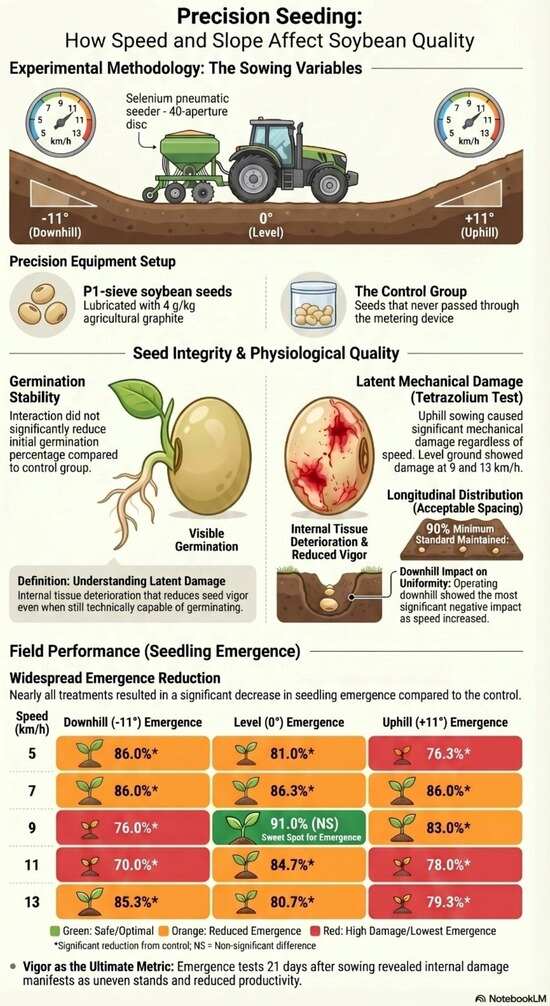
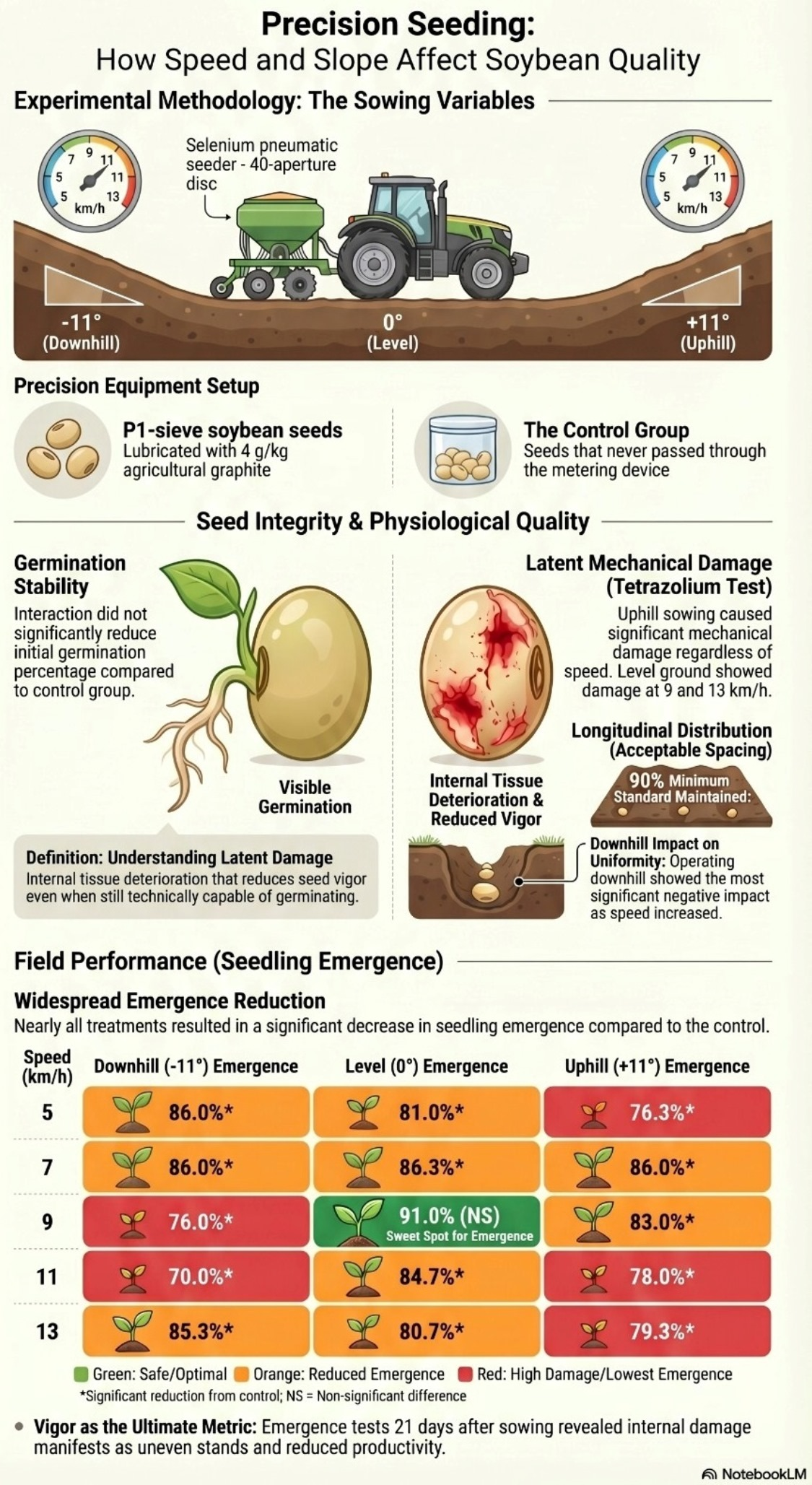
Research has advanced in the development of precision seed metering devices to ensure proper seed distribution at high speeds. However, little is known about the effect of increasing seeding speed, as well as seeding at different inclinations of the tractor-seeder unit, on the integrity and physiological quality of soybean seeds. This study aimed to identify the effect of travel speeds (5, 7, 9, 11, and 13 km h−1) combined with three longitudinal inclinations of a pneumatic seed metering device (−11°, 0°, and 11°), simulating field conditions, on the distribution and integrity of soybean seeds. We used a 5 × 3 factorial design was used with an additional control treatment in which the seeds did not pass through the metering device. The variables evaluated included the percentage of spacing between individual seeds, germination, mechanical damage (tetrazolium test), and seedling emergence. The results demonstrated that increasing the speed did not prevent the spacing between individual seeds from falling below the minimum limit of 90% for pneumatic seed metering devices. The treatments did not affect germination compared to the control. Sowing on a slope caused the greatest mechanical damage to soybean seeds. All treatments significantly reduced plant emergence, except when the pneumatic metering device operated at an incline of 0° at 9 km h−1.
Keywords: Glycine max L.; mechanical damage; longitudinal inclination and distribution Glycine max L.; mechanical damage; longitudinal inclination and distribution
Graphical Abstract