


Abstract
Dual-purpose (DP) crops diversify farm income, facilitating livestock and grain production. Dual-purpose wheat (Triticum aestivum L.), i.e., grazing or clipping herbage early in the season followed by grain harvest, is commonly used in the Great Plains of the United States of America (USA), but the use of DP crops, including oat (Avena sativa L.), in the southeastern USA is limited. This 2-year study assessed agronomic and nutritive value responses and grain production of one wheat (AGS 4023) and four oat (Brooks, Horizon 214, Horizon 306, and Horizon 578) cultivars under two management strategies (dual-purpose [DP, clipping for forage and subsequent grain harvest] or grain production [GP]. Treatments were arranged in a randomized complete block design with three replications. Seasonal forage accumulation ranged from 4140 to 5460 kg ha−1 yr−1 among cultivars. Greater concentration of NDF (p < 0.001) was observed in year 2 than in year 1 (46.3% vs. 40.9%, respectively), but cultivars did not differ. Crude protein concentration ranged from 18.6% to 21% among cultivars. Grain yield was greater for H578 than all other cultivars (7400 versus an average of 5100 kg DM ha−1). Grain yield reduction for DP ranged from 27 to 45% compared with GP. These results demonstrate the potential of selected cultivars (e.g., H578) for use as DP crops in the region. Recognizing some reduction in grain yield compared with GP, DP cropping increases flexibility for producers, facilitating the use of integrated crop-livestock systems that diversify income streams and enhance the circularity of agroecosystems.
1. Introduction
Southeastern USA livestock operations are based predominantly on perennial warm-season grasses such as bahiagrass (Paspalum notatum Flueggé) and bermudagrass (Cynodon dactylon L.), and the cool-season perennial tall fescue [Festuca arundinacea (Schreb.) Dumort.] [1]. These perennial grasses rely on inorganic nitrogen (N) to meet the production and nutritional needs of livestock operations [2]. Pronounced seasonality of production of perennial forages requires alternative species to provide feed during periods when biomass production or forage nutritive value of perennials fail to meet livestock requirements [3].
Using annual cool-season forages is a common practice to extend the grazing season and provide higher-quality forage. The most-used forage species in the southeastern USA include cereal rye (Secale cereale L.), oat, wheat, annual ryegrass (Lolium multiflorum), and clovers (Trifolium spp.) [4]. Over the past decades, a growing interest in integrated crop-livestock systems has emerged, primarily due to the expansion of conservation practices aimed at enhancing the delivery of ecosystem services and the pursuit of income diversification in agricultural operations [5,6,7]. In this context, dual-purpose forage crops can support livestock production goals and contribute to the sustainability and feasibility of agroecosystems.
In the Great Plains of the USA, dual-purpose wheat is widely used by farmers to support forage and grain crop production [8]. Although the southeastern USA provides an adequate growing season due to mild winters [4], there is limited dual-purpose cropping of cool-season grasses. A recent study evaluated dual-purpose wheat cultivars (generic feed type, GA Gore, Pioneer 26R41, and AGS 2024) managed under three grazing intensities (ungrazed, low- and high-intensity grazing) in Alabama [9]. The authors reported greater forage mass for AGS 2024 (2660 kg ha−1) and grain yield ranging from 1270 to 3620 kg dry matter (DM) ha−1 among cultivars. Additionally, the area planted to oat continues to steadily increase in the region for use as a cover crop under conservation practices and for cool-season livestock grazing [1,4,10].
In southeastern livestock operations, oat is most often used as a monoculture managed under grazing or as conserved feed due to its forage nutritive value and production [11,12]. The inclusion of oat in diverse forage mixtures has also been expanding, aiming to improve forage distribution and ecosystem services delivery (e.g., nutrient cycling) [13,14]. Due to climate change impacts, there has been a growing focus on climate-resilient management strategies [14]. Therefore, incorporating grazing or haying crops presents an opportunity to diversify operations economically while enhancing environmental resilience [7]. In this context, integrated row crop-livestock systems have been expanding in the region since they provide a greater diversity of income streams [5,7].
The use of integrated systems can also optimize nutrient cycling, resource use efficiency, and productivity [5,15]. Plant residues (e.g., roots, stems) release nutrients that may be immobilized by microorganisms, stored in the soil for the next crop in rotation, among other fates [16]. Previous studies reported increased soil organic carbon and total N with improved crop rotation diversity under long-term systems [17,18,19]. A 3-year study evaluated the short-term effects of cover crop planting in contrasting cropping systems under different grazing intensities and N fertilization [7]. The authors reported lower cumulative N leaching under cover cropping than fallow areas (18 vs. 32 kg N ha−1 season−1).
Proper grazing management is crucial to the success of dual-purpose systems, including the appropriate timing of grazing initiation to support stand and root system growth and establishment [1,20]. Thus, the use of proper stubble height and regrowth interval allows plants to recover leaf area and energy reserves timely [1]. Grazing termination is recommended at the first hollow stem, and the last forage mass harvest should occur up to 60 days prior to grain harvest to allow proper assimilate allocation for grain filling [21,22]. Previous studies conducted in the southeastern USA reported on the proper management strategies for forage management for small grains, including under dual-purpose management, to inform production and grazing season duration [4,9,11,20,23,24].
More information is needed to support the dual-purpose management of oat and wheat species and facilitate their adoption by producers. The objective of this study was to determine agronomic responses and grain yield of improved oat and wheat cultivars managed under two management strategies (dual-purpose and grain production). We hypothesized that improved cultivars would minimize grain yield reductions under clipping management, therefore, diversifying and supporting enhanced sustainability of operations.
2. Materials and Methods
2.1. Experimental Site
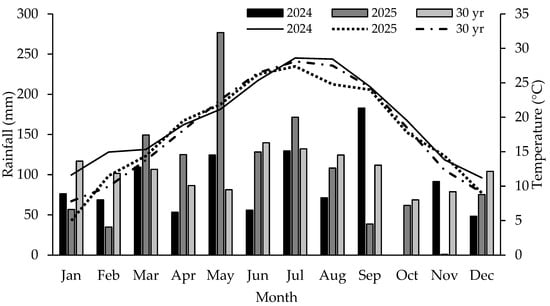
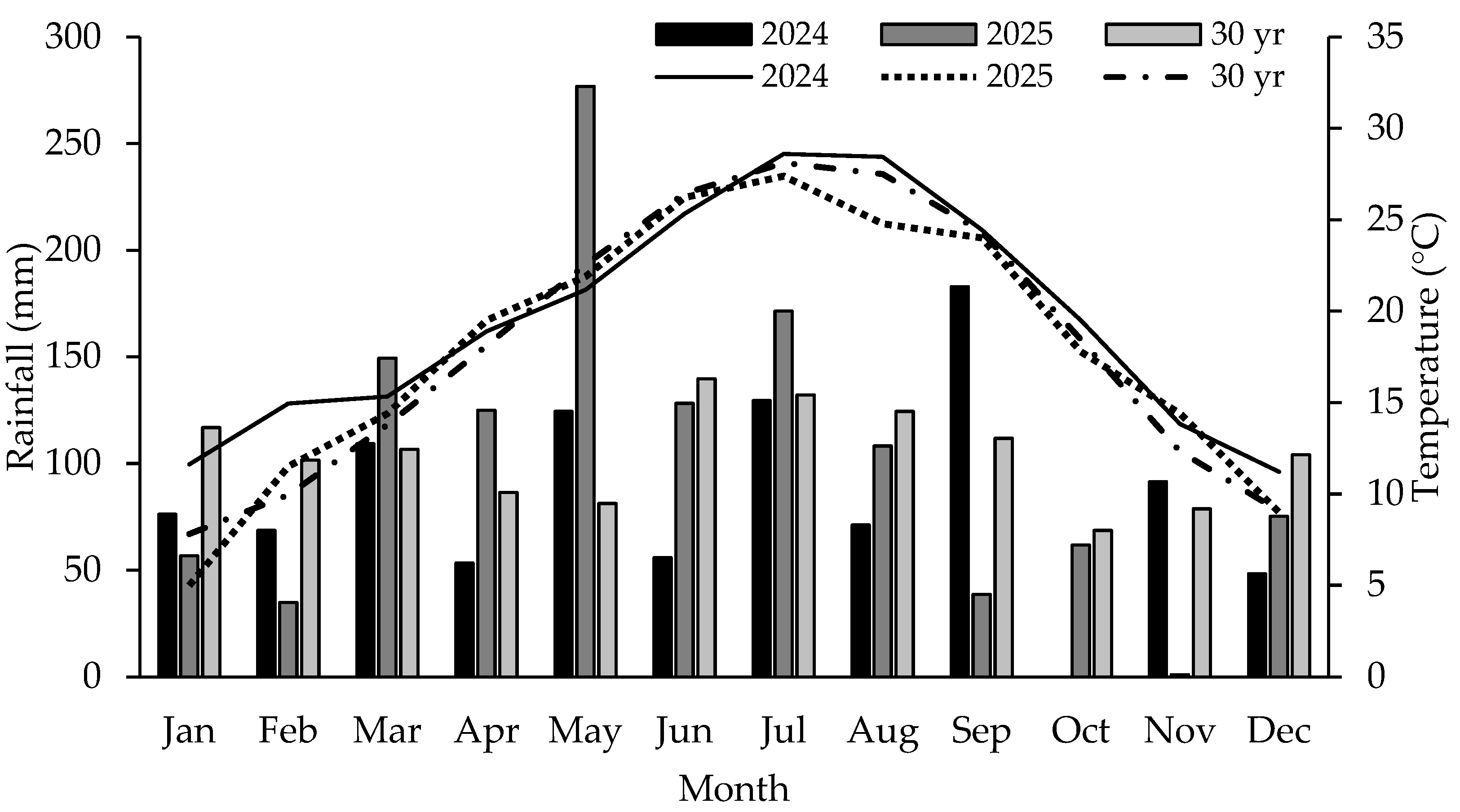
A 2-year study was conducted at the Clemson University Edisto Research and Education Center in Blackville, SC (33°21′25″ N, 81°16′22″ W). The predominant soil is Barnwell sandy loam (fine-loamy, kaolinitic, thermic Typic Kanhapludults) [25]. Initial soil (0- to 15 cm depth) chemical characteristics included pH of 5.8 and Mehlich-3 extractable P, K, Ca, and Mg concentrations of 61, 122, 724, and 119 mg kg−1, respectively, reported by the Clemson University Agricultural Service Laboratory. Weather data were obtained from the National Oceanic and Atmospheric Administration (NOAA) dataset for the research site (Figure 1). Total annual rainfall was 1011 and 1227 mm in 2024 and 2025, respectively, compared with the 30-year average (1252 mm).
Figure 1.
Monthly weather data at Blackville, SC, during the 2-year study and the 30-year historical average. Bars indicate cumulative monthly rainfall; lines indicate monthly average temperature.
2.2. Experimental Design and Treatments
A randomized complete block design with three replications was used. Treatments consisted of four oat cultivars [Horizon 306 (H306; medium maturity; Mixon Seed Services, Orangeburg, SC, USA), Horizon 578 (H578; medium maturity; Mixon Seed Services, Orangeburg, SC, USA), Brooks (medium early; Hill View Farms, VA, USA) and Horizon 214 (H214; medium maturity; Mixon Seed Services, Orangeburg, SC, USA)] and one wheat cultivar [AGS 4023 (medium maturity; AG South; Mixon Seed Services, Orangeburg, SC, USA)] managed under two management strategies [dual-purpose (DP) and grain production (GP)].
2.3. Forage Establishment and Management
Prior to planting, the experimental area was disced, harrowed, and a non-selective herbicide was applied. Plots (experimental units) were 11.3 m2 in area and were sown on 2 November 2023 and 6 November 2024, using a Kincaid–Great Plains compact drill (model 3P606NT; Great Plains Manufacturing Inc., Salina, KS, USA) under adequate soil moisture conditions. The seeding rate used was 100 kg pure live seed (PLS) ha−1. At planting, plots were fertilized with N, phosphorus (P), and potassium (K) at rates of 33 kg N ha−1, 44 kg P ha−1, and 67 kg K ha−1. A split-rate of N was used with a second application of 67 kg N ha−1 on 1 February 2024, and 24 March 2025.
In 2025, the plant development and growth rate were slower than expected due to the impact of lower temperatures and a rare heavy snowfall event (approximately 10 cm) in early winter. Therefore, to aid plant growth, an additional 44 kg N ha−1 was applied on 31 January 2025, using a liquid 24 N-sulfur source. Still, forage growth was limited during the first half of the cool season, which delayed and limited the number of harvest events conducted for the DP management strategy in the second year.
For winter weed control, on 5 January 2024, and 8 January 2025, the experimental area was sprayed with 74- and 593 mL ha−1, respectively, of thifensulfuron-methyl, tribenuron-methyl (Harmony Extra@, FMC Corporation, Philadelphia, PA, USA), and 2,4-dichlorophenoxyacetic acid. The weather conditions were appropriate during the spraying time with low wind speed.
2.4. Response Variables
2.4.1. Seasonal Forage Accumulation
Under the DP management strategy, forage accumulation (FA) was determined by harvesting two random 0.1-m2 quadrats per experimental unit to a 10 cm stubble height using electric clippers. After sample collection, all DP experimental units were clipped to a 10 cm stubble height. Harvests occurred on 20 February 2024 and 20 March 2024 (Feekes scale stage 4 to 5) [26], and only on 24 March 2025 (Feekes scale stage 5) [26], due to limited early-season growth that year. Forage accumulation data for DP treatments represent the sum of two forage harvests in 2024 but only the single harvest in 2025. The GP management strategy plots were not defoliated at these dates.
The 30-day regrowth interval between harvests used for the DP treatment in 2024 was that recommended for rotational stocking management [1]. Harvested forage samples were dried at 60 °C until constant weight and weighed. Then, samples were ground to pass a 1 mm screen using a Wiley Mill (Model T3700.002, Thomas Scientific, Swedesboro, NJ, USA).
2.4.2. Forage Nutritive Value
Ground samples were analyzed to determine concentrations of neutral detergent fiber (NDF), acid detergent fiber (ADF), and crude protein (CP). Concentration of neutral fiber detergent (NDF, ANKOM Technology, Macedon, NY, USA) [27] and acid fiber detergent (ADF, ANKOM Technology) [28] were determined by wet chemistry using an ANKOM Delta Fiber Analyzer (ANKOM, Macedon, NY, USA). Total nitrogen (N) concentration was determined by the Kjeldahl digestion–distillation method [29] using an automated Kjeltec™ 9 system (Foss Analytical, Hillerød, Denmark). Crude protein concentration was calculated by multiplying total N concentration by the standard factor of 6.25.
2.4.3. Canopy Height
Five non-compressed canopy height (CH) measurements were conducted at randomly selected locations on all experimental units prior to each forage harvest of the DP treatment. The CH was measured for all experimental units under both management strategies at each sampling date.
2.4.4. Grain Yield
Grain crop harvest was conducted using a Kincaid single-plot combine (Kincaid, Haven, KS, USA) on 20 June 2024 (approximately 60 days after the last forage mass sampling). The length of the 2024 growing season was 224 days. At grain harvest, moisture percentage, test weight, and dry yield data were determined. All plots were harvested on the same day to determine grain crop production under both management strategies. In 2025, excessive rainfall and soil moisture in May led to a delay in harvesting the grain crop, ultimately resulting in excessive plant lodging in late June. Therefore, the quality conditions of the plant and grain were compromised, and no measurement of grain yield was possible in 2025. The data for grain yield presented in the current study are from 2024 only.
2.5. Statistical Analysis
Data was analyzed with R v4.4.0 [30] using a linear mixed-effects model (lmer). Forage cultivar, management strategy, year, and their interactions were considered as fixed effects, while block was considered as a random effect. Least-squares means were obtained using the “emmeans” package [31] and reported for significant main effects and interactions (p ≤ 0.05). Treatment means were separated using Tukey’s test.
3. Results
3.1. Seasonal Forage Accumulation and Forage Nutritive Value
There was no effect of cultivar (p = 0.25) or cultivar x year interaction (p = 0.07) on seasonal forage accumulation. Forage accumulation ranged from 4140 to 5460 kg ha−1 yr−1 among cultivars (Table 1). Greater (p = 0.02) forage accumulation was observed in year 1 than year 2 (5280 vs. 4563 kg ha−1, respectively, Table S1).
Table 1.
Forage accumulation (FA) and concentrations of neutral detergent fiber (NDF), acid detergent fiber (ADF), and crude protein (CP) of oat and wheat cultivars during 2024 and 2025 in Blackville, SC. Data are means across two years and three replicates (n = 6). There were no differences (p > 0.05) among cultivars within a response variable.
Neutral detergent fiber concentration was affected by year (p < 0.001), but not by cultivar (p = 0.07) or cultivar x year interaction (p = 0.50). Concentration of NDF averaged 43.6% among cultivars (Table 1), but it was 13% greater in year 2 than in year 1 (46.3% versus 40.9%, respectively, Table S1). There was no effect of cultivar (p = 0.20), year (p = 0.30), or cultivar x year interaction (p = 0.62) on ADF concentration. Concentration of ADF averaged 28.6% among cultivars (Table 1), while years 1 and 2 averaged 28.4% and 28.8%, respectively. Lastly, CP concentration ranged from 18.6% to 21% among cultivars (p = 0.92, Table 1). Crude protein concentration was 45% greater in year 1 than in year 2 (23.3% versus 16.1%, respectively, Table S1).
3.2. Canopy Height
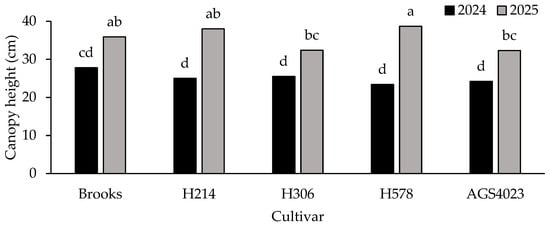
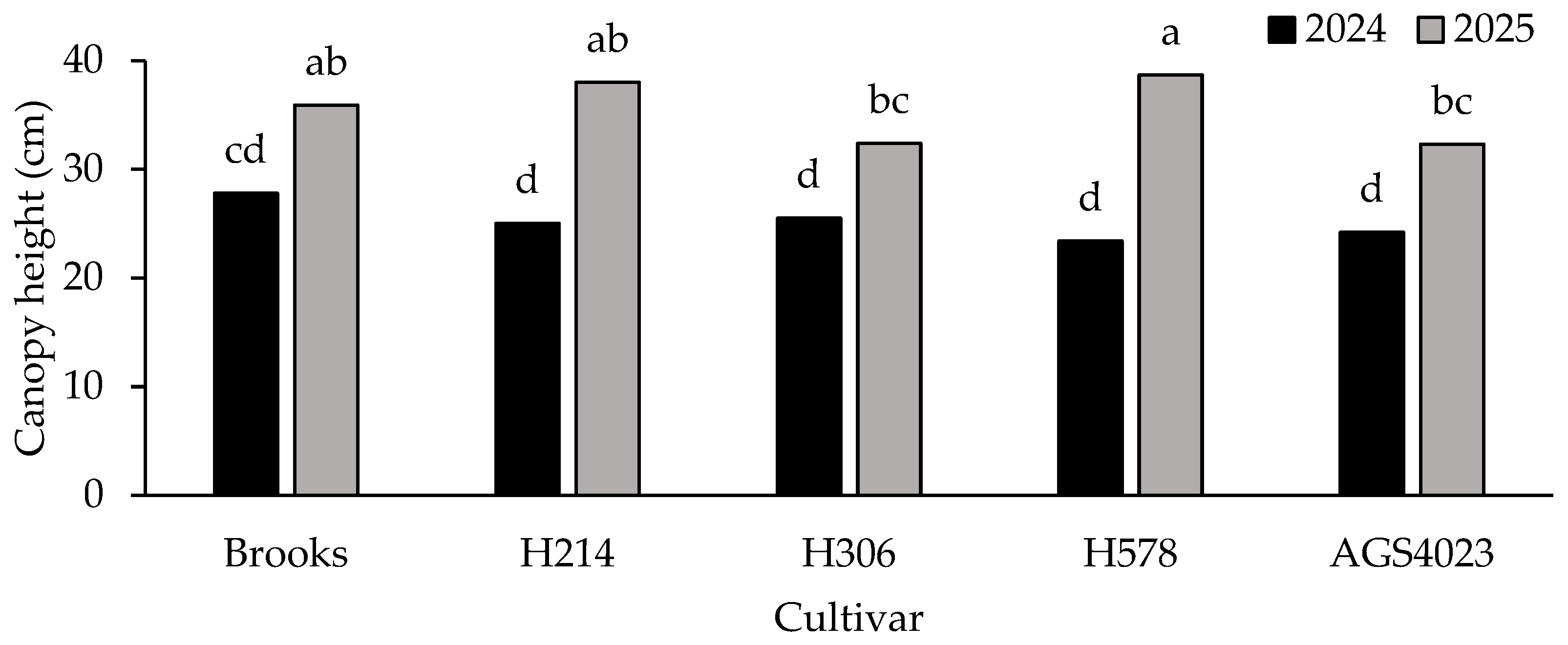
There was a cultivar x year interaction (p = 0.02) for canopy height (Figure 2). All cultivars were taller in year 2 than in year 1 (p ≤ 0.05). Interaction occurred because the magnitude of the between-year height difference varied among cultivars. In year 1, greater canopy height was observed for Brooks (28 cm) than H214, H578, and AGS4023 (25, 23, and 24 cm, respectively) (Table S2). In year 2, greater canopy height was observed for H578 (39 cm) than for H306 and AGS4043 (32 cm) (Table S3).
Figure 2.
Forage canopy height for oat and wheat cultivars in 2024 and 2025 at Blackville, SC (year x cultivar interaction; p = 0.02, SE = 1.2). Means followed by different letters are different at 5% significance level.
3.3. Grain Yield
There was no cultivar x management strategy interaction (p = 0.17) for grain yield (Table 2), but there were main effects of cultivar and management strategy on grain yield (p < 0.001). Among cultivars, grain yield was greater for oat cultivar H578 than all other cultivars tested (7400 versus an average of 5100 kg DM ha−1, respectively; Table 2). Grain yield averaged 6860 versus 4260 kg DM ha−1 under GP and DP strategies, respectively (p < 0.001). Although there was a 60-day regrowth period between the last forage mass harvest and the grain yield harvest, an average 38% reduction in grain yield was observed for DP compared with GP.
Table 2.
Grain yield of oat and wheat cultivars in 2024 at Blackville, SC. Data are means across two management strategies and three replicates (n = 6).
4. Discussion
Seasonal FA of oat and wheat in the DP system ranged from 4140 to 5460 kg ha−1, but did not differ among cultivars (Table 1). This is greater than or in the upper part of the range reported in the literature for these species. In year 1, FA ranged from 4433 to 5983 kg ha−1 (Table S2), while in year 2, it ranged from 4133 to 5800 kg ha−1 (Table S3). In a 2-year study evaluating oat and black oat (Avena strigosa Schreb.) in Florida, the authors reported an average total forage accumulation of 5110 kg ha−1 [12]. A 2-year study in Florida reported forage accumulation ranging from 800 to 2600 kg ha−1 per harvest event throughout the season for five oat cultivars (Horizon 270, 321, 474, 201, and Coker 227) [32]. Likewise, in a 2-year study evaluating four dual-purpose wheat cultivars, average forage accumulation was 2200 kg ha−1 per grazing cycle [9]. In a 2-year study conducted in Kentucky evaluating dual-purpose wheat under grazing management, forage accumulation averaged 1300 and 400 kg ha−1 in years 1 and 2, respectively [33]. In a 2-year study investigating binary mixtures of cereal rye, oat, and triticale with annual ryegrass, forage accumulation ranged from 540 to 1250 kg ha−1 FM [11]. In the current study, the average forage accumulation per harvest event ranged from 800 to 2050 kg ha−1 in year 1 (two harvests that year), compared with 4133 to 5800 kg ha−1 (single harvest) in year 2. These values are greater than those reported in most previous studies in the region. This was likely due to the favorable growth conditions for regionally adapted oat and wheat cultivars, even in year 2, which had challenging weather conditions during the early portion of the growing season.
In the current study, NDF concentration was greater in year 2 than in year 1, while ADF concentration did not differ between years. The concentration of CP was 45% greater in year 1 than in year 2 (Table S1). Cultivars did not differ in nutritive value. These responses are likely associated with the delay in harvesting FM in year 2, which may have impacted assimilate and nutrient distribution, as well as structural component accumulation rates, at the time forage mass samples were collected in March 2025. For the current study, concentrations of NDF, ADF, and CP among cultivars averaged 43.6%, 28.3%, and 19.7%, respectively (Table 1). Concentration of NDF ranged from 39.7 to 42.7% and 43.9 to 49.0% in years 1 and 2, respectively (Tables S2 and S3). These values are indicative of high-quality forage capable of supporting high levels of animal production, even for those with greater nutritional requirements [20,34]. The concentrations of NDF observed in the current study were lower than those previously reported for dual-purpose wheat [9] (ranged from 46.8% to 49.8%). In a 3-year grazing study, authors reported an average of 47% NDF concentration for wheat pasture in Alabama [23]. Concentrations of ADF were similar to the range of 22.5 to 25% previously reported [9]. Likewise, CP concentrations (19.3–20.8%) reported previously [9] were similar to those in the current study. Concentration of CP ranged from 21.6 to 25.8% and 15.0 to 17.1%, respectively, in years 1 and 2 (Table S2 and S3). In a 2-year grazing study in Florida, the authors reported CP concentrations ranging from 11.3 to 29.4% and 14.4 to 28.8% in years 1 and 2, respectively, for binary small grains-annual ryegrass mixtures [11].
In the current 2-year study, canopy height ranged, at forage harvest dates, from 23 to 39 cm among cultivars, which was similar to values reported in Alabama [10]. Those authors reported canopy heights of less than 40 cm for the dual-purpose wheat cultivars managed under grazing. In the current study, greater CH was observed in year 2 than in year 1 (35 vs. 25 cm, respectively, Table S1), likely due to delayed harvest in year 2. The delay in the FA harvest in year 2 occurred because of slow growth in the early season associated with below-normal temperatures and snow, which dictated only one forage harvest in year 2. This longer, uninterrupted growth period allowed plants to elongate stems and accumulate more structural components. This was observed as a 13% greater NDF concentration in year 2 than in year 1 (46.3% versus 40.9%, respectively, Table S1). While CP concentration had a 45% reduction observed from year 1 to year 2 (23.3% vs. 16.1%, respectively).
In the current study, grain yield averaged 6860 and 4260 kg DM ha−1 under GP and DP strategies, respectively. A reduction in grain production ranging from 27% to 45% was observed for cultivars under the DP strategy. Although the last FA harvest occurred 60 days ahead of the grain harvest, grain yield was likely influenced by fewer assimilates available during the growth and filling period for DP [22]. These grain yields were superior to those observed in previous studies [9]. Grain yield ranged from 1430 to 5410 kg DM ha−1 among cultivars, with an average yield of 3060 kg DM ha−1 under low grazing intensity [9]. In a separate study, grain yields were 1950 to 2310 kg DM ha−1 under grazing and 2100 to 2690 kg DM ha−1 when not defoliated [8].
In the current study, the grain yield of H578 was 6230 and 8560 kg DM ha−1 under the DP and GP strategies, respectively. This represents a 28% reduction in grain yield in exchange for production of 4140 kg ha−1 of forage during the cool season. Additionally, this forage produced has excellent nutritive value (19.5% CP) during a period when actively growing forage is often unavailable or in short supply. This provides evidence that, in the context of cow-calf operations and integrated crop-livestock systems in the southeast USA, the use of elite small grain cultivars selected for their performance under DP management can be a viable practice to support the economic resilience of these operations. Dual-purpose production systems support forage production for livestock and diversify the source of income, which, in times of volatile markets, can enhance economic outcomes.
Cultivar selection is critical to the success of the DP management system. It is essential to determine those cultivars that are best adapted to the local edaphoclimatic conditions in order to achieve optimal forage and grain yield. Additionally, factors such as proper fertilization rates and timing will be essential to ensure optimal responses for forage and grain accumulation. However, it is important to recognize that, regardless of efforts to optimize plant genetics and system management, unpredictable weather conditions and climate change will continue to affect agronomic responses. This increases the relevance of implementing climate-resilient management strategies to improve the environmental and economic resilience of integrated crop-livestock systems [14].
5. Conclusions
These data provide evidence that cultivar selection is critical to the success of DP management systems for small grains in the southeastern USA. Our results show that the best cultivars minimize the reduction in grain yield associated with DP management to less than 30% compared with undefoliated plants. In exchange, the defoliated fields contribute 4000 to 5000 kg ha−1 yr−1 of high-quality forage DM for use by livestock during a time of the year when available forage resources are limited, and costs to supplement livestock are high. Based on our results, DP systems are a viable option for implementing integrated crop-livestock systems, which align with climate-resilient management strategies that can be adopted in agricultural ecosystems. Therefore, it will be crucial to further investigate their long-term economic and environmental contributions to enhance sustainability. The adoption and implementation of DP systems in the region will rely on developing practical, economical, and scalable recommendations for producers.
Supplementary Materials
The following supporting information can be downloaded at: https://www.mdpi.com/article/10.3390/crops6020027/s1. Table S1. Forage accumulation (FA), canopy height (CH) and concentrations of neutral detergent fiber (NDF), acid detergent fiber (ADF) and crude protein (CP) of oat and wheat cultivars on year 2024 and 2025 in Blackville, SC. Data are means across three replicates (n = 3). There were no differences (P > 0.05) among cultivars within a response variable. Table S2. Forage accumulation (FA), canopy height (CH) and concentrations of neutral detergent fiber (NDF), acid detergent fiber (ADF) and crude protein (CP) of oat and wheat cultivars on year 2024 in Blackville, SC. Data are means across three replicates (n = 3). There were no differences (P > 0.05) among cultivars within a response variable. Table S3. Forage accumulation (FA), canopy height (CH) and concentrations of neutral detergent fiber (NDF), acid detergent fiber (ADF) and crude protein (CP) of oat and wheat cultivars on year 2025 in Blackville, SC. Data are means across three replicates (n = 3). There were no differences (P > 0.05) among cultivars within a response variable.
Author Contributions
Conceptualization, L.S.d.S. and A.C.; methodology, L.S.d.S. and A.C.; software, L.S.d.S.; validation, L.S.d.S.; formal analysis, L.S.d.S. and A.C.; investigation, L.S.d.S., C.C.V.G., S.G., and A.C.; resources, L.S.d.S. and A.C.; data curation, L.S.d.S. and A.C.; writing—original draft preparation, L.S.d.S.; writing—review and editing, L.S.d.S.; visualization, L.S.d.S. and A.C.; supervision, L.S.d.S. and A.C.; project administration, L.S.d.S. and A.C.; funding acquisition, L.S.d.S. All authors have read and agreed to the published version of the manuscript.
Funding
This work was supported by the Clemson University Experimental Station Hatch Project SC-1700621 and Multistate Project SC-1700613 (NC-1182).
Data Availability Statement
The original contributions presented in the study are included in the article and Supplementary Material, further inquiries can be directed to the corresponding author.
Acknowledgments
The authors would like to acknowledge the support field technicians and graduate students who assisted with planting and data collection for this study.
Conflicts of Interest
The authors declare that they have no conflicts of interest.
Abbreviations
The following abbreviations are used in this manuscript:
| ADF | Acid detergent fiber |
| CH | Canopy height |
| CP | Crude protein |
| DP | Dual-purpose |
| DM | Dry matter |
| FA | Seasonal forage accumulation |
| GP | Grain production |
| K | Potassium |
| NDF | Neutral detergent fiber |
| N | Nitrogen |
| NV | Nutritive value |
| P | Phosphorus |
| USA | United States of America |
References
- Silva, L.S.D.; Dillard, L.; Mullenix, M.K.; Wallau, M.O.; Vasco, C.; Tucker, J.J.; Keishmer, K.; Russell, D.; Kelley, K.; Runge, M.; et al. Concepts and Research-Based Guidelines for Forage-Livestock Systems in the Southeast Region; Sustainable Agriculture Research and Education: Auburn, AL, USA, 2022; Volume 1, p. 127. [Google Scholar]
- Silveira, M.L.; Rouquette, F.M.; Smith, G.R.; Silva, H.M.S.; Dubeux, J.C.B. Soil-fertility principles for warm-season perennial forages and sustainable pasture production. Forage Grazinglands 2014, 12, 1–9. [Google Scholar] [CrossRef] [Scilit]
- Redmon, L. Reducing input costs for livestock production systems. In Proceedings of the Annual Meeting of the Southern Branch of the American Society of Agronomy, Lexington, KY, USA, 30–31 January 2000; p. 6. [Google Scholar]
- Mullenix, M.K.; Rouquette, F.M. Review: Cool-season annual grasses or grass–clover management options for extending the fall–winter–early spring grazing season for beef cattle. Prof. Anim. Sci. 2018, 34, 231–239. [Google Scholar] [CrossRef] [Scilit]
- Franzluebbers, A.J.; Martin, G. Farming with forages can reconnect crop and livestock operations to enhance circularity and foster ecosystem services. Grass Forage Sci. 2022, 77, 270–281. [Google Scholar] [CrossRef] [Scilit]
- Franzluebbers, A.J.; Hendrickson, J.R. Should we consider integrated crop–Livestock systems for ecosystem services, carbon sequestration, and agricultural resilience to climate change? Agron. J. 2024, 116, 415–432. [Google Scholar] [CrossRef] [Scilit]
- Santos, E.R.S.; Dubeux, J.C.B.; Mackowiak, C.L.; Wright, D.L.; Anguelov, G. Integrated crop-livestock systems result in less nitrate leaching than ungrazed crop systems in North Florida. J. Environ. Qual. 2023, 52, 847–858. [Google Scholar] [CrossRef] [Scilit]
- Edwards, J.T.; Carver, B.F.; Horn, G.W.; Payton, M.E. Impact of dual-purpose management on wheat grain yield. Crop Sci. 2011, 51, 2181–2185. [Google Scholar] [CrossRef] [Scilit]
- West, M.H.; Smith, W.B.; Mullenix, M.K.; Rabinowitz, A.N.; Dillard, S.L. Evaluation of dual-purpose wheat varieties in the Southeast United States. Appl. Anim. Sci. 2024, 40, 446–455. [Google Scholar] [CrossRef] [Scilit]
- Han, K.J.; Smith, D.J.; Pitman, W.D. Potential of cool-season species as cover crops and forage in the Southeastern United States. Crop Forage Turfgrass Manag. 2018, 4, 1–7. [Google Scholar] [CrossRef] [Scilit]
- Dubeux, J.C.B.; Dilorenzo, N.; Blount, A.; Mackowiak, C.; Santos, E.R.S.; Silva, H.M.S.; Ruiz-Moreno, M.; Schulmeister, T. Animal performance and pasture characteristics on cool-season annual grass mixtures in North Florida. Crop Sci. 2016, 56, 2841–2852. [Google Scholar] [CrossRef] [Scilit]
- Santos, E.R.D.S.; Dubeux, J.C.B.; Dantas Queiroz, L.M.; Jaramillo, D.M.; Garcia, L.; Van Cleef, F.D.O.S.; Sousa De Abreu, D.; Ruiz-Moreno, M. Seeding rate affects the performance of oat and black oat. Crop Forage Turfgrass Manag. 2022, 8, e20192. [Google Scholar] [CrossRef] [Scilit]
- Severino da Silva, L.; Vela Garcia, C.; Adkison, J.; Seavey, K.; Giri, S.; Zagato, L.; Vieira-Filho, L. Agronomic and structural responses of cool-season mixtures managed under contrasting harvest strategies. In Proceedings of the CANVAS 2025, Salt Lake City, UT, USA, 9–12 November 2025. [Google Scholar]
- Silva, L.S. Enhancing climate resilience of forage ecosystems through sustainable intensification and educational knowledge transfer in the Southeastern USA. Crops 2025, 5, 42. [Google Scholar] [CrossRef] [Scilit]
- Russelle, M.P.; Entz, M.H.; Franzluebbers, A.J. Reconsidering Integrated Crop–Livestock Systems in North America. Agron. J. 2007, 99, 325–334. [Google Scholar] [CrossRef] [Scilit]
- Sainju, U.M.; Lenssen, A.W.; Allen, B.L.; Stevens, W.B.; Jabro, J.D. Nitrogen balance in response to dryland crop rotations and cultural practices. Agric. Ecosyst. Environ. 2016, 233, 25–32. [Google Scholar] [CrossRef] [Scilit]
- Schmer, M.R.; Jin, V.L.; Wienhold, B.J.; Becker, S.M.; Varvel, G.E. Long-term rotation diversity and nitrogen effects on soil organic carbon and nitrogen stocks. Agrosystems Geosci. Environ. 2020, 3, e20055. [Google Scholar] [CrossRef] [Scilit]
- Maiga, A.; Alhameid, A.; Singh, S.; Polat, A.; Singh, J.; Kumar, S.; Osborne, S. Responses of soil organic carbon, aggregate stability, carbon and nitrogen fractions to 15 and 24 years of no-till diversified crop rotations. Soil Res. 2019, 57, 149–157. [Google Scholar] [CrossRef] [Scilit]
- Alhameid, A.; Ibrahim, M.; Kumar, S.; Sexton, P.; Schumacher, T.E. Soil Organic Carbon Changes Impacted by Crop Rotational Diversity under No-Till Farming in South Dakota, USA. Soil Sci. Soc. Am. J. 2017, 81, 868–877. [Google Scholar] [CrossRef] [Scilit]
- Ball, D.M.; Hoveland, C.S.; Lacefield, G.D. Southern Forages: Modern Concepts for Forage Crop Management, 5th ed.; International Plant Nutrition Institute: Peachtree Corners, GA, USA, 2015. [Google Scholar]
- DeVuyst, E.A.; Epplin, F.M.; Taylor, K.W.; Horn, G.; Edwards, J.T. Effect of grazing past first hollow stem on wheat and stocker profits. In Oklahoma Cooperative Extension; Oklahoma State University: Stillwater, OK, USA, 2011. [Google Scholar]
- Saint Pierre, C.; Peterson, C.J.; Ross, A.S.; Ohm, J.B.; Verhoeven, M.C.; Larson, M.; Hoefer, B. White wheat grain quality changes with genotype, nitrogen fertilization, and water stress. Agron. J. 2008, 100, 414–420. [Google Scholar] [CrossRef] [Scilit]
- Mullenix, M.; Dillard, S.; Lin, J.; Gamble, B.; Muntifering, R. Evaluation of wheat and triticale forage for stocker production in the Gulf Coast region. Prof. Anim. Sci. 2014, 30, 296–304. [Google Scholar] [CrossRef] [Scilit]
- Darapuneni, M.K.; Morgan, G.D.; Shaffer, O.J. Effect of Planting Date on Distribution of Seasonal Forage Yields in Dual-Purpose Wheat, Oats, and Ryegrass Crops. Crop Forage Turfgrass Manag. 2016, 2, 1–8. [Google Scholar] [CrossRef] [Scilit]
- USDA. Soil Survey. Available online: https://websoilsurvey.nrcs.usda.gov/app/ (accessed on 24 February 2026).
- Large, E.C. Growth stages in cereals. Plant Pathol. 1954, 3. [Google Scholar] [CrossRef] [Scilit]
- ANKOM Technology. Method 13–Neutral Detergent Fiber in Feeds: Filter Bag Technique (for A2000 and A2000I). Available online: https://www.ankom.com/sites/default/files/document-files/Method_13_NDF_A2000.pdf (accessed on 25 December 2025).
- ANKOM Technology. Method 5-Acid Detergent Fiber in Feeds: Filter Bag Technique (for A2000 and A2000I). Available online: https://www.ankom.com/sites/default/files/document-files/Method_5_ADF_A200.pdf (accessed on 25 December 2025).
- AOAC. Official Methods of Analysis of AOAC International; Oxford University Press: Arlington, VA, USA, 2023; Volume 22. [Google Scholar]
- R Core Team. R: A Language and Environment for Statistical Computing (Version 4.4.0). Available online: https://www.R-project.org/ (accessed on 25 December 2025).
- Lenth, R.V.; Piaskowski, J.; Banfai, B.; Bolker, B.; Buerkner, P.; Giné-Vázquez, I.; Hervé, M.; Jung, M.; Love, J.; Miguez, F.; et al. Package Emmeans. Available online: https://cran.r-project.org/web/packages/emmeans/index.html (accessed on 25 December 2025).
- Mackowiak, C.L.; Myer, R.O.; Blount, A.R.; Foster, J.L.; Barnett, R.D. Yield and mineral concentrations of Southeastern United States oat cultivars used for forage. J. Plant Nutr. 2011, 34, 1828–1842. [Google Scholar] [CrossRef] [Scilit]
- Netthisinghe, A.; Galloway, H.; Degraves, F.; Agga, G.E.; Sistani, K. Grain yield and beef cow–calf growth performance in dual-purpose and conventional grain wheat production systems and stockpiled tall fescue pasturing. Agronomy 2020, 10, 1543. [Google Scholar] [CrossRef] [Scilit]
- NASEM. Nutrient Requirements of Beef Cattle; The National Academies Press: Washington, DC, USA, 2016. [Google Scholar]

Disclaimer/Publisher’s Note: The statements, opinions and data contained in all publications are solely those of the individual author(s) and contributor(s) and not of MDPI and/or the editor(s). MDPI and/or the editor(s) disclaim responsibility for any injury to people or property resulting from any ideas, methods, instructions or products referred to in the content. |
© 2026 by the authors. Licensee MDPI, Basel, Switzerland. This article is an open access article distributed under the terms and conditions of the Creative Commons Attribution (CC BY) license.