
Article

On the Observability and Redundancy of Intelligent Transportation Networks
by
Mohammadreza Doostmohammadian
Mechatronics Group, Faculty of Mechanical Engineering, Semnan University, Semnan 35131-19111, Iran
Future Transp. 2026, 6(2), 84; https://doi.org/10.3390/futuretransp6020084
Submission received: 25 February 2026 / Revised: 19 March 2026 / Accepted: 24 March 2026 / Published: 7 April 2026

Abstract

The safety and reliability of intelligent transportation systems (ITSs) can be greatly enhanced through adding redundancy in the information-sharing network of the vehicles. In this paper, we first model the mixed traffic of human-driven and autonomous vehicles as a distributed system observability problem using a network of communicating vehicles. We clearly show that a strongly connected network with a minimum of n links (with n as the network size) is sufficient for the observability of a mixed-traffic network. Then, we present graph-theoretic results on adding redundancy to the changing network of vehicles to make it resilient to the failure of a certain number of vehicles/sensors or their data-sharing links. Finally, we employ a distributed observer design to validate our results using a simple mixed-traffic example.

1. Introduction

The redundant design of dynamical systems and automatic control systems [1,2] has been the topic of the signal processing and control literature. These systems, which are related to many applications—including industrial automation, robotics, sensor networks, and smart transportation—must not only perform their intended functions properly but also withstand and recover from failures. Redundancy, as a fundamental design principle, plays a key role in enhancing the safety and robustness of these systems especially in large-scale applications. By incorporating multiple components or pathways that can perform similar functions, redundancy ensures that a system can continue operating properly even when a failure occurs in a part of its architecture. This is done, for example, by adding equivalent measurements [3], redundant sensors [4,5], and extra linkings over the connecting network [6,7]. The redundant design is also considered for reducing the criticality of road links [8], planning road network junctions [9,10], identifying the critical stations of metro networks [11,12], and improving the resilience of transportation systems [13,14]. There are practical challenges regarding simulation and validation for connected automated vehicles. The work in ref. [15] discusses some existing challenges for integrated simulation environments for connected and automated vehicles.
It should be noted that adding redundancy results in a trade-off between robustness and complexity. While redundancy can indeed increase robustness in distributed systems, in complex cyber–physical infrastructures such as transportation networks, it may also introduce additional system complexity and interactions between subsystems that do not always complement each other. Redundant sensing or communication channels, for instance, may produce inconsistent measurements, synchronization issues, or operational conflicts if the integration between systems is not carefully designed. In other words, redundancy improves fault tolerance and observability coverage, yet in cyber–physical transportation networks with mixed traffic and heterogeneous sensing/communication stacks, it can create coordination challenges, measurement inconsistencies, and integration risks that must be managed through careful system design.
Observability, the ability to infer the internal state of a system from its external outputs, complements redundancy by enhancing the system’s capacity to detect and respond to anomalies, faults, or attacks [16]. Observability plays a key role in the distributed estimation of large-scale dynamical systems [17] or time-varying networks [18]. Together, redundancy and observability form a robust framework for safer and more reliable operations in distributed control systems, including ITSs. This combination not only facilitates fault detection and diagnosis [16] but also enables measures to mitigate potential disruptions before they escalate into critical failures [19]. The principles of redundancy and observability can be particularly transformative when applied to the inference of ITSs. In these complex systems, where real-time decision-making and coordinated actions are vital, the integration of redundant channels and an observability perspective [20] can considerably improve resilience against failures caused by traffic incidents, infrastructure breakdowns, or malicious attacks. As intelligent transportation demands increase, the need for systems that can work (safely) in the face of uncertainties and faults is of great interest. In this context, this paper explores the role of observability and redundancy within ITSs. In particular, we examine how these concepts can be extended to transportation networks modelled as dynamical systems. Recall that dynamical network modelling accounts for both node (vehicle) dynamics and the structure of the ITS network (as a graph) [21]. Using this model, the current work provides a technique for the development of more resilient and robust transportation setups, for example, in vehicle platooning [22]. In the ITS setup, this also has applications for safe merging scenarios of autonomous vehicles (AVs) and human-driven vehicles (HDVs) in mixed traffic [23,24,25].
In this paper, we clearly formulate the mixed-traffic scenario as a distributed observability problem in a system-theoretic perspective where both linear system models and network-theoretic notions are involved. We develop the notion of distributed observability of the network of mixed traffic (both HDVs and AVs) and mathematically formulate this via algebraic terms. As our main contribution, introducing the notion of system graph observability, we derive sufficient conditions for distributed observability of the group of HDVs by the network of AVs. Then, we provide a distributed observer scenario that only needs the strong connectivity of the AV network for tracking HDV states. This significantly reduces the connectivity requirement and network traffic as compared to much of the existing literature, which requires more than strong connectivity [26,27,28,29,30,31]. This further allows for redundant design for resilient tracking. We discuss relevant graph-theoretic notions and propose an algorithm for the redundant design of the information-sharing network of AVs such that the transportation network is resilient to a certain number of link (or node) failures (time-varying network setup). To validate the results, we perform simulations on a sample mixed HDV-AV traffic network under node and link failure.
The rest of the paper is organized as follows. In Section 2 we formulate the problem of intelligent transportation in the observability perspective. Section 3 presents the results on distributed observability using transportation networks. Section 4 provides the algorithms on the redundant networked observer design. Section 5 gives an illustrative example. Finally, Section 6 concludes the paper.

2. Statement of the Problem

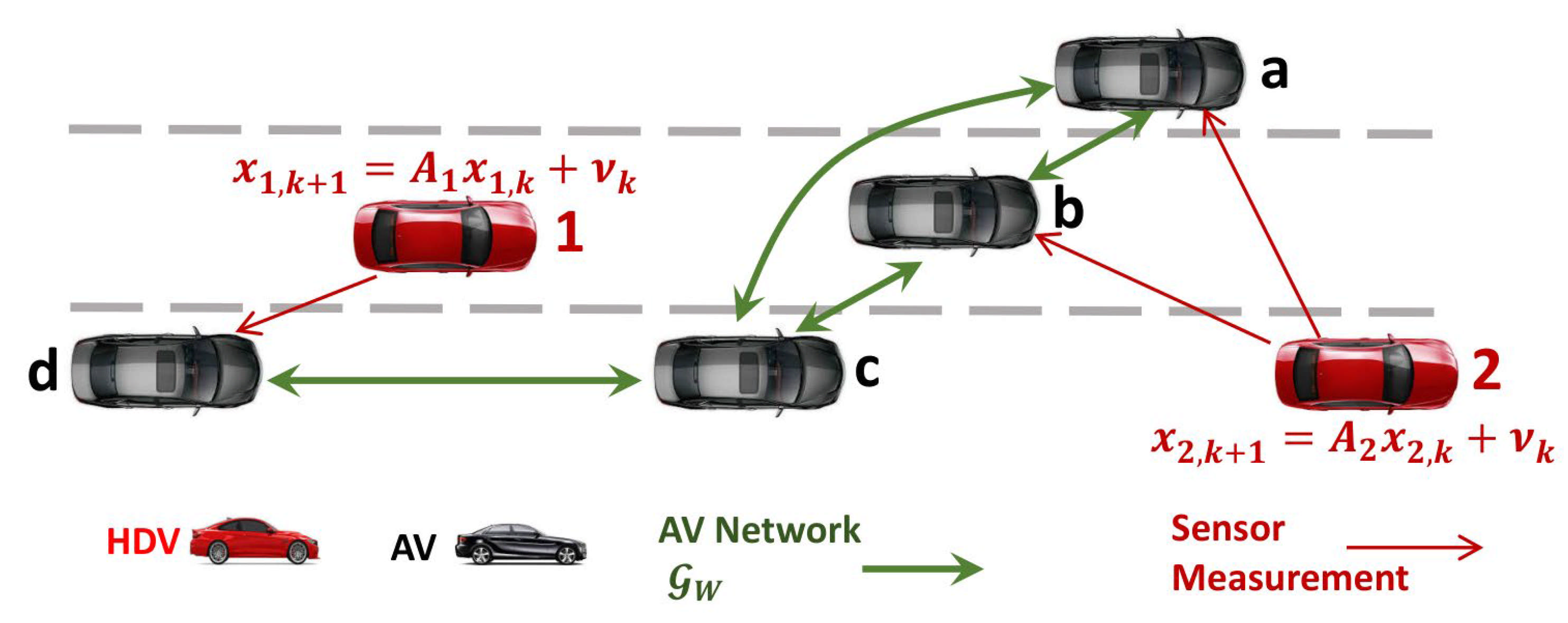
In this section, we first derive the conditions for the observability of the HDVs by the connected network of AVs. This is necessary to estimate the state of the HDVs for merging scenarios and stable mixed traffic of HDVs and AVs. Consider a group of AVs moving autonomously within the HDV-AV traffic as in Figure 1. Among the group of AVs, some take a direct sensor measurement of the state of the HDVs and the rest obtain this information via the information-sharing network of AVs, denoted by G W . Let the state dynamics of HDV i be in the following state-space model:
x i , k + 1 = A i x i , k + B i u i , k ,
with state x i , k + 1 R m and input u i , k R l i at time-step k . Matrix A i R m × m and B i R m × l i are the system and input matrices. One can concatenate the state of all N HDVs and the associated sensor measurements in a compact form as
x k + 1 = A x k + B u k ,
with x k = x 1 , k , , x N , k R N m as the states of all HDVs at time k . The block diagonal matrix A = blockdiag A i R N m × N m and B = blockdiag B i R N m × N l i are the overall state-space system and input matrices. We consider discrete-time dynamical systems, and it is known that such discretization models of continuous-time dynamical systems result in (generically) full-rank system matrix A with non-zero diagonal entries (referred to as self-damped); see details in ref. [32]. Furthermore, most existing tracking models, for example nearly constant velocity (NCV), nearly constant acceleration (NCA), and Singer dynamics [33], are full-rank. The HDV model is associated with sensor measurements by AVs in the form
y k = C x k + μ k ,
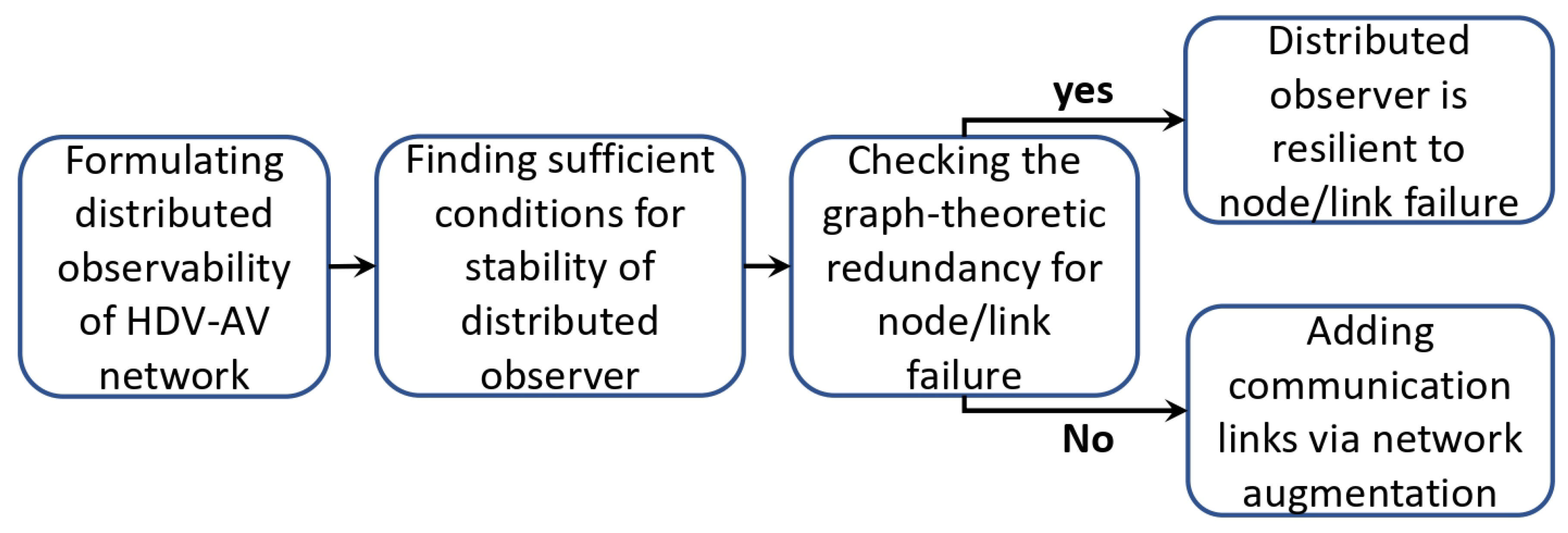
where y k = y 1 , k , , y n , k R l and μ k are the measurement vector and output noise at time k . The output matrix C R l × N m is the output matrix. It should be mentioned that not all the AVs take state measurements of the HDVs. Only some of the AVs take direct sensor measurements of the states of the nearby HDVs and then, the information is shared over the network G W . This is also shown in Figure 1. For stable mixed traffic, the unknown state of the HDVs must be estimated by the rest of the AVs and this is the place where observability plays the key role. In other words, for the rest of AVs with no direct measurements, the state of HDVs must be observable. This is achieved via the information-sharing network of AVs, denoted by G W , and is referred to as distributed observability or networked observability. This implies that no local observability requirement for any vehicle is assumed; instead, distributed observability is obtained via the information-sharing network of the AVs and by applying a proper networked estimation protocol. The problem in this paper is to first formulate distributed observability, then derive the sufficient conditions on G W to satisfy distributed observability, and, finally, propose a redundant design of the G W such that the distributed observability holds in spite of failure in some of the AVs or their communication links over G W . The distributed observability conditions and redundant design are based on some graph-theoretic concepts described in the next section. Figure 2 visually summarizes the problem statement, objectives and methodology.

3. Distributed Tracking via Observability on Graphs

In networked control systems and sensor networks, it is typical to analyze the linear system observation model using (2) and (3) in a graph-theoretic perspective. In the system graph representation G A , the states are modelled as nodes and every non-zero entry of A , say a i j , represents a link connecting state node j to i . Similarly, the entry C i j of the observation matrix C represents a link from the state node j to output node i . In this way, the observability can be analyzed via graph-theoretic terms as given in the next lemma.
Lemma 1 
([34]). Given a full-rank system matrix A  , the pair  A , C  is observable if, for every state node  i  in  G A  , there is a directed path starting from node  i  and ending at output node  j .
The condition in Lemma 1 is known as output connectivity. In the distributed setup, we need to extend the output connectivity to the global system dynamics. In the global model, the information of every AV node i is shared with its direct neighbours j N i over G W . This global state dynamics is modelled by the Kronecker product of the system matrix A and W matrix as the stochastic adjacency matrix of the network G W as [35]
x _ k + 1 = W A x _ k + 1 n u k ,
with denoting the Kronecker product. Note that, in this setup, the entry w i j of the adjacency matrix W represents the weight assigned to the information received to AV i from AV j . This represents a consensus-type setup with weight matrix W being stochastic, i.e., j = 1 n w i j = 1 [36]. This implies averaging-type dynamics at AVs for filtering information received from their neighbours. The diagonal entries w i j are all non-zero, implying that every AV uses its own information (a priori estimates and/or measurements) to update its observed state.
As an example, consider the single-time-scale distributed estimator/observer. The dynamics include consensus on a priori estimates and innovation updates based on measurements and is formulated as follows:
x ^ i , k | k 1 =   j N i w i j A x ^ j , k | k 1 ,
x ^ i , k | k = x ^ i , k | k 1 + K i j N i C j T y j , k C j x ^ j , k | k 1 ,
with K i as the local gain matrix and x ^ i , k | k 1 and x ^ i , k | k as a priori and posteriori estimates at AV i . The global error dynamics (concatenated at all AVs) for this distributed estimator are as follows (see detailed derivation of the error dynamics in ref. [37]):
e _ k + 1 =   W A     K D C W A e _ k +   ζ k ,
with ζ k collecting the noise and input terms and D C = blockdiag j N i C j C j . Then, for Schur stability of the error dynamics (7), we need the pair W A , D C to be observable, which follows the Kalman stability theorem [28].
Remark 1. 
The observability of the pair  W A , D C  denotes the mathematical formulation for distributed observability.
Theorem 1. 
Let the conditions in Lemma 1 for the observability of the system graph  G A  hold. If the network G W  connecting the AVs is strongly connected (SC), then  W A , D C  observability holds.
Proof. 
First, we prove that matrix W A is full-rank. For an SC network G W , its adjacency matrix W is irreducible [38]. Recall that in this irreducible structure, all the diagonal entries are non-zero. This implies that the system is self-damped and, thus, is structurally full-rank [39]. Then following the properties of the Kronecker product, we know that the Kronecker product of two full-rank matrices is also full-rank [40]. Next, following Lemma 1, we check that every state node in the global system W A is output-connected. Given that the pair A , C is observable, all its state nodes are output-connected according to Lemma 1. Note that the system graph G A can be decomposed into strongly connected components (SCCs) and, accordingly, the matrix A can be decomposed into irreducible structures each associated with an SCC. Note that, from Lemma 1, the output connectivity implies that every SCC is connected to an output. Next, following the definition, if the network G W is SC, then there is a direct path from every node to every other node in the graph [40]. This implies that in the composite graph G W × G A (associated with the global system W A ), there are giant SCCs made from the Kronecker product of the SC network G W and SCCs in G A . Note that these giant SCCs contain the main smaller SCCs in G A which are primarily output-connected. Following the definition of SCCs, there is a path from every node in the giant SCC to this output-connected subgraph and, thus, all nodes in every giant SCC in G W × G A are output-connected. This proves the output connectivity of the composite graph replicating the structure of the global system W A . It should be noted that the observability of the Kronecker product system W A follows the structure of the system graph associated with A and network associated with G W . This complex network can be seen as a network of networks or a Kronecker product network associated with the W A matrix. To analyze the observability of this Kronecker product network, recall some results from ref. [41]. Ref. [41] clearly proves the observability condition for the Kronecker product network in the form G W × G A with the adjacency matrix in the form W A . Given that A is full-rank and minimal measurements for output connectivity are given in Lemma 1, Theorem 4 in ref. [41] gives the (minimal) sufficient conditions for the output connectivity of G W × G A with network G W being strongly connected and self-damped. Recall that G W is self-damped because every (AV) node uses its own information over the network and thus all the diagonal entries of W are non-zero. Therefore, strong connectivity of G W is sufficient for output connectivity and W A , D C observability. □
Recall that W A , D C observability implies that the distributed observer can locally track the state of the system dynamics given by Equation (2) with steady-state stability (via the proper design of the feedback gain matrix K i ). Then, the following corollary holds from Theorem 1:
Corollary 1. 
Assume that there is one sensor measurement taken from every HDV with dynamics  A i by (at least) one AV, as in Figure 1. Using distributed observer (5) and (6) and designing the information-sharing network  G W  to be SC,  W A , D C observability holds. This implies that the states of all HDVs are observable to all AVs for tracking purposes. This is better illustrated by the example in Section 5.

4. Redundant Design

Recall that, as proved in Theorem 1, the network requirement for our distributed observer is relaxed to strong connectivity. This allows the redundant design to add extra links to the network of AVs to make it more robust to link/node failure. As compared to many distributed observers in the literature, this redundant network design and relaxed network requirement is a favourable capability for resilient tracking over time-varying networks; see Table 1 for better comparison. Note that works [26,27,28,29,30,31] cannot address redundant design as they require more than strong connectivity.
The primary goal of this section is to provide a network topology that can sustain connectivity even when certain links or nodes are compromised or removed. A key concept in this domain is the idea of κ -link-connected and κ -node-connected graphs. A κ -link-connected (k-node-connected) graph/network is an SC graph that remains connected even after the removal of any κ 1 links (nodes). This is done by increasing the path multiplicity among nodes, which enhances the resilience of the network and allows for alternative routes of data-sharing to exist, thus mitigating disruption caused by failures. Here, we provide an algorithm for redundant network design (it is known that the problem of graph augmentation to reach κ -link connectivity is generally NP-hard [42]). We present a graph augmentation method (see Algorithm 1 below), which aims to add additional links to a given graph to heuristically achieve κ -link connectivity. Other similar methods such as the greedy-type algorithms [43] can be employed to identify the minimum number of (or cost-optimal) links to add.
Algorithm 1 takes a (seed) graph G W = V , E and an integer κ . For each node in the graph, it finds additional nodes to connect with to ensure the degree of all nodes reaches κ with complexity O V . This is because for κ -link connectivity, the minimum node degree must be κ [44]. Then, connected components are defined via the Tarjan or DFS algorithm with complexity O V + E . The algorithm checks for disconnected components and adds links between them to reach κ -link connectivity. This depends on the graph structure and in the worst case could be O E . Based on this, the overall complexity is O V + E = O V 2 and is thus scalable. However, the algorithm outcome may not be the most efficient and optimal solution. Recall that the optimal network augmentation for κ -link connectivity is generally NP-hard [45,46,47]. For example, for comparison, the algorithm in ref. [45] is of complexity O V 4 , the optimal augmentation algorithm in ref. [47] is of complexity O V 5 , the simplified algorithm in ref. [48] is of complexity O V E + V 2 log V , and the algorithm in ref. [46] is of complexity O h V 2 with h as the number of causalities; these require higher complexity and running time than the proposed Algorithm 1.
Algorithm 1. Design a κ -Link-Connected Network
Data: Seed graph G W = V , E and integer κ
Result: An augmented graph G W = V , E with at least κ -link connectivity
Let E E ;
For each node  i   V  do
Let d i degree i if d i <   κ  then
Find new κ d i nodes v 1 , v 2 , , v κ d i in V ;
For each  v j  do
If  i , v j E  then
Add link i , v j to E ;
Let C ConnectedComponents G W ;
For each pair of components  C i , C j  in  C  do
If the components are not  κ -connected then
Add links between C i and C j to establish κ distinct links between the two components;
Ensure added links maintain κ -link connectivity of the two components;
Update E with the newly added links;
Return  G W = V , E
Remark 2. 
The node connectivity metric of a graph is always less than the link connectivity metric; therefore, a  κ -node-connected graph is always  κ -link-connected, i.e., node connectivity ≤ link connectivity ≤ minimum degree following Whitney’s theorem.
If G W is already given, the min-cut algorithm identifies the minimum number of links that, if removed, would disconnect the graph [49]. By identifying these links, additional links can be added to ensure that the minimum cut is greater than a certain number. Moreover, Menger’s theorem finds the relation between the connectivity of a graph and the maximum number of disjoint paths between two nodes [50]. Using this theorem, one can identify whether sufficient redundancy is present or needs to be introduced to meet the desired connectivity levels.

5. Illustrative Example and Simulations

The NCV and NCA models are commonly used in tracking and estimation problems, particularly in applications involving the prediction and filtering of unknown dynamic systems such as maneuvering targets [33]. In the context of autonomous vehicles, self-driving cars and drones use these models to predict the motion of other vehicles to make safe navigation decisions; see refs. [51,52,53]. For example, consider the AV predicting the future position and velocity of the HDVs to navigate through traffic safely. The vehicle uses the NCA model to estimate the state of the HDVs assuming that acceleration changes slowly and is subject to small random variations. This prediction helps in path planning, collision avoidance, and ensuring smooth and safe navigation in a dynamic traffic environment. In this context, the HDV dynamics are modelled as (2) with the state x = p x ¨ , p y ¨ , p x ˙ , p y ˙ , p x , p y , with p x , p y as the position of the HDV in 2D, p x ˙ , p y ˙ as its velocity, and p x ¨ , p y ¨ as its acceleration. The input u k is considered random, and the system and input matrices are defined as
A = 1 0 0 0 0 0 0 1 0 0 0 0 T 0 1 0 0 0 0 T 0 1 0 0 T 2 2 0 T 0 1 0 0 T 2 2 0 T 0 1   ,   B = T 2 2 0 0 T 2 2 T 0 0 T 1 0 0 1 ,
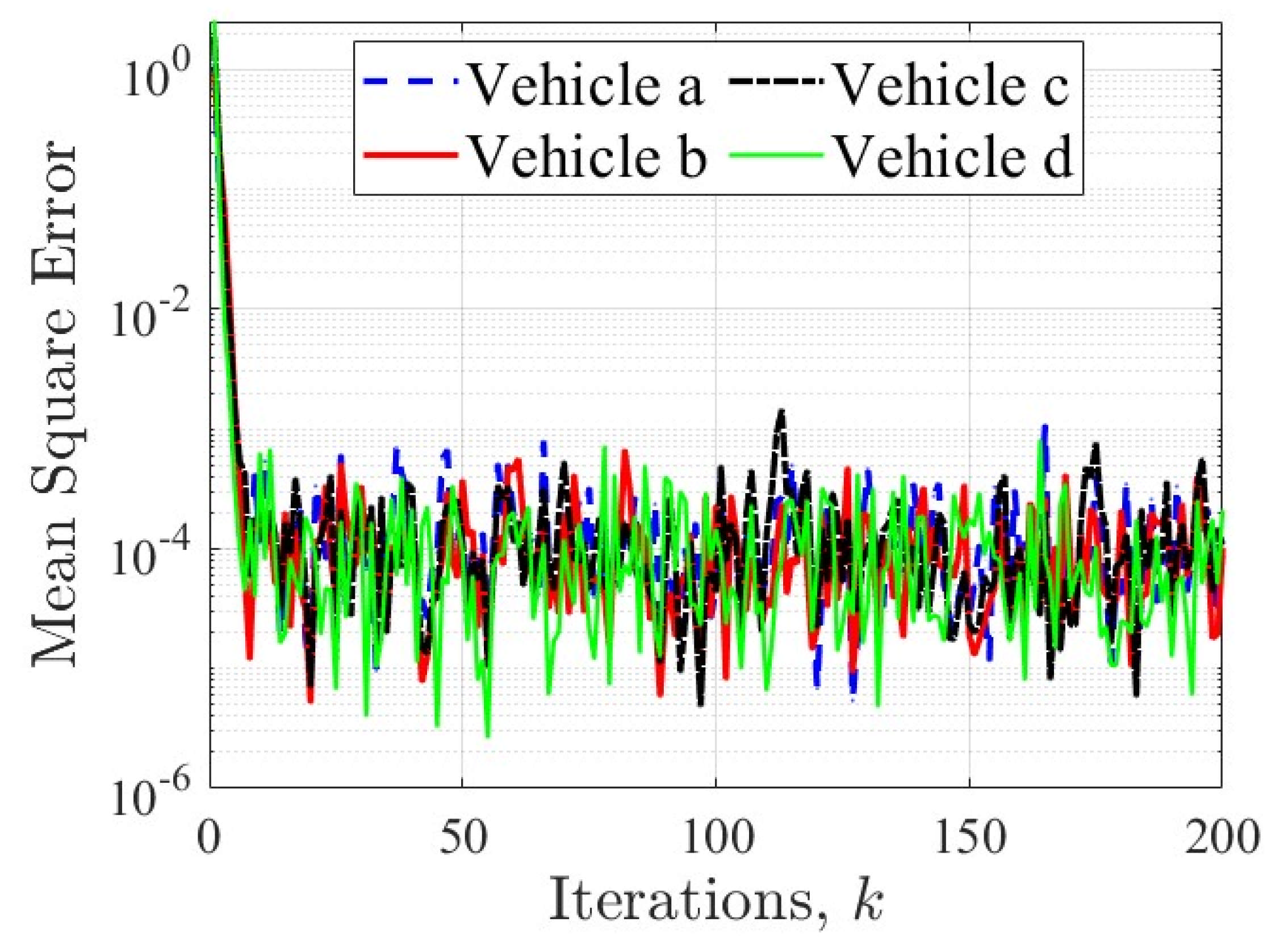
with parameter T as the sampling time. We consider the network G W given in Figure 1 as the information-sharing network of n = 4 AVs. The entries of the associated adjacency matrix W are set randomly such that row stochasticity holds, i.e., j = 1 n W i j = 1 . The shared information among the neighbouring AVs includes the state estimates and (possibly) measurements. Note that the AVs with no sensor measurements of the HDVs only share their estimates. For simulation, we set the sampling time as T = 0.05 and input u as a uniform random process in the range 1,1 . We adopt the distributed observer (5) and (6) and design the gain matrix K i with the algorithm given in ref. [37]’s Appendix. The distributed observer enables every AV to locally estimate the state of the HDVs. Applying this distributed observer, the mean square error (MSE) of all AVs is shown in Figure 3. Note that every vehicle i only receives the information from the neighbouring vehicles j N i , without receiving any direct messages from the rest of the AVs. Despite this, it is clear from the figure that the MSE of all AVs is Schur (steady-state) stable under the proposed distributed observer design. This implies that every AV i can track the state of every HDV, even those with no direct measurement by AV i . Recall that the steady-state error is due to noise considerations.
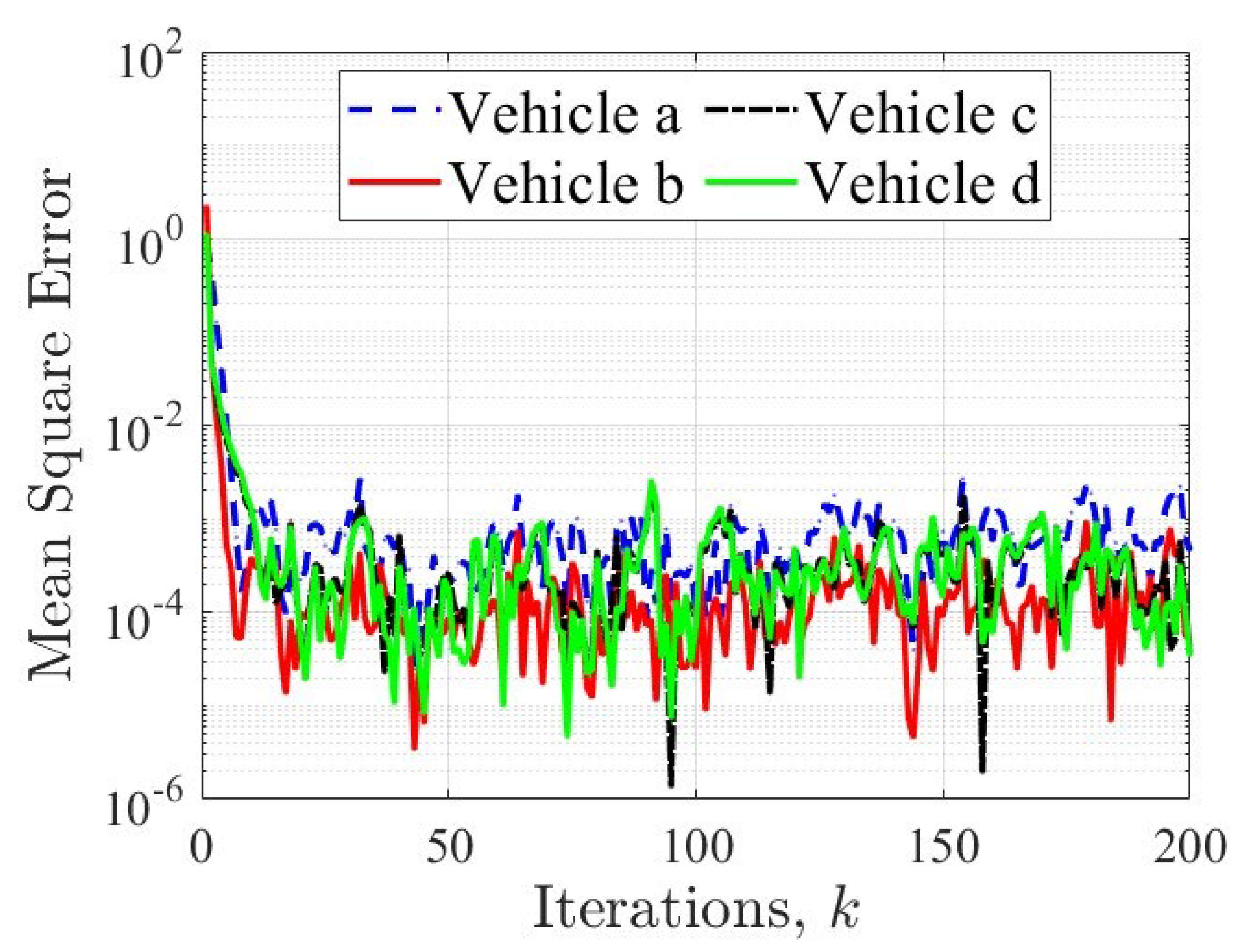
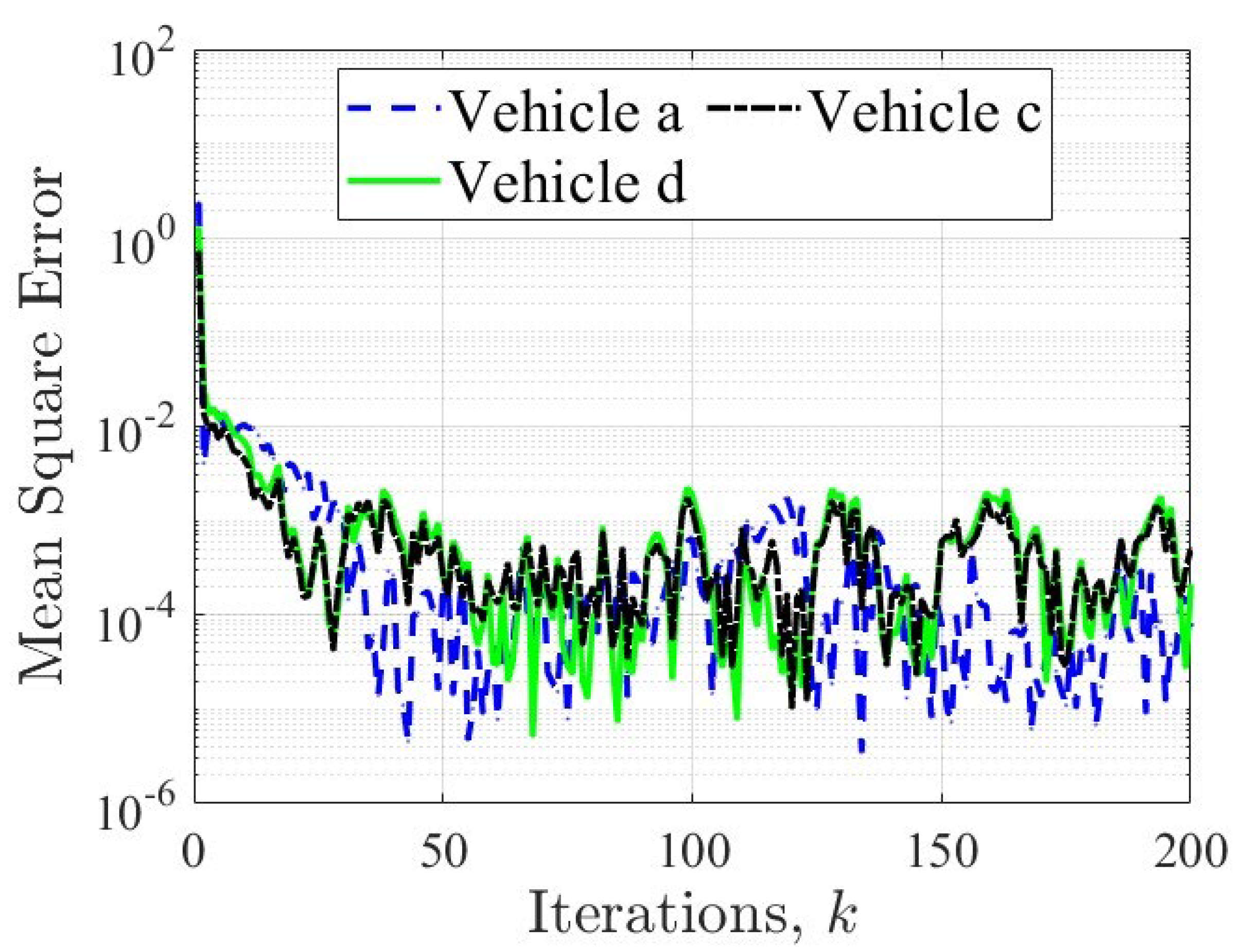
Next, we consider time-varying networks and evaluate the redundancy of the proposed observer design. Recall from Figure 1 that the network G W is resilient to removal (or failure) of AV ‘b’ and the link ‘bc’. First, we remove the link ‘bc’. Note that, due to the existence of the redundant link ‘ac’, the remaining network is still SC. Therefore, the condition in Theorem 1 holds, and the error dynamics are Schur stable. This is shown in Figure 4, which represents stable MSE for all vehicles. Next, we consider the case that AV ‘b’ is faulty and, therefore, removed from the network (its associated links are also removed). The remaining AVs and their reduced network G W are still SC and satisfy the stability condition in Theorem 1; therefore, the MSE is stable for all remaining AVs, as illustrated in Figure 5.
Remark 3. 
Recall that, although the algorithm is illustrated over a small-scale vehicular network, it can be efficiently extended to larger-scale setups. This is because the proposed algorithm is of complexity order  O ( V 2 ) ; this implies that the complexity of the proposed algorithm can be extended polynomially to a larger scale with efficient computations.

6. Conclusions

In this paper, providing the graph-theoretic formulation for observability, the merging scenario for a network of AVs and HDVs is presented, aiming to make the dynamics of all HDVs observable and trackable by all the AVs. This allows the AVs to estimate the state of all HDVs by applying relevant distributed estimation protocols for safe mixed-traffic strategies. Then, an efficient strategy is proposed to add redundancy in the network of vehicles for resilient design against failures. This helps to estimate the (position, velocity, and acceleration) state of HDVs even in the case of link failure due to unreliable communications or when the vehicles go out of communication range of each other. This paper may have many applications in ITSs including in autonomous vehicle coordination. As a future research direction, one could incorporate real-world constraints in the data-sharing network of vehicles, such as quantization, to address limitations in network traffic.
Future research may connect the proposed framework with empirical research fields where multiple sensing technologies are already integrated to analyze real driving behaviour. For example, naturalistic driving studies combine GNSS positioning, onboard sensors, and vehicle telemetry to capture real-world driving dynamics [54,55,56]. Within this context, the concept of GNSS signal integrity has been highlighted as a key challenge, since positioning signals alone may not always provide reliable information and therefore often need to be complemented with other sensing technologies. This line of research could help place the proposed theoretical framework within a broader context of multi-sensor transportation systems and data integration challenges.

Funding

This research was funded by Semnan University, grant number: No. 226/1403/1403208.

Institutional Review Board Statement

Not applicable.

Informed Consent Statement

Not applicable.

Data Availability Statement

The raw data supporting the conclusions of this article will be made available by the authors on request.

Conflicts of Interest

The author declares no conflicts of interest.

References

  1. Ragot, J.; Maquin, D.; Kratz, F. Observability and redundancy decomposition application to diagnosis. In Issues of Fault Diagnosis for Dynamic Systems; Springer: Berlin/Heidelberg, Germany, 2000; pp. 51–85. [Google Scholar]
  2. Cauffriez, L.; Ciccotelli, J.; Conrard, B.; Bayart, M. Design of intelligent distributed control systems: A dependability point of view. Reliab. Eng. Syst. Saf. 2004, 84, 19–32. [Google Scholar] [CrossRef]
  3. Doostmohammadian, M.; Rabiee, H.R.; Zarrabi, H.; Khan, U. Observational Equivalence in System Estimation: Contractions in Complex Networks. IEEE Trans. Netw. Sci. Eng. 2018, 5, 212–224. [Google Scholar] [CrossRef]
  4. Doostmohammadian, M.; Rabiee, H.R.; Khan, U.A. Structural cost-optimal design of sensor networks for distributed estimation. IEEE Signal Process. Lett. 2018, 25, 793–797. [Google Scholar] [CrossRef]
  5. London, J.; Alberto, L.F.C.; Bretas, N.G. Network observability: Identification of the measurements redundancy level. In Proceedings of the International Conference on Power System Technology; IEEE: New York, NY, USA, 2000; Volume 2, pp. 577–582. [Google Scholar]
  6. Liu, L.; Yin, Y.; Zhang, Z.; Malaiya, Y.K. Redundant design in interdependent networks. PLoS ONE 2016, 11, e0164777. [Google Scholar] [CrossRef] [PubMed]
  7. Xu, X.; Chen, A.; Xu, G.; Yang, C.; Lam, W.H.K. Enhancing network resilience by adding redundancy to road networks. Transp. Res. Part E Logist. Transp. Rev. 2021, 154, 102448. [Google Scholar] [CrossRef]
  8. Allen, E.; Costello, S.; Henning, T. Contribution of Network Redundancy to Reducing Criticality of Road Links. Transp. Res. Rec. 2024, 2678, 1574–1590. [Google Scholar] [CrossRef]
  9. El-Rashidy, R.A.; Grant-Muller, S. The evaluation of redundancy for road traffic networks. Transport 2016, 31, 427–439. [Google Scholar] [CrossRef]
  10. Sventekova, E.; Prievoznik, P.; Sibila, M.; Boros, M. Road Junction Throughput Testing in Transport Logistics–Slovak Case Study. Sustainability 2024, 16, 6249. [Google Scholar] [CrossRef]
  11. Jing, W.; Xu, X.; Pu, Y. Route redundancy-based approach to identify the critical stations in metro networks: A mean-excess probability measure. Reliab. Eng. Syst. Saf. 2020, 204, 107204. [Google Scholar] [CrossRef]
  12. Zhang, J.; Li, W.; Li, F.; Song, B. Critical Station Identification and Vulnerability Assessment of Metro Networks Based on Dynamic DomiRank and Flow DomiGCN. Sustainability 2026, 18, 1781. [Google Scholar] [CrossRef]
  13. Zhou, Y.; Wang, J.; Yang, H. Resilience of transportation systems: Concepts and comprehensive review. IEEE Trans. Intell. Transp. Syst. 2019, 20, 4262–4276. [Google Scholar] [CrossRef]
  14. Bellini, E.; Bellini, P.; Cenni, D.; Nesi, P.; Pantaleo, G.; Paoli, I.; Paolucci, M. An IOE and big multimedia data approach for urban transport system resilience management in smart cities. Sensors 2021, 21, 435. [Google Scholar] [CrossRef] [PubMed]
  15. Stepanyants, V.G.; Romanov, A.Y. A survey of integrated simulation environments for connected automated vehicles: Requirements, tools, and architecture. IEEE Intell. Transp. Syst. Mag. 2023, 16, 6–22. [Google Scholar] [CrossRef]
  16. Doostmohammadian, M.; Zarrabi, H.; Charalambous, T. Sensor fault detection and isolation via networked estimation: Rank-deficient dynamical systems. Int. J. Control 2023, 96, 2853–2870. [Google Scholar] [CrossRef]
  17. Modalavalasa, S.; Sahoo, U.K.; Sahoo, A.K.; Baraha, S. A review of robust distributed estimation strategies over wireless sensor networks. Signal Process. 2021, 188, 108150. [Google Scholar] [CrossRef]
  18. Wang, S.; Guay, M. Distributed state estimation for jointly observable linear systems over time-varying networks. Automatica 2024, 163, 111564. [Google Scholar] [CrossRef]
  19. Xing, L. Cascading failures in internet of things: Review and perspectives on reliability and resilience. IEEE Internet Things J. 2020, 8, 44–64. [Google Scholar] [CrossRef]
  20. Gagliardi, G.; D’Angelo, V.; Torchiaro, F.; Casavola, A. Trustworthy Traffic Sensors Networks via Fault-Tolerant Sensor Reconciliation Architectures. IEEE Trans. Autom. Sci. Eng. 2024, 22, 3567–3581. [Google Scholar] [CrossRef]
  21. Montanari, A.N.; Aguirre, L.A. Observability of network systems: A critical review of recent results. J. Control Autom. Electr. Syst. 2020, 31, 1348–1374. [Google Scholar] [CrossRef]
  22. Abolfazli, E.; Jiang, W.; Charalambous, T. Towards Establishing String Stability Conditions For Heterogeneous Vehicle Platoons Under the MPF Topology. In Proceedings of the European Control Conference (ECC); IEEE: New York, NY, USA, 2022; pp. 944–950. [Google Scholar]
  23. Hamdipoor, V.; Meskin, N.; Cassandras, C.G. Safe merging control in mixed vehicular traffic. In Proceedings of the American Control Conference (ACC); IEEE: New York, NY, USA, 2023; pp. 4386–4392. [Google Scholar]
  24. Kojchev, S.; Hult, R.; Kneissl, M.; Fredriksson, J. Optimization-Based Coordination of Automated and Human-Driven Vehicles in Confined Sites. IEEE Trans. Control Syst. Technol. 2024, 33, 1221–1234. [Google Scholar] [CrossRef]
  25. Grana, A.; Curto, S.; Petralia, A.; Giuffre, T. Connected automated and human-driven vehicle mixed traffic in urban freeway interchanges: Safety analysis and design assumptions. Vehicles 2024, 6, 693–710. [Google Scholar] [CrossRef]
  26. Boukhobza, T.; Hamelin, F.; Martinez-Martinez, S.; Sauter, D. Structural Analysis of the Partial State and Input Observability for Structured Linear Systems: Application to Distributed Systems. Eur. J. Control 2009, 15, 503–516. [Google Scholar] [CrossRef]
  27. Ennasr, O.; Tan, X. Numerical and topological conditions for sub-optimal distributed Kalman filtering. IEEE Trans. Control Netw. Syst. 2022, 10, 1255–1265. [Google Scholar] [CrossRef]
  28. Khan, U.A.; Jadbabaie, A. Coordinated networked estimation strategies using structured systems theory. In Proceedings of the 50th IEEE Conference on Decision and Control and European Control Conference; IEEE: New York, NY, USA, 2011; pp. 2112–2117. [Google Scholar]
  29. Chen, Y.; Kar, S.; Moura, J.M.F. Resilient distributed estimation through adversary detection. IEEE Trans. Signal Process. 2018, 66, 2455–2469. [Google Scholar] [CrossRef]
  30. He, X.; Ren, X.; Sandberg, H.; Johansson, K.H. How to secure distributed filters under sensor attacks. IEEE Trans. Autom. Control 2021, 67, 2843–2856. [Google Scholar] [CrossRef]
  31. Battilotti, S.; Cacace, F.; d’Angelo, M. A stability with optimality analysis of consensus-based distributed filters for discrete-time linear systems. Automatica 2021, 129, 109589. [Google Scholar] [CrossRef]
  32. Doostmohammadian, M.; Khan, U.A. On the complexity of minimum-cost networked estimation of self-damped dynamical systems. IEEE Trans. Netw. Sci. Eng. 2019, 7, 1891–1900. [Google Scholar] [CrossRef]
  33. Bar-Shalom, Y.; Li, X.R.; Kirubarajan, T. Estimation with Applications to Tracking and Navigation: Theory Algorithms and Software; John Wiley & Sons: Hoboken, NJ, USA, 2004. [Google Scholar]
  34. Liu, Y.Y.; Slotine, J.J.; Barab’asi, A.L. Observability of complex systems. Proc. Natl. Acad. Sci. USA 2013, 110, 2460–2465. [Google Scholar] [CrossRef]
  35. Doostmohammadian, M.; Khan, U.A. On the characterization of distributed observability from first principles. In Proceedings of the IEEE Global Conference on Signal and Information Processing; IEEE: New York, NY, USA, 2014; pp. 914–917. [Google Scholar]
  36. Olfati-Saber, R.; Fax, J.A.; Murray, R.M. Consensus and Cooperation in Networked Multi-Agent Systems. IEEE Proc. 2007, 95, 215–233. [Google Scholar] [CrossRef]
  37. Doostmohammadian, M.; Khan, U. On the genericity properties in distributed estimation: Topology design and sensor placement. IEEE J. Sel. Top. Signal Process. 2013, 7, 195–204. [Google Scholar] [CrossRef]
  38. Reinschke, K.J. Multivariable Control, a Graph Theoretic Approach; Springer: Berlin/Heidelberg, Germany, 1988. [Google Scholar]
  39. Chapman, A.; Mesbahi, M. On strong structural controllability of networked systems: A constrained matching approach. In Proceedings of the American Control Conference; IEEE: New York, NY, USA, 2013; pp. 6126–6131. [Google Scholar]
  40. Hammack, R.; Imrich, W.; Klavžar, S. Handbook of Product Graphs; CRC Press: Boca Raton, FL, USA, 2011. [Google Scholar]
  41. Doostmohammadian, M.; Khan, U.A. Minimal Sufficient Conditions for Structural Observability/Controllability of Composite Networks via Kronecker Product. IEEE Trans. Signal Inf. Process. Over Netw. 2020, 6, 78–87. [Google Scholar] [CrossRef]
  42. Chopra, S. The k-edge-connected spanning subgraph polyhedron. SIAM J. Discret. Math. 1994, 7, 245–259. [Google Scholar] [CrossRef]
  43. Horsch, F.; Szigeti, Z. The (2, k)-connectivity augmentation problem: Algorithmic aspects. Algorithmica 2021, 83, 2333–2350. [Google Scholar] [CrossRef]
  44. Gabow, H.N.; Goemans, M.X.; Tardos, E.; Williamson, D.P. Approximating the smallest k-edge connected spanning subgraph by LP-rounding. Netw. Int. J. 2009, 53, 345–357. [Google Scholar] [CrossRef]
  45. Bang-Jensen, J.; Jordán, T. Edge-connectivity augmentation preserving simplicity. SIAM J. Discret. Math. 1998, 11, 603–623. [Google Scholar] [CrossRef]
  46. Zhang, Z.; Radhakrishnan, S.; Barker, K.; González, A.D. Maintaining the Giant Component in Networks with Edge Weighted Augmentation Given Causal Failures. IEEE Access 2024, 12, 136588–136598. [Google Scholar] [CrossRef]
  47. Vegh, L. Connectivity Augmentation Algorithms. Ph.D. Thesis, Department of Operations Research, Eotvos Lorand University, Budapest, Hungary, 2010. [Google Scholar]
  48. Oki, T.; Taoka, S.; Watanabe, T. A Simplified Algorithm for Augmenting Edge-Connectivity by One with Bipartition Constraints. Bull. Netw. Comput. Syst. Softw. 2012, 1, 769–777. [Google Scholar]
  49. Arikati, S.R.; Chaudhuri, S.; Zaroliagis, C.D. All-pairs min-cut in sparse networks. J. Algorithms 1998, 29, 82–110. [Google Scholar] [CrossRef][Green Version]
  50. Bollob’as, B. Graph Theory: An Introductory Course; Springer Science & Business Media: Berlin/Heidelberg, Germany, 2012; Volume 63. [Google Scholar]
  51. Lefèvre, S.; Vasquez, D.; Laugier, C. A survey on motion prediction and risk assessment for intelligent vehicles. ROBOMECH J. 2014, 1, 1. [Google Scholar] [CrossRef]
  52. Kaempchen, N.; Weiss, K.; Schaefer, M.; Dietmayer, K. IMM object tracking for high dynamic driving maneuvers. In Proceedings of the IEEE Intelligent Vehicles Symposium; IEEE: New York, NY, USA, 2004; pp. 825–830. [Google Scholar]
  53. Huang, R.; Zhuo, G.; Xiong, L.; Lu, S.; Tian, W. A Review of Deep Learning-Based Vehicle Motion Prediction for Autonomous Driving. Sustainability 2023, 15, 14716. [Google Scholar] [CrossRef]
  54. Balsa-Barreiro, J. Application of GNSS and GIS Systems to Transport Infrastructures. Studies Focusing on Naturalistic Drivin. Ph.D. Thesis, Department of Civil Engineering, University of A Coruna (Spain) and Politecnico di Torino, A Coruna, Spain, 2015. [Google Scholar]
  55. Balsa-Barreiro, J.; Valero-Mora, P.M.; Berné-Valero, J.L.; Varela-García, F.A. GIS mapping of driving behavior based on naturalistic driving data. ISPRS Int. J. Geo-Inf. 2019, 8, 226. [Google Scholar] [CrossRef]
  56. Balsa-Barreiro, J.; Valero-Mora, P.M.; Pareja-Montoro, I.; Sánchez-García, M. Proposal of geographic information systems methodology for quality control procedures of data obtained in naturalistic driving studies. IET Intell. Transp. Syst. 2015, 9, 673–682. [Google Scholar] [CrossRef]
Figure 1. A mixed-traffic scenario with both AVs and HDVs: for stable traffic movement, the states of the HDVs need to be measured and tracked by the AVs. Vehicle ‘c’ tracks the state of HDV number 2 via information-sharing with both vehicles ‘a’ and ‘b’. In case the link ‘bc’ fails, the redundant link ‘ac’ delivers the state information to vehicle ‘c’ for stable tracking. On the other hand, if the link ‘cd’ fails, there is no other way to deliver state information of the dynamics of HDV number 1 to the rest of the AVs.
Futuretransp 06 00084 g001
Figure 2. The flowchart summarizes the objectives and methodology in this paper.
Futuretransp 06 00084 g002
Figure 3. The time evolution of the mean square error (MSE) of all AVs connected via the network G W shown in Figure 1.
Futuretransp 06 00084 g003
Figure 4. The time evolution of the mean square error (MSE) of all vehicles over the same network G W in Figure 1 after removing link ‘bc’.
Futuretransp 06 00084 g004
Figure 5. The time evolution of the mean square error (MSE) over the network G W in Figure 1 after removing AV ‘b’.
Futuretransp 06 00084 g005
Table 1. Comparison of the proposed distributed observer in terms of network connectivity × communication rate per iteration of system dynamics.
Refs.Minimum Required Links × Communication Rate
[26] n n 1 × 1
[27,28,29] 3 n × 1
[30,31] n × L with L more than network diameter
This work n × 1
Disclaimer/Publisher’s Note: The statements, opinions and data contained in all publications are solely those of the individual author(s) and contributor(s) and not of MDPI and/or the editor(s). MDPI and/or the editor(s) disclaim responsibility for any injury to people or property resulting from any ideas, methods, instructions or products referred to in the content.