


Abstract
People with special needs often face barriers to participating in adapted outdoor leisure physical activities. A participatory action research project involving a nonprofit organization, a citizen with motor disabilities, and researchers aimed to co-develop a digital platform connecting people with special needs interested in outdoor leisure physical activities with trained volunteers. The adopted co-design methodology followed four stages: (1) Exploration (identifying users’ needs and preferences), (2) Co-design (defining key information and platform features), (3) Validation (prioritizing features), and (4) Development (implementing and testing the platform). This article focuses on stages 2, 3, and 4. During stage 2, key information and features were identified to support matching people with special needs and volunteers and informing users about adapted outdoor leisure physical activities. In stage 3, these elements were prioritized using eight key considerations, including technological (e.g., ease of use), environmental (e.g., avoiding redundancy with existing initiatives), organizational (e.g., availability of human resources), and financial factors (e.g., grant planning). Stage 4 resulted in the launch of Tandem Actif, followed by user testing to document user experience and guide improvements. This article details the application of co-design within a participatory action research project aimed at promoting safe, ethical, and accessible participation in outdoor leisure physical activities for people with special needs.
1. Introduction
Nearly 16% of the world’s population reported at least one disability in 2021, which is a significant increase from the past decade [1]. Disability is defined as an “umbrella term for impairments, activity limitations and participation restrictions, denoting the negative aspects of the interaction between an individual (with a health condition) and that individual’s contextual (environmental and personal) factors” [2] (p. 1). The difficulties people with special needs experience when accessing their social and physical environments can lead to social isolation and reduced participation in meaningful activities during leisure time, such as recreational physical activities, gardening, and meeting with loved ones [3,4,5,6].
Outdoor leisure physical activities (i.e., outdoor activities that are practiced within elements of nature in a manner that is different from competitive sports [7]) contribute to social (i.e., facilitating cohesion among individuals [8,9]), psychological (i.e., improving quality of life and happiness [9]), and physiological well-being (i.e., protecting against cardiovascular disease [10]) for everyone [11]. To participate in outdoor leisure physical activities and fully benefit from them, people with special needs must overcome multiple barriers across different levels: intrapersonal (e.g., lack of self-confidence, limited knowledge and skills related to adaptive equipment), social environment (e.g., lack of support from family and peers, negative societal attitudes toward disability), physical environment (e.g., poor terrain conditions, lack of safety), and policy-related (e.g., limited government financial support for volunteer training) [12]. Among these factors, the need for assistance with specific tasks such as transfers, loading and unloading equipment, or propulsion can limit the spontaneity and independence of people with special needs during outdoor leisure physical activities, as these activities typically require third-party involvement [9].
Under Article 30 of the Convention on the Rights of Persons with Disabilities, signatory states have committed to facilitating access to leisure activities for people with special needs, notably through equitable provision of adequate resources [13]. Various initiatives have been implemented worldwide, such as websites that compile information about outdoor leisure physical activities (e.g., types and costs of necessary equipment) [14], or that host forums where physically active people with special needs can share their experiences to enhance accessibility [15]. However, few websites comply with accessibility standards [16]. Non-profit organizations have also launched programs to promote healthy behaviors [17] and address physical environmental barriers. For example, the Association Régionale de Loisir pour Personnes Handicapées de la Capitale-Nationale (ARLPH-03), a non-profit organization in Quebec City (Canada), provides services to other organizations (e.g., advice on improving park accessibility) and individuals (e.g., a catalogue of accessible equipment available for free borrowing). Despite these efforts, no tools or programs currently address the need for assistance of people with special needs during outdoor leisure physical activities [18].
In 2021, a citizen with motor disabilities in Quebec City approached ARLPH-03 expressing the need to facilitate support for people with special needs seeking to engage in outdoor leisure physical activities. Their idea was to develop a digital platform that would:
- Facilitate connections between people with special needs wishing to participate in outdoor leisure physical activities and trained volunteers,
- Provide online training resources to promote safe and enjoyable outdoor leisure physical activities,
- Offer a directory of adapted equipment available in the region.
Future users’ attitudes toward a technological innovation can strongly influence both their interaction with it and its eventual adoption. According to Rogers (2003) [19] individuals fall into five adopter categories: (1) Innovators, who are the first to adopt an innovation because they are highly informed and quick to experiment; (2) Early Adopters, opinion leaders who feel comfortable with new technologies and actively seek opportunities for change; (3) Early Majority, who adopt an innovation slightly before the average user, but only after carefully considering it; (4) Late Majority, who adopt an innovation slightly after the average user, primarily due to economic constraints or social pressure; and (5) Laggards, the last to adopt an innovation, as their decisions tend to be guided by tradition or by reliance on previous solutions.
The main objective of this article is to describe the co-design methodology used to define and test the content and format of a digital platform supporting safe, ethical, and accessible participation of people with special needs in outdoor leisure physical activities, and to share lessons learned that guided its development and refinement, along with key findings.
2. Materials and Methods
2.1. General Approach
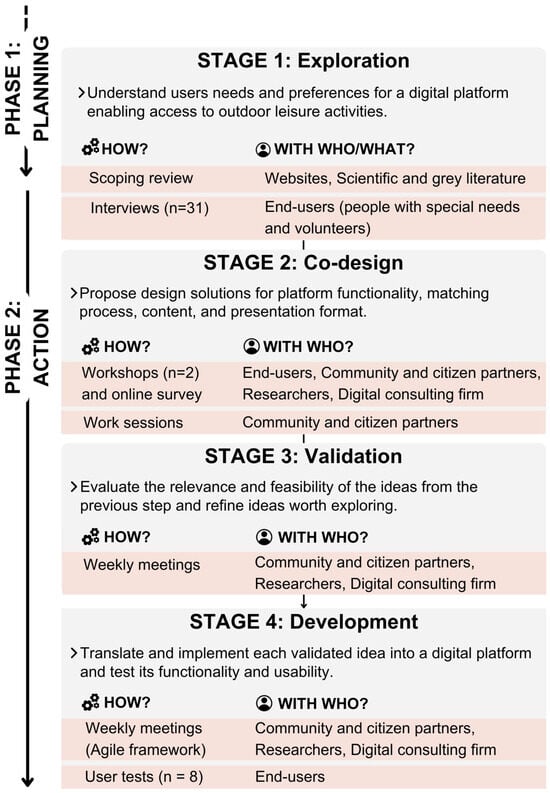
A participatory action research project was initiated in 2022, a collaboration between ARLPH-03, a citizen with motor disabilities, and researchers. The project followed the iterative four-phase action research cycle described by Rauch et al. (2014) [20]: (1) planning; (2) action; (3) evaluation/reflection; and (4) expansion. This article focused on the activities carried out and results obtained during the second phase (action) only. To guide and actively involve partners and future users throughout this phase, researchers adopted a co-design methodology [21]. This approach emphasizes creativity and collaboration among knowledge-users (e.g., researchers, partners, citizens). The underlying principles of co-design (e.g., culture of mutual respect, managerial practices) help enhance the quality of research and ensure that outcomes reflect the priorities and interests of the people directly concerned [22]. While the benefits and best practices of co-design are well documented in the literature [23], a few scientific publications were found that detail the processes required to create a website, especially when it is intended for an audience with highly diverse abilities [24]. This appears to fall largely within the domain of technical knowledge and expertise held by private companies. The following sections detail the actions taken and the actors involved in the four stages of the co-design methodology [21], summarized in Figure 1.
Figure 1.
Summary of actions taken and role of knowledge-users involved in the four stages of co-design (adapted from Morales et al. (2012) [21]).
Stage 1 (exploration), completed prior to the current article, was in fact part of Phase 1 (planning) of the action research cycle described by Rauch et al. (2014) [20]. Its objective was to identify key factors for developing a digital platform with a matching system between people with special needs and volunteers [18,25]. Although intended for people with all types of disabilities, supporting access to outdoor leisure physical activities for individuals with cognitive disorders posed additional challenges (e.g., extra training to facilitate communication between people with special needs and volunteers), leading ARLPH-03 to initially focus on physical and sensory disabilities. Findings from a scoping review [18] and a qualitative study [25] were then used to develop an initial set of specifications outlining the desired features of the platform (i.e., a “wish-list”). This document was intended for the software developer and served as a foundation for the subsequent co-design stages.
The ethics committee of the Centre intégré de santé et de services sociaux de la Capitale-Nationale (Quebec City, Canada; 2023-2619) approved the project. All participants signed a consent form (either paper or electronic) and received financial compensation for their participation.
2.2. Stage 2: Co-Design
Stage 2 (co-design) focused on developing concrete solutions for a matching platform to support adapted outdoor leisure physical activities. Collaborative working sessions with project partners and workshops were used to finalize the specifications drafted during the previous stage. These workshops are powerful tools for generating innovative solutions within a diverse group [26].
2.2.1. Participants and Recruitment
This stage involved a range of knowledge-users: community and citizen partners, researchers, a digital consulting firm, and potential future users of the platform (people with special needs and volunteers). Researchers were invited for their expertise in rehabilitation and physical activity. The digital consulting firm, selected by the ARLPH-03, was tasked with developing the platform and brought expertise in web accessibility. Inclusion criteria for future users were as follows for people with special needs: (1) having one or more physical or sensory disabilities; (2) being 18 years or older; (3) requiring assistance to participate in outdoor leisure physical activities; and (4) being able to communicate in French. For volunteers, those criteria were: (1) having experience in one or more outdoor leisure physical activities; (2) being interested in supporting people with special needs in their participation; (3) being 18 years or older; and (4) being able to communicate in French. These future users were recruited through the network of ARLPH-03.
2.2.2. Procedure
Stage 2 (co-design) began with working sessions between the citizen partner and an ARLPH-03 member to develop preliminary wireframes defining core “must-have” features and the platform’s architecture. Subsequently, two 2.5 h workshops were conducted with the knowledge-users (i.e., researchers, community and citizen partners, the digital consulting firm, and future users, including people with special needs and volunteers) to identify additional “nice-to-have” features, prioritized through an online Mentimeter 2023 © survey conducted between sessions. Both workshops were recorded, and summaries were shared with participants for validation and feedback.
2.3. Stage 3: Validation
Stage 3 (validation) sought consensus on a solution that meets users’ needs, while considering financial, technical, ethical, and safety constraints to help refine promising ideas. A qualitative study was conducted to document the factors that influenced design decisions.
2.3.1. Participant and Recruitment
This stage involved the community partner (i.e., director, program coordinator, and project officer), the citizen partner, researchers and the project manager of the digital consulting firm tasked with developing the platform.
2.3.2. Procedure
The community and citizen partners began holding online weekly meetings and punctual collaborative working sessions with the digital consulting firm to make key design decisions about the “must-have” and “nice-to-have” features previously identified. Agendas were set by the firm as their work progressed. Based on the discussions, mock-ups were refined by the citizen partner and regular summaries were discussed during weekly meetings with the researchers to ensure follow-up. An Excel© spreadsheet was used by researchers to track design decisions as they were made. It was later completed with the program coordinator to ensure its accuracy and completeness.
2.3.3. Analysis
A thematic analysis of the Excel© spreadsheet content was conducted using NVivo 15.2.2 © software. The analysis was based on the five-step framework of Braun and Clarke (2006) [27]: (1) Familiarization: the spreadsheet was read multiple times; (2) Generating Codes: relevant excerpts were identified and coded by a research team member; (3) Theme development: codes were grouped into sub-themes and themes using an inductive approach [27]. This method, being data-driven, minimizes researcher bias; (4) Theme review: themes were reviewed by the research team; (5) Defining themes: a coding tree was co-developed by the researchers and later discussed and validated with the project partners.
2.4. Stage 4: Development
Stage 4 (development) involved translating the ideas validated in the previous stage into concrete features and testing the completed platform. The digital consulting firm responsible for the project used the Scrum framework, defined as “a lightweight framework that helps people, teams and organizations generate value through adaptive solutions for complex problems” [28] (p. 3). This iterative and incremental approach was structured into four-week sprints, during which the development team implemented actions aimed at achieving a specific objective (e.g., building user authentication functionality). Once the platform was delivered, user testing [29] was conducted to assess its usability, defined as “the extent to which a product can be used by specified users to achieve specified goals with effectiveness, efficiency and satisfaction in a specified context of use” [30]. Such testing informs future improvements to the digital platform in preparation for broader-scale evaluations (eventually phases 3 and 4 of the Rauch et al. (2014) model [20]).
2.4.1. Participants and Recruitment
Testing was conducted with potential users of the platform: people with special needs and volunteers. Inclusion criteria for people with special needs were to: (1) have one or more physical or sensory disabilities, (2) be 18 years of age or older, (3) require assistance to participate in outdoor leisure physical activities, and (4) be able to communicate in French. For volunteers, the inclusion criteria were to: (1) have experience with outdoor leisure physical activities, (2) be willing to support people with special needs during their participation in outdoor leisure physical activities, (3) be 18 years of age or older, and (4) be able to communicate in French. Participants were recruited through the network of our community partner, ARLPH-03. Purposeful sampling was conducted to include different disability types and adopter categories (i.e., innovators, early adopters, etc.) [31]. Following Nielsen and Landauer’s [32] recommendations for qualitative user testing, we aimed to recruit at least five participants while maintaining a balance between the number of people with special needs and volunteers.
2.4.2. Procedure
Each test lasted up to one hour and included a socio-demographic questionnaire (including a question to identify the adopter-category based on Rogers’ classification [19]), and seven real-life scenarios to be completed independently by participants (i.e., contacting ARLPH-03, registering, submitting an activity request, updating preferences, reporting inappropriate behavior, canceling an activity, and responding to an activity request), using the technology of their choice. Some scenarios were optional and skipped if time ran out. A success criterion was defined for each scenario (e.g., the user went to “Contact us”), and the researcher could help the participant if they got stuck during task completion. An observation grid documented the number of errors, assistances, and observations (see Supplementary Material). During these tasks, the “Think Aloud” method [33] was applied, whereby participants verbalized their thoughts to enable researchers to capture perceptions and explore underlying cognitive processes. Following each scenario, a brief discussion was conducted to review the most challenging actions and collect recommendations. All sessions were video recorded for subsequent analysis.
2.4.3. Analysis
Video recordings were rewatched by the research team to document participants’ observed and verbalized actions (e.g., misclicks, hesitations, emotions such as frustration or satisfaction). Audio and video data were used to identify errors and suggestions for each scenario. A synthesis of the issues encountered (e.g., difficulty locating the edit button, incorrect clicks, misinterpretation of selected information) was then compiled in Excel©. Each issue was categorized according to Bastien and Scapin’s [34] eight ergonomic criteria: guidance, significance of codes, workload, error management, explicit control, adaptability, consistency and compatibility.
3. Results
3.1. Participants
A total of 21 individuals took part in stages 2, 3, and 4, including people with physical and sensory disabilities, volunteers, researchers, members of non-profit organizations, and representatives from the digital consulting firm. Table 1 describes participants and roles across stage 2 (co-design), stage 3 (validation), and stage 4 (development).
Table 1.
Role and number of participants involved in stages 2, 3, and 4.
3.2. Selection of Key Information and Features
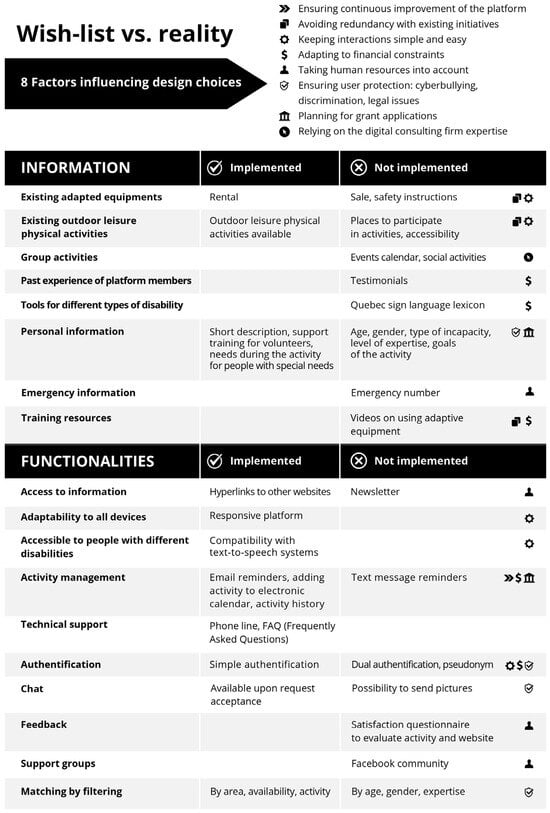
Stage 1 (exploration) and stage 2 (co-design) helped identify key information and features (i.e., a wish-list) to include in the digital platform aimed at facilitating access to outdoor leisure physical activities by matching people with special needs with trained volunteers. In stage 3 (validation), eight key factors guided decisions to remove or modify certain functionalities. Figure 2 summarizes the design choices and influencing factors, which are discussed in detail in the following sections.
Figure 2.
A summary of the desired content versus the content integrated into the platform, and the factors that influenced design choices.
3.2.1. Ensuring Continuous Improvement of the Platform
The platform’s main goal is to connect people with special needs with volunteers to facilitate access to adapted outdoor leisure physical activities. To encourage ongoing use, future features such as automated prompts (e.g., reminders if no activity is scheduled) were considered. These require anticipating data collection needs (e.g., activity history). Additional features, such as a feedback page, were also proposed to support service improvement.
3.2.2. Avoiding Redundancy with Existing Initiatives
During workshops (stage 2), participants suggested numerous features to make the platform comprehensive (e.g., listing adapted activity locations, equipment rental). However, many overlapped with existing initiatives. A thorough understanding of the outdoor recreation ecosystem helped avoid redundancy by selecting only essential features.
3.2.3. Keeping Interactions Simple and Easy
Design choices prioritized a clean interface to ensure intuitive navigation and avoid information overload. For example, while two-factor authentication (i.e., enter a password and provide a code received by text message) is more secure, it was deemed too complex for users with low digital literacy. Since the platform does not handle sensitive data, single-factor authentication (i.e., enter a password) was preferred.
3.2.4. Adapting to Financial Constraints
Budget constraints influenced both the initial development and ongoing maintenance of the platform (e.g., server hosting). Cost-effective alternatives were chosen, such as email notifications instead of text messages, and a responsive website rather than a mobile app.
3.2.5. Taking Human Resources into Account
Some features required ongoing staff involvement. For instance, satisfaction surveys would need regular processing to be useful. Due to limited capacity, simpler alternatives were adopted (e.g., contact page, report button). Similarly, providing an emergency contact number during matches would require staff availability on weekends, which was not feasible. The team opted to refer users to standard emergency services (e.g., 911).
3.2.6. Ensuring User Protection
Several design decisions addressed risks such as:
- Cyberbullying. Some features, while essential to the platform, can lead to abuse. To mitigate these risks, safeguards were implemented regarding the timing and duration of feature availability. For example, chat access is granted only after mutual consent and disappears 24 h after the end of the activity. Additional precautions were taken in the type of information requested and displayed to other users (e.g., name, pseudonym, address), and a moderation system was added to allow users to report inappropriate behavior.
- Discrimination. During stage 3 (validation), discussions focused on what information to request for effective matching while respecting user dignity. Participants raised concerns about potential discrimination based on experience level, gender, disability, weight, or age. Essential information was identified, and users were given the option to share additional personal details later in the process (e.g., weight for transfer needs, photos).
- Legal issues. Users are protected by regulations that vary by region (e.g., General Data Protection Regulation (GDPR) in Europe [35], Law 25 in Quebec [36]). Some elements were mandatory (e.g., privacy policy), while others had to be justified (e.g., asking for gender). Since Quebec’s human rights commission prohibits asking about specific types of disability [37], the team reframed questions to focus on activity-related needs.
3.2.7. Planning for Grant Applications
During stage 2 (co-design), discussions focused on the information needed to operate the platform and protect users. In stage 3 (validation), partners identified key data to request (e.g., activity regions) or collect (e.g., number of organized activities). These data will help improve the platform and support future grant applications with evidence-based metrics.
3.2.8. Relying on the Digital Consulting Firm Expertise
The digital consulting firm was selected during the “action” phase of the action research cycle [20], influencing several design decisions in stage 3 (validation). Each firm relies on specific technologies and programming languages, and the choices made by the selected firm shaped the platform’s architecture and administrators’ interactions. Moreover, the digital consulting firm’s expertise and awareness of web accessibility and WCAG standards [38] affected both design decisions and user experience.
3.3. Final Matching Process
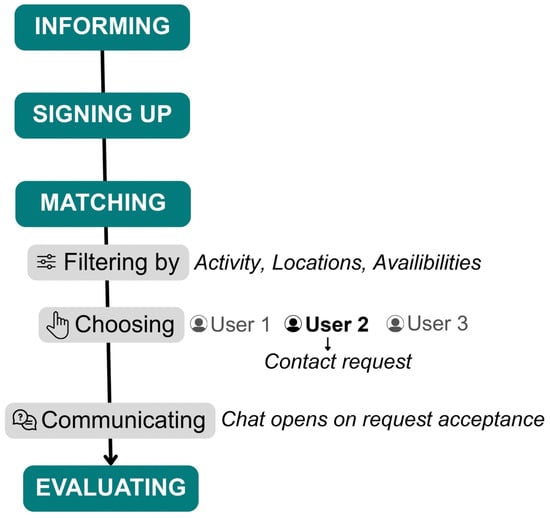
The matching platform (Tandem Actif [39]) was launched in June 2024 during stage 4 (development). Figure 3 illustrates the overall functioning of the platform, co-developed by knowledge-users.
Figure 3.
Overview of the platform’s core functions: accessing information, registering, matching, and evaluating.
- Informing. Some pages on the platform are publicly accessible. They provide details about adapted activities and equipment. As suggested during earlier co-design stages, these pages include hyperlinks to existing resources.
- Signing up. During registration, users provide personal information to facilitate communication with administrators (e.g., email, phone number) and the matching process (e.g., preferred activities, availability). To ensure safety, people with special needs specify their needs during outdoor leisure physical activities, while volunteers indicate relevant training or certifications.
- Matching. All registered users, whether as people with special needs or volunteers, can send a match request. They must first specify the activity, the regional municipality(ies), and their availability. These criteria help filter profiles. Once a potential match is identified, a contact request can be sent. If accepted, users can plan the activity via the chat feature.
- Evaluating the match. The request history allows both users and administrators to track the number and types of requests completed, and to report issues (e.g., partner behavior). Users can also contact administrators at any time through a dedicated page to report problems or provide feedback.
3.4. Platform Testing
At the end of stage 4 (development), eight user tests were conducted in July 2024 with four people with special needs (ages: 30–69; physical impairments: n = 3, visual: n = 1) and four volunteers (ages: 18–69). More details are presented in Table 2.
Table 2.
Participants’ characteristics.
Seven participants used their computers, and one used their mobile phone. Of the seven planned scenarios, two were not completed by all participants due to time constraints (scenarios 5 and 6). Scenario 6 was the least successful (43% of success), while scenarios 3 and 7 resulted in the most errors among participants (see Table 3).
Table 3.
Success rate, number of errors and assistance of the seven scenarios.
A total of 54 issues were identified and categorized using Bastien and Scapin’s [34] eight ergonomic criteria (see Table 4). Most issues related to guidance and the significance of codes.
Table 4.
Summary and frequency of issues encountered by participants, categorized according to Bastien and Scapin’s eight ergonomic criteria [34].
4. Discussion
This article outlines the procedures implemented to complete the second phase (“action”) of the iterative action research cycle [20], building on insights from the first phase (“planning”). In collaboration with a non-profit organization and a citizen with motor disabilities, we used Morales and colleagues’ [21] co-design methodology to develop a digital platform that matches people with special needs and volunteers for engaging in adapted outdoor leisure physical activities. The following section highlights the strengths and limitations of applying such a methodology.
4.1. Importance of Design Expertise
Co-design approaches involve future users, considered “experts of their own experience”, in knowledge development, idea generation, and concept creation [40]. Researchers and designers act as facilitators, providing tools for ideation and expression. In this participatory research project, the community partner contributed expertise in adapted outdoor leisure physical activities, while the citizen-partner brought both user experience and web interface design skills. To compensate for the researchers’ limited design expertise, a digital consulting firm was involved from the workshops onward. Their role was to support participants in translating ideas into concrete platform elements. However, rather than fostering creativity, the firm tended to frame participants’ suggestions within technical and legal constraints. As a result, ideas were shared verbally and documented in meeting notes, but not visualized through mock-ups. Visuals were only developed later during sessions between the community and citizen partners. Morales et al. (2012) [21] recommend involving domain experts primarily during stage 3 (validation) to assess feasibility. Sanders and Stappers (2008) [40] emphasize that those guiding co-design must learn to support creative expression. In this case, none of the main actors had sufficient experience to fully assume that role.
4.2. Profile Diversity in Co-Design
The term sensory impairment encompasses a wide range of abilities and therefore highly diverse needs in terms of interface and interaction design (e.g., image descriptions, high-contrast visuals, screen-reader and text-to-speech software) [41]. Throughout the four stages of co-design, the researchers attempted to involve participants with varied accessibility needs. During usability testing, however, only one participant with low vision was recruited. Although this participant relied on the text-magnification feature of their mobile phone, issues related to screen-reader use could not be detected. It was only several months later that a platform user reported being unable to complete the request-submission process. Additionally, more informal tests were then conducted with this individual to pinpoint the platform’s shortcomings. This highlights the importance of testing with a wider diversity of users employing different types of assistive technologies.
Beyond the diversity of participants’ physical abilities, their attitudes toward technological innovation and their level of digital literacy are important characteristics to consider throughout the co-design process. Evidence suggests a relationship between Rogers’ adopter categories [19] and digital illiteracy. Although this association varies depending on context and individual characteristics (e.g., age, gender), the late majority and laggards are generally described as having lower technical skills, difficulties using digital applications, and limited interest in adopting new technologies [42,43]. These profiles were not represented among the participants involved in usability testing, all of whom were volunteers with at least some interest in the project and the platform. Future studies should therefore seek to recruit participants with more diverse digital literacy profiles.
4.3. Partnership Evolution
Participatory and collaborative design methods engage partners and users throughout the process, helping reduce societal biases in tools developed for people with special needs [12]. These approaches foster a sense of ownership and responsibility among partners [44]. Shifts in roles, power dynamics, and partner engagement are common issues in participatory research, and may fluctuate due to other responsibilities (e.g., annual reports, action plans) [45]. A key strength of this project was the sustained involvement of partners throughout the co-design process. As previously described, each partner brought distinct expertise; thus, the researchers’ role evolved across stages. Stage 1 (exploration), focused on identifying user needs, was led by researchers (i.e., literature review [18] and qualitative study [25]). In contrast, partners led stage 3 (validation) and stage 4 (development), informing researchers of decisions. In these stages, researchers acted primarily as advisors while still participating in feature testing during agile development. While co-design often disrupts traditional power structures [46], all actors maintained strong engagement despite evolving roles.
However, this shift in leadership during the co-design process introduced new challenges. While partners focused primarily on the final product, the matching platform, researchers were concerned with documenting the co-design process. This divergence in objectives led to conflicts between the data needed to address research questions and the information generated by partners [47]. Thus, during stage 3 (validation), researchers had to organize additional meetings with partners to more thoroughly document the design decisions made for the platform.
4.4. Collaboration Between a Nonprofit and a Private Firm
This participatory research project involved researchers, a non-profit organization, and a citizen with motor disabilities. In Quebec, organizations such as the Regroupement Des Aveugles Et Amblyopes Du Montréal Métropolitain (RAAMM) [48] provide training and tools to promote accessible web development. Based on RAAMM’s recommendations and the firm’s strong reputation in web accessibility, ARLPH-03 selected the digital consulting firm.
Once selected, the first firm acted not as a full partner but as a contracted supplier. Designing and improving a website, and more broadly, a nonprofit service, required navigating specific constraints. Any involvement beyond platform development (e.g., participation in workshops in stage 2) incurred additional costs, requiring strategic decisions about the level of engagement to balance budget constraints with the need to leverage the firm’s expertise. Although project partners were committed to improving access to outdoor leisure physical activities for people with special needs, the firm’s involvement was primarily financially motivated. This was reflected in their limited participation in non-development activities, such as workshops, where they showed little interest in understanding the needs of people with special needs and volunteers. Such challenges and strategies to engage external knowledge-users are well-documented in participatory research literature (e.g., ensuring engagement expectations are clear to all) [45].
This participatory action research project aimed to develop a tool tailored to people with special needs’ support needs in accessing outdoor leisure physical activities. The resulting digital matching platform, Tandem Actif [39], was launched in June 2024 across two regions in Quebec. Initial user testing revealed usability and accessibility issues, leading to additional work sessions with researchers, ARLPH-03 and the citizen partner. To better meet web accessibility standards and implement improvements, ARLPH-03 engaged a new digital consulting firm. The platform’s real-world use will be evaluated in two steps: (1) prospective acceptability (prior to registration) and (2) concurrent acceptability (during use). These studies will help clarify user expectations and identify barriers and facilitators to daily adoption.
5. Conclusions
This article presents the actions implemented during the second phase (“action”) of the action research cycle [20] to co-develop a matching platform aimed at facilitating access to outdoor leisure physical activities for people with special needs. Tandem Actif was launched in June 2024 following a co-design process [21]. This article details how the different co-design stages were carried out and highlights eight factors that influenced design choices for the platform’s four main features: signing up, informing, matching, and evaluating the match. Finally, usability testing revealed the need for a new iteration of the co-design process to address 54 usability issues identified by participants.
Supplementary Materials
The following supporting information can be downloaded at: https://www.mdpi.com/article/10.3390/disabilities6020030/s1, Observation grid S1: user test observation grid.
Author Contributions
Conceptualization, N.L. and F.R.; methodology, N.L.; validation, N.L., K.B., D.L., M.M., N.R., J.L. and F.R.; formal analysis, B.N. and N.L.; investigation, N.L., D.L., M.M. and N.R.; data curation, B.N. and N.L.; writing—original draft preparation, B.N., N.L., K.B., D.L., M.M., N.R., J.L. and F.R.; writing—review and editing, B.N., N.L., K.B. and F.R.; visualization, B.N.; supervision, J.L. and F.R.; project administration, B.N., N.L., J.L. and F.R.; funding acquisition, B.N., N.L., J.L. and F.R. All authors have read and agreed to the published version of the manuscript.
Funding
This research was funded by the Mitacs Accelerate and PASSERELLE programs (IT40015); the Mitacs Elevation program (IT28874); and the Quebec Health Research Funds (FRQS Junior 2 and Senior).
Institutional Review Board Statement
The study was conducted in accordance with the Declaration of Helsinki, and approved by the Ethics Committee of the Centre intégré de santé et de services sociaux de la Capitale-Nationale (Quebec City, Canada; approval code: 2023-2619; date of approval: 29 June 2022).
Informed Consent Statement
Informed consent was obtained from all participants involved in the study.
Data Availability Statement
The digital platform is available (in French only) at https://tandemactif.com/, further inquiries can be directed to the corresponding author.
Acknowledgments
The authors would like to thank Ernesto Morales and Alicia Ruiz Rodrigo for their guidance and support in organizing the methodological approach used in this manuscript. We also thank Martine Légaré for designing the figures.
Conflicts of Interest
Although employees of ARLPH03 and a citizen partner are among the authors, no potential conflict of interest was reported by any of them. F.R. is an Editorial Board Member of the journal, Disabilities, but was not involved in any aspect of the evaluation, peer review, or decision-making process relating to this submission.
Disability Language/Terminology Positionality Statement
In this manuscript, we use the term “people with special needs” in alignment with the terminology employed by our partner organization involved in the project, the Association régionale de loisir pour personnes handicapées de la Capitale-Nationale (ARLPH03). As the study was conducted within their programs and community context, adopting their established language ensured coherence with local practice. Participants did not express a strong preference for person-first or identity-first terminology. In the absence of participant-driven preferences, we followed the terminology used by ARLPH03, whose longstanding expertise in adapted leisure guided our choice. Our intention is not to generalize this term, but to transparently justify its use within the specific cultural and organizational context of the study.
Abbreviations
The following abbreviations are used in this manuscript:
| ARLPH-03 | Association Régionale de Loisir pour Personnes Handicapées de la Capitale-Nationale |
| WCAG | Web Content Accessibility Guidelines |
| GDPR | General Data Protection Regulation |
References
- World Health Organization. Global Report on Health Equity for Persons with Disabilities. Available online: https://www.who.int/publications/i/item/9789240063600 (accessed on 2 March 2026).
- World Health Organization. WHO Global Disability Action Plan 2014–2021: Better Health for All People with Disability; World Health Organization: Geneva, Switzerland, 2015; ISBN 978-92-4-150961-9. [Google Scholar]
- Lebrasseur, A.; Fortin-Bédard, N.; Lettre, J.; Bussières, E.-L.; Best, K.; Boucher, N.; Hotton, M.; Beaulieu-Bonneau, S.; Mercier, C.; Lamontagne, M.-E.; et al. Impact of COVID-19 on People with Physical Disabilities: A Rapid Review. Disabil. Health J. 2021, 14, 101014. [Google Scholar] [CrossRef] [Scilit] [PubMed]
- Bezyak, J.L.; Sabella, S.; Hammel, J.; McDonald, K.; Jones, R.A.; Barton, D. Community Participation and Public Transportation Barriers Experienced by People with Disabilities. Disabil. Rehabil. 2020, 42, 3275–3283. [Google Scholar] [CrossRef] [Scilit]
- Trevorrow, S.; Gustafsson, L.; Hodson, T. Leisure Engagement Among People Living with Acquired Brain Injury: A Scoping Review. Occup. Ther. J. Res. 2024, 44, 263–277. [Google Scholar] [CrossRef] [Scilit]
- Martin Ginis, K.A.; van der Ploeg, H.P.; Foster, C.; Lai, B.; McBride, C.B.; Ng, K.; Pratt, M.; Shirazipour, C.H.; Smith, B.; Vásquez, P.M.; et al. Participation of People Living with Disabilities in Physical Activity: A Global Perspective. Lancet 2021, 398, 443–455. [Google Scholar] [CrossRef] [Scilit]
- Association Régionale de Loisir Pour Personnes Handicapées de la Capitale-Nationale (ARLPH03). Le Plein Air Accessible. Available online: https://arlph03.com/le-plein-air-accessible/ (accessed on 18 January 2024).
- Levinger, P.; Cerin, E.; Milner, C.; Hill, K.D. Older People and Nature: The Benefits of Outdoors, Parks and Nature in Light of COVID-19 and beyond—Where to from Here? Int. J. Environ. Health Res. 2022, 32, 1329–1336. [Google Scholar] [CrossRef] [Scilit]
- Menzies, A.; Mazan, C.; Borisoff, J.F.; Mattie, J.L.; Mortenson, W.B. Outdoor Recreation among Wheeled Mobility Users: Perceived Barriers and Facilitators. Disabil. Rehabil. Assist. Technol. 2021, 16, 384–390. [Google Scholar] [CrossRef] [Scilit] [PubMed]
- Mao, G.-X.; Cao, Y.-B.; Lan, X.-G.; He, Z.-H.; Chen, Z.-M.; Wang, Y.-Z.; Hu, X.-L.; Lv, Y.-D.; Wang, G.-F.; Yan, J. Therapeutic Effect of Forest Bathing on Human Hypertension in the Elderly. J. Cardiol. 2012, 60, 495–502. [Google Scholar] [CrossRef] [Scilit]
- Manferdelli, G.; La Torre, A.; Codella, R. Outdoor Physical Activity Bears Multiple Benefits to Health and Society. J. Sports Med. Phys. Fit. 2019, 59, 868–879. [Google Scholar] [CrossRef] [Scilit] [PubMed]
- Derakhshan, P.; Miller, W.C.; Bundon, A.; Labbé, D.; Bolt, T.; Mortenson, W.B. Adaptive Outdoor Physical Activities for Adults with Mobility Disability: A Scoping Review. Front. Rehabil. Sci. 2024, 4, 1331971. [Google Scholar] [CrossRef] [Scilit]
- United Nations Enable. United Nations Article 30—Participation in Cultural Life, Recreation, Leisure and Sport. Available online: https://www.un.org/development/desa/disabilities/convention-on-the-rights-of-persons-with-disabilities/article-30-participation-in-cultural-life-recreation-leisure-and-sport.html (accessed on 18 January 2024).
- UBC Wiki. Course: KIN 341/Inclusive Online Physical Activity Resources for People with Disabilities 2021. Available online: https://wiki.ubc.ca/Course:KIN_341/Inclusive_Online_Physical_Activity_Resources_for_People_with_Disabilities_2021 (accessed on 23 July 2025).
- Ferguson, K. Amplifying the Voices and Needs of Parasport Participants. Western News. 2021. Available online: https://news.westernu.ca/2021/06/amplifying-voices-needs-parasport/ (accessed on 23 July 2025).
- WebAIM. The WebAIM Million—The 2025 Report on the Accessibility of the Top 1,000,000 Home Pages. Available online: https://webaim.org/projects/million/ (accessed on 15 December 2025).
- Shikako, K.; Mogo, E.R.I.; Grand-Maison, V.; Simpson, R.; Pritchard-Wiart, L.; Majnemer, A.; Group, J.A.R. Designing User-Centered Mobile Health Initiatives to Promote Healthy Behaviors for Children with Disabilities: Development and Usability Study. JMIR Form. Res. 2021, 5, e23877. [Google Scholar] [CrossRef] [Scilit]
- Lapierre, N.; Huet-Fiola, C.; Labrie, D.; Vincent-Blouin, E.; Côté, C.; Gagnon, M.; Rhéaume, N.; Laberge, J.; Best, K.L.; Routhier, F. Digital Platforms to Facilitate Physical Activities for People with Physical or Sensory Disabilities: A Scoping Review. Disabil. Health J. 2024, 17, 101626. [Google Scholar] [CrossRef] [Scilit] [PubMed]
- Rogers, E.M. Diffusion of Innovations, 5th ed.; Free Press: New York, NY, USA, 2003; ISBN 978-0-7432-5823-4. [Google Scholar]
- Rauch, F.; Schuster, A.; Stern, T.; Pribila, M.; Townsend, A. Promoting Change Through Action Research; Sense Publishers: Rotterdam, The Netherlands, 2014; ISBN 978-94-6209-801-5. [Google Scholar]
- Morales, E.; Rousseau, J.; Passini, R. Using a Co-Design Methodology for Research on Environmental Gerontology. J. Gerontol. Geriat. Res. 2012, 1, 1000106. [Google Scholar]
- Fraser-Barbour, E.; Robinson, S.; Gendera, S.; Burton-Clark, I.; Fisher, K.R.; Alexander, J.; Howe, K. Shifting Power to People with Disability in Co-Designed Research. Disabil. Soc. 2025, 40, 259–280. [Google Scholar] [CrossRef] [Scilit]
- Benz, C.; Scott-Jeffs, W.; McKercher, K.A.; Welsh, M.; Norman, R.; Hendrie, D.; Locantro, M.; Robinson, S. Community-Based Participatory-Research through Co-Design: Supporting Collaboration from All Sides of Disability. Res. Involv. Engagem. 2024, 10, 47. [Google Scholar] [CrossRef] [Scilit]
- Henni, S.H.; Maurud, S.; Fuglerud, K.S.; Moen, A. The Experiences, Needs and Barriers of People with Impairments Related to Usability and Accessibility of Digital Health Solutions, Levels of Involvement in the Design Process and Strategies for Participatory and Universal Design: A Scoping Review. BMC Public Health 2022, 22, 35. [Google Scholar] [CrossRef] [Scilit]
- Routhier, F.; Lapierre, N.; Huet-Fiola, C.; Labrie, D.; Rhéaume, N.; Laberge, J.; Naudé, B.; Best, K. Identifying the Needs and Preferences of Potential Users of a Digital Platform to Facilitate Outdoor Leisure Physical Activities for People with Physical or Sensory Disabilities. Disabil. Rehabil. 2025, 47, 6337–6346. [Google Scholar] [CrossRef] [Scilit]
- White, B.; Quehl, K.; Costello, J.W.; Costello, J.W. A Workshop on Brainstorming Workshops Successful Brainstorming with Diverse Creators in a Hybrid Work Environment. In Proceedings of the 14th Conference on Creativity and Cognition; Association for Computing Machinery: New York, NY, USA, 2022; pp. 494–497. [Google Scholar]
- Braun, V.; Clarke, V. Using Thematic Analysis in Psychology. Qual. Res. Psychol. 2006, 3, 77–101. [Google Scholar] [CrossRef] [Scilit]
- Schwaber, K.; Sutherland, J. The Scrum Guide 2020. Available online: https://scrumguides.org/docs/scrumguide/v2020/2020-Scrum-Guide-US.pdf (accessed on 3 April 2025).
- Abras, C.; Maloney-Krichmar, D.; Preece, J. User-Centered Design. In Encyclopedia of Human-Computer Interaction; Sage Publications: Bainbridge, IN, USA, 2004. [Google Scholar]
- ISO/Np 9241-11; Ergonomics of Human-System Interaction—Part 11: Usability: Definitions and Concepts. International Organization for Standardization: Geneva, Switzerland, 2018.
- Palinkas, L.A.; Horwitz, S.M.; Green, C.A.; Wisdom, J.P.; Duan, N.; Hoagwood, K. Purposeful Sampling for Qualitative Data Collection and Analysis in Mixed Method Implementation Research. Adm. Policy Ment. Health Ment. Health Serv. Res. 2015, 42, 533–544. [Google Scholar] [CrossRef] [Scilit]
- Nielsen, J.; Landauer, T.K. A Mathematical Model of the Finding of Usability Problems. In Proceedings of the INTERACT ’93 and CHI ’93 Conference on Human Factors in Computing Systems; Association for Computing Machinery: New York, NY, USA, 1993; pp. 206–213. [Google Scholar]
- Fonteyn, M.E.; Kuipers, B.; Grobe, S.J. A Description of Think Aloud Method and Protocol Analysis. Qual. Health Res. 1993, 3, 430–441. [Google Scholar] [CrossRef] [Scilit]
- Bastien, C.; Scapin, D. Ergonomic Criteria for the Evaluation of Human-Computer Interfaces. 1993. Available online: https://inria.hal.science/inria-00070012v1 (accessed on 13 August 2025).
- GDPR. General Data Protection Regulation (GDPR). Available online: https://gdpr-info.eu/ (accessed on 29 August 2025).
- Gouvernement du Québec. Loi Sur L’accès Aux Documents des Organismes Publics et Sur la Protection des Renseignements Personnels. Available online: https://www.legisquebec.gouv.qc.ca/fr/document/lc/A-2.1 (accessed on 29 August 2025).
- Gouvernement du Québec. Charte des Droits et Libertés de la Personne. Available online: https://www.legisquebec.gouv.qc.ca/fr/document/lc/c-12 (accessed on 29 July 2025).
- World Wide Web Consortium (W3C). Web Content Accessibility Guidelines (WCAG) 2.1. Available online: https://www.w3.org/TR/WCAG21/ (accessed on 23 July 2025).
- ARLPH03. Tandem Actif. Available online: https://tandemactif.com/ (accessed on 13 November 2024).
- Sanders, E.B.-N.; Stappers, P.J. Co-Creation and the New Landscapes of Design. CoDesign 2008, 4, 5–18. [Google Scholar] [CrossRef] [Scilit]
- Government of Canada. Visual Impairments. Available online: https://a11y.canada.ca/en/visual-impairments/ (accessed on 5 March 2026).
- Muzanenhamo, T.J.; Mubaya, C.P.; Tsvere, M. Adopter Category Characterizations and the Adoption of Mobile Phone Applications for Improved Small-scale Commercial Agriculture in Chitomborwizi-Makonde District, Zimbabwe. East Afr. J. Agric. Biotechnol. 2025, 8, 60–77. [Google Scholar] [CrossRef] [Scilit]
- Valle-Cruz, D.; Sandoval-Almazan, R. Diffusion of Innovations Among Mexico: The Technology Adoption of State Governments. In Digital Government and Achieving E-Public Participation: Emerging Research and Opportunities; IGI Global Scientific Publishing: Hershey, PA, USA, 2020; pp. 39–62. ISBN 9781799815266. [Google Scholar]
- Van Slingerland, K.J.; Durand-Bush, N.; KenttÄ, G. Collaboratively Designing the Canadian Centre for Mental Health and Sport (CCMHS) Using Group Concept Mapping. J. Appl. Sport Psychol. 2021, 33, 98–122. [Google Scholar] [CrossRef] [Scilit]
- Latulippe, K.; Tessier, A.; Routhier, F.; Raymond, É.; Fiset, D.; Corcuff, M.; Archambault, P.S. Facilitators and Challenges in Partnership Research Aimed at Improving Social Inclusion of Persons with Disabilities. Disabil. Rehabil. 2024, 46, 957–968. [Google Scholar] [CrossRef] [Scilit] [PubMed]
- Antonini, M. An Overview of Co-Design: Advantages, Challenges and Perspectives of Users’ Involvement in the Design Process. J. Des. Think. 2020, 2, 45–60. [Google Scholar]
- Littlechild, R.; Tanner, D.; Hall, K. Co-Research with Older People: Perspectives on Impact. Qual. Soc. Work 2014, 14, 18–35. [Google Scholar] [CrossRef] [Scilit]
- RAAMM. Services en Accessibilité Numérique. Available online: https://raamm.org/services-grand-public/accessibilite-numerique/ (accessed on 29 August 2025).

Disclaimer/Publisher’s Note: The statements, opinions and data contained in all publications are solely those of the individual author(s) and contributor(s) and not of MDPI and/or the editor(s). MDPI and/or the editor(s) disclaim responsibility for any injury to people or property resulting from any ideas, methods, instructions or products referred to in the content. |
© 2026 by the authors. Licensee MDPI, Basel, Switzerland. This article is an open access article distributed under the terms and conditions of the Creative Commons Attribution (CC BY) license.