1. Introduction
Physical inactivity during childhood and adolescence represents a major challenge for public health and educational systems worldwide. International guidelines highlight the need to promote inclusive, accessible, and sustainable opportunities for physical activity, particularly within school settings, where motor experiences play a crucial role in health, development, and social participation [
1]. Despite these recommendations, a large proportion of young people do not meet the minimum levels of daily physical activity, with even lower participation observed among children and adolescents with disabilities, who face structural, social, and educational barriers to movement [
1,
2].
From an educational perspective, physical activity is increasingly recognised not only as a health-related behaviour, but as a fundamental right and a dimension of full citizenship. International frameworks in physical education emphasise movement as a medium through which children can explore their environment, develop competencies, and participate meaningfully in collective life [
3]. In this sense, restricted access to motor experiences reflects broader inequalities in education, health, and social inclusion [
4,
5].
These issues are particularly salient for deaf and hard of hearing children and adolescents, a population that often experiences limited participation in structured motor activities. Hearing loss is frequently associated with vestibular dysfunction, due to the close anatomical and functional relationship between the auditory and vestibular systems [
6]. The extent of balance impairment may vary depending on the degree and type of hearing loss, since vestibular involvement is not uniform across individuals with auditory deficits. This variability may influence postural control and could affect the responsiveness to motor interventions aimed at improving balance. A growing body of evidence indicates that children with sensorineural hearing loss may present deficits in static and dynamic balance, postural control, coordination, and spatial orientation, with potential consequences for motor development, autonomy, and safety [
7,
8].
Postural balance relies on the integration of visual, vestibular, and proprioceptive inputs. When vestibular information is partially compromised, as often occurs in individuals with hearing loss, greater reliance on visual and somatosensory cues becomes necessary. This process of sensory reweighting, while adaptive, may be insufficient in complex or dynamic motor tasks, leading to increased instability and reduced motor efficiency [
9,
10]. If not adequately addressed through targeted motor experiences, these difficulties may limit children’s engagement in physical activity and contribute to a condition that can be described as sensory and motor sedentariness, where reduced movement also restricts opportunities for interaction and learning [
11,
12].
In recent years, motor interventions aimed at improving balance in children with hearing loss have shown promising results. Systematic reviews and experimental studies report that structured physical activity programmes—including balance training, proprioceptive exercises, and movement-based interventions—can significantly improve postural stability and functional balance, particularly when delivered over periods of 8–16 weeks [
5,
8,
10]. However, the literature remains relatively scarce in the pediatric population, and further research is needed to identify educationally meaningful and contextually feasible approaches [
13,
14,
15].
Within this framework, dance-based activities emerge as a particularly relevant pedagogical and motor strategy [
15,
16]. Dance integrates rhythm, coordination, balance, and expressive movement, while engaging multiple sensory channels [
16,
17]. For children with hearing loss, dance can be adapted to emphasise visual, tactile, and vibrotactile cues, supporting embodied learning and compensatory sensory integration [
7,
16,
17]. Recent experimental studies have demonstrated that adapted dance programmes, including dance sport and Latin dance, can lead to significant improvements in balance performance, vestibular function, proprioception, and physical fitness in children with hearing loss, while also enhancing psychological well-being and body confidence [
10,
18].
Moreover, evidence from adolescent and school-based populations suggests that dance and proprioceptive training integrated within physical education can effectively enhance dynamic balance and postural control, highlighting the potential of structured, inclusive motor programmes implemented in educational contexts [
5,
19]. From this perspective, dance is not merely an artistic activity, but a form of embodied pedagogy, in which the body becomes a subject of knowledge, interaction, and inclusion.
Taking these considerations into account, investigating dance-based motor interventions in children and adolescents with hearing loss represents both a scientific and educational priority. Such approaches have the potential to address balance deficits, support sensory integration, and promote equitable access to meaningful movement experiences within inclusive school environments.
1.1. Aim of the Study
The primary objective of the present study is to evaluate the effectiveness of motor activity interventions incorporating elements of dance and music, implemented alongside the physical activity sessions included in the school curriculum, on the improvement of static and dynamic balance abilities in a sample of students—children and adolescents—with hearing loss.
Using validated tests and objective measurement instruments, the study aims to investigate whether the inclusion of dance- and rhythm-based activities, administered over a 12-week period, is capable of producing relevant functional changes compared with a standard curricular physical education program.
1.2. Specific Objectives
- (a)
To compare motor performance between pre-test (T0) and post-test (T1) in the experimental group and the control group, in relation to the following variables:
Independent variable (IV): motor intervention protocol;
Dependent variables (DV): scores from the Pediatric Reach Test, a subtest of the Functional Reach Test; stabilometric parameters recorded using a baropodometric platform, including Center of Pressure (COP), mean COP sway velocity, and stability ellipse area.
- (b)
To verify whether the experimental protocol produces significant improvements in balance and postural parameters compared with the control group.
2. Materials and Methods
2.1. Participants and Study Design
The study involved a total of 25 deaf and hard of hearing participants (n = 25) with a certified diagnosis of hearing loss, who regularly engaged in physical activity as part of the school curriculum. The participants were aged between approximately 9 and 14 years. The age range reflected the actual composition of the school population available at the time of the study. Because the research was conducted in a single specialized school for students with hearing loss, participant selection was limited to the students enrolled in that institution, and it was not possible to restrict recruitment to a narrower age range. Participants were recruited using a convenience sampling method from a single specialized school for students with hearing loss and were divided into two groups:
All participants were assessed at two time points: baseline (T0), prior to the start of the intervention, and post-intervention (T1), at the end of the 12-week study period. Assessments included stabilometric platform testing and the Pediatric Reach Test, both conducted at T0 and T1. The study was conducted in accordance with the Declaration of Helsinki. Written informed consent was obtained from parents or legal guardians, and assent was obtained from all participating students. Consent was also obtained from the teachers of the respective classes.
2.2. Inclusion and Exclusion Criteria
Participants were eligible for inclusion if they met the following criteria:
- (i)
certified diagnosis of hearing loss;
- (ii)
absence of additional disabilities incompatible with participation in the motor intervention;
- (iii)
regular attendance at school physical activity sessions;
- (iv)
adherence to the intervention protocol;
- (v)
informed consent provided by parents or legal guardians and assent provided by the students.
The diagnosis of hearing loss was based on official clinical certification required for enrollment in the specialized school for students with hearing loss from which the sample was recruited. All participants had a documented medical diagnosis available in the school records. The researchers did not perform independent audiological evaluations, and classification of hearing loss severity was not available for all students.
Participants were excluded from the analysis if they presented missing data at either T0 or T1, attended fewer than 70% of the intervention sessions, or lacked parental, teacher, or student consent.
2.3. Group Allocation
After recruitment, the 25 participants were randomly allocated to two groups: 15 students to the experimental group (EG), which received the dance- and rhythm-based intervention in addition to the standard school curriculum, and 10 students to the control group (CG), which continued with regular school-based physical activity only. The allocation has been done using a computer-generated random number sequence. Group assignment was performed by a researcher not involved in data collection or outcome assessment to minimize allocation bias.
Baseline anthropometric characteristics of the participants are summarized in
Table 1.
2.4. Experimental Procedure
All assessments were conducted during regular school hours at the same location for both groups. Testing sessions were performed in small groups under the supervision of trained personnel with expertise in movement sciences and pediatric motor assessment. The order of the tests was kept consistent across sessions to maintain standardized testing conditions. A fixed sequence was preferred in order to preserve the validity of the assessment procedures and to ensure comparable conditions between baseline (T0) and post-intervention (T1). Each testing session included the assessment of anthropometric characteristics followed by the administration of stabilometric and functional balance tests. Body height was measured using a wooden stadiometer, and body mass was measured using an analog scale, following standardized procedures. Environmental conditions were kept consistent across sessions, with controlled ambient temperature and familiar surroundings to reduce anxiety and enhance compliance.
2.5. Stabilometric Assessment
Postural control was assessed using a stabilometric platform equipped with 2304 resistive sensors (1 × 1 cm) distributed over a 480 × 480 mm active surface, with an acquisition frequency of up to 100 Hz and a pressure detection range of 30–400 kPa. Proprietary software was used to process plantar pressure data and compute stabilometric parameters, including contact area, force distribution, mean and peak pressures, weight distribution, and center of pressure (COP) trajectory. Static postural tests were performed under eyes-open and eyes-closed conditions, following standardized instructions. For consistency, the acronym COP is used throughout the text, while the notation COP. is retained in figures and tables where it reflects the original platform output.
2.6. Pediatric Reach Test
Dynamic balance and anticipatory postural control were assessed using the Pediatric Reach Test (PRT), a pediatric adaptation of the Functional Reach Test, originally described by Duncan et al. and widely used to evaluate limits of stability in children [
19,
20,
21]. The PRT measures the maximum distance an individual can reach beyond arm’s length while maintaining a stable base of support without stepping or losing balance [
19]. The test primarily evaluates the ability to control the center of mass within the limits of stability during voluntary trunk movements and anticipatory postural adjustments [
20]. In individuals with hearing loss, balance and postural control may be influenced by vestibular dysfunctions frequently associated with auditory deficits. The PRT represents a safe and appropriate assessment tool for this population, as it does not rely on complex verbal instructions and can be administered through visual demonstration in both school-based and clinical settings. In the present study, the PRT was performed in four movement directions to allow a multidirectional evaluation of dynamic postural control:
- (i)
forward reach, involving forward trunk flexion with the arm extended anteriorly;
- (ii)
backward reach, involving trunk extension while maintaining the arm in a forward-reaching position;
- (iii)
left lateral reach, involving lateral trunk flexion toward the left side;
- (iv)
right lateral reach, involving lateral trunk flexion toward the right side.
During each condition, participants stood upright with their feet positioned comfortably apart. Visual demonstration was used to instruct participants to reach as far as possible in the specified direction without moving the feet, touching external supports, or compromising postural stability. Reach distance was recorded in centimeters as the displacement between the starting position and the maximal reach position. Multiple trials were performed for each direction, and the mean value was used for statistical analysis [
21]. Previous research supports the reliability and clinical utility of the Pediatric Reach Test in pediatric populations, including children with sensory impairments. Normative data and the influence of anthropometric factors on reach performance have been reported in typically developing children [
13], while systematic reviews confirm the frequent use of reach-based tests in children with hearing loss and their suitability for both research and applied contexts [
22].
2.7. Statistical Analysis
All statistical analyses and graphical representations were performed using Python (version 3.13; Python Software Foundation). Data handling, statistical computation, and figure generation were carried out using standard Python scientific libraries. Continuous variables were screened for plausibility and completeness prior to analysis. Descriptive statistics are reported as mean ± standard deviation (SD), unless otherwise specified. Statistical significance was set at p < 0.05 for all analyses. Baseline comparability between the experimental group (EG) and the control group (CG) was assessed for anthropometric variables and all balance-related outcomes to exclude pre-existing group differences. To examine intervention effects, mixed-design analyses of variance (ANOVA) were conducted separately for each outcome, with Group (EG vs. CG) as the between-subject factor and Time (baseline, T0; post-intervention, T1) as the within-subject factor. When significant main effects or Group × Time interactions were observed, post hoc analyses were performed to explore within-group changes over time and between-group differences in change scores (Δ = T1 − T0), as appropriate. Effect sizes were calculated and reported as partial eta squared (ηp2) to quantify the magnitude of observed effects.
2.8. Composite Balance Score and Responder Analysis
To provide a multidimensional yet functionally meaningful evaluation of balance adaptations, a composite balance score was defined a priori and calculated by integrating selected stabilometric and functional outcomes. The construction of this composite index was exploratory in nature and aimed at summarizing complementary dimensions of balance rather than developing a clinically validated scale. Four variables were included in the composite score: (i) center of pressure (COP) distance under eyes-closed conditions, (ii) ellipse surface under eyes-open conditions, (iii) average center of pressure speed under eyes-open conditions, and (iv) backward reach distance from the Pediatric Reach Test. These variables were selected because they capture distinct and commonly investigated components of balance control in pediatric populations, including sensory-dependent postural stability, quiet-stance control under visual conditions, and functional posterior dynamic balance. Although alternative variable selections could have been considered, the chosen set was intended to reflect a broad yet interpretable representation of static and dynamic balance performance relevant to children and adolescents with hearing loss.
Given the different measurement units and directional interpretations of the included variables, all outcomes were standardized using z-score normalization based on baseline (T0) values pooled across the entire sample. For stabilometric variables (COP distance, ellipse surface, and average speed), where lower values indicate better postural stability, z-scores were multiplied by −1 so that higher standardized values consistently reflected better balance performance. For the Pediatric Reach Test backward reach distance, where higher values indicate better performance, the original z-score orientation was retained. The composite balance score was calculated for each participant and time point as the arithmetic mean of the standardized scores. Equal weighting was deliberately adopted to avoid introducing a priori assumptions regarding the relative contribution or clinical importance of individual balance components, particularly in the absence of validated weighting schemes for this population and outcome combination. Consequently, the composite index should be interpreted as a research-oriented summary measure of overall balance performance rather than as a diagnostic or clinically validated tool.
Change scores (Δ = T1 − T0) were subsequently computed for the composite balance score and used for between-group comparisons. In addition, a responder analysis was conducted to identify participants who exhibited a meaningful improvement in overall balance performance. Participants were classified as responders if their composite balance score change exceeded 0.5 standard deviations of the distribution of change scores across the full sample. This threshold was selected in line with conventions frequently adopted in behavioral, motor learning, and rehabilitation research to indicate a moderate magnitude of change that is unlikely to reflect measurement noise alone and may represent a potentially meaningful adaptation at the individual level. Participants not meeting this criterion were classified as non-responders.
3. Results
3.1. Participants and Baseline Comparability
Twenty-five participants completed the study and were included in the statistical analyses (Experimental Group, EG: n = 15; Control Group, CG: n = 10). All participants provided complete datasets at both baseline (T0) and post-intervention (T1). No significant baseline differences were observed between groups for anthropometric variables (body mass, height, BMI) or for any stabilometric or Pediatric Reach Test (PRT) outcomes (all p > 0.05), confirming baseline comparability.
3.2. Stabilometric Outcomes
Eyes Closed Conditions
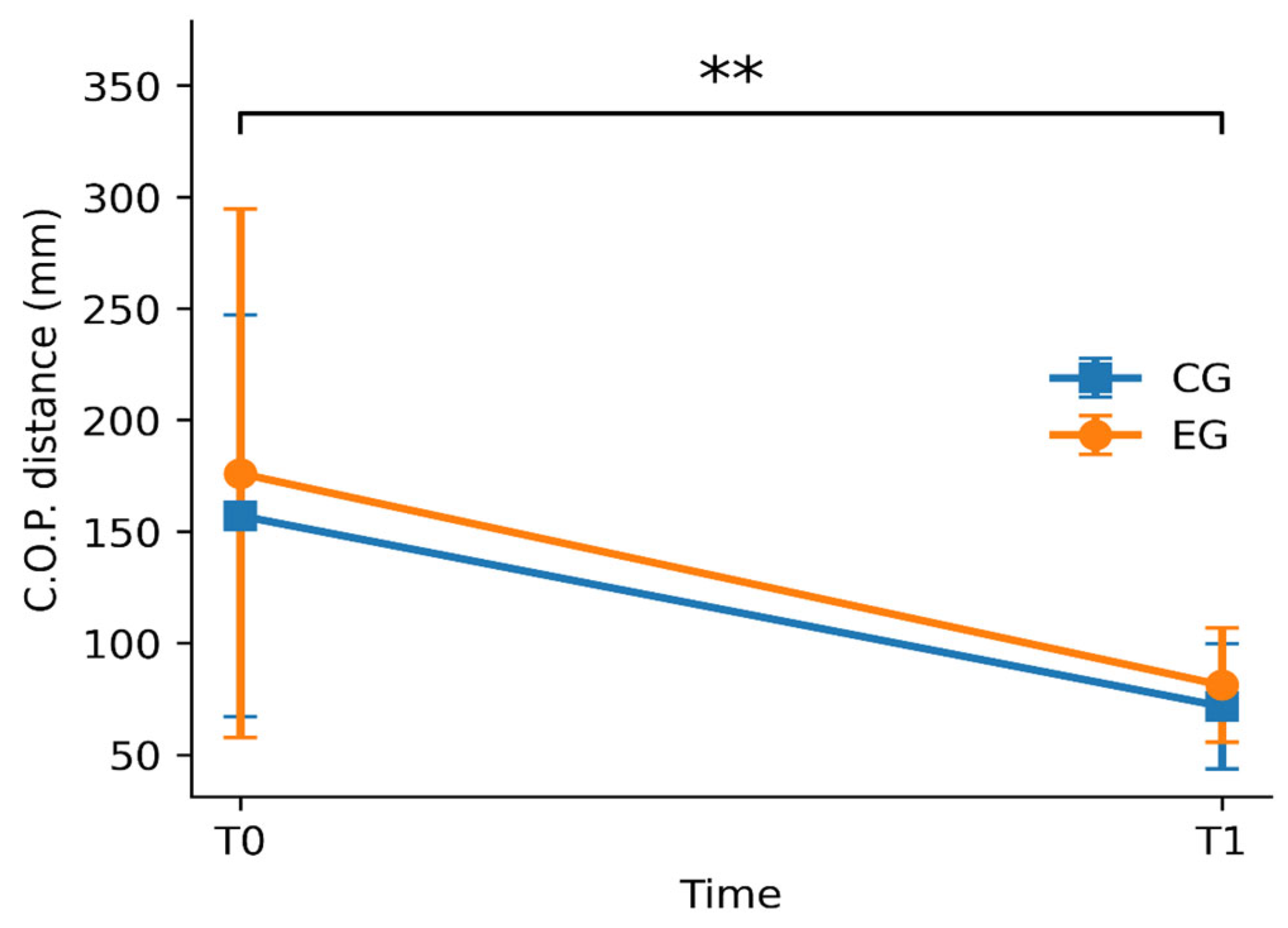
For COP distance (eyes closed), the mixed-design ANOVA revealed a significant main effect of Time (
F(1, 23) = 9.87,
p = 0.004,
ηp2 = 0.30), indicating a general reduction from T0 to T1 across participants. The Group × Time interaction was not significant (
F(1, 23) = 0.42,
p = 0.52,
ηp2 = 0.02), suggesting that the magnitude of improvement did not differ between EG and CG. Post hoc analyses confirmed a significant within-group reduction in COP distance in both EG (
p = 0.003) and CG (
p = 0.021). No significant main effects or interactions were detected for ellipse surface or average speed under eyes-closed conditions (all
p > 0.05). These results are illustrated in
Figure 1.
3.3. Eyes Open Condition
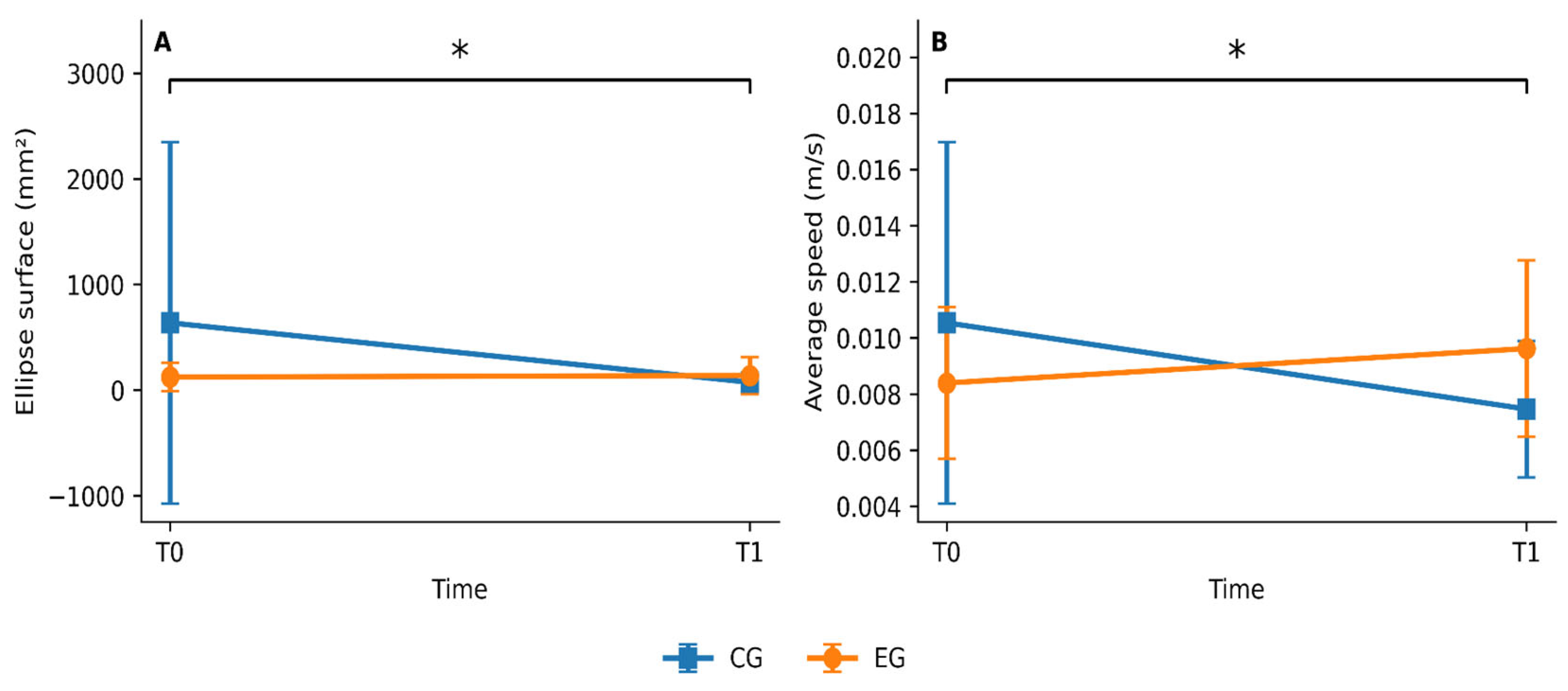
For ellipse surface (eyes open), the mixed ANOVA revealed a significant Group × Time interaction (
F(1, 23) = 5.11,
p = 0.033,
ηp2 = 0.18). Post hoc comparisons showed a reduction from T0 to T1 in both groups; however, the magnitude of reduction was significantly greater in the control group than in the experimental group. Similarly, average COP speed (eyes open) demonstrated a significant Group × Time interaction (
F(1, 23) = 7.02,
p = 0.014,
ηp2 = 0.23), with a more pronounced decrease observed in the control group compared with the experimental group. For COP distance (eyes open), a significant main effect of Time was found (
F(1, 23) = 8.45,
p = 0.008,
ηp2 = 0.27), indicating an overall improvement from baseline to post-intervention across both groups, whereas the Group × Time interaction was not significant (
F(1, 23) = 0.31,
p = 0.58,
ηp2 = 0.01). Taken together, these results indicate that, under eyes-open conditions, both ellipse surface and average COP speed exhibited larger reductions in the control group than in the experimental group, demonstrating that stabilometric improvements in quiet stance with visual input were not specifically associated with the dance-based intervention. These findings are illustrated in
Figure 2, which presents group mean changes from baseline to post-intervention, with data expressed as mean ± standard deviation.
3.4. Pediatric Reach Test
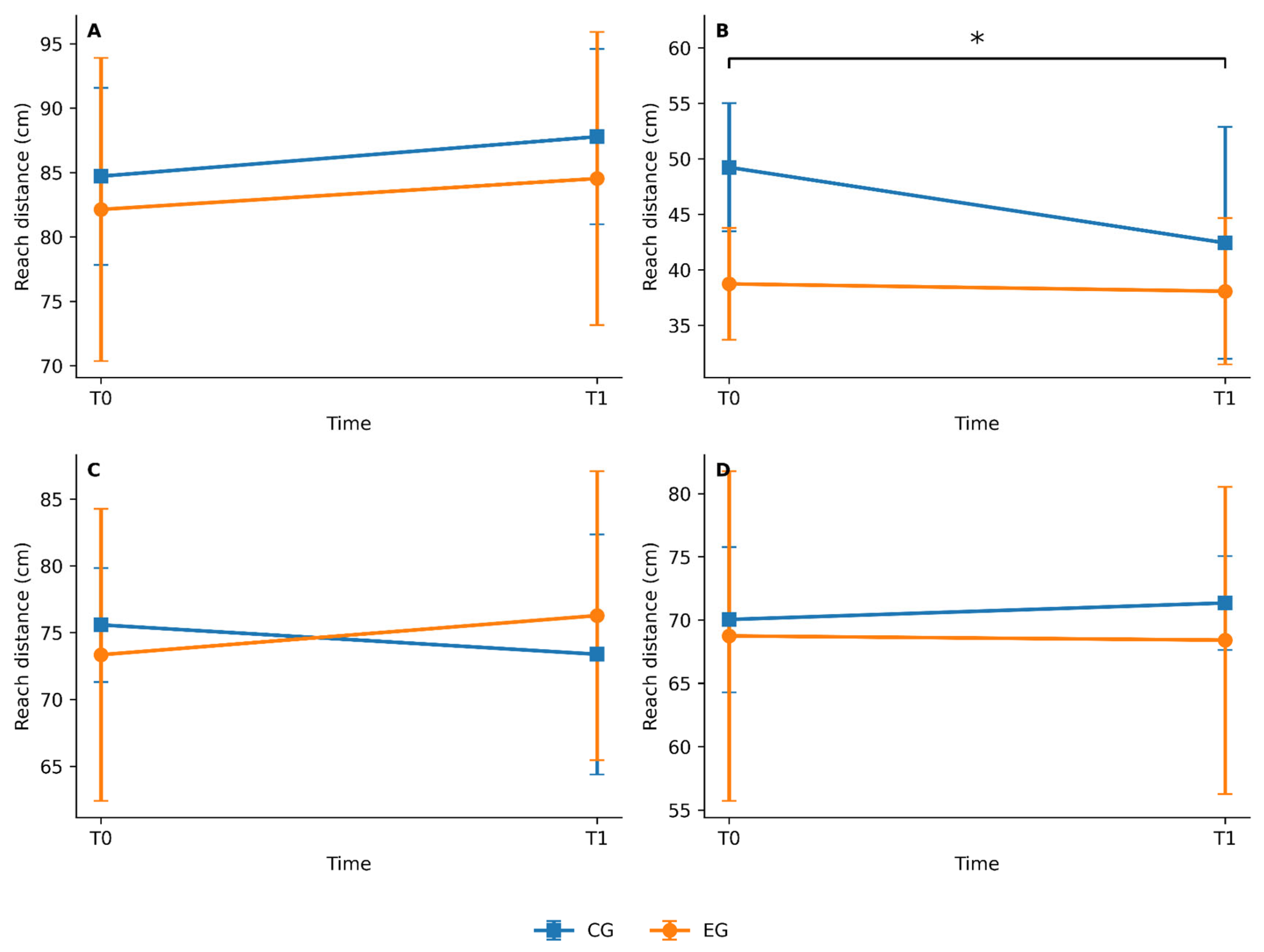
For the Pediatric Reach Test, the mixed-design ANOVA revealed a significant Group × Time interaction exclusively for the backward reach direction (
Figure 3B;
F(1, 23) = 4.63,
p = 0.042,
ηp2 = 0.17). Post hoc analyses indicated that backward reach distance remained substantially stable from T0 to T1 in the experimental group (
p = 0.61), whereas a significant reduction over time was observed in the control group (
p = 0.031). Consequently, the between-group comparison of change scores (Δ = T1 − T0) reached statistical significance, reflecting a relative preservation of posterior dynamic balance in the experimental group compared with controls. It is important to emphasise that the intervention effect on the Pediatric Reach Test was limited exclusively to the backward direction, while frontal (
Figure 3A), left (
Figure 3C), and right (
Figure 3D) reach performances did not show significant Group × Time interactions (all
p > 0.05;
ηp2 range: 0.02–0.08). Although minor, non-systematic fluctuations across time were observed in these directions, the overall patterns did not indicate direction-specific differential adaptations between groups. Therefore, the observed benefit should be interpreted as direction-specific rather than as a general improvement in Pediatric Reach Test performance.
3.5. Composite Balance Outcome
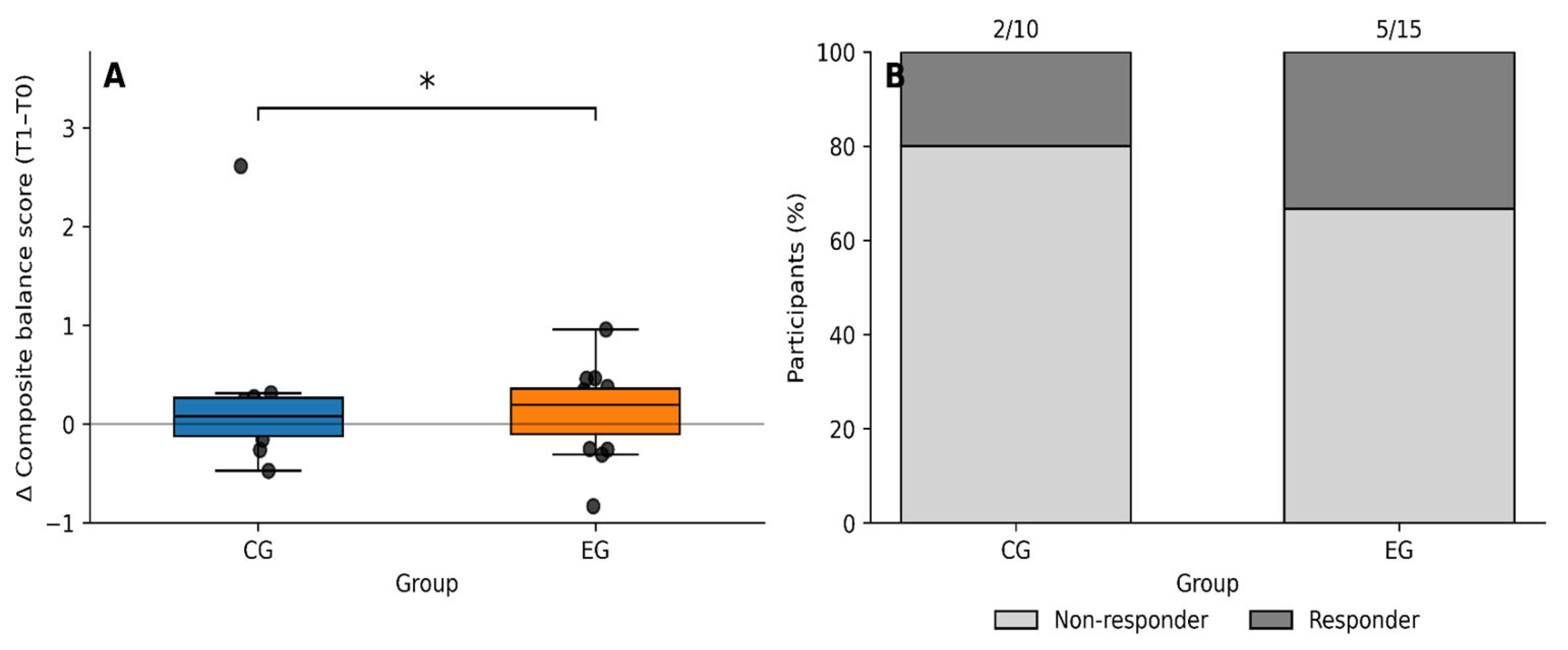
Analysis of the composite balance score revealed a significant Group × Time interaction (
F(1, 23) = 6.54,
p = 0.018,
ηp2 = 0.22), indicating a more favorable overall balance adaptation in the experimental group compared with the control group. Responder analysis further showed a higher proportion of responders in the experimental group relative to the control group. These results are summarized in
Figure 4, which illustrates both the distribution of composite score changes and responder classification.
4. Discussion
This study investigated whether a 12-week, school-based motor programme integrating dance- and rhythm-oriented activities could enhance static and dynamic balance in deaf and hard of hearing children and adolescents. The principal findings can be summarised as follows: (i) stabilometric performance improved over time in both groups in the eyes-closed condition, as indicated by a reduction in COP distance, suggesting a general pre–post adaptation; (ii) under eyes-open conditions, ellipse surface and average speed showed significant Group × Time interactions, with a larger reduction in the control group; (iii) the Pediatric Reach Test revealed a direction-specific Group × Time interaction confined to backward reach, characterised by relative preservation in the experimental group and a decline in controls; and (iv) when balance outcomes were synthesised into a composite score, the experimental group displayed a more favourable overall adaptation along with a higher proportion of responders. Taken together, these results indicate that the intervention may have contributed to maintaining or protecting specific components of functional balance, while other stabilometric indices exhibited patterns that require cautious interpretation in light of methodological and contextual factors.
The most clinically interpretable improvement attributable to the experimental protocol emerged from the multidirectional dynamic balance assessment. Specifically, the experimental group maintained backward reach performance from T0 to T1, whereas the control group showed a decline, yielding a significant interaction [
8,
17]. Backward reaching is biomechanically demanding because it challenges the limits of stability in the posterior direction, requires anticipatory postural adjustments, and is typically associated with a higher reliance on accurate vestibular and proprioceptive integration. In deaf and hard of hearing students—where vestibular hypofunction can co-occur with auditory deficits—preserving posterior control may reflect meaningful functional gains, especially in activities requiring trunk extension, backward stepping preparation, or rapid postural corrections [
16,
18].
From a mechanistic perspective, dance- and rhythm-based practice plausibly targets several elements relevant to posterior dynamic control: repeated transitions in the sagittal plane, weight shifts across the base of support, and synchronisation of movement timing through counting and vibrotactile/visual cues [
10,
23]. The progressive increase in step complexity described in the intervention could further stimulate sensorimotor recalibration by requiring more refined control of centre-of-mass displacement while maintaining foot placement, thereby reinforcing anticipatory strategies and improving movement confidence.
From a physiological perspective, the potential effects of dance- and rhythm-based activities may be related to improvements in sensory integration and compensatory postural strategies. In deaf and hard of hearing students, vestibular function may be partially compromised, leading to a greater reliance on visual and proprioceptive inputs for balance control. The intervention required coordinated movements, rhythmic timing, and repeated adjustments of body position, all of which involve continuous regulation of the center of mass and integration of multiple sensory cues. Such multisensory motor practice may facilitate anticipatory postural control and enhance sensory reweighting processes, allowing participants to use alternative sensory information more efficiently when vestibular input is reduced. These adaptations may also reflect improvements in feedforward motor control mechanisms and anticipatory neuromuscular strategies, which are essential for stabilizing the body during dynamic tasks and for compensating reduced vestibular input. However, the response to training may vary across individuals depending on the degree of hearing loss, the use of hearing devices, and differences in daily physical activity habits, which may partly explain the heterogeneous results observed in the present study.
Although stabilometric improvements were not uniformly stronger in the experimental group across all conditions, the composite balance score suggested an overall pattern favourable to the intervention. Composite metrics are often more sensitive to multidimensional adaptations than single stabilometric variables, particularly in small samples, because they reduce outcome fragmentation and capture coordinated changes across related domains (static sway indices and functional reach performance). In this context, a significant Group × Time interaction for the composite score supports the notion that the intervention may have produced a global balance benefit even when individual endpoints were direction- or condition-specific [
8,
24].
Between-group contrasts indicate a nuanced response profile. In the eyes-closed condition, both groups improved in COP distance, while no interaction was detected. This pattern is consistent with a general time effect that may reflect test familiarisation, maturation, or non-specific adaptations stemming from ongoing school activities and repeated exposure to balance tasks. The absence of an interaction suggests that the intervention did not amplify improvements beyond the control condition for this specific static metric under visual deprivation [
12,
25]. The improvement observed in the control group should be interpreted in light of several contextual and methodological factors. First, participants in both groups continued to attend regular school-based physical education activities, which may have contributed to general motor adaptation over the 12-week period even in the absence of experimental intervention. Second, the stabilometric and functional tests were administered at baseline and repeated at post-intervention, and a familiarization effect cannot be excluded, particularly in a pediatric population.
In addition, the sample was heterogeneous with respect to daily physical activity habits, residential conditions within the school, and use of hearing devices. Some students lived in the school environment and engaged in different levels of physical activity compared with those living at home, and not all participants used hearing aids consistently. These factors may have influenced postural control and responsiveness to testing independently of the intervention. Finally, balance abilities are still developing in this age range, and maturational changes over the study period may also have contributed to the observed improvements in both groups.
In contrast, the eyes-open stabilometric findings (ellipse surface and average speed) revealed significant Group × Time interactions driven by larger reductions in the control group. At a descriptive level, this indicates that quiet-stance sway amplitude decreased more markedly in participants who followed the standard physical activity programme. However, these findings should be interpreted cautiously. Reductions in sway amplitude do not necessarily reflect superior functional balance, particularly in children with sensory impairments, where decreased variability may also result from more conservative or visually anchored postural strategies rather than enhanced adaptive control [
19]. The present study did not include direct measures capable of distinguishing between adaptive flexibility and rigid postural control, such as indices of muscular co-contraction or mechanical stiffness. Consequently, any mechanistic interpretation regarding the underlying control strategies associated with the observed stabilometric changes remains speculative. In this context, greater reductions in sway under eyes-open conditions cannot be unequivocally interpreted as indicative of superior balance capacity. Importantly, the direction-specific preservation of backward reaching performance and the favourable changes observed in the composite balance score in the experimental group appear more closely aligned with functional balance demands than isolated reductions in sway magnitude during quiet stance [
22,
26]. Taken together, these findings highlight that different balance outcomes may capture distinct aspects of postural control and support the use of combined stabilometric and functional assessments when evaluating motor interventions in children with hearing loss.
The responder analysis further strengthens the clinical interpretation of between-group differences. A higher proportion of responders in the experimental group indicates that the intervention effect was not limited to a small subset of participants and suggests heterogeneity in training responsiveness that is typical in paediatric and disability-related interventions. Reporting responder profiles is particularly valuable in educational settings, where individual-level gains (or preservation of function) can be more meaningful than group averages alone [
27,
28,
29].
Several methodological aspects are relevant for interpreting these findings. First, the study was conducted in a real-world educational environment within a specialised school context, increasing ecological validity but inevitably introducing variability in daily routines, engagement, and exposure to other school-based physical activities. Second, although random assignment was performed, the sampling strategy was convenience-based and drawn from a single school, which may have influenced baseline characteristics and responsiveness patterns. Third, the stabilometric outcomes were derived from a baropodometric platform with established parameters; nonetheless, sway measures can be sensitive to stance instructions, attention, fatigue, and visual fixation conditions. In paediatric samples, especially those with sensory impairments, test–retest learning effects and changes in compliance across sessions can contribute meaningfully to pre–post differences [
5,
27,
30,
31].
The intervention itself incorporated progressive dance elements, choreographed movements, and rhythm management through vibration perception and movement counting. This multimodal design is a strength because it aligns with compensatory sensory pathways relevant to hearing loss; however, it also complicates attribution to a single training component. The observed pattern—functional preservation in posterior reach with broader composite improvement—suggests that the intervention may have preferentially affected anticipatory control and dynamic stability rather than uniformly reducing quiet-stance sway in all conditions [
17].
Finally, the analytical approach appropriately prioritised Group × Time interactions and complemented them with change-score and responder analyses. In small samples, effect sizes and clinically oriented summaries (e.g., composite indices and responder proportions) provide added interpretive value beyond p-values, particularly when outcomes respond heterogeneously or when different balance tests capture distinct control strategies.
5. Study Limitations
This study has several limitations that should be acknowledged. The sample size was modest (n = 25), which limits statistical power and the stability of estimates, particularly when multiple balance outcomes are analysed. The study was conducted at a single site, and findings may not generalise to other schools, age ranges, degrees of hearing loss, or vestibular profiles. Vestibular function was not directly assessed; therefore, it was not possible to stratify participants by vestibular integrity or to determine whether intervention effects were moderated by the presence or severity of vestibular impairment. In addition, potential confounders such as baseline physical activity levels, comorbid motor coordination difficulties, or prior exposure to dance-based activities were not systematically quantified and may have influenced individual responsiveness to the intervention. An additional limitation is that the favourable effects observed for the experimental group were partial and outcome-specific. Improvements were limited to backward reach performance and to the composite balance score and were not supported by stabilometric parameters assessed under eyes-open conditions. Consequently, the present findings should not be interpreted as evidence of a generalised or global superiority of the dance-based intervention across all balance domains. From a measurement standpoint, stabilometric parameters represent surrogate indices that do not always map linearly onto functional balance in daily life, particularly in children, whose attentional engagement and postural strategies may vary during testing. Likewise, the Pediatric Reach Test, while practical and validated, may be influenced by anthropometric factors and flexibility. Although baseline comparability was observed, growth-related changes over the 12-week period could have contributed to performance variability. Finally, adherence was defined based on attendance thresholds; however, qualitative aspects of participation, such as motivation, engagement, and instructor-related factors, were not formally assessed and may have influenced intervention effects.
Another limitation concerns the relatively large standard deviations observed in several outcome measures. This variability likely reflects the heterogeneity of the sample, including differences in degree of hearing loss, inconsistent use of hearing aids, variability in daily physical activity habits, and differences in participation related to the residential school setting. In small pediatric samples, such variability can substantially reduce statistical power and make it difficult to detect significant effects even when functional changes are present.
6. Practical Implications and Future Directions
Despite these limitations, the present findings support the feasibility and potential utility of integrating dance- and rhythm-based motor activities into school programmes for deaf and hard of hearing students. From a practical perspective, such interventions are attractive because they can be delivered in small groups during school hours, require minimal specialised equipment, and can be adapted to emphasise visual, tactile, and vibrotactile cues. The observed preservation of backward reaching capacity suggests potential benefits for functional safety and autonomy, as posterior stability is relevant to dynamic tasks, perturbation responses, and fall-risk-related scenarios.
Future research should expand the sample and include multi-site designs to enhance generalisability. Incorporating objective vestibular assessments would clarify which subgroups benefit most and would help to mechanistically link training effects to sensory integration. Longer follow-up periods are also warranted to assess whether improvements persist and whether they translate to real-world outcomes such as participation in physical activity, confidence in movement, or reductions in falls and near-falls. In addition, future protocols could compare dance-based interventions with other structured balance programmes (e.g., proprioceptive or perturbation-based training) to determine relative effectiveness and to identify the most scalable and educationally meaningful approach. Finally, refining the composite balance outcome and predefining responder thresholds grounded in measurement reliability (e.g., minimal detectable change) would strengthen clinical interpretability and facilitate implementation in educational practice.
7. Conclusions
The present study provides novel evidence on the effects of a school-based motor intervention integrating dance and rhythm-oriented activities on balance and postural control in deaf and hard of hearing children and adolescents. Within a real-world educational context, the intervention demonstrated the potential to influence specific components of functional balance when outcomes were examined using multidimensional and functionally oriented measures.
Although stabilometric parameters showed heterogeneous patterns across testing conditions, the intervention demonstrated potential benefits primarily for posterior dynamic balance and for the composite multidimensional outcome, whereas stabilometric indices under eyes-open conditions did not show specific advantages for the experimental group and eyes-closed conditions revealed only time-related effects common to both groups. In particular, the experimental programme was associated with a relative preservation of backward reach performance and with a more favourable adaptation when balance performance was synthesised into a composite score. Consistently, the responder analysis indicated that a greater proportion of participants in the experimental group experienced meaningful improvements compared with controls, suggesting that the intervention may confer individual-level functional benefits beyond group mean differences.
The novelty of this study lies in its combined educational and biomechanical approach. Unlike many laboratory-based or clinically oriented balance interventions, the present protocol was embedded within the school curriculum and relied on dance- and rhythm-based activities specifically adapted to the sensory characteristics of deaf and hard of hearing students. By emphasising visual, tactile, and vibrotactile cues, progressive motor complexity, and rhythmic structure, the intervention aligns with principles of sensory compensation and embodied learning, offering a feasible and inclusive strategy to support selected aspects of postural control in this population.
From a scientific perspective, these findings underscore the importance of adopting multidimensional outcome frameworks—such as composite balance indices and responder analyses—when evaluating motor interventions in small and heterogeneous pediatric samples. Such approaches may capture functionally relevant adaptations that are not fully reflected by isolated stabilometric parameters, particularly in populations characterised by alternative postural strategies and sensory reweighting processes.
From an applied and educational standpoint, the study highlights the potential of adapted dance-based motor programmes as accessible, low-cost, and pedagogically meaningful tools to support or preserve balance-related functions in deaf and hard of hearing students. These programmes can be implemented within regular school hours, promote engagement and motivation, and contribute to safer and more confident movement behaviour.
In conclusion, while the effects of the intervention should be interpreted as outcome-specific rather than generalised across all balance domains, the present findings support the integration of adapted dance- and rhythm-based motor activities into school settings as a promising approach to enhance posterior dynamic balance and multidimensional balance performance in students with hearing loss. Further research with larger samples and longitudinal follow-up is warranted to clarify the durability and generalisability of these effects. However, the findings should be interpreted with caution due to the limited sample size, the recruitment from a single specialized school, the relatively short duration of the intervention, and the heterogeneity of the participants. Further studies with larger and more homogeneous samples are required to confirm the present results and to better clarify the effectiveness of dance- and rhythm-based motor programs in students with hearing loss.
Author Contributions
Conceptualization, M.A.G. and F.M.; methodology, M.A.G. and M.R.; software, E.F.G., N.M. and G.R.; validation, G.M., M.M. and F.M.; formal analysis, N.M., F.M., V.A.E. and A.D.M.; investigation, A.M.; resources, A.M. and F.M.; data curation, N.M. and F.M.; writing—original draft preparation, M.A.G.; writing—review and editing, R.P., E.F.G. and G.R.; visualization, V.A.E. and A.D.M.; supervision, G.M., M.M. and R.P.; project administration, E.F.G. and N.M. All authors have read and agreed to the published version of the manuscript.
Funding
This research received no external funding.
Institutional Review Board Statement
The study was conducted in accordance with the Declaration of Helsinki and approved by the Institutional Ethics Committee of Pegaso Telematic University (PROT/E 002466, 29 March 2024).
Informed Consent Statement
Informed consent was obtained from the parents of all participants involved in the study.
Data Availability Statement
The data presented in this study are available on request from the corresponding author. The data are not publicly available due to privacy and ethical restrictions related to the participation.
Acknowledgments
We would like to thank the headteacher of the School for her support and for providing the necessary equipment and facilities. We also thank Babeș-Bolyai University and the students who collaborated in the activities.
Conflicts of Interest
The authors declare no conflicts of interest.
Disability Language/Terminology Positionality Statement
In this manuscript, inclusive and person-centered terminology is adopted, consistent with international recommendations. The terms “hearing loss” and “deaf and hard of hearing” are therefore used.
References
- Bull, F.C.; Al-Ansari, S.S.; Biddle, S.; Borodulin, K.; Buman, M.P.; Cardon, G.; Carty, C.; Chaput, J.-P.; Chastin, S.; Chou, R.; et al. World Health Organization 2020 Guidelines on Physical Activity and Sedentary Behaviour. Br. J. Sports Med. 2020, 54, 1451–1462. [Google Scholar] [CrossRef] [Scilit]
- Geppert, A.; Smith, E.M.; MacLachlan, M. UNCRPD and Sport: A Comparative Analysis of European States Parties Reports. Disabilities 2025, 6, 2. [Google Scholar] [CrossRef] [Scilit]
- Ma, Y.; Liu, M.; Liu, Y.; Liu, D.; Hou, M. Exploring Physical Activity in Children and Adolescents with Disabilities: A Bibliometric Review of Current Status, Guidelines, Perceived Barriers, and Facilitators and Future Directions. Healthcare 2024, 12, 934. [Google Scholar] [CrossRef] [Scilit] [PubMed]
- Chaput, J.-P.; Willumsen, J.; Bull, F.; Chou, R.; Ekelund, U.; Firth, J.; Jago, R.; Ortega, F.B.; Katzmarzyk, P.T. 2020 WHO Guidelines on Physical Activity and Sedentary Behaviour for Children and Adolescents Aged 5–17 Years: Summary of the Evidence. Int. J. Behav. Nutr. Phys. Act. 2020, 17, 141. [Google Scholar] [CrossRef] [Scilit]
- Guerriero, M.A.; Moscatelli, F.; Messina, G.; Grosu, E.F.; Maniu, E.Á.; Enache, V.A.; Grosu, V.T.; Polito, R.; Monda, M.; Messina, A.; et al. School-Based Proprioceptive and Plyometric Training Improves Balance in Students with Visual Impairment: A 12-Week Controlled Study. Disabilities 2025, 5, 101. [Google Scholar] [CrossRef] [Scilit]
- Lubans, D.R.; Shields, N.; Eather, N.; Smith, J.J.; Noetel, M.; Hillman, C.H.; Lonsdale, C.; Oldmeadow, C.; Stuart, A.; Kennedy, S.G.; et al. Scalable Physical Activity Intervention for Youth with Disability: Burn 2 Learn Adapted Cluster Randomized Controlled Trial. Int. J. Behav. Nutr. Phys. Act. 2025, 22, 125. [Google Scholar] [CrossRef] [Scilit] [PubMed]
- Mbhele, S.; Rogers, C.; Saman, Y. Clinical Balance Assessment Tools for Children with Hearing Loss: A Scoping Review. BMC Pediatr. 2025, 25, 218. [Google Scholar] [CrossRef] [Scilit]
- Chisari, D.; Vitkovic, J.; Clark, R.; Rance, G. Vestibular Function and Balance Performance in Children with Sensorineural Hearing Loss. Int. J. Audiol. 2024, 63, 875–883. [Google Scholar] [CrossRef] [Scilit]
- Carpenter, M.G.; Campos, J.L. The Effects of Hearing Loss on Balance: A Critical Review. Ear Hear. 2020, 41, 107S–119S. [Google Scholar] [CrossRef] [Scilit]
- Zarei, H.; Norasteh, A.A.; Lieberman, L.J.; Ertel, M.W.; Brian, A. Balance Control in Individuals with Hearing Impairment: A Systematic Review and Meta-Analysis. Audiol. Neurotol. 2024, 29, 30–48. [Google Scholar] [CrossRef] [Scilit]
- Ruggiero, M.; Montesano, P.; Ferrante, L.; Mennitti, C.; Scudiero, O.; Mazzeo, F. Unified Sports for Inclusive Education: Assessing Basketball’s Role in Supporting Students with Special Educational Needs—A Pilot Study. Disabilities 2025, 5, 102. [Google Scholar] [CrossRef] [Scilit]
- Alotaibi, R.S.; Algabbani, M.F.; Shaheen, A.A.M.; Albishi, A.M.; Almurdi, M.M. Normative Values and Factors Affecting Pediatric Reach Tests in Saudi Children Aged 6–11 Years in the Eastern Province: Cross-Sectional Study. Front. Pediatr. 2024, 11, 1240659. [Google Scholar] [CrossRef] [Scilit]
- Gerdsen, M.; Hundscheid, T.M.; Boudewyns, A.; Van Rompaey, V.; Van De Berg, R.; Widdershoven, J.C.C. Vestibular Assessment in Children with Sensorineural Hearing Loss: Diagnostic Accuracy and Proposal for a Diagnostic Algorithm. Front. Neurol. 2024, 15, 1349554. [Google Scholar] [CrossRef] [Scilit]
- Gerdsen, M.; Schuurman, B.G.; Boudewyns, A.; van de Berg, R.; Widdershoven, J.C.C. Diagnosing Vestibular Hypofunction in Children with Sensorineural Hearing Loss: Using the Video Head Impulse Test or the Caloric Test First Not the Cervical Vestibular Evoked Myogenic Potential. J. Clin. Med. 2025, 14, 2721. [Google Scholar] [CrossRef] [Scilit]
- Hu, F.; Qiu, X.; Wu, X.; Wu, X.; Li, H.; Kim, S. Effects of Dance Sports Exercise on Vestibular Function and Balance of Children with Sensorineural Hearing Loss; a Randomized Quasi-Experimental Trial. Front. Pediatr. 2024, 12, 1426343. [Google Scholar] [CrossRef] [Scilit]
- Li, H.; Kim, Y.; Zhou, Z.; Qiu, X.; Kim, S. Effects of Cha-Cha Dance Training on Physical-Fitness-Related Indicators of Hearing-Impaired Students: A Randomized Controlled Trial. Bioengineering 2023, 10, 1106. [Google Scholar] [CrossRef] [Scilit]
- Zhou, Y.; Qi, J. Effectiveness of Interventions on Improving Balance in Children and Adolescents With Hearing Impairment: A Systematic Review. Front. Physiol. 2022, 13, 876974. [Google Scholar] [CrossRef] [Scilit]
- Mancini, N.; Mancini, S.; Ferrantino, M.; Moscatelli, F.; Messina, G.; Monda, M.; Ruberto, M.; Vasco, P.; Casella, C.; Colecchia, F.P.; et al. Effects of a Proprioceptive Training Program on Dynamic Balance and Neuromotor Performance in Adolescent Latin American Dancers. Sports 2025, 13, 388. [Google Scholar] [CrossRef] [Scilit]
- Bartlett, D.; Birmingham, T. Validity and Reliability of a Pediatric Reach Test. Pediatr. Phys. Ther. 2003, 15, 84–90. [Google Scholar] [CrossRef] [Scilit] [PubMed]
- Johnson, C.; Hallemans, A.; Goetschalckx, M.; Meyns, P.; Rameckers, E.; Klingels, K.; Verbecque, E. Psychometric Properties of Functional Postural Control Tests in Children: A Systematic Review. Ann. Phys. Rehabil. Med. 2023, 66, 101729. [Google Scholar] [CrossRef] [Scilit] [PubMed]
- Duncan, P.W.; Weiner, D.K.; Chandler, J.; Studenski, S. Functional reach: A new clinical measure of balance. J. Gerontol. 1990, 45, M192–M197. [Google Scholar] [CrossRef] [Scilit] [PubMed]
- Wiener-Vacher, S.R.; Campi, M.; Caldani, S.; Thai-Van, H. Vestibular Impairment and Postural Development in Children With Bilateral Profound Hearing Loss. JAMA Netw. Open 2024, 7, e2412846. [Google Scholar] [CrossRef] [Scilit]
- Melo, R.S.; Lemos, A.; Wiesiolek, C.C.; Soares, L.G.M.; Raposo, M.C.F.; Lambertz, D.; Belian, R.B.; Ferraz, K.M. Postural Sway Velocity of Deaf Children with and without Vestibular Dysfunction. Sensors 2024, 24, 3888. [Google Scholar] [CrossRef] [Scilit] [PubMed]
- Piker, E.G. Clinical Consensus Statement on Pediatric Vestibular Testing. J. Am. Acad. Audiol. 2025, 36, 141. [Google Scholar] [CrossRef] [Scilit] [PubMed]
- Lavender, V.; Janky, K.; Bachmann, K.; Caine, M.; Castiglione, M.; Zhou, G. American Academy of Audiology Clinical Consensus Statement: Assessment of Vestibular Function in the Pediatric Population. J. Am. Acad. Audiol. 2025, 36, 196–229. [Google Scholar] [CrossRef] [Scilit]
- Darr, N.S.; Franjoine, M.R.; Norton, C.; Young, B.L. Contemporary Normative Values for Five Common Static Standing Tasks on Firm and Compliant Floor Surfaces in Children Two to Thirteen Years. Children 2024, 12, 35. [Google Scholar] [CrossRef] [Scilit]
- Julienne, A.; Verbecque, E.; Besnard, S. Normative Data for Instrumented Posturography: A Systematic Review and Meta-Analysis. Front. Hum. Neurosci. 2024, 18, 1498107. [Google Scholar] [CrossRef] [Scilit]
- Vasco, P.; Allocca, S.; Casella, C.; Colecchia, F.P.; Ruberto, M.; Mancini, N.; Casillo, M.; Messina, A.; Monda, M.; Messina, G.; et al. Nutrition and Physical Activity in the University Population: A Scoping Review of Combined Impacts on Psychological Well-Being, Cognitive Performance, and Quality of Life. J. Funct. Morphol. Kinesiol. 2025, 10, 374. [Google Scholar] [CrossRef] [Scilit]
- Mohamed, S.T.; Hazzaa, N.; Abdel Rahman, T.; Ezz Eldin, D.M.; Elhusseiny, A.M. Efficacy of Vestibular Rehabilitation Program in Children with Balance Disorders and Sensorineural Hearing Loss. Int. J. Pediatr. Otorhinolaryngol. 2024, 179, 111931. [Google Scholar] [CrossRef] [Scilit]
- Guerriero, M.A.; Dipace, A.; Monda, A.; De Maria, A.; Polito, R.; Messina, G.; Monda, M.; di Padova, M.; Basta, A.; Ruberto, M.; et al. Relationship Between Sedentary Lifestyle, Physical Activity and Stress in University Students and Their Life Habits: A Scoping Review with PRISMA Checklist (PRISMA-ScR). Brain Sci. 2025, 15, 78. [Google Scholar] [CrossRef] [Scilit]
- McCarron, E.; Curran, E.; McConkey, R. Changing Children’s Attitudes to Disability through Music: A Learning Intervention by Young Disabled Mentors. Disabilities 2022, 2, 87–95. [Google Scholar] [CrossRef] [Scilit]
Figure 1.
Center of Pressure distance during eyes-closed stance. Changes in center of pressure (COP) distance during the eyes-closed condition from baseline (T0) to post-intervention (T1) in the experimental group (EG) and control group (CG). Data are presented as mean ± standard deviation (SD). A significant main effect of Time was observed, indicating a reduction in COP distance from T0 to T1 across both groups (** p < 0.01), whereas the Group × Time interaction was not significant, suggesting comparable magnitudes of improvement in EG and CG. Lower values reflect improved postural stability. COP, center of pressure; EG, experimental group; CG, control group; T0, baseline; T1, post-intervention; SD, standard deviation.
Figure 1.
Center of Pressure distance during eyes-closed stance. Changes in center of pressure (COP) distance during the eyes-closed condition from baseline (T0) to post-intervention (T1) in the experimental group (EG) and control group (CG). Data are presented as mean ± standard deviation (SD). A significant main effect of Time was observed, indicating a reduction in COP distance from T0 to T1 across both groups (** p < 0.01), whereas the Group × Time interaction was not significant, suggesting comparable magnitudes of improvement in EG and CG. Lower values reflect improved postural stability. COP, center of pressure; EG, experimental group; CG, control group; T0, baseline; T1, post-intervention; SD, standard deviation.
Figure 2.
Stabilometric outcomes during eyes-open stance. Panel (A) illustrates changes in ellipse surface area during the eyes-open condition from baseline (T0) to post-intervention (T1) in the experimental group (EG) and control group (CG). Panel (B) shows the corresponding changes in average center of pressure velocity under the same condition. Data are presented as mean ± standard deviation (SD). For both ellipse surface and average speed, a significant Group × Time interaction was observed (* p < 0.05), indicating differential temporal adaptations between groups. Specifically, the control group exhibited a greater reduction from T0 to T1 compared with the experimental group. Lower values indicate improved postural stability and reduced sway during quiet standing with visual input. EG, experimental group; CG, control group; T0, baseline; T1, post-intervention; SD, standard deviation; COP, center of pressure.
Figure 2.
Stabilometric outcomes during eyes-open stance. Panel (A) illustrates changes in ellipse surface area during the eyes-open condition from baseline (T0) to post-intervention (T1) in the experimental group (EG) and control group (CG). Panel (B) shows the corresponding changes in average center of pressure velocity under the same condition. Data are presented as mean ± standard deviation (SD). For both ellipse surface and average speed, a significant Group × Time interaction was observed (* p < 0.05), indicating differential temporal adaptations between groups. Specifically, the control group exhibited a greater reduction from T0 to T1 compared with the experimental group. Lower values indicate improved postural stability and reduced sway during quiet standing with visual input. EG, experimental group; CG, control group; T0, baseline; T1, post-intervention; SD, standard deviation; COP, center of pressure.
Figure 3.
Pediatric Reach Test performance across reaching directions. Changes in Pediatric Reach Test (PRT) performance from baseline (T0) to post-intervention (T1) in the experimental group (EG) and control group (CG) across the four reaching directions. Panel (A) depicts frontal reach distance, Panel (B) backward reach distance, Panel (C) left reach distance, and Panel (D) right reach distance. Data are presented as mean ± standard deviation (SD). A significant Group × Time interaction was observed exclusively for the backward reach direction (* p < 0.05; Panel (B)), indicating a relative preservation of posterior dynamic balance in the experimental group, whereas the control group exhibited a significant reduction over time. No significant Group × Time interactions were detected for the frontal, left, or right reach directions (all p > 0.05). PRT, Pediatric Reach Test; EG, experimental group; CG, control group; T0, baseline; T1, post-intervention; SD, standard deviation.
Figure 3.
Pediatric Reach Test performance across reaching directions. Changes in Pediatric Reach Test (PRT) performance from baseline (T0) to post-intervention (T1) in the experimental group (EG) and control group (CG) across the four reaching directions. Panel (A) depicts frontal reach distance, Panel (B) backward reach distance, Panel (C) left reach distance, and Panel (D) right reach distance. Data are presented as mean ± standard deviation (SD). A significant Group × Time interaction was observed exclusively for the backward reach direction (* p < 0.05; Panel (B)), indicating a relative preservation of posterior dynamic balance in the experimental group, whereas the control group exhibited a significant reduction over time. No significant Group × Time interactions were detected for the frontal, left, or right reach directions (all p > 0.05). PRT, Pediatric Reach Test; EG, experimental group; CG, control group; T0, baseline; T1, post-intervention; SD, standard deviation.
Figure 4.
Composite balance outcome and responder analysis. Panel (A) illustrates the distribution of changes in the composite balance score from baseline to post-intervention (Δ = T1 − T0) in the experimental group (EG) and control group (CG). Individual data points are shown alongside box-and-whisker plots representing the median and interquartile range, with whiskers indicating data dispersion. A significant Group × Time interaction was observed (* p < 0.05), indicating a more favorable overall balance adaptation in the experimental group compared with the control group. Panel (B) depicts the responder analysis, showing the proportion of responders and non-responders in each group. The experimental group exhibited a higher proportion of responders relative to the control group, further supporting a differential effect of the intervention on global balance performance. EG, experimental group; CG, control group; T0, baseline; T1, post-intervention; Δ, change score; SD, standard deviation.
Figure 4.
Composite balance outcome and responder analysis. Panel (A) illustrates the distribution of changes in the composite balance score from baseline to post-intervention (Δ = T1 − T0) in the experimental group (EG) and control group (CG). Individual data points are shown alongside box-and-whisker plots representing the median and interquartile range, with whiskers indicating data dispersion. A significant Group × Time interaction was observed (* p < 0.05), indicating a more favorable overall balance adaptation in the experimental group compared with the control group. Panel (B) depicts the responder analysis, showing the proportion of responders and non-responders in each group. The experimental group exhibited a higher proportion of responders relative to the control group, further supporting a differential effect of the intervention on global balance performance. EG, experimental group; CG, control group; T0, baseline; T1, post-intervention; Δ, change score; SD, standard deviation.

Table 1.
Anthropometric characteristics of the participants at T0 (mean ± standard deviation), stratified by group: experimental group (EG) and control group (CG).
Table 1.
Anthropometric characteristics of the participants at T0 (mean ± standard deviation), stratified by group: experimental group (EG) and control group (CG).
| Features | EG | CG |
|---|
| Age (Years) | 10.5 ±1.69 | 11.8 ± 1.90 |
| Body height (cm) | 136 ± 16.38 | 136.08 ± 11.03 |
| Body weight (kg) | 30.33 ± 9.26 | 31.7 ± 11.63 |
| BMI (kg/m2) | 16.18 ± 3.24 | 16.67 ± 5.26 |
| Disclaimer/Publisher’s Note: The statements, opinions and data contained in all publications are solely those of the individual author(s) and contributor(s) and not of MDPI and/or the editor(s). MDPI and/or the editor(s) disclaim responsibility for any injury to people or property resulting from any ideas, methods, instructions or products referred to in the content. |




 ,
,