


Abstract
Public transport is vital for social and economic life, but many people with disabilities still face exclusion due to both physical and psychosocial barriers. This study examined how psychosocial barriers influence public transport travel behavior among people with mobility, vision, and hearing disabilities in the City of Tshwane, South Africa. A quantitative survey was conducted using a structured questionnaire among 214 respondents. The results showed that fear of crime, lack of personal safety, anxiety when travelling alone or to unfamiliar places, and negative treatment by drivers and co-passengers are major deterrents to public transport use. Psychosocial barriers were significantly associated with travel behavior and a strong preference for private cars as well as ride-hailing services. Group comparisons revealed that individuals with vision disabilities experience significantly higher levels of transport-related fear compared to other groups. People with mobility and vision disabilities are more affected by negative attitudes from co-passengers compared to people with hearing disabilities. Psychosocial barriers are associated with low trip frequencies for non-essential activities, indicating suppressed travel. The study concludes that achieving inclusive urban mobility requires addressing psychosocial barriers alongside physical accessibility to ensure safe, dignified, and independent travel for people with disabilities.
1. Introduction
Transport plays a vital role in facilitating various aspects of daily life, enabling individuals to engage in social activities, pursue economic opportunities, and access essential services [1,2,3]. Urban public transport systems are particularly important as they provide affordable mobility options that are essential for people without access to private vehicles. Accessible transport is crucial for ensuring that all individuals regardless of their economic status can participate in society and benefit from available services [4,5]. Despite the importance of public transport, access is often unevenly distributed across different demographics and geographic areas [5]. Various factors such as disability, income level, location, and transport system design are associated with disparities in transport availability and usability [6,7]. These inequalities can result in broader patterns of social exclusion where certain groups, particularly marginalized groups, find it increasingly difficult to connect with essential services [8]. Addressing these disparities is essential for promoting social equity and improving the quality of life for all community members.
For people with disabilities, transport access is a critical determinant of independence and quality of life, as limited mobility can restrict participation in education, employment, healthcare, and community life [9,10]. People with disabilities continue to face barriers related to transport that marginalize them [11]. Research shows that inadequate transport systems among people with disabilities contribute to reduced travel frequency, constrained activity participation, and increased reliance on others [11,12]. As a result, transport disadvantage is increasingly recognized as both a cause and consequence of social exclusion for people with disabilities [13,14].
While policy frameworks in many countries emphasize universal access and inclusive mobility, the lived experiences of people with disabilities often reveal persistent barriers within transport systems [15,16]. These barriers include but are not limited to physical infrastructure, as well as social, attitudinal, and psychological dimensions [17,18,19].
1.1. Disability and Travel Behavior
Disability can be understood through various models, including the social and the biopsychosocial models [20,21,22]. The social model of disability has transformed discussions about disability worldwide, acknowledging that functional limitations combined with environmental, social, and institutional factors create disadvantages associated with disability [21,23]. Within the transport domain, this perspective highlights that accessibility is not solely determined by physical design but also by how transport systems are operated, perceived, and experienced by users [22,24].
Travel behavior refers to the ways in which individuals organize and undertake travel, including mode choice, trip frequency, trip purpose, and route selection [25]. One aim of travel behavior analysis in transport planning is to address urban transport inequality [25]. For people with disabilities, travel behavior is often associated with a combination of personal capacity, environmental conditions, and the perceived risks related to different transport modes [12]. The availability and ease of use of transport options affect people’s travel behaviors and choices [26]. Studies have shown that people with disabilities tend to make fewer trips, avoid peak travel periods, and rely on specific modes perceived as safer or more controllable, such as private cars or door-to-door services [11].
Mode choice among people with disabilities is strongly influenced by factors including accessibility constraints, safety perceptions, and previous travel experiences [18,27]. Various factors may be associated with reduced travel frequency or avoidance of certain activities altogether, resulting in suppressed demand instead of expressed travel needs [28,29,30]. Because observed travel behavior may not accurately represent the underlying mobility needs of individuals with disabilities, it should be viewed as an initial indicator rather than a complete picture. Understanding this behavior is therefore a useful starting point for analyzing how transport barriers influence everyday mobility outcomes and for uncovering the mechanisms through which exclusion occurs [25].
1.2. Psychosocial Barriers and Their Influence on Travel Behaviour
Beyond physical accessibility, a growing body of literature highlights the importance of psychosocial barriers in shaping transport use among people with disabilities [17]. Psychosocial barriers refer to subjective experiences such as fear, anxiety, perceived insecurity, stigma, discrimination, and the negative social interactions encountered during travel [29,31]. Psychosocial barriers affect not only people’s ability to travel but also their confidence, safety, and dignity while doing so.
Fear of crime and personal safety concerns are repeatedly identified as major deterrents to public transport use, particularly among people with visible disabilities [18,32]. Such fears may be intensified in unfamiliar environments or during off-peak travel periods and may be associated with restrictions in spatial and temporal mobility [30]. Negative experiences with drivers, including the lack of awareness, impatience, or refusal to assist, further contribute to anxiety and avoidance of public transport [24,33].
The attitudes and behaviors of co-passengers play a significant role in shaping travel experiences [34]. Discrimination, staring, verbal abuse, and a lack of assistance can all undermine feelings of dignity and belonging [34,35,36]. Psychosocial barriers therefore operate as mediating factors between transport systems and travel behavior, influencing mode choice, trip frequency, and willingness to travel independently [34,37]. Despite their importance, psychosocial barriers remain underexplored in quantitative transport studies, particularly in the African context.
1.3. Transport and Disability in the South African Context
South Africa is characterized by spatial inequality and socio-economic disparities. Transport disadvantage among people with disabilities is intertwined with historical spatial inequality and socio-economic exclusion [38]. Apartheid-era spatial planning has resulted in long travel distances and limited transport options for marginalized communities, including persons with disabilities [39,40]. The public transport system in South Africa is fragmented. South Africa has documented numerous transport-related barriers faced by people with disabilities, including inaccessible vehicles, unsafe pedestrian infrastructure, limited information, and inadequate driver training [15,41]. Safety concerns and fear of crime further compound these challenges, particularly in urban environments where public transport is often overcrowded and poorly regulated. Cost is a central dimension of transport exclusion in South Africa [42,43]. Additional out-of-pocket expenses for adapted transport, longer journeys, or unreliable services increase economic vulnerability among people with disabilities.
Despite policy commitments to include people with disabilities in transport systems, they continue to experience significant mobility constraints that limit participation in social and economic life in South Africa [38,44]. Existing research has largely focused on policy and physical and infrastructural barriers [15,38,45,46], with limited attention to the psychosocial factors that influence travel behavior. Furthermore, few studies have quantitatively examined differences in psychosocial transport barriers across disability types within an urban South African context.
This study focused on three groups of individuals with disabilities: those with mobility, visual, and hearing impairments. Psychosocial barriers disproportionately affect individuals with mobility and vision disabilities, whose needs may be more visible and require interaction with others [30,47]. Research indicates that the individuals using wheelchairs and those with vision disabilities face increased feelings of inadequacy and victimization in transport [27]. In contrast, the individuals with hearing disabilities are often underrepresented in research and policy discussions [48].
1.4. Aim and Objectives of the Study
The aim of this study was to examine the psychosocial barriers affecting public transport travel behavior among people with disabilities in the City of Tshwane.
To achieve the aim of this study, the following objectives were established:
- (1)
- To identify the key psychosocial barriers faced by people with disabilities when using public transport.
- (2)
- To examine the similarities and differences in transport barriers among people with disabilities.
This study directly supports Sustainable Development Goal (SDG) 11 which calls for making cities inclusive, safe, resilient and sustainable. By examining the relationship between urban public transport experiences and the everyday travel behavior of people with disabilities in the City of Tshwane, the study suggests that psychosocial barriers influence mode choice and trip frequency. These insights can inform urban transport planning that goes beyond infrastructure provision to address safety, dignity, and user experience as central to sustainable urban mobility.
2. Materials and Methods
This study was conducted in the City of Tshwane, a metropolitan municipality located in the Gauteng Province of South Africa. The city has a population of approximately four million [49] and it is the largest municipality by landmass [50]. The City of Tshwane is characterized by a dispersed urban form, and high levels of socio-economic inequality, with low-income earners relying on public transport [40]. The city has experienced rapid urbanization over the past years, with most people living in urban areas [50]. The public transport services in the city include municipal buses, privately operated buses, commuter rail, and minibus taxis, which together constitute the main mobility options for most residents. The city also has distinct geographical areas that influence the access to amenities [51]. The distinct geographical areas and varied transport modes provide a useful context for examining mobility experiences, including those of people with disabilities. The City of Tshwane was selected as the study area because it represents a large South African metropolitan context in which people with disabilities rely on public transport for everyday travel.
2.1. Research Design
A quantitative research method was employed in this study to systematically examine the psychosocial barriers influencing travel behavior among people with disabilities. Quantitative methods are particularly suitable for studies that seek to measure attitudes, perceptions, and behaviors using numerical data and to identify patterns, relationships, and differences across population groups through statistical analysis. The adoption of a quantitative approach enabled the study to collect data from a relatively large sample and to apply robust statistical techniques, including descriptive statistics, exploratory factor analysis, and inferential tests such as the analysis of variance. This approach is widely used in transport and disability research [27,52,53].
2.2. Sampling Plan
The target population comprises people with disabilities living in the City of Tshwane, specifically people with mobility, vision and hearing disabilities. Due to the absence of a comprehensive sampling frame for people with disabilities, a non-probability sampling approach was employed. The primary aim of the study was not to produce population estimates, but rather to identify patterns, relationships, and differences in psychosocial transport barriers among distinct disability groups [54]. In this regard, purposive sampling was considered appropriate, as it prioritizes analytical depth over representativeness. Using Raosoft [55], the target sample size was estimated as 384 for a 95% confidence level and a 5% margin of error. However, this target could not be achieved because at the time of the study no comprehensive database or sampling frame of people with disabilities existed in the City of Tshwane. A total of 214 respondents participated in this study. The sample size was considered adequate for factor analysis, as it exceeded the commonly recommended minimum of 200 cases for exploratory factor analysis [56].
2.3. Data Collection
Data was collected using a structured questionnaire which was designed based on existing literature on transport barriers and the mobility of people with disabilities. The study utilized both online and hard copy questionnaires to accommodate the diverse needs and preferences of participants. The use of multiple modes of questionnaire administration was intended to enhance accessibility, inclusivity, and the response rates among the people with different types of disabilities. The online questionnaire was specifically designed to be compatible with the screen reader software, allowing individuals with vision disabilities to complete the questionnaire independently. Hard copy questionnaires were made available for participants who preferred or required a paper-based format, including individuals with limited access to digital devices, internet connectivity, or assistive technologies. Providing hard copy questionnaires is particularly important in contexts characterized by digital inequality and varying levels of technological literacy.
2.4. Data Analysis
Data was analyzed using the Statistical Package for the Social Sciences (SPSS) version 30. To identify underlying dimensions of psychosocial barriers, the Exploratory Factor Analysis (EFA) was conducted on the ten psychosocial barrier items. To address differences in psychosocial barriers across disability types, a one-way Analysis of Variance (ANOVA) was conducted. The use of a one-way ANOVA is appropriate when comparing mean differences across more than two independent groups [54]. Assumptions of normality were assessed using the Kolmogorov–Smirnov test and the visual inspection of histograms. Where the assumption of homogeneity of variance was met, the Scheffé post hoc tests were applied. In cases where homogeneity of variance was violated, the Brown–Forsythe tests and Dunnett T3 post hoc comparisons were used.
3. Results
A total of 214 respondents participated in the study. Table 1 presents the socio-demographic profile of the participants. The largest age group was 25–34 years, followed by 35–44 years. Participants aged 18–24 years accounted for 15.9%, while those aged 55–64 years represented the smallest proportion (13.6%). In terms of gender distribution, 52.8% were female and 47.2% were male, indicating a relatively balanced representation. With regard to disability type, 44.9% of the respondents reported having a mobility or physical disability, while 27.6% reported vision disabilities and 27.6% reported hearing disabilities.
Table 1.
Profile of participants.
More than half of the respondents were unemployed (53.7%), while 29.0% were employed and smaller proportions were self-employed (6.1%), students (8.9%), retired (2.3%), or engaged in other activities. Educational attainment varied, although most respondents had either primary education (22.4%), matric (21.0%), or no formal education (17.8%), while only a small proportion held postgraduate qualifications (2.8%). Matric is a South African term for the final year of high school (Grade 12) and the qualification obtained after passing it is formally called the National Senior Certificate (NSC).
The income levels among the participants with disabilities were markedly low, with 63.6% earning below ZAR 3000 per month. This pattern is consistent with national evidence showing that people with disabilities earn substantially less than the general population. A study done by Graham [58] found that employed adults without disabilities earned a low mean monthly income compared to adults with disabilities.
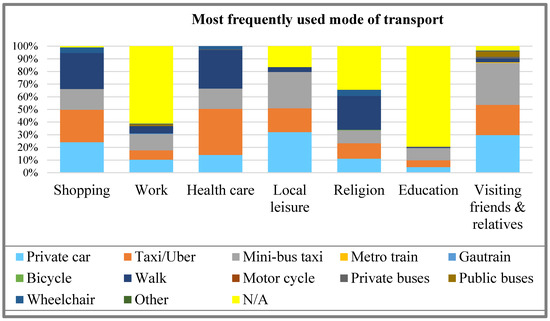
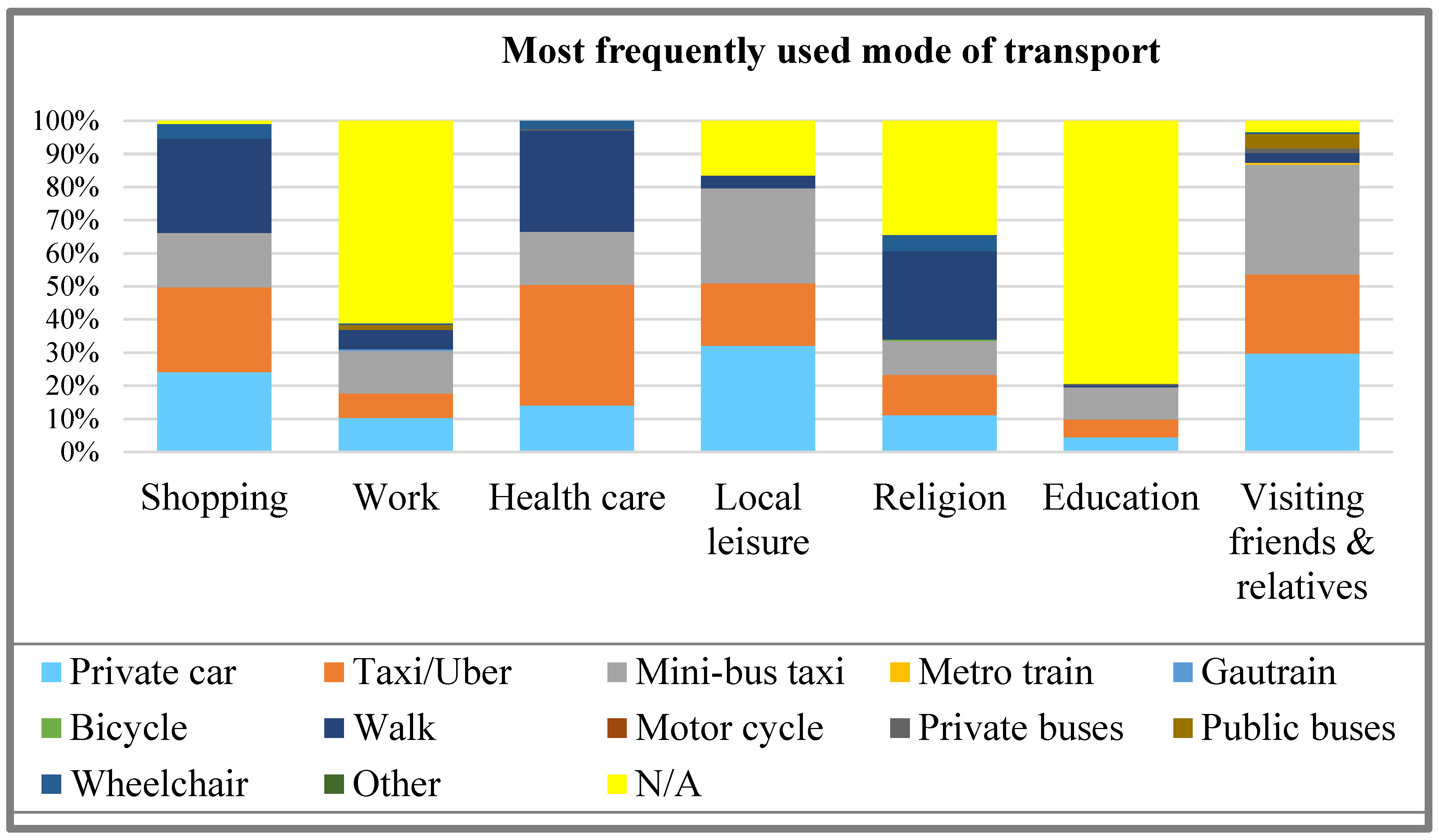
The most frequently used modes of transport varied by trip purpose (Figure 1). It should be noted that “N/A” in Figure 1 does not represent a transport mode but indicates that a trip was not made for that purpose. For shopping trips, walking was the most common mode (28.5%), followed by taxis or Uber services (25.6%) and private cars (24.2%), likely due to the proximity of the shopping facilities. Work-related trips were primarily made using minibus taxis (12.8%), followed by private cars (10.3%) and taxi/Uber services (7.4%). For healthcare trips, taxi/Uber and private cars together accounted for 50.5% of trips, possibly reflecting the urgency of medical visits and the need for more reliable transport. Local leisure trips also relied heavily on private cars and taxi/Uber services (50.9%), although a notable proportion (28.6%) used minibus taxis, likely due to wider route coverage. Religious trips were most commonly made on foot (26.7%), while 34.5% of the respondents reported not making such trips at all, possibly due to transport barriers. Most respondents were not enrolled in educational institutions; however, those who were enrolled predominantly used minibus taxis. The trips to visit friends and relatives were most often undertaken using minibus taxis (33.2%). Overall, the results indicated that private cars and taxi/Uber services were the most frequently used modes, suggesting limited reliance on conventional public transport options. Figure 1 shows the frequency of trips by purpose.
Figure 1.
Most frequently used mode of transport.
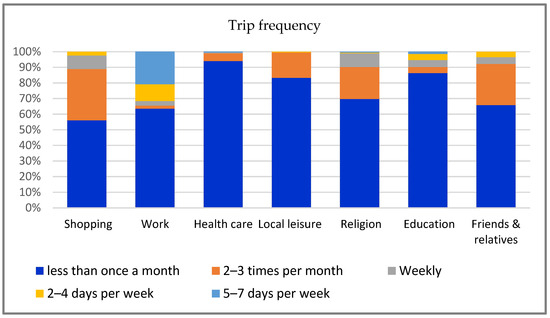
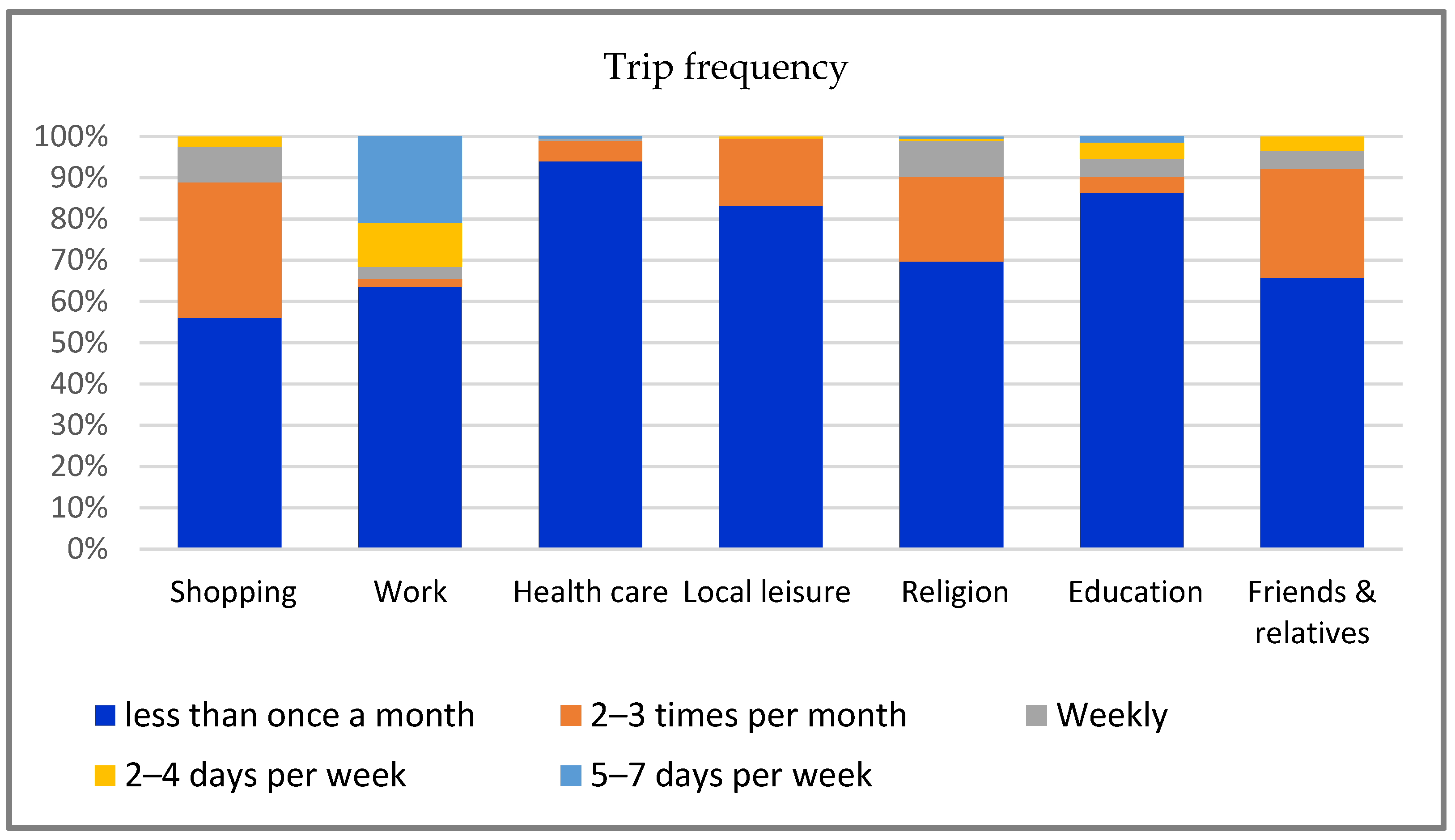
The trip frequency patterns indicate generally low levels of mobility across most activity purposes (Figure 2). For nearly all the trip purposes, the most common response category was travelling less than once a month, including shopping, healthcare, local leisure, religion, education, as well as visiting friends and relatives. Regular travel was most evident for work-related trips, where a notable share of respondents reported travelling five to seven days per week. Education-related travel was particularly limited, with many respondents reporting that there was no education travel, thereby reflecting that a large proportion of the respondents were not enrolled in educational institutions.
Figure 2.
Frequency of trips.
Psychosocial deterrents were measured using a five-point Likert scale, where higher mean values indicated stronger agreement with deterrent statements (Table 2). The highest-rated deterrent was preference for private cars over public transport (M = 4.18), followed by fear of becoming a victim of crime while using public transport (M = 4.15). Respondents also strongly agreed that drivers were not aware of their special transport needs (M = 4.06) and that they feared using public transport when travelling to unfamiliar places (M = 3.99). Other prominent deterrents included personal fear of using public transport (M = 3.80) and not feeling safe when travelling alone (M = 3.79). The negative behavior from drivers and co-passengers was also reported, although with slightly lower mean values. These findings suggest that fear, safety, and social attitudes play a significant role in shaping travel behavior among people with disabilities.
Table 2.
Psychosocial deterrents.
3.1. Exploratory Factor Analysis of Psychosocial Barriers
The data’s suitability for Exploratory Factor Analysis (EFA) was confirmed by a KMO value of 0.828 and a significant Bartlett’s test of sphericity (χ2 = 1050.834, p < 0.001). These results indicated adequate correlations among the items, demonstrating a statistically significant structure that is appropriate for conducting EFA on the “psychosocial barriers” items. Additionally, the correlation matrix was not an identity matrix. The results presented in Table 3 further support the feasibility of conducting factor analysis. The next step was to determine the number of factors.
Table 3.
KMO and Bartlett’s test.
Table 4 summarizes the total variance in the items explained by the extracted factors. Two factors with eigenvalues greater than 1 were retained, explaining 72.25% of the total variance in the initial solution and 66.19% after extraction. The second part of Table 4 presents the extracted sums of squared loadings. The cumulative variability explained by the two factors in the extracted solution was 66.19%, which represented a loss of approximately 6.06% compared to the initial solution. This loss is attributed to latent factors, meaning that the initial solution accounted for 6.06% more variation. The scree plot confirmed that only the first two factors exhibited eigenvalues greater than 1, with a cumulative variance of at least 70%. Since the first two factors were deemed meaningful, they were retained for rotation. These two factors were renamed as: (1) “Transport fear and security” and (2) “Co-passengers’ attitudes”.
Table 4.
Total variance explained.
Factor 1, “Transport fear and security,” impacts all groups of people with disabilities in various ways. The items that formed Factor 1 included:
- D2.8: “I fear using public transport when going to unfamiliar places.”
- D2.7: “I fear becoming a victim of crime while using public transport”.
- D2.6: “I have a personal fear of using public transport”.
- D2.5: “I prefer using private cars over public transport”.
- D2.4: “I do not feel safe traveling alone on public transport”.
- D2.3: “Drivers are often rude to people with disabilities”.
Factor 2, “Co-passengers’ attitudes,” relates to how co-passengers treat individuals with disabilities while using public transport. The items forming Factor 2 were:
- D2.10: “I feel discriminated against in public transport”.
- D2.9: “Other passengers are not kind to me when using public transport”.
Principal component analysis revealed two components with eigenvalues greater than 1, which accounted for 57.9% and 14.4% of the variance, respectively. An inspection of the scree plot suggested that only the first two factors were meaningful, so these were retained for rotation. Exploratory factor analysis was conducted on the responses to ten items related to “psychosocial barriers”. To extract the factors, principal axis factoring was performed followed by Varimax rotation. This analysis identified six items loading onto the first factor, labeled “transport fear and security”. Although a factor typically requires a minimum of two items [56], two items were identified loading onto the second factor, labeled “co-passenger attitudes”. According to Yong and Pearce [59], a factor with two variables is considered reliable only when the variables are highly correlated with one another (r > 0.70) and fairly uncorrelated with other variables. In this case, the items in Factor 2 were retained due to their logical association with each other.
Items D2.1 and D2.2 were omitted because their communality values were below 0.2. The communality values for the other items in Table 5 were all above 0.2, indicating that these items appropriately belonged to their respective factor structures. Following this, reliability tests were conducted. The reliability estimates were found to be 0.878 for “transport fear and security” and 0.938 for “co-passenger attitudes”. Therefore, the constructs related to psychosocial deterrents were deemed reliable.
Table 5.
Rotated factor pattern and final community.
3.2. Group Comparison
To address the secondary objective, “To identify similarities and differences in transport barriers between people with different types of disabilities”, a one-way ANOVA was conducted. The analysis was used to determine whether there are statistically significant differences among the three groups of people with disabilities concerning structural barriers. According to Zikmund and Babin [54], the one-way ANOVA is the appropriate statistical tool for comparing the means of more than two groups or populations. In this case, the groups being compared were individuals with mobility, vision, and hearing disabilities. Following this, an F-test was conducted, and the results of the analysis are presented in Table 6.
Table 6.
ANOVA analysis—transport fear and security.
The results in Table 6 indicate a statistically significant difference among the three groups of people with disabilities (F(2, 154) = 9.331, p < 0.001). The null hypothesis that the differences in “type of disability” are independent of differences in “transport fear and security” was rejected; therefore, it can be concluded that not all the group means were equal. The research hypothesis that differences in “type of disability” are related to differences in “transport fear and security” was supported in this analysis.
The construct score was not normally distributed. To assess the normality assumption required for ANOVA, the researcher used the Kolmogorov–Smirnov test alongside visual inspection of histograms. The p-value for Levene’s test was 0.235, indicating that the variances of the “transport fear and security” data for groups of people with disabilities were equal. Therefore, the researchers do not reject the null hypothesis of homogeneity. To identify specific differences between the groups of people with disabilities regarding transport and security, a multiple comparison test was conducted using Scheffe’s method. A Bonferroni adjustment was applied by dividing the alpha value of 0.05 by the number of tests performed. The results of the Scheffe test are presented in Table 7.
Table 7.
Multiple comparisons—transport fear and security.
The results presented in Table 7 indicate a statistically significant difference in transport-related fear and security experienced by groups with hearing and vision disabilities (p < 0.001). However, no significant differences were found between groups with mobility and hearing disabilities (p = 0.029) or between groups with mobility and vision disabilities (p = 0.118). While the deterrents related to transport fear and security affect all the groups, the individuals with vision disabilities appear to be more significantly impacted. This suggests that navigating an unfamiliar transport environment can be particularly challenging for people with vision disabilities and this may be associated with heightened fears of falling or getting lost in unfamiliar places.
3.3. Co-Passenger’s Attitudes
The summarized results from the ANOVA and post hoc tests are discussed in this section. The descriptive statistics for “co-passengers’ attitudes” from the ANOVA are presented in Table 8.
Table 8.
ANOVA descriptive—co-passengers’ attitudes.
The construct score does not follow a normal distribution. To test the normality assumption required for one-way ANOVA, the researcher utilized the Kolmogorov–Smirnov test and conducted a visual inspection of histograms. The results showed a p-value of 0.018 for Levene’s test, indicating that the variances of “co-passengers’ attitudes” among groups of people with disabilities were not equal. Consequently, we reject the null hypothesis that differences in “type of disability” are independent of differences in “co-passengers’ attitudes,”. This analysis supports the research hypothesis that the differences in “type of disability” are related to the differences in “co-passengers’ attitudes”.
The researchers also employed the Brown–Forsythe test to assess the equality of group variances, which yielded a p-value of less than 0.001, further confirming that the variances were not equal. To identify the specific differences in co-passengers’ attitudes among the groups of people with disabilities, a multiple comparison test using Dunnett’s T3 method was conducted. A Bonferroni adjustment was applied by dividing the alpha value of 0.05 by the number of performed tests. The results from the Dunnett T3 test are presented in Table 9.
Table 9.
Multiple comparisons—co-passengers’ attitudes.
The results presented in Table 9 indicate that there was a statistically significant difference in the attitudes of co-passengers experienced by groups with mobility and hearing disabilities (p < 0.001), as well as between groups with hearing and vision disabilities (p < 0.001). However, no significant differences were found between groups with vision and mobility disabilities (p = 0.495).
The individuals with mobility and vision disabilities often face negative attitudes from co-passengers because they require some assistance. For instance, a passenger with a vision disability may need help asking for stops or finding a seat, while a person using a wheelchair may require assistance when boarding or disembarking from a vehicle. Some passengers may be unwilling to help those with disabilities. In contrast, the individuals with hearing disabilities typically do not require as much assistance compared to those with vision or mobility disabilities.
4. Discussion
The findings of this study are discussed in relation to the research objectives which are: (1) to identify the key psychosocial barriers faced by people with disabilities when using public transport and (2) to examine the similarities and differences in transport barriers among people with various types of disabilities. The findings support the concept proposed in Section 1.2, in which fear, insecurity, and negative social interactions are associated with avoidance strategies and substitution away from conventional public transport. Beyond confirming that psychosocial deterrents are relevant, the results showed differentiated patterns across disability types. This disaggregation provides empirical support for the argument that “people with disabilities” should not be treated as a homogeneous group in transport research and inclusive mobility interventions.
4.1. Key Psychosocial Barriers Faced by People with Disabilities When Using Public Transport
The low frequency of trips reported for most activity types highlights how psychosocial deterrents impact mobility. Many respondents reported undertaking various activities, either infrequently or not at all. This finding aligns with the research done by Zhang, Farber, Young, Tiznado-Aitken and Ross [11] which shows that people with disabilities make fewer trips compared to other transport users. This pattern aligns with the concept of suppressed travel demand, where individuals restrict or avoid trips not due to a lack of need, but because of fear, insecurity, and the expectation of negative experiences during travel [60]. The finding that ‘transport fear and security’ is the main factor shows how people’s feelings about transport environments are often more important than how easily they are accessible. Similar findings have been reported in studies showing that people with disabilities frequently suppress travel demand due to anxiety, fear of crime, and the lack of confidence, even when transport services are technically available [18]. In this study, fear was not limited to crime alone but extended to uncertainty associated with unfamiliar places, travelling alone, and interacting with drivers, factors that collectively undermine independent mobility [36].
The study found that many people prefer to use private cars instead of public transport, even though they have low incomes. This shows how personal factors affect their travel choices. This finding may suggest that private car use functions as a coping strategy for some people with disabilities, particularly where public transport is perceived as unsafe, unpredictable, or undignified. However, private car use may also reflect other factors such as household vehicle access, trip complexity, or the availability of informal support networks. Darcy and Burke [61] highlight that for many people with disabilities, a private modified vehicle is often essential due to barriers in public transport and social disadvantages. Similar patterns have been observed in African and other global south contexts, where unreliable and unsafe public transport environments reinforce car dependence or reliance on taxis and ride-hailing services [24,30,62]. However, reliance on private car use increases financial burdens, especially for those with limited resources.
The second factor, ‘co-passengers’ attitudes’, highlights the importance of social interactions in shaping transport experiences. The study found that reports of discrimination and unkind behavior from other passengers were consistent with previous research [24,35,41]. This research shows that stigma, staring, verbal abuse, and lack of assistance erode dignity and discourage public transport use among people with disabilities [29,36]. Although this factor explained less variance than fear and security, its high reliability indicates that negative social encounters are a persistent and meaningful barrier.
These findings reinforce arguments that accessibility cannot be reduced to infrastructure alone. Psychosocial deterrents may help to explain the relationship between transport systems and travel behavior, often rendering physically accessible systems functionally inaccessible. In the City of Tshwane, fear, insecurity, and hostile social environments may be associated with lower public transport use and lower frequencies of non-essential trips, with potential implications for social inclusion and quality of life.
4.2. Similarities and Differences in Transport Barriers Among People with Disabilities
The results demonstrate that while psychosocial deterrents affect all groups, their intensity varies significantly depending on the type of disability. For ‘transport fear and security’, the individuals with vision disabilities reported significantly higher levels of fear compared to those with hearing disabilities. This finding is consistent with the evidence showing that people with vision disabilities face heightened vulnerability in transport environments partly due to difficulties in spatial orientation, hazard detection, and accessing information [12,63]. Fear of falling, getting lost, or becoming a victim of crime is often amplified in unfamiliar or poorly designed transport settings, particularly where audible announcements and staff assistance are lacking [33,63].
The absence of significant differences between individuals with mobility disabilities and the other groups suggests that fear and security concerns are widely shared across the disability types. This aligns with the studies indicating that perceived insecurity affects a broad spectrum of passengers with disabilities, regardless of impairment, particularly in contexts characterized by overcrowding, weak regulation, and high crime rates [6,15].
More pronounced differences emerged in relation to ‘co-passengers’ attitudes’. The individuals with mobility and vision disabilities reported significantly higher levels of discrimination and negative treatment than those with hearing disabilities. This finding supports existing literature showing that visible disabilities are more likely to attract stigma, impatience, and hostile behavior in public spaces, including in public transport [27,64]. Passengers who require assistance such as wheelchair users or individuals with vision disabilities, often depend on drivers or co-passengers for boarding, seating, or navigation, thereby increasing exposure to negative social interactions [47,64].
In contrast, hearing disabilities are often less visible and may require fewer overt interactions during travel, which may partially explain the lower levels of reported discrimination. However, this does not imply the absence of deterrents for people with hearing disabilities; rather, it reflects the differentiated ways in which psychosocial deterrents operate across disability types. Similar patterns have been observed in studies suggesting that the relative invisibility of some disabilities may be associated with the under-recognition of certain accessibility needs in transport planning and policy [48,64].
Overall, the findings highlight the importance of disaggregating disability categories in transport research. Treating people with disabilities as a homogeneous group risks obscuring meaningful differences in lived experiences and may be associated with poorly targeted interventions. Effective transport policy should recognize that psychosocial deterrents are not uniform and may differ according to disability, visibility, interactional demands, and contextual vulnerabilities.
4.3. Limitations
While purposive sampling does not allow for statistical generalization to the broader population of people with disabilities, this limitation is widely acknowledged and accepted in applied social research. The primary aim of the study was not to produce population estimates, but rather to identify patterns, relationships, and differences in psychosocial transport barriers among distinct disability groups [54]. In this regard, purposive sampling was considered appropriate, as it prioritized analytical depth over representativeness. The study focused on mobility, vision, and hearing disabilities; it did not include individuals with intellectual, cognitive, communication, speech impairments or psychosocial disabilities, whose transport experiences may differ substantially.
While some deaf and hard-of-hearing participants may experience communication-related deterrents, communication and speech impairments can also occur independently of hearing loss and may involve different psychosocial challenges in public transport environments. Future research could explicitly include communication and speech impairments to better understand these experiences.
The second psychosocial construct “co-passengers’ attitudes” was represented by only two items. Although the items were highly correlated and conceptually coherent, two-item factors are generally considered less stable and may provide a narrower representation of the underlying construct. The results for this factor should therefore be interpreted cautiously, and future research could include additional indicators capturing a wider range of passenger attitudes and discrimination experiences.
In addition, using this two-item construct in the ANOVA may constrain the robustness and interpretability of group differences. The results for this construct should therefore be interpreted cautiously, and future research could include additional indicators of passenger attitudes and discrimination to strengthen measurement validity.
4.4. Contributions
This study contributes to disability and transport literature in three ways. Firstly, it provides quantitative evidence on psychosocial transport barriers in a South African metropolitan context, where existing work has largely emphasized policy and physical accessibility. Secondly, it identifies underlying psychosocial dimensions (transport fear/security and co-passenger attitudes) using exploratory factor analysis, helping to operationalize psychosocial deterrents in a way that can support measurement in future global south studies. Thirdly, by comparing psychosocial deterrents across mobility, vision, and hearing disabilities, the study demonstrates that psychosocial constraints are not uniform across disability types, highlighting the importance of disaggregated analysis for inclusive transport policy and planning.
5. Conclusions
This study examined the psychosocial deterrents influencing public transport travel behavior among people with mobility, vision, and hearing disabilities in the City of Tshwane. The findings indicated that psychosocial deterrents, particularly those related to fear, safety, and negative social interactions, are associated with reduced use of conventional public transport and a greater reliance on private cars and taxi/ride-hailing services. However, the intensity of these deterrents varied across disability groups. Transport-related fear and insecurity were most pronounced among the respondents with vision disabilities, while negative co-passenger attitudes were reported more strongly among the respondents with mobility and vision disabilities than among those with hearing disabilities.
The results showed that the fear of crime, insecurity when travelling alone, and anxiety about unfamiliar environments are widespread across all disability groups but are particularly pronounced among people with vision disabilities. In parallel, discriminatory and unkind behavior from co-passengers disproportionately affects people with mobility and vision disabilities, reflecting the role of visibility, dependence on assistance, and social stigma in public transport spaces. These psychosocial deterrents help to explain the strong preference for private cars, taxis, and ride-hailing services observed in the study, even among respondents with low incomes, thereby indicating that travel choices are often driven by a need for safety, dignity, and control rather than by cost or availability alone.
Based on the findings of this study, below are the recommendations proposed to reduce psychosocial deterrents and to improve public transport use among people with disabilities in the City of Tshwane and in similar urban contexts. Firstly, because the fear of crime, personal insecurity, and anxiety when travelling alone were among the most strongly reported psychosocial barriers, safety interventions should be treated as part of accessibility. This includes but is not limited to improved lighting and visibility at bus stops and terminals, increased presence of trained security personnel, and better regulation of boarding and waiting environments. Secondly, because negative driver behavior and lack of awareness of disability needs were strongly reported, driver and frontline staff training should prioritize disability awareness, respectful communication, and assistance practices, particularly in minibus taxi operations where driver–passenger interaction is frequent. Thirdly, because discrimination and unkind behavior from co-passengers formed a distinct deterrent construct, public education and passenger awareness initiatives should be implemented alongside enforcement mechanisms to protect passengers with disabilities from harassment. Finally, since fear and insecurity were most pronounced among respondents with vision disabilities, interventions such as audible announcements, clearer wayfinding, and assistance protocols at interchanges are likely to be particularly beneficial for this group.
Future studies could focus on the compounded vulnerabilities of women with disabilities, LGBTQ+, and marginalized populations. Further research could extend beyond mobility, vision, and hearing disabilities to include intellectual, cognitive, and psychosocial disabilities, whose transport experiences and psychosocial deterrents remain underexplored.
These findings should be interpreted in light of the limitations of the study, including purposive sampling, the focus on three disability groups, and the exclusion of cognitive, psychosocial, and communication/speech impairments, which may involve different transport-related psychosocial experiences.
Funding
This research received no external funding.
Institutional Review Board Statement
The study was conducted in accordance with the Declaration of Helsinki and approved by the Department of Transport and Supply Chain Management Ethics Committee at the University of Johannesburg (2019TSCM-006PhD, 14 October 2019).
Informed Consent Statement
Informed consent was obtained from the participants involved in the study.
Data Availability Statement
Data will be made available upon reasonable request.
Acknowledgments
This study forms part of the my doctoral research undertaken at the University of Johannesburg, South Africa. AI tools were used to improve grammar, clarity and readability. All ideas, analysis and conclusion presented in this work are my own.
Conflicts of Interest
The author declares no conflicts of interest.
Disability Language/Terminology Positionality Statement
This study was conducted by a transport researcher with experience in disability and public transport accessibility in South Africa and is informed by a social and relational understanding of disability, which recognizes that exclusion arises from interactions between people with disabilities and inaccessible transport systems, infrastructure, and social practices. Person-first language (e.g., “people with disabilities”, “passengers with disabilities”) is used throughout the manuscript, as it is commonly adopted in South African policy and research contexts and reflects respectful and inclusive academic practice; participants’ specific language preferences were not formally assessed. The author acknowledges the voluntary participation of all contributors and affirms that ethical principles of dignity, respect, autonomy, and informed consent guided all stages of the research process, while recognizing that the author’s positionality influenced the framing, interpretation, and presentation of the study.
References
- Tessier, A.; Gélinas, I.; Boucher, N.; Croteau, C.; Morin, D.; Archambault, P. Enhancing Employment Access for People with Disabilities through Transportation: Insights from Workers with Disabilities, Employers, and Transportation Providers. Disabilities 2024, 4, 384–412. [Google Scholar] [CrossRef] [Scilit]
- de La Roche, D.; Curl, A.; Fitt, H. The power of community: Perspectives from women with disabilities on making healthcare journeys in Yogyakarta, Indonesia. J. Transp. Geogr. 2025, 124, 104182. [Google Scholar] [CrossRef] [Scilit]
- Martens, K. Ageing, impairments and travel: Priority setting for an inclusive transport system. Transp. Policy 2018, 63, 122–130. [Google Scholar] [CrossRef] [Scilit]
- Labbé, D.; Yao, D.P.; Scales, T.; McCain, H.; Miller, W.C.; Mortenson, W.B. Inclusion of People With Disabilities in Public Transportation: A Case-Study Analysis of Canada and U.S. Policies. J. Disabil. Policy Stud. 2025, 10442073251370266. [Google Scholar] [CrossRef] [Scilit]
- Gumasing, M.J.J.; Del Castillo, T.R.P.; Palermo, A.G.L.; Tabino, J.T.G.; Gatchalian, J.T. Enhancing Accessibility in Philippine Public Bus Systems: Addressing the Needs of Persons with Disabilities. Disabilities 2025, 5, 45. [Google Scholar] [CrossRef] [Scilit]
- Kett, M.; Cole, E.; Turner, J. Disability, Mobility and Transport in Low- and Middle-Income Countries: A Thematic Review. Sustainability 2020, 12, 589. [Google Scholar] [CrossRef] [Scilit]
- Vergunst, R.; Swartz, L.; Mji, G.; MacLachlan, M.; Mannan, H. ‘You must carry your wheelchair’—Barriers to accessing healthcare in a South African rural area. Glob. Health Action 2015, 8, 29003. [Google Scholar] [CrossRef] [Scilit]
- Mindell, J.S.; Mackett, R.L.; Yaffe, S.; Amin, S. A meta-review of literature reviews of disability, travel and inequalities. J. Transp. Health 2025, 41, 101961. [Google Scholar] [CrossRef] [Scilit]
- Bascom, G.W.; Christensen, K.M. The impacts of limited transportation access on persons with disabilities’ social participation. J. Transp. Health 2017, 7, 227–234. [Google Scholar] [CrossRef] [Scilit]
- Scherer, N.; Chabaputa, R.; Chansa-Kabali, T.; Nseibo, K.; McKenzie, J.; Banda-Chalwe, M.; Smythe, T. Community inclusion, participation and support for people with disabilities in Zambia: A qualitative study. Disabil. Health J. 2025, 18, 101839. [Google Scholar] [CrossRef] [Scilit]
- Zhang, Y.; Farber, S.; Young, M.; Tiznado-Aitken, I.; Ross, T. Exploring travel patterns of people with disabilities: A multilevel analysis of accessible taxi trips in Toronto, Canada. Travel Behav. Soc. 2023, 32, 100575. [Google Scholar] [CrossRef] [Scilit]
- Neven, A.; Ectors, W. “I am dependent on others to get there”: Mobility barriers and solutions for societal participation by persons with disabilities. Travel Behav. Soc. 2023, 30, 302–311. [Google Scholar] [CrossRef] [Scilit]
- Lucas, K. Transport and social exclusion: Where are we now? Transp. Policy 2012, 20, 105–113. [Google Scholar] [CrossRef] [Scilit]
- Jahangir, S.; Bailey, A.; Hasan, M.M.U.; Hossain, S. Inequalities in accessing public transportation and social exclusion among older adults and people with disabilities in Bangladesh: A scoping review. Transp. Res. Interdiscip. Perspect. 2024, 26, 101138. [Google Scholar] [CrossRef] [Scilit]
- Vanderschuren, M.; Nnene, O.A. Inclusive planning: African policy inventory and South African mobility case study on the exclusion of persons with disabilities. Health Res. Policy Syst. 2021, 19, 124. [Google Scholar] [CrossRef] [Scilit]
- Behrens, R.; Görgens, T. Challenges in Achieving Universal Access to Transport Services in South African Cities. In The Palgrave Handbook of Disability and Citizenship in the Global South; Springer: Cham, Switzerland, 2019; pp. 183–196. [Google Scholar]
- Charles, W.P.; Gie, L.; Musakuro, R.N. Barriers to the employability of people with disabilities in the South African public service. Afr. J. Disabil. 2023, 12, 1178. [Google Scholar] [CrossRef] [Scilit]
- Sundling, C.; Ceccato, V.; Gliori, G. Disability, victimisation, and safety in train travel. Transp. Res. Interdiscip. Perspect. 2024, 25, 101131. [Google Scholar] [CrossRef] [Scilit]
- Remillard, E.T.; Campbell, M.L.; Koon, L.M.; Rogers, W.A. Transportation challenges for persons aging with mobility disability: Qualitative insights and policy implications. Disabil. Health J. 2022, 15, 101209. [Google Scholar] [CrossRef] [Scilit]
- Wade, D.T.; Halligan, P.W. The biopsychosocial model of illness: A model whose time has come. Clin. Rehabil. 2017, 31, 995–1004. [Google Scholar] [CrossRef] [Scilit]
- da Silveira, J.; de Oliveira, R.R.; Schmitt, B.D.; Seron, B.B. Social Determinants of Health in the Lives of People with Disability. Disabil. CBR Incl. Dev. 2025, 36, 85–102. [Google Scholar] [CrossRef]
- Lid, I.M.; Solvang, P.K. (Dis)ability and the experience of accessibility in the urban environment. Alter 2016, 10, 181–194. [Google Scholar] [CrossRef] [Scilit]
- Waldschmidt, A. Disability-Culture-Society. Alter 2018, 12, 65–78. [Google Scholar] [CrossRef] [Scilit]
- Stjernborg, V. Accessibility for All in Public Transport and the Overlooked (Social) Dimension—A Case Study of Stockholm. Sustainability 2019, 11, 4902. [Google Scholar] [CrossRef] [Scilit]
- Goulias, K.G.; Davis, A.W.; McBride, E.C. Introduction and the genome of travel behavior. In Mapping the Travel Behavior Genome; Elsevier: Amsterdam, The Netherlands, 2020; pp. 1–14. [Google Scholar]
- Sarkheyli, E.; Sarkheyli, A. “I care about transport sustainability, but i have children”: Open-text surveys highlight the concerns of families with children. Travel Behav. Soc. 2026, 42, 101155. [Google Scholar] [CrossRef] [Scilit]
- Ali, H.; Abdullah, M. Exploring the perceptions about public transport and developing a mode choice model for educated disabled people in a developing country. Case Stud. Transp. Policy 2023, 11, 100937. [Google Scholar] [CrossRef] [Scilit]
- Corran, P.; Steinbach, R.; Saunders, L.; Green, J. Age, disability and everyday mobility in London: An analysis of the correlates of ‘non-travel’ in travel diary data. J. Transp. Health 2018, 8, 129–136. [Google Scholar] [CrossRef] [Scilit]
- Mwaka, C.R.; Best, K.L.; Cunningham, C.; Gagnon, M.; Routhier, F. Barriers and facilitators of public transport use among people with disabilities: A scoping review. Front. Rehabil. Sci. 2023, 4, 1336514. [Google Scholar] [CrossRef] [Scilit]
- Mansilla, J.C.; Boucher, N.; Routhier, F. Public Transport in the Disabling City: A Narrative Ethnography of Dilemmas and Strategies of People with Mobility Disabilities. Disabilities 2024, 4, 228–261. [Google Scholar] [CrossRef] [Scilit]
- Handley, R.V.; Salkovskis, P.M.; Ehlers, A. Treating clinically significant avoidance of public transport following the London bombings? Behav. Cogn. Psychother. 2009, 37, 87–93. [Google Scholar] [CrossRef] [Scilit]
- Emerson, E.; Krnjacki, L.; Llewellyn, G.; Vaughan, C.; Kavanagh, A. Perceptions of safety and exposure to violence in public places among working age adults with disabilities or long-term health conditions in the UK: Cross sectional study. Public Health 2016, 135, 91–96. [Google Scholar] [CrossRef] [Scilit]
- Sajib, S.H. Identifying Barriers to the Public Transport Accessibility for Disabled People in Dhaka: A Qualitative Analysis. Trans. Transp. Sci. 2022, 13, 5–16. [Google Scholar] [CrossRef] [Scilit]
- Nickpour, F.; Jordan, P.W.; Dong, H. Inclusive Bus Travel: A Psychosocial Approach. In Designing Inclusive Systems; Springer: London, UK, 2012; pp. 13–22. [Google Scholar]
- Duri, B.; Luke, R. The Experiences of Public Transport Drivers with People with Disability in the City of Tshwane, South Africa. Disabil. CBR Incl. Dev. 2022, 33, 56. [Google Scholar] [CrossRef] [Scilit]
- Wayland, S.; Newland, J.; Gill-Atkinson, L.; Vaughan, C.; Emerson, E.; Llewellyn, G. I had every right to be there: Discriminatory acts towards young people with disabilities on public transport. Disabil. Soc. 2022, 37, 296–319. [Google Scholar] [CrossRef] [Scilit]
- McKercher, B.; Darcy, S. Re-conceptualizing barriers to travel by people with disabilities. Tour. Manag. Perspect. 2018, 26, 59–66. [Google Scholar] [CrossRef] [Scilit]
- Lister, H.E.; Dhunpath, R. The taxi industry and transportation for people with disabilities: Implications for universal access in a metropolitan municipality. Transform. Crit. Perspect. South. Afr. 2016, 90, 28–48. [Google Scholar] [CrossRef] [Scilit]
- Lucas, K. Making the connections between transport disadvantage and the social exclusion of low income populations in the Tshwane Region of South Africa. J. Transp. Geogr. 2011, 19, 1320–1334. [Google Scholar] [CrossRef] [Scilit]
- Ndwandwe, B.; Gumbo, T. Progressive or Regressive: Efficacy of Innovative Urban Public Transport Systems On Urban Mobility In The City Of Tshwane. In Proceedings of the Southern African Transport Conference, Pretoria, South Africa, 9–12 July 2018. [Google Scholar]
- Fredericks, J.P.; Visagie, S.; van Niekerk, L. A qualitative exploration of community mobility experiences of wheelchair users. Afr. J. Disabil. 2024, 13, 1253. [Google Scholar] [CrossRef] [Scilit]
- Thomas, D.P. Public transportation in South Africa: Challenges and opportunities. World 2016, 3, 352–366. [Google Scholar] [CrossRef] [Scilit]
- Kerr, A. Tax (i) ing the poor? Commuting costs in South African cities. South Afr. J. Econ. 2017, 85, 321–340. [Google Scholar] [CrossRef] [Scilit]
- Gibberd, A.E.; Hankwebe, N. Transport experiences of people with disabilities during learnerships. Afr. J. Disabil. 2022, 11, 936. [Google Scholar] [CrossRef] [Scilit]
- Chakwizira, J.; Bikam, P.; Adeboyejo, T.A. Access and constraints to commuting for persons with disabilities in Gauteng Province, South Africa. In Urban Inclusivity in Southern Africa; Springer: Berlin/Heidelberg, Germany, 2021; pp. 347–394. [Google Scholar]
- Dlamini, S.; Magidimisha, H. Walkability and Accessibility for People with Disabilities in Ethekwini Municipality: A Qualitative Exploration of Challenges and Opportunities. J. Incl. Cities Built Environ. 2025, 5, 1–10. [Google Scholar]
- Velho, R. Transport accessibility for wheelchair users: A qualitative analysis of inclusion and health. Int. J. Transp. Sci. Technol. 2019, 8, 103–115. [Google Scholar] [CrossRef] [Scilit]
- Bigby, C.; Johnson, H.; O’Halloran, R.; Douglas, J.; West, D.; Bould, E. Communication access on trains: A qualitative exploration of the perspectives of passengers with communication disabilities. Disabil. Rehabil. 2019, 41, 125–132. [Google Scholar] [CrossRef] [Scilit] [PubMed]
- Municipalities of South Africa. City of Tshwane Metropolitan Municipality. Available online: https://municipalities.co.za/demographic/3/city-of-tshwane-metropolitan-municipality (accessed on 13 February 2026).
- Statistics South Africa. City of Tshwane. Available online: https://beta2.statssa.gov.za/?page_id=1021&id=city-of-tshwane-municipality (accessed on 13 February 2026).
- Moeti, T.; Mokhele, T.; Tesfamichael, S. Associating socioeconomic factors with access to public healthcare facilities using geographically weighted regression in the city of Tshwane, South Africa. Geospat. Health 2024, 19, 1288. [Google Scholar] [CrossRef] [Scilit]
- Dumedah, G.; Azong, P.; Adanu, E.K.; Okyere, P.A.; Jones, S. Transport-related health, safety and accessibility in sub-Saharan Africa: Comparative insights from Kumasi-Ghana and Dar es Salaam-Tanzania. Afr. Transp. Stud. 2025, 3, 100058. [Google Scholar] [CrossRef] [Scilit]
- Ajayi, J.; Aworemi, R.; Wojuade, C.; Adebayo, T. Problems Affecting the Accessibility of Physically-Challenged Individuals to Intermediate Public Transport Services in Oyo State, Nigeria. Logist. Sustain. Transp. 2020, 11, 114–120. [Google Scholar] [CrossRef] [Scilit]
- Zikmund, W.G.; Babin, B.J. Essentials of Marketing Research; Amazon: Seattle, WA, USA, 2010. [Google Scholar]
- Raosoft. Sample Size Calculator. Available online: http://www.raosoft.com/samplesize.html (accessed on 22 March 2022).
- Pallant, J. SPSS Survival Manual: A Step by Step Guide to Data Analysis Using IBM SPSS; Routledge: Oxfordshire, UK, 2020. [Google Scholar]
- Duri, B.; Luke, R. Service Quality Barriers Encountered in Urban Public Transport by People with Disability in South Africa. Soc. Sci. 2025, 14, 366. [Google Scholar] [CrossRef] [Scilit]
- Graham, L. Differences in employment and income poverty between people with and without disabilities in South Africa. Alter 2020, 14, 299–317. [Google Scholar] [CrossRef] [Scilit]
- Yong, A.G.; Pearce, S. A beginner’s guide to factor analysis: Focusing on exploratory factor analysis. Tutor. Quant. Methods Psychol. 2013, 9, 79–94. [Google Scholar] [CrossRef] [Scilit]
- Palm, M.; Nakshi, P.; Yousefzadeh Barri, E.; Farber, S.; Widener, M. Uncovering suppressed travel: A scoping review of surveys measuring unmet transportation need. Travel Behav. Soc. 2024, 36, 100784. [Google Scholar] [CrossRef] [Scilit]
- Darcy, S.; Burke, P.F. On the road again: The barriers and benefits of automobility for people with disability. Transp. Res. Part A Policy Pract. 2018, 107, 229–245. [Google Scholar] [CrossRef] [Scilit]
- Kwame Odame, P.; Obilie Amoako-Sakyi, R.; Abane, A.; Nii Martey Mensah, M. Alternative travel mode for commuters with disability in Accra: The lived experiences of Uber and taxi users. Case Stud. Transp. Policy 2023, 11, 100968. [Google Scholar] [CrossRef] [Scilit]
- Cabello, N.; Galilea, P.; Ortúzar, J.D.D. Valuing improvements to bus universal accessibility for visually impaired users: A case study in Santiago, Chile. Res. Transp. Econ. 2025, 110, 101523. [Google Scholar] [CrossRef] [Scilit]
- Low, W.-Y.; Cao, M.; De Vos, J.; Hickman, R. The journey experience of visually impaired people on public transport in London. Transp. Policy 2020, 97, 137–148. [Google Scholar] [CrossRef] [Scilit]

Disclaimer/Publisher’s Note: The statements, opinions and data contained in all publications are solely those of the individual author(s) and contributor(s) and not of MDPI and/or the editor(s). MDPI and/or the editor(s) disclaim responsibility for any injury to people or property resulting from any ideas, methods, instructions or products referred to in the content. |
© 2026 by the author. Licensee MDPI, Basel, Switzerland. This article is an open access article distributed under the terms and conditions of the Creative Commons Attribution (CC BY) license.