


Abstract
Extremely fast charging (XFC) of high-energy-density lithium-ion batteries is fundamentally constrained by the intrinsic waveform characteristics of conventional variable-current profiles (VCPs), limiting further reductions in charging time while maintaining electro-thermal safety. In the present study, a computational electro-thermally constrained optimization framework is developed in which a square-wave VCP is reformulated using a finite Fourier series to improve XFC performance. An electro-thermal numerical model is employed to evaluate the charging behavior of the resulting Fourier series-based square wave (F-square wave) with the number of harmonic terms ranging from N = 1 to 100. The optimal charging performance is achieved at N = 10, reducing the charging time from 940 to 878 s (6.6%) and satisfying the U.S. DOE 15-min XFC target (900 s). The performance enhancement originates from two complementary effects: the Gibbs overshoot, which locally increases the charging current near the allowable current limit, and the finite-series approximation, which smooths the current transition before and after the waveform discontinuity. Rather than treating the Gibbs overshoot associated with Fourier approximation as an undesirable numerical artifact, this study demonstrates that it can be computationally exploited as a controlled perturbation to accelerate charging while maintaining electro-thermal safety. Although the Fourier perturbation slightly increases the terminal voltage risk near the waveform discontinuity, all electrical and thermal constraints remain satisfied throughout the charging process. These findings demonstrate that finite Fourier perturbation provides an effective computational design strategy for overcoming the intrinsic waveform limitations of discontinuous charging profiles and advancing electro-thermally constrained XFC of lithium-ion batteries.
1. Introduction
The transition to electric vehicles (EVs) is crucial for mitigating global warming, as emphasized by the Paris Agreement and the IPCC 6th Assessment Report (AR6) [1,2]. However, the slow charging rate of EVs compared with the refueling rate of internal combustion engine vehicles (ICEVs), together with range anxiety, remains a major obstacle to widespread adoption [3,4]. Although increasing the battery capacity to extend the driving range has been considered, the high cost of Li-ion batteries and limited raw material availability render this approach impractical [5]. The development of high-energy-density Li-ion batteries with specific energies of 300 Wh/kg has alleviated the range anxiety. Nevertheless, large battery packs are still required to achieve a 300-mile driving range [6,7]. Consequently, fast charging has emerged as a promising alternative, which enables battery downsizing while maintaining affordability and sustainability [4,5]. Notably, the current fast charging rate of EVs (>30 min) remains significantly slower than the refueling rate of conventional ICEVs [8]. Therefore, the United States Department of Energy (U.S. DOE) and the United States Advanced Battery Consortium (U.S. ABC) have set a goal of extremely fast charging (XFC) within 15 min to reach 80% state of charge (SoC) while limiting the capacity loss to less than 20% after 500 XFC cycles [9,10]. However, thermal management of high-energy-density Li-ion batteries under XFC conditions is a great challenge. If thermal management fails, the battery temperature rises rapidly, which accelerates degradation and increases the risk of thermal runaway [11,12].
Numerous studies have focused on developing effective battery charging schemes to minimize the charging time and capacity loss [13,14]. Sikha et al. [15] proposed a varying current decay (VCD) charging scheme, which applied an initial short constant current (CC) pulse until the battery reached the cutoff voltage, followed by a gradual current decay, significantly reducing the charging time but also increasing the capacity loss due to the neglect of battery temperature effects. More recently, model predictive control (MPC)-based charging strategies have been investigated to dynamically regulate the charging current while considering battery-state prediction, thermal behavior, lithium plating, and electrochemical constraints [16,17,18]. However, the feedback-based approaches generally rely on accurate real-time sensing, state estimation, and model prediction, which may increase implementation complexity and computational requirements. An et al. [19] introduced a multistage constant current (MSCC) fast charging scheme to reduce the charging time and capacity loss compared with conventional CC–CV fast charging. However, MSCC charging has typically been proposed without a well-defined physical criterion for designing the stage currents [20,21], and stepwise discontinuities during each stage transition impose additional constraints on the charging efficiency. Guo et al. [21] proposed a variable current profile (VCP) based on a nonlinear exponential function to enable rapid initial charging followed by a gradual current decrease. Despite these efforts, previously developed VCPs [13,14,15,19,20,21] remain fundamentally constrained by their intrinsic mathematical shape, and in particular, stepwise profiles such as the MSCC and square-wave functions retain their discontinuities, leaving further improvements in charging speed largely unexplored once a given profile has been optimized through translation and scaling alone. To overcome this limitation, the Fourier series offers a mathematically rigorous framework for reshaping a periodic function through a weighted summation of sinusoidal harmonic terms, but approximating a discontinuous function inevitably produces a persistent overshoot near the discontinuity, known as the Gibbs phenomenon [22,23], which has conventionally been regarded as an unavoidable artifact rather than a feature to be exploited.
In this study, a computational, electro-thermally constrained optimization framework is presented that applies a finite partial sum of the Fourier series exclusively to the optimized baseline square-wave charging function to further enhance its extremely fast charging performance. An electro-thermal numerical model is used to systematically evaluate a range of harmonic terms and identify the optimal number that maximizes the charging speed without exceeding the allowable limits of maximum temperature, temperature difference, charging current, and terminal voltage. Central to this framework, the Gibbs overshoot is reinterpreted as a controlled perturbation that can be strategically exploited to accelerate the charging current near the discontinuity, rather than treated as an approximation artifact to be minimized.
2. Methodology
2.1. Electro-Thermal Numerical Model
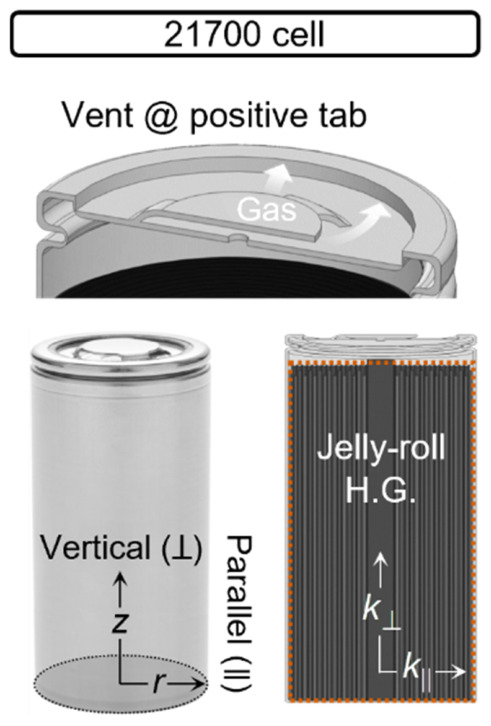
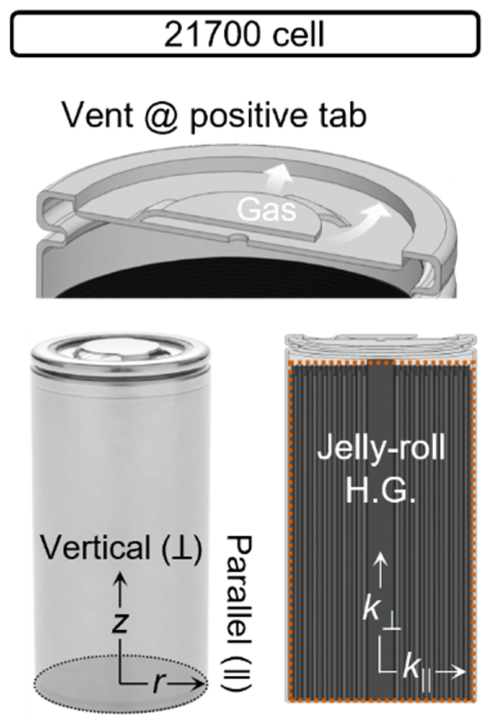
Figure 1 shows a three-dimensional 21700 cylindrical Li-ion cell (4.8 Ah, NCA/graphite, SAMSUMG SDI, Yongin-si, Republic of Korea) geometry. Although the internal jelly-roll structure (anode–separator–cathode) is modeled as a single material, the anisotropic thermal conductivity induced by its layered configuration is considered.
Figure 1.
Schematics of a 21700 Li-ion cylindrical cell illustrating the jelly-roll structure with anisotropic thermal conductivity.
The following assumptions are applied in the numerical model:
- Isobaric system with constant material properties.
- Negligible enthalpy of mixing and phase changes.
- Negligible thermal contact resistance at solid-to-solid interfaces.
- Negligible radiation heat transfer owing to the relatively low operating temperatures considered in this study.
The cell-level thermal analysis is incorporated into an energy conservation equation as follows:
where represents the volumetric battery heat generation rate (W·m−3) source term. The initial temperature of the battery is set to 298.15 K. A forced convection boundary condition is applied at the cell surface using Newton’s law of cooling:
where is the heat transfer coefficient, is the surface area of the cell, is the cell temperature, and is the ambient air temperature. The material properties and boundary conditions of the cell used in this study are listed in Table 1.
Table 1.
Material properties and boundary conditions of the cell.
By applying the first law of thermodynamics to an isobaric battery system, the total heat generation rate of the cell is calculated as the sum of the irreversible heat generation rate and reversible heat generation rate , as follows:
The irreversible heat generation rate results from the cell overpotential during operation and can be expressed using the internal resistance of the battery as
The reversible heat generation rate results from the entropy change of the battery. In practical battery systems, the Gibbs free energy change represents the maximum possible electrical work. For a Li-ion secondary battery, the electric work is related to the open-circuit voltage (OCV) as follows:
where is the number of electrons participating in the reaction, and is the Faraday constant. The entropy change is associated with Li-ion insertion and extraction at the electrodes and can be described by the thermodynamic relationship
The reversible heat generation rate can be calculated from the OCV variation with temperature and is simplified as follows:
Polarization refers to any deviation of the cell terminal voltage from the open-circuit voltage owing to current flow through the cell. The voltage response consists of the instantaneous polarization caused by , which results in an immediate voltage drop when the current is applied and an immediate voltage recovery when the current is removed. Furthermore, the polarization slowly decays owing to the diffusion of lithium ions, a phenomenon referred to as diffusion voltage. The terminal voltage at the time step is given by
where represents the resistor current, expressed as
where denotes the capacitance, given by
2.2. Baseline Square-Wave VCP
The square-wave function is a stepwise periodic profile defined as
where denotes the half-period of the square wave. A translation-and-scaling operation is applied to this baseline function as
The translated and scaled square-wave function was optimized by adjusting the translation and scaling parameters to minimize the charging time while satisfying the prescribed electro-thermal constraints. The resulting optimal parameters are listed in Table 2 and define the baseline square-wave VCP used for the subsequent Fourier series analysis.
Table 2.
Baseline square-wave VCP parameters.
2.3. Fourier Series Charging Scheme
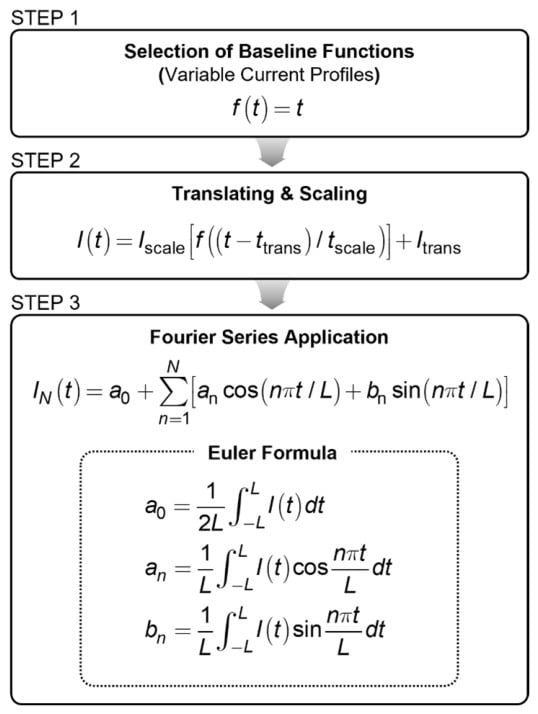
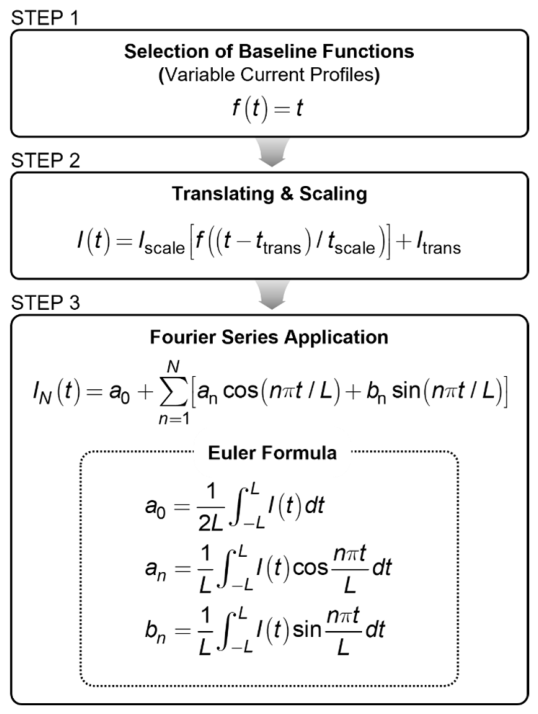
A Fourier series-based optimization framework is applied to the baseline square-wave function to further optimize its charging performance, as shown in Figure 2. The Fourier series approximates a periodic baseline function with period as an infinite sum of sinusoidal harmonic terms:
with the Fourier coefficients obtained from the Euler formula:
Figure 2.
Fourier series-based optimization framework.
Rather than approximating with , this study strategically truncates the series at a finite number of harmonic terms to introduce controlled perturbations to the baseline function:
is denoted the Fourier series-based square wave (F-square wave). As N increases, more closely approximates the baseline function, thereby reducing the approximation error , defined as the square error between approximated function and the baseline function:
However, near the stepwise discontinuity, this approximation produces a persistent overshoot known as the Gibbs phenomenon, which does not vanish regardless of N. In this study, the vertical component of this overshoot is denoted , and the horizontal approximation error associated with the smooth current transition before and after the overshoot is denoted . This overshoot is treated as a controlled perturbation that accelerates the charging current near the discontinuity, and the harmonic term number N is introduced as a key optimization variable, which provides greater flexibility in the optimization of charging current. To determine the optimal harmonic term number, the charging performance is evaluated for integer values of N ranging from 1 to 100.
2.4. Optimization Constraints and Risk Assessment
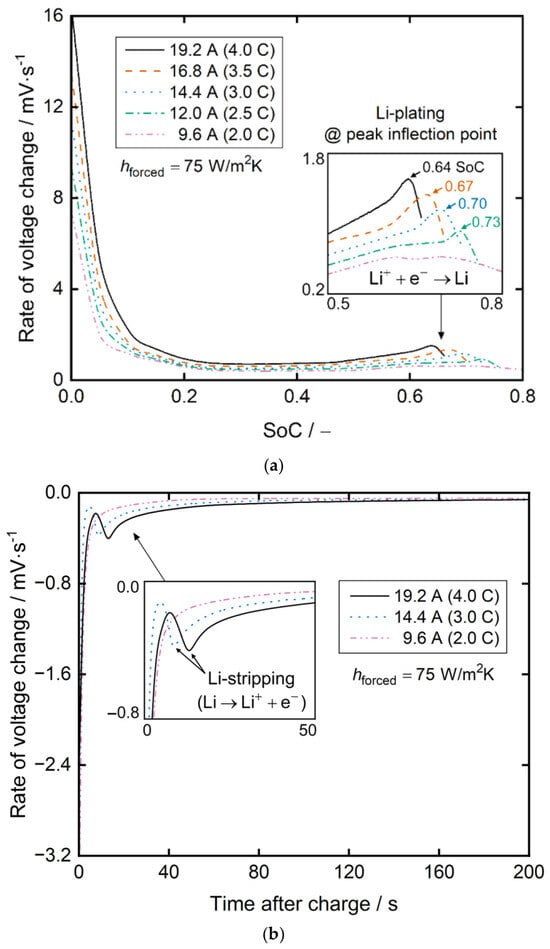
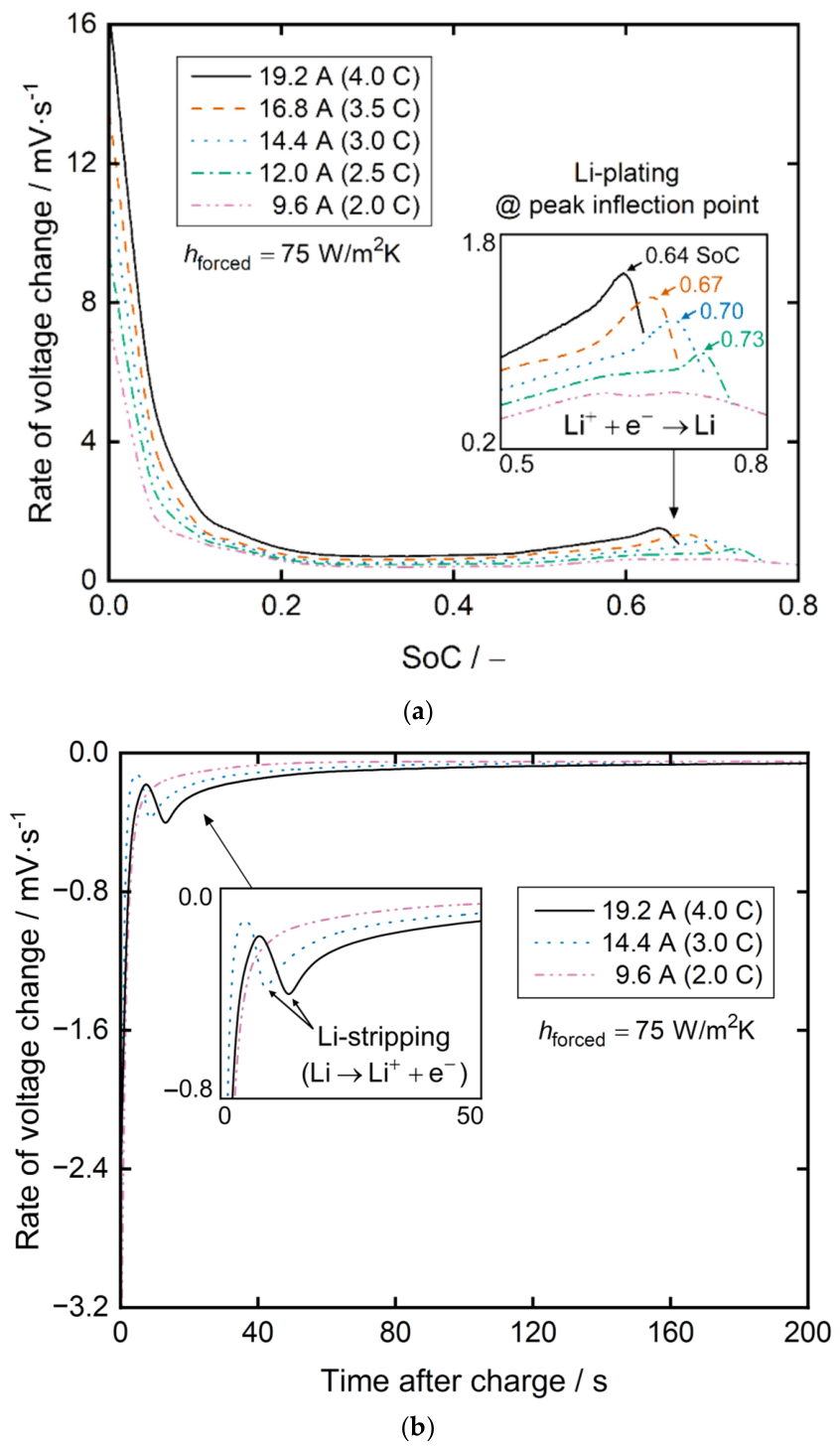
The thermal and electrical constraint bounds applied to the cell, including the maximum temperature, temperature difference, terminal voltage, and charging current, are summarized in Table 3. It should be noted that lithium-plating behavior was experimentally characterized at different charging rates to establish an additional charging-current condition for XFC. Figure 3a shows the onset of lithium plating at high SoCs [24,25], while Figure 3b shows characteristic Li-stripping behavior during voltage relaxation [26,27]. Higher charging currents caused lithium plating to occur at lower SoCs, whereas no noticeable plating or stripping behavior was observed at 2 C. Based on these experimentally identified current-dependent Li-plating characteristics, the charging current was restricted in the late charging stage to avoid operating beyond the Li-plating onset condition up to the target SoC of 0.8. Thus, lithium plating was considered through an additional charging-current condition, although it was not included as an independent degradation model. Long-term aging was not included as an explicit optimization objective in the present framework and remains an important subject for further investigation.
Table 3.
Optimization constraint bounds for the cell.
Figure 3.
Experimental characterization of lithium plating and stripping phenomena. (a) Voltage derivative (dV/dt) plots identifying Li-plating onset at distinct charging rates, and (b) voltage relaxation curves demonstrating clear Li-stripping behavior immediately after charging.
For each evaluated harmonic term , the charging time with penalty is calculated as
where represents the extent to which each constraint exceeds its prescribed limit, specifically for each physical quantity (, , , ). When is below zero, that is, , the charging time has no penalty, that is, . The parameter is the penalty coefficient, selected to ensure stable convergence and prevent the search from favoring constraint-violating solutions. Different orders of were applied to account for the different numerical scales of the constraint violations, as summarized in Table 4. The harmonic term number that minimizes without exceeding the allowable thermal and electrical constraints is selected as the optimal value.
Table 4.
Penalty coefficients for electro-thermal constraints.
To further evaluate the proximity of each thermal and electrical quantity to its allowable constraint, a normalized risk expression, ranging from 0 (safe) to 1 (risky), is defined as
where represents the lower bound and corresponds to the upper bound of the respective constraint. The risk terms defined in this study represent physical safety indicators used to evaluate how closely the operating condition approaches the allowable constraints, whereas the penalty term serves as a mathematical constraint that prevents the search process from violating the prescribed limits. The risk metric and the penalty function play distinct roles in performance evaluation and optimization enforcement, respectively.
3. Results and Discussion
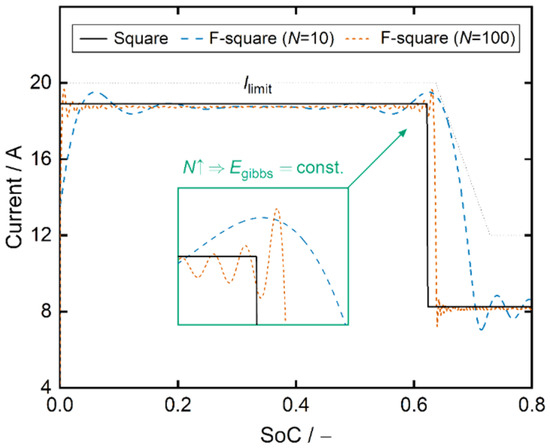
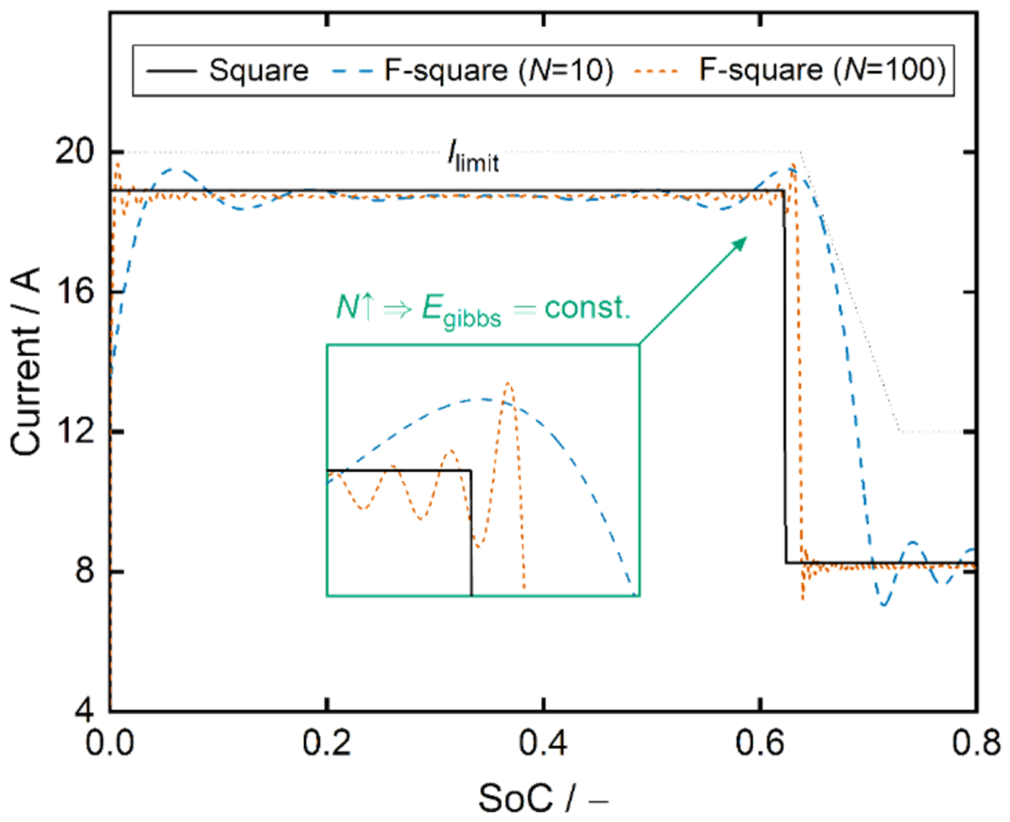
The finite Fourier representation progressively recovers the intrinsic shape of the baseline square wave as the harmonic term number N increases. As shown in Figure 4, the F-square wave at N = 100 more closely approximates the baseline profile than that at N = 10, except near the discontinuity where the Gibbs overshoot persists. This trend is consistent with the general property of the Fourier series, in which a larger number of harmonic terms yields a closer approximation to the target function away from any discontinuity.
Figure 4.
Fourier series-based reshaping of the baseline square-wave charging profile.
However, near the stepwise discontinuity at approximately 0.63 SoC, both the N = 10 and N = 100 profiles exhibit a persistent overshoot that does not diminish in magnitude despite the increase in N. This behavior is a direct manifestation of the Gibbs phenomenon, in which the overshoot near a discontinuity remains approximately constant regardless of the number of harmonic terms used to approximate the function. Rather than being suppressed by additional harmonic terms, this overshoot persists as an intrinsic feature of the truncated Fourier series.
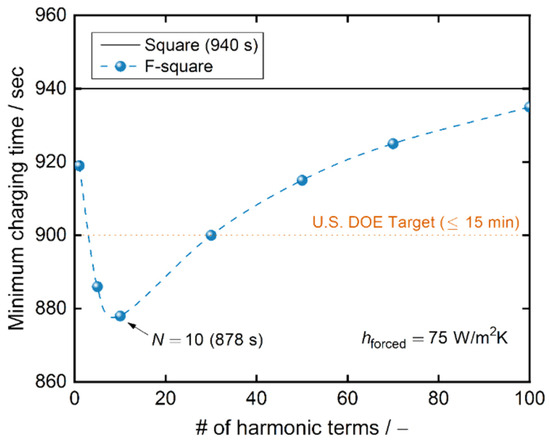
The charging performance exhibits a non-monotonic dependence on the harmonic term number N, as shown in Figure 5. The minimum charging time is obtained at N = 10, which represents the global optimum over the complete integer range of N = 1–100 evaluated in this study. This optimum results from the competing effects of waveform preservation and finite-series perturbation. At relatively low N, the intrinsic square-wave shape is insufficiently preserved, whereas increasing N beyond the optimum progressively restores the baseline profile and reduces the perturbation responsible for charging acceleration. These results indicate that selecting an appropriate harmonic term number is critical for balancing the approximation accuracy and charging performance improvement.
Figure 5.
Effect of the harmonic term number on the charging performance of the F-square wave.
The baseline square-wave VCP (940 s) is further improved through the Fourier series-based approach proposed in this study. The optimal F-square wave of N = 10 (878 s) achieves an additional 6.6% reduction in charging time compared with the baseline square wave, notably enabling the profile to meet the U.S. DOE 15-min XFC target (900 s), which the baseline square wave alone does not achieve.
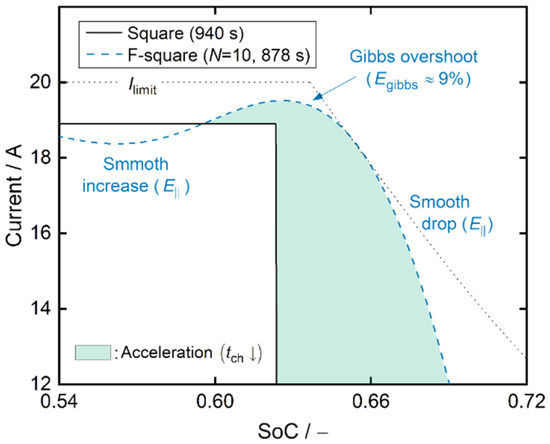
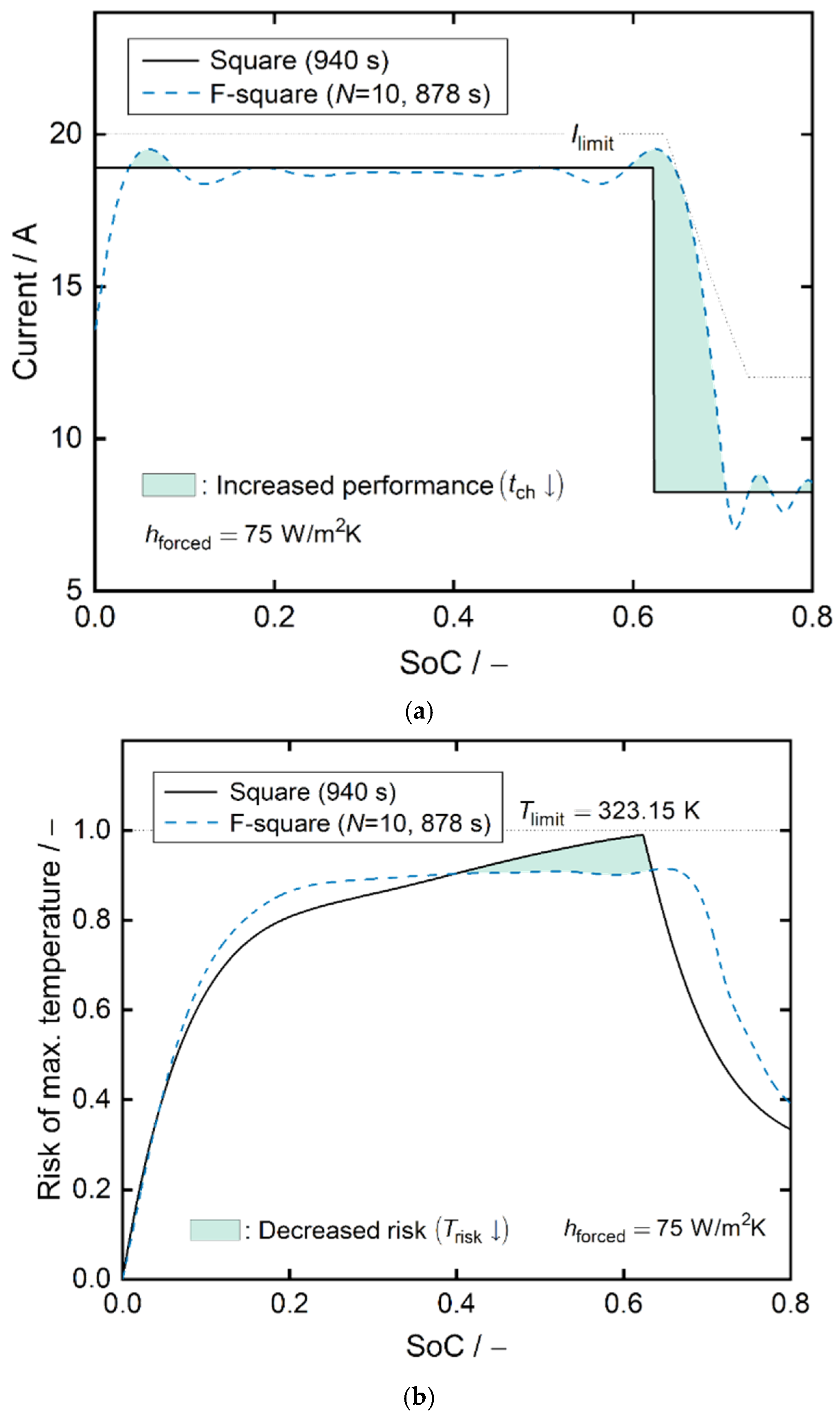
The charging-time reduction at N = 10 originates primarily from the reshaped current transition near the discontinuity at approximately 0.63 SoC. As illustrated in Figure 6, the baseline square wave exhibits a stepwise current reduction at the discontinuity, as it reaches the temperature risk and terminal voltage risk simultaneously. In contrast, the F-square wave introduces a vertical perturbation owing to the Gibbs overshoot, , which enables a higher charging current close to the allowable current limit (). Moreover, the optimal harmonic term (N = 10) increases the horizontal approximation error , creating a smooth current increase before the Gibbs overshoot and a smooth current drop afterward. This smooth current transition maximizes the charging acceleration at the discontinuity, which explains the 6.6% reduction in charging time discussed above, and reduces the thermal risk near the discontinuity relative to the baseline square wave. Regardless of the number of harmonic terms N, the Gibbs overshoot does not disappear, maintaining an approximation error of approximately 9% before and after the discontinuity. Although the Gibbs overshoot is generally recognized as a fundamental limitation of the Fourier series when approximating discontinuous functions, this behavior is reinterpreted in this study as an additional advantageous factor for optimizing the dynamic charging waveform, rather than as an artifact to be suppressed. The overshoot originates mathematically from the finite Fourier approximation, whereas its use as a controlled perturbation is restricted by the prescribed charging current and electro-thermal constraints. It should be noted that the Gibbs overshoot itself is not inherently safe. Its effect on the terminal voltage depends on the OCV and polarization state at the time of the perturbation. In the present case, the overshoot occurs locally near the discontinuity at approximately 0.63 SoC and remains within the prescribed terminal voltage limit. Moreover, all harmonic term numbers are evaluated under the prescribed electro-thermal constraints, and any condition exceeding the allowable limits is penalized according to Equation (19).
Figure 6.
Gibbs overshoot and current transition at the discontinuity of the F-square wave.
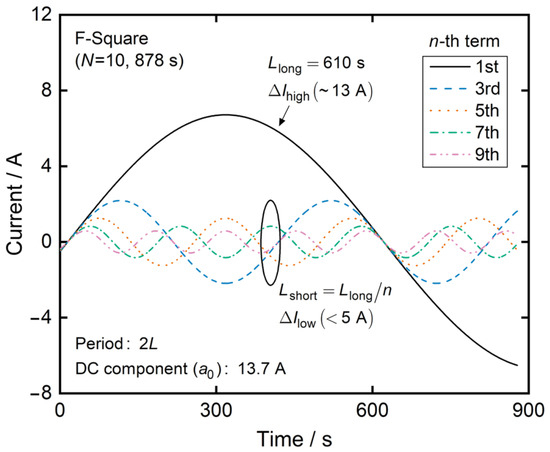
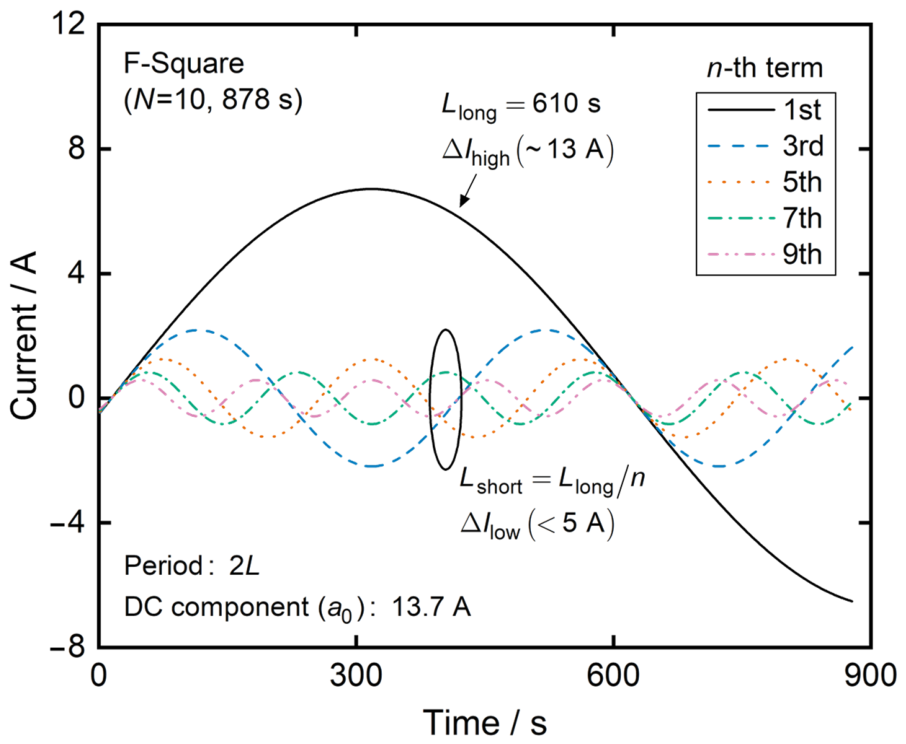
The role of each harmonic component can be further identified by decomposing the optimal F-square wave. As presented in Figure 7, the optimal F-square wave (N = 10) is decomposed into individual nth-order harmonic components. Based on the Fourier series and Euler formula, the period and amplitude of each harmonic component decrease with increasing harmonic order n. The first-order harmonic term (n = 1), characterized by a long period and large amplitude, primarily governs the overall shape of the perturbation and the acceleration near the discontinuity, whereas the higher-order harmonic terms (n > 1), characterized by progressively shorter periods and smaller amplitudes, provide fine adjustments to the current profile throughout the remainder of the charging process. These decomposed values are summarized quantitatively in Table 5.
Figure 7.
Harmonic decomposition of the optimal F-square wave.
Table 5.
Fourier series harmonic decomposition of the optimized F-square wave, N = 10.
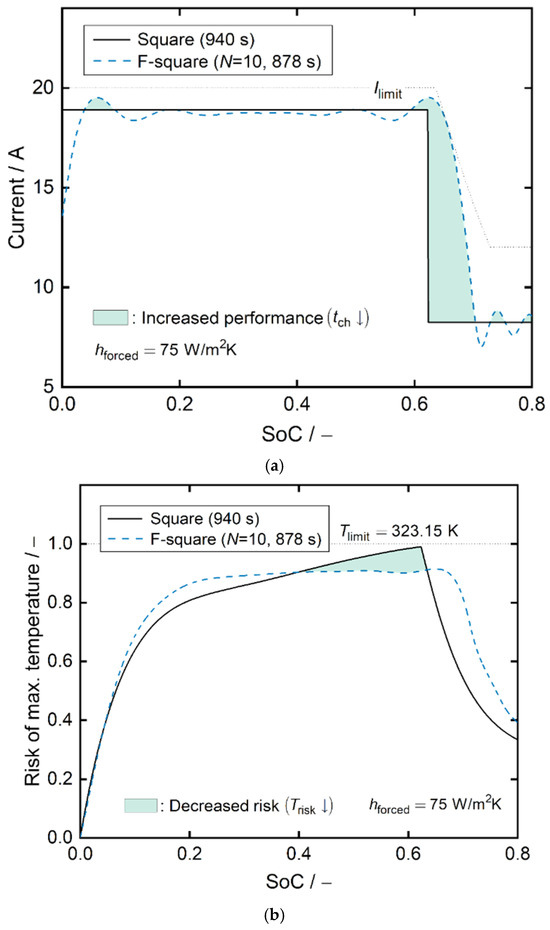
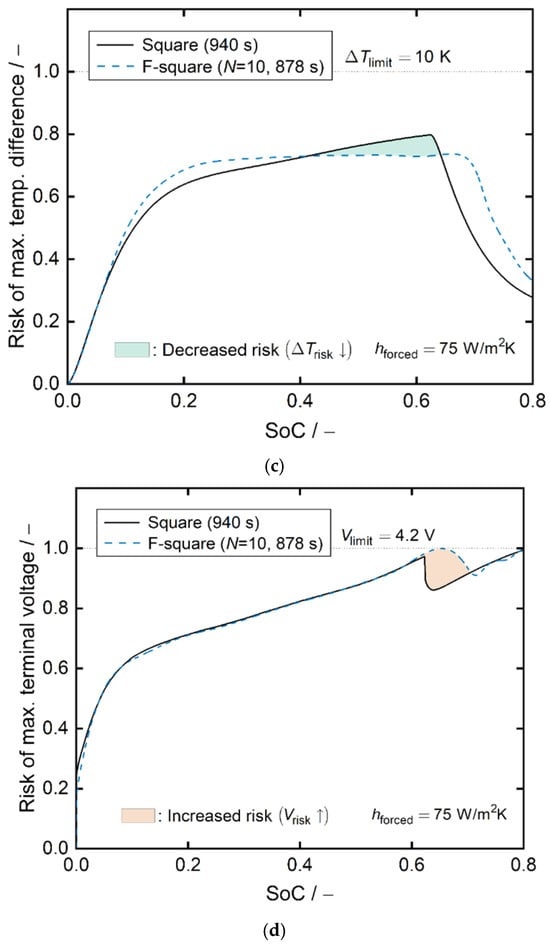
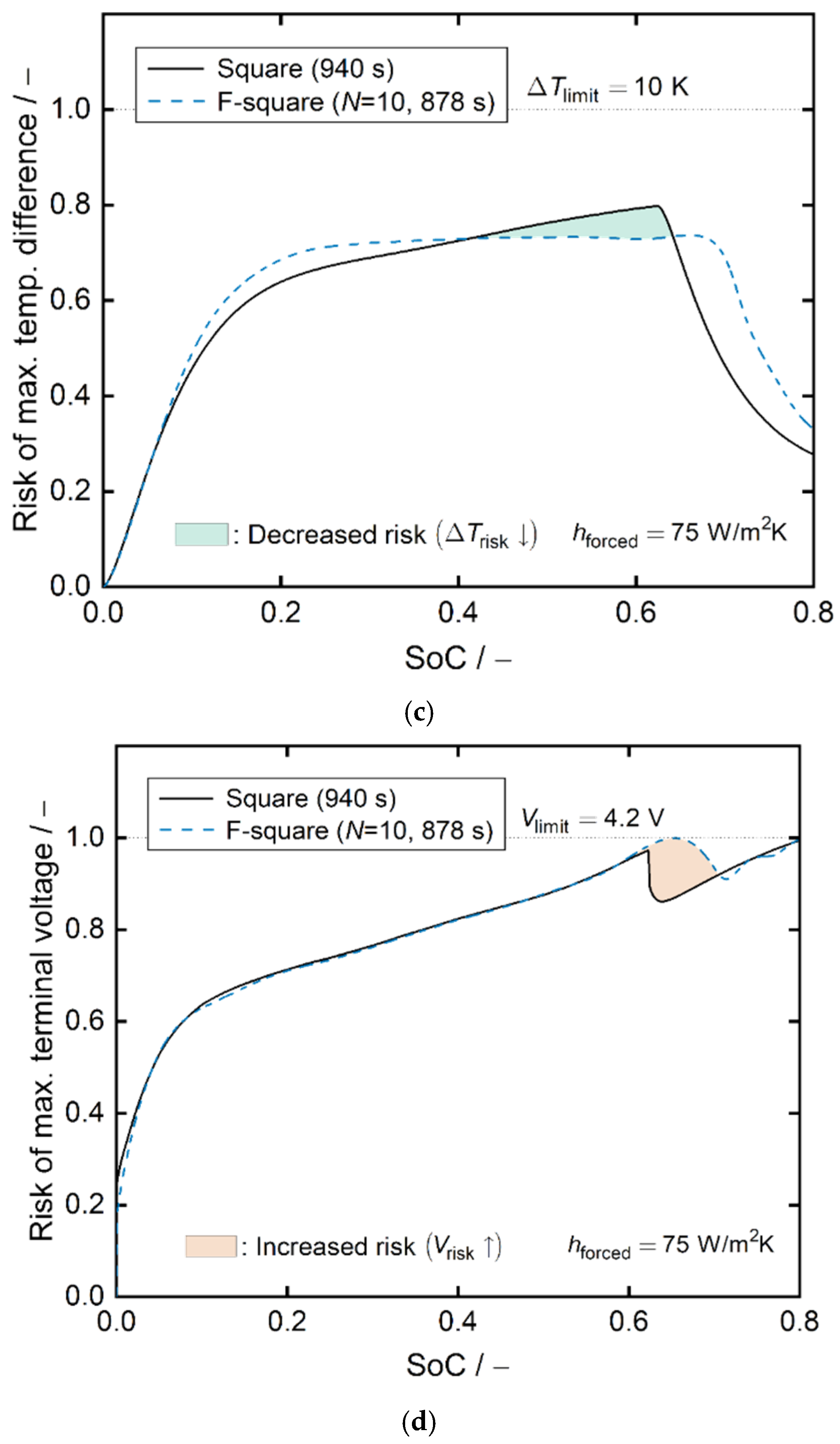
The improved charging performance is accompanied by different responses of the thermal and electrical constraint risks. As shown in Figure 8a, the F-square wave (878 s) reduces the charging time relative to the baseline square wave (940 s). Figure 8b presents the evolution of the maximum temperature risk . Both the baseline square wave and the F-square wave exhibit a similar temperature risk trend throughout the charging process, indicating that the Fourier series perturbation does not substantially alter the temperature risk. Figure 8c represents the evolution of the temperature difference risk . Near the discontinuity, the F-square wave exhibits a slightly lower than the baseline square wave, consistent with the smoother current transition introduced by the Fourier series perturbation. Figure 8d shows the evolution of the terminal voltage risk . Near the discontinuity, the F-square wave exhibits a slightly higher than the baseline square wave, reflecting the higher instantaneous charging current enabled by the Gibbs overshoot. These results indicate a trade-off between the thermal and electrical risks introduced by the Fourier series-based optimization: the smoother current transition reduces the temperature difference risk, while the higher peak current near the discontinuity increases the terminal voltage risk. Nevertheless, the corresponding physical quantities remain within their prescribed limits throughout the charging process, confirming that the improvement in charging speed achieved by the F-square wave is realized without violating the electro-thermal constraints of the cell.
Figure 8.
Electro-thermal constraint comparison between the baseline square wave and the F-square wave. (a) Charging time comparison. Evolution of (b) maximum temperature risk, (c) temperature difference risk, and (d) terminal voltage risk for the baseline square wave and the optimal F-square wave (N = 10).
4. Conclusions
This study presents a computational electro-thermally constrained optimization framework in which a finite Fourier series is applied to an optimized baseline square-wave VCP to further improve XFC performance. By evaluating harmonic term numbers from N = 1 to 100, the optimal F-square wave was identified at N = 10, reducing the charging time from 940 to 878 s (6.6%) and satisfying the U.S. DOE 15-min XFC target. The improved charging performance originates from the finite Fourier perturbation near the waveform discontinuity. The Gibbs overshoot enables a locally higher charging current close to the allowable current limit, while the finite-series approximation smooths the current transition before and after the discontinuity. Harmonic decomposition further indicates that the first-order harmonic term primarily governs the overall perturbation shape, whereas the higher-order terms provide finer adjustment of the charging profile. The Fourier series-based optimization also introduces a trade-off between the thermal and electrical constraints. The smoother current transition reduces the temperature difference near the discontinuity, whereas the higher instantaneous current slightly increases the terminal voltage risk. Nevertheless, the maximum temperature, temperature difference, charging current, and terminal voltage remain within their prescribed limits throughout the charging process. These findings demonstrate that finite Fourier perturbation can provide an effective computational strategy for overcoming the intrinsic waveform limitation of discontinuous charging profiles under electro-thermal constraints.
Author Contributions
N.L.: Conceptualization, Formal Analysis, Methodology, Validation, Investigation, Writing—original draft; J.C.: Data curation, Resources, Software, Visualization; T.K.: Data curation, Visualization; S.P.: Data curation, Visualization; S.U.: Conceptualization, Formal Analysis, Funding acquisition, Investigation, Supervision, Project administration, Writing—review & editing. All authors have read and agreed to the published version of the manuscript.
Funding
This research was funded by the Korea Evaluation Institute of Industrial Technology [Grant Numbers 1415187481 and 2410004195].
Data Availability Statement
Data will be made available on request.
Acknowledgments
This study was supported by the Korea Evaluation Institute of Industrial Technology [Grant Numbers 1415187481 and 2410004195].
Conflicts of Interest
The authors declare no conflicts of interest.
References
- United Nations. The Paris Agreement, United Nations Framework Convention on Climate Change. 2015. Available online: https://unfccc.int/sites/default/files/resource/parisagreement_publication.pdf (accessed on 12 December 2015).
- IPCC. Climate Change 2023: Synthesis Report. Contribution of Working Groups I, II and III to the Sixth Assessment Report of the Intergovernmental Panel on Climate Change; Core Writing Team, Lee, H., Romero, J., Eds.; IPCC: Geneva, Switzerland, 2023; pp. 35–115. [Google Scholar]
- Howell, D.; Boyd, S.; Cunningham, B.; Gillard, S.; Slezak, L.; Ahmed, S.; Bloom, I.; Burnham, A.; Hardy, K.; Jansen, A.N.; et al. Enabling Fast Charging: A Technology Gap Assessment; Idaho National Laboratory (INL): Idaho Falls, ID, USA, 2017. [Google Scholar]
- Meintz, A.; Zhang, J.; Vijayagopal, R.; Kreutzer, C.; Ahmed, S.; Bloom, I.; Burnham, A.; Carlson, R.B.; Dias, F.; Dufek, E.J.; et al. Enabling fast charging–Vehicle considerations. J. Power Sources 2017, 367, 216–227. [Google Scholar] [CrossRef] [Scilit]
- Wang, C.Y.; Liu, T.; Yang, X.G.; Ge, S.; Stanley, N.V.; Rountree, E.S.; Leng, Y.; McCarthy, B.D. Fast charging of energy-dense lithium-ion batteries. Nature 2022, 611, 485–490. [Google Scholar] [CrossRef] [Scilit] [PubMed]
- Zhang, H.; Wang, L.; Li, H.; He, X. Criterion for identifying anodes for practically accessible high-energy-density lithium-ion batteries. ACS Energy Lett. 2021, 6, 3719–3724. [Google Scholar] [CrossRef] [Scilit]
- Deng, J.; Bae, C.; Denlinger, A.; Miller, T. Electric vehicles batteries: Requirements and challenges. Joule 2020, 4, 511–515. [Google Scholar] [CrossRef] [Scilit]
- Zeng, Y.; Zhang, B.; Fu, Y.; Shen, F.; Zheng, Q.; Chalise, D.; Miao, R.; Kaur, S.; Lubner, S.D.; Tucker, M.C.; et al. Extreme fast charging of commercial Li-ion batteries via combined thermal switching and self-heating approaches. Nat. Commun. 2023, 14, 3229. [Google Scholar] [CrossRef] [Scilit] [PubMed]
- U.S. Department of Energy. Department of Energy Announces $19 Million for Advanced Battery and Electrification Research to Enable Extreme Fast Charging; U.S. Department of Energy: Washington, DC, USA, 2018.
- United States Advanced Battery Consortium. Development of Advanced Low-Cost/Fast-Charge (LC/FC) Batteries for Electric Vehicle (EV) Applications; United States Advanced Battery Consortium: Southfield, MI, USA, 2018. [Google Scholar]
- Keyser, M.; Pesaran, A.; Li, Q.; Santhanagopalan, S.; Smith, K.; Wood, E.; Ahmed, S.; Bloom, I.; Dufek, E.; Shirk, M.; et al. Enabling fast charging–Battery thermal considerations. J. Power Sources 2017, 367, 228–236. [Google Scholar] [CrossRef] [Scilit]
- Finegan, D.P.; Scheel, M.; Robinson, J.B.; Tjaden, B.; Hunt, I.; Mason, T.J.; Millichamp, J.; Di Michiel, M.; Offer, G.J.; Hinds, G.; et al. In-operando high-speed tomography of lithium-ion batteries during thermal runaway. Nat. Commun. 2015, 6, 6924. [Google Scholar] [CrossRef] [Scilit] [PubMed]
- Tomaszewska, A.; Chu, Z.; Feng, X.; O’kane, S.; Liu, X.; Chen, J.; Ji, C.; Endler, E.; Li, R.; Liu, L.; et al. Lithium-ion battery fast charging: A review. eTransportation 2019, 1, 100011. [Google Scholar] [CrossRef] [Scilit]
- Weiss, M.; Ruess, R.; Kasnatscheew, J.; Levartovsky, Y.; Levy, N.R.; Minnmann, P.; Stolz, L.; Waldmann, T.; Wohlfahrt-Mehrens, M.; Aurbach, D.; et al. Fast charging of lithium-ion batteries: A review of materials aspects. Adv. Energy Mater. 2021, 11, 2101126. [Google Scholar] [CrossRef] [Scilit]
- Sikha, G.; Ramadass, P.; Haran, B.S.; White, R.E.; Popov, B.N. Comparison of the capacity fade of Sony US 18650 cells charged with different protocols. J. Power Sources 2003, 122, 67–76. [Google Scholar] [CrossRef] [Scilit]
- Lu, Y.; Han, X.; Lu, L.; Feng, X.; Ouyang, M. Optimal charging strategy for lithium-ion batteries based on model predictive control with coupled thermal-electric decomposed electrode model. IEEE Trans. Ind. Appl. 2024, 60, 6582–6592. [Google Scholar] [CrossRef] [Scilit]
- Jaguemont, J.; Darwiche, A.; Bardé, F. Model Predictive Control Using an Artificial Neural Network for Fast-Charging Lithium-Ion Batteries. World Electr. Veh. J. 2025, 16, 231. [Google Scholar] [CrossRef] [Scilit]
- Zhuang, Z.; Chen, H.; Chen, Y.; Luan, W.; Chen, H.; Ji, X. Transformer-based model predictive control with anode potential awareness for online fast charging optimization of lithium-ion batteries. Appl. Energy 2026, 404, 127158. [Google Scholar] [CrossRef] [Scilit]
- An, F.; Zhang, R.; Wei, Z.; Li, P. Multi-stage constant-current charging protocol for a high-energy-density pouch cell based on a 622NCM/graphite system. RSC Adv. 2019, 9, 21498–21506. [Google Scholar] [CrossRef] [Scilit] [PubMed]
- Tahir, M.U.; Sangwongwanich, A.; Stroe, D.I.; Blaabjerg, F. Overview of multi-stage charging strategies for Li-ion batteries. J. Energy Chem. 2023, 84, 228–241. [Google Scholar] [CrossRef] [Scilit]
- Guo, Z.; Liaw, B.Y.; Qiu, X.; Gao, L.; Zhang, C. Optimal charging method for lithium ion batteries using a universal voltage protocol accommodating aging. J. Power Sources 2015, 274, 957–964. [Google Scholar] [CrossRef] [Scilit]
- Kreyszig, E. Advanced Engineering Mathematics, 10th ed.; John Wiley & Sons: Hoboken, NJ, USA, 2012. [Google Scholar]
- Jerri, A.J. The Gibbs Phenomenon in Fourier Analysis, Splines and Wavelet Approximations; Springer Science & Business Media: Cham, Switzerland, 1998. [Google Scholar]
- Uhlmann, C.; Illig, J.; Ender, M.; Schuster, R.; Ivers-Tiffée, E. In situ detection of lithium metal plating on graphite in experimental cells. J. Power Sources 2015, 279, 428–438. [Google Scholar] [CrossRef] [Scilit]
- Lee, D.; Kim, B.; Shin, C.B. Modeling fast charge protocols to prevent lithium plating in a lithium-ion battery. J. Electrochem. Soc. 2022, 169, 090502. [Google Scholar] [CrossRef] [Scilit]
- Yang, X.G.; Ge, S.; Liu, T.; Leng, Y.; Wang, C.Y. A look into the voltage plateau signal for detection and quantification of lithium plating in lithium-ion cells. J. Power Sources 2018, 395, 251–261. [Google Scholar] [CrossRef] [Scilit]
- von Lüders, C.; Zinth, V.; Erhard, S.V.; Osswald, P.J.; Hofmann, M.; Gilles, R.; Jossen, A. Lithium plating in lithium-ion batteries investigated by voltage relaxation and in situ neutron diffraction. J. Power Sources 2017, 342, 17–23. [Google Scholar] [CrossRef] [Scilit]

Disclaimer/Publisher’s Note: The statements, opinions and data contained in all publications are solely those of the individual author(s) and contributor(s) and not of MDPI and/or the editor(s). MDPI and/or the editor(s) disclaim responsibility for any injury to people or property resulting from any ideas, methods, instructions or products referred to in the content. |
© 2026 by the authors. Licensee MDPI, Basel, Switzerland. This article is an open access article distributed under the terms and conditions of the Creative Commons Attribution (CC BY) license.