


Abstract
Coral reef degradation has accelerated the development of active restoration approaches, including the use of mid-water coral nurseries (Floating Reef Devices; FRDs) designed to enhance coral growth and survival. Although primarily used for coral propagation, the broader ecological roles of FRDs remain poorly understood. We assess the biodiversity and ecological structure of a long-term FRD deployed in the Gulf of Eilat over two decades as an active coral nursery. We surveyed naturally recruited sessile organisms and associated fish communities, quantifying taxonomic breadth and distinctness (Δ+), functional diversity, and trophic structure. The FRD supported a diverse community spanning eight phyla and 128 genera, with high taxonomic distinctness and wide functional trait representation across multiple trophic levels. Despite lower genus richness compared to natural habitats, coral and fish assemblages exhibited taxonomic and functional patterns that fell within the range observed for the adjacent natural reef. Functional analyses showed that the FRD’s coral assemblage occupied nearly the full regional trait space, while fish biomass was dominated by planktivores and secondary consumers, indicating a differently structured trophic organization. These findings demonstrate that long-term floating nursery systems can develop into structurally complex, multi-trophic communities, providing ecological and conservation values and ecosystem services beyond their original restoration role. These findings provide an ecological foundation for future studies of floating restoration systems and their associated ecological roles, while also informing their design, implementation, and evaluation as practical tools for enhancing ecosystem recovery and associated ecological functions.
1. Introduction
Coral reefs are highly biodiverse and functionally complex marine ecosystems supporting a wide range of ecological processes and ecosystem services, yet they are declining rapidly due to climate change, ocean acidification, overfishing, and local anthropogenic stressors [1,2]. Where natural recovery is insufficient, active reef restoration has become an essential tool to recover the functionality of the habitat, with coral gardening emerging as one of the most widely adopted approaches globally [3]. This two-step intervention involves creating coral stocks through sexual or asexual propagation in mid-water floating nurseries, followed by their transplantation onto degraded reef areas [4,5]. These nurseries, typically floating or suspended structures, are designed to optimize coral growth and survival by enhancing water flow to better intercept particles by suspension-feeding organisms, and reducing sedimentation, as impacts of coralivorous taxa [6,7,8,9]. When left to mature rather than totally harvested, these structures are progressively populated by naturally recruited sessile and mobile organisms in addition to the transplanted corals, evolving into what we have termed Floating Reef Devices (FRDs), mid-water oases in oligotrophic open water, sustained primarily by the photosynthetic activity of their symbiotic-mixotrophic coral communities [10].
Despite this potential, the ecological roles of FRDs in supporting biodiversity and ecosystem functioning remain poorly understood. Most studies have focused on coral physiological performance (growth and survivorship) and transplantation success, while the few ecological investigations have mainly described colonization patterns and benthic succession [11,12]. Consequently, it is still unknown whether long-term FRDs develop into ecologically integrated ecosystems rather than simply assemblages associated with coral propagation structures. In particular, it remains unclear whether long-term nursery systems attain the taxonomic, functional, and trophic complexity comparable to that of natural reef communities. Building on this conceptual framework, we propose that mid-water floating artificial structures, including coral nurseries and other aquaculture installations, may, when associated with habitat-forming species and allowed to mature, evolve into FRDs that provide ecological services beyond their intended purpose. Previous work has qualitatively and conceptually proposed that such structures may evolve into floating reef ecosystems over time, beyond their primary goal of producing coral biomass for restoration [10,11]. Yet, this concept has not been rigorously tested using quantitative, multi-dimensional biodiversity frameworks. Understanding whether and how these systems support ecological complexity is critical for evaluating their role in conservation, restoration, and emerging nature-based solutions. To evaluate this conceptual framework, we tested the hypothesis that a mature FRD exhibits the characteristics of an ecologically integrated ecosystem. Specifically, we predicted that its taxonomic, functional, and trophic structure would resemble that of the adjacent natural reef community.
In this study, we use a long-term FRD deployed in the Gulf of Eilat as a case study to assess the biodiversity, taxonomic structure, and functional structure. The studied structure, originally a fish cage in an offshore aquaculture facility, was deployed in 2008 to function as a mid-water coral nursery for restoration studies. Using taxonomic distinctness metrics, functional trait analyses, and trophic characterization across large sessile and mobile fauna, we evaluate whether the FRD supports a structured ecosystem rather than a simple species aggregation. Furthermore, we compare the FRD community with that of the adjacent natural reef to place its ecological properties within a regional context. If such structures consistently support high taxonomic, functional, and trophic complexity, they should be viewed not only as restoration tools but also as ecological systems in their own right. Here we thus introduce the concept of a “biodiversity hub”, defined as a compact, human-made structure that supports a wide range of ecological functions and services through the development of high biodiversity and functional complexity. This provides a conceptual framework for highlighting how engineered marine systems contribute not only to restoration activities but also to broader conservation and ecosystem service objectives.
2. Materials and Methods
2.1. Floating Reef Device Description
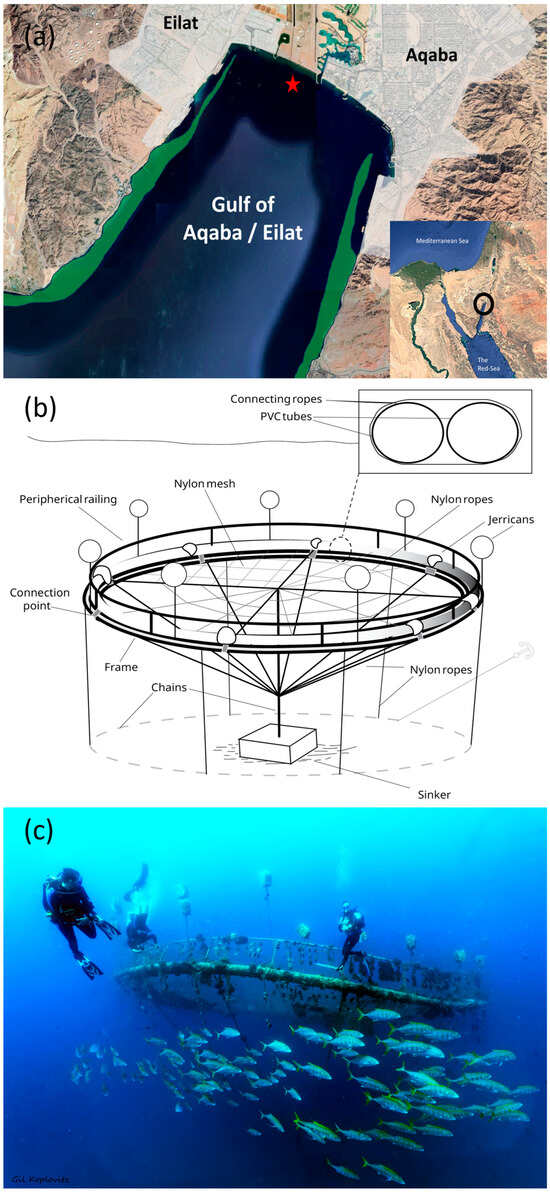
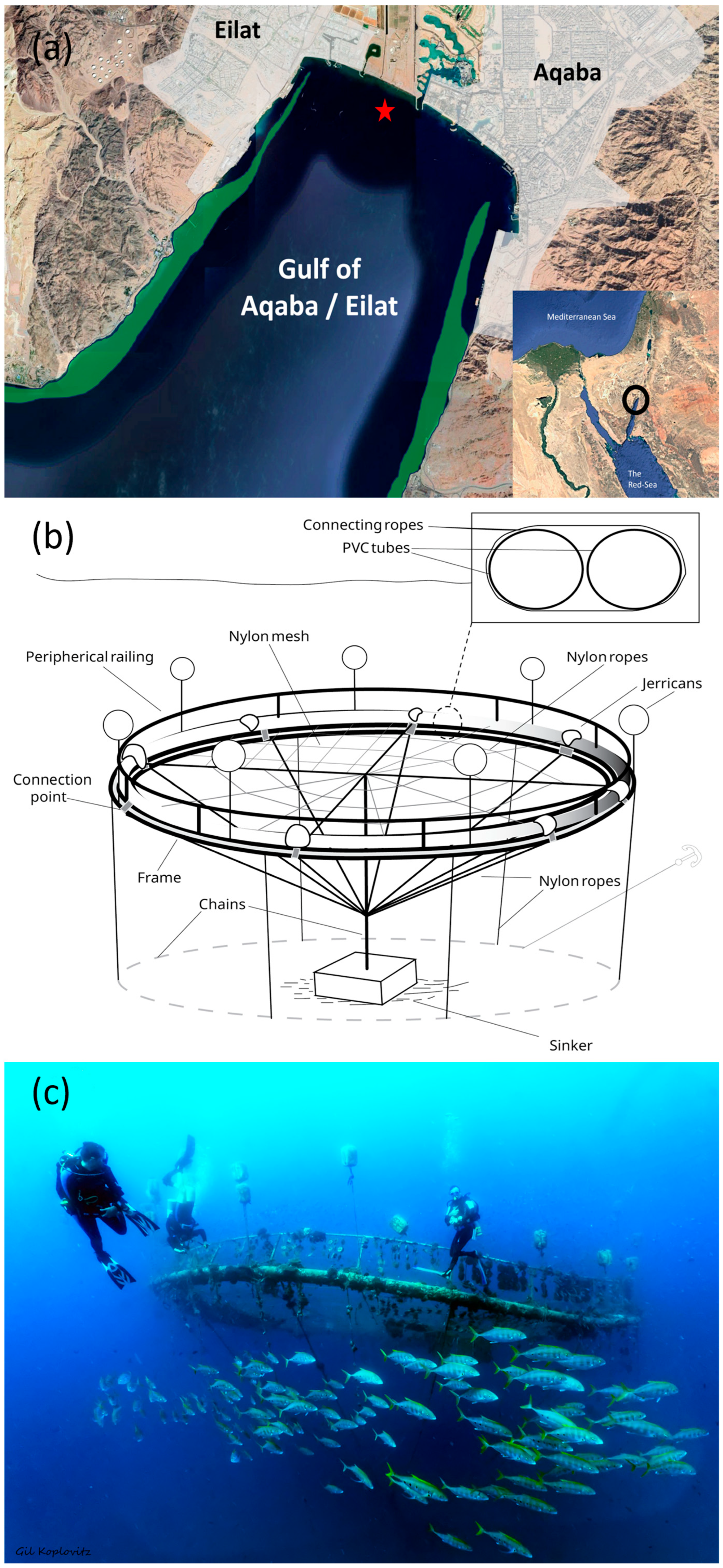
The FRD is located at the northern tip of the Gulf of Eilat (Red Sea; 29°32′24.02″ N, 34°58′28.77 E, Figure 1a), north of the coral reef and the marine protected area, on a sandy bottom. It consists of a circular floating platform constructed from two PVC tubes (25 cm diameter each; hereafter referred to as the “frame”; Figure 1), with a total diameter of 10 m. A peripheral railing is attached to the frame at 32 evenly spaced connection points. Approximately 25% of the platform area is covered with nylon mesh, while the remaining area is spanned by tension ropes arranged radially in a spider-web-like configuration. Coral colonies are grown on trays that are attached to the rope network. Since its deployment in 2008, the FRD has served as an experimental coral nursery, with coral colonies periodically added and harvested for restoration and research purposes. Consequently, the number of trays, as well as the size, abundance, and species composition of cultivated corals, has varied over time depending on the objectives of individual experiments.
Figure 1.
Study location and the Eilat’s Floating Reef Device. (a) Location of the study site in the northern Gulf of Aqaba/Eilat, Red Sea. The red star indicates the location of the FRD. The green shaded areas represent shallow coral reef habitat extending from approximately 1 to 50 m depth. The inset shows the location of the study area within the northern Red Sea. (b) Schematic illustration of the FRD deployed in the Gulf of Eilat. The system consists of a circular floating frame made of two PVC tubes, supported by distributed buoyancy elements (jerrycans) and stabilized by vertical nylon ropes. A peripheral railing and mesh-covered sections provide structural support and substrate for coral cultivation. The structure is suspended in the mid-water column and anchored to the seabed by a chain connected to a concrete sinker. The radial rope configuration creates a three-dimensional framework used for coral growth and habitat formation. (c) A photo of the FRD from a distance (with associated school of fish; photographed by and copyrights: Gil Koplovitz).
The system’s sinker is deployed at a seabed depth of ~21–22 m (depending on tides), and the platform is maintained at a depth of ~11 m below the sea surface. The FRD is anchored using a system composed of a ~1-ton concrete sinker, a 1-ton depth-adjusted metal chain and an additional anchor located at some distance from the FRD. Sixteen vertical nylon ropes connect the frame to the chain, while 8 additional ropes extend diagonally from the frame towards the FRD center, converging ~6 m below the center of the platform into a bundled connection attached to the concrete sinker. Buoyancy is provided by 125 air-filled plastic jerrycans (25 L each), distributed both above and below the frame. Over the years, the FRD underwent periodic maintenance, including replacement of buoyancy elements and buoyancy adjustments, ensuring that the structure remained at its intended operating depth.
2.2. Surveys of the FRD
Sessile organisms that naturally recruited to the FRD were surveyed between May and July 2024 using SCUBA across the entire frame, railing, and concrete sinker (100% coverage of these components). Along the rope network and netted bottom section, surveys were conducted using an alternating pattern, with every second rope selected to ensure even representation across all sides and depths of the structure, covering approximately half of the total rope length. Complete coverage of the rope network was not feasible due to time constraints and the structural complexity of the FRD’s three-dimensional structure. Across all structural components, this protocol covered an estimated 80% of the FRD’s total surveyable substrate. Surveys were carried out via visual census, with observations recorded on underwater slates, and supplemented by underwater photography and video (Canon X7 camera equipped with underwater housing). When species could not be reliably identified in the field, recorded images were used for subsequent identification. Organisms were identified to species level based on morphological traits when possible, and to genus level when species-level identification was inconclusive. Colony size was measured directly using a ruler attached to the writing slate or estimated from imagery when scale was known (e.g., corals growing on ropes of known diameter). The minimum detectable colony size was 1 cm. Only naturally recruited sessile animals were documented, while transplanted or experimentally introduced organisms were excluded from the survey. Fish communities were surveyed independently from the sessile community using methods appropriate for mobile fauna and were therefore conducted during a separate field campaign. In addition, logistical constraints prevented both surveys from being conducted concurrently. The fish community associated with the FRD was surveyed in March 2024 by a single full visual census conducted by three experienced SCUBA divers. To ensure standardized spatial coverage and minimize observer overlap, the FRD was divided into three non-overlapping sectors of approximately equal area, with each diver assigned one sector prior to the survey. The census followed a standardized two-step roving visual protocol. First, divers began ~5 m outside the external frame of their assigned FRD section, at the surface, and slowly descended toward the seabed while recording transient fish observed in the water column surrounding the structure, before disturbance by divers. This initial descent lasted approximately 2 min per section and was designed to record species moving around the FRD before they were disturbed by divers. Divers then ascended to the floating level of the FRD and systematically surveyed their assigned section, focusing on benthic and coral-associated species occurring on, within, or immediately adjacent to the coral units and artificial framework. Fish were identified at the species level when possible or to the genus level otherwise. To reduce observer bias and avoid double counting, divers surveyed only their assigned sector, followed identical search procedures, and reconciled uncertain identifications immediately after the dive.
Additional taxa were recorded outside the standardized survey protocol to complement the FRD’s community inventory. Cryptic organisms associated with coral colonies (e.g., taxa living within branches or on colony surfaces) were documented opportunistically during surveys and recorded as present without abundance estimates. Large mobile fauna that were foraging or resting in the FRD (e.g., rays, turtles, and transient predatory fishes) were also recorded during repeated visits to the FRD prior to the formal survey period. These records were integrated into the overall species list, while quantitative estimates (e.g., abundance and biomass) were restricted to taxa surveyed under standardized protocols.
2.3. Analyses
Each identified genus or species was assigned attributes across six categories. First, taxonomic classification was recorded at five hierarchical levels (phylum, class, order, family, and genus; Supplementary Table S1). Second, the trophic strategy was categorized by primary mode of energy acquisition (e.g., filter feeder, herbivores, carnivores). Third, trophic position was assigned according to placement within the food web to facilitate visualization of food-web structure, from primary producers to tertiary consumers. Fourth, a numeric trophic level was defined to provide a continuous estimate of each taxon’s trophic position within the food web. Zooxanthellate corals were classified as mixotrophic (trophic level 1.5), reflecting their dual role as both primary producers and consumers. Fifth, functional role describes each organism’s relationship to habitat structure and is independent of trophic position (e.g., benthic, engineer, reef associate, Transient). Sixth, coral taxa were further characterized by functional traits, including colony morphology, polyp size, coloniality, and reef-building capacity. Taxonomic data were retrieved from WoRMS (www.marinespecies.org); coral functional traits from the Coral Trait Database (https://www.coraltraits.org); and fish trophic data from FishBase (https://www.fishbase.se, accessed on 12 July 2026; Supplementary Table S2).
All analyses were performed in R software (version: 2023.12.1) [13]. Taxonomic richness was quantified across all five hierarchical levels for the full assemblages and separately for sessile and mobile animals. Estimated species richness was calculated by summing the estimated number of species within each documented genus. The total number of genera (genus richness) was independently calculated as the total number of genera recorded, reflecting the conservative nature of genus-level identification since several taxa could not be reliably identified to species level from underwater observations. Evolutionary breadth of the community was assessed using average taxonomic distinctness (Δ+), calculated for the full assemblage and separately for sessile and mobile fauna [14,15]. Delta+ (Δ+) measures the mean taxonomic path length between all possible pairs of taxa, calculated across the taxonomic five-level hierarchy. Under this hierarchy, the theoretical maximum value is 100, which corresponds to a community in which every pair of taxa belongs to a different phylum. Δ+ calculations were performed using the taxondive() function in the vegan package [16] based on a presence-only community matrix and a taxonomic distance matrix generated with taxa2dist(). Genera lacking complete taxonomic information were excluded from the Delta+ calculation.
To compare the FRD coral assemblage with the adjacent natural reef (3–8 km; Figure 1a), we compared Δ+ and variation in taxonomic distinctness (Λ+) against data from the National Monitoring Program (NMP) at the reef of Eilat in 2024 [17]. The NMP surveys the reef annually over several weeks during the summer at three sites across a depth range of 1–20 m, using 10–25 transects (10 m each) for each site–depth combination. Comparisons were conducted for all corals combined, as well as separately for Hexacorallia, Octocorallia, and fish. A shared taxonomic reference pool was constructed from the combined list of genera recorded at either site. Both Δ+ and Λ+ were calculated from a taxonomic distance matrix derived from this shared pool, to ensure that values are directly comparable between sites [14,15,18]. Δ+ deviations from random expectation from each site were assessed using a null model with 1000 random subsets for k genera from the shared pool across a range of richness values, generating 95% simulation envelopes [18], against which both FRD and NMP assemblages were compared.
Functional richness of the FRD naturally recruited community was quantified based on the trait framework described above (Supplementary Table S2) using convex hull area in trait space. Pairwise functional distances among genera were calculated using Gower’s distance coefficient [19], which accommodates mixed variable types, implemented with the gowdis() function in the FD package [20]. Mode of life (sessile/mobile) was excluded from the distance matrix because it represents a broad biological classification rather than a functional trait and would artificially compress trait space, and thus retained only for visualization. Principal coordinates analysis (PCoA) was then applied to the resulting distance matrix using the pcoa() function in the ape package [21], and functional richness was estimated as the convex hull area in the first two PCoA axes [22,23,24]. Convex hull areas were computed separately for the full assemblage, for sessile fauna, and for mobile fauna using the polyarea() function.
To compare functional diversity of the coral assemblage between the FRD and the NMP reef, mean pairwise functional dissimilarity was quantified using Rao’s quadratic entropy (RaoQ) [24,25], which integrates both taxon identity and trait differences, reflecting the average functional distance among taxa within an assemblage. Because genus-level abundance could not be normalized for direct comparison between the FRD and the surveyed NMP, abundance data were excluded from this analysis. RaoQ was therefore calculated from presence-only genus lists, with all genera weighted equally. Four coral-specific traits were used: colony morphology (categorical), polyp size (ordinal), coloniality (categorical), and reef-building status (binary; Supplementary Table S2). RaoQ was calculated for the FRD coral assemblage, the NMP reef assemblage and the combined pool. Functional space overlap was visualized using PCoA on the coral Gower distance matrix with convex hull areas computed for each site and for the combined pool.
The size structure of the scleractinian coral community in the FRD was characterized from colony diameter measurements grouped into five size classes (0–5 cm, 5–10 cm, 10–20 cm, 20–50 cm, and >50 cm). The analysis was restricted to Scleractinia to enable comparison with NMP coral monitoring data [17]. Genus-level diversity was quantified using the Shannon diversity index (H’) and the Simpson index (1-D), calculated from colony counts per genus for the full census and separately per size class. Effective number of genera (eH’) was calculated as an intuitive diversity metric [26]. Shannon diversity, Simpson diversity, and effective genus richness were reported for the Scleractinia census, all Cnidaria (including Hexacorallia, Octocorallia, and Millepora), and for the full sessile community.
Fish biomass was estimated using standard length–weight relationships. Due to data limitations for some species, we binned the documented fish into 25 species. For each species, total biomass was calculated as estimated individual weight (g) multiplied by extrapolated abundance (individuals m−3 × module volume). Total biomass was summed by functional role and trophic strategy, and each category contribution was expressed as a percentage of total fish community biomass.
3. Results
3.1. Richness
3.1.1. Total Richness in the Floating Reef Device (FRD)
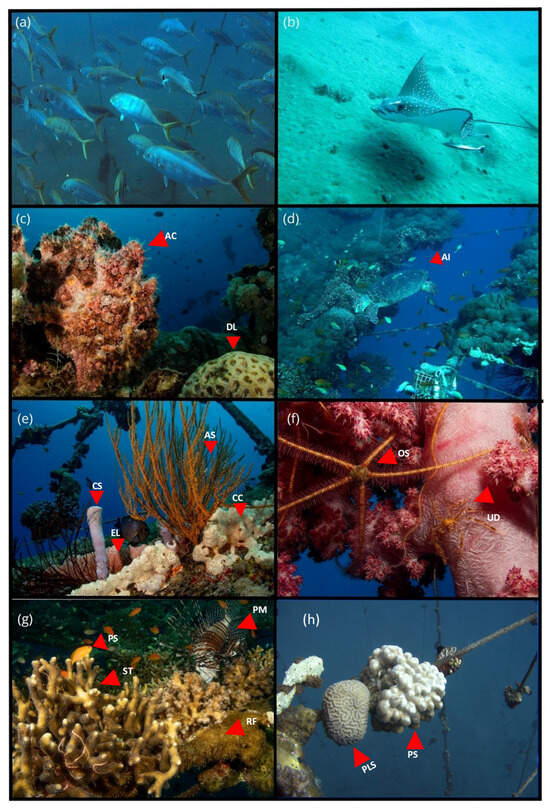
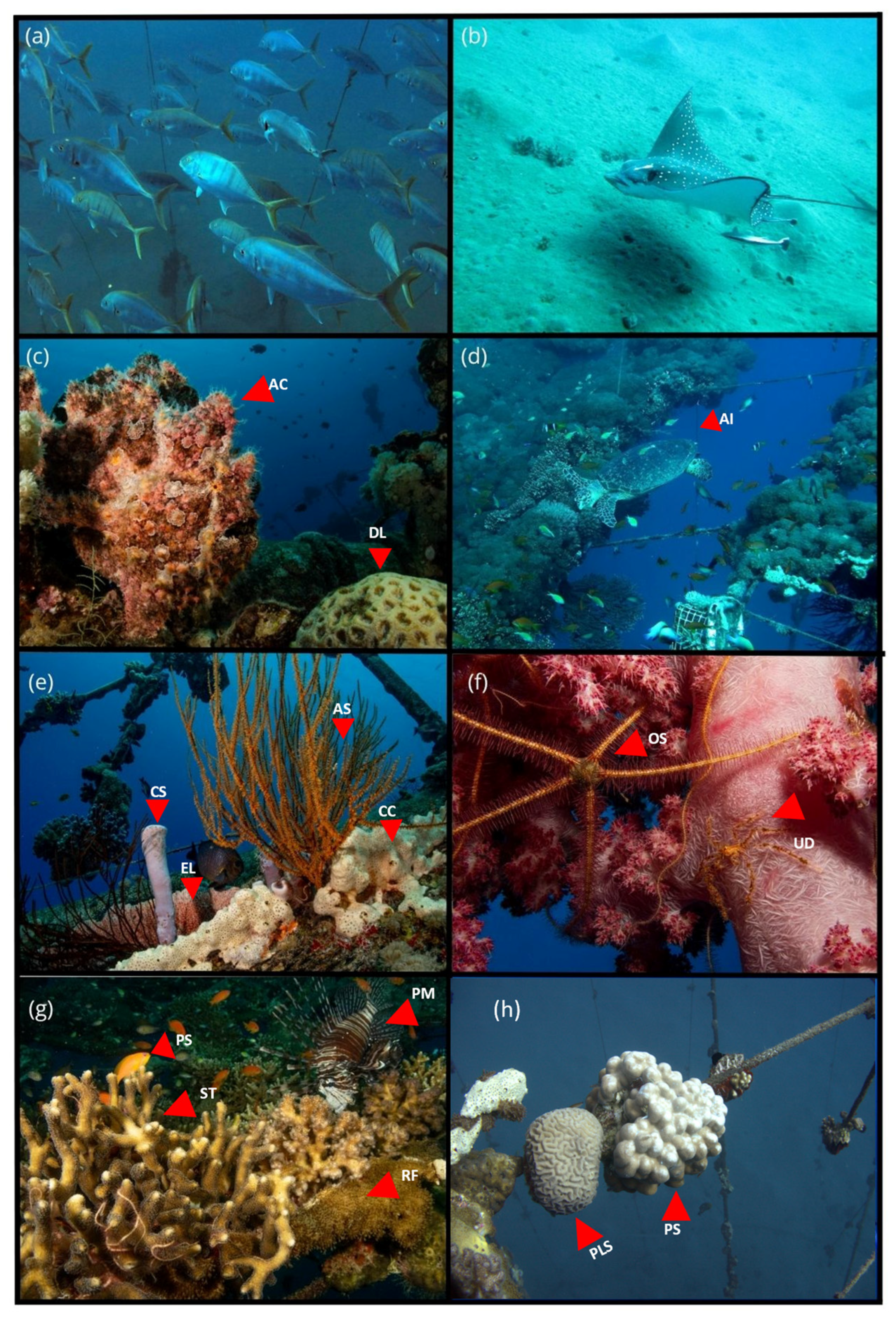
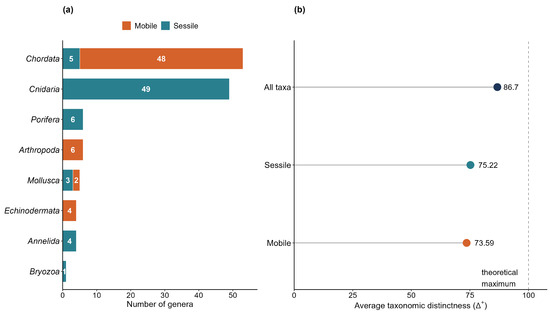
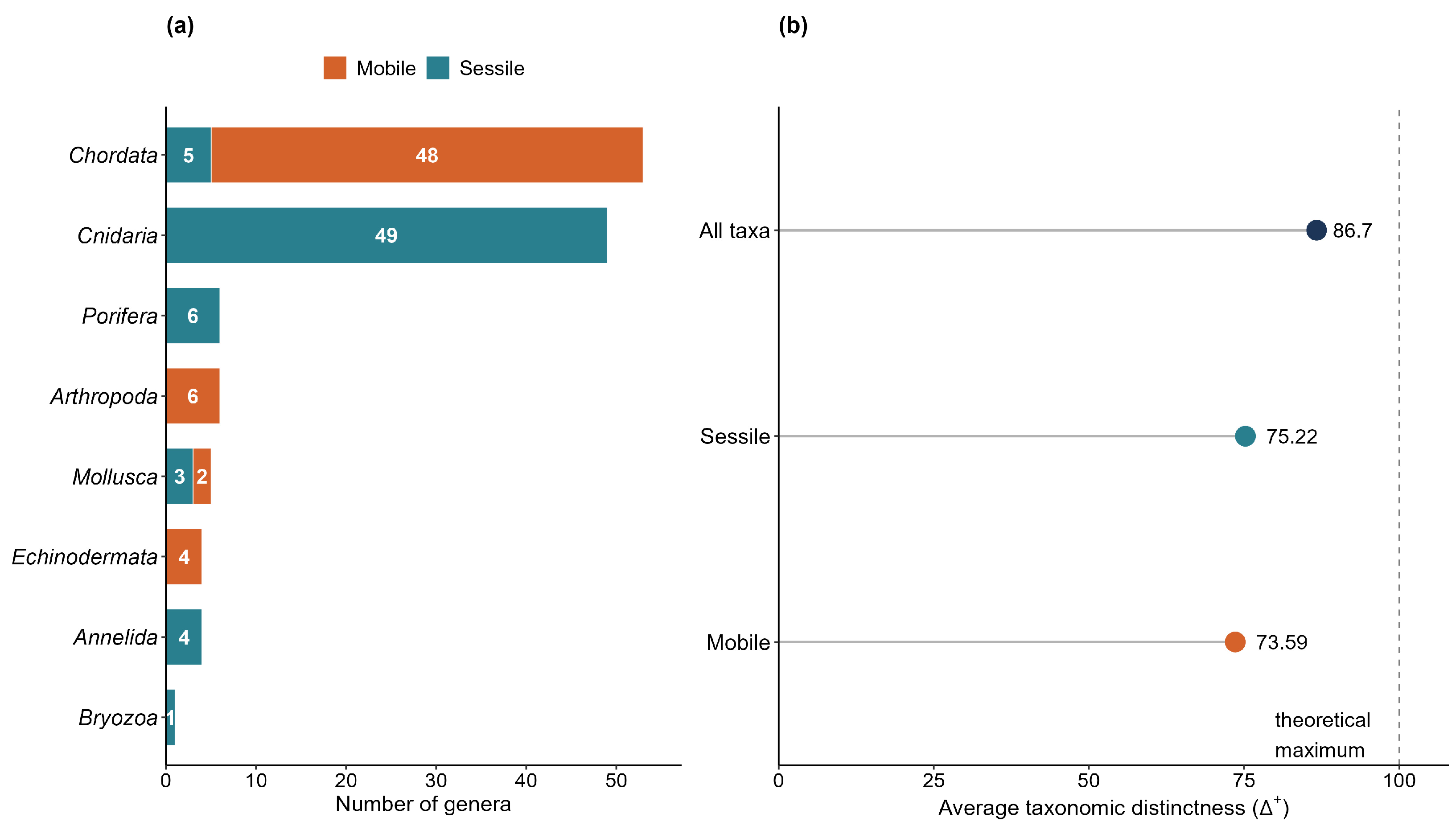
The FRD community exhibited a broad taxonomic range of easily inspected macro-organisms (Figure 1c and Figure 2), comprising an estimated 164 species across 128 genera, 78 families, 44 orders, and 15 classes, representing 8 phyla (Supplementary Table S3). The sessile assemblage included an estimated 94 species from 68 genera across 6 phyla, including Cnidaria, Porifera, Bryozoa, Chrodata, Mollusca, and Annelida, while the mobile community comprised an estimated 70 species from 60 genera across 4 phyla, including Chordata, Echinodermata, Mollusca, and Arthropoda (Figure 2 and Figure 3a).
Figure 2.
Representative organisms associated with the FRD. (a) Caranx sp. (Traveli) in the open space below the FRD platform; (b) Aetobatus narinari (Eagle ray) travelling below the FRD; (c) Antennarius commersoni (Frog fish; AC) and Dipsastraea lacuna (DL); (d) Eretmochelys imbricata (Hawksbill sea turtle; AI) visiting the FRD for food and rest; (e) three common residing macro-invertebrates: Antipatharia sp. (Black coral; AS), the sponges Callyspongia sp. (CS), Crella cyathophora (CC) and the colonial ascidian Eusynstyela latericius (EL); (f) Ophinocoma sp. (Brittle star; OS) and an unidentified decapod crab (UD) on the soft coral Dendronephthya sp.; (g) the reef building coral Stylopohra pistillata (ST), the encrusting soft coral Rhytisma fulvim (RF), the reef accosiates Pseudanthias squamipinnis (PS) and Pterois miles (PM); (h) naturally recruited Platygyra sp. (PLS) and Porites sp.
Figure 3.
Taxonomic breadth and evolutionary distinctness of the FRD community. (a) Number of genera per phylum for sessile (teal) and mobile (orange) fauna. (b) Average taxonomic distinctness (Δ+) for the full assemblage and separately for sessile and mobile components (mode of life). The dashed line marks the theoretical maximum (Δ+ = 100), corresponding to a community in which every pair of taxa belongs to different phyla.
3.1.2. Taxonomic Distinctness
Average taxonomic distinctness (Δ+) for the full assemblage of 128 genera was 86.7, indicating that the community spans a wide evolutionary breadth relative to the theoretical maximum of 100. When examined by mode of life, sessile fauna showed Δ+ = 75.2 and mobile fauna Δ+ = 73.8, both reflecting high taxonomic breadth within each mode of life (Figure 3b).
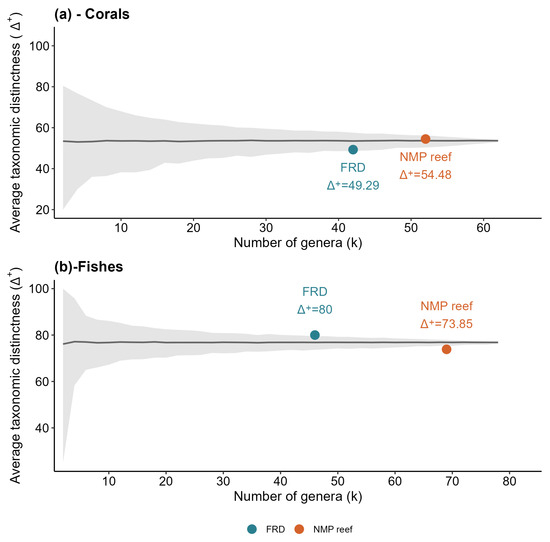
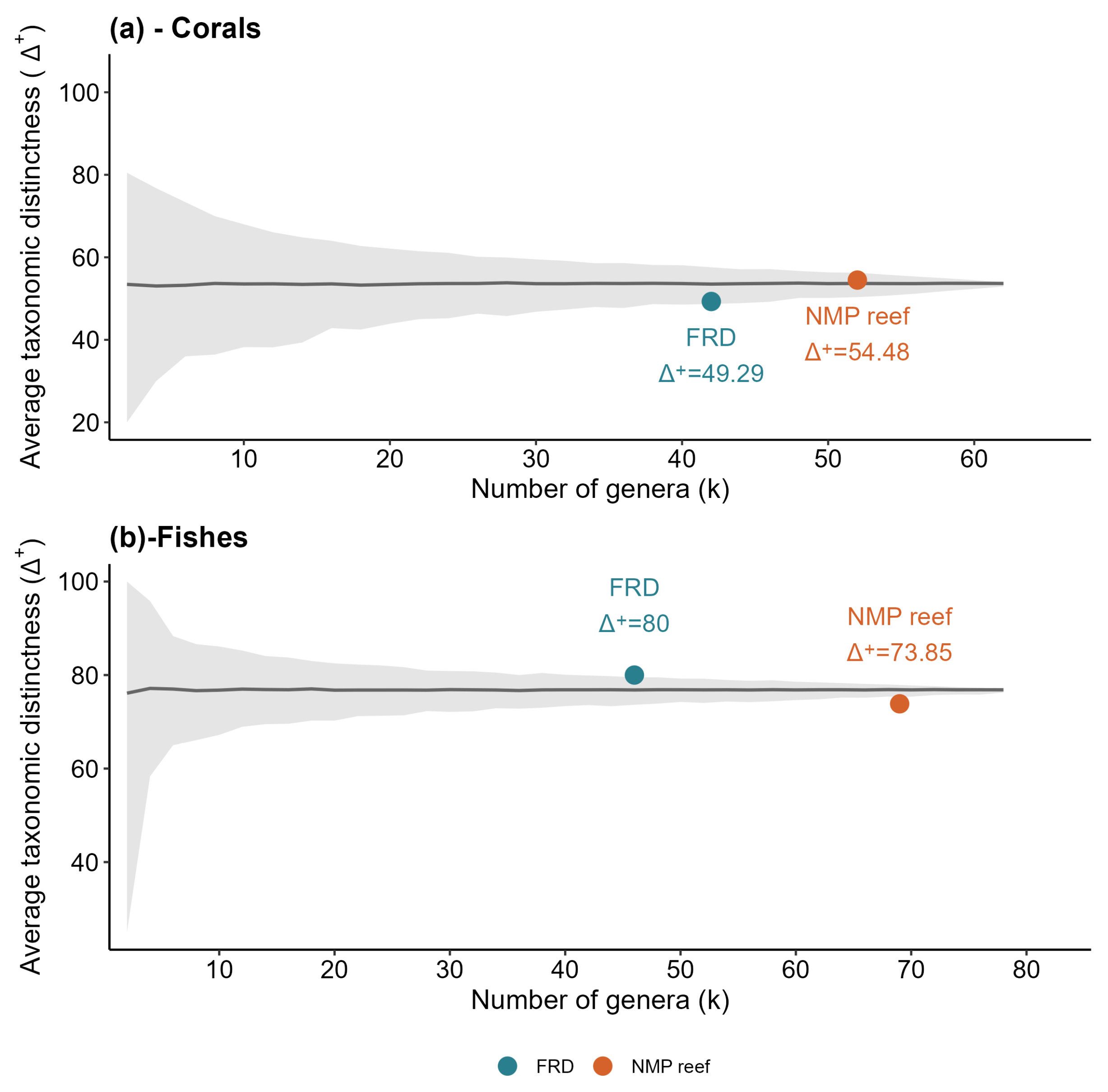
Comparison of the FRD coral assemblage (all anthozoans and the hydrozoan genus Millepora) with the adjacent natural shallow reef monitored by the NMP revealed that a combined pool of 63 genera, out of which 52 genera were documented in the NMP and 42 in the FRD, represented 80.8% of the NMP genus richness. Of these, 31 genera were shared between NMP and FRD, while 21 were documented only in the NMP and 12 only in the FRD. Despite this difference in richness between sites, Δ+ and Λ+ values were of similar magnitude (FRD: Δ+ = 49.3, Λ+ = 404; NMP reef: Δ+ = 54.5, Λ+ = 491), with both assemblages falling within the 95% null model envelope (Figure 4a). At the coral class level, the FRD Hexacorallia had a Δ+ of 65.6 compared with 62.9 for NMP (FRD: Λ+ = 154, n = 37; NMP: Λ+ = 112, n = 40), with both falling within the 95% null model envelope. For Octocorallia, Δ+ values were 77.8 for the FRD and 77.0 for the NMP despite a difference in genus richness (FRD: 4 genera; NMP: 11 genera), with both assemblages remaining within the 95% null model envelope (Supplementary Figure S1). In the fish community (phylum Chordata, subphylum Vertebrata), the FRD harbored 45 genera out of the 78 in the shared pool, representing 66.2% of the NMP reef’s generic richness (68 genera). Despite this lower richness, the FRD fish assemblage had average taxonomic distinctness Δ+ 79.3 compared with 73.2 for the NMP (Λ+ = 315; NMP: Λ+ = 205, respectively), with the FRD value lying within but near the upper limit of the null model simulation envelope (Figure 4b).
Figure 4.
Average taxonomic distinctness (Δ+) of the coral (a) and fish (b) assemblages at the FRD and the adjacent NMP of the natural reef, plotted against a 95% null model simulation envelope (grey shading) generated from 1000 random draws from the respective shared taxonomic pools. The solid line represents the mean expected Δ+ for a random assemblage of k genera. Points falling within the envelope are consistent with random assembly from the shared regional pool; points above the envelope indicate higher-than-expected taxonomic breadth. Teal = FRD; orange = NMP reef.
3.2. Functionality
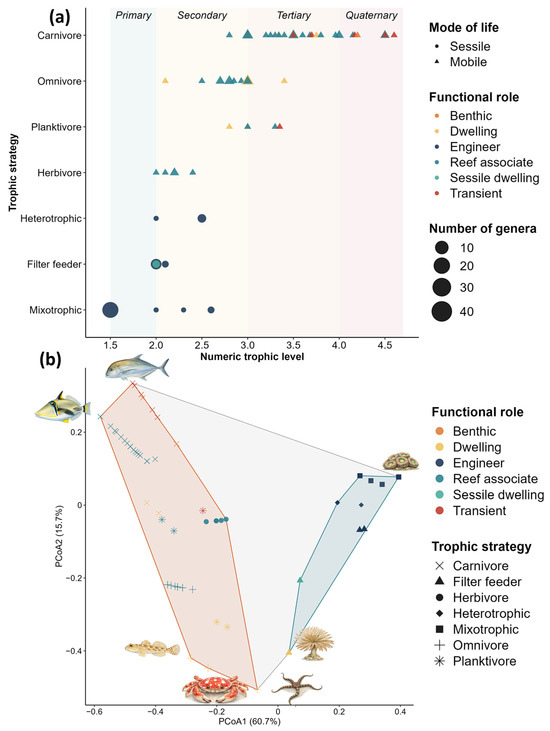
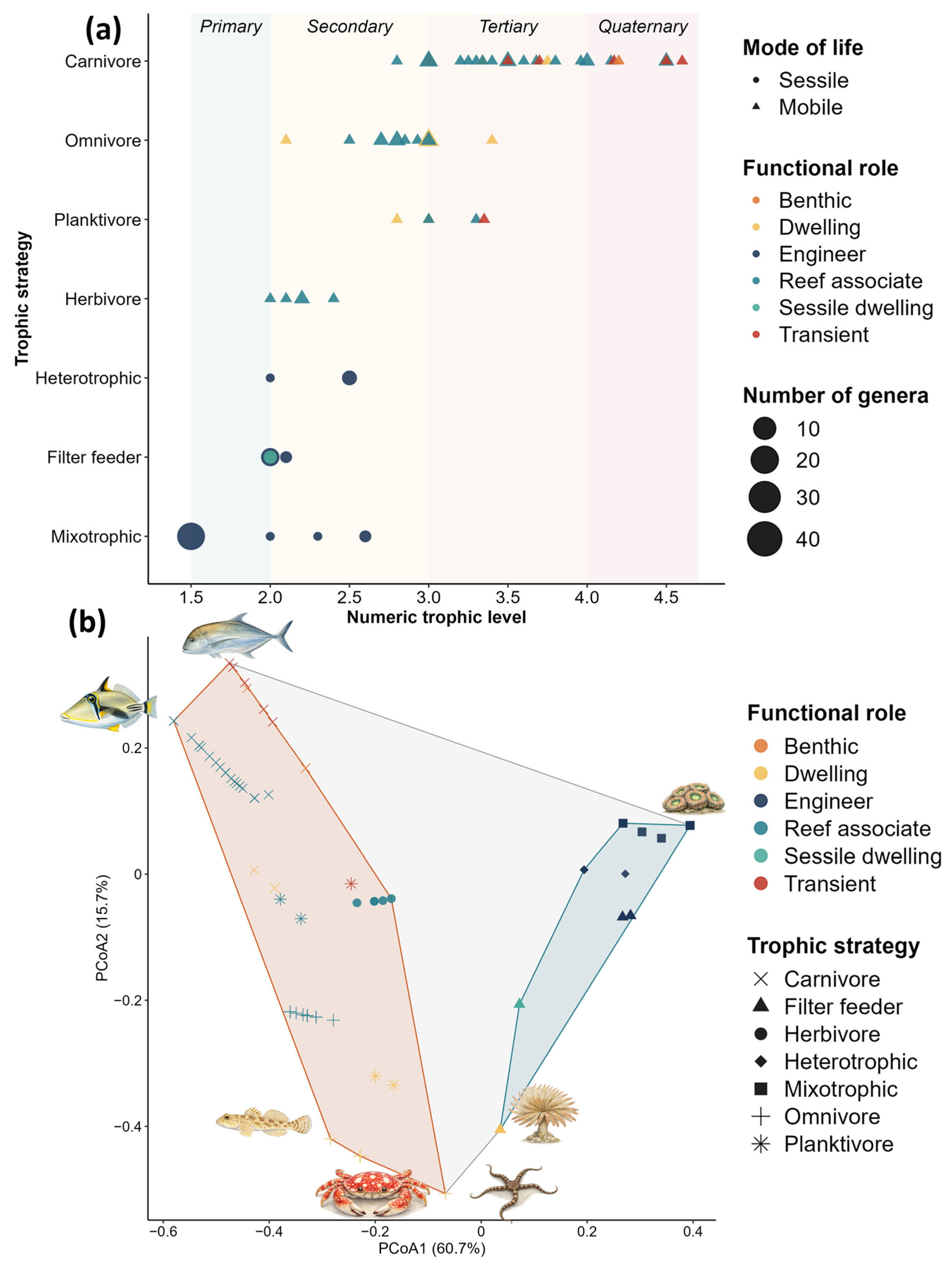
The FRD community spanned a broad functional spectrum across all four trait dimensions (Supplementary Table S1). Trophic strategy and trophic position ranged from mixotrophic primary producers and consumers (corals with zooxanthellae or the bivalve Tridacna sp.) to obligate carnivores, spanning primary to quaternary predators (as barracudas; Sphyraena qenie), covering a continuous numeric trophic level of 1.5 to 4.6 (Figure 2). In total, seven trophic strategies and six functional roles were identified among 127 genera, with the sessile component dominated by engineering species and mixotrophic primary producers and consumers (n = 63) and the mobile component by reef associates (n = 39 genera) and secondary consumers (Supplementary Figure S2; Figure 5a).
Figure 5.
(a) Functional niche occupancy of the FRD community across trophic strategies and numeric trophic levels. Each point represents a unique combination of trophic strategy, numeric trophic level, and functional role. Point size scales with the number of genera. Shape indicates mode of life (circles = sessile; triangles = mobile) and color indicates functional role. Vertical shading denotes trophic position categories (primary, secondary, tertiary, quaternary). (b) Functional space of the FRD community derived from PCoA of Gower distances calculated from three traits: numeric trophic level, trophic strategy, and functional role. Each point represents a genus; shape indicates trophic strategy and color indicates functional role. The grey polygon outlines the total functional space occupied by all 127 genera. The orange polygon represents the sessile subset (11.1% of total functional space) and the teal polygon represents the mobile subset (39.4% of total functional space). Mode of life was not included in the distance matrix and is shown here post hoc via hull shading only. Axes represent the first two PCoA axes, explaining 60.8% and 15.8% of total variance, respectively.
Functional trait space, derived from a PCoA based on Gower distance across 127 genera, showed that the first two PCoA axes explained 60.7% and 15.7% of the total variance (Figure 5b). The total convex hull area representing the full FRD functional space was 0.443. The sessile fauna occupied 11.1% of the total space, while the mobile fauna occupied 39.4%, indicating that mobile taxa contribute disproportionately to functional diversity compared to sessile taxa despite representing lower genus richness (Figure 5). Within functional role groups, dwelling taxa (n = 13 genera) and reef associates (n = 39 genera) occupied the broadest functional area (convex hull areas = 0.086 and 0.073, respectively), while transient and ecosystem engineer taxa were more functionally restricted.
Within coral assemblages, functional diversity was compared between the FRD and NMP reef using Rao’s quadratic entropy (RaoQ), a metric of mean pairwise functional dissimilarity based on growth morphology, polyp size, coloniality, and reef-building status. The FRD exhibited a RaoQ of 0.301 (94% of the total region pool; n = 43), which was 5.6% lower than the NMP (RaoQ = 0.298; 92.8% from the total pool; n = 52), despite the FRD containing only 80.8% of the genus richness observed at NMP. In terms of functional space, the FRD coral assemblage occupies 99.7% of the total pool convex hull area (FRD hull = 0.33; combined pool hull = 0.331), compared to 82.8% for the NMP (hull = 0.274; Supplementary Figure S3). The coral PCoA analysis further indicated strong structuring of coral morpho-functional types, with the first two axes explaining 68.4% and 15.5% of the variance, respectively.
3.3. Sessile Species Distribution
The sessile assemblage comprised 1612 individuals from 65 genera, with Shannon diversity H’ = 3.06 (21.4 effective genera; Simpson 1–D = 0.919; Supplementary Table S3). When restricted to Cnidaria (47 genera, n = 941 colonies, including Hexacorallia, Octocorallia, and the hydrozoan Millepora), Shannon diversity decreased to H’ = 2.67 (14.5 effective genera; Simpson 1–D = 0.860). The scleractinian coral component comprised 548 colonies from 37 genera, with colony diameters ranging from 1 to 60 cm. Size distribution was right-skewed, dominated by small colonies: 58.6% of colonies were below 10 cm in diameter (1–5 cm: 21.2%, n = 116; 5–10 cm: 37.4%, n = 205; Supplementary Figure S4 and Table S4).
Across size classes, Porites, Psammocora, and Stylophora consistently dominated colonies below 20 cm. In the 20–50 cm class, Stylophora was the most abundant genus (32.6%), while colonies exceeding 50 cm were rare (n = 4), belonging to Acropora, Montipora and Turbinaria. Shannon diversity for the full scleractinian census was H’ = 2.76 (effective genus richness = 15.9; Simpson 1–D = 0.901). Diversity remained broadly stable across smaller size classes (H’ = 2.45–2.61), declining in the 20–50 cm class (H’ = 2.31; 10.1 effective genera) and dropping markedly at >50 cm (H’ = 1.39; 3 effective genera; Supplementary Table S3; Supplementary Figure S4).
3.4. Fish Biomass
The surveyed fish community, as sampled in the FRD, was binned into 25 species, with a total estimated biomass of 533.4 kg. Secondary consumers dominated the community biomass, accounting for 472 kg (88.4% of total biomass; 17 species), followed by tertiary consumers (42.6 kg; 8.0%; 3 species) and primary consumers (19.2 kg; 3.6%; 5 species). By trophic strategy, planktivores contributed the majority of biomass (388 kg; 72.8%; 4 species), followed by carnivores (95.3 kg; 17.9%; 13 species), omnivores (32.9 kg; 6.2%; 5 species), and herbivores (16.8 kg; 3.2%; 3 species; Supplementary Table S5). The planktivore Caesio lunaris dominated the assemblage, accounting for 381.4 kg (71.5% of the total fish biomass), driven by high abundance (1816 individuals). The next most significant contributor species were the tertiary consumer Cephalopholis miniata (35.4 kg; 6.6%) and the secondary consumer Cheilodipterus lachneri (33.6 kg; 6.3%), with all remaining species each contributing less than 4%.
4. Discussion
4.1. Ecological Complexity of the FRD
Previous studies have documented the transformation of mid-water coral nurseries into structurally and biologically complex floating ecosystems, with progressive increases in species richness and community complexity over time [10,11]. These studies suggested the importance of the position in the water column not only related to particle interception due to hydrodynamics, but also as potential interceptors of larvae and propagules of different species. The present study provides, to our knowledge, the first quantitative evaluation of this trajectory using a multi-metric biodiversity framework. Within the context of this case study, the FRD exhibited taxonomic and functional characteristics that fell within the range observed for the adjacent natural reef at the community level. Our findings indicate that Eilat’s FRD, originally deployed as a floating coral nursery for active reef restoration, has, after almost two decades and multiple coral extraction sessions, evolved beyond its original function into a structure that sustains high levels of ecological complexity. The FRD assemblage spans a wide taxonomic and functional spectrum, encompassing eight phyla and representing multiple trophic levels, from mixotrophic primary producers to quaternary predators (including suspension feeders, grazers, predators, and corallivores), all reflecting a heterogeneous community structure.
Further, the combination of high genus richness and elevated average taxonomic distinctness indicates broad evolutionary lineages rather than dominance by closely related taxa. This pattern may be associated with independent recruitment from diverse larval sources rather than derivation from a single or limited donor pool [14,18]. This interpretation is reinforced by the occupation of functional trait space, with the FRD spanning seven trophic strategies, six functional roles, and a continuous trophic level range of 1.5 to 4.6, indicating that the assemblage encompasses a diverse set of ecological strategies. This range includes habitat-forming mixotrophic corals that enhance structural complexity and primary production, suspension feeders such as sponges and basket star (Astroboa nuda), and higher trophic level taxa, including transient and reef-associated predators such as frogfish, eagle rays, and tunas (Apolemichthys xanthotis, Aetobatus narinari and Caranx sexfasciatus, respectively). These metrics capture complementary dimensions of ecological organization. Taxonomic distinctness reflects evolutionary breadth, RaoQ quantifies functional dissimilarity among coral taxa based on their functional traits, and trophic structure describes energy flow pathways within the FRD system. Together, these suggest that the FRD functions not merely as a species accumulator, but as a structured ecological system organizing biodiversity across multiple dimensions [27,28]. Even if in the present context the zooplankton was not counted, Borghese et al. (2025) [29] suggest that ecosystem engineer-based ecosystems such as the present one accumulate all kinds of crustaceans, larvae and propagules nearby. The broad extent of trait space, trophic range, and taxonomic distinctness further suggests that the system simultaneously supports a wide range of ecological roles, consistent with the occupation of a large proportion of available niche space. Systems exhibiting this combination of high richness and broad functional and evolutionary representation are typically associated with increased functional complementarity among species and an enhanced capacity to sustain multiple ecological processes concurrently [14,30,31,32].
Despite its physical isolation from the natural reef and the marine protected area (MPA) in Eilat, the FRD community was compared with reefs monitored under the National Monitoring Program (NMP). Across coral assemblages, the FRD achieved 90–104% of NMP Δ+ values despite lower genus richness, and both assemblages fell within the null model simulation envelope. For fishes, FRD Δ+ exceeded that of the NMP reef (79.3 vs. 73.2), indicating that the FRD fish assemblages span a broad evolutionary range per unit richness despite lower overall species number. Collectively, these results demonstrate that the FRD supports a taxonomically diverse community whose taxonomic breadth falls within the range observed for the natural reefs. The coral functional analysis reinforces this pattern. The FRD coral assemblage occupied 99.7% of the total regional pool convex hull in functional trait space, compared to 82.8% for the NMP reef, while coral RaoQ at the FRD reached 93.2% of the regional pool value. These results indicate that the FRD coral assemblage encompasses nearly the full range of morpho-functional coral strategies present in the regional pool, despite its smaller genus richness.
It is important to note that the NMP comparison is based on monitoring survey data rather than a fully matched census design, and differences in depth profiles and sampling effort exist between the datasets. However, the use of average taxonomic distinctness (Δ+) and variation in taxonomic distinctness (Λ+), both of which are designed to be robust to sampling intensity, effort differences and survey design [14,15], makes the taxonomic comparison defensible. While these metrics effectively capture taxonomic breadth and evenness, they do not directly account for the total number of species present, which remains sensitive to sampling completeness. Nevertheless, comparisons of absolute richness should be interpreted cautiously given these methodological constraints. At the same time, the NMP dataset represents the broadest available reference for the surrounding reef, encompassing multiple sites and a wider depth range than the FRD. Therefore, comparisons should be interpreted as assessing whether the FRD’s taxonomic structure falls within the range observed across the surrounding reef, rather than as a direct one-to-one comparison between identically sampled assemblages.
Although several taxonomic and functional metrics placed the FRD within the range of the surrounding reef, notable differences remained. The FRD supported fewer coral genera (80.8% of the NMP) and fewer fish species (66.2% of the NMP), with the fish assemblage numerically dominated by the planktivorous Caesio lunaris. These differences likely reflect, at least in part, the FRD’s relatively smaller spatial footprint, artificial origin, and distinct habitat configuration. Thus, our results do not indicate full ecological equivalence with the surrounding reef, but rather demonstrate that the FRD developed substantial taxonomic and functional complexity despite these limitations.
The species inventory also includes taxa of conservation concern. The long-spined sea urchin Diadema setosum, which suffered near-local extinction in the Gulf of Eilat following a disease outbreak in 2022 [33], was recorded at the FRD. The vulnerable (IUCN Red List) seahorse Hippocampus kelloggi was documented in the FRD habitat. The endangered hawksbill turtle Eretmochelys imbricata was observed at the FRD, likely foraging on the dense soft coral community (Figure 2d). The spotted eagle ray Aetobatus narinari was recorded as a transient visitor (Figure 2b). These species, spanning echinoderms, fish, reptiles, and elasmobranchs, converge on a single mid-water FRD highlights its capacity to support a taxonomically diverse assemblage of conservation interest. These observations collectively suggest that the FRD provides refuge, foraging opportunities, and habitat complexity for species that are rare or absent from the surrounding degraded reef environment.
4.2. From a Coral Nursery to a Floating Reef
The emergence of the ecological complexity on an FRD was not accidental. Rather, we suggest that the interaction of physical, structural, and biological drivers may have generated a positive feedback loop that initiated and sustained a facilitative cascade. This cascade progressively expanded the range of ecological niches available and increased the diversity of taxa able to exploit them. From a physical and structural perspective, the mid-water position of the FRD confers several advantages over fixed benthic structures. Floating mid-water structures are exposed to stronger ambient currents relative to those near the seafloor, which can enhance water exchange [34,35], oxygenation and the removal of metabolic waste products [36], increasing the flux of particulate food particles to filter feeders and reducing debris accumulation [6]. Reduced sedimentation, together with elevated flow and distance from the bottom, minimizes sediment accumulation on sessile engineering species, allowing energy allocation toward growth rather than tissue repair, thereby enhancing survivorship and overall fitness [37,38]. This positive energy budget shift may enable these species to invest excess resources into reproduction and lateral expansion, potentially accelerating habitat complexity development beyond what would be expected from growth alone.
Beyond hydrodynamics, the FRD encompasses the full water column and incorporates a diverse array of substrate types, each offering distinct ecological conditions [11]. The structure spans from the sandy seabed at 21–22 m depth, through a concrete sinker and vertical ropes, to the PVC platform and rope mesh at ~11 m depth. This vertical and material heterogeneity generates a wide range of microhabitat conditions, in terms of light, flow, substrate texture, and proximity to the sediment, that collectively support a diversity of ecological guilds simultaneously [39,40,41,42,43,44]. The FRD multilevel habitat architecture integrates multiple reef zones, from soft-bottom to cryptic crevice to sunlit platform, into a single vertical footprint, allowing species that would ordinarily be separated by depth or substrate preference to coexist in close proximity, potentially facilitating novel ecological interactions. This structural complexity likely enhances larval recruitment from the plankton, as different taxa exhibit species-specific preferences for settlement and metamorphosis across environmental gradients such as light, flow, and substrate type [45,46,47,48]. For example, in the FRD, azooxanthellate corals that do not depend on light and are often found in the mesophotic reef of Eilat, such as black corals (Antipatharia spp.) and sun corals (Tubastraea sp., Cladopsammia sp.) [49], occupy the deeper, more shaded sections of the FRD structure, where photosymbiotic corals that rely on light fail to thrive. Soft-sediment specialists inhabit the sandy seabed below (as the cowtail stingray Pastinachus sephen and the sand goby Istigobius decoratus), while reef-associated fish and invertebrates reside the coral canopies on the platform and surrounding open waters (e.g., the emperor angelfish Pomacanthus imperator and the sea goldie Pseudanthias squamipinnis). This vertical partitioning of the available space is consistent with the well-established role of structural complexity as a key driver of biodiversity in coral reef ecosystems [44,50]. Biologically, the long-term practice of coral gardening likely acted as the initiating and enhancing mechanism. The repeated introduction and cultivation of coral fragments on the FRD over approximately two decades provided the biogenic substrate and the additional structural and ecological complexity necessary for community development [51]. Under favorable mid-water conditions, coral fragments rapidly developed into large colonies, forming complex canopies across the platform within relatively short timeframes [6]. These coral structures modified local hydrodynamic and light conditions, enhancing larval retention, while increasing the capture of suspended particulate matter, thereby accelerating the recruitment of associated fauna [52,53,54,55,56]. This includes the recruitment of planktonic larvae from a wide range of taxa, including coral-associated fishes (e.g., Dascyllus spp., Pseudochromis spp., Acanthurus spp.) and obligate coral-dwelling crabs and fishes (e.g., Trapezia spp, Gobiodon citrinusas, Chormis virdis). These species’ presence may further enhance nutrient flux between the water column and the benthic community by capturing plankton and further releasing dissolved nutrients and mucus to the water column [1,57,58,59,60]. Over time, the accumulation of biogenic structure and niche diversity facilitated the recruitment of additional engineering taxa [12,61]. This positive feedback loop, where early engineering species create microhabitats that reduce predation and enhance larval settlement, which in turn supports further structural development, is a well-documented mechanism driving ecological succession on artificial structures [62]. Each of these groups likely contributed to and amplified the facilitative cascade, expanding the community further [63,64].
An additional contributing factor is the geographic location of the FRD outside the natural reef and the MPA. Positioned over a sandy bottom adjacent to seagrass beds, the FRD lies beyond the core reef herbivore community. While herbivorous fish and invertebrates are essential for controlling algal growth, high densities can exert significant top-down pressure on benthic communities, suppressing coral recruitment through grazing on juvenile colonies [65,66]. In fact, the low herbivore biomass recorded in this study (3.6% of total fish biomass) suggests reduced grazing pressure, which may have facilitated the successful establishment and growth of sessile organisms on the FRD.
4.3. Potential Applications: FRD as a Biodiversity Hub
The present case study provides quantitative, multi-metric evidence supporting the progression of water-floating coral nurseries into floating reef-like ecosystems. We postulate that the interplay of physical, structural, and biological processes, both natural and human-induced, can transform a floating restoration device into a community that is taxonomically broad, functionally diverse, and trophically structured. Building on this rationale, we further advance the concept by defining mature FRDs as “biodiversity hubs”- compact, human-initiated yet self-sustaining structures that, by virtue of their ecological complexity, support a wide range of conservation and ecological functions and ecosystem services extending well beyond their original restoration role [10].
The notion of a mature FRD as a “biodiversity hub” arises from the interactions that develop among habitat-forming organisms, associated fauna, and ecological processes within the structure. As these interactions accumulate over time, the role of the FRD may extend beyond coral cultivation itself, underlying a broad suite of ecosystem functions and services (Table 1). Building on this rationale, we propose the biodiversity hub concept as a framework for considering the broader ecological roles and potential applications of mature FRDs. The following applications are based on the ecological characteristics documented here and in previous studies, and should be viewed as future directions rather than direct outcomes of the present case study. From a conservation standpoint, FRDs can function as refuges, recruitment sources, and foraging grounds for species that are rare or declining on nearby reefs, as well as for transient visitors. The close proximity of mature sessile organisms may enhance fertilization success [67], while the structure itself can serve as a passive larval source for surrounding habitats. Strategically positioned FRDs could function as stepping stones, enhancing connectivity between fragmented reef habitats [68,69,70]. From a restoration perspective, FRDs operate as production platforms for sessile organisms destined for transplantation onto degraded reefs [4,6]. Where nursery-farmed colonies are managed for genetic diversity, the FRD can additionally serve as a source of sexually reproduced planulae for active reef seeding [68]. Beyond direct restoration, FRDs provide valuable in situ experimental platforms for testing restoration techniques, ecological engineering approaches, and assisted evolution methods under field conditions [71,72]. In terms of blue carbon and climate perspective, the dense biomass of calcifying organisms and the photosynthetic activity of zooxanthellate corals contribute to carbon sequestration within the FRD structure [51]. This carbon storage capacity may be enhanced over time as successive generations of calcifiers deposit skeletal material onto the structure, potentially transforming the FRD from a net carbon source during construction to a long-term carbon sink—an often-overlooked co-benefit of reef restoration that aligns with nature-based climate solutions [51].
Table 1.
The spectrum of conservation functions, restoration roles, and ecosystem services associated with FRDs, conceptualized as biodiversity hubs. These functions are grouped into three main ecological management functions: conservation, restoration and ecosystem services. The citations presented draw on the present study (“current work”) and available literature.
This capacity could be further enhanced by incorporating other photosynthetic organisms that can be cultivated on FRD structures as part of nature-based solutions [84,85]. From an economic perspective, FRDs can support multiple revenue streams. These include mariculture of ornamental species and organisms producing bioactive compounds with pharmaceutical applications [71,77], as well as fisheries support by providing habitat and recruitment grounds for commercially valuable fish species [10]. Furthermore, FRDs can serve as an ecotourism and educational destination, offering divers a unique mid-water environment that blends features of natural and artificial reefs [71,75,76]. In addition, networks of FRDs may support the development of biodiversity crediting frameworks, where quantified ecological gain could contribute to financing the deployment, maintenance, and long-term monitoring of such systems, either independently or in combination with other revenue streams [76].
Importantly, although the present study examined a coral-based FRD in the Gulf of Eilat, the biodiversity hub concept of floating devices is not limited to tropical coral reef systems. Yet, this possibility remains hypothetical and requires empirical evaluation. The mid-water floating platform is a modular and scalable structure, allowing adaptation with different foundation and engineering species depending on regional conditions, ecological context, and management goals. In regions unsuitable for coral growth, alternative habitat-forming taxa such as sponges, bivalves, gorgonians and cold-water octocorals can act as structural engineers. In such FRDs systems, the underlying principle of enhancing vertical heterogeneity and biotic structure remains constant, even as the identity of the engineering species shifts to match local biogeography.
Sponges, which are among the most efficient biological filter feeders, could be cultivated on FRDs adjacent to fish farms or in eutrophic coastal zones to absorb dissolved organic matter and excess nutrients, functioning as biological filtration systems [80,86,87] with additional applications in biomedicine [81]. Similarly, macroalgae cultivation on floating platforms offers a scalable approach for nutrient bioremediation, blue carbon production, and integrated multi-trophic aquaculture in coastal waters where nutrient loading is a management concern [82,83,84]. As a long-term case study of a single FRD, the present work provides insight into one potential pathway of ecological development under the specific environmental conditions examined. Whether comparable trajectories emerge in other regions, restoration designs, or systems involving different habitat-forming taxa remains an open question that should be addressed through comparative studies. In all cases, the initial establishment of the FRD with the appropriate foundation species could initiate the facilitative cascade described above, progressively increasing community complexity and expanding the range of ecosystem services it provides. Thus, the FRD should be viewed not as a fixed design but as a flexible ecological engineering framework, capable of generating biodiversity, biomass, and ecosystem services tailored to conservation, restoration, or production depending on a given context.
5. Conclusions
This long-term case study demonstrates that a floating coral nursery can evolve into a structurally and ecologically complex community that extends well beyond its initial restoration purpose, representing a case of a forethoughtful coral nursery [18]. Although the FRD did not fully replicate the characteristics of the surrounding natural reef, it supported broad taxonomic representation, high functional diversity, and a multi-trophic assemblage that, according to several metrics, approached the range observed in the adjacent reef. These findings provide ecological support for the proposed biodiversity hub concept, whereby mature floating restoration structures may contribute ecosystem functions beyond coral propagation alone. While the broader applications proposed here remain conceptual and require validation across additional systems, restoration designs, and habitat-forming taxa, forethoughtful coral nurseries represent a promising tool for advancing reef management. Situated at the intersection of ecological, societal, and economic challenges, these innovative approaches merit further scientific investigation and consideration within future conservation strategies.
Supplementary Materials
The following supporting information can be downloaded at: https://www.mdpi.com/article/10.3390/conservation6030094/s1, Figure S1: Average taxonomic distinctness (Δ+) of Hexacorallia and Octocorallia communities at the FRD and the adjacent NMP reef; Figure S2: Trophic structure of the FRD community by trophic position and mode of life; Figure S3: Functional trait space of coral genera at the FRD and NMP reef based on PCoA; Figure S4: Size structure and diversity of the scleractinian coral community at the FRD; Table S1: Species inventory and ecological classification of taxa recorded at the FRD; Table S2: Trait categories and classification used for functional and ecological attributes; Table S3: Taxonomic breadth of the FRD community across hierarchical levels; Table S4: Genus-level diversity indices across taxa and size classes; Table S5: Fish community biomass by trophic level and strategy.
Author Contributions
Conceptualization, D.S.; methodology, D.S. and G.G.; software, D.S.; validation, D.S., G.G., S.R. and B.R.; formal analysis, D.S. and G.G.; investigation, D.S. and G.G.; resources, B.R.; data curation, D.S. and G.G.; writing—review and editing, D.S., G.G., S.R. and B.R.; visualization, D.S. and G.G.; supervision, S.R. and B.R.; project administration, D.S., G.G., S.R. and B.R.; funding acquisition, S.R. and B.R. All authors have read and agreed to the published version of the manuscript.
Funding
This study was supported by the ISF/NSFC (number 3511/21) Joint Scientific Research Program (BR), and by the Horizon Europe OCEAN CITIZEN project (no 101093910; Marine forest coastal restoration: an underwater gardening socio-ecological plan) (SR and BR). DS post-doctoral fellowship was granted by Underwater Gardens International and by the sponsorship of the BNP Paribas Foundation.
Institutional Review Board Statement
Not applicable.
Informed Consent Statement
Figure 1b contains a photograph taken by an individual who is not an author of the manuscript. The photographer has granted permission for the image to be used and published as part of this article.
Data Availability Statement
The data are available in the Supporting Information.
Acknowledgments
We thank Marc Garcia-Duran for his support and Gil Koplovitz for providing the photo for Figure 1b.
Conflicts of Interest
D.S. and S.R. are affiliated with Underwater Gardens International. The authors declare that the research was conducted in the absence of any commercial or financial relationships that could be construed as influencing the scientific conclusions of the study.
References
- Eddy, T.D.; Lam, V.W.Y.; Reygondeau, G.; Cisneros-Montemayor, A.M.; Greer, K.; Palomares, M.L.D.; Bruno, J.F.; Ota, Y.; Cheung, W.W.L. Global Decline in Capacity of Coral Reefs to Provide Ecosystem Services. One Earth 2021, 4, 1278–1285. [Google Scholar] [CrossRef] [Scilit]
- Bindoff, N.L.; Cheung, W.W.L.; Kairo, J.G.; Arístegui, J.; Guinder, V.A.; Hallberg, R.; Hilmi, N.; Jiao, N.; Karim, M.S.; Levin, L.; et al. Changing Ocean, Marine Ecosystems, and Dependent Communities. In IPCC Special Report on the Ocean and Cryosphere in a Changing Climate; Pörtner, H.-O., Roberts, D.C., Masson-Delmotte, V., Zhai, P., Tignor, M., Poloczanska, E., Mintenbeck, K., Alegria, A., Nicolai, M., Okem, O., et al., Eds.; Cambridge University Press: Cambridge, UK, 2019; pp. 447–588. ISBN 9781009157964. [Google Scholar]
- Boström-Einarsson, L.; Babcock, R.C.; Bayraktarov, E.; Ceccarelli, D.; Cook, N.; Ferse, S.C.A.; Hancock, B.; Harrison, P.; Hein, M.; Shaver, E.; et al. Coral Restoration—A Systematic Review of Current Methods, Successes, Failures and Future Directions. PLoS ONE 2020, 15, e0226631. [Google Scholar] [CrossRef] [Scilit] [PubMed]
- Horoszowski-Fridman, Y.; Brêthes, J.C.; Rahmani, N.; Rinkevich, B. Marine Silviculture: Incorporating Ecosystem Engineering Properties into Reef Restoration Acts. Ecol. Eng. 2015, 82, 201–213. [Google Scholar] [CrossRef] [Scilit]
- Montoya-Maya, P.H.; Smit, K.P.; Burt, A.J.; Frias-Torres, S. Large-Scale Coral Reef Restoration Could Assist Natural Recovery in Seychelles, Indian Ocean. Nat. Conserv. 2016, 16, 1–17. [Google Scholar] [CrossRef] [Scilit]
- Shafir, S.; Van Rijn, J.; Rinkevich, B. A Mid-Water Coral Nursery. In Proceedings of the Proceeding of 10th International Coral Reef Symposium; Japanese Coral Reef Society: Okinawa, Japan, 2006; pp. 1674–1679. [Google Scholar]
- Shafir, S.; Van Rijn, J.; Rinkevich, B. Steps in the Construction of Underwater Coral Nursery, an Essential Component in Reef Restoration Acts. Mar. Biol. 2006, 149, 679–687. [Google Scholar] [CrossRef] [Scilit]
- Frias-Tores, S.; Montoya-Maya, P.; Shah, N. Coral Reef Restoration Toolkit A Field-Oriented Guide Developed in the Seychelles Islands; Nature Seychelles: Mahe, Republic of Seychelles, 2018. [Google Scholar]
- Gili, J.-M.; Coma, R. Benthic Suspension Feeders: Their Paramount Role in Littoral Marine Food Webs. Trends Ecol. Evol. 1998, 13, 316–321. [Google Scholar] [CrossRef] [Scilit] [PubMed]
- Rinkevich, B. Forethoughtful Coral Nurseries: Alleviating Climate Change Impediments on the Reefs of Tomorrow. Discov. Oceans 2025, 2, 21. [Google Scholar] [CrossRef] [Scilit]
- Shafir, S.; Rinkevich, B. Integrated Long-Term Mid-Water Coral Nurseries: A Management Instrument Evolving into a Floating Ecosystem. Univ. Maurit. Res. J. 2010, 16, 365–386. [Google Scholar]
- Higgins, E.; Scheibling, R.E.; Desilets, K.M.; Metaxas, A. Benthic Community Succession on Artificial and Natural Coral Reefs in the Northern Gulf of Aqaba, Red Sea. PLoS ONE 2019, 14, e0212842. [Google Scholar] [CrossRef] [Scilit] [PubMed]
- R Core Team. R: A Language and Environment for Statistical Computing; R Foundation for Statistical Computing: Vienna, Austria, 2014. [Google Scholar]
- Warwick, R.; Clarke, K. New “biodiversity” Measures Reveal a Decrease in Taxonomic Distinctness with Increasing Stress. Mar. Ecol. Prog. Ser. 1995, 129, 301–305. [Google Scholar] [CrossRef] [Scilit]
- Clarke, K.R.; Warwick, R.M. A Taxonomic Distinctness Index and Its Statistical Properties. J. Appl. Ecol. 1998, 35, 523–531. [Google Scholar] [CrossRef] [Scilit]
- Oksanen, J.; Simpson, G.; Blanchet, F.; Kindt, R.; Legendre, P.; Minchin, P.; O’Hara, R.; Solymos, P.; Stevens, M.; Szoecs, E.; et al. Vegan: Community Ecology Package; Comprehensive R Archive Network (CRAN): Vienna, Austria, 2025. [Google Scholar]
- Shaked, Y.; Fine, M. Israel National Monitoring Program at the Gulf of Eilat 2024; Israel National Monitoring Program at the Gulf of Eilat: Jerusalem, Israel, 2025. [Google Scholar]
- Clarke, K.; Warwick, R. A Further Biodiversity Index Applicable to Species Lists: Variation in Taxonomic Distinctness. Mar. Ecol. Prog. Ser. 2001, 216, 265–278. [Google Scholar] [CrossRef] [Scilit]
- Gower, J.C. A General Coefficient of Similarity and Some of Its Properties. Biometrics 1971, 27, 857. [Google Scholar] [CrossRef] [Scilit]
- Laliberté, E.; Legendre, P. A Distance-based Framework for Measuring Functional Diversity from Multiple Traits. Ecology 2010, 91, 299–305. [Google Scholar] [CrossRef] [Scilit] [PubMed]
- Paradis, E.; Schliep, K. Ape 5.0: An Environment for Modern Phylogenetics and Evolutionary Analyses in R. Bioinformatics 2019, 35, 526–528. [Google Scholar] [CrossRef] [Scilit] [PubMed]
- Villéger, S.; Mason, N.W.H.; Mouillot, D. New Multidimensional Functional Diversity Indices for a Multifaceted Framework in Functional Ecology. Ecology 2008, 89, 2290–2301. [Google Scholar] [CrossRef] [Scilit] [PubMed]
- Cornwell, W.K.; Schwilk, D.W.; Ackerly, D.D. A Trait-Based Test for Habitat Filtering: Convex Hull Volume. Ecology 2006, 87, 1465–1471. [Google Scholar] [CrossRef] [Scilit]
- Schleuter, D.; Daufresne, M.; Massol, F.; Argillier, C. A User’s Guide to Functional Diversity Indices. Ecol. Monogr. 2010, 80, 469–484. [Google Scholar] [CrossRef] [Scilit]
- Botta-Dukát, Z. Rao’s Quadratic Entropy as a Measure of Functional Diversity Based on Multiple Traits. J. Veg. Sci. 2005, 16, 533–540. [Google Scholar] [CrossRef]
- Hill, M.O. Diversity and Evenness: A Unifying Notation and Its Consequences. Ecology 1973, 54, 427–432. [Google Scholar] [CrossRef] [Scilit]
- Macarthur, R.; Levins, R. The Limiting Similarity, Convergence, and Divergence of Coexisting Species. Am. Nat. 1967, 101, 377–385. [Google Scholar] [CrossRef] [Scilit]
- Tilman, D. Niche Tradeoffs, Neutrality, and Community Structure: A Stochastic Theory of Resource Competition, Invasion, and Community Assembly. Proc. Natl. Acad. Sci. USA 2004, 101, 10854–10861. [Google Scholar] [CrossRef] [Scilit] [PubMed]
- Borghese, J.; Giangrande, A.; Arduini, D.; Trani, R.; Doria, L.; Anglano, M.; Rizzo, L.; Rossi, S. Influence of an Innovative IMTA System (Mediterranean Sea, Italy) on Environmental and Biological Parameters: Seasonal Analysis. Aquaculture 2025, 596, 741726. [Google Scholar] [CrossRef] [Scilit]
- Mason, N.W.H.; Mouillot, D.; Lee, W.G.; Wilson, J.B. Functional Richness, Functional Evenness and Functional Divergence: The Primary Components of Functional Diversity. Oikos 2005, 111, 112–118. [Google Scholar] [CrossRef] [Scilit]
- Mouillot, D.; Graham, N.A.J.; Villéger, S.; Mason, N.W.H.; Bellwood, D.R. A Functional Approach Reveals Community Responses to Disturbances. Trends Ecol. Evol. 2013, 28, 167–177. [Google Scholar] [CrossRef] [Scilit] [PubMed]
- Hooper, D.U.; Chapin, F.S.; Ewel, J.J.; Hector, A.; Inchausti, P.; Lavorel, S.; Lawton, J.H.; Lodge, D.M.; Loreau, M.; Naeem, S.; et al. Effects of Biodiversity on Ecosystem Functioning: A Consensus of Current Knowledge. Ecol. Monogr. 2005, 75, 3–35. [Google Scholar] [CrossRef] [Scilit]
- Roth, L.; Eviatar, G.; Schmidt, L.M.; Bonomo, M.; Feldstein-Farkash, T.; Schubert, P.; Ziegler, M.; Al-Sawalmih, A.; Abdallah, I.S.; Quod, J.P.; et al. Mass Mortality of Diadematoid Sea Urchins in the Red Sea and Western Indian Ocean. Curr. Biol. 2024, 34, 2693–2701.e4. [Google Scholar] [CrossRef] [Scilit] [PubMed]
- Perkol-Finkel, S.; Zilman, G.; Sella, I.; Miloh, T.; Benayahu, Y. Floating and Fixed Artificial Habitats: Effects of Substratum Motion on Benthic Communities in a Coral Reef Environment. Mar. Ecol. Prog. Ser. 2006, 317, 9–20. [Google Scholar] [CrossRef] [Scilit]
- Fan, R.; Wei, H.; Mai, Y.; Zhang, L.; Yu, J.; Wang, D. Observations of Waves and Currents on the Fore-Reef and Reef Flat of a Coral Reef Atoll in the South China Sea. Front. Mar. Sci. 2024, 11, 1460450. [Google Scholar] [CrossRef] [Scilit]
- Shashar, N.; Cohen, Y.; Loya, Y. Extreme Diel Fluctuations of Oxygen in Diffusive Boundary Layers Surrounding Stony Corals. Biol. Bull. 1993, 185, 455–461. [Google Scholar] [CrossRef] [Scilit] [PubMed]
- Bhuyan, M.d.S.; Jenzri, M.; Adikari, D. Impacts of Sedimentation on Coral Health and Reef Ecosystems: A Comprehensive Review. Mar. Pollut. Bull. 2025, 221, 118480. [Google Scholar] [CrossRef] [Scilit] [PubMed]
- Riegl, B.; Branch, G.M. Effects of Sediment on the Energy Budgets Scleractinian (Bourne 1900) and Five Alcyonacean 18 16) Corals of Four (Lamouroux 1816) corals. J. Exp. Mar. Biol. Ecol. 1995, 186, 259–275. [Google Scholar] [CrossRef] [Scilit]
- Edeline, E.; Bennevault, Y.; Rozen-Rechels, D. Habitat Structural Complexity Increases Age-Class Coexistence and Population Growth Rate through Relaxed Cannibalism in a Freshwater Fish. Peer Community J. 2025, 5, e54. [Google Scholar] [CrossRef] [Scilit]
- Romoth, K.; Darr, A.; Papenmeier, S.; Zettler, M.L.; Gogina, M. Substrate Heterogeneity as a Trigger for Species Diversity in Marine Benthic Assemblages. Biology 2023, 12, 825. [Google Scholar] [CrossRef] [Scilit] [PubMed]
- Katz, L.; Mitchell, E.; Danis, B.; Griffiths, H. Microhabitat Patchiness Structures Benthic Biodiversity in the Western Antarctic Peninsula. Ecol. Evol. 2026, 16, e73392. [Google Scholar] [CrossRef] [Scilit] [PubMed]
- Rilov, G.; Benayahu, Y. Fish Assemblage on Natural versus Vertical Artificial Reefs: The Rehabilitation Perspective. Mar. Biol. 2000, 136, 931–942. [Google Scholar] [CrossRef] [Scilit]
- Charbonnel, E.; Serre, C.; Ruitton, S.; Harmelin, J.-G.; Jensen, A. Effects of Increased Habitat Complexity on Fish Assemblages Associated with Large Artificial Reef Units (French Mediterranean Coast). ICES J. Mar. Sci. 2002, 59, S208–S213. [Google Scholar] [CrossRef] [Scilit]
- Graham, N.A.J.; Nash, K.L. The Importance of Structural Complexity in Coral Reef Ecosystems. Coral Reefs 2013, 32, 315–326. [Google Scholar] [CrossRef] [Scilit]
- Golbuu, Y.; Richmond, R.H. Substratum Preferences in Planula Larvae of Two Species of Scleractinian Corals, Goniastrea Retiformis and Stylaraea Punctata. Mar. Biol. 2007, 152, 639–644. [Google Scholar] [CrossRef] [Scilit]
- Bae, S.; Ubagan, M.D.; Shin, S.; Kim, D.G. Comparison of Recruitment Patterns of Sessile Marine Invertebrates According to Substrate Characteristics. Int. J. Environ. Res. Public Health 2022, 19, 1083. [Google Scholar] [CrossRef] [Scilit] [PubMed]
- Whalan, S.; Abdul Wahab, M.A.; Sprungala, S.; Poole, A.J.; de Nys, R. Larval Settlement: The Role of Surface Topography for Sessile Coral Reef Invertebrates. PLoS ONE 2015, 10, e0117675. [Google Scholar] [CrossRef] [Scilit] [PubMed]
- Mundy, C.N.; Babcock, R.C. Role of Light Intensity and Spectral Quality in Coral Settlement: Implications for Depth-Dependent Settlement? J. Exp. Mar. Biol. Ecol. 1998, 223, 235–255. [Google Scholar] [CrossRef] [Scilit]
- Tamir, R.; Eyal, G.; Kramer, N.; Laverick, J.H.; Loya, Y. Light Environment Drives the Shallow-to-mesophotic Coral Community Transition. Ecosphere 2019, 10, e02839. [Google Scholar] [CrossRef] [Scilit]
- Hixon, M.A.; Beets, J.P. Predation, Prey Refuges, and the Structure of Coral-Reef Fish Assemblages. Ecol. Monogr. 1993, 63, 77–101. [Google Scholar] [CrossRef] [Scilit]
- Rinkevich, B. A Conceptual Approach for an Innovative Marine Animal Forest Apparatus That Facilitates Carbon Sequestration and Biodiversity Enhancement. Sci. Total Environ. 2024, 947, 174353. [Google Scholar] [CrossRef] [Scilit] [PubMed]
- Nelson, H.; Bramanti, L. From Trees to Octocorals: The Role of Self-Thinning and Shading in Underwater Animal Forests. In Perspectives on the Marine Animal Forests of the World; Rossi, S., Bramanti, L., Eds.; Springer International Publishing: Cham, Switzerland, 2020; pp. 401–417. [Google Scholar]
- Privitera-Johnson, K.; Lenz, E.A.; Edmunds, P.J. Density-Associated Recruitment in Octocoral Communities in St. John, US Virgin Islands. J. Exp. Mar. Biol. Ecol. 2015, 473, 103–109. [Google Scholar] [CrossRef] [Scilit]
- Hata, T.; Madin, J.S.; Cumbo, V.R.; Denny, M.; Figueiredo, J.; Harii, S.; Thomas, C.J.; Baird, A.H. Coral Larvae Are Poor Swimmers and Require Fine-Scale Reef Structure to Settle. Sci. Rep. 2017, 7, 2249. [Google Scholar] [CrossRef] [Scilit] [PubMed]
- Kazanidis, G.; Henry, L.-A.; Roberts, J.M. Hidden Structural Heterogeneity Enhances Marine Hotspots’ Biodiversity. Coral Reefs 2021, 40, 1615–1630. [Google Scholar] [CrossRef] [Scilit]
- Dela Cruz, D.W.; Villanueva, R.D.; Baria, M.V.B. Community-Based, Low-Tech Method of Restoring a Lost Thicket of Acropora Corals. ICES J. Mar. Sci. 2014, 71, 1866–1875. [Google Scholar] [CrossRef] [Scilit]
- Rossi, S.; Coppari, M.; Viladrich, N. Benthic-Pelagic Coupling: New Perspectives in the Animal Forests. In Marine Animal Forests; Rossi, S., Bramanti, L., Gori, A., Orejas, C., Eds.; Springer International Publishing: Cham, Switzerland, 2017; pp. 855–885. [Google Scholar]
- Neil, R.C.; Barton, J.A.; Heyward, A.; Francis, D.S.; Nankervis, L.; Mock, T.S.; Humphrey, C.; Bourne, D.G. Nutritional and Microbial Responses of Pocillopora verrucosa to Co-Culture with Chromis viridis Damselfish. Environ. Microbiol. Rep. 2026, 18, e70291. [Google Scholar] [CrossRef] [Scilit] [PubMed]
- Shantz, A.A.; Ladd, M.C.; Ezzat, L.; Schmitt, R.J.; Holbrook, S.J.; Schmeltzer, E.; Vega Thurber, R.; Burkepile, D.E. Positive Interactions between Corals and Damselfish Increase Coral Resistance to Temperature Stress. Glob. Change Biol. 2023, 29, 417–431. [Google Scholar] [CrossRef] [Scilit] [PubMed]
- Wild, C.; Huettel, M.; Klueter, A.; Kremb, S.G.; Rasheed, M.Y.M.; Jørgensen, B.B. Coral Mucus Functions as an Energy Carrier and Particle Trap in the Reef Ecosystem. Nature 2004, 428, 66–70. [Google Scholar] [CrossRef] [Scilit] [PubMed]
- Fariñas-Franco, J.M.; Allcock, L.; Smyth, D.; Roberts, D. Community Convergence and Recruitment of Keystone Species as Performance Indicators of Artificial Reefs. J. Sea Res. 2013, 78, 59–74. [Google Scholar] [CrossRef] [Scilit]
- Perkol-Finkel, S.; Benayahu, Y. Recruitment of Benthic Organisms onto a Planned Artificial Reef: Shifts in Community Structure One Decade Post-Deployment. Mar. Environ. Res. 2005, 59, 79–99. [Google Scholar] [CrossRef] [Scilit] [PubMed]
- Giallongo, G.; Shashar, N.; Rinkevich, B. Exploring Ecological Facilitation toward Precision Coral Reef Restoration. Sci. Total Environ. 2026, 1016, 181453. [Google Scholar] [CrossRef] [Scilit] [PubMed]
- Ellison, A.M. Foundation Species, Non-Trophic Interactions, and the Value of Being Common. iScience 2019, 13, 254–268. [Google Scholar] [CrossRef] [Scilit] [PubMed]
- Hughes, T.P.; Rodrigues, M.J.; Bellwood, D.R.; Ceccarelli, D.; Hoegh-Guldberg, O.; McCook, L.; Moltschaniwskyj, N.; Pratchett, M.S.; Steneck, R.S.; Willis, B. Phase Shifts, Herbivory, and the Resilience of Coral Reefs to Climate Change. Curr. Biol. 2007, 17, 360–365. [Google Scholar] [CrossRef] [Scilit] [PubMed]
- Mumby, P.J. The Impact of Exploiting Grazers (Scaridae) on the Dynamics of Caribbean Coral Reefs. Ecol. Appl. 2006, 16, 747–769. [Google Scholar] [CrossRef] [Scilit]
- Levitan, D.R. The Ecology of Fertilization in Free-Spawning Invertebrates. In Ecology of Marine Invertebrate Larvae; McEdward, L., Ed.; CRC Press: London, UK, 2020; pp. 123–156. [Google Scholar]
- Amar, K.O.; Rinkevich, B. A Floating Mid-Water Coral Nursery as Larval Dispersion Hub: Testing an Idea. Mar. Biol. 2007, 151, 713–718. [Google Scholar] [CrossRef] [Scilit]
- Coolen, J.W.P.; Boon, A.R.; Crooijmans, R.; van Pelt, H.; Kleissen, F.; Gerla, D.; Beermann, J.; Birchenough, S.N.R.; Becking, L.E.; Luttikhuizen, P.C. Marine Stepping-Stones: Connectivity of Mytilus Edulis Populations between Offshore Energy Installations. Mol. Ecol. 2020, 29, 686–703. [Google Scholar] [CrossRef] [Scilit] [PubMed]
- Henry, L.A.; Mayorga-Adame, C.G.; Fox, A.D.; Polton, J.A.; Ferris, J.S.; McLellan, F.; McCabe, C.; Kutti, T.; Roberts, J.M. Ocean Sprawl Facilitates Dispersal and Connectivity of Protected Species. Sci. Rep. 2018, 8, 11346. [Google Scholar] [CrossRef] [Scilit] [PubMed]
- Rinkevich, B. Novel Tradable Instruments in the Conservation of Coral Reefs, Based on the Coral Gardening Concept for Reef Restoration. J. Environ. Manag. 2015, 162, 199–205. [Google Scholar] [CrossRef] [Scilit] [PubMed]
- Shefy, D.; Shashar, N.; Rinkevich, B. Exploring Traits of Engineered Coral Entities to Be Employed in Reef Restoration. J. Mar. Sci. Eng. 2020, 8, 1038. [Google Scholar] [CrossRef] [Scilit]
- Linden, B.; Rinkevich, B. Elaborating an Eco-Engineering Approach for Stock Enhanced Sexually Derived Coral Colonies. J. Exp. Mar. Biol. Ecol. 2017, 486, 314–321. [Google Scholar] [CrossRef] [Scilit]
- Belhassen, Y.; Rousseau, M.; Tynyakov, J.; Shashar, N. Evaluating the Attractiveness and Effectiveness of Artificial Coral Reefs as a Recreational Ecosystem Service. J. Environ. Manag. 2017, 203, 448–456. [Google Scholar] [CrossRef] [Scilit] [PubMed]
- Tynyakov, J.; Rousseau, M.; Chen, M.; Figus, O.; Belhassen, Y.; Shashar, N. Artificial Reefs as a Means of Spreading Diving Pressure in a Coral Reef Environment. Ocean Coast. Manag. 2017, 149, 159–164. [Google Scholar] [CrossRef] [Scilit]
- Shefy, D.; Rossi, S.; Rinkevich, B. Not Just Carbon: Biodiversity Credits for Restoration of the Marine Animal Forests. Ecosyst. People 2025, 21, 2488350. [Google Scholar] [CrossRef] [Scilit]
- Rotter, A.; Barbier, M.; Bertoni, F.; Bones, A.M.; Cancela, M.L.; Carlsson, J.; Carvalho, M.F.; Cegłowska, M.; Chirivella-Martorell, J.; Conk Dalay, M.; et al. The Essentials of Marine Biotechnology. Front. Mar. Sci. 2021, 8, 629629. [Google Scholar] [CrossRef] [Scilit]
- Giangrande, A.; Pierri, C.; Arduini, D.; Borghese, J.; Licciano, M.; Trani, R.; Corriero, G.; Basile, G.; Cecere, E.; Petrocelli, A.; et al. An Innovative IMTA System: Polychaetes, Sponges and Macroalgae Co-Cultured in a Southern Italian In-Shore Mariculture Plant (Ionian Sea). J. Mar. Sci. Eng. 2020, 8, 733. [Google Scholar] [CrossRef] [Scilit]
- Troell, M.; Joyce, A.; Chopin, T.; Neori, A.; Buschmann, A.H.; Fang, J.-G. Ecological Engineering in Aquaculture—Potential for Integrated Multi-Trophic Aquaculture (IMTA) in Marine Offshore Systems. Aquaculture 2009, 297, 1–9. [Google Scholar] [CrossRef] [Scilit]
- Gökalp, M.; Mes, D.; Nederlof, M.; Zhao, H.; Merijn de Goeij, J.; Osinga, R. The Potential Roles of Sponges in Integrated Mariculture. Rev. Aquac. 2021, 13, 1159–1171. [Google Scholar] [CrossRef] [Scilit]
- Maslin, M.; Gaertner-Mazouni, N.; Debitus, C.; Joy, N.; Ho, R. Marine Sponge Aquaculture towards Drug Development: An Ongoing History of Technical, Ecological, Chemical Considerations and Challenges. Aquac. Rep. 2021, 21, 100813. [Google Scholar] [CrossRef] [Scilit]
- Ross, F.W.R.; Malerba, M.E.; Macreadie, P.I. Global Potential for Seaweed Aquaculture on Existing Offshore Infrastructure. Heliyon 2025, 11, e41248. [Google Scholar] [CrossRef] [Scilit] [PubMed]
- Huang, C.; Wang, C.M.; von Herzen, B.; Nguyen, H.-P. Development of Novel Offshore Submersible Seaweed Cultivation Infrastructure with Deep-Cycling Capability. J. Mar. Sci. Eng. 2025, 13, 1958. [Google Scholar] [CrossRef] [Scilit]
- Duarte, C.M.; Delgado-Huertas, A.; Marti, E.; Gasser, B.; Martin, I.S.; Cousteau, A.; Neumeyer, F.; Reilly-Cayten, M.; Boyce, J.; Kuwae, T.; et al. Carbon Burial in Sediments below Seaweed Farms Matches That of Blue Carbon Habitats. Nat. Clim. Change 2025, 15, 180–187. [Google Scholar] [CrossRef] [Scilit]
- Macreadie, P.I.; Costa, M.D.P.; Atwood, T.B.; Friess, D.A.; Kelleway, J.J.; Kennedy, H.; Lovelock, C.E.; Serrano, O.; Duarte, C.M. Blue Carbon as a Natural Climate Solution. Nat. Rev. Earth Environ. 2021, 2, 826–839. [Google Scholar] [CrossRef] [Scilit]
- Amato, A.; Esposito, R.; Federico, S.; Pozzolini, M.; Giovine, M.; Bertolino, M.; Guida, M.; Manfra, L.; Libralato, G.; Zupo, V.; et al. Marine Sponges as Promising Candidates for Integrated Aquaculture Combining Biomass Increase and Bioremediation: An Updated Review. Front. Mar. Sci. 2024, 10, 1234225. [Google Scholar] [CrossRef] [Scilit]
- de Goeij, J.M.; van Oevelen, D.; Vermeij, M.J.A.; Osinga, R.; Middelburg, J.J.; de Goeij, A.F.P.M.; Admiraal, W. Surviving in a Marine Desert: The Sponge Loop Retains Resources Within Coral Reefs. Science 2013, 342, 108–110. [Google Scholar] [CrossRef] [Scilit] [PubMed]

Disclaimer/Publisher’s Note: The statements, opinions and data contained in all publications are solely those of the individual author(s) and contributor(s) and not of MDPI and/or the editor(s). MDPI and/or the editor(s) disclaim responsibility for any injury to people or property resulting from any ideas, methods, instructions or products referred to in the content. |
© 2026 by the authors. Licensee MDPI, Basel, Switzerland. This article is an open access article distributed under the terms and conditions of the Creative Commons Attribution (CC BY) license.