


Abstract
The return of the wolf is causing controversy. Herders (hereafter referred to interchangeably as shepherds) are among the groups most strongly affected and yet scarcely investigated. Using a mixed-methods online questionnaire, 82 German-speaking herders provided information on their assessment of the wolf’s return, their perception of the risk to their livestock, and their evaluation of the socio-political debate. Overall, the shepherds view the wolf rather critically; at the same time, their opinions are nuanced: opposition is less pronounced than might be expected based on similar studies. Negative assessments are grounded in three ethical lines of reasoning: agent-centered, since the wolf increases the workload and mental strain for the shepherds; anthropocentric, as it threatens pastoral farming; and pathocentric, because the grazing animals suffer from its presence. Positive assessments reflect biocentric–holistic arguments, according to which the wolf has a right to exist and is welcomed as part of a diverse natural environment. In addition, supporters point out that the wolf’s return leads to greater appreciation of the shepherding profession. The effectiveness of herd protection measures is subject to widely differing assessments. Generally, the wolf is considered one of several risk factors; however, unlike force majeure events such as lightning strikes or falls, the wolf is perceived by critical voices as anthropogenic and therefore avoidable. The perception that the wolf’s return has been intentionally facilitated by humans appears to reinforce the rejection. Respondents criticize the socio-political debate on the wolf as detached from practical realities, dominated by actors who lack on-site experience and are not directly affected.
1. Introduction
Once persecuted as a “pest” and eradicated in many European regions, then protected as an endangered species, the wolf (Canis lupus) has been returning to Central Europe for several decades [1,2]. For instance, scientific estimates indicated a total of 206 packs in the Alpine region for the year 2023 [3]. This so-called “return of the wolf” raises not only ecological but also socio-political questions, which are debated quite controversially [4,5,6,7,8,9,10,11]. The different attitudes towards the wolf—understood as positive or negative assessments of an object or situation that exert a decisive influence on human behavior [12]—have been documented in a large number of empirical studies. For example, surveys point to the role of sociodemographic factors and suggest that older individuals tend to hold more critical attitudes toward the predator [5,13,14], whereas younger people and those with higher formal education are generally associated with more positive assessments [13,14]. Greater spatial distance tends to be associated with more positive perspectives, whereas greater proximity is linked to more critical evaluations [13,15]. Accordingly, individuals living in urban areas and larger communities generally exhibit more positive attitudes toward the wolf than rural populations [13]. Finally, working in livestock farming is identified as a particularly relevant characteristic: compared to the rest of the population, livestock farmers display significantly more critical attitudes, in some cases the most negative attitudes of all the population groups surveyed [13,14,16,17,18].
In addition to sociodemographic factors, fundamental value-based convictions are considered influential: individuals with anthropocentric beliefs, according to which “nature” possesses no independent moral status but is primarily understood as a resource for human purposes, tend to reject the presence of predators such as the wolf more strongly than those with biocentric beliefs—that is, the view that natural entities should be morally considered for their own sake [19,20,21,22,23].
Although numerous studies have examined attitudes toward the return of the wolf, it is striking that one particularly affected group has rarely been systematically taken into account: herders (hereafter referred to interchangeably as shepherds). Exceptions include the works of Benciolini and Stauder [24] and Rigg et al. [25]. In their professional daily lives, shepherds operate in the immediate tension between human interests, implemented livestock protection, and the wolf as a predator, raising both practical and fundamental ethical questions. Yet little is known so far about how shepherds evaluate the return of the wolf. To address this gap, this paper examines this development from their specific professional and ethical perspectives. More specifically, a mixed-methods online survey with a qualitative focus was conducted among shepherds in German-speaking regions to address three overarching research questions: (1a) How do shepherds in German-speaking areas evaluate the return of the wolf from their professional perspective, and (1b) on which ethical considerations is their assessment based? (2) How do shepherds describe and contextualize the risks posed by the wolf in comparison to other risks to their livestock? And finally, (3) how do shepherds evaluate the socio-political debate surrounding the wolf?
The study aimed to capture the context-specific experiences, ethical reflections, and perceptions of societal discourse of individuals directly engaged in pastoral work. Accordingly, research questions (1b), (2), and (3) followed an exploratory and inductive logic grounded in qualitative inquiry.
2. Materials and Methods
2.1. Research Design
This study followed a mixed-methods approach with a qualitative emphasis; more precisely it employed a qualitative exploratory research design to investigate shepherds’ perspectives on the return of the wolf in German-speaking regions. To complement the mentioned qualitative core, the survey also included a selection of closed-ended items, particularly in relation to research question (1a). In this context, based on the literature suggesting that spatial proximity and professional involvement in livestock farming are associated with critical evaluations of the wolf [13,15,24,25], we hypothesized that shepherds predominantly evaluate the return of the predator negatively.
2.2. Survey Instrument
Data were collected using a German-language online questionnaire consisting of both open-ended questions and closed-ended items. For the latter, statements were presented, and respondents were asked to indicate their degree of agreement or disagreement using a 6-point Likert scale. The scale was structured as follows: (1) “I completely disagree”, (2) “I disagree”, (3) “I somewhat disagree”, (4) “I somewhat agree”, (5) “I agree”, and (6) “I completely agree”. An additional response option “no answer” was also provided. This even-numbered scale was deliberately selected to eliminate a neutral midpoint and encourage respondents to indicate a directional tendency, while the “no answer” option ensured that participants were not forced into a false compliance if they felt unable or uncomfortable to decide. A few items used context-specific scales: A 10-point scale was specifically employed for the item regarding the general view of the return of the wolf to allow for a higher degree of granularity. Overall, the questionnaire—excluding sociodemographic information—contained 15 closed-ended items and seven open-ended questions.
Content-wise, the questionnaire was divided into three sections: (1) First, socio-demographic data were collected, specifically the shepherds’ gender, age, and professional experience, as well as the number of animals tended, the type of animals, the region of work, and whether the work as a shepherd is seasonal or year-round. (2) The questionnaire assessed shepherds’ attitudes toward and experiences with the wolf, using both closed-ended items (10 items) and two open-ended questions. Two additional open-ended questions focused specifically on animal-ethical aspects. (3) Finally, respondents were asked about their perception of the societal discourse through five closed-ended items and three open-ended questions. The questionnaire is provided as Supplementary Material S1. Before the formal launch, a pilot test with three shepherds was conducted to refine the clarity and neutrality of the items. Based on their feedback, wording was adjusted to minimize potential response bias.
2.3. Recruitment Process
The survey targeted individuals working (at least part-time) as shepherds in German-speaking regions. In this study, a “shepherd” (synonym: “herder”) was strictly defined as follows: a person who is responsible for the welfare of a herd in grazing areas (e.g., alpine pastures) and provides continuous or mostly on-site monitoring of the animals’ health, care, protection, and guidance of the herd. The term therefore intentionally distinguishes those persons who are directly responsible for the care and supervision of the herd on site from the owners of the animals, who may only exercise control sporadically. This ensures the study captures the unique perspectives of those with direct, daily exposure to wildlife. Potential study participants were asked to take part in the survey only if they recognized their work in this description. To reach this geographically dispersed and “hard-to-reach” population, a purposive online recruitment strategy was employed.
To identify potential participants, publicly available contact information for shepherd associations was searched online. These associations acted as institutional gatekeepers; they were informed about the study via e-mail, contact forms, and messenger services and were asked to forward the link to the online questionnaire (e.g., through newsletters or messenger groups) to potential participants. Additionally, the link was shared—in consultation with the responsible administrators—on targeted online platforms (www.zalp.ch; www.landwirt.com) (both platforms assessed on 2 February 2025) as well as in the Facebook group “Senner und Hirten” (assessed on 2 February 2025).
This multi-channel approach, combined with the mandatory self-screening description, was designed to maximize sample integrity within a specialized professional niche. A total of 82 individuals participated in the survey. Not every question was answered by all participants, as individual items could be skipped, and open-ended text fields generally yielded lower completion rates. Regarding the socio-demographic data and the closed-ended items, the average number of active respondents was 66. The corresponding number of active respondents for each item is explicitly indicated throughout the Section 3. All percentages reported in the following text are rounded.
2.4. Data Collection
The questionnaire was administered online between 27 February 2025 and 28 March 2025 using the platform “www.umfrageonline.com” (enuvo GmbH, Zurich, Switzerland). Participation was voluntary and anonymous. Prior to beginning the survey, participants were informed about the purpose of the study and the anonymous handling of the data.
2.5. Data Analysis
The evaluation focused specifically on the open-ended questions. The corresponding responses were analysed using Mayring’s [26] approach to inductive qualitative content analysis, executed within the software “QCAmap” (Association for Supporting Qualitative Research ASQ, Klagenfurt, Austria; open-access web application, 2025 Version) The analysis commenced (1) with an initial screening of the material to mark significant text segments, (2) followed by the development of broad thematic main categories. (3) A pilot phase was then conducted to test and refine this initial system before (4) the material was systematically coded using the refined main categories. To ensure reliability, the data were independently coded by the two authors (C.D. and V.H.) during these stages of category development and refinement. Following these phases, the researchers engaged in a deliberative process to compare and harmonize the emergent categories. Any inconsistencies were resolved through discussion until a consensus was reached, resulting in the final category system. This iterative process ensured a high degree of internal validity and a transparent representation of the qualitative material. Subsequently, (5) all text segments assigned to the same main category were compiled, allowing for the inductive derivation of more nuanced sub-categories through intensive engagement with the material. (6) This was followed by a comprehensive coding of the entire dataset using the final, differentiated category system, during which any emerging questions were continuously discussed and resolved among the researchers. (7) Finally, a category-based evaluation and synthesis of the results were performed.
Quantitative data from the closed-ended items were analyzed using descriptive statistics and visualized to identify key trends. To examine selected statistically significant relationships, independent-samples t-tests and correlation analyses were conducted; however, these descriptive statistical data served as a supporting, contextual framework rather than a central experimental testing model.
2.6. Limitations
While providing insights into a specialized professional group, this study has several limitations. Notably, it does not claim to be representative of all shepherds in German-speaking regions. In this context, the question of the total target population arises. Determining the number of herders in the studied German-speaking regions proves challenging, as official statistics frequently lack isolated data on this specific professional group. Inquiries made during this study to relevant ministries, agricultural chambers, and associations revealed that exact numbers of active herders are not officially recorded; instead, existing datasets often aggregate all personnel employed on alpine pastures or record the total number of pastures under the constant care of a herder rather than individual workers. To provide at least an approximate reference framework based on available institutional data, the Swiss Federal Office for Agriculture indicated upon request that 255 holdings operated with permanent shepherding in 2024. Under the assumption of one shepherd per pastoral holding, the participation of 47 Swiss herders would yield an estimated response rate of approximately 18.4% for the Swiss subsample.
Furthermore, the use of an online survey may have introduced a self-selection bias, potentially underrepresenting individuals with lower digital affinity. Regarding the survey design, some items were framed to address the known challenges of wolf presence. While this helped to identify specific areas of conflict, it is acknowledged that such framing can influence the emotional tone of responses. This was mitigated by the extensive use of open-ended questions, allowing participants to provide nuanced and self-directed perspectives. A further consideration involves language as a limiting factor: for the present publication, the quotes were translated from German into English. To ensure the highest possible degree of conceptual accuracy, potential ambiguities were discussed within the author team. Nevertheless, nuances are inevitably lost in any translation. Since the paper aims to capture the subjective expressiveness of the participants’ lived experiences, we provide the original German quotes as Supplementary Material (Supplementary Material S2) to allow direct access to the source material. Due to the specific socio-ethical focus of this paper, local ecological variables—such as regional wolf densities, natural prey availability, and environmental conditions affecting herd protection effectiveness—were outside the scope of this study. Lastly, the geographic distribution is uneven, with a majority of respondents based in Switzerland. Consequently, the findings primarily reflect the socio-political and ecological context of the Swiss alpine region, and caution should be exercised when generalizing these results to other regions. When interpreting the attitudes of German-speaking shepherds, regional differences in both topography and environmental policy must be considered. Pastoral systems in alpine regions (e.g., Switzerland and Western Austria) face unique structural and geographic challenges regarding herd protection. Additionally, the nature of Swiss wolf management policy differs from the regulatory frameworks in Germany and Austria, which are directly bound by EU environmental legislation. Future research with larger sub-samples is needed to statistically isolate how these regional frameworks modulate ethical orientations and attitudes.
3. Results
3.1. Sociodemographic Data
In our sample, 60% of participants were male, and 40% female. Ages ranged from 18 to 78 years, with the largest group (38%) between 31 and 40 years old. The majority (63%) reported having more than five years of professional experience as a shepherd. Regarding the types of animals tended, 38% of respondents reported “sheep” and 24% “cattle” (the remaining responses in this category mostly referred to combinations of sheep, cattle, and goats). In total, 61% of participants worked in Switzerland, followed by Austria (16%), Italy (8%), and Germany (4%).
3.2. Direct Experiences with Wolves
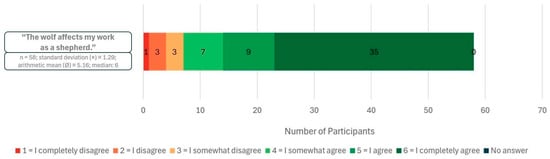
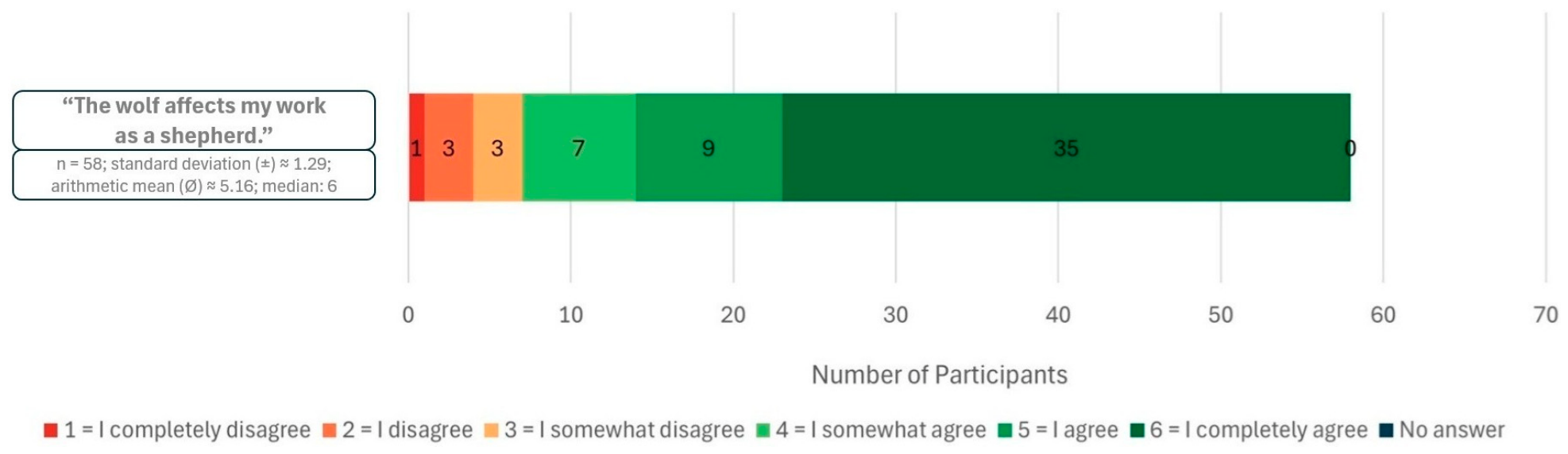
The majority of respondents (70%) reported that a wolf had never killed any animals from their flock. Accordingly, 30% indicated having experienced one or more fatal wolf attacks affecting their own herd. When asked whether they had ever seen a wolf in the wild in their region, around one third (33%) answered yes. When asked whether the wolf affects their own work as a shepherd, there was clear agreement (Figure 1).
Figure 1.
Perceived impact of wolves on shepherds’ own work (n = 58).
3.3. Attitudes Toward the Return of the Wolf
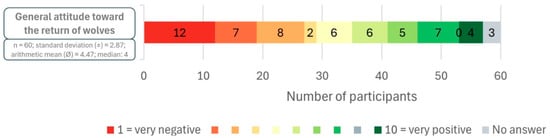
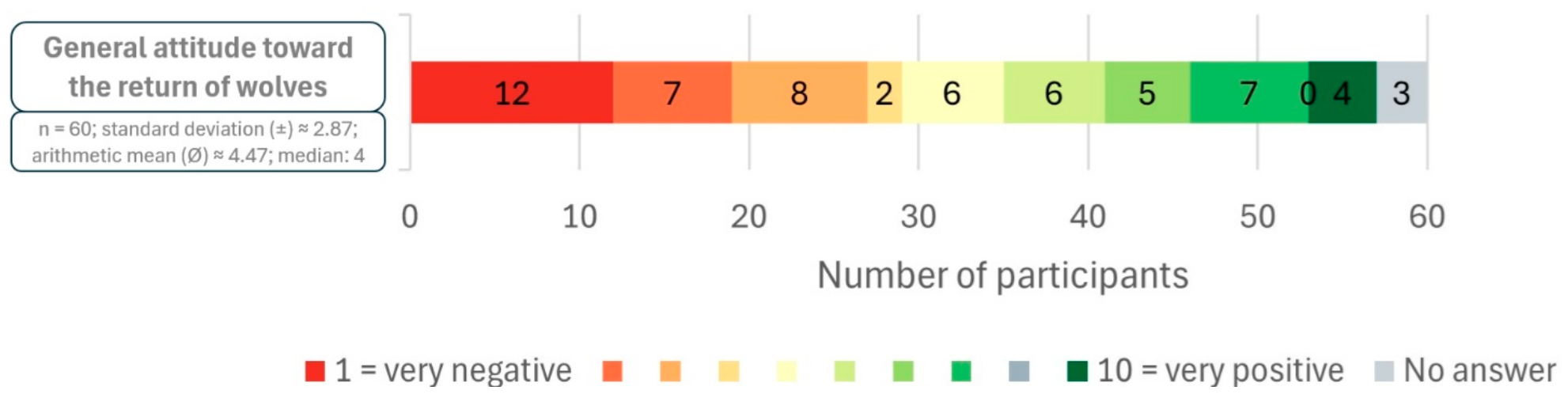
Respondents were asked to indicate their attitude toward the return of the wolf in their region from their perspective as shepherds on a provided scale (1 = “very negative” to 10 = “very positive”). An additional option, “no answer,” was also available. The most frequently selected value was “1” (n = 12), meaning that 20% of respondents for this item (n = 60) indicated a “very negative” attitude. Approximately 58% of respondents chose an option between “1” and “5,” corresponding to a negative assessment overall. Despite an overall negative trend in the mean (mean ≈ 4.47), the relatively high standard deviation (≈2.87) indicates substantial variability in opinions. For example, 7% of respondents reported a “very positive” attitude, and in total, 37% chose a response in the positive range (see Figure 2).
Figure 2.
The general attitude of the shepherds surveyed toward the return of the wolf (n = 60).
3.4. Reasoning Behind Attitudes
The shepherds were asked to give reasons for their attitude in their own words. Using an inductive qualitative content analysis, central thematic areas (see Section 3.4.1, Section 3.4.2, Section 3.4.3 and Section 3.4.4) and associated categories (C) were identified (n:50). The thematic areas are presented below, with exemplary quotes provided for the categories. As the categories sometimes overlap in content and are not always clearly distinguishable, quantifying expressions within the text are intended to provide a broad indication of the categories’ relative weight rather than an exact statistical distribution. This approach applies to all parts of the article in which open-ended responses are interpreted.
3.4.1. Reasons for Negative Assessment
When examining the reasoning for negative assessments of the wolf’s return, (C1) increased workload is among the most frequently mentioned aspects. For example, a respondent stated: “The workload to protect the animals from attacks has increased enormously.” One respondent stated: “Honestly, it is also exhausting to implement new protective measures in the pastures. Not everything works or fits the conditions of the pasture. It is partly very labor-intensive and frustrating, trial and error.”
For shepherds, the wolf also causes (C2) mental burden: “It is mentally burdensome when wolves are present. It is difficult to leave the flock calmly to sleep or eat …” One shepherd explained: “Moreover, you are never calm when wolves are present, because you never know when something will happen.” To explain their negative attitude toward the wolf, respondents also simply referred to (C3) attacks on livestock. One shepherd described the situation as: “Absolutely terrible. Last summer, the wolf killed seven sheep and injured one in a single night.” In addition, respondents highlighted (C4) the lack of space for the wolf in densely populated cultural landscapes. For example: “The area is too small for the wolf (…).”Another participant noted: “The wolf does not fit the current conditions of alpine farming. Everything is too densely populated and farmed. This is also not an environment the wolf desires. He needs vast, untouched forests where he can live out his natural instincts.” Closely related to this argument is (C5) concern for the future of agriculture, more specifically for pastoral farming. One shepherd stated in general: “The return of the wolf is a catastrophe for pastoral farming.” Another comment in this context read: “Consequence [of the wolf’s return; C.D.]: the alpine pastures are giving up, the farmers are giving up, the landscape becomes overgrown, and tradition is lost.” Agricultural work—particularly in the alpine pastures—was often described in the responses as already facing significant challenges: “Alpine farming faces major challenges: labor, scrub encroachment, climate change, stocking density… the return of the wolf and large predators is just the tip of the iceberg.” One shepherd recounted with regard to farming: “The wolf is one problem too many.”
The negative assessment of the wolf’s return is also based on (C6) concerns regarding the welfare of the livestock. More specifically, shepherds reported restrictions on their animals’ freedom due to the presence of the wolf, as well as behavioral changes in the flocks (e.g., nervousness, stress, fearfulness) following encounters with the predator. An illustrative quote for the latter aspect reads: “The surviving sheep after a wolf attack are disturbed and no longer go to the alpine pasture.” In reasoning their rejection of the wolf, respondents also referred to (C7) livestock protection measures, or more precisely, their impossibility or difficulties. For example, the terrain in their grazing area was described as unsuitable for certain protective measures, being too steep, rocky, or extensive. Furthermore, in explaining their scepticism, respondents mentioned (C8) the learning behavior or “misguided education” of the wolf: This means that wolves learn—especially from unprotected, unguarded grazing animals—that farm animals are easier to hunt than wild prey. Finally, the surveyed shepherds also explicitly mentioned (C9) financial burdens (e.g., livestock protection costs money; farmers may not be able to afford shepherding, etc.) as well as (C10) potential conflicts with tourism (for example, livestock guardian dogs perceiving tourists as a threat to the herd).
3.4.2. Reasons for Positive Assessment
A look at the reasoning behind positive assessments shows that participants primarily perceive (C11) the wolf as part of a diverse natural environment and a functioning, rich ecosystem and therefore welcome its presence. Accordingly, respondents explained their positive view with statements such as: “I am happy when nature becomes more intact.” Another comment reads: “The wolf is a natural part of the ecosystem for me. Its return is only natural, just like rockfalls, infections, or other factors on the Alps that affect dead animals.” To provide a more detailed example in this context: “…it is essential to view nature conservation, sheep and goats, as well as the return of the wolf not as a threat, but as an enrichment for the local environment. The wolf plays an important role in the ecological balance, regulates wild populations, and contributes to biodiversity.”
Closely intertwined with this argument is the belief that (C12) the wolf has a right to exist: “From my perspective, it is the wolf’s right to return …” Similarly, another response stated: “The wolf is a living being and, in my understanding of the universe, has the same right to exist as all other living beings.” Some participants questioned or fundamentally criticized the human right to decide over the existence of a species, stating for example: “The question is not whether he [the wolf; C.D.] has the right to exist, but why humans think they can have the right to judge whether wolf or not wolf.” Against this background, one respondent argued: “Humans must learn again to live in harmony with nature, rather than dominate it.”
Some participants emphasized (C13) the positive effects of the return of the wolf on the importance of the shepherding profession: “Thanks to the wolf, there are shepherds for sheep again at all. The vast majority of shepherd positions exist because of livestock protection. Without the wolf, no shepherds.” One shepherd described the consequences of the wolf’s return as follows: “The job [as a shepherd; C.D.] is becoming more valued again, because people see a use in us again.” Finally, in the reasoning behind positive evaluations, there is also the simple observation that (C14) coexistence between pastoral farming and the wolf is possible. In this context, respondents referred to other countries or to successful coexistence in the past. One shepherd exemplified this view: “There are plenty of countries where coexistence works.”
3.4.3. Pragmatic Acceptance
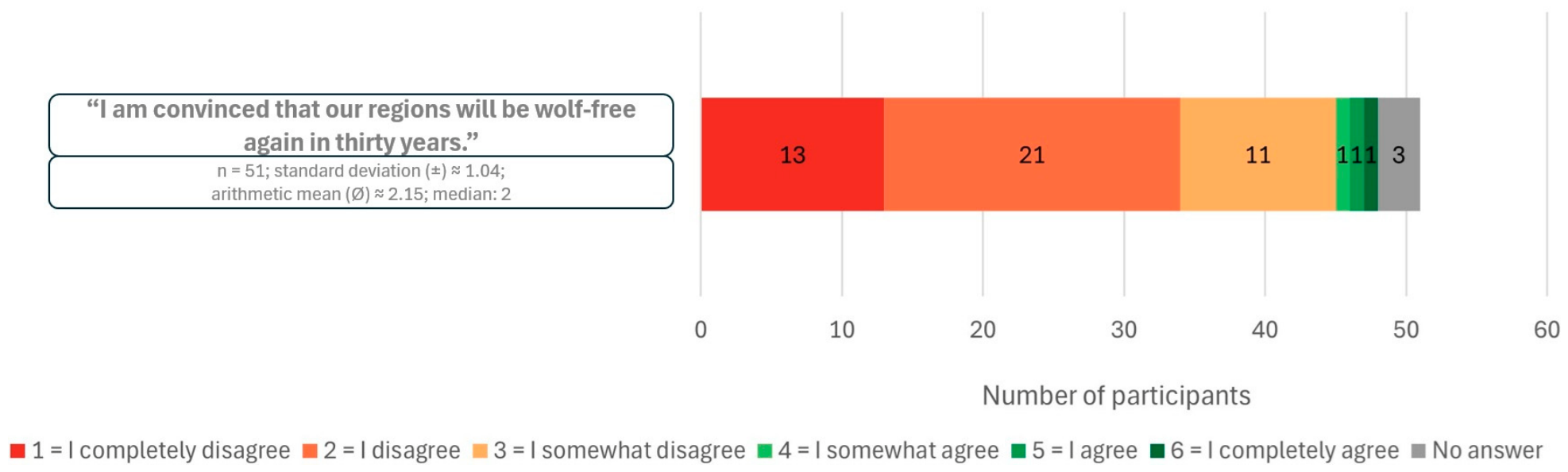
In addition to the reasons for negative or positive evaluations, a stance appeared in the responses that can be described as “pragmatic acceptance.” In this context, respondents did not provide an explicit assessment but described the wolf’s return as a given situation with which they, as shepherds, necessarily have to cope. One response captured this perspective as follows: “I find it difficult to judge [the return of the wolf; C.D.] because I think one must accept things as they are.” Another respondent said: “(…) He [the wolf; C.D.] has come, and we have to live with him.” The belief that the wolf’s return is not a temporary phenomenon is also reflected in the quantitative part, where the vast majority assumes that the predator “has come to stay” (Figure 3).
Figure 3.
Assessment of the wolf’s long-term presence in the region (n = 51).
3.4.4. Debate on Specific Livestock Protection Measures
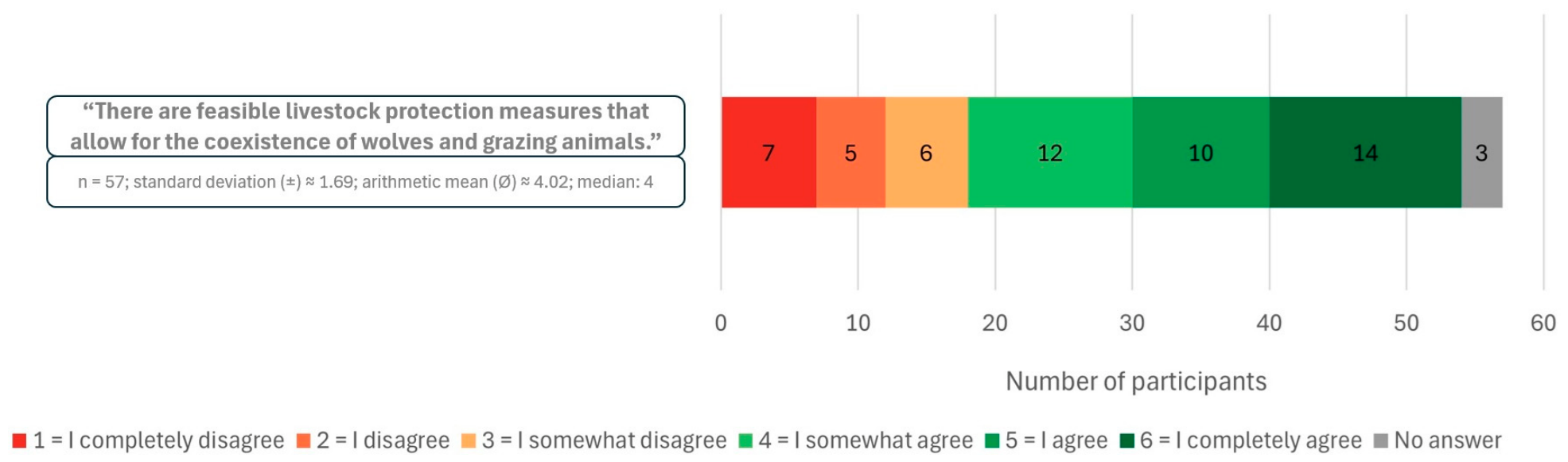
Shepherds frequently refer to specific livestock protection measures when providing reasoning for their assessment of the wolf. In particular, night pens, fences, and livestock guardian dogs were discussed, with assessments of the feasibility of these measures varying: respondents reported both successful applications and practical challenges or impossibilities. For example, one response stated: “I was personally on one of the first alpine pastures in [anonymized region; C.D.] where sheep were attacked, and they tried to implement a livestock protection concept. We failed!” Other shepherds, however, reported convictions like: “With shepherds, dogs, and fences (…) the wolf—at least in the mountains!—does not pose a serious threat.” This heterogeneous set of opinions is also reflected in the quantitative part, where the item regarding feasible livestock protection measures exhibits a relatively wide dispersion (Figure 4).
Figure 4.
Debate on feasible measures for the protection of grazing animals (n = 57).
By contrast, a broad consensus emerges (in the responses to the open-ended questions) regarding one specific measure, namely culling: as a last resort, the controlled shooting of individual animals should be possible. One respondent stated: “I am not in favor of shooting all wolves, but in the case of packs that repeatedly attack animals, I would support an unbureaucratic cull.” One participant argued that he is “… in favor of the return of an animal. However, there must be regulations if the wolf learns wrong behavior.” Similarly: “I fundamentally welcome the return of the wolf, on the condition that, as with other wild animals, the population is managed (hunting). This should not be indiscriminate decimation but should target animals that circumvent livestock protection and lack natural shyness.”
3.4.5. Influence of Sociodemographic Characteristics
Despite the small sample size, potential associations between selected sociodemographic variables (gender, age, years of professional experience, and experience of wolf predation on one’s own herd) and the general attitude toward the return of the wolf (measured on a 10-point rating scale) were examined within an exploratory, bivariate analytical framework. Specifically, independent-sample t-tests were conducted for categorical variables, using Welch’s t-test when the assumption of homogeneity of variances was violated. This included gender, experience of wolf predation, and professional experience, which was dichotomized into two groups for pragmatic reasons to optimize the exploratory comparison (experienced: >5 years, n = 44; less experienced: ≤5 years, n = 13). Age was analyzed via Pearson’s correlation analysis. The aim was to detect potential trends rather than testing a confirmatory a priori model. No statistically significant effects were found with regard to age, professional experience (M_experienced = 4.73, M_less experienced = 3.62; p = 0.187), or gender (p = 0.918). However, statistical significance emerged for the final variable: shepherds who had experienced wolf predation (n = 15) reported a significantly more negative attitude toward the wolf (M = 3.27) than those without such experience (n = 39; M = 5.13; p = 0.030).
3.5. Risk Perception of the Wolf
To examine the herders’ risk perception, participants were presented with a prominent argumentative statement often raised in public debates: “Please comment on the following statement: ‘More animals die on alpine pastures from disease, lightning strikes, and falls than from wolves.’” (n:49) This predefined statement received agreement. One respondent noted for example: “Definitely more animals die from disease, severe weather, rockfall, or falls.” However, the majority of respondents took a nuanced stance on the given statement, acknowledging the argument but at the same time pointing to three additional factors or limitations: (1) Most frequently, respondents noted that other risks—unlike the wolf—are practically unavoidable and can be considered a form of force majeure. For example: “First of all, the [provided statement; C.D.] is correct. But! These are things that are beyond one’s control and can be considered force majeure.” Another comment read: “These causes [illness, lightning strikes, falls; C.D.] cannot usually be prevented, but reintroducing wolves is a weapon against us shepherds and farmers.” (2) Another distinction between the risks focuses on the type of killing and the degree of pain and stress experienced by the livestock, with the wolf being perceived as more negative than the other risks. An illustrative quote reads: the wolf attack “… is, in my view, much more brutal. […] If a wolf attacks a fenced herd, it can be a massacre. It is enormously brutal to witness.” One shepherd argued with regard to disease, lightning, and falls: “Moreover (excluding disease), the animals usually do not suffer, and the surviving [grazing animals; C.D.] are neither stressed nor traumatized.” (3) Finally, some respondents pointed to the differing number of animals affected by wolf attacks compared with other risks. For example: “I think, that is mainly the difference for farmers: With lightning, disease, etc., they occasionally lose one animal, but when the wolf comes, it often kills many animals at once.”
Within these discussion of different risks, the importance of shepherding was repeatedly emphasized. Participants stressed that careful supervision and/or adapted livestock protection measures can reduce not only wolf predation but also other hazards for the animals: “Everything [disease, falls, lightning strikes, as well as wolf attacks; C.D.] could be reduced, even entirely prevented, by the shepherd.” In some responses, the lack of proper shepherding was also criticized. One shepherd wrote that before the return of the wolf, it was common for some livestock owners to “simply leave the animals on the summer alpine pastures and only check on them occasionally.” One participant sharpened this criticism, stating: “In my view, the problem lies more with the ‘old men’ who, ever since their ancestors exterminated the wolf, have left large, unsupervised herds alone on the mountains and collected in the autumn whatever was left.”
3.6. Perception of the Socio-Political Debate
The open questions regarding the perception of the socio-political debate on the wolf revealed primarily two points of criticism (n:45): It is seen as (1) lacking objectivity and (2) disconnected from practical realities. (1) Shepherds expressed a desire for a more objective and factual discussion about the wolf. However, it is not always clear how “objectivity” is specifically understood, or rather different perspectives emerged. For example, one respondent stated: “We [the shepherds; C.D.] could show that the wolf, for instance, is not ‘evil’ toward humans, but rather curious; that much can be prevented or achieved if certain behavioral rules regarding wolves are followed…” From this perspective, “objectivity” is understood as the attempt not to demonize the wolf as an antagonist, but rather to highlight possibilities for coexistence. However, opposing perspectives also emerged: “Shepherds have the opportunity, with their perspective, to correct the romanticized image that many people have of the wolf’s return and to point out the problems for grazing animal husbandry.” From this perspective, “objectivity” is understood as raising awareness about the actual dangers and impacts of the predator, beyond any romanticization.
Amid these clear positions, more nuanced voices emerged, aiming primarily to avoid polarization. One respondent stated: “I feel that people in these debates often hold extreme opinions and see only their own position, not others. I partially understand both viewpoints, but I am rarely asked.” Another comment read: “I always try to explain the situation and problems to others in a neutral and objective way. The wolf issue is so complex, there is no black or white (…). We as shepherds can help shed light on these many aspects.” In this third perspective, “objectivity” is understood as highlighting the complexity of the situation beyond simple polarization and promoting dialogue and compromise.
(2) Regarding the second concern, there was broad consensus: participants emphasized that the perspectives of herders—as voices from practical experience—should be given greater consideration in socio-political debates about the wolf. For example, one respondent stated: “I think shepherds should be much more involved in the public debate.” Another comment read: “What we shepherds can provide [in the socio-political debate; C.D.] is practice! We have to test and implement the measures. We often know what works and what doesn’t. But we are rarely asked….” One shepherd noted: “I hear a lot about how my work supposedly is—from people who have never herded for a single day…”
Several shepherds highlighted a perceived distance between urban and rural life, or between agricultural and non-agricultural perspectives. This perceived alienation was described as problematic, as shepherds saw themselves in a minority position and experienced the discourse as being largely shaped by actors who had no practical insight. One herder stated: “The debate is dominated 90% by actors who have no idea about alpine or agricultural life…” Large segments of the population were described as having “lost contact with agriculture.” From the perspective of some participants, the debate is further shaped by actors who are not directly affected by the presence of the predator. One respondent noted feeling “that militant wolf conservationists are particularly found in cities—and as is well known, neither wolves nor grazing animals are present there…”
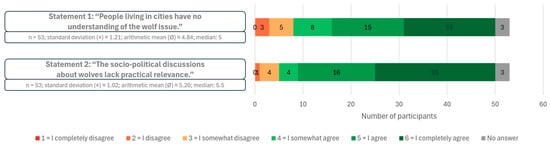
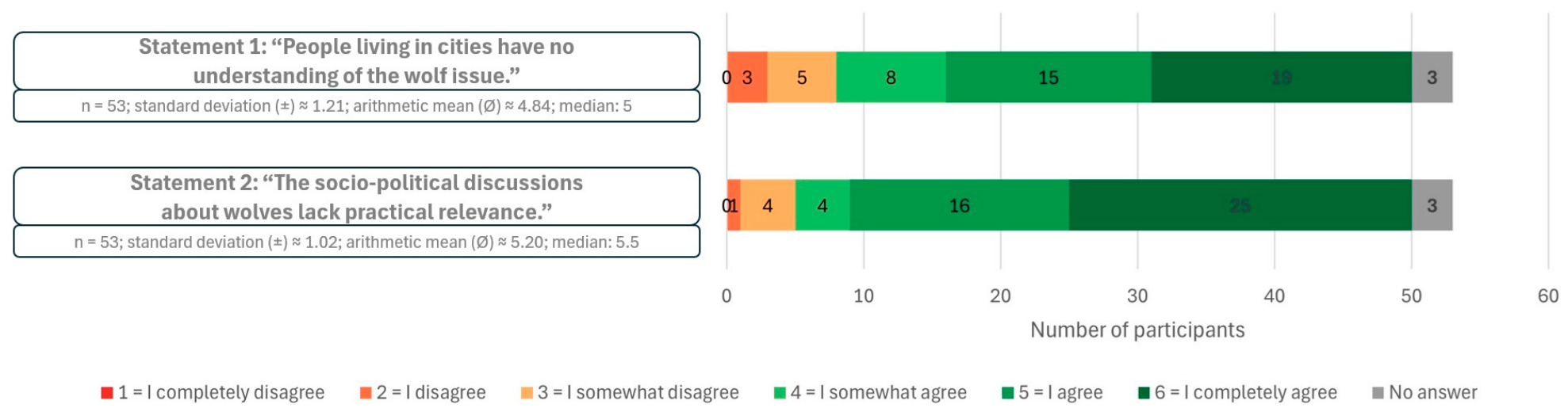
Finally, the study participants were also presented with closed items regarding the socio-political discourse on the return of the wolf (see Figure 5). The statement “People living in cities have no understanding of the wolf issue” was largely agreed with. Even stronger agreement was observed for the statement “The socio-political discussions about wolves lack practical relevance.” With a mean of approximately 5.20, this item received the highest level of agreement among all assessment questions in the survey.
Figure 5.
Perception of socio-political discourse (n = 53).
4. Discussion
4.1. Shepherds’ Assessment of the Wolf
Regarding the first research question, findings indicate that herders in German-speaking regions generally view the return of the wolf from a professional perspective rather critically. At the same time, the variation in the ratings of the closed-ended items, as well as the responses to the open-ended questions, suggest that the degree of rejection is less pronounced and more nuanced than might be expected based on comparable studies on livestock farming, pastoralism, and wolf perception [13,14,16,17,18,25]. Accordingly, the surveyed shepherds expressed not only negative but also positive evaluations of the wolf’s return. The negative assessments are primarily grounded in three ethical lines of reasoning: (1): Agent-centered arguments focus on the situation of the shepherds themselves: the return of the wolf entails a considerable increase in workload as well as an emotional burden, stemming from their constant concern for the grazing animals. A similar finding is reported by Benciolini and Stauder [24]. (2): Anthropocentric arguments focus on the negative impacts of the wolf on human objectives, primarily on pastoralism and agriculture in general. The latter is characterized as an occupation and way of life already exposed to substantial pressures. Against this background, the wolf is perceived as “one problem too many” for agriculture. In the debate on the wolf-agriculture relationship, a key criticism stands out: compared to earlier centuries and to other countries, the wolf simply no longer has a place in the densely populated and agriculturally as well as touristically used regions of Central Europe— critics therefore argue that conflicts are considered inevitable. A particularly compelling finding is that arguments of this kind repeatedly reflect the idea of where wolves “actually” belong, namely in—to quote one respondent—“vast, untouched forests.” López-Bao et al. [27] criticize this position as a falsely framed dichotomy: the “classic” paradigm, according to which wildlife “belongs in wilderness,” is considered outdated under current conditions—in which virtually all spaces are human-dominated —and should be replaced by a “land-sharing” concept that aims at the (co-)existence of large predators in anthropogenically shaped landscapes. While it remains beyond the scope of the present study to determine how critical shepherds would react to this counterargument, our findings nonetheless suggest that exploring this confrontation of perspectives could be a highly rewarding avenue for future debate. (3): Pathocentric arguments, finally, emphasize the negative impacts of the wolf on the grazing animals, particularly regarding painful death, fear and stress, as well as restrictions on animal welfare.
The boundaries between these categories are fluid in the shepherds’ practical experience. For example, the emotional burden of managing wolf presence intimately overlaps with pathocentric concerns for animal welfare and the direct economic considerations of livestock losses.
The positive assessments are primarily grounded in three ethical lines of reasoning: (1) From an ethical perspective, the voices welcoming the return of the wolf predominantly articulate biocentric and/or holistic convictions. Biocentric ethical positions ascribe intrinsic value to all living beings, irrespective of their utility or harm to humans [28]. Beings possessing intrinsic value must not, from this moral standpoint, be absolutely instrumentalized for human purposes [29]; rather, they ought to be approached with “reverence” [30]. A further characteristic of biocentric ethics is that human beings are regarded as one species among many, without any fundamental priority [29]. Holistic ethical approaches attribute intrinsic value not only to animals or plants, but also to entities such as ecosystems, rivers, or landscapes [31]. Humans are called upon to understand themselves as part of a larger whole and to bring their actions “back into harmony with the order of the whole” [32], (p. 10, author’s translation). The supportive voices among the shepherds are permeated by such biocentric and holistic convictions: the wolf is said to have a right to exist; it is described as an expression and integral part of a diverse nature; humans are not entitled to deny other living beings their legitimacy of existence; rather, the task is to live once again “in harmony” with nature instead of dominating and controlling it solely according to calculations of human utility. The assessment of the wolf, therefore, is not independent of how “nature” is fundamentally understood from an ethical perspective and what moral value is attributed to it [18,21,33]. (2) Agent-centered arguments point to an unintended consequence of the return of large predators, namely that the herding profession regains significance. Put succinctly, where there are more wolves, there are once again more shepherds. Similarly, Durá-Alemañ et al. [34] diagnose that the continued presence of wolves in Spanish regions is associated with a strengthening of shepherding as well as a revalorization of “traditional” knowledge related to shepherding practices. (3) As mentioned above, those in favor of wolves view them as part of an intact ecosystem and high biodiversity. This argument can be interpreted as biocentric or holistic, but also anthropocentric, since a functioning ecosystem and high species diversity also benefit humans, whether as a necessary resource or in terms of aesthetic appreciation.
Regarding the socio-demographic findings, the interpretation of the influence of individual characteristics is of limited robustness due to the small sample size. Overall, in the present dataset, gender, age, and years of professional experience do not reach statistical significance. Similar findings—indicating that age and gender have no substantial influence on attitudes toward the wolf—are reported by Stronen et al. [35] in their survey of farmers in Canada. One variable, however, does reveal a significant link: shepherds who have experienced a wolf killing an animal in their own herd tend to evaluate the return of the predator more negatively than their professional colleagues. Comparable findings regarding the impact of direct negative experience are reported by Arbieu et al. [4] and Dressel et al. [14].
4.2. The Wolf in the Context of Risk Perception
For shepherds, the wolf constitutes a significant risk, noticeably impacting their daily work. Crucially, the fact that two-thirds of respondents have never seen a wolf and 70% have not experienced a wolf kill does not contradict this: its mere potential presence generates a perceived threat that necessitates preventive protection and alters working conditions. This finding aligns with similar studies on livestock farmers [36].
Shepherds perceive the wolf as one risk among others (such as lightning strikes, severe weather, falls, etc.). At the same time, particularly in the critical responses, two objections emerge: (1) From an animal-ethical perspective, the magnitude of harm caused by the wolf is perceived as greater. (2) In contrast to other risks—which are regarded as immutable components of pastoralism and as “force majeure”—the predator is described as avoidable. This perception is grounded in the wolf’s prior absence, which renders its presence seemingly reversible in principle, and in the assumption that its return has been intentionally brought about through human action. The term “reintroduction” recurs repeatedly in this context. The evaluation of the wolf’s return as anthropogenic rather than natural thus appears to increase rejection. This finding is consistent with research on risk perception, which suggests that risks perceived as human-made tend to evoke stronger aversions than “natural” risks of comparable magnitude [37]. The fact that the wolf’s return has been promoted through deliberate conservation programs may therefore reinforce its perception as a human-made and avoidable risk—and, consequently, intensify opposition. A similar interpretative pattern emerged in a study conducted in Sweden, where supporters of the wolf tended to perceive it as having “returned naturally,” whereas opponents viewed it as having been “artificially introduced” [38].
In the context of risk perception as well as with regard to the broader debate, an ontological question thus becomes pivotal: the crucial issue goes beyond how the wolf is evaluated—whether one is for or against it—to the underlying question of what the wolf—especially in the age of the Anthropocene—actually is for us. Is it a native wild animal, or—following Karafyllis [39]—a “biofact,” that is, a living being substantially shaped and influenced by human action? The answer to this question carries significant consequences for both risk perception and the debate as a whole. Consequently, future (quantitative) surveys as well as participatory stakeholder processes should explicitly address this ontological dimension.
4.3. The Socio-Political Debate on Wolves from the Perspective of Herders
Regarding the perception of the socio-political debate on wolves, there is broad consensus among the respondents: the discussions lack practical relevance, and it is precisely this perspective that herders—as one of the few groups—could contribute. However, they perceive themselves as an unheard minority. Against this background, they wish to have a stronger voice in societal debates. At this point, parallels emerge with other professional groups in livestock farming, such as farmers or veterinarians, who perceive and criticize debates about their professional field in a similar way [40,41]. Studies also indicate that the sense of lacking participation—or of “not being seen”—in societal debates is more frequently experienced by rural populations than by people in urban areas [42]. In line with this, the shepherds highlight a fundamental estrangement between the lifeworlds of the “city” and the “countryside.” The significance of this “urban–rural divide” within the wolf debate is also emphasized by Zscheischler and Friedrich [43], who argue that the controversy over the wolf reflects, not least, a spatial–cultural split between urban and rural areas. Based on the collected data, the present study reaches a similar assessment: Respondents repeatedly criticize the clear distance between urban and rural lifeworlds; however, a more precise formulation is to describe this as a sense of estrangement between “agriculture” and “non-agriculture”. This distinction is crucial because the herders specifically emphasize that the wolf debate is shaped by actors who lack practical agricultural experience, do not have to make decisions on-site, and are not directly affected by the presence of the predator—all of which are aspects that can equally apply to individuals who reside in rural areas but are not employed in farming [44,45,46]. Against this background, the focus is not primarily on an urban–rural divide, but rather on the encounter of divergent lifeworlds that differ as a kind of “practical knowledge-and-exposure gap”. Broadly speaking, the return of a wild animal affects society to varying degrees. The frequently cited phrase “the wolf is returning” raises the question of exactly where it is returning to and which groups of people are affected, and to what extent.
The critical and sometimes starkly worded responses of the shepherds reveal a fundamental challenge: when those directly affected perceive that they are neither taken seriously nor heard in societal debates, the result is not merely individual frustration. Rather, such alienation risks undermining trust in political decision-making processes. From this perspective, “the wolf” becomes a catalyst for social estrangement and has the potential to exacerbate broader democratic tensions.
5. Conclusions
The present study demonstrates that while shepherds are profoundly affected by the return of the wolf, they feel largely marginalized in public discourses and political decision-making processes. The diverse assessments formulated by the surveyed herders reveal three underlying dimensions that characterize this intense debate: first, an ethical question concerning the moral status of wild animals in relation to the protection of livestock; second, an ontological question regarding the wolf’s nature in the Anthropocene; and third, a democratic-political question of legitimate decision-making under conditions of unequally distributed exposure. Future research, wildlife management strategies, and participatory citizen-engagement initiatives would be well-advised not to disregard any of these three dimensions.
Supplementary Materials
The following supporting information can be downloaded at: https://www.mdpi.com/article/10.3390/conservation6030093/s1, File S1: English version of the questionnaire; File S2: Results section with original participant quotes in German.
Author Contributions
C.D.: Conceptualization, Data curation, Formal analysis, Investigation, Methodology, Software, Supervision, Writing—original draft, Writing—review and editing. V.H.: Conceptualization, Formal analysis, Investigation, Writing—review and editing. All authors have read and agreed to the published version of the manuscript.
Funding
This research received no external funding.
Institutional Review Board Statement
In accordance with the regulations of the University of Veterinary Medicine Vienna, the planned study was submitted to the Ethics Committee of FH Campus Wien for review prior to data collection. The study was conducted in accordance with the Declaration of Helsinki, and approved by the Ethics Committee of FH Campus Wien (protocol code EK No.: 227/2024 and date of approval 20 December 2024). Participation in the survey was voluntary and anonymous. No incentives were offered, and participants were informed that the results would be published in anonymized form as part of a scientific study.
Informed Consent Statement
Informed consent was obtained from all subjects involved in the study.
Data Availability Statement
The data of this study are available from the corresponding author upon reasonable request, subject to institutional and/or ethical restrictions.
Acknowledgments
Open Access Funding by the University of Veterinary Medicine Vienna. The study was conducted as part of a diploma thesis at the University of Veterinary Medicine Vienna. We thank all shepherds who participated in the study and shared their experiences and perspectives. For them, the return of the wolf is not merely a societal debate, but something that directly affects their daily work and professional identity. This paper aims to reflect that reality.
Conflicts of Interest
The authors declare no conflicts of interest.
References
- The Situation of the Wolf (Canis lupus) in the European Union—An in-Depth Analysis. Available online: https://www.actu-environnement.com/media/pdf/news-43167-analyse-commission-europeenne-loup-2023.pdf (accessed on 23 April 2026).
- Herzog, S. Return of grey wolf (Canis lupus) to Central Europe: Challenges and recommendations for future management in cultural landscapes. Ann. For. Res. 2018, 61, 203–209. [Google Scholar] [CrossRef] [Scilit]
- Der Status der Wolfspopulation im Alpenraum. Available online: https://www.lifewolfalps.eu/de/der-status-der-wolfspopulation-im-alpenraum/ (accessed on 23 April 2026).
- Arbieu, U.; Mehring, M.; Bunnefeld, N.; Kaczensky, P.; Reinhardt, I.; Ansorge, H.; Böhning-Gaese, K.; Glikman, J.A.; Kluth, G.; Nowak, C.; et al. Attitudes towards returning wolves (Canis lupus) in Germany: Exposure, information sources and trust matter. Biol. Conserv. 2019, 234, 202–210. [Google Scholar] [CrossRef] [Scilit]
- Breyne, J.; Abildtrup, J.; Maréchal, K. The wolves are coming: Understanding human controversies on the return of the wolf through the use of socio-cultural values. Eur. J. Wildl. Res. 2021, 67, 1–17. [Google Scholar]
- Boitani, L.; Linnell, J. Bringing Large Mammals Back: Large Carnivores in Europe. In Rewilding European Landscapes, 1st ed.; Pereira, H., Navarro, L., Eds.; Springer: Cham, Switzerland, 2015; Volume 1, pp. 67–68. [Google Scholar]
- Capitain, S.; Lamm, C.; Marshall-Pescini, S.; Range, F. Uncovering the full potential of attitude measures in navigating human-wolf coexistence. Biol. Conserv. 2025, 281, 110976. [Google Scholar] [CrossRef] [Scilit]
- Research for AGRI Committee—The Revival of Wolves and Other Large Predators and Its Impact on Farmers and Their Livelihood in Rural Regions of Europe. Available online: http://www.europarl.europa.eu/thinktank/en/document.html?reference=IPOL_STU(2018)617488 (accessed on 23 April 2026).
- Pettersson, H.L.; Quinn, C.H.; Holmes, G.; Sait, S.M.; López-Bao, J.V. Welcoming Wolves? Governing the Return of Large Carnivores in Traditional Pastoral Landscapes. Front. Conserv. Sci. 2021, 2, 710218. [Google Scholar] [CrossRef] [Scilit]
- Trouwborst, A. Managing the Carnivore Comeback: International and EU Species Protection Law and the Return of Lynx, Wolf and Bear to Western Europe. J. Environ. Law 2010, 22, 347–372. [Google Scholar] [CrossRef] [Scilit]
- Van Herzele, A.; Aarts, N.; Casaer, J. Wildlife comeback in Flanders: Tracing the fault lines and dynamics of public debate. Eur. J. Wildl. Res. 2015, 61, 539–555. [Google Scholar] [CrossRef] [Scilit]
- Ajzen, I.; Fishbein, M. Attitude-behavior relations: A theoretical analysis and review of empirical research. Psychol. Bull. 1977, 84, 888–918. [Google Scholar] [CrossRef]
- Røskaft, E.; Händel, B.; Bjerke, T.; Kaltenborn, B.P. Human attitudes towards large carnivores in Norway. Wildl. Biol. 2007, 13, 172–185. [Google Scholar] [CrossRef] [Scilit]
- Dressel, S.; Sandström, C.; Ericsson, G. A meta-analysis of studies on attitudes toward bears and wolves across Europe 1976–2012. Conserv. Biol. 2015, 29, 565–574. [Google Scholar] [PubMed]
- Karlsson, J.; Sjöström, M. Human attitudes towards wolves, a matter of distance. Biol. Conserv. 2007, 137, 610–616. [Google Scholar] [CrossRef] [Scilit]
- Naughton-Treves, L.; Grossberg, R.; Treves, A. Paying for Tolerance: Rural Citizens’ Attitudes toward Wolf Depredation and Compensation. Conserv. Biol. 2003, 17, 1500–1511. [Google Scholar] [CrossRef] [Scilit]
- Public Attitudes Toward Wolves and Wolf Conservation in Austrian, French, Italian and Slovenian Alps. Available online: https://www.lifewolfalps.eu/wp-content/uploads/2025/01/Annex_FR_D1_01_DEL_Report-attitudes-1.pdf (accessed on 23 April 2026).
- Van Heel, B.F.; Boerboom, A.M.; Fliervoet, J.M.; Lenders, H.J.R.; van den Born, R.J.G. Analysing stakeholders’ perceptions of wolf, lynx and fox in a Dutch riverine area. Biodivers. Conserv. 2017, 26, 1723–1743. [Google Scholar] [CrossRef] [Scilit]
- Adhikari, S.; Joshi, O.; Sorice, M.G.; Fuhlendorf, S.D. Understanding behavioral intention of landowners to promote wildlife richness and biodiversity in the Southern Great Plains. J. Environ. Manag. 2024, 349, 119607. [Google Scholar] [CrossRef] [Scilit] [PubMed]
- Grilli, G.; Notaro, S.; Campbell, D. Including value orientations in choice models to estimate benefits of wildlife management policies. Ecol. Econ. 2018, 151, 70–81. [Google Scholar] [CrossRef] [Scilit]
- Hunziker, M. Die Akzeptanz der Raubtiere in der Schweiz. Ergebnisse sozialwissenschaftlicher Untersuchungen. In Tagungsdokumentation: Akzeptanz für Wölfe, 1st ed.; Naturschutzbund Deutschland (NABU), Ed.; Bundesamt für Naturschutz: Bonn, Germany, 2009; Volume 1, pp. 12–15. [Google Scholar]
- Rickenbach, O.; Reyes-García, V.; Moser, G.; Garcia, C. What Explains Wildlife Value Orientations? A Study among Central African Forest Dwellers. Hum. Ecol. 2016, 45, 293–306. [Google Scholar] [CrossRef] [Scilit]
- Teel, T.L.; Manfredo, M.J. Understanding the diversity of public interests in wildlife conservation. Conserv. Biol. 2010, 24, 128–139. [Google Scholar] [CrossRef] [Scilit] [PubMed]
- Benciolini, M.; Stauder, J. Dealing with wolves and livestock protection measures in the Alps: Perspectives about farmers and shepherds knowledge and perceptions. Res. Sq. 2022. [Google Scholar] [CrossRef] [Scilit] [PubMed]
- Rigg, R.; Finďo, S.; Wechselberger, M.; Gorman, M.L.; Sillero-Zubiri, C.; Macdonald, D.W. Mitigating carnivore–livestock conflict in Europe: Lessons from Slovakia. Oryx 2011, 45, 272–280. [Google Scholar] [CrossRef] [Scilit]
- Mayring, P. Qualitative Inhaltsanalyse. Grundlagen und Techniken, 12th ed.; Beltz Verlag: Weinheim, Germany, 2015. [Google Scholar]
- López-Bao, J.; Bruskotter, J.; Chapron, G. Finding space for large carnivores. Nat. Ecol. Evol. 2017, 1, 0140. [Google Scholar] [CrossRef] [Scilit] [PubMed]
- Altner, G. Die Überlebenskrise in der Gegenwart. Ansätze zum Dialog mit der Natur in Naturwissenschaft und Theologie; Wissenschaftliche Buchgesellschaft Darmstadt: Darmstadt, Germany, 1987. [Google Scholar]
- Taylor, P.W. Die Ethik der Achtung gegenüber der Natur. In Naturethik. Grundtexte der Gegenwärtigen tier- und Ökoethischen Diskussion, 1st ed.; Krebs, A., Ed.; Suhrkamp: Frankfurt am Main, Germany, 1997; pp. 111–143. [Google Scholar]
- Schweitzer, A. Gesammelte Werke in 5 Bänden, Band 2; Beck: München, Germany, 1974. [Google Scholar]
- Naess, A. Die tiefenökologische Bewegung. In Naturethik. Grundtexte der Gegenwärtigen tier- und Ökoethischen Diskussion, 1st ed.; Krebs, A., Ed.; Suhrkamp: Frankfurt am Main, Germany, 1997; pp. 182–210. [Google Scholar]
- Meyer-Abich, K.M. Naturphilosophische Begründung einer holistischen Ethik. In Ökologische Ethik und Rechtstheorie, 1st ed.; Nida-Rümelin, J., Von den Pfordten, D., Eds.; Nomos: Baden-Baden, Germany, 1995; pp. 159–178. [Google Scholar]
- Bogezi, C.; van Eeden, L.M.; Wirsing, A.J.; Marzluff, J.M. Ranchers’ perspectives on participating in non-lethal wolf-livestock coexistence strategies. Front. Conserv. Sci. 2021, 2, 683732. [Google Scholar] [CrossRef] [Scilit]
- Durá-Alemañ, C.J.; Almarcha, F.; Sánchez-Zapata, J.A.; Pérez-Ibarra, I.; Morales-Reyes, Z. Land of wolves, school of shepherds: The importance of pastoral knowledge on co-existence with large carnivores. Ecosyst. People 2024, 20, 2422910. [Google Scholar] [CrossRef] [Scilit]
- Stronen, A.V.; Brook, R.K.; Paquet, P.C.; Mclachlan, S. Farmer attitudes toward wolves: Implications for the role of predators in managing disease. Biol. Conserv. 2007, 135, 1–10. [Google Scholar] [CrossRef] [Scilit]
- Zahl-Thanem, A.; Burton, R.J.; Blekesaune, A.; Haugen, M.S.; Rønningen, K. The impact of wolves on psychological distress among farmers in Norway. J. Rural Stud. 2020, 78, 1–11. [Google Scholar] [CrossRef] [Scilit]
- Siegrist, M.; Sütterlin, B. Human and nature-caused hazards: The affect heuristic causes biased decisions. Risk Anal. 2014, 34, 1482–1494. [Google Scholar] [CrossRef] [Scilit] [PubMed]
- Sjölander-Lindqvist, A. Local Identity, Science and Politics Indivisible: The Swedish Wolf Controversy Deconstructed. J. Environ. Policy Plan. 2008, 10, 71–94. [Google Scholar] [CrossRef] [Scilit]
- Karafyllis, N. Das Wesen der Biofakte. In Biofakte. Versuch über den Menschen Zwischen Artefakt und Lebewesen, 1st ed.; Karafyllis, N., Ed.; Mentis: Paderborn, Germany, 2003; pp. 11–27. [Google Scholar]
- Dürnberger, C. ‘You should be slaughtered!’ Experiences of criticism/hate speech, motives and strategies among German-speaking livestock farmers using social media. Int. J. Livest. Prod. 2019, 10, 151–165. [Google Scholar]
- Dürnberger, C. The last of us? An online survey among German farm veterinarians about the future of veterinary training, livestock farming and the profession in general. Int. J. Livest. Prod. 2020, 11, 72–83. [Google Scholar] [CrossRef] [Scilit]
- Hyland, M.; Mascherini, M.; Lamont, M. Feeling overlooked: A rural–urban divide in recognition. Glob. Policy 2024, 15, 807–822. [Google Scholar] [CrossRef] [Scilit]
- Zscheischler, J.; Friedrich, J. The wolf (Canis lupus) as a symbol of an urban–rural divide? Results from a media discourse analysis on the human–wolf conflict in Germany. Environ. Manag. 2022, 70, 1051–1065. [Google Scholar] [CrossRef] [Scilit] [PubMed]
- Barmoen, M.; Bærum, K.M.; Mathiesen, K.E. Living with wolves: A worldwide systematic review of attitudes. Ambio 2024, 53, 1414–1432. [Google Scholar] [CrossRef] [Scilit] [PubMed]
- Sponarski, C.C.; Semeniuk, C.; Glikman, J.A.; Bath, A.J.; Musiani, M. Heterogeneity among Rural Resident Attitudes Toward Wolves. Hum. Dimens. Wildl. 2013, 18, 239–248. [Google Scholar] [CrossRef] [Scilit]
- Trebo, S.; Cary, E.; Wartmann, F. Emotions shape attitudes towards wolf conservation management in the Italian Alps. Eur. J. Wildl. Res. 2025, 71, 7. [Google Scholar] [CrossRef] [Scilit]
Disclaimer/Publisher’s Note: The statements, opinions and data contained in all publications are solely those of the individual author(s) and contributor(s) and not of MDPI and/or the editor(s). MDPI and/or the editor(s) disclaim responsibility for any injury to people or property resulting from any ideas, methods, instructions or products referred to in the content. |
© 2026 by the authors. Licensee MDPI, Basel, Switzerland. This article is an open access article distributed under the terms and conditions of the Creative Commons Attribution (CC BY) license.