


Abstract
Assessing individual animal health is essential for detecting early ecological stress that may scale to population-level impacts. Yet, conventional capture-based methods are invasive and logistically challenging, particularly for large mammals. This study evaluates the accuracy of drone-based morphometric measurements as a non-invasive approach for estimating elephants’ Body Condition Index (BCI). Research was conducted in Way Kambas National Park, Sumatra, using a DJI Matrice 300 RTK equipped with a multisensor camera to acquire aerial imagery, primarily from a top-down perspective. Morphometric parameters were extracted through image preprocessing, segmentation, and edge detection using an OpenCV-based Canny algorithm, followed by coordinate and Euclidean distance analyses. Drone-derived measurements were validated against field-based morphometry in captive Sumatran elephants. Linear regression revealed strong agreement between methods, with R2 values ranging from 0.91 to 0.97. Mid-body width showed the highest accuracy (R2 = 0.97, MAPE = 2.66%, RMSE = 2.36), while other body dimensions also performed consistently well. BCI-related morphometric ratios exhibited minimal differences between drone and field measurements, confirming methodological reliability. As an exploratory extension, a preliminary allometric scaling framework was applied to estimate body condition proxies in free-ranging wild elephants except for mid-body width; however, these estimates are model-derived from total body length and should be interpreted as indicative rather than as direct morphometric assessments of body condition. These findings demonstrate that drone-based photogrammetry provides a validated, practical, and non-invasive method for morphometric measurement in captive elephants, with promising but as yet incompletely validated potential for application to wild populations.
1. Introduction
Monitoring body condition and health in wildlife, particularly long-lived megafauna, is fundamental to contemporary conservation science. Beyond reflecting the physiological status of individual animals, Body Condition Index (BCI) functions as an integrative indicator of habitat quality, environmental sustainability, trophic stability, and the broader ecological processes that sustain populations in dynamic landscapes [1,2]. Healthy and stable BCI profiles typically signify adequate resource availability, functional ecosystem integrity, and low anthropogenic pressure, whereas declines in BCI often precede observable demographic impacts and can signal early-stage ecosystem disruptions, including habitat fragmentation, climatic anomalies, nutritional stress, and intensifying human–wildlife interactions [3,4]. As such, systematic BCI monitoring provides a sensitive and scalable tool for detecting environmental change before it manifests in reduced survival or reproductive rates [5]. In conservation practice, BCI thus serves not only as a measure of individual well-being but also as a quantitative proxy for ecosystem resilience and the effectiveness of landscape-level management interventions—making it indispensable for adaptive and evidence-based conservation planning.
The Sumatran elephant (Elephas maximus sumatranus) remains one of the most critically endangered megafaunal subspecies, facing severe and accelerating pressures from habitat loss, landscape fragmentation, human–elephant conflict, and broader ecological instability [6,7]. Safeguarding this species requires conservation strategies grounded in accurate, repeatable, and minimally invasive assessments of health and body condition. Yet, conventional field-based measurement techniques are often impractical or unsafe, given elephants’ large body size, unpredictable movement patterns, and the substantial risks to both animals and personnel. Additionally, repeated handling or close-range disturbance can alter natural behaviors and compromise long-term welfare, reducing the reliability of physiological assessments [8]. These constraints highlight a critical need for robust technological approaches capable of generating high-quality morphometric and health-related data without necessitating physical contact. Consequently, the integration of remote sensing, drone imaging, and other advanced, contactless monitoring systems is emerging as an essential component of modern conservation science, offering a scalable and ethically responsible pathway for supporting evidence-based management of Sumatran elephant populations.
The rapid advancement of unmanned aerial vehicles (UAVs) has transformed wildlife ecology by enabling the collection of high-resolution spatial and morphological data without the need for direct proximity to animals [9,10,11,12]. Drone-based photogrammetry, in particular, has emerged as a powerful tool capable of accurately estimating body dimensions, surveying population structure, and even detecting health abnormalities through thermal or multispectral imaging—thereby strengthening evidence-based conservation practices [11,13,14,15]. These capabilities are especially valuable for monitoring elephants, whose large body size, mobility, and behavioral unpredictability complicate traditional measurement techniques and elevate risks for both researchers and animals [11,16,17]. By enabling precise morphometric quantification from a distance, drone-supported photogrammetry provides a genuinely non-invasive, scalable, and repeatable approach suitable for long-term monitoring across diverse habitats [18]. Such technology offers substantial promise not only for managed or semi-wild groups but also for free-ranging populations, where safe and efficient data collection remains a critical challenge in conservation science.
Perimeter-based and ratio-based photogrammetric approaches have been increasingly adopted for evaluating body condition in large marine mammals such as manatees [13], gray whales [19], and dugongs [20], demonstrating their effectiveness in generating reliable morphological indicators from aerial imagery. Aerial photogrammetric studies have primarily relied on top-down imagery to quantify body proportions and estimate body condition in large aquatic mammals [13,19,20]. While lateral imagery may provide additional morphological information, its utility for quantitative morphometric analysis remains less established and has rarely been evaluated for terrestrial megafauna such as elephants [21]. Despite the proven utility of these methods, their application to medium-large terrestrial mammals remains very limited, and virtually no studies have examined their potential for Sumatran elephants, which possess distinct morphometric profiles and inhabit ecologically heterogeneous landscapes. Despite widespread use, conventional assessments of body condition continue to rely on subjective visual judgments, which are prone to potentially significant observer-induced variation and reduce their reliability for broad-scale ecological and conservation applications [22]. This lack of standardized, quantitative approaches highlights a critical research gap and reinforces the need for more objective, repeatable, and non-invasive morphometric techniques to support evidence-based conservation and robust long-term monitoring of this threatened subspecies.
Way Kambas National Park (WKNP), established as Indonesia’s primary conservation and training center for Sumatran elephants since 1985, occupies a pivotal position in the long-term management of this critically endangered subspecies. In this context, the development of modern, reliable, and non-invasive health monitoring tools has become increasingly urgent to enhance evidence-based decision-making in conservation programs. This study evaluates the accuracy of drone-derived morphometric measurements obtained primarily from top-down imagery and examines their suitability for estimating BCI as a quantitative indicator of individual health, while also exploring the potential of lateral imagery as a supplementary observational perspective. Beyond generating methodological insights specific to Sumatran elephants, the findings are expected to inform broader conservation frameworks and contribute directly to the advancement of UAV-supported wildlife health monitoring systems.
2. Materials and Methods
2.1. Study Design
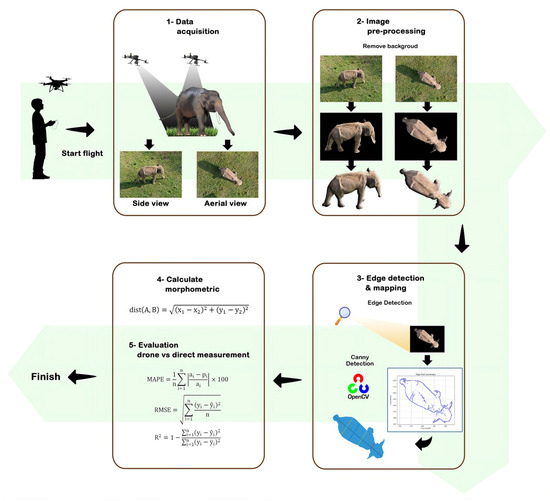
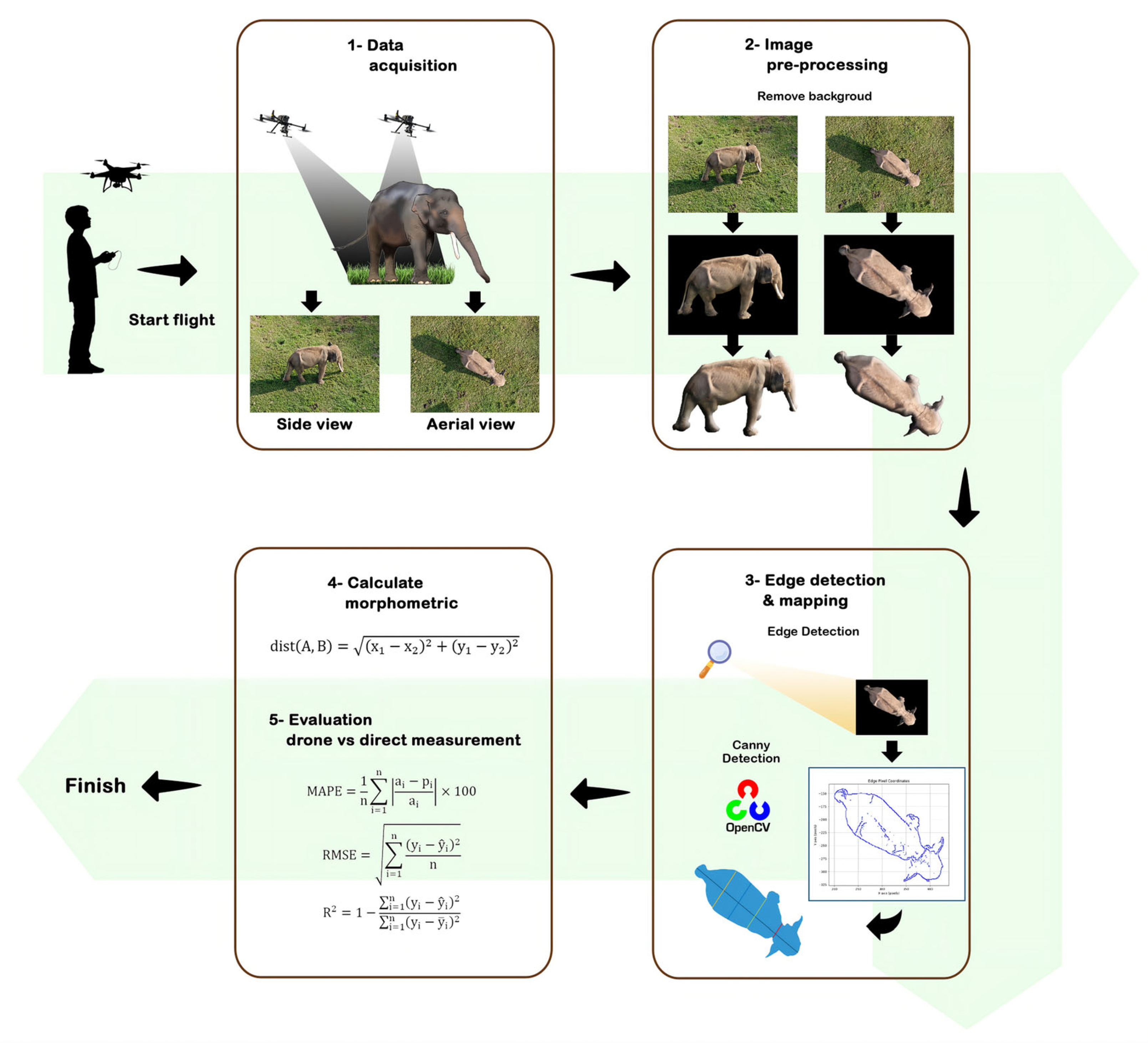
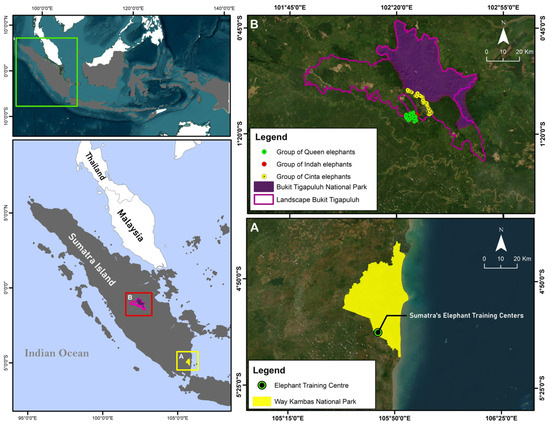
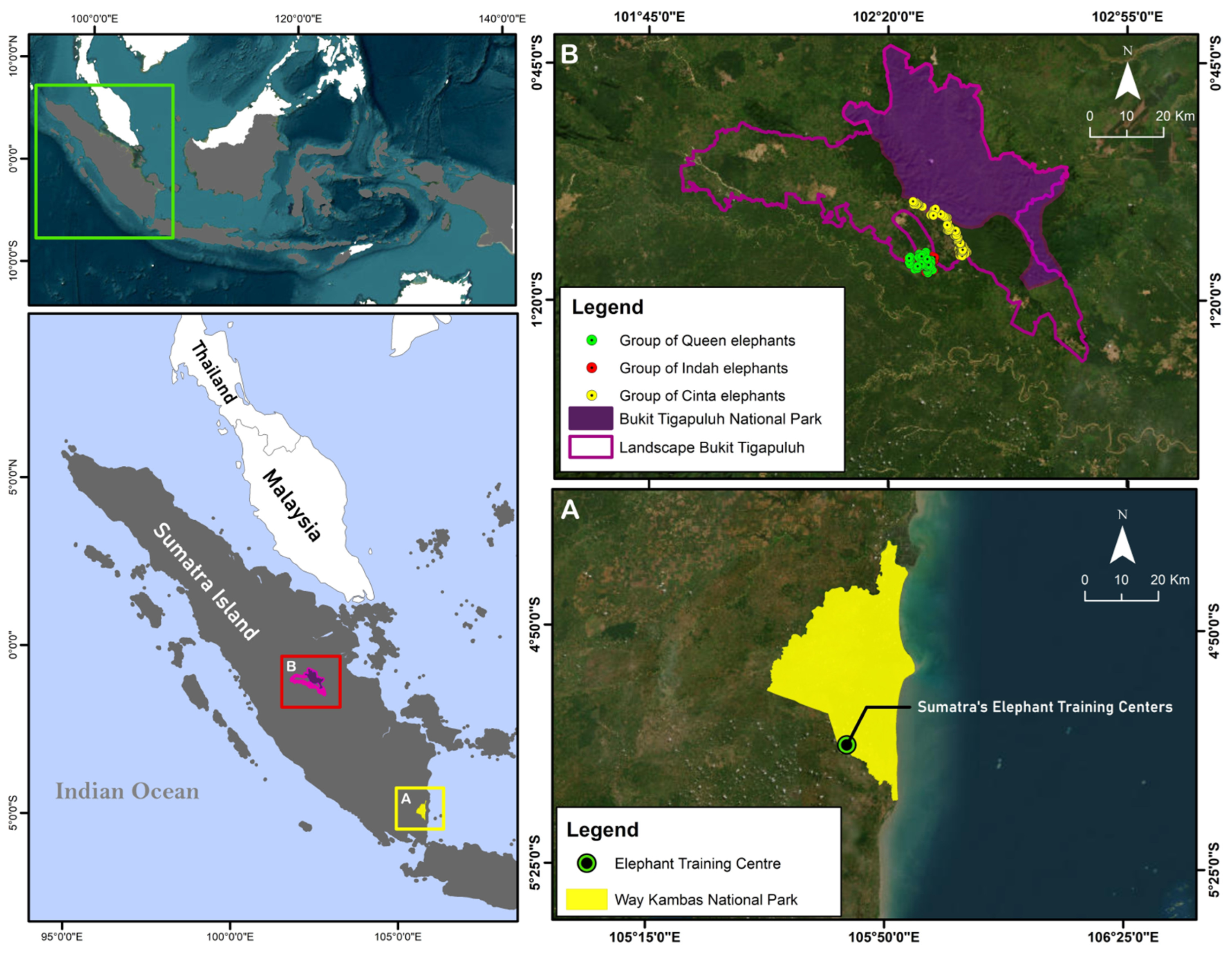
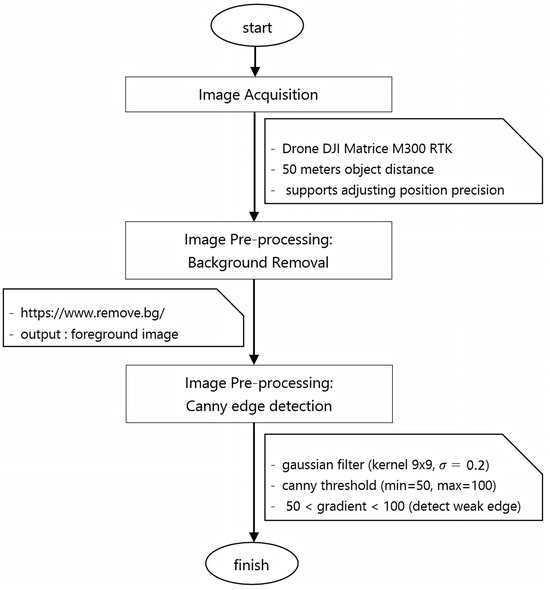
We conducted experiments to assess the accuracy of drone-based methods for measuring Sumatran elephants’ body size and using these measures to estimate their body condition. We provide a detailed workflow outlining the steps undertaken in experiment in Figure 1. We examined differences in the accuracy of trained Sumatran elephant body size estimates acquired from drone-based photogrammetry of elephants, using a reference object of known size to scale imagery from direct measurement. The data from the experiment were then used to develop preliminary body condition estimates for elephants using manual straight-line measures of body length and curvilinear measures of umbilical girth compared to photogrammetry-based straight-line measures of body length and maximum width. The experimentally validated model was subsequently applied to estimate the Body Condition Index (BCI) of free-ranging elephants in the Bukit Tigapuluh Landscape using data collected in 2023 (Figure 2). Due to technical constraints during data acquisition, total body length and mid-body width (MBW) were the only morphometric parameters consistently obtained and were therefore used as the sole input for BCI calculation. Thus, we built a new model to predict the remaining morphometric variables, e.g., front leg width (FLW), neck width (NW), and rear leg width (RLW) for wild elephants (33 individuals). Photogrammetric data were collected using manual UAV flights, following standardized survey protocols for Sumatran elephants [11]. First, we ensured that our drone’s flight altitude did not exceed 120 m, in compliance with the Regulation of the Minister of Transportation of the Republic of Indonesia No. 37/2020 regarding the Operation of Unmanned Aircraft in Airspace Served by the State of Indonesia. Second, in preparation for implementing drone surveys to assess Sumatran elephants’ body condition, we conducted tests to assess potential drone-related disturbances, such as evasive maneuvers, that could impact survey accuracy and minimise disturbance to elephants. Based on our findings, we determined a minimum flying height of 30 m for the drones to avoid disturbing the elephants, which was the same as the height at which they had last flown before fleeing. Moreover, to reduce potential animal disturbance, UAV take-off was conducted at a distance of 100–150 m from the focal individual [11,23]. The vertical distance to the elephants when photographed by this method was 50 m, both for the trained elephants at Sumatra’s Elephant Training Centers (SETC) in Way Kambas National Park and for wild elephants in the Bukit Tigapuluh Landscape. Observations were made using a x10 optical zoom camera (Zenmuse-H20 by Da-Jiang Innovations (DJI) Technology Co., Ltd., Shenzhen, China) mounted on a quadcopter drone (DJI, Matrice 300 RTK). The optical zoom allowed observers to remain unnoticed by the animals while still obtaining highly detailed photos. This payload’s main features include a 20 MP zoom camera (video resolution: 3840 × 2160 and photo size: 5184 × 3888) with a 12 MP wide camera, a 1200 m laser rangefinder.
Figure 1.
Research flowchart: elephant Body Condition Index (BCI) estimation via drone image.
Figure 2.
Locations of drone-based photogrammetric data acquisition for Sumatran elephants (Elephas maximus sumatranus): (A) Way Kambas National Park and (B) Bukit Tigapuluh Landscape.
This study comprises two analytical components that should be interpreted separately. The first component presents the primary validated analysis, consisting of a direct comparison of BCI-relevant morphometric ratios between manual field measurements and drone-derived measurements in captive Sumatran elephants, for which complete direct measurements were available. The second component represents an exploratory extension to wild elephants, where most width-related variables could not be independently measured and were therefore estimated using allometric scaling relationships derived from captive individuals. Consequently, BCI values for wild elephants should be interpreted as model-derived allometric proxies rather than direct observational measures of body condition, and comparisons between captive and wild populations should be considered indicative rather than inferential.
2.2. Study Site and Subjects
We conducted our experiments with 32 trained Sumatran elephants of various ages and both sexes at SETC in Way Kambas National Park, the South of Sumatra, Lampung Province, Indonesia (Figure 2). All trained elephants were housed in the same grazing fields, where at least one other elephant could see or interact with each other to express their natural behaviours. The health and welfare of all animals were regularly assessed during veterinary exams, and all elephants were estimated to be in good physical condition and in good health. Next, further information on free-ranging elephants in the Bukit Tigapuluh Landscape and their habitat is available in various references, particularly studies that use drone photogrammetry to estimate population abundance and predict the age structure of the endangered Sumatran elephant [11].
2.3. Data Acquisition
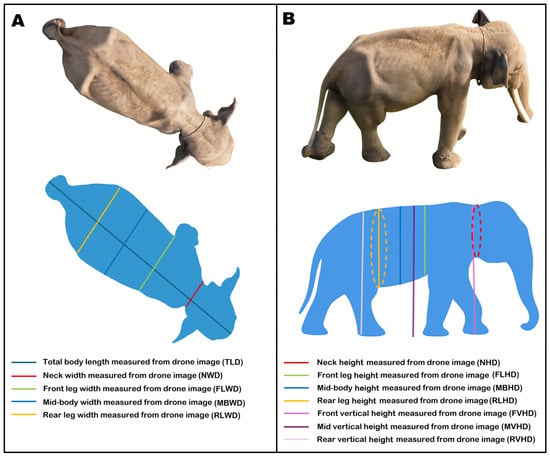
We obtained elephant body size data from both direct manual measurements and drone-based photogrammetric estimations. Manual measurements of elephant body size were taken in accordance with standardized morphometric protocols as part of scheduled health monitoring activities performed in the week prior to the drone imaging. Manual morphometric data were obtained by stabilizing the elephants in a stationary position and using measuring tapes operated by multiple trained handlers. Drone-derived morphometric data were obtained from images captured from two perspectives. The first perspective provided a top-down (aerial) view of the elephants, while the second offered a side view. However, the side view was not perfectly horizontal, as it was taken from an altitude of around 50 m. Using drone imagery acquired from a top-down (aerial) perspective, five primary morphometric parameters were derived: total length (TLD), neck width (NWD), front leg width (FLWD), mid-body width (MBWD), and rear leg width (RLWD). The character “D” refers to “Drone”. These variables formed the core dataset for subsequent validation and body condition modelling. In addition, side-view imagery was examined as an exploratory assessment of lateral measurement feasibility under field conditions. From these images, seven morphometric parameters were extracted, including TiLD, TBDD, TTD, TBBD, DVD, TVD, and BVD.
Data acquisition using drones with two perspectives is illustrated in Figure 3 for both direct and drone-derived methods; morphometric measurements were performed on identical anatomical regions. The pixel-to-metric conversion was performed using a reference object of known dimensions placed within the observation area. The reference object was positioned on the same ground plane as the observed subjects to minimize vertical disparity and ensure consistent scaling. In our study, we use a distance of 50 m from drone to object (elephants). The Ground Sampling Distance (GSD), which represents the real-world distance corresponding to each pixel in the image, was used to validate the pixel-to-metric conversion and ensure consistent scaling across the dataset. Regarding camera inclination and perspective distortion, the drone camera was maintained in (top-down) orientation during data acquisition and the object was located relatively in the central region to minimize geometric distortion. The RTK module ensures consistent positioning and repeatability of the data acquisition process.
Figure 3.
Elephant morphometry to be measured using: a top-down perspective (A) and a side view perspective (B).
2.4. Image Pre-Processing and Canny Edge Detection
For obtaining the images, we used a DJI Matrice 300 RTK (M300 RTK) drone. The DJI Matrice 300 RTK (M300 RTK) drone can handle distortion (Distortion Correction). In addition, this drone supports adjusting position precision with its RTK module to obtain position data (1–1.5 cm + 1 ppm). This condition ensures that, even with small distortions, the image’s geographic position remains accurate, making it easier for mapping software (IDLE Shell 3.13.7) to reproject the image correctly. Thus, the DJI Matrice M300 RTK drone can produce stable, precise imagery with minimal distortion. Pixels were converted into real-world units using pixel measurement. Pixel measurements were converted to units via the reference object dimension in the scene. We used a scale factor (mm/pixel) as the ratio of the actual object length to the measured pixel length.
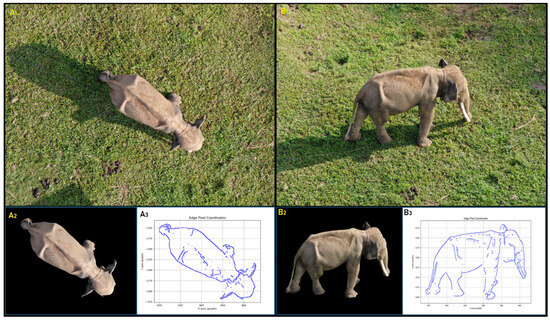
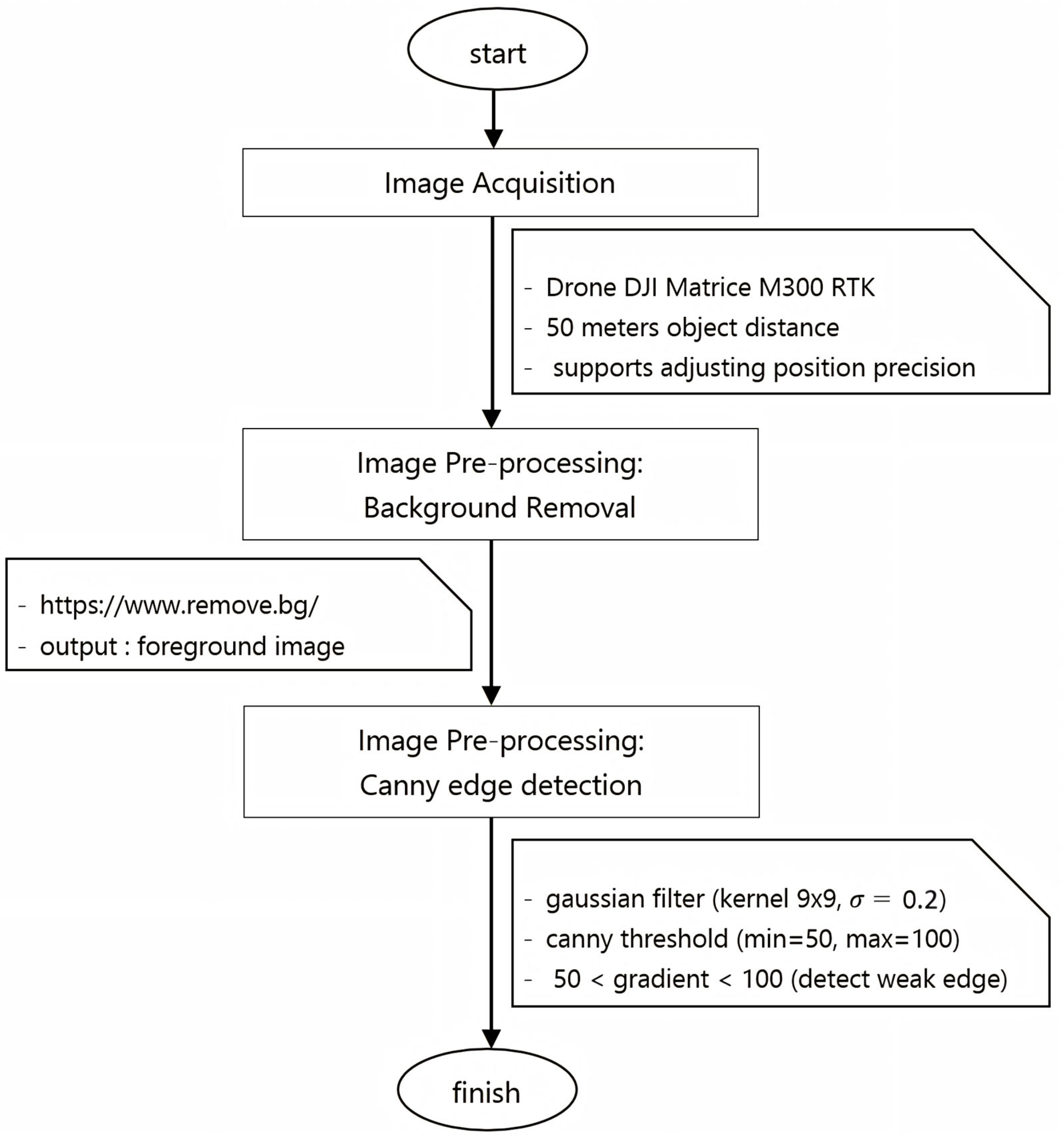
Elephants captured in drone imagery were typically observed in open areas with grassy backgrounds. To isolate the animal for morphometric extraction, background elements were removed, leaving only the elephant’s silhouette. The background was then darkened to enhance contrast, thereby facilitating more accurate edge detection. After the image was obtained, the image background removal process employed the remove.bg tool, which is well-established for background removal. Remove.bg (web version; accessed 5 January 2026) is a tool developed by kaleido.ai that has been widely used professionally for fast and user-friendly background removal and segmentation [24]. AI technology with deep learning is applied to this tool to produce quite good background removal results. Several studies that also use remove.bg as a background removal tool include [25,26,27]. These studies indicate that removing and segmenting images with remove.bg remains relevant. Moreover, today this tool has been updated with Artificial Intelligence, not only for removing the background but also for generating the background. After the elephant (as the foreground) was separated from the background, the Canny detection algorithm was applied to the image. An illustration of the preprocessing workflow and edge-extraction procedure is shown in Figure 4.
Figure 4.
Illustration of pre-processing up to the edge detection process: (A1) original top-view image; (A2) segmented top-view image after background removal; (A3) edge pixel coordinates of the top-view image; (B1) original side-view image; (B2) segmented side-view image after background removal; (B3) edge pixel coordinates of the side-view image.
The ability to extract features from acquired images is key to successful image recognition. Canny detection is one method for effective contour extraction. Theoretically, Canny detection offers advantages in terms of robustness against noise, greater precision in edge acquisition, reduced spurious edges, and the ability to produce more continuous edges in complex backgrounds. These are the key considerations for selecting this algorithm over the Sobel or Prewitt algorithms.
Canny Edge Detection is considered one of the most widely applied techniques in computer vision for extracting object boundaries. Previous studies have employed this method for diverse applications, including detecting microcracks in solar cells [28] and improving thermal-image–based structural detection on building exteriors [29]. The basic principle of the Canny algorithm is to identify edges with high precision while minimizing noise. The process begins with noise reduction using a Gaussian filter to produce a smoothed image. Gradients in intensity are then calculated to locate pixels representing potential edges. Non-maximum suppression is applied to thin the detected edges, resulting in a cleaner, more distinct contour. Two threshold values are subsequently used for hysteresis thresholding to classify strong and weak edges. Weak edges that are connected to strong edges are preserved, whereas isolated weak edges are discarded. The final output is an image with sharp, continuous, and well-defined edges suitable for subsequent morphometric analysis. The workflow in Figure 5 provides a detailed diagram of the background removal and edge detection processes.
Figure 5.
Detailed mechanism and parameter adjustment of pre-processing and edge detection.
2.5. Edge Mapping and Distance Measurement
The edges extracted from each Canny-processed elephant image were subsequently mapped onto Cartesian coordinates to obtain precise spatial reference points (Figure 4). The Canny detection workflow was implemented using the OpenCV library (version 4.13.0.92) in the Python programming environment (version 3.11.15). These coordinate values were then used to compute linear distances between specific anatomical landmarks that serve as morphometric indicators. Distance calculations followed the Euclidean metric, whereby the distance between two points A() and B(), denoted as dist(A, B), is computed using the following equation:
Points A and B represent the mapped coordinates of the edge-defined anatomical landmarks corresponding to each morphometric parameter. This approach ensures that all distance measurements reflect standardized, geometry-based quantification of body dimensions derived directly from the processed drone imagery.
Total body length () in the top-down perspective is computed by measuring the Euclidean distance between point A, located at the tip of the head, and point B, positioned at the tip of the tail. The same procedure is applied to extract additional top-view morphometric parameters, including and . For the side-view imagery perspective, foreleg height (TBD) is calculated from the vertical distance between point A and point B. Using this approach, side-view morphometric dimensions—such as TiLD, TTD, TBB, VDD, VTD, and VBD—are derived by measuring the corresponding coordinate pairs that define each anatomical landmark. This two-perspective measurement framework enables a comprehensive three-dimensional representation of elephant body shape and enhances the accuracy of morphometric estimation.
2.6. Linear Regression Model
The linear regression model is a simple yet effective statistical approach for analyzing the relationship between two quantitative variables. In this study, elephant morphometric measurements were obtained directly through manual field measurements and those derived from aerial drone imagery [30]. Essentially, the linear regression model expresses the dependent variable (Y), such as the directly measured body length, as a linear function of the independent variable (X), which represents the same measurement but obtained from drone images. This framework enables quantification of how closely drone-derived measurements correspond to direct field data. In addition to estimating regression parameters, we evaluated whether the slope differed significantly from unity and the intercept from zero to assess potential proportional and fixed bias. Standard regression assumptions, including homoscedasticity and residual normality, were formally tested to ensure model validity.
To evaluate the strength of association, the coefficient of determination (R2) was used to indicate the proportion of variability in the direct measurements explained by drone-derived estimates. However, because correlation alone does not imply agreement, additional accuracy metrics were calculated, including mean absolute percentage error (MAPE) and root mean square error (RMSE), to quantify prediction error and overall deviation between methods.
In addition to ordinary least squares regression, Passing–Bablok regression was performed to account for measurement error in both direct and drone-derived variables for method-comparison studies. Furthermore, agreement between measurement techniques was assessed using Bland–Altman analysis, which provides estimates of mean bias and 95% limits of agreement. This approach allows direct evaluation of systematic and random differences and offers a scale-dependent interpretation of measurement interchangeability.
The application of linear regression in elephant morphometric studies offers substantial advantages: it reduces the cost and field time required for manual measurements, minimizes risks associated with close encounters with large wildlife, and supports conservation efforts by providing reliable, non-invasive data [16]. These benefits are maximized when proper drone calibration and standardized imaging protocols are implemented to reduce perspective-related distortions. In this study, five morphometric variables of elephants were compared between direct field measurements and drone-derived estimates. These variables include: (i) total body length (TL), measured horizontally from the front of the head to the base of the tail; (ii) neck width (NW); (iii) front leg width (FLW); (iv) mid-body width (MBW); and (v) rear leg width (RLW).
To estimate the Body Condition Index (BCI) for wild elephants, a total of 33 individuals were photographed across several locations within the Bukit Tigapuluh Landscape. However, due to technical and observational constraints, only total body length and mid-body width could be reliably measured from the available aerial imagery. As a result, this component of the analysis should be understood as an exploratory, model-based extension of the validated captive framework rather than an independent morphometric assessment of body condition in wild elephants. The BCI values derived below are allometric proxies based on the total length as a predictor and scaling coefficients estimated from a captive population; they are indicative of general body proportions but carry substantial prediction uncertainty and have not been independently validated against direct measurements in wild individuals. In addition, one independent morphometric variable, mid-body width (MBW), was measured directly from top-down imagery where image quality permitted, providing an observationally independent reference for body width.
The remaining morphometric variables, namely neck width (NW), front leg width (FLW), and rear leg width (RLW), were estimated using allometric scaling relationships. To predict these variables, we applied a log–log allometric model of the form [31]:
where represents the target morphometric variables (NW, FLW, BMW, and RLW), denotes total body length, and is the error term. The intercept was constrained to zero in log-space (i.e., a no-intercept model) to reflect proportional scaling assumptions and to improve predictive stability within the observed size range.
Importantly, because these variables are predicted rather than independently measured in wild individuals, the resulting BCI should be interpreted as an allometric proxy derived from body length, with MBW serving as an independent observational reference where available, rather than a direct observational estimate of body condition. This approach allows morphometric relationships established from well-characterized captive individuals to be applied to wild populations when complete direct measurements are not feasible, a strategy commonly used in wildlife morphometric studies where logistical or observational constraints limit the number of independently measurable variables. Since the relationship is defined in the log scale, to compute the BCI, we need to exponentiate the difference between predicted morphometric variables, and such that:
It should be noted that the extremely high R2 values observed here are in large part a consequence of the log–log proportional model structure and the wide body-size range of captive individuals spanning different age classes; near-unity R2 is therefore expected in this setting and does not by itself constitute evidence that predictions for individual wild elephants will be equally precise. Prediction intervals are the appropriate measure of individual-level predictive uncertainty and should be consulted alongside the point estimates when interpreting wild elephant BCI values.
3. Results
3.1. Direct Measurement vs. Drone
The fitted models based on side-view measurements exhibited weak performance, with coefficients of determination consistently below 0.5. Given this limited explanatory power, no further inferential or predictive analyses were pursued using lateral measurements. Therefore, side-view imagery should be interpreted as an exploratory component of the study and is not recommended for reliable morphometric-based body condition assessment under the current acquisition protocol.
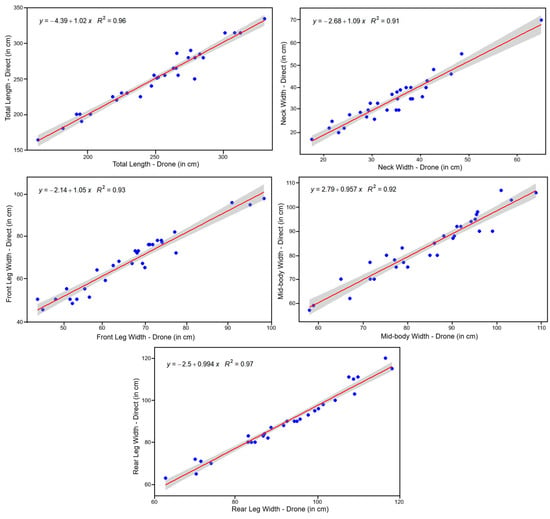
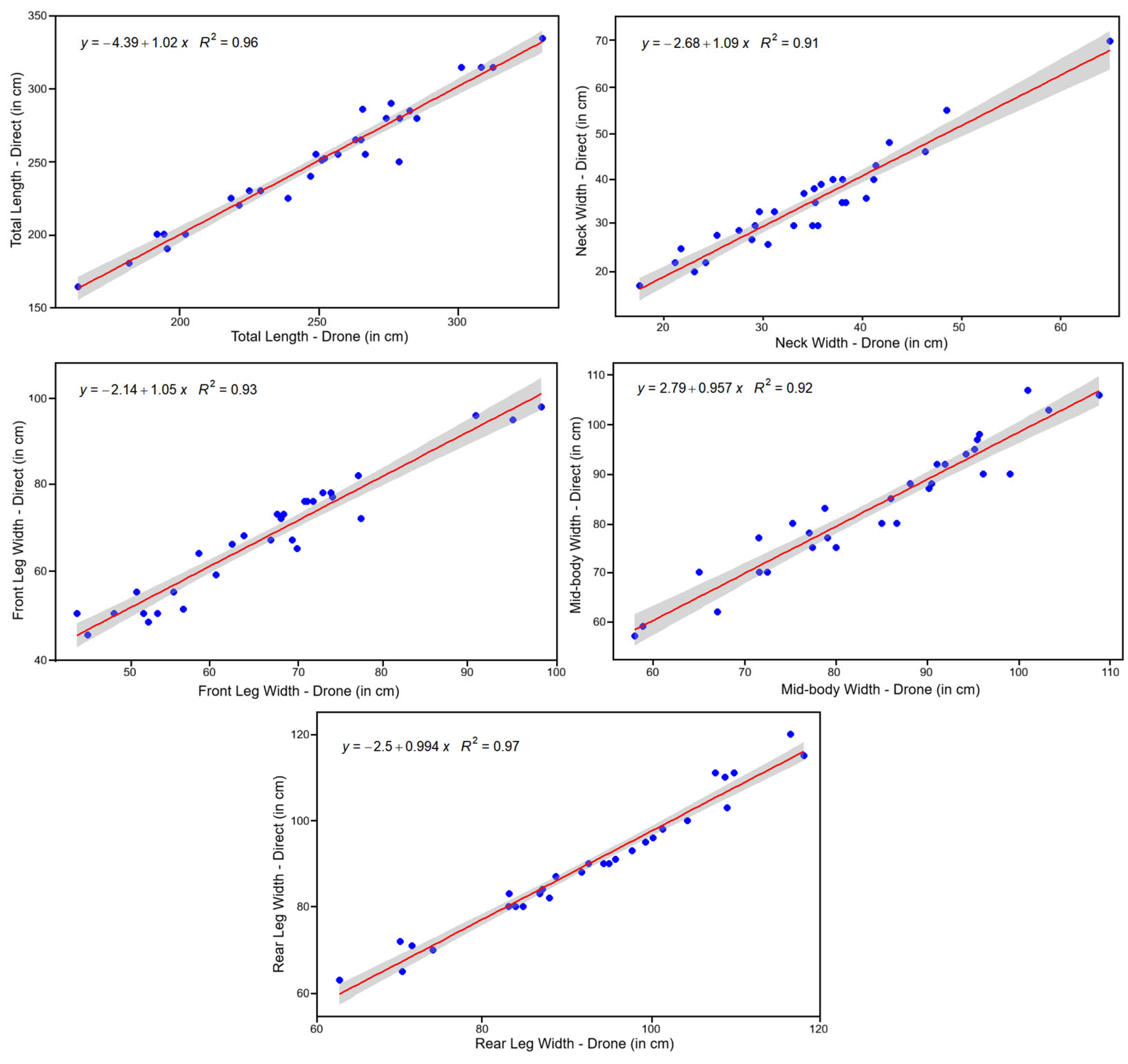
For total body length (TL), the regression analysis between the direct field measurements and drone-derived measurements (TLD) produced a coefficient of determination (R2) of 0.96, indicating that 96% of the variation in TL was explained by TLD. The accuracy metrics further demonstrated strong agreement between the two measurement methods, with a mean absolute percentage error (MAPE) of 2.53% and a root mean square error (RMSE) of 6.32, reflecting high predictive accuracy and minimal deviation.
Regression models were also developed for the remaining morphometric variables. Overall, the results consistently showed strong positive associations between drone-based and direct measurements, with high R2 values and low error metrics, emphasizing the reliability of drone photogrammetry for estimating elephant morphometry. A summary of all regression model results, including parameter estimates, goodness-of-fit statistics, and accuracy metrics, is presented in Table 1.
Table 1.
Regression model performance for direct vs. drone-based elephant morphometric measurements.
The results demonstrate that all evaluated morphometric models, including neck width (NW), front leg width (FLW), mid-body width (MBW), and rear leg width (RLW), exhibit consistently high coefficients of determination (R2 > 0.90), indicating strong linear correspondence between direct field measurements and drone-derived estimates. The estimated slopes were closely approximated by unity, with 95% confidence intervals encompassing 1 for all variables, suggesting no significant proportional bias. Similarly, the 95% confidence intervals for the intercepts included 0, indicating no meaningful fixed bias. These findings confirm that drone-derived measurements do not systematically overestimate or underestimate direct measurements. In addition, the low MAPE (2.53–9.06%) and RMSE values (in cm) further demonstrate strong predictive performance and limited measurement deviation, underscoring the reliability of drone-based assessments for quantifying elephant body dimensions under field conditions.
To further account for potential measurement error in both direct and drone-derived variables, an additional Passing–Bablok regression analysis was performed as a robustness check (Table 2). Unlike ordinary least squares regression, which assumes the independent variable is measured without error, Passing–Bablok regression considers uncertainty in both measurement methods. Assuming equal error variance between methods, the Passing–Bablok regression results produced slope estimates that were similarly close to unity across all morphometric variables, consistent with the ordinary regression results. This additional analysis confirmed the strong agreement between drone-derived and direct measurements and indicated that the conclusions regarding the accuracy of drone-based morphometric estimation are robust to alternative method-comparison frameworks.
Table 2.
Passing–Bablok regression estimates comparing drone-derived and reference morphometric measurements.
Collectively, these findings confirm that drone-derived morphometric measurements can serve as a practical, efficient, and accurate substitute for conventional manual measurements, particularly in contexts where direct handling poses logistical or welfare challenges. To facilitate interpretation, regression plots for each morphometric variable are presented following the table, providing visual evidence of the strong alignment between drone measurements and ground-truth data. The linear regression comparison between manual measurements and drone-derived top-down (aerial) measurements is presented in Figure 6.
Figure 6.
Linear regression of elephant morphometrics via top-down view (aerial).
To ensure the validity of the regression models, diagnostic tests were conducted to evaluate key assumptions. Residual normality was assessed using the Kolmogorov–Smirnov test, while homoscedasticity was examined using the Breusch–Pagan test. For all morphometric models (TL, NW, FLW, MBW, and RLW), the Kolmogorov–Smirnov test produced non-significant results (p-value = 0.06–0.98), indicating that residuals did not significantly deviate from normality. Similarly, the Breusch–Pagan test yielded non-significant p-values (p-value = 0.17–0.74), confirming the absence of heteroscedasticity (Table 3). These results demonstrate that the assumptions of normality and constant variance were satisfied across models, supporting the reliability and validity of the regression-based inferences.
Table 3.
Diagnostic check of regression models: (i) residual normality, (ii) residual homoscedasticity.
In addition to regression analysis, Bland–Altman tests were conducted to evaluate agreement and practical interchangeability between methods. Across all variables, mean bias values were small (generally <3.5%), indicating minimal systematic over- or underestimation by drone-derived measurements. The 95% limits of agreement showed moderate dispersion, with most variables exhibiting relative limits within approximately ±6–11%, and only one variable displaying wider variability (Table 4).
Table 4.
Bland–Altman test results on bias and relative bias, upper and lower limits of agreement (LoA) and relative LoA.
3.2. Body Condition Index (BCI) Estimation
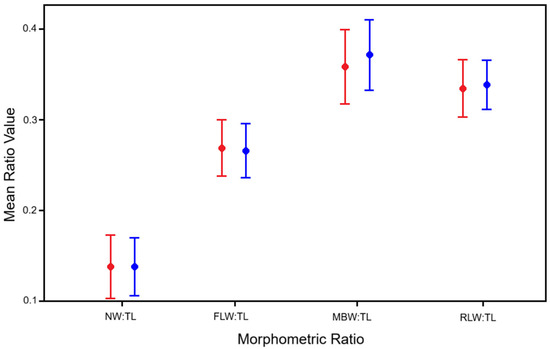
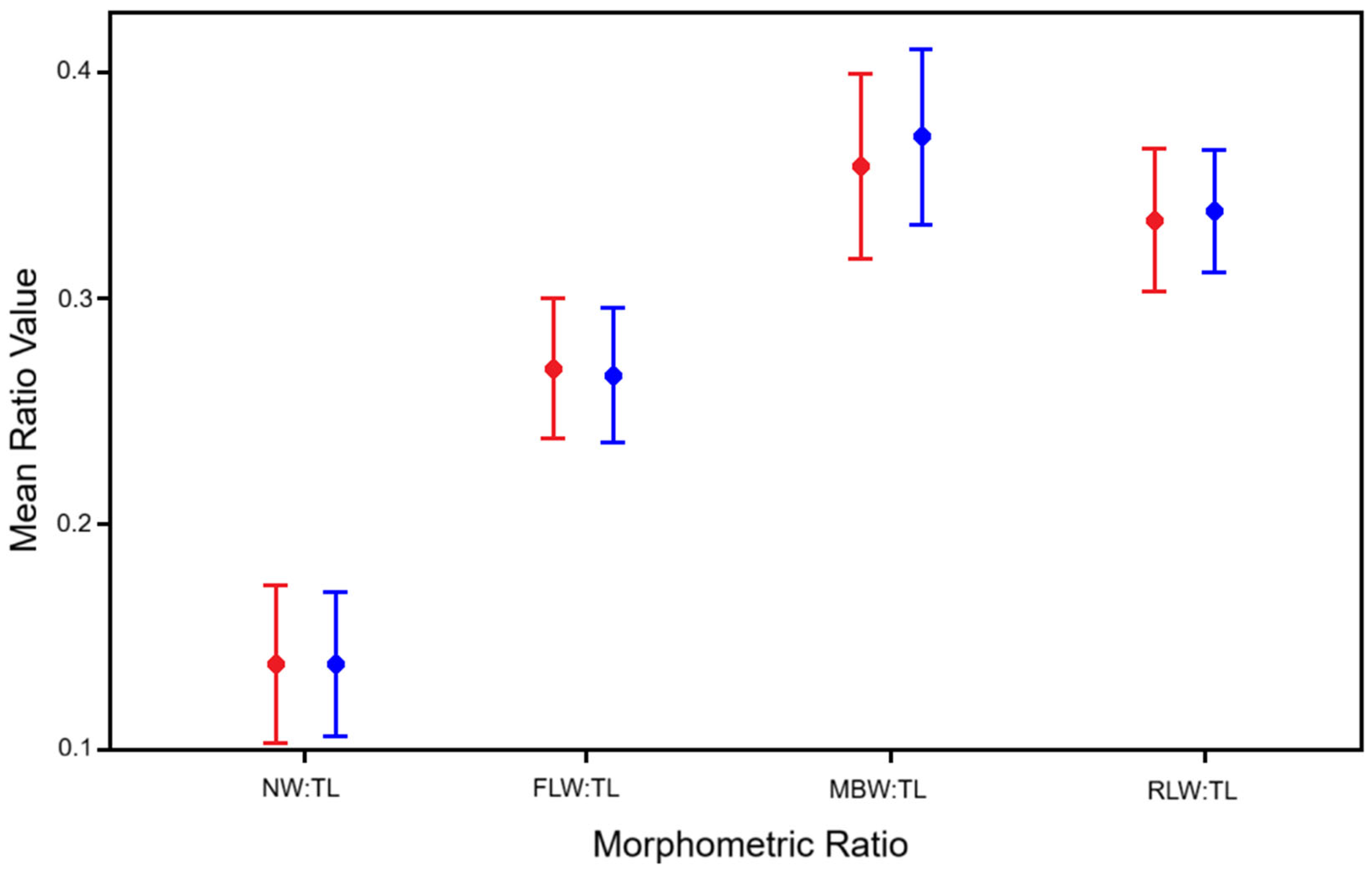
We calculated the body condition index (BCI) of captive elephants to compare direct morphometric measurements with those obtained from drone imagery. The results, presented as an error bar plot showing the mean ± standard deviation of morphometric ratios (NW:TL, FLW:TL, MBW:TL, and RLW:TL) (Figure 7), reveal minimal differences between direct and drone-derived values. This consistency demonstrates that drone-based measurements can accurately estimate key morphometric ratios, offering a practical alternative to direct measurements, which are often difficult or unsafe to perform—especially in free-ranging elephants.
Figure 7.
Error bar plot illustrating the mean ± standard deviation of morphometric ratios, i.e., NW:TL, FLW:TL, MBW:TL and RLW:TL, to visualize the variation and comparison of direct (red) and drone-based (blue) measurements.
We extended the modeling framework to estimate the Body Condition Index (BCI) for wild elephants. Model parameters were estimated using morphometric data from 32 captive elephants. A summary of the fitted models is presented in Table 5.
Table 5.
Model summary between total body length (TL) and the remaining morphometric variables, i.e., neck width (NW), front leg width (FLW), and rear leg width (RLW).
Our model suggests that is well explained by where coefficient determination, , which explains the variation in the target variable, reaches 99% for all models as shown in Table 5. Thus, we use the obtained models from Table 5 to predict log(NW), log(FLW), and log(RLW).
The regression lines fitted for each morphometric variable can be seen in the scatter plots provided in the Supplementary Figure S1. The summary of the BCI for various morphometrics of wild and captive elephants is shown in Table 6 below.
Table 6.
Comparison of BCI Between Wild and Captive Elephants (Mean ± SD).
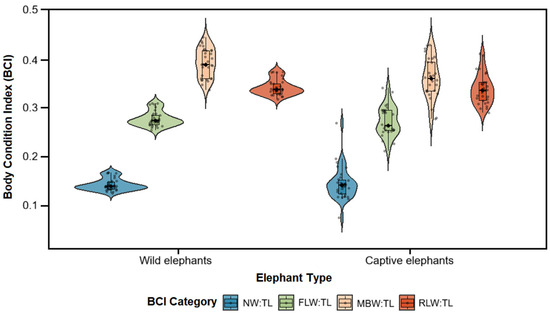
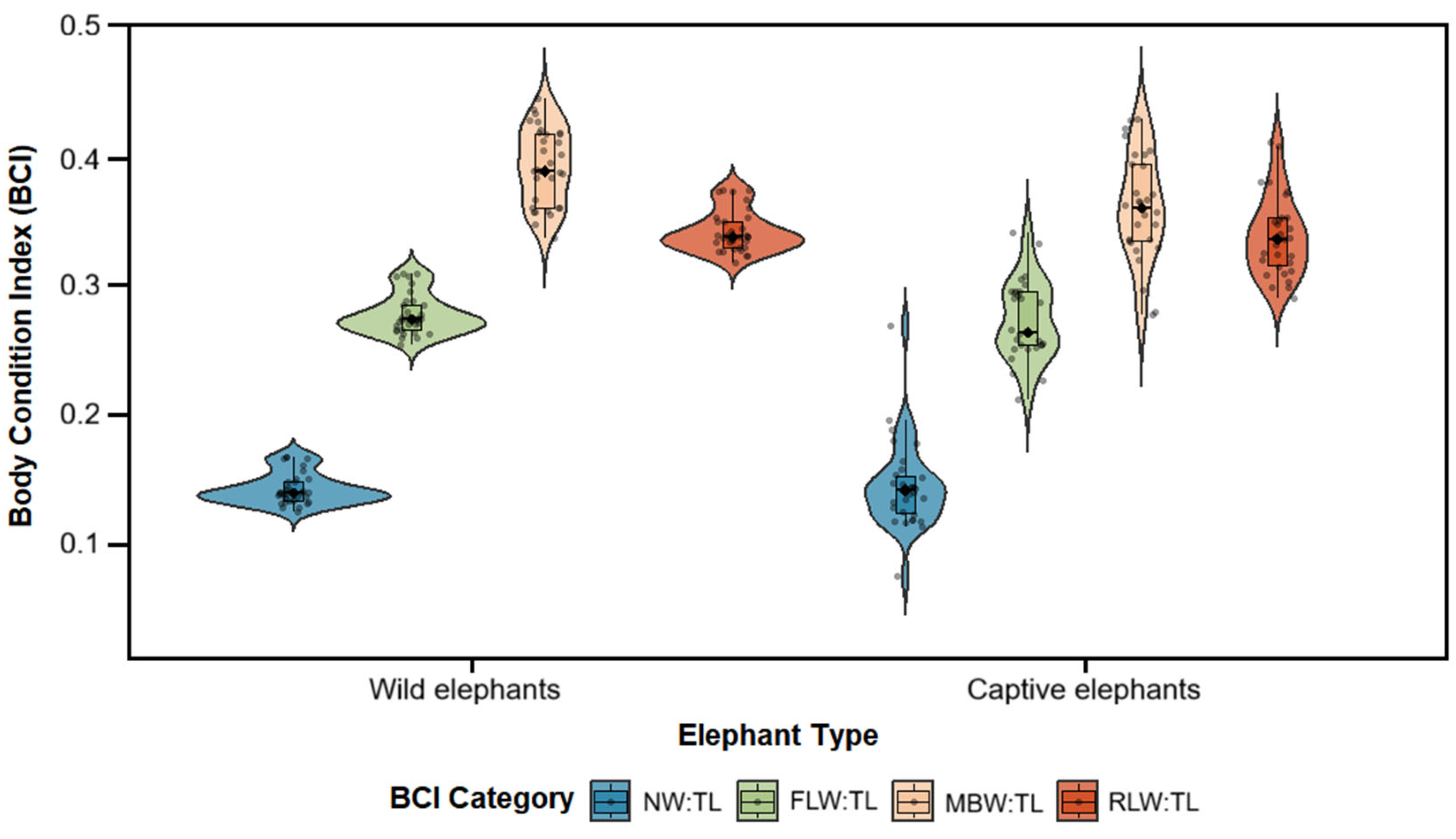
Body condition indices (BCI) of wild and captive elephants showed broadly similar mean values across all measured ratios (NW:TL, FLW:TL, MBW:TL, and RLW:TL). However, wild elephants consistently exhibited greater variability, as indicated by larger standard deviations and a wider distribution of BCI, as illustrated by the broader shapes of the violin boxplots in Figure 8, compared to captive individuals. Although captive elephants displayed slightly higher mean BCI values across all indices, these differences were small, indicating that overall body proportions remain comparable between wild and captive elephants.
Figure 8.
Violin plots showing the distribution of Body Condition Index (BCI) in wild and captive elephants across four morphometric ratio categories (NW:TL, FLW:TL, MBW:TL, and RLW:TL). Each violin represents the probability density of BCI values, with embedded boxplots indicating quartiles and points representing individual elephants. The figure illustrates variations in body condition between wild and captive populations based on different body proportion indices.
A comparison between drone-derived BCI values from wild elephants and reference values from captive individuals indicates broadly similar morphometric patterns. The captive BCI dataset was derived from individuals whose Body Condition Scores (BCS) were determined through direct physical assessments conducted by experienced elephant experts, providing a reference for known body condition categories. Captive elephants classified as having ideal body condition (BCS 5) show mean BCI ratios of approximately 0.136, 0.267, 0.355, and 0.333 across the four morphometric ratio categories, whereas fleshy individuals (BCS 6–7) exhibit slightly higher values (0.149, 0.282, 0.388, and 0.346). In contrast, a thin individual (BCS 3) presents lower ratios (0.109, 0.239, 0.274, and 0.304), reflecting reduced body mass relative to structural length. The mean BCI values estimated for wild elephants in this study (0.140 ± 0.012, 0.275 ± 0.016, 0.392 ± 0.030, and 0.341 ± 0.016) fall within or slightly above the range observed for captive elephants in ideal condition and partially overlap with those of fleshy individuals. These results suggest that the monitored wild population generally exhibits body proportions consistent with healthy body condition while supporting the utility of drone-based photogrammetry for generating comparable morphometric indicators.
4. Discussion
Conventional or visual assessment of the Body Condition Index (BCI) relies heavily on expert judgment and experience, which can introduce subjectivity and bias. In contrast, a drone-based approach offers a more objective, reproducible, and well-documented alternative that can be revisited for future analyses. Drone systems provide several key advantages, including the ability to survey large areas, minimize disturbance to wildlife and their ecology, and enable repeated or retrospective analyses using stored imagery, making them particularly suitable for studies of wild animals. Although limitations remain—such as reduced effectiveness under dense canopy cover and potential flight-safety concerns—the findings of this study show that digitally processed drone imagery provides a highly accurate, efficient, and non-invasive method for obtaining morphometric measurements and assessing BCI in elephants.
By primarily using top-down imagery captured through unmanned aerial vehicles (UAVs), the study successfully generated precise estimates of multiple morphometric parameters, thereby minimizing observer bias commonly associated with direct field measurements. Although lateral imagery was initially explored to complement these measurements, the results indicated that side-view morphometrics exhibited substantially lower reliability (R2 < 0.5) and are therefore not recommended for quantitative morphometric estimation under the current imaging conditions. The strong linear associations observed between drone-derived and ground-truth measurements—reflected in coefficients of determination (R2) ranging from 0.91 to 0.97—indicate that top-down UAV-based estimations reliably explain most of the variation in conventional morphometric data. In addition, Bland–Altman tests showed a moderate dispersion of the 95% limits of agreement. Acceptable limits of morphometric error depend on the biological context and intended application rather than purely statistical thresholds [32,33]. In wildlife monitoring, particularly when comparing direct and drone-based photogrammetric measurements, errors within approximately 5–15% are commonly reported and considered acceptable for assessing body condition and population-level trends [34,35,36]. Width-based morphometric variables are inherently subject to greater uncertainty than length measurements due to animal posture, image resolution, and altimeter inaccuracy, and these sources of error are well-recognized in the photogrammetric literature [36,37]. The limits of agreement observed in the present study are therefore consistent with what the field considers acceptable for population-level health monitoring, and are unlikely to systematically alter the classification of individuals as underconditioned when threshold-based assessments are applied at the population rather than individual level. These results align with an expanding body of literature highlighting the robustness of UAV-based photogrammetry for assessing body size, condition, and structural attributes in large mammals, particularly due to its capacity to produce high-resolution, repeatable measurements while reducing risks to both researchers and wildlife [11,19,30,38,39]. Collectively, the evidence reinforces the growing recognition of UAV technologies as a transformative tool in wildlife monitoring, ecological assessment, and conservation-based decision-making.
The application of Canny Edge Detection in this study proved effective in generating clear, stable, and noise-reduced delineations of elephant body contours, thereby facilitating the extraction of morphometric coordinates with high spatial accuracy. As one of the most robust gradient-based edge detection algorithms, Canny has been extensively implemented across diverse fields—including industrial material inspection, biomedical imaging, and anatomical structure identification—owing to its ability to optimize edge localization while suppressing non-relevant gradients [40,41,42]. Its adaptation within an ecological and conservation-oriented framework represents a methodological advancement, enabling consistent segmentation of large-bodied wildlife despite environmental variability in illumination, texture, and background complexity. When integrated with Euclidean-based coordinate mapping, this pipeline yields reliable, repeatable distance estimates between anatomical landmarks, effectively reducing measurement bias that typically arises from perspective distortion or inconsistent field conditions. This approach reinforces the growing utility of digital image processing for high-precision morphometric assessment in wildlife monitoring and strengthens the methodological foundation for non-invasive biometric analyses in conservation science.
From an operational standpoint, deploying drones offers substantial advantages for elephant conservation and monitoring, particularly compared to conventional morphometric measurement techniques. Traditional approaches often involve close-contact procedures that are hazardous for researchers and may also induce stress or defensive behaviours in elephants, making such methods impractical—if not impossible—for wild, free-ranging, or behaviorally unpredictable individuals. UAV-based data acquisition mitigates these risks by enabling precise morphometric and behavioral observations from a safe standoff distance, thereby minimizing anthropogenic disturbance [43,44,45]. This aligns with a growing body of literature underscoring the critical role of non-invasive and remote-sensing technologies in the monitoring of large-bodied megafauna.
Moreover, modern UAV platforms equipped with multisensor payloads—such as the Zenmuse H20 series, which integrates visual, thermal, and laser rangefinder capabilities—offer expanded analytical potential [11,15]. These integrated systems allow simultaneous acquisition of high-resolution imagery, surface temperature profiles, and precise spatial distances, thereby enabling multifaceted assessments of physiological and ecological parameters [46]. Such capabilities support advanced applications, including the monitoring of thermoregulation, detection of subclinical stress responses, and the early identification of disease indicators, as demonstrated by recent studies using thermal and multispectral imaging in wildlife health assessment [11,46,47,48,49]. Collectively, these operational and technological advantages position UAVs as transformative tools for enhancing precision, safety, and ecological validity in elephant conservation research.
Body Condition Index estimation in this study, calculated using the ratio of body width to body length, produced highly consistent values between direct field measurements and drone-derived morphometric data. This congruence reinforces the methodological validity of drone-based approaches for non-invasive assessment of elephant body condition. However, for wild elephants, only total body length (TL) and mid-body width (MBW) could be directly measured from aerial imagery, while most width variables were estimated using allometric scaling relationships derived from captive individuals. Consequently, the resulting BCI values for wild elephants should be interpreted primarily as an allometric proxy derived from TL rather than as a fully independent morphometric observation of body condition. In addition, one width variable (MBW) was independently measured from top-down imagery where image quality permitted, providing a limited observational reference for body width. The BCI ratios derived from body-width parameters fall within the expected range for healthy captive elephants. Stable or relatively high ratios indicate adequate fat reserves and good nutritional status, whereas values substantially lower than the population mean (typically more than 1–2 SD below the average) may indicate reduced body mass, nutritional deficits, or emerging health concerns. Although universal BCI thresholds for elephants have not been standardized, the patterns observed in this study provide both methodological validation for UAV-based assessments and a valuable baseline for health monitoring in captive and wild populations. The wider spread in BCI likely reflects natural heterogeneity in wild populations driven by differences in age, sex, seasonal resource availability, and habitat conditions [50,51]. In contrast, the narrower variation observed in captive elephants suggests a more uniform body condition, likely resulting from regulated diets, veterinary care, and reduced environmental stress.
As a widely recognized physiological indicator, the BCI is fundamental for evaluating nutritional status, energy balance, reproductive capacity, and overall health in large mammals [52]. Extensive empirical evidence demonstrates that stable or elevated BCI values reflect adequate energy reserves and favorable health states, whereas declining BCI values often signify insufficient nutrition, chronic physiological stress, parasitic burden, or underlying pathological conditions [53,54]. Despite its importance, the absence of a universally accepted standard for elephant BCI continues to pose a challenge for cross-population comparison. Nevertheless, the existing literature converges on the notion that individuals with BCI ratios falling 1 to 2 standard deviations below the population mean can be reliably categorized as underconditioned and warrant further veterinary or behavioral assessment [55]. Given the model-based nature of several morphometric estimates for wild individuals, comparisons between captive and wild BCI values should therefore be interpreted cautiously and primarily as an exploratory assessment of general body proportion patterns rather than a strictly equivalent morphometric evaluation. The morphometric ratios generated in this study validate the accuracy and reliability of UAV-based BCI estimation in captive elephants and provide an empirical baseline for future monitoring at WKNP. The extension to wild individuals constitutes a methodological proof-of-concept, and independent morphometric validation in free-ranging populations remains a necessary next step before definitive conclusions about their body condition or nutritional status can be drawn.
The findings of this study carry significant implications for population management and long-term conservation planning. The adoption of drones as systematic monitoring tools enables the generation of high-resolution, temporally consistent datasets that can inform evidence-based decision-making across multiple management domains. These include tracking seasonal fluctuations in body condition, evaluating the outcomes of rehabilitation or captive-breeding programs, and facilitating the early detection of declining physiological condition linked to habitat degradation, human–wildlife conflict, or emerging disease pressures. Contemporary research increasingly highlights that integrating UAV platforms into large-mammal conservation frameworks can substantially enhance the timelines and precision of management responses, particularly when enriched by machine-learning–driven image analysis pipelines and multispectral or thermal sensor technologies [56,57]. Collectively, these technological advancements underscore the transformative potential of UAV-based monitoring to strengthen conservation strategies, enhance predictive capacity, and support proactive interventions to maintaining the health and viability of elephant populations.
Several specific sources of measurement uncertainty warrant explicit discussion. Regarding the allometric scaling models used to estimate width variables in wild elephants, i.e., the extremely high R2 values (0.995–0.999) obtained from the log–log no-intercept models largely reflect the proportional nature of elephant morphometry across a wide size range, rather than constituting independent evidence of predictive precision. In a log–log proportional framework fitted to a dataset spanning juvenile to adult individuals, near-unity coefficients of determination are expected almost by construction. This does not imply that predictions for individual wild elephants will be equally precise, particularly because those individuals may differ from the captive training sample in age structure, sex composition, nutritional history, and body proportions shaped by different ecological conditions. Accordingly, the 95% prediction intervals reported in Table 5 reflect the true uncertainty attached to individual predictions and should be consulted alongside the point estimates. Finally, neither direct field measurements nor drone-derived measurements are error-free, and the Passing–Bablok regression (Table 2) is the appropriate framework for interpreting agreement under mutual measurement error; ordinary R2 from least-squares regression should not be used as the sole criterion for assessing interchangeability between methods.
Despite its demonstrated strengths, this study also presents several methodological limitations that warrant attention in future research. First, the suboptimal angle of side-view image acquisition from a flight altitude of 50 m introduces perspective distortion, particularly affecting the accuracy of body height and other vertical morphometric parameters. Such geometric distortion has long been recognized as a major constraint in wildlife photogrammetry, and addressing it typically requires additional calibration procedures or three-dimensional reconstruction techniques such as Structure-from-Motion (SfM) photogrammetry [58]. Incorporating 3D modeling would allow for more precise spatial correction across varying camera angles and improve the reliability of vertical measurements. Second, Canny detection applied to elephants also shows promise for images or objects with less complex edge structures [5,13,30]. However, its high sensitivity to parameters limits Canny’s ability to detect complex objects with textured surfaces, such as leaves, scaly fish, or biological organs. Third, although the current workflow successfully identifies body contours, the partially manual steps involved in background removal and edge segmentation present opportunities for operator bias and inconsistencies across samples. Advancing this component through automated segmentation algorithms—particularly those based on deep learning architectures or vision transformer (ViT) models—could significantly enhance reproducibility, reduce processing time, and improve the precision of morphometric extraction. Several recent studies have demonstrated the potential of these approaches for wildlife detection, shape extraction, and morphological quantification, underscoring their value for future pipeline refinement. Collectively, addressing these limitations would contribute to more standardized, scalable, and fully automated UAV-based morphometric assessments for elephant conservation applications. Finally, we emphasize the potential limitations of applying this approach in more complex environments, such as dense vegetation, where visibility, position, and behavioral variability can affect measurement reliability.
5. Conclusions
The overall findings of this study underscore the substantial potential of drone-based photogrammetry as a reliable tool for monitoring elephant health within controlled conservation settings such as Way Kambas National Park, with a preliminary allometric framework demonstrated as a proof-of-concept for free-ranging populations pending further direct validation. This potential is reinforced by rapid advances in multisensor UAV platforms, which now offer enhanced sensor resolution, improved flight stability, and the integration of multisensor modalities, thereby broadening their applicability in wildlife monitoring. In parallel, developments in artificial intelligence—particularly in automated feature extraction, image segmentation, and morphometric estimation—have significantly increased the feasibility of implementing high-throughput, non-invasive monitoring systems for megafauna. Collectively, these technological innovations position UAV-based photogrammetry as an essential component of contemporary ecological monitoring, capable of delivering scalable, high-resolution data for assessing both megafaunal health and ecosystem integrity [59,60,61]. As a result, drone-assisted photogrammetry is poised to assume an increasingly central role in conservation science, enabling more precise evaluations of body condition, stress physiology, and population health across spatial and temporal scales that were previously unattainable. This methodological transition toward high-resolution, remotely sensed monitoring is closely aligned with global conservation priorities, particularly those focused on early detection of health declines, adaptive management, and the long-term persistence of elephant populations under rapidly intensifying ecological pressures. It must be noted, however, that the primary validated contribution of this study is the demonstration of strong agreement between drone-derived and directly measured morphometric variables in captive Sumatran elephants, with BCI ratios showing minimal method-dependent differences. The extension of allometric scaling relationships to estimate body condition proxies in wild individuals represents an exploratory proof-of-concept, not an independently validated assessment of the health or nutritional status of free-ranging elephants. Future work should prioritise acquiring multiple independently measured width variables from wild elephants using drone imagery to enable robust, directly observed BCI estimation in the field, thereby fulfilling the promise of the methodological framework demonstrated here.
Supplementary Materials
The following supporting information can be downloaded at: https://www.mdpi.com/article/10.3390/conservation6020049/s1, Figure S1: Regression plots illustrating the log-transformed relationships between total body length (TL) and other morphometric variables, i.e., neck width (NW), front leg width (FLW), mid-body width (MBW), and rear leg width (RLW). The fitted regression lines and corresponding coefficients of determination (R2) indicate strong positive correlations between TL and other morphometric variables.
Author Contributions
Conceptualization, D.A.R., T.H. and R.H.; methodology, D.A.R., T.H. and R.H.; formal analysis, D.A.R., T.H. and R.H.; investigation, D.A.R.; data curation, D.A.R.; writing—original draft preparation, D.A.R.; writing—review and editing, D.A.R., T.H. and R.H.; visualization, D.A.R.; funding acquisition, D.A.R., T.H. and R.H. All authors have read and agreed to the published version of the manuscript.
Funding
This work was undertaken with support from the Directorate General of Strengthening Research and Development, Ministry of Research, Technology and Higher Education, Republic of Indonesia (Regular Fundamental Research with contract number 006/C3/DT.05.00/PL/2025).
Institutional Review Board Statement
Ethical review and approval were not required for this study. We use a non-invasive approach in collecting wild animal data.
Data Availability Statement
The data presented in this study are available on request from the corresponding author. The data used in this study are owned by the authors. However, any request for data access by parties outside the research team requires prior approval from the Way Kambas National Park, in accordance with applicable regulations and permitting agreements.
Acknowledgments
This study was supported by the IPB University. We acknowledge the teams from Way Kambas National Park (WKNP), particularly for Sumatra’s Elephant Training Centers, for their support in the field missions. We thank the head of the WKNP for authorizing this research. In the WKNP, this research was authorized under the Conservation Area Entry Permit (SIMAKSI) No. S1.903/T.11/TU/HMS/07/2025.
Conflicts of Interest
The authors declare that they have no known competing financial interests or personal relationships that could have appeared to influence the work reported in this paper.
References
- McKinnon, E.A.; Rotenberg, J.A.; Stutchbury, B.J.M. Seasonal change in tropical habitat quality and body condition for a declining migratory songbird. Oecologia 2015, 179, 363–375. [Google Scholar] [CrossRef] [Scilit] [PubMed]
- Champion, C.; Hobday, A.J.; Pecl, G.T.; Tracey, S.R. Oceanographic habitat suitability is positively correlated with the body condition of a coastal-pelagic fish. Fish. Oceanogr. 2019, 29, 100–110. [Google Scholar] [CrossRef] [Scilit]
- Shilereyo, M.T.; Magige, F.J.; Ogutu, J.O.; Røskaft, E. Land use and habitat selection by small mammals in the Tanzanian Greater Serengeti Ecosystem. Glob. Ecol. Conserv. 2021, 27, e01606. [Google Scholar] [CrossRef] [Scilit]
- Adjapong, A.O.; Oppong, S.K.; Danquah, E.; Nsor, C.A.; Kumi, S. Habitat effects on morphometrics and body condition of Tullberg’s soft-furred mouse (Praomys tullbergi) in two tropical forests. Glob. Ecol. Conserv. 2023, 48, e02741. [Google Scholar] [CrossRef] [Scilit]
- Castelblanco-Martínez, D.N.; Slone, D.H.; Landeo-Yauri, S.S.; Ramos, E.A.; Alvarez-Alemán, A.; Attademo, F.L.N.; Beck, C.A.; Bonde, R.K.; Butler, S.M.; Cabrias-Contreras, L.J.; et al. Analysis of body condition indices reveals different ecotypes of the Antillean manatee. Sci. Rep. 2021, 11, 19451. [Google Scholar] [CrossRef] [Scilit]
- Rahman, D.A.; Santosa, Y.; Purnamasari, I.; Condro, A.A. Drivers of three most charismatic mammalian species distribution across a multiple-use tropical forest landscape of Sumatra, Indonesia. Animals 2022, 12, 2722. [Google Scholar] [CrossRef] [Scilit]
- de Silva, S.; Wu, T.; Nyhus, P.; Weaver, A.; Thieme, A.; Johnson, J.; Wadey, J.; Mossbrucker, A.; Vu, T.; Neang, T.; et al. Land-use change is associated with multi-century loss of elephant ecosystems in Asia. Sci. Rep. 2023, 13, 5996. [Google Scholar] [CrossRef] [Scilit]
- Trondrud, L.M.; Ugland, C.; Ropstad, E.; Loe, L.E.; Albon, S.; Stien, A.; Evans, A.L.; Thorsby, P.M.; Veiberg, V.; Irvine, R.J.; et al. Stress responses to repeated captures in a wild ungulate. Sci. Rep. 2022, 12, 16289. [Google Scholar] [CrossRef] [Scilit]
- Ulhaq, A.; Adams, P.; Cox, T.; Khan, A.; Low, T.; Paul, M. Automated detection of animals in low-resolution airborne thermal imagery. Remote Sens. 2021, 13, 3276. [Google Scholar] [CrossRef] [Scilit]
- Infantes, E.; Carroll, D.; Silva, W.T.A.F.; Härkönen, T.; Edwards, S.V.; Harding, K.C. An automated workflow for pinniped surveys: A new tool for monitoring population dynamics. Front. Ecol. Evol. 2022, 10, 905309. [Google Scholar] [CrossRef] [Scilit]
- Rahman, D.A.; Herliansyah, R.; Subhan, B.; Hutasoit, D.; Imron, M.A.; Kurniawan, D.B.; Sriyanto, T.; Wijayanto, R.D.; Fikriansyah, M.H.; Siregar, A.F.; et al. The first use of a photogrammetry drone to estimate population abundance and predict age structure of threatened Sumatran elephants. Sci. Rep. 2023, 13, 21311. [Google Scholar] [CrossRef] [Scilit]
- Karahan, A.; Demircan, N.; Özgeriş, M.; Gökçe, O.; Karahan, F. Integration of drones in landscape research: Technological approaches and applications. Drones 2025, 9, 603. [Google Scholar] [CrossRef] [Scilit]
- Ramos, E.A.; Landeo-Yauri, S.; Castelblanco-Martínez, N.; Arreola, M.R.; Quade, A.H.; Rieucau, G. Drone-based photogrammetry assessments of body size and body condition of Antillean manatees. Mamm. Biol. 2022, 102, 765–779. [Google Scholar] [CrossRef] [Scilit]
- Harris, R.C.; Kennedy, L.M.; Pingel, T.J.; Thomas, V.A. Assessment of canopy health with drone-based orthoimagery in a southern Appalachian red spruce forest. Remote Sens. 2022, 14, 1341. [Google Scholar] [CrossRef] [Scilit]
- Rahman, D.A.; Sitorus, A.B.Y.; Condro, A.A. From coastal to montane forest ecosystems: Using drones for multi-species research in the tropics. Drones 2022, 6, 6. [Google Scholar] [CrossRef] [Scilit]
- Shirane, Y.; Mori, F.; Yamanaka, M.; Nakanishi, M.; Ishinazaka, T.; Mano, T.; Jimbo, M.; Sashika, M.; Tsubota, T.; Shimozuru, M. Development of a noninvasive photograph-based method for the evaluation of body condition in free-ranging brown bears. PeerJ 2020, 8, e9982. [Google Scholar] [CrossRef] [Scilit] [PubMed]
- Carey-Douglas, A.; Jasperse-Sjolander, L.; Kokiro, P.; Ilterewa, G.G.; Lolchuragi, D.; Scrase, J.E.; Pope, F.; Vollrath, F.; D’Ammando, G. Elephant habituation to drones as a behavioural observation tool. Sci. Rep. 2025, 15, 39329. [Google Scholar] [CrossRef] [Scilit]
- Saunders, D.; Nguyen, H.; Cowen, S.; Magrath, M.; Marsh, K.; Bell, S.; Bobruk, J. Radio-tracking wildlife with drones: A viewshed analysis quantifying survey coverage across diverse landscapes. Wildl. Res. 2022, 49, 1–10. [Google Scholar] [CrossRef] [Scilit]
- Bierlich, K.C.; Karki, S.; Bird, C.N.; Fern, A.; Torres, L.G. Automated body length and body condition measurements of whales from drone videos for rapid assessment of population health. Mar. Mamm. Sci. 2024, 40, e13137. [Google Scholar] [CrossRef] [Scilit]
- Goudalier, C.; Mouillot, D.; Bernagou, L.; Boksmati, T.; Bristol, C.; Clark, H.; Herandarudewi, S.M.C.; Hocdé, R.; Koester, A.; McIvor, A.J.; et al. Drone photogrammetry reveals contrasting body conditions of dugongs across the Indo-Pacific. Remote Sens. Ecol. Conserv. 2025, 11, 701–718. [Google Scholar] [CrossRef] [Scilit]
- Xu, J.; Zhang, S.; Jing, H.; Hancock, C.; Qiao, P.; Shen, N.; Blay, K.B. Improving real-scene 3D model quality of unmanned aerial vehicle oblique-photogrammetry with a ground camera. Remote Sens. 2024, 16, 3933. [Google Scholar] [CrossRef] [Scilit]
- Graff, E.C.; Lea, C.R.; Delmain, D.; Chamorro, E.D.; Ma, X.; Zheng, J.; Zhang, Y.; Brinker, E.; Kittell, K.; Hicks, M.; et al. Inter-evaluator bias and applicability of feline body condition score from visual assessment. Front. Vet. Sci. 2025, 12, 1604557. [Google Scholar] [CrossRef] [Scilit]
- Mulero-Pázmány, M.; Jenni-Eiermann, S.; Strebel, N.; Sattler, T.; Negro, J.J.; Tablado, Z. Unmanned aircraft systems as a new source of disturbance for wildlife: A systematic review. PLoS ONE 2017, 12, e0178448. [Google Scholar] [CrossRef] [Scilit]
- Kaleido AI GmbH. remove.bg. Available online: https://www.remove.bg/ (accessed on 5 January 2026).
- Lee, J.; Jeon, S.; Park, Y.; Chung, J.; Jeong, D. A forensic methodology for detecting image manipulations. JKIISC 2023, 33, 671. [Google Scholar]
- Zailuddin, M.F.N.O.; Harun, N.A.N.; Rahim, H.A.A.; Kamaruzaman, A.F.; Berahim, M.H.; Harun, M.H.; Ibrahim, Y. Redefining creative education: A case study analysis of AI in design courses. J. Res. Innov. Teach. Learn. 2024, 17, 282–296. [Google Scholar] [CrossRef] [Scilit]
- Shodiq, S.; Cahyo, A.A.R. Development of digital media with CapCut, Canva, and Remove-BG to improve students’ digital competence in innovative learning course for BIPA. Int. J. Soc. Sci. Hum. Res. 2025, 8, 137–145. [Google Scholar]
- Monicka, S.G.; Manimegalai, D.; Karthikeyan, M. Detection of microcracks in silicon solar cells using Otsu–Canny edge detection algorithm. Renew. Energy Focus 2022, 43, 183–190. [Google Scholar] [CrossRef] [Scilit]
- Lu, Y.; Duanmu, L.; Zhai, Z.; Wang, Z. Application and improvement of Canny edge-detection algorithm for exterior wall hollowing detection using infrared thermal images. Energy Build. 2022, 274, 112421. [Google Scholar] [CrossRef] [Scilit]
- de Oliveira, L.L.; Andriolo, A.; Cremer, M.J.; Zerbini, A.N. Aerial photogrammetry techniques using drones to estimate morphometric measurements and body condition in South American small cetaceans. Mar. Mamm. Sci. 2023, 39, 13011. [Google Scholar] [CrossRef] [Scilit]
- Kanchanapangka, S.; Supawong, S.; Koedlab, K.; Kaewpannarai, J.; Khawnual, P.; Tummaruk, P.; Sajjarengpong, K. Body weight formulation in Asian elephant. Thai J. Vet. Med. 2007, 37, 49–58. [Google Scholar] [CrossRef] [Scilit]
- Bland, J.M.; Altman, D.G. Statistical methods for assessing agreement between two methods of clinical measurement. Lancet 1986, 327, 307–310. [Google Scholar] [CrossRef] [Scilit]
- Bland, J.M.; Altman, D.G. Measuring agreement in method comparison studies. Stat. Methods Med. Res. 1999, 8, 135–160. [Google Scholar] [CrossRef] [Scilit]
- Durban, J.W.; Fearnbach, H.; Barrett-Lennard, L.G.; Perryman, W.L.; Leroi, D.J. Photogrammetry of killer whales using a small hexacopter launched at sea. J. Unmanned Veh. Syst. 2015, 3, 131–135. [Google Scholar] [CrossRef] [Scilit]
- Dawson, S.M.; Bowman, M.H.; Leunissen, E.; Sirguey, P. Inexpensive aerial photogrammetry for studies of whales and large marine animals. Front. Mar. Sci. 2017, 4, 366. [Google Scholar] [CrossRef] [Scilit]
- Bierlich, K.C.; Schick, R.S.; Hewitt, J.; Dale, J.; Goldbogen, J.A.; Friedlaender, A.S.; Johnston, D.W. Bayesian approach for predicting photogrammetric uncertainty in morphometric measurements derived from drones. Mar. Ecol. Prog. Ser. 2021, 673, 193–210. [Google Scholar] [CrossRef] [Scilit]
- Christiansen, F.; Vivier, F.; Charlton, C.; Ward, R.; Amerson, A.; Burnell, S.; Bejder, L. Maternal body size and condition determine calf growth rates in southern right whales. Mar. Ecol. Prog. Ser. 2018, 592, 267–281. [Google Scholar] [CrossRef] [Scilit]
- Waite, J.N.; Schrader, W.J.; Mellish, J.-A.E.; Horning, M. Three-dimensional photogrammetry as a tool for estimating morphometrics and body mass of Steller sea lions (Eumetopias jubatus). Can. J. Fish. Aquat. Sci. 2007, 64, 296–303. [Google Scholar] [CrossRef] [Scilit]
- Yaney-Keller, A.; McIntosh, R.R.; Clarke, R.H.; Reina, R.D. Closing the air gap: The use of drones for studying wildlife ecophysiology. Biol. Rev. 2025, 100, 1206–1228. [Google Scholar] [CrossRef] [Scilit]
- Canny, J. A computational approach to edge detection. IEEE Trans. Pattern Anal. Mach. Intell. 1986, 8, 679–698. [Google Scholar] [CrossRef] [Scilit]
- Xin, G.; Ke, C.; Xiaoguang, H. An improved Canny edge detection algorithm for color image. In Proceedings of the IEEE 10th International Conference on Industrial Informatics, Beijing, China, 25–27 July 2012; pp. 113–117. [Google Scholar]
- Vemuru, K.V. Implementation of the Canny edge detector using a spiking neural network. Future Internet 2022, 14, 371. [Google Scholar] [CrossRef] [Scilit]
- Clark, D.A.; van Beest, F.M.; Brook, R.K. Polar bear–human conflicts: State of knowledge and research needs. Can. Wildl. Biol. Manag. 2012, 1, 21–29. [Google Scholar]
- Christie, K.S.; Gilbert, S.L.; Brown, C.L.; Hatfield, M.; Hanson, L. Unmanned aircraft systems in wildlife research: Current and future applications of a transformative technology. Front. Ecol. Environ. 2016, 14, 241–251. [Google Scholar] [CrossRef] [Scilit]
- Pedrazzi, L.; Naik, H.; Sandbrook, C.; Lurgi, M.; Fürtbauer, I.; King, A.J. Advancing animal behaviour research using drone technology. Anim. Behav. 2025, 222, 123147. [Google Scholar] [CrossRef] [Scilit]
- Wijayanto, R.D.; Condro, A.A.; Rahman, D.A. Thermal drone technology used to capture thermoregulation in wild Sumatran elephants. HAYATI J. Biosci. 2023, 30, 1061–1070. [Google Scholar] [CrossRef] [Scilit]
- Chrétien, L.-P.; Théau, J.; Ménard, P. Visible and thermal infrared remote sensing for the detection of white-tailed deer using an unmanned aerial system. Wildl. Soc. Bull. 2016, 40, 181–191. [Google Scholar] [CrossRef] [Scilit]
- McCafferty, D.J.; Gilbert, C.; Paterson, W.; Pomeroy, P.P.; Thompson, D.; Currie, J.I.; Ancel, A. Estimating metabolic heat loss in birds and mammals by combining infrared thermography with biophysical modelling. Comp. Biochem. Physiol. A Mol. Integr. Physiol. 2011, 158, 337–345. [Google Scholar] [CrossRef] [Scilit]
- Fernandez Ajó, A.; Pirotta, E.; Bierlich, K.C.; Hildebrand, L.; Bird, C.N.; Hunt, K.E.; Buck, C.L.; New, L.; Dillon, D.; Torres, L.G. Assessment of a non-invasive approach to pregnancy diagnosis in gray whales through drone-based photogrammetry and faecal hormone analysis. R. Soc. Open Sci. 2023, 10, 230452. [Google Scholar] [CrossRef] [Scilit]
- Ross, J.G.B.; Newman, C.; Buesching, C.D.; Connolly, E.; Nakagawa, S.; Macdonald, D.W. A fat chance of survival: Body condition provides life-history dependent buffering of environmental change in a wild mammal population. Clim. Change Ecol. 2021, 2, 100022. [Google Scholar] [CrossRef] [Scilit]
- Lukanov, S.; Atanasova, I. Correlation between individual body condition and seasonal activity in Buresch’s crested newt, Triturus ivanbureschi. Diversity 2025, 17, 350. [Google Scholar] [CrossRef] [Scilit]
- Burkholder, W.J. Use of body condition scores in clinical assessment of the provision of optimal nutrition. J. Am. Vet. Med. Assoc. 2000, 217, 650–654. [Google Scholar] [CrossRef] [Scilit]
- Santoro, M.; Mattiucci, S.; Work, T.; Cimmaruta, R.; Nardi, V.; Cipriani, P.; Bellisario, B.; Nascetti, G. Parasitic infection by larval helminths in Antarctic fishes: Pathological changes and impact on the host body condition index. Dis. Aquat. Org. 2013, 105, 139–148. [Google Scholar] [CrossRef] [Scilit]
- Sun, Y.; Chen, Y.; Díaz-Sacco, J.J.; Shi, K. Assessing population structure and body condition to inform conservation strategies for a small isolated Asian elephant (Elephas maximus) population in southwest China. PLoS ONE 2021, 16, e0248210. [Google Scholar] [CrossRef] [Scilit]
- Frauendorf, M.; Allen, A.M.; Verhulst, S.; Jongejans, E.; Ens, B.J.; van der Kolk, H.-J.; de Kroon, H.; Nienhuis, J.; van de Pol, M. Conceptualizing and quantifying body condition using structural equation modelling: A user guide. J. Anim. Ecol. 2021, 90, 2478–2496. [Google Scholar] [CrossRef] [Scilit]
- Aliane, N. Drones and AI-driven solutions for wildlife monitoring. Drones 2025, 9, 455. [Google Scholar] [CrossRef] [Scilit]
- Raza, A.; Hanif, F.; Mohammed, H.A. Analyzing the enhancement of CNN-YOLO and transformer-based architectures for real-time animal detection in complex ecological environments. Sci. Rep. 2025, 15, 39142. [Google Scholar] [CrossRef] [Scilit]
- Jaud, M.; Passot, S.; Allemand, P.; Le Dantec, N.; Grandjean, P.; Delacourt, C. Suggestions to limit geometric distortions in the reconstruction of linear coastal landforms by SfM photogrammetry with PhotoScan® and MicMac® for UAV surveys with restricted GCPs pattern. Drones 2019, 3, 2. [Google Scholar] [CrossRef] [Scilit]
- Dash, J.P.; Watt, M.S.; Pearse, G.D.; Heaphy, M.; Dungey, H.S. Assessing very high-resolution UAV imagery for monitoring forest health during a simulated disease outbreak. ISPRS J. Photogramm. Remote Sens. 2017, 131, 1–14. [Google Scholar] [CrossRef] [Scilit]
- Ecke, S.; Dempewolf, J.; Frey, J.; Schwaller, A.; Endres, E.; Klemmt, H.-J.; Tiede, D.; Seifert, T. UAV-based forest health monitoring: A systematic review. Remote Sens. 2022, 14, 3205. [Google Scholar] [CrossRef] [Scilit]
- Rahman, D.A.; Putro, H.R.; Mufawwaz, T.A.; Rinaldi, D.; Yudiarti, Y.; Prabowo, E.D.; Arief, H.; Sihite, J.; Priantara, F.R.N. Developing a new method using thermal drones for population surveys of the world’s rarest great ape species, Pongo tapanuliensis. Glob. Ecol. Conserv. 2025, 58, e03463. [Google Scholar] [CrossRef] [Scilit]

Disclaimer/Publisher’s Note: The statements, opinions and data contained in all publications are solely those of the individual author(s) and contributor(s) and not of MDPI and/or the editor(s). MDPI and/or the editor(s) disclaim responsibility for any injury to people or property resulting from any ideas, methods, instructions or products referred to in the content. |
© 2026 by the authors. Licensee MDPI, Basel, Switzerland. This article is an open access article distributed under the terms and conditions of the Creative Commons Attribution (CC BY) license.