
Article

Urban Trade of Non-Timber Forest Products (NTFPs) in Kolwezi, DR Congo: Diversity, Livelihoods, and Sustainability Changes

by
John Kikuni Tchowa
1,2,*,
Médard Mpanda Mukenza
1,2,
Dieu-donné N’tambwe Nghonda
3,
François Malaisse
2,
Jean-François Bastin
2,
Yannick Useni Sikuzani
3,
Kouagou Raoul Sambieni
4,
Audry Tshibangu Kazadi
5,
Apollinaire Biloso Moyene
6 and
Jan Bogaert
2,*
1
Department of Plant Science, Faculty of Agronomic Sciences, Université de Kolwezi, Kolwezi P.O. Box 57, Democratic Republic of the Congo
2
Teaching and Research Centre (TERRA), Gembloux Agro-Bio Tech—Université de Liège, 5030 Gembloux, Belgium
3
Ecology, Ecological Restoration and Landscape Unit, Faculty of Agronomic Sciences, Université de Lubumbashi, Lubumbashi 1825, Democratic Republic of the Congo
4
Faculty of Architecture, Université de Lubumbashi, Lubumbashi 1825, Democratic Republic of the Congo
5
Crop Production System Research Unit, Department of Crops Sciences, Faculty of Agronomic Sciences, Université de Lubumbashi, Lubumbashi 1825, Democratic Republic of the Congo
6
Department of Agricultural Economics, Faculty of Agronomic Sciences and Environment, Université de Kinshasa, Kinshasa 01015, Democratic Republic of the Congo
*
Authors to whom correspondence should be addressed.
Conservation 2026, 6(2), 48; https://doi.org/10.3390/conservation6020048
Submission received: 20 February 2026 / Revised: 7 April 2026 / Accepted: 10 April 2026 / Published: 16 April 2026

Abstract

The urban trade in non-timber forest products (NTFPs) plays a key role in sustaining livelihoods in the Global South, while also suggesting potential pressure on resource supply systems. This study provides an integrated analysis of NTFP diversity, market structure, economic importance, and perceived drivers of resource decline in Kolwezi, a rapidly expanding mining city where such dynamics remain poorly documented. Data were collected through surveys conducted with 35 sellers across two major urban markets and 384 consumers from different neighbourhoods and analysed using descriptive and inferential statistics to examine patterns, associations, and socio-demographic influences. A total of 65 NTFP species were recorded, including 49 plant, 14 animal, and 2 fungal species, reflecting strong dependence on Miombo ecosystems. Medicinal (59.3%) and food uses dominate, with multifunctional species such as Bobgunnia madagascariensis (Desv.) J.H.Kirkbr. & Wiersama, Canarium schweinfurthii Engl., Terminalia mollis M.A.Lawson, Gardenia ternifolia subsp. jovis-tonantis (Welw.) Verdc., and Albizia antunesiana Harms, playing a central role in both household use and market supply. The trade is largely female-dominated (79.1%) and constitutes a major component of the informal urban economy, with monthly incomes ranging from USD 9 to 429.3, primarily driven by sales volume rather than unit price. However, the sector is constrained by structural and logistical limitations, including remoteness of supply areas, seasonality, and limited value addition. The perceived declining availability of high-use-value species, attributed by respondents to deforestation, mining expansion, and overexploitation, highlights perceived sustainability concerns. These pressures are perceived differently across socio-demographic groups, indicating heterogeneous understandings of environmental change. Overall, the results indicate a perceived mismatch between rising urban demand and declining resource availability, which may reflect an emerging socio-ecological imbalance between urban demand and perceived resource availability. Addressing these challenges requires integrated strategies that combine the domestication of priority species, the development of processing chains, improved infrastructure, and strengthened governance mechanisms. Such approaches are essential to reconcile livelihood support with the sustainable management of NTFPs in rapidly transforming urban landscapes.

1. Introduction

Non-timber forest products (NTFPs) constitute a major component of the ecosystem services provided by tropical and subtropical forests, contributing to biodiversity conservation, local well-being, and socio-ecological resilience [1,2]. NTFPs are broadly defined as biological resources of plant, fungal, and animal origin, excluding timber, derived from forests, other wooded lands, and trees outside forests, and widely used for food, medicine, and livelihood across the Global South [3,4,5]. Beyond their subsistence role, these products are increasingly embedded in commercial dynamics that connect forest ecosystems to local and regional markets [6,7].
In rapidly expanding urban centres of developing countries, demand for NTFPs has increased sharply due to population growth and the diversification of dietary and therapeutic practices. Urban populations continue to rely on traditional food and medicinal products, fostering the emergence of dynamic, but largely informal, urban markets that connect cities to their forested hinterlands [8,9]. A growing body of literature highlights the central role of these urban NTFP markets in supporting livelihoods, structuring value chains, and linking rural harvesting systems to urban consumption [8,9,10,11]. However, this urban demand could increase pressure on source ecosystems, particularly when supply relies on wild harvesting in natural environments without effective regulatory mechanisms [12]. Urban markets would thus act as drivers of spatially displaced ecological pressures, potentially contributing to the overexploitation of certain species.
Miombo ecosystems, which dominate the southeastern part of the Democratic Republic of the Congo (DRC), represent one of the region’s principal reservoirs of NTFPs, supporting a wide range of plant and fungal resources essential for rural and urban livelihoods [13,14,15,16,17,18,19]. These ecosystems are nevertheless subject to intense disturbances linked to deforestation, shifting cultivation, charcoal production, mining expansion, and climate change, resulting in progressive habitat degradation and reduced availability of NTFP source species [20,21].
Despite the growing body of international and regional research on NTFP commercialisation and urban markets [10,11,22,23,24,25,26], empirical evidence remains limited for the southeastern DRC, particularly in rapidly expanding mining cities such as Kolwezi. Existing studies in the region have primarily focused on the ecological and ethnobotanical dimensions of NTFPs [13,16,27,28,29,30,31], with relatively little attention to their role in urban market systems and livelihood strategies. Consequently, key aspects such as product diversity traded, trade organisation, traded volumes, income generation, and local perceptions of resource declining availability remain poorly documented. This lack of information may hinder the development of effective strategies for sustainable ecosystem management, local economic development, and governance of NTFP value chains in mining-urban areas of southeastern DRC and the broader Miombo ecoregion.
Against this background, the present study aims to (i) document the diversity of marketed species, (ii) examine market structure and traded volumes, (iii) assess the economic importance of NTFPs for sellers, and (iv) analyse local perceptions of resource decline and sectoral constraints. The study tests the following hypotheses: (1) the diversity of traded NTFPs, dominated by medicinal and food species, reflects a strong urban dependence on Miombo ecosystems, suggesting potential pressure on the most versatile and sought-after species, as inferred from market patterns and respondent reports; (2) the NTFP trade in Kolwezi, largely dominated by women, is a major socio-economic activity for involved households but faces structural and logistical constraints that vary with sellers’ socio-demographic profiles; and (3) deforestation, mining expansion, and overexploitation are perceived as the main factors responsible for the decline in availability of NTFPs in urban markets, varying according to socio-demographic profiles.
The study does not directly measure ecological stock status but rather examines urban market dynamics and local perceptions regarding resource availability and decline.

2. Materials and Methods

2.1. Study Area

The present study was conducted in the city of Kolwezi, located in Lualaba Province in the southeastern part of the DRC (Figure 1). Located at 10°43′ S and 25°28′ E, at an altitude of approximately 1500 m on the Manika Plateau, the city lies within the Katangan Copperbelt, which hosts the country’s largest copper–cobalt deposits [32]. This mining context subjects the region to strong ecological and demographic pressures, mainly driven by the intensification of extractive activities.
The climate of Kolwezi is classified as type “Cw” according to the Köppen system, characterized by a rainy season from November to April and a dry season during the remainder of the year [33]. However, Ref. [34] reported the existence of a cool dry season (May–July), a hot dry season (August–September), an early rainy season (October–November), a peak rainy season (December–February), and a late rainy season (March–April) based on phenological observations of vegetation. Total annual rainfall ranges between 1200 and 1600 mm, while average annual temperatures vary from 17 to 25 °C [16].
The soils are predominantly Ferralsols, highly weathered, nutrient-poor, and prone to erosion in the absence of vegetation cover [35]. These edapho-climatic conditions determine the structure of Miombo woodland, the dominant vegetation formation, alongside dry forests (Muhulu), gallery forests (Mushitu), savannas, and marshy grasslands [16]. Around the city, however, this natural vegetation has undergone marked regression due to increasing anthropogenic pressures [36,37]. With a population of approximately 574,998 inhabitants [38], Kolwezi’s townships and surrounding slums have sprawled from the city centre, creating a scattered and poorly serviced urban environment [39]. Field observations suggest the actual population may be closer to one million. This higher estimate may be explained by the recent expansion of Kolwezi’s urban area from 213 km2 to 1313 km2, as defined by the National Agency for Territorial Planning [40]. The local economy is primarily based on mining, agriculture, and a dynamic (largely informal) commercial sector [41,42], which includes the trade in NTFPs.

2.2. Methods

2.2.1. Market Selection and Population Sampling

Two central markets in Kolwezi, Kasulo and Manika, were selected for this study. Identified during preliminary surveys as the main trading hubs, these markets concentrate the majority of NTFP commercial flows on the urban scale. In the absence of reliable statistical data on the total number of NTFP sellers and given their strong spatial dispersion within the markets, a non-probabilistic sampling approach was adopted. An itinerant sampling strategy was first implemented through systematic field navigation across different sections of each market (entrances, main alleys, peripheral zones, and temporary selling areas) at different times of the day. This approach aimed to identify and approach sellers actively engaged in the sale of NTFPs while capturing the spatial heterogeneity of market activities. Initial respondents were purposively selected based on the visible presence of NTFPs on their market stalls and their active involvement in sales during the survey period. Subsequently, a snowball sampling technique was applied, whereby interviewed sellers were asked to refer to other NTFP sellers operating within the same market or in less visible locations. This combined approach enabled the progressive identification of sellers and improved the spatial and functional coverage of market activities [43]. While this strategy does not aim at strict statistical representativeness, it is designed to minimize omissions and capture the diversity of actors involved in the NTFP trade.
A total of 35 NTFP sellers were surveyed, including 15 in Kasulo and 20 in Manika, representing nearly all regular sellers present during the study period. The sample size was validated using the principle of information saturation. Saturation was assessed through an iterative process of data collection and preliminary analysis, whereby the research team continuously monitored the emergence of new themes related to product diversity, trade organisation, income generation, and perceived constraints. Saturation was considered reached when successive interviews no longer generated new themes and instead confirmed recurring patterns across respondents [44].
To assess use value and user perceptions regarding the availability of NTFPs in urban markets, a stratified systematic sampling approach was implemented. Given the lack of an exhaustive sampling frame and the dispersed nature of NTFP users in urban areas, the city was divided into two geographical strata to account for socio-spatial heterogeneity [45]. Stratification was based on urban planning characteristics and access to basic services: a stratum of relatively well-serviced neighbourhoods (Moïse Tshombé and Mutoshi) and a stratum of more densely populated and under-serviced neighbourhoods (Mununka and Kasulo) (Table 1). Within each stratum, two survey routes were defined. Households were selected using a sampling interval of k = 5 after a random draw of the starting point had been chosen. Inclusion criteria required respondents to (i) have consumed at least one NTFP during the previous 30 days and (ii) have resided in the household for at least six months, in accordance with standards for measuring food consumption practices [46,47]. On this basis, individual interviews were conducted with 384 household heads who were NTFP users. A “household” was defined as all persons living in the same dwelling, regardless of kinship ties [48].
To minimize potential biases, several measures were applied, including alternating survey days and times (weekdays versus weekends; morning versus afternoon) and strict substitution rules (replacement allowed only after two consecutive absences).

2.2.2. Data Collection

Individual interviews guided by semi-structured questionnaires were conducted in accordance with the study objectives [49]. For NTFP sellers, the data collected included socio-demographic profile (gender, age, education level), diversity of species traded, the organs sold and their uses, supply areas, marketing channels, unit selling prices, quantities sold per month, constraints related to NTFP trade, and suggestions for improving the sector. (Supplementary Materials S1). Reported sales units were converted into kilograms (kg) to estimate monthly gross income. This conversion was based on average equivalences established through repeated observations and occasional weighing conducted from markets.
Socio-demographic data were used to characterize the surveyed sellers and assess their capacity to provide consistent and detailed information. Respondents were grouped into three age categories (Young: 18–35 years; Adult: 36–60 years; Elderly: ≥61 years), following the classifications used by Dieng et al. [50]. For education level, respondents were classified into four groups: uneducated, primary level, secondary level, and university level.
Information collected from users focused on NTFP species consumed, organs used and their purposes, quantities purchased monthly, perceptions of NTFP availability in markets, perceived causes of declining availability, and proposed strategies for preserving and/or restoring NTFP abundance in urban markets (Supplementary Materials S2). Data from individual interviews were collected using the Kobo Collect application (Version 2025.2.3), which enabled direct field entry and automatic export to Excel format, thereby reducing manual data-entry errors. Surveys were conducted between 28 June and 5 October 2025, and involved two distinct groups of respondents: 35 NTFP sellers and 384 consumer households, yielding a total of 419 participants. These groups were analysed separately due to differences in their roles and the data-collection instruments used.
Taxonomic identification of species, initially recorded under their vernacular names, was carried out using available floras (Flora of Zambia, Flora of Zimbabwe, and World Flora), as well as scientific articles, specialized books, manuals, and identification guides [16,30,31,51].

2.2.3. Data Analysis

This study employs a mixed-methods framework that integrates descriptive and inferential statistical analyses. The overall distributions of sellers’ socio-demographic variables (n = 35) were compared to a theoretical uniform distribution. Gender was analysed using an exact binomial test (binom.test) under the null hypothesis of equal proportions (H0: p = 0.5), while variables with more than two categories (age groups and education level) were assessed with a chi-square goodness-of-fit test (chisq.test). The significance level was set at p < 0.05.
Qualitative data were analysed using descriptive statistics (relative frequencies), offering a clear overview of response distribution across categorical variables. To identify the most traded and used NTFPs in Kolwezi, citation frequency (F) was calculated from survey data. This approach relied on the assumption that species most frequently mentioned by respondents are those most sold or used [52,53]. The equation used to determine citation frequency is presented below (Equation (1)):
F = S N ×   100
where S represents the number of respondents citing the species, and N is the total number of respondents. A frequency value close to 0 indicates that the species is rarely sold or used, whereas a value of 100 indicates that it is widely sold or used [53,54]. For consistency throughout the manuscript, citation frequency is denoted as F.
In addition, Fisher’s exact test was used to assess the relationship between sellers’ sociodemographic profiles and their perceptions of constraints and suggestions for improvement measures of the NTFP trade in Kolwezi. The significance threshold was set at p < 0.05. This non-parametric test serves as an alternative to the Chi-square test of association, particularly when expected cell counts in contingency tables fall below 5, violating one of the assumptions of the Chi-square test [55,56].
Furthermore, the use value (UV) was calculated (Equation (2)) to determine the relative importance of each species [57]. The UV provides an approximate measure reflecting the social and economic significance of a species, as it is proportional to its level of use among respondents. It is commonly applied to rank NTFP source species according to their domains of use (food, medicinal, handicraft, construction, etc.). The use value has been widely employed in previous studies, notably by Dossou et al. [54], Kouakou [58], and Tsobou et al. [53].
U V i = i n S i n
where UV(i) is the use value of species i within a given use category, Si represents the use score assigned by respondents, and n is the number of respondents in that specific use category. The use value of a species within a given category therefore corresponds to the average use score recorded for that category. An importance score was assigned to each species by respondents using a demand rating scale ranging from 0 to 3. Species with the highest use values are considered highly important and strongly sought after by local populations [53,58,59]. Thus, the use value allowed the identification of the most highly utilised species in Kolwezi.
To examine the relationship between NTFP consumers’ perceptions and their socio-demographic profile elements, a multiple correspondence analysis (MCA) was conducted [60,61]. All analysis was carried out using R software (version 4.5.1).

3. Results

3.1. Socio-Demographic Profile of NTFP Sellers in Kolwezi

The trade in NTFPs in the markets of Kolwezi is largely dominated by women (p < 0.05), who account for 79.1% of sellers, compared to 20.9% of men. Most respondents were adults aged 36 to 60 years (66.7%) (p < 0.05), while younger sellers (18–35 years) represented 30.8%, and those over 60 years constituted only a small proportion (2.5%). Regarding education level, more than half of the sellers attended secondary school (60.9%), and 15% had received university education (Table 2). Overall, the seller sample primarily comprised adults with secondary-level education, suggesting a relatively experienced group of market actors.

3.2. Taxonomic Diversity and Uses of Non-Timber Forest Products Sold in Kolwezi Markets

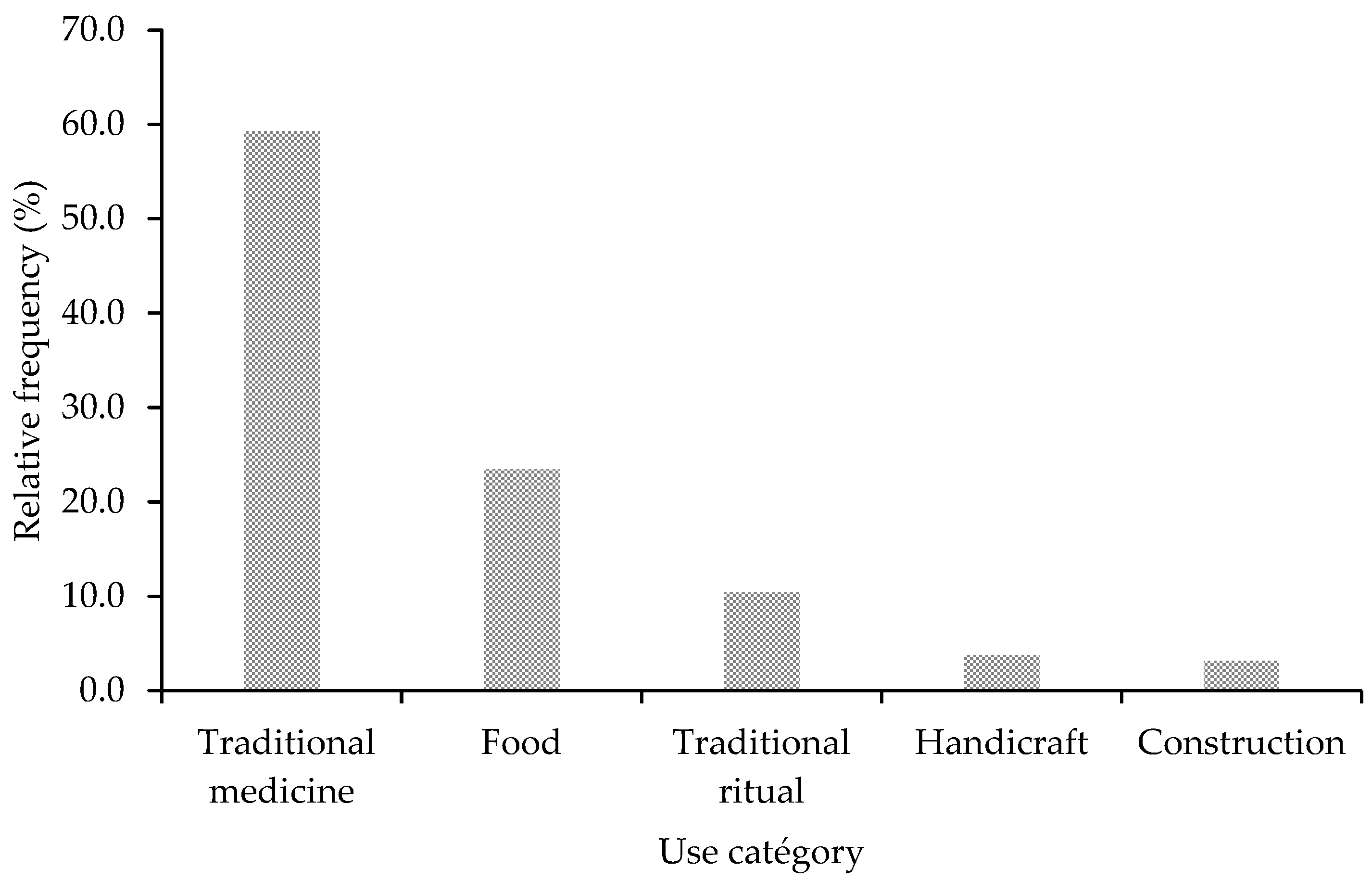
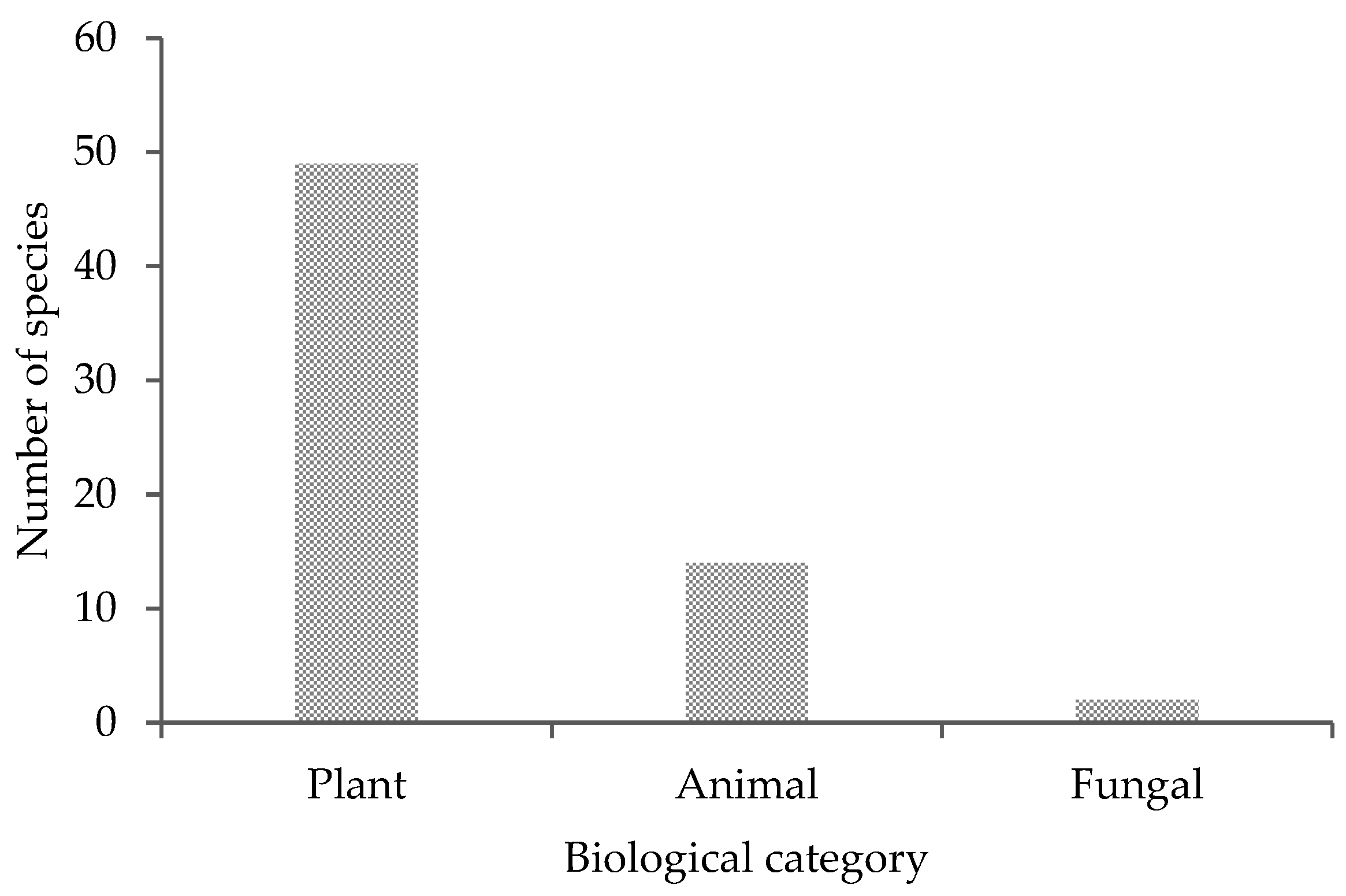
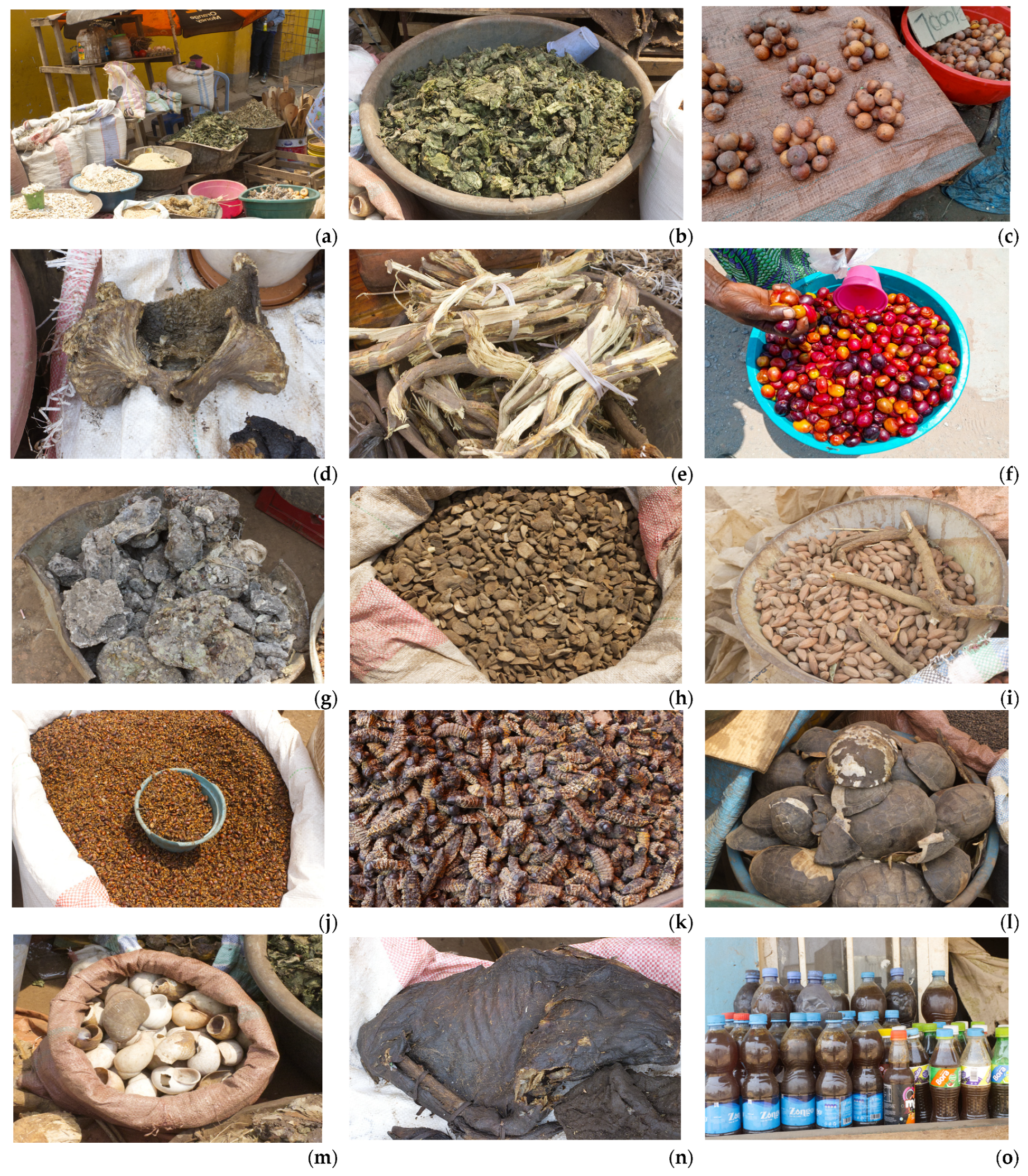
Surveys conducted in the two main urban markets of Kolwezi, which host NTFP sellers from various regions, identified 65 traded NTFP species, including 49 plant species, 14 animal species, and 2 fungal species (Figure 2; Table A1). These species belong to 57 genera and 40 families and are sold for food, medicinal, handicraft, ritual, and construction purposes. Medicinal species largely dominate the trade, accounting for 59.3% of the recorded species, followed by food species (23.4%), whereas species used for ritual, artisanal, and construction purposes remain marginal (Figure 3). Some species show particularly high citation frequencies, reflecting their socio-economic importance, notably Albizia antunesiana Harms, Terminalia mollis M.A.Lawson, Parinari curatellifolia Planch. ex Benth., Piper umbellatum L., Phyllanthus muellerianus (Kuntze) Exell, and Canarium schweinfurthii Engl. among plant-based NTFPs, as well as Burtoa nilotica (L.Pfeiffer, 1861), Pelusios nanus Laurent, 1956; Python sebae (Gmelin, 1789), and Apis mellifera subsp. adansoni Latreille, 1804 (honey) among animal-derived NTFPs. Fungal NTFPs are exclusively represented by two edible species, Cantharellus afrocibarius Buyck & V.Hofst and Termitomyces microcarpus (Berk. & Broome) R.Heim. The plant or animal parts marketed vary according to species, reflecting the diversity of uses and valorisation practices observed in Kolwezi markets (Figure 4).

3.3. Supply Areas and Marketing Channels for NTFPs in Kolwezi, DRC

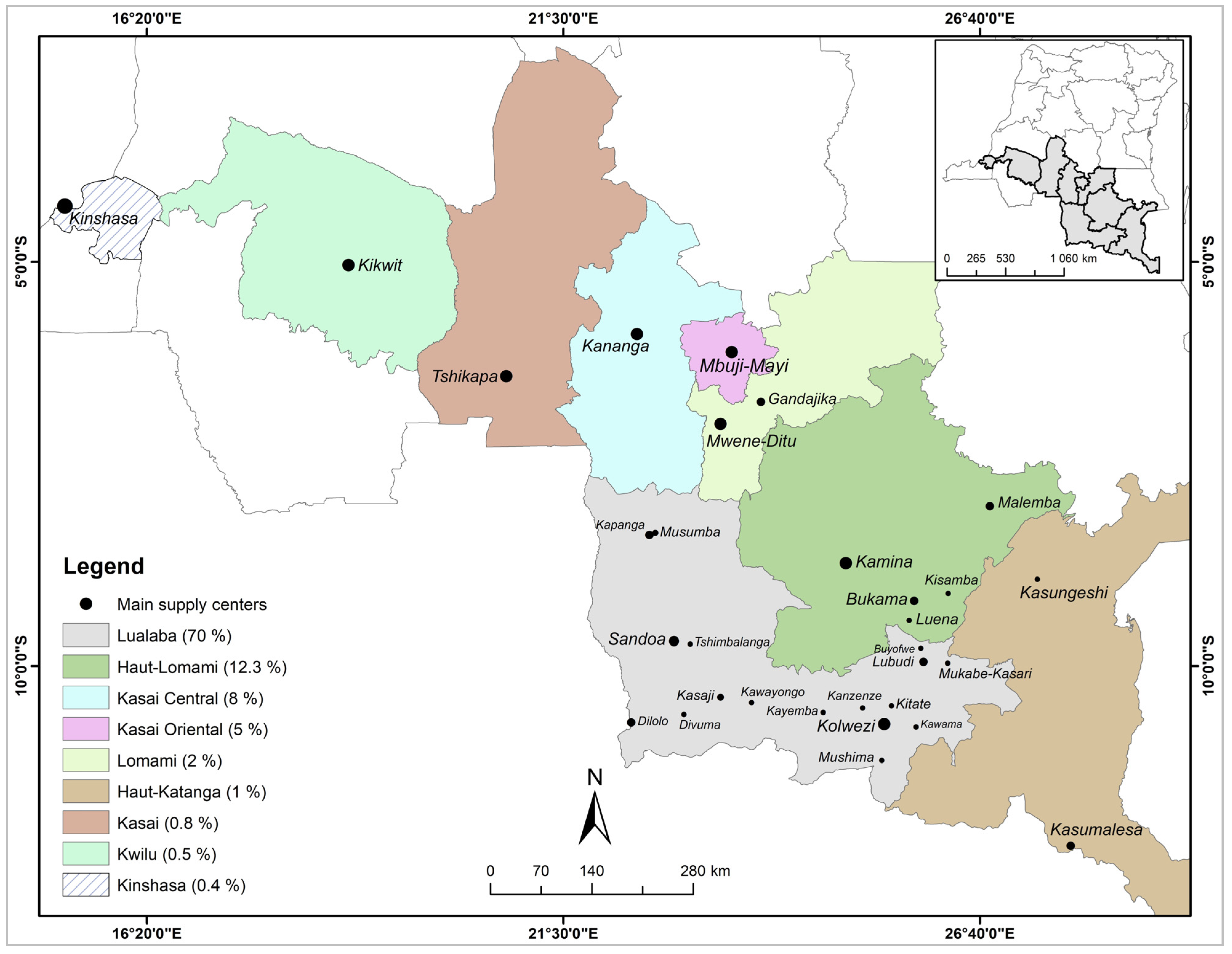
In total, eight provinces of the DRC contribute to the supply of NTFPs to the urban markets of Kolwezi (Figure 5, Table A2). The Lualaba province is by far the main source area, providing approximately 70% of the marketed volumes, indicating that the urban market relies primarily on surrounding rural supply areas where collection activities are concentrated. Secondary but significant flows come from Haut-Lomami (12.3%), Kasaï Central (8%), and Kasaï Oriental (5%), indicating the existence of well-established interprovincial exchange networks. More marginal contributions are recorded from Lomami (2%), Haut-Katanga (1%), Kasaï (0.8%), and Kwilu (0.5%). Finally, occasional inputs from Kinshasa (0.4%) underscore the sporadic integration of the Kolwezi market into national NTFP trade circuits, likely for products with high cultural or gastronomic value for a specific category of consumers.
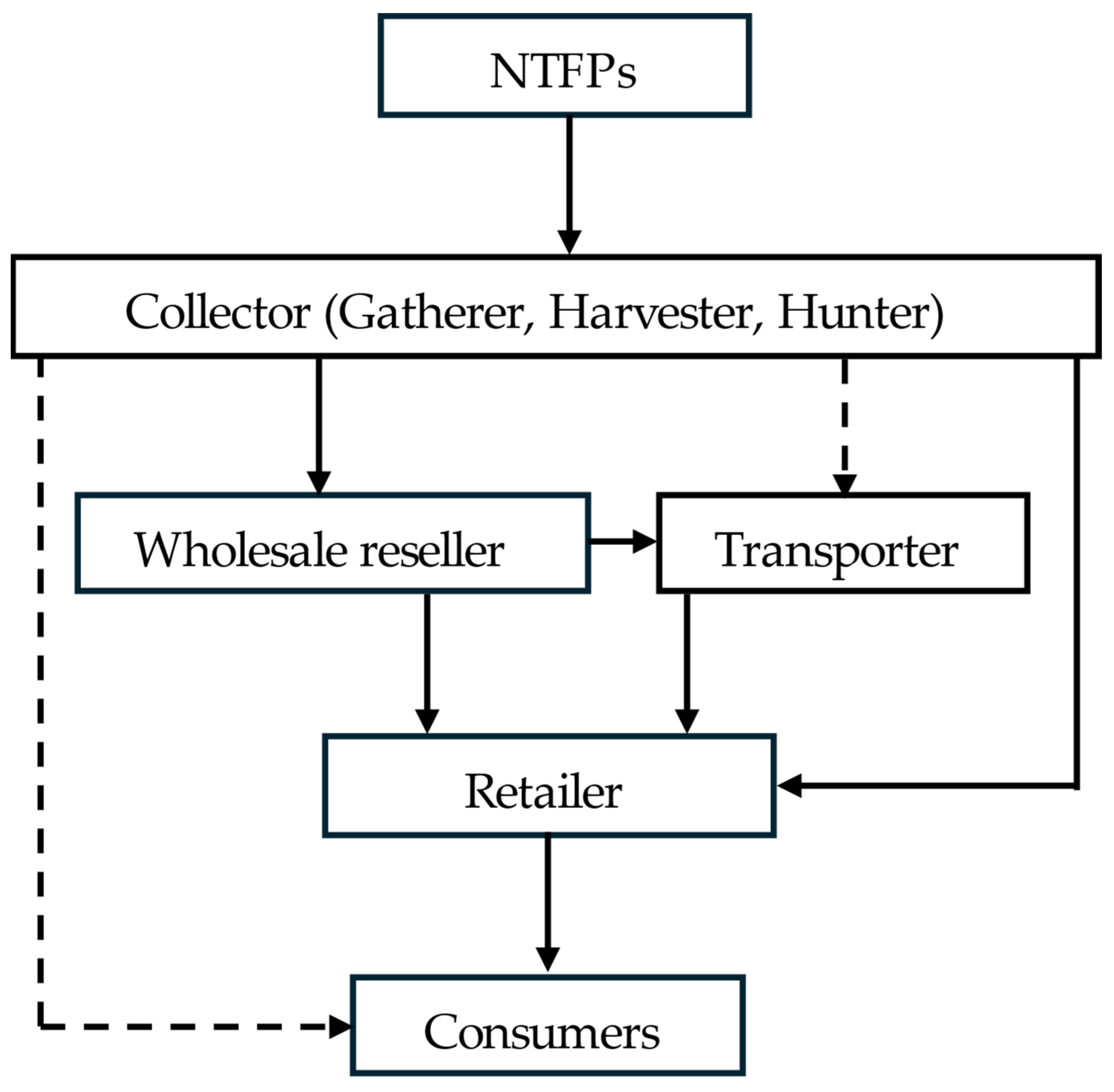
The marketing circuit of NTFPs in the Kolwezi region is illustrated in Figure 6, showing the relationships among the different actors in the value chain. Collectors (gatherers, harvesters, hunters), mainly residing in rural areas, exploit wild resources for both subsistence and sale. They sell their products to wholesale resellers, who sometimes spend several days in the villages awaiting deliveries. Once in the city, whether they use transporters, these wholesalers sell the products to retailers, who then make them available to consumers. In some cases, collectors bring their products directly to urban markets, with or without using transporters, where they sell them in bulk to retailers or in small quantities to consumers. This indicates that some actors may simultaneously act as collectors and retailer-sellers. The largely informal nature of this marketing circuit reflects the lack of formal organization by public authorities and the absence of structured trade associations.

3.4. Market Value of NTFPs and Their Contribution to Sellers’ Income in Kolwezi, DRC

The market value of NTFPs, the quantities sold per month, and the monthly gross income earned by a seller in Kolwezi vary according to different use categories, ranging from USD 0.9 to 160 per kg, 0.8 to 110.4 kg, and USD 9 to 429.3 per month, respectively. The highest market value was recorded for NTFPs used in traditional rituals (C. schweinfurthii), while the lowest was observed for food-use NTFPs (P. aquilinum). The highest quantity sold was noted for NTFPs used in handicrafts (A. adianthifolia). In contrast, the highest gross income was generated by food-use NTFPs (Sylvicapra grimmia (Linnaeus, 1758)), and the lowest by those used for handicrafts (Albizia versicolor Welw. ex Oliv.) (Table 3).

3.5. Constraints in the NTFP Trade in Kolwezi and Suggestions for Improvement

The main constraints reported by NTFP sellers in Kolwezi are the remoteness from supply areas (34.2%) and seasonality (25.8%), which limit regular supply and increase transaction costs. Product scarcity (8.3%) and the lack of processed by-products (8.3%) also hinder the competitiveness of NTFPs on the local market. Intermediate constraints include limited access to finance (6.7%) and consumer preference for imported products (5%), reflecting the weak organization of the NTFP trade and growing competition from modern supply chains. Marginal constraints include poor packaging by intermediaries (3.4%), high taxation (3.4%), short shelf life (2.5%), and consumers’ limited knowledge of NTFP properties (2.5%) (Table 4). These results highlight the importance of structural and logistical constraints affecting the functioning and competitiveness of the NTFP trade in Kolwezi.
The results presented in Table 5 show that establishing NTFP processing chains is the top priority for sellers in both markets (average 35%), followed by the promotion of cultivation of source species (30.8%), reflecting a strong demand for product valorisation and sustainable availability. Recommendations related to raising awareness of the benefits of local NTFPs (13.4%) and standardizing sales units (5.9%) were less frequent, suggesting that information dissemination and market regulation are considered secondary. In contrast, measures such as tax reduction (5%) and rehabilitation of rural access roads (10%) were specific to certain markets, reflecting fiscal constraints in Manika and infrastructure limitations in Kasulo.

3.6. Socio-Demographic Determinants of Constraint Perception and Improvement Strategies in Kolwezi’s Urban NTFP Trade

The perception of constraints in the NTFP trade in Kolwezi, as well as the improvement measures proposed by sellers, is influenced by socio-demographic factors, particularly gender, age, and education level (Table 6). Several constraints, including seasonality and scarcity, are significantly associated with both gender and education level, whereas scarcity and the lack of processed by-products vary significantly with age.
Women, who constitute the majority of NTFP traders, more frequently perceive seasonality and scarcity as key drivers of supply instability. Younger sellers tend to identify the lack of processed by-products and the short shelf life of products as major constraints, whereas adult and older sellers more commonly emphasise scarcity, suggesting differences in how constraints are perceived across age groups. In addition, respondents with secondary or higher education are more likely to report constraints related to consumer preferences for imported products, as well as seasonality and scarcity, suggesting greater awareness of market dynamics.
Overall, proposed improvement measures show limited variation across socio-demographic groups, indicating a general convergence in perceptions. However, awareness-raising initiatives on the benefits of local NTFPs, rehabilitation of rural roads, and, to a lesser extent, standardisation of sales units are more frequently suggested by respondents with higher education levels, highlighting their greater sensitivity to structural and governance-related issues. In contrast, these suggestions vary little by gender and age, except for older sellers, who place greater emphasis on the standardization of sales units.

3.7. Non-Timber Forest Products Commonly Used by the Population of Kolwezi

Use value (UV) and use frequency (UF) analyses identified 17 NTFPs as the most commonly used by households in Kolwezi. The results presented in Table 7 show that several species play a central role in local livelihood systems due to their functional versatility, economic importance, and relative availability. The most highly valued species include Bobgunnia madagascariensis (Desv.) J.H.Kirkbr. & Wiersama (UV = 2.4; UF = 43.2%), Canarium schweinfurthii (UV = 2.3; UF = 60.9%), Terminalia mollis (UV = 2.2; UF = 45.1%), Gardenia ternifolia subsp. Jovis-tonantis (Welw.) (UV = 2.2; UF = 36.9%), Albizia antunesiana (UV = 2.1; UF = 76.6%), Cussonia corbisieri De Wild. (UV = 2.0; UF = 41.1%), Python sebae (UV = 2.0; UF = 43.2%), and Zanthoxylum chalybeum Engl. (UV = 2.0; UF = 48.2%). These species show average monthly household use volumes ranging from 0.5 to 4.3 kg. Their high use values reflect multifunctional uses (food, medicinal, handicraft, ritual, and construction) and sustained demand in local markets. However, some of these species were reported as infrequent or rare in local markets (C. schweinfurthii, C. corbisieri, P. sebae) or rare (G. ternifolia and Z. chalybeum).
In contrast, species such as Strychnos cocculoides, Piper umbellatum (UV = 1.1; UF = 72.4%), Anisophyllea boehmii (UV = 1.0; UF = 57%), Sarcocephalus latifolius (Sm.) E.A.Bruce (UV = 1.0; UF = 53.1%), Elaphrodes lactea Gaede, 1932 (UV = 1.1; UF = 33.3%), Dracaena reflexa Baker (UV = 1.0; UF = 34.1%), Uapaca kirkiana (UV = 1.0; UF = 47.1%), Imbrasia epimethea Drury, 1773 (UV = 1.0; UF = 41.1%), and Cantharellus afrocibarius (UV = 1.0; UF = 45.1%), although sometimes purchased in relatively large quantities, exhibit use values below 2, indicating functional specialization mainly limited to food use.

3.8. Perceived Causes of Declining NTFP Availability in Kolwezi Markets and Proposed Measures for Resource Restoration

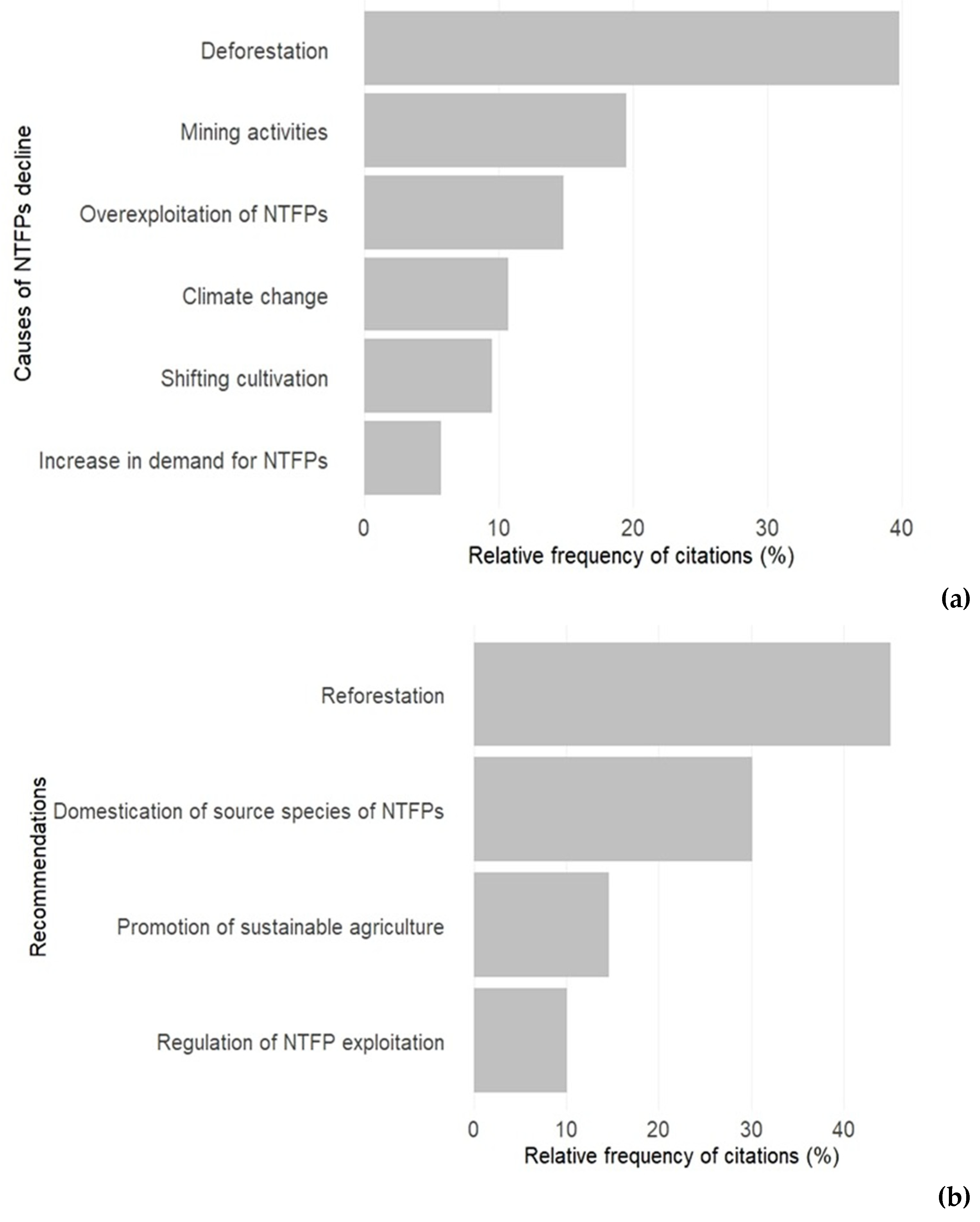
According to respondents, deforestation was perceived as the main factor contributing to the declining availability of NTFPs in Kolwezi markets, cited by 39.8% of respondents. It was followed by mining activities (19.5%) and perceived resource overexploitation (14.8%), reflecting a widely shared perception that anthropogenic pressures are affecting resource availability. The effects of climate change (10.7%) and shifting cultivation (9.5%) were also mentioned as contributing factors, whereas the rise in urban demand for NTFPs was more marginally reported (5.7%) (Figure 7a). Regarding proposed measures to restore and conserve NTFPs, reforestation was cited by 45.1% of respondents. In addition, domestication of NTFP source species and the promotion of sustainable agriculture were mentioned by 30.2% and 14.6% of the surveyed household heads, respectively, compared with 10.1% who suggested regulating NTFP harvesting (Figure 7b).

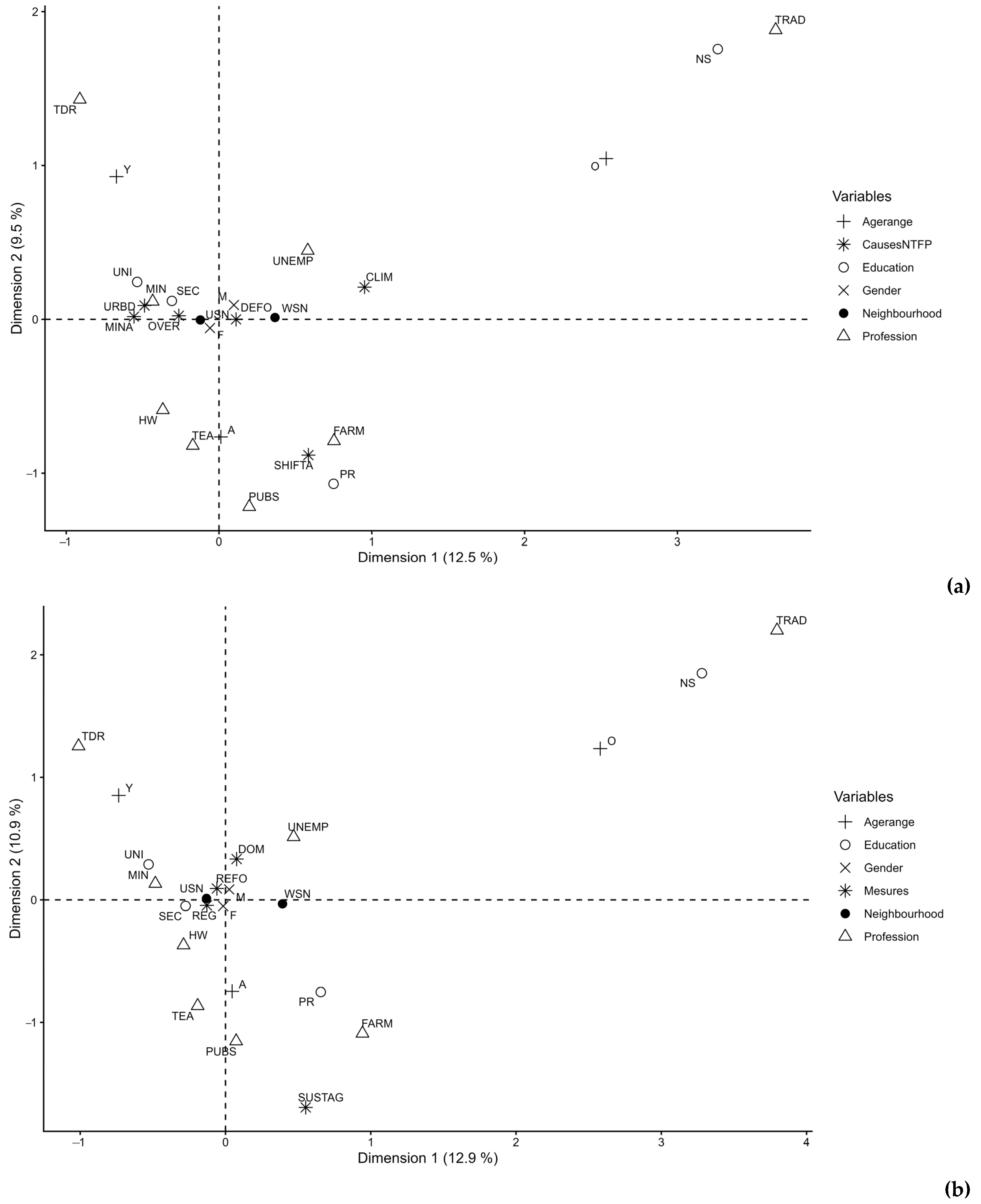
3.9. Socio-Demographic Analysis of Perceived Causes of Declining NTFP Availability in Kolwezi Markets and Preferred Sustainable Management Measures Among Urban Consumers

Perceptions of both the causes of declining NTFP availability and the proposed sustainable management measures are influenced by respondents’ socio-demographic characteristics, especially education level, occupation, age, and residential setting. Overall, respondents with secondary or higher education and those living in better-serviced neighbourhoods tend to see scarcity through the lens of broader environmental factors, notably climate change and deforestation. Conversely, respondents with primary or no formal education and those in under-serviced neighbourhoods more often focus on immediate pressures related to resource use and market dynamics, including rising demand, mining, and perceived overexploitation. Age differences are also evident: younger respondents and traditional practitioners associate declining NTFP availability with large-scale environmental changes, while adults and actively employed groups, such as farmers and the unemployed, highlight livelihood issues, including those related to shifting cultivation (Figure 8a).
A similar pattern appears regarding proposed restoration measures. The promotion of sustainable agriculture is mainly suggested by farmers and respondents with primary education, reflecting a production-focused view linked to their livelihoods. Regulatory actions, such as controlling NTFP exploitation and reforestation efforts, are more frequently proposed by respondents with secondary education and those involved in public service or homemaking, indicating a preference for institutional or management interventions. Additionally, the domestication of NTFP species is primarily associated with unemployed individuals, suggesting a need to improve access to resources and diversify income sources (Figure 8b).

4. Discussion

4.1. Methodological Considerations and Remaining Uncertainties

Multiple sources of uncertainty can influence the robustness of the estimates from this study. Data on trade quantities and income are based on self-reports, making them susceptible to recall bias and social desirability bias. To mitigate these effects, information was systematically cross-checked between sellers and consumers, and consistency checks were performed during data processing. Additionally, using digital data collection tools (KoboCollect) helped reduce data entry errors and improve overall data reliability, in line with established survey methodology recommendations [62,63]. Converting local selling units into standardized weights introduces another source of approximation due to variability stemming from species, product condition, and packaging practices. This issue was addressed by establishing average equivalences based on repeated field observations and occasional direct weighing. Nonetheless, residual variability persists, as extensively documented in studies on informal markets and NTFP value chains [64,65,66]. Furthermore, the cross-sectional nature of the survey limits the ability to analyse temporal changes, such as seasonal and year-to-year variations in availability, trade volumes, and prices. This limitation was somewhat offset by collecting data over several months and at different times during market activity. However, understanding long-term trends would require dedicated longitudinal study designs [67]. Finally, interpretative robustness was enhanced through data triangulation across respondent groups (sellers and consumers) and information types (quantities, prices, constraints, and perceptions). This approach, widely recommended in mixed-methods research, strengthens the internal consistency of findings [67,68,69]. However, the lack of direct ecological measurements means that the results should be viewed as reflecting market dynamics and local perceptions of resource change, rather than the biophysical status of the resources. In addition, in this study, perceived scarcity refers to two distinct but related phenomena: reduced market availability for urban consumers, and increased distance to harvesting or supply areas for sellers and intermediaries. These perceptions should not be conflated with direct ecological depletion. Accordingly, subsequent interpretations of sustainability are framed in terms of market signals and respondent perceptions rather than direct ecological assessment.

4.2. Socio-Demographic Characteristics of NTFP Sellers: Gender, Age Structure and Professionalisation

The socio-demographic profile of NTFP sellers in Kolwezi is characterized by a strong female predominance (p < 0.05), confirming the central role of women in NTFP collection and marketing chains in sub-Saharan Africa [8,9,70,71]. As most actors are adults aged 36 to 60 years (p < 0.05), this suggests a relatively stable activity based on accumulated experience, well-established supply networks, and a good knowledge of local markets. These assets likely enhance their ability to adapt to fluctuations in demand or supply constraints [9,70,71]. The notable presence of young sellers indicates a gradual renewal of actors, probably linked to urban employment challenges and to the attractiveness of NTFPs as an alternative source of income [65,72]. Conversely, the low proportion of elderly individuals (over 61 years old) may be explained by the physical demands associated with sourcing products or managing market stalls. The relatively high level of education observed constitutes an asset for the adoption of improved commercial practices and the integration of sustainability requirements into value-chain management. Education is indeed recognised as a key driver of the professionalisation and governance of NTFP value chains [53,73].

4.3. Species and Functional Diversity of NTFPs Sold in the Kolwezi Market: Multiple Uses and Sustainability Issues

Surveys conducted in Kolwezi markets recorded 65 species traded as NTFPs, including 49 plant, 14 animal, and 2 fungal species (Figure 2). This diversity highlights the central role of NTFPs in urban socio-economic systems, where they contribute to food provision, traditional medicine, handicrafts, cultural practices, and construction materials. Comparable levels of diversity have been documented in urban markets across Central Africa, where NTFPs serve as a critical interface between forest ecosystems and informal urban economies [10,74,75,76,77,78,79]. Similarly, in Southern Africa, urban NTFP markets play a key role in livelihood diversification and household resilience to economic shocks [65,80,81].
Moreover, the species richness observed in Kolwezi is comparable to that reported in more established Central African markets (e.g., Douala, Brazzaville), where inventories do not exceed 80 species [77,82,83]. However, compared to the edible species listed in the southeastern region of the DRC by Ref. [30] and Ref. [16], this diversity is relatively low. Several factors may explain this pattern. First, the four-month survey period, which does not cover the full maturation cycle of all edible NTFPs, especially for wild fruits and mushrooms with highly seasonal phenology [84,85]. Second, the low level of local processing and value addition may constrain the diversity of products entering urban markets [65], suggesting that the Kolwezi NTPF market is still a less mature stage of commercial development. Third, rapid socio-economic transformations associated with mining-driven urbanisation may contribute to dietary shifts toward processed and imported products, thereby reducing the prominence of certain NTFPs in urban consumption patterns [86]. These findings indicate that observed diversity reflects not only ecological availability but also evolving socio-economic dynamics.
The predominance of medicinal uses (59.3%) underscores the continued importance of traditional pharmacopeia in African urban contexts, particularly where access to formal healthcare remains limited or costly [81,87]. This pattern is widely documented across Central and Southern Africa, where medicinal plant trade constitutes a major component of urban NTFP markets [53,81,88]. Food uses also represent a critical dimension of urban food security, particularly through the consumption of wild fruits, edible fungi, and animal-based products such as insects and bushmeat, which provide essential micronutrients and dietary diversity for low-income households [27,89,90,91].
Beyond their utilitarian functions, NTFPs retain strong cultural significance, as evidenced by species used in ritual, symbolic, and artisanal practices. This persistence of cultural uses, despite rapid urbanisation, is consistent with previous findings highlighting the role of NTFPs in maintaining social identity and cultural continuity [87,92].
The diversity of harvested plant and animal parts (roots, bark, leaves, fruits, resins, whole organisms, etc.) reflects the multifunctional nature of NTFP use and trade in Kolwezi. This pattern may raise sustainability concerns, especially where market demand involves roots, bark, or whole organisms, which the literature identifies as potentially more destructive forms of extraction [9,93]. In the context of this study, however, such concerns are inferred from market composition and respondents’ reports and should not be interpreted as direct ecological evidence of species decline or ecosystem imbalance. Rather, they point to possible tensions between urban demand, harvesting practices, and the long-term sustainability of supply systems [94].
The case of Kolwezi presents additional specificities related to its status as a major copper-cobalt mining hub [32,39]. Unlike non-mining urban centres, where NTFP trade is embedded in long-standing rural-urban linkages [65,66,95], Kolwezi’s market dynamics are strongly influenced by extractive economic processes. Mining expansion likely affects habitat integrity and may contribute to reduced availability of key NTFP species [96,97,98,99], as suggested by the literature and by respondents’ perceptions in the present study [52]. At the same time, rising income disparities and shifting consumption patterns influence demand, alongside the coexistence of subsistence-oriented trade and emerging higher-value market niches [100]. Moreover, migration flows associated with mining activities may disrupt local ecological knowledge systems and accelerate the erosion of intergenerational knowledge transmission, as observed in other extractive frontiers [101].

4.4. Marketing Channels of NTFPs and Supply to the Urban Market in Kolwezi

The supply of NTFPs to the urban market in Kolwezi relies predominantly on the Lualaba Province, which provides nearly two-thirds of the products sold (Figure 5). This situation reflects a close link between rural areas of Lualaba and the urban market, as observed in other contexts of the Congo Basin, where urban markets largely depend on rural communities for the majority of NTFPs [9,93]. This rural–urban connection aligns with the documented role of the Miombo in the local socio-economic system, where NTFPs support both food security and local incomes [14,19]. However, miombo forests face increasing anthropogenic pressures [102], potentially threatening the long-term availability of NTFPs. Furthermore, Ref. [36] reported the regression of natural cover around Kolwezi, which may contribute to increasing the distance to supply areas. These dynamics can reduce the resilience of supply chains and the capacity of local communities to derive sustainable benefits from natural resources.
The presence of NTFPs from Haut-Lomami, Kasaï Central, and Kasaï Oriental in Kolwezi markets indicates established interprovincial trade networks, characteristic of functional but informal value chains [93,103]. In contrast, marginal contributions from distant provinces, such as Kinshasa or Kwilu, suggest the circulation of products with high cultural or gastronomic value, a phenomenon already documented for rare or culturally demanded NTFPs [4].
The observed marketing circuit (Figure 6), dominated by direct interactions among rural collectors, wholesale resellers, transporters, retailers, and sometimes end consumers, reflects the typical informal structure of NTFP value chains in Central Africa [103,104,105]. The coexistence of collector–sellers, capable of integrating multiple links of the chain, illustrates an adaptation strategy aimed at maximising profit margins under precarious economic conditions, a phenomenon also described by Ingram and Schure [106] in the marketing of NTFPs in Central Africa. However, the informal nature of the Kolwezi sector constitutes a major constraint to its sustainable development. The absence of professional structures, recognised cooperatives, or trade unions would limit actors’ capacity to negotiate collectively, regulate resource access, or enhance product value in more remunerative markets. Numerous studies emphasise that the organisation of collectors and traders is a key factor for improving both the ecological and economic sustainability of NTFPs, particularly through securing usage rights, providing actor training, and certifying marketed NTFPs [7,9,107,108,109].

4.5. Socio-Economic Value, Constraints, and Sustainable Prospects of the NTFP Trade in Kolwezi

The sale of NTFPs is a permanent activity and constitutes a significant source of income as well as an employment driver in the informal sector in Kolwezi. Most NTFPs sold in Kolwezi have notable economic value, as evidenced by the prices observed in urban markets and the monthly income generated by sellers (Table 3). These findings are consistent with previous studies highlighting the important socio-economic role of NTFPs [9,22,30,52,58,77,80,103,110,111,112].
However, market value, quantities sold, and gross incomes vary according to the category of use. NTFPs used in traditional rituals command the highest unit prices, reflecting their rarity and strong cultural value, whereas edible NTFPs show lower prices, linked to their availability, status as common consumer goods [86,108], and the shift in urban dietary habits toward manufactured products [66,86].
However, edible NTFPs generate the highest monthly gross incomes due to larger quantities sold and consistent demand. In contrast, ritual NTFPs, despite their high unit price, contribute little to overall income because of low sales volumes. These results demonstrate that income from NTFPs depends more on volumes and frequency of sales than on unit price or symbolic value, as widely documented in NTFP markets across sub-Saharan Africa [65,66,105].
Furthermore, the high monthly sales volumes observed for NTFPs used for artisanal and construction purposes indicate their functional integration into local value chains but also raise potential sustainability concerns. From a market perspective, high traded volumes may indicate increased pressure on supply systems and possible vulnerability of certain species if harvesting remains unmanaged [65,66,113,114].
Moreover, the NTFP trade in Kolwezi is primarily constrained by structural and logistical limitations (Table 4). Indeed, sellers reported that the remoteness of supply areas, combined with seasonality, reduces supply regularity and increases transaction costs, a pattern commonly reported in African urban markets where distance and seasonal variability undermine value chain competitiveness [9,106]. Product declining availability and the absence of processed by-products suggest a lack of local value addition, limiting both the creation of added value and the capacity to compete with modern supply chains, as highlighted by Ref. [7], and Ref. [105]. Intermediate constraints, such as limited access to finance and preference of consumers for imported products, reflect the weak structuring of the NTFP trade [103,104,105], while high taxation, poor NTFPs packaging by intermediary sellers, and short shelf life, although marginal, further limit market competitiveness and the stability of NTFP-derived incomes [7,115].
However, these constraints are not perceived the same way by all sellers; perceptions vary by gender, age, and education level (Table 6). Women tend to perceive seasonality and declining availability more strongly, which may be due to their central role in supply chains and greater exposure to supply instability, as observed in other African markets [8,64,70]. Age-related differences highlight a contrast between a competitiveness-focused view among younger actors and a long-term perception of resource declining availability among more experienced traders, possibly reflecting differences in experience and market [64,116]. Education level also influences how market dynamics are understood, with more educated actors more likely to recognize structural and governance-related constraints [117].
In response to these challenges, sellers suggested the establishment of processing chains and the domestication of NTFP source species as priority solutions (Table 5). These proposals reflect a desire to improve the competitiveness and sustainability of the sector, in line with strategies recommended for areas under anthropogenic pressure [7,118,119], such as the Kolwezi region. On one hand, domestication of NTFP source species represents an alternative to stabilise local supply while contributing to biodiversity conservation [120,121]. On the other hand, NTFP processing increases shelf life and enhances product quality, thereby potentially increasing income and helping reduce dependence on wild-harvested supplies [7]. The shared recognition of the need to strengthen processing, domestication, and infrastructure, along with the adoption of tailored approaches, underscores a common understanding of how to improve intervention effectiveness.

4.6. From Abundance to Scarcity: Household Dependence on Miombo NTFPs, Perceived Causes of Declining Abundance on the Market, and Pathways for Sustainable Restoration

The value attributed to species is shaped by the ways in which they are used by local populations. This study identified 17 NTFP species as the most frequently used by households in Kolwezi (Table 7). High use values (UV > 2) observed for species such as B. madagascariensis, C. schweinfurthii, T. mollis, G. ternifolia, and A. antunesiana reflect their functional versatility and strong integration into local socio-economic practices. These species are used for food, traditional medicine, rituals, and construction, which explains their high demand on the local market and highlights their importance in the daily lives of Kolwezi’s urban population. Indeed, the importance assigned to a species depends not on its availability but on its capacity to meet population needs across different use categories [120,121].
However, several species with high social and economic value, such as C. schweinfurthii, C. cobisieri, B. gabonica gabonica, G. ternifolia, and Z. chalybeum, are perceived as common or rare on the market. This low perceived market availability of high-use-value species may reflect strong harvesting pressure [122], although this study does not directly measure ecological depletion. Moreover, the contrast between high household consumption (0.5–4.3 kg month−1 per household) and perceived low market volatility could indicate an imbalance between supply and demand.
Consumer perceptions of declining NTFP availability in Kolwezi indicate a clear awareness of human pressures affecting resource access and supply. The prominence of deforestation and mining among perceived causes is consistent with documented land-use and land-cover changes in Miombo ecosystems, where expanding agricultural and extractive activities significantly reduce resource availability and the ability of species to regenerate [14,15,17]. Mentioning overexploitation also indicates that consumers recognize the impact of harvesting methods, revealing an understanding of the risks associated with unsustainable resource use. Conversely, the low importance given to rising urban demand suggests an underestimation of market-driven pressures, which may nonetheless play an important role in shaping NTFP market dynamics [123].
Proposed measures, mainly reforestation and species domestication, aim to increase supply and restore resources. This approach aligns with strategies in tropical forest systems, where agroforestry and domestication are seen as ways to potentially reduce dependence on wild populations while supporting local livelihoods [124,125]. However, the low emphasis on regulating harvesting practices highlights limited focus on governance mechanisms, which are still vital for ensuring long-term sustainability [116].

4.7. Socio-Demographic Determinants of Perceived Causes of Declining NTFP Availability in Markets and Sustainable Management Strategies in a Rapidly Changing Urban Context

The perceived causes of declining NTFP availability in Kolwezi Markets and suggested sustainable management strategies are influenced by respondents’ socio-demographic profiles, particularly education level, age, occupation, and place of residence (Figure 8). As demonstrated by several studies, this structuring of perceptions reflects the influence of social positions and differentiated roles in accessing resources and information [123,126,127]. Thus, highly educated respondents residing in better-served areas tend to perceive NTFP declining availability through the lens of global environmental factors, such as deforestation and climate change. This reflects greater ecological awareness and increased exposure to scientific and institutional discourse [48,90]. Conversely, less-educated individuals or those living in under-equipped neighbourhoods prioritize explanations anchored in immediate local realities—notably mining activities, direct harvesting pressure, and growing demand—reflecting a perception strongly shaped by daily livelihood constraints and direct material interactions with the ecosystem.
The influence of age on the perception of the drivers of this decline can be explained by the cumulative experience with long-term environmental processes. As emphasised by Ref. [128], the understanding of complex dynamics, such as deforestation or reduced resource availability, becomes more refined through continuous observation and historical grounding within the territories. In the present study, while youth and some traditional healers tend to associate scarcity with large-scale environmental degradation, adults engaged in productive activities (such as farmers or unemployed individuals) emphasise factors directly correlated with their livelihoods, such as shifting cultivation. This result suggests that environmental representations are co-constructed by local knowledge and household economic adaptation strategies [64].
Furthermore, the observed divergences regarding the proposed management measures reflect differing priorities across social groups. Farmers and respondents with low educational attainment prioritize production-oriented solutions, notably sustainable agriculture, aligned with their field practices and immediate needs. In contrast, more educated individuals or those working in the public service and domestic sector suggest more institutional measures, such as controlled reforestation and strict harvesting regulations, reflecting a better grasp of environmental governance mechanisms [122]. Finally, the association of NTFP domestication with unemployed individuals suggests that these wild resources are perceived as genuine levers for economic diversification and resilience in the face of socio-economic vulnerability.
These results suggest that the conceptualisation of environmental problems and their corresponding solutions depends heavily on actors’ social trajectories, education levels, and lived experiences. They highlight the imperative need to integrate these socio-demographic variables into the formulation of NTFP management policies. Such an approach will enable the promotion of inclusive, concerted, and socially differentiated strategies, which are particularly crucial in rapidly changing urban and peri-urban contexts like that of Kolwezi.

5. Conclusions

This study provides an integrated analysis of NTFP trade dynamics in Kolwezi, encompassing species diversity, market structures, economic significance, and perceived sustainability. The high diversity of traded species, mainly used for medicinal and food purposes, suggests a strong reliance of urban populations on Miombo ecosystems. Additionally, the prominence of multifunctional species points to potential pressure on highly demanded resources, as inferred from market and perception data, supporting the first hypothesis. Dominated mainly by women and generating significant income, the NTFP trade is a key component of the urban informal economy; however, it faces structural and logistical challenges that vary across socio-demographic groups, supporting the second hypothesis. Furthermore, the finding that respondents identified deforestation, mining expansion, and perceived overexploitation as the primary causes of declining NTFP availability, with their impacts influenced by education level, age, and socio-economic status, is consistent with the third hypothesis and underscores the role of social factors in shaping perceptions of environmental change. The perceived discrepancy between the high demand for high-use-value species and their diminishing availability in the market points to emerging sustainability challenges in this mining-influenced urban landscape. Overall, these findings highlight the need for integrated management strategies that include species domestication, value addition through processing, infrastructure improvements, and stronger governance mechanisms. Such approaches, which consider the socio-demographic diversity of actors, are important for improving the sustainability of NTFP supply systems and strengthening livelihood resilience. This study is best understood as a regional urban case study that contributes empirical evidence from a mining-driven miombo context rather than as a generalizable model of urban NTFP dynamics. Based on these findings, future research should prioritise (i) village-level surveys to link urban perceptions with field-based indicators of miombo stock dynamics and identify high-risk harvesting areas, and (ii) ecophysiological and silvicultural studies of priority multifunctional species to support domestication and agroforestry integration. Lastly, from a governance standpoint, integrating female traders, who are key players in this economy, into decision-making processes is essential for creating truly inclusive and sustainable urban and environmental management policies.

Supplementary Materials

The following supporting information can be downloaded at: https://www.mdpi.com/article/10.3390/conservation6020048/s1, Survey Questionnaire S1: Market survey on NTFP trade dynamics and supply chains-Kolwezi; Survey Questionnaire S2: NTFP consumption and perception survey-Kolwezi.

Author Contributions

Conceptualization, J.K.T., A.B.M., Y.U.S., A.T.K., K.R.S. and J.B.; methodology, J.K.T., M.M.M., K.R.S. and D.-d.N.N.; software, J.K.T.; validation, F.M., Y.U.S., A.B.M. and J.B.; formal analysis, J.K.T. and D.-d.N.N.; investigation, J.K.T., A.B.M. and M.M.M.; resources, J.-F.B., Y.U.S. and J.B.; data curation, J.K.T., K.R.S., A.T.K. and J.B.; writing—original draft preparation, J.K.T.; writing—review and editing, J.K.T., Y.U.S., F.M. and J.B.; visualization, J.K.T., M.M.M., F.M. and D.-d.N.N.; supervision, Y.U.S., A.B.M., J.-F.B., K.R.S., A.T.K. and J.B.; project administration, Y.U.S. and J.-F.B.; funding acquisition, Y.U.S. and J.-F.B. All authors have read and agreed to the published version of the manuscript.

Funding

The research was funded by the Académie de Recherche et d’Enseignement Supérieur (ARES-CDD, Belgium) through the Amorce & Valorisation Project «ARBOREKOL: un consortium pour l’initiation des recherches en écologie forestière et l’optimisation de l’enseignement de la botanique et de la systématique des plantes à Kolwezi par la création d’un arboretum».

Institutional Review Board Statement

This study was conducted in accordance with the Declaration of Helsinki and approved by the Ethics Committee of the Faculty of Agronomic Sciences at the University of Kolwezi (EC/FSA/UNIKOL/12/2025) on 23 November 2025.

Informed Consent Statement

Verbal informed consent was obtained from the participants. Verbal consent was obtained rather than written because of varying literacy levels and the informal nature of market settings. Prior to data collection, all participants were provided with a clear and accessible explanation of the study’s objectives, procedures, and their rights, delivered in their preferred language (French or Swahili). These included the voluntary nature of participation, the right to withdraw at any time without consequence, and guarantees of confidentiality and anonymity. Data were collected using Kobo Collect on mobile devices. No personal identifiers (such as names or contact details) were recorded, and all data were anonymized at the point of collection. The study did not involve any physical intervention, biological sampling, or collection of sensitive personal data, and therefore posed minimal risk to participants. All data were securely stored and accessed only by the research team for scientific purposes.

Data Availability Statement

The data related to the present study will be available upon request from the interested party.

Acknowledgments

Authors thank the Académie de Recherche et d’Enseignement Supérieur (ARES) for granting a doctoral scholarship to John Kikuni Tchowa and Médard Mpanda Mukenza through the Amorce & Valorization Project: «ARBOREKOL: un consortium pour l’initiation des recherches en écologie forestière et l’optimisation de l’enseignement de la botanique et de la systématique des plantes à Kolwezi par la création d’un arboretum». Our thanks go to the sellers of NTFPs from the Kasulo and Manika markets, and the residents of the Mutoshi, Kasulo, Munanka and Moise Tshombé neighbourhoods who took part in this study.

Conflicts of Interest

The authors declare no conflicts of interest. All co-authors have reviewed and approved the contents of the manuscript, and we confirm that the submission represents original work and is not currently under review by any. The funders had no role in the design of the study; in the collection, analyses, or interpretation of data; in the writing of the manuscript; or in the decision to publish the results.

Appendix A

Appendix A.1. List of Non-Timber Forest Products (NTFPs) Sold in the Markets of Kolwezi, DR Congo

Table A1. List of non-timber forest products (NTFPs) sold in the markets of Kolwezi, DR Congo. Species are listed alphabetically according to NTFP categories. F indicates the frequency of citation, n, sample size. Plant parts and products traded include: Ro, root; Tu, tuber; Ba, bark; St, stem; Le, leaf; Fd, frond; Fl, flower; Fr, fruit; Se, seed; Re, resin, Bf, biological fluid; Fb, fruiting body; Sh, shell; Ca, carapace; Cat, caterpillar; Wa, whole animal; Mp, meat portion; Oi, oil; Ins, Insect. Use categories are: Fo, food; Tm, traditional medicine; Tr, traditional ritual; Co, construction; and Ha, handicraft. - indicates that the species was not found among sellers in the surveyed markets. Local vernacular names are provided in the following languages: (1) Kibemba, (2) Lingala, (3) Kiluba, (4) Kikaonde, (5) Kiswahili, (6) Tshiluba, (7) Kilamba, (8) Lunda, and (9) Kisanga.
SpeciesFamilyLocal NameMarkets, F (%)Organs SoldUses
Manika (n = 20)Kasulo (n = 15)ManikaKasuloManikaKasulo
Plant-based NTFPs
Acacia polyacantha Wild.FabaceaeKiombwe (1)30.020.0Ba, RoBaTmTm
Aframomum melegueta K.Schum.ZingiberaceaeMondongo (2)10.0-Fr-Mt-
Albizia adianthifolia (Schumach.) W.WightFabaceaeKapetansofu (1), Kikolo (4)60.073.3Ba, Ro, StBa, Ro, StTm, Ha, CoTm, Ha, Co
Albizia antunesiana HarmsFabaceaeMukoso (1), Musase (4), Muyeye (3)95.066.7Ro, StRoTm, Co, HaTm, Ha
Albizia versicolor Welw. ex Oliv.FabaceaeMubamba Ngoma (3), Ifumangoma (1)25.013.3Ro, StRoTm, HaTm, Ha
Anisophyllea boehmii Engl.AnisophilleaceaeNfungo (4), Mufungo (1)5.033.3Ba, FrBa, FrFo, TmFo, Tm
Annona senegalensis Pers.AnnonaceaeMulolo (3)5.020.0StFr, StHaFo, Ha
Bobgunnia madagascariensis (Desv.) J.H.Kirkbr. & WiersamaFabaceaeNdale (1), Kapwipu ou Mpampi (3)55.020.0Ba, Ro, StRo, StTm, Tr, HaTm, Co, Ha
Brachycorythis spp.OrchidaceaeKikanda (1)5.013.3TuTuFoFo
Brachystegia boehmii Taub.FabaceaeNgasa (Musamba) (1), Musamba (3)25.020.0Ba, StStTm, Co, HaCo
Brachystegia spiciformis Benth.FabaceaeMuputu ou Kaputu (3)45.013.3Ro, StRa, StTm, CoTm, Co
Canarium schweinfurthii Engl.BurseraceaeMpafu (3)50.013.3Fr, Re, SeRe, SeFo, Tm, TrTm, Tr
Cassia abbreviata Oliv.FabaceaeMukalafya (1), Mulandankamba (3)5.0-Ba, Ro-Tm-
Combretum molle (Klotzsch) Engl. & DielsCombretaceaeMontamfumu (1)30.013.3RoRoTmTm
Crossopteryx febrifuga (Afzel. ex. G.Don) Benth.RubiaceaeMutoshi/Kimami (3)30.020.0BaBaTmTm
Cussonia corbisieri De Wild.AraliaceaeNtambo mutshi (3), Pudriko (5)40.040.0RoRoTmTm, Tr
Cymbopogon densiflorus (Steud.) Stapf PaoceaeKyasubila (3), Tshikota (6)35.040.0Fl, SeFl, SeTm, FoTm, Fo
Diospyros mespiliformis Hochst. ex A.DC.EbenaceaeMuchenja (1), Mutshi Mufita (3)5.0-Ro-Tm-
Diplorhynchus condylocarpon (Müll.Arg.) PichonApocynaceaeMwenge (1) & (3)50.020.0RoRoTmTm
Dracaena mannii BakerAsparagaceaeMungonda/Mulengelenge (1), Lubondo (3)5.033.3FlFlFoFo
Ekebergia benguelensis Welw. ex C.DC.MeliaceaeKalayi (1), Kalaya (3)25.040.0Ba, RoFr, Ba, RoTmTm
Gardenia ternifolia subsp. jovis-tonantis (Welw.) Verdc.RubiaceaeKapanga nzevu (1)40.020.0Ro, StRo, StTm, HaTm, Ha
Hymenocardia acida Tul.PhyllanthaceaeKapempe (1)25.0-Ro-Tm-
Ipomoea aquatica Forssk.ConvolvulaceaeMulapalala (6)20.013.3LeLeFoFo
Julbernardia paniculata (Benth.) TroupinFabaceaeMutondo (1) & (3)40.040.0Ro, StStTm, CoCo
Lippia multiflora MoldenkeVerbenaceaeNyemba lukuitshi (6), Bulukutu (2)10.0-Le-Fo, Tm-
Ocimum basilicum L.LamiceaeTshilwabwenu (6)15.0-Le-Fo, Tm-
Parinari curatellifolia Planch. ex Benth. ChrysobalanaceaeKifulu muti (2), Mpundu (1)50.053.3RoRoTmTm
Phyllanthus muellerianus (Kuntze) ExellEuphorbiaceaeLulembalemba (3), Mulembalemba (1)50.040.0RoRoTmTm
Piliostigma thonningii (Schumach.) Milne-Redh.FabaceaeKifumbe (1)20.013.3RoRoTmTm
Piper guineense Schumach. & Thonn.PiperaceaeNketu (2)5.0-Se-Tm-
Piper umbellatum L.PiperaceaeDilombolombo (6)55.053.3LeLeFo, TmFo, Tm
Pteridium aquilinum (L.) Kuhn subsp. Centrali-africanum HieronDennstaedtiaceaeMushilu (1)20.033.3FdFdFoFo
Pterocarpus angolensis DC.FabaceaeMulombwa (1)45.013.3Ro, StRo, StTm, CoMt, Co
Pterocarpus tintorius Welw.FabaceaeMukula/Kakula (1), N’golo (3)50.0-Ba, St-Tm, Co-
Rhynchosia insignis (O.Hoffm) R.E.Fr.FabaceaeMunkoyo (1)25.020.0RoRoFoFo
Samanea leptophylla (Hams) Brenan & BrummittCaesalpiniaceaeMunyenze (3)45.020.0BaBaTmTm
Sarcocephalus latifolius (Sm.) E.A.BruceRubiaceaeMujilanga (6)40.033.3BaBaTmTm
Satyrium buchananii Schltr.OrchidaceaeKikanda (1)45.053.3TuTuFoFo
Securidaca longipedunculata Fresen.PolygalaceaeMweyeye (Lupapi)45.046.7RoRoTm, TrTm, Tr
Senna petersiana (Bolle) LockLeguminisaeKavungu mbele (3), Kafungunansha (1)-13.3-Ro-Tm
Solanum incanum L.SolanaceaeTuntunya (7)15.0-Fr-Tm-
Sterculia quinqueloba (Garcke) K.Schum.MalvaceaeKapombo (1), Mwabi (3)25.013.3Ba, RoBa, RoTm, TrTm, Tr
Strychnos cocculoides BakerLoganiaceaeKasongole (1) & (4), Kisongole (5)40.053.3Fr, RoFrFo, TmFo
Strychnos spinosa Lam.LoganiaceaeSansa (1)10.0-Fr-Fo-
Sygygium guineense (Willd.) DC.MyrtaceaeMusafwa (1), kibumbia (3)5.0-Ro, Fr-Tm, Fo-
Terminalia mollis M.A.LawsonCombretaceaeMbubu(3), Mubobo/Kibobo (1) & (7)85.066.7Ba, RoRo, StCo, Tm, HaTm, Ha
Uapaca kirkiana Müll.Arg.PhyllanthaceaeMasuku (1)10.013.3Ro, FrRo, FrTm, FoTm, Fo
Zanthoxylum chalybeum Engl.FabaceaePupwekyulu (3), Pupwe/Chipupa (1) & (7)15.073.3RoRoTmTm
Mushrooms
Cantharellus afrocibarius Buyck & V.HofstHydnaceaeButondo (1) & (7)35.0-Fb-Fo-
Termitomyces microcarpus (Berk. & Broome) R.HeimLyophyllaceaeWiskansik (8), Musangwa (7) & (9), Tande or Kasangwa (1)35.033.3FbFbFo, TmFo, Tm
Animal-based NTFPs
Achatina fulica Bowdich, 1822AchatinidaeKikalanyonga (3)-13.3-Ins-Fo
Apis mellifera subsp. adansoni Latreille, 1804ApidaeNsali (5), Buki (3)15.033.3BfBfFoFo
Burtoa nilotica (L.Pfeiffer, 1861)AchatinidaeKikolokofyo (1) & (7), Kikalanyonga (3)40.020.0ShShTm, TrTm, Tr
Cricetomys gambianus Waterhouse, 1840NesomyidaeMamanambao (1), Nkumbi (4)-13.3-Wa-Fo
Cryptomys hottentotus (Lesson, 1826)BatyergidaeBombomfuko (1) 15.020.0WaWaFoFo
Elaphrodes lactea Gaede, 1932NotodontidaeTunkubiu (1), Nkuyu (4)35.020.0-CatFoFo
Imbrasia epimethea Drury, 1773SaturniidaeMasese (4)30.020.0-CatFoFo
Lobobunaea saturnus Fabricius, 1793SaturniidaeFinkubala (1)10.020.0CatCatFoFo
Macrotermes falciger (Gerstäcker, 1891)TermitidaeMakalo (3)10.013.3InsInsFoFo
Pelusios nanus Laurent, 1956PelomedusidaeBandakwe (3), Nkovu (4)30.013.3CaCaTm, TrTm, Tr
Potamochoerus porcus (Linnaeus, 1758)SuideaNgulube wa mpanga (1)5.020.0MpMpFoFo
Python sebae (Gmelin, 1789)PythonidaeLusato (1) & (4), Nguma (3) & (9)20.020.0Mp, OiMp, OiFo, Tm, TrFo, Tm, Tr
Sylvicapra grimmia (Linnaeus, 1758)BovidaeKashia (5)30.013.3MpMpFoFo
Syncerus caffer subsp. nanus (Sparrman, 1779)BovidaeMboko (5)15.013.3MpMpFoFo

Appendix A.2. Straight-Line Distances Between Kolwezi and NTFP Supply Areas

Table A2. Geographic origins of NTFPs sold in Kolwezi markets: main supply areas by province and straight-line distance.
ProvinceSupply EntityStraight-Line Distance (km)Proportion of NTFP Supply (%)
LualabaKitate27.025.670.0
Mushima51.621.7
Kanzenze34.913.5
Kasaji222.87.3
Kawama45.86.9
Kawayongo180.66.1
Musumba404.04.0
Sandoa304.93.6
Kapanga407.93.2
Dilolo341.31.9
Tshimbalanga282.61.5
Lubudi100.21.5
Divuma269.51.3
Mukabe120.50.9
Buyofwe114.50.5
Kayemba82.00.5
Haut-LomamiMalemba329.83.512.3
Bukama171.93.0
Luena144.62.0
Butumba197.91.9
Kamina223.91.9
Kasaï CentralKananga629.18.08.0
Kasaï OrientalMbuji-Mayi547.55.05.0
LomamiMweneditu464.61.32.0
Ngandajika469.10.7
Haut-KatangaKasumbalesa305.00.71.0
Kasungeshi284.90.3
KasaïTshikapa699.10.80.8
KwiluKikwit962.50.50.5
KinshasaKinshasa1324.40.40.4

References

  1. Chamberlain, J.L.; Frey, G.E.; Ingram, C.D.; Jacobson, M.G.; Downes, C.M.S. Forest ecosystem services: Provisioning of non-timber forest products. In Trees at Work: Economic Accounting for Forest Ecosystem Services in the US South; Sills, E.O., Moore, S.E., Cubbage, F.W., McCarter, K.D., Holmes, T.P., Mercer, D.E., Eds.; Chapter 5; Gen. Tech. Rep. SRS-226; Southern Research Station: Asheville, NC, USA, 2017; Volume 226, pp. 65–93. [Google Scholar]
  2. Nedeljković, J. Non-timber Forest Products (NTFPs). In Life on Land; Leal Filho, W., Azul, A.M., Brandli, L., Lange Salvia, A., Wall, T., Eds.; Encyclopedia of the UN Sustainable Development Goals; Springer: Cham, Switzarland, 2021; pp. 729–744. [Google Scholar] [CrossRef]
  3. Angelsen, A.; Jagger, P.; Babigumira, R.; Belcher, B.; Hogarth, N.J.; Bauch, S.; Börner, J.; Smith-Hall, C.; Wunder, S. Environmental Income and Rural Livelihoods: A Global-Comparative Analysis. World Dev. 2014, 64, S12–S28. [Google Scholar] [CrossRef] [PubMed]
  4. Shackleton, C.M.; Pandey, A.K. Positioning Non-timber Forest Products on the Development Agenda. For. Policy Econ. 2014, 38, 1–7. [Google Scholar] [CrossRef]
  5. Delgado, T.S.; McCall, M.K.; López-Binnqüist, C. Non-Timber Forest Products: Small Matters, Big Significance, and the Complexity of Reaching a Workable Definition for Sustainability. Small-Scale For. 2023, 22, 37–68. [Google Scholar] [CrossRef]
  6. Rosenfeld, T.; Pokorny, B.; Marcovitch, J.; Poschen, P. Bioeconomy based on Non-timber Forest Products for Development and Forest Conservation—Untapped potential or false hope? A systematic review for the BRAZILIAN amazon. For. Policy Econ. 2024, 163, 103228. [Google Scholar] [CrossRef]
  7. Boyapati, T.; Muthukumarappan, K. Non-timber Forest Products and the Bioeconomy: Linking livelihood security and biodiversity conservation (2015–2025 trends). Front. Sustain. Food Syst. 2025, 9, 1714576. [Google Scholar] [CrossRef]
  8. Tchatat, M.; Ndoye, O. Étude des produits forestiers non ligneux d’Afrique Centrale: Réalités et perspectives. Bois For. Trop. 2006, 289, 27–39. Available online: https://www.cifor-icraf.org/publications/pdf_files/articles/ANdoye0601.pdf (accessed on 23 December 2025). [CrossRef]
  9. Awono, A.; Ingram, V.; Schure, J.; Levang, P. Guide for Small and Medium Enterprises in the Sustainable Non-timber Forest Product Trade in Central Africa; CIFOR: Bogor, Indonesia, 2013; p. 36. [Google Scholar] [CrossRef]
  10. Belcher, B.; Ruíz-Pérez, M.; Achdiawan, R. Global patterns and trends in the use and management of commercial NTFPs: Implications for livelihoods and conservation. World Dev. 2005, 33, 1435–1452. [Google Scholar] [CrossRef]
  11. Shackleton, S.; Delang, C.O.; Angelsen, A. From subsistence to safety nets and cash income: Exploring the diverse values of non-timber forest products for livelihoods and poverty alleviation. In Non-Timber Forest Products in the Global Context; Shackleton, S., Shackleton, C., Shanley, P., Eds.; Tropical Forestry; Springer: Berlin/Heidelberg, Germany, 2011; Volume 7, pp. 55–81. [Google Scholar] [CrossRef]
  12. Amusa, T.O.; Avana-Tientcheu, M.L.; Awazi, N.P.; Chirwa, P.W. The Role of Non-Timber Forest Products for Sustainable Livelihoods in African Multifunctional Landscapes. In Trees in a Sub-Saharan Multi-Functional Landscape: Research, Management, and Policy; Chirwa, P.W., Syampungani, S., Mwamba, T.M., Eds.; Springer Nature: Cham, Switzerland, 2024; pp. 153–178. [Google Scholar] [CrossRef]
  13. Nghonda, D.-d.N.; Muteya, H.K.; Biloso, M.A.; Malaisse, F.; Useni, S.Y.; Kalenga, W.M.; Bogaert, J. Socio-Economic Value and Availability of Plant-Based Non-Timber Forest Products (NTFPs) within the Charcoal Production Basin of the City of Lubumbashi (DR Congo). Sustainability 2023, 15, 14943. [Google Scholar] [CrossRef]
  14. Campbell, B.M.; Angelsen, A.; Cunningham, A.; Katerere, Y.; Sitoe, A.; Wunder, S. Miombo Woodlands–Opportunities and Barriers to Sustainable Forest Management; CIFOR: Bogor, Indonesia, 2007; p. 37. [Google Scholar]
  15. Syampungani, S.; Chirwa, P.W.; Akinnifesi, F.K.; Sileshi, G.; Ajayi, O.C. The miombo woodlands at the cross roads: Potential threats, sustainable livelihoods, policy gaps and challenges. Nat. Resour. Forum 2009, 33, 150–159. [Google Scholar] [CrossRef]
  16. Malaisse, F. How to Live and Survive in Zambezian Open Forest (Miombo Ecoregion); Les Presses Agronomiques de Gembloux: Gembloux, Belgium, 2010; p. 424. [Google Scholar]
  17. Dewees, P.A.; Campbell, B.M.; Katerere, Y.; Sitoe, A.; Cunningham, A.B.; Angelsen, A.; Wunder, S. Managing the miombo woodlands of southern Africa: Policies, incentives and options for the rural poor. J. Nat. Resour. Policy Res. 2010, 2, 57–73. [Google Scholar] [CrossRef]
  18. Ryan, C.M.; Pritchard, R.; McNicol, I.; Owen, M.; Fisher, J.A.; Lehmann, C. Ecosystem Services from Southern African Woodlands and their Future under Global Change. Philos. Trans. R. Soc. B Biol. Sci. 2016, 371, 20150312. [Google Scholar] [CrossRef]
  19. Ribeiro, N.S.; Katerere, Y.; Chirwa, P.W.; Grundy, I.M. Miombo Woodlands in a Changing Environment: Securing the Resilience and Sustainability of People and Woodlands; Springer International Publishing: Cham, Switzerland, 2020; p. 269. [Google Scholar] [CrossRef]
  20. Chidumayo, E.N.; Gumbo, D.J. The Environmental Impacts of Charcoal Production in Tropical Ecosystems of the World: A Synthesis. Energy Sustain. Dev. 2013, 17, 86–94. [Google Scholar] [CrossRef]
  21. Syampungani, S.; Tigabu, M.; Matakala, N.; Handavu, F.; Oden, P.C. Coppicing Ability of Dry Miombo Woodland Species Harvested for Traditional Charcoal Production in Zambia: A win–win strategy for sustaining rural livelihoods and recovering a woodland ecosystem. J. For. Res. 2017, 28, 549–556. Available online: https://link.springer.com/article/10.1007/s11676-016-0307-1 (accessed on 23 December 2025). [CrossRef]
  22. Ruiz-Pérez, M.; Belcher, B.; Achdiawan, R.; Alexiades, M.; Aubertin, C.; Caballero, J.; Campbell, B.; Clement, C.; Cunningham, T.; Fantini, A.; et al. Markets drive the specialization strategies of forest peoples. Ecol. Soc. 2004, 9, 23. Available online: https://www.jstor.org/stable/26267665 (accessed on 23 December 2025). [CrossRef]
  23. Kilchling, P.; Hansmann, R.; Seeland, K. Demand for non-timber forest products: Surveys of urban consumers and sellers in Switzerland. For. Policy Econ. 2009, 11, 297–300. [Google Scholar] [CrossRef]
  24. Mukul, S.A. Changing Consumption and Marketing pattern of Non-timber Forest Products in a Competitive World: Case Study from an Urban Area of North-eastern Bangladesh. Small-Scale For. 2011, 10, 273–286. [Google Scholar] [CrossRef]
  25. Vuola, M.; Bauch, S.C.; Sills, E.O. The regional market for non-timber forest products. Desenvolv. E Meio Ambient. 2018, 48, 498–511. [Google Scholar] [CrossRef]
  26. Okunlola, M.I.; Onyekwelu, J.C.; Oluwajuwon, T.V.; Olasuyi, E.; Ojo, D.O.; Israel, R. Marketing of non-timber forest products in Nigeria: A case of Akure metropolis. Env. Dev. Sustain. 2025, 27, 7595–7614. [Google Scholar] [CrossRef]
  27. Bomolo, O.; Niassy, S.; Chocha, A.; Longanza, B.; Bugeme, D.M.; Ekesi, S.; Tanga, C.M. Ecological Diversity of Edible Insects and their Potential Contribution to Household Food Security in Haut-Katanga Province, Democratic Republic of Congo. Afr. J. Ecol. 2017, 55, 640–653. [Google Scholar] [CrossRef]
  28. De Kesel, A.; Kasongo, B.; Degreef, J. Champignons Comestibles du Haut-Katanga (R.D. Congo); Royal Belgian Institute of Natural Sciences: Bruxelles, Belgium, 2017; p. 290. [Google Scholar]
  29. Mbuyi, K.S.; Kalunga, M.R.; Kalonda, M.E.; Cimanga, C.C.B.; Wa Ilunga, N.E.; Kahumba, B.J.; Lumbu, S.J.-B. Aperçu ethnobotanique de plantes réputées antipaludéennes utilisées dans la ville de Lubumbashi et ses environs, dans le Haut-Katanga en RD Congo. Ethnopharmacologia 2019, 61, 75–84. [Google Scholar]
  30. Kasongo, B.K.W.N.; De Kesel, A.; Mukala, E.K.; Bostoen, K.; Degreef, J. Edible Fungi Consumed by the Lamba and Bemba People of Haut-Katanga (DR Congo). Eur. J. Agric. Food Sci. 2021, 3, 41–46. [Google Scholar] [CrossRef]
  31. Ndaye, F.N.; Amuri, S.B.; Shakalenga, C.M.; Kalumbu, J.T.; Okwe, A.N.; Fyama, J.N.M.; Duez, P. Contribution à l’Analyse du Marché des Plantes Médicinales dans la Région de Lubumbashi, RD Congo: Acteurs et Enjeux Socio-Économiques. Eur. Sci. J. 2024, 20, 180. [Google Scholar] [CrossRef]
  32. Atibu, E.K.; Lacroix, P.; Sivalingam, P.; Ray, N.; Giuliani, G.; Mulaji, C.K.; Otamonga, J.-P.; Mpiana, P.T.; Slaveykova, V.I.; Poté, J. High Contamination in the Areas Surrounding Abandoned Mines and Mining Activities: An Impact Assessment of the Dilala, Luilu and Mpingiri Rivers, Democratic Republic of the Congo. Chemosphere 2018, 191, 1008–1020. [Google Scholar] [CrossRef] [PubMed]
  33. Kottek, M.; Grieser, J.; Beck, C.; Rudolf, B.; Rubel, F. World Map of the Koopeen-Geiger Climate classification updated. Meteorol. Z. 2016, 15, 259–263. [Google Scholar] [CrossRef]
  34. Malaisse, F. Phenology of the Zambezian woodland area with emphasis on the miombo ecosystem. In Phenology and Seasonality Modelling; Lieth, H., Ed.; Springer: Berlin/Heidelberg, Germany, 1974; Volume 8, pp. 269–286. [Google Scholar]
  35. Mukalay, M.H.J. Identification et Classification des Sols Sous les Nouvelles Normes et étude de Bio-Identification et Restauration des Unités Dégradées Dans la Zone Agricole du Haut-Katanga/R.D. Congo. Ph.D. Thesis, Université de Lubumbashi, Lubumbashi, Democratic Republic of the Congo, 2016; p. 255. [Google Scholar]
  36. Dupin, L.; Nkono, C.; Burlet, C.; Muhashi, F.; Vanbrabant, Y. Land Cover Fragmentation Using Multi-Temporal Remote Sensing on Major Mine Sites in Southern Katanga (Democratic Republic of Congo). Adv. Remote Sens. 2013, 2, 127–139. [Google Scholar] [CrossRef]
  37. Muteya, H.K.; Nghonda, D.-d.N.; Malaisse, F.; Waselin, S.; Sambiéni, K.R.; Kaleba, S.C.; Kankumbi, F.M.; Bastin, J.F.; Bogaert, J.; Useni, S.Y. Quantification and Simulation of Landscape Anthropization around the Mining Agglomerations of Southeastern Katanga (DR Congo) between 1979 and 2090. Land 2022, 11, 850. [Google Scholar] [CrossRef]
  38. World Population Prospects (2024 Revision)—United Nations Population Estimates and Projections. Available online: https://worldpopulationreview.com/cities/dr-congo/kolwezi (accessed on 28 March 2026).
  39. Brown, C.; Boyd, D.S.; Kara, S. Landscape Analysis of Cobalt Mining Activities from 2009 to 2021 Using Very High-Resolution Satellite Data (Democratic Republic of the Congo). Sustainability 2022, 14, 9545. [Google Scholar] [CrossRef]
  40. Agence Congolaise de Presse (ACP). Nouvelle Configuration de Kolwezi: 1.313 Kilomètres Carrés. Available online: https://acp.cd/province/nouvelle-configuration-de-kolwezi-1-313-kilometres-carres/ (accessed on 28 March 2026).
  41. Bazin, F.; Renard, O.; Katya, M. Filières Porteuses et Emploi des Jeunes au Katanga; Projet PAEJK/BIT; Bureau International du Travail: Genève, Switzerland, 2015; p. 69. [Google Scholar]
  42. Ngoie, E. Démembrement des provinces et nouvelle territorialisation en République démocratique du Congo: Logiques, attentes, contraintes et défis. In Proceedings of the CIST2016-Enquête de territoire(s)? Collège International des Sciences du Territoire (CIST): Grenoble, France, 2016; pp. 333–338. [Google Scholar]
  43. Johnston, L.G.; Sabin, K. Échantillonnage déterminé selon les répondants pour les populations difficiles à joindre. Methodol. Innov. Online 2010, 5, 38–48. [Google Scholar] [CrossRef]
  44. Fofana, F.; Bazeley, P.; Regnault, A. Applying a mixed methods design to test saturation for qualitative data in health outcomes research. PLoS ONE 2020, 15, e0234898. [Google Scholar] [CrossRef]
  45. Lohr, S.L. Sampling: Design and Analysis, 2nd ed.; Brooks/Cole: Boston, MA, USA; Arizona State University: Tempe, AZ, USA, 2010; p. 596. [Google Scholar]
  46. Bougma, S.; Hama-Ba, F.; Garanet, F.; Savadogo, A. Caractéristiques sociodémographiques des mères et pratiques d’alimentation de complément chez les enfants de 6 à 23 mois dans le Centre-Nord du Burkina Faso. Afr. J. Food Agric. Nutr. Dev. 2022, 33, 25. [Google Scholar] [CrossRef]
  47. Ngoyi, M.R.A.; Ilunga, K.C.; Ngoy, F.S. Habitude alimentaire des ménages en milieu rural (Cas des villages: Mweyi, Kyavie et Lwabo). Glob. Sci. J. 2023, 11, 13. Available online: https://www.globalscientificjournal.com/researchpaper/HABITUDE_ALIMENTAIRE_DES_MENAGES_EN_MILIEU_RURAL.pdf (accessed on 10 January 2026).
  48. Pilon, M.; Vignikin, K. Ménages et Familles en Afrique subsaharienne; Editions des Archives Contemporaines: Paris, France; Agence Universitaire de la Francophonie: Montréal, QC, Canada, 2006; p. 135. [Google Scholar]
  49. Traoré, L.; Hien, M.; Ouédraogo, I. Usages, disponibilité et stratégies endogènes de préservation de Canarium schweinfurthii (Engl.) (Burseraceae) dans la région des Cascades (Burkina Faso). Ethnobot. Res. Appl. 2021, 21, 1–17. [Google Scholar] [CrossRef]
  50. Dieng, K.; Kalandi, M.; Sow, A.; Millogo, V.; Ouedraogo, G.A.; Sawadogo, G.J. Profil socio-économique des acteurs de la chaine de valeur lait local à Kaolack au Sénégal. Rev. Afr. Santé Prod. Anim. 2014, 12, 161–168. [Google Scholar]
  51. Smith, P.; Allen, Q. Field Guide to the Trees and Shrubs of the Miombo Woodlands; Royal Botanic Gardens: Brussels, Belgium, 2004; p. 176. [Google Scholar]
  52. Badjaré, B.; Kokou, K.; Bigou-laré, N.; Koumantiga, D.; Akpakouma, A. Étude ethnobotanique d’espèces ligneuses des savanes sèches au Nord-Togo: Diversité, usages, importance et vulnérabilité. Biotechnol. Agron. Soc. Environ. 2018, 22, 152–171. [Google Scholar] [CrossRef]
  53. Tsobou, R.; Tiokeng, B.; Fonyikeh, L.C.; Guidawa, F.; Njiméli, S.P.; Nzetchou, N.S.M.; Neme, F.S.B.; Agyingi, A.L.; Mapongmetsem, P.-M. Etude ethnobotanique des produits forestiers non ligneux (PFNLs) d’origine végétale de la localité de Tonga, Ouest Cameroun. Int. J. Innov. Sci. Res. 2022, 63, 9–33. [Google Scholar]
  54. Dossou, M.E.; Houessou, G.L.; Lougbégnon, O.T.; Tenté, A.H.B.; Codjia, J.T.C. Étude ethnobotanique des ressources forestières ligneuses de la forêt marécageuse d’Agonvè et terroirs connexes au Bénin. Tropicultura 2012, 30, 41–48. [Google Scholar]
  55. Confais, J.; Grelet, Y.; Le Guen, M. La procédure FREQ de SAS. Tests d’indépendance et mesures d’association dans un tableau de contingence. La Rev. Modul. 2005, 33, 188–242, ⟨halshs-00287397⟩. [Google Scholar]
  56. Nowacki, A. Chi-Square and Fisher’s Exact Tests. Clevel. Clin. J. Med. 2017, 84, e20–e25. [Google Scholar] [CrossRef]
  57. Hoffman, B.; Gallaher, T. Importance Indices in Ethnobotany. Ethnobot. Res. Appl. 2007, 5, 201–218. [Google Scholar] [CrossRef]
  58. Kouakou, K. Disponibilité et Vulnérabilité des Espèces Sources de Produits Forestiers Non Ligneux D’origine Végétale de la forêt Classée du Haut-Sassandra et sa Périphérie Après la Décennie de Crise au Centre-Ouest de la Côte D’Ivoire. Ph.D. Thesis, Université de Jean Lorougnon Guede, Daloa, Côte d’Ivoire, 2019; p. 188. [Google Scholar]
  59. Piba, S.C.; Tra Bi, F.H.; Konan, D.; Bitignon, B.G.A.; Bakayoko, A. Inventaire et disponibilité des plantes médicinales dans la forêt classée de Yapo-Abbé, en Côte d’Ivoire. Eur. Sci. J. 2015, 11, 161–181. [Google Scholar]
  60. Mori, Y.; Kuroda, M.; Makino, N. Multiple Correspondence Analysis. In Nonlinear Principal Component Analysis and Its Applications; SpringerBriefs in Statistics; Springer: Singapore, 2016; pp. 21–28. [Google Scholar] [CrossRef]
  61. Kamalja, K.; Khangar, N. Multiple Correspondence Analysis and its applications. Electron. J. Appl. Stat. Anal. 2017, 10, 432–462. [Google Scholar] [CrossRef]
  62. Zeleke, A.A.; Naziyok, T.; Fritz, F.; Christianson, L.; Röhrig, R. Data Quality and Cost-effectiveness Analyses of Electronic and Paper-Based Interviewer-Administered Public Health Surveys: Systematic Review. J. Med. Internet Res. 2021, 23, e21382. [Google Scholar] [CrossRef] [PubMed]
  63. Dizon, T.J.R.; Saito, N.; Reñosa, M.D.C.; Bravo, T.A.P.; Silvestre, C.J.; Endoma, V.F.; Guevarra, J.R.B.; Quiambao, B.P.; Nishizono, A. Experiences in Using KoBo Collect and KoBoToolbox in a Cross-Sectional Dog Population and Rabies Knowledge and Practices Household Survey in the Philippines. In MEDINFO 2021: One World, One Health–Global Partnership for Digital Innovation; Otero, P., Scott, P., Martin, S.Z., Huersing, E., Eds.; IOS Press: Amsterdam, The Netherlands, 2022; pp. 1082–1083. Available online: https://ebooks.iospress.nl/doi/10.3233/SHTI220278 (accessed on 31 March 2026).
  64. Shackleton, S.; Shanley, P.; Ndoye, O. Invisible but viable: Recognising local markers for non-timber forest products. Int. For. Rev. 2007, 9, 697–712. [Google Scholar] [CrossRef]
  65. Mahonya, S.; Shackleton, C.M.; Schreckenberg, K. Non-timber Forest Product Use and Market Chains Along a Deforestation Gradient in Southwest Malawi. Front. For. Glob. Change 2019, 2, 12. [Google Scholar] [CrossRef]
  66. Nabaloum, A.; Sabo, P.; Goetze, D.; Sehoubo, Y.J.; Ouédraogo, A.; Thiombiano, A. Availability and Trade Values of Some Non-timber Forest Products in Local Markets: Implications for the Conservation of Savanna Ecosystems in Burkina Faso. Econ. Bot. 2025, 79, 79–99. [Google Scholar] [CrossRef]
  67. Angelsen, A.; Larsen, H.O.; Lund, J.F.; Smith-Hall, C.; Wunder, S. Measuring Livelihoods and Environmental Dependence: Methods for Research and Fieldwork; CIFOR: Bogor, Indonesia, 2011; p. 282. [Google Scholar]
  68. Zohrabi, M. Mixed method research: Instruments, validity, reliability and reporting findings. Theory Pract. Lang. Stud. 2013, 3, 254–262. [Google Scholar] [CrossRef]
  69. Donkoh, S.; Mensah, J. Application of triangulation in qualitative research. J. Appl. Biotechnol. Bioeng. 2023, 10, 6–9. [Google Scholar] [CrossRef]
  70. Obayelu, O.A.; Farinola, L.A. Gender and Returns to Marketing of Non-Timber Forest Products in Southwest Nigeria; AgEcon Search: Minneapolis, MN, USA, 2017; p. 11. [Google Scholar] [CrossRef]
  71. Namuene, K.S.; Mbella, M.F.; Ntsomboh-Ntsefong, G.; Waki, E.; Kiekeh, H. Conservation and trade dynamics of non-timber forest products in local markets in south western Cameroon. J. Biodiv. Environ. Sci. 2025, 27, 58–69. [Google Scholar] [CrossRef]
  72. Betti, J.L.; Ngankoué, C.M.; Dibong, S.D.; Singa, A.E. Etude ethnobotanique des plantes alimentaires spontanées vendues dans les marchés de Yaoundé, Cameroun. Int. J. Biol. Chem. Sci. 2016, 10, 1678–1693. [Google Scholar] [CrossRef]
  73. Tieguhong, J.C.; Ndoye, O.; Grouwels, S. Financial Status of Small and Medium Scale Enterprises based on Non-wood Forest Products (NWFP) in Central Africa. For. Policy Econ. 2012, 20, 112–119. [Google Scholar] [CrossRef]
  74. Tieguhong, J.C.; Ndoye, O.; Tchatat, M.; Chikamai, B. Processing and Marketing of Non-Wood Forest Products for Poverty Alleviation in Africa. Discov. Innov. 2009, 21, 60–65. [Google Scholar]
  75. Ruiz-Pérez, M.; Ndoye, O.; Eyebe, A.; Puntodewo, A. Spatial characterisation of non-timber forest products markets in the humid forest zone of Cameroon. Int. For. Rev. 2000, 2, 71–148. Available online: https://www.jstor.org/stable/42610109?seq=1 (accessed on 31 March 2026).
  76. Awono, A.; Ndoye, O.; Schreckenberg, K.; Tabuna, H.; Isseri, F.; Temple, L. Production and Marketing of Safou (Dacryodes edulis) in Cameroon and Internationally: Market Development Issues. For. Trees Livelihoods 2002, 12, 125–147. [Google Scholar] [CrossRef]
  77. Priso, R.J.; Nnanga, J.F.; Etame, J.; Ndongo, D.; Amougou, A. Les produits forestiers non ligneux d’origine végétale: Valeur et importance dans quelques marchés de la région du Littoral—Cameroun. J. Appl. Biosci. 2011, 40, 2715–2726. [Google Scholar]
  78. Matoumouene, G.A.M.; Leckoundzou, A.; Yoka, J.; Baba-Moussa Lamine, S. Floristic Diversity of Edible Non-Timber Forest Products (NTFPs) Sold on the Markets of Brazzaville. Sch. Acad. J. Biosci. 2021, 9, 238–247. [Google Scholar] [CrossRef]
  79. Zima, G.G.S.; Mialoundama, F.; Kossa, I. Use of Non-timber Forest Products of Plant Origin as Food and the Impact of Human Activities on Their Sustainability in the South West of the Central African Republic. Am. J. Plant Biol. 2019, 4, 96–104. [Google Scholar] [CrossRef]
  80. Kaoma, H.; Shackleton, C.M. The Direct Use Value of Urban Tree Non-timber Forest Products to Household Income in Poorer Suburbs in South African Towns. For. Policy Econ. 2015, 61, 104–112. [Google Scholar] [CrossRef]
  81. Shackleton, C.M.; Shackleton, S.E. The Importance of Non-timber Forest Products in Rural Livelihood Security and as Safety nets: A review of evidence from South Africa. S. Afr. J. Sci. 2004, 100, 658–664. Available online: https://hdl.handle.net/10520/EJC96169 (accessed on 31 March 2026).
  82. Angoni, H. Non-timber forest products and their contributions on the income of local residents in the Douala- Edea Wildlife Reserve of Cameroon. J. Ecol. Nat. Environ. 2025, 7, 263–270. [Google Scholar] [CrossRef]
  83. Dibong, S.D.; Mpondo Mpondo, E.; Ngoye, A.; Kwin, M.F. Inventory and identification of plants used in traditional medicine in Douala (Cameroun). J. Appl. Biosci. 2011, 37, 2496–2507. [Google Scholar]
  84. Cortés-Flores, J.; Cornejo-Tenorio, G.; Urrea-Galeano, L.A.; Andersen, E.; González-Rodríguez, A.; Ibarra-Manríquez, G. Phylogeny, fruit traits, and ecological correlates of fruiting phenology in a Neotropical dry forest. Oecologia 2019, 189, 159–169. [Google Scholar] [CrossRef]
  85. Degreef, J.; Kasongo, B.K.W.N.; Niyangabo, E.; De Kesel, A. Edible mushrooms, a vulnerable ecosystem service from African miombo woodlands. Biotechnol. Agron. Soc. Environ. 2020, 24, 70–80. [Google Scholar] [CrossRef]
  86. Ahmed, A.; Lazo, D.P.L.; Alatinga, K.A.; Gasparatos, A. From Ampesie to French fries: Systematising the characteristics, drivers and impacts of diet change in rapidly urbanising Accra. Sustain. Sci. 2022, 25. [Google Scholar] [CrossRef] [PubMed]
  87. Cunningham, A.B. Applied Ethnobotany: People, Wild Plant Use and Conservation; Routledge: London, UK, 2014; p. 320. [Google Scholar] [CrossRef]
  88. van Andel, T.; Croft, S.; van Loon, E.E.; Quiroz, D.; Towns, A.; Raes, N. Prioritizing West African Medicinal Plants for Conservation and Sustainable Extraction Studies based on Market Surveys and Species Distribution Models. Biol. Conserv. 2015, 181, 173–181. [Google Scholar] [CrossRef]
  89. FAO. Edible Insects-Future Prospects for Food and Feed Security; FAO: Rome, Italy, 2013; p. 224. [Google Scholar]
  90. FAO. The State of the World’s Forests: Forest Pathways to Sustainable Development; FAO: Rome, Italy, 2018; p. 139. [Google Scholar]
  91. Sardeshpande, M.; Shackleton, C. Wild Edible Fruits: A systematic review of an under-researched multifunctional NTFP (Non-timber Forest Product). Forests 2019, 10, 467. [Google Scholar] [CrossRef]
  92. Lake, F.K.; Emery, M.R.; Baumflek, M.J.; Friday, K.S.; Kamelamela, K.; Kruger, L.; Grewe, N.; Gilbert, J.; Reo, N.J. Cultural dimensions of nontimber products. In Assessment of Nontimber Forest Products in the United States Under Changing Conditions; Chamberlain, J.L., Emery, M.R., Patel-Weynand, T., Eds.; Gen. Tech. Rep. SRS–232, NC; US Department of Agriculture, Forest Service, Southern Research Station: Asheville, NC, USA, 2018; pp. 84–99. Available online: https://research.fs.usda.gov/treesearch/57298 (accessed on 31 March 2026).
  93. Ingram, V.J. Win-Win in Forest Product Value Chains? How Governance Impacts the Sustainability of Livelihoods Based on Non-Timber Forest Products from Cameroon. Ph.D. Thesis, University of Amsterdam, Amsterdam, The Netherlands, 2014; p. 389. [Google Scholar]
  94. Savadogo, S.; Ouoba, P.A.; Dapola, E.C.D. Extraction des PFNL et menace sur les espèces pourvoyeuses au Burkina Faso: Cas de Kokologho et Tenado dans la région du centre-ouest. Rev. Ivoir. Sci. Technol. 2019, 33, 240–258. [Google Scholar]
  95. Phumee, P.; Pagdee, A. From subsistence to market-driven: The role of non-timber forest products at community forests in Northeast Thailand. For. Trees Livelihoods 2021, 30, 151–168. [Google Scholar] [CrossRef]
  96. Mwitwa, J.; German, L.; Muimba-Kankolongo, A.; Puntondewo, A. Governance and sustainability challenges in landscape shaped by mining: Miningforestry linkages and impacts in the copper belt of Zambia and the DR Congo. For. Policy Econ. 2012, 25, 19–30. [Google Scholar] [CrossRef]
  97. Siqueira-Gay, J.; Sonter, L.J.; Sánchez, L.E. Exploring potential impacts of mining on forest loss and fragmentation within a biodiverse region of Brazil’s northeastern Amazon. Resour. Policy 2020, 67, 101662. [Google Scholar] [CrossRef]
  98. Morley, J.; Buchanan, G.; Mitchard, E.T.; Keane, A. Quasi-experimental analysis of new mining developments as a driver of deforestation in Zambia. Sci. Rep. 2022, 12, 18252. [Google Scholar] [CrossRef]
  99. Zhang, W.; Jiang, Z.; Dai, H.; Lin, G.; Liu, K.; Yan, R.; Zhu, Y. Modelling Multi-Scenario Ecological Network Patterns and Dynamic Spatial Conservation Priorities in Mining Areas. Land 2024, 13, 1065. [Google Scholar] [CrossRef]
  100. Chai, A.; Stepanova, E.; Moneta, A. Quantifying expenditure hierarchies and the expansion of global consumption diversity. J. Econ. Behav. Organ. 2023, 214, 860–886. [Google Scholar] [CrossRef]
  101. Aikman, S. Hidden, scattered and reconstructed: Indigenous lifeways, knowledges and intergenerational learning. Comp. Educ. 2023, 55, 11–28. [Google Scholar] [CrossRef]
  102. Useni, S.Y.; Mukenza, M.M.; Kikuni, T.J.; Kabamb, K.D.; Malaisse, F.; Bogaert, J. Hierarchical Analysis of Miombo Woodland Spatial Dynamics in Lualaba Province (Democratic Republic of the Congo), 1990–2024: Integrating Remote Sensing and Landscape Ecology Techniques. Remote Sens. 2024, 16, 3903. [Google Scholar] [CrossRef]
  103. Toirambe, B. Analyse de l’état des lieux du secteur des produits forestiers non ligneux et évaluation de leur contribution à la sécurité alimentaire en République Démocratique du Congo. In Renforcement de la Sécurité Alimentaire en Afrique Centrale à Travers la Gestion et L’utilisation Durable des Produits Forestiers non Ligneux; FAO: Rome, Italy, 2007; p. 76. [Google Scholar]
  104. Biloso, A.; Lejoly, J. Etude de l’exploitation et du marché des produits forestiers non ligneux à Kinshasa. Tropicultura 2006, 24, 183–188. [Google Scholar]
  105. Loubelo, E. Impact des Produits Forestiers non Ligneux (PFNL) sur L’économie des Ménages et la Sécurité Alimentaire: Cas de la République du Congo. Ph.D. Thesis, Université Rennes 2, Rennes, France, 2012; p. 260. [Google Scholar]
  106. Ingram, V.; Schure, J. Review of Non-Timber Forest Products (NTFPs) in Central Africa: Cameroon; CIFOR: Yaounde, Cameroon, 2010; p. 176. [Google Scholar]
  107. Vermeulen, C.; Schippers, C.; Julve, C.; Ntoune, M.; Bracke, C.; Doucet, J.-L. Enjeux méthodologiques autour des produits forestiers non ligneux dans le cadre de la certification en Afrique Centrale. Bois For. Trop. 2009, 300, 69–78. [Google Scholar] [CrossRef]
  108. Shackleton, C.M.; Shackleton, S.; Shanley, P. Building a Holistic Picture: An Integrative Analysis of Current and Future Prospects for Non-timber Forest Products in a Changing World. In Non-Timber Forest Products in the Global Context; Shackleton, S., Shackleton, C., Shanley, P., Eds.; Tropical Forestry; Springer: Berlin/Heidelberg, Germany, 2011; Volume 7, pp. 255–280. [Google Scholar] [CrossRef]
  109. UICN-Burkina Faso. Certification des PFNL au Burkina Faso: Manuel Simplifié à L’usage des Organisations Communautaires de Base (OCB); UICN: Ouagadougou, Burkina Faso, 2015; p. 32. [Google Scholar]
  110. Noubissie, E.; Tieguhong, J.C.; Ndoye, O. Analyse des Aspects Socio-Économiques des Produits Forestiers non Ligneux (PFNL) en Afrique Centrale; FAO: Rome, Italy, 2008; p. 58. [Google Scholar]
  111. Tabouna, H. Commerce Sous Régional et International des Produits Forestiers non Ligneux Alimentaires et des Produits Agricoles Traditionnels en Afrique Centrale: Etat des Lieux et Stratégie de Développement; FAO: Rome, Italy, 2007; p. 139. [Google Scholar]
  112. Delang, C.O. Not just minor forest products: The economic rationale for the consumption of wild food plants by subsistence farmers. Ecol. Econ. 2006, 59, 64–73. [Google Scholar] [CrossRef]
  113. Maxwell, S.; Fuller, R.; Brooks, T.; Watson, J.E.M. Biodiversity: The ravages of guns, nets and bulldozers. Nature 2016, 536, 143–145. [Google Scholar] [CrossRef]
  114. Torrance, A.W.; Tomlinson, B. Overharvesting: The Why of Biodiversity Loss. Tex. A&M J. Prop. Law 2025, 11, 615–642. [Google Scholar] [CrossRef]
  115. Meinhold, K.; Darr, D. The Processing of Non-Timber Forest Products through Small and Medium Enterprises—A Review of Enabling and Constraining Factors. Forests 2019, 10, 1026. [Google Scholar] [CrossRef]
  116. Ticktin, T. The ecological implications of harvesting non-timber forest products. J. Appl. Ecol. 2004, 41, 11–21. [Google Scholar] [CrossRef]
  117. Warsame, A.O.; Mohamed, J.A.; Abdulle, A.Y.; Ahmed, A.A. Overcoming structural barriers: Understanding the multi-dimensional barriers to women’s entrepreneurship in Somalia. Cogent. Bus. Manag. 2025, 12, 2593090. [Google Scholar] [CrossRef]
  118. Capsa, R.G.; Tchouamo, I.R.; Mweru, M.J.-P.; Mbang, A. Marketing Ricinodendron heudelotii Kernels and Gnetum spp. Leaves Around Lobeke National Park, East Cameroon. Tropicultura 2018, 36, 565–577. [Google Scholar]
  119. Ketchatang, T.P.; Zapfack, L.; Kabelong Banoho, L.P.R.; Endamana, D. Disponibilité des produits forestiers non ligneux fondamentaux à la périphérie du Parc national de Lobeke. VertigO 2017, 17. [Google Scholar] [CrossRef]
  120. Lykke, A.M.; Kristensen, M.K.; Ganaba, S. Valuation of the local dynamics of 56 woody species in the Sahel. Biodivers. Conserv. 2004, 13, 1961–1990. [Google Scholar] [CrossRef]
  121. Lougbegnon, T.O.; Tente, B.A.H.; Amontcha, M.; Codjia, J.T.C. Importance culturelle et valeur d’usage des ressources végétales de la réserve forestière marécageuse de la vallée de Sitatunga et zones connexes. Bull. Rech. Agron. Bénin 2011, 70, 35–46. [Google Scholar]
  122. Camou-Guerrero, A.; Reyes-García, V.; Martínez-Ramos, M.; Casas, A. Knowledge and use value of plant species in a Rarámuri community: A gender perspective for conservation. Hum. Ecol. 2008, 36, 259–272. [Google Scholar]
  123. Belcher, B.; Schreckenberg, K. Commercialisation of Non-timber Forest Products: A Reality Check. Dev. Policy Rev. 2007, 25, 355–377. [Google Scholar] [CrossRef]
  124. Leakey, R.R.B.; Weber, J.C.; Page, T.; Cornelius, J.P.; Akinnifesi, F.K.; Roshetko, J.M.; Tchoundjeu, Z.; Jamnadass, R. Tree Domestication in Agroforestry: Progress in the Second Decade (2003–2012). In Agroforestry—The Future of Global Land Use; Nair, P., Garrity, D., Eds.; Advances in Agroforestry; Springer: Dordrecht, The Netherlands; Gainesville, FL, USA, 2012; Volume 9, pp. 145–173. [Google Scholar] [CrossRef]
  125. Tchoundjeu, Z.; Degrande, A.; Leakey, R.R.; Nimino, G.; Kemajou, E.; Asaah, E.; Facheux, C.; Mbile, P.; Mbosso, C.; Sado, T.; et al. Impacts of participatory tree domestication on farmer livelihoods in West and Central Africa. For. Trees Livelihoods 2010, 19, 217–234. [Google Scholar] [CrossRef]
  126. Ferraton, N.; Touzard, I. Comprendre L’agriculture Familiale. Diagnostic des Systèmes de Production; Presse Agronomiques de Gembloux: Gembloux, Belgium, 2009; p. 132. [Google Scholar] [CrossRef]
  127. Yu, S.; Kilduff, G.J. Knowing where others stand: Accuracy and performance effects of individuals’ perceived status hierarchies. J. Pers. Soc. Psychol. 2020, 119, 159–184. [Google Scholar] [CrossRef]
  128. Sakata, G. Code Forestier Congolais et ses Mesures D’application: Commentaire Pratique; Académia-EME: Louvain-la-Neuve, Belgium, 2010; p. 180. [Google Scholar]
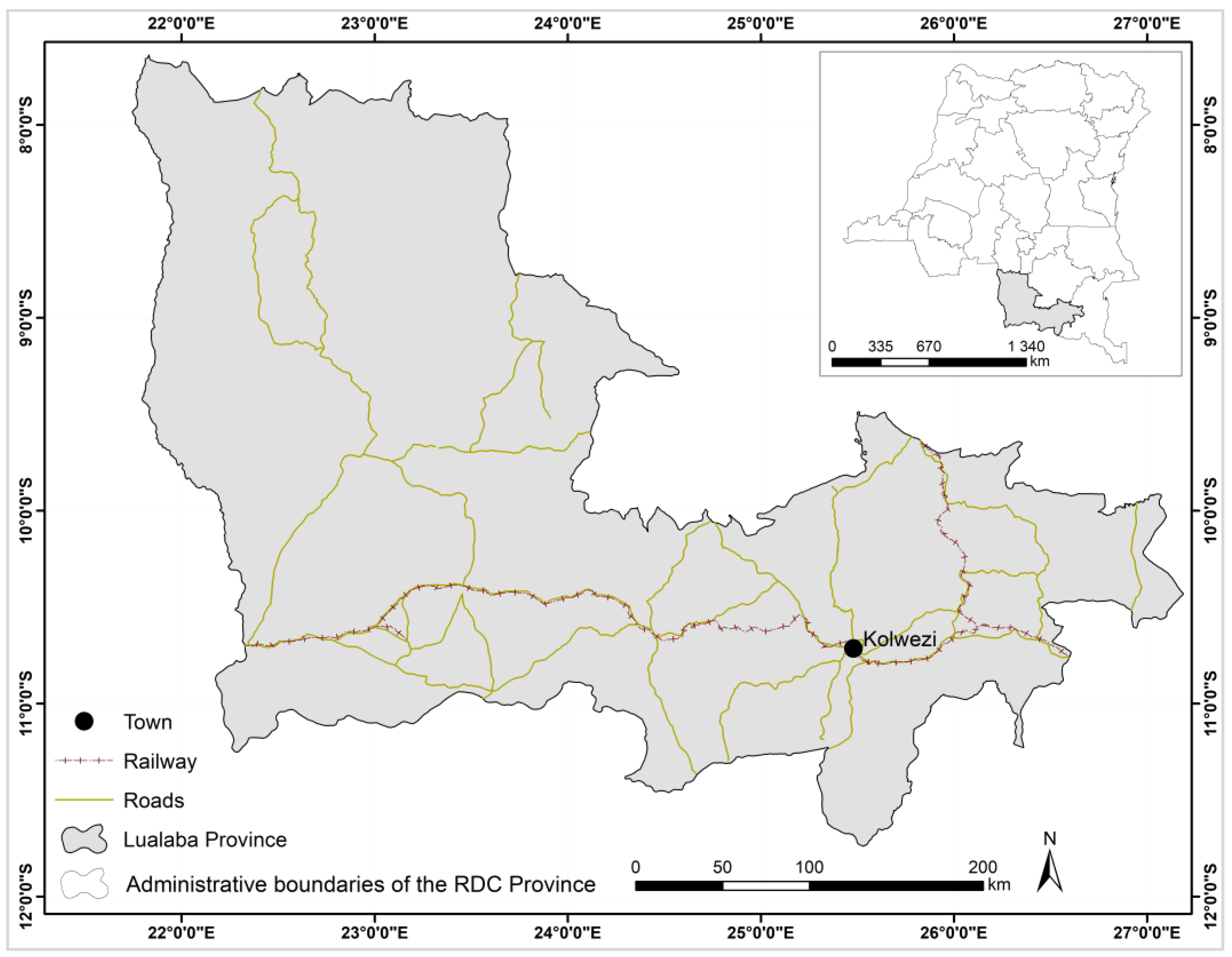
Figure 1. Location of the city of Kolwezi in Lualaba Province, southeastern Democratic Republic of Congo.
Conservation 06 00048 g001
Figure 2. Number of non-timber forest product (NTFP) species by biological category sold in the Kolwezi market, DRC.
Conservation 06 00048 g002
Figure 3. Use categories of non-timber forest products (NTFPs) sold in the markets of Kolwezi, DRC.
Conservation 06 00048 g003
Figure 4. Some non-timber forest products (NTFPs) sold in the markets of Kolwezi, DRC. (a), Stall selling NTFPs; (b), Leaves of Piper umbellatum L.; (c), Fruits of Uapaca kirkiana Müll.Arg.; (d), meat portion of Python sebae (Gmelin, 1789); (e), Roots of Rhynchosia insignis (Holfm) R.E.Fr.; (f), Fruits of Anisophyllea boehmii Engl.; (g), Resin of Canarium schweinfurthii Engl.; (h), Tubers of Satyrium buchananii Schltr.; (i), Seeds of C. schweinfurthii; (j), Macrotermes falciger (Gerstäcker, 1891); (k), Caterpillars of Lobobunaea Saturnus Fabricius, 1793; (l), Carapace of Pelusios nanus Laurent, 1956; (m), Shells of Burtoa nilotica (L.Pfeiffer, 1861); (n), meat portion of Sylvicapra grimmia (Linnaeus, 1758); (o), Bottles of A. mellifera subsp. adansoni honey. (Photo credits: Kikuni, J.T., 2025).
Conservation 06 00048 g004
Figure 5. Main supply areas of non-timber forest products (NTFPs) sold in the Kolwezi market, DRC. Black dots indicate the villages and towns reported by sellers as sources of the NTFPs commercialized in the Kolwezi market.
Conservation 06 00048 g005
Figure 6. General diagram of the marketing channels for non-timber forest products (NTFPs) in the Kolwezi region. Solid arrows indicate the most frequent trade pathways, while dashed arrows represent less frequent ones.
Conservation 06 00048 g006
Figure 7. (a) Perceived causes of declining NTFP availability and (b) sustainability perspectives according to users.
Conservation 06 00048 g007
Figure 8. Socio-demographic patterns in consumers’ perceptions of (a) causes of declining NTFP availability and (b) restoration measures in Kolwezi. Based on multiple correspondence analysis (MCA), the first two dimensions explain 22% and 23.8% of the inertia for causes and measures, respectively. USN, under-serviced neighbourhood; WSN, relatively well-serviced neighbourhood; F, female; M, male; Y, young (18–35 years); A, adult (36–60 years); O, old (61 years and older); NS, uneducated; PR, primary school; SEC, secondary school; UNI, university level; FARM, farmer; HW, homemaker; MIN, mining worker; PUBS, public servant; TDR, traditional healer; TEA, teacher; TRAD, trader; UNEMP, unemployed; DEFO, deforestation; MINA, mining activities; OVER, overexploitation of NTFPs; CLIM, climate change; SHIFTA, shifting cultivation; URBD, increase in demand for NTFPs; REFO, reforestation; DOM, domestication of NTFP source species; SUBSTAG, promotion of sustainable agriculture; REG, regulating NTFP exploitation.
Conservation 06 00048 g008
Table 1. Demographic characteristics and sample size of NTFP users in the different neighbourhoods covered by this study. *, Relatively well-serviced neighbourhoods.
NeighbourhoodsStreetTotal Number of HouseholdsSample SizeGender (%)
WomanMale
KasuloKimbangu35613065.434.6
Moïse Tshombe *Masengo1895768.431.6
MununkaLikasi42315857.642.4
Mutoshi *Masengo1273961.538.5
Total109538462.537.8
Table 2. Socio-demographic characteristics of NTFP sellers across different markets in the city of Kolwezi. n, Sample size. p, exact binomial test (for Gender) and chi-square test (for Age range and Education level); * indicates a statistically significant association between variables.
Profile of SellersMarketsAverage Percentage (%)p
Manika (n = 20)Kasulo (n= 15)
Gender (%)
Woman85.073.379.10.001 *
Male15.026.720.9
Age range (%)
Young (18–35 years)35.026.730.90.000 *
Adult (36–60 years)60.073.366.7
Old (>60 years)5.0-2.5
Education level (%)
Uneducated5.0-2.50.000 *
Primary school30.013.321.7
Secondary school55.066.760.9
University level10.020.015.0
Table 3. Market value, quantities sold, and commercial margins of the five most traded NTFPs on the Kolwezi market, DRC. Species are listed alphabetically by use NTFP categories, with their full names provided in Appendix A.1. (Table A1). NTFPs sourced from areas outside Lualaba Province were excluded from this table, and in cases of equal values, species were counted as a single entry. F indicates the frequency of citation; n, sample size; “-” indicates that the species was not reported by the seller. *, plant-based species; **, animal-based species; ***, fungal species. All liquid products were converted and expressed in kilograms (kg). Average weights of pestle = 1.81 kg; mortar = 9.2 kg; blender = 0.25 kg; handle = 0.78 kg. Exchange rate: 1 USD = 2500 CDF.
SpeciesMarkets (F %)Organ/Part or Object SoldSelling Price (USD/kg)Quantity Sold Per Month (kg)Monthly Gross Income (USD)
Manika (n = 20)Kasulo (n = 15)
Food use
A. boehmii * 40.033.3Fruit2.840.0 ± 2.1112.0 ± 5.8
A. fulica ** -13.3Snail4.49.1 ± 0.240.0 ± 0.8
A. senegalensis * -20.0Fruit1.019.0 ± 1.019.0 ± 1.0
C. afrocibarius *** 35.0-Cap + Stipe4.019.8 ± 0.579.2 ± 0.2
C. gambianus ** -13.3Whole animal22.27.0 ± 1.1155.4 ± 24.4
C. hottentotus ** -20.0Whole animal28.66.5 ± 1.5185.9 ± 42.9
E. benguelensis * -13.3Fruit4.07.0 ± 0.228.0 ± 0.8
E. lactea ** -20.0Caterpillar20.015.3 ± 0.5306.0 ± 10.0
I. epimethea ** -20.0Caterpillar18.010.5 ± 0.5189.0 ± 9.0
M. falciger ** -13.3Termite6.710.8 ± 0.273.4 ± 1.3
A. mellifera ** -33.3Bottle6.819.6 ± 0.9133.3 ± 6.12
P. aquilinum * -33.3Frond0.919.4 ± 0.217.5 ± 0.18
P. umbellatum * 50.053.3Leaf4.060.5 ± 0.4242.0 ± 1.6
P. porcus ** -13.3Meat portion21.14.7 ± 1.099.2 ± 21.1
P. sebae ** -13.3Meat portion57.42.3 ± 0.2132.0 ± 11.5
R. insignis * 25.020.0Root1.819.8 ± 0.935.64 ± 1.6
S. buchananii * 40.053.3Tuber8.015.6 ± 0.2124.8 ± 1.6
S. cocculoides * 40.053.3Fruit1.49.1 ± 0.612.7 ± 0.8
S. grimmia ** 30.0-Meat portion40.510.6 ± 1.1429.3 ± 44.55
T. microcarpus *** 35.033.3Cap + stipe5.716.8 ± 2.395.8 ± 13.1
U. kirkiana * -13.3Fruit1.050.8 ± 3.550.8 ± 3.5
Use in traditional medicine
A. adianthifolia * 60.073.3Bark or root10.46.5 ± 0.367.6 ± 3.1
A. antunesiana * 95.066.7Root3.086.4 ± 1.4259.2 ± 4.2
B. madagascariensis * 55.0-Root or bark5.056.8 ± 0.1284.0 ± 0.5
C. schweinfurthii * 50.046.7Resin4.036.3 ± 0.5145.2 ± 2.0
C. corbisieri * -40.0Root (powdered)16.02.5 ± 0.140.0 ± 1.6
D. condylocarpon * 50.0-Root4.021.9 ± 1.087.6 ± 4.0
P. curatellifolia * 50.053.3Root10.06.1 ± 1.361.0 ± 13.0
P. muellerianus * 50.040.0Root8.05.4 ± 0.643.2 ± 4.8
S. longipedunculata * 45.040.0Root12.012.9 ± 2.0154.8 ± 24.0
T. mollis * 85.053.3Root or bark10.025.4 ± 1.2254.0 ± 12.0
Z. chalybeum * -46.7Root10.06.4 ± 2.464.0 ± 24.0
Use in traditional rituals
B. nilotica ** 35.0-Shell32.72.8 ± 0.191.6 ± 3.3
C. schweinfurthii * 35.046.7Resin/Seed4.0/160.036.3 ± 0.5/0.8 ± 0.0145.2 ± 2.0/128.0 ± 0.3
P. nanus ** 30.013.3Carapace102.00.4 ± 0.040.8 ± 0.2
P. sebae ** 25.06.7Meat portion or Oil31.91.5 ± 0.147.9 ± 3.2
S. longipedunculata * 40.040.0Root12.012.9 ± 3.5154.8 ± 42.0
S. quinqueloba * 45.020.0Bark or root9.36.6 ± 1.061.4 ± 9.3
Handicraft use
A. adianthifolia * 35.033.3Pestle/Mortar1.7/0.9210.8 ± 0.3/110.4 ± 1.518.4 ± 0.5/101.6 ± 1.4
A. antunesiana * 45.040.0Pestle/Blender1.7/3.09.1 ± 0.5/3.5 ± 0.115.5 ± 0.9/10.5 ± 0.3
A. versicolor * 25.013.3Handle/Blender3.2/3.03.9 ± 0.2/3.0 ± 0.112.5 ± 0.6/9.0 ± 0.3
A. senegalensis * 5.020.0Handle3.26.2 ± 2.520.0 ± 8.0
B. madagascariensis * 40.026.7Handle/Mortar3.2/1.73.1 ± 1.6/25.0 ± 1.29.9 ± 5.1/42.5 ± 2.0
B. nilotica ** 5.0-Carapace32.72.8 ± 0.591.6 ± 16.4
Use in hut construction
A. adianthifolia * 5.020.0Stem1.031.5 ± 2.331.5 ± 2.3
B. boehmii * 25.033.3Stem1.023.3 ± 4.123.3 ± 4.1
B. spiciformis * 15.040.0Stem1.025.0 ± 1.625.0 ± 1.6
J. paniculata * 40.046.7Stem1.560.6 ± 3.890.9 ± 5.7
P. angolensis * 45.013.3Stem2.037.5 ± 0.875.0 ± 1.6
P. tintorius * 5.0-Stem2.026.1 ± 2.552.2 ± 5.0
Table 4. Sellers’ perception of constraints affecting the NTFP market in Kolwezi, DRC. F, indicates the frequency of citation; n, sample size.
ConstraintsMarkets (F%)Average Percentage (%)
Manika (n = 20)Kasulo (n = 15)
Remoteness from supply areas35.033.334.2
Seasonality25.026.725.8
Lack of processed by-products10.06.78.3
Scarcity10.06.78.3
Limited access to finance-13.36.7
Consumer preference for imported products10.0-5.0
Poor packaging of NTFPs by intermediary sellers-6.73.4
High taxation-6.73.4
Limited consumer knowledge of NTFP properties5.0-2.5
Short shelf life of NTFPs5.0-2.5
Table 5. Sellers’ suggestions for improving the NTFP trade in Kolwezi, DRC. F indicates the frequency of citation; n, sample size.
RecommendationsMarkets (F%)Average Percentage (%)
Manika (n = 20)Kasulo (n = 15)
Establish NTFP processing chains30.040.035.0
Promote the cultivation of NTFP source species35.026.630.8
Raise awareness among the population about the benefits of local NTFPs20.06.713.4
Rehabilitating rural access roads-20.010.0
Standardize NTFP sales units5.06.75.9
Reduce taxes10.0-5.0
Table 6. Association between perceptions and sellers’ suggestions for improvement measures of the NTFP trade in Kolwezi and the socio-demographic profile of respondents. The figures presented in this table are p-value from Fisher’s exact test. * indicates a statistically significant association between variables.
PerceptionGenderAge RangeEducation Level
Constraints
Remoteness from supply areas0.1150.1931.000
Seasonality0.027 *0.1300.019 *
Lack of processed by-products0.3920.004 *0.172
Scarcity0.019 *0.000 *0.018 *
Limited access to finance0.0640.019 *0.064
Consumer preference for imported products0.9640.1390.020 *
Poor packaging of NTFPs by intermediary sellers0.7430.0890.742
High taxation0.3980.6580.398
Limited consumer knowledge of NTFP properties0.7430.0890.743
Short shelf life of NTFPs0.0640.009 *0.063
Suggestions
Establish NTFP processing chains0.6890.5570.184
Promote the cultivation of NTFP source species0.2000.3980.089
Raise awareness among the population about the benefits of local NTFPs0.0790.0590.032 *
Rehabilitating rural access roads0.5621.0000.046 *
Standardize NTFP sales units1.0000.046 *0.089
Reduce taxes1.0000.0890.266
Table 7. The 10 most frequently used NTFPs by households in Kolwezi. Species are ranked in descending order based on their use values (UV). NTFPs sourced from outside Lualaba Province were excluded from this table, and in cases of equal values, species were counted as a single entry. “-” indicates that the species or use was not mentioned by the respondent; * plant-based species, ** animal-based species, *** fungi. UF, use frequency; n, sample size; Fo., food; Fb, fruit body; Med., medicinal, Ha., handcraft; Co., construction; Ri, Ritual; Ba, bark; Fl, flower; Fr, fruit; Le, leaf; Ro, root, St, Stem; Re, resin; Se, Seed; Cat, caterpillar; Me, meat.
SpeciesUses/Parts and Organs UsedUF (%), n = 384Average Quantity Purchased Per Month (kg)UVAvailability
Fo.Med.Ri.Ha.Co.
B. madagascariensis * -Ro, BaRo, BaStSt43.22.8 ± 0.22.4Frequent
C. schweinfurthii * FrReRe, Se--60.91.4 ± 0.12.3Infrequent
T. mollis * -Ro, Ba-StSt45.13.1 ± 0.02.2Frequent
G. ternifolia * -Ro-St-36.91.8 ± 0.12.2rare
A. antunesiana * -Ro, Ba-StSt76.64.3 ± 0.12.1Frequent
C. corbisieri * -RoRo--41.10.5 ± 0.02.0Infrequent
P. sebae ** MeOilOil--43.21.2 ± 0.22.0Infrequent
Z. chalybeum * -Ro-St-48.23.0 ± 0.12.0rare
S. cocculoides * FrRo---63.82.7 ± 0.01.2Infrequent
P. umbellatum * LeLe---72.43.6 ± 0.11.1Frequent
A. boehmii * FrRo--St57.02.5 ± 0.21.0Infrequent
S. latifolius * -Ro---53.10.6 ± 0.11.0Frequent
E. lactea ** Cat----33.31.9 ± 0.01.0Infrequent
D. reflexa * Fl----34.11.9 ± 0.11.0Frequent
U. kirkiana * FrRo---47.13.5 ± 0.41.0Infrequent
I. epimethea ** Cat----41.12.7 ± 0.01.0Frequent
C. afrocibarius *** Fb----45.14.0 ± 0.01.0Frequent
Disclaimer/Publisher’s Note: The statements, opinions and data contained in all publications are solely those of the individual author(s) and contributor(s) and not of MDPI and/or the editor(s). MDPI and/or the editor(s) disclaim responsibility for any injury to people or property resulting from any ideas, methods, instructions or products referred to in the content.