


Abstract
Benzo-(1,2,3)-thiadiazole-7-carbothioic acid S-methyl ester (BTH), a salicylic acid (SA) analogue, induces resistance to several tomato pests and pathogens, including the whitefly Bemisia tabaci. However, the transcriptional mechanisms underlying BTH-induced responses to the biotic stress due to infestation by this insect remain incompletely understood. Here, we first investigated whether BTH treatment alters the tomato transcriptome consistently with activation of SA-associated defence. Gene expression in BTH-treated and untreated plants of susceptible tomato cv. Moneymaker was analysed using the Affymetrix GeneChip Tomato Genome Array. BTH treatment resulted in 1280 differentially expressed transcripts, including 502 upregulated and 778 downregulated transcripts. This was associated with increased expression of defence-related genes, including WRKY transcription factors and pathogenesis-related proteins, together with repression of genes involved in jasmonic acid signalling and photosynthetic processes. Subsequent B. tabaci infestation only slightly modified these transcriptional changes, with most differential transcripts shared between infested and uninfested plants. Comparison of BTH-treated Moneymaker with resistant Motelle (carrying the Mi-1 gene) identified 1241 differentially expressed transcripts. Overall, the results support a model in which BTH establishes a distinct SA-associated transcriptional state that is relatively stable following B. tabaci attack, while differing substantially from the constitutive transcriptomic profile associated with Mi-1-mediated genetic resistance.
1. Introduction
Pest control in the current context of intensified agriculture and abandonment of traditional farming continues to be dominated by chemical methods, despite its disadvantages for human and environmental health. The adoption of integrated pest management (IPM) is urgently needed to contribute to sustainable, resilient, profitable and robust agricultural systems, and host plant resistance (HPR) is a fundamental element in IPM implementation.
Many cultivated plants display HPR in response to the biotic stress produced by potential attacks from pests or pathogens, with some of these interactions being regulated by a single resistance gene (R-gene) of the plant [1]. For example, the Mi-1 gene of tomato is responsible for genetic resistance to the whitefly Bemisia tabaci [2], and the same R-gene also provides resistance to root-knot nematodes (Meloidogyne spp.) [3], the potato aphid Macrosiphum euphorbiae [4] and the tomato psyllid Bactericera cockerelli [5].
In addition to genetic HPR, induced or acquired resistance [6] was considered a promising tool within IPM in the 1980s and 1990s, although because of the fitness costs involved, resistance inducers were rarely used in practice. However, there is a renewed interest in these products in the current agricultural context, where the elimination of pests and diseases is no longer pursued and sustainable management strategies are urgently needed [7,8].
Systemic acquired resistance (SAR) [9] is induced through the salicylic acid (SA)-mediated pathway beyond the zone of inoculation or application of the stressor organism. Benzo-(1,2,3)-thiadiazole-7-carbothioic acid S-methyl ester (BTH) is a SA analogue that activates SAR in plants [10,11,12], providing resistance mainly to plant diseases. BTH treatment of wheat and barley can induce broad-spectrum resistance to various diseases, including powdery mildew, leaf rust or Fusarium head blight [13]. BTH was also effective in controlling cumin damping-off and wilt disease caused by F. oxysporum f. sp. cumini [14]. Also, in forest systems, BTH induces resistance, as has been shown in the case of Pinus koraiensis resistance to pine wood nematode [15]. Induced resistance is also a tool against insect pests. For example, BTH enhances the suppression of Aphis gossypii on melon plants [16]. Additionally, BTH can also provide increased resistance to abiotic stress, as in the case of improved wound healing of potato tubers [17], or resistance to glyphosate damage in Conyza bonariensis [18], and BTH treatment makes plants more attractive to parasitoids [19].
Inducing resistance in tomatoes has proven to be an important tool for both disease and pest control. BTH treatment protected tomato plants against root rot (Fusarium oxysporum f. sp. radicis-lycopersici), cucumber mosaic virus or tomato mosaic virus [20,21,22]. BTH treatment resulted in a delay in Myzus persicae [23] and Macrosiphum euphorbiae [24,25] development.
In tomato, both induced and genetic resistance are tools available for B. tabaci control, which is challenging because this insect causes direct and indirect damage by virus transmission and frequently develops resistance to insecticides [26,27,28]. BTH application induced local resistance in tomato plants, reducing infestation levels and causing a delay in B. tabaci development [29]. Additionally, B. tabaci adults showed a preference for untreated plants compared to BTH-treated tomato plants [29]. Both types of host resistance (genetic and induced) are related in the case of tomato: BTH is a SA analogue, and SA is needed for Mi-mediated resistance to insects and nematodes [25,30,31]. Moreover, BTH application to VFNxNahG plants (which degrades SA to catechol) restored resistance to nematodes and aphids [25,30,32].
Understanding the molecular mechanisms underlying plant responses to biotic stress is essential for the development of sustainable strategies for pest management. Application of salicylic acid (SA) or its analogue BTH results in the activation of several resistance mechanisms. SA application in tomato induced a number of defence-related genes [33] and increased antioxidant enzyme activities [34]. Increased levels of WRKY TFs, thiamine and glutathione metabolism, accumulation of phytohormones and cell wall reorganization were also observed upon BTH application in tomato [35]. In other plant species, BTH also elicited profound responses, with decreased hydrogen peroxide, accumulation of phenolic compounds, and increased enzyme activities [18,36,37].
The molecular mechanisms of SAR response in Arabidopsis, rice, and Triticeae crops of wheat and barley have been reviewed [38]. Also, the induced resistance of postharvest fruits and vegetables through acibenzolar-S-methyl (ASM, equivalent to BTH) has been reviewed recently, summarizing the processes involved in five groups of mechanisms [39]. However, the mechanisms involved in BTH-induced resistance in tomato plants have not been completely studied. Thus, the aim of this work is to gain a deeper knowledge of the molecular mechanisms involved in tomato responses to this type of biotic stress by performing a transcriptomic analysis. This type of analysis has been recently performed in several studies involving tomato response to different abiotic factors [40,41], rendering useful information. Similarly, in tomato, a recent study by our group used the same methodology to address the analysis of the molecular mechanisms involved in susceptibility and Mi-1-mediated resistance to B. tabaci [42]. It is also aimed in the present study to compare the BTH-induced resistance with the genetic resistance provided in tomato by the Mi-1 gene.
2. Results
A complete file with the lists of differentially expressed genes that were obtained in each of the microarray analyses is included as Supplementary Table S1.
2.1. Effect of BTH Treatment on the Transcriptome of Moneymaker Tomato Plants
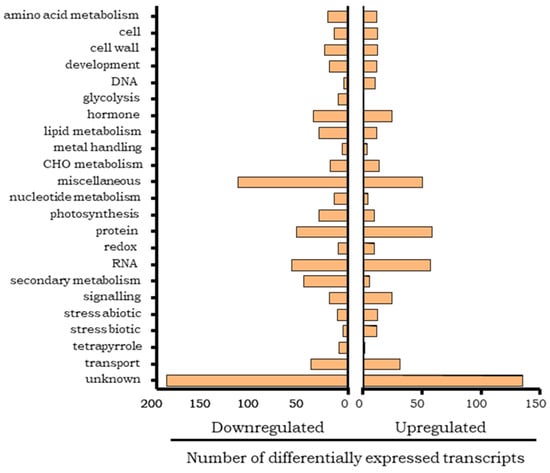
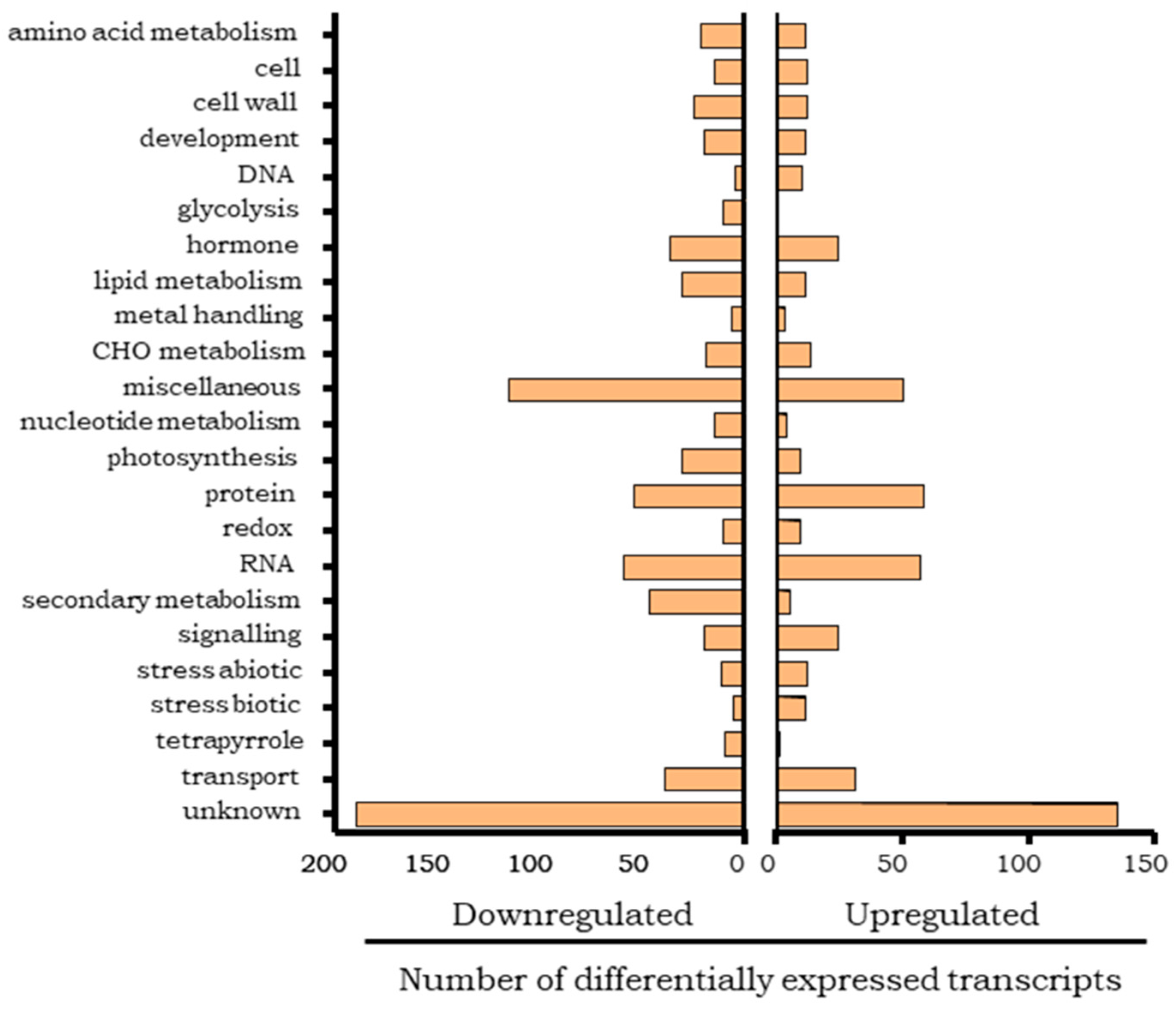
Comparison of transcriptomes from 8-week-old Moneymaker tomato plants treated and untreated with BTH showed 1280 differentially expressed transcripts, of which 502 were upregulated and 778 were downregulated in the BTH-treated plants. Figure 1 shows the functional classification of the differential transcripts obtained according to Mapman.
Figure 1.
Classification of the differential transcripts of the plants treated with BTH in comparison with the untreated plants, according to the biological processes in which they intervene, identified in Mapman.
Leaving aside the unknown and miscellaneous categories, a large number of differential transcripts corresponded to genes in the protein category. The upregulation of Avr9/Cf-9 protein-coding genes can be highlighted, one of them encoding an F-box protein. Other Avr9/cf-9 protein-coding genes were in the categories of signalling, miscellaneous and hormone metabolism, all of which were upregulated after BTH treatment. In addition, the genes encoding protease and proteinase inhibitors were generally downregulated. Protease and proteinase inhibitors were in other categories (signalling, photosynthesis, miscellaneous and not assigned to any category), generally downregulated too.
In the RNA category, differential expression of genes encoding transcription factors was observed. Very strong downregulation of several transcription factors of the MYB family occurred in the BTH-treated plants, while a few others in this same family were upregulated. Differential expression was also observed for the WRKY transcription factors family, although it was weaker than in the MYB case, and these transcripts were generally upregulated. Different types of zinc finger proteins were also differentially expressed, including B-box and Constans proteins. As in the RNA category, some zinc finger proteins were upregulated while others were downregulated; for example, Constans 1 was strongly downregulated (FC = −30.55). Expression of ethylene-responsive transcription factors followed this pattern as well, i.e., some were upregulated while others were downregulated. Ethylene-responsive transcription factors were also found in the hormone metabolism Mapman category, subcategory ethylene signal transduction, with some transcripts upregulated and others downregulated.
The abiotic stress category grouped the same number of overexpressed and downregulated transcripts, although a significant group of the overexpressed ones corresponded to genes encoding bifunctional nucleases, proteins related to the response to wounding, while the downregulated genes mostly encoded chaperones.
Within the hormonal metabolism category, a similar number of transcripts were overexpressed and downregulated, except in the case of brassinosteroid metabolism, where most transcripts were downregulated. In addition to the genes represented by these transcripts, this category includes other genes involved in the ABA, auxin, ethylene, gibberellin, jasmonic acid, and salicylic acid signalling pathways. Thus, the results show the interaction between these different pathways.
A greater number of overexpressed than downregulated transcripts were grouped into the signalling category, in which calmodulin and calmodulin-binding proteins, as well as an exordium-like protein, should be highlighted. It is also worth mentioning the overexpression of a Nudix hydrolase 1 (G-protein) and an early flowering protein.
In the biotic stress category, BTH application caused differential expression of several PRs. Upregulation of PR5 and PR1 was detected, while another PR1 protein was downregulated. Also, in this biotic stress category, the Ve gene (Verticillium wilt disease resistance gene) was upregulated, while a NADPH oxidase gene was repressed after BTH treatment.
The rest of the categories had in general a greater number of downregulated transcripts than overexpressed ones, but in the cell organization category, several F-box proteins were upregulated. In the cell wall category, the downregulation of genes encoding expansin, the enzyme cellulose synthase and various XTHs (Xyloglucan xyloglucosyl transferases and xyloglucan endotransglucosylase/hydrolases) stands out. Expression of a polygalacturonase inhibiting protein was also decreased. Within the photosynthesis category, the downregulation (FC = −180.57) of the gene encoding Rubisco activase was particularly remarkable. Downregulated transcripts related to secondary metabolism included one identified with a gene encoding the ELI3 protein (Cinnamyl alcohol dehydrogenase) and those encoding several enzymes related to flavonoid metabolism, such as chalcone synthase.
2.2. Effect of B. tabaci Infestation on the Transcriptional Reprogramming Caused by BTH in Moneymaker Tomato
The comparison between BTH-treated and untreated Moneymaker plants, all of which were subsequently infested with B. tabaci, rendered 1179 differentially expressed transcripts, of which 561 were upregulated and 618 downregulated in response to BTH treatment. The expression of the upregulated transcripts ranged from 2- to 41-fold higher in plants treated with BTH and subsequently infested than in plants that were only whitefly-infested but never treated with BTH. The downregulated transcripts had a wider range of expression: the expression of the downregulated transcripts ranged from 2- to 138-fold lower in plants treated with BTH and infested than in the untreated and infested plants.
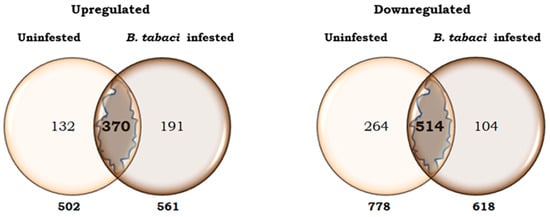
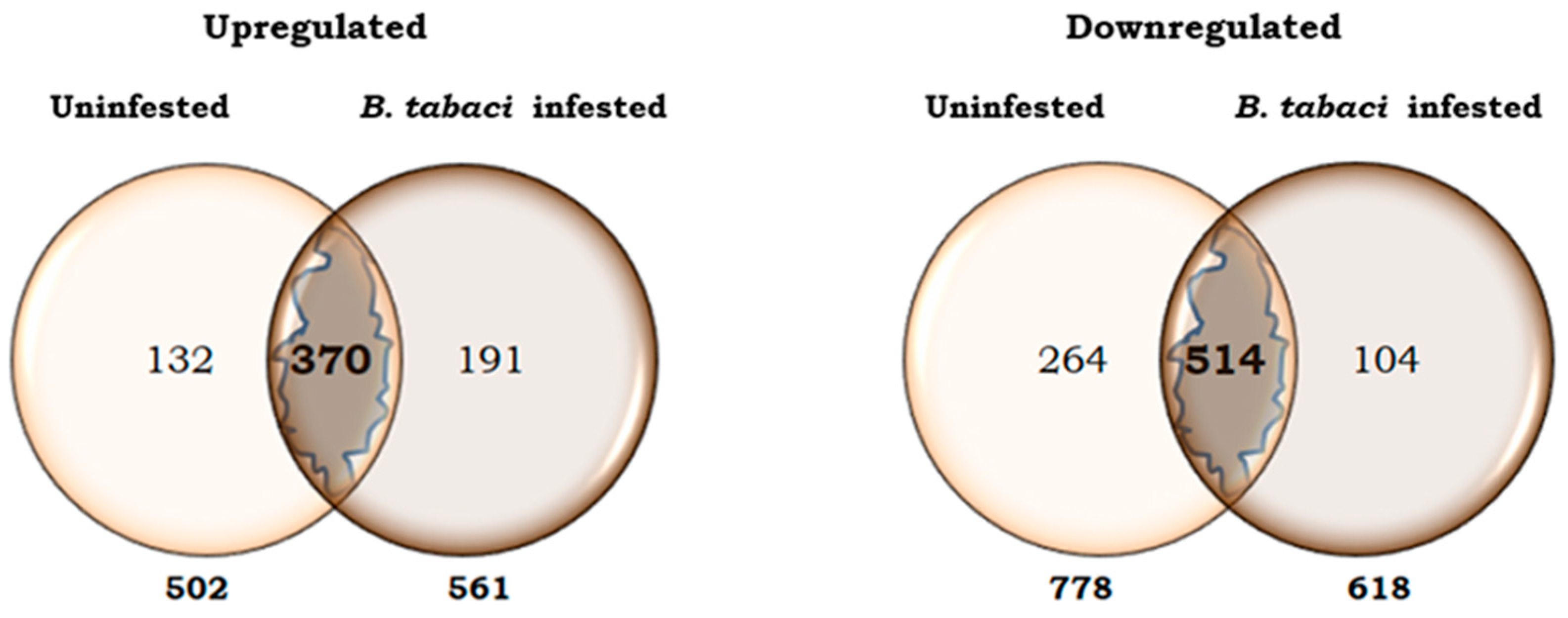
When these results were compared with those previously obtained in the absence of infestation, this was represented by Venn diagrams (Figure 2) with the results obtained from the first (uninfested plants) and the second analysis (in the presence of B. tabaci infestation), separating the differential transcripts common to both analyses and the specific ones for each of the two cases.
Figure 2.
Venn diagram showing the number of transcripts with differential expression between BTH-treated and untreated Moneymaker plants, in the absence of infestation (Uninfested) or in the presence of infestation (B. tabaci infested). Upregulated represent transcripts more expressed in BTH-treated than in untreated Moneymaker plants. Downregulated represent transcripts less expressed in BTH-treated than in untreated plants. Transcripts included have statistically significant values (FDR < 0.05) and Relative Expression ≥ 2 (upregulated) and ≤−2 (downregulated).
Most of the differential transcripts detected in the analysis carried out with all plants infested by B. tabaci (67% of the up- and 83% of the downregulated in the BTH-treated plants) were the same ones that had changed their expression due to the effect of BTH treatment in the absence of infestation. Thus, infestation with B. tabaci slightly altered the transcriptional reprogramming caused by BTH treatment in the uninfested plants.
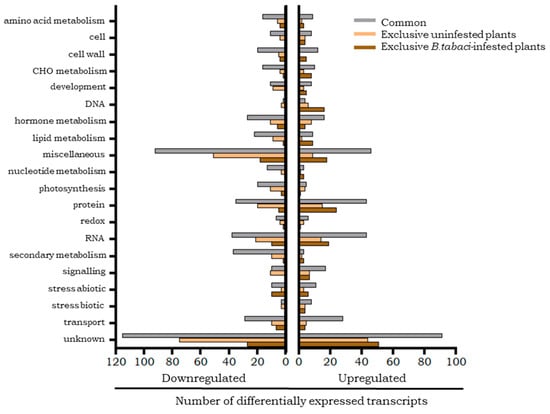
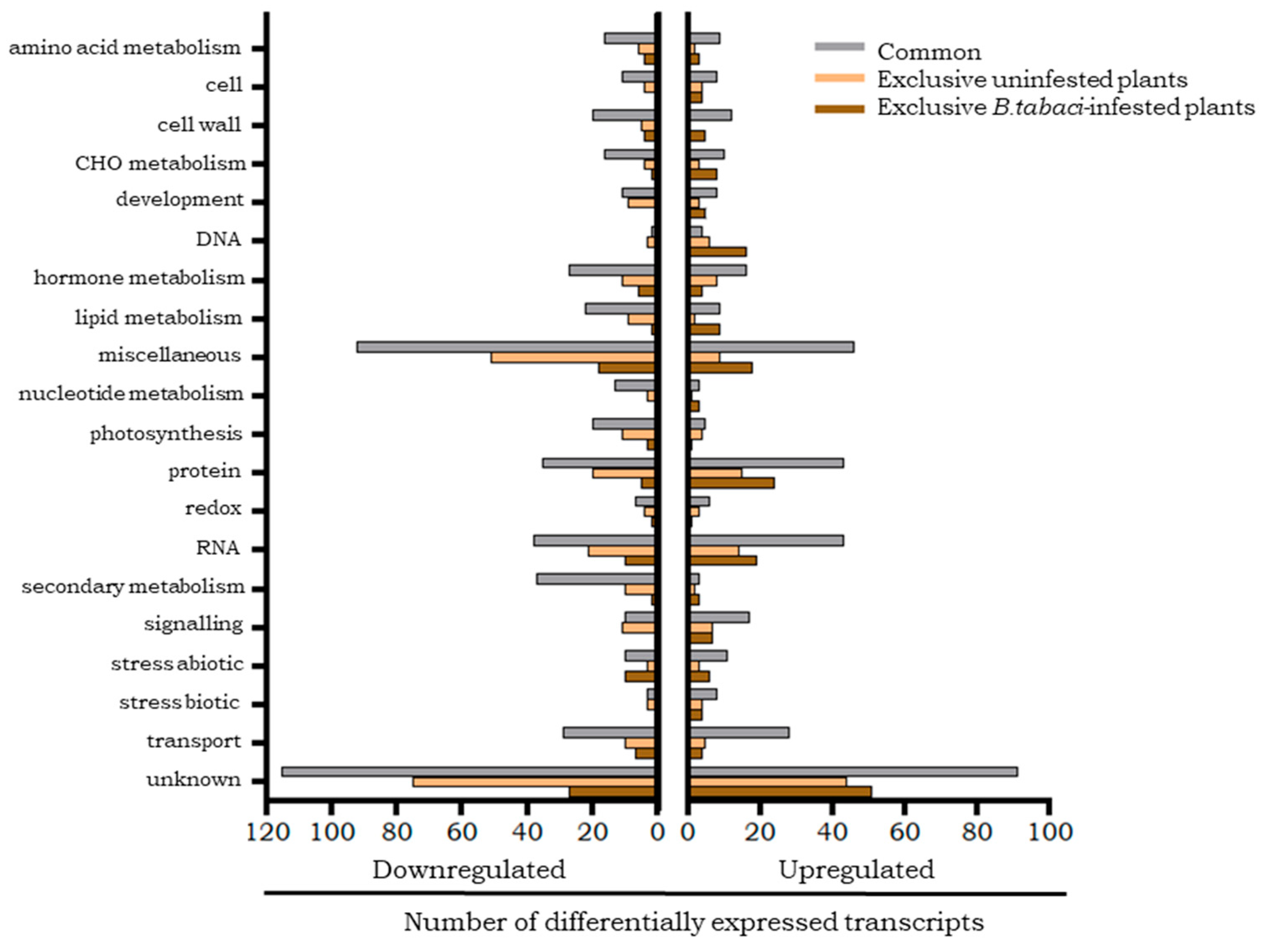
Figure 3 shows the classification of the differential transcripts specific to each of the two analyses, as well as the common ones, grouped according to the biological processes in which the related genes are involved.
Figure 3.
Functional classification by Mapman of the differential transcripts unique to the effect of BTH on uninfested plants (light brown), unique to the effect of BTH analysed in the presence of infestation by B. tabaci (dark brown) and those common to both cases (grey), according to the biological processes in which they intervene.
As in previous comparisons, Mapman analysis grouped most of the differential transcripts (common and exclusive) in the unknown and miscellaneous categories.
Among the transcripts common to both the first (uninfested plants) and the second (whitefly-infested plants) analyses, it was observed that the categories with the highest number of upregulated transcripts were the protein category (particularly the cysteine protease enzyme, which appears to be involved in defence processes) and the RNA category, which included overexpressed transcription factors from the WRKY family and the CONSTANS interacting protein 2a (CIP2a), with transcripts up- and downregulated. In the signalling category, calmodulins were mostly overexpressed, and the phi-1 protein was also overexpressed. Finally, the biotic stress category mostly grouped upregulated transcripts, including the Verticillium wilt disease resistance (Ve) gene.
On the other hand, the categories that grouped the largest number of downregulated common transcripts were RNA, secondary metabolism, proteins, hormonal metabolism, lipid metabolism, cell wall, and photosynthesis. The elicitor-activated gene 3 (ELI3) and the chalcone synthase enzyme stand out in the secondary metabolism category, while genes involved in different signalling pathways, including the salicylic acid pathway, stand out in the hormonal metabolism category. The omega-3 desaturase enzyme (FAD3) in lipid metabolism, several xyloglucan endotransglucosylases-hydrolases (XTHs), and cellulose synthase in the cell wall category, as well as the Rubisco activase gene in the photosynthesis category, with strong downregulation, are also prominent.
Other transcripts related to small chaperones were found (up- and downregulated) in the abiotic stress category, and the biotic stress category included the whitefly-induced gene gp91-phox (NADPH oxidase). Finally, it is worth highlighting the downregulation of CONSTANS proteins, included in the RNA category, and the protease inhibitor (Pin1), included in the protein category.
The transcripts overexpressed in plants treated with BTH, but exclusively in the presence of infestation by B. tabaci, corresponded to genes found mainly in the DNA category, which grouped several histones; the protein category, which included a MAPKK; the RNA category, with several transcription factors; and the biotic stress category, which included several PRs and the Wfi (whitefly-induced) gene. In contrast, the transcripts downregulated by BTH treatment, but exclusive to infested plants, were mainly grouped in the hormone metabolism category, mostly in the ethylene signalling pathway, and in the abiotic stress category, including several chaperones and a wound-induced protein (win).
2.3. Comparison Between BTH-Induced and Mi-1-Mediated Genetic Resistance in Tomato
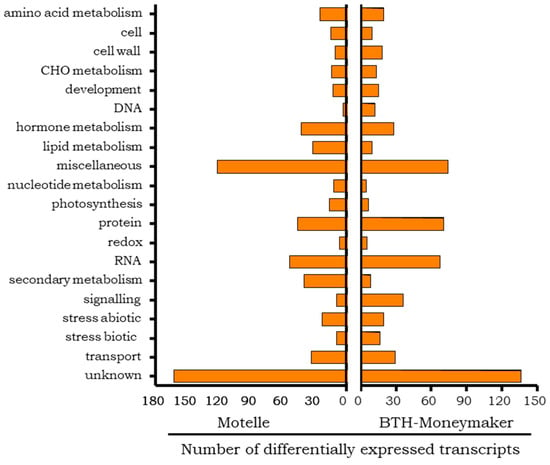
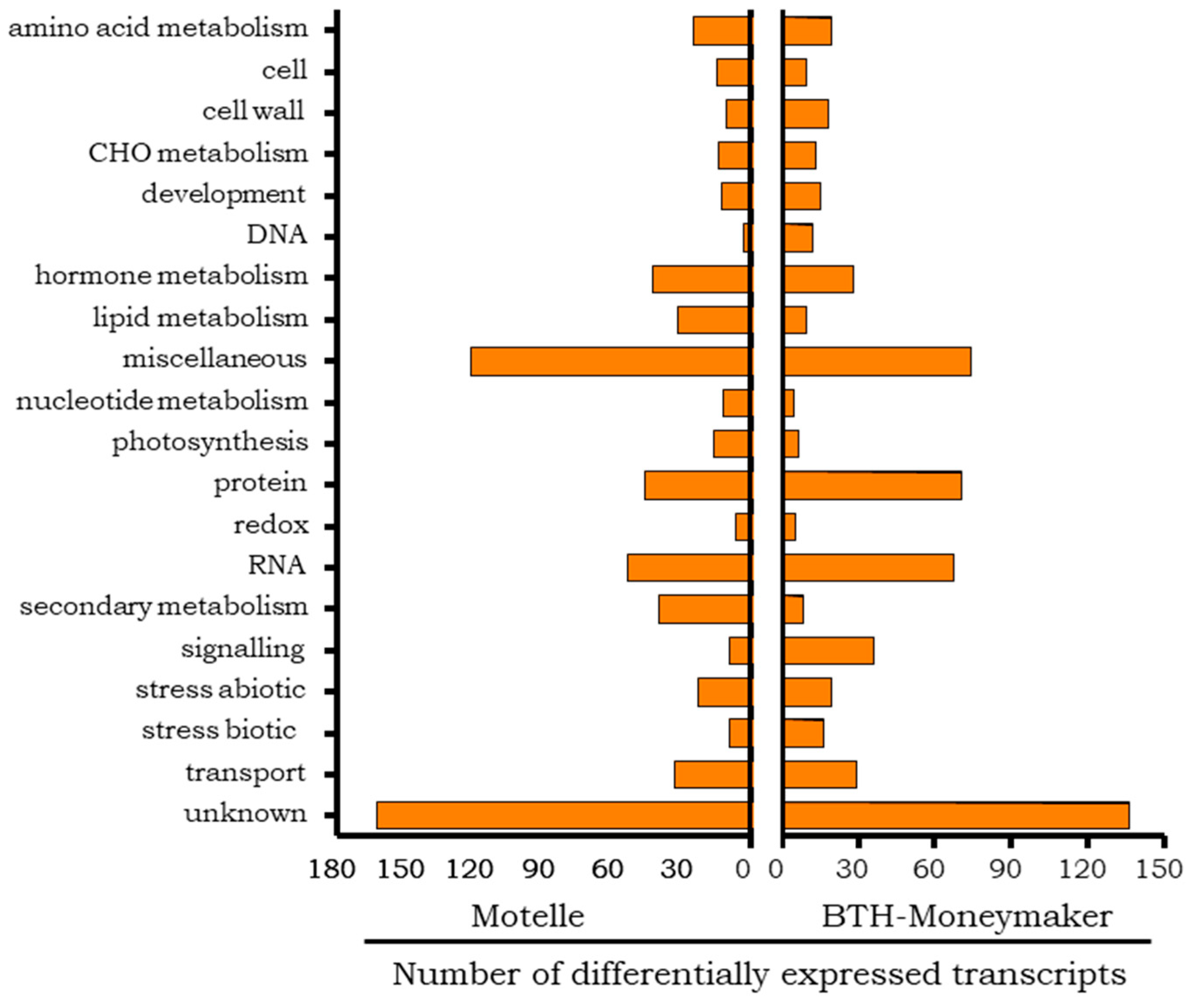
To compare induced resistance with Mi-1-mediated resistance, BTH-treated Moneymaker plants were compared with untreated Motelle plants, all in the absence of infestation. A total of 1241 transcripts were differentially expressed at least twofold (≥2 or ≤−2) and with an FDR < 0.05. Of them, 572 transcripts were significantly more expressed in BTH-treated Moneymaker than in Motelle, and 669 transcripts showed the opposite result. The transcripts showing differential expression were classified according to the Mapman functional categories (Figure 4).
Figure 4.
Classification of the differential transcripts of the Moneymaker plants treated with BTH in comparison with the untreated Motelle plants, according to the biological processes in which they intervene, identified in Mapman.
Apart from the unknown and miscellaneous categories, the categories with the highest representation of differential transcripts were protein, RNA, cell wall, signalling and biotic stress. In the protein category, the highest expression of some F-box proteins in BTH-treated Moneymaker can be highlighted, although some other F-box proteins were downregulated. The RNA category included transcription factors of the WRKY family, which had mostly higher expression in the BTH-treated plants, and the MYB family, which showed mostly the opposite result. In the cell wall category, several XTH enzymes, expansins and one polygalacturonase were also more expressed in BTH-treated plants, as well as genes in the signalling category encoding the calmodulin protein, MAP kinases and an exordium-like protein. Finally, in the biotic stress category, several PRs and the Wfi (whitefly-induced gp91-phox) and Ve (Verticillium resistance) genes were more expressed in the BTH-treated plants than in Motelle plants.
Most of the transcripts with lower expression in Moneymaker treated with BTH than in Motelle plants corresponded to genes grouped into the hormone metabolism category, which included genes involved in different signalling pathways, although it is worth noting the higher expression of the DELLA protein GAI. The lipid metabolism category also grouped a greater number of genes with higher expression in Motelle plants, among which the presence of the fatty acid desaturases FAD3 and FAD6 stood out. Some transcripts with lower expression in BTH-treated plants than in Motelle plants were also related to genes classified in the photosynthesis category, including the gene encoding Rubisco activase, and in the category of secondary metabolism, in which the ELI3 (Cinnamyl alcohol dehydrogenase) protein was found.
3. Discussion
The present study is based on a well-established transcriptomic experimental design using Affymetrix microarray technology, which provides robust and highly reproducible data for global gene expression analysis. As with all transcriptomic approaches, the data reflect steady-state mRNA levels and therefore represent a snapshot of transcriptional activity rather than direct functional outputs.
3.1. Effect of BTH Treatment on the Transcriptome of Moneymaker Tomato Plants
In the present work, treatment of Moneymaker tomato plants (lacking the Mi-1 gene) with a SA analogue (BTH) caused extensive transcriptional reprogramming in these plants. It was previously demonstrated by our group that BTH induced local acquired resistance to Bemisia tabaci (Hemiptera:Aleyrodidae) in susceptible Moneymaker plants, with a decrease in infestation levels and a delay in the development of this whitefly, which also showed a preference for the untreated plants [29]. It is well known that BTH is a SA analogue that activates systemic acquired resistance (SAR) [9] to pathogenic organisms and pests in a number of plant species [10,11,12]. SAR is induced through the SA-mediated pathway beyond the zone of inoculation or application of the inducing agent. In wheat and barley, BTH treatment can induce broad-spectrum resistance to various diseases [13,38]. The application of BTH confers resistance to certain plant-pathogenic fungi in tobacco and tomato [43], as well as in solanaceous crops such as potatoes [44]. SA is necessary for tomato resistance to aphids and nematodes [25,30,32], while the application of BTH in susceptible tomatoes caused a delay in the development of the aphids Myzus persicae [23] and Macrosiphum euphorbiae [24,25]. The marked reprogramming caused by BTH treatment in the tomato transcriptome is probably responsible for these induced or acquired resistance responses to attack by the aforementioned pests or pathogens.
In certain plant species, the overexpression/repression of genes produced by BTH commonly involves genes such as PR genes, the SA receptor protein NPR1, or WRKY TFs, which are considered markers of SAR and referred to as BTH-induced resistance (BIR) [38]. Aside from these expression markers in response to BTH treatment, transcriptional regulation can be more or less specific. Although, to our knowledge, it has not been reported in other cases of BTH treatment, several Avr9/Cf-9 rapidly elicited genes related to tomato resistance to the fungal pathogen Cladosporium fulvum [45] were overexpressed in BTH-treated tomato in the present work. On the other hand, one of the most important groups of transcripts upregulated in BTH-treated Moneymaker was WRKY TFs, in the RNA category. WRKYs play an important role in transcriptional reprogramming associated with the plant response to stress [46] and are commonly overexpressed after BTH treatment in different plant species, such as cabbage [47], rice [48], and banana [49], and also in other tomato cultivars [22]. We have also found upregulation of transcription factors related to stress signalling, including MYB and WRKY TFs, in the incompatible interaction between Bemisia tabaci and tomato plants containing the Mi-1 resistance gene [42]. Although the results of this study do not allow us to establish with certainty the specific role of these transcription factors in BTH-induced resistance, they lay the foundations for a future research line using additional functional validation methods to verify the causal involvement of WRKY genes in resistance. So, Virus-Induced Gene Silencing (VIGS) of key WRKY genes, followed by BTH treatment and subsequent infestation by B. tabaci, will make it possible to determine whether these TFs are necessary for the expression of the resistant phenotype.
BTH treatment also induced the expression of CIP2a, a CONSTANS-interacting protein involved in transcriptional regulation, as well as signalling-related proteins such as calmodulin, calmodulin-binding proteins, and phi-1. CONSTANS-like proteins have been associated with flowering and abiotic stress responses in tomato and other plant species [50,51], while phi-1 has been reported to respond to salt stress and to be upregulated during the early phase of the incompatible tomato–B. tabaci interaction [42,52]. As expected, treatment of Moneymaker tomato plants with BTH also caused the overexpression of genes encoding SA-associated PR proteins. PR genes, such as those encoding chitinase, thaumatin, glucanase, thionin and defensin, play a vital role in SAR, interacting with various components of hormonal signalling pathways, including receptors (e.g., NPR1 in SA signalling), transcription factors, and cis-regulating elements, to modulate plant defence responses in Arabidopsis [50]. Overexpression of PR genes has been reported after BTH or Acibenzolar-S-methyl (ASM) treatment in plants such as cabbage, Arabidopsis, rice, wheat, barley, banana, apple and pear [38,47,49,51,52]. In tomato, upregulation in the expression of PR genes, mostly beta-1,3-glucanase genes (PR-2), chitinase genes (PR-3), PR-4, and PR-5, has been recently reported [35]. Induction of SA-associated defences has been observed in plant-pathogen/insect interactions, as reviewed [53]. For example, through the overexpression of the PR-2 protein during the compatible and incompatible tomato-aphid [54] and tomato-B.tabaci interactions [42].
On the other hand, treatment of Moneymaker plants with BTH caused the downregulation of genes linked to wound stress, such as protease and proteinase inhibitors, associated with JA. Decreased expression of protease inhibitor II was observed in pepper after BTH treatment or whitefly infestation [55]. A similar effect was observed in tomato plants treated with BTH [56], which indicates a repression of JA-dependent defences and an antagonistic relationship between the SA and JA pathways. The results of the present study also support and confirm the existence of this antagonistic crosstalk between SA and JA, a phenomenon widely described in plant defence signalling. While activation of the SA pathway by means of BTH treatment may induce resistance to phloem-feeding insects such as B. tabaci [29], it could potentially compromise defence against other pests or pathogens that rely on JA-mediated responses, such as chewing insects or necrotrophic pathogens [57,58]. Therefore, the agronomic use of BTH should consider these potential trade-offs in multi-stress environments. Moreover, BTH treatment of Moneymaker plants also provoked an antagonistic relationship between SA and auxins, repressing some auxin-regulated genes, a fact previously reported [59].
It is noteworthy that treatment of Moneymaker tomato plants with BTH induced an increase in the expression of the Verticillium wilt disease resistance gene (Ve gene), included in the biotic stress category. The expression of this gene increases when SA-regulated defence responses are activated by Verticillium [60], and overexpression has also been reported in Motelle tomato during the incompatible interaction with B. tabaci mediated by the Mi-1 gene [42].
Among the genes downregulated after BTH treatment was the gene encoding the protein ELI3, a type of Cinnamyl alcohol dehydrogenase (CAD) protein [61], associated with the phenylpropanoid pathway. ELI3 was also downregulated in the incompatible tomato-B. tabaci interaction [42], although ELI3 levels increased in both the compatible and incompatible nematode-tomato interactions [32]. CAD activity also increased in potato (Solanum tuberosum L.) after BTH treatment, as part of the elevation of phenylpropanoid metabolism [62]. This shows a singularity in the expression pattern of this CAD gene and a common tomato response after B. tabaci and BTH exposure. On the other hand, this downregulation of ELI3 seems to contradict the overexpression of MYB transcription factors (TFs) found after BTH treatment of Moneymaker tomato, because overexpression of MYB TFs is often accompanied by stress-induced accumulation of phenylpropanoids such as flavonoids, anthocyanins, and lignin [63]. This apparent contradiction is furthered by the fact that lignin plays an important role in BTH-induced resistance, for example, the resistance of cabbage to pathogenic bacteria [47]. But it must also be taken into account that one of the biological processes that included a greater number of genes downregulated by BTH treatment of susceptible tomato was that related to the cell wall (several XTH enzymes, a pectate lyase, a PGIP, an expansin, and a cellulose synthase). It is possible that mechanisms activated by BTH treatment are sufficient as a defence against subsequent infestation, without requiring a CAD increase. This possibility is supported by the observed upregulation of genes in the cell wall category, such as leucine-rich repeat family protein genes, which has also been observed in cabbage after BTH treatment [47].
Most of the tomato genes involved in photosynthetic processes were downregulated after BTH treatment. Among them, the gene encoding the Rubisco activase enzyme stands out, with a 180.57-fold lower expression than in the untreated plants. This strong transcriptional repression suggests a potential reduction in photosynthetic capacity, which is consistent with the well-described trade-off between growth and defence in plants. Previous studies have shown that activation of defence pathways, particularly SA-mediated responses, can lead to a reallocation of resources from photosynthesis to defence-related processes. Downregulation of genes involved in photosynthetic processes had previously been observed in Nicotiana attenuata when attacked by several insects and when it was treated with several elicitors such as SA, JA, and BTH [64]. BTH treatment has been reported to downregulate Rubisco in different plant species, including Nicotiana attenuata and Triticum aestivum [64,65]. In our study, the downregulation of the gene encoding Rubisco activase and other photosynthesis-related genes suggests a potential physiological cost, although photosynthetic rate and biomass were not directly measured. Future studies, including gas exchange measurements or biomass accumulation, would be necessary to quantify this effect and evaluate the energetic cost of BTH-induced resistance.
Taken as a whole, the transcriptional changes observed following foliar treatment with BTH may help explain previously reported biological effects of this functional analogue of SA on Bemisia tabaci [29], including reduced oviposition and delayed development. In particular, the modulation of secondary metabolism, cell wall-related genes, and defence-associated proteins such as PRs may alter leaf quality, palatability, or defensive compounds, thereby affecting insect performance and behaviour. Although these effects were not directly measured in the present work, the transcriptomic data provide a molecular basis that could underlie the biological responses previously observed.
3.2. Effect of B. tabaci Infestation on the Transcriptional Reprogramming Caused by BTH in Moneymaker
As seen in the previous section, exogenous application of BTH caused significant transcriptional reprogramming in susceptible tomato plants of the Moneymaker cultivar. After infestation of all plants with B. tabaci, 66% of the genes overexpressed in BTH-treated plants and 83% of those downregulated were the same genes that already differentiated treated from untreated plants in the absence of infestation. Therefore, it appears that infestation by B. tabaci only slightly alters the differences between BTH-treated and untreated plants compared with the massive transcriptomic changes caused by BTH prior to the insect infestation. Both in the absence and in the presence of infestation, BTH-treated plants overexpressed WRKY TFs, calmodulins, the CONSTANS interacting protein 2a (CIP2a), the phi-1 protein and the Ve1 gene, discussed under the previous heading. Among the genes downregulated by BTH, common to plants with and without B. tabaci infestation, the ELI3 protein, small chaperones, and some CONSTANS proteins, already discussed, are relevant. In addition, genes related to the JA pathway, such as Pin1 and FAD3, were also downregulated. In general, it appears that after BTH treatment, Moneymaker plants undergo an initial overexpression of genes related to the SA pathway and the repression of genes associated with the JA pathway, previously demonstrated in other studies [56], and this is not significantly altered by subsequent infestation with B. tabaci.
The most important alteration caused by B. tabaci infestation on the effect of BTH is the overexpression of the whitefly-induced gp91-phox, included in the biotic stress category, which did not occur in plants treated with BTH but not infested. Also, this gene was not overexpressed either in the compatible or the incompatible interaction tomato-B. tabaci [42]. It is possible that the expression of this gene requires significant activation of SA-dependent defences for subsequent B. tabaci activity to be detected. Other genes overexpressed in plants treated with BTH only in the presence of B. tabaci infestation were those encoding several histones in the DNA category. No relationship between histone expression and BTH has been reported, but BTH treatment induced histone modification in the cucumber mosaic virus—Arabidopsis thaliana system [66].
Overall, the biotic stress due to a subsequent B. tabaci infestation only modestly modified the transcriptional state established by BTH treatment in the susceptible tomato. Most of the differentially expressed transcripts identified in the presence of infestation had already been altered in BTH-treated plants in the absence of insect exposure, supporting the hypothesis that BTH establishes a relatively stable stress-associated transcriptional state. The additional induction of the whitefly-induced gp91-phox gene and other infestation-specific transcripts indicates that BTH does not completely prevent subsequent stress-responsive transcription, but rather modifies the molecular context in which the plant responds to insect attack.
3.3. Comparison Between BTH-Induced and Mi-1-Mediated Genetic Resistance in Tomato
The fact that BTH treatment induces local resistance to Bemisia tabaci (Hemiptera:Aleyrodidae) in Moneymaker tomato plants [29] sparked our curiosity to find out what similarities or differences at the transcriptomic level could be found between these two types of resistance (induced and genetic) in tomato. For this purpose, it is important to be reminded that susceptible Moneymaker and resistant Motelle are quasi-isogenic plants [67] as they differ only in a small fragment of chromosome 6, which includes the Mi-1 gene in Motelle. We previously demonstrated that basal differences exist in the transcriptomic profiles of these two tomato cultivars in the absence of any treatment or infestation [68]. Therefore, it is important to bear in mind that the results obtained in this analysis may partially reflect both the effect of BTH treatment and basal differences between genotypes. Nevertheless, it was interesting to note the large number of genes differentially expressed between Motelle and BTH-treated Moneymaker plants, which suggests notable baseline differences between genetic and induced resistance.
The most notable result was related to the whitefly-induced gp91-phox gene, whose expression was 7-fold greater in Moneymaker plants treated with BTH than in Motelle plants. A previous comparison of untreated Moneymaker and Motelle plants (both uninfested) revealed no differential expression of this gene [69]. Also, no differential expression was found either in compatible (Moneymaker) and incompatible (Motelle) tomato-B. tabaci interactions [42].
The expression of the Ve gene was higher in Moneymaker plants treated with BTH than in Motelle plants. As discussed above, this gene was also more expressed in Moneymaker plants treated with BTH compared to untreated Moneymaker plants. This gene is also upregulated in the incompatible Motelle-B.tabaci interaction [42]. Similarly, a higher expression in BTH-treated Moneymaker plants than in Motelle plants was observed in this work for other genes related to defence processes, including those encoding WRKY transcription factors, MAPKs, calmodulin, CONSTANS protein, phi protein, the PAL enzyme, and SA-associated PR proteins. On the other hand, certain genes related to photosynthetic processes showed lower expression in Moneymaker plants treated with BTH than in untreated Motelle plants, and these genes also showed a reduction in expression due to the effect of BTH in the previous comparison of BTH-treated and untreated Moneymaker plants. Treatment with this SA analogue also causes the repression of photosynthetic genes in other plants [64,65], which indicates that resource allocation to defence decreases photosynthetic processes.
The DELLA GAI protein was more highly expressed in BTH-treated Moneymaker plants than in Motelle plants, consistent with the higher basal expression previously observed in Moneymaker than in Motelle [68] and with other reports of GAI upregulation during the incompatible tomato-B. tabaci interaction [42]. Given the role of DELLAs in regulating SA signalling and balancing defence and growth [70], as well as the importance of SA in the Mi-1-mediated resistance to B. tabaci [31], this differential expression may be related to the distinct defence states of BTH-treated and Mi-1-mediated resistant plants. However, the available evidence does not allow a specific role of GAI in SA regulation to be established [71].
In contrast, certain JA-associated genes, such as protease inhibitors and the gene encoding the FAD3 enzyme, were less expressed in Moneymaker plants treated with BTH than in Motelle plants. As previously discussed, the effect of BTH treatment on Moneymaker plants (lacking the Mi-1 gene) resulted in repression of JA-associated genes and overexpression of SA-associated genes.
The expression level of the ELI3 protein was lower in BTH-treated Moneymaker plants than in Motelle plants. As discussed above, this gene was downregulated in Moneymaker plants by BTH treatment. The expression of ELI3 is lower in Motelle than in Moneymaker tomato, but only in the presence of B. tabaci infestation [69], and it is downregulated exclusively in the incompatible interaction (Motelle-B. tabaci) and not in the compatible (Moneymaker-B.tabaci) [42].
3.4. General Remarks
Based on the results obtained, a putative model of BTH-induced resistance in tomato can be proposed. BTH treatment activates SA-dependent signalling pathways, leading to the induction of WRKY transcription factors and PR proteins, together with changes in signalling components such as calmodulins and MAP kinases. Simultaneously, the JA-dependent pathway and photosynthetic processes are repressed, suggesting a redirection of resources towards defence.
These molecular changes result in a primed physiological state that is only slightly modified upon B. tabaci infestation, contributing to enhanced resistance, with this induced resistance showing a basal transcriptomic pattern a priori different from that of genetic resistance mediated by the Mi-1 gene. This model provides a framework for future functional studies aimed at validating the role of specific genes and pathways.
The observed transcriptional patterns are strongly consistent with previously reported BTH- and SA-associated responses to biotic stress in tomato and other plant species, which supports the biological relevance of these findings. In addition, the study focuses on early transcriptional responses under controlled conditions, which allows for the identification of primary regulatory networks with high resolution and minimizes environmental variability. This approach is particularly appropriate for dissecting complex defence-related signalling events such as SAR induction and Mi-1-mediated responses.
Therefore, these aspects define the scope of the study as an exploratory transcriptomic analysis in which a number of differentially expressed genes are identified as candidates for further in-depth studies, providing a solid framework for future functional and physiological investigations. Future research integrating transcriptomics with physiological and functional assays will further refine the mechanistic understanding of BTH-induced resistance. However, the findings of the current study already provide an overview of the transcriptional reprogramming associated with induced and genetic resistance in tomato.
4. Materials and Methods
4.1. Plant Material and Growth Conditions
The tomato cultivars Moneymaker and Motelle were used for the experiments. These cultivars are quasi-isogenic [67], differing only by the presence of a 650-kb introgressed region in chromosome 6 from Solanum peruvianum containing the Mi-1 gene in the Motelle cultivar [72]. Tomato seeds were sown in sterile vermiculite (number 3, Projar, Spain). Two-week-old seedlings were transplanted into pots containing the same substrate, and then watered fortnightly with a 20–20–20 nutritive complex (Nutrichem 60, Miller Chemical, Hanover, PA, USA) at a concentration of 3 g·L−1, and with water when needed. Since plant age is a very important factor in the Mi-1-mediated resistance of tomato to whitefly Bemisia tabaci [73], all plants were grown for 6 more weeks in chambers under controlled conditions at 25 °C during the light period and 20 °C during the dark period, with a 16:8 (L:D) photoperiod and 70% R.H.
4.2. BTH Treatment and Whitefly Infestations
When all tomato plants were 8 weeks old and had 8–9 true leaves, half of the Moneymaker plants were treated with Bion® 50 WG (Agro S.A., Madrid, Spain; CAS No. 135158-54-2), whose active ingredient is Benzo[1–3]thiadiazole-7-carbothioic acid-S-methyl ester (BTH). Three well-developed leaflets from the upper part of each plant were treated with six 10 μL drops of 0.2 g·L−1 Bion® (0.1 g·L−1 BTH) per leaflet. The other half of the Moneymaker plants were not treated with BTH and were used as controls.
Immediately after the BTH solution had been absorbed, these BTH-treated leaflets and other similar but untreated leaflets from the control plants were infested with Bemisia tabaci biotype Q. Whiteflies had been reared on tomato cultivar Marmande at 24 °C, with a 16:8 h (L:O) photoperiod and 60% H.R. Infestation was performed following the methodology described in [69]. Briefly, three leaflets of the tomato plant were placed in cages (one leaf per cage) made from 50 mL Falcon tubes (Labbox Labware, S.L., Barcelona, Spain). A lateral hole was drilled in those cages to introduce 30 adult female whiteflies per leaflet. The selected female whiteflies were of various ages as they were obtained from a continuously maintained colony, but all of them were at the adult stage of development. This was done in order to maintain the same methodological conditions as those established in other studies by our group, so that comparisons could be made between the results obtained from this and the previous analyses. Leaflets of uninfested Moneymaker and Motelle plants were also placed in cages to guarantee the same conditions as for infested plants.
4.3. Sampling
Two days after BTH treatment and whitefly infestation, cages and whiteflies were removed from all plants, and the same leaflets that had been BTH-treated were subsequently harvested, as well as the corresponding untreated leaflets from the control plants. Three plants were sampled from each of the following treatments:
- (1)
- BTH-treated and B. tabaci-infested plants cv. Moneymaker
- (2)
- BTH-treated and uninfested plants cv. Moneymaker
- (3)
- untreated and B. tabaci-infested plants cv. Moneymaker
- (4)
- untreated and uninfested plants cv. Moneymaker
- (5)
- untreated and uninfested plants cv. Motelle
At the moment of sampling, three biological replicates were collected from each treatment. Each biological replicate consisted of three leaflets, with one leaflet collected from each of three plants. Thus, each treatment comprised three biological replicates and a total of nine leaflets collected from three plants. Sampled leaflets were quickly frozen with liquid nitrogen and kept at −80 °C until RNA extraction and microarray analysis.
4.4. Sample Processing for Microarray Hybridization
Samples were ground using a mortar, and total RNA extraction was performed using Trizol Reagent (Thermo Fisher Scientific, Waltham, MA, USA). The extracted RNA was purified with the RNeasy mini kit (“clean-up” protocol, Qiagen, Hilden, Germany), and its integrity was determined by means of the Bioanalyzer 2100 (Agilent Technologies, Santa Clara, CA, USA).
The Affymetrix GeneChip™ Tomato Genome Array was used to assess gene expression. This chip contains over 10,000 probe sets to interrogate over 9200 tomato transcripts (http://www.affymetrix.com/products_services/arrays/specific/tomato.affx accessed on 14 May 2013). cDNA was synthesized from 4 μg RNA using one-cycle target labeling and control reagents (Affymetrix®, Santa Clara, CA, USA) to produce biotin-labelled cRNA. The cRNA preparation (15 μg) was cleaved at 94 °C for 35 min into segments 35 to 200 bases in length.
Labelled cRNAs were hybridized to Affymetrix® arrays in a hybridization solution containing 100 mM 2-(N-morpholino) ethanesulfonic acid, 1 M Na+, and 20 mM EDTA in the presence of 0.01% Tween 20 to a final concentration of 0.05 μg ml−1 cRNA for 16 h at 45 °C. Each microarray was washed and stained with streptavidin-phycoerythrin on a Fluidics 450 station (Affymetrix®) and scanned at 1.56 µm resolution on a GeneChip Scanner 3000 7 G system (Affymetrix®).
4.5. Data Analysis
GeneChip intensities were background corrected, normalized and summarized using the affy package from Bioconductor (https://www.bioconductor.org/ accessed on 14 May 2013), following the robust multiarray averages (RMA) method [68]. The moderate t-test implemented in Bioconductor’s limma package [70] was used to determine differentially expressed transcripts. Raw p values were adjusted for multiple hypothesis testing using the false discovery rate (FDR) method [71]. Genes with a change in expression ≥ 2 or ≤ −2 and FDR < 0.05 were considered differentially expressed. Positive Fold-Change (FC) values identified upregulated transcripts, whilst negative FC values corresponded to down-regulated transcripts.
The VENNY version 2.1 program [74] was used to compare the previously selected gene lists and identify the shared and exclusive genes in the different gene lists.
Descriptions of the genes and target sequences corresponding to Gene Chip probesets were obtained from Affymetrix, Tomato Annotations Release 36 (NetAffx Analysis Center Affymetrix, Inc., Santa Clara, CA, USA). Target sequences were also used in BLAST searches of their corresponding tomato genes (version SL3.0 and Annotation ITAG4.10) in the Sol Genomics database [75]. Functional analysis of differentially expressed genes was performed using the Mapman software version 3.1.0.
5. Conclusions
- BTH treatment induces extensive transcriptional reprogramming in susceptible Moneymaker tomato plants.
- The transcriptional changes are consistent with the activation of SA-associated defence responses, modulation of jasmonic acid-related genes and repression of photosynthesis-associated transcripts.
- Subsequent infestation by B. tabaci alters, only to a limited extent, the important effect of BTH treatment.
- Comparison with Mi-1-carrying Motelle plants demonstrates that BTH-induced resistance and genetic resistance are associated with substantially different transcriptomic states, despite sharing several defence-related components.
- These findings support a model in which BTH establishes a stress-associated transcriptional state that persists during early B. tabaci attack, and it is clearly distinguishable from the transcriptomic profile associated with the Mi-1-mediated genetic resistance.
- Candidate genes for future functional investigations are provided.
Supplementary Materials
The following supporting information can be downloaded at https://www.mdpi.com/article/10.3390/stresses6040087/s1, Table S1. List of differentially expressed tomato genes in response to treatment with BTH.
Author Contributions
Conceptualization, G.N.; methodology, G.N. and J.M.F.-Z.; software, I.L.-V. and J.M.F.-Z.; validation, G.N., C.I.R.-Á., I.L.-V., J.M.F.-Z. and S.P.; investigation, C.I.R.-Á.; resources, G.N.; data curation, G.N., I.L.-V. and J.M.F.-Z.; writing—original draft preparation, S.P. and C.I.R.-Á.; writing—review and editing, S.P. and G.N.; visualization, S.P.; supervision, G.N.; project administration, G.N.; funding acquisition, G.N. All authors have read and agreed to the published version of the manuscript.
Funding
This research was funded by a project (AGL2007-65854/AGR) from the Plan Nacional I+D+I, Spanish Ministry of Education and Science, and Projects PID2020-119451GB-I00 and PID2023-149400NB-I00. Clara I. Rodríguez Álvarez was financially supported by a fellowship/contract (AP2006-1035) from the Spanish FPU Program.
Institutional Review Board Statement
Not applicable.
Informed Consent Statement
Not applicable.
Data Availability Statement
Data is contained within the article or Supplementary Materials.
Conflicts of Interest
The authors declare no conflicts of interest.
References
- Dangl, J.L.; Jones, J.D.G. Plant Pathogens and Integrated Defence Responses to Infection. Nature 2001, 411, 826–833. [Google Scholar] [CrossRef] [Scilit]
- Nombela, G.; Williamson, V.M.; Muñiz, M. The Root-Knot Nematode Resistance Gene Mi-1.2 of Tomato Is Responsible for Resistance Against the Whitefly Bemisia tabaci. Mol. Plant-Microbe Interact. 2003, 16, 645–649. [Google Scholar] [CrossRef] [Scilit] [PubMed]
- Roberts, P.; Thomason, I. Variability in Reproduction of Isolates of Meloidogyne-Incognita and Meloidogyne-Javanica on Resistant Tomato Genotypes. Plant Dis. 1986, 70, 547–551. [Google Scholar] [CrossRef] [Scilit]
- Rossi, M.; Goggin, F.; Milligan, S.; Kaloshian, I.; Ullman, D.; Williamson, V. The Nematode Resistance Gene Mi of Tomato Confers Resistance against the Potato Aphid. Proc. Natl. Acad. Sci. USA 1998, 95, 9750–9754. [Google Scholar] [CrossRef] [Scilit] [PubMed]
- Casteel, C.L.; Walling, L.L.; Paine, T.D. Behavior and Biology of the Tomato Psyllid, Bactericera cockerelli, in Response to the Mi-1.2 Gene. Entomol. Exp. Appl. 2006, 121, 67–72. [Google Scholar] [CrossRef] [Scilit]
- Sticher, L.; MauchMani, B.; Metraux, J. Systemic Acquired Resistance. Annu. Rev. Phytopathol. 1997, 35, 235–270. [Google Scholar] [CrossRef] [Scilit] [PubMed]
- Yassin, M.; Ton, J.; Rolfe, S.; Valentine, T.; Cromey, M.; Holden, N.; Newton, A. The Rise, Fall and Resurrection of Chemical-Induced Resistance Agents. Pest Manag. Sci. 2021, 77, 3900–3909. [Google Scholar] [CrossRef] [Scilit] [PubMed]
- Zhu, F.; Cao, M.-Y.; Zhang, Q.-P.; Mohan, R.; Schar, J.; Mitchell, M.; Chen, H.; Liu, F.; Wang, D.; Qing Fu, Z. Join the Green Team: Inducers of Plant Immunity in the Plant Disease Sustainable Control Toolbox. J. Adv. Res. 2024, 57, 15–42. [Google Scholar] [CrossRef] [Scilit] [PubMed]
- Ross, A.F. Systemic Acquired Resistance Induced by Localized Virus Infections in Plants. Virology 1961, 14, 340–358. [Google Scholar] [CrossRef] [Scilit] [PubMed]
- Friedrich, L.; Lawton, K.; Ruess, W.; Masner, P.; Specker, N.; Rella, M.; Meier, B.; Dincher, S.; Staub, T.; Uknes, S.; et al. A Benzothiadiazole Derivative Induces Systemic Acquired Resistance in Tobacco. Plant J. 1996, 10, 61–70. [Google Scholar] [CrossRef] [Scilit]
- Gorlach, J.; Volrath, S.; KnaufBeiter, G.; Hengy, G.; Beckhove, U.; Kogel, K.; Oostendorp, M.; Staub, T.; Ward, E.; Kessmann, H.; et al. Benzothiadiazole, a Novel Class of Inducers of Systemic Acquired Resistance, Activates Gene Expression and Disease Resistance in Wheat. Plant Cell 1996, 8, 629–643. [Google Scholar] [CrossRef] [Scilit] [PubMed]
- Lawton, K.; Friedrich, L.; Hunt, M.; Weymann, K.; Delaney, T.; Kessmann, H.; Staub, T.; Ryals, J. Benzothiadiazole Induces Disease Resistance in Arabidopsis by Activation of the Systemic Acquired Resistance Signal Transduction Pathway. Plant J. 1996, 10, 71–82. [Google Scholar] [CrossRef] [Scilit] [PubMed]
- Wang, X.; Bi, W.; Gao, J.; Yu, X.; Wang, H.; Liu, D. Systemic Acquired Resistance, NPR1, and Pathogenesis-Related Genes in Wheat and Barley. J. Integr. Agric. 2018, 17, 2468–2477. [Google Scholar] [CrossRef] [Scilit]
- Abo-Elyousr, K.A.M.; Mousa, M.A.A.; Ibrahim, O.H.M. Inducing Cumin Resistance against Fusarium oxysporum f. sp. cumini Using Bion, Ascorbic Acid and Salicylic Acid. Gesunde Pflanz. 2023, 75, 1507–1515. [Google Scholar] [CrossRef] [Scilit]
- Zhang, J.; Jia, H.; Ye, L.; Chen, Q.; Hu, X. Benzothiadiazole Induces Pinus Koraiensis to Resist Pine Wilt Disease. Pestic. Biochem. Physiol. 2025, 213, 106522. [Google Scholar] [CrossRef] [Scilit] [PubMed]
- Moreno-de la Fuente, A.; Garzo, E.; Fereres, A.; Vinuela, E.; Medina, P. Effects of a Salicylic Acid Analog on Aphis gossypii and Its Predator Chrysoperla carnea on Melon Plants. Agronomy 2020, 10, 1830. [Google Scholar] [CrossRef] [Scilit]
- Jiang, H.; Wang, Y.; Li, C.; Wang, B.; Ma, L.; Ren, Y.; Bi, Y.; Li, Y.; Xue, H.; Prusky, D. The Effect of Benzo-(1,2,3)-Thiadiazole-7-Carbothioic Acid S-Methyl Ester (BTH) Treatment on Regulation of Reactive Oxygen Species Metabolism Involved in Wound Healing of Potato Tubers during Postharvest. Food Chem. 2020, 309, 125608. [Google Scholar] [CrossRef] [Scilit] [PubMed]
- Tani, E.; Perraki, A.; Gerakari, M.; Chachalis, D.; Kanatas, P.; Goufa, M.; Papadakis, I. How Is Glyphosate Resistance Modified by Exogenous Salicylic Acid Application on Conyza bonariensis Biotypes. Phytoparasitica 2020, 48, 305–315. [Google Scholar] [CrossRef] [Scilit]
- Sobhy, I.S.; Bruce, T.J.A.; Turlings, T.C.J. Priming of Cowpea Volatile Emissions with Defense Inducers Enhances the Plant’s Attractiveness to Parasitoids When Attacked by Caterpillars. Pest Manag. Sci. 2018, 74, 966–977. [Google Scholar] [CrossRef] [Scilit] [PubMed]
- Anfoka, G. Benzo-(1,2,3)-Thiadiazole-7-Carbothioic Acid S-Methyl Ester Induces Systemic Resistance in Tomato (Lycopersicon esculentum. Mill Cv. Vollendung) to Cucumber Mosaic Virus. Crop Prot. 2000, 19, 401–405. [Google Scholar] [CrossRef] [Scilit]
- Benhamou, N.; Bélanger, R. Benzothiadiazole-Mediated Induced Resistance to Fusarium oxysporum f. sp. Radicis-lycopersici in Tomato. Plant Physiol. 1998, 118, 1203–1212. [Google Scholar] [CrossRef] [Scilit] [PubMed]
- Frackowiak, P.; Wrzesinska, B.; Wieczorek, P.; Sanchez-Bel, P.; Kunz, L.; Dittmann, A.; Obrepalska-Steplowska, A. Deciphering of Benzothiadiazole (BTH)-Induced Response of Tomato (Solanum lycopersicum L.) and Its Effect on Early Response to Virus Infection through the Multi-Omics Approach. Plant Soil 2022, 481, 511–534. [Google Scholar] [CrossRef] [Scilit]
- Boughton, A.J.; Hoover, K.; Felton, G.W. Impact of Chemical Elicitor Applications on Greenhouse Tomato Plants and Population Growth of the Green Peach Aphid, Myzus persicae. Entomol. Exp. Appl. 2006, 120, 175–188. [Google Scholar] [CrossRef] [Scilit]
- Cooper, W.; Jia, L.; Goggin, F. Acquired and R-Gene-Mediated Resistance against the Potato Aphid in Tomato. J. Chem. Ecol. 2004, 30, 2527–2542. [Google Scholar] [CrossRef] [Scilit] [PubMed]
- Li, Q.; Xie, Q.-G.; Smith-Becker, J.; Navarre, D.A.; Kaloshian, I. Mi-1-Mediated Aphid Resistance Involves Salicylic Acid and Mitogen-Activated Protein Kinase Signaling Cascades. Mol. Plant-Microbe Interact. 2006, 19, 655–664. [Google Scholar] [CrossRef] [Scilit] [PubMed]
- Fiallo-Olivé, E.; Navas-Castillo, J. Tomato Chlorosis Virus, an Emergent Plant Virus Still Expanding Its Geographical and Host Ranges. Mol. Plant Pathol. 2019, 20, 1307–1320. [Google Scholar] [CrossRef] [Scilit] [PubMed]
- Horowitz, A.R.; Ghanim, M.; Roditakis, E.; Nauen, R.; Ishaaya, I. Insecticide Resistance and Its Management in Bemisia tabaci Species. J. Pest Sci. 2020, 93, 893–910. [Google Scholar] [CrossRef] [Scilit]
- Simmons, A.M.; Harrison, H.F.; Ling, K.-S. Forty-Nine New Host Plant Species for Bemisia tabaci (Hemiptera: Aleyrodidae). Entomol. Sci. 2008, 11, 385–390. [Google Scholar] [CrossRef] [Scilit]
- Nombela, G.; Pascual, S.; Aviles, M.; Guillard, E.; Muniz, M. Benzothiadiazole Induces Local Resistance to Bemisia tabaci (Hemiptera: Aleyrodidae) in Tomato Plants. J. Econ. Entomol. 2005, 98, 2266–2271. [Google Scholar] [CrossRef] [Scilit]
- Branch, C.; Hwang, C.; Navarre, D.; Williamson, V. Salicylic Acid Is Part of the Mi-1-Mediated Defense Response to Root-Knot Nematode in Tomato. Mol. Plant-Microbe Interact. 2004, 17, 351–356. [Google Scholar] [CrossRef] [Scilit] [PubMed]
- Rodriguez-Alvarez, C.I.; Lopez-Climent, M.F.; Gomez-Cadenas, A.; Kaloshian, I.; Nombela, G. Salicylic Acid Is Required for Mi-1-Mediated Resistance of Tomato to Whitefly Bemisia tabaci, but Not for Basal Defense to This Insect Pest. Bull. Entomol. Res. 2015, 105, 574–582. [Google Scholar] [CrossRef] [Scilit] [PubMed]
- Bhattarai, K.K.; Xie, Q.-G.; Mantelin, S.; Bishnoi, U.; Girke, T.; Navarre, D.A.; Kaloshian, I. Tomato Susceptibility to Root-Knot Nematodes Requires an Intact Jasmonic Acid Signaling Pathway. Mol. Plant-Microbe Interact. 2008, 21, 1205–1214. [Google Scholar] [CrossRef] [Scilit] [PubMed]
- El-Garhy, H.A.S.; Abdel-Rahman, F.A.; Shams, A.S.; Osman, G.H.; Moustafa, M.M.A. Comparative Analyses of Four Chemicals Used to Control Black Mold Disease in Tomato and Its Effects on Defense Signaling Pathways, Productivity and Quality Traits. Plants 2020, 9, 808. [Google Scholar] [CrossRef] [Scilit] [PubMed]
- Srinivasa, C.; Umesha, S.; Pradeep, S.; Ramu, R.; Gopinath, S.M.; Ansari, M.A.; Alomary, M.N.; Ali, A.; Ahmad, W.; Kollur, S.P.; et al. Salicylic Acid-Mediated Enhancement of Resistance in Tomato Plants against Xanthomonas perforans. Saudi J. Biol. Sci. 2022, 29, 2253–2261. [Google Scholar] [CrossRef] [Scilit] [PubMed]
- Frackowiak, P.; Gawlik-Dziki, U.; Sanchez-Bel, P.; Obrepalska-Steplowska, A. The Effect of Benzo(1,2,3)-Thiadiazole-7-Carbothioic Acid s-Methyl Ester (BTH) and Its Cholinium Ionic Liquid Derivative on the Resistance Induction and Antioxidant Properties of Tomato (Solanum lycopersicum L.). J. Agric. Food Chem. 2023, 71, 12958–12974. [Google Scholar] [CrossRef] [Scilit] [PubMed]
- Ding, X.; Zhu, X.; Zheng, W.; Li, F.; Xiao, S.; Duan, X. BTH Treatment Delays the Senescence of Postharvest Pitaya Fruit in Relation to Enhancing Antioxidant System and Phenylpropanoid Pathway. Foods 2021, 10, 846. [Google Scholar] [CrossRef] [Scilit] [PubMed]
- Stadnik, M.; Buchenauer, H. Inhibition of Phenylalanine Ammonia-Lyase Suppresses the Resistance Induced by Benzothiadiazole in Wheat to Blumeria graminis f. sp. tritici. Physiol. Mol. Plant Pathol. 2000, 57, 25–34. [Google Scholar] [CrossRef] [Scilit]
- Zhao, S.; Li, M.; Ren, X.; Wang, C.; Sun, X.; Sun, M.; Yu, X.; Wang, X. Enhancement of Broad-Spectrum Disease Resistance in Wheat through Key Genes Involved in Systemic Acquired Resistance. Front. Plant Sci. 2024, 15, 1355178. [Google Scholar] [CrossRef] [Scilit] [PubMed]
- Li, C.; Wang, Z.; Xu, H.; Zhu, J.; Cheng, Y.; Ge, Y. Inducing Resistance of Postharvest Fruits and Vegetables through Acibenzolar-S-Methyl Application: A Review of Implications and Mechanisms. Plant Physiol. Biochem. 2025, 220, 109542. [Google Scholar] [CrossRef] [Scilit] [PubMed]
- Ding, J.; Zhao, J.; Pan, T.; Xi, L.; Zhang, J.; Zou, Z. Comparative Transcriptome Analysis of Gene Expression Patterns in Tomato under Dynamic Light Conditions. Genes 2019, 10, 662. [Google Scholar] [CrossRef] [Scilit] [PubMed]
- Fuentes-Merlos, M.I.; Bamba, M.; Sato, S.; Higashitani, A. Comparative Transcriptome Analysis of Grafted Tomato with Drought Tolerance. Plants 2022, 11, 1947. [Google Scholar] [CrossRef] [Scilit] [PubMed]
- Pascual, S.; Rodriguez-Alvarez, C.I.; Lopez-Vidriero, I.; Franco-Zorrilla, J.M.; Nombela, G. Over Time Changes in the Transcriptomic Profiles of Tomato Plants with or without Mi-1 Gene during Their Incompatible or Compatible Interactions with the Whitefly Bemisia tabaci. Plants 2025, 14, 1054. [Google Scholar] [CrossRef] [Scilit] [PubMed]
- Achuo, E.; Audenaert, K.; Meziane, H.; Hofte, M. The Salicylic Acid-Dependent Defence Pathway Is Effective against Different Pathogens in Tomato and Tobacco. Plant Pathol. 2004, 53, 65–72. [Google Scholar] [CrossRef] [Scilit]
- Bokshi, A.I.; Morris, S.C.; Deverall, B.J. Effects of Benzothiadiazole and Acetylsalicylic Acid on β-1,3-Glucanase Activity and Disease Resistance in Potato. Plant Pathol. 2003, 52, 22–27. [Google Scholar] [CrossRef] [Scilit]
- Zhao, T.; Pei, T.; Jiang, J.; Yang, H.; Zhang, H.; Li, J.; Xu, X. Understanding the Mechanisms of Resistance to Tomato Leaf Mold: A Review. Hortic. Plant J. 2022, 8, 667–675. [Google Scholar] [CrossRef] [Scilit]
- Meraj, T.A.; Fu, J.; Raza, M.A.; Zhu, C.; Shen, Q.; Xu, D.; Wang, Q. Transcriptional Factors Regulate Plant Stress Responses through Mediating Secondary Metabolism. Genes 2020, 11, 346. [Google Scholar] [CrossRef] [Scilit] [PubMed]
- Ge, Y.; Wang, Y.; Han, J.; Lu, Y.; Yue, X.; Zhang, X.; Wang, Y.; Shen, S.; Zhao, J.; Ma, W.; et al. Transcriptome Analysis Reveals Resistance Induced by Benzothiadiazole against Soft Rot in Chinese Cabbage. Sci. Hortic. 2023, 315, 111978. [Google Scholar] [CrossRef] [Scilit]
- Takatsuji, H. Development of Disease-Resistant Rice Using Regulatory Components of Induced Disease Resistance. Front. Plant Sci. 2014, 5, 630. [Google Scholar] [CrossRef] [Scilit] [PubMed]
- Zhu, X.; Ma, K.; Yao, Y.; Song, Z.; Zhou, Y.; Si, Z.; Lu, H.; Chen, W.; Li, X. Benzothiadiazole Induced Changes in the Transcriptome and Regulation of Banana Fruit Ripening and Disease Resistance. Postharvest Biol. Technol. 2023, 196, 112161. [Google Scholar] [CrossRef] [Scilit]
- Kumar, P.; Pandey, S.; Pati, P.K. Interaction between Pathogenesis-Related (PR) Proteins and Phytohormone Signaling Pathways in Conferring Disease Tolerance in Plants. Physiol. Plant. 2025, 177, e70174. [Google Scholar] [CrossRef] [Scilit] [PubMed]
- Civolani, S.; Mirandola, D.; Benetti, L.; Finetti, L.; Pezzi, M.; Bernacchia, G. Effects of Acibenzolar-S-Methyl on the Probing Behaviour and Mortality of Cacopsylla pyri on Pear Plants. Insects 2022, 13, 525. [Google Scholar] [CrossRef] [Scilit] [PubMed]
- Marolleau, B.; Gaucher, M.; Heintz, C.; Degrave, A.; Warneys, R.; Orain, G.; Lemarquand, A.; Brisset, M.-N. When a Plant Resistance Inducer Leaves the Lab for the Field: Integrating ASM into Routine Apple Protection Practices. Front. Plant Sci. 2017, 8, 1938. [Google Scholar] [CrossRef] [Scilit] [PubMed]
- Kaloshian, I.; Walling, L. Hemipterans as Plant Pathogens. Annu. Rev. Phytopathol. 2005, 43, 491–521. [Google Scholar] [CrossRef] [Scilit] [PubMed]
- Martínez de Ilarduya, O.; Xie, Q.; Kaloshian, I. Aphid-Induced Defense Responses in Mi-1-Mediated Compatible and Incompatible Tomato Interactions. Mol. Plant-Microbe Interact. 2003, 16, 699–708. [Google Scholar] [CrossRef] [Scilit] [PubMed]
- Yang, J.W.; Yi, H.-S.; Kim, H.; Lee, B.; Lee, S.; Ghim, S.-Y.; Ryu, C.-M. Whitefly Infestation of Pepper Plants Elicits Defence Responses against Bacterial Pathogens in Leaves and Roots and Changes the Below-Ground Microflora. J. Ecol. 2011, 99, 46–56. [Google Scholar] [CrossRef] [Scilit]
- Fidantsef, A.; Stout, M.; Thaler, J.; Duffey, S.; Bostock, R. Signal Interactions in Pathogen and Insect Attack: Expression of Lipoxygenase, Proteinase Inhibitor II, and Pathogenesis-Related Protein P4 in the Tomato, Lycopersicon esculentum. Physiol. Mol. Plant Pathol. 1999, 54, 97–114. [Google Scholar] [CrossRef] [Scilit]
- Thaler, J.S. Induced Resistance in Agricultural Crops: Effects of Jasmonic Acid on Herbivory and Yield in Tomato Plants. Environ. Entomol. 1999, 28, 30–37. [Google Scholar] [CrossRef] [Scilit]
- Kouzai, Y.; Kimura, M.; Watanabe, M.; Kusunoki, K.; Osaka, D.; Suzuki, T.; Matsui, H.; Yamamoto, M.; Ichinose, Y.; Toyoda, K.; et al. Salicylic Acid-dependent Immunity Contributes to Resistance against Rhizoctonia Solani, a Necrotrophic Fungal Agent of Sheath Blight, in Rice and Brachypodium distachyon. New Phytol. 2018, 217, 771–783. [Google Scholar] [CrossRef] [Scilit] [PubMed]
- Kazan, K.; Manners, J.M. Linking Development to Defense: Auxin in Plant-Pathogen Interactions. Trends Plant Sci. 2009, 14, 373–382. [Google Scholar] [CrossRef] [Scilit] [PubMed]
- Fradin, E.F.; Zhang, Z.; Ayala, J.C.J.; Castroverde, C.D.M.; Nazar, R.N.; Robb, J.; Liu, C.-M.; Thomma, B.P.H.J. Genetic Dissection of Verticillium Wilt Resistance Mediated by Tomato Ve1. Plant Physiol. 2009, 150, 320–332. [Google Scholar] [CrossRef] [Scilit] [PubMed]
- Logemann, E.; Reinold, S.; Somssich, I.E.; Hahlbrock, K. A Novel Type of Pathogen Defense-Related Cinnamyl Alcohol Dehydrogenase. Biol. Chem. 1997, 378, 909–914. [Google Scholar] [CrossRef] [Scilit] [PubMed]
- Jiang, H.; Wang, B.; Ma, L.; Zheng, X.; Gong, D.; Xue, H.; Bi, Y.; Wang, Y.; Zhang, Z.; Prusky, D. Benzo-(1,2,3)-Thiadiazole-7-Carbothioic Acid s-Methyl Ester (BTH) Promotes Tuber Wound Healing of Potato by Elevation of Phenylpropanoid Metabolism. Postharvest Biol. Technol. 2019, 153, 125–132. [Google Scholar] [CrossRef] [Scilit]
- Zhang, F.-B.; Ji, S.-X.; Yang, J.-G.; Wang, X.-W.; Han, W.-H. Genome-Wide Analysis of MYB Family in Nicotiana benthamiana and the Functional Role of the Key Members in Resistance to Bemisia tabaci. Int. J. Biol. Macromol. 2023, 235, 123759. [Google Scholar] [CrossRef] [Scilit] [PubMed]
- Heidel, A.; Baldwin, I. Microarray Analysis of Salicylic Acid- and Jasmonic Acid-Signalling in Responses of Nicotiana Attenuata to Attack by Insects from Multiple Feeding Guilds. Plant Cell Environ. 2004, 27, 1362–1373. [Google Scholar] [CrossRef] [Scilit]
- Gunel, A.; Asbahi, A.; Ozgazi, N.; Akkaya, M.S. Identification of Differentially Expressed Proteins in Wheat after Benzothiadiazole Treatment. J. Plant Dis. Prot. 2012, 119, 182–190. [Google Scholar] [CrossRef] [Scilit]
- Ando, S.; Jaskiewicz, M.; Mochizuki, S.; Koseki, S.; Miyashita, S.; Takahashi, H.; Conrath, U. Priming for Enhanced ARGONAUTE2 Activation Accompanies Induced Resistance to Cucumber Mosaic Virus in Arabidopsis thaliana. Mol. Plant Pathol. 2021, 22, 19–30. [Google Scholar] [CrossRef] [Scilit] [PubMed]
- Laterrot, H. Near Isogenic Tomato Lines in Moneymaker Type with Different Genes for Disease Resistances. Rep. Tomato Genet. Coop. 1987, 37, 91. [Google Scholar]
- Irizarry, R.A.; Bolstad, B.M.; Collin, F.; Cope, L.M.; Hobbs, B.; Speed, T.P. Summaries of Affymetrix GeneChip Probe Level Data. Nucleic Acids Res. 2003, 31, e15. [Google Scholar] [CrossRef] [Scilit] [PubMed]
- Rodriguez-Alvarez, C.I.; Lopez-Vidriero, I.; Franco-Zorrilla, J.M.; Nombela, G. Basal Differences in the Transcriptional Profiles of Tomato Leaves Associated with the Presence/Absence of the Resistance Gene Mi-1 and Changes in These Differences after Infestation by the Whitefly Bemisia tabaci. Bull. Entomol. Res. 2020, 110, 463–479. [Google Scholar] [CrossRef] [Scilit] [PubMed]
- Smyth, G.K. Limma: Linear Models for Microarray Data. In Bioinformatics and Computational Biology Solutions Using R and Bioconductor; Gentleman, R., Carey, V.J., Huber, W., Irizarry, R.A., Dudoit, S., Eds.; Springer: New York, NY, USA, 2005; pp. 397–420. ISBN 978-0-387-29362-2. [Google Scholar]
- Benjamini, Y.; Hochberg, Y. Controlling the False Discovery Rate: A Practical and Powerful Approach to Multiple Testing. J. R. Stat. Soc. Ser. B 1995, 57, 289–300. [Google Scholar] [CrossRef] [Scilit]
- Ho, J.; Weide, R.; Ma, H.; Vanwoedragen, M.; Lambert, K.; Koornneef, M.; Zabel, P.; Williamson, V. The Root-Knot Nematode Resistance Gene (Mi) in Tomato—Construction of a Molecular Linkage Map and Identification of Dominant cDNA Markers in Resistant Genotypes. Plant J. 1992, 2, 971–982. [Google Scholar] [CrossRef] [Scilit]
- Rodriguez-Alvarez, C.I.; Muniz, M.; Nombela, G. Effect of Plant Development (Age and Size) on the Mi-1-Mediated Resistance of Tomato to Whitefly Bemisia tabaci. Bull. Entomol. Res. 2017, 107, 768–776. [Google Scholar] [CrossRef] [Scilit] [PubMed]
- Oliveros, J. VENNY, version 2.1.0. An Interactive Tool for Comparing Lists with Venn Diagrams. CNB-CSIC: Madrid, Spain, 2007.
- Fernandez-Pozo, N.; Menda, N.; Edwards, J.D.; Saha, S.; Tecle, I.Y.; Strickler, S.R.; Bombarely, A.; Fisher-York, T.; Pujar, A.; Foerster, H.; et al. The Sol Genomics Network (SGN)—From Genotype to Phenotype to Breeding. Nucleic Acids Res. 2015, 43, D1036–D1041. [Google Scholar] [CrossRef] [Scilit] [PubMed]
Disclaimer/Publisher’s Note: The statements, opinions and data contained in all publications are solely those of the individual author(s) and contributor(s) and not of MDPI and/or the editor(s). MDPI and/or the editor(s) disclaim responsibility for any injury to people or property resulting from any ideas, methods, instructions or products referred to in the content. |
© 2026 by the authors. Licensee MDPI, Basel, Switzerland. This article is an open access article distributed under the terms and conditions of the Creative Commons Attribution (CC BY) license.