


Abstract
Global demand for cape gooseberry fruits has experienced significant growth in recent years. These fruits exhibit a physiological disorder known as cracking, caused by irregular water supply to the crop and calcium deficiencies. Therefore, the effects of different irrigation levels and calcium fertilization on fruit quality and on enzymes such as polygalacturonase, which is involved in cell wall degradation during ripening and stress responses. A completely randomized block design was used, with three blocks representing irrigation frequencies (4, 9, and 14 days) and twelve treatments arranged in a 4 × 3 factorial design. The first factor was the irrigation coefficient (0.7, 0.9, 1.1, and 1.3 of evaporation), and the second was calcium fertilization (0, 50, and 100 kg ha−1 of Ca2+ applied as calcium nitrate). Calcium fertilization did not affect the fruits’ calcium concentration [Ca2+]. Cape gooseberry plants fertilized with 50 and 100 kg ha−1 of calcium accumulated 57% and 107% more of this nutrient in the leaves compared to the control, while the calyx accumulated 72% more with calcium application. Irrigation coefficients of 1.1 and 1.3 of ETc reduced [Ca2+] in the leaves by 24% compared to irrigation coefficients of 0.7 and 0.9. [Ca2+] in the calyx decreased by 25% when the irrigation frequency was increased from 4 to 14 days. Numerically, the highest fruit concentrations of K+, Ca2+, and Mg2+ were observed under the combination of a 50 kg ha−1 calcium dose, a 0.9 irrigation coefficient, and a 9-day irrigation frequency. Polygalacturonase activity was significantly reduced by calcium fertilization, but irrigation treatments did not produce statistically significant effects.
1. Introduction
The global demand for exotic fruits such as cape gooseberry (Physalis peruviana L.) has grown notably in recent years, owing to their high economic potential and valuable nutritional properties, which include phenolic compounds (e.g., polyphenols, flavonoids), vitamins (e.g., vitamin C, vitamin E, vitamin A), and proteins, many of which possess antioxidant properties [1]. This crop thrives in various soils and climatic conditions, particularly in tropical regions at altitudes between 1800 and 2700 m, with average temperatures of 13 °C to 16 °C [2]. However, increased climate variability can affect growth stages and physiological processes in cape gooseberry fruit in tropical and subtropical regions, thereby altering flowering cycles, enzymatic activity, fruit chemical composition, and secondary metabolite production, which depend on the nutrition of the crop, light quality and intensity, and water stress [3]. Climate change intensifies water scarcity and irregular rainfall patterns, imposing severe water deficit stress on fruit crops in tropical highlands. In this sense, the greenhouse study increases average temperatures, which accentuates transpiration rates and, therefore, amplifies the effects of water stress on calcium transport and distribution, thus constituting a suitable model to study the physiological responses of the cape gooseberry to the high temperatures and water scarcity predicted in future climate scenarios [3]. Fischer et al. [4] report that during periods of drought or intense, prolonged rainfall, cape gooseberry fruits exhibit increased cracking, which is also caused by calcium deficiencies and can result in quality losses in over 50% of the fruit. Proper irrigation and nutrition management are effective strategies to mitigate the impact of climate change on crop production and are key factors to consider, as they can limit optimal plant development and consequently, yield. In this regard, Srivastava et al. [5] found that proper fertilization can improve fruit diameter, weight, and number per plant.
One of the main disorders in cape gooseberry fruit is cracking, which can primarily be caused by two factors: irregular water supply, leading to excessive fruit expansion in the final stage and surpassing the tissue’s ability to absorb calcium, and calcium deficiency [6], which may also be linked to genetic or nutritional deficiencies occurring at the end of fruit development after ripening [4]. Additionally, calcium fertilization helps maintain cell turgor, reduces pest and disease incidence, and prevents fruit cracking by stabilizing cell walls and maintaining cell permeability, thereby protecting them from enzymatic degradation [7].
Calcium has been shown to reduce several disorders, including cracking, which has been controlled by calcium applications in fruits such as nectarines, cherries, grapes, and cape gooseberries [7]. However, Álvarez-Herrera et al. [8] reduced fruit cracking from 39% to 28% with an application of 100 kg ha−1 of Ca2+, though these values still indicate significant production losses. The high rate of cracking is attributed to the low mobility of calcium in the phloem, which limits the nutrient’s entry into the fruit and complicates control of cracking.
Calcium plays a central role in the integrity of the cell wall through the cross-linking of pectin polymers [7,9]; potassium is a key osmotic regulator that influences water relations and fruit expansion [10,11]; and magnesium is essential for chlorophyll synthesis and enzymatic activation, with its relationship to calcium (Mg/Ca) indicating nutritional balance [12,13]. Among these, the K/Ca ratio has been particularly associated with physiological disorders such as translucent pulp and cracking in various fruit species [14,15]. It is well established that calcium is predominantly transported through the xylem, driven by transpiration. As a result, organs with low transpiration rates, such as fruits and flowers, tend to accumulate much lower calcium concentrations than leaves and other vegetative tissues. This differential distribution limits the effectiveness of calcium fertilization in increasing fruit calcium content and contributes to calcium-related physiological disorders such as cracking and blossom-end rot [16]. Under water stress, stomatal closure reduces transpiration, thereby limiting calcium transport to fruits and other low-transpiration organs, weakening cell wall integrity, and predisposing fruits to cracking [7]. The Physalis fruit is covered by a modified leaf structure known as the calyx, which consists of five fused, modified sepals that swell after fertilization to enclose, protect, and nourish the fruit during its development. It plays an important role as a transpiring organ, accumulating calcium from the xylem and serving as a carbohydrate source [2]. Therefore, understanding calcium dynamics in the calyx is fundamental to elucidating the calcium supply pathway to the fruit and clarifying how water stress modulates calcium distribution among plant organs. Additionally, it is essential to understand the underlying mechanisms, including polygalacturonase (PG) activity. PG is an enzyme that degrades the cell wall and hydrolyzes pectin, while calcium ions cross-link pectin chains to stabilize the wall [17]. It is also known that PG is the most important enzyme involved in Physalis fruit cracking [18].
Moreover, deficit irrigation can alter root architecture and nutrient absorption efficiency, compounding the effects of low calcium mobility [19]. Conversely, excessive irrigation may dilute tissue nutrient concentrations and promote vegetative growth, further reducing fruit calcium levels. Thus, the interaction between water supply and calcium nutrition must be dissected to develop resilient irrigation schedules that sustain fruit quality under stress. In tomato, a related Solanaceae, water deficit has been shown to reduce fruit calcium concentration and increase the incidence of calcium-related disorders, highlighting the importance of integrated water and calcium management [20].
Understanding how irrigation management can mitigate these stress-induced disorders is essential for sustainable production in variable climates. Recent studies have shown that deficit irrigation significantly reduces growth, fruit yield, and vitamin C content, while increasing water-use efficiency and total soluble solids in cape gooseberry [21]. Furthermore, the species is reported to be poorly tolerant to water deficit, requiring irrigation during cultivation or the use of techniques to increase stress tolerance [22].
Despite the recognized importance of calcium and irrigation in reducing cracking, the underlying causes require further investigation. First, the interaction mechanism between water supply and calcium nutrition must be clarified to determine the impact of different irrigation regimes on calcium distribution among leaves, calyx, and fruit, which has not been systematically characterized in cape gooseberry. Second, while calcium applied to the soil effectively increases leaf calcium concentration, its limited mobility in the phloem hinders increases in fruit calcium levels, and the conditions that generate this situation require further study [17,23]. Third, the relationship between polygalacturonase (PG) activity, a key enzyme in cell wall degradation, and nutrient contents (particularly K/Ca and Mg/Ca) across different plant organs has not been explored, even though these ratios are known indicators of physiological disorders in other fruit species [14,15]. Based on the above, the following hypotheses arise: (i) water deficit stress (low frequency and irrigation coefficient) reduces the concentration of calcium in the transpiring organs (leaves and calyx) but does not affect the concentration of calcium in the fruit due to the limited mobility of calcium in the phloem; and (ii) fertilization with calcium reduces the activity of polygalacturonase in the fruits. Therefore, the objective of this research was to determine the concentration of calcium, potassium, and magnesium in the leaves, calyx, and fruits of the cape gooseberry under different irrigation and calcium fertilization treatments, and to examine their relationship with polygalacturonase activity.
2. Results
2.1. Calcium Concentration in Plant Organs Under Different Water and Calcium Regimes
The ANOVA showed significant differences in calcium concentration ([Ca2+]) in the calyx of cape gooseberry, attributable to the calcium dose and irrigation frequency applied to the plants. In contrast, the irrigation coefficient and the interaction between the irrigation coefficient and calcium dose did not affect [Ca2+] in the calyx (Table 1). Applying 100 kg ha−1 of Ca2+ increased the concentration of this element in the calyx by 72% compared to when no Ca2+ was used in the fertilization (Table 2).
Table 1.
F-values from the ANOVA of nutrients evaluated in different organs of cape gooseberry plants subjected to different calcium doses and irrigation levels.
Table 2.
Effect of irrigation coefficient, calcium dose, and irrigation frequency on nutrient concentration in leaves, fruits, and calyx.
In cape gooseberry fruits, [Ca2+] was significantly affected by the irrigation coefficient (Table 1). The highest fruit [Ca2+] (0.0859%) was recorded under the 0.9 irrigation coefficient, while the lowest (0.0630%) was observed at the 0.7 coefficient (Table 2). However, calcium dose, irrigation frequency, and their interactions did not significantly affect fruit [Ca2+] (Table 1).
For leaves, the ANOVA showed highly significant differences for calcium dose, irrigation frequency, and irrigation volume (Table 1). The application of 50 and 100 kg ha−1 of Ca2+ to cape gooseberry plants increased leaf [Ca2+] by 57% and 107%, respectively.
Regarding the irrigation regime applied, the [Ca2+] in the leaves decreased as the irrigation coefficient increased (Table 2). Higher irrigation coefficients (1.1 and 1.3) resulted in 24% less Ca2+ in the leaves compared to lower irrigation coefficients (0.7 and 0.9). When analyzing irrigation frequency, as irrigation became more frequent (every 4 days), leaf [Ca2+] was 82% higher than when water was applied every 14 days.
2.2. Magnesium Concentration in Plant Organs
Magnesium concentration ([Mg2+]) in the calyx showed significant differences only for the irrigation coefficient and calcium dose factors individually. However, irrigation frequency and the interaction between irrigation coefficient and calcium dose were not significant (Table 1). As the calcium application increased, [Mg2+] in the calyx also increased, and a lower irrigation coefficient (0.7) resulted in a higher [Mg2+] (Table 2).
In fruits, [Mg2+] was significantly affected by the irrigation coefficient (Table 1). The highest fruit [Mg2+] (0.0807%) was observed at the 0.9 irrigation coefficient, while the lowest (0.0599%) was recorded at the 0.7 coefficient (Table 2). However, calcium dose, irrigation frequency, and their interactions did not significantly affect fruit [Mg2+] (Table 1). Foliar [Mg2+] was significantly affected by calcium dose and irrigation frequency. Increasing calcium fertilization raised leaf [Mg2+], while extending the irrigation interval from 4 to 14 days reduced foliar [Mg2+] by 55% (Table 2). The Mg/Ca ratio in leaves averaged 1:2.85, indicating a balanced nutritional status under the evaluated conditions.
2.3. Potassium Concentration in Plant Organs
Potassium concentration ([K+]) in the calyx was significantly affected by calcium dose (Table 1). The highest calyx [K+] (0.8638%) was observed with the 50 kg ha−1 calcium dose, while the lowest (0.5786%) was recorded at the 100 kg ha−1 dose (Table 2). However, irrigation coefficient, irrigation frequency, and their interactions did not significantly affect [K+] in the calyx (Table 1). The average [K+] in the calyx was 0.67 ± 0.11%. There were no significant differences in potassium concentration ([K+] in the calyx for any of the evaluated factors or the interaction between irrigation coefficient and calcium dose. The [K+] values in the fruit showed highly significant differences for the irrigation coefficient variable. In contrast, the interactions between irrigation coefficient and calcium dose, and between irrigation coefficient and irrigation frequency, did not exhibit the same behavior (Table 1). An irrigation coefficient of 0.9 resulted in the highest [K+] in the fruit, whereas other coefficients had similar values (Table 2). The application of different calcium doses did not affect [K+] in the fruit. The average K/Ca ratio in fruits was 25, considerably higher than ratios reported for other fruit species. For [K+] in the leaves of cape gooseberry plants, there were highly significant differences primarily due to irrigation frequency (Table 1). However, neither the interaction nor the separate effects of the irrigation coefficient and calcium dose influenced [K+] at the foliar level. It is noteworthy that an irrigation frequency of 4 days resulted in the highest K+ concentration in the leaves, approximately double that obtained when water was applied every 9 or 14 days.
2.4. Polygalacturonase (PG) Activity in Cape Gooseberry Fruits
PG activity was measured in fruits harvested at the same maturity stage (color index 4) to minimize the confounding effect of ripening on enzymatic activity. Polygalacturonase activity showed significant differences only for the calcium dose factor. Fruits from plants that did not receive calcium exhibited 119% higher PG activity compared to those receiving 100 kg ha−1 of Ca2+. Irrigation frequency and irrigation coefficient did not significantly affect PG activity (Table 3). A non-significant decreasing trend was observed as irrigation frequency decreased (from 278.5 UPG at 4 days to 200.3 UPG at 14 days), but this pattern requires further investigation. Healthy fruits showed PG activity of 97.5 UPG, whereas cracked fruits averaged 487 UPG, indicating an association between cell wall degradation and the physiological disorder. However, this comparison does not establish whether elevated PG activity caused cracking or resulted from tissue damage.
Table 3.
Effect of irrigation coefficient, calcium dose, and irrigation frequency on polygalacturonase activity in Cape Gooseberry fruit.
2.5. Correlation Analysis Among Nutrients and PG Activity
The nutrient concentration values across different organs of cape gooseberry plants indicate that, on average, the highest [K+] is found in the fruits at 1.95%, followed by the leaves, which have an average value of 1.20%, and with the lowest [K+] in the calyx. Similarly, the [K+] in the fruits and calyx is higher than that of Ca2+ and Mg2+.
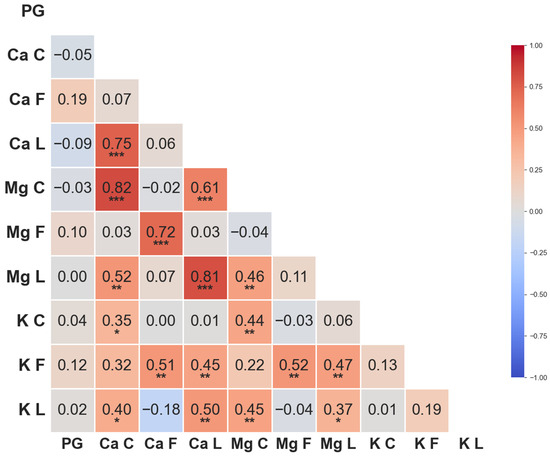
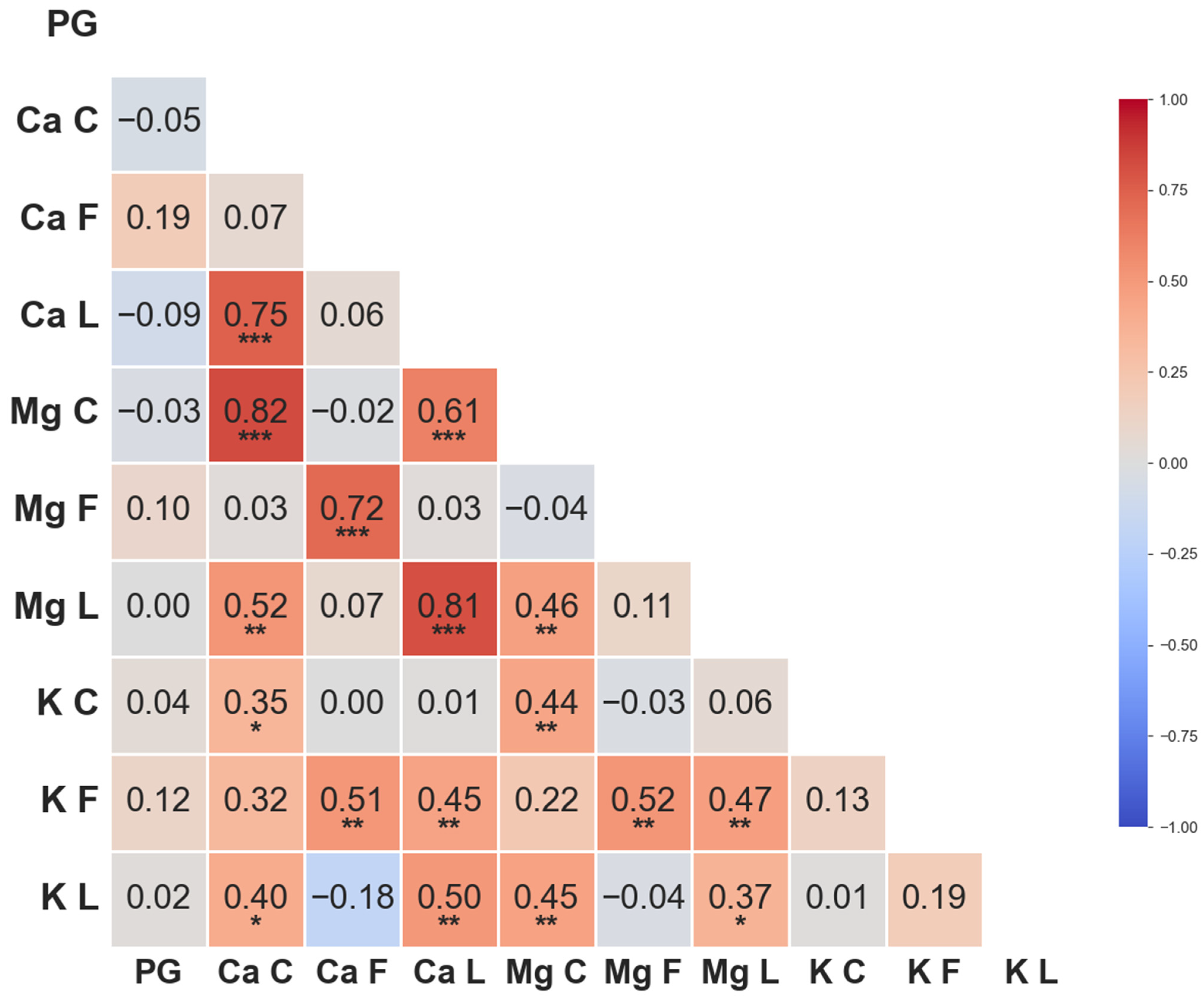
For the leaves and calyx, the behavior is similar in both organs, with [Ca2+] predominant, followed by K+ and Mg2+. When analyzing the correlation between PG activity in cape gooseberry fruits and nutrient concentrations and their respective ratios across different plant organs, no significant correlation was found for any of the evaluated parameters. The [Ca2+] in cape gooseberry fruits explains only 18.9% of the variation in PG activity (Figure 1), with no significant relationship between the two variables. Therefore, the reduction in PG activity observed with increasing calcium dose cannot be attributed to changes in fruit Ca concentration.
Figure 1.
Pearson’s rank correlation coefficients among nutrient concentrations across different plant organs and polygalacturonase (PG) activity in cape gooseberry fruits. The darker the color, the stronger the correlation. Ca C = calcium in calyx; Ca F: calcium in fruit; Ca L: calcium in leaves; Mg C: Magnesium in calyx; Mg F: magnesium in fruits; Mg L: magnesium in leaves; K C: Potassium in calyx; K F: potassium in fruits; K L: potassium in leaves. *, **, ***, indicate a positive association between the variables, p < 0.05, p < 0.01 and p < 0.001, respectively.
Observing the relationships between nutrients in different organs, it can be seen that both [Ca2+] in leaves and in the calyx show a relatively high correlation, and these are also linked to [Mg2+] in the same organs.
3. Discussion
3.1. Water Deficit Modulates Calcium Partitioning: Leaves and Calyx as Transpiring Sinks
The results clearly demonstrate that water availability is a dominant factor controlling calcium concentration in transpiring organs of cape gooseberry. The pronounced reduction in leaf [Ca2+] under high irrigation coefficients (1.1 and 1.3) points to a dilution effect driven by excess water, but more critically, the 82% decrease in leaf [Ca2+] when irrigation frequency was extended from 4 to 14 days reveals a severe stress response. Under water deficit, stomatal closure reduces transpiration, thereby diminishing the xylem-driven flow of calcium to leaves and the calyx—both of which are high-transpiring tissues [7,17]. This implies that water stress from irrigation applied every 14 days is severe and reduces nutrient accumulation in leaves, even when nutrients are available in the soil or substrate. The severity of water deficit imposed by the 14-day irrigation frequency is supported by previous measurements of plant water status in the same experimental setup. Álvarez-Herrera et al. [8] reported that leaf water potential (Ψleaf) and stem water potential (Ψstem) in cape gooseberry plants followed a sinusoidal diurnal pattern, with the highest values at predawn (approximately −0.5 MPa) and the lowest at midday (approximately −1.15 MPa). Plants irrigated every 14 days exhibited significantly more negative Ψleaf values (down to −1.25 MPa at midday) compared to those irrigated every 4 days (approximately −0.75 MPa), confirming that the 14-day frequency imposed substantial water stress [8]. Furthermore, the irrigation coefficient of 0.7 resulted in strong symptoms of wilting and lower water potential values, while the 1.1 coefficient maintained better plant water status and produced the highest number of large fruits with the lowest cracking percentage [8].
Conversely, if the water supply is continuous and sufficient, plants will accumulate a higher content of Ca2+ in the leaves and calyx. Additionally, irrigation frequency directly affects soil moisture patterns and water distribution [24] and indirectly influences root development, thereby affecting Ca2+ absorption. This element is primarily absorbed by the tips of the younger root hairs and depends significantly on their number and distribution in the soil [17]. Furthermore, since the crop was planted under a plastic cover, which had an average temperature of 5 °C higher than the outside temperature, transpiration processes may have increased, leading to a higher concentration of calcium in the leaves and a decrease in the concentration of this element in the fruit. The calcium content in the leaves was 18 times higher than that in the fruits, which is consistent with the findings of Celiktopuz et al. [25]. They reported that external calcium application can modulate stomatal regulation through intracellular signaling pathways in guard cells, where calcium ions act as secondary messengers involved in the efflux of potassium and malate from vacuoles, contributing to stomatal closure. This effect was more pronounced in plants grown at low temperatures [25].
The calyx is a modified leaf that protects the fruit and acts as a source of carbohydrates translocated to the fruit during the first 20 days of growth [2]. Therefore, it is likely that the calyx accumulates high levels of Ca2+ because it is a transpiring organ, given that this nutrient primarily moves through the transpiration stream, cation exchange in the xylem, and root pressure [7]. Similarly, when the irrigation frequency was decreased from 4 to 14 days, [Ca2+] in the calyx reduced by 25%. This may occur because, under low soil moisture levels, calcium becomes less mobile and is transported only with water flow to plant roots, which also affects its translocation to other plant organs [26].
This aligns with the well-established dependency of calcium transport on transpiration flow; under drought, root pressure and xylem sap velocity decline, limiting calcium supply to aerial organs [26]. Notably, calcium fertilization successfully increased leaf and calyx [Ca2+] by up to 107%, but this effect was partially nullified under low water availability, highlighting that agronomic calcium biofortification is ineffective without adequate soil moisture to drive its uptake and translocation [23].
In this regard, Wood et al. [27] tested different pre-harvest calcium doses ranging from 10 to 90 kg ha−1 in apple plants and found no significant increases in calcium concentration in the fruits of various cultivars. A similar outcome was observed in Asian pears [28], where foliar calcium application did not increase the concentration of this element in the fruits, and in tomatoes [29]. In this context, Saure [17] noted that increasing calcium fertilization may increase [Ca2+] in leaves but not necessarily in organs with low transpiration rates, such as fruits, which require lower levels of this element to promote rapid cell expansion and high membrane permeability. This may explain the absence of significant differences in [Ca2+] in Cape gooseberry fruits. Similarly, Jaime-Guerrero et al. [7] mention that within the fruit, the development of the xylem in the distal part can be delayed by factors such as salinity or water stress. It is assumed that this can lead to high resistance to water movement within the xylem, which consequently causes poor distribution of Ca2+ in the distal parts of the fruit.
On the other hand, there are reports of increased [Ca2+] in fruits of various crops subjected to Ca2+ applications. In plums, higher doses of this element increased calcium concentration in fruits [30], as well as in blueberries with an early application of 5 L ha−1 of calcium chloride [31] and kiwifruit [32]. Therefore, it can be inferred that [Ca2+] in the fruit responds to early applications of the element. However, these cases involved foliar and fruit-directed spraying, which is not feasible in cape gooseberries. The fruits are protected by a translucent resin (withanolide E and 4β-hydroxy withanolide E) and the calyx [2], preventing direct Ca2+ application to the fruit. This makes it challenging to increase Ca2+ content in the fruit via foliar application, as Ca2+ must be applied directly to the fruit [17].
The results allow us to affirm that the more calcium applied during fertilization, the greater the foliar accumulation of Ca2+, which is consistent with findings in tomatoes [33] and apple trees [34]. Saure [17] notes that increased foliar Ca2+ content due to fertilization is standard, but the main challenge is elevating its accumulation in fruits. Ca2+ moves within the plant following the transpiration stream, with nutrient concentration in plants generally ordered from lowest to highest as roots, stems, and leaves. Once deposited in the leaves, Ca2+ becomes relatively immobile because it is fixed in the cell walls and cannot be readily remobilized via the phloem, making its redistribution to developing fruits difficult [9]. This explains why leaves accumulate high calcium concentrations while fruits, which have low transpiration rates, remain calcium-deficient even under high calcium fertilization.
Consequently, while leaves and calyx serve as reliable indicators of calcium status under stress, fruit calcium appears to be determined early in development and is largely uncoupled from post-anthesis water and nutrient management.
3.2. Magnesium Mobility and Translocation Under Water Stress
Magnesium, unlike calcium, exhibits partial mobility in the phloem and plays important roles in osmotic regulation, particularly as a cofactor for enzymes involved in carbohydrate metabolism and as a component of chlorophyll [12]. Under water stress conditions, the osmotic contribution of Mg becomes relevant, as it helps maintain cell turgor and stabilize membrane integrity. This section focuses on Mg translocation patterns, based on the distribution of this nutrient among plant organs under different irrigation regimes. The combination of the irrigation coefficient and calcium dose factors nullified the individual effects each factor may have on [Mg2+] in the calyx. As the calcium application increased, [Mg2+] in the calyx also increased; this likely reflects that both Mg2+ and Ca2+ are primarily translocated within the plant via the transpiration stream [12]. Even though Ca and Mg compete for absorption sites in the roots, adequate calcium levels prevent magnesium from being fixed in the soil, making it more available to the plant [12]. Similarly, the lower irrigation coefficients (0.7) resulted in higher [Mg2+]. In this regard, inadequate water supply can reduce water content and diminish the translocation of nutrients to the leaves and calyx by increasing resistance to water movement throughout the plant’s aerial system, thereby reducing element concentration [8].
When the amount of water applied to the plants decreased, the [Mg2+] in the fruit was lower; this is consistent with Celiktopuz et al. [25], who found no differences in fruit [Mg2+] when applying different irrigation coefficients (0.5, 0.75, 1, or 1.25 of ET) in strawberries of the ‘Kabarla’ cultivar. However, [Mg2+] slightly increased from 0.131% to 0.136% as the amount of water applied increased. When evaluating the effects of calcium dose and irrigation frequency separately, neither factor significantly affected fruit [Mg2+], in contrast to Wood et al. [27], who found increases in fruit [Mg2+] in Braeburn apples with the addition of 5 kg ha−1 of CaCl2. For other evaluated cultivars, no differences were found, and in some cases, calcium application decreased fruit [Mg2+].
As the calcium fertilization dose increased, the [Mg2+] in the leaves also increased, similar to Shiri et al. [35], who found that applying 15 g L−1 of CaCl2 to kiwifruit increased [Mg2+] in the leaves throughout the growing cycle. Grzebisz [13] notes that an adequate Mg/Ca ratio for plant growth should range between 1:1 and 1:5 without limiting the absorption of either nutrient. Therefore, the Mg/Ca ratio of 1:2.85 found at the foliar level in cape gooseberry plants indicates that there was a balanced nutritional environment for the development of the crop.
Regarding irrigation frequency, foliar [Mg2+] was 55% higher when plants were irrigated every 4 days than when they were irrigated every 14 days. This is similar to Atilgan et al. [36], who found that in tomatoes, foliar Mg2+ content increased from 0.28% to 0.33% in plants subjected to 70% and 100% of evaporation measured in the A class tank. Silber and Bar-Tal [37] note that managing high irrigation frequencies reduces variation in nutrient concentrations, thereby increasing plant availability and decreasing leaching.
3.3. Potassium Dynamics Under Water Stress: Mobility and Osmotic Roles
The values of [K+] found in the calyx are higher than the values for Ca2+ and Mg2+ in this plant organ. The absence of significant differences in [K+] in the calyx across the evaluated factors may be due to [K+] in the plant responding positively to potassium fertilization, as potassium is highly mobile within the plant and can be transported quickly within tissues [10]. Since the application of this nutrient was the same across all treatments, [K+] in the calyx did not vary.
Cape gooseberry plants with an irrigation coefficient of 0.7 may experience low water availability, hindering normal potassium absorption and translocation to the fruit. Similarly, higher irrigation coefficients (1.1 and 1.3) resulted in larger fruits [8]. Due to the dilution effect, the [K+] in the fruit in treatments with more water may have been lower. However, Liaqat et al. [11] state that high foliar [K+] promotes processes such as water absorption due to K+’s osmotic potential in plants. The absence of an effect of calcium doses on [K+] is consistent with findings reported for kiwi by Sotiropoulos et al. [14]. They tested different calcium fertilizer doses and observed no significant differences in fruit [K+]. In contrast, Shiri et al. [35] applied 15 g L−1 of CaCl2 to kiwi plants at three different times via spraying and found significant differences in fruit [K+] when the spraying occurred 35 days after full bloom.
The average K/Ca ratio found is higher than the 8 reported by Sotiropoulos et al. [14] for kiwi and the 20 reported by Peralta et al. [38] for tomato. Poovarodom and Boonplang [15] reported that higher K/Ca ratios were associated with increased incidence of TFD, as elevated potassium levels promote fruit enlargement while simultaneously reducing calcium concentration, leading to weaker cell walls. Although we did not directly measure the correlation between K/Ca ratio and cracking incidence in this study, the high K/Ca ratio observed, combined with the known role of calcium in cell wall integrity [7,9], suggests that this ratio may be a contributing factor to cracking susceptibility in cape gooseberry. However, this relationship requires direct validation in future studies.
An irrigation frequency of 4 days resulted in the highest K+ assimilation in the leaves, consistent with findings by Neilsen et al. [39], who reported that increasing irrigation frequency raised foliar K+ concentration in cherries. Similarly, in grapes, foliar levels of Ca2+, Mg2+, and K+ increased when plants were well-watered compared to when they were subjected to water stress [40]. Liaqat et al. [11] report that when plants receive insufficient water, K+ levels may decline, causing leaf margins to lose turgidity.
3.4. Polygalacturonase Activity as a Stress-Responsive Indicator of Cell Wall Integrity
Polygalacturonase (PG) is a cell wall-degrading enzyme that hydrolyzes the α-1,4 glycosidic bonds between galacturonic acid residues in pectin, a major component of the primary cell wall and middle lamella. Calcium plays a crucial role in maintaining cell wall integrity by forming ionic cross-links between the negatively charged carboxyl groups of adjacent pectin chains [7,9]. This calcium–pectin complex (Ca2+-PGA) stabilizes the cell wall matrix and reduces its susceptibility to enzymatic degradation. Under water-deficit stress, reduced transpiration limits xylem-driven calcium transport to fruits, thereby weakening this protective mechanism. PG activity in fruits was significantly elevated (119% higher) when calcium was omitted from fertilization, confirming that calcium is essential for suppressing PG-mediated cell wall degradation. Ca2+ binds to the negatively charged methyl-esterified residues of polygalacturonic acid (PGA) at the C6 position, forming the Ca2+-PGA complex [9]. This complex, along with cellulose and pectins, forms a three-dimensional mesh stabilized by hydrogen bonds, calcium-mediated ionic interactions, and structural proteins rich in hydroxyproline, which contribute to cell wall architecture [41]. It has been reported that Ca2+ can reduce PG activity in various fruit species [42,43,44], although the precise mechanism—whether through direct enzyme inhibition, substrate modification, or other pathways—remains unclear. Our study measured only bulk PG activity, and we did not assess PG gene expression or isoform-specific activity. Furthermore, we acknowledge that other pectolytic enzymes, such as pectin methylesterase (PME), may also contribute to cell wall degradation and cracking [45,46]. Therefore, the role of PG in cracking should be interpreted with caution, and future studies should investigate the coordinated action of multiple cell wall-modifying enzymes [45].
Although calcium fertilization reduced PG activity, the lack of correlation between fruit Ca concentration and PG activity indicates that this effect is not explained by fruit Ca levels. The reduction may be mediated by calcium in other tissues (e.g., leaves or calyx) or through indirect mechanisms. Similar results showing decreased PG activity with Ca2+ applications have been reported in cherries treated with 1% and 2% CaCl2 [42], in nectarines treated with a 0.5 g L−1 nano-calcium solution [43], and in grapevines [44].
More importantly, the comparison between healthy (97.5 UPG) and cracked fruits (487 UPG) demonstrates that once the physiological disorder manifests, PG activity increases dramatically. This does not mean that PG is the cause of cracking in cape gooseberries, as other enzymes are likely involved in the initial softening of the cell wall. Trinchero et al. [46] reported that as fruits ripen, the activities of pectin methylesterases (PMEs) and α-galactosidases increase, while PG activity remains low throughout ripening. In this regard, Sañudo-Barajas et al. [45] mention that homogalacturonans (HG) decrease during fruit development due to the action of apoplastic PMEs. This suggests that studies on the activity of PME and other pectolytic enzymes should be conducted to clarify the cracking issue in cape gooseberries.
Irrigation treatments did not significantly affect PG activity in this study. Although a non-significant downward trend was observed as irrigation frequency decreased, the lack of statistical significance precludes any conclusion that water deficit modulates PG activity. The significant reduction in PG activity was observed only with increasing calcium dose, confirming the role of calcium in suppressing PG-mediated cell wall degradation, as reported in other fruit species [42,43,44]. While water stress may influence fruit physiology and ripening through other mechanisms, our data do not support a direct modulation of PG activity by irrigation regime. A limitation of this study is that only bulk PG activity was measured. We did not quantify PG gene expression, protein abundance, or isoform-specific activities. Therefore, our results do not allow us to conclude whether the observed reduction in PG activity by calcium fertilization is due to inhibition of enzyme activity, reduction of enzyme synthesis, or changes in substrate availability. Future mechanistic studies should include molecular analyses to clarify the regulation of PG and other pectolytic enzymes under different irrigation and calcium regimes. Calcium was supplied as calcium nitrate [Ca(NO3)2], which also provided nitrate to the plants, which can influence fruit quality parameters, including organic acid metabolism, sugar accumulation, and overall fruit composition [47]. Although our study was not designed to separate the effects of calcium from those of nitrate, the observed reductions in PG activity and changes in nutrient partitioning may partially reflect the combined influence of both calcium and nitrate. Future studies should include treatments with different calcium sources, like calcium chloride, to isolate the specific effects of calcium from its counter-ion.
3.5. Integrative Implications for Stress Mitigation: The Optimal Water–Calcium Balance
Synthesizing the nutrient and enzymatic responses, our marginal means suggest that the combination of a 0.9 irrigation coefficient, 9-day frequency, and 50 kg ha−1 calcium dose produced the numerically highest concentrations of K+, Ca2+, and Mg2+ in fruits (Table 2) and maintained intermediate but adequate levels in leaves and calyx. However, this should be considered a preliminary observation, as a complete three-factor treatment comparison would be required to confirm this as a statistically validated optimal treatment. The three-factor interaction (irrigation coefficient × calcium dose × irrigation frequency) was significant only for fruit K+ (Table 1), not for Ca2+ or Mg2+. This regime may balance transpirational flow (for xylem-mobile Ca and Mg) with phloem loading (for K), potentially avoiding the dilution effect of excess water and the uptake limitations of severe drought, but this interpretation requires validation in independently replicated experiments. According to Shakya and Lal [9], in organs with high growth rates (young leaves or fruits), there is a higher volume of solute flow in the phloem, which increases [K+] and, in turn, decreases the flow of Ca2+ to the fruits. This explains the higher K+ content compared to Ca2+ and Mg2+ in cape gooseberry fruits. Similarly, the net import of Ca2+ to the leaves occurs via the xylem, and as transpiration and the organ’s sink potential increase, so does the flow of this element to the leaves. Additionally, K+ mainly arrives via the phloem, while only 25% to 40% of Mg2+ is transported via the phloem [9].
The strong correlations between [Ca2+] and [Mg2+] in leaves and calyx (Figure 1) confirm that these two nutrients share similar translocation pathways and are both sensitive to water stress. In contrast, the lack of correlation between fruit calcium and PG activity, while surprising, may be due to the fact that PG activity increases sharply only after cracking has been initiated, and other enzymes are responsible for the early stages of cell wall-intensified degradation activity; additionally, PG activity remained low throughout ripening [18]. Similarly, [Ca2+] in the fruit tends to decrease throughout growth and development, resulting in low values of this element at maturity [17]. Future research should investigate PME and α-galactosidase activities under varying water regimes to fully elucidate the cascade of events that lead to cracking.
In the context of climate change, where erratic rainfall and prolonged dry spells are increasingly common, our findings provide a practical framework. Maintaining a moderate irrigation schedule (approximately 0.9 of evaporation, every 9 days) not only sustains calcium uptake and partitioning to structural organs but also moderates potassium dominance and keeps pectolytic enzymes in check. This approach reduces reliance on excessive calcium fertilization, which was ineffective at directly increasing fruit calcium, and instead leverages water management as the primary lever to mitigate water-deficit stress and its associated fruit-quality losses.
4. Materials and Methods
4.1. The Experiment Location and Material
Cape gooseberry (Physalis peruviana L.), ecotype ‘Colombia,’ was planted in the greenhouse of the Faculty of Agronomy at the National University of Colombia, Bogotá campus (4°38′7′′ N and 74°5′20′′ W), at an altitude of 2556 m, with an average indoor temperature of 18 °C and 60% relative humidity, and the temperatures are approximately 5 °C higher than the external ambient conditions. This temperature differential increased transpiration rates and amplified the effects of the irrigation treatments on plant water status and nutrient transport. Initially, cape gooseberry seeds were germinated in A-BA72 plastic trays (A and P, Tenjo, Colombia), with one seed per cell, using PS 8020 XL peat moss (Projar Group, Valencia, Spain) as the substrate. The seeds germinated after 45 days and remained in the trays for four months, reaching an average height of 30 cm, at which point the seedlings were transplanted into the same substrate in 20 L pots. The planting layout was 2 m between plants and 2 m between rows. Fertilization was fractionally applied, starting from planting, with two quarterly applications followed by three bimonthly applications. The following fertilizer sources were used: urea (46% N) for nitrogen, triple superphosphate (46% P2O5) for phosphorus, potassium sulfate (50% K2O) for potassium, and magnesium sulfate (16% MgO) for magnesium. The total doses applied were 150, 220, 150, 60, 40, 1, 3, 2, and 0.5 kg ha−1 of N, P2O5, K2O, MgO, S, B, Zn, Cu, and Mn, respectively. The peat moss substrate (PS 8020 XL, Projar Group, Spain) used for planting had the following mineral background: Ca 0.12%, Mg 0.08%, K 0.05%, and pH 5.8. These background values were subtracted from the total nutrient concentrations measured in plant tissues to estimate the contribution of exogenous calcium fertilization. The plants were trellised in a high V-shaped system.
4.2. Irrigation and Calcium Treatments
The experimental design was a completely randomized block design, with irrigation frequency (4, 9, and 14 days) as the blocking factor and a structure of 12 treatments arranged in a 4 × 3 factorial within each block. One factor was the irrigation coefficient (0.7, 0.9, 1.1, and 1.3 of the evaporation measured in a class A pan located inside the greenhouse), and the other factor was calcium fertilization doses (0, 50, and 100 kg ha−1), supplied as calcium nitrate [Ca(NO3)2], applied monthly to the substrate over six months. The blocks were treated as replicates, yielding 36 experimental units, each comprising two plants, for a total of 72 plants. It is important to note that irrigation frequency was assigned to three separate greenhouse bays to avoid water cross-contamination. As a result, the irrigation frequency factor was assumed to be the same as for the block, and the experimental unit for this factor was the bay rather than the individual pot. Thus, the observed differences in irrigation frequencies should be interpreted as preliminary and require validation in independently replicated experiments.
Irrigation treatments were applied using two 4 L h−1 drippers per plant. Evaporation (EV) inside the greenhouse was measured every four days and corroborated the evaporation recorded by the IDEAM weather station 2403513. The amount of water applied per treatment was calculated following the methodology used by Álvarez-Herrera et al. [48], using Equation (1):
where PET: potential evapotranspiration, expressed in mm and calculated as 0.8 × EV measured in the Class A evaporimeter pan; C: multiplier coefficient according to treatments; A = area of the pot (254 cm2); ηr: drip irrigation efficiency (0.9).
4.3. Nutrient Measurement
Nutrient content was measured in fruits, calyx, and leaves. Fruits were harvested at commercial maturity (color index 4: orange-yellow, approximately 50–60 days after anthesis). This stage corresponds to the ripening phase, during which PG activity is known to increase [18] and cracking is most commonly observed [8]. Samples were taken from the second harvest, 17 weeks after transplanting. Five fully expanded mature leaves were collected from the middle third of each plant (nodes 8–12), representing functional leaves with active transpiration. Eight fruits per plant were harvested at commercial maturity (color index 4: orange-yellow, approximately 50–60 days after anthesis), along with their respective calyxes. This maturity stage was chosen because cracking is most commonly observed at this stage [8] and because PG activity is known to increase during ripening [18]. Each sample was washed and dried at 50 °C. Then, 1 g of the sample was placed in a crucible and ashed at 475 ± 25 °C for 4 h. After cooling, 4 mL of HCl was added, and the sample was dried at 50 °C. Next, 2 mL of HCl was added; the solution was filtered with deionized water, and the volume was adjusted to 25 mL in a 25 mL volumetric flask before transferring it to a 50 mL plastic bottle. The concentration of calcium, magnesium, and potassium (in the presence of 30 mg mL−1 of 1% lanthanum solution) was determined in the solution by atomic absorption flame spectrometry using a SOLAAR M Series AA spectrophotometer (Thermo Fisher Scientific, Waltham, MA, USA).
4.4. Enzyme Activity Measurement
Polygalacturonase (PG) activity was measured following the methodology of Ramírez and Martínez [49]. The crude enzyme extract was prepared by homogenizing 5 g of frozen fruit tissue in 10 mL of 50 mM citrate buffer (pH 4.5) containing 0.5 M NaCl. The homogenate was centrifuged at 12,000 rpm (approximately 24,000× g, rotor radius 15 cm) for 20 min at 4 °C, and the supernatant was used as the crude enzyme extract. Protein concentration in the extract was determined using the Bradford method [50] with bovine serum albumin (BSA) as the standard.
For the PG activity assay, 120 μL of polygalacturonic acid solution (1% w/v in citrate buffer) was mixed with 50 μL of 200 mM citrate buffer (pH 4.5). The mixture was incubated at 35 °C for 5 min, and 80 μL of crude enzyme extract (containing 2.97 μg of protein) was added to start the reaction. The reaction was incubated at 35 °C for 30 min and stopped by heating at 92 °C for 5 min. The reducing sugars produced (including galacturonic acid) were quantified using the Nelson-Somogyi method. To 250 μL of the reaction mixture, 200 μL of Somogyi I reagent and 50 μL of Somogyi II reagent were added, heated at 92 °C for 20 min, cooled to room temperature, and 250 μL of Nelson reagent and 1000 μL of distilled water were added. The mixture was vortexed (2500 rpm, 20 °C, 10 s), left to stand for 20 min, and the absorbance was measured at 500 nm.
The calibration curve for the Nelson-Somogyi method was prepared using D-glucose, with concentrations ranging from 0 to 300 μM. D-glucose was used as the calibration standard because it is a reducing sugar that reacts with the Nelson-Somogyi reagent in a manner stoichiometrically similar to galacturonic acid. While galacturonic acid is the specific product of PG-mediated pectin hydrolysis, D-glucose provides a reliable, readily available, and consistent standard for quantifying reducing sugar equivalents. This approach has been validated in previous PG activity studies [49] and allows for reproducible comparisons across experiments. Activity is expressed as galacturonic acid equivalents (μmol PGU mg−1 protein min−1) to reflect the expected product of PG-mediated hydrolysis of polygalacturonic acid.
For the comparison between healthy and cracked fruits, five healthy fruits (no visible cracks) and five cracked fruits (visible cracks on the epidermis) were selected from each treatment at the same maturity stage. These samples were processed and analyzed in triplicate. This comparison is descriptive and does not establish causality; elevated PG activity in cracked fruits may be a consequence rather than a cause of cracking.
4.5. Data Analysis
Prior to analysis, data normality was assessed using the Shapiro–Wilk test, and homogeneity of variances was verified using Levene’s test. These assumptions were satisfied for all datasets (p > 0.05), justifying the use of parametric statistics. Data were then evaluated using an analysis of variance (ANOVA) in a completely randomized block design to determine whether there were significant differences between irrigation frequencies (blocks) and between treatments (coefficients per frequency) for each measured response variable. Additionally, Tukey’s test at the 5% significance level was conducted to classify the levels of the evaluated factors. Linear correlation tests were performed. The data were analyzed using the SAS OnDemand for Academics software 9.4M8 (SAS Institute Inc., Cary, NC, USA).
5. Conclusions
Calcium fertilization of cape gooseberry plants increased the concentration of this nutrient primarily in the leaves and calyx, while fruit calcium concentration remained unchanged. The calcium concentration in the leaves decreased as the amount of water applied increased. As the calcium fertilization dose increased, leaf [Mg2+] also increased. Both the leaves and the calyx showed similar patterns in Ca2+, Mg2+, and K+ concentrations. Cape gooseberry fruits accumulated higher concentrations of K+ than of Ca2+ and Mg2+. PG activity was significantly reduced by calcium fertilization. Numerically, the combination of a 0.9 irrigation coefficient, 9-day frequency, and a 50 kg ha−1 calcium dose produced the highest concentrations of K+, Ca2+, and Mg2+ in fruits based on marginal means. However, the three-factor interaction was statistically significant only for fruit K+, not for Ca2+ or Mg2+. Therefore, this observation should be considered preliminary and requires confirmation through fully replicated factorial experiments with independent replication of the irrigation frequency factor.
Author Contributions
Conceptualization, G.F. and J.G.Á.-H.; methodology, J.G.Á.-H.; software, J.G.Á.-H. and M.J.-G.; validation, J.G.Á.-H.; M.J.-G. and G.F.; formal analysis, J.G.Á.-H.; investigation, J.G.Á.-H.; resources, J.G.Á.-H.; data curation, J.G.Á.-H. and M.J.-G.; writing—original draft preparation, J.G.Á.-H.; writing—review and editing, J.G.Á.-H.; M.J.-G. and G.F.; visualization, J.G.Á.-H. and M.J.-G.; supervision, G.F.; project administration, J.G.Á.-H.; funding acquisition, J.G.Á.-H. and M.J.-G. All authors have read and agreed to the published version of the manuscript.
Funding
This research was supported by Universidad Nacional de Colombia through the División de Investigación, Bogotá (DIB). The APC was funded through Call 05 of 2026 Universidad Pedagógica y Tecnológica de Colombia.
Institutional Review Board Statement
Not applicable.
Informed Consent Statement
Not applicable.
Data Availability Statement
The data will be made available upon request.
Conflicts of Interest
The authors declare no conflicts of interest.
References
- Agudelo-Sánchez, S.; Mosquera-Palacios, Y.; David-Úsuga, D.; Cartagena-Montoya, S.; Duarte-Correa, Y. Effect of Processing Methods on the Postharvest Quality of Cape Gooseberry (Physalis peruviana L.). Horticulturae 2023, 9, 1158. [Google Scholar] [CrossRef] [Scilit]
- Fischer, G.; Balaguera-López, H.E.; Melgarejo, L.M. Crop Physiology of Physalis peruviana. In Handbook of Goldenberry (Physalis peruviana): Cultivation, Processing and Functionality; Academic Press: Cambridge, MA, USA; Elsevier: London, UK, 2024; pp. 101–119. [Google Scholar] [CrossRef] [Scilit]
- Fischer, G.; Parra-Coronado, A.; Balaguera-López, H.E. Altitude as a determinant of fruit quality with emphasis on the andean tropics of Colombia. A Review. Agron. Colomb. 2022, 40, 212–227. [Google Scholar] [CrossRef] [Scilit]
- Fischer, G.; Balaguera-López, H.E.; Álvarez-Herrera, J. Causes of fruit cracking in the era of climate change. A Review. Agron. Colomb. 2021, 39, 196–207. [Google Scholar] [CrossRef] [Scilit]
- Srivastava, R.K.; Mequanint, F.; Chakraborty, A.; Panda, R.K.; Halder, D. Augmentation of maize yield by strategic adaptation to cope with climate change for a future period in eastern India. J. Clean. Prod. 2022, 339, 130599. [Google Scholar] [CrossRef] [Scilit]
- Álvarez-Herrera, J.; González, H.; Fischer, G. Water potential in cape gooseberry (Physalis peruviana L.) plants subjected to different irrigation treatments and doses of calcium. Agron. Colomb. 2019, 37, 274–282. [Google Scholar] [CrossRef] [Scilit]
- Jaime-Guerrero, M.; Álvarez-Herrera, J.G.; Fischer, G. Effect of calcium on fruit quality: A Review. Agron. Colomb. 2024, 42, e112026. [Google Scholar] [CrossRef] [Scilit]
- Alvarez-Herrera, J.; Balaguera-López, H.; Fischer, G. Effect of irrigation and nutrition with calcium on fruit cracking of the cape gooseberry (Physalis peruviana L.) in the three strata of the plant. Acta Hortic. 2010, 928, 163–170. [Google Scholar] [CrossRef] [Scilit]
- Shakya, R.; Lal, M.A. Fruit Development and Ripening. In Plant Physiology, Development and Metabolism; Springer Nature: Singapore, 2018; pp. 857–883. [Google Scholar] [CrossRef] [Scilit]
- De Luca, A.; Corell, M.; Chivet, M.; Parrado, M.A.; Pardo, J.M.; Leidi, E.O. Reassessing the role of potassium in tomato grown with water shortages. Horticulturae 2021, 7, 20. [Google Scholar] [CrossRef] [Scilit]
- Liaqat, S.; Chhabra, S.; Saffeullah, P.; Iqbal, N.; Siddiqi, T.O. Role of potassium in drought adaptation: Insights into physiological and biochemical characteristics of plants. In Role of Potassium in Abiotic Stress; Springer Nature: Singapore, 2022; pp. 143–162. [Google Scholar] [CrossRef] [Scilit]
- Chaudhry, A.H.; Nayab, S.; Hussain, S.B.; Ali, M.; Pan, Z. Current understandings on magnesium deficiency and future outlooks for sustainable agriculture. Int. J. Mol. Sci. 2021, 22, 1819. [Google Scholar] [CrossRef] [Scilit] [PubMed]
- Grzebisz, W. Magnesium. In Handbook of Plant Nutrition; Barker, A., Pilbeam, D.J., Eds.; CRC Press: Boca Raton, FL, USA, 2015; pp. 199–260. [Google Scholar] [CrossRef] [Scilit]
- Sotiropoulos, T.; Voulgarakis, A.; Karaiskos, D.; Chatzistathis, T.; Manthos, I.; Dichala, O.; Mpountla, A. Foliar calcium fertilizers impact on several fruit quality characteristics and leaf and fruit nutritional status of the ‘Hayward’ kiwifruit cultivar. Agronomy 2021, 11, 235. [Google Scholar] [CrossRef] [Scilit]
- Poovarodom, S.; Boonplang, N. Soil calcium application and pre-harvest calcium and boron sprays on mangosteen fruit quality attributes. Acta Hortic. 2010, 868, 359–366. [Google Scholar] [CrossRef] [Scilit]
- Yang, B.; Fu, P.; Lu, J.; Ma, F.; Sun, X.; Fang, Y. Regulated deficit irrigation: An effective way to solve the shortage of agricultural water for horticulture. Stress Biol. 2022, 2, 28. [Google Scholar] [CrossRef] [Scilit] [PubMed]
- Saure, M.C. Calcium translocation to fleshy fruit: Its mechanism and endogenous control. Sci. Hortic. 2005, 105, 65–89. [Google Scholar] [CrossRef] [Scilit]
- Majumder, K.; Mazumdar, B. Changes of pectic substances in developing fruits of cape-gooseberry (Physalis peruviana L.) in relation to the enzyme activity and evolution of ethylene. Sci. Hortic. 2002, 96, 91–101. [Google Scholar] [CrossRef] [Scilit]
- Adams, P.; El-Gizawy, A.M. Effect of salinity and watering level on the calcium content of tomato fruit. Acta Hortic. 1986, 190, 253–260. [Google Scholar] [CrossRef] [Scilit]
- Stein, B.B.; Duarte, S.N.; Freire, M.M.; Nascimento, L.F.d.S.; Jacomino, A.P.; Costa, J.d.O.; Coelho, R.D. Production and harvest quality of tomato fruit cultivated under different water replacement levels and photoprotector strategies. AgriEngineering 2024, 6, 4372–4383. [Google Scholar] [CrossRef] [Scilit]
- Mousavi, S.A.H.; Nekounam, F.; Barzegar, T.; Ghahremani, Z.; Nikbakht, J. Assessments of humic acid soil application and deficit irrigation on growth, fruit quality and water use efficiency of Physalis peruviana L. J. Hortic. Sci. 2024, 38, 321–337. [Google Scholar] [CrossRef]
- Cardoso, C.P.; Napoleão, G.M.; Vargens, F.N.; Rodrigues, L.S.; Pegorin, P.; Gonçalves, L.S.; Ouros, L.F.d.; Leonel, S.; Boaro, C.S.F. Trade-Off between fruit yield and antioxidant accumulation in Physalis peruviana L. under different water availability regimes. Horticulturae 2026, 12, 517. [Google Scholar] [CrossRef] [Scilit]
- Kumar, A.; Singh, U.M.; Manohar, M.; Gaur, V.S. Calcium transport from source to sink: Understanding the mechanism(s) of acquisition, translocation, and accumulation for crop biofortification. Acta Physiol. Plant. 2015, 37, 1722. [Google Scholar] [CrossRef] [Scilit]
- Alves-Souza, S.; Higino-Vieira, J.; Bispo dos Santos Farias, D.; da-Silva, G.H.; Cabral-Aleman, C. Impact of irrigation frequency and planting density on bean’s morpho-physiological and productive traits. Water 2020, 12, 2468. [Google Scholar] [CrossRef] [Scilit]
- Celiktopuz, E.; Kapur, B.; Sarıdas, M.A.; Kargı, S.P. Response of strawberry fruit and leaf nutrient concentrations to the application of irrigation levels and a biostimulant. J. Plant Nutr. 2021, 44, 153–165. [Google Scholar] [CrossRef] [Scilit]
- Yu, X.; Zhao, M.; Wang, X.; Jiao, X.; Song, X.; Li, J. Reducing vapor pressure deficit improves calcium absorption by optimizing plant structure, stomatal morphology, and aquaporins in tomatoes. Environ. Exp. Bot. 2022, 195, 104786. [Google Scholar] [CrossRef] [Scilit]
- Wood, R.M.; de Freitas, S.T.; Argenta, L.C.; Neuwald, D.A. Influence of pre-harvest calcium application on the concentration and distribution of ascorbic acid and mineral content in apple cultivars at harvest and during storage. Postharvest Biol. Technol. 2024, 214, 112979. [Google Scholar] [CrossRef] [Scilit]
- Seo, H.J.; Sawant, S.S.; Lee, B.; Kim, K.; Song, J.; Choi, E.D. Mechanisms driving fruit cracking in ‘Sinhwa’ pears (Pyrus pyrifolia Nakai) and effect of foliar fertilizer application on fruit quality. Sci. Hortic. 2024, 332, 113232. [Google Scholar] [CrossRef] [Scilit]
- Karlsons, A.; Osvalde, A.; Cekstere, G.; Āboliņa, L. Effects of Ca sprays on fruit ca content and yield of tomato variety susceptible to blossom-end rot. Plants 2023, 12, 1640. [Google Scholar] [CrossRef] [Scilit] [PubMed]
- Sinha, A.; Jawandha, S.K.; Gill, P.P.S.; Singh, H. Influence of pre-harvest sprays of calcium nitrate on storability and quality attributes of plum fruits. J. Food Sci. Technol. 2019, 56, 1427–1437. [Google Scholar] [CrossRef] [Scilit] [PubMed]
- Lobos, T.E.; Retamales, J.B.; Hanson, E.J. Early preharvest calcium sprays improve postharvest fruit quality in ‘liberty’ highbush blueberries. Sci. Hortic. 2021, 277, 109790. [Google Scholar] [CrossRef] [Scilit]
- Sotiropoulos, T.; Manthos, I.; Chatzistathis, T.; Kountis, N.; Dichala, O.; Tsoktouridis, G. Effect of organic calcium uptake and biostimulants during integrated nutrient management (INM) cultivation of kiwifruit cv. ‘Hayward’. Not. Bot. Horti Agrobot. Cluj-Napoca 2023, 51, 13109. [Google Scholar] [CrossRef] [Scilit]
- Melo, R.O.D.; Martinez, H.E.P.; Rocha, B.C.P.; Garcia, E. Production and quality of sweet grape tomato in response to foliar calcium fertilization. Rev. Ceres 2022, 69, 48–54. [Google Scholar] [CrossRef] [Scilit]
- Kucukyumuk, Z.; Erdal, İ. Effect of calcium on and mineral nutrient concentrations and fruit quality in different apple tree varieties. J. Elem. 2022, 27, 75–85. [Google Scholar] [CrossRef] [Scilit]
- Shiri, M.A.; Ghasemnezhad, M.; Moghadam, J.F.; Ebrahimi, R. Efficiency of CaCl2 spray at different fruit development stages on the fruit mineral nutrient accumulation in cv. Hayward kiwifruit. J. Elem. 2016, 21, 195–209. [Google Scholar] [CrossRef] [Scilit]
- Atilgan, A.; Rolbiecki, R.; Saltuk, B.; Jagosz, B.; Arslan, F.; Erdal, I.; Aktas, H. Deficit irrigation stabilizes fruit yield and alters leaf macro and micronutrient concentration in tomato cultivation in greenhouses: A case study in Turkey. Agronomy 2022, 12, 2950. [Google Scholar] [CrossRef] [Scilit]
- Silber, A.; Bar-Tal, A. Nutrition of substrate-grown plants. In Soilless Culture: Theory and Practice; Raviv, M., Lieth, J.H., Bar-Tal, A., Eds.; Elsevier: San Diego, CA, USA, 2019; pp. 291–339. [Google Scholar] [CrossRef] [Scilit]
- Peralta Manjarrez, R.M.; Delgado Martínez, R.; Benavides Mendoza, A.; Juárez Maldonado, A.; Cabrera De la Fuente, M. Calcium, potassium, and magnesium affect the nutritional value of tomato grafted fruits grown in a nutrient film technique system. Agriculture 2023, 13, 2189. [Google Scholar] [CrossRef] [Scilit]
- Neilsen, G.H.; Neilsen, D.; Kappel, F.; Herbert, L. Effect of nutrient and water management on nutrition and growth of young ‘Cristalina’ and ‘Skeena’ sweet cherry on Gisela 6 rootstock. Acta Hortic. 2010, 868, 81–86. [Google Scholar] [CrossRef] [Scilit]
- Porro, D.; Ramponi, M.; Tomasi, T.; Rolle, L.; Poni, S. Nutritional implications of water stress in grapevine and modifications of mechanical properties of berries. Acta Hortic. 2010, 868, 73–80. [Google Scholar] [CrossRef] [Scilit]
- Shin, Y.; Chane, A.; Jung, M.; Lee, Y. Recent advances in understanding the roles of pectin as an active participant in plant signaling networks. Plants 2021, 10, 1712. [Google Scholar] [CrossRef] [Scilit] [PubMed]
- Çelik, C.; Karakurt, Y.; Yıldırım, A. Effects of hot water, calcium chloride and 1-MCP on the activity of cell wall degrading enzymes in sweet cherry (Prunus avium). Harran Tarım Gıda Bilim. Derg. 2022, 26, 422–431. [Google Scholar] [CrossRef] [Scilit]
- Zhu, M.; Yu, J.; Wang, R.; Zeng, Y.; Kang, L.; Chen, Z. Nano-calcium alleviates the cracking of nectarine fruit and improves fruit quality. Plant Physiol. Biochem. 2023, 196, 370–380. [Google Scholar] [CrossRef] [Scilit] [PubMed]
- Yu, J.; Zhu, M.; Bai, M.; Xu, Y.; Fan, S.; Yang, G. Effect of calcium on relieving berry cracking in grape (Vitis vinifera L.) ‘Xiangfei’. PeerJ 2020, 8, e9896. [Google Scholar] [CrossRef] [Scilit] [PubMed]
- Sañudo-Barajas, J.A.; Lipan, L.; Cano-Lamadrid, M.; de la Rocha, R.V.; Noguera-Artiaga, L.; Sánchez-Rodríguez, L.; Carbonell-Barrachina, A.A.; Hernández, F. Texture. In Postharvest Physiology and Biochemistry of Fruits and Vegetables; Woodhead Publishing: Cambridge, UK, 2019; pp. 293–314. [Google Scholar] [CrossRef] [Scilit]
- Trinchero, G.D.; Sozzi, G.O.; Cerri, A.M.; Vilella, F.; Fraschina, A.A. Ripening-related changes in ethylene production, respiration rate and cell-wall enzyme activity in goldenberry (Physalis peruviana L.), a solanaceous species. Postharvest Biol. Technol. 1999, 16, 139–145. [Google Scholar] [CrossRef] [Scilit]
- Haider, S.T.-A.; Anjum, M.A.; Shah, M.N.; Hassan, A.U.; Parveen, M.; Danish, S.; Alharbi, S.A.; Alfarraj, S. Deciphering the effects of different calcium sources on the plant growth, yield, quality, and postharvest quality parameters of ‘Tomato’. Horticulturae 2024, 10, 1003. [Google Scholar] [CrossRef] [Scilit]
- Álvarez-Herrera, J.; Fischer, G.; Vélez, J.E. Análisis de la producción de uchuva (Physalis peruviana L.) durante el ciclo de cosechas en invernadero con diferentes láminas de riego. Rev. Acad. Colomb. Cienc. Exactas Fis. Nat. 2021, 45, 109–121. [Google Scholar] [CrossRef] [Scilit]
- Ramírez, E.; Martínez, S. Determinación del contenido extra e intracelular de algunas enzimas líticas relacionadas con pared celular en raíces de clavel (Dianthus caryophyllus L.). Rev. Colomb. Quím. 2016, 45, 5–11. [Google Scholar] [CrossRef] [Scilit]
- Bradford, M.M. A rapid and sensitive method for the quantitation of microgram quantities of protein utilizing the principle of protein-dye binding. Anal. Biochem. 1976, 72, 248–254. [Google Scholar] [CrossRef] [PubMed]

Disclaimer/Publisher’s Note: The statements, opinions and data contained in all publications are solely those of the individual author(s) and contributor(s) and not of MDPI and/or the editor(s). MDPI and/or the editor(s) disclaim responsibility for any injury to people or property resulting from any ideas, methods, instructions or products referred to in the content. |
© 2026 by the authors. Licensee MDPI, Basel, Switzerland. This article is an open access article distributed under the terms and conditions of the Creative Commons Attribution (CC BY) license.