


Abstract
Developing lightweight cementitious materials incorporating recycled constituents while maintaining appropriate functional performance requires a balance between density, mechanical resistance, durability-related properties, and thermal efficiency. This study comparatively evaluates lightweight mortars incorporating expanded clay (LECA), expanded perlite, and recycled crumb rubber, used individually and in binary combinations, and examines the influence of combined styrene–butadiene rubber (SBR) latex and polypropylene fiber (PPF) modification. Ten mortar mixtures were produced, comprising five unmodified mixtures with a water-to-cement ratio of 0.40 and five corresponding mixtures containing 10% SBR and 1% PPF by cement weight, for which the added mixing water was reduced to account for the water supplied by the SBR latex. Flowability, compressive and flexural strength, hardened density, and water absorption were experimentally assessed, while thermal conductivity was estimated from oven-dry density correlations. The mortars exhibited densities between 760 and 1072 kg/m3, confirming their lightweight character. The SBR–PPF-modified LECA–perlite mixture achieved the highest 56-day compressive strength of 8.1 MPa, whereas rubber-containing mixtures generally exhibited the lowest strength levels, a trend consistent with mechanisms reported in the literature, including weak rubber–matrix interaction and increased internal defects or voids. Estimated thermal conductivity ranged from 0.19 to 0.28 W/m·K. The mixtures incorporating SBR and PPF together with reduced added mixing water exhibited improved flexural performance and later-age strength more clearly in LECA- and perlite-based systems than in rubber-dominated mixtures. The results demonstrate that aggregate selection governs the principal performance trade-offs in these lightweight mortars, while the combined modified mixture design can improve selected properties without fully overcoming the detrimental interfacial effects associated with high crumb rubber contents. The investigated mortars may therefore be considered candidates for further evaluation in non-load-bearing lightweight applications. The density-based thermal conductivity estimates provide only a comparative indication of potential thermal behavior; direct standardized measurements are required before thermal insulation performance or suitability for insulation applications can be established.
1. Introduction
The construction industry stands at a critical juncture, with the challenge of environmental sustainability and resource efficiency. Being among the biggest consumers of natural resources and producers of industrial waste, this industry needs creative solutions to minimize its environmental impact [1]. Due to the constant mining of natural sand and aggregates to build conventional construction materials, there has been a depletion of resources and significant environmental degradation. At the same time, the accumulation of non-biodegradable waste products, particularly end-of-life vehicle tires, is a serious global environmental concern [2].
The need to develop construction materials that incorporate alternative and recycled constituents has received increasing attention in recent years. This paradigm shift has prompted the investigation of alternative materials that can lower the reliance on natural resources and solve the problem of waste management. Here, the creation of lightweight cementitious composites that use waste materials has been a viable solution. Such materials may offer advantages including reduced structural dead loads, potential thermal benefits, and opportunities for incorporating recycled resources [3].
Expanded clay (LECA) and expanded perlite are widely used lightweight aggregates (LWAs) in mortar and concrete production due to their low density and thermal insulation capability. LECA is produced by firing clay at high temperatures, forming porous particles with a relatively strong outer shell, whereas expanded perlite develops a highly porous structure that contributes to low density and improved thermal insulation performance [4,5,6]. Previous studies have shown that lightweight aggregates can significantly reduce the self-weight of cementitious composites while improving thermal efficiency. However, these materials are often associated with increased porosity, higher water absorption, and reductions in mechanical strength [7,8,9].
Crumb rubber (CR), obtained from recycled waste tires, has also been investigated as a lightweight aggregate replacement material. Rubber incorporation may improve ductility, impact resistance, and energy absorption capacity while reducing density and improving thermal and acoustic insulation characteristics [10,11]. Nevertheless, rubberized cementitious composites commonly exhibit lower compressive strength due to weak bonding between rubber particles and the cement matrix, low particle stiffness, and increased internal voids [12].
The use of lightweight aggregates, recycled rubber, and polymeric/fiber modifiers has been shown to significantly affect the density, mechanical properties, pore structure, and transport properties of cementitious composites in recent studies [13,14]. Up to a certain level of replacement, in particular for lightweight and rubber-containing systems, such systems will typically have a decrease in density, along with changes in the compressive strength and water transport properties, depending on the properties of the particles, the amount of replacement, and the quality of the interface [13,15]. Polypropylene fibers have also been extensively studied for their ability to decrease crack formation in cement-based products and their effect on the mechanical behavior of the materials [13,15,16]. Polymer modification can affect the water transport and matrix continuity [14,17,18]. The results show the importance of testing the type of lightweight aggregate and the polymer–fiber modification as a whole rather than as separate components. Recent experimental studies that combined mechanical and microstructural analysis also showed that the macro response of fiber-modified cementitious materials can be significantly affected by the pore structure and interfacial characteristics [13,19].
Lightweight and rubberized mortars still present some limitations, and polymer and fiber modifications have been proposed to improve their performance. SBR latex may enhance bonding, reduce permeability, and improve flexural behavior through the formation of a polymer film within the cementitious matrix [20,21]. Similarly, PPF may improve crack resistance and toughness by controlling microcrack propagation and enhancing stress transfer [22,23].
Although previous studies have investigated lightweight mortars incorporating individual lightweight aggregates or selected binary combinations, limited research has systematically compared the behavior of LECA-, perlite-, and crumb rubber-based mortar systems within the same experimental framework. Such comparative evaluation is important for better understanding the influence of different lightweight aggregate systems on density, mechanical performance, and water absorption behavior. In the present study, mixtures containing all three lightweight aggregates simultaneously were not included because the experimental program was intentionally designed to isolate and evaluate the individual and pairwise effects of LECA, perlite, and crumb rubber on mortar behavior. This approach allows a more controlled comparative assessment of the influence of aggregate type and SBR–PPF modification on the investigated properties.
Therefore, this study investigates lightweight cement mortars incorporating LECA, expanded perlite, and crumb rubber as partial or complete fine aggregate replacements. The main objectives are:
- (1)
- To systematically investigate lightweight mortar systems incorporating LECA, perlite, and crumb rubber in individual and binary combinations.
- (2)
- To evaluate the influence of styrene–butadiene rubber (SBR) latex and polypropylene fiber (PPF) on the fresh, mechanical, and durability-related performance of these lightweight mortar systems.
- (3)
- To examine the relationships among aggregate composition, density, mechanical performance, and water absorption behavior.
- (4)
- To assess the performance trade-offs between density reduction, mechanical resistance, water absorption, and the density-based thermal indicator, and to identify mixture configurations that may warrant further investigation for non-load-bearing lightweight applications.
- (5)
- To provide a comparative experimental framework for evaluating lightweight mortar systems incorporating conventional lightweight aggregates and recycled crumb rubber, with and without SBR–PPF modification.
2. Methodology
The research methodology was based on a targeted experimental program designed to quantify the influence of LWAs and recycled constituents on the fresh, mechanical, and durability-related performance of lightweight cement mortars. LECA and perlite were employed as the main LWAs, while crumb rubber was introduced as a recycled component. The cement content was maintained constant across all mixtures. The unmodified mixtures were prepared with an added water-to-cement ratio of 0.40, whereas in the SBR–PPF-modified mixtures the added mixing water was reduced to account for the water contributed by the SBR latex. Consequently, comparisons between the two groups reflect the coupled effects of SBR–PPF incorporation and the associated adjustment in mixing water, and the individual contribution of each factor cannot be isolated within the present experimental design. Fresh behavior was characterized through flowability, and hardened performance was evaluated using compressive strength development at multiple ages and flexural strength at 28 days, in addition to hardened density and water absorption as key indicators of lightweight efficiency and pore connectivity. This methodology was selected to provide a consistent comparative framework for identifying performance trade-offs and mixture configurations that may warrant further evaluation for potential lightweight and non-load-bearing applications. No application-specific suitability is established from the present experimental program. The idea behind the use of crumb rubber, expanded perlite, and LECA in mixtures of mortar is to achieve a balanced performance by taking advantage of the complementary properties of each material. In isolation, crumb rubber enhances ductility and energy absorption; however, compressive strength is usually reduced because rubber particles do not bond effectively with the cement matrix. Expanded perlite helps reduce density and has been associated with low thermal conductivity in previous studies, although thermal insulation performance was not experimentally evaluated in the present study.
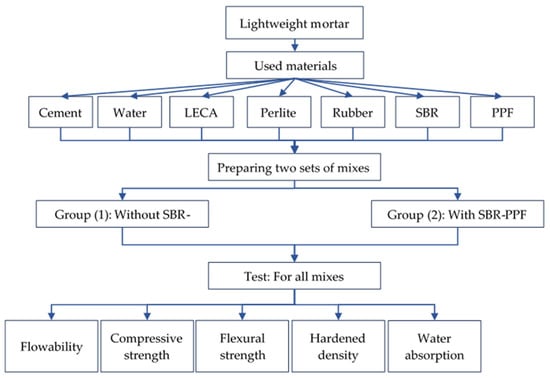
Thus, the combination of these aggregates is intended to reduce the limitations associated with each individual material while improving the overall performance of the mortar system. In general, the investigated mixtures were designed to explore lightweight mortar systems with reduced density and measurable mechanical performance. The present study does not establish suitability for a specific construction application or compliance with application-specific requirements for strength, durability, moisture resistance, dimensional stability, fire performance, or thermal performance. Figure 1 presents a brief overview of the research methodology.
Figure 1.
The methodology of the research.
2.1. Materials
In this study, sulfate-resistant Portland cement was adopted as the primary binder. Its physical and chemical properties are listed in Table 1, and the results indicate that the cement complies with the requirements of the Iraqi specification [24].
Table 1.
(A). Chemical properties of the used cement. (B). Physical properties of the used cement.
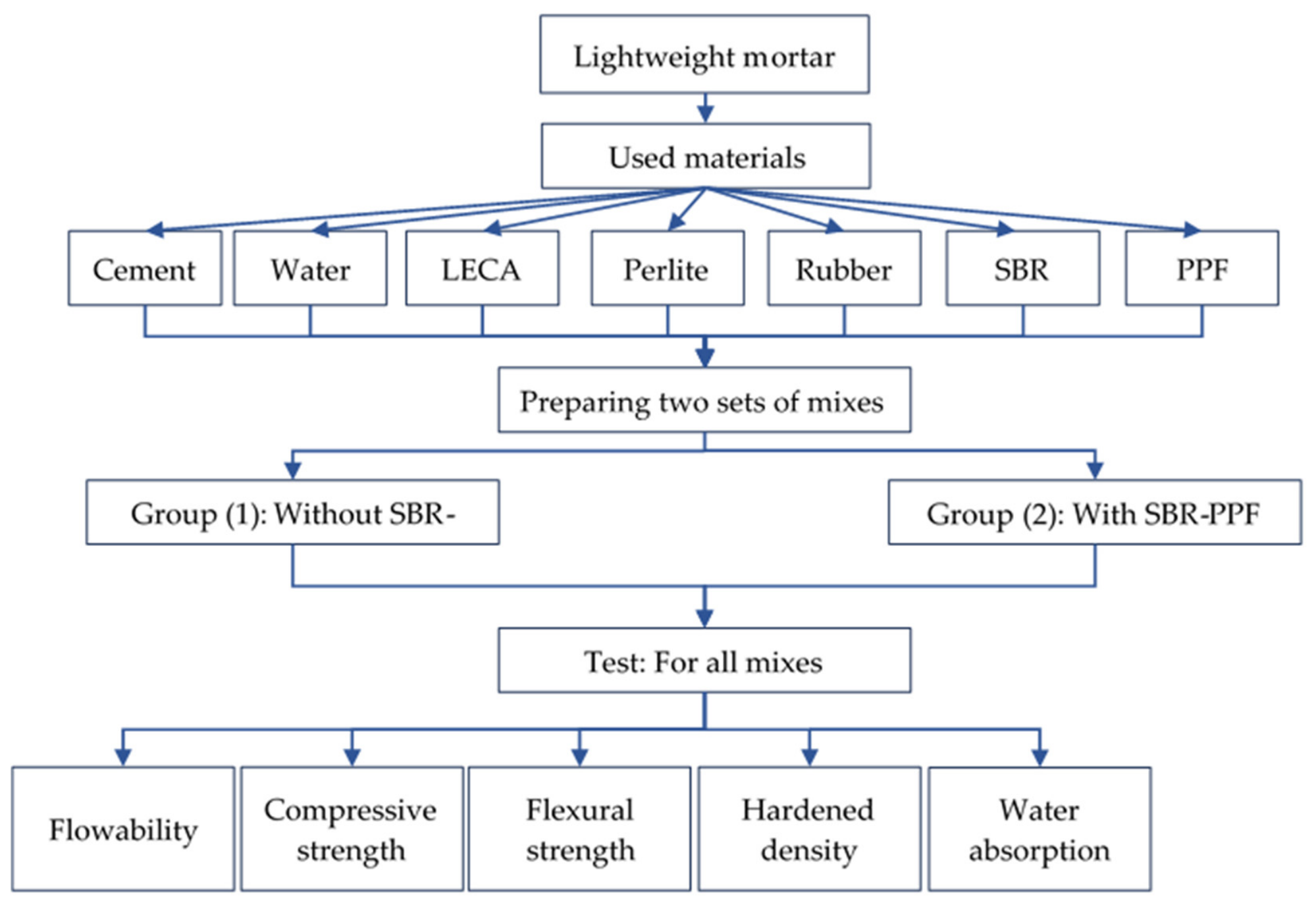
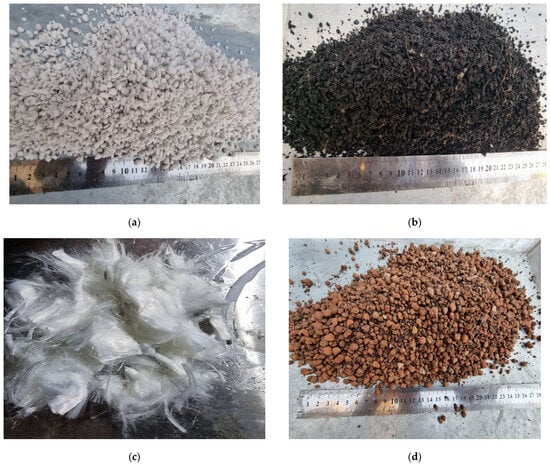
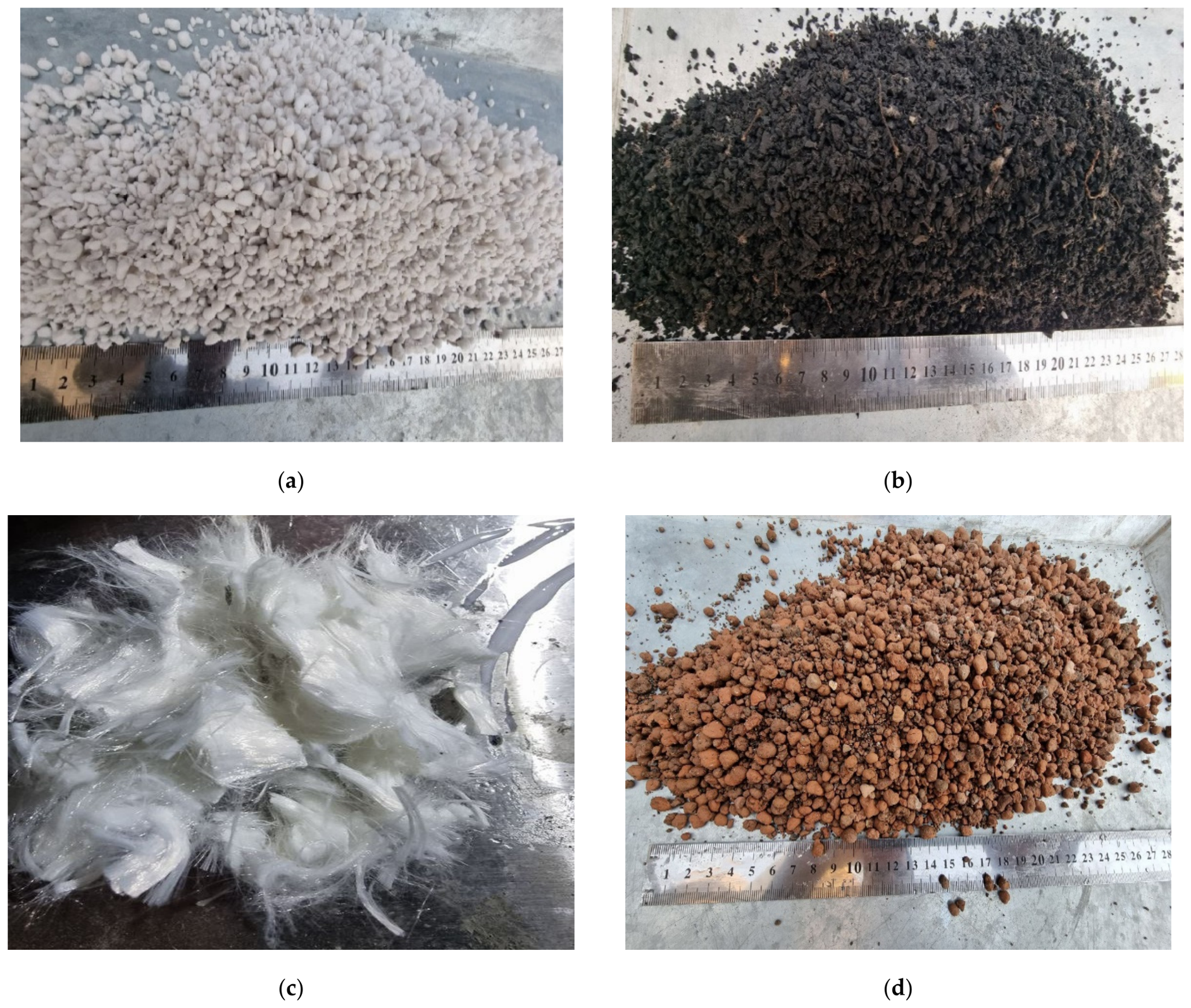
Fine LWAs, including perlite, LECA, and recycled rubber, were used for the production of lightweight mortar; all types of aggregate used are displayed in Figure 2, in addition to PPF.
Figure 2.
The materials used: (a) Perlite aggregate, (b) Recycled rubber, (c) Polypropylene fiber, and (d) LECA aggregate.
Styrene–butadiene rubber (SBR) latex is a polymer-based material commonly used as a modifying agent in cementitious composites. It may improve bonding between the cement paste and aggregates, reduce water permeability, and enhance flexibility and crack resistance. In addition, SBR modification may contribute to improved durability by reducing water penetration and improving interfacial bonding within the cementitious matrix. According to the manufacturer’s technical data sheet, the SBR latex with trademark of SHIELDLATEX SBR 50 (BAYSHIELD International FZC, Umm Al Quwain, United Arab Emirates) has a solids content of 50%. The adopted SBR dosage of 10% refers to the mass of the as-received latex relative to the cement mass, rather than to the mass of polymer solids. The latex density was not used in the dosage calculation, which was performed on a mass basis. This value was considered when calculating the effective mixing water, as the remaining 50% of the latex contributes water to the mixture. Accordingly, for the SBR–PPF-modified mixtures containing 30 kg/m3 of SBR latex, 15 kg/m3 was considered as polymer solids and the remaining 15 kg/m3 as water contributing to the effective water content.
Polypropylene fibers (PPF) are synthetic fibers commonly incorporated into cementitious composites to improve crack resistance and toughness. These fibers act as crack-bridging elements that help control microcrack propagation, thereby improving post-cracking behavior and reducing brittle failure.
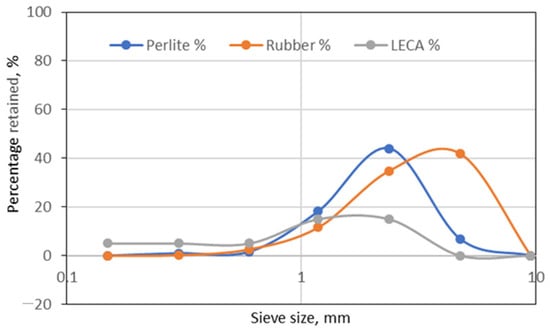
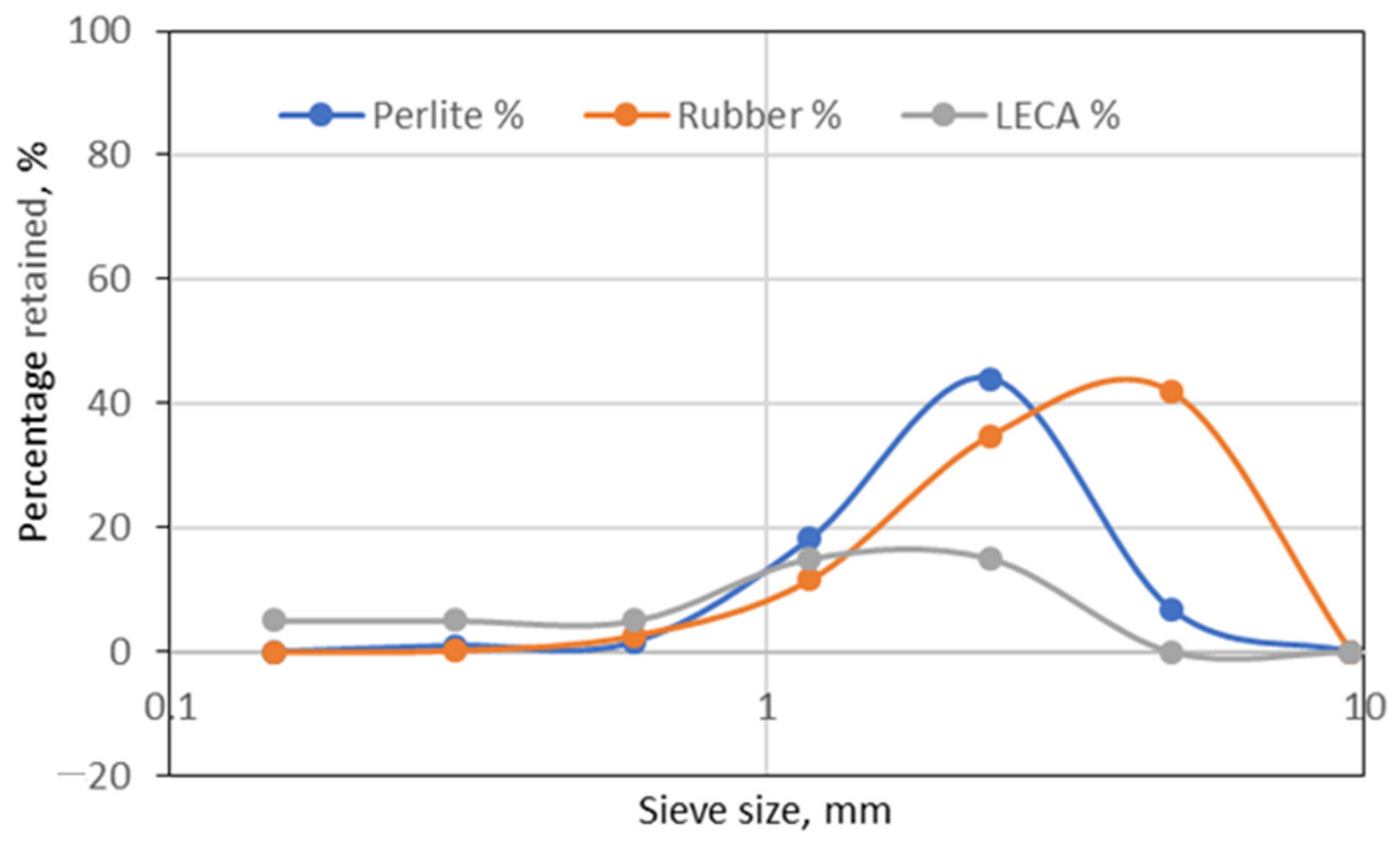
The aggregates used in this study were gap-graded, as shown in Figure 3, resulting in heterogeneous mixtures with a relatively low fines content, which may contribute to increased water absorption and void content. Expanded perlite has a highly porous cellular structure and low density. LECA consists of lightweight, porous, rounded particles produced by firing natural clay at high temperature. In contrast, crumb rubber particles are flexible, hydrophobic, and deformable, which may reduce bonding with the cement paste but can improve energy absorption capacity and ductility. Figure 3 presents the particle size distributions of the three aggregate types, each with a nominal maximum size of 4.75 mm.
Figure 3.
Particle size distribution curve for all the lightweight materials.
Furthermore, the main physical properties of the used LWAs are summarized in Table 2.
Table 2.
The physical properties for all the aggregates used.
The density values reported in Table 2 represent bulk densities of the aggregate materials and are used to characterize their mass–volume relationship in the adopted mixture-proportioning procedure. They should not be interpreted as particle densities or specific gravities for an absolute-volume calculation. The chemical composition of the LECA, expanded perlite, and crumb rubber used in this study was not independently determined. Accordingly, batch-specific oxide or elemental composition data are not reported for these constituents. Their characterization in the present work is therefore limited to the physical properties and particle size distributions reported in Table 2 and Figure 3, respectively.
2.2. Mix Proportion and Tests
All constituent materials were prepared prior to mixing to ensure uniformity during mortar production. To minimize rapid water uptake during mixing, expanded perlite and LECA were pre-soaked in water for 24 h and subsequently air-dried before batching. Crumb rubber particles were incorporated in a dry condition without pre-treatment because of their hydrophobic and non-absorptive nature.
A mechanical mixer was used for the preparation of the mortar mixtures. All the dry materials (such as cement and aggregates) were first mixed thoroughly and evenly to distribute the constituent materials. Water and SBR latex (when used) were then slowly added while the mixing process was carried out until a uniform mortar was achieved. The PPF was introduced at the final mixing stage, followed by further mixing to promote uniform fiber dispersion throughout the mortar matrix. The same mixing sequence and mixing duration were maintained for all mixtures to ensure consistency in constituent dispersion and fresh-mixture preparation. After mixing the fresh mortar, specimens were cast and compacted following the specified procedure. The specimens were then cured at a controlled temperature of 20 ± 2 °C as per the relevant standards. Ten mixes were prepared in this research, divided into two groups of five mixes each. The first group, consisting of unmodified mixtures without SBR latex and PPF, was considered the reference group and used as the baseline for evaluating the effect of SBR–PPF modification. These mixes contain fine lightweight aggregates (LWAs), namely LECA, perlite, and crumb rubber. The first group was prepared without SBR and PPF modification. In the second group, 10% SBR by weight of cement was added to increase the adhesion between the ingredients of the mixture, and 1% PPF by weight of cement was employed to enhance mechanical performance. For mixtures containing SBR latex, the added mixing water was reduced to account for the water supplied by the latex. Based on the manufacturer’s specified solids content of 50%, the remaining 50% of the SBR latex mass was included in the total mixing water. Thus, the unmodified mixtures contained 120 kg/m3 of water and 300 kg/m3 of cement, corresponding to a water-to-cement ratio of 0.40. The modified mixtures contained 90 kg/m3 of added water plus 15 kg/m3 of water contributed by the SBR latex, resulting in an effective water content of 105 kg/m3 and an effective water-to-cement ratio of 0.35. The lightweight aggregates were pre-soaked in water for 24 h before mixing and subsequently air-dried before batching. No separate standardized verification of the SSD condition was performed. Therefore, the aggregate preconditioning procedure is reported operationally rather than as a rigorously verified SSD state. Water retained within the pre-soaked aggregates was not included as free mixing water in the calculation of the effective water-to-cement ratio. Table 3 presents the nominal mixture proportions and batch quantities adopted in the experimental program. These quantities are mixture design values based on the specified volumetric proportions and should not be interpreted as experimentally normalized masses corresponding to an exact fresh mortar yield of 1.000 m3. The numerical mix-ratio notation in Table 3 follows the constituent sequence indicated for each mixture and is used as a nominal proportioning designation rather than as an absolute-volume calculation based on the aggregate densities in Table 2. The adopted proportions were based on a previous relevant study [25]. The selected mixture proportions and modifier dosages were defined based on preliminary trial mixtures and previous relevant studies in order to achieve lightweight mortars with reduced density, acceptable workability, and suitable mechanical performance. The values 1, 1.2, 2, and 3.2 in the mix-ratio designations represent nominal volumetric parts according to the constituent sequence specified in Table 3. Because the lightweight aggregates have different bulk densities and particle characteristics, the corresponding batch masses differ among the investigated mixtures.
Table 3.
Nominal mixture proportions and batch quantities used in the experimental program.
The flow test was performed in conformance with the ASTM C1437 standard [26]. The fresh mortar was added to the flow mold in several layers, with each layer compacted and the surface smoothed. The mold was then carefully removed, and the flow table was operated for 25 drops. The diameter of the spread of the mortar was measured, and the flow value was calculated using the following equation:
where Davg is the average diameter of the mortar spread after the flow test and D0 is the original inside diameter of the flow mold.
Water absorption and oven-dry hardened density were determined at 28 days in accordance with ASTM C642 [27]. As for the mechanical tests, they included the compressive strength test of the mortar at ages 7, 28, and 56 days according to the specification BS EN12390-3 [28]. All these tests were conducted using 5 × 5 × 5 cm cubic specimens. The flexural strength test was conducted at the age of 28 days according to the specification ASTM C78 [29], using 4 × 4 × 16 cm prismatic specimens. Each mixture and testing condition was evaluated using three independent specimens (n = 3). The experimental results are reported as mean ± standard deviation (SD). Given the limited number of replicates, statistical comparisons among the different mixture groups were restricted to descriptive statistics, and no formal inferential significance testing was performed for between-mixture comparisons. Consequently, differences among mixtures are interpreted as observed experimental trends rather than as statistically significant differences.
2.3. Casting and Curing Samples
Before casting, the lightweight aggregates were preconditioned by the soaking and air-drying procedure described in Section 2.2. The specimens were cast in three layers, with each layer compacted in accordance with ASTM C192/C192M [30]. The molds were also tapped externally with a metal tamping rod to reduce entrapped air and obtain consistent specimen consolidation. All specimens were demolded 24 h after casting and subsequently subjected to continuous water curing at 20 ± 2 °C until the specified testing age. The same curing regime was applied to both the unmodified and SBR–PPF-modified mixtures to maintain consistency throughout the experimental program.
3. Results and Discussion
3.1. Effect of Lightweight Aggregate Type (Unmodified Mixes)
3.1.1. Flowability of Unmodified Mixes
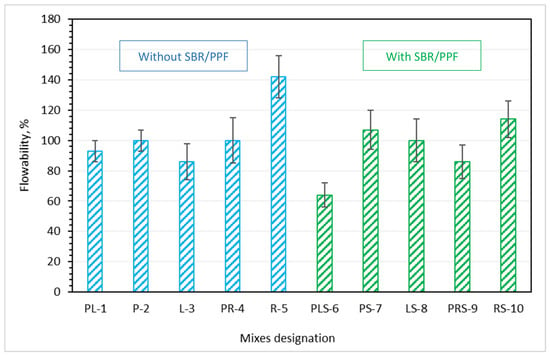
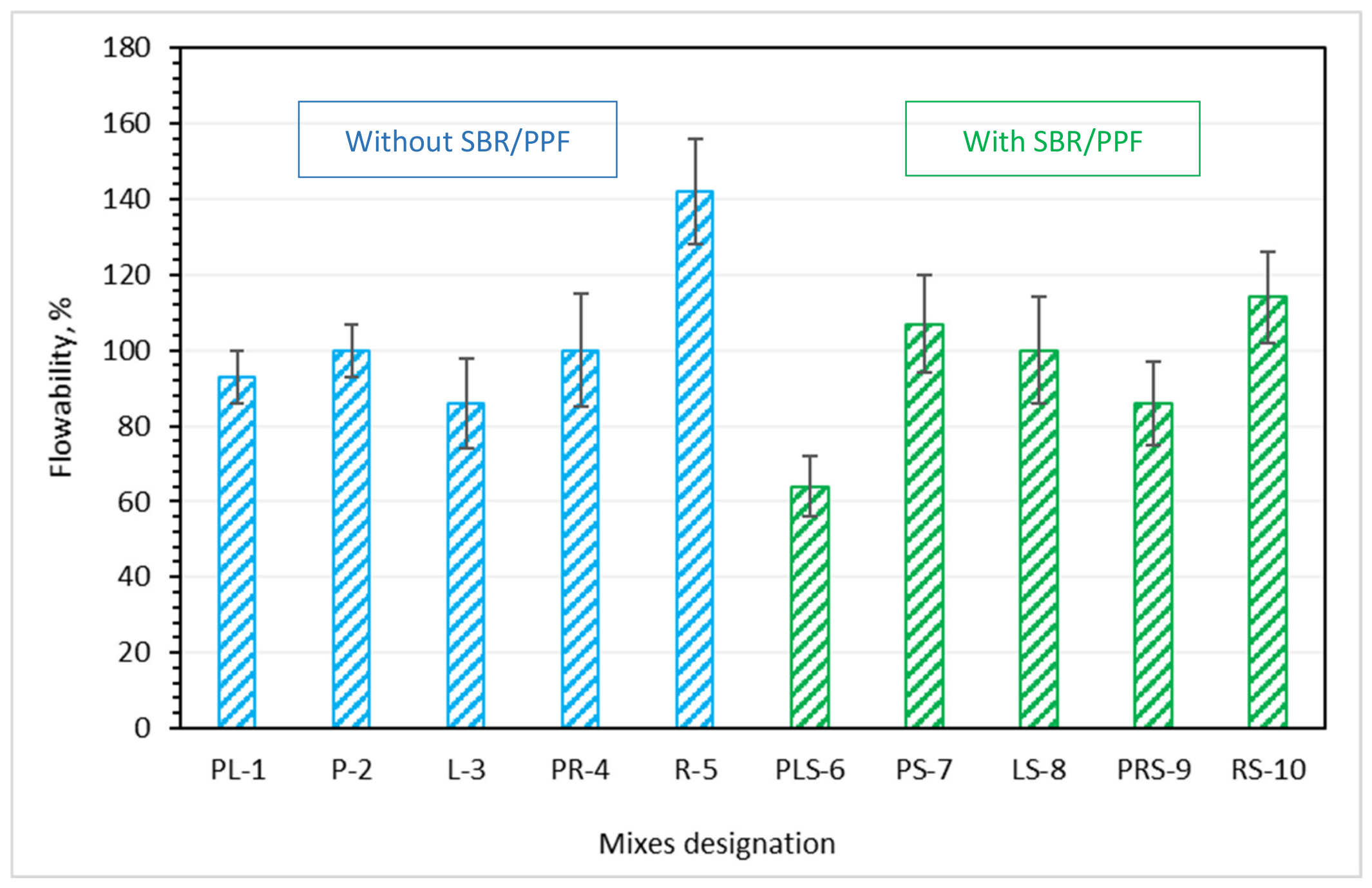
Figure 4 represents the flowability of the fresh mixes. In general, the plotted results showed a broad dispersion in flowability (i.e., 64–142%), demonstrating that the observed behavior was controlled by changes in the effective availability of mixing water, internal friction, and paste modification. For the mixtures without SBR and PPF containing a water content of 120 kg/m3, the mixes comprising LECA solely or with perlite aggregate provided lower flowability compared with those containing perlite and/or rubber, which can be attributed to the inherent porous and absorptive nature of LECA, which withdraws part of the effective mixing water and increases interparticle friction, thereby lowering the effective lubrication of the mortar matrix [8]. In contrast, the rubber-only mixture delivered higher flowability, indicating that, under the present particle characteristics and replacement scheme, rubber behaved as a largely non-absorptive material that preserved free water within the fresh mixture and facilitated its spread ability; a similar interpretation has been reported in related studies [12].
Figure 4.
Flowability of the investigated cement mortar mixes (mean ± SD, n = 3).
Nevertheless, comprehensive recent reviews also note that rubberized cementitious composites frequently show reduced workability when rubber content and particle morphology increase friction or entrain air, highlighting that the direction of change can be mixture-dependent [31]. In addition, the perlite-only mix exhibited moderate flowability through the plastic stage, which is consistent with prior reports that perlite-based lightweight mortars can display variable workability depending on grading and preconditioning, with outcomes ranging from reduced to acceptable flow behavior [9]. The perlite-based lightweight mortars exhibited higher flowability by around 16.3 and 7.5% compared with LECA and LECA–perlite mortars, respectively, while their flowability was lower than that of rubber-only mortar by about 29.6%. Moreover, when rubber was combined with perlite, the high flowability observed with rubber alone was suppressed, implying competing mechanisms in which perlite-related water demand and packing effects counterbalanced the free-water retention associated with rubber, a non-monotonic response that is commonly emphasized in studies of composite lightweight rubberized mortar systems [12].
3.1.2. Compressive Strength of Unmodified Mixes
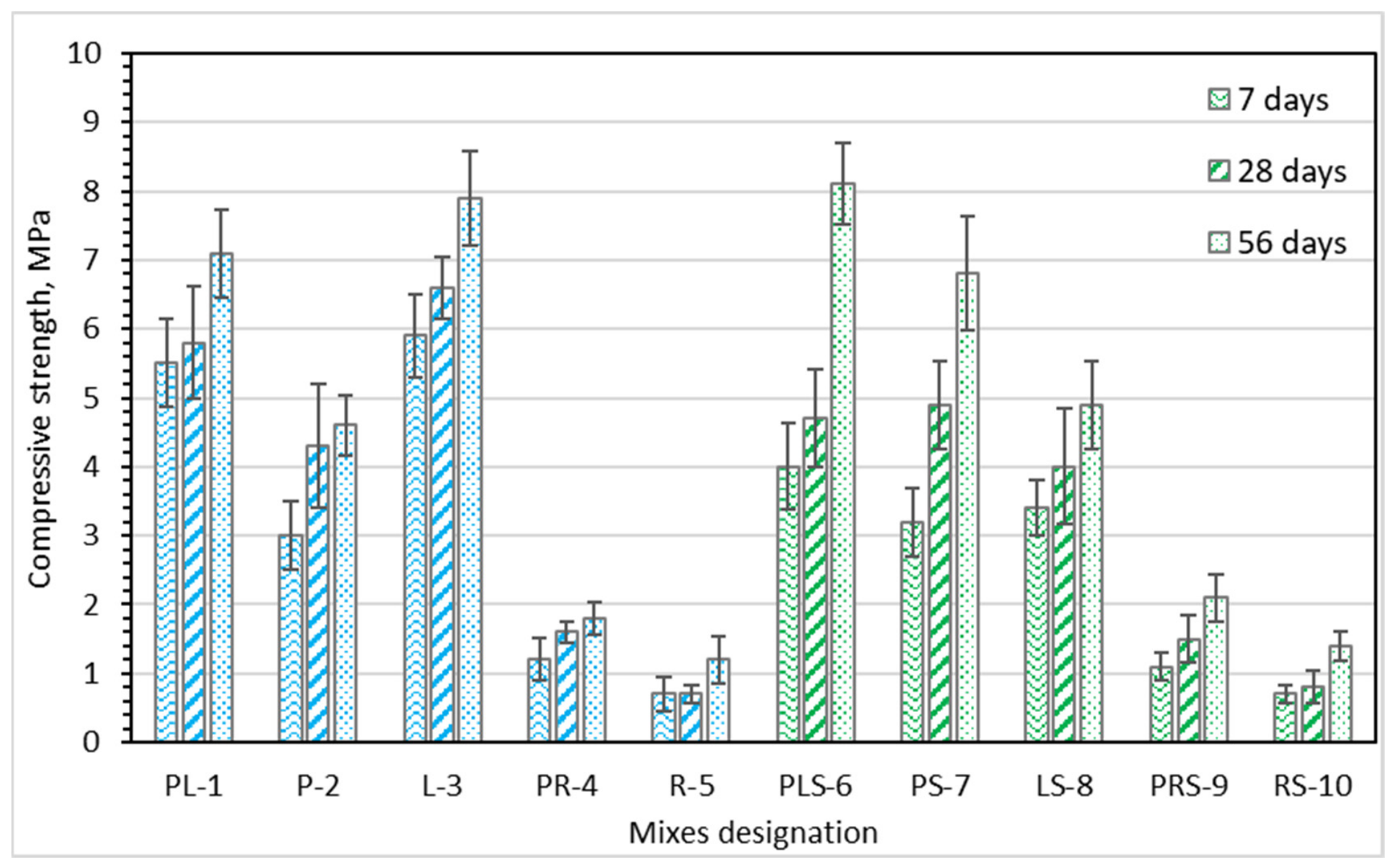
The compressive strength results plotted in Figure 5 show a clear age-dependent gain across all mixes (from 0.7–5.9 MPa at 7 days to 1.2–8.1 MPa at 56 days), reflecting the continuous hydration of cement over the adopted testing ages [32]. The compressive strength (C.S) data of different concrete mixes are given in Table 4 and Figure 5 for the curing ages of 7 days, 28 days, and 56 days. Three independent specimens (S1, S2, S3) were tested for each mixture, and the results are reported as mean ± standard deviation (SD). However, the ranking is strongly controlled by the aggregate type and, most decisively, the presence of rubber. In the mixes without SBR and PPF, the compressive strength of the LECA-only mixture consistently exceeded that of the LECA–perlite mixture, reaching 6.6 MPa at 28 days and 7.9 MPa at 56 days, reflecting an improvement of 13.8 and 11.3% relative to PL-1, which exhibited compressive strengths of 5.8 and 7.1 MPa at these testing ages. This behavior may be associated with the comparatively higher mechanical stability of LECA and its rougher surface texture, which can contribute to improved interaction with the cement matrix. The highly porous structure of expanded perlite leads to a higher overall void content, which may reduce mechanical strength while improving thermal insulation characteristics. This is consistent with the general understanding that lightweight systems are highly sensitive to aggregate porosity, absorption capacity, and the quality of the paste–aggregate interface [8].
Figure 5.
Compressive strength of the investigated cement mortar mixes.
Table 4.
Compressive strength results, MPa (mean ± standard deviation).
By contrast, rubber incorporation caused the strongest strength reductions. The rubber-only mixture R-5 exhibited compressive strengths ranging from 0.7 to 1.2 MPa over the tested ages, corresponding to reductions of approximately 87.9% and 83.1% relative to PL-1 at 28 and 56 days, respectively. Similarly low values were observed for the perlite–rubber mixture PR-4. The observed reduction in compressive strength is consistent with mechanisms commonly reported for rubberized cementitious materials, including weaker rubber–paste interfacial interaction, stiffness mismatch, and increased air or defect content [12]. However, these microstructural and interfacial mechanisms were not directly characterized in the present study and should therefore be regarded as possible explanations for the measured macroscopic response.
3.1.3. Flexural Strength of Unmodified Mixes
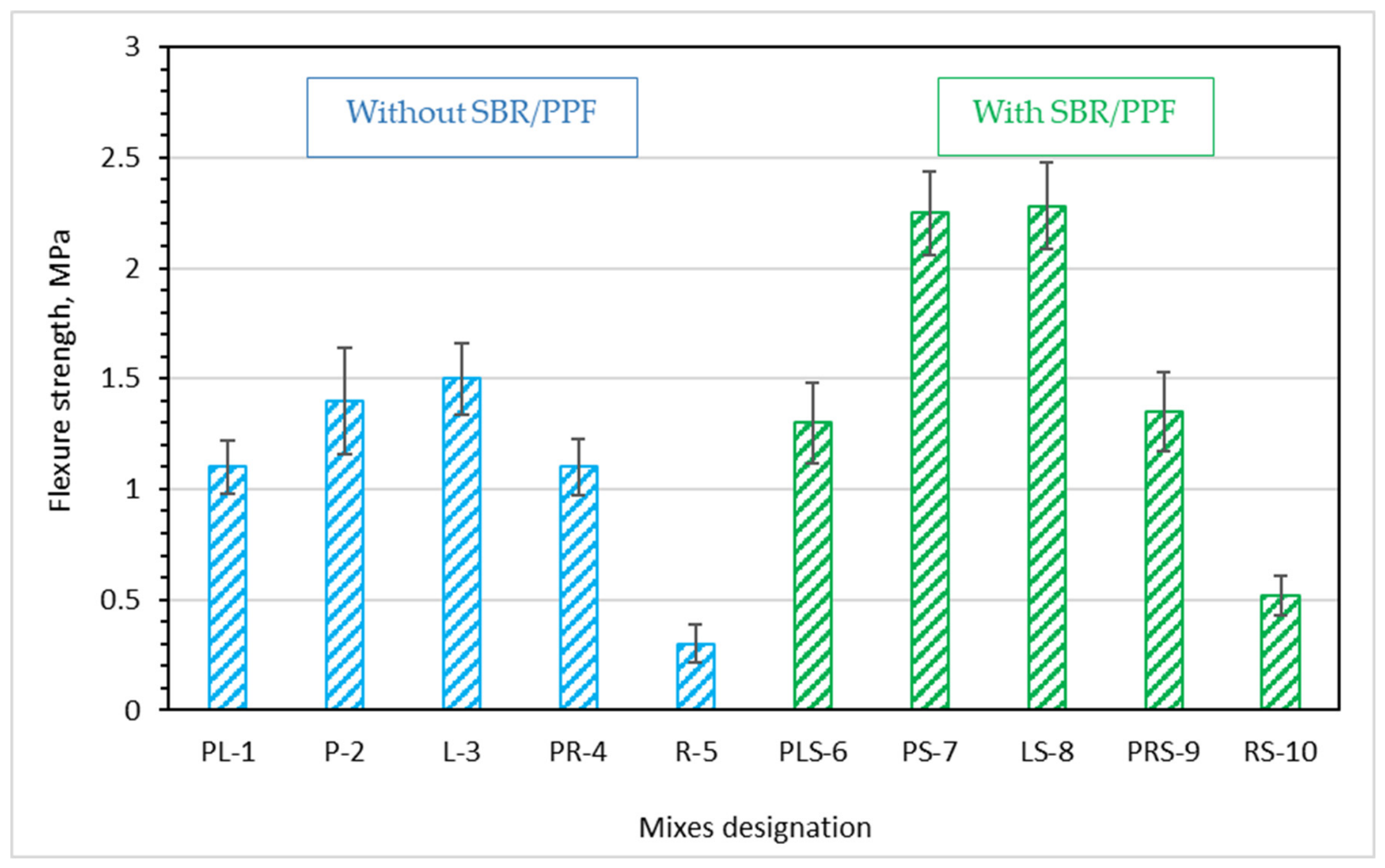
The flexural strength of the investigated mortars spans a wide range (0.3–2.3 MPa), indicating substantial differences in bending response among the mixtures. Based on mechanisms reported in the literature, these differences may be associated with load-transfer conditions at the paste–aggregate and paste–rubber interfaces and, in the modified mixtures, with the combined effects of the modified mixture design; however, these mechanisms were not directly characterized in the present study. Figure 6 and Table 5 illustrate the 28-day flexural strength results. The PL-1 mixture, containing LECA and perlite, exhibited a flexural strength of 1.1 MPa. Replacing this aggregate system with perlite only (P-2, 1.4 MPa) or LECA only (L-3, 1.5 MPa) increased the flexural strength by 27.3% and 36.4%, respectively, indicating a more effective skeleton and/or improved stress redistribution under bending loads. From another perspective, rubber incorporation produced the clearest adverse effect on the flexural strength. Whereas the rubber-only mix (R-5) produced a strength of 0.3 MPa, and after modification with polymer and fiber, the strength increased to 0.5 MPa, it still fell by 72.7% and 52.7% compared to PL-1. In addition, when rubber was combined with perlite, the flexural strength increased remarkably, to 1.1 and 1.4 MPa for the rubber-perlite mix and modified rubber-perlite mix, respectively. However, the strength remained well below that of the best-performing modified mixtures. This trend is consistent with literature reports associating crumb rubber incorporation with weaker rubber–matrix interaction and increased defect or void content [33]; these interfacial and microstructural features were not directly observed in the present study.
Figure 6.
Flexural strength of the investigated cement mortar mixes.
Table 5.
Flexural strength results, MPa (mean ± standard deviation).
The relatively low flexural performance of rubber-containing mixtures may be associated with the weaker interaction between rubber particles and the cementitious matrix [34].
3.1.4. Density of Unmodified Mixes
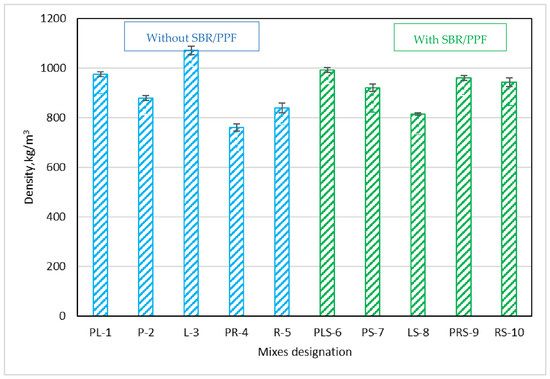
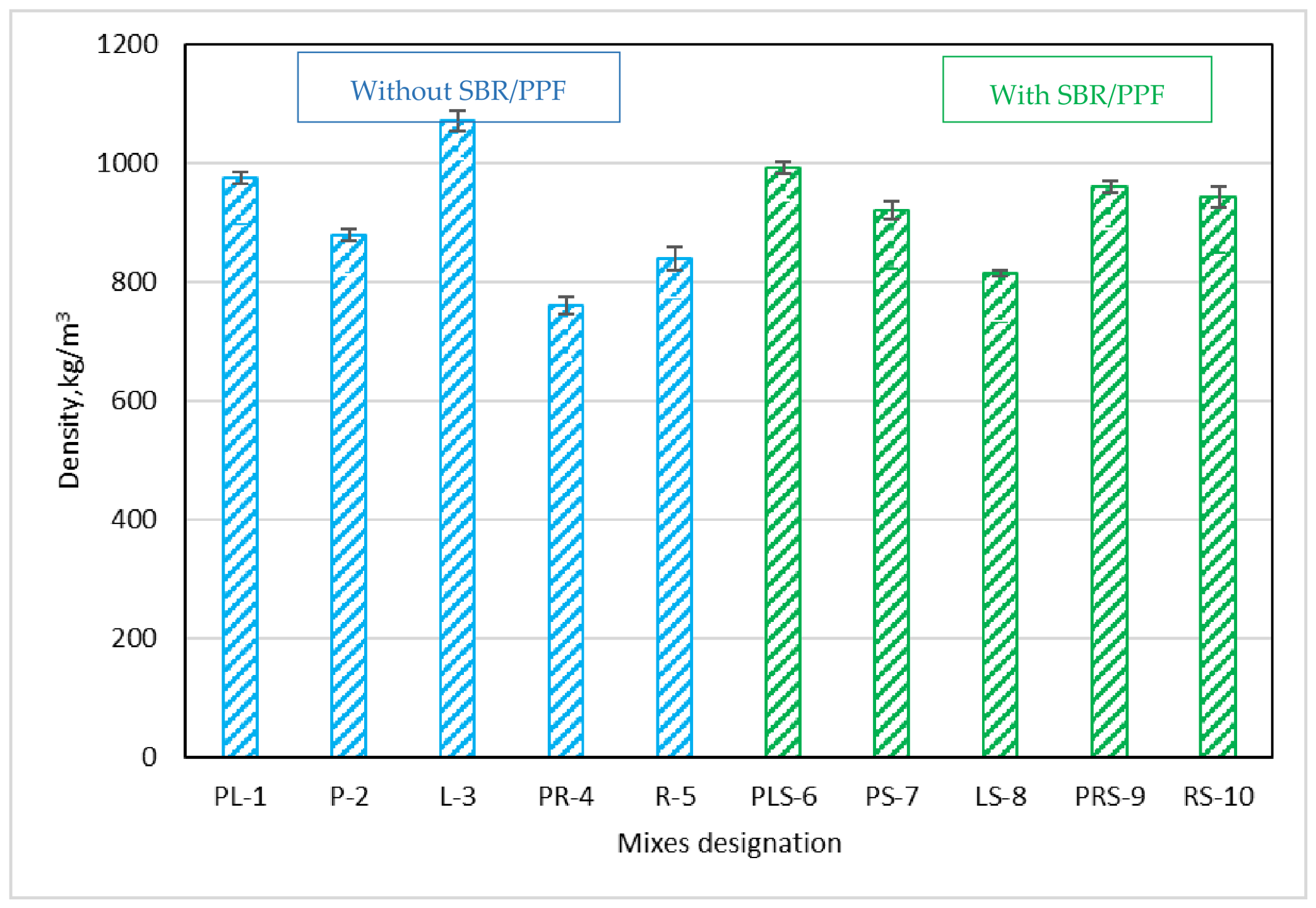
At 28 days, the measured hardened density values of the mortar specimens varied from 760 to 1072 kg/m3, demonstrating that the hardened mass of the fabricated mortars is mainly dictated by the type (and volumetric share) of the used LWAs and the inclusion of rubber, rather than by the constant cement paste content alone, as clearly shown in Table 6 and Figure 7. Compared with the density of the PL-1 mix of 976 kg/m3, the LECA-only mixture L-3 (1072 kg/m3) exhibited the highest density with an increase of 9.8%, while the perlite-only mixture P-2 exhibited a density value of 880 kg/m3, showing a reduction of 9.8%, which is consistent with the distinct packing, porosity characteristics, and intrinsic bulk density of LWAs reported for comparable lightweight cementitious systems [5].
Table 6.
Oven-dry hardened density results, kg/m3 (mean ± standard deviation).
Figure 7.
Hardened density of the investigated cement mortar mixes.
The most pronounced reduction in density occurred when rubber was incorporated as fine aggregate. The PR-4 and R-5 mixtures exhibited densities of 760 and 840 kg/m3, respectively, corresponding to reductions of approximately 22.1% and 13.9% relative to PL-1. This behavior reinforces the well-documented tendency of crumb rubber to reduce hardened density because of its lower specific gravity and its propensity to increase the void content within the mortar system [35,36]. The observed ranking of density values, with the highest value for the LECA-only mixture and the lowest values for rubber-containing mixtures, is consistent with previous studies showing that LWA selection governs the baseline density of lightweight mortars, while rubber incorporation can further reduce density through its low particle density and associated void effects [5,35].
3.1.5. Water Absorption of Unmodified Mixes
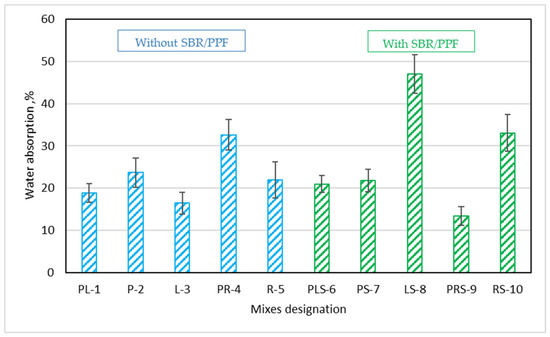
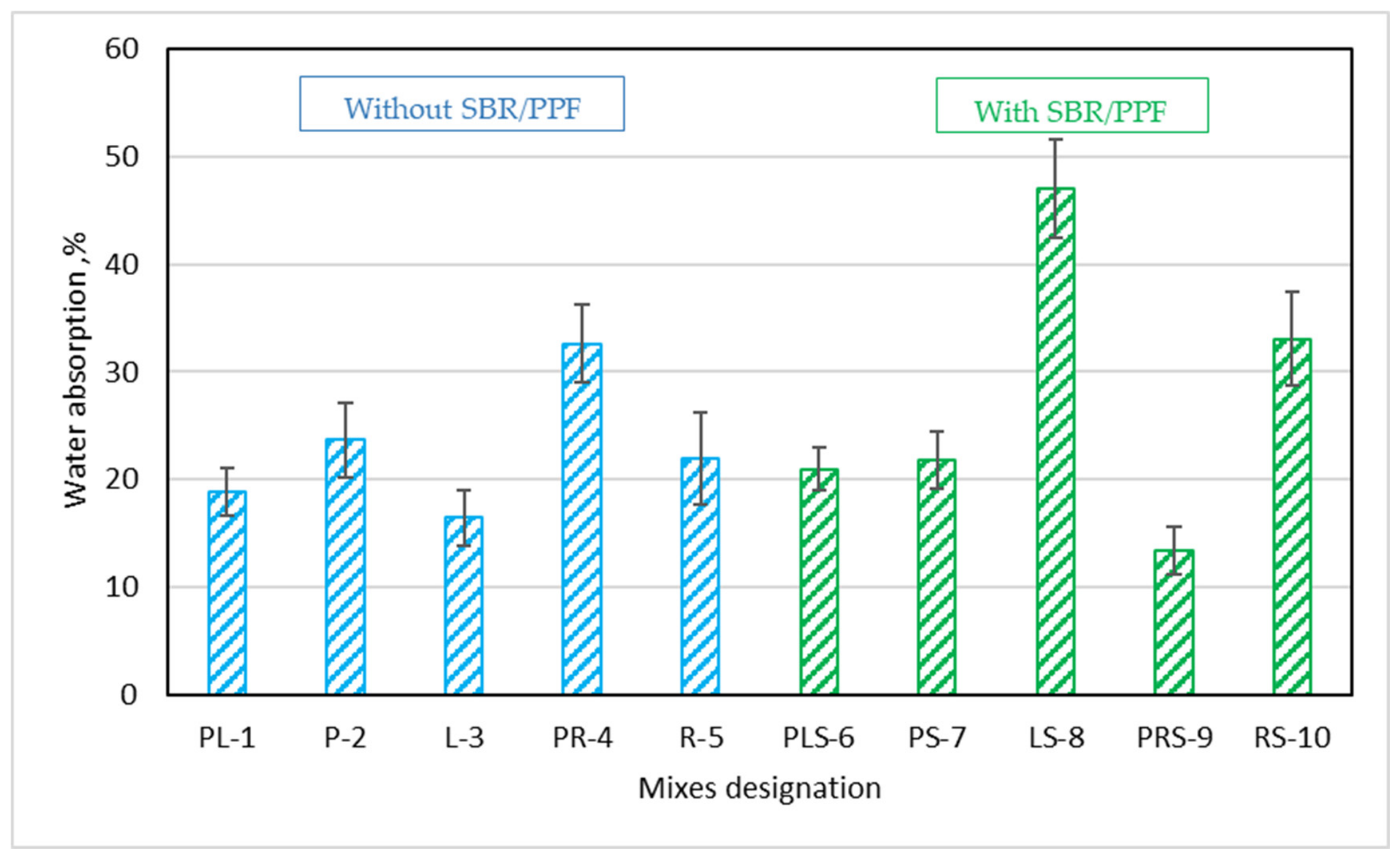
After curing the specimens for 28 days, the water absorption capacity of the fabricated mortars ranged widely from 13.3% to 47.1%, showing substantial differences among the investigated mixtures, as presented in Table 7 and Figure 8. These differences may be associated with the absorption characteristics of the aggregates and with variations in pore accessibility and internal structure; however, pore connectivity and void structure were not directly characterized in the present study. The water absorption value of PL-1 was 18.9%, and replacing the aggregate system with perlite only (P-2) increased the water absorption to 23.6%, corresponding to an increase of approximately 25.4%, which is consistent with the intrinsically high porosity and water uptake potential commonly reported for perlite-based lightweight systems [6]. By contrast, the LECA-only mix (L-3) exhibited water absorption of 16.2%, showing a reduction of around 12.9% relative to PL-1, which indicates lower measured water absorption under this proportioning; the corresponding pore network characteristics were not directly determined. In addition, introducing rubber generally pushed absorption upward to 21.90%, representing an increase of about 16.2% relative to the PL-1 mix, while PR-4 containing rubber and perlite provided a water absorption value of 32.6%, which increased sharply by 73.1%, reflecting the well-recognized tendency of crumb rubber cementitious composites to develop higher defect volume and interfacial discontinuities that promote transport, especially when rubber is combined with other porous constituents [37,38].
Table 7.
Water absorption results, % (mean ± standard deviation).
Figure 8.
Water absorption capacity of the investigated cement mortar mixes.
Lightweight aggregates such as perlite or LECA are typically linked with increased water absorption, as they are porous and thus absorb more water than the cementitious matrix and polymer modification, but the lower absorption of water in certain mixes can be explained by the prevalence of the cementitious matrix. The incorporation of SBR may contribute to improved matrix cohesion and reduced water penetration within the mortar system, as suggested in previous studies involving polymer-modified cementitious materials [18].
Therefore, the overall water absorption behavior may not only be influenced by the absorption characteristics of the aggregates and the connectivity of the pore network, but also by interactions between water molecules and the solid phases of the cementitious matrix. Hydrophilic cement hydration products contain polar and hydroxyl-bearing sites that may interact with water molecules through hydrogen bonding and other surface interactions, thereby contributing to moisture uptake. However, a higher measured water absorption cannot be interpreted directly as evidence of stronger hydrogen bonding, because the measured response is also strongly influenced by pore volume, pore accessibility, pore connectivity, and aggregate absorption. In the present study, no FTIR, surface-chemical, or other molecular-scale characterization was performed to quantify these interactions. Accordingly, the molecular interpretation is considered a possible contributing mechanism, while the experimental discussion remains primarily based on macroscopic pore accessibility, material composition, and the measured water absorption response.
3.2. Combined Effects of SBR–PPF Modification and Reduced Mixing Water
The comparisons presented in this section reflect the combined effects of SBR–PPF incorporation and the associated reduction in added mixing water. Because these variables were changed simultaneously, their individual contributions cannot be isolated within the present experimental design. Accordingly, the observed differences between modified and unmodified mixtures are interpreted as coupled responses rather than as effects attributable exclusively to SBR, PPF, or water adjustment.
3.2.1. Flowability of Modified Mixes
As shown in Figure 4, the introduction of SBR latex and PPF with a reduced mixing water content made the flow response more sensitive to mixture composition. This observed decrease in flowability could be due to the interplay of the various factors, namely, PPF incorporation, the addition of SBR latex, and the reduction in mixing water. PPF has been reported to significantly decrease the workability of mortars due to increased frictional resistance and the formation of a mechanical fiber network that may adversely affect the spreadability of the fresh mortar. Likewise, SBR latex can affect the cohesiveness and viscosity of the cementitious matrix and therefore affect the flowability, especially if the amount of water available for mixing is reduced. In the current experimental design, however, the effect of these three variables on the resultant flow behavior can not be distinguished from each other. It is therefore difficult to conclude that the above mechanisms represent individual causal effects, as opposed to mere possibilities [39]. This combined response was most pronounced for the LECA–perlite mortar and may reflect the simultaneous influence of reduced mixing water, the high water demand of the porous aggregates, and the presence of fibers on the fresh-mixture rheology. However, the individual contribution of each factor cannot be established from the present experimental design, consistent with the general requirement in lightweight mortar practice to account for aggregate absorption when interpreting fresh workability [31]. Conversely, rubber-containing SBR–PPF mixes retained comparatively higher flowability, supporting the idea that the low absorption of rubber can help preserve workability even under reduced water content with fiber incorporation, as also observed in rubberized mortar reports when mixture design favors free-water retention [40]. The flow was decreased from 142% to 114% in RS-10, which may reflect the combined effects of PPF and SBR incorporation together with the reduction in mixing water; meanwhile, the rubber-SBR–PPF mixture provided higher flowability by 78.1, 6.5, 14.0, and 32.6% compared to LECA–perlite, perlite-only, LECA-only, and perlite–rubber mortars, respectively, demonstrating the effect of the inherent porous nature of the aggregate on the flowability of the fresh mixture.
3.2.2. Compressive Strength of Modified Mixes
Incorporating SBR and PPF, along with reducing the mixing water, made the later-age compressive strength more sensitive to the mixture composition. The strength of the PLS-6 mix increased from 4.0 at 7 days to 8.1 MPa at 56 days, as shown in Figure 5, representing a gain of 102.5%. This value exceeded that of the PL-1 mix at 56 days by 14.1%. The pronounced later-age strength increase observed for PLS-6 should be interpreted cautiously. Because SBR, PPF, mixing water content, and curing conditions may all influence strength development, the present experimental design does not permit this increase to be attributed to a single mechanism. In particular, the continuous water-curing regime adopted for all specimens may have influenced the development of the SBR-modified matrix, and this effect was not investigated independently in the present study. However, the rubber-bearing mixes remained low, confirming that, within the studied proportions, the adverse effect of rubber dominated the compressive strength response unless the rubber–paste interaction is enhanced through surface modification, which has been shown to mitigate strength loss by improving the cement–rubber interface [41].
3.2.3. Flexural Strength of Modified Mixes
The mixtures incorporating SBR and PPF together with reduced added mixing water exhibited the most pronounced flexural strength increases in the perlite- and LECA-based systems. The PS-7 and LS-8 mixes achieved a flexural strength value of approximately 2.3 MPa (Figure 6), representing an increase of about 109.1% compared to the LECA–perlite mortar. Moreover, these mixes exceeded their unmodified counterparts, P-2 and L-3, by approximately 60.7 and 52.0%, respectively.
This behavior is consistent with mechanisms reported in the literature, including crack bridging by PPF and improved matrix bonding associated with SBR. However, because PPF, SBR, and mixing water content were varied simultaneously, and crack bridging was not directly characterized, these mechanisms cannot be isolated or confirmed in the present study. They are therefore considered possible explanations for the measured flexural response rather than experimentally demonstrated causal effects [21,23].
3.2.4. Density of Modified Mixes
In addition, for the modified series mixes with polymer and fiber, the density response was relatively moderate and mix-dependent. The density of PLS-6 slightly exceeded that of PL-1 by approximately 1.6%, as shown in Figure 7. In contrast, the densities of PS-7, LS-8, PRS-9, and RS-10 were lower by 5.7, 16.4, 1.6, and 3.3%, respectively, compared with PL-1. The observed density differences indicate that the modified mixture design, incorporating SBR and PPF together with reduced mixing water, did not override the dominant aggregate-controlled density trend. Because these variables were changed simultaneously, their individual contributions to changes in internal structure and pore distribution cannot be isolated. Previous studies on SBR-modified mortars have reported variations in dry bulk density with polymer dosage and curing conditions [21]; however, such mechanisms cannot be independently verified from the present experimental design.
3.2.5. Water Absorption of Modified Mixes
For the modified mortar incorporating polymer and fiber, the response became highly mix-dependent. The water absorption values of PLS-6 and PS-7 were only moderately higher than those of PL-1, as shown in Figure 8, and remained extremely low, providing the reading ranged from approximately 11.2 to 15.3%, respectively. In contrast, the LS-8 mix exhibited the highest absorption, with an increase of 149.6% relative to PL-1. This behavior may reflect the combined influence of aggregate properties, SBR–PPF incorporation, and reduced mixing water on the internal structure of the mortar system. Because these factors were varied simultaneously, the individual contribution of PPF to localized void formation cannot be isolated. Fiber-induced voids are therefore considered a possible mechanism based on previous studies rather than a demonstrated effect of the present experiments [41].
Interestingly, PRS-9 recorded the lowest water absorption, with a reduction of 29.3%. This reduction may reflect the combined influence of rubber hydrophobicity, SBR–PPF incorporation, and reduced mixing water. Previous studies have reported reduced water absorption in SBR-modified cementitious systems [20]; however, the present experimental design does not permit the individual contribution of SBR to be separated from the other simultaneous changes.
3.3. Thermal Conductivity
The thermal conductivity of concrete is a fundamental property that controls the rate of heat transfer through the material and is therefore important in assessing thermal insulation, energy efficiency, and overall service behavior. Density is considered one of the most influential parameters affecting this property because it reflects the compactness of the concrete matrix and the amount of entrapped air or voids within the material. In general, an increase in oven-dry density is associated with an increase in thermal conductivity, which is why density-based empirical equations are commonly used to estimate the thermal conductivity of concrete in engineering practice and research [42,43].
Although thermal conductivity can be measured experimentally using standard methods such as ASTM C177 [44], it was not measured experimentally in the present study. Instead, it was estimated from the oven-dry density using the empirical relationship proposed by Valore [45], which relates thermal conductivity to material density, as shown in Equation (2). It should therefore be emphasized that the values derived from the Valore correlation are not equivalent to experimental values of thermal conductivity. The correlation does not explicitly include moisture conditions, pore connectivity, aggregate-specific thermal properties, and the non-homogeneous distribution of the units under investigation for the mortar composite. The Valore relationship was originally developed in the context of hollow masonry [45] and was not specifically calibrated for mortar systems containing expanded perlite, LECA, crumb rubber, or polymeric and fiber modifiers. Its transfer to the present heterogeneous lightweight mortars therefore introduces an additional source of uncertainty. Moreover, because no direct thermal conductivity measurements were performed, the magnitude of this prediction uncertainty cannot be quantified from the present experimental data. The calculated values should consequently be regarded only as approximate density-based indicators.
where kc denotes the thermal conductivity of concrete (W/m·K), e is the base of the natural logarithm, and d represents the density of concrete (kg/m3). According to this equation, thermal conductivity is related to the oven-dry density of the material, where lower density values are generally associated with increased air void content and reduced heat transfer capacity. However, this empirical relationship does not explicitly account for the heterogeneous nature of the investigated composite systems or the individual thermal properties of the incorporated lightweight aggregates.
kc = 0.072e0.00125d
The calculated thermal conductivity values ranged from approximately 0.19 to 0.28 W/m·K. Because the Valore relationship uses oven-dry density as its input, differences among these calculated values arise directly from differences in density. These estimates should therefore be interpreted as density-based comparative indicators rather than as independent or experimentally validated thermal properties of the different mortar compositions.
In cementitious materials, density is commonly associated with thermal conductivity. Lower-density mixtures generally contain higher amounts of entrapped air and internal voids, which may contribute to lower thermal conductivity values. Since air has very low thermal conductivity at room temperature [46], higher air or void contents may be associated with lower thermal conductivity. However, the present study did not directly measure either thermal conductivity or thermal insulation performance.
Several mixtures exhibited lower estimated thermal conductivity values with decreasing density, as expected from the density-based form of the adopted empirical correlation. Although LECA, expanded perlite, and crumb rubber have been associated with low thermal conductivity in previous studies [47,48,49], the present estimates do not independently verify their thermal behavior in the investigated mortar systems.
Because the adopted correlation is a function of density alone, the calculated values cannot be used to determine independent effects of aggregate type, SBR, PPF, or other compositional variables on thermal conductivity. They should therefore be interpreted only as density-based comparative indicators. However, these estimates do not demonstrate actual thermal insulation performance. Direct thermal conductivity measurements using standardized experimental methods are therefore required to validate the thermal behavior of the investigated mortar systems. Accordingly, the present density-based estimates should not be used to assign a thermal-insulating mortar classification under BS EN 998-1 [50]. Compliance with the T1 or T2 thermal conductivity classes can only be assessed using experimentally determined thermal conductivity values under the applicable test conditions.
3.4. Relationship Between Density and Water Absorption
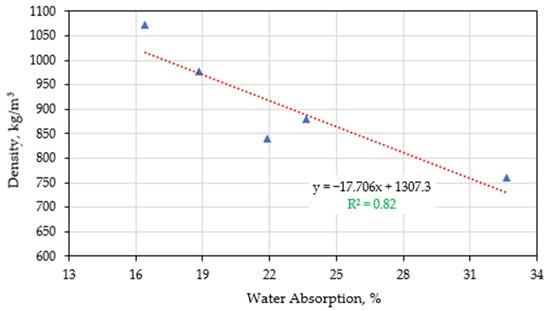
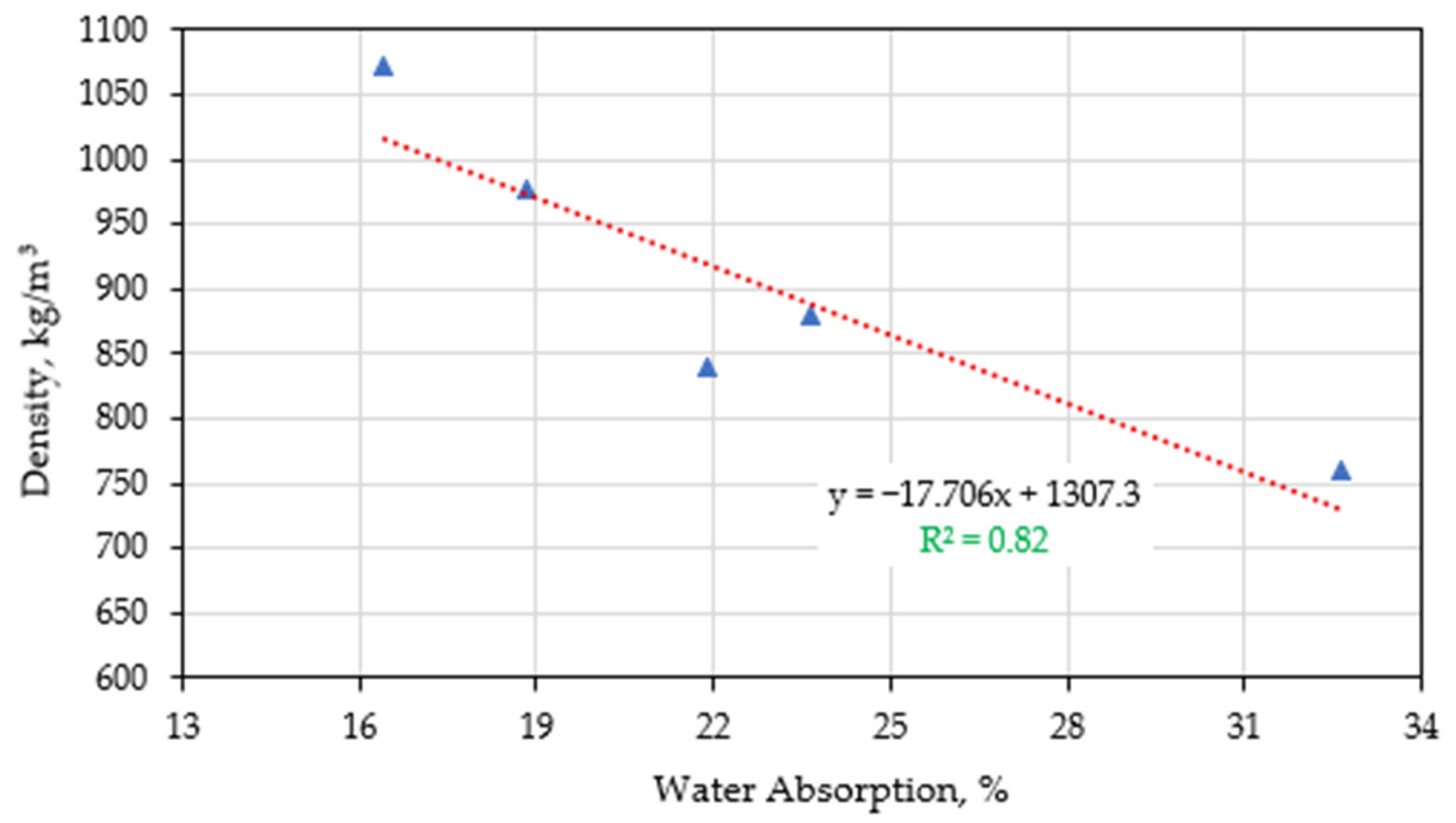
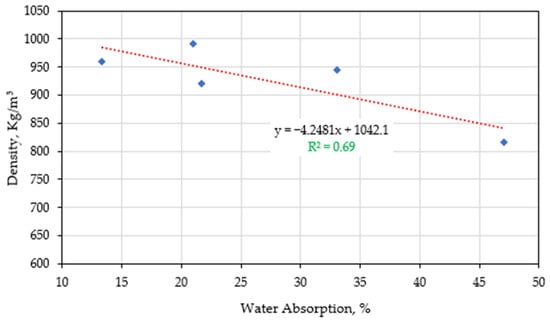
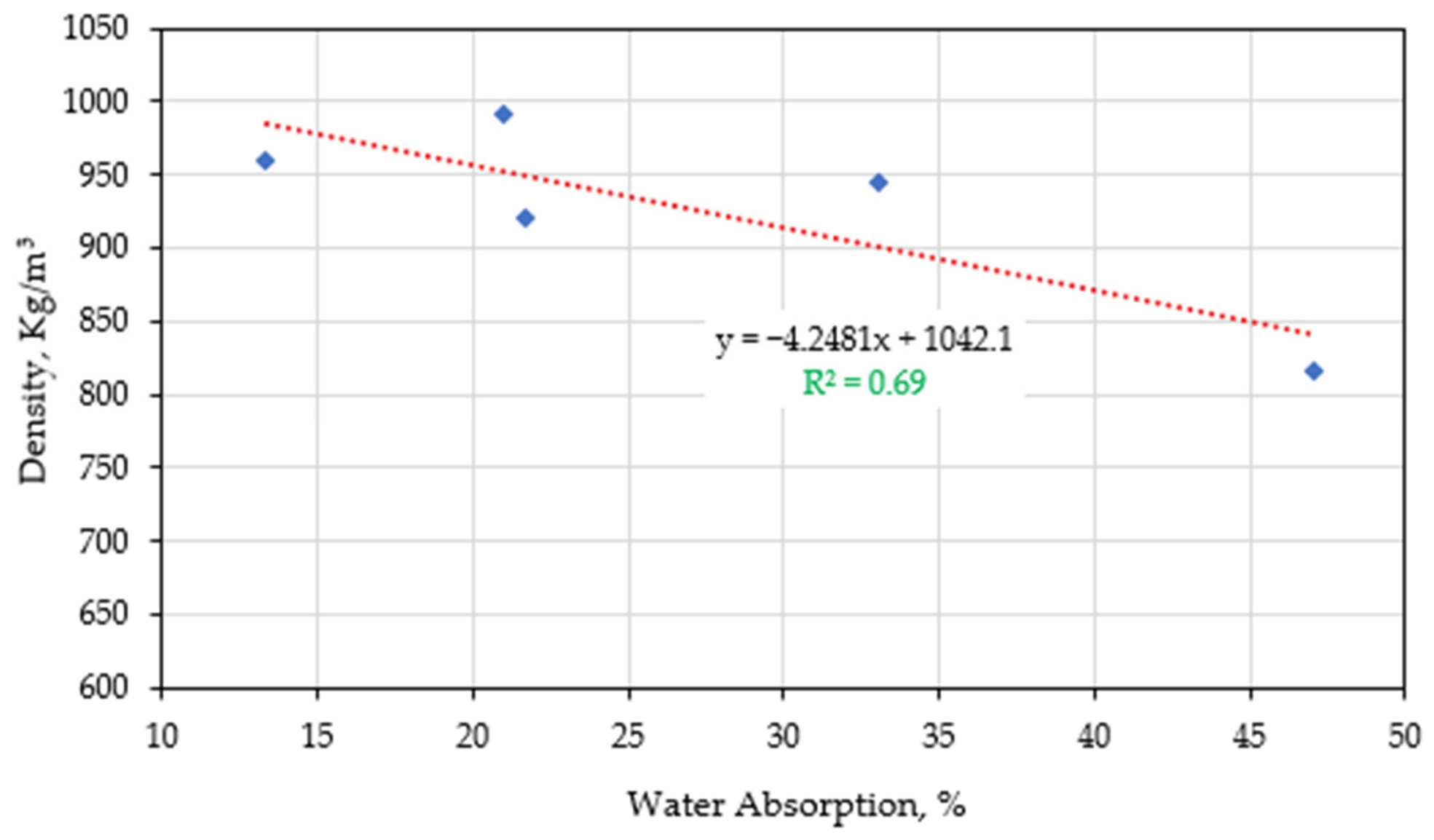
In Figure 9, the relationship between hardened density and water absorption is presented for the mixtures without SBR and PPF, while Figure 10 shows the corresponding relationship for the mixtures containing SBR and PPF. In both cases, the regression analysis indicates an inverse density–absorption relationship, with higher water absorption generally associated with lower hardened density. For the mixtures without SBR–PPF modification, the descriptive linear regression yielded a slope of −17.7 kg/m3 per 1% increase in water absorption and R2 = 0.82 (p = 0.033). For the mixtures incorporating SBR and PPF together with reduced mixing water, the slope was −4.25 kg/m3 per 1% increase in water absorption, with R2 = 0.69 (p = 0.080). Thus, at the 5% significance level, the linear association was statistically significant only for the unmodified mixtures. Because each regression is based on only five mixture-level mean values, these relationships should be regarded as exploratory. In particular, the regression for the modified mixtures is sensitive to the high water absorption value of LS-8 and should not be interpreted as robust evidence of a general linear relationship.
Figure 9.
The relationship between density and water absorption (without SBR/PPF). Blue triangles represent experimental data points, and the red dotted line represents the linear regression fit.
Figure 10.
The relationship between density and water absorption (with SBR/PPF). Blue diamonds represent experimental data points, and the red dotted line represents the linear regression fit.
This difference indicates that the combined modified mixture design is associated with a change in the density–water absorption relationship within the present dataset. Based on mechanisms reported in the literature, SBR may influence water transport, while PPF may affect void formation or compaction; however, these individual mechanisms cannot be isolated or confirmed from the present experimental design. The observed relationship is therefore interpreted at the macroscopic level only, and direct pore structure characterization would be required to establish the role of pore connectivity or other microstructural features.
This interpretation is consistent with previous studies on lightweight and polymer-modified cementitious materials, which indicate that water absorption is governed by a combination of aggregate porosity, pore structure, pore connectivity, and curing or polymer modification effects rather than by density alone [8,9,18]. Consequently, although the inverse trend observed in the present dataset is physically consistent with the literature, the moderate scatter—particularly for the modified mixtures—indicates that hardened density by itself is not sufficient to predict water absorption reliably.
It should be noted that the relationship between density and water absorption is not strictly proportional, as illustrated by the comparison between Figure 9 and Figure 10. Although density reflects the overall compactness of the matrix, pore connectivity and accessibility are more directly related to water absorption than total porosity alone. The differences observed for the modified mixtures may be associated with several mechanisms reported in the literature for polymer- and fiber-modified cementitious materials. PPF may contribute to entrapped air and localized void formation, whereas SBR may affect matrix cohesion and the continuity of water transport pathways. However, these mechanisms cannot be isolated or confirmed within the present experimental design because SBR, PPF, and mixing water content were varied simultaneously. In addition, polymer film formation, pore blocking, and fiber-induced voids were not directly characterized. These interpretations should therefore be regarded as possible mechanisms rather than experimentally demonstrated causal effects. Thus, the divergence between the density and water absorption trends indicates that the water absorption behavior of the modified mortars is not only governed by density, but also by interactions among the incorporated materials.
3.5. Limitations and Future Prospects
The results of the present study should be interpreted with the following limitations.
First, the experimental design does not permit the individual effects of SBR, PPF, and the reduction in added mixing water to be separated. These variables were changed simultaneously in the modified mixture group; therefore, differences between modified and unmodified mixtures should be interpreted as combined effects of polymer–fiber modification and water adjustment rather than as causal effects of SBR or PPF individually. Additional control mixtures containing SBR only, PPF only, and corresponding water-adjusted mixtures would be required to quantify the contribution of each variable independently.
The same continuous water-curing regime was applied to all mixtures, including those containing SBR latex. Although this ensured consistency across the experimental program, the curing regime was not specifically optimized for polymer-modified mortars. Future studies should therefore evaluate alternative moist/dry or air-curing regimes to determine their influence on polymer film development and later-age mechanical performance.
Second, the investigation focused primarily on the macroscopic fresh and hardened properties of the mortar mixtures and did not include direct microstructural or phase characterization, such as SEM/EDS, XRD, FTIR, or quantitative pore structure analysis. Consequently, explanations involving interfacial bonding, pore connectivity, polymer film formation, and fiber-induced voids are interpretations inferred from the measured macroscopic trends and previous literature rather than experimentally established microstructural findings. Direct microstructural characterization would be required to confirm these proposed mechanisms. In addition, direct chemical characterization of the LECA, expanded perlite, and crumb rubber was not performed and should be included in future studies where compositional effects are investigated.
Third, thermal conductivity was not measured experimentally but estimated using an empirical density-based correlation. The reported values should therefore be treated only as comparative density-based thermal indicators and not as experimentally validated thermal properties. The adopted correlation does not explicitly account for moisture condition, pore connectivity, aggregate-specific thermal properties, particle morphology, or the heterogeneous nature of the investigated mortar systems. In addition, the correlation was not specifically developed or validated for the lightweight rubber- and perlite-containing mortars investigated here, and the uncertainty associated with its use for these materials could not be quantified without direct thermal conductivity measurements. Direct standardized thermal conductivity measurements, including assessment under controlled moisture conditions, are required to validate the estimated values and establish actual thermal insulation performance.
Fourth, each mixture and testing condition was evaluated using three independent specimens (n = 3). Although the mean and standard deviation provide a descriptive indication of experimental variability, the limited number of replicates restricts the robustness of inferential statistical assessment and the generalization of the results. Therefore, no formal significance testing was performed for comparisons among mixture groups, and these differences are interpreted as experimental trends rather than statistically significant effects. The only inferential statistics reported are the exploratory significance tests associated with the two five-point density–water absorption regressions, which should be interpreted cautiously because of the very small regression datasets. Future studies should include a larger number of replicates and appropriate inferential statistical analyses to provide a more rigorous assessment of differences among mixture groups.
Furthermore, the present study was not aimed at the investigation of the characteristics of long-term durability such as the drying shrinkage, dimensional stability, the resistance to freezing and thawing, the resistance to chemicals and the long-term moisture behavior. A life-cycle assessment, embodied-carbon analysis, and energy assessment were not conducted. Therefore, although the investigated mixtures incorporate lightweight and recycled constituents, no conclusion regarding overall environmental superiority or sustainability can be established from the present experimental results. Consequently, the present results should not be interpreted as demonstrating suitability for a specific construction product or application. Application-specific validation would require consideration of the relevant strength criteria together with durability, moisture resistance, dimensional stability, fire performance, and experimentally measured thermal properties.
Future studies should combine mechanical and physical testing with SEM/EDS, XRD, FTIR, TG/DSC, and quantitative pore structure characterization to provide a more comprehensive understanding of the investigated mortar systems. TG/DSC analyses would provide complementary information on thermal stability, mass-loss processes, and thermal transitions, while direct thermal conductivity measurements remain necessary to establish the actual heat transfer performance of the materials. Thermal testing under controlled moisture conditions and long-term durability assessment are also recommended. Furthermore, life-cycle and environmental assessments should be made to define the potential sustainability benefits of using recycled crumb rubber and lightweight aggregates. More detailed investigations are needed to develop a sounder foundation for assessing the potential of these mortar systems in non-load-bearing lightweight applications, with thermal performance requiring separate experimental validation.
4. Conclusions
This study evaluated lightweight cement mortars incorporating lightweight expanded clay aggregate (LECA), perlite, and crumb rubber, as well as the combined effects of SBR–PPF incorporation and reduced mixing water on fresh behavior, mechanical performance, density, water absorption, and estimated thermal conductivity. The obtained results showed that the overall behavior of lightweight mortars is strongly influenced by the aggregate system and by the interaction between the aggregate particles and the cementitious matrix.
Based on the experimental results, the following conclusions can be drawn:
- All investigated mixtures exhibited oven-dry densities between 760 and 1072 kg/m3, confirming their lightweight character. The density-based correlation yielded lower estimated thermal conductivity values for the lower-density mixtures; however, these estimates do not constitute experimental evidence of improved thermal insulation performance, which requires direct thermal measurements.
- The type of lightweight aggregate significantly influenced the fresh and hardened properties of the mortars. Mixtures containing porous aggregates generally exhibited lower flowability because of increased water absorption and internal friction, whereas rubber-containing mixtures showed comparatively higher workability.
- Crumb rubber incorporation was associated with the largest reductions in compressive and flexural strength. This trend is consistent with mechanisms reported in the literature, including weaker rubber–matrix interaction, stiffness mismatch, and increased internal defects or voids; however, these microstructural mechanisms were not directly characterized in the present study.
- The mixtures incorporating SBR and PPF together with reduced added mixing water exhibited improved flexural performance and, in some LECA- and perlite-based systems, greater later-age compressive strength than their corresponding unmodified mixtures. Because SBR, PPF, and mixing water content were varied simultaneously, these differences should be interpreted as combined effects of the modified mixture design rather than as effects attributable independently to SBR or PPF.
- An inverse relationship between density and water absorption was observed for both modified and unmodified mixtures. These macroscopic trends are consistent with differences in pore accessibility and internal structure, but direct pore structure and interfacial characterization were not performed.
- Perlite-based mixtures exhibited a favorable balance between reduced density and mechanical performance within the investigated dataset. Their density-based thermal estimates also indicate potential for further thermal evaluation; however, suitability for a specific lightweight or insulation application cannot be established without application-specific strength, durability, and direct thermal performance verification.
- The results demonstrate the feasibility of producing lightweight cementitious composites incorporating recycled crumb rubber together with lightweight aggregates. However, no life-cycle assessment, embodied-carbon analysis, or energy assessment was performed; therefore, the present study does not establish overall environmental superiority or sustainability. The incorporation of recycled crumb rubber should be interpreted as a material-reuse strategy rather than as evidence of a quantified environmental benefit.
Overall, the results demonstrate that the performance of these lightweight mortar systems is governed by trade-offs between density reduction, mechanical resistance, water absorption, and the density-based thermal indicator. Aggregate selection plays a decisive role in controlling this balance, while the mixtures incorporating SBR and PPF together with reduced mixing water exhibited improvements in selected mechanical properties, particularly in LECA- and perlite-based systems, but did not fully compensate for the reductions in mechanical performance associated with high crumb rubber contents. From a practical perspective, the investigated mixtures provide different performance profiles that may warrant further evaluation for potential non-load-bearing lightweight applications. Their suitability for specific construction uses must, however, be established against the relevant requirements for mechanical strength, durability, moisture resistance, dimensional stability, fire performance, and directly measured thermal properties. Nevertheless, the thermal conductivity values reported in this study were estimated from density-based correlations rather than measured experimentally. Future research should therefore include direct thermal conductivity measurements and further investigate durability, microstructural characteristics, and optimized aggregate–polymer–fiber combinations to establish more comprehensive performance-based criteria for these lightweight cementitious materials.
Author Contributions
Conceptualization, H.A.A.-H., M.S.W., L.M.R.M. and M.N.A.; methodology, L.M.R.M., M.N.A., A.D. and H.A.S.P.; software, H.A.A.-H. and M.S.W.; validation, A.D., H.A.S.P. and L.F.A.B.; formal analysis, H.A.A.-H., M.S.W. and L.M.R.M.; investigation, A.D., H.A.S.P. and L.F.A.B.; resources, H.A.A.-H., H.A.S.P. and L.F.A.B.; data curation, H.A.A.-H. and M.S.W.; writing—original draft preparation, H.A.A.-H., M.S.W., L.M.R.M., M.N.A., A.D., L.F.A.B., H.A.S.P. and V.M.P.C.; writing—review and editing, H.A.A.-H., M.S.W., L.M.R.M., M.N.A., A.D., L.F.A.B., H.A.S.P. and V.M.P.C.; supervision, A.D., L.F.A.B., H.A.S.P. and V.M.P.C.; project administration, A.D. and L.F.A.B.; funding acquisition, L.F.A.B., H.A.S.P. and V.M.P.C. All authors have read and agreed to the published version of the manuscript.
Funding
The authors acknowledge support from the GeoBioTec Research Unit, through the strategic project UID/04035/2025 (https://doi.org/10.54499/UID/04035/2025), funded by the Fundação para a Ciência e a Tecnologia, IP/MCTES through national funds (PIDDAC). Funding for the period 2025-2029.
Institutional Review Board Statement
Not applicable.
Informed Consent Statement
Not applicable.
Data Availability Statement
The original contributions presented in the study are included in the article, further inquiries can be directed to the corresponding authors.
Acknowledgments
The authors express sincere gratitude for the support received from Kerbala University in Iraq.
Conflicts of Interest
The authors declare no conflicts of interest.
References
- Awoyera, P.O.; Adesina, A. Plastic Wastes to Construction Products: Status, Limitations and Future Perspective. Case Stud. Constr. Mater. 2020, 12, e00330. [Google Scholar] [CrossRef] [Scilit]
- Thomas, B.S.; Gupta, R.C. A Comprehensive Review on the Applications of Waste Tire Rubber in Cement Concrete. Renew. Sustain. Energy Rev. 2016, 54, 1323–1333. [Google Scholar] [CrossRef] [Scilit]
- Harris, S.; Mata, É.; Lucena, A.F.P.; Bertoldi, P. Climate Mitigation from Circular and Sharing Economy in the Buildings Sector. Resour. Conserv. Recycl. 2023, 188, 106709. [Google Scholar] [CrossRef] [Scilit]
- Uysal, O.; Uslu, İ.; Aktaş, C.B.; Chang, B.; Yaman, İ.Ö. Physical and Mechanical Properties of Lightweight Expanded Clay Aggregate Concrete. Buildings 2024, 14, 1871. [Google Scholar] [CrossRef] [Scilit]
- Almeida, V.G.d.O.; Farias, K.R.; Souza, V.A.; Melo, F.M.C.d.; Oliveira, H.A.d.; Pimenta, A.S.; Khan, S.; Melo, R.R.d. Influence of Laminated Expanded Clay Proportion on Mortar Properties. J. Compos. Sci. 2025, 9, 309. [Google Scholar] [CrossRef] [Scilit]
- Whwah, M.S.; Al-Hussainy, H.A.; Dulaimi, A.; Bernardo, L.F.A.; Ribeiro, T.P. Investigation of the Effects of Water-to-Cement Ratios on Concrete with Varying Fine Expanded Perlite Aggregate Content. J. Compos. Sci. 2025, 9, 390. [Google Scholar] [CrossRef] [Scilit]
- Petrella, A.; Notarnicola, M. Lightweight Cement Conglomerates Based on End-of-Life Tire Rubber: Effect of the Grain Size, Dosage and Addition of Perlite on the Physical and Mechanical Properties. Materials 2021, 14, 225. [Google Scholar] [CrossRef] [Scilit] [PubMed]
- Domagała, L.; Podolska, A. Effect of Lightweight Aggregate Impregnation on Selected Concrete Properties. Materials 2022, 15, 198. [Google Scholar] [CrossRef] [Scilit] [PubMed]
- Lanzón, M.; García-Ruiz, P.A. Lightweight Cement Mortars: Advantages and Inconveniences of Expanded Perlite and Its Influence on Fresh and Hardened State and Durability. Constr. Build. Mater. 2008, 22, 1798–1806. [Google Scholar] [CrossRef] [Scilit]
- Rashad, A.M. A Comprehensive Overview about Recycling Rubber as Fine Aggregate Replacement in Traditional Cementitious Materials. Int. J. Sustain. Built Environ. 2016, 5, 46–82. [Google Scholar] [CrossRef] [Scilit]
- Pongsopha, P.; Sukontasukkul, P.; Zhang, H.; Limkatanyu, S. Thermal and Acoustic Properties of Sustainable Structural Lightweight Aggregate Rubberized Concrete. Results Eng. 2022, 13, 100333. [Google Scholar] [CrossRef] [Scilit]
- Kilani, A.J.; Ikotun, B.D.; Abdulwahab, R. Production of Sustainable Mortar with Sodium Hydroxide Treated Rubber Crumb. Iran. J. Sci. Technol.-Trans. Civ. Eng. 2025, 49, 5497–5521. [Google Scholar] [CrossRef] [Scilit]
- Ghone, M.O.; Long, G.; Yang, K.; Ma, X.; Islam, N. Toughness Improvement of Low Strength Ceramsite Lightweight Concrete by Polypropylene Fiber and Recycled Rubber Particle. Constr. Build. Mater. 2024, 422, 135716. [Google Scholar] [CrossRef] [Scilit]
- Peng, Y.; Zhao, G.; Qi, Y.; Zeng, Q. In-Situ Assessment of the Water-Penetration Resistance of Polymer Modified Cement Mortars by μ-XCT, SEM and EDS. Cem. Concr. Compos. 2020, 114, 103821. [Google Scholar] [CrossRef] [Scilit]
- Li, J.J.; Niu, J.G.; Wan, C.J.; Jin, B.; Yin, Y.L. Investigation on Mechanical Properties and Microstructure of High Performance Polypropylene Fiber Reinforced Lightweight Aggregate Concrete. Constr. Build. Mater. 2016, 118, 27–35. [Google Scholar] [CrossRef] [Scilit]
- Feng, H.; Gao, D.Y.; Yuan, J.S. The Mechanical Properties of Polypropylene Fiber Reinforced Polymer Modified Cement Mortar. Appl. Mech. Mater. 2013, 438–439, 283–289. [Google Scholar] [CrossRef] [Scilit]
- Abdulrahman, P.I.; Bzeni, D.K. Bond Strength Evaluation of Polymer Modified Cement Mortar Incorporated with Polypropylene Fibers. Case Stud. Constr. Mater. 2022, 17, e01387. [Google Scholar] [CrossRef] [Scilit]
- Ramli, M.; Tabassi, A.A.; Hoe, K.W. Porosity, Pore Structure and Water Absorption of Polymer-Modified Mortars: An Experimental Study under Different Curing Conditions. Compos. Part B Eng. 2013, 55, 221–233. [Google Scholar] [CrossRef] [Scilit]
- Zhang, Y.; Sun, X. An Investigation of the Hybrid Effect of Pre-Absorbed Lightweight Aggregate and Basalt-Polypropylene Fiber on Concrete Performance. Constr. Build. Mater. 2023, 408, 133626. [Google Scholar] [CrossRef] [Scilit]
- Idrees, M.; Saeed, F.; Amin, A.; Hussain, T. Improvement in Compressive Strength of Styrene-Butadiene-Rubber (SBR) Modified Mortars by Using Powder Form and Nanoparticles. J. Build. Eng. 2021, 44, 102651. [Google Scholar] [CrossRef] [Scilit]
- Kligys, M.; Girskas, G. Styrene–Butadiene Rubber Latex Modified Mortars Prepared with High Early Strength Portland Cement. Materials 2024, 17, 6000. [Google Scholar] [CrossRef] [Scilit] [PubMed]
- Xia, Z.; Geng, J.; Zhou, Z.; Liu, G. Comparative Analysis of Polypropylene, Basalt, and Steel Fibers in 3D Printed Concrete: Effects on Flowability, Printability, Rheology, and Mechanical Performance. Constr. Build. Mater. 2025, 465, 140098. [Google Scholar] [CrossRef] [Scilit]
- Arvizu-Montes, A.; Guerrero-Bustamante, O.; Polo-Mendoza, R.; Martinez-Echevarria, M.J. Mechanical Performance of Fiber-Reinforced Cement Mortars: A Comparative Study on the Effect of Synthetic and Natural Fibers. Buildings 2025, 15, 2352. [Google Scholar] [CrossRef] [Scilit]
- IQS 5-2019; Portland Cement, the Central Agency for Standardization and Quality Control. Iraqi Standard Specification: Baghdad, Iraq, 2019. Available online: https://www.scribd.com/document/698968605/IQS-5-2019 (accessed on 7 April 2026).
- Jadooe, A.; Whwah, M.S.; Al-Hussainy, H.A.; Kaishesh, A.J.; Pinto, H.A.S.; Bernardo, L.F.A.; Dulaimi, A. Effects of Silica Fume, Perlite, and Polypropylene Fibers on the Mechanical Properties of Lightweight Polystyrene Concrete Composite. J. Compos. Sci. 2026, 10, 124. [Google Scholar] [CrossRef] [Scilit]
- ASTM C1437-20; Standard Test Method for Flow of Hydraulic Cement Mortar. ASTM International: West Conshohocken, PA, USA, 2020. [CrossRef] [Scilit]
- ASTM C642; Standard Test Method for Density, Absorption, and Voids in Hardened Concrete. ASTM International: West Conshohocken, PA, USA, 1969. Available online: https://www.astm.org/c0642-21.html (accessed on 26 June 2026).
- BS EN 12390-3; Testing Hardened Concrete—Part 3: Compressive Strength of Test Specimens. British Standards Institution: London, UK, 2019. Available online: https://standards.globalspec.com/std/13376131/bs-en-12390-3 (accessed on 23 June 2026).
- ASTM C78; Standard Test Method for Flexural Strength of Concrete (Using Simple Beam with Third-Point Loading). ASTM International: West Conshohocken, PA, USA, 1930. Available online: https://www.astm.org/c0078-09.html (accessed on 16 June 2026).
- ASTM C192/C192M-26; Standard Practice for Making and Curing Concrete Test Specimens in the Laboratory. ASTM International: West Conshohocken, PA, USA, 2026. Available online: https://webstore.ansi.org/standards/astm/astmc192c192m26 (accessed on 16 July 2026).
- Kilani, A.J.; Ikotun, B.D.; Abdulwahab, R. Abdulwahab, Effect of Crumb Rubber on Concrete’s and Mortar’s Structural Properties: A Review. Iran. J. Sci. Technol.-Trans. Civ. Eng. 2025, 49, 1037–1067. [Google Scholar] [CrossRef] [Scilit]
- Mehta, P.K.; Monteiro, P.J. Concrete: Microstructure, Properties, and Materials. 2014. Available online: https://www.scirp.org/reference/referencespapers?referenceid=2942456 (accessed on 18 May 2026).
- Moolchandani, K.; Sharma, A. State-of-the-Art Review on the Influence of Crumb Rubber on the Strength, Durability, and Morphological Properties of Concrete. Sci. Eng. Compos. Mater. 2025, 32, 20250060. [Google Scholar] [CrossRef] [Scilit]
- Chen, H.; Li, D.; Ma, X.; Zhong, Z.; Abd-Elaal, E.S. Strength Reduction of Crumb Rubber Concrete: Microstructures and Mesoscale Modelling. Int. J. Mech. Sci. 2026, 309, 111026. [Google Scholar] [CrossRef] [Scilit]
- Ghoniem, A.; Aboul Nour, L. Experimental Investigation into the Properties of Crumb Rubberized Concrete Incorporating Corrugated Round Steel Fibers. Arch. Civ. Mech. Eng. 2024, 24, 100. [Google Scholar] [CrossRef] [Scilit]
- Abdo, A.; El-Sisi, A.; El Sayed, S.; Hassan, H.; Ahmed, S. Properties and Stress-Strain Curve of Rubberized Concrete Cast with Uncoated or Pre-Coated Rubber with Cement/Waste Materials. Case Stud. Constr. Mater. 2024, 20, e03226. [Google Scholar] [CrossRef] [Scilit]
- Elbaz, Y.; Mwafy, A.; El-Hassan, H.; El-Maaddawy, T. Advancements in Characterization and Potential Structural Seismic Performance of Alkali-Activated Concrete Incorporating Crumb Rubber: A State-of-the-Art Review. Sustainability 2025, 17, 6043. [Google Scholar] [CrossRef] [Scilit]
- Shen, D.; Yu, Y.; Jin, Z.; Li, N. Effects of Crumb Rubber Particles on the Evolution of Pore Structure in Steam-Cured Concrete under Freeze-Thaw Cycles. J. Build. Eng. 2025, 103, 112138. [Google Scholar] [CrossRef] [Scilit]
- El-Mir, A.; Fayad, T.; Assaad, J.J.; El Dandachy, M.E.; Khatib, J.; El-Hassan, H. Multi-Criteria Optimization of SBR-Modified Mortar Incorporating Polyethylene Terephthalate Waste. Case Stud. Constr. Mater. 2024, 20, e03295. [Google Scholar] [CrossRef] [Scilit]
- Chatveera, B.; Ejaz, A.; Sua-Iam, G.; Hanif, M.A.; Gadagamma, C.K.; Maskey, P.M.; Hussain, Q.; Chaimahawan, P. Workability of Sustainable Cement Sand Mortar Made with Waste Fine Aggregates. Eng. Technol. Appl. Sci. Res. 2025, 15, 28674–28679. [Google Scholar] [CrossRef] [Scilit]
- Kang, J.; Liu, Y.; Yuan, J.; Chen, C.; Wang, L.; Yu, Z. Effectiveness of Surface Treatment on Rubber Particles towards Compressive Strength of Rubber Concrete: A Numerical Study on Rubber-Cement Interface. Constr. Build. Mater. 2022, 350, 128820. [Google Scholar] [CrossRef] [Scilit]
- Asadi, I.; Shafigh, P.; Abu Hassan, Z.F.B.; Mahyuddin, N.B. Thermal Conductivity of Concrete—A Review. J. Build. Eng. 2018, 20, 81–93. [Google Scholar] [CrossRef] [Scilit]
- Kurpińska, M.; Karwacki, J.; Maurin, A.; Kin, M. Measurements of Thermal Conductivity of LWC Cement Composites Using Simplified Laboratory Scale Method. Materials 2021, 14, 1351. [Google Scholar] [CrossRef] [Scilit] [PubMed]
- ASTM C177-19; Standard Test Method for Steady-State Heat Flux Measurements and Thermal Transmission Properties by Means of the Guarded-Hot-Plate Apparatus. ASTM International: West Conshohocken, PA, USA, 2019. [CrossRef] [Scilit]
- Valore, R.C. Calculations of U-Values of Hollow Masonry. Concr. Int. 1980, 2, 40–63. [Google Scholar]
- Zhao, J.; Fan, C.; Huang, G.; Guo, Y.; Arachchilage, C.B.; Gupta, R.; Liu, W.V. Machine Learning-Assisted Characterization of the Thermal Conductivity of Cement-Based Grouts for Borehole Heat Exchangers. Constr. Build. Mater. 2024, 449, 138506. [Google Scholar] [CrossRef] [Scilit]
- Jeon, D.; Yum, W.S.; Oh, J.E. Influence of Expanded Perlite and Vermiculite Pore Structures on Acoustic and Thermal Properties of Quicklime-Activated Fly Ash Composites. J. Build. Eng. 2026, 117, 114728. [Google Scholar] [CrossRef] [Scilit]
- Poonyakan, A.; Rachakornkij, M.; Wecharatana, M.; Smittakorn, W. Potential Use of Plastic Wastes for Low Thermal Conductivity Concrete. Materials 2018, 11, 1938. [Google Scholar] [CrossRef] [Scilit] [PubMed]
- Lakhiar, M.T.; Kong, S.Y.; Bai, Y.; Susilawati, S.; Zahidi, I.; Paul, S.C.; Raghunandan, M.E. Thermal and Mechanical Properties of Concrete Incorporating Silica Fume and Waste Rubber Powder. Polymers 2022, 14, 4858. [Google Scholar] [CrossRef] [Scilit] [PubMed]
- BS EN 998-1:2016; Specification for Mortar for Masonry—Part 1: Rendering and Plastering Mortar. British Standards Institution: London, UK, 2016.

Disclaimer/Publisher’s Note: The statements, opinions and data contained in all publications are solely those of the individual author(s) and contributor(s) and not of MDPI and/or the editor(s). MDPI and/or the editor(s) disclaim responsibility for any injury to people or property resulting from any ideas, methods, instructions or products referred to in the content. |
© 2026 by the authors. Licensee MDPI, Basel, Switzerland. This article is an open access article distributed under the terms and conditions of the Creative Commons Attribution (CC BY) license.